


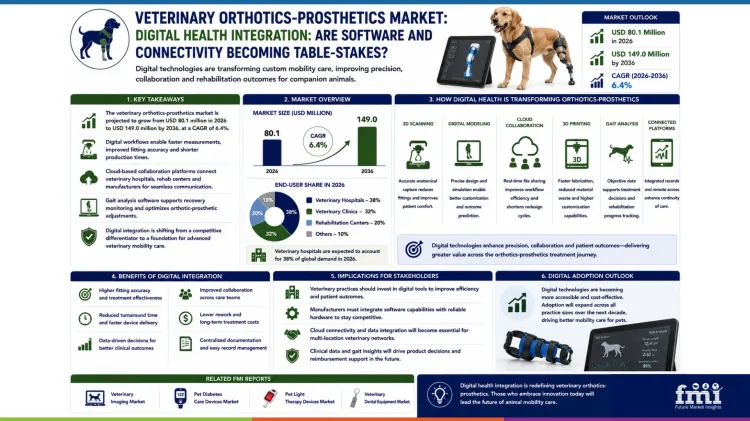
- The veterinary orthotics-prosthetics market is projected to reach USD 149.0 Million by 2036, at a CAGR of 6.4% during the forecast period. Digital design and rehabilitation technologies are increasingly becoming a part of animal mobility care.
- Digital workflows are transforming the creation of custom orthotic and prosthetic devices, allowing faster measurements, improved fitting accuracy, and shorter production times.
- Veterinary specialists are turning to 3D scanning, digital modeling and cloud-based collaboration platforms to support bespoke mobility solutions for companion animals.
- Connections between veterinary hospitals, rehabilitation centers and device manufacturers are shortening redesign cycles and improving treatment outcomes.
- Gait analysis software is a valuable tool in monitoring patient recovery and optimizing orthotic-prosthetic adjustments during rehabilitation.
- As clinical expectations rise, digital integration is moving from a competitive differentiator to a foundation for advanced veterinary mobility care.
While the physical devices are a major aspect of the veterinary orthotics-prosthetics market, a technological revolution is also underway. Traditionally, the development of orthotic braces and prosthetic limbs has been based on manual casting techniques, physical measurements and multiple fitting sessions. While these approaches remain useful, the industry is increasingly turning to digital technologies that can improve precision, efficiency and long-term patient outcomes.
As the market is expected to grow from USD 80.1 million in 2026 to USD 149.0 million by 2036, software platforms, digital imaging tools and connected rehabilitation systems are emerging as key elements of veterinary orthotics and prosthetics workflows.
That’s in large part due to the complexity of custom animal mobility solutions.
Orthotics and prosthetics, on the other hand, must accommodate a wide range of animal size, breed, anatomy, injury type and mobility needs, not to mention standardized veterinary devices. Digital technologies address these challenges, enabling highly customized device design with better repeatability than traditional approaches.
One of the most significant developments is the use of 3D scanning technology.
Increasingly, veterinary specialists are using digital scanners to create accurate anatomical measurements rather than physical molds. Digital scans mean more accuracy, fewer fittings and less discomfort for the patient. The data produced can be directly imported into computer aided design environments speeding up production workflows.
Software platforms are also transforming how stakeholders collaborate.
Orthopedic surgeons, rehab specialists, veterinary surgeons and device manufacturers can now share digital files through cloud-based systems. This connectivity allows for more efficient review, modification and approval of treatment plans than paper-based processes.
Beyond manufacturing, the benefits are extensive.
Rehabilitation has become an important part of veterinary orthotic and prosthetic treatment. Digital gait analysis systems are increasingly used to support clinical decisions, providing objective measures of mobility during the recovery. These systems help clinicians assess weight bearing, movement symmetry and functional improvement after device implementation.
This enables modifications to treatment to be based on quantifiable indicators of performance rather than simply on subjective observation.
Digital integration is also helping to drive greater use of 3D printing technologies.
Digital capture of anatomical data allows for more accurate design and manufacturing of device components. This approach reduces material waste, reduces development times and increases customization capabilities. These benefits can significantly improve the outcome of treatment for veterinary patients that require sophisticated solutions.
Connectivity is becoming equally important from an operational standpoint as well.
Veterinary hospitals and specialty rehab centers are moving toward integrated workflows to improve communication between care teams. Centralized platforms can combine digital records, imaging files, gait assessments and device specifications to improve continuity of care through the treatment process.
These capabilities are especially useful for referral-based care models.
Many orthotics and prosthetics cases require a team approach by primary veterinarians, orthopedic surgeons, rehabilitation specialists, and external device manufacturers. Digital systems facilitate the streamlining of information exchange and reduce the administrative burden.
Now, manufacturers are investing in software ecosystems, not just hardware development.
Companies that can offer digital design tools, remote consultation capabilities and connected support services are strengthening their competitive positioning. The value proposition is becoming more and more a matter of the entire treatment workflow rather than just the device.
The way in which regions adopt suggests varying levels of digital maturity.
North America and Western Europe are currently leading in the adoption of advanced digital workflows, due to better infrastructure in terms of specialty care and increased spend on companion animal healthcare. But emerging markets are adopting digital design technologies more as the cost of equipment declines and awareness grows.
The misconception to avoid is that software and connectivity are only for large veterinary institutions.
In practice, digital tools are becoming available to a broader range of practices. The adoption barriers are lowering with cloud-based platforms, portable scanners and increasingly affordable design software, opening the door for smaller clinics to participate in advanced mobility care programs.
The use of digital integration is expected to further increase in the future.
More important in treatment planning and patient management may be artificial intelligence-assisted design, predictive analytics for rehabilitation, and remote-monitoring capabilities. These technologies have the potential to increase efficiency and improve long-term mobility outcomes for animals that require orthotic or prosthetic support.
Bottom Line
With veterinary mobility care becoming more specialized and data-driven, software platforms, digital design tools and connected rehabilitation systems are emerging as cornerstones of clinical practice. Digital integration in the veterinary orthotics-prosthetics market is rapidly shifting from a value-added capability to a core expectation that will shape future competitiveness.

