


- Probiotic ingredient economics are not measured only by price per kilogram or price per billion CFU; they depend on usable viable counts through the full value chain.
- Fermentation yield, freeze-drying loss, storage stability, packaging protection, and application survival can change the real cost of a probiotic ingredient.
- FMI’s Probiotic Ingredients Market benchmark shows stable growth, but margin capture depends on suppliers proving cost-in-use advantages rather than headline potency alone.
- Dietary supplements remain the largest application, yet food and beverage use cases often create higher stability and processing burdens.
- Heat-stable, spore-forming, microencapsulated, and strain-protected systems can command premiums when they reduce overage and improve end-of-shelf-life performance.
- The misconception to avoid is that the cheapest culture is the most economical. In probiotics, the economical ingredient is the one that delivers usable viability at the intended point of use.
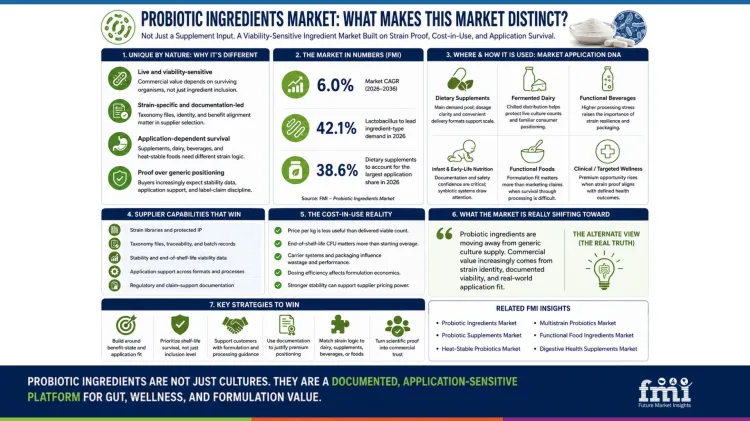
The economics of probiotic ingredients are often misunderstood. Buyers may compare suppliers by price per kilogram, declared CFU count, or headline potency. Those metrics are easy to quote, but they do not capture the real cost of using a probiotic ingredient. In a live microbial ingredient market, value depends on how many viable organisms survive production, storage, formulation, distribution, and shelf life. This is why cost-in-use is a better lens than price per billion CFU.
FMI’s Probiotic Ingredients Market shows steady growth supported by dietary supplements, functional foods, fermented dairy, beverages, and broader wellness positioning. Yet the economic challenge remains practical: probiotics lose value when viability declines. A culture that appears inexpensive at purchase can become costly if a manufacturer must add high overage, redesign packaging, shorten shelf life, use refrigerated logistics, or deal with inconsistent assay results.
The cost curve begins at fermentation. Strain productivity, media efficiency, contamination control, harvest timing, and downstream recovery all influence the cost base. Some strains grow robustly and produce high viable cell counts. Others are commercially attractive because of documented benefits but harder to cultivate efficiently. Suppliers with stronger fermentation know-how can reduce cost while maintaining strain quality. This is one reason strain ownership and process optimization are connected. A proprietary strain is more valuable when it can be produced consistently at commercial scale.
The next cost point is stabilization. Probiotic cultures are commonly dried or processed into formats that can be shipped and incorporated into finished products. Freeze-drying, spray-drying, encapsulation, carrier selection, moisture control, and oxygen protection all affect survival. If the drying process damages viability, the supplier must compensate with higher starting counts or accept weaker finished performance. If the carrier absorbs moisture or interacts poorly with the final matrix, shelf-life losses can accelerate.
Overage is the hidden economic variable. Finished-product brands often add more probiotic ingredient than the label target requires because some CFU loss is expected during shelf life. This is normal, but the size of the overage determines real cost. A strain that needs heavy overage may look cheaper at the ingredient quote stage but more expensive in the finished formula. A more stable strain or better-protected format may cost more upfront but reduce overage, complaints, failed stability tests, and reformulation risk.
Dietary supplements, the leading application in FMI’s Probiotic Ingredients Market, are economically attractive because capsules, tablets, sachets, and powders can be designed around probiotic stability. Even so, moisture, excipient compatibility, packaging, oxygen exposure, and storage conditions remain important. A capsule formula with poor desiccant strategy or a gummy format with high water activity can erode viability quickly. Ingredient suppliers that provide formulation guidance help buyers protect economics beyond the raw ingredient price.
Food and beverage applications are more complex. Functional dairy, fermented foods, juice-based drinks, shelf-stable beverages, bars, gummies, and bakery formats expose probiotics to pH, heat, oxygen, sugar systems, water activity, and processing stress. The Functional Food Ingredients Market and Fermented Food and Beverage Market are important adjacent references because they show where probiotic ingredients are being pulled into broader food systems. However, entering these formats often raises cost-in-use unless the strain and delivery system are matched carefully.
Heat-stable probiotics change the economics in certain applications. The Heat-Stable Probiotics Market points to growing demand for strains that survive processing conditions that conventional cultures cannot tolerate. These ingredients may carry a premium, but the premium can be justified if they enable shelf-stable supplements, baked goods, hot beverages, or ready-to-drink formats with lower viability loss. The value is not simply heat resistance; it is the reduction in formulation risk and overage requirements.
Microencapsulation can also change the cost equation. Encapsulation may increase ingredient cost, but it can protect cells from acid, moisture, oxygen, heat, or interactions with other ingredients. For brands, the right question is not whether encapsulation costs more. The question is whether it improves viable delivery, reduces overage, expands the application range, or supports more credible labeling. When it does, the higher ingredient cost can be economically rational.
Packaging is part of the economics even though it is not usually counted as the ingredient cost. Bottles, sachets, blister packs, foil laminates, desiccants, oxygen barriers, and refrigeration requirements can all influence total system cost. A probiotic ingredient that demands expensive packaging may be justified in premium segments but difficult to scale in value products. A stable ingredient that works with simpler packaging can create margin advantage.
Cold-chain requirements can also change the commercial equation. Some probiotic ingredients require refrigerated storage or careful temperature control during transport. That may be manageable for premium supplement brands, clinical nutrition products, and refrigerated dairy, but it can be difficult for mass-market sachets, emerging-market distribution, or e-commerce shipments exposed to heat. Suppliers that can offer room-temperature stability, better moisture protection, or clear handling windows may reduce downstream logistics cost even when the ingredient quote is higher.
Regional economics differ as well. In mature supplement markets, buyers may pay more for documented strains, branded ingredients, and strong stability data because claim credibility and consumer trust are central. In emerging markets, affordability and distribution resilience may matter more, but stability can still be decisive because heat and humidity increase viability risk. This means the best economic argument changes by geography. A premium strain may win in one market because it supports clinical positioning, while the same ingredient wins elsewhere because it survives less controlled distribution.
Procurement teams increasingly need to model probiotic ingredients as systems, not isolated inputs. The calculation should include dosage, overage, shelf-life target, storage condition, packaging, finished-product waste, re-testing, quality holds, and consumer complaint risk. When these variables are included, an ingredient that looks expensive on a purchase order can be cheaper in the finished product. Conversely, a low-priced culture can become expensive if it forces a brand to compensate throughout the value chain.
Supplier economics also depend on quality testing. Probiotic ingredient buyers need reliable CFU assays, strain identification, contaminant control, allergen documentation, and batch consistency. Failed tests can delay production and raise cost. Strong suppliers reduce this risk by providing consistent specifications and clear documentation. Weak suppliers transfer hidden costs to the customer through re-testing, rejected batches, and stability failures.
The strongest economic position belongs to suppliers that can prove usable viability across the intended route to market. This means showing not only starting potency but expected survival under realistic conditions. A supplement brand needs end-of-shelf-life evidence. A beverage brand needs pH and shelf-life data. A gummy brand needs moisture-stability data. A dairy brand needs matrix interaction data. An animal nutrition buyer needs survivability through feed processing. The same CFU claim does not mean the same economic value across all applications.
This also explains why branded probiotic ingredients can defend premium positions. A branded strain with recognizable documentation, stability guidance, and application support reduces the buyer's uncertainty. For a finished-product company, that reduction in uncertainty has economic value. It can shorten development timelines, improve retailer confidence, support premium positioning, and lower the risk of reformulation after launch.
The misconception to avoid is that the lowest quoted probiotic ingredient price equals the lowest finished-product cost. In many cases, the cheaper culture may require higher dosage, stricter storage, better packaging, or shorter shelf life. These costs are simply hidden in other parts of the system.
Bottom line: probiotic ingredient economics are viability economics. Suppliers that reduce overage, improve survival, and document end-use performance can defend premium pricing because they lower the buyer’s total cost-in-use. The market rewards ingredients that remain viable when and where they matter.
Related FMI Reports
- Probiotic Ingredients Market: Primary interlink for market scope, Lactobacillus leadership, and application demand
- Probiotic Strains Market: Use when discussing strain identity, clinical proof, and supplier differentiation
- Multistrain Probiotics Market: Use when discussing strain combinations and compatibility
- Heat-Stable Probiotics Market: Use when discussing processing tolerance and survivability
- Probiotic Supplements Market: Use when discussing supplement buyer demand and finished-product formats
- Functional Food Ingredients Market: Use when discussing functional food applications and broader ingredient demand

