

- Market Size (2026)
- USD 16.6 Bn
- Forecast (2036)
- USD 44.0 Bn
- CAGR (2026 to 2036)
- 10.2%
Scalp Scrub Market Size, Market Forecast and Outlook By FMI
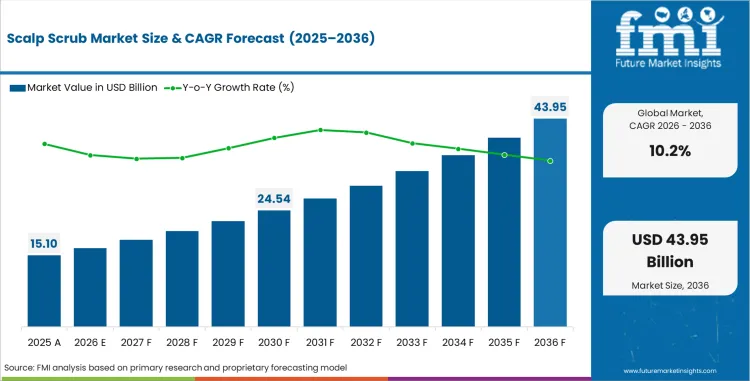
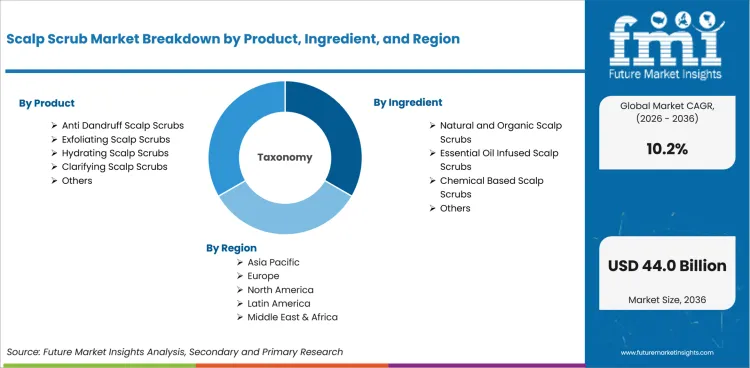
The scalp scrub market was valued at USD 15.1 billion in 2025. The market is set to reach USD 16.6 billion by 2026-end and grow at a CAGR of 10.2% between 2026-2036 to reach USD 44.0 billion by 2036. Anti Dandruff Scalp Scrubs will dominate with a 33.0% share, while Natural and Organic Scalp Scrubs will lead with a 41.0% share.
Summary of the Scalp Scrub Market
- Demand and Growth Drivers
- Growing consumer understanding that scalp health directly affects hair quality, growth rate, and overall appearance is creating demand for exfoliating scrub products that remove buildup, excess sebum, and dead skin cells.
- The expansion of scalp care from salon-exclusive professional treatments to mass retail and direct-to-consumer products is broadening market accessibility and converting scalp scrubbing from occasional to routine haircare.
- Dermatologist recommendations for scalp exfoliation as treatment for dandruff, seborrheic dermatitis, and product buildup are providing clinical credibility that supports consumer adoption across natural and medicated formulations.
- Product and Segment View
- Anti-dandruff scalp scrubs account for 33.0% of the product segment, supported by the large population of consumers seeking effective dandruff management through physical exfoliation combined with active ingredient treatment.
- By ingredient, natural and organic formulations hold 41.0% share, reflecting the clean beauty movement and consumer preference for plant-derived exfoliants including sugar, salt, and charcoal over synthetic abrasive particles.
- Hair care leads the application segment at 55.0%, confirming that scalp scrubs are primarily positioned as hair wellness products that improve hair quality through scalp health optimization.
- Geography and Competitive Outlook
- China is projected to grow at 8.1% through 2036, supported by the scale of the consumer haircare market, growing scalp health awareness, and the expansion of natural and organic personal care product availability.
- India follows at 7.9%, reflecting rising consumer education about scalp health as a foundation for hair quality and the penetration of dermatologist-recommended exfoliation products.
- Companies that combine brand credibility in haircare, formulation expertise across natural and medicated product lines, and distribution across salon, pharmacy, mass retail, and online channels are positioned to gain traction during the forecast period.
- Analyst Opinion
- The scalp scrub market is at an inflection point where the category is transitioning from a salon-professional niche to a mass consumer haircare essential. The insight driving growth is that consumers are beginning to treat scalp care with the same attention they give facial skincare, creating demand for dedicated exfoliation, treatment, and hydration products rather than relying on shampoo alone. Companies that can position scalp scrubs within broader scalp health ecosystems, including companion serums and treatments, are building higher lifetime customer value. The competitive advantage is shifting from single-product marketing to scalp care routine building that mirrors the multi-step approach that succeeded in facial skincare.
- The Scalp Scrub Market is moving from a supply driven model toward a demand responsive structure where end user requirements shape product development.
- Adoption is increasing due to evolving consumer expectations and expanding distribution channel accessibility across online and retail formats.
- Growth reflects the structural shift toward higher specification products and more informed purchasing behavior driven by online research and reviews.
- Demand is further supported by changing lifestyle preferences and growing awareness of product quality and performance differences across brands.
Key Takeaways, Market Size, and Forecast
- The Scalp Scrub market was valued at USD 15.10 billion in 2025.
- By 2036, the Scalp Scrub Market is expected to be worth USD 43.95 billion.
- From 2026 to 2036, the market is projected to expand at a CAGR of 10.2%.
- The market is projected to create an incremental opportunity of USD 27.31 billion between 2026 and 2036.
- In 2026, Anti Dandruff Scalp Scrubs is expected to account for 33.0% of the Product, driven by rising consumer awareness of scalp health as a foundation for hair quality, combined with the expansion of dermatologist-recommended exfoliation treatments into mainstream retail channels.
- China (8.1%) and India (7.9%) are two of the fastest growing markets in the world.
Scalp Scrub Market Definition
The scalp scrub market covers exfoliating products designed for scalp cleansing and treatment including anti-dandruff, hydrating, clarifying, and general exfoliating formulations. Products use natural, organic, essential oil, and chemical-based ingredients distributed through e-commerce, retail, pharmacy, and salon channels.
Scalp Scrub Market Inclusions
Market scope encompasses all commercially traded products categorized by Product (Anti Dandruff Scalp Scrubs, Exfoliating Scalp Scrubs, Hydrating Scalp Scrubs, Clarifying Scalp Scrubs, Others); Ingredient (Natural and Organic Scalp Scrubs, Essential Oil Infused Scalp Scrubs, Chemical Based Scalp Scrubs, Others); Distribution Channel (E commerce Platforms, Supermarkets and Hypermarkets, Specialty Beauty Stores, Pharmacies, Salons and Spas); End User (Residential, Professional Use); Application (Hair Care, Personal Care). Revenue estimates cover the forecast period from 2026 to 2036.
Scalp Scrub Market Exclusions
The scope does not include standard shampoos without dedicated scalp exfoliation function, prescription dermatological treatments for scalp conditions, hair styling products, or general body scrubs not formulated for scalp application.
Scalp Scrub Market Research Methodology
- Primary Research: FMI analysts conducted interviews with haircare brand product developers, dermatologists specializing in scalp conditions, salon procurement managers, and natural ingredient suppliers across key markets to validate demand patterns, pricing structures, and procurement dynamics.
- Desk Research: Research combined data from haircare industry production statistics, dermatological research publications, and beauty retail market tracking data, with cross referencing against publicly available industry databases and regulatory filings.
- Market Sizing and Forecasting: Market sizing uses a hybrid bottom up and top down approach, aggregating demand across product, ingredient, distribution channel, end user, application with regional adoption curves.
- Data Validation: Data was validated quarterly against production statistics, trade data, and manufacturer disclosures to maintain forecast accuracy.
Why is the Scalp Scrub Market Growing?
- Growing consumer recognition that scalp health is the foundation for hair quality and growth is creating demand for dedicated exfoliation products that remove buildup, excess sebum, and dead skin cells from the scalp surface.
- The transition of scalp scrubs from salon-exclusive professional treatments to mass retail and direct-to-consumer products is broadening accessibility and converting scalp exfoliation from occasional to routine haircare practice.
- China leads growth at 8.1%, supported by the scale of the consumer haircare market, growing scalp health awareness, and the expansion of natural and organic personal care product availability.
The scalp scrub market is expanding at 10.2% CAGR as consumers adopt scalp care as a distinct haircare step, mirroring the multi-step approach that transformed facial skincare over the past decade. The insight driving growth is that product buildup, excess sebum, and dead skin cells on the scalp surface restrict hair follicle function and compromise hair quality, creating demand for exfoliation products that address the root cause rather than treating symptoms through shampoo alone.
Anti-dandruff scrubs lead the product segment at 33.0% share, combining physical exfoliation with active ingredients that target the fungal causes of dandruff. Natural and organic formulations hold 41.0% of ingredient share, reflecting the clean beauty movement. E-commerce leads distribution at 38.0%, with specialty beauty stores and pharmacies serving the clinical recommendation channel. Residential consumers account for 62.0% of demand.
L'Oreal (Kerastase, Redken) holds an estimated 22.0% market share through its salon-professional heritage and multi-brand scalp care portfolio. Unilever (Head & Shoulders, Living Proof), Briogeo, and Ouai compete across mass, clinical, and clean beauty positioning. The competitive landscape is shaped by the tension between salon-professional credibility and direct-to-consumer accessibility.
Market Segmentation Analysis
- Anti Dandruff Scalp Scrubs accounts for 33.0% of the Product segment, supported by established procurement patterns and application requirements.
- Natural and Organic Scalp Scrubs holds 41.0% of the Ingredient segment, reflecting concentrated demand in core use cases.
The Scalp Scrub market is segmented by product, ingredient, distribution channel, end user, application. Demand patterns reflect the concentration of procurement in established application areas and the growing diversification of end use requirements.
Insights into the Product Segment
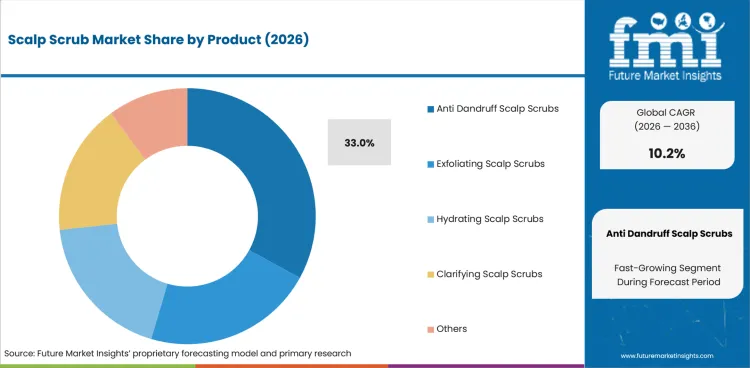
Anti-dandruff scalp scrubs account for 33.0% of the product segment, supported by the large population of consumers seeking effective dandruff management through physical exfoliation combined with active ingredient treatment.
Insights into the Ingredient Segment
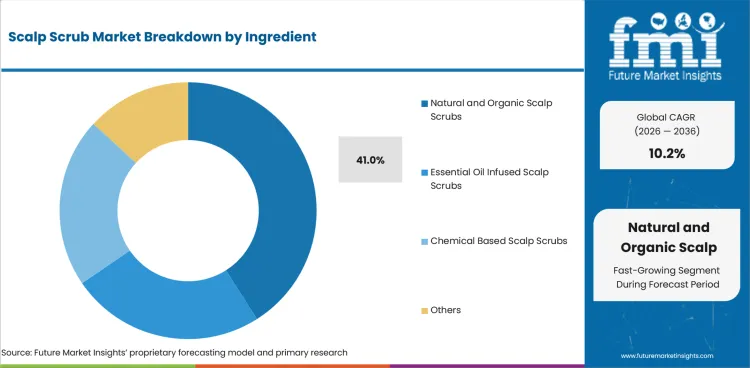
By ingredient, natural and organic formulations hold 41.0% share, reflecting the clean beauty movement and consumer preference for plant-derived exfoliants including sugar, salt, and charcoal over synthetic abrasive particles.
Scalp Scrub Market Drivers, Restraints, and Opportunities
- L'Oreal (Kerastase, Redken) holds an estimated 22.0% market share through its salon-professional heritage and multi-brand scalp care portfolio spanning professional and consumer channels.
- Unilever (Head & Shoulders, Living Proof), Briogeo, and Ouai compete across mass, clinical, and clean beauty positioning with distinct formulation and distribution strategies.
- The competitive landscape is shaped by the tension between salon-professional credibility and direct-to-consumer accessibility, with clean beauty brands disrupting traditional haircare distribution.
The Scalp Scrub market is shaped by demand drivers, supply constraints, and emerging opportunities. Growth is supported by expanding application requirements, while cost pressures and competitive dynamics influence adoption rates.
Primary Demand Drivers
Growing consumer understanding that scalp health directly affects hair quality, growth rate, and overall appearance is creating demand for exfoliating scrub products that remove buildup, excess sebum, and dead skin cells.
Supply and Cost Dynamics
The expansion of scalp care from salon-exclusive professional treatments to mass retail and direct-to-consumer products is broadening market accessibility and converting scalp scrubbing from occasional to routine haircare.
Emerging Growth Opportunities
Dermatologist recommendations for scalp exfoliation as treatment for dandruff, seborrheic dermatitis, and product buildup are providing clinical credibility that supports consumer adoption across natural and medicated formulations.
Analysis of Scalp Scrub Market By Key Countries
.webp "Top Country Growth Comparison Scalp Scrub Market Cagr (2026 2036)")
| Country | CAGR |
|---|---|
| China | 8.1% |
| India | 7.9% |
| Germany | 7.4% |
| USA | 7.3% |
| UK | 7.1% |
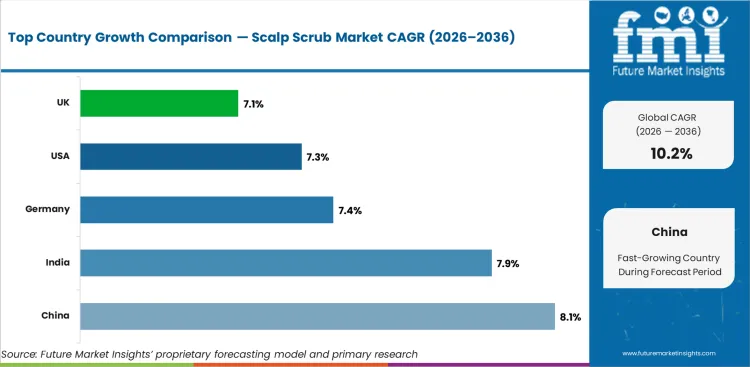
- China at 8.1%: supported by local market conditions and sector investment.
- India at 7.9%: supported by local market conditions and sector investment.
- Germany at 7.4%: supported by local market conditions and sector investment.
- USA at 7.3%: supported by local market conditions and sector investment.
The global scalp scrub market is expected to grow at a rate of 10.2% per year from 2026 to 2036. The study covers more than 30 countries, and the main markets are listed below.
Demand Outlook for Scalp Scrub Market in China
China is projected to grow at 8.1% through 2036. The scale of the consumer haircare market, growing scalp health awareness influenced by dermatologist education content on social platforms, and the rapid expansion of natural and organic personal care availability through Tmall and JD.com create the largest growth opportunity globally.
- The scale of the consumer haircare market and growing social media education about scalp health create the largest addressable market for scalp scrub products globally.
- Rapid adoption of new personal care categories through e-commerce platforms like Tmall and JD.com enables fast market penetration for scalp scrub brands.
- Consumer preference for natural and herbal ingredients in personal care aligns with scalp scrub formulations featuring traditional Chinese herbal and plant-based exfoliant ingredients.
Future Outlook for Scalp Scrub Market in India
India is projected to grow at 7.9% through 2036. Growing urban consumer awareness of scalp health, the traditional Ayurvedic heritage of herbal scalp treatments, and the expansion of natural personal care brands through online and pharmacy distribution are sustaining demand for scalp scrub products.
- Ayurvedic heritage in herbal scalp treatments creates natural consumer familiarity with scalp care concepts, supporting adoption of modern scalp scrub formulations.
- Growing urban consumer awareness of scalp health through dermatologist social media content and beauty influencer recommendations is expanding demand beyond traditional herbal treatment usage.
- Price sensitivity favors affordable natural formulations distributed through pharmacy and online channels that reach consumers outside major metropolitan beauty retail.
Opportunity Analysis of Scalp Scrub Market in Germany
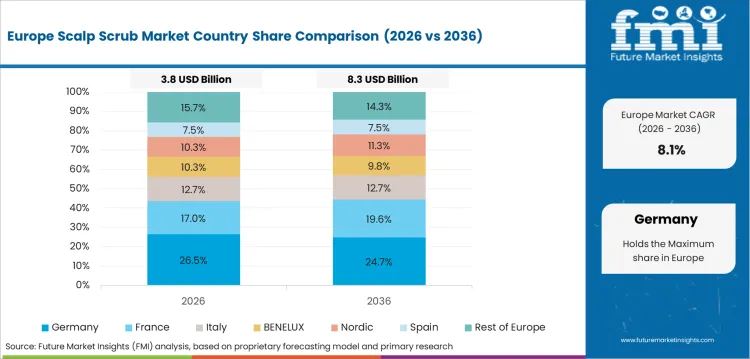
Germany is projected to grow at 7.4% through 2036. Consumer preference for dermatologically tested personal care products and the strength of pharmacy distribution for clinical scalp treatments sustain demand for scrubs with documented efficacy and ingredient safety credentials.
- Consumer preference for dermatologically tested products with documented clinical efficacy sustains demand for scalp scrubs with published safety and effectiveness data.
- Pharmacy (Apotheke) distribution provides a trusted channel for clinical scalp care products, supporting consumer confidence in product safety and efficacy claims.
- Growing awareness of scalp microbiome health and its relationship to hair quality is creating demand for specialized scrub formulations that balance exfoliation with microbiome preservation.
In-depth Analysis of Scalp Scrub Market in the United States
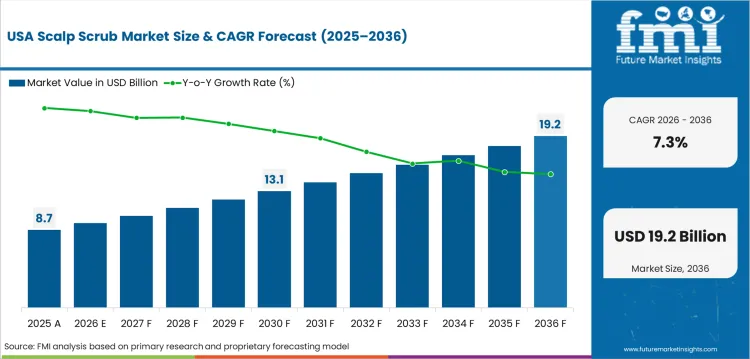
The United States is projected to grow at 7.3% through 2036. Growing consumer education through dermatologist social media content, the expansion of clean beauty brands offering scalp scrubs through Sephora, Ulta, and direct-to-consumer channels, and the influence of wellness culture on haircare routines sustain demand.
- Dermatologist social media content and skincare influencer education are accelerating consumer adoption of scalp scrubs as a distinct haircare step beyond traditional shampoo-only routines.
- Clean beauty retail expansion through Sephora, Ulta, and direct-to-consumer channels provides distribution infrastructure for scalp scrub brands targeting ingredient-conscious consumers.
- The wellness culture emphasis on holistic self-care routines is creating demand for scalp treatments positioned as part of comprehensive hair and scalp health regimens.
Sales Analysis of Scalp Scrub Market in UK
The United Kingdom is projected to grow at 7.1% through 2036. Clean beauty movement influence, growing consumer interest in scalp health as a distinct haircare category, and the expansion of both premium and affordable scalp scrub options through online and pharmacy retail sustain demand.
- Clean beauty movement influence sustains demand for scalp scrubs with natural, transparent ingredient lists distributed through online and pharmacy retail channels.
- Growing consumer interest in scalp health as a distinct category, separate from general haircare, is expanding the market beyond dandruff-specific treatment to routine scalp maintenance.
- Salon-to-retail product transition is creating consumer awareness of professional-grade scalp scrubs now available through direct-to-consumer and beauty retail distribution.
Competitive Landscape and Strategic Positioning
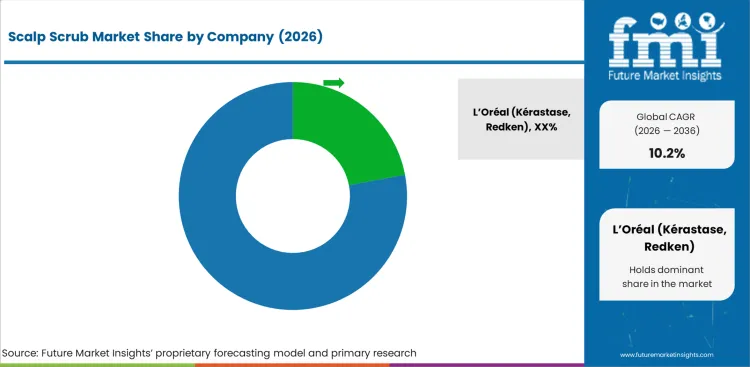
- L'Oreal (Kerastase, Redken) holds an estimated 22.0% market share through its salon-professional heritage and multi-brand scalp care portfolio spanning professional and consumer channels.
- Unilever (Head & Shoulders, Living Proof), Briogeo, and Ouai compete across mass, clinical, and clean beauty positioning with distinct formulation and distribution strategies.
- The competitive landscape is shaped by the tension between salon-professional credibility and direct-to-consumer accessibility, with clean beauty brands disrupting traditional haircare distribution.
L'Oreal holds an estimated 22.0% market share through Kerastase scalp scrub products in the salon-professional channel and Redken formulations for broader retail distribution, leveraging its R&D investment in scalp science.
Unilever competes through Head & Shoulders clinical positioning and Living Proof technology-driven formulations. Briogeo targets the clean beauty consumer. Ouai serves the lifestyle-driven haircare consumer through direct-to-consumer and Sephora distribution.
The competitive landscape reflects the scalp care category's maturation path from salon-professional niche to mass consumer category, with brands at different stages of this transition competing for consumer attention and shelf space.
Key Companies in the Scalp Scrub Market
Key global companies leading the scalp scrub market include:
- L’Oréal (Kérastase, Redken), Unilever (Head & Shoulders, Living Proof), Briogeo, Ouai hold established positions through product portfolios, brand recognition, and distribution relationships.
- Christophe Robin, Virtue Labs, dpHUE are specialized players focusing on differentiation and niche positioning.
- Act+Acre, Gisou represent emerging participants with growth potential.
Competitive Benchmarking: Scalp Scrub Market
| Company | Formulation Science | Salon Credibility | Mass Distribution | Clean Beauty Position |
|---|---|---|---|---|
| L'Oreal (Kerastase, Redken) | Strong | Strong | Strong | Moderate |
| Unilever (Head & Shoulders) | Strong | Moderate | Strong | Low |
| Briogeo | Strong | Moderate | Moderate | Strong |
| Ouai | Moderate | Low | Moderate | Strong |
Source: Future Market Insights competitive analysis, 2026.
Key Developments in Scalp Scrub Market
- In 2025, L'Oreal launched a new Kerastase scalp scrub with microbiome-balancing technology targeting consumers with scalp sensitivity and reactivity concerns.
- In 2025, Briogeo expanded its Scalp Revival line with a new charcoal and tea tree formulation for consumers seeking deep cleansing without synthetic sulfates.
Key Players in the Scalp Scrub Market
Major Global Players
- L’Oréal (Kérastase, Redken)
- Unilever (Head & Shoulders, Living Proof)
- Briogeo
- Ouai
Emerging Players/Startups
- Christophe Robin
- Virtue Labs
- dpHUE
- Act+Acre
- Gisou
Report Scope and Coverage
| Parameter | Details |
|---|---|
| Quantitative Units | USD 16.64 Billion to USD 43.95 Billion, at a CAGR of 10.2% |
| Market Definition | The scalp scrub market covers exfoliating products designed for scalp cleansing and treatment including anti-dandruff, hydrating, clarifying, and general exfoliating formulations. |
| Regions Covered | North America, Latin America, Europe, East Asia, South Asia and Pacific, Middle East and Africa |
| Countries Covered | China, India, Germany, USA, UK, 30 plus countries |
| Key Companies Profiled | L’Oréal (Kérastase, Redken), Unilever (Head & Shoulders, Living Proof), Briogeo, Ouai |
| Forecast Period | 2026 to 2036 |
| Approach | Hybrid bottom up and top down methodology starting with verified transaction data, projecting adoption velocity across segments and regions. |
Market Segmentation Analysis
Scalp Scrub Market Segmented by Product:
-
- Anti Dandruff Scalp Scrubs
- Zinc Based Scrubs
- Medicated Scalp Scrubs
- Exfoliating Scalp Scrubs
- Salt Based Scrubs
- Sugar Based Scrubs
- Hydrating Scalp Scrubs
- Moisturizing Scrubs
- Aloe Based Scrubs
- Clarifying Scalp Scrubs
- Deep Clean Scrubs
- Detox Scalp Scrubs
- Others
- Herbal Blends
- Custom Formulations
- Anti Dandruff Scalp Scrubs
Scalp Scrub Market Segmented by Ingredient:
-
- Natural and Organic Scalp Scrubs
- Plant Extract Based
- Herbal Infused Formulas
- Essential Oil Infused Scalp Scrubs
- Tea Tree Oil Based
- Lavender Oil Based
- Chemical Based Scalp Scrubs
- Sulfate Based Formulas
- Synthetic Cleansing Agents
- Others
- Hybrid Formulations
- Enzyme Based Scrubs
- Natural and Organic Scalp Scrubs
Scalp Scrub Market Segmented by Distribution Channel:
-
- E commerce Platforms
- Marketplace Platforms
- Direct Brand Websites
- Supermarkets and Hypermarkets
- Large Retail Chains
- Mass Merchandisers
- Specialty Beauty Stores
- Cosmetic Stores
- Premium Beauty Outlets
- Pharmacies
- Retail Pharmacies
- Dermatology Clinics
- Salons and Spas
- Professional Salons
- Hair Treatment Centers
- E commerce Platforms
Scalp Scrub Market Segmented by End User:
-
- Residential
- Home Care Users
- Personal Grooming Users
- Professional Use
- Salons
- Trichology Clinics
- Residential
Scalp Scrub Market Segmented by Application:
-
- Hair Care
- Scalp Treatment
- Hair Growth Care
- Personal Care
- Routine Grooming
- Therapeutic Care
- Hair Care
Scalp Scrub Market by Region:
- North America
- USA
- Canada
- Mexico
- Latin America
- Brazil
- Chile
- Rest of Latin America
- Western Europe
- Germany
- UK
- Italy
- Spain
- France
- Nordic
- BENELUX
- Rest of Western Europe
- Eastern Europe
- Russia
- Poland
- Hungary
- Balkan & Baltic
- Rest of Eastern Europe
- East Asia
- China
- Japan
- South Korea
- South Asia and Pacific
- India
- ASEAN
- Australia & New Zealand
- Rest of South Asia and Pacific
- Middle East & Africa
- Kingdom of Saudi Arabia
- Other GCC Countries
- Turkiye
- South Africa
- Other African Union
- Rest of Middle East & Africa
Research Sources and Bibliography
- 1. American Academy of Dermatology. (2024). AAD Guidelines for Scalp Care and Exfoliation. AAD.
- 2. International Federation of Societies of Cosmetic Chemists. (2025). IFSCC Scalp Care Formulation Report. IFSCC.
- 3. L'Oreal. (2025). Annual Report 2024: Professional Products Division. L'Oreal.
- 4. Euromonitor International. (2025). Global Haircare Market Data. Euromonitor.
- 5. World Health Organization. (2025). WHO Skin and Hair Health Report. WHO.
This bibliography is provided for reader reference. The full Future Market Insights report contains the complete reference list with publication dates, URLs, and supporting data for all cited works.
This Report Answers
- Estimating the size of the market and revenue from 2026 to 2036.
- Segmentation by product, ingredient, distribution channel, end user, application.
- Insights about more than 30 markets in the region.
- Analysis of trends shaping the market.
- Assessment of the competitive landscape.
- Finding investment opportunities across key application areas.
- Supply chain and procurement pattern tracking.
- Delivery of data in PDF and Excel formats.
Frequently Asked Questions
How big is the scalp scrub market in 2026?
The global scalp scrub market is estimated to be valued at USD 16.6 billion in 2026.
What will be the size of scalp scrub market in 2036?
The market size for the scalp scrub market is projected to reach USD 44.0 billion by 2036.
How much will be the scalp scrub market growth between 2026 and 2036?
The scalp scrub market is expected to grow at a 10.2% CAGR between 2026 and 2036.
What are the key product in the scalp scrub market?
The key product in scalp scrub market are anti dandruff scalp scrubs, zinc based scrubs, medicated scalp scrubs, exfoliating scalp scrubs, salt based scrubs, sugar based scrubs, hydrating scalp scrubs, moisturizing scrubs, aloe based scrubs, clarifying scalp scrubs, deep clean scrubs, detox scalp scrubs, others, herbal blends and custom formulations.
Which ingredient segment is expected to contribute significant share in the scalp scrub market in 2026?
In terms of ingredient, natural and organic scalp scrubs segment is expected to command 41.0% share in the scalp scrub market in 2026.
Preview the report firsthand - request a free sample
Get SampleGet the brochure for pricing and purchase details.
Get PDFTable of Content
- Executive Summary
- Global Market Outlook
- Demand-side Trends
- Supply-side Trends
- Technology Roadmap Analysis
- Analysis and Recommendations
- Market Overview
- Market Coverage / Taxonomy
- Market Definition / Scope / Limitations
- Research Methodology
- Chapter Orientation
- Analytical Lens and Working Hypotheses
- Market Structure, Signals, and Trend Drivers
- Benchmarking and Cross-market Comparability
- Market Sizing, Forecasting, and Opportunity Mapping
- Research Design and Evidence Framework
- Desk Research Programme (Secondary Evidence)
- Company Annual and Sustainability Reports
- Peer-reviewed Journals and Academic Literature
- Corporate Websites, Product Literature, and Technical Notes
- Earnings Decks and Investor Briefings
- Statutory Filings and Regulatory Disclosures
- Technical White Papers and Standards Notes
- Trade Journals, Industry Magazines, and Analyst Briefs
- Conference Proceedings, Webinars, and Seminar Materials
- Government Statistics Portals and Public Data Releases
- Press Releases and Reputable Media Coverage
- Specialist Newsletters and Curated Briefings
- Sector Databases and Reference Repositories
- FMI Internal Proprietary Databases and Historical Market Datasets
- Subscription Datasets and Paid Sources
- Social Channels, Communities, and Digital Listening Inputs
- Additional Desk Sources
- Expert Input and Fieldwork (Primary Evidence)
- Primary Modes
- Qualitative Interviews and Expert Elicitation
- Quantitative Surveys and Structured Data Capture
- Blended Approach
- Why Primary Evidence is Used
- Field Techniques
- Interviews
- Surveys
- Focus Groups
- Observational and In-context Research
- Social and Community Interactions
- Stakeholder Universe Engaged
- C-suite Leaders
- Board Members
- Presidents and Vice Presidents
- R&D and Innovation Heads
- Technical Specialists
- Domain Subject-matter Experts
- Scientists
- Physicians and Other Healthcare Professionals
- Governance, Ethics, and Data Stewardship
- Research Ethics
- Data Integrity and Handling
- Primary Modes
- Tooling, Models, and Reference Databases
- Desk Research Programme (Secondary Evidence)
- Data Engineering and Model Build
- Data Acquisition and Ingestion
- Cleaning, Normalisation, and Verification
- Synthesis, Triangulation, and Analysis
- Quality Assurance and Audit Trail
- Market Background
- Market Dynamics
- Drivers
- Restraints
- Opportunity
- Trends
- Scenario Forecast
- Demand in Optimistic Scenario
- Demand in Likely Scenario
- Demand in Conservative Scenario
- Opportunity Map Analysis
- Product Life Cycle Analysis
- Supply Chain Analysis
- Investment Feasibility Matrix
- Value Chain Analysis
- PESTLE and Porter’s Analysis
- Regulatory Landscape
- Regional Parent Market Outlook
- Production and Consumption Statistics
- Import and Export Statistics
- Market Dynamics
- Global Market Analysis 2021 to 2025 and Forecast, 2026 to 2036
- Historical Market Size Value (USD Million) Analysis, 2021 to 2025
- Current and Future Market Size Value (USD Million) Projections, 2026 to 2036
- Y-o-Y Growth Trend Analysis
- Absolute $ Opportunity Analysis
- Global Market Pricing Analysis 2021 to 2025 and Forecast 2026 to 2036
- Global Market Analysis 2021 to 2025 and Forecast 2026 to 2036, By Product
- Introduction / Key Findings
- Historical Market Size Value (USD Million) Analysis By Product , 2021 to 2025
- Current and Future Market Size Value (USD Million) Analysis and Forecast By Product , 2026 to 2036
- Anti Dandruff Scalp Scrubs
- Zinc Based Scrubs
- Medicated Scalp Scrubs
- Exfoliating Scalp Scrubs
- Salt Based Scrubs
- Sugar Based Scrubs
- Hydrating Scalp Scrubs
- Moisturizing Scrubs
- Aloe Based Scrubs
- Clarifying Scalp Scrubs
- Anti Dandruff Scalp Scrubs
- Y-o-Y Growth Trend Analysis By Product , 2021 to 2025
- Absolute $ Opportunity Analysis By Product , 2026 to 2036
- Global Market Analysis 2021 to 2025 and Forecast 2026 to 2036, By Ingredient
- Introduction / Key Findings
- Historical Market Size Value (USD Million) Analysis By Ingredient, 2021 to 2025
- Current and Future Market Size Value (USD Million) Analysis and Forecast By Ingredient, 2026 to 2036
- Natural and Organic Scalp Scrubs
- Plant Extract Based
- Herbal Infused Formulas
- Essential Oil Infused Scalp Scrubs
- Tea Tree Oil Based
- Lavender Oil Based
- Chemical Based Scalp Scrubs
- Sulfate Based Formulas
- Synthetic Cleansing Agents
- Others
- Natural and Organic Scalp Scrubs
- Y-o-Y Growth Trend Analysis By Ingredient, 2021 to 2025
- Absolute $ Opportunity Analysis By Ingredient, 2026 to 2036
- Global Market Analysis 2021 to 2025 and Forecast 2026 to 2036, By Distribution Channel
- Introduction / Key Findings
- Historical Market Size Value (USD Million) Analysis By Distribution Channel, 2021 to 2025
- Current and Future Market Size Value (USD Million) Analysis and Forecast By Distribution Channel, 2026 to 2036
- E commerce Platforms
- Marketplace Platforms
- Direct Brand Websites
- Supermarkets and Hypermarkets
- Large Retail Chains
- Mass Merchandisers
- Specialty Beauty Stores
- Cosmetic Stores
- Premium Beauty Outlets
- Pharmacies
- E commerce Platforms
- Y-o-Y Growth Trend Analysis By Distribution Channel, 2021 to 2025
- Absolute $ Opportunity Analysis By Distribution Channel, 2026 to 2036
- Global Market Analysis 2021 to 2025 and Forecast 2026 to 2036, By End User
- Introduction / Key Findings
- Historical Market Size Value (USD Million) Analysis By End User, 2021 to 2025
- Current and Future Market Size Value (USD Million) Analysis and Forecast By End User, 2026 to 2036
- Residential
- Home Care Users
- Personal Grooming Users
- Professional Use
- Salons
- Trichology Clinics
- Residential
- Y-o-Y Growth Trend Analysis By End User, 2021 to 2025
- Absolute $ Opportunity Analysis By End User, 2026 to 2036
- Global Market Analysis 2021 to 2025 and Forecast 2026 to 2036, By Application
- Introduction / Key Findings
- Historical Market Size Value (USD Million) Analysis By Application, 2021 to 2025
- Current and Future Market Size Value (USD Million) Analysis and Forecast By Application, 2026 to 2036
- Hair Care
- Scalp Treatment
- Hair Growth Care
- Personal Care
- Routine Grooming
- Therapeutic Care
- Hair Care
- Y-o-Y Growth Trend Analysis By Application, 2021 to 2025
- Absolute $ Opportunity Analysis By Application, 2026 to 2036
- Global Market Analysis 2021 to 2025 and Forecast 2026 to 2036, By Region
- Introduction
- Historical Market Size Value (USD Million) Analysis By Region, 2021 to 2025
- Current Market Size Value (USD Million) Analysis and Forecast By Region, 2026 to 2036
- North America
- Latin America
- Western Europe
- Eastern Europe
- East Asia
- South Asia and Pacific
- Middle East & Africa
- Market Attractiveness Analysis By Region
- North America Market Analysis 2021 to 2025 and Forecast 2026 to 2036, By Country
- Historical Market Size Value (USD Million) Trend Analysis By Market Taxonomy, 2021 to 2025
- Market Size Value (USD Million) Forecast By Market Taxonomy, 2026 to 2036
- By Country
- USA
- Canada
- Mexico
- By Product
- By Ingredient
- By Distribution Channel
- By End User
- By Application
- By Country
- Market Attractiveness Analysis
- By Country
- By Product
- By Ingredient
- By Distribution Channel
- By End User
- By Application
- Key Takeaways
- Latin America Market Analysis 2021 to 2025 and Forecast 2026 to 2036, By Country
- Historical Market Size Value (USD Million) Trend Analysis By Market Taxonomy, 2021 to 2025
- Market Size Value (USD Million) Forecast By Market Taxonomy, 2026 to 2036
- By Country
- Brazil
- Chile
- Rest of Latin America
- By Product
- By Ingredient
- By Distribution Channel
- By End User
- By Application
- By Country
- Market Attractiveness Analysis
- By Country
- By Product
- By Ingredient
- By Distribution Channel
- By End User
- By Application
- Key Takeaways
- Western Europe Market Analysis 2021 to 2025 and Forecast 2026 to 2036, By Country
- Historical Market Size Value (USD Million) Trend Analysis By Market Taxonomy, 2021 to 2025
- Market Size Value (USD Million) Forecast By Market Taxonomy, 2026 to 2036
- By Country
- Germany
- UK
- Italy
- Spain
- France
- Nordic
- BENELUX
- Rest of Western Europe
- By Product
- By Ingredient
- By Distribution Channel
- By End User
- By Application
- By Country
- Market Attractiveness Analysis
- By Country
- By Product
- By Ingredient
- By Distribution Channel
- By End User
- By Application
- Key Takeaways
- Eastern Europe Market Analysis 2021 to 2025 and Forecast 2026 to 2036, By Country
- Historical Market Size Value (USD Million) Trend Analysis By Market Taxonomy, 2021 to 2025
- Market Size Value (USD Million) Forecast By Market Taxonomy, 2026 to 2036
- By Country
- Russia
- Poland
- Hungary
- Balkan & Baltic
- Rest of Eastern Europe
- By Product
- By Ingredient
- By Distribution Channel
- By End User
- By Application
- By Country
- Market Attractiveness Analysis
- By Country
- By Product
- By Ingredient
- By Distribution Channel
- By End User
- By Application
- Key Takeaways
- East Asia Market Analysis 2021 to 2025 and Forecast 2026 to 2036, By Country
- Historical Market Size Value (USD Million) Trend Analysis By Market Taxonomy, 2021 to 2025
- Market Size Value (USD Million) Forecast By Market Taxonomy, 2026 to 2036
- By Country
- China
- Japan
- South Korea
- By Product
- By Ingredient
- By Distribution Channel
- By End User
- By Application
- By Country
- Market Attractiveness Analysis
- By Country
- By Product
- By Ingredient
- By Distribution Channel
- By End User
- By Application
- Key Takeaways
- South Asia and Pacific Market Analysis 2021 to 2025 and Forecast 2026 to 2036, By Country
- Historical Market Size Value (USD Million) Trend Analysis By Market Taxonomy, 2021 to 2025
- Market Size Value (USD Million) Forecast By Market Taxonomy, 2026 to 2036
- By Country
- India
- ASEAN
- Australia & New Zealand
- Rest of South Asia and Pacific
- By Product
- By Ingredient
- By Distribution Channel
- By End User
- By Application
- By Country
- Market Attractiveness Analysis
- By Country
- By Product
- By Ingredient
- By Distribution Channel
- By End User
- By Application
- Key Takeaways
- Middle East & Africa Market Analysis 2021 to 2025 and Forecast 2026 to 2036, By Country
- Historical Market Size Value (USD Million) Trend Analysis By Market Taxonomy, 2021 to 2025
- Market Size Value (USD Million) Forecast By Market Taxonomy, 2026 to 2036
- By Country
- Kingdom of Saudi Arabia
- Other GCC Countries
- Turkiye
- South Africa
- Other African Union
- Rest of Middle East & Africa
- By Product
- By Ingredient
- By Distribution Channel
- By End User
- By Application
- By Country
- Market Attractiveness Analysis
- By Country
- By Product
- By Ingredient
- By Distribution Channel
- By End User
- By Application
- Key Takeaways
- Key Countries Market Analysis
- USA
- Pricing Analysis
- Market Share Analysis, 2025
- By Product
- By Ingredient
- By Distribution Channel
- By End User
- By Application
- Canada
- Pricing Analysis
- Market Share Analysis, 2025
- By Product
- By Ingredient
- By Distribution Channel
- By End User
- By Application
- Mexico
- Pricing Analysis
- Market Share Analysis, 2025
- By Product
- By Ingredient
- By Distribution Channel
- By End User
- By Application
- Brazil
- Pricing Analysis
- Market Share Analysis, 2025
- By Product
- By Ingredient
- By Distribution Channel
- By End User
- By Application
- Chile
- Pricing Analysis
- Market Share Analysis, 2025
- By Product
- By Ingredient
- By Distribution Channel
- By End User
- By Application
- Germany
- Pricing Analysis
- Market Share Analysis, 2025
- By Product
- By Ingredient
- By Distribution Channel
- By End User
- By Application
- UK
- Pricing Analysis
- Market Share Analysis, 2025
- By Product
- By Ingredient
- By Distribution Channel
- By End User
- By Application
- Italy
- Pricing Analysis
- Market Share Analysis, 2025
- By Product
- By Ingredient
- By Distribution Channel
- By End User
- By Application
- Spain
- Pricing Analysis
- Market Share Analysis, 2025
- By Product
- By Ingredient
- By Distribution Channel
- By End User
- By Application
- France
- Pricing Analysis
- Market Share Analysis, 2025
- By Product
- By Ingredient
- By Distribution Channel
- By End User
- By Application
- India
- Pricing Analysis
- Market Share Analysis, 2025
- By Product
- By Ingredient
- By Distribution Channel
- By End User
- By Application
- ASEAN
- Pricing Analysis
- Market Share Analysis, 2025
- By Product
- By Ingredient
- By Distribution Channel
- By End User
- By Application
- Australia & New Zealand
- Pricing Analysis
- Market Share Analysis, 2025
- By Product
- By Ingredient
- By Distribution Channel
- By End User
- By Application
- China
- Pricing Analysis
- Market Share Analysis, 2025
- By Product
- By Ingredient
- By Distribution Channel
- By End User
- By Application
- Japan
- Pricing Analysis
- Market Share Analysis, 2025
- By Product
- By Ingredient
- By Distribution Channel
- By End User
- By Application
- South Korea
- Pricing Analysis
- Market Share Analysis, 2025
- By Product
- By Ingredient
- By Distribution Channel
- By End User
- By Application
- Russia
- Pricing Analysis
- Market Share Analysis, 2025
- By Product
- By Ingredient
- By Distribution Channel
- By End User
- By Application
- Poland
- Pricing Analysis
- Market Share Analysis, 2025
- By Product
- By Ingredient
- By Distribution Channel
- By End User
- By Application
- Hungary
- Pricing Analysis
- Market Share Analysis, 2025
- By Product
- By Ingredient
- By Distribution Channel
- By End User
- By Application
- Kingdom of Saudi Arabia
- Pricing Analysis
- Market Share Analysis, 2025
- By Product
- By Ingredient
- By Distribution Channel
- By End User
- By Application
- Turkiye
- Pricing Analysis
- Market Share Analysis, 2025
- By Product
- By Ingredient
- By Distribution Channel
- By End User
- By Application
- South Africa
- Pricing Analysis
- Market Share Analysis, 2025
- By Product
- By Ingredient
- By Distribution Channel
- By End User
- By Application
- USA
- Market Structure Analysis
- Competition Dashboard
- Competition Benchmarking
- Market Share Analysis of Top Players
- By Regional
- By Product
- By Ingredient
- By Distribution Channel
- By End User
- By Application
- Competition Analysis
- Competition Deep Dive
- L’Oréal (Kérastase, Redken)
- Overview
- Product Portfolio
- Profitability by Market Segments (Product/Age /Sales Channel/Region)
- Sales Footprint
- Strategy Overview
- Marketing Strategy
- Product Strategy
- Channel Strategy
- Unilever (Head & Shoulders, Living Proof)
- Briogeo
- Ouai
- Other Companies (combined)
- L’Oréal (Kérastase, Redken)
- Competition Deep Dive
- Assumptions & Acronyms Used


