

- Industry Size (2026)
- USD 32.0 billion
- Forecast (2036)
- USD 60.6 billion
- CAGR (2026 to 2036)
- 6.6%
Ship Repair and Maintenance Service Market Forecast and Outlook 2026 to 2036
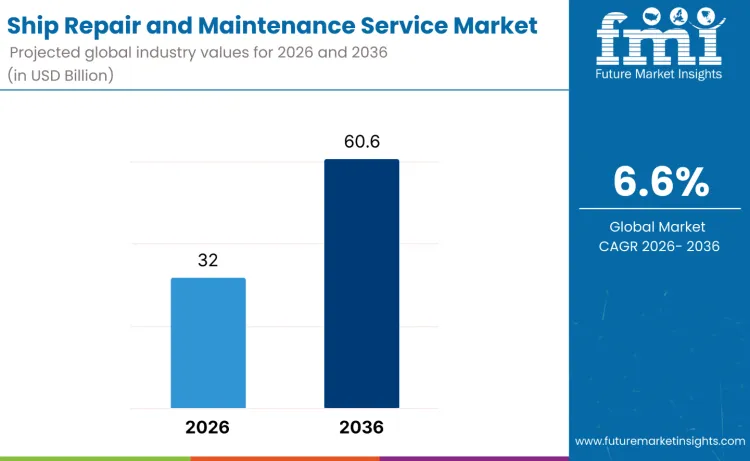
The ship repair and maintenance service market, valued at USD 32.0 billion in 2026 and forecast to reach USD 60.6 billion by 2036 at a CAGR of 6.6%, is gaining momentum as global trade volumes, offshore activities, and naval modernization programs expand. With fleets aging and regulatory scrutiny intensifying, ship operators are prioritizing lifecycle management over costly new builds. Repair yards, dry docks, and specialized service providers benefit from recurring demand for hull overhauls, engine maintenance, retrofitting, corrosion protection, and routine inspections.
A major growth catalyst comes from tightening environmental and safety regulations, including emissions standards and ballast-water treatment norms. These requirements drive upgrades such as scrubbers, fuel-efficiency enhancements, hybrid propulsion solutions, and digital monitoring systems. Ports and service hubs across Asia Pacific, the Middle East, and Europe are expanding capacity to capture increasing regional repair activity.
Quick Stats for Ship Repair and Maintenance Service Market
- Ship Repair and Maintenance Service Market Value (2026): USD 32.0 billion
- Ship Repair and Maintenance Service Market Forecast Value (2036): USD 60.6 billion
- Ship Repair and Maintenance Service Market Forecast CAGR: 6.6%
- Leading Vessel Type in Ship Repair and Maintenance Service Market: Container ships
- Key Growth Regions in Ship Repair and Maintenance Service Market: East Asia and South Asia Pacific
- Top Players in Ship Repair and Maintenance Service Market: Damen Shipyards Group, Sembcorp Industries Ltd., Cochin Shipyard Limited, China State Shipbuilding Corporation (CSSC), Fincantieri S.p.A., Dae Sun Shipbuilding & Engineering Co. Ltd., HD Hyundai Heavy Industries, Arab Shipbuilding and Repair Yard Company, Dormac Ship Repairs, Alexandria Shipyard
Key Takeaways, Market Size, and Forecast
| Metric | Value |
|---|---|
| Market Size (2026) | USD 32.0 Billion |
| Market Size (2036) | USD 60.6 Billion |
| CAGR (2026–2036) | 6.6% |
| Leading Vessel | Container Ships |
| Container Ships Share | ~40% |
| Leading Service Type | General Services |
| General Services Share | ~35% |
Technology is reshaping operations. Predictive maintenance using IoT sensors, drones for hull inspections, robotics for underwater repairs, and digital twins improve turnaround times while lowering risk and cost. Scheduled, data-driven maintenance plans help shipowners minimize downtime and extend vessel lifespans.
Growth spans container ships, bulk carriers, tankers, offshore vessels, ferries, and naval fleets. Key challenges include high yard modernization costs, volatile raw-material prices, skilled labor constraints, and geopolitical disruptions that alter routing and service schedules.
Ship Repair and Maintenance Service Market Key Takeaways
| Metric | Value |
|---|---|
| Market Value (2026) | USD 32.0 billion |
| Market Forecast Value (2036) | USD 60.6 billion |
| Forecast CAGR (2026 to 2036) | 6.6% |
How Is the Ship Repair and Maintenance Service Market Segmented?
The ship repair and maintenance service market is segmented by vessel type, service type, and region, reflecting how different fleets require unique maintenance strategies and technical support. By vessel type, the industry includes container ships, bulk carriers, oil and chemical tankers, general cargo vessels, gas carriers, offshore vessels, passenger ships and ferries, and mega yachts and specialty vessels. Each category has distinct repair requirements driven by engine configuration, cargo handling systems, operational hours, and exposure to harsh marine environments. By service type, the industry is divided into general services, dockage, hull part, engine parts, electric works, and auxiliary services. These services encompass routine inspections, heavy structural repairs, propulsion system upgrades, and electrical control diagnostics essential to sustaining vessel compliance and safety readiness. Regionally, the industry spans North America, Latin America, Western and Eastern Europe, East Asia, South Asia Pacific, and the Middle East and Africa, where repair activity closely follows global trade density, shipyard availability, and regulatory enforcement conditions.
Which Vessel Type Represents the Largest Share of Global Demand?
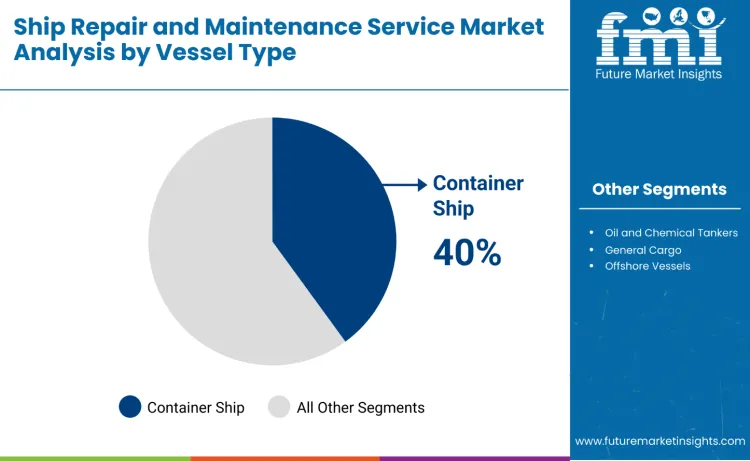
Container ships represent the largest vessel category within the ship repair and maintenance service market, accounting for 40% of global demand. Their dominance is tied to the central role container vessels play in global logistics, operating on continuous long-haul trade lanes that require frequent inspection, hull preservation, equipment servicing, and periodic retrofits. Because downtime directly disrupts supply chain continuity, operators of container fleets prioritize proactive maintenance strategies, contract-based service plans, and dockyard partnerships to minimize operational disruption. Bulk carriers, tankers, and other cargo vessels contribute significant additional demand, but container vessels consistently generate higher maintenance intensity due to continuous utilization and tight delivery schedules.
Which Service Type Accounts for the Largest Market Share?
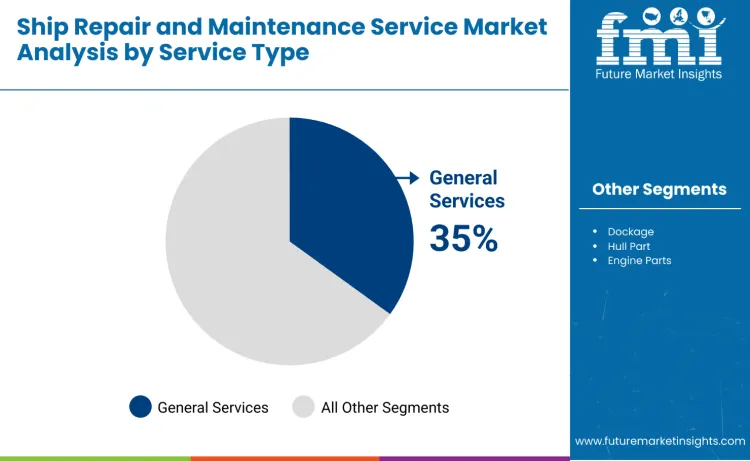
General services represent the largest service category in the ship repair and maintenance service market, accounting for 35% of activity. This segment encompasses routine upkeep, surface treatment, cleaning, basic mechanical repair, repainting, inspections, and scheduled dock visits that ensure vessels remain compliant with class and regulatory requirements. Because these activities are conducted regularly across all fleet types, they form the backbone of shipyard workloads worldwide. More intensive segments such as hull reconstruction, propulsion system overhaul, and advanced electrical upgrades complement general servicing but occur less frequently and require specialized drydock infrastructure, engineering expertise, and extended vessel layup periods.
What Drivers Are Supporting Growth in the Ship Repair and Maintenance Service Market?
Growth in the ship repair and maintenance service market is propelled by continual expansion in global seaborne trade, which increases the operating burden on fleets and creates sustained maintenance cycles. Aging vessel fleets further amplify service demand as structural fatigue, corrosion, and mechanical wear intensify with longer operating lives. Stricter environmental and safety regulations compel operators to upgrade equipment, modify engines, and install emission control technologies, increasing the scope of service projects. Advances in coating systems, welding techniques, and diagnostic technologies reduce downtime and support longer maintenance intervals, making professional service providers essential partners in fleet optimization strategies.
What Restraints Limit Market Expansion?
Market growth is constrained by cost volatility, regulatory variability, and rising technical complexity across ship fleets. Increasing prices for steel, coatings, skilled labor, and specialized components elevate repair budgets and often delay project approvals from vessel owners who prioritize cost control. Differing international maritime regulations add further pressure, as shipyards operating across multiple jurisdictions must maintain separate compliance systems and documentation processes. Older vessels introduce engineering challenges during major refits, requiring customized fabrication, structural reinforcement, and extended docking periods. Shortages of experienced marine technicians in several regions limit available capacity, creating scheduling backlogs during peak seasons and slowing service throughput and turnaround across global shipyard networks.
What Key Trends Are Shaping the Ship Repair and Maintenance Service Market?
Several trends are reshaping the ship repair and maintenance service market. Asian shipyards, particularly in China, India, and Southeast Asia, are expanding capabilities and capturing a rising share of global repair contracts due to cost advantages and increasing yard capacity. Digitalization is becoming embedded in maintenance programs, with predictive analytics, remote monitoring tools, and digital service records enabling better planning and failure prevention. Fleet operators increasingly favor multi-year service agreements that combine inspection, mechanical work, and retrofitting into a coordinated service strategy. The industry is watching evolving ship technologies and future propulsion systems, which may gradually change repair requirements and require continual upskilling among service providers.
How will the Ship Repair and Maintenance Service Market evolve between 2026 and 2036?
The Ship Repair and Maintenance Service Market is expanding as vessel owners prioritize lifecycle optimization, regulatory readiness, and uptime reliability. Increasing global shipping volumes require regular dry-docking, hull treatment, engine overhauls, and inspection services to maintain operational efficiency. Environmental compliance upgrades, including ballast water treatment systems and emission-control retrofits, are creating strong recurring demand. Digital diagnostics, predictive maintenance systems, and remote inspection tools are reducing service cycles while improving accuracy. Naval modernization and offshore energy projects further increase maintenance intensity. Although high labor costs and shipyard capacity constraints remain challenges, preventive service strategies are replacing reactive repair models. From 2026 to 2036, the industry will grow steadily as fleets age, operational standards tighten, and shipowners invest consistently in structured repair programs that extend vessel service life and reduce costly breakdown risks.
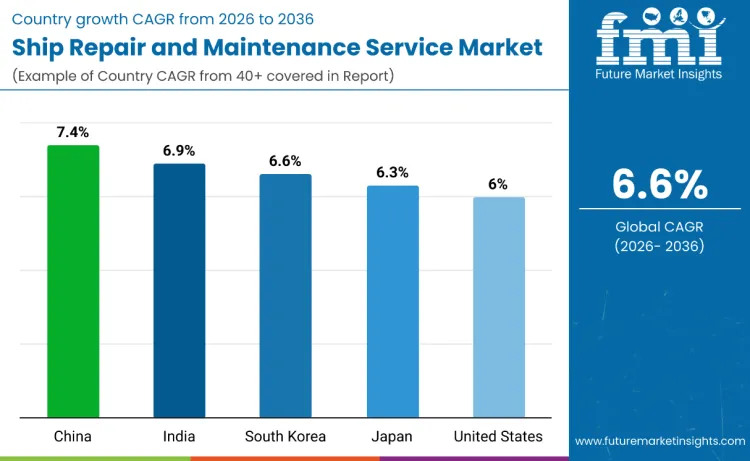
| Country | CAGR |
|---|---|
| China | 7.4% |
| India | 6.9% |
| South Korea | 6.6% |
| Japan | 6.3% |
| United States | 6.0% |
How is China strengthening dominance in the Ship Repair and Maintenance Service Market?
China leads the Ship Repair and Maintenance Service Market thanks to large shipyards, extensive dry-dock capacity, and government-supported fleet modernization policies. Major service hubs in Shanghai, Guangdong, and Shandong handle structural repair, hull treatment, propulsion upgrades, and regulatory retrofits for domestic and international fleets. Strong integration between shipyards, component suppliers, and specialized maintenance firms enables fast turnaround and cost-efficient service delivery. Digital inspection, automated blasting, and quality-control platforms are increasingly embedded across repair processes. From 2026 to 2036, China’s Ship Repair and Maintenance Service Market is projected to grow at a 7.4% CAGR, driven by expanding merchant fleets, rising retrofit demand, and continuous investments that enhance repair scope, capacity, and technology sophistication across commercial yards and contracted service facilities.
Why is India emerging as a high-growth hub in the Ship Repair and Maintenance Service Market?
India is rapidly scaling capacity in the Ship Repair and Maintenance Service Market as port upgrades and shipyard modernization programs expand repair capabilities. Facilities in Mumbai, Kochi, Chennai, and Kolkata are adding dry-docks, workshops, and marine engineering services to support hull repairs, machinery refurbishments, and regulatory inspections. Government incentives encourage local maintenance activity, reducing the need for vessels to travel abroad for servicing. Indian operators are deploying corrosion-control solutions, condition-monitoring tools, and Planned Maintenance Systems to improve reliability and cost control. From 2026 to 2036, India’s Ship Repair and Maintenance Service Market is expected to grow at a 6.9% CAGR, supported by increasing vessel calls, competitive service pricing, and national initiatives that promote domestic repair ecosystems aligned with international maritime safety and compliance standards.
How is South Korea sustaining regional strength in the Ship Repair and Maintenance Service Market?
South Korea’s Ship Repair and Maintenance Service Market benefits from its advanced shipbuilding heritage and strong engineering capabilities. Major yards in Busan, Ulsan, and Geoje provide specialized repairs, propulsion upgrades, LNG system servicing, and digital inspection integration. Korean service providers emphasize precision workmanship, documentation accuracy, and regulatory conformity, making them preferred partners for complex fleet upgrades. Retrofit activity linked to emissions reduction and performance optimization remains strong. From 2026 to 2036, South Korea’s Ship Repair and Maintenance Service Market is projected to expand at a 6.6% CAGR, driven by demand for high-specification maintenance services, lifecycle support programs for commercial vessels, and partnerships that integrate real-time data monitoring with scheduled dockside repairs to minimize operational disruption.
How is Japan strengthening competitiveness in the Ship Repair and Maintenance Service Market?
Japan focuses on reliability-driven servicing, performance optimization, and advanced technology deployment within the Ship Repair and Maintenance Service Market. Shipyards in Tokyo Bay, Yokohama, Nagasaki, and Hiroshima manage engine upgrades, hull conditioning, and digital inspection programs targeted at improving vessel efficiency and lifespan. National modernization policies encourage investment in automated diagnostics and specialized workforce training. Although some yards face integration and cost challenges, collaboration with international service firms supports capability expansion. From 2026 to 2036, Japan’s Ship Repair and Maintenance Service Market is expected to grow at a 6.3% CAGR, supported by rising demand for structured maintenance planning, compliance upgrades, and high-quality service delivery across merchant and regional fleets operating on busy Pacific trade lanes.
What enables the United States to maintain technology leadership in the Ship Repair and Maintenance Service Market?
The United States leads technologically in the Ship Repair and Maintenance Service Market through advanced digital diagnostics, automation-supported servicing, and strong naval and commercial maintenance programs. Major facilities across the Gulf Coast, West Coast, and East Coast handle structural repairs, propulsion retrofits, cybersecurity-integrated systems, and emissions-control upgrades. Collaboration between shipyards, defense contractors, and technology firms accelerates modernization cycles and improves service precision. Regulatory requirements drive scheduled inspections and lifecycle maintenance planning. From 2026 to 2036, the USA Ship Repair and Maintenance Service Market is expected to grow at a 6.0% CAGR, supported by modernization of commercial fleets, continued naval servicing demand, and increasing reliance on data-driven maintenance programs that enhance safety, uptime, and compliance performance.
How Are Companies Competing and Building Advantage in the Ship Repair and Maintenance Service Market?
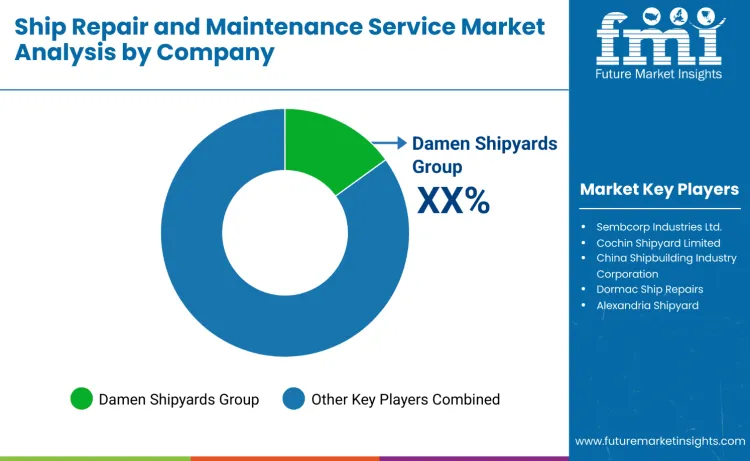
The ship repair and maintenance service market is defined by growing reliance on professional fleet support to ensure vessel availability, regulatory compliance, and operational safety. In the ship repair and maintenance service market, customers seek partners that can manage complex overhaul work, routine maintenance cycles, and emergency repairs with minimal disruption to shipping schedules. Competitive positioning is shaped by technical capability, service reliability, and long standing maritime relationships instead of price driven rivalry alone.
In the ship repair and maintenance service market, Damen Shipyards Group, China State Shipbuilding Corporation (CSSC), and Sembcorp Industries hold leading influence through comprehensive service portfolios and wide facility access. Their strategies in the ship repair and maintenance service market emphasize lifecycle partnerships, engineering strength, and the ability to handle diverse vessel classes from commercial fleets to offshore units.
Challengers such as Fincantieri and Cochin Shipyard create momentum in the ship repair and maintenance service market through specialized maintenance programs and strong footholds in key maritime regions. Their position in the ship repair and maintenance service market is reinforced by regional customer proximity and tailored project execution.
Technology specialists including Hyundai Mipo Dockyards, Dae Sun Shipbuilding & Engineering, and Arab Shipbuilding and Repair Yard focus on advanced repair technologies and vessel specific customization. Their contributions to the ship repair and maintenance service market center on precision engineering, digital planning tools, and performance focused refit capabilities.
Regional players and emerging providers expand competitiveness in the ship repair and maintenance service market by offering responsive service models, localized compliance expertise, and flexible maintenance packages. Port proximity and familiarity with national maritime rules give these companies distinct advantages when serving coastal shipping operators and offshore service fleets.
Across the ship repair and maintenance service market, success increasingly relies on integrating digital diagnostics, predictive maintenance platforms, and continuous technical support. Companies that combine engineering expertise with strong customer partnerships are best positioned to improve fleet reliability, extend vessel life cycles, and strengthen long term presence in the ship repair and maintenance service market.
Key Players in the Ship Repair and Maintenance Service Market
- Damen Shipyards Group
- Sembcorp Industries Ltd.
- Cochin Shipyard Limited
- China State Shipbuilding Corporation (CSSC)
- Fincantieri S.p.A.
- Dae Sun Shipbuilding & Engineering Co. Ltd.
- HD Hyundai Heavy Industries
- Arab Shipbuilding and Repair Yard Company
- Dormac Ship Repairs
- Alexandria Shipyard
Scope of Report
| Items | Values |
|---|---|
| Quantitative Units | USD Billion |
| Vessel Type | Oil and Chemical Tankers, Bulk Carriers, General Cargo, Container Ships, Gas Carriers, Offshore Vessels, Passenger Ships and Ferries, Mega Yachts and Other Vessels |
| Service | General Services, Dockage, Hull Part, Engine Parts, Electric Works, Auxiliary Services |
| Regions Covered | North America, Latin America, Western Europe, Eastern Europe, East Asia, South Asia Pacific, Middle East & Africa |
| Country Covered | China, India, South Korea, Japan, United States, and 40+ countries |
| Key Companies Profiled | Damen Shipyards Group, Sembcorp Industries Ltd., Cochin Shipyard Limited, China State Shipbuilding Corporation (CSSC), Fincantieri S.p.A., Dae Sun Shipbuilding & Engineering Co. Ltd., HD Hyundai Heavy Industries, Arab Shipbuilding and Repair Yard Company, Dormac Ship Repairs, Alexandria Shipyard |
| Additional Attributes | Dollar sales by vessel type and service categories, detailed regional adoption patterns across Asia-Pacific and emerging maritime hubs, benchmarking of repair facilities and dock capacities, competitive mapping of independent and integrated service yards, analysis of regulatory compliance costs, evaluation of digital diagnostics and predictive maintenance platforms, and insights into lifecycle service models improving turnaround time, cost efficiency, and vessel availability. |
Ship Repair and Maintenance Service Market by Segments
Vessel Type:
- Oil and Chemical Tankers
- Bulk Carriers
- General Cargo
- Container Ships
- Gas Carriers
- Offshore Vessels
- Passenger Ships and Ferries
- Mega Yachts and Other Vessels
Service:
- General Services
- Dockage
- Hull Part
- Engine Parts
- Electric Works
- Auxiliary Services
Region:
- North America
- United States
- Canada
- Mexico
- Latin America
- Brazil
- Chile
- Rest of Latin America
- Western Europe
- Germany
- United Kingdom
- France
- Italy
- Spain
- Nordic
- BENELUX
- Rest of Western Europe
- Eastern Europe
- Russia
- Poland
- Rest of Eastern Europe
- East Asia
- China
- Japan
- South Korea
- South Asia Pacific
- India
- Australia and New Zealand
- ASEAN
- Rest of South Asia Pacific
- Middle East and Africa
- Kingdom of Saudi Arabia
- Other GCC Countries
- Turkey
- South Africa
- Other African Union
- Rest of Middle East and Africa
Bibliography
- International Maritime Organization. (2023). 2023 IMO Strategy on Reduction of GHG Emissions from Ships. International Maritime Organization.
- European Union. (2023). Regulation (EU) 2023/1805 on the use of renewable and low-carbon fuels in maritime transport (FuelEU Maritime). EUR-Lex.
- European Maritime Safety Agency. (2023). Consolidated Annual Activity Report 2023. European Maritime Safety Agency.
- International Association of Classification Societies. (2024). IACS Annual Review 2024. International Association of Classification Societies.
- United Nations Conference on Trade and Development. (2023). Review of Maritime Transport 2023. UNCTAD.
Frequently Asked Questions
How big is the ship repair and maintenance service market in 2026?
The ship repair and maintenance service market is valued at USD 32.0 billion in 2026.
What will be the size of the ship repair and maintenance service market in 2036?
The market is projected to reach USD 60.6 billion by 2036.
How fast will the ship repair and maintenance service market grow from 2026 to 2036?
The market is expected to expand at a CAGR of 6.6% during the forecast period.
Which vessel type dominates the ship repair and maintenance service market?
Container ships lead the market, accounting for around 40% of total service demand.
Which service type contributes the largest share in the ship repair and maintenance service market?
General services dominate the market with approximately a 35% share in 2026.
Preview the report firsthand - request a free sample
Get SampleGet the brochure for pricing and purchase details.
Get PDFTable of Content
- Executive Summary
- Global Market Overview
- Key Numbers and Growth Outlook
- Segment-Level Highlights
- Regional Opportunities
- Analyst Perspective
- Market Introduction
- Market Definition
- Taxonomy
- Research Scope and Methodology
- Assumptions and Limitations
- Market Background
- Market Dynamics
- Drivers
- Restraints
- Opportunities
- Key Trends
- Regulatory & Compliance Landscape
- Value Chain Analysis
- Porter’s Five Forces
- PESTLE Analysis
- Market Dynamics
- Global Market Analysis 2026-2036
- Market Size and Forecast (USD Billion)
- Year-on-Year (Y-o-Y) Growth
- Absolute $ Opportunity Analysis
- Market Attractiveness Index
- Global Market Analysis, By Vessel Type
- Introduction and Key Findings
- Market Size and Forecast (USD Billion)
- Market Share Analysis
- Y-o-Y Growth Trend
- Opportunity Assessment
- Global Market Analysis, By Service Type
- Introduction and Key Findings
- Market Size and Forecast (USD Billion)
- Market Share Analysis
- Y-o-Y Growth Trend
- Opportunity Assessment
- Regional Market Analysis
- North America
- Latin America
- Western Europe
- Eastern Europe
- East Asia
- South Asia Pacific
- Middle East & Africa
- Market Structure & Competition
- Competition Dashboard
- Market Share Analysis of Key Players
- Competition Heat Map
- Competitive Landscape
- Company Profiles
- Strategic Overview
- Key Developments & Investments
- Research Methodology
- Appendix & Acronyms


