

- Market Size (2026)
- USD 2.9 Bn
- Forecast (2036)
- USD 5.2 Bn
- CAGR (2026 to 2036)
- 6.0%
How big is Absolute Pressure Transducers Market in 2026?
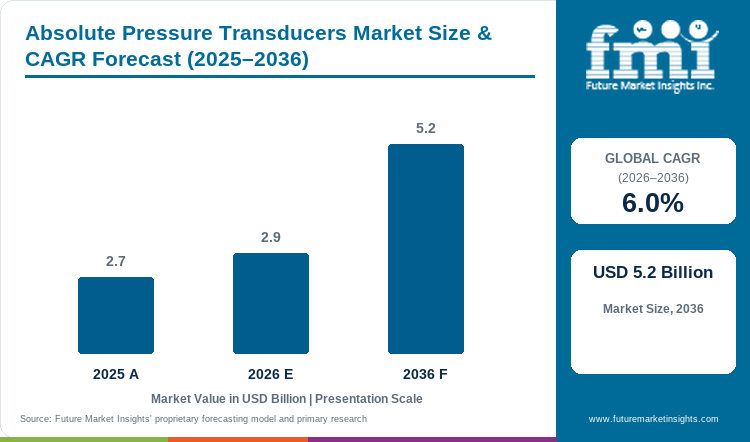
The absolute pressure transducers market is valued at USD 2.9 billion in 2026 and is projected to reach USD 5.2 billion by 2036, growing at a 6.0% CAGR.
Sales of absolute pressure transducers are estimated to rise at 6.0% CAGR through 2036, increasing valuation from USD 2.7 billion in 2025 to USD 2.9 billion in 2026, and reaching USD 5.2 billion by 2036. Machine builders use a sealed vacuum reference when outside air pressure would change the control signal. NIST calibrates pressure transducers with piston gauges and can run those gauges in absolute mode. These checks give equipment teams a traceable accuracy reference. They also help teams confirm long-term stability before approving a device for process or test systems.
South Korea is projected to grow at 6.0% CAGR through 2036 compared with 5.1% for Germany. Korean electronics projects create more design work for pressure sensors. Germany has a larger base of installed equipment that needs replacement. World Bank WITS recorded strong 2024 trade in HS 902620 pressure instruments in both countries. Korean equipment teams need close local design support. German plants focus more on service life and compatibility with existing controls.
Key Takeaways of Absolute Pressure Transducers Market
- Equipment builders are adding absolute pressure points because vacuum-based control avoids errors from changing air pressure.
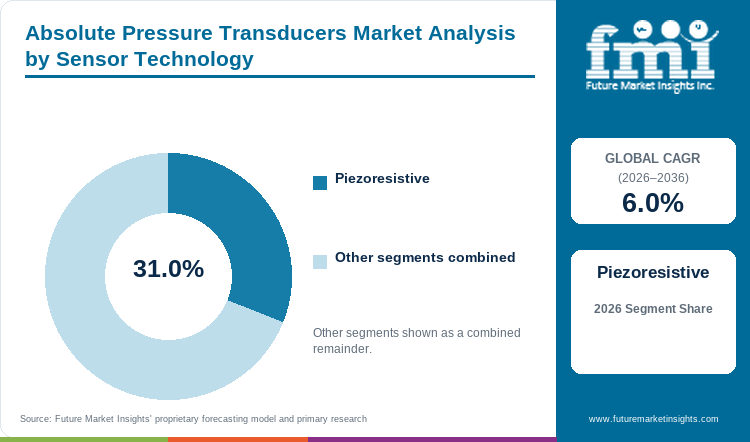
- Piezoresistive designs are projected to hold 31.0% of sensor technology revenue in 2026, supported by small silicon packages and simple signal conditioning.
- By pressure range, the 10-100 bar band is estimated to hold 32.0% in 2026, influenced by common industrial pressure needs.
- Analog voltage is forecast to represent 29.0% of output demand in 2026, linked to controllers that can read a direct conditioned signal.
- Calibration drift and application checks can delay approval when accurate pressure readings are critical for process control or equipment safety.
- Some of the key players in this market include Honeywell Technologies, TE Connectivity, Sensata Technologies, WIKA, KELLER Pressure, Emerson, Siemens, Kulite, BD|SENSORS, and STMicroelectronics.
Analyst Perspective
"Design teams rarely choose an absolute transducer by pressure range alone. Stable calibration and the right electrical connection usually decide whether the part is approved."
- Nikhil Kaitwade, Principal Consultant, Future Market Insights
How is the Absolute Pressure Transducers Market segmented?
The absolute pressure transducers market is segmented by Sensor Technology, Pressure Range, Output, Application, Sales Channel, and Region.
The absolute pressure transducers market uses five segment axes with region as the geographic split.
Sensor technology covers piezoresistive, capacitive, MEMS, thin-film, and resonant silicon.
Pressure range covers vacuum to 1 bar, 1-10 bar, 10-100 bar, and above 100 bar.
Output covers analog voltage, 4-20 mA, digital (I2C and SPI), and CAN industrial bus.
Application covers industrial process, aerospace, automotive, medical devices, and HVAC-vacuum systems.
Sales channel covers direct sensor OEM, industrial distributors, embedded module suppliers, and system integrators.
What makes piezoresistive designs central to the sensor technology category?
Piezoresistive sensors use a thin diaphragm that moves under pressure. That movement changes electrical resistance inside the sensor. Suppliers add temperature correction for more stable readings. The same design can work in small modules and sealed industrial units. NIST uses piezoresistive pressure transducers in high-accuracy low-pressure calibration work. Design teams can test them with familiar electronics and traceable checks. The method also works in several package sizes.
- Based on sensor technology, piezoresistive designs are projected to account for 31.0% in 2026, supported by small sensor parts and standard signal conditioning.
- Familiar calibration steps also reduce redesign work when pressure transducers connect to existing control electronics.
Why does the 10-100 bar range cover many pressure-range decisions?
The 10-100 bar band covers the middle range between low-pressure measurement and specialist high-pressure instruments. Hydraulic circuits and test systems often use pressures in this span. Siemens reported July 2026 accuracy upgrades for SITRANS P320 and P420 transmitters used in process work. Equipment makers can keep common ports and electronics while changing the measuring cell for each pressure duty. Common hardware reduces the number of parts used during design and service.
- By pressure range, 10-100 bar is estimated to hold 32.0% in 2026, influenced by industrial uses that need pressure headroom without extreme-pressure hardware.
- The range also covers many industrial sensors used in hydraulic controls and pressure test equipment.
How does analog voltage retain an important output position?
Analog voltage is useful when a controller already accepts a conditioned input and the cable run is short. Engineers can read the signal without adding a digital protocol. Honeywell Technologies lists analog voltage options for packaged pressure sensors used in industrial equipment. Machine builders can keep those simple inputs while newer designs add digital checks. Existing platforms can use the same pressure task without changing the main control setup.
- In 2026, analog voltage is expected to lead the output category with 29.0% share, linked to controllers that accept direct conditioned signals.
- Digital interfaces are gaining use in automotive pressure sensors because diagnostics and remote setup can cut setup work.
What supports industrial process use within the application category?
Process plants use absolute pressure when weather changes must not move the control reference. Vacuum vessels and sealed systems need that fixed reference. KELLER Pressure added ATEX Zone 2 versions to its transmitter range in February 2026 for plant and hydrogen use. Plant engineers check how sensor materials react with process fluids. They also check long-term stability before changing an approved instrument. Industrial demand favors packages with suitable housings and clear pressure performance.
- By application, industrial process is forecast to represent 28.0% in 2026, reinforced by vacuum and sealed systems that need fixed pressure references.
- Plants also buy related process instrumentation during retrofits if they keep the existing process connection.
Why do direct sensor OEM programs lead the sales-channel category?
OEM programs set the pressure range and electrical output before mass production starts. Changing a supplier can reopen tests and software work. In February 2026, KELLER Pressure introduced 10LX-GM transmitter capsules for gas meters and electronic volume correctors. The small interfaces support built-in designs and repeat production. Direct engineering support matters because the sensor becomes part of the approved machine design.
- Direct sensor OEM is set to lead the sales channel category with 42.0% share in 2026, attributable to repeat orders from design-in approvals.
- Industrial distributors keep replacement parts available for installed machines. Many industrial automation integrators update older control systems.
What are the drivers, restraints and opportunities in the Absolute Pressure Transducers Market?
In the absolute pressure transducers market, the key driver is automated equipment adding more pressure feedback points because a fixed vacuum reference keeps control readings consistent when outside air pressure would otherwise shift the signal, making a sealed absolute reference a standard requirement on closed-loop industrial and process systems, the key restraint is the equipment approval process that locks sensor specifications into each machine design at qualification, since a supplier change afterward can reopen zero-shift, temperature-effect, and material-compatibility tests that engineering teams want to avoid once a device is already approved for production, and the key opportunity is the integration of digital interfaces with diagnostics and remote setup into pressure devices, which gives service technicians device condition data before a shutdown and lets suppliers offer added service value without weakening the core pressure reading.
- Driver: Automated equipment needs more pressure feedback because a fixed vacuum reference keeps control more consistent.
- Restraint: Calibration drift and application checks can delay a supplier change in equipment that needs high accuracy or formal approval.
- Opportunity: Digital interfaces can cut setup work by giving technicians pressure data, diagnostics and device settings in one place.
Automation is adding more pressure points inside closed-loop industrial equipment. A stable absolute reference is needed when outside air pressure must not change the measured zero. NIST calibrates customer pressure transducers with piston gauges. It can also run those gauges in absolute mode for traceable checks. These steps keep reference accuracy inside the equipment specification. Machine builders place sensors in vacuum pump stations and automated process skids. Retrofit projects create the same need for electrical checks. Each installation also has set rules for process fluids and electrical connections. Suppliers win repeat orders when a transducer meets those rules without forcing changes to the controller or the mechanical design. This can save extra redesign work during product approval.
Qualification work can slow a replacement even when a new transducer costs less. Engineers check zero shift and temperature effects before they approve a new device. They also test parts that touch process fluids. NIST updated its low-pressure calibration guidance in May 2026. It includes piezoresistive devices used for high-accuracy work. Calibration is harder near vacuum or under tight accuracy limits. Hazardous service can add safety papers and environmental tests. These checks raise engineering cost before a new part reaches regular production. Buyers often keep an approved part longer if a change would reopen tests already completed for installed MEMS sensors. Lower unit prices may not cover that extra work.
Digital pressure devices can make field service easier. Siemens reported better accuracy for SITRANS P320 and P420 transmitters in July 2026. The same transmitter family also supports digital links. Device checks give technicians more detail during planned service. Remote setup cuts manual work on similar assets. The best use case is smart sensors that solve a clear service problem. Maintenance teams can check device condition before a shutdown. They can also prepare the right spare before work begins. Suppliers still need stable and accurate pressure readings. Digital features cannot fix sensor drift or poor material fit. Digital links should help service teams without weakening the pressure reading. This balance can cut setup work and keep measurement dependable.
Which country CAGRs are profiled in the Absolute Pressure Transducers Market?
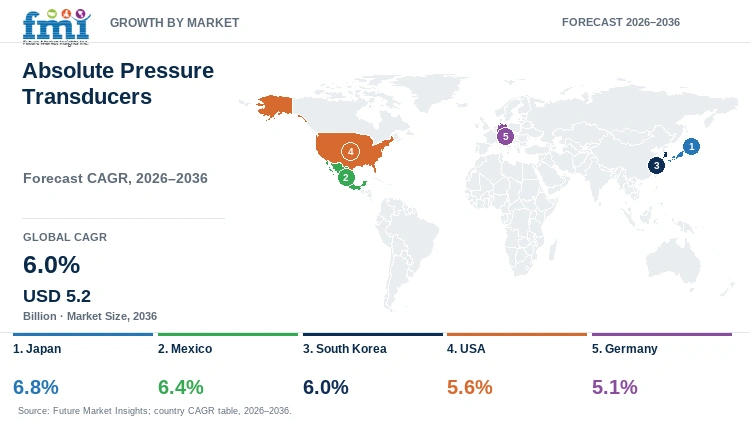
| Country | CAGR |
|---|---|
| Japan | 6.8% |
| Mexico | 6.4% |
| South Korea | 6.0% |
| USA | 5.6% |
| Germany | 5.1% |
How do country-level CAGRs compare in the Absolute Pressure Transducers Market?
Japan and Mexico form the upper growth group at 6.8% and 6.4%. Germany closes the displayed set at 5.1%. South Korea and the USA are in the middle. The 1.7-point spread shows forecast speed, not current market size. Installed equipment, design cycles and replacement needs differ in each country.
- Japanese buyers check calibration stability and package size when they approve sensors for precision equipment.
- Mexican vehicle and equipment factories rely more on OEM channels because sensors are chosen before mass production.
- South Korean electronics plants need vacuum and utility sensors with small packages and stable pressure readings.
- US aerospace programs, process plants and automation builders support several niches for specialist and broad sensor suppliers.
- German machinery builders favor sensors that keep familiar connections when equipment designs change.
Similar CAGRs can still create different selling conditions because approval work and installed equipment differ by country. The full report provides country-level CAGR analysis across North America, Latin America, Western Europe, Eastern Europe, East Asia, South Asia and Pacific, and the Middle East and Africa.
Country-wise Analysis
- Japanese equipment makers use imported pressure instruments with local electronics and semiconductor manufacturing equipment. Japan is projected to record 6.8% CAGR through 2036, supported by programs that need small and stable sensors. World Bank WITS recorded USD 266.8 million of Japanese HS 902620 pressure-instrument imports in 2024. This trade gives equipment makers access to pressure hardware from national supply channels. Local approval still depends on accuracy and package fit. Engineers also check calibration support before they approve a new part. Suppliers can enter new equipment programs faster when they make these checks easier. Proven control designs do not need to change.
- Mexican factories support vehicle and equipment production with a large cross-border trade in pressure instruments and controls. Absolute pressure transducer sales in Mexico are forecast to expand at 6.4% CAGR through 2036, influenced by design-in demand and replacement work. Data México recorded USD 1.383 billion of 2024 trade in HS 902620 pressure instruments. Exports reached USD 709 million and imports reached USD 674 million. This two-way trade gives factories several national supply routes. Platform changes still need fresh testing before production starts. Suppliers need steady delivery and nearby engineering support because approval delays can disrupt model changes and maintenance schedules.
- South Korean electronics and advanced manufacturing projects need small pressure sensors and clean equipment design. Demand for absolute pressure transducers in South Korea is forecast to rise at 6.0% CAGR through 2036, tied to equipment approval. World Bank WITS recorded large 2024 Korean imports under HS 902620 for pressure instruments. These imports give equipment builders access to a broad national supply base. High-purity uses still need careful material and calibration checks. Engineers test reading stability before a part enters production. Local engineering support can answer those questions earlier. This can shorten approval work before mass production starts. Local support can also shorten fixes during equipment trials.
- US buyers include process plants, aerospace programs and equipment builders that use embedded controls and air pressure sensors. The USA is estimated to post 5.6% CAGR over the forecast period, linked to a large installed base and new automation projects. World Bank WITS recorded USD 1.895 billion of US imports under HS 902620 in 2024. Mexico and Germany were major sources for that national pressure-instrument trade. The large import base gives buyers several supply routes. End-use programs still apply different environmental and calibration rules. Suppliers that clearly document interface behavior and pressure limits can serve OEM and replacement channels with less application risk.
- German machine builders and process plants use a large installed base of pressure instruments. Adoption of absolute pressure transducers in Germany is estimated to expand at 5.1% CAGR through 2036, shaped by replacement demand. World Bank WITS recorded USD 1.313 billion of German imports under HS 902620 in 2024. China and Switzerland were important sources in this national trade. Mature plants can delay optional replacements during weak investment periods. Maintenance teams compare calibration stability and service access before approving a substitute part. Suppliers need to prove longer service value because new-equipment demand is less important in a mature replacement cycle.
Who are the notable companies in the Absolute Pressure Transducers Market?
Honeywell Technologies, TE Connectivity, Sensata Technologies, WIKA, KELLER Pressure, Emerson, Siemens, Kulite, BD|SENSORS, and STMicroelectronics are active within the defined market boundary.
The field includes large automation groups, sensor specialists and pressure companies. Industrial groups sell pressure devices with control systems and service support. Sensor specialists join machine design early and focus on package size or electrical links. Pressure specialists handle hard jobs with extreme ranges or harsh conditions. Past approval records affect whether a supplier reaches regular production. Vendors must also support approved devices for the full life of a machine or plant.
- Honeywell Technologies and WIKA serve broad industrial measurement needs. Emerson and Siemens also supply pressure devices for plant automation.
- TE Connectivity, Sensata Technologies and STMicroelectronics focus on built-in sensors and OEM electronics.
- KELLER Pressure and Kulite focus on specialist pressure work. BD|SENSORS also serves industrial and test uses.
Competitive Benchmarking: Absolute Pressure Transducers Market
| Company | Absolute Range & Media Coverage | Digital Interface & Diagnostics | Harsh-Environment Qualification | Geographic Reach |
|---|---|---|---|---|
| Honeywell Technologies | High | Medium | High | Global |
| TE Connectivity | High | High | Medium | Global |
| Sensata Technologies | Medium | High | High | Global |
| WIKA | High | High | High | Global |
| KELLER Pressure | High | High | High | Europe, North America, Asia and distributors |
| Emerson | High | High | High | Global process-industry footprint |
| Siemens | High | High | High | Global industrial automation footprint |
| Kulite | Medium | Medium | High | North America, Europe and aerospace OEM programs |
| BD|SENSORS | High | High | High | Europe, Asia and international distributors |
| STMicroelectronics | Medium | High | Medium | Global semiconductor and sensor channels |
Scoring basis: High means strong current evidence for the named criterion. Medium means the evidence covers fewer products or uses. Low means the public evidence remains limited in scope. Geographic reach describes company coverage and does not receive a score.
Key Developments in the Absolute Pressure Transducers Market
- In July 2026, Siemens reported better accuracy and long-term stability for its SITRANS P320 and P420 pressure transmitters.
- In February 2026, KELLER Pressure introduced ATEX Zone 2 versions of its 23SY transmitters for hazardous and hydrogen uses.
- In September 2026, Sensata Technologies launched the R290 Pressure + Temperature Sensor, a combined pressure and temperature sensing solution for automotive OEMs adopting R290 propane refrigerant in EV thermal management systems."
Key Players in the Absolute Pressure Transducers Market
Broad industrial measurement and automation
- Honeywell Technologies
- WIKA
- Emerson
- Siemens
Embedded and OEM sensing
- TE Connectivity
- Sensata Technologies
- STMicroelectronics
Specialist pressure engineering
- KELLER Pressure
- Kulite
- BD|SENSORS
Absolute Pressure Transducers Market - Report Scope
| Coverage field | Report scope |
|---|---|
| Market breakdown | By sensor technology, pressure range, output, application, sales channel and region. |
| Quantitative Units | USD billion. |
| Market Definition | Absolute pressure transducers measure pressure against a sealed vacuum reference and convert that measurement into an electrical output for equipment, process or test systems. |
| Regions Covered | North America, Latin America, Western Europe, Eastern Europe, East Asia, South Asia and Pacific, and Middle East and Africa. |
| Countries Covered | Japan, Mexico, South Korea, USA, Germany, and 20+ countries included in the full report. |
| Key Companies Profiled | Honeywell Technologies, TE Connectivity, Sensata Technologies, WIKA, KELLER Pressure, Emerson, Siemens, Kulite, BD|SENSORS, and STMicroelectronics. |
| Forecast Period | 2026 to 2036. |
| Approach | Primary and secondary research with market triangulation. |
Absolute Pressure Transducers Market - Research Methodology
| Method | Approach |
|---|---|
| Primary Research | FMI analysts gathered input from manufacturers, service providers, technology developers, distributors, end users, procurement teams, and subject-matter experts. Interviews examined purchasing decisions, product or service evaluation, adoption barriers, approval requirements, pricing considerations, and expectations for technical or commercial support. Respondents were also asked what evidence is required before a trial, pilot, or initial order develops into regular purchasing. |
| Desk Research | Desk research covered government statistics, regulatory publications, trade data, industry associations, technical literature, standards, company filings, product information, and official corporate announcements. Sources were reviewed for relevance, publication date, geographic coverage, and consistency with the defined market scope. Claims relating to performance, applications, approvals, capacity, investment, and commercial activity were retained only when supported by credible public evidence. |
| Market Sizing and Forecasting | The market model combined the baseline value with historical performance, segment structure, pricing and volume indicators, adoption levels, company participation, and country-level demand conditions. Forecast assumptions considered economic activity, investment trends, regulatory developments, technology adoption, purchasing cycles, supply availability, and barriers to wider market use. Segment and regional estimates were reconciled before the final market total was calculated. |
| Data Validation | Estimates were checked against multiple independent indicators, including public data, company activity, trade patterns, industry developments, and findings from primary interviews. Validation also tested whether products, services, applications, and company revenues fell within the defined market boundaries. Adjacent categories, unsupported claims, overlapping revenues, and activities without direct market relevance were excluded to reduce double counting and maintain consistency across segments and countries. |
Absolute Pressure Transducers Market by Segments
Absolute Pressure Transducers Market segmented by Sensor Technology:
- Piezoresistive
- Capacitive
- MEMS
- Thin-film
- Resonant silicon
Absolute Pressure Transducers Market segmented by Pressure Range:
- Vacuum to 1 bar
- 1-10 bar
- 10-100 bar
- Above 100 bar
Absolute Pressure Transducers Market segmented by Output:
- Analog voltage
- 4-20 mA
- Digital - I2C and SPI
- CAN - industrial bus
Absolute Pressure Transducers Market segmented by Application:
- Industrial process
- Aerospace
- Automotive
- Medical devices
- HVAC - vacuum systems
Absolute Pressure Transducers Market segmented by Sales Channel:
- Direct sensor OEM
- Industrial distributors
- Embedded module suppliers
- System integrators
Absolute Pressure Transducers Market by Region:
- North America
- United States
- Canada
- Latin America
- Brazil
- Mexico
- Chile
- Rest of Latin America
- Western Europe
- Germany
- United Kingdom
- Italy
- Spain
- France
- Nordics
- Benelux
- Rest of Western Europe
- Eastern Europe
- Russia
- Poland
- Hungary
- Balkan and Baltic States
- Rest of Eastern Europe
- East Asia
- China
- Japan
- South Korea
- South Asia and Pacific
- India
- ASEAN
- Australia and New Zealand
- Rest of South Asia and Pacific
- Middle East and Africa
- Kingdom of Saudi Arabia
- Other GCC Countries
- Türkiye
- South Africa
- Other African Union Countries
- Rest of Middle East and Africa
Research Sources and Bibliography
- National Institute of Standards and Technology. (2016; updated January 15, 2026). Piston gauges and pressure transducers.
- Siemens. (2026, July 16). Pressure transmitters SITRANS P320/P420 - Improved accuracy across the portfolio.
- Sensata Technologies. (2026, September 2). Sensata Technologies Launches R290 Pressure + Temperature Sensor to Enable Adoption of Low-GWP and PFAS-free Refrigerants in EV Thermal Management Systems.
- KELLER Pressure. (2026, February 25). KELLER Pressure Transmitter With ATEX Approval for Zone 2 (3G/Ex ec).
- KELLER Pressure. (2026, February 17). KELLER 10LX-GM - Compact Pressure Transmitter Capsules for Use in Gas Volume Correctors.
- National Institute of Standards and Technology. (2018; updated May 27, 2026). Low Pressure Transducer Calibration.
- World Bank World Integrated Trade Solution. (2024). Japan imports of instruments and apparatus for measuring or checking pressure, HS 902620.
- Secretaría de Economía, Data México. (2024). Instruments and apparatus for measuring or checking pressure of liquids or gases, HS 902620.
- World Bank World Integrated Trade Solution. (2024). Republic of Korea imports of instruments and apparatus for measuring or checking pressure, HS 902620.
- World Bank World Integrated Trade Solution. (2024). United States imports of instruments and apparatus for measuring or checking pressure, HS 902620.
- World Bank World Integrated Trade Solution. (2024). Germany imports of instruments and apparatus for measuring or checking pressure, HS 902620.
- Honeywell Technologies. (2026, June 29). Honeywell Technologies Launches As Independent, Pure-Play Automation Company Following Completion of Honeywell Aerospace Spin-Off.
- KELLER Pressure. (2026, January 5). WE ARE KELLER Pressure - Legal Name Change and Optimisation of Logistics.
- STMicroelectronics. (2026, February 2). STMicroelectronics expands sensors capabilities with closing of acquisition of NXP’s MEMS business.
- BD|SENSORS. (2026, March 4). Annual review of 2025 - Preview of the 2026 fiscal year.
- Kulite Semiconductor Products. (2026, May). Kulite’s University Sponsorships Reach New Heights.
- WIKA. (2026, March). Submersible pressure sensor LS-1000 from WIKA now with Ex approvals.
- Honeywell Technologies. (n.d.). Pressure and force sensors. Retrieved September 22, 2026.
- KELLER Pressure. (2026, January 27). KELLER 26KyX - Piezoresistive Level Probe With Kynar® Diaphragm.
- BD|SENSORS. (2026, March 12). With the DCL 531i, BD|SENSORS is extending its range of submersible probes with a high-precision version featuring a digital interface.
- Siemens. (2026, July 13). SITRANS P320, SITRANS P420 / PROFINET PA Profile Device Z60038.
- KELLER Pressure. (2026, May 28). New ‘Diamant’ Building: Solskin Facade Contributes to KELLER Pressure’s Energy Supply in Winterthur.
- BD|SENSORS. (2026, June 18). BD|SENSORS expands its U.S. presence with dedicated subsidiary.
- KELLER Pressure. (2026, September 1). KELLER Pressure LEO Ultimate - The New Generation of Digital Pressure Gauge.
- Siemens. (2026, July 23). SITRANS P320, SITRANS P420 - Explosion protection/FM certification.
- WIKA. (2026, June). WIKA China is expanding its site in Suzhou.
- Emerson. (2026, August 24). Emerson’s Advanced Measurement Instrumentation Selected by Equinor to Optimize Operations, Accelerate Development.
This bibliography is provided for reader reference and is not exhaustive. The full report contains the complete reference list and detailed citations
This Report Answers
- How large is the absolute pressure transducers market in 2026 and what value is projected for 2036?
- What is increasing demand for absolute pressure measurement?
- Which sensor technology holds the largest 2026 share?
- Why does the 10-100 bar pressure range cover a large part of 2026 demand?
- How are analog and digital outputs changing equipment integration?
- How do the five country CAGRs compare?
- What slows supplier changes in applications that need high accuracy?
- Which companies are active in the absolute pressure transducers market?
- How do OEM design-in programs differ from distributor-led replacement sales?
Frequently Asked Questions
How big is the Absolute Pressure Transducers Market in 2026?
The absolute pressure transducers market is valued at USD 2.9 billion in 2026 and projected at USD 5.2 billion by 2036. Growth is supported by automated equipment and process systems that need a stable vacuum-based pressure reference.
What is the CAGR of the Absolute Pressure Transducers Market from 2026 to 2036?
The absolute pressure transducers market is projected to grow at 6.0% CAGR between 2026 and 2036. Equipment design-ins and replacement orders support demand in uses that need a stable vacuum reference.
Which sensor technology leads the Absolute Pressure Transducers Market?
Piezoresistive designs are expected to hold 31.0% of sensor technology revenue in 2026 because small silicon parts fit many package types. Simple signal methods also make these sensors easier to add to existing equipment.
Which different output segment is gaining adoption in the Absolute Pressure Transducers Market?
Digital interfaces are gaining use in the output category because new equipment needs better device checks and remote setup. Service teams use device data to cut setup time and find faults faster during maintenance.
Which companies are active in the Absolute Pressure Transducers Market?
Key companies operating in the market include Honeywell Technologies, TE Connectivity, Sensata Technologies, WIKA, KELLER Pressure, Emerson, Siemens, Kulite, BD|SENSORS, and STMicroelectronics. Buyers mainly compare range, package fit, interface options and approval records.
Preview the report firsthand - request a free sample
Get SampleGet the brochure for pricing and purchase details.
Get PDFTable of Content
- Key Takeaways
- Market Size and CAGR
- Top Growth Driver
- Fastest Growing Segment
- Leading Region
- Key Companies
- Emerging Opportunities
- Executive Summary
- Global Market Outlook
- Demand-side Trends
- Supply-side Trends
- Technology Roadmap Analysis
- Analysis and Recommendations
- Analyst Perspective (What is happening? Why now? What should investors know?)
- Key Questions Answered
- How large is the market?
- What is the CAGR?
- What are key trends?
- Which region dominates?
- Who are the leaders?
- Market Overview
- Market Coverage / Taxonomy
- Market Definition / Scope / Limitations
- Research Methodology
- Chapter Orientation
- Analytical Lens and Working Hypotheses
- Market Structure, Signals, and Trend Drivers
- Benchmarking and Cross-market Comparability
- Market Sizing, Forecasting, and Opportunity Mapping
- Research Design and Evidence Framework
- Desk Research Programme (Secondary Evidence)
- Expert Input and Fieldwork (Primary Evidence)
- Tooling, Models, and Reference Databases
- Data Engineering and Model Build
- Quality Assurance and Audit Trail
- Market Background
- Market Dynamics (Drivers, Restraints, Opportunity, Trends)
- Scenario Forecast (Optimistic, Likely, Conservative)
- Impact Analysis
- AI Impact
- Sustainability Impact
- Regulatory Impact
- Technology Impact
- Consumer / Buyer Analysis
- Purchase Drivers
- Adoption Barriers
- Buyer Journey
- Opportunity Map Analysis
- Product Life Cycle Analysis
- Supply Chain Analysis
- Investment Feasibility Matrix
- Value Chain Analysis
- PESTLE and Porter's Analysis
- Regulatory Landscape
- Regional Parent Market Outlook
- Production and Consumption Statistics
- Import and Export Statistics
- Global Market Analysis and Forecast, 2021 to 2036
- Historical Market Size Value (USD Billion) Analysis, 2021 to 2025
- Current and Future Market Size Value (USD Billion) Projections, 2026 to 2036
- Y-o-Y Growth Trend Analysis
- Absolute $ Opportunity Analysis
- Global Market Pricing Analysis, 2021 to 2036
- Global Market Analysis and Forecast, By Sensor Technology, 2021 to 2036
- Introduction / Key Findings
- Historical Market Size Value (USD Billion) Analysis By Sensor Technology, 2021 to 2025
- Current and Future Market Size Value (USD Billion) Analysis and Forecast By Sensor Technology, 2026 to 2036
- Piezoresistive
- Capacitive
- MEMS
- Thin-film
- Resonant silicon
- Y-o-Y Growth Trend Analysis By Sensor Technology, 2021 to 2025
- Absolute $ Opportunity Analysis By Sensor Technology, 2026 to 2036
- Global Market Analysis and Forecast, By Pressure Range, 2021 to 2036
- Introduction / Key Findings
- Historical Market Size Value (USD Billion) Analysis By Pressure Range, 2021 to 2025
- Current and Future Market Size Value (USD Billion) Analysis and Forecast By Pressure Range, 2026 to 2036
- Vacuum to 1 bar
- 1-10 bar
- 10-100 bar
- Above 100 bar
- Y-o-Y Growth Trend Analysis By Pressure Range, 2021 to 2025
- Absolute $ Opportunity Analysis By Pressure Range, 2026 to 2036
- Global Market Analysis and Forecast, By Output, 2021 to 2036
- Introduction / Key Findings
- Historical Market Size Value (USD Billion) Analysis By Output, 2021 to 2025
- Current and Future Market Size Value (USD Billion) Analysis and Forecast By Output, 2026 to 2036
- Analog voltage
- 4-20 mA
- Digital - I2C and SPI
- CAN - industrial bus
- Y-o-Y Growth Trend Analysis By Output, 2021 to 2025
- Absolute $ Opportunity Analysis By Output, 2026 to 2036
- Global Market Analysis and Forecast, By Application, 2021 to 2036
- Introduction / Key Findings
- Historical Market Size Value (USD Billion) Analysis By Application, 2021 to 2025
- Current and Future Market Size Value (USD Billion) Analysis and Forecast By Application, 2026 to 2036
- Industrial process
- Aerospace
- Automotive
- Medical devices
- HVAC - vacuum systems
- Y-o-Y Growth Trend Analysis By Application, 2021 to 2025
- Absolute $ Opportunity Analysis By Application, 2026 to 2036
- Global Market Analysis and Forecast, By Sales Channel, 2021 to 2036
- Introduction / Key Findings
- Historical Market Size Value (USD Billion) Analysis By Sales Channel, 2021 to 2025
- Current and Future Market Size Value (USD Billion) Analysis and Forecast By Sales Channel, 2026 to 2036
- Direct sensor OEM
- Industrial distributors
- Embedded module suppliers
- System integrators
- Y-o-Y Growth Trend Analysis By Sales Channel, 2021 to 2025
- Absolute $ Opportunity Analysis By Sales Channel, 2026 to 2036
- Global Market Analysis and Forecast, By Region, 2021 to 2036
- Introduction
- Historical Market Size Value (USD Billion) Analysis By Region, 2021 to 2025
- Current Market Size Value (USD Billion) Analysis and Forecast By Region, 2026 to 2036
- North America
- Latin America
- Western Europe
- Eastern Europe
- East Asia
- South Asia and Pacific
- Middle East and Africa
- Market Attractiveness Analysis By Region
- North America Market Analysis and Forecast, By Country, 2021 to 2036
- Historical Market Size Value (USD Billion) Trend Analysis By Market Taxonomy, 2021 to 2025
- Market Size Value (USD Billion) Forecast By Market Taxonomy, 2026 to 2036
- By Country
- United States
- Canada
- By Sensor Technology
- By Pressure Range
- By Output
- By Application
- By Sales Channel
- By Country
- Market Attractiveness Analysis
- By Country
- By Sensor Technology
- By Pressure Range
- By Output
- By Application
- By Sales Channel
- Key Takeaways
- Latin America Market Analysis and Forecast, By Country
- Historical Market Size Value (USD Billion) Trend Analysis By Market Taxonomy, 2021 to 2025
- Market Size Value (USD Billion) Forecast By Market Taxonomy, 2026 to 2036
- By Country
- Brazil
- Mexico
- Chile
- Rest of Latin America
- By Sensor Technology
- By Pressure Range
- By Output
- By Application
- By Sales Channel
- By Country
- Market Attractiveness Analysis
- By Country
- By Sensor Technology
- By Pressure Range
- By Output
- By Application
- By Sales Channel
- Key Takeaways
- Western Europe Market Analysis and Forecast, By Country
- Historical Market Size Value (USD Billion) Trend Analysis By Market Taxonomy, 2021 to 2025
- Market Size Value (USD Billion) Forecast By Market Taxonomy, 2026 to 2036
- By Country
- Germany
- United Kingdom
- Italy
- Spain
- France
- Nordics
- Benelux
- Rest of Western Europe
- By Sensor Technology
- By Pressure Range
- By Output
- By Application
- By Sales Channel
- By Country
- Market Attractiveness Analysis
- By Country
- By Sensor Technology
- By Pressure Range
- By Output
- By Application
- By Sales Channel
- Key Takeaways
- Eastern Europe Market Analysis and Forecast, By Country
- Historical Market Size Value (USD Billion) Trend Analysis By Market Taxonomy, 2021 to 2025
- Market Size Value (USD Billion) Forecast By Market Taxonomy, 2026 to 2036
- By Country
- Russia
- Poland
- Hungary
- Balkan and Baltic States
- Rest of Eastern Europe
- By Sensor Technology
- By Pressure Range
- By Output
- By Application
- By Sales Channel
- By Country
- Market Attractiveness Analysis
- By Country
- By Sensor Technology
- By Pressure Range
- By Output
- By Application
- By Sales Channel
- Key Takeaways
- East Asia Market Analysis and Forecast, By Country
- Historical Market Size Value (USD Billion) Trend Analysis By Market Taxonomy, 2021 to 2025
- Market Size Value (USD Billion) Forecast By Market Taxonomy, 2026 to 2036
- By Country
- China
- Japan
- South Korea
- By Sensor Technology
- By Pressure Range
- By Output
- By Application
- By Sales Channel
- By Country
- Market Attractiveness Analysis
- By Country
- By Sensor Technology
- By Pressure Range
- By Output
- By Application
- By Sales Channel
- Key Takeaways
- South Asia and Pacific Market Analysis and Forecast, By Country
- Historical Market Size Value (USD Billion) Trend Analysis By Market Taxonomy, 2021 to 2025
- Market Size Value (USD Billion) Forecast By Market Taxonomy, 2026 to 2036
- By Country
- India
- ASEAN
- Australia and New Zealand
- Rest of South Asia and Pacific
- By Sensor Technology
- By Pressure Range
- By Output
- By Application
- By Sales Channel
- By Country
- Market Attractiveness Analysis
- By Country
- By Sensor Technology
- By Pressure Range
- By Output
- By Application
- By Sales Channel
- Key Takeaways
- Middle East and Africa Market Analysis and Forecast, By Country
- Historical Market Size Value (USD Billion) Trend Analysis By Market Taxonomy, 2021 to 2025
- Market Size Value (USD Billion) Forecast By Market Taxonomy, 2026 to 2036
- By Country
- Kingdom of Saudi Arabia
- Other GCC Countries
- Türkiye
- South Africa
- Other African Union Countries
- Rest of Middle East and Africa
- By Sensor Technology
- By Pressure Range
- By Output
- By Application
- By Sales Channel
- By Country
- Market Attractiveness Analysis
- By Country
- By Sensor Technology
- By Pressure Range
- By Output
- By Application
- By Sales Channel
- Key Takeaways
- Key Countries Market Analysis
- United States
- Pricing Analysis
- Market Share Analysis, 2025
- By Sensor Technology
- By Pressure Range
- By Output
- By Application
- By Sales Channel
- Canada
- Pricing Analysis
- Market Share Analysis, 2025
- By Sensor Technology
- By Pressure Range
- By Output
- By Application
- By Sales Channel
- Mexico
- Pricing Analysis
- Market Share Analysis, 2025
- By Sensor Technology
- By Pressure Range
- By Output
- By Application
- By Sales Channel
- Brazil
- Pricing Analysis
- Market Share Analysis, 2025
- By Sensor Technology
- By Pressure Range
- By Output
- By Application
- By Sales Channel
- Chile
- Pricing Analysis
- Market Share Analysis, 2025
- By Sensor Technology
- By Pressure Range
- By Output
- By Application
- By Sales Channel
- Germany
- Pricing Analysis
- Market Share Analysis, 2025
- By Sensor Technology
- By Pressure Range
- By Output
- By Application
- By Sales Channel
- United Kingdom
- Pricing Analysis
- Market Share Analysis, 2025
- By Sensor Technology
- By Pressure Range
- By Output
- By Application
- By Sales Channel
- Italy
- Pricing Analysis
- Market Share Analysis, 2025
- By Sensor Technology
- By Pressure Range
- By Output
- By Application
- By Sales Channel
- Spain
- Pricing Analysis
- Market Share Analysis, 2025
- By Sensor Technology
- By Pressure Range
- By Output
- By Application
- By Sales Channel
- France
- Pricing Analysis
- Market Share Analysis, 2025
- By Sensor Technology
- By Pressure Range
- By Output
- By Application
- By Sales Channel
- India
- Pricing Analysis
- Market Share Analysis, 2025
- By Sensor Technology
- By Pressure Range
- By Output
- By Application
- By Sales Channel
- ASEAN
- Pricing Analysis
- Market Share Analysis, 2025
- By Sensor Technology
- By Pressure Range
- By Output
- By Application
- By Sales Channel
- Australia and New Zealand
- Pricing Analysis
- Market Share Analysis, 2025
- By Sensor Technology
- By Pressure Range
- By Output
- By Application
- By Sales Channel
- China
- Pricing Analysis
- Market Share Analysis, 2025
- By Sensor Technology
- By Pressure Range
- By Output
- By Application
- By Sales Channel
- Japan
- Pricing Analysis
- Market Share Analysis, 2025
- By Sensor Technology
- By Pressure Range
- By Output
- By Application
- By Sales Channel
- South Korea
- Pricing Analysis
- Market Share Analysis, 2025
- By Sensor Technology
- By Pressure Range
- By Output
- By Application
- By Sales Channel
- Russia
- Pricing Analysis
- Market Share Analysis, 2025
- By Sensor Technology
- By Pressure Range
- By Output
- By Application
- By Sales Channel
- Poland
- Pricing Analysis
- Market Share Analysis, 2025
- By Sensor Technology
- By Pressure Range
- By Output
- By Application
- By Sales Channel
- Hungary
- Pricing Analysis
- Market Share Analysis, 2025
- By Sensor Technology
- By Pressure Range
- By Output
- By Application
- By Sales Channel
- Kingdom of Saudi Arabia
- Pricing Analysis
- Market Share Analysis, 2025
- By Sensor Technology
- By Pressure Range
- By Output
- By Application
- By Sales Channel
- Türkiye
- Pricing Analysis
- Market Share Analysis, 2025
- By Sensor Technology
- By Pressure Range
- By Output
- By Application
- By Sales Channel
- South Africa
- Pricing Analysis
- Market Share Analysis, 2025
- By Sensor Technology
- By Pressure Range
- By Output
- By Application
- By Sales Channel
- United States
- Market Structure Analysis
- Competition Dashboard
- Competition Benchmarking
- Market Share Analysis of Top Players
- By Regional
- By Sensor Technology
- By Pressure Range
- By Output
- By Application
- By Sales Channel
- Emerging Startups
- Innovation Benchmarking
- Competition Analysis
- Competition Deep Dive
- Honeywell Technologies
- Overview
- Product Portfolio
- Profitability by Market Segments
- Sales Footprint
- Strategy Overview
- Marketing Strategy
- Product Strategy
- Channel Strategy
- TE Connectivity
- Sensata Technologies
- WIKA
- KELLER Pressure
- Emerson
- Siemens
- Kulite
- BD|SENSORS
- STMicroelectronics
- Honeywell Technologies
- Case Studies
- Success Stories
- Recent Developments
- Competition Deep Dive
- Assumptions & Acronyms Used


