

- Industry Size (2026)
- USD 5.40 Bn
- Forecast (2036)
- USD 8.14 Bn
- CAGR (2026 to 2036)
- 4.2%
Acetic Ether Market Size, Market Forecast and Outlook By FMI
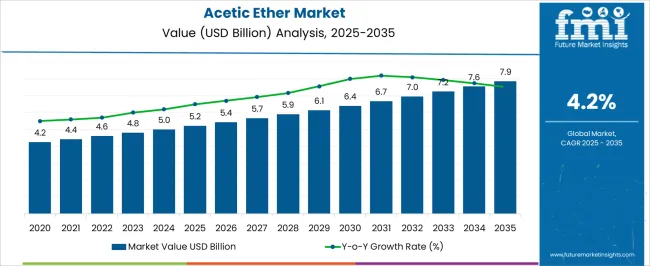
The Acetic Ether market was valued at USD 5.18 billion in 2025, projected to reach USD 5.40 billion in 2026, and is forecast to expand to USD 8.14 billion by 2036 at a 4.2% CAGR. Acetic ether, commercially designated as ethyl acetate, serves as a versatile industrial solvent and chemical intermediate across packaging ink and printing solvent applications, paints and coatings formulation, pharmaceutical excipient and extraction solvent use, flavour and fragrance manufacturing, and food contact packaging material production.
FMI is of the opinion that the acetic ether market is experiencing a structural demand shift toward bio-based ethyl acetate production routes using bio-ethanol feedstocks, driven by packaging industry sustainability commitments, food contact material regulatory requirements favouring bio-derived solvents, and printing ink manufacturer carbon reduction programmes. The market operates across tightly defined industrial, food, and pharmaceutical grade specifications governing allowable impurity profiles and production process requirements.
Summary of Acetic Ether Market
- Market Snapshot
- The Acetic Ether market is valued at USD 5.18 billion in 2025 and is projected to reach USD 8.14 billion by 2036.
- The industry is expected to grow at a 4.2% CAGR from 2026 to 2036, creating an incremental opportunity of USD 2.758 billion.
- The market is a growth-oriented category where application differentiation, regulatory compliance requirements, and end-use industry expansion define competitive positioning.
- Demand and Growth Drivers
- Demand is driven by packaging procurement growth across industrial grade application segments in key industrial and consumer end-use markets.
- Product performance specifications mandated by end-use industry standards and regulatory compliance requirements anchor demand for certified acetic ether grades across major markets.
- Asia Pacific manufacturing expansion and downstream industry growth in pharmaceuticals, construction, and consumer goods sectors are generating incremental demand across all product grades.
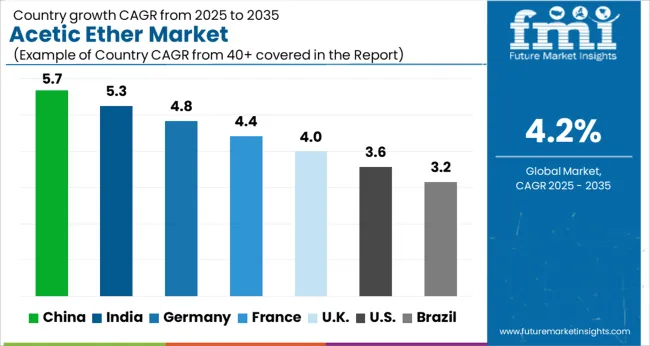
- China leads at 5.7% CAGR, followed by India at 5.3%, Germany at 4.8%, France at 4.4%, UK at 4.0%, USA at 3.6%, and Brazil at 3.2%.
- Product and Segment View
- The market covers acetic ether products across application categories and application grades serving industrial, commercial, and regulated end-use procurement channels.
- Solvent leads Application with 21.3% share in 2026, driven by its performance advantages and established specification acceptance across primary end-use applications.
- Packaging accounts for 28.3% by End-Use Industry in 2026, reflecting its dominant positioning in established procurement channels.
- Industrial Grade holds 52.3% by Grade in 2026, anchored by volume consumption in key industrial and commercial end-use segments.
- Scope includes certified acetic ether products for defined end-use applications; excludes precursor chemicals, downstream derivative products, and non-certified materials.
- Geography and Competitive Outlook
- China and India are the fastest-growing markets driven by manufacturing industry expansion and regulatory compliance adoption, while established markets in Germany, UK, and USA sustain steady demand through replacement and compliance upgrade cycles.
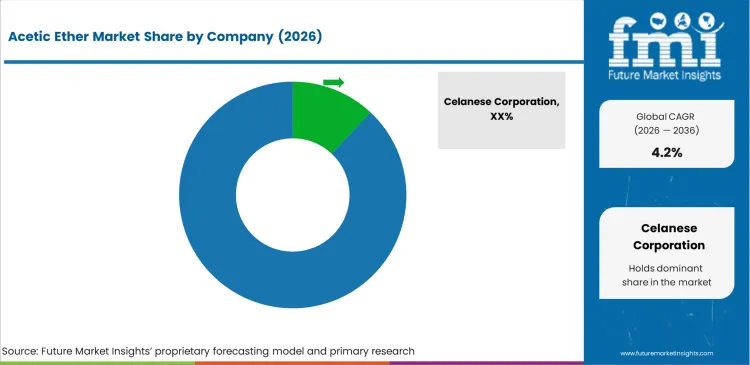
- Competition is served by global integrated chemical and materials manufacturers alongside regional specialists, with key players including Celanese Corporation, INEOS Group, Eastman Chemical Company, Solvay SA, Jubilant Ingrevia, Daicel Corporation, Sipchem (Saudi International Petrochemical Co.), Shanghai Wujing Chemical Co. Ltd., Solventis Ltd., Showa Denko K.K., Lonza Group Ltd., GNFC (Gujarat Narmada Valley Fertilizers & Chemicals Ltd.), Laxmi Organic Industries, Godavari Biorefineries.
Acetic Ether Market Key Takeaways
| Metric | Details |
|---|---|
| Industry Size (2026) | USD 5.40 billion |
| Industry Value (2036) | USD 8.14 billion |
| CAGR (2026 to 2036) | 4.2% |
| Source | Future Market Insights, 2026 |
Source: FMI analysis based on primary research and proprietary forecasting model
The absolute dollar increment from 2026 to 2036 reaches USD 2.758 billion, reflecting above-average growth relative to mature petrochemical solvents, underpinned by packaging industry solvent demand expansion, the transition to water-based and high-solids coating formulations that retain ethyl acetate as a co-solvent, and food and pharmaceutical grade demand growth from food processing and drug manufacturing.
FMI analysts observe that the packaging end-use industry is the largest demand anchor for acetic ether, with flexible packaging printers and laminate manufacturers consuming substantial volumes as a gravure and flexographic ink solvent with favourable evaporation rate, low residual solvent profile, and regulatory acceptability for food contact packaging applications. The flavour and fragrance application generates high-value demand with pharmaceutical-grade purity requirements, sustaining price premiums over industrial-grade bulk material.
China leads at a 5.7% CAGR through 2036, driven by packaging industry expansion, domestic printing ink manufacturing, and growing pharmaceutical and food processing sectors generating multi-grade ethyl acetate consumption. India follows at 5.3% as pharmaceutical API extraction, packaging ink printing, and food flavour manufacturing growth drives demand. Germany advances at 4.8% supported by specialty coatings, pharmaceutical, and food processing applications under regulatory frameworks favouring ethyl acetate in food contact applications.
France progresses at 4.4% anchored by flavour and fragrance manufacturing and pharmaceutical applications. The United Kingdom tracks at 4.0%, the United States at 3.6% with steady packaging and pharmaceutical demand, and Brazil at 3.2% from packaging and food processing industry growth.
Acetic Ether Market Definition
The Acetic Ether market encompasses ethyl acetate and related short-chain aliphatic acetate ester compounds serving as solvents, chemical intermediates, flavouring agents, and pharmaceutical excipients across packaging ink printing, paints and coatings formulation, food and flavour manufacturing, pharmaceutical processing, and chemical synthesis applications. Ethyl acetate is produced from petrochemical or bio-ethanol feedstocks via esterification, Tishchenko reaction, or direct synthesis routes, with industrial, food, and pharmaceutical grade specifications governing purity and impurity limits for respective application markets.
Acetic Ether Market Inclusions
Market scope includes industrial-grade ethyl acetate for ink, coatings, and general solvent applications, food-grade ethyl acetate for flavour, fragrance, and food contact packaging applications, pharmaceutical-grade ethyl acetate for extraction, recrystallisation, and excipient applications, and bio-based ethyl acetate produced from bio-ethanol feedstocks across all grade tiers. Both bulk liquid and packaged product supply forms are fully incorporated.
Acetic Ether Market Exclusions
Acetic acid and ethanol as upstream chemical precursors are excluded from market valuation. Other acetate ester solvents including butyl acetate, propyl acetate, and isopropyl acetate are treated as separate chemical markets. Downstream finished products incorporating ethyl acetate as a component, such as printed packaging materials, coatings films, and formulated flavour compounds, fall outside analytical boundaries.
Acetic Ether Market Research Methodology
- Primary Research: FMI analysts engaged with procurement managers, product development engineers, and regulatory compliance specialists across key end-use industries, alongside acetic ether manufacturer product executives, to map demand drivers, specification requirements, and regulatory compliance triggers governing market adoption.
- Desk Research: Data aggregation incorporated end-use industry production statistics from national statistical agencies, regulatory standards documentation, company primary disclosures from annual reports and investor presentations, and official product launch and capacity expansion announcements from manufacturers.
- Market-Sizing and Forecasting: Baseline values were derived from bottom-up aggregation of end-use industry output volumes, acetic ether consumption intensity per unit of end-use production, and regional product grade mix, with forward projections applying regulatory adoption curves and end-use industry growth rates from government and multilateral statistical sources.
- Data Validation and Update Cycle: Projections are cross-validated against publicly reported revenue and volume data from leading manufacturers and calibrated against end-use industry production output statistics from government statistical agencies and regulatory authority programme reports.
Why is the Acetic Ether Market Growing?
The acetic ether market is experiencing steady growth driven by its increasing use as a versatile chemical intermediate and solvent across multiple industries. Rising demand in chemical processing, pharmaceuticals, coatings, and packaging applications is shaping the market trajectory. Its properties as a highly effective solvent for resins, polymers, and extraction processes are creating opportunities in industrial and commercial settings.
Expanding production capacities and advancements in chemical manufacturing technologies are enhancing product availability and quality, enabling consistent performance for end users. Growth is also being influenced by the increasing need for high-purity industrial chemicals in regions with expanding manufacturing and packaging sectors. Regulatory focus on process efficiency, safety, and environmental compliance is further guiding adoption patterns.
The market outlook is supported by ongoing research into new applications and optimized production methods that reduce energy consumption and improve yields As industrial and commercial demand continues to rise, acetic ether is anticipated to remain a critical intermediate and solvent, with opportunities for increased penetration in emerging economies alongside developed markets.
Segmental Analysis
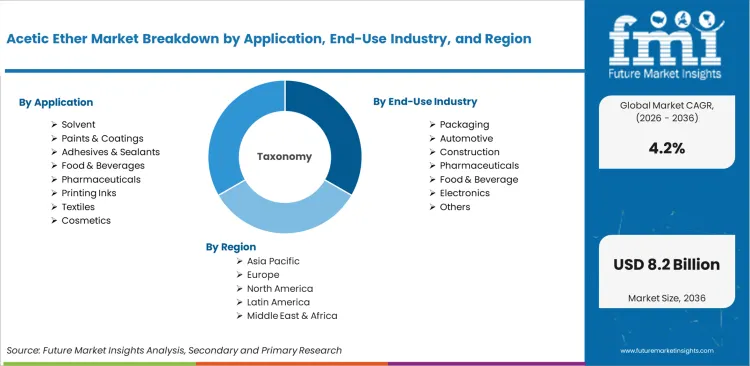
The acetic ether market is segmented by application, end-use industry, grade, distribution channel, and geographic regions. By application, acetic ether market is divided into Solvent, Paints & Coatings, Adhesives & Sealants, Food & Beverages (Flavoring), Pharmaceuticals, Printing Inks, Textiles, and Cosmetics. In terms of end-use industry, acetic ether market is classified into Packaging, Automotive, Construction, Pharmaceuticals, Food & Beverage, Electronics, and Others.
Based on grade, acetic ether market is segmented into Industrial Grade, Pharmaceutical Grade, and Food Grade. By distribution channel, acetic ether market is segmented into Offline and Online. Regionally, the acetic ether industry is classified into North America, Latin America, Western Europe, Eastern Europe, Balkan & Baltic Countries, Russia & Belarus, Central Asia, East Asia, South Asia & Pacific, and the Middle East & Africa.
Insights into the Solvent Application Segment
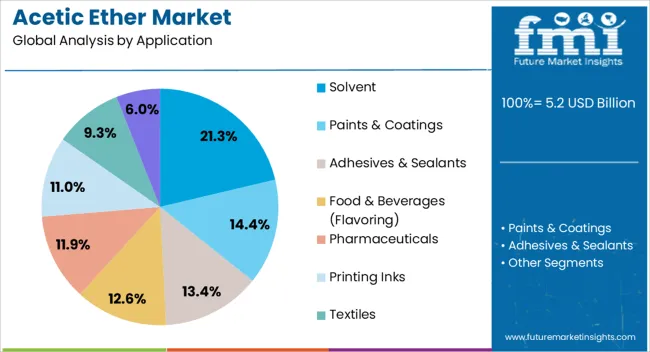
The solvent application segment is projected to account for 21.3% of the acetic ether market revenue share in 2026, making it a leading application. Its growth is being driven by its ability to effectively dissolve polymers, resins, and other chemical compounds used in coatings, pharmaceuticals, and chemical intermediates. The segment is benefiting from increasing adoption in industrial processes that require high-purity and stable solvents, where product quality directly affects operational efficiency and end-product performance.
Acetic ether’s compatibility with diverse chemical formulations and its performance under controlled reaction conditions have reinforced its preference among manufacturers. Growing emphasis on process efficiency and safety in chemical processing plants has further encouraged the shift toward reliable solvent-based applications.
Additionally, ongoing developments in production technologies are enhancing product consistency and availability, supporting wider adoption As industries continue to optimize operations and meet stringent quality standards, the solvent application segment is expected to maintain a significant share in the acetic ether market.
Insights into the Packaging End-Use Industry Segment
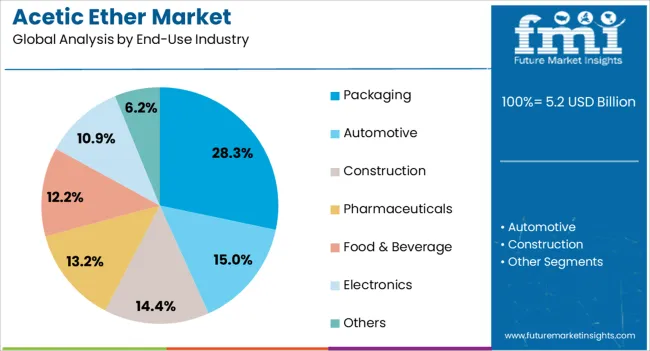
The packaging end-use industry segment is anticipated to represent 28.3% of the acetic ether market revenue share in 2026, establishing it as a leading end-use sector. Its leadership is being supported by the growing use of acetic ether in inks, coatings, and adhesive formulations critical for food, beverage, and industrial packaging applications. The material’s ability to provide consistent drying rates, film uniformity, and chemical stability in packaging processes has reinforced its adoption.
Rising demand for high-performance and sustainable packaging solutions, combined with stricter regulations for food safety and product protection, is further driving growth. Manufacturers prefer acetic ether for its reliability and compatibility with modern packaging machinery and production lines.
Increasing industrial expansion in emerging markets, coupled with ongoing innovations in packaging technologies, is also contributing to segment growth The ability to adapt formulations to meet evolving packaging requirements ensures the continued dominance of this segment within the acetic ether market.
Insights into the Industrial Grade Segment
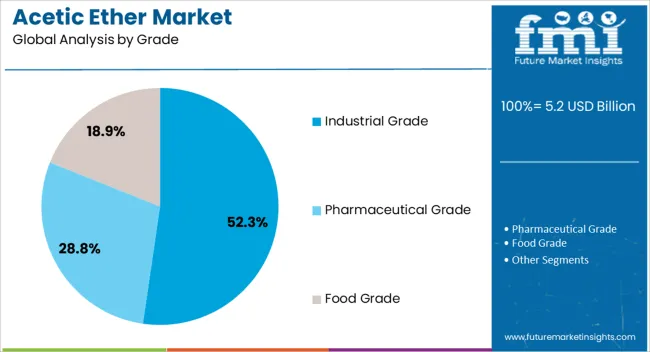
The industrial grade segment is projected to hold 52.3% of the acetic ether market revenue share in 2026, making it the largest grade category. Its dominance is being driven by high demand from manufacturing, chemical processing, coatings, and industrial solvent applications where performance and purity requirements are critical. Industrial grade acetic ether offers reliability, consistent composition, and stability under high-volume production conditions, which is essential for large-scale operations.
Manufacturers benefit from reduced process downtime and higher operational efficiency due to the product’s consistent quality. Growth in energy, automotive, and chemical sectors, along with increasing emphasis on production efficiency and adherence to regulatory standards, is reinforcing the segment’s market share.
The availability of industrial grade acetic ether in bulk quantities and its adaptability for multiple applications have further strengthened its leadership position As industrial activity expands and production processes become more complex, the industrial grade segment is expected to continue driving overall market growth in the coming years.
Market Overview
Acetic Ether Market Overview
Acetic ether is a colorless organic compound and is formed by reacting ethanol with acetic acid. Acetic ether is mainly employed as solvent in various application segments such as coatings formulations including urethanes, cellulosic, vinyl and acrylics among others .Other niche applications include nail polish removers, glue and cigarettes among others. Cellulosic application segment dominates the global demand for acetic ether.
Major end user industries for acetic ether include perfume, varnishes and plastics among others. Plastics dominate the global demand for acetic ether; acetic ether is primarily employed as a solvent in the production of plastics. Increasing demand for paints is anticipated to drive the market growth during the forecast period. Food, printing and packaging are some other major end user industries for acetic ether.
Low production cost as compared to its substitute has been a major factor driving growth for acetic ether market. Major end user industries for acetic ether include perfume, varnishes and printing several other consumer segments. Therefore GDP growth rate and increasing disposable income in a region are among major factors fuelling growth for acetic ether market.
Growth in several end user segments such as laboratory experiments and wine are some other growth drivers for the industry. Acetic ether has high flammability and has to be handled with utmost care during transportation and storage. Acetic ether has also been reported to cause several health hazards such as skin irritation, vomiting and dizziness among others.
The health hazards have led to several government regulation in the acetic ether market which have been major factors restraining growth for the acetic ether market. Research and development activities to increase the application scope for acetic ether are expected to offer huge growth opportunity in the market.
North America followed by Europe dominates the global acetic ether market in terms of consumption and the trend is expected to continue during the forecast period.
Acetic ether market growth in North America and Europe is anticipated to grow at sluggish rate mainly owing to market saturation in end user industries. High number of government regulations is among other factors restraining growth for acetic ether market in North America and Europe.
Asia Pacific is expected to be the fastest growing region for acetic ether market. Huge population and high GDP growth rate in the emerging economies of India and China are among major factors driving growth for acetic ether market in Asia Pacific. Moreover high industrial investment and increasing disposable income of people in the region has led to high growth in several end user industries such as paints and perfumes among others.
Therefore, Asia Pacific is anticipated to be the fastest growing region for acetic ether market for a foreseeable future. Demand from developing economies in South America and Africa are anticipated to offer huge growth opportunity for acetic ether market.
Acetic ether market is highly fragmented and dominated by regional players. The market is characterized by high degree of competition and major players compete by price differentiation thus increasing price sensitivity. Major players in the acetic ether market include Eastman Chemical Company, Sasol, GFS Chemicals, Inc, Mil-Spec Industries Corp, Wego Chemical & Mineral Corp, Alfa Chemical Corp, Spectrum Chemicals & Laboratory Products, Eastman Chemical Co, Laxmi Organic Industries Ltd, Jubilant Organosys Ltd among others.
The research report presents a comprehensive assessment of the market and contains thoughtful insights, facts, historical data, and statistically supported and industry-validated market data.
It also contains projections using a suitable set of assumptions and methodologies. The research report provides analysis and information according to market segments such as geographies, application, and industry.
The report covers exhaust analysis on
- Market Segments
- Market Dynamics
- Market Size
- Supply & Demand
- Current Trends/Issues/Challenges
- Competition & Companies involved
- Technology
- Value Chain
Regional analysis includes
- North America (USA, Canada)
- Latin America (Mexico. Brazil)
- Western Europe (Germany, Italy, France, UK, Spain)
- Eastern Europe (Poland, Russia)
- Asia Pacific (China, India, ASEAN, Australia & New Zealand)
- Japan
- Middle East and Africa (GCC Countries, S. Africa, Northern Africa)
The report is a compilation of first-hand information, qualitative and quantitative assessment by industry analysts, inputs from industry experts and industry participants across the value chain.
The report provides in-depth analysis of parent market trends, macro-economic indicators and governing factors along with market attractiveness as per segments. The report also maps the qualitative impact of various market factors on market segments and geographies.
Analysis of Acetic Ether Market By Key Countries
.webp "Top Country Growth Comparison Acetic Ether Market Cagr (2026 2036)")
| Country | CAGR |
|---|---|
| China | 5.7% |
| India | 5.3% |
| Germany | 4.8% |
| France | 4.4% |
| UK | 4.0% |
| USA | 3.6% |
| Brazil | 3.2% |
Source: FMI analysis based on primary research and proprietary forecasting model
Country-wise Analysis
The Acetic Ether Market is expected to register a CAGR of 4.2% during the forecast period, exhibiting varied country level momentum. China leads with the highest CAGR of 5.7%, followed by India at 5.3%. Developed markets such as Germany, France, and the UK continue to expand steadily, while the USA is likely to grow at consistent rates. Brazil posts the lowest CAGR at 3.2%, yet still underscores a broadly positive trajectory for the global Acetic Ether Market. In 2026, Germany held a dominant revenue in the Western Europe market and is expected to grow with a CAGR of 4.8%. The USA Acetic Ether Market is estimated to be valued at USD 1.9 billion in 2026 and is anticipated to reach a valuation of USD 2.7 billion by 2036. Sales are projected to rise at a CAGR of 3.6% over the forecast period between 2026 and 2036. While Japan and South Korea markets are estimated to be valued at USD 265.3 million and USD 169.9 million respectively in 2026.
Key Players in the Acetic Ether Market
- Celanese Corporation
- INEOS Group
- Eastman Chemical Company
- Solvay SA
- Jubilant Ingrevia
- Daicel Corporation
- Sipchem (Saudi International Petrochemical Co.)
- Shanghai Wujing Chemical Co. Ltd.
- Solventis Ltd.
- Showa Denko K.K.
- Lonza Group Ltd.
- GNFC (Gujarat Narmada Valley Fertilizers & Chemicals Ltd.)
- Laxmi Organic Industries
- Godavari Biorefineries
Scope of the Report
| Metric | Value |
|---|---|
| Quantitative Units | USD 5.40 billion to USD 8.14 billion, at a CAGR of 4.2% |
| Market Definition | The Acetic Ether market encompasses ethyl acetate and related short-chain aliphatic acetate ester compounds serving as solvents, chemical intermediates, flavouring agents, and pharmaceutical excipients across packaging ink printing, paints and coatin... |
| Application Segmentation | Solvent, Flavour & Fragrance, Pharmaceutical Excipient, Others) |
| End-Use Industry Segmentation | Packaging, Paints & Coatings, Pharmaceuticals, Food & Beverage, Others) |
| Regions Covered | North America, Latin America, Europe, East Asia, South Asia, Oceania, Middle East & Africa |
| Countries Covered | China, India, Germany, France, UK, USA, Brazil, and 40 plus countries |
| Key Companies Profiled | Celanese Corporation, INEOS Group, Eastman Chemical Company, Solvay SA, Jubilant Ingrevia, Daicel Corporation, Sipchem (Saudi International Petrochemical Co.), Shanghai Wujing Chemical Co. Ltd., Solventis Ltd., Showa Denko K.K., Lonza Group Ltd., GNFC (Gujarat Narmada Valley Fertilizers & Chemicals Ltd.), Laxmi Organic Industries, Godavari Biorefineries |
| Forecast Period | 2026 to 2036 |
| Approach | Bottom-up aggregation from end-use industry output volumes and acetic ether consumption intensity rates, with scenario modelling for regulatory compliance adoption timelines and grade mix transitions. |
Acetic Ether Market by Segments
By Application:
- Solvent
- Paints & Coatings
- Adhesives & Sealants
- Food & Beverages (Flavoring)
- Pharmaceuticals
- Printing Inks
- Textiles
- Cosmetics
By End-Use Industry:
- Packaging
- Automotive
- Construction
- Pharmaceuticals
- Food & Beverage
- Electronics
- Others
By Grade:
- Industrial Grade
- Pharmaceutical Grade
- Food Grade
By Distribution Channel:
- Offline
- Online
By Region:
- North America
- USA
- Canada
- Mexico
- Latin America
- Brazil
- Chile
- Rest of Latin America
- Western Europe
- Germany
- UK
- Italy
- Spain
- France
- Nordic
- BENELUX
- Rest of Western Europe
- Eastern Europe
- Russia
- Poland
- Hungary
- Balkan & Baltic
- Rest of Eastern Europe
- East Asia
- China
- Japan
- South Korea
- South Asia and Pacific
- India
- ASEAN
- Australia & New Zealand
- Rest of South Asia and Pacific
- Middle East & Africa
- Kingdom of Saudi Arabia
- Other GCC Countries
- Turkiye
- South Africa
- Other African Union
- Rest of Middle East & Africa
Bibliography
- 1. European Chemicals Agency. (2025). Substance evaluation: Ethyl acetate. ECHA. https://www.echa.europa.eu
- 2. United States Food and Drug Administration. (2025). Generally recognised as safe (GRAS) substances list update. FDA. https://www.fda.gov
- 3. European Commission, Directorate-General for Health. (2025). Food contact materials regulation update. European Commission. https://food.ec.europa.eu
- 4. International Fragrance Association. (2025). IFRA standards update. IFRA. https://ifrafragrance.org
- 5. Organisation for Economic Co-operation and Development. (2023). Chemical production and trade statistics. OECD. https://www.oecd.org
- 6. Packaging Industry Association of India. (2025). Flexible packaging market annual report. PIAI. https://www.packagingindia.com
This bibliography is provided for reader reference. The full Future Market Insights report contains the complete reference list with primary research documentation.
Frequently Asked Questions
How large is the Acetic Ether market in 2026?
The Acetic Ether market is estimated at USD 5.398 billion in 2026.
What will the Acetic Ether market reach by 2036?
The market is projected to reach USD 8.145 billion by 2036.
What is the CAGR for the Acetic Ether market from 2026 to 2036?
The market is expected to grow at a CAGR of 4.2% from 2026 to 2036.
Which Application leads the Acetic Ether market in 2026?
Solvent application accounts for 21.3% of the Acetic Ether market in 2026, anchored by bulk consumption in packaging ink printing, paints and coatings formulation, and pharmaceutical extraction where ethyl acetate's evaporation rate and regulatory acceptability in food contact and pharmaceutical applications provide clear advantages.
Which End-Use Industry dominates demand in 2026?
Packaging accounts for 28.3% of end-use demand in 2026, driven by flexible packaging printers and laminate manufacturers consuming ethyl acetate as a gravure and flexographic ink solvent with favourable residual solvent profiles for food contact packaging compliance.
Which Grade segment leads in 2026?
Industrial Grade holds 52.3% share in 2026, representing bulk solvent demand in packaging ink, coatings, and general industrial solvent applications that do not require food or pharmaceutical purity specifications.
Which country leads growth in the Acetic Ether market?
China leads with a 5.7% CAGR through 2036, driven by packaging industry expansion, domestic printing ink manufacturing growth, and increasing pharmaceutical and food processing sector consumption of multi-grade ethyl acetate.
Preview the report firsthand - request a free sample
Get SampleGet the brochure for pricing and purchase details.
Get PDFTable of Content
- Executive Summary
- Global Market Outlook
- Demand-side Trends
- Supply-side Trends
- Technology Roadmap Analysis
- Analysis and Recommendations
- Market Overview
- Market Coverage / Taxonomy
- Market Definition / Scope / Limitations
- Research Methodology
- Chapter Orientation
- Analytical Lens and Working Hypotheses
- Market Structure, Signals, and Trend Drivers
- Benchmarking and Cross-market Comparability
- Market Sizing, Forecasting, and Opportunity Mapping
- Research Design and Evidence Framework
- Desk Research Programme (Secondary Evidence)
- Company Annual and Sustainability Reports
- Peer-reviewed Journals and Academic Literature
- Corporate Websites, Product Literature, and Technical Notes
- Earnings Decks and Investor Briefings
- Statutory Filings and Regulatory Disclosures
- Technical White Papers and Standards Notes
- Trade Journals, Industry Magazines, and Analyst Briefs
- Conference Proceedings, Webinars, and Seminar Materials
- Government Statistics Portals and Public Data Releases
- Press Releases and Reputable Media Coverage
- Specialist Newsletters and Curated Briefings
- Sector Databases and Reference Repositories
- FMI Internal Proprietary Databases and Historical Market Datasets
- Subscription Datasets and Paid Sources
- Social Channels, Communities, and Digital Listening Inputs
- Additional Desk Sources
- Expert Input and Fieldwork (Primary Evidence)
- Primary Modes
- Qualitative Interviews and Expert Elicitation
- Quantitative Surveys and Structured Data Capture
- Blended Approach
- Why Primary Evidence is Used
- Field Techniques
- Interviews
- Surveys
- Focus Groups
- Observational and In-context Research
- Social and Community Interactions
- Stakeholder Universe Engaged
- C-suite Leaders
- Board Members
- Presidents and Vice Presidents
- R&D and Innovation Heads
- Technical Specialists
- Domain Subject-matter Experts
- Scientists
- Physicians and Other Healthcare Professionals
- Governance, Ethics, and Data Stewardship
- Research Ethics
- Data Integrity and Handling
- Primary Modes
- Tooling, Models, and Reference Databases
- Desk Research Programme (Secondary Evidence)
- Data Engineering and Model Build
- Data Acquisition and Ingestion
- Cleaning, Normalisation, and Verification
- Synthesis, Triangulation, and Analysis
- Quality Assurance and Audit Trail
- Market Background
- Market Dynamics
- Drivers
- Restraints
- Opportunity
- Trends
- Scenario Forecast
- Demand in Optimistic Scenario
- Demand in Likely Scenario
- Demand in Conservative Scenario
- Opportunity Map Analysis
- Product Life Cycle Analysis
- Supply Chain Analysis
- Investment Feasibility Matrix
- Value Chain Analysis
- PESTLE and Porter’s Analysis
- Regulatory Landscape
- Regional Parent Market Outlook
- Production and Consumption Statistics
- Import and Export Statistics
- Market Dynamics
- Global Market Analysis 2021 to 2025 and Forecast, 2026 to 2036
- Historical Market Size Value (USD Million) Analysis, 2021 to 2025
- Current and Future Market Size Value (USD Million) Projections, 2026 to 2036
- Y-o-Y Growth Trend Analysis
- Absolute $ Opportunity Analysis
- Global Market Pricing Analysis 2021 to 2025 and Forecast 2026 to 2036
- Global Market Analysis 2021 to 2025 and Forecast 2026 to 2036, By Application
- Introduction / Key Findings
- Historical Market Size Value (USD Million) Analysis By Application , 2021 to 2025
- Current and Future Market Size Value (USD Million) Analysis and Forecast By Application , 2026 to 2036
- Solvent
- Paints & Coatings
- Adhesives & Sealants
- Food & Beverages
- Pharmaceuticals
- Printing Inks
- Textiles
- Cosmetics
- Solvent
- Y-o-Y Growth Trend Analysis By Application , 2021 to 2025
- Absolute $ Opportunity Analysis By Application , 2026 to 2036
- Global Market Analysis 2021 to 2025 and Forecast 2026 to 2036, By End-Use Industry
- Introduction / Key Findings
- Historical Market Size Value (USD Million) Analysis By End-Use Industry, 2021 to 2025
- Current and Future Market Size Value (USD Million) Analysis and Forecast By End-Use Industry, 2026 to 2036
- Packaging
- Automotive
- Construction
- Pharmaceuticals
- Food & Beverage
- Electronics
- Others
- Packaging
- Y-o-Y Growth Trend Analysis By End-Use Industry, 2021 to 2025
- Absolute $ Opportunity Analysis By End-Use Industry, 2026 to 2036
- Global Market Analysis 2021 to 2025 and Forecast 2026 to 2036, By Grade
- Introduction / Key Findings
- Historical Market Size Value (USD Million) Analysis By Grade, 2021 to 2025
- Current and Future Market Size Value (USD Million) Analysis and Forecast By Grade, 2026 to 2036
- Industrial Grade
- Pharmaceutical Grade
- Food Grade
- Industrial Grade
- Y-o-Y Growth Trend Analysis By Grade, 2021 to 2025
- Absolute $ Opportunity Analysis By Grade, 2026 to 2036
- Global Market Analysis 2021 to 2025 and Forecast 2026 to 2036, By Distribution Channel
- Introduction / Key Findings
- Historical Market Size Value (USD Million) Analysis By Distribution Channel, 2021 to 2025
- Current and Future Market Size Value (USD Million) Analysis and Forecast By Distribution Channel, 2026 to 2036
- Offline
- Online
- Offline
- Y-o-Y Growth Trend Analysis By Distribution Channel, 2021 to 2025
- Absolute $ Opportunity Analysis By Distribution Channel, 2026 to 2036
- Global Market Analysis 2021 to 2025 and Forecast 2026 to 2036, By Region
- Introduction
- Historical Market Size Value (USD Million) Analysis By Region, 2021 to 2025
- Current Market Size Value (USD Million) Analysis and Forecast By Region, 2026 to 2036
- North America
- Latin America
- Western Europe
- Eastern Europe
- East Asia
- South Asia and Pacific
- Middle East & Africa
- Market Attractiveness Analysis By Region
- North America Market Analysis 2021 to 2025 and Forecast 2026 to 2036, By Country
- Historical Market Size Value (USD Million) Trend Analysis By Market Taxonomy, 2021 to 2025
- Market Size Value (USD Million) Forecast By Market Taxonomy, 2026 to 2036
- By Country
- USA
- Canada
- Mexico
- By Application
- By End-Use Industry
- By Grade
- By Distribution Channel
- By Country
- Market Attractiveness Analysis
- By Country
- By Application
- By End-Use Industry
- By Grade
- By Distribution Channel
- Key Takeaways
- Latin America Market Analysis 2021 to 2025 and Forecast 2026 to 2036, By Country
- Historical Market Size Value (USD Million) Trend Analysis By Market Taxonomy, 2021 to 2025
- Market Size Value (USD Million) Forecast By Market Taxonomy, 2026 to 2036
- By Country
- Brazil
- Chile
- Rest of Latin America
- By Application
- By End-Use Industry
- By Grade
- By Distribution Channel
- By Country
- Market Attractiveness Analysis
- By Country
- By Application
- By End-Use Industry
- By Grade
- By Distribution Channel
- Key Takeaways
- Western Europe Market Analysis 2021 to 2025 and Forecast 2026 to 2036, By Country
- Historical Market Size Value (USD Million) Trend Analysis By Market Taxonomy, 2021 to 2025
- Market Size Value (USD Million) Forecast By Market Taxonomy, 2026 to 2036
- By Country
- Germany
- UK
- Italy
- Spain
- France
- Nordic
- BENELUX
- Rest of Western Europe
- By Application
- By End-Use Industry
- By Grade
- By Distribution Channel
- By Country
- Market Attractiveness Analysis
- By Country
- By Application
- By End-Use Industry
- By Grade
- By Distribution Channel
- Key Takeaways
- Eastern Europe Market Analysis 2021 to 2025 and Forecast 2026 to 2036, By Country
- Historical Market Size Value (USD Million) Trend Analysis By Market Taxonomy, 2021 to 2025
- Market Size Value (USD Million) Forecast By Market Taxonomy, 2026 to 2036
- By Country
- Russia
- Poland
- Hungary
- Balkan & Baltic
- Rest of Eastern Europe
- By Application
- By End-Use Industry
- By Grade
- By Distribution Channel
- By Country
- Market Attractiveness Analysis
- By Country
- By Application
- By End-Use Industry
- By Grade
- By Distribution Channel
- Key Takeaways
- East Asia Market Analysis 2021 to 2025 and Forecast 2026 to 2036, By Country
- Historical Market Size Value (USD Million) Trend Analysis By Market Taxonomy, 2021 to 2025
- Market Size Value (USD Million) Forecast By Market Taxonomy, 2026 to 2036
- By Country
- China
- Japan
- South Korea
- By Application
- By End-Use Industry
- By Grade
- By Distribution Channel
- By Country
- Market Attractiveness Analysis
- By Country
- By Application
- By End-Use Industry
- By Grade
- By Distribution Channel
- Key Takeaways
- South Asia and Pacific Market Analysis 2021 to 2025 and Forecast 2026 to 2036, By Country
- Historical Market Size Value (USD Million) Trend Analysis By Market Taxonomy, 2021 to 2025
- Market Size Value (USD Million) Forecast By Market Taxonomy, 2026 to 2036
- By Country
- India
- ASEAN
- Australia & New Zealand
- Rest of South Asia and Pacific
- By Application
- By End-Use Industry
- By Grade
- By Distribution Channel
- By Country
- Market Attractiveness Analysis
- By Country
- By Application
- By End-Use Industry
- By Grade
- By Distribution Channel
- Key Takeaways
- Middle East & Africa Market Analysis 2021 to 2025 and Forecast 2026 to 2036, By Country
- Historical Market Size Value (USD Million) Trend Analysis By Market Taxonomy, 2021 to 2025
- Market Size Value (USD Million) Forecast By Market Taxonomy, 2026 to 2036
- By Country
- Kingdom of Saudi Arabia
- Other GCC Countries
- Turkiye
- South Africa
- Other African Union
- Rest of Middle East & Africa
- By Application
- By End-Use Industry
- By Grade
- By Distribution Channel
- By Country
- Market Attractiveness Analysis
- By Country
- By Application
- By End-Use Industry
- By Grade
- By Distribution Channel
- Key Takeaways
- Key Countries Market Analysis
- USA
- Pricing Analysis
- Market Share Analysis, 2025
- By Application
- By End-Use Industry
- By Grade
- By Distribution Channel
- Canada
- Pricing Analysis
- Market Share Analysis, 2025
- By Application
- By End-Use Industry
- By Grade
- By Distribution Channel
- Mexico
- Pricing Analysis
- Market Share Analysis, 2025
- By Application
- By End-Use Industry
- By Grade
- By Distribution Channel
- Brazil
- Pricing Analysis
- Market Share Analysis, 2025
- By Application
- By End-Use Industry
- By Grade
- By Distribution Channel
- Chile
- Pricing Analysis
- Market Share Analysis, 2025
- By Application
- By End-Use Industry
- By Grade
- By Distribution Channel
- Germany
- Pricing Analysis
- Market Share Analysis, 2025
- By Application
- By End-Use Industry
- By Grade
- By Distribution Channel
- UK
- Pricing Analysis
- Market Share Analysis, 2025
- By Application
- By End-Use Industry
- By Grade
- By Distribution Channel
- Italy
- Pricing Analysis
- Market Share Analysis, 2025
- By Application
- By End-Use Industry
- By Grade
- By Distribution Channel
- Spain
- Pricing Analysis
- Market Share Analysis, 2025
- By Application
- By End-Use Industry
- By Grade
- By Distribution Channel
- France
- Pricing Analysis
- Market Share Analysis, 2025
- By Application
- By End-Use Industry
- By Grade
- By Distribution Channel
- India
- Pricing Analysis
- Market Share Analysis, 2025
- By Application
- By End-Use Industry
- By Grade
- By Distribution Channel
- ASEAN
- Pricing Analysis
- Market Share Analysis, 2025
- By Application
- By End-Use Industry
- By Grade
- By Distribution Channel
- Australia & New Zealand
- Pricing Analysis
- Market Share Analysis, 2025
- By Application
- By End-Use Industry
- By Grade
- By Distribution Channel
- China
- Pricing Analysis
- Market Share Analysis, 2025
- By Application
- By End-Use Industry
- By Grade
- By Distribution Channel
- Japan
- Pricing Analysis
- Market Share Analysis, 2025
- By Application
- By End-Use Industry
- By Grade
- By Distribution Channel
- South Korea
- Pricing Analysis
- Market Share Analysis, 2025
- By Application
- By End-Use Industry
- By Grade
- By Distribution Channel
- Russia
- Pricing Analysis
- Market Share Analysis, 2025
- By Application
- By End-Use Industry
- By Grade
- By Distribution Channel
- Poland
- Pricing Analysis
- Market Share Analysis, 2025
- By Application
- By End-Use Industry
- By Grade
- By Distribution Channel
- Hungary
- Pricing Analysis
- Market Share Analysis, 2025
- By Application
- By End-Use Industry
- By Grade
- By Distribution Channel
- Kingdom of Saudi Arabia
- Pricing Analysis
- Market Share Analysis, 2025
- By Application
- By End-Use Industry
- By Grade
- By Distribution Channel
- Turkiye
- Pricing Analysis
- Market Share Analysis, 2025
- By Application
- By End-Use Industry
- By Grade
- By Distribution Channel
- South Africa
- Pricing Analysis
- Market Share Analysis, 2025
- By Application
- By End-Use Industry
- By Grade
- By Distribution Channel
- USA
- Market Structure Analysis
- Competition Dashboard
- Competition Benchmarking
- Market Share Analysis of Top Players
- By Region
- By Application
- By End-Use Industry
- By Grade
- By Distribution Channel
- Competition Analysis
- Competition Deep Dive
- Celanese Corporation
- Overview
- Product Portfolio
- Profitability by Market Segments (Product/Age /Sales Channel/Region)
- Sales Footprint
- Strategy Overview
- Marketing Strategy
- Product Strategy
- Channel Strategy
- INEOS Group
- Eastman Chemical Company
- Solvay SA
- Jubilant Ingrevia
- Daicel Corporation
- Sipchem (Saudi International Petrochemical Co.)
- Shanghai Wujing Chemical Co. Ltd.
- Solventis Ltd.
- Showa Denko K.K.
- Lonza Group Ltd.
- GNFC (Gujarat Narmada Valley Fertilizers & Chemicals Ltd.)
- Laxmi Organic Industries
- Godavari Biorefineries
- Celanese Corporation
- Competition Deep Dive
- Assumptions & Acronyms Used


