

- Industry Size (2026)
- USD 318.88 Mn
- Forecast (2036)
- USD 560.38 Mn
- CAGR (2026 to 2036)
- 5.80%
Tethered Drone Market Size, Market Forecast and Outlook By FMI
The tethered drone market was valued at USD 301.40 million in 2025, projected to reach USD 318.88 million in 2026, and is forecast to expand to USD 560.38 million by 2036 at a 5.80% CAGR.
Summary of Tethered Drone Market
- By 2036, the market is projected to be worth USD 560.38 million.
- A 5.80% compound annual growth rate is anticipated between 2026 and 2036.
- Market size in 2025 was estimated at USD 301.40 million.
- An absolute dollar opportunity of USD 241.50 million is anticipated between 2026 and 2036.
- Defense modernization budgets and critical infrastructure protection mandates are sustaining procurement of persistent aerial surveillance platforms. Tethered systems offer continuous power delivery and secure data links, differentiating them from free-flying drones in applications where uninterrupted operation over fixed positions is required..
- Among key countries, China at 7.8% CAGR, India at 7.3% CAGR, Germany at 6.7% CAGR, France at 6.1% CAGR.
Tethered Drone Market Key Takeaways
| Metric | Details |
|---|---|
| Industry Size (2026) | USD 318.88 million |
| Industry Value (2036) | USD 560.38 million |
| CAGR (2026 to 2036) | 5.80% |
Source: Future Market Insights, 2026
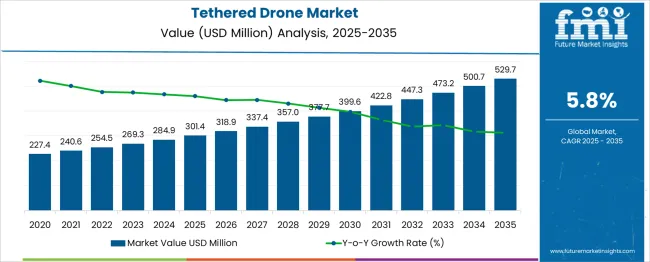
Defense modernization budgets and critical infrastructure protection mandates are sustaining procurement of persistent aerial surveillance platforms. Tethered systems offer continuous power delivery and secure data links, differentiating them from free-flying drones in applications where uninterrupted operation over fixed positions is required.
Regional demand reflects defense procurement cycles and public safety modernization priorities. China at 7.8%, India at 7.3%, Germany at 6.7%, France at 6.1%, UK at 5.5%, USA at 4.9%, Brazil at 4.4%. China leads through military and border surveillance deployments. India follows, driven by defense modernization under Make in India and border security programs. Germany and France sustain procurement through NATO-aligned persistent surveillance requirements. UK and USA maintain demand for critical infrastructure protection and event security. Brazil expands usage for Amazon region environmental monitoring and border patrol.
Tethered Drone Market Definition
Tethered drones are unmanned aerial systems physically connected to a ground station via a cable that supplies continuous power and a secure data link. These systems are deployed for persistent surveillance, communications relay, and environmental monitoring where uninterrupted flight time over a fixed location is required. The market covers stationary, mobile, and hybrid tethered configurations across defense, public safety, commercial, and environmental verticals.
Tethered Drone Market Inclusions
Market scope includes stationary, mobile, and hybrid tethered drone platforms across short-range, mid-range, and long-range configurations. Coverage spans vehicle-mounted, portable, fixed ground station, and maritime deployment modes. Applications include defense and security, public safety, commercial and industrial, and environmental monitoring, with global and regional sizing from 2026 to 2036.
Tethered Drone Market Exclusions
The scope excludes free-flying autonomous drones without a physical tether connection, satellite-based surveillance systems, and manned aerial vehicles. Ground-based surveillance cameras and standalone communication relay towers are also excluded.
Tethered Drone Market Research Methodology
- Primary Research: Analysts engaged with procurement specialists, product engineers, and distribution channel managers to map decision criteria and adoption triggers across core verticals.
- Desk Research: Data collection aggregated regulatory filings, standards body publications, trade association reports, and public procurement records across covered geographies.
- Market-Sizing and Forecasting: Baseline values derive from a bottom-up aggregation of product-level shipments and service contracts, applying region-specific adoption curves to project future demand velocity.
- Data Validation and Update Cycle: Projections are tested against publicly reported capital expenditure guidance, trade statistics, and primary interview inputs from active market participants.
Why is the Tethered Drone Market Growing?
The tethered drone market is experiencing robust expansion, driven by increasing demand for continuous aerial surveillance, persistent communication relays, and enhanced situational awareness in defense, public safety, and event security applications. Unlike traditional drones, tethered systems provide extended flight durations through continuous power supply, making them ideal for long-term deployment.
The growing adoption of tethered drones by law enforcement agencies, border patrols, and disaster response units is bolstered by advancements in fiber optic tethers, lightweight materials, and compact ground stations. Commercial sectors are also leveraging tethered drones for infrastructure inspection and media broadcasting.
Regulatory ease compared to free-flight UAVs and the ability to operate in GPS-denied environments are further enhancing market appeal. Continued investments in tether durability, sensor integration, and mobility platforms will reinforce market growth across both military and civilian domains.
Segmental Analysis
The tethered drone market is segmented by type, range, deployment mode, technology integration, application, and geographic regions. The tethered drone market is divided into Stationary tethered drones, Mobile tethered drones, and Hybrid tethered drones. In terms of the range, the tethered drone market is classified into Mid-range (100 - 300 meters), Short-range (100 meters), and Long-range (> 300 meters). The tethered drone market is segmented into Vehicle-mounted systems, Portable/man-portable systems, Fixed ground station-based systems, and Maritime. The technology integration of the tethered drone market is segmented into AI-enabled tethered drones, Computer vision-enhanced systems, Automated launch & recovery, Real-time edge computing systems, Encrypted communication & cybersecurity features, and Others. The tethered drone market is segmented into Defense & security, Public safety & emergency response, Commercial & industrial, Environmental monitoring, and Others. Regionally, the tethered drone industry is classified into North America, Latin America, Western Europe, Eastern Europe, Balkan & Baltic Countries, Russia & Belarus, Central Asia, East Asia, South Asia & Pacific, and the Middle East & Africa.
Insights into the Type Segment - Stationary Tethered Drones
Stationary tethered drones are projected to lead the market with a 45.00% share in 2026. Their ability to offer stable, uninterrupted flight for extended periods makes them ideal for fixed-site surveillance, crowd monitoring, and event security.
These drones are typically deployed with compact ground power units, enabling real-time data transmission and persistent operation. Their cost-efficiency and ease of setup have driven adoption among government agencies and private security firms.
Additionally, stationary drones are less affected by weather variables, making them suitable for continuous field operation. As operational reliability and regulatory compliance remain top priorities, stationary systems continue to gain traction in mission-critical applications.
Insights into the Range Segment - Mid-Range (100 - 300 meters)
The mid-range category is expected to dominate the range segment with a 42.00% share in 2026. This range offers a balance between altitude flexibility and operational stability, making it suitable for perimeter security, emergency response, and communication relay applications.
Mid-range tethers provide sufficient elevation for wide-area coverage without compromising tether integrity or signal quality. These drones are favored for their ability to remain within visual line-of-sight (VLOS) while providing high-resolution imaging and data relay.
Technological improvements in lightweight tether cables and compact elevation controls are further optimizing mid-range performance, fueling deployment across both urban and remote locations.
Insights into the Deployment Mode Segment - Vehicle-Mounted Systems
Vehicle-mounted systems are projected to hold a 39.00% share of the tethered drone market in 2026, emerging as the leading deployment mode. These mobile platforms combine flexibility with rapid deployment, enabling on-the-go surveillance for convoys, emergency units, and battlefield operations.
Mounted systems can be integrated into trucks, armored vehicles, or trailers, allowing continuous operation during transit or stationary missions. Their growing use in defense, law enforcement, and border patrol operations is supported by enhancements in stabilization mechanisms, autonomous winching, and tether management systems.
As governments emphasize mobile intelligence-gathering and perimeter surveillance, vehicle-mounted tethered drones are gaining preference for their operational agility and field readiness.
What are the Drivers, Restraints, and Key Trends of the Tethered Drone Market?
The tethered drone market is expanding as continuous aerial surveillance, extended flight duration, and secure data transmission become essential in defense, public safety, and infrastructure monitoring. Unlike free-flying drones, tethered variants operate with a physical cable that supplies power and communication, enabling uninterrupted operations over long periods. Their ability to maintain stable altitude and real-time video makes them highly effective for crowd control, border patrol, event monitoring, and tactical communication. As ground-based sectors demand persistent visibility, tethered drones are gaining traction across global applications.
Defense and Public Safety Applications Drive Adoption
Tethered drones have become valuable assets for defense forces and law enforcement agencies due to their ability to provide persistent aerial coverage without the limitations of onboard battery life. These systems are used for battlefield observation, perimeter surveillance, and crowd management in large public gatherings. Their continuous power supply allows for long-duration operations, which is a critical requirement for military outposts or tactical units that require real-time intelligence over extended periods. In public safety, emergency responders deploy tethered drones during natural disasters or urban incidents to gather aerial views of affected areas while maintaining reliable data links. Unlike traditional drones, they offer a stable position that is less susceptible to interference or signal loss. These capabilities make them essential for command centers that rely on uninterrupted aerial video feeds. As tactical planning and real-time situational awareness gain priority, tethered drones continue to replace traditional observation tools in various operational environments.
Mobility Limitations and Terrain Dependency Pose Challenges
One of the core limitations of tethered drones is their constrained mobility, which restricts their usage in dynamic or large-area operations. The cable, while enabling uninterrupted power and data, limits flight range to a fixed radius and hinders deployment in rugged or obstructed terrain. This makes them less effective for search-and-rescue missions across unpredictable landscapes or fast-changing combat zones. The setup process can also be time-consuming, especially when deployed from mobile units or temporary installations. Infrastructure requirements, such as power generators and ground control units, must be present and secure. Additionally, the physical tether can become a point of vulnerability in high-wind conditions or during adversarial engagements. These constraints mean tethered drones are typically used for fixed-location surveillance rather than agile operations. Companies and organizations seeking flexibility may hesitate to adopt tethered systems unless their use case strongly favors endurance and signal stability over mobility and geographic reach.
Infrastructure and Event Monitoring Unlocks New Markets
Outside of defense, tethered drones are being adopted in commercial sectors for applications requiring stable, continuous overhead observation. Large construction projects, critical infrastructure inspections, and major public events benefit from elevated monitoring capabilities without needing aircraft or free-flying drones. For instance, contractors can use tethered drones to monitor construction sites for safety compliance, progress tracking, and equipment management. Utilities and energy companies deploy them for substation surveillance or pipeline observation in remote areas, where reliability of visuals and secure data links are essential. Event organizers, especially for concerts or sports, use tethered drones for live broadcast and crowd monitoring due to their uninterrupted aerial presence. These drones can also act as temporary communication relays or lighting sources. As awareness grows around their operational reliability and cost-effectiveness compared to manned observation or continuous free-flight drones, new market segments are increasingly considering tethered drones as viable tools for fixed-location aerial insight.
Regulatory Ambiguity and Deployment Restrictions Restrain Market Growth
Tethered drones, despite their operational advantages, face various regulatory uncertainties that affect market scalability. Their classification often falls between manned aerial systems and traditional drones, leading to inconsistent rules across regions. Some jurisdictions may still require airspace clearance or line-of-sight operations even though the drone is physically connected to the ground. In urban settings, deployment may be hindered by local ordinances restricting aerial activity or tether installation on public land. There are also challenges regarding data privacy when used for surveillance in civilian areas. Furthermore, operating near airports, secure facilities, or communication towers may require special permits or be entirely prohibited. Commercial users must navigate these regulatory hurdles carefully, which can delay deployment or limit operations in key locations. Without clear regulatory pathways or standardized guidelines, adoption among civilian, industrial, and municipal sectors remains slower than the technology’s capabilities might otherwise suggest.
Analysis of Tethered Drone Market By Key Countries
.webp "Top Country Growth Comparison Tethered Drone Market Cagr (2026 2036)")
| Country | CAGR |
|---|---|
| China | 7.8% |
| India | 7.3% |
| Germany | 6.7% |
| France | 6.1% |
| UK | 5.5% |
| USA | 4.9% |
| Brazil | 4.4% |
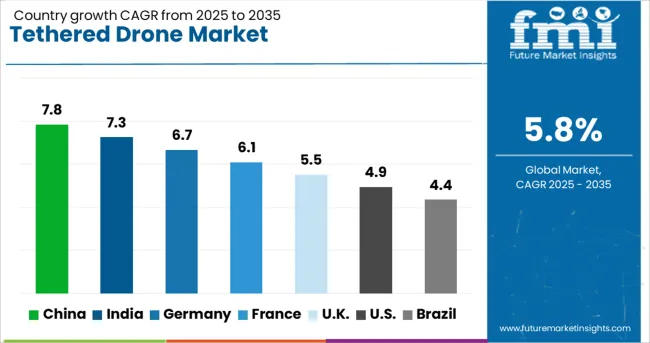
The global tethered drone market is expanding at a CAGR of 5.8%, driven by increasing demand for persistent aerial surveillance, secure communication links, and border monitoring. China leads with 7.8% growth, backed by military modernization programs and investments in drone-based infrastructure monitoring. India follows at 7.3%, fueled by applications in defense, disaster response, and crowd control. Germany reports 6.7% growth, reflecting advancements in industrial inspection and adherence to strict regulatory frameworks. The United Kingdom shows steady growth at 5.5%, with usage across emergency services and event security. The United States, growing at 4.9%, remains a mature market with a focus on R&D, secure data transmission, and regulatory compliance. Market trends are shaped by endurance capabilities, power supply innovations, and real-time data integration. This report includes insights on 40+ countries; the top countries are shown here for reference.
Tethered Drone Market Advancements in China
In China, tethered drone market is expanding at a 7.8% CAGR, backed by the country’s growing interest in long-endurance surveillance, communication relays, and border monitoring. Defense and public safety agencies are incorporating tethered systems for continuous aerial coverage without relying on battery limitations. Civil applications such as traffic management, infrastructure inspection, and large event monitoring are also contributing to market growth. Manufacturers are producing compact, rugged units with lightweight tether cables and advanced power transfer modules. Local governments support drone tech incubators and collaborative projects with research institutions to develop smarter autonomous flight control systems. The export market is growing, with Chinese tethered drones being adopted by overseas customers in Asia and Africa.
- Law enforcement used drones for sustained aerial patrols
- Event organizers deployed tethered units for crowd monitoring
- Export shipments increased across developing regions
Tethered Drone Market Outlook in India
India is witnessing steady progress in the tethered drone segment, with a CAGR of 7.3%, supported by expanding use in defense, telecommunications, and disaster management. Paramilitary and police forces are deploying these drones for prolonged situational awareness during border operations and public demonstrations. Tethered platforms are increasingly integrated into command systems for continuous surveillance in difficult terrains. Telecom providers are piloting drones as temporary aerial towers to boost signal strength during outages or emergencies. Indian drone startups are collaborating with public agencies to develop portable, battery-agnostic tethering stations. The government is also encouraging use in powerline inspections and traffic regulation.
- Security forces used drones for extended field visibility
- Telecom operators tested drones as aerial network boosters
- Startups built lightweight tether systems for mobility
Tethered Drone Market Adoption in Germany
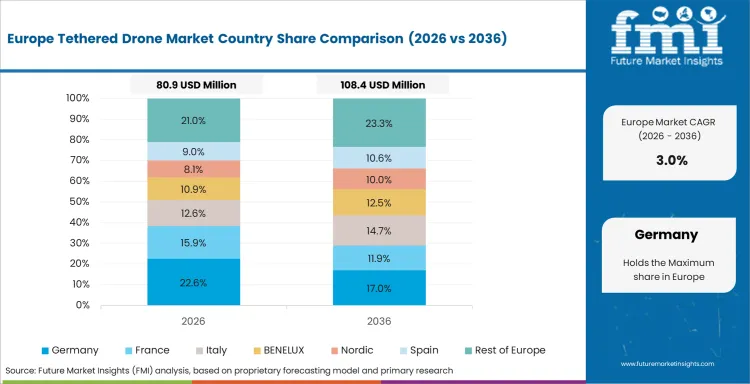
Tethered drone market in Germany, registering a 6.7% CAGR, is being driven by demand from industrial inspection, emergency response, and military support services. Utility companies are adopting drones for substation and transmission line monitoring, especially in remote areas. Emergency services utilize tethered drones for live visual feedback during fire rescues, accidents, and search operations. The country’s engineering firms are designing tethered platforms that support thermal cameras and gas detectors for industrial applications. Integration with communication relay systems is also advancing, allowing use in low-connectivity zones. Public safety departments are establishing drone units for disaster readiness protocols.
- Power firms used drones for grid inspection tasks
- Fire departments deployed aerial views during rescues
- Industrial units adopted drones with gas sensors
Tethered Drone Market Trends in the United States
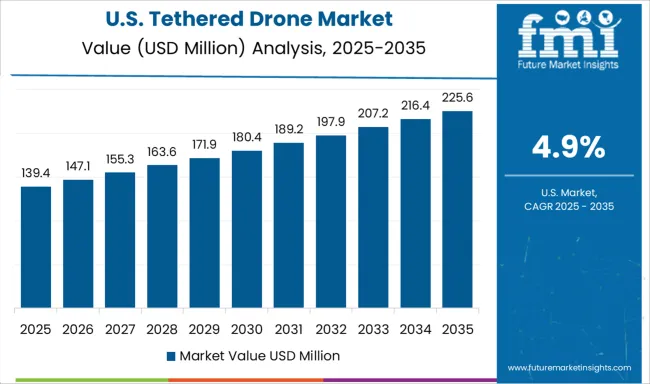
The United States tethered drone market is growing at a 4.9% CAGR, influenced by rising demand from defense, critical infrastructure, and public safety sectors. Homeland security agencies are testing tethered drones for persistent overwatch in high-risk zones and critical facility monitoring. Utility companies are using these systems to inspect pipelines, refineries, and remote substations with minimal downtime. In emergency response scenarios, tethered drones offer uninterrupted visibility over wildfire zones, flooding areas, and large-scale evacuations. Tech startups are developing drone ground stations that integrate with mobile command units and provide uninterrupted data streaming. Regulations are also evolving to accommodate longer operational hours.
- Security agencies implemented drones for facility monitoring
- Energy sector used aerial systems for infrastructure checks
- Emergency crews relied on tethered drones for field visibility
Competitive Landscape of Tethered Drone Market
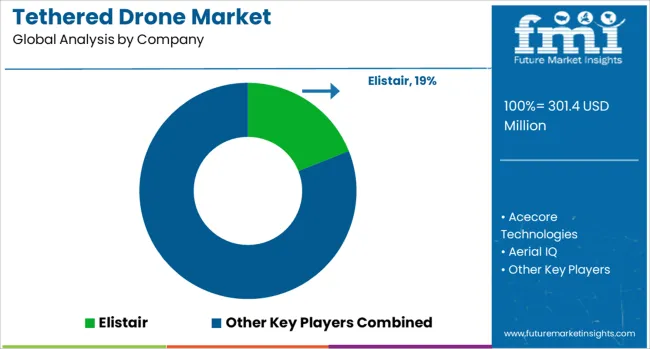
The Tethered Drone Market is gaining attention for its role in providing long-duration aerial surveillance, communication relays, and monitoring without the limitations of battery life. These drones are physically connected to a ground power source via a cable, allowing them to remain airborne for extended periods ideal for defense, public safety, traffic control, and event security applications. Their reliability and uninterrupted data transmission capabilities make them a practical choice in scenarios where conventional drones may fall short. Key players such as Elistair, Acecore Technologies, and Fotokite are at the forefront of delivering compact, field-deployable systems tailored for law enforcement, firefighting, and military units.
Companies like Easy Aerial and Aerial IQ offer turnkey solutions that combine rugged hardware with autonomous flight software, while FlyFocus emphasizes high-resolution, persistent surveillance. India's Bharat Electronics is developing domestic solutions to meet local defense and homeland security requirements, supporting government-led deployment initiatives. The market is expanding alongside demand for continuous situational awareness, perimeter security, and live aerial intelligence. Tethered drone systems are also seeing growth in industrial use such as monitoring construction sites, large-scale infrastructure, and offshore platforms where consistent, high-altitude observation is critical. With simplified regulations and increasing focus on safety, the tethered drone market is expected to remain a reliable tool for high-endurance aerial operations.
Key Developments in Tethered Drone Market
On May 13, 2025, Elistair officially announced the delivery of 13 tethered surveillance drones to Terra Spatium, supporting the Hellenic Fire Service. Integrated into mobile operations centers, these drones enable continuous aerial monitoring for wildfire detection and emergency response as part of Greece’s national disaster resilience initiative.
Scope of the Report
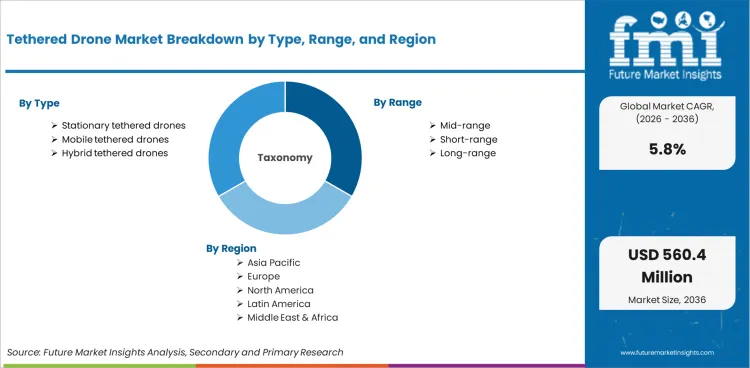
| Metric | Value |
|---|---|
| Quantitative Units | USD 318.88 million to USD 560.38 million, at a CAGR of 5.80% |
| Market Definition | Tethered drones are unmanned aerial systems physically connected to a ground station via a cable that supplies continuous power and a secure data link. These systems are deployed for persistent surveillance, communications relay, and environmental monitoring where uninterrupted flight time over a fixed location is required. The market covers stationary, mobile, and hybrid tethered configurations across defense, public safety, commercial, and environmental verticals. |
| Type Segmentation | Stationary Tethered Drones, Mobile Tethered Drones, Hybrid Tethered Drones |
| Range Segmentation | Mid-range, Short-range, Long-range |
| Deployment Mode Segmentation | Vehicle-mounted Systems, Portable/Man-portable Systems, Fixed Ground Station-based Systems, Maritime |
| Technology Integration Segmentation | AI-enabled Tethered Drones, Computer Vision-enhanced Systems, Automated Launch & Recovery, Real-time Edge Computing Systems, Encrypted Communication & Cybersecurity Features, Others |
| Application Segmentation | Defense & Security, Public Safety & Emergency Response, Commercial & Industrial, Environmental Monitoring, Others |
| Regions Covered | North America, Latin America, Europe, East Asia, South Asia, Oceania, Middle East & Africa |
| Countries Covered | China, India, Germany, France, UK, USA, Brazil, and 40 plus countries |
| Key Companies Profiled | Elistair, Acecore Technologies, Fotokite, Easy Aerial, Aerial IQ, FlyFocus, Bharat Electronics |
| Forecast Period | 2026 to 2036 |
| Approach | Forecasting models apply a bottom-up methodology starting with global installed base metrics and cross-validate projections against primary research and public procurement data. |
Tethered Drone Market by Segments
Type:
- Stationary tethered drones
- Mobile tethered drones
- Hybrid tethered drones
Range:
- Mid-range (100 – 300 meters)
- Short-range (100 meters)
- Long-range (> 300 meters)
Deployment Mode:
- Vehicle-mounted systems
- Portable/man-portable systems
- Fixed ground station-based systems
- Maritime
Technology Integration:
- AI-enabled tethered drones
- Computer vision-enhanced systems
- Automated launch & recovery
- Real-time edge computing systems
- Encrypted communication & cybersecurity features
- Others
Application:
- Defense & security
- Public safety & emergency response
- Commercial & industrial
- Environmental monitoring
- Others
Region:
- North America
- USA
- Canada
- Mexico
- Latin America
- Brazil
- Chile
- Rest of Latin America
- Western Europe
- Germany
- UK
- Italy
- Spain
- France
- Nordic
- BENELUX
- Rest of Western Europe
- Eastern Europe
- Russia
- Poland
- Hungary
- Balkan & Baltic
- Rest of Eastern Europe
- East Asia
- China
- Japan
- South Korea
- South Asia and Pacific
- India
- ASEAN
- Australia & New Zealand
- Rest of South Asia and Pacific
- Middle East & Africa
- Kingdom of Saudi Arabia
- Other GCC Countries
- Turkiye
- South Africa
- Other African Union
- Rest of Middle East & Africa
Bibliography
- 1. North Atlantic Treaty Organization. (2024). NATO Standardization Agreement for Unmanned Systems. NATO.
- 2. Ministry of Defence, India. (2025). Defence Procurement Procedure 2025. MoD India.
- 3. European Defence Agency. (2024). Capability Development Plan for Unmanned Aerial Systems. EDA.
- 4. USA Department of Defense. (2025). Unmanned Systems Integrated Roadmap. DoD.
- 5. International Civil Aviation Organization. (2024). Unmanned Aircraft Systems Traffic Management Framework. ICAO.
This bibliography is provided for reader reference. The full Future Market Insights report contains the complete reference list with primary research documentation.
Frequently Asked Questions
How large is the demand for Tethered Drone in the global market in 2026?
Demand for Tethered Drone in the global market is estimated to be valued at USD 318.88 million in 2026.
What will be the market size of Tethered Drone in the global market by 2036?
Market size for Tethered Drone is projected to reach USD 560.38 million by 2036.
What is the expected demand growth for Tethered Drone between 2026 and 2036?
Demand for Tethered Drone is expected to grow at a CAGR of 5.80% between 2026 and 2036.
Which Type is poised to lead global sales by 2026?
Stationary Tethered Drones leads by Type in 2026, driven by broad adoption across core verticals.
What is driving demand in China?
China leads at 7.8% CAGR, driven by expanding domestic capacity and growing adoption across core application segments.
What is the India growth outlook in this report?
India is projected to grow at a CAGR of 7.3% during 2026 to 2036.
What is included in the scope of this Tethered Drone report?
Market scope includes stationary, mobile, and hybrid tethered drone platforms across short-range, mid-range, and long-range configurations. Coverage spans vehicle-mounted, portable, fixed ground station, and maritime deployment modes. Applications include defense and security, public safety, commercial and industrial, and environmental monitoring, with global and regional sizing from 2026 to 2036.
What is excluded from the scope of this report?
The scope excludes free-flying autonomous drones without a physical tether connection, satellite-based surveillance systems, and manned aerial vehicles. Ground-based surveillance cameras and standalone communication relay towers are also excluded.
Preview the report firsthand - request a free sample
Get SampleGet the brochure for pricing and purchase details.
Get PDFTable of Content
- Executive Summary
- Global Market Outlook
- Demand-side Trends
- Supply-side Trends
- Technology Roadmap Analysis
- Analysis and Recommendations
- Market Overview
- Market Coverage / Taxonomy
- Market Definition / Scope / Limitations
- Research Methodology
- Chapter Orientation
- Analytical Lens and Working Hypotheses
- Market Structure, Signals, and Trend Drivers
- Benchmarking and Cross-market Comparability
- Market Sizing, Forecasting, and Opportunity Mapping
- Research Design and Evidence Framework
- Desk Research Programme (Secondary Evidence)
- Company Annual and Sustainability Reports
- Peer-reviewed Journals and Academic Literature
- Corporate Websites, Product Literature, and Technical Notes
- Earnings Decks and Investor Briefings
- Statutory Filings and Regulatory Disclosures
- Technical White Papers and Standards Notes
- Trade Journals, Industry Magazines, and Analyst Briefs
- Conference Proceedings, Webinars, and Seminar Materials
- Government Statistics Portals and Public Data Releases
- Press Releases and Reputable Media Coverage
- Specialist Newsletters and Curated Briefings
- Sector Databases and Reference Repositories
- FMI Internal Proprietary Databases and Historical Market Datasets
- Subscription Datasets and Paid Sources
- Social Channels, Communities, and Digital Listening Inputs
- Additional Desk Sources
- Expert Input and Fieldwork (Primary Evidence)
- Primary Modes
- Qualitative Interviews and Expert Elicitation
- Quantitative Surveys and Structured Data Capture
- Blended Approach
- Why Primary Evidence is Used
- Field Techniques
- Interviews
- Surveys
- Focus Groups
- Observational and In-context Research
- Social and Community Interactions
- Stakeholder Universe Engaged
- C-suite Leaders
- Board Members
- Presidents and Vice Presidents
- R&D and Innovation Heads
- Technical Specialists
- Domain Subject-matter Experts
- Scientists
- Physicians and Other Healthcare Professionals
- Governance, Ethics, and Data Stewardship
- Research Ethics
- Data Integrity and Handling
- Primary Modes
- Tooling, Models, and Reference Databases
- Desk Research Programme (Secondary Evidence)
- Data Engineering and Model Build
- Data Acquisition and Ingestion
- Cleaning, Normalisation, and Verification
- Synthesis, Triangulation, and Analysis
- Quality Assurance and Audit Trail
- Market Background
- Market Dynamics
- Drivers
- Restraints
- Opportunity
- Trends
- Scenario Forecast
- Demand in Optimistic Scenario
- Demand in Likely Scenario
- Demand in Conservative Scenario
- Opportunity Map Analysis
- Product Life Cycle Analysis
- Supply Chain Analysis
- Investment Feasibility Matrix
- Value Chain Analysis
- PESTLE and Porter’s Analysis
- Regulatory Landscape
- Regional Parent Market Outlook
- Production and Consumption Statistics
- Import and Export Statistics
- Market Dynamics
- Global Market Analysis 2021 to 2025 and Forecast, 2026 to 2036
- Historical Market Size Value (USD Million) Analysis, 2021 to 2025
- Current and Future Market Size Value (USD Million) Projections, 2026 to 2036
- Y-o-Y Growth Trend Analysis
- Absolute $ Opportunity Analysis
- Global Market Pricing Analysis 2021 to 2025 and Forecast 2026 to 2036
- Global Market Analysis 2021 to 2025 and Forecast 2026 to 2036, By Type
- Introduction / Key Findings
- Historical Market Size Value (USD Million) Analysis By Type , 2021 to 2025
- Current and Future Market Size Value (USD Million) Analysis and Forecast By Type , 2026 to 2036
- Stationary tethered drones
- Mobile tethered drones
- Hybrid tethered drones
- Stationary tethered drones
- Y-o-Y Growth Trend Analysis By Type , 2021 to 2025
- Absolute $ Opportunity Analysis By Type , 2026 to 2036
- Global Market Analysis 2021 to 2025 and Forecast 2026 to 2036, By Range
- Introduction / Key Findings
- Historical Market Size Value (USD Million) Analysis By Range, 2021 to 2025
- Current and Future Market Size Value (USD Million) Analysis and Forecast By Range, 2026 to 2036
- Mid-range
- Short-range
- Long-range
- Mid-range
- Y-o-Y Growth Trend Analysis By Range, 2021 to 2025
- Absolute $ Opportunity Analysis By Range, 2026 to 2036
- Global Market Analysis 2021 to 2025 and Forecast 2026 to 2036, By Deployment Mode
- Introduction / Key Findings
- Historical Market Size Value (USD Million) Analysis By Deployment Mode, 2021 to 2025
- Current and Future Market Size Value (USD Million) Analysis and Forecast By Deployment Mode, 2026 to 2036
- Vehicle-mounted systems
- Portable/man-portable systems
- Fixed ground station-based systems
- Maritime
- Vehicle-mounted systems
- Y-o-Y Growth Trend Analysis By Deployment Mode, 2021 to 2025
- Absolute $ Opportunity Analysis By Deployment Mode, 2026 to 2036
- Global Market Analysis 2021 to 2025 and Forecast 2026 to 2036, By Technology Integration
- Introduction / Key Findings
- Historical Market Size Value (USD Million) Analysis By Technology Integration, 2021 to 2025
- Current and Future Market Size Value (USD Million) Analysis and Forecast By Technology Integration, 2026 to 2036
- AI-enabled tethered drones
- Computer vision-enhanced systems
- Automated launch & recovery
- Real-time edge computing systems
- Encrypted communication & cybersecurity features
- Others
- AI-enabled tethered drones
- Y-o-Y Growth Trend Analysis By Technology Integration, 2021 to 2025
- Absolute $ Opportunity Analysis By Technology Integration, 2026 to 2036
- Global Market Analysis 2021 to 2025 and Forecast 2026 to 2036, By Application
- Introduction / Key Findings
- Historical Market Size Value (USD Million) Analysis By Application, 2021 to 2025
- Current and Future Market Size Value (USD Million) Analysis and Forecast By Application, 2026 to 2036
- Defense & security
- Public safety & emergency response
- Commercial & industrial
- Environmental monitoring
- Others
- Defense & security
- Y-o-Y Growth Trend Analysis By Application, 2021 to 2025
- Absolute $ Opportunity Analysis By Application, 2026 to 2036
- Global Market Analysis 2021 to 2025 and Forecast 2026 to 2036, By Region
- Introduction
- Historical Market Size Value (USD Million) Analysis By Region, 2021 to 2025
- Current Market Size Value (USD Million) Analysis and Forecast By Region, 2026 to 2036
- North America
- Latin America
- Western Europe
- Eastern Europe
- East Asia
- South Asia and Pacific
- Middle East & Africa
- Market Attractiveness Analysis By Region
- North America Market Analysis 2021 to 2025 and Forecast 2026 to 2036, By Country
- Historical Market Size Value (USD Million) Trend Analysis By Market Taxonomy, 2021 to 2025
- Market Size Value (USD Million) Forecast By Market Taxonomy, 2026 to 2036
- By Country
- USA
- Canada
- Mexico
- By Type
- By Range
- By Deployment Mode
- By Technology Integration
- By Application
- By Country
- Market Attractiveness Analysis
- By Country
- By Type
- By Range
- By Deployment Mode
- By Technology Integration
- By Application
- Key Takeaways
- Latin America Market Analysis 2021 to 2025 and Forecast 2026 to 2036, By Country
- Historical Market Size Value (USD Million) Trend Analysis By Market Taxonomy, 2021 to 2025
- Market Size Value (USD Million) Forecast By Market Taxonomy, 2026 to 2036
- By Country
- Brazil
- Chile
- Rest of Latin America
- By Type
- By Range
- By Deployment Mode
- By Technology Integration
- By Application
- By Country
- Market Attractiveness Analysis
- By Country
- By Type
- By Range
- By Deployment Mode
- By Technology Integration
- By Application
- Key Takeaways
- Western Europe Market Analysis 2021 to 2025 and Forecast 2026 to 2036, By Country
- Historical Market Size Value (USD Million) Trend Analysis By Market Taxonomy, 2021 to 2025
- Market Size Value (USD Million) Forecast By Market Taxonomy, 2026 to 2036
- By Country
- Germany
- UK
- Italy
- Spain
- France
- Nordic
- BENELUX
- Rest of Western Europe
- By Type
- By Range
- By Deployment Mode
- By Technology Integration
- By Application
- By Country
- Market Attractiveness Analysis
- By Country
- By Type
- By Range
- By Deployment Mode
- By Technology Integration
- By Application
- Key Takeaways
- Eastern Europe Market Analysis 2021 to 2025 and Forecast 2026 to 2036, By Country
- Historical Market Size Value (USD Million) Trend Analysis By Market Taxonomy, 2021 to 2025
- Market Size Value (USD Million) Forecast By Market Taxonomy, 2026 to 2036
- By Country
- Russia
- Poland
- Hungary
- Balkan & Baltic
- Rest of Eastern Europe
- By Type
- By Range
- By Deployment Mode
- By Technology Integration
- By Application
- By Country
- Market Attractiveness Analysis
- By Country
- By Type
- By Range
- By Deployment Mode
- By Technology Integration
- By Application
- Key Takeaways
- East Asia Market Analysis 2021 to 2025 and Forecast 2026 to 2036, By Country
- Historical Market Size Value (USD Million) Trend Analysis By Market Taxonomy, 2021 to 2025
- Market Size Value (USD Million) Forecast By Market Taxonomy, 2026 to 2036
- By Country
- China
- Japan
- South Korea
- By Type
- By Range
- By Deployment Mode
- By Technology Integration
- By Application
- By Country
- Market Attractiveness Analysis
- By Country
- By Type
- By Range
- By Deployment Mode
- By Technology Integration
- By Application
- Key Takeaways
- South Asia and Pacific Market Analysis 2021 to 2025 and Forecast 2026 to 2036, By Country
- Historical Market Size Value (USD Million) Trend Analysis By Market Taxonomy, 2021 to 2025
- Market Size Value (USD Million) Forecast By Market Taxonomy, 2026 to 2036
- By Country
- India
- ASEAN
- Australia & New Zealand
- Rest of South Asia and Pacific
- By Type
- By Range
- By Deployment Mode
- By Technology Integration
- By Application
- By Country
- Market Attractiveness Analysis
- By Country
- By Type
- By Range
- By Deployment Mode
- By Technology Integration
- By Application
- Key Takeaways
- Middle East & Africa Market Analysis 2021 to 2025 and Forecast 2026 to 2036, By Country
- Historical Market Size Value (USD Million) Trend Analysis By Market Taxonomy, 2021 to 2025
- Market Size Value (USD Million) Forecast By Market Taxonomy, 2026 to 2036
- By Country
- Kingdom of Saudi Arabia
- Other GCC Countries
- Turkiye
- South Africa
- Other African Union
- Rest of Middle East & Africa
- By Type
- By Range
- By Deployment Mode
- By Technology Integration
- By Application
- By Country
- Market Attractiveness Analysis
- By Country
- By Type
- By Range
- By Deployment Mode
- By Technology Integration
- By Application
- Key Takeaways
- Key Countries Market Analysis
- USA
- Pricing Analysis
- Market Share Analysis, 2025
- By Type
- By Range
- By Deployment Mode
- By Technology Integration
- By Application
- Canada
- Pricing Analysis
- Market Share Analysis, 2025
- By Type
- By Range
- By Deployment Mode
- By Technology Integration
- By Application
- Mexico
- Pricing Analysis
- Market Share Analysis, 2025
- By Type
- By Range
- By Deployment Mode
- By Technology Integration
- By Application
- Brazil
- Pricing Analysis
- Market Share Analysis, 2025
- By Type
- By Range
- By Deployment Mode
- By Technology Integration
- By Application
- Chile
- Pricing Analysis
- Market Share Analysis, 2025
- By Type
- By Range
- By Deployment Mode
- By Technology Integration
- By Application
- Germany
- Pricing Analysis
- Market Share Analysis, 2025
- By Type
- By Range
- By Deployment Mode
- By Technology Integration
- By Application
- UK
- Pricing Analysis
- Market Share Analysis, 2025
- By Type
- By Range
- By Deployment Mode
- By Technology Integration
- By Application
- Italy
- Pricing Analysis
- Market Share Analysis, 2025
- By Type
- By Range
- By Deployment Mode
- By Technology Integration
- By Application
- Spain
- Pricing Analysis
- Market Share Analysis, 2025
- By Type
- By Range
- By Deployment Mode
- By Technology Integration
- By Application
- France
- Pricing Analysis
- Market Share Analysis, 2025
- By Type
- By Range
- By Deployment Mode
- By Technology Integration
- By Application
- India
- Pricing Analysis
- Market Share Analysis, 2025
- By Type
- By Range
- By Deployment Mode
- By Technology Integration
- By Application
- ASEAN
- Pricing Analysis
- Market Share Analysis, 2025
- By Type
- By Range
- By Deployment Mode
- By Technology Integration
- By Application
- Australia & New Zealand
- Pricing Analysis
- Market Share Analysis, 2025
- By Type
- By Range
- By Deployment Mode
- By Technology Integration
- By Application
- China
- Pricing Analysis
- Market Share Analysis, 2025
- By Type
- By Range
- By Deployment Mode
- By Technology Integration
- By Application
- Japan
- Pricing Analysis
- Market Share Analysis, 2025
- By Type
- By Range
- By Deployment Mode
- By Technology Integration
- By Application
- South Korea
- Pricing Analysis
- Market Share Analysis, 2025
- By Type
- By Range
- By Deployment Mode
- By Technology Integration
- By Application
- Russia
- Pricing Analysis
- Market Share Analysis, 2025
- By Type
- By Range
- By Deployment Mode
- By Technology Integration
- By Application
- Poland
- Pricing Analysis
- Market Share Analysis, 2025
- By Type
- By Range
- By Deployment Mode
- By Technology Integration
- By Application
- Hungary
- Pricing Analysis
- Market Share Analysis, 2025
- By Type
- By Range
- By Deployment Mode
- By Technology Integration
- By Application
- Kingdom of Saudi Arabia
- Pricing Analysis
- Market Share Analysis, 2025
- By Type
- By Range
- By Deployment Mode
- By Technology Integration
- By Application
- Turkiye
- Pricing Analysis
- Market Share Analysis, 2025
- By Type
- By Range
- By Deployment Mode
- By Technology Integration
- By Application
- South Africa
- Pricing Analysis
- Market Share Analysis, 2025
- By Type
- By Range
- By Deployment Mode
- By Technology Integration
- By Application
- USA
- Market Structure Analysis
- Competition Dashboard
- Competition Benchmarking
- Market Share Analysis of Top Players
- By Regional
- By Type
- By Range
- By Deployment Mode
- By Technology Integration
- By Application
- Competition Analysis
- Competition Deep Dive
- Elistair
- Overview
- Product Portfolio
- Profitability by Market Segments (Product/Age /Sales Channel/Region)
- Sales Footprint
- Strategy Overview
- Marketing Strategy
- Product Strategy
- Channel Strategy
- Acecore Technologies
- Fotokite
- Easy Aerial
- Aerial IQ
- FlyFocus
- Bharat Electronics
- Elistair
- Competition Deep Dive
- Assumptions & Acronyms Used


