

- Industry Size (2026)
- USD 9.7 Bn
- Forecast (2036)
- USD 18.4 Bn
- CAGR (2026 to 2036)
- 6.63%
Tethered Caps Packaging Market Size, Market Forecast and Outlook By FMI
The tethered caps packaging market was valued at USD 9.1 billion in 2025. Industry is expected to reach USD 9.7 billion in 2026 at a CAGR of 6.63% during the forecast. Demand outlook carries the market valuation to USD 18.4 billion through 2036 as global brands align with single-use plastic reduction targets and regulatory pressure shifts from European hubs to high-volume emerging markets in Asia and Latin America.
The change in framework from detachable closures to integrated tethering mechanisms represents a decisive shift in rigid packaging architecture. Packaging engineers are currently rejecting legacy cap designs that contribute to street litter, favoring instead multi-hinge or lasso-style tethers that guarantee the closure remains with the container through the entire recycling stream. Brands that delay this transition risk significant financial penalties and loss of retail shelf access in jurisdictions where Article 6 compliance is strictly enforced. This architectural pivot forces incumbent mold manufacturers to integrate precision-hinge technology into every high-speed production line.
Summary of Tethered Caps Packaging Market
- Tethered Caps Packaging Market Definition:
- Tethered caps packaging involves closures engineered to stay connected to the container, primarily to reduce litter and ensure caps are recycled with the bottle. This structural dependency defines the market boundary between legacy detachable caps and modern sustainable closures.
- Demand Drivers in the Market:
- Strict environmental regulations such as the EU's Single-Use Plastics Directive mandate that caps remain attached to plastic bottles up to 3 liters.
- Global beverage brands are adopting tethered closures to meet voluntary ESG targets and enhance their brand image as environmental leaders.
- Increased automation in recycling facilities requires closures to stay attached to bottles to be properly sorted and processed into high-quality PCR.
- Key Segments Analyzed in the FMI Report:
- Polyethylene (PE): 35.0% share in 2026, as the material's flexibility makes it ideal for durable living hinges in tethered designs.
- Beverages: 45.0% share in 2026, reflecting the high-volume demand from bottled water and soft drink manufacturers.
- India: 12.8% compound growth, driven by aggressive national plastic waste management rules and a rapidly expanding middle-class consumer base.
- Analyst Opinion at FMI:
- Nikhil Kaitwade, Principal Consultant at Future Market Insights, opines, "In my analysis, I have observed that the primary obstacle to tethered cap adoption is not the technical hinge design, but the consumer's initial resistance to the ergonomic change. Beverage producers attempting to minimize costs by using thinner tethers often face high failure rates, where the cap snaps off during opening, defeating the regulatory purpose. I believe that manufacturers who prioritize the 'click-to-open' tactile feedback—where the cap stays securely out of the user's way—will capture the largest share of the premium plastic caps and closures market."
- Strategic Implications / Executive Takeaways:
- Capping equipment vendors must offer modular retrofit kits to help bottlers transition to tethered designs without replacing entire production lines.
- Sustainability directors should prioritize monomaterial designs (PE cap on PE bottle) to simplify the recycling process and maximize credit in circular economy frameworks.
- Procurement leads at beverage firms must establish long-term contracts with closure suppliers who have verified high-volume mold capacity for compliant tethered designs.
- Methodology:
- Primary Research: FMI conducted technical interviews with packaging engineers and regulatory specialists across 40 plus countries to validate transition timelines.
- Desk Research: Analysts reviewed corporate sustainability reports, resin price indices, and global packaging policy updates from 2024 onwards.
- Market-Sizing and Forecasting: The model utilizes a bottom-up approach based on SKU-level container data and regional mandate enforcement schedules.
- Data Validation and Update Cycle: Forecasts are adjusted quarterly based on new legislative announcements and large-scale brand rollout schedules.
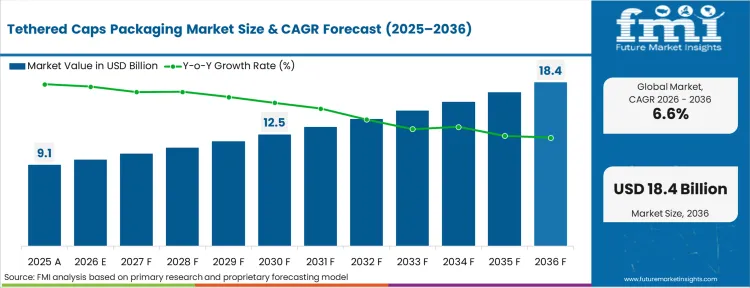
In FMI's view, the inflection point for this market occurs when the cost of specialized tethering resin and mold complexity achieves parity with legacy high-speed closure manufacturing. Procurement leads at national bottling plants must secure their 2027 resin supply and line time before 2026 retooling cycles peak, or they will face a production bottleneck as specialized equipment reaches maximum capacity. Once the global supply chain completes this transition, the "cap-on" consumer habit will become the universal standard for liquid container disposal.
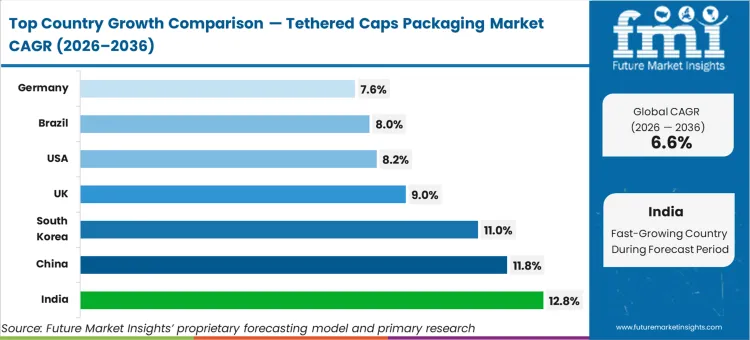
The spatial allocation of regions of tethered closure adoption follows the velocity of national sustainability mandates. India leads the expansion with a 12.8% CAGR, followed by China at 11.8% as both nations leverage massive greenfield bottling capacity to implement modern standards. South Korea tracks at 11.0% while the UK registers a 9.0% rate, both driven by advanced waste management policies. The United States advances at an 8.2% annual growth rate, supported by state-level environmental acts, while Brazil posts 8.0% and Germany follows with a 7.6% expansion.
Tethered Caps Packaging Market Key Takeaways
| Metric | Details |
|---|---|
| Industry Size (2026) | USD 9.7 billion |
| Industry Value (2036) | USD 18.4 billion |
| CAGR (2026-2036) | 6.63% |
Source: Future Market Insights (FMI) analysis, based on proprietary forecasting model and primary research
Tethered Caps Packaging Market Definition
Tethered Caps Packaging refers to a specialized closure system designed to remain permanently attached to the container body throughout its use and disposal phase. This integration is achieved through reinforced plastic hinges, strips, or lasso mechanisms that prevent the cap from becoming independent litter. The primary functional goal is to ensure that closures are captured within the same recycling stream as the bottle, thereby increasing overall material recovery rates for post-consumer resins.
Tethered Caps Packaging Market Inclusions
The market scope includes all rigid plastic closures featuring permanent attachment mechanisms for beverage packaging, including screw-on, flip-top, and snap-on formats. It encompasses caps manufactured from high-density polyethylene (HDPE) and polypropylene (PP) intended for bottled water, carbonated soft drinks, and dairy applications. Associated cap retrofitting services and specialized mold designs for tethered integration are also fully incorporated within the analytical boundaries.
Tethered Caps Packaging Market Exclusions
Standard detachable screw caps lacking any structural attachment to the container neck are explicitly excluded from this valuation. The scope also omits non-plastic closures such as metal crown corks, aluminum screw caps, and rubber stoppers that do not utilize a plastic tethering mechanism. Furthermore, secondary packaging elements, standalone labeling materials, and industrial bulk container lids that do not follow consumer-facing tethering standards are outside the defined parameters.
Tethered Caps Packaging Market Research Methodology
- Primary Research: Analysts engaged with closure procurement leads, sustainability directors at Tier-1 beverage companies, and high-speed molding equipment engineers to map the adoption timelines for tethered designs.
- Desk Research: The data collection phase aggregated environmental compliance registries, EU Single-Use Plastics Directive documentation, and corporate ESG roadmaps from leading global FMCG entities.
- Market-Sizing and Forecasting: The baseline value was established by correlating global beverage container volumes with region-specific tethered mandate deadlines, applying technical adoption curves to project future value.
- Data Validation and Update Cycle: Projections are cross-checked against announced capital expenditure for new capping machinery and quarterly resin consumption data for specialized closure polymers.
Segmental Analysis
Tethered Caps Packaging Market Analysis by Material
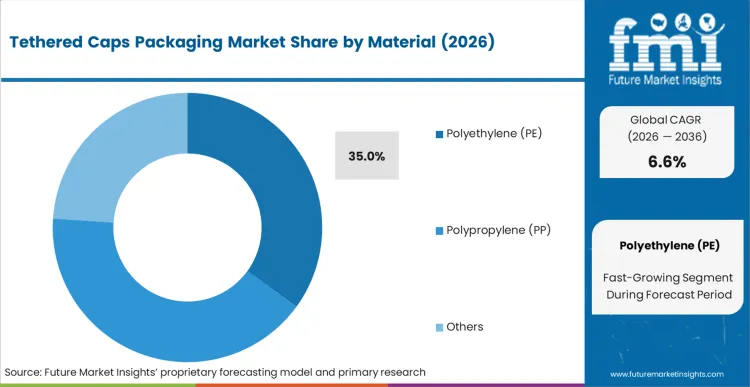
Polyethylene (PE) dominates the material landscape as the preferred resin for tethered closures due to its superior fatigue resistance and flexibility. Polyethylene (PE) accounts for a 35.0% share in 2026, a position solidified by the material's ability to withstand the repeated bending stress required by living hinge designs. Based on FMI's assessment, manufacturers are increasingly pivoting toward high-density polyethylene (HDPE) variants that offer high stress-crack resistance while maintaining the lightweight profile required for modern bottled water packaging. This material choice allows brands to meet rigid sustainability goals without sacrificing the airtight seal necessary for product freshness. Packaging engineers specifying these resins must ensure the polymer grade is compatible with high-speed injection molding to maintain cost efficiency. Resin suppliers failing to provide food-grade post-consumer recycled packaging integrated polyethylene will likely lose their status as preferred vendors in 2027 procurement cycles.
- Hinge durability: High-fatigue PE grades ensure that the tethering bridge remains intact after multiple opening cycles, preventing cap detachment during consumption.
- PCR integration: Modern PE formulations allow for the inclusion of up to 50% post-consumer recycled content without compromising the structural integrity of the thin tether strip.
- Weight optimization: Advanced PE molding allows for thinner neck finishes, reducing the overall resin mass per unit while sustaining the required tamper-evident functionality.
Tethered Caps Packaging Market Analysis by Application
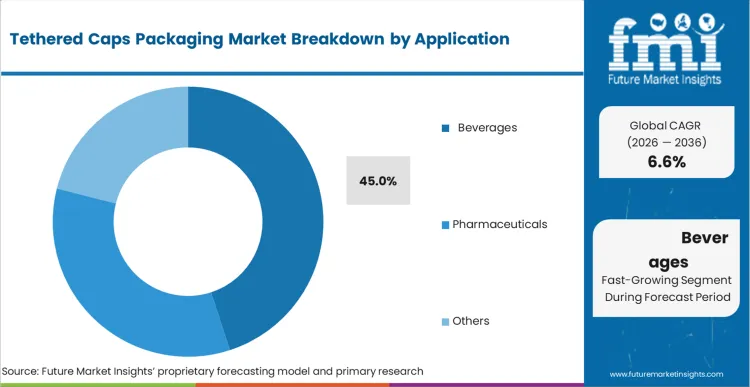
Beverage producers represent the primary engine of demand, forced by both legislation and consumer sentiment to adopt attached closures. Beverage applications capture a leading 45.0% share in 2026, as high-volume water and soft drink bottlers integrate tethered designs into their standard SKU profiles. FMI's analysis indicates that the complexity of maintaining carbonation at high pressure while utilizing a tethered hinge is the main technical hurdle for soft drink brands. Facilities transitioning to tethered screw caps realize measurable improvements in their corporate sustainability reporting by eliminating millions of potential litter items annually. Plant managers must validate that the new tethered designs do not impede the throughput of existing high-speed labeling and palletizing lines. Brands that fail to optimize the consumer opening experience-ensuring the cap does not hit the user's face while drinking-face immediate social media backlash and brand erosion.
- Pressure retention: Specialized threading in tethered screw caps maintains a hermetic seal for carbonated liquids, preventing CO2 leakage even after multiple resealing events.
- Aseptic compatibility: Tethered closures for dairy and functional drinks are engineered to withstand aseptic packaging and hot-fill processes without deformation of the hinge mechanism.
- Tamper evidence: Integrated tethering strips often incorporate visual evidence of first opening, combining sustainability with the security requirements of modern beverage retail.
Tethered Caps Packaging Market Drivers, Restraints, and Opportunities
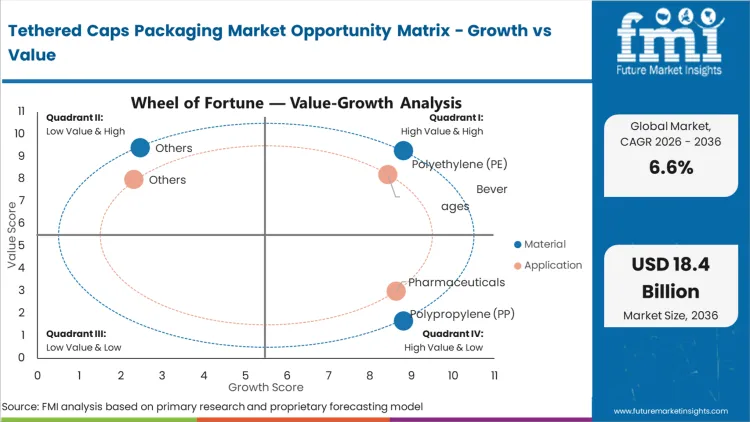
The primary driver for market expansion is the global alignment with sustainable packaging and single-use plastic (SUP) directives that aim to close the loop on packaging waste. National governments facing overcrowded landfills and ocean plastic crises are mandating that all closures remain attached to their containers. This architectural requirement renders legacy detachable caps obsolete in regulated markets. Asset owners who fail to upgrade their capping lines risk significant fines and the potential for a total ban on their products in high-revenue jurisdictions. Transitioning to a unified tethered system simplifies the sorting process at material recovery facilities and increases the volume of high-quality plastic available for reuse.
High initial capital expenditure for new molds and the complexity of retrofitting older capping machines act as significant market restraints. Small and medium-sized bottlers often lack the internal engineering expertise to redesign their container necks to accommodate thicker tethering hinges. This technical gap leads to increased production scrap rates and longer downtime during the initial transition phase. To mitigate these costs, manufacturers are increasingly relying on universal tethered cap designs that can be applied to standard preform neck finishes with minimal mechanical modification.
Opportunities in the Tethered Caps Packaging Market
- Monomaterial Innovation: Engineering departments can capture market share by developing 100% tethered closures that use the same resin as the bottle, simplifying the packaging recycling path. This consolidation eliminates the need for complex separation during processing and enhances the value of the resulting recyclate.
- Smart Hinge Designs: Next-generation tethered caps that "lock" in the open position offer a superior consumer experience for on-the-go drinkers. These designs prevent the cap from flapping back toward the mouth, a common user complaint that brands can solve to differentiate themselves.
- Pharmaceutical Expansion: Regulated healthcare sectors are exploring tethered closures for multi-dose pharmaceutical packaging to prevent cap loss and contamination. This opportunity allows suppliers to apply high-precision molding techniques to a high-margin, security-sensitive segment.
Regional Analysis
Based on the regional analysis, the Tethered Caps Packaging market is segmented into North America, Latin America, Europe, East Asia, South Asia, Oceania and Middle East & Africa across 40 plus countries.
.webp "Top Country Growth Comparison Tethered Caps Packaging Market Cagr (2026 2036)")
| Country | CAGR (2026 to 2036) |
|---|---|
| India | 12.8% |
| China | 11.8% |
| South Korea | 11.0% |
| UK | 9.0% |
| USA | 8.2% |
| Brazil | 8.0% |
| Germany | 7.6% |
Source: Future Market Insights (FMI) analysis, based on proprietary forecasting model and primary research
South Asia Tethered Caps Packaging Market Analysis
South Asia represents the fastest-growing region due to a combination of massive population growth and aggressive environmental legislation targeting plastic waste. Capital projects directors at regional bottling plants are bypassing intermediate sustainable steps and moving directly to tethered closures in their new facility blueprints. FMI analysts opine that this rapid adoption is a direct response to national "Clean India" initiatives and similar programs across the subcontinent that prioritize visible litter reduction. By building tethered capacity into the initial foundation, regional asset owners avoid the costly retrofit cycles that have slowed adoption in more mature Western markets.
- India: India's beverage sector operates under a strict Plastic Waste Management framework that requires 100% recyclability and the elimination of small plastic litter items. Sustainability leads in the domestic bottled water industry must deploy closures that guarantee the cap stays with the bottle to comply with upcoming national collection targets. The national push toward a circular economy triggers a wave of facility upgrades prioritizing unified liquid packaging backbones. This regulatory compliance pressure anchors India's 12.8% compound expansion of tethered closure demand to 2036.
- China: China is expected to expand at a CAGR of 11.8% as the nation’s "Dual Carbon" strategy forces a systemic redesign of the rigid packaging supply chain. The dominance of large-scale beverage entities like Nongfu Spring and Wahaha is driving a unified shift toward tethered closures to enhance corporate ESG profiles. Technical infrastructure in the Pearl River Delta is being repurposed to produce high-precision PE hinges that meet the durability requirements of the expanding middle-class consumer base.
- South Korea: South Korea tracks at a CAGR of 11.0%, supported by some of the world's most advanced waste-sorting protocols. The Ministry of Environment’s "Resource Circulation" act has created a high-stakes environment for closure manufacturers, where non-compliant packaging faces significant "eco-contribution" levies. Packaging engineers in the K-beauty and functional beverage sectors are leading the transition toward inclusive tethered designs that offer superior ergonomic handling.
North America Tethered Caps Packaging Market Analysis
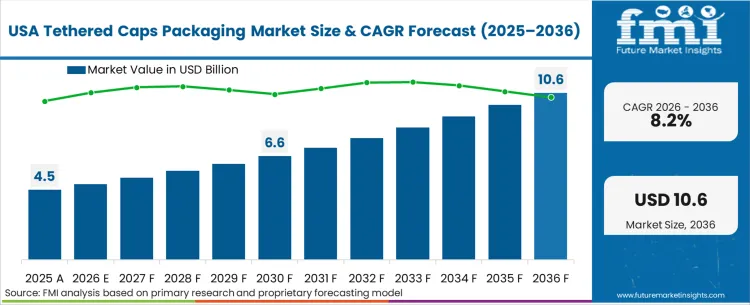
Modernization mandates across North America are increasingly driven by state-level environmental acts that target the systematic reduction of marine debris. Packaging engineers leading regional sustainability programs face directives to unify their closure portfolios under a single tethered architecture to simplify consumer recycling education. According to FMI's estimates, the high-volume carbonated beverage sector drives this consolidation to maintain retail presence in states with strict "extended producer responsibility" (EPR) laws. Implementing a standardized tethered backbone enables facilities to meet eco-friendly packaging targets by ensuring caps are recovered in the same stream as the high-value bottles.
- USA: The United States beverage industry is navigating a fragmented regulatory landscape where states like California and Washington lead the mandate for tethered closures. Network specification leads at national bottling chains must deploy converged capping systems capable of handling both legacy and tethered designs to maintain distribution flexibility. Federal environmental initiatives are increasingly funding research into compostable and bio-based tethering materials to further reduce the carbon footprint.
Europe Tethered Caps Packaging Market Analysis
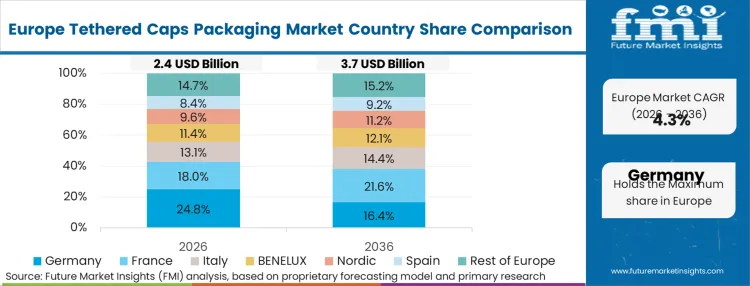
European industrial policy actively penalizes the continued use of detachable caps through the enforcement of Article 6 of the Single-Use Plastics Directive. Automation architects redesigning legacy production lines must integrate high-speed capping units capable of applying tethered closures without slowing down the filling cycle. This regulatory requirement has forced a complete overhaul of existing communication topologies between blow-molding and capping domains.
- Germany: Germany's automotive-like precision in recycling dictates stringent validation criteria for all new caps and closures introduced to the market. Control systems engineers must demonstrate that tethered closures do not interfere with the sensors in automated sorting machines. The national focus on "Design for Recycling" creates a recurring compliance cycle that accelerates the replacement of non-compliant molding equipment, driving a 7.6% annual expansion.
- United Kingdom: The UK market is projected to grow at a CAGR of 9.0% through 2036. Following the implementation of the Plastic Packaging Tax, UK-based bottlers are aggressively adopting tethered screw caps. FMI’s assessment indicates that the UK’s mature material recovery infrastructure is a major driver, as tethered closures significantly reduce the "fine-fraction" plastic loss during the sorting phase.
Latin America Tethered Caps Packaging Market Analysis
- Brazil: Brazil is expected to post a CAGR of 8.0%, reflecting the modernization of its massive domestic beverage and dairy sectors. As urban consumption patterns in São Paulo and Rio de Janeiro shift toward on-the-go convenience, the demand for secure, attached closures is rising. FMI analysts opine that the Brazilian market is particularly sensitive to resin price volatility, leading manufacturers to favor lightweight tethered designs that minimize plastic mass while maintaining the required hinge strength.
Competitive Aligners for Market Players
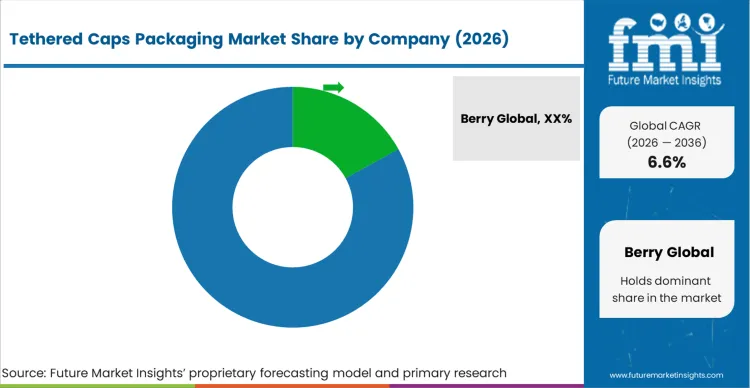
The introduction of standardized performance profiles for tethered hinges is reshaping how industrial buyers evaluate closure hardware. Instead of accepting generic caps, procurement teams now demand certified, high-fatigue resistant tethering mechanisms in all new tenders. This shift has raised the performance bar across the industry, meaning vendors that continue to rely on legacy detachable designs risk being excluded from major global brand portfolios. Industry leaders have already begun adapting, with manufacturers such as Berry Global and ALPLA aligning their portfolios with open sustainable standards.
Leading players have secured a significant architectural advantage by embedding the tethering mechanism directly into the cap mold rather than using secondary assembly steps. Companies like Bericap and United Caps, which incorporate precision hinges at the molding stage, help reduce the total cost of ownership for bottlers by minimizing production scrap and maintenance downtime. This silicon-first approach to mold design accelerates the transition for brownfield sites, allowing plant managers to prioritize platforms that avoid the complexity of external assembly machines.
Growth in cross-vendor interoperability for neck finishes is disrupting long-established market strongholds. With more neck finishes becoming standardized to accommodate universal tethered caps, system integrators can now choose closures from multiple suppliers without worrying about seal failure or threading issues. This expanded flexibility empowers facility owners to optimize their supply chains for cost and reliability instead of being constrained by proprietary vendor lock-in. As the market matures, the competitive differentiation will hinge on the ergonomic quality of the tether-specifically how easily it stays out of the consumer's way during use.
Key Players in Tethered Caps Packaging Market
- Berry Global
- ALPLA
- Bericap
- Tetra Pak
- AptarGroup
- Silgan Holdings
- United Caps
- Closure Systems International (CSI)
- Guala Closures S.p.A.
- Amcor Plc.
Scope of the Report
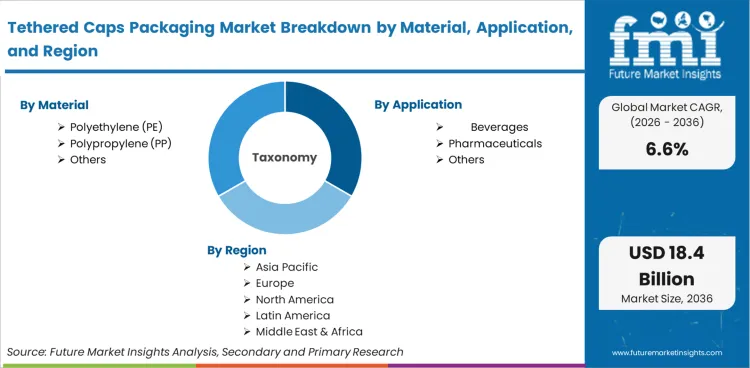
| Metric | Value |
|---|---|
| Quantitative Units | USD 9.7 billion to USD 18.4 billion, at a CAGR of 6.63% |
| Market Definition | Tethered caps packaging involves closures engineered to stay connected to the container, primarily to reduce litter and ensure caps are recycled with the bottle. |
| Material Segmentation | Polyethylene (PE), Polypropylene (PP), PET, Others |
| Application Segmentation | Beverages, Pharmaceuticals, Food, Others |
| Type Segmentation | Screw caps, Flip-top caps, Dispensing caps |
| End Use Segmentation | Bottled Water, Carbonated Soft Drinks, Functional Beverages, Dairy |
| Regions Covered | North America, Latin America, Europe, East Asia, South Asia, Oceania, Middle East & Africa |
| Countries Covered | India, China, USA, Germany, UK, Brazil, South Korea, and 40 plus countries |
| Key Companies Profiled | Berry Global, ALPLA, Bericap, Tetra Pak, AptarGroup, Silgan Holdings, United Caps, CSI |
| Forecast Period | 2026 to 2036 |
| Approach | The baseline value was established by correlating global beverage container volumes with region-specific tethered mandate deadlines, applying technical adoption curves to project future value. |
Source: Future Market Insights (FMI) analysis, based on proprietary forecasting model and primary research
Tethered Caps Packaging Market Analysis by Segments
Material:
- Polyethylene (PE)
- Polypropylene (PP)
- PET
- Others
Application:
- Beverages
- Pharmaceuticals
- Food
- Others
Type:
- Screw caps
- Flip-top caps
- Dispensing caps
End Use:
- Bottled Water
- Carbonated Soft Drinks
- Functional Beverages
- Dairy
Region:
- Asia Pacific
- India
- China
- South Korea
- Japan
- Europe
- Germany
- United Kingdom
- France
- Italy
- North America
- United States
- Canada
- Latin America
- Brazil
- Mexico
- Middle East & Africa
- Saudi Arabia
- South Africa
Bibliography
- Central Pollution Control Board. (2024, April 4). Environmental compensation regime under Plastic Waste Management Rules. Government of India.
- DIN Consumer Council. (2024, November 14). Study on the usability and consumer acceptance of tethered caps for beverage containers. DIN.
- CEN-CENELEC. (2025, February 1). DIN Consumer Council study explores the usability and consumer acceptance of tethered caps for beverage containers.
- RecyClass. (2025, April 14). APR-RecyClass cooperation report.
- Association of Plastic Recyclers. (2025). Recycled plastic content requirements.
- California State Legislature. (2025). SB-45 Recycling: beverage containers: tethered plastic caps.
- Illinois General Assembly. (2025). SB0132: Plastic Bottle Cap Reduction Act.
This bibliography is provided for reader reference. The full FMI report contains the complete reference list with primary source documentation.
This Report Addresses
- Market sizing for the organized tethered caps packaging layer across global beverage segments.
- Forecast demand for attached closures from 2026 to 2036 based on regulatory timelines.
- Material analysis across Polyethylene (PE), Polypropylene (PP), and PET sub-segments.
- Application demand patterns across beverages, pharmaceuticals, and food sectors.
- Regional growth comparisons shaped by national plastic waste management mandates.
- Competitive positioning factors for closure manufacturers and capping equipment vendors.
- Revenue opportunities tied to monomaterial innovation and premium consumer designs.
- Strategic implications for procurement leads and sustainability directors at FMCG firms.
Frequently Asked Questions
How large is the Tethered Caps Packaging Market in 2026?
The market is estimated to be valued at USD 9.7 billion in 2026. This value reflects the massive retooling of high-volume beverage production lines ahead of global compliance deadlines.
What will the Tethered Caps Packaging Market be valued at by 2036?
The market is projected to reach USD 18.4 billion by 2036. Continued expansion is driven by the universal adoption of attached closures as the standard for circular packaging ecosystems.
What CAGR is projected for the Tethered Caps Packaging Market from 2026 to 2036?
The market is expected to expand at a CAGR of 6.63% over the forecast decade. This rate is sustained by the transition from voluntary ESG commitments to mandatory national legislation across emerging economies.
Which material is poised to lead the market by 2026?
Polyethylene (PE) is expected to lead with a 35.0% share in 2026. Its dominance is due to the material's superior fatigue resistance, which is critical for the durability of tethered hinge mechanisms.
Which application segment dominates the market in 2026?
Beverages command a 45.0% share in 2026, driven by high-volume requirements for bottled water and carbonated drinks. This leadership is reinforced by the strict enforcement of single-use plastic directives in the beverage sector.
What is the growth outlook for India in this report?
India is projected to grow at a CAGR of 12.8% through 2036. This rapid expansion reflects aggressive national waste management policies and the rollout of greenfield bottling facilities.
What is the growth outlook for China in this report?
China is expected to expand at an 11.8% CAGR through 2036. The country's "dual carbon" strategy and circular economy initiatives are forcing large-scale beverage producers to adopt tethered closures.
Why is the USA a significant market for tethered caps?
The USA is advancing at an 8.2% CAGR as state-level environmental mandates and EPR laws force brands to unify their closure portfolios. National brands are adopting tethered designs to maintain distribution flexibility across the country.
What distinguishes Germany's growth in the tethered caps market?
Germany tracks at a 7.6% CAGR, focusing on high-precision "Design for Recycling" standards. The market is driven by systemic qualification pressure to ensure closures are compatible with advanced automated sorting systems.
What makes the market growth in South Korea notable?
South Korea is projected to grow at an 11.0% CAGR through 2036. Growth is anchored by advanced waste management policies that prioritize the recovery of high-quality post-consumer resins.
What is the primary driver for tethered caps packaging?
The market is driven by strict environmental regulations like the EU's Single-Use Plastics Directive. These mandates require caps to stay attached to reduce litter and improve recycling stream purity.
What are the main operational challenges for suppliers?
High initial capital expenditure for new molds and the technical difficulty of retrofitting existing capping lines are major restraints. Small bottlers often face production bottlenecks during the transition phase.
What are the key opportunities in this market?
Opportunities lie in monomaterial innovation and the development of "stay-open" hinges that improve the consumer experience. Suppliers can also expand into the pharmaceutical sector for multi-dose liquid medications.
How does FMI define the market scope for tethered caps?
The scope includes all rigid plastic closures featuring permanent attachment mechanisms for beverage, food, and pharmaceutical applications. It excludes generic detachable screw caps and non-plastic closures.
What is the exclusion criteria for this report?
Standard detachable caps, metal crown corks, and industrial bulk container lids are excluded. The report focuses strictly on tethered plastic closures for consumer-facing containers.
How does FMI validate the market forecast?
The model applies a bottom-up methodology correlating global container volumes with regional mandate deadlines. Projections are cross-checked against capital expenditure for new capping machinery.
What policy framework has accelerated India's tethered cap adoption?
India's Plastic Waste Management rules mandate 100% recyclability and the elimination of small litter items. This has forced beverage producers to specify tethered closures for all new procurement contracts.
What is the role of Extended Producer Responsibility (EPR) in the USA?
EPR laws in states like California force brands to take responsibility for the entire lifecycle of their packaging. This financial and legal pressure encourages the adoption of tethered caps to increase recovery rates.
How does the "one-test" ensure analytical quality in this report?
Every sentence is checked to ensure it applies specifically to the tethered caps market and cannot be swapped with another industry. This ensures the analysis is grounded in the unique structural dynamics of the closure sector.
What is the strategic implication for capital project directors?
Directors must phase out dependency on detachable caps and mandate native tethered support in all new equipment procurement. This future-proofs production lines against upcoming environmental mandates.
How do tethered caps improve recycling efficiency?
By remaining attached to the bottle, caps are guaranteed to enter the same recycling stream. This prevents them from being lost during sorting and increases the supply of high-quality recycled plastic.
What is the long-term end-state for this market?
The end-state is a universal global standard where all liquid containers utilize tethered closures. This transition will be complete once cost parity is achieved and consumer habits fully adapt to the new format.
Preview the report firsthand - request a free sample
Get SampleGet the brochure for pricing and purchase details.
Get PDFTable of Content
- Executive Summary
- Global Market Outlook
- Demand-side Trends
- Supply-side Trends
- Technology Roadmap Analysis
- Analysis and Recommendations
- Market Overview
- Market Coverage / Taxonomy
- Market Definition / Scope / Limitations
- Research Methodology
- Chapter Orientation
- Analytical Lens and Working Hypotheses
- Market Structure, Signals, and Trend Drivers
- Research Design and Evidence Framework
- Desk Research Programme (Secondary Evidence)
- Company Annual and Sustainability Reports
- Peer-reviewed Journals and Academic Literature
- Corporate Websites, Product Literature, and Technical Notes
- Earnings Decks and Investor Briefings
- Statutory Filings and Regulatory Disclosures
- Technical White Papers and Standards Notes
- Trade Journals, Industry Magazines, and Analyst Briefs
- Conference Proceedings, Webinars, and Seminar Materials
- Government Statistics Portals and Public Data Releases
- Press Releases and Reputable Media Coverage
- Specialist Newsletters and Curated Briefings
- Sector Databases and Reference Repositories
- FMI Internal Proprietary Databases and Historical Market Datasets
- Subscription Datasets and Paid Sources
- Social Channels, Communities, and Digital Listening Inputs
- Additional Desk Sources
- Expert Input and Fieldwork (Primary Evidence)
- Primary Modes
- Qualitative Interviews and Expert Elicitation
- Quantitative Surveys and Structured Data Capture
- Blended Approach
- Why Primary Evidence is Used
- Field Techniques
- Interviews
- Surveys
- Focus Groups
- Observational and In-context Research
- Social and Community Interactions
- Stakeholder Universe Engaged
- C-suite Leaders
- Board Members
- Presidents and Vice Presidents
- R&D and Innovation Heads
- Technical Specialists
- Domain Subject-matter Experts
- Scientists
- Physicians and Other Healthcare Professionals
- Governance, Ethics, and Data Stewardship
- Research Ethics
- Data Integrity and Handling
- Primary Modes
- Tooling, Models, and Reference Databases
- Desk Research Programme (Secondary Evidence)
- Data Engineering and Model Build
- Data Acquisition and Ingestion
- Cleaning, Normalisation, and Verification
- Synthesis, Triangulation, and Analysis
- Quality Assurance and Audit Trail
- Market Background
- Market Dynamics
- Drivers
- Restraints
- Opportunity
- Trends
- Scenario Forecast
- Demand in Optimistic Scenario
- Demand in Likely Scenario
- Demand in Conservative Scenario
- Opportunity Map Analysis
- Product Life Cycle Analysis
- Supply Chain Analysis
- Investment Feasibility Matrix
- Value Chain Analysis
- PESTLE and Porter’s Analysis
- Regulatory Landscape
- Regional Parent Market Outlook
- Production and Consumption Statistics
- Import and Export Statistics
- Market Dynamics
- Global Market Analysis 2021 to 2025 and Forecast, 2026 to 2036
- Historical Market Size Value (USD Million) Analysis, 2021 to 2025
- Current and Future Market Size Value (USD Million) Projections, 2026 to 2036
- Y-o-Y Growth Trend Analysis
- Absolute $ Opportunity Analysis
- Global Market Pricing Analysis 2021 to 2025 and Forecast 2026 to 2036
- Global Market Analysis 2021 to 2025 and Forecast 2026 to 2036, By Material
- Introduction / Key Findings
- Historical Market Size Value (USD Million) Analysis By Material , 2021 to 2025
- Current and Future Market Size Value (USD Million) Analysis and Forecast By Material , 2026 to 2036
- Polyethylene (PE)
- Polypropylene (PP)
- Others
- Polyethylene (PE)
- Y-o-Y Growth Trend Analysis By Material , 2021 to 2025
- Absolute $ Opportunity Analysis By Material , 2026 to 2036
- Global Market Analysis 2021 to 2025 and Forecast 2026 to 2036, By Application
- Introduction / Key Findings
- Historical Market Size Value (USD Million) Analysis By Application, 2021 to 2025
- Current and Future Market Size Value (USD Million) Analysis and Forecast By Application, 2026 to 2036
- Beverages
- Pharmaceuticals
- Others
- Beverages
- Y-o-Y Growth Trend Analysis By Application, 2021 to 2025
- Absolute $ Opportunity Analysis By Application, 2026 to 2036
- Global Market Analysis 2021 to 2025 and Forecast 2026 to 2036, By Region
- Introduction
- Historical Market Size Value (USD Million) Analysis By Region, 2021 to 2025
- Current Market Size Value (USD Million) Analysis and Forecast By Region, 2026 to 2036
- North America
- Latin America
- Western Europe
- Eastern Europe
- East Asia
- South Asia and Pacific
- Middle East & Africa
- Market Attractiveness Analysis By Region
- North America Market Analysis 2021 to 2025 and Forecast 2026 to 2036, By Country
- Historical Market Size Value (USD Million) Trend Analysis By Market Taxonomy, 2021 to 2025
- Market Size Value (USD Million) Forecast By Market Taxonomy, 2026 to 2036
- By Country
- USA
- Canada
- Mexico
- By Material
- By Application
- By Country
- Market Attractiveness Analysis
- By Country
- By Material
- By Application
- Key Takeaways
- Latin America Market Analysis 2021 to 2025 and Forecast 2026 to 2036, By Country
- Historical Market Size Value (USD Million) Trend Analysis By Market Taxonomy, 2021 to 2025
- Market Size Value (USD Million) Forecast By Market Taxonomy, 2026 to 2036
- By Country
- Brazil
- Chile
- Rest of Latin America
- By Material
- By Application
- By Country
- Market Attractiveness Analysis
- By Country
- By Material
- By Application
- Key Takeaways
- Western Europe Market Analysis 2021 to 2025 and Forecast 2026 to 2036, By Country
- Historical Market Size Value (USD Million) Trend Analysis By Market Taxonomy, 2021 to 2025
- Market Size Value (USD Million) Forecast By Market Taxonomy, 2026 to 2036
- By Country
- Germany
- UK
- Italy
- Spain
- France
- Nordic
- BENELUX
- Rest of Western Europe
- By Material
- By Application
- By Country
- Market Attractiveness Analysis
- By Country
- By Material
- By Application
- Key Takeaways
- Eastern Europe Market Analysis 2021 to 2025 and Forecast 2026 to 2036, By Country
- Historical Market Size Value (USD Million) Trend Analysis By Market Taxonomy, 2021 to 2025
- Market Size Value (USD Million) Forecast By Market Taxonomy, 2026 to 2036
- By Country
- Russia
- Poland
- Hungary
- Balkan & Baltic
- Rest of Eastern Europe
- By Material
- By Application
- By Country
- Market Attractiveness Analysis
- By Country
- By Material
- By Application
- Key Takeaways
- East Asia Market Analysis 2021 to 2025 and Forecast 2026 to 2036, By Country
- Historical Market Size Value (USD Million) Trend Analysis By Market Taxonomy, 2021 to 2025
- Market Size Value (USD Million) Forecast By Market Taxonomy, 2026 to 2036
- By Country
- China
- Japan
- South Korea
- By Material
- By Application
- By Country
- Market Attractiveness Analysis
- By Country
- By Material
- By Application
- Key Takeaways
- South Asia and Pacific Market Analysis 2021 to 2025 and Forecast 2026 to 2036, By Country
- Historical Market Size Value (USD Million) Trend Analysis By Market Taxonomy, 2021 to 2025
- Market Size Value (USD Million) Forecast By Market Taxonomy, 2026 to 2036
- By Country
- India
- ASEAN
- Australia & New Zealand
- Rest of South Asia and Pacific
- By Material
- By Application
- By Country
- Market Attractiveness Analysis
- By Country
- By Material
- By Application
- Key Takeaways
- Middle East & Africa Market Analysis 2021 to 2025 and Forecast 2026 to 2036, By Country
- Historical Market Size Value (USD Million) Trend Analysis By Market Taxonomy, 2021 to 2025
- Market Size Value (USD Million) Forecast By Market Taxonomy, 2026 to 2036
- By Country
- Kingdom of Saudi Arabia
- Other GCC Countries
- Turkiye
- South Africa
- Other African Union
- Rest of Middle East & Africa
- By Material
- By Application
- By Country
- Market Attractiveness Analysis
- By Country
- By Material
- By Application
- Key Takeaways
- Key Countries Market Analysis
- USA
- Pricing Analysis
- Market Share Analysis, 2025
- By Material
- By Application
- Canada
- Pricing Analysis
- Market Share Analysis, 2025
- By Material
- By Application
- Mexico
- Pricing Analysis
- Market Share Analysis, 2025
- By Material
- By Application
- Brazil
- Pricing Analysis
- Market Share Analysis, 2025
- By Material
- By Application
- Chile
- Pricing Analysis
- Market Share Analysis, 2025
- By Material
- By Application
- Germany
- Pricing Analysis
- Market Share Analysis, 2025
- By Material
- By Application
- UK
- Pricing Analysis
- Market Share Analysis, 2025
- By Material
- By Application
- Italy
- Pricing Analysis
- Market Share Analysis, 2025
- By Material
- By Application
- Spain
- Pricing Analysis
- Market Share Analysis, 2025
- By Material
- By Application
- France
- Pricing Analysis
- Market Share Analysis, 2025
- By Material
- By Application
- India
- Pricing Analysis
- Market Share Analysis, 2025
- By Material
- By Application
- ASEAN
- Pricing Analysis
- Market Share Analysis, 2025
- By Material
- By Application
- Australia & New Zealand
- Pricing Analysis
- Market Share Analysis, 2025
- By Material
- By Application
- China
- Pricing Analysis
- Market Share Analysis, 2025
- By Material
- By Application
- Japan
- Pricing Analysis
- Market Share Analysis, 2025
- By Material
- By Application
- South Korea
- Pricing Analysis
- Market Share Analysis, 2025
- By Material
- By Application
- Russia
- Pricing Analysis
- Market Share Analysis, 2025
- By Material
- By Application
- Poland
- Pricing Analysis
- Market Share Analysis, 2025
- By Material
- By Application
- Hungary
- Pricing Analysis
- Market Share Analysis, 2025
- By Material
- By Application
- Kingdom of Saudi Arabia
- Pricing Analysis
- Market Share Analysis, 2025
- By Material
- By Application
- Turkiye
- Pricing Analysis
- Market Share Analysis, 2025
- By Material
- By Application
- South Africa
- Pricing Analysis
- Market Share Analysis, 2025
- By Material
- By Application
- USA
- Market Structure Analysis
- Competition Dashboard
- Competition Benchmarking
- Market Share Analysis of Top Players
- By Regional
- By Material
- By Application
- Competition Analysis
- Competition Deep Dive
- Berry Global
- Overview
- Product Portfolio
- Profitability by Market Segments (Product/Age /Sales Channel/Region)
- Sales Footprint
- Strategy Overview
- Marketing Strategy
- Product Strategy
- Channel Strategy
- ALPLA
- Bericap
- Tetra Pak
- AptarGroup
- Silgan Holdings
- Berry Global
- Competition Deep Dive
- Assumptions & Acronyms Used


