

- Market Size (2026)
- USD 26.4 Bn
- Forecast (2036)
- USD 64.8 Bn
- CAGR (2026 to 2036)
- 9.4%
How big is Agri-Food Tech Venture & Innovation Ecosystem Market size?
USD 26.4 billion in 2026 and USD 64.8 billion by 2036 at a 9.4% CAGR.
The agri-food tech venture & innovation ecosystem sector is projected to expand at 9.4% CAGR between 2026 and 2036, increasing valuation from USD 26.4 billion in 2026 to USD 64.8 billion by 2036. Commercial value covers venture activity and accelerator services supporting research translation. Public programmes and corporate initiatives add validation facilities and specialist guidance. Investor review focuses on technical evidence and repeatable production economics. EIT Food announced its 2025 corporate partners in February 2025, linking startup screening with industry expertise and potential pilot access.
Singapore and Netherlands programmes are anticipated to favour coordinated research access and defined field-validation routes. United States and United Kingdom investors are projected to emphasize milestone evidence and customer conversion. Country differences influence funding structures and proof requirements across venture stages. Regional participation gains durability through shared facilities and credible first-customer routes. Export planning supports ventures formed inside smaller domestic demand bases. EIT Food reported more than 1,300 one-to-one meetings between corporate partners and startups during 2024 in February 2025, demonstrating active validation exchange across regional programmes.
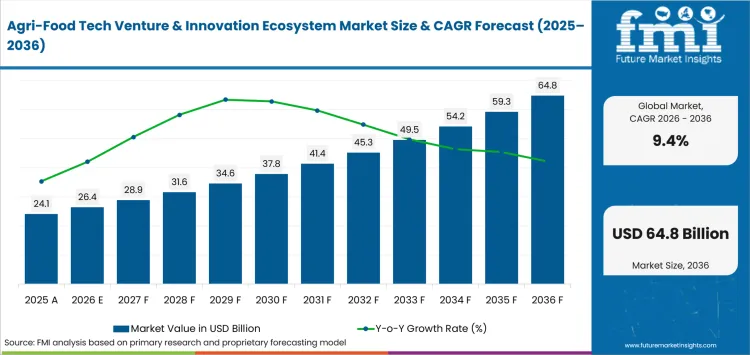
Key Takeaways for the Agri-Food Tech Venture & Innovation Ecosystem Market
- Demand for agri-food venture support is driven by complex proof requirements, with founders needing technical evidence and customer access prior to commercial expansion.
- Seed is forecast to garner 57.1% share of stage in 2026, influenced by concentrated support for prototypes and first pilot evidence.
- Venture Capital is estimated to lead funding type with 42.2% share in 2026, backed by equity tolerance for uncertain technical schedules.
- Field variability and lengthy approval routes restrict follow-on investment across agritech and food innovation programmes.
- Competition focuses on EIT Food, AgFunder, Big Idea Ventures, Blue Horizon, Astanor, ADM Ventures, and Cargill, with participants addressing distinct commercialisation gaps.
Analyst Perspective
“Agri-food ventures create commercial value through evidence. Investors examine field performance and production economics during capital review. Durable support connects scientific proof with customers prepared to define a paid commercial route.”
- Nandini Roy Choudhury, Principal Analyst for Food and Beverage at Future Market Insights
How is Agri-Food Tech Venture & Innovation Ecosystem Market segmented?
The agri-food tech venture & innovation ecosystem industry is segmented by segment, stage, funding type, and region.
The agri-food tech venture & innovation ecosystem market is segmented by segment, stage, funding type, and region. Segment coverage includes Agtech and Foodtech serving different validation needs. ALT-protein and supply chain complete segment coverage across food production and distribution innovation. Stage coverage separates seed from growth according to technical and commercial readiness. Funding type coverage includes venture capital and private equity. Corporate investment and government grants complete financing coverage across risk profiles. Regional coverage spans North America and Latin America together with Western Europe. Eastern Europe and East Asia extend analysis across established research and industrial networks. South Asia and Pacific with Middle East and Africa complete geographic assessment.
What makes AgTech central to segment selection?
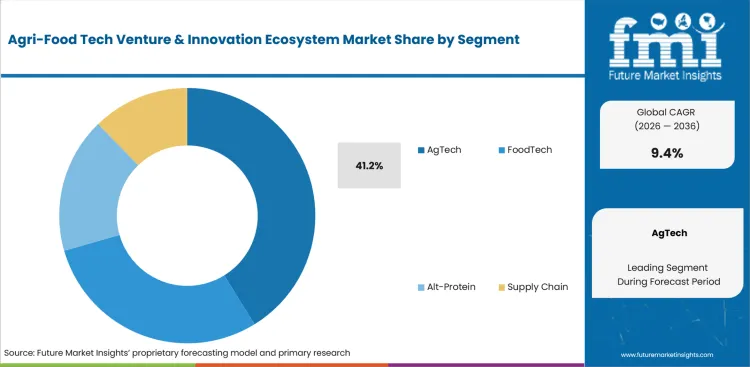
Precision agriculture developers combine field trials with service planning, since investor review covers agronomic performance and dependable operation across varied production settings. Agricultural robots and smart agriculture platforms need proof linking technical output with farmer economics, extending validation beyond laboratory demonstrations into repeatable farm use. CGIAR reported 16 innovation teams at a Nairobi demonstration day in June 2025, demonstrating how coached field records strengthen commercial explanations during investor and customer discussions. Farm management software adds record continuity across pilot locations, helping founders present operating histories supporting distribution planning and post-pilot service decisions.
- AgTech is predicted to represent 41.2% share of segment in 2026, led by capital needs spanning prototype construction and agronomic proof. Distribution preparation adds another financing requirement across farm-facing technologies.
- FoodTech and Alt-Protein ventures focus on process repeatability and food-safety evidence prior to customer approval. Supply Chain ventures emphasize integration quality and dependable operating records across distribution networks.
Why does seed lead stage demand?
EIT Food supported 18 startups through technology validation funding in October 2025, directing real-world testing toward investment readiness and clearer commercial claims. Structured documentation reduces uncertainty surrounding scale assumptions, helping Growth investors assess production repeatability and customer conversion without reopening early technical questions. Seed programmes concentrate on translating technical inventions into products supported by pilot inputs and credible manufacturing assumptions.
- In 2026, seed is anticipated to account for 57.1% share since it is reflected by concentrated work on product definition and technical validation. Early programmes also prepare founders for investor review and customer discussions.
- Growth financing supports manufacturing expansion and distribution development across ventures holding verified technical evidence. Investor review shifts toward repeatable economics and customer conversion across established programmes.
How does venture capital shape funding type demand?
Venture Capital finances companies facing uncertain development schedules and limited collateral, providing ownership exposure during technically demanding formative stages. Specialist review examines scientific defensibility and founder execution, aligning funding milestones with product proof and customer progress. Big Idea Ventures selected 7 companies for its Global Food Innovation Fund II cohort in July 2025, connecting specialist capital with fermentation-enabled oils and sustainable ingredients. Alternative protein businesses face closer scrutiny of process stability and scale economics, placing board guidance and follow-on access at the centre of investment decisions.
- Based on funding type, venture capital is estimated to secure 42.2% share in 2026 as it is guided by tolerance for technical risk prior to stable cash flow. Board guidance and follow-on investor access add commercial discipline during product development.
- Private Equity supports established ventures entering larger production phases and structured ownership transitions. Corporate Investment and Government Grants finance strategic pilots and public-interest research under distinct governance requirements.
What are drivers, restraints, and opportunities in Agri-Food Tech Venture & Innovation Ecosystem Market?
Food-security problems support venture formation and long proof cycles limit investor conversion. Shared validation assets create expansion potential across research-led companies.
- Driver: Producers need practical solutions for resource efficiency and dependable food supply across changing operating conditions.
- Restraint: Field variability and manufacturing inconsistency delay technical approval across capital-intensive ventures.
- Opportunity: Shared facilities and staged evidence connect research teams with commercial partners and specialist investors.
Corporate R&D networks support venture formation through technical facilities and customer problem statements. Cargill reported more than 20 innovation centers in June 2025, demonstrating industrial demand for distributed product-development capability. Facility access helps young companies test applications with specialists familiar with processing and customer requirements. Capital providers gain stronger evidence through trials built around defined use cases.
Field validation restricts progress across hardware and biological ventures. EIT Food selected 10 startups for real-farm trials in June 2025, requiring each participant to hold at least one prototype prepared for field testing. Trial access exposes reliability and service demands absent from laboratory demonstrations. Follow-on finance weakens if field evidence fails to support repeatable outcomes.
Commercialisation programmes create opportunity through structured links between research proof and sales preparation. Food traceability ventures benefit from records connecting technical claims with customer operations. EIT Food selected 4 startups for its Fast Track to Market Initiative in April 2025, directing support toward commercial success and new-market entry. Focused programmes help founders translate technical assets into buyer-ready offers. Investors gain clearer evidence regarding customer demand and execution quality.
How are country CAGRs aligned in Agri-Food Tech Venture & Innovation Ecosystem Market?
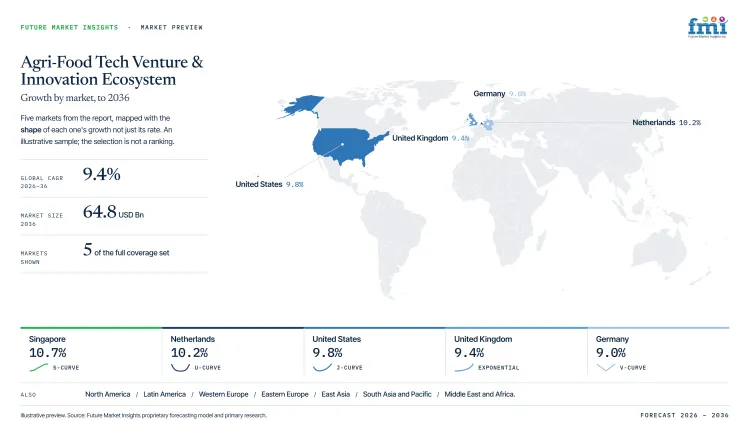
| Country or Market | CAGR |
|---|---|
| Singapore | 10.7% |
| Netherlands | 10.2% |
| United States | 9.8% |
| United Kingdom | 9.4% |
| Germany | 9.0% |
Source: Future Market Insights analysis, 2026.
How do country-level CAGRs compare in Agri-Food Tech Venture & Innovation Ecosystem Market?
Country comparison shows a gradual step-down across markets covered. Singapore occupies first position and Netherlands follows within a limited distance. Middle placement belongs to United States across disclosed rates. Lower forecast positions include United Kingdom and Germany. A 1.7 percentage-point spread separates Singapore from Germany. Profiled rates reflect comparable expansion prospects under distinct commercialization conditions.
- Singapore is anticipated to lead comparison through mission-led research and shared translation facilities.
- Netherlands is likely to follow through concentrated food science and startup support institutions.
- United States is expected to occupy a middle band through specialist capital and competitive research grants.
- United Kingdom is projected to precede Germany through cluster programmes supporting agritech commercialisation.
- Germany completes comparison through formal research-industry collaboration and disciplined technical review.
Markets carrying similar CAGRs may present distinct entry conditions based on trial infrastructure and investor depth. Full report coverage includes North America, Latin America, Western Europe, Eastern Europe, East Asia, South Asia and Pacific, Middle East and Africa.
Country-wise Analysis
Demand in Singapore is forecast to expand at 10.7% CAGR during the study period, led by mission-led research and shared test facilities for constrained production systems. Singapore Food Agency reported 4 projects hosted through its Agritech Translation Programme in November 2025 inside a dedicated vertical farming facility, providing shared testing access and industry feedback for constrained-production solutions. Translation capacity helps ventures identify operating problems prior to regional deployment. Export planning remains important since local production provides a limited commercial base.
Dutch venture activity benefits from close links among universities and food manufacturers. Sector in Netherlands is estimated to rise at 10.2% CAGR during the assessment period, guided by concentrated research capability and startup acceleration. Wageningen University & Research reported 10 Youth Food Lab teams in December 2025, creating a mentored pipeline for food-system concepts requiring research input and commercial refinement. Commercial prospects improve if local validation connects with manufacturing and customers outside domestic borders.
Specialist investors and federal programmes divide technical risk across early development. National Institute of Food and Agriculture reported 50.0% of applications funded for its Phase II small-business programme in July 2025, concentrating public finance on prior Phase I winners needing stronger commercialisation evidence. Selection rules place commercialisation pressure on ventures already holding technical evidence. Industry in the United States is projected to record 9.8% CAGR between 2026 and 2036, reflecting deep capital availability and fragmented customer routes.
The market in United Kingdom is anticipated to expand at 9.4% CAGR during 2026 to 2036, driven by regional clusters joining technical support with investor access. UK Research and Innovation reported 12 projects receiving support through an Agri-tech and food technology Launchpad in April 2024, connecting regional technical resources with projects needing early commercial support. Project diversity across crops and automation creates multiple routes for venture formation. Scale activity requires manufacturing evidence and customer conversion beyond successful trials.
Germany Trade & Invest reported almost 86% of farmers using digital technologies on their farms in 2025, creating a substantial trial audience for ventures needing user feedback and operating proof. Formal technical review supports ventures holding detailed field data and disciplined documentation. Industrial partners may improve scale preparation through production expertise and customer qualification. Sales in Germany are predicted to grow at 9.0% CAGR during the forecast period, backed by research institutes and agricultural technology clusters.
Who are notable companies in Agri-Food Tech Venture & Innovation Ecosystem Market?
EIT Food, AgFunder, Big Idea Ventures, Blue Horizon, Astanor, ADM Ventures, and Cargill are prominent organizations influencing activity across market coverage.
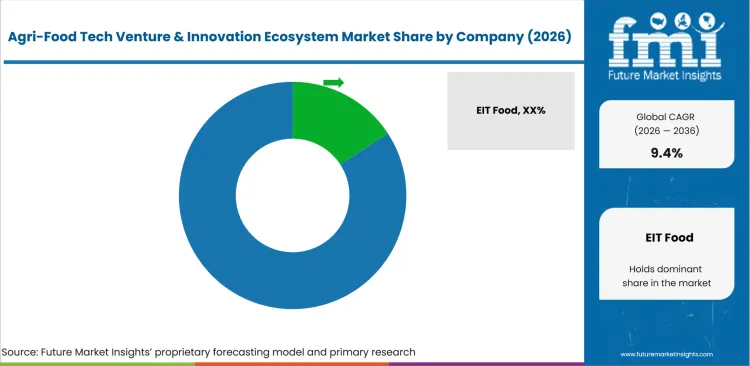
Competition centers on removal of specific commercialization risks. EIT Food supports venture creation and validation through networked programmes. AgFunder and Big Idea Ventures apply specialist investment knowledge across food and agriculture technologies. Blue Horizon and Astanor focus capital on science-led food and agricultural ventures. ADM Ventures and Cargill connect startup development with established technical teams and industrial customers. Investor and founder review covers stage focus and access to real operating environments.
- EIT Food supports structured venture formation and technology validation. Programme value reflects research links and corporate participation across European countries.
- AgFunder and Big Idea Ventures provide specialist deal sourcing and portfolio guidance. Investment selection reflects scientific quality and credible paths toward customer revenue.
- Blue Horizon and Astanor direct capital toward science-led food and agricultural innovation. Portfolio support emphasizes management capability and readiness for later financing.
- ADM Ventures and Cargill provide strategic investment and technical collaboration. Industrial facilities and customer relationships support ventures preparing for larger-scale production.
Competitive Benchmarking: Agri-Food Tech Venture & Innovation Ecosystem Market
| Organization | Specialist Capital | Validation Network | Commercial Scale Access | Geographic Reach |
|---|---|---|---|---|
| EIT Food | High | High | High | Europe and associated research countries |
| AgFunder | High | Medium | High | United States, Europe, and Asia |
| Big Idea Ventures | High | High | High | North America, Europe, and Singapore |
| Blue Horizon | High | Medium | High | Europe, North America, and selected international programmes |
| Astanor | High | Medium | High | Europe with international portfolio exposure |
| ADM Ventures | Medium | High | High | International agrifood and nutrition activities |
| Cargill | Medium | High | High | International agricultural and food supply chains |
Source: Future Market Insights competitive analysis, 2026.
Key Developments in Agri-Food Tech Venture & Innovation Ecosystem Market
- In April 2025, Cargill reopened its transformed Singapore Innovation Center for food co-development across Asian customer programmes. Expanded application spaces improved access to technical testing and corporate collaboration for emerging food solutions.
- In May 2025, Big Idea Ventures acquired Vevolution assets to expand connections among agrifoodtech startups and investors. Platform integration strengthened deal discovery and founder access across specialist food and agriculture investment activity.
- In October 2025, StartLife and EIT Food formed a strategic partnership supporting European agrifood startups. Combined acceleration and investment access created a clearer transition from programme participation into scale preparation.
Key Players in Agri-Food Tech Venture & Innovation Ecosystem Market
Public and Networked Commercialization Platforms
- EIT Food
Specialist Agrifood Venture Investors
- AgFunder
- Big Idea Ventures
- Blue Horizon
- Astanor
Corporate Innovation and Strategic Scale Partners
- ADM Ventures
- Cargill
Agri-Food Tech Venture & Innovation Ecosystem Market Report Scope
| Coverage field | Report scope |
|---|---|
| Market breakdown | Agri-food tech venture & innovation ecosystem market breakdown includes Segment, Stage, Funding Type, and Region. |
| Quantitative Units | Revenue in USD Million, CAGR in %. |
| Market Definition | Agri-Food Tech Venture & Innovation Ecosystem Market covers venture investment and accelerator services supporting AgTech, FoodTech, Alt-Protein, and Supply Chain ventures. Public commercialisation programmes and corporate innovation activity complete defined coverage. General agricultural finance without venture-development services is excluded. |
| Regions Covered | North America, Latin America, Western Europe, Eastern Europe, East Asia, South Asia and Pacific, Middle East and Africa. |
| Countries Covered | Singapore, Netherlands, United States, United Kingdom, Germany, and more than 25 additional countries complete full report coverage. |
| Key Companies Profiled | EIT Food, AgFunder, Big Idea Ventures, Blue Horizon, Astanor, ADM Ventures, and Cargill. |
| Forecast Period | 2026 to 2036 |
| Approach | Hybrid bottom-up and top-down methodology uses segment shares and country CAGRs. Programme activity and participant roles support final market reconciliation. |
Source: Future Market Insights analysis, 2026.
Agri-Food Tech Venture & Innovation Ecosystem Market - Research Methodology
| Method | Approach |
|---|---|
| Primary Research | FMI analysts gathered input from manufacturers, service providers, technology developers, distributors, end users, procurement teams, and subject-matter experts. Interviews examined purchasing decisions, product or service evaluation, adoption barriers, approval requirements, pricing considerations, and expectations for technical or commercial support. Respondents were also asked what evidence is required before a trial, pilot, or initial order develops into regular purchasing. |
| Desk Research | Desk research covered government statistics, regulatory publications, trade data, industry associations, technical literature, standards, company filings, product information, and official corporate announcements. Sources were reviewed for relevance, publication date, geographic coverage, and consistency with the defined market scope. Claims relating to performance, applications, approvals, capacity, investment, and commercial activity were retained only when supported by credible public evidence. |
| Market Sizing and Forecasting | The market model combined the baseline value with historical performance, segment structure, pricing and volume indicators, adoption levels, company participation, and country-level demand conditions. Forecast assumptions considered economic activity, investment trends, regulatory developments, technology adoption, purchasing cycles, supply availability, and barriers to wider market use. Segment and regional estimates were reconciled before the final market total was calculated. |
| Data Validation | Estimates were checked against multiple independent indicators, including public data, company activity, trade patterns, industry developments, and findings from primary interviews. Validation also tested whether products, services, applications, and company revenues fell within the defined market boundaries. Adjacent categories, unsupported claims, overlapping revenues, and activities without direct market relevance were excluded to reduce double counting and maintain consistency across segments and countries. |
Source: Future Market Insights analysis, 2026.
Agri-Food Tech Venture & Innovation Ecosystem Market by Segments
Agri-Food Tech Venture & Innovation Ecosystem Market segmented by Segment:
- AgTech
- FoodTech
- Alt-Protein
- Supply Chain
Agri-Food Tech Venture & Innovation Ecosystem Market segmented by Stage:
- Seed
- Growth
Agri-Food Tech Venture & Innovation Ecosystem Market segmented by Funding Type:
- Venture Capital
- Private Equity
- Corporate Investment
- Government Grants
Agri-Food Tech Venture & Innovation Ecosystem Market segmented by Region:
- North America
- United States
- Canada
- Latin America
- Brazil
- Mexico
- Argentina
- Chile
- Western Europe
- Germany
- France
- United Kingdom
- Italy
- Spain
- Benelux
- Nordics
- Eastern Europe
- Poland
- Czech Republic
- Romania
- Hungary
- East Asia
- China
- Japan
- South Korea
- South Asia and Pacific
- India
- ASEAN
- Australia and New Zealand
- Middle East and Africa
- GCC Countries
- South Africa
- Türkiye
- Israel
Research Sources and Bibliography
- EIT Food. (2025, March 27). The EIT Food Accelerator Network announces its 2025 corporate partners to drive innovation and food system transformation.
- Alliance of Bioversity International and CIAT. (2025, September 1). AgriTech4Kenya demo day: Growing Kenya’s agritech ecosystem.
- EIT Food. (2025, October 16). EIT Food Accelerator Network provides €600,000 in funding to 2025 Tech Validation winners, accelerating AgriFoodTech innovation.
- Big Idea Ventures. (2025, July 15). Big Idea Ventures announces seven innovative startups in latest Global Food Innovation Fund II cohort.
- Cargill. (2025, June 26). Inside Cargill’s worldwide innovation center network.
- EIT Food. (2025, June 5). Ten startups selected for EIT Food’s Test Farms Programme to trial innovations on real farms.
- EIT Food. (2025, April 8). EIT Food announces €875,000 to accelerate commercialisation of agrifood products and services in Europe.
- Singapore Food Agency. (2025, November 5). Speech by Mr Damian Chan, CEO of the Singapore Food Agency at the Asia-Pacific Agri-Food Innovation Summit, Singapore International Agri-Food Week.
- Wageningen University & Research. (2025, December 16). Meet the 2025 Youth Food Lab teams - The power of young changemakers.
- National Institute of Food and Agriculture. (2025, July 16). Small Business Innovation Research and Small Business Technology Transfer Programs Phase II.
- UK Research and Innovation. (2024, April 9). Business-led schemes set to boost growth all over the UK.
- Germany Trade & Invest. (2025). Smart farming in Germany.
- Cargill. (2025, April 10). Cargill unveils transformed Innovation Center in Singapore to advance food innovation, for Asia from Asia.
- Big Idea Ventures. (2025, May 20). Big Idea Ventures acquires global AgriFoodTech platform Vevolution.
- EIT Food. (2025, October 15). StartLife and EIT Food join forces to empower Europe’s agrifood startups.
This bibliography is provided for reader reference and is not exhaustive. The full report contains the complete reference list and detailed citations.
This Report Answers
- How do Segment and Stage structures influence demand across agri-food venture support?
- What criteria guide investors assessing AgTech and FoodTech ventures prior to funding?
- Why do country CAGRs differ across profiled markets?
- What organizations compete through acceleration and specialist capital?
- How are forecasts validated through bottom-up and top-down analysis?
- What evidence supports customer review prior to pilot expansion?
- Why do field trials and production records influence investment selection?
- How does weak unit economics limit follow-on financing?
- How do research institutions influence commercialisation routes?
- What participant capabilities improve long-term venture confidence?
Frequently Asked Questions
How big is the Agri-Food Tech Venture & Innovation Ecosystem Market in 2026?
The agri-food tech venture & innovation ecosystem market is valued at USD 26.4 billion in 2026 and is forecast to reach USD 64.8 billion by 2036, supported by growing demand for venture capital, accelerator services, and commercialization programmes across AgTech, FoodTech, Alt-Protein, and supply chain innovation.
What is the CAGR of the Agri-Food Tech Venture & Innovation Ecosystem Market from 2026 to 2036?
The agri-food tech venture & innovation ecosystem market is projected to grow at a CAGR of 9.4% between 2026 and 2036, supported by producer demand for resource-efficient food solutions and expanding corporate and public investment in structured venture validation and commercialization programmes.
Which stage leads the Agri-Food Tech Venture & Innovation Ecosystem Market?
Seed accounts for 57.1% of the agri-food tech venture & innovation ecosystem market by stage in 2026, driven by concentrated support for prototype development, technical validation, and first pilot evidence that prepares founders for investor review and early customer discussions.
Which country is the fastest growing in the Agri-Food Tech Venture & Innovation Ecosystem Market?
The agri-food tech venture & innovation ecosystem market in Singapore is projected to expand at a CAGR of 10.7% through 2036, ahead of the overall market average of 9.4%, underpinned by mission-led research programmes, shared field-validation facilities, and government-backed agritech translation infrastructure for constrained-production systems.
Who are the leading companies in the Agri-Food Tech Venture & Innovation Ecosystem Market?
Leading organizations in the agri-food tech venture & innovation ecosystem market include EIT Food, AgFunder, Big Idea Ventures, Blue Horizon, Astanor, ADM Ventures, and Cargill, competing across public commercialization platforms, specialist agrifood venture investment, and corporate innovation and strategic scale partnerships.
Preview the report firsthand - request a free sample
Get SampleGet the brochure for pricing and purchase details.
Get PDFTable of Content
- Key Takeaways
- Market Size and CAGR
- Top Growth Driver
- Fastest Growing Segment
- Leading Region
- Key Companies
- Emerging Opportunities
- Executive Summary
- Global Market Outlook
- Demand-side Trends
- Supply-side Trends
- Technology Roadmap Analysis
- Analysis and Recommendations
- Analyst Perspective (What is happening? Why now? What should investors know?)
- Key Questions Answered
- How large is the market?
- What is the CAGR?
- What are key trends?
- Which region dominates?
- Who are the leaders?
- Market Overview
- Market Coverage / Taxonomy
- Market Definition / Scope / Limitations
- Research Methodology
- Chapter Orientation
- Analytical Lens and Working Hypotheses
- Market Structure, Signals, and Trend Drivers
- Benchmarking and Cross-market Comparability
- Market Sizing, Forecasting, and Opportunity Mapping
- Research Design and Evidence Framework
- Desk Research Programme (Secondary Evidence)
- Expert Input and Fieldwork (Primary Evidence)
- Tooling, Models, and Reference Databases
- Data Engineering and Model Build
- Quality Assurance and Audit Trail
- Market Background
- Market Dynamics (Drivers, Restraints, Opportunity, Trends)
- Scenario Forecast (Optimistic, Likely, Conservative)
- Impact Analysis
- AI Impact
- Sustainability Impact
- Regulatory Impact
- Technology Impact
- Consumer / Buyer Analysis
- Purchase Drivers
- Adoption Barriers
- Buyer Journey
- Opportunity Map Analysis
- Product Life Cycle Analysis
- Supply Chain Analysis
- Investment Feasibility Matrix
- Value Chain Analysis
- PESTLE and Porter's Analysis
- Regulatory Landscape
- Regional Parent Market Outlook
- Production and Consumption Statistics
- Import and Export Statistics
- Global Market Analysis and Forecast, 2021 to 2036
- Historical Market Size Value (USD Billion) Analysis, 2021 to 2025
- Current and Future Market Size Value (USD Billion) Projections, 2026 to 2036
- Y-o-Y Growth Trend Analysis
- Absolute $ Opportunity Analysis
- Global Market Pricing Analysis, 2021 to 2036
- Global Market Analysis and Forecast, By Segment, 2021 to 2036
- Introduction / Key Findings
- Historical Market Size Value (USD Billion) Analysis By Segment, 2021 to 2025
- Current and Future Market Size Value (USD Billion) Analysis and Forecast By Segment, 2026 to 2036
- AgTech
- FoodTech
- Alt-Protein
- Supply Chain
- AgTech
- Y-o-Y Growth Trend Analysis By Segment, 2021 to 2025
- Absolute $ Opportunity Analysis By Segment, 2026 to 2036
- Global Market Analysis and Forecast, By Stage, 2021 to 2036
- Introduction / Key Findings
- Historical Market Size Value (USD Billion) Analysis By Stage, 2021 to 2025
- Current and Future Market Size Value (USD Billion) Analysis and Forecast By Stage, 2026 to 2036
- Seed
- Growth
- Seed
- Y-o-Y Growth Trend Analysis By Stage, 2021 to 2025
- Absolute $ Opportunity Analysis By Stage, 2026 to 2036
- Global Market Analysis and Forecast, By Funding Type, 2021 to 2036
- Introduction / Key Findings
- Historical Market Size Value (USD Billion) Analysis By Funding Type, 2021 to 2025
- Current and Future Market Size Value (USD Billion) Analysis and Forecast By Funding Type, 2026 to 2036
- Venture Capital
- Private Equity
- Corporate Investment
- Government Grants
- Venture Capital
- Y-o-Y Growth Trend Analysis By Funding Type, 2021 to 2025
- Absolute $ Opportunity Analysis By Funding Type, 2026 to 2036
- Global Market Analysis and Forecast, By Region, 2021 to 2036
- Introduction
- Historical Market Size Value (USD Billion) Analysis By Region, 2021 to 2025
- Current Market Size Value (USD Billion) Analysis and Forecast By Region, 2026 to 2036
- North America
- Latin America
- Western Europe
- Eastern Europe
- East Asia
- South Asia and Pacific
- Middle East & Africa
- Market Attractiveness Analysis By Region
- North America Market Analysis and Forecast, By Country, 2021 to 2036
- Historical Market Size Value (USD Billion) Trend Analysis By Market Taxonomy, 2021 to 2025
- Market Size Value (USD Billion) Forecast By Market Taxonomy, 2026 to 2036
- By Country
- USA
- Canada
- By Segment
- By Stage
- By Funding Type
- By Country
- Market Attractiveness Analysis
- By Country
- By Segment
- By Stage
- By Funding Type
- Key Takeaways
- Latin America Market Analysis and Forecast, By Country
- Historical Market Size Value (USD Billion) Trend Analysis By Market Taxonomy, 2021 to 2025
- Market Size Value (USD Billion) Forecast By Market Taxonomy, 2026 to 2036
- By Country
- Brazil
- Mexico
- Chile
- Rest of Latin America
- By Segment
- By Stage
- By Funding Type
- By Country
- Market Attractiveness Analysis
- By Country
- By Segment
- By Stage
- By Funding Type
- Key Takeaways
- Western Europe Market Analysis and Forecast, By Country
- Historical Market Size Value (USD Billion) Trend Analysis By Market Taxonomy, 2021 to 2025
- Market Size Value (USD Billion) Forecast By Market Taxonomy, 2026 to 2036
- By Country
- Germany
- UK
- Italy
- Spain
- France
- Nordic
- BENELUX
- Rest of Western Europe
- By Segment
- By Stage
- By Funding Type
- By Country
- Market Attractiveness Analysis
- By Country
- By Segment
- By Stage
- By Funding Type
- Key Takeaways
- Eastern Europe Market Analysis and Forecast, By Country
- Historical Market Size Value (USD Billion) Trend Analysis By Market Taxonomy, 2021 to 2025
- Market Size Value (USD Billion) Forecast By Market Taxonomy, 2026 to 2036
- By Country
- Russia
- Poland
- Hungary
- Balkan & Baltic
- Rest of Eastern Europe
- By Segment
- By Stage
- By Funding Type
- By Country
- Market Attractiveness Analysis
- By Country
- By Segment
- By Stage
- By Funding Type
- Key Takeaways
- East Asia Market Analysis and Forecast, By Country
- Historical Market Size Value (USD Billion) Trend Analysis By Market Taxonomy, 2021 to 2025
- Market Size Value (USD Billion) Forecast By Market Taxonomy, 2026 to 2036
- By Country
- China
- Japan
- South Korea
- By Segment
- By Stage
- By Funding Type
- By Country
- Market Attractiveness Analysis
- By Country
- By Segment
- By Stage
- By Funding Type
- Key Takeaways
- South Asia and Pacific Market Analysis and Forecast, By Country
- Historical Market Size Value (USD Billion) Trend Analysis By Market Taxonomy, 2021 to 2025
- Market Size Value (USD Billion) Forecast By Market Taxonomy, 2026 to 2036
- By Country
- India
- ASEAN
- Australia & New Zealand
- Rest of South Asia and Pacific
- By Segment
- By Stage
- By Funding Type
- By Country
- Market Attractiveness Analysis
- By Country
- By Segment
- By Stage
- By Funding Type
- Key Takeaways
- Middle East & Africa Market Analysis and Forecast, By Country
- Historical Market Size Value (USD Billion) Trend Analysis By Market Taxonomy, 2021 to 2025
- Market Size Value (USD Billion) Forecast By Market Taxonomy, 2026 to 2036
- By Country
- Kingdom of Saudi Arabia
- Other GCC Countries
- Türkiye
- South Africa
- Other African Union
- Rest of Middle East & Africa
- By Segment
- By Stage
- By Funding Type
- By Country
- Market Attractiveness Analysis
- By Country
- By Segment
- By Stage
- By Funding Type
- Key Takeaways
- Key Countries Market Analysis
- USA
- Pricing Analysis
- Market Share Analysis, 2025
- By Segment
- By Stage
- By Funding Type
- Canada
- Pricing Analysis
- Market Share Analysis, 2025
- By Segment
- By Stage
- By Funding Type
- Mexico
- Pricing Analysis
- Market Share Analysis, 2025
- By Segment
- By Stage
- By Funding Type
- Brazil
- Pricing Analysis
- Market Share Analysis, 2025
- By Segment
- By Stage
- By Funding Type
- Chile
- Pricing Analysis
- Market Share Analysis, 2025
- By Segment
- By Stage
- By Funding Type
- Germany
- Pricing Analysis
- Market Share Analysis, 2025
- By Segment
- By Stage
- By Funding Type
- UK
- Pricing Analysis
- Market Share Analysis, 2025
- By Segment
- By Stage
- By Funding Type
- Italy
- Pricing Analysis
- Market Share Analysis, 2025
- By Segment
- By Stage
- By Funding Type
- Spain
- Pricing Analysis
- Market Share Analysis, 2025
- By Segment
- By Stage
- By Funding Type
- France
- Pricing Analysis
- Market Share Analysis, 2025
- By Segment
- By Stage
- By Funding Type
- India
- Pricing Analysis
- Market Share Analysis, 2025
- By Segment
- By Stage
- By Funding Type
- ASEAN
- Pricing Analysis
- Market Share Analysis, 2025
- By Segment
- By Stage
- By Funding Type
- Australia & New Zealand
- Pricing Analysis
- Market Share Analysis, 2025
- By Segment
- By Stage
- By Funding Type
- China
- Pricing Analysis
- Market Share Analysis, 2025
- By Segment
- By Stage
- By Funding Type
- Japan
- Pricing Analysis
- Market Share Analysis, 2025
- By Segment
- By Stage
- By Funding Type
- South Korea
- Pricing Analysis
- Market Share Analysis, 2025
- By Segment
- By Stage
- By Funding Type
- Russia
- Pricing Analysis
- Market Share Analysis, 2025
- By Segment
- By Stage
- By Funding Type
- Poland
- Pricing Analysis
- Market Share Analysis, 2025
- By Segment
- By Stage
- By Funding Type
- Hungary
- Pricing Analysis
- Market Share Analysis, 2025
- By Segment
- By Stage
- By Funding Type
- Kingdom of Saudi Arabia
- Pricing Analysis
- Market Share Analysis, 2025
- By Segment
- By Stage
- By Funding Type
- Türkiye
- Pricing Analysis
- Market Share Analysis, 2025
- By Segment
- By Stage
- By Funding Type
- South Africa
- Pricing Analysis
- Market Share Analysis, 2025
- By Segment
- By Stage
- By Funding Type
- USA
- Market Structure Analysis
- Competition Dashboard
- Competition Benchmarking
- Market Share Analysis of Top Players
- By Regional
- By Segment
- By Stage
- By Funding Type
- Emerging Startups
- Innovation Benchmarking
- Competition Analysis
- Competition Deep Dive
- EIT Food
- Overview
- Product Portfolio
- Profitability by Market Segments
- Sales Footprint
- Strategy Overview
- Marketing Strategy
- Product Strategy
- Channel Strategy
- AgFunder
- Big Idea Ventures
- Blue Horizon
- Astanor
- ADM Ventures
- Cargill
- EIT Food
- Case Studies
- Success Stories
- Recent Developments
- Competition Deep Dive
- Assumptions & Acronyms Used


