

- Market Size (2026)
- USD 699.0 Mn
- Forecast (2036)
- USD 1540.0 Mn
- CAGR (2026 to 2036)
- 8.2%
How big is the Allergen-Free Baking Mix Ingredients Market in 2026?
USD 699.0 million in 2026 and USD 1540.0 million by 2036 at an 8.2% CAGR.
Sales of allergen-free baking mix ingredients are estimated to rise at 8.2% CAGR through 2036, increasing valuation from USD 699.0 million in 2026 to USD 1540.0 million by 2036. Commercial bakeries are replacing eggs and gluten with proteins or fibers that must preserve dough strength across routine production. The FDA issued Edition 5 of its allergen labeling guidance in January 2025 and clarified declarations for major allergens and derived ingredients. That guidance increases the value of traceable ingredient identity across the food allergen testing market and during internal formula approval. Commercial value appears through fewer reformulation cycles and more dependable transfer from bench tests to full bakery lines.
Indian bakeries often need cost-sensitive mixes supported by nearby laboratories that can adjust formulas for regional flour behavior. Japanese formulators place greater weight on exact national allergen declarations and compact production routines that limit failed trial capacity. United States processors operate within a federal framework that includes sesame among nine major allergens and supports formal qualification programs. British food businesses need written allergen information and cross-contact controls across retail or catering settings under detailed national guidance. The Food Standards Agency published an allergen checklist in March 2025 to guide those operating practices across food businesses. These national differences change the documents and plant trials required for commercial release across the allergen-free food market. Companies that reuse one global dossier can face repeated revisions and delayed approval across several customer channels.
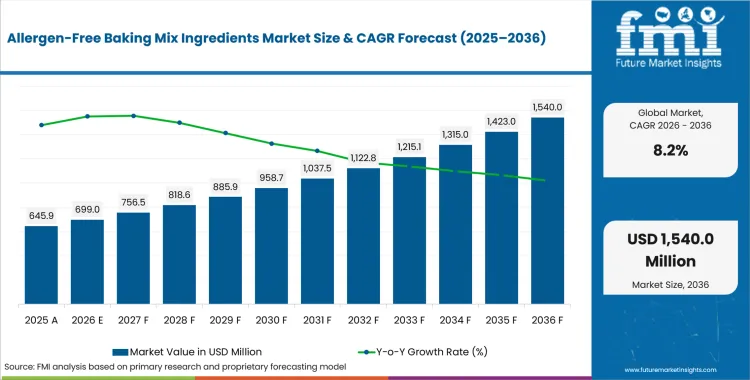
Key Takeaways of Allergen-Free Baking Mix Ingredients Market
- Demand is expected to rise as commercial bakeries need repeatable mixes that combine allergen control with dependable dough processing across routine production.
- Proteins are expected to account for 28.0% share in 2026, supported by their ability to replace binding and water-control functions.
- Bakery is projected to hold 52.0% of application demand in 2026, reflecting repeated reformulation across bread and sweet baked products.
- Shared-line cross-contact controls and country-specific label requirements remain material barriers for commercial bakeries using common production equipment.
- Competition includes Ingredion and Cargill alongside ADM and Kerry; Puratos and Tate & Lyle join Bunge and Corbion through specialized bakery application support.
Analyst Perspective
"Allergen-free baking mixes create value through one formula that passes allergen review and performs reliably on a full production line. A strong bench result carries little commercial weight if crumb changes across flour lots or cleaning rules disrupt line schedules. Ingredient companies that combine traceable materials with bakery application support can shorten qualification and protect repeatability across several manufacturing plants."
- Nandini Roy Choudhury, Principal Analyst, Future Market Insights
How is the Allergen-Free Baking Mix Ingredients Market segmented?
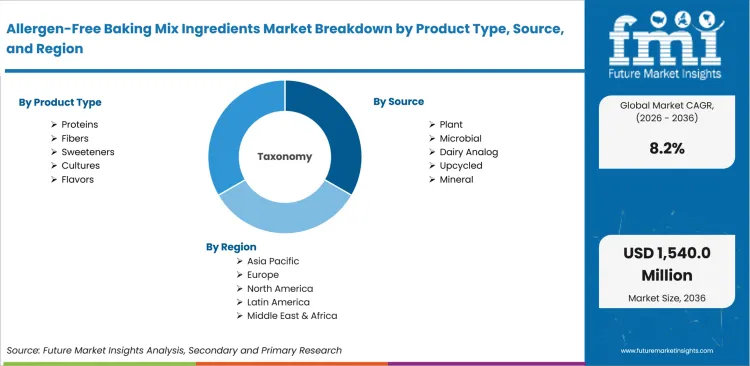
The allergen-free baking mix ingredients industry is segmented by product type, source, application, end user, and region.
Product type separates proteins, fibers, sweeteners, cultures, and flavors by the function they perform in restricted bakery recipes. Source distinguishes plant, microbial, dairy analog, upcycled, and mineral inputs by origin and traceability needs. Application shows whether a mix supports bakery, beverages, snacks, infant nutrition, or ready meals across different processing conditions. End user identifies the organization responsible for formulation approval and repeat purchasing across commercial customer channels. Regional analysis compares label rules, technical service coverage, and distribution conditions across national bakery channels.
Why do proteins shape product type demand in the allergen-free baking mix ingredients market?
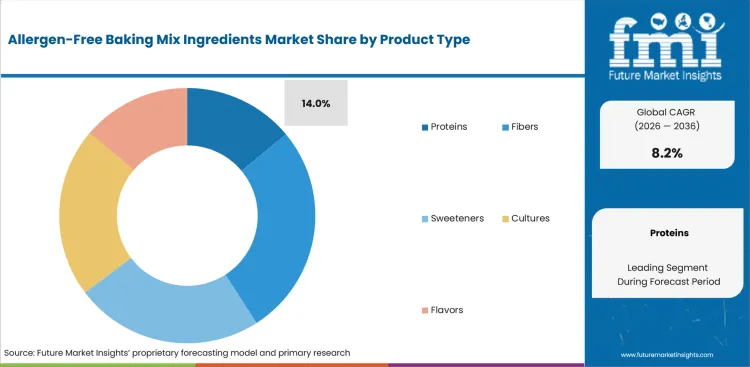
Proteins can replace binding and structure that eggs or gluten provide in conventional bakery formulas. In May 2026 ADM introduced eight protein ingredients including pea flour that requires no allergen labeling and suits baked goods or batters. Formulators can use the launch to strengthen dough without adding a major allergen declaration across commercial bakery products. Related egg replacement ingredients demonstrate why protein choice must match aeration and moisture targets across each intended finished format.
- Based on product type, proteins are projected to account for 14.0% in 2026 due to their ability to replace binding and water-control functions across restricted bakery recipes. One system can support binding and water control across commercial cakes or breads with different moisture profiles. That combination gives commercial bakeries a broader starting point than ingredients designed for one narrow texture correction.
- Commercial bakeries adopt protein systems through bench trials that confirm rise and crumb across the intended shelf life. Quality teams require traceable raw materials and clear allergen statements during internal formula approval and production scale-up. Protein companies gain repeat orders through application support that resolves recipe changes across different manufacturing plants.
What keeps plant sources central to source demand?
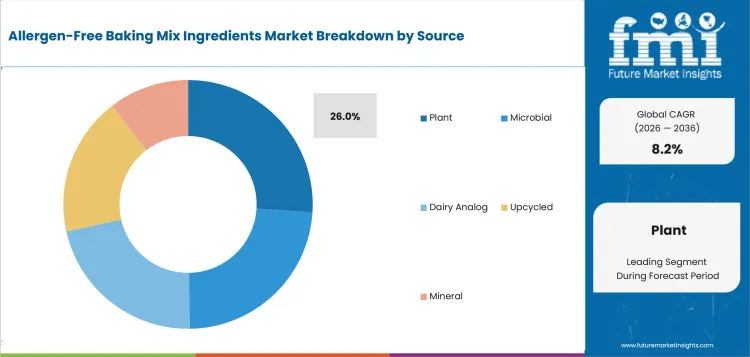
Plant sources give formulators starches and proteins that rebuild structure without relying on dairy-based functionality. Puratos and Guelph Foods formed a joint venture in September 2025 around plant-based egg wash alternatives for Asian bakeries. The partnership combines local production with bakery research and service capacity across China and other Asia-Pacific markets. That model broadens plant formulation routes across egg substitutes used in mixes requiring reliable appearance and label clarity.
- By source, plant sources are forecast to represent 26.0% in 2026 driven by broad availability across starch and protein families used in free-from formulation. Formulators can combine several crop-derived inputs to rebuild texture without relying on one costly specialty ingredient. The category supports mainstream and premium free-from recipes across several bakery formats and price positions.
- Manufacturers compare plant inputs through trials that test flavor and process tolerance across different crop sources. Seasonal raw-material variation can alter hydration and finished color across repeated production runs in different bakery plants. Ingredient companies with regional sourcing and application laboratories can adjust blend ratios faster across several customer facilities.
How does bakery create the clearest application demand?
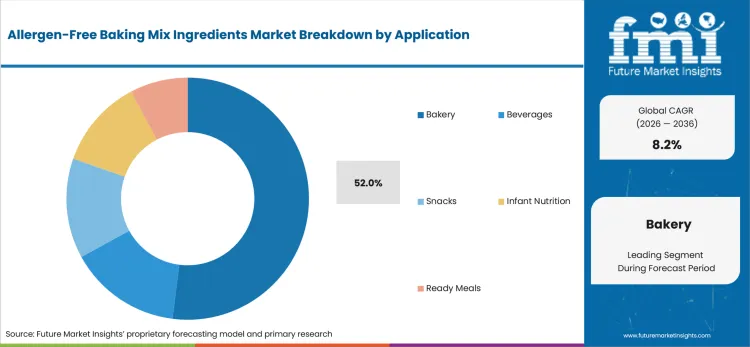
Bakery processes expose ingredient weaknesses during mixing and proofing prior to heat setting the final structure. Puratos introduced Cubease in May 2025 as a concentrated improver with one cube dosed for ten kilograms of flour, demonstrating how bakery mixes can combine functional performance with simpler dosing across artisan and industrial work areas. Allergen-free systems need the same operating discipline to preserve texture and repeatability across both production settings.
- Bakery is likely to capture 52.0% share in 2026 attributable to frequent reformulation across bread and sweet baked products. Preblended systems reduce weighing steps and help plants repeat sensitive recipes across several production shifts and flour conditions. Finished volume and crumb consistency provide measurable qualification tests that manufacturing teams can compare across commercial batches.
- Bakeries favor mixes that run on existing equipment without longer mixing cycles or separate handling areas. Shared lines also need clear cleaning instructions and validated cross-contact controls between scheduled production runs and product changes. A formulation gains recurring volume through stable plant performance and documented results across several commercial production schedules.
Which operating need keeps food manufacturers central to end user demand?
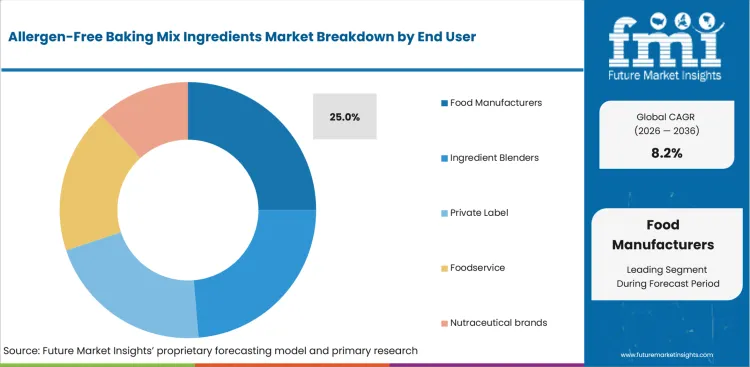
Food manufacturers control recipe approval and label release across packaged products sold through several retail channels. Puratos opened innovation hubs in Montreal and Costa Rica in August 2025 for local testing and co-development across bakery categories. The facilities give manufacturing teams faster access to regional flour trials and technical support during recipe transfer. That access links food safety testing services with practical formulation work during allergen-aware product qualification.
- By end user, food manufacturers are estimated to hold 25.0% in 2026 owing to repeat production volumes and formal qualification systems across established product lines. Their decisions combine ingredient performance with plant documentation across several manufacturing locations and retail programs. An approved mix can generate recurring commercial volume beyond one formula or seasonal production campaign.
- Quality teams approve new mixes through staged trials that connect formulation results with cleaning and label controls. Operations managers then assess dosing accuracy and possible line disruption across a complete commercial validation schedule. Ingredient companies that coordinate technical and regulatory support reduce handoffs across the complete approval process and plant transfer.
What are the drivers, restraints, and opportunities in the Allergen-Free Baking Mix Ingredients Market?
Clearer allergen rules and functional replacement systems increase commercial use, yet shared-line controls restrict adoption and create an opening for application-led reformulation.
- Driver: Clearer allergen guidance gives manufacturers defined requirements for ingredient declarations and documented controls across commercial bakery plants.
- Restraint: Shared bakery lines require segregation and validated cleaning that can delay credible free-from production across smaller facilities.
- Opportunity: Application-led reformulation can combine allergen reduction with measurable texture and plant-performance gains across established recipes.
Clearer regulatory interpretation reduces uncertainty during label review and ingredient approval across commercial bakery programs. The FDA held a public meeting on food allergen thresholds in February 2026 for regulators and food manufacturers. Sessions examined manufacturing uses and cross-contact control alongside possible labeling applications for defined threshold values. Defined reference points could help manufacturers build validation plans around measurable controls and consistent internal approval criteria. Ingredient companies can respond through technical dossiers that answer the same questions raised during formula qualification.
Cross-contact risk limits adoption at plants that handle wheat and other major allergens on shared equipment. The Food Standards Agency updated its allergen guidance in July 2026 for businesses making free-from claims. The guidance requires strict ingredient and handling controls that reduce cross-contamination risk across shared food production facilities. Smaller bakeries may delay specialized mixes until available production space and schedules can support effective segregation controls. Exposure beyond the main production line also requires documented controls across storage and rework routes.
Egg replacement gives ingredient companies a direct route to combine allergen reduction with practical bakery performance. Corbion launched new egg replacers in April 2025 to address supply pressure and preserve finished-product quality. The development gives gluten-free bakery premix teams a verified starting point for cakes and other egg-reduced recipes. Application laboratories can capture the opening through trials that measure crumb and plant consistency together. The same trial can confirm allergen declarations and finished-product performance within one commercial qualification program.
Which country CAGRs are profiled in the Allergen-Free Baking Mix Ingredients Market?

| Country | CAGR |
|---|---|
| India | 11.1% |
| United States | 10.3% |
| France | 9.4% |
| Japan | 8.6% |
| United Kingdom | 7.8% |
| Germany | 7.0% |
How do country-level CAGRs compare in the Allergen-Free Baking Mix Ingredients Market?
The country forecasts form a gradual progression across a 4.1 percentage-point range rather than isolated growth tiers. India and the United States remain closely aligned through expanding packaged bakery activity and local formulation support. France and Japan follow through mature channels that require precise label review and controlled product qualification. The United Kingdom and Germany show steadier percentage expansion within established free-from systems and familiar purchasing relationships. Similar rates therefore mask different routes from laboratory formulation to repeat commercial production across national bakery channels. Technical service depth and plant validation costs explain more commercial variation than the CAGR spacing alone.
- India's price-sensitive bakery base rewards local formulation support that can adjust mixes across regional flour quality and plant scale.
- The United States links mature allergen rules with broad laboratory capacity across national bakery manufacturing networks.
- France combines formal label review with distinct support needs across packaged products and artisan bakery sales.
- Japan requires precise ingredient identity and compact production routines as the mandatory allergen list continues to change.
- The United Kingdom provides detailed written guidance but imposes costly free-from controls on smaller shared-site bakeries.
- Germany combines mandatory allergen disclosure with established formulas that require measurable performance gains prior to replacement.
Comparable growth rates can produce different entry conditions across local bakery manufacturing and retail systems. Label approval and technical service coverage influence how quickly manufacturers convert a formulation trial into repeat production. The full report provides country-level CAGR analysis across North America, Latin America, Europe, East Asia, South Asia, Oceania and the Middle East and Africa.
Country-wise Analysis
- India's commercial bakeries range from regional plants to national brands that need cost-sensitive formulation support. Allergen-free baking mix ingredient sales in India are forecast to expand at 11.1% CAGR by 2036, supported by packaged bakery growth and local application development. Regional flour variation and tight price targets increase the value of local trials during commercial scale-up. Cargill introduced bake-stable fillings and functional bakery systems at AAHAR in March 2025 and offered research sessions at its Gurgaon innovation center. Those sessions help manufacturers adjust mixes through smaller trials that avoid immediate commitment of full production capacity. Fragmented plant capabilities can complicate cleaning validation across shared lines and several customer operating models. Smaller plants hold limited specialty inventory, so regional distributors need dependable lead times during scheduled production campaigns.
- United States manufacturers operate under federal allergen declarations and established qualification programs across industrial bakery plants. ADM opened its Central Lab-Milling in October 2025 and reported support for 31 North American operations. The allergen-free baking mix ingredients outlook for the United States is anticipated to advance at 10.3% CAGR over the assessment period, underpinned by broad laboratory access and national ingredient distribution. The laboratory tests flour through milling and baking to show likely performance across several commercial production settings. Different equipment and cleaning programs remain a material transfer risk across customer sites and regional product lines. Technical service adds value through flour-lot adjustments during national product rollouts and scheduled plant transfers.
- French bakery businesses must present clear information in French across prepacked foods and disclose allergens for non-prepacked products. Formal label review gives ingredient companies a defined documentation route across packaged and service bakery formats. DGCCRF confirmed in June 2025 that allergen information must appear near non-prepacked bakery and pastry products. Allergen-free baking mix ingredients demand in France is forecast to rise at 9.4% CAGR over the forecast period, influenced by established bakery channels and formal label review. Artisan and industrial bakeries use different processes that increase training and formulation support requirements across accounts. Regional teams must translate national rules into practical recipes and staff instructions for each bakery format.
- Japanese food companies must align ingredient files with a mandatory allergen list that changed during 2026. In Japan, allergen-free baking mix ingredients demand is predicted to advance at 8.6% CAGR through 2036, linked to precise labeling and compact product development cycles. The new mandatory declaration creates a direct reformulation and label-review task for affected commercial bakery mixes. The Consumer Affairs Agency added cashew to mandatory declarations on April 1, 2026 for foods sold through Japanese channels. Limited production space can complicate ingredient segregation across compact manufacturing facilities and tightly scheduled product trials. Failed production trials consume scarce plant time, so local distributors need rapid technical response during commercial qualification.
- United Kingdom bakeries must provide accurate allergen information across packaged products and food sold through service channels. The Food Standards Agency updated out-of-home guidance in March 2025 and encouraged written information for fourteen regulated allergens. Adoption of allergen-free baking mix ingredients in the United Kingdom is estimated to expand at 7.8% CAGR through 2036, reinforced by established guidance and specialty retail demand. Written records give ingredient companies a clear training framework across retail and foodservice customer accounts. Strict free-from guarantees raise operating costs for smaller sites using shared preparation and storage areas. Ingredient partners need practical materials that support central production teams and individual service locations during routine operations.
- German manufacturers must declare fourteen regulated allergens across packaged and unpackaged food routes serving industrial and craft bakeries. Ingredient companies need documentation that follows allergens through recipe approval and customer-facing information across each sales channel. Germany's federal agriculture ministry restated these requirements in April 2025 and confirmed mandatory allergen information for unpackaged foods. The German allergen-free baking mix ingredients sector is projected to record 7.0% CAGR during the assessment period, reflecting steady reformulation within established bakery channels. Mature customer relationships slow replacement of familiar mixes without measurable texture and processing gains across full production runs. Local application teams must connect label compliance with plant performance across industrial and craft bakery settings.
Who are the notable companies in the Allergen-Free Baking Mix Ingredients Market?
Ingredion, Cargill, ADM, Kerry, Puratos, Tate & Lyle, Bunge, and Corbion are notable companies shaping this market.
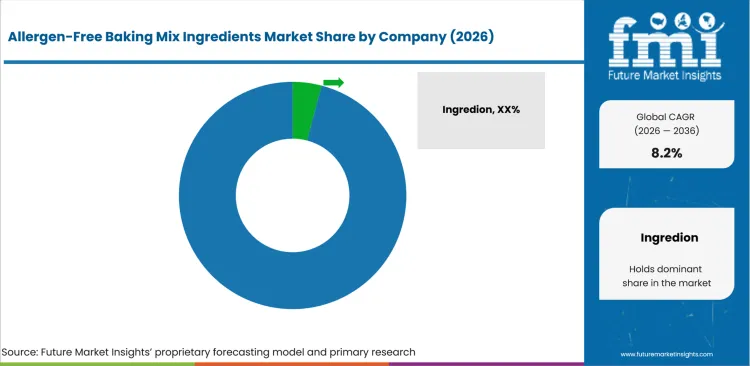
Competition outlook is influenced by how ingredient companies combine allergen replacement with bakery trials and documented label support. Ingredion and ADM provide starch or protein systems for structure replacement across cakes and breads. Cargill and Puratos add application centers that help manufacturers adjust recipes through commercial scale-up and plant transfer. Kerry and Tate & Lyle contribute taste or sweetening tools across gluten-free products that require balanced sensory performance. Bunge expands plant protein and lecithin options, and Corbion supplies egg replacement and bakery functional systems. Company selection depends on the required formulation change plus the available local testing and service route.
- Ingredion and ADM join Cargill in providing protein or starch systems that address binding and moisture control across restricted bakery recipes. Their technical value depends on portfolio breadth plus regional teams that adapt formulas across flour types and commercial equipment during production scale-up.
- Puratos and Kerry join Tate & Lyle in supporting projects that require coordinated bakery testing and sensory adjustment across several ingredients. Puratos contributes bakery-specific co-development; Kerry and Tate & Lyle add taste or sweetening tools during complex reformulation programs across regional bakery accounts.
- Bunge and Corbion broaden available routes through plant proteins and lecithin alongside egg replacement or bakery functional systems. Their focused capabilities complement larger portfolios during targeted formula changes that require measurable production or shelf-performance gains across regional product programs and customer facilities.
Competitive Benchmarking: Allergen-Free Baking Mix Ingredients Market
| Company | Functional Allergen Replacement | Bakery Application and Scale-up Support | Commercial Ingredient and Service Reach | Geographic Reach |
|---|---|---|---|---|
| Ingredion | High | High | High | Global |
| Cargill | Medium | High | High | Global |
| ADM | High | High | High | Global |
| Kerry | Medium | High | High | Global |
| Puratos | High | High | High | Global |
| Tate & Lyle | Medium | Medium | High | Global |
| Bunge | Medium | Medium | High | Global |
| Corbion | High | High | Medium | Global |
Key Developments in the Allergen-Free Baking Mix Ingredients Market
- In March 2026, Bunge completed its acquisition of IFF's soy protein concentrate and lecithin businesses. The transaction added functional protein brands used across bakery and snack formulations that require texture and nutrition support. The completed deal expands ingredient combinations available for higher-protein or egg-reduced baking mixes across several commercial applications. Application teams can compare protein and emulsification functions within one broader portfolio during allergen-aware reformulation.
- In May 2026, Cargill and Voyage Foods brought NextCoa cocoa-free confectionery alternatives to North America. The line excludes dairy and soy alongside peanuts or tree nuts and includes formats for baked goods. The partnership combines Voyage Foods' formulation technology with Cargill's business-to-business distribution network across the United States. Bakery manufacturers gain another major-allergen-free inclusion option that can enter familiar chocolate-handling and baking processes.
- In September 2025, Kerry opened a biotechnology center in Leipzig for enzyme and fermentation development across food applications. The facility supports discovery and scale-up through more than one hundred scientists and technical specialists working across several application areas. Kerry identified BIOBAKE enzymes among its commercialized technologies for bakery processability and finished-product shelf life. The center expands technical capacity that can support complex recipe redesign across commercial bakery systems.
- In June 2026, Corbion launched LUMI Set for commercial bakery icings that need a titanium dioxide-free stabilizer. The system addresses regulatory and customer pressure without sacrificing visual appeal across sweet baked products. The launch expands the functional toolkit available during broader allergen-aware recipe redesign across commercial icing applications. Bakery teams can evaluate color stability and line performance alongside restricted-ingredient controls during the same plant trial.
Key Players in the Allergen-Free Baking Mix Ingredients Market
Functional Ingredient Providers
- Ingredion
- Cargill
Bakery Application and Taste Specialists
- ADM
- Kerry
Focused Bakery Ingredient Companies
- Puratos
- Tate & Lyle
- Bunge
- Corbion
Allergen-Free Baking Mix Ingredients Market - Report Scope
| Coverage field | Report scope |
|---|---|
| Market breakdown | Product type, source, application, end user, and region. |
| Quantitative Units | Revenue in USD Million, CAGR in %. |
| Market Definition | Commercially tracked ingredient systems formulated for baking applications that exclude specified allergens and support defined functional performance. |
| Regions Covered | North America, Latin America, Europe, East Asia, South Asia, Oceania, and Middle East and Africa. |
| Countries Covered | United States, Germany, United Kingdom, France, Japan, India, and 30+ countries. |
| Key Companies Profiled | Ingredion, Cargill, ADM, Kerry, Puratos, Tate & Lyle, Bunge, and Corbion. |
| Forecast Period | 2026 to 2036. |
| Approach | Hybrid bottom-up and top-down market sizing supported by primary interviews and official desk research. |
Allergen-Free Baking Mix Ingredients Market - Research Methodology
| Method | Approach |
|---|---|
| Primary Research | FMI analysts gathered input from manufacturers, service providers, technology developers, distributors, end users, procurement teams, and subject-matter experts. Interviews examined purchasing decisions, product or service evaluation, adoption barriers, approval requirements, pricing considerations, and expectations for technical or commercial support. Respondents were also asked what evidence is required before a trial, pilot, or initial order develops into regular purchasing. |
| Desk Research | Desk research covered government statistics, regulatory publications, trade data, industry associations, technical literature, standards, company filings, product information, and official corporate announcements. Sources were reviewed for relevance, publication date, geographic coverage, and consistency with the defined market scope. Claims relating to performance, applications, approvals, capacity, investment, and commercial activity were retained only when supported by credible public evidence. |
| Market Sizing and Forecasting | The market model combined the baseline value with historical performance, segment structure, pricing and volume indicators, adoption levels, company participation, and country-level demand conditions. Forecast assumptions considered economic activity, investment trends, regulatory developments, technology adoption, purchasing cycles, supply availability, and barriers to wider market use. Segment and regional estimates were reconciled before the final market total was calculated. |
| Data Validation | Estimates were checked against multiple independent indicators, including public data, company activity, trade patterns, industry developments, and findings from primary interviews. Validation also tested whether products, services, applications, and company revenues fell within the defined market boundaries. Adjacent categories, unsupported claims, overlapping revenues, and activities without direct market relevance were excluded to reduce double counting and maintain consistency across segments and countries. |
Allergen-Free Baking Mix Ingredients Market by Segments
Allergen-Free Baking Mix Ingredients Market segmented by product type:
- Proteins
- Fibers
- Sweeteners
- Cultures
- Flavors
Allergen-Free Baking Mix Ingredients Market segmented by source:
- Plant
- Microbial
- Dairy Analog
- Upcycled
- Mineral
Allergen-Free Baking Mix Ingredients Market segmented by application:
- Bakery
- Beverages
- Snacks
- Infant Nutrition
- Ready Meals
Allergen-Free Baking Mix Ingredients Market segmented by end user:
- Food Manufacturers
- Beverage Manufacturers
- Foodservice Operators
- Contract Manufacturers
- Retail Brands
Allergen-Free Baking Mix Ingredients Market segmented by region:
- North America
- Europe
- East Asia
- South Asia and Pacific
- Latin America
- Middle East and Africa
Allergen-Free Baking Mix Ingredients Market by Region:
- North America
- United States
- Canada
- Mexico
- Latin America
- Brazil
- Chile
- Rest of Latin America
- Western Europe
- Germany
- UK
- Italy
- Spain
- France
- Nordic
- BENELUX
- Rest of Western Europe
- Eastern Europe
- Russia
- Poland
- Hungary
- Balkan and Baltic
- Rest of Eastern Europe
- East Asia
- China
- Japan
- South Korea
- South Asia and Pacific
- India
- ASEAN
- Australia and New Zealand
- Rest of South Asia and Pacific
- Middle East and Africa
- Kingdom of Saudi Arabia
- Other GCC Countries
- Turkiye
- South Africa
- Other African Union
- Rest of Middle East and Africa
Research Sources and Bibliography
- USA Food and Drug Administration. (2025, January). Guidance for Industry: Questions and Answers Regarding Food Allergen Labeling (Edition 5).
- Food Standards Agency. (2025, March 13). Allergen checklist for food businesses.
- ADM. (2026, May 20). ADM Advances Protein Innovation with New Ingredient Solutions.
- Puratos. (2025, September 12). Puratos and Guelph Announced Strategic Joint Venture to Ignite a New Chapter for Asia Pacific Bakery Industry.
- Puratos. (2025, May 7). Puratos brings a trio of transformative innovations to iba 2025.
- Puratos. (2025, August 25). Puratos Announces Two New Hubs for Food Innovation: Montreal and Costa Rica.
- Corbion. (2026, March 17). Our Advance 2025 strategy and beyond.
- USA Food and Drug Administration. (2026, February 18). Virtual Public Meeting and Listening Session on Food Allergen Thresholds and Their Potential Applications.
- Food Standards Agency. (2026, July 17). Allergen guidance for food businesses.
- Corbion. (2025, April 7). Corbion Launches Innovative Egg Replacers to Empower Bakeries Amid Supply Challenges.
- Cargill. (2025, March 4). Cargill Showcases Full Range of Innovative Food Solutions at AAHAR 2025.
- ADM. (2025, October 14). ADM Advances Quality Capabilities with opening of New Central Lab-Milling.
- Direction générale de la concurrence, de la consommation et de la répression des fraudes. (2025, June 6). Étiquetage des denrées alimentaires : les règles à connaître.
- Consumer Affairs Agency. (2026, April 1).
- Food Standards Agency. (2025, March 5). Updated industry guidance issued for food allergen information in the out-of-home sector.
- Bundesministerium für Landwirtschaft, Ernährung und Heimat. (2025, April 7). Allergenkennzeichnung ist Pflicht.
- Bunge. (2026, March 2). Bunge Completes Acquisition of IFF's Soy Protein Concentrate, Lecithin, and Crush Business.
- Cargill. (2026, May 12). Cargill and Voyage Foods to bring NextCoa™ cocoa-free confectionery alternatives to North America.
- Kerry. (2025, September 24). Kerry Establishes New Biotechnology Centre in Leipzig.
- Corbion. (2026, June 15). Corbion launches LUMI™ Set to help bakers reformulate away from titanium dioxide without sacrificing visual appeal.
- Ingredion Incorporated. (2026, February 17). Annual report on Form 10-K for the fiscal year ended December 31, 2025.
- Ingredion. (2025, May 22). The role of egg replacements in baking.
- Cargill. (2025, June 26). Inside Cargill’s worldwide innovation center network.
- Archer-Daniels-Midland Company. (2026, February 17). Annual report on Form 10-K for the fiscal year ended December 31, 2025.
- Kerry. (2026, March 19). Kerry publishes 2025 Annual Report: A year defined by impact, innovation and purpose.
- Tate & Lyle. (2026, May 21). Tate & Lyle PLC: Results for the year ended 31 March 2026.
- Bunge Global SA. (2026, February 19). Annual report on Form 10-K for the fiscal year ended December 31, 2025.
This bibliography is provided for reader reference and is not exhaustive. The full report contains the complete reference list and detailed citations
This Report Answers
- How large is the allergen-free baking mix ingredients market in 2026 and 2036?
- Why do proteins account for the selected product type share in 2026?
- How do plant sources support allergen-free bakery formulations?
- Why does bakery represent the selected application share in 2026?
- How do food manufacturers qualify new allergen-free ingredient systems?
- What regulatory controls constrain shared-line use of free-from baking mixes?
- How do country growth routes differ across India, the United States, and Europe?
- Which companies combine functional ingredients with bakery application support?
- What capabilities shape competitive benchmarking across ingredient companies?
Frequently Asked Questions
What is driving growth in the allergen-free baking mix ingredients market?
Commercial bakers need mixes that preserve familiar texture under stricter allergen controls across shared production lines. Clearer labeling guidance gives quality teams a structured basis for ingredient approval and commercial release.
Who are the key players in the allergen-free baking mix ingredients market?
Ingredion and Cargill join ADM and Kerry in providing broad formulation systems for commercial bakeries. Puratos and Tate & Lyle join Bunge and Corbion through specialized allergen replacement and bakery support.
What is a notable restraint in the allergen-free baking mix ingredients market?
Shared bakery lines create cross-contact risk that requires segregation and validated cleaning across scheduled production runs. Smaller sites may delay adoption due to added floor-space needs and trained-staff requirements during commercial production.
Why should executives track the allergen-free baking mix ingredients market?
Allergen controls affect formula approval and production continuity across bakery plants using shared manufacturing lines. Executives need clear visibility into qualification costs and technical support requirements during commercial scale-up across several facilities.
What business problem does the allergen-free baking mix ingredients market address?
The market addresses texture and processing losses that follow allergen removal from conventional bakery formulas. Preblended systems help manufacturing plants repeat validated recipes across different equipment and regional flour conditions.
What should food manufacturers evaluate in the allergen-free baking mix ingredients market?
Food manufacturers should compare application evidence with local technical support and dependable ingredient sourcing across intended production sites. Quality teams must confirm traceability and cross-contact controls through each formula approval and commercial release stage.
What limits return on investment in the allergen-free baking mix ingredients market?
Segregation costs and repeated plant adjustments can weaken returns across smaller allergen-free production programs and seasonal campaigns. Unreliable specialty ingredient supply adds further commercial risk during scheduled bakery production and customer launch periods.
What supports long-term confidence in the allergen-free baking mix ingredients market?
Repeatable plant performance and clear allergen documentation support long-term confidence during commercial expansion across several facilities. Dependable sourcing protects formulation behavior across manufacturing locations with different equipment and seasonal flour conditions.
Preview the report firsthand - request a free sample
Get SampleGet the brochure for pricing and purchase details.
Get PDFTable of Content
- Key Takeaways
- Market Size and CAGR
- Top Growth Driver
- Fastest Growing Segment
- Leading Region
- Key Companies
- Emerging Opportunities
- Executive Summary
- Global Market Outlook
- Demand-side Trends
- Supply-side Trends
- Technology Roadmap Analysis
- Analysis and Recommendations
- Analyst Perspective (What is happening? Why now? What should investors know?)
- Key Questions Answered
- How large is the market?
- What is the CAGR?
- What are key trends?
- Which region dominates?
- Who are the leaders?
- Market Overview
- Market Coverage / Taxonomy
- Market Definition / Scope / Limitations
- Research Methodology
- Chapter Orientation
- Analytical Lens and Working Hypotheses
- Market Structure, Signals, and Trend Drivers
- Benchmarking and Cross-market Comparability
- Market Sizing, Forecasting, and Opportunity Mapping
- Research Design and Evidence Framework
- Desk Research Programme (Secondary Evidence)
- Expert Input and Fieldwork (Primary Evidence)
- Tooling, Models, and Reference Databases
- Data Engineering and Model Build
- Quality Assurance and Audit Trail
- Market Background
- Market Dynamics (Drivers, Restraints, Opportunity, Trends)
- Scenario Forecast (Optimistic, Likely, Conservative)
- Impact Analysis
- AI Impact
- Sustainability Impact
- Regulatory Impact
- Technology Impact
- Consumer / Buyer Analysis
- Purchase Drivers
- Adoption Barriers
- Buyer Journey
- Opportunity Map Analysis
- Product Life Cycle Analysis
- Supply Chain Analysis
- Investment Feasibility Matrix
- Value Chain Analysis
- PESTLE and Porter's Analysis
- Regulatory Landscape
- Regional Parent Market Outlook
- Production and Consumption Statistics
- Import and Export Statistics
- Global Market Analysis and Forecast, 2021 to 2036
- Historical Market Size Value (USD Million) Analysis, 2021 to 2025
- Current and Future Market Size Value (USD Million) Projections, 2026 to 2036
- Y-o-Y Growth Trend Analysis
- Absolute $ Opportunity Analysis
- Global Market Pricing Analysis, 2021 to 2036
- Global Market Analysis and Forecast, By Product Type, 2021 to 2036
- Introduction / Key Findings
- Historical Market Size Value (USD Million) Analysis By Product Type, 2021 to 2025
- Current and Future Market Size Value (USD Million) Analysis and Forecast By Product Type, 2026 to 2036
- Proteins
- Fibers
- Sweeteners
- Cultures
- Flavors
- Proteins
- Y-o-Y Growth Trend Analysis By Product Type, 2021 to 2025
- Absolute $ Opportunity Analysis By Product Type, 2026 to 2036
- Global Market Analysis and Forecast, By Source, 2021 to 2036
- Introduction / Key Findings
- Historical Market Size Value (USD Million) Analysis By Source, 2021 to 2025
- Current and Future Market Size Value (USD Million) Analysis and Forecast By Source, 2026 to 2036
- Plant
- Microbial
- Dairy Analog
- Upcycled
- Mineral
- Plant
- Y-o-Y Growth Trend Analysis By Source, 2021 to 2025
- Absolute $ Opportunity Analysis By Source, 2026 to 2036
- Global Market Analysis and Forecast, By Application, 2021 to 2036
- Introduction / Key Findings
- Historical Market Size Value (USD Million) Analysis By Application, 2021 to 2025
- Current and Future Market Size Value (USD Million) Analysis and Forecast By Application, 2026 to 2036
- Bakery
- Beverages
- Snacks
- Infant Nutrition
- Ready Meals
- Bakery
- Y-o-Y Growth Trend Analysis By Application, 2021 to 2025
- Absolute $ Opportunity Analysis By Application, 2026 to 2036
- Global Market Analysis and Forecast, By End User, 2021 to 2036
- Introduction / Key Findings
- Historical Market Size Value (USD Million) Analysis By End User, 2021 to 2025
- Current and Future Market Size Value (USD Million) Analysis and Forecast By End User, 2026 to 2036
- Food Manufacturers
- Ingredient Blenders
- Private Label
- Foodservice
- Nutraceutical brands
- Food Manufacturers
- Y-o-Y Growth Trend Analysis By End User, 2021 to 2025
- Absolute $ Opportunity Analysis By End User, 2026 to 2036
- Global Market Analysis and Forecast, By Region, 2021 to 2036
- Introduction
- Historical Market Size Value (USD Million) Analysis By Region, 2021 to 2025
- Current Market Size Value (USD Million) Analysis and Forecast By Region, 2026 to 2036
- North America
- Latin America
- Western Europe
- Eastern Europe
- East Asia
- South Asia and Pacific
- Middle East & Africa
- Market Attractiveness Analysis By Region
- North America Market Analysis and Forecast, By Country, 2021 to 2036
- Historical Market Size Value (USD Million) Trend Analysis By Market Taxonomy, 2021 to 2025
- Market Size Value (USD Million) Forecast By Market Taxonomy, 2026 to 2036
- By Country
- USA
- Canada
- By Product Type
- By Source
- By Application
- By End User
- By Country
- Market Attractiveness Analysis
- By Country
- By Product Type
- By Source
- By Application
- By End User
- Key Takeaways
- Latin America Market Analysis and Forecast, By Country
- Historical Market Size Value (USD Million) Trend Analysis By Market Taxonomy, 2021 to 2025
- Market Size Value (USD Million) Forecast By Market Taxonomy, 2026 to 2036
- By Country
- Brazil
- Mexico
- Chile
- Rest of Latin America
- By Product Type
- By Source
- By Application
- By End User
- By Country
- Market Attractiveness Analysis
- By Country
- By Product Type
- By Source
- By Application
- By End User
- Key Takeaways
- Western Europe Market Analysis and Forecast, By Country
- Historical Market Size Value (USD Million) Trend Analysis By Market Taxonomy, 2021 to 2025
- Market Size Value (USD Million) Forecast By Market Taxonomy, 2026 to 2036
- By Country
- Germany
- UK
- Italy
- Spain
- France
- Nordic
- BENELUX
- Rest of Western Europe
- By Product Type
- By Source
- By Application
- By End User
- By Country
- Market Attractiveness Analysis
- By Country
- By Product Type
- By Source
- By Application
- By End User
- Key Takeaways
- Eastern Europe Market Analysis and Forecast, By Country
- Historical Market Size Value (USD Million) Trend Analysis By Market Taxonomy, 2021 to 2025
- Market Size Value (USD Million) Forecast By Market Taxonomy, 2026 to 2036
- By Country
- Russia
- Poland
- Hungary
- Balkan & Baltic
- Rest of Eastern Europe
- By Product Type
- By Source
- By Application
- By End User
- By Country
- Market Attractiveness Analysis
- By Country
- By Product Type
- By Source
- By Application
- By End User
- Key Takeaways
- East Asia Market Analysis and Forecast, By Country
- Historical Market Size Value (USD Million) Trend Analysis By Market Taxonomy, 2021 to 2025
- Market Size Value (USD Million) Forecast By Market Taxonomy, 2026 to 2036
- By Country
- China
- Japan
- South Korea
- By Product Type
- By Source
- By Application
- By End User
- By Country
- Market Attractiveness Analysis
- By Country
- By Product Type
- By Source
- By Application
- By End User
- Key Takeaways
- South Asia and Pacific Market Analysis and Forecast, By Country
- Historical Market Size Value (USD Million) Trend Analysis By Market Taxonomy, 2021 to 2025
- Market Size Value (USD Million) Forecast By Market Taxonomy, 2026 to 2036
- By Country
- India
- ASEAN
- Australia & New Zealand
- Rest of South Asia and Pacific
- By Product Type
- By Source
- By Application
- By End User
- By Country
- Market Attractiveness Analysis
- By Country
- By Product Type
- By Source
- By Application
- By End User
- Key Takeaways
- Middle East & Africa Market Analysis and Forecast, By Country
- Historical Market Size Value (USD Million) Trend Analysis By Market Taxonomy, 2021 to 2025
- Market Size Value (USD Million) Forecast By Market Taxonomy, 2026 to 2036
- By Country
- Kingdom of Saudi Arabia
- Other GCC Countries
- Türkiye
- South Africa
- Other African Union
- Rest of Middle East & Africa
- By Product Type
- By Source
- By Application
- By End User
- By Country
- Market Attractiveness Analysis
- By Country
- By Product Type
- By Source
- By Application
- By End User
- Key Takeaways
- Key Countries Market Analysis
- USA
- Pricing Analysis
- Market Share Analysis, 2025
- By Product Type
- By Source
- By Application
- By End User
- Canada
- Pricing Analysis
- Market Share Analysis, 2025
- By Product Type
- By Source
- By Application
- By End User
- Mexico
- Pricing Analysis
- Market Share Analysis, 2025
- By Product Type
- By Source
- By Application
- By End User
- Brazil
- Pricing Analysis
- Market Share Analysis, 2025
- By Product Type
- By Source
- By Application
- By End User
- Chile
- Pricing Analysis
- Market Share Analysis, 2025
- By Product Type
- By Source
- By Application
- By End User
- Germany
- Pricing Analysis
- Market Share Analysis, 2025
- By Product Type
- By Source
- By Application
- By End User
- UK
- Pricing Analysis
- Market Share Analysis, 2025
- By Product Type
- By Source
- By Application
- By End User
- Italy
- Pricing Analysis
- Market Share Analysis, 2025
- By Product Type
- By Source
- By Application
- By End User
- Spain
- Pricing Analysis
- Market Share Analysis, 2025
- By Product Type
- By Source
- By Application
- By End User
- France
- Pricing Analysis
- Market Share Analysis, 2025
- By Product Type
- By Source
- By Application
- By End User
- India
- Pricing Analysis
- Market Share Analysis, 2025
- By Product Type
- By Source
- By Application
- By End User
- ASEAN
- Pricing Analysis
- Market Share Analysis, 2025
- By Product Type
- By Source
- By Application
- By End User
- Australia & New Zealand
- Pricing Analysis
- Market Share Analysis, 2025
- By Product Type
- By Source
- By Application
- By End User
- China
- Pricing Analysis
- Market Share Analysis, 2025
- By Product Type
- By Source
- By Application
- By End User
- Japan
- Pricing Analysis
- Market Share Analysis, 2025
- By Product Type
- By Source
- By Application
- By End User
- South Korea
- Pricing Analysis
- Market Share Analysis, 2025
- By Product Type
- By Source
- By Application
- By End User
- Russia
- Pricing Analysis
- Market Share Analysis, 2025
- By Product Type
- By Source
- By Application
- By End User
- Poland
- Pricing Analysis
- Market Share Analysis, 2025
- By Product Type
- By Source
- By Application
- By End User
- Hungary
- Pricing Analysis
- Market Share Analysis, 2025
- By Product Type
- By Source
- By Application
- By End User
- Kingdom of Saudi Arabia
- Pricing Analysis
- Market Share Analysis, 2025
- By Product Type
- By Source
- By Application
- By End User
- Türkiye
- Pricing Analysis
- Market Share Analysis, 2025
- By Product Type
- By Source
- By Application
- By End User
- South Africa
- Pricing Analysis
- Market Share Analysis, 2025
- By Product Type
- By Source
- By Application
- By End User
- USA
- Market Structure Analysis
- Competition Dashboard
- Competition Benchmarking
- Market Share Analysis of Top Players
- By Regional
- By Product Type
- By Source
- By Application
- By End User
- Emerging Startups
- Innovation Benchmarking
- Competition Analysis
- Competition Deep Dive
- Ingredion
- Overview
- Product Portfolio
- Profitability by Market Segments
- Sales Footprint
- Strategy Overview
- Marketing Strategy
- Product Strategy
- Channel Strategy
- Cargill
- ADM
- Kerry
- Puratos
- Tate & Lyle
- Bunge
- Corbion
- Ingredion
- Case Studies
- Success Stories
- Recent Developments
- Competition Deep Dive
- Assumptions & Acronyms Used


