

- Industry Size (2025)
- USD 7.9 Bn
- Forecast (2035)
- USD 12.1 Bn
- CAGR (2025 to 2035)
- 4.3%
Arthroscopy Devices Market Outlook from 2025 to 2035
The arthroscopy devices market is advancing steadily, driven by rising orthopedic case volumes, a global shift toward minimally invasive surgeries, and technological innovations in joint visualization and repair systems. Industry reports and orthopedic surgical associations have highlighted the growing incidence of sports injuries, osteoarthritis, and traumatic joint disorders, prompting greater demand for arthroscopic interventions.
Surgeons and healthcare providers have increasingly preferred arthroscopy due to its benefits of reduced postoperative pain, shorter hospital stays, and faster recovery times, fueling procedural volumes across sports medicine and orthopedic departments. Continuous advancements in imaging systems, high-definition arthroscopes, and precision-guided instruments have enhanced the accuracy and efficiency of arthroscopic surgeries, further expanding their application across joint types.
Hospital investments in minimally invasive infrastructure and the rising adoption of digital integration in operating rooms have also accelerated the uptake of advanced arthroscopy platforms. Over the coming years, market growth is expected to be shaped by increased procedural demand for knee interventions, rising adoption of bioabsorbable implants, and improved access to orthopedic care in emerging economies.
Quick Stats for Arthroscopy Devices Market
- Arthroscopy Devices Market Industry Value (2025): USD 7.9 billion
- Arthroscopy Devices Market Forecast Value (2035): USD 12.1 billion
- Arthroscopy Devices Market Forecast CAGR: 4.3%
- Leading Segment in Arthroscopy Devices Market in 2025: Knee Arthroscopic Procedure (29.8%)
- Key Growth Region in Arthroscopy Devices Market: North America, Asia-Pacific, Europe
- Top Key Players in Arthroscopy Devices Market: Smith & Nephew plc, Medtronic plc, Zimmer Biomet Holdings, Inc, Conmed Corporation, Johnson & Johnson, Henke Sass Wolf GmbH, Stryker Corporation, Karl Storz GmbH & Co. KG, Arthrex, Inc, Richard Wolf GmbH
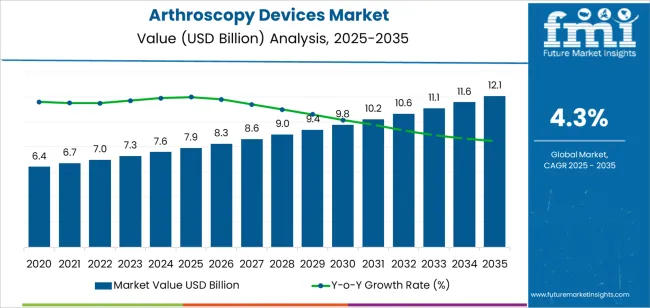
| Metric | Value |
|---|---|
| Arthroscopy Devices Market Estimated Value in (2025 E) | USD 7.9 billion |
| Arthroscopy Devices Market Forecast Value in (2035 F) | USD 12.1 billion |
| Forecast CAGR (2025 to 2035) | 4.3% |
Segmental Analysis
The market is segmented by Procedure and Product Type and region. By Procedure, the market is divided into Knee Arthroscopic Procedure, Shoulder Arthroscopic Procedure, Hip Arthroscopic Procedure, and Others. In terms of Product Type, the market is classified into Arthroscopic Implants, Arthroscopies, Shoulder Implants, Knee Implants, Hip Implants, Small Joint Implants, Arthroscopic Shaver Systems, Arthroscopic Visualization, Fluid Management Systems, Arthroscopic Radio Frequency Devices, Arthroscopic Radio Frequency Systems, and Arthroscopic Radio Frequency Wands. Regionally, the market is classified into North America, Latin America, Western Europe, Eastern Europe, Balkan & Baltic Countries, Russia & Belarus, Central Asia, East Asia, South Asia & Pacific, and the Middle East & Africa.
Insights into the Procedure Segment: Knee Arthroscopic Procedure
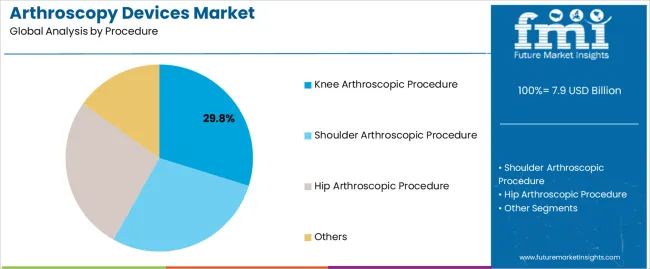
The Knee Arthroscopic Procedure segment is projected to contribute 29.80% of the arthroscopy devices market revenue in 2025, maintaining its position as the leading procedure category. This dominance has been attributed to the high prevalence of knee-related injuries and degenerative conditions, including meniscal tears, ligament injuries, and early-stage osteoarthritis.
Sports medicine research and orthopedic surgery journals have documented a sustained increase in arthroscopic knee procedures, driven by growing participation in athletic activities and aging populations prone to joint deterioration. Knee arthroscopy has been favored for its ability to provide accurate diagnosis and targeted treatment of intra-articular pathologies with minimal invasiveness.
Furthermore, improvements in surgical techniques and enhanced fixation devices have broadened the scope of knee arthroscopic interventions. Healthcare systems have also expanded orthopedic rehabilitation programs, facilitating faster recovery and improving procedural outcomes. With continuous innovation in suture anchors, shavers, and visualization tools, the Knee Arthroscopic Procedure segment is expected to retain its leadership, supported by clinical demand and procedural efficacy.
Insights into the Product Type Segment: Arthroscopic Implants
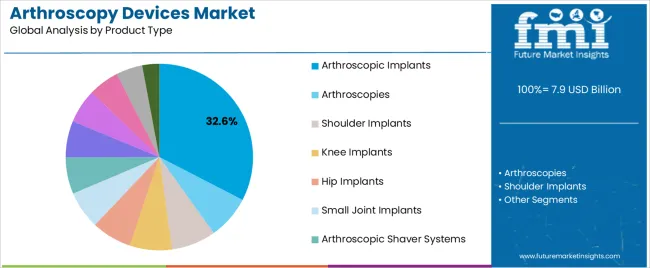
The Arthroscopic Implants segment is projected to account for 32.6% of the arthroscopy devices market revenue in 2025, emerging as the top product type. Growth of this segment has been driven by increased use of fixation and stabilization implants during minimally invasive joint repair procedures.
Orthopedic device manufacturers have introduced a wide range of bioabsorbable and metal-based implants designed to enhance joint stability, reduce surgical time, and support tissue integration. Clinical publications and surgeon feedback have supported the efficacy of arthroscopic implants in ligament reconstruction, rotator cuff repair, and meniscal fixation, leading to higher adoption rates.
Additionally, innovation in anchor design, screw systems, and suture management tools has improved procedural accuracy and patient outcomes. Healthcare providers have also reported greater procedural consistency and reduced revision rates with modern implant systems. As orthopedic practices continue to shift toward minimally invasive techniques, the Arthroscopic Implants segment is anticipated to remain a cornerstone of arthroscopic surgery, driven by clinical utility and technological refinement.
Semi Annual Market Update
As shown in the table above, the global arthroscopy devices market is predicted to expand by a significant CAGR during several semi-annual periods between 2025 and 2035. A CAGR of 4.8% is predicted for the first half (H1) of the decade from 2025 to 2035, followed by a slightly lower growth rate of 4.6% for the second half (H2).
| Particular | Value CAGR |
|---|---|
| H1 | 4.8% (2025 to 2035) |
| H2 | 4.6% (2025 to 2035) |
| H1 | 4.4% (2025 to 2035) |
| H2 | 4.1% (2025 to 2035) |
Over the period from H1 2025 to H2 2035, it is expected that the CAGR will increase slightly to 4.4% in the first half of 2025 and remain at relatively moderate levels of 4.1% in the second half of 2035.
Key Industry Highlights
Growing Incidences of Sports Injuries and Musculoskeletal Disorders is likely to Accelerate Arthroscopy Devices Market Growth
The increasing number of sports injuries will drive the growth rate of the arthroscopy device market. The increase in the prevalence of musculoskeletal disorder is anticipated to fuel the global arthroscopy devices market size. The rising frequency of musculoskeletal disorders such as rheumatoid arthritis and osteoarthritis is anticipated to propel the global arthroscopy devices market size.
The increasing number of government initiatives to raise public knowledge about various treatment options will be a significant driver of the growth rate of the arthroscopy device market.
The growing elderly population and increased acceptance of minimally invasive (MI) treatment methods are key drivers of market development. Numerous developments in sports medicine, as well as the development of technologically superior product versions, impacting device adoption, further fueling the global arthroscopy devices market size.
Growing Investments in Research and Development and Technological are expected to Propel Market Growth
Surge in investments for research and development activities is likely to create possibilities for the arthroscopy devices market to expand. The development and modernization of healthcare infrastructure in emerging nations is anticipated to accelerate the growth rate of the arthroscopy devices market during the forecast period.
As medical device technology advances, the growth rate of the arthroscopy devices market is likely to surge during the forecast period. Manufacturers are developing arthroscopy equipment with high definition cameras, advanced suturing processes, and specialty suturing materials to increase visibility.
High Cost of Arthroscopy Equipment to Impede Arthroscopy devices Market Growth
The high cost of arthroscopy equipment is likely to restrain market expansion. The shortage of experienced specialists would offer a significant barrier to the arthroscopy device industry. Changes in hospital decision making and tight regulatory standards are key challenges and limitations of arthroscopy devices market throughout the projection period.
2020 to 2024 Global Arthroscopy Devices Demand Analysis Compared to Demand Forecasts for 2025 to 2035
Global arthroscopy devices demand increased at a CAGR of 4% from 2020 to 2025. For the next ten years (2025 to 2035), projections are that expenditure on arthroscopy devices will reach a CAGR of 4.3%.
During the historical period, the market grew owing to advances in minimally invasive surgical methods, the rising frequency of joint related illnesses, and the growing preference for arthroscopic treatments due to their shorter recovery periods and decreased risk of complications when compared to standard surgeries.
Over the projection period, the aging global population is increasing the prevalence of osteoarthritis and other joint ailments, raising the demand for arthroscopic procedures. Technical advancements in arthroscopy equipment, such as improved imaging systems, sophisticated surgical tools, and the incorporation of robots, are projected to fuel the global arthroscopy devices market size.
Increased healthcare spending in emerging nations is driving to a greater use of arthroscopic surgeries. Countries in Asia Pacific, Latin America, and the Middle East are spending considerably in healthcare infrastructure, resulting in improved availability and cost of modern surgical procedures. This tendency is anticipated to drive the global arthroscopy devices market size.
Patient awareness of the benefits of minimally invasive operations is playing an important role in market growth. Patients are increasingly seeking procedures that promote faster recovery and less scarring, which arthroscopy does.
The arthroscopy devices market size and forecast is expected to expand significantly during the projected period. With technological improvements, increased healthcare spending, and an increasing patient desire for minimally invasive procedures, drives the global arthroscopy devices market size is anticipated to show potential growth prospects during the forecast period.
Market Concentration
A significant portion of the global market share is captured by Tier 1 companies, which dominate the market at a share of 42%. Research and development are important areas of focus for these companies, continually improving patient care through new products and procedures.
Tier 1 companies may engage in collaboration with medical professionals, universities, and research institutions in order to foster innovation. By sharing resources, innovating, and integrating resources, new arthroscopy devices are being developed. Prominent players within tier 1 include Johnson & Johnson, Stryker Corporation, Smith & Nephew plc, and Arthrex, Inc.
Mid-sized companies in Tier 2 account for 26% of revenues and are highly influencing the domestic markets. Despite their market presence and well-known product offerings, these companies may not offer as much as Tier 1 companies.
The industry is focusing on technology that enhances surgical precision and improves patient outcomes through advanced vision systems, surgical tools, and implantable devices. Prominent companies in tier 2 include Medtronic plc, Zimmer Biomet Holdings, Inc, and Karl Storz GmbH & Co. KG.
Tier 3 players include companies with a regional presence or specialized product offerings that have a niche market presence. The market is often competitive by providing cost-effective or specialized solutions to emerging arthroscopic technologies. They also offer innovative solutions to their customers in addition to specializing in a variety of products.
The companies in Tiers 1 and 2 have significant market shares, but their global reach and product range are often limited. Prominent Players include Conmed Corporation, Henke Sass Wolf GmbH, and Richard Wolf GmbH.
Country-wise Insights
The following table shows the estimated growth rates of the top three markets. The United States and Canada are set to exhibit high arthroscopy devices market growth, recording CAGRs of 5.7% and 4.9%, respectively, through 2035.
| Countries | CAGR 2025 to 2035 |
|---|---|
| The United States | 5.2% |
| Canada | 4.3% |
| Italy | 4.2% |
| France | 4.4% |
| China | 6.2% |
Surge in Sports Injuries is likely to Drive the Market in the United States
The United States is projected to ascend at a CAGR of 5.2% during the forecast period. The prevalence of sport injuries is extremely high the United States is anticipated to augment the growth rate of the arthroscopy devices market in the United States.
According to a study published by AASO in June 2025, from 2020 to 2020, high school athletic trainers reported 15,531 injuries throughout 6,778,209 AEs, for an overall rate of 2.29 injuries per 1,000 AEs. An estimated 5,228,791 injuries occurred nationwide.
The highest injury rates were seen in football (3.96 per 1,000 AEs), girls soccer (2.65), and boys wrestling (2.36). Boys sports had a greater injury rate (2.52) than girls sports (1.56). All the above statistics necessitates the need for arthroscopy devices further driving the growth rate of the arthroscopy devices market.
Advanced Healthcare Infrastructure in Italy is Driving the Market Demand
Italy is predicted to augment at a CAGR of 4.2% during the projected period. The advanced healthcare infrastructure in Italy contributes considerably to the growth rate of the arthroscopy devices market.
The healthcare system in Italy, which is known for high standards and universal accessibility, creates a favorable environment for technology innovation. Cutting edge hospitals and specialist clinics are suitable for the most advanced arthroscopic equipment, allowing for minimally invasive procedures.
Significant expenditures in healthcare facilities and ongoing professional training guarantee that medical personnel are skilled in the use of advanced arthroscopic technology further driving the market growth in the country.
Chronic Illness and Increasing Knee Surgeries is Propelling the Market Demand in China
China is expected to thrive at a CAGR of 6.2% during the assessment period. The rising incidence of chronic illness and sports injuries is among the key factors driving the growth of the arthroscopy devices market. Rising demand for joint replacement surgeries and incidence of sport injuries are factors influencing the growth.
Increasing healthcare infrastructure, patient awareness, and minimally invasive surgical techniques will contribute to strong growth in China in the coming years. In order to capitalize on growth opportunities and expand their footprint, key players are focusing on China as a strategic market.
Category-Wise Insights
Hospitals to Lead the Arthroscopy Devices Market
| Segment | Hospitals (End User) |
|---|---|
| Value Share (2025) | 44% |
The hospitals category is expected to lead the arthroscopy devices market by 2025, accounting for 44%. This growth emphasizes the role of hospitals in the arthroscopic surgeries. As complete medical care institutions, hospitals provide cutting edge facilities and access to highly trained orthopedic surgeons, making them ideal locations for arthroscopy.
The increased frequency of joint related illnesses, along with the growing need for less invasive operations, fuels this trend. Driven by their capacity to manage difficult situations, offer post operative care, and promote rapid recovery, the hospital segment is anticipated to lead the end user segment and drive the global arthroscopy devices market size.
The Arthroscopic Shavers Segment to Drive the Market Growth
| Segment | Arthroscopic shavers (Product Type) |
|---|---|
| Value Share (2025) | 36.9% |
In 2025, the arthroscopic shavers segment is predicted to lead the arthroscopy devices market, with a market share of 36.9%. This growth is a reflection of the use of arthroscopic shavers in minimally invasive surgical procedures, especially in orthopedics.
The rising frequency of sports injuries and osteoarthritis has increased demand for improved arthroscopic equipment, fueling the demand for this for segment. Shaver technological innovations, including as increased blade design and motor efficiency, are also driving the demand for the segment which further increase the global arthroscopy devices market size.
Competitive Landscape
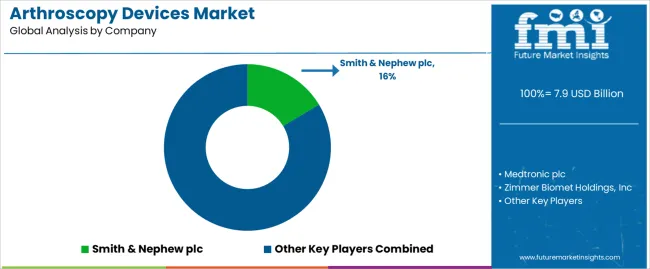
The global arthroscopy devices market is extremely competitive. Leading market players dominate the market owing to their diverse product ranges and high brand awareness. The industry giants invest extensively in research and development to offer advanced, minimally invasive surgical equipment that improve procedural efficiency and patient outcomes.
The market is seeing rising competition from new enterprises and startups that specialize in specific niches and novel technology. The new entrants frequently bring new viewpoints and cutting edge solutions, challenging the established market players and propelling the market growth.
Collaborations, mergers, and acquisitions are frequent techniques used by industry leaders to increase their product offerings and boost their worldwide position.
Technological developments are critical in the competitive field, with businesses constantly introducing next generation arthroscopy devices with increased imaging systems, robotics integration, and ergonomic designs.
Recent Developments
- In April 2025, Medtronic plc, a global leader in healthcare technology announced that the USA Food and Drug Administration (FDA) authorized the Inceptiv™ closed-loop rechargeable spinal cord stimulator for the treatment of chronic pain.
- In April 2025, Zimmer Biomet Holdings, Inc., a worldwide medical technology pioneer, reported the successful completion of the world's first robotic-assisted shoulder replacement operation using its ROSA® Shoulder System.
Leading Arthroscopy Devices Brands
Medtronic plc, Zimmer Biomet Holdings, Inc, Conmed Corporation, Johnson & Johnson, Henke Sass Wolf GmbH, Smith & Nephew plc, Stryker Corporation, Karl storz GmbH & Co. KG, Arthrex, Inc and Richard Wolf GmbH are the key players in this market.
Key Segments of the Report
By Procedure:
The arthroscopy devices market is classified into shoulder arthroscopic procedure, knee arthroscopic procedure, hip arthroscopic procedure, and others.
By Product Type:
The arthroscopy devices market is classified into arthroscopies, arthroscopic implants, shoulder implants, knee implants, hip implants, small joint implants, arthroscopic shaver systems, arthroscopic visualization, fluid management systems, arthroscopic radio frequency devices, arthroscopic radio frequency systems, arthroscopic radio frequency wands.
By End User:
The arthroscopy devices market is classified into hospitals, clinics and others.
By Region:
Analysis of the arthroscopy devices market has been carried out in key countries of North America, Latin America, Western Europe, South Asia, East Asia, Eastern Europe and Middle East & Africa.
Frequently Asked Questions
How big is the arthroscopy devices market in 2025?
The global arthroscopy devices market is estimated to be valued at USD 7.9 billion in 2025.
What will be the size of arthroscopy devices market in 2035?
The market size for the arthroscopy devices market is projected to reach USD 12.1 billion by 2035.
How much will be the arthroscopy devices market growth between 2025 and 2035?
The arthroscopy devices market is expected to grow at a 4.3% CAGR between 2025 and 2035.
What are the key product types in the arthroscopy devices market?
The key product types in arthroscopy devices market are knee arthroscopic procedure, shoulder arthroscopic procedure, hip arthroscopic procedure and others.
Which product type segment to contribute significant share in the arthroscopy devices market in 2025?
In terms of product type, arthroscopic implants segment to command 32.6% share in the arthroscopy devices market in 2025.
Preview the report firsthand - request a free sample
Get SampleGet the brochure for pricing and purchase details.
Get PDFTable of Content
- Executive Summary
- Global Market Outlook
- Demand-side Trends
- Supply-side Trends
- Technology Roadmap Analysis
- Analysis and Recommendations
- Market Overview
- Market Coverage / Taxonomy
- Market Definition / Scope / Limitations
- Market Background
- Market Dynamics
- Drivers
- Restraints
- Opportunity
- Trends
- Scenario Forecast
- Demand in Optimistic Scenario
- Demand in Likely Scenario
- Demand in Conservative Scenario
- Opportunity Map Analysis
- Product Life Cycle Analysis
- Supply Chain Analysis
- Investment Feasibility Matrix
- Value Chain Analysis
- PESTLE and Porter’s Analysis
- Regulatory Landscape
- Regional Parent Market Outlook
- Production and Consumption Statistics
- Import and Export Statistics
- Market Dynamics
- Global Market Analysis 2020 to 2024 and Forecast, 2025 to 2035
- Historical Market Size Value (USD Million) Analysis, 2020 to 2024
- Current and Future Market Size Value (USD Million) Projections, 2025 to 2035
- Y-o-Y Growth Trend Analysis
- Absolute $ Opportunity Analysis
- Global Market Pricing Analysis 2020 to 2024 and Forecast 2025 to 2035
- Global Market Analysis 2020 to 2024 and Forecast 2025 to 2035, By Procedure
- Introduction / Key Findings
- Historical Market Size Value (USD Million) Analysis By Procedure , 2020 to 2024
- Current and Future Market Size Value (USD Million) Analysis and Forecast By Procedure , 2025 to 2035
- Knee Arthroscopic Procedure
- Shoulder Arthroscopic Procedure
- Hip Arthroscopic Procedure
- Others
- Y-o-Y Growth Trend Analysis By Procedure , 2020 to 2024
- Absolute $ Opportunity Analysis By Procedure , 2025 to 2035
- Global Market Analysis 2020 to 2024 and Forecast 2025 to 2035, By Product Type
- Introduction / Key Findings
- Historical Market Size Value (USD Million) Analysis By Product Type, 2020 to 2024
- Current and Future Market Size Value (USD Million) Analysis and Forecast By Product Type, 2025 to 2035
- Arthroscopic Implants
- Arthroscopies
- Shoulder Implants
- Knee Implants
- Hip Implants
- Small Joint Implants
- Arthroscopic Shaver Systems
- Arthroscopic Visualization
- Fluid Management Systems
- Arthroscopic Radio Frequency Devices
- Arthroscopic Radio Frequency Systems
- Y-o-Y Growth Trend Analysis By Product Type, 2020 to 2024
- Absolute $ Opportunity Analysis By Product Type, 2025 to 2035
- Global Market Analysis 2020 to 2024 and Forecast 2025 to 2035, By Region
- Introduction
- Historical Market Size Value (USD Million) Analysis By Region, 2020 to 2024
- Current Market Size Value (USD Million) Analysis and Forecast By Region, 2025 to 2035
- North America
- Latin America
- Western Europe
- Eastern Europe
- East Asia
- South Asia and Pacific
- Middle East & Africa
- Market Attractiveness Analysis By Region
- North America Market Analysis 2020 to 2024 and Forecast 2025 to 2035, By Country
- Historical Market Size Value (USD Million) Trend Analysis By Market Taxonomy, 2020 to 2024
- Market Size Value (USD Million) Forecast By Market Taxonomy, 2025 to 2035
- By Country
- USA
- Canada
- Mexico
- By Procedure
- By Product Type
- By Country
- Market Attractiveness Analysis
- By Country
- By Procedure
- By Product Type
- Key Takeaways
- Latin America Market Analysis 2020 to 2024 and Forecast 2025 to 2035, By Country
- Historical Market Size Value (USD Million) Trend Analysis By Market Taxonomy, 2020 to 2024
- Market Size Value (USD Million) Forecast By Market Taxonomy, 2025 to 2035
- By Country
- Brazil
- Chile
- Rest of Latin America
- By Procedure
- By Product Type
- By Country
- Market Attractiveness Analysis
- By Country
- By Procedure
- By Product Type
- Key Takeaways
- Western Europe Market Analysis 2020 to 2024 and Forecast 2025 to 2035, By Country
- Historical Market Size Value (USD Million) Trend Analysis By Market Taxonomy, 2020 to 2024
- Market Size Value (USD Million) Forecast By Market Taxonomy, 2025 to 2035
- By Country
- Germany
- UK
- Italy
- Spain
- France
- Nordic
- BENELUX
- Rest of Western Europe
- By Procedure
- By Product Type
- By Country
- Market Attractiveness Analysis
- By Country
- By Procedure
- By Product Type
- Key Takeaways
- Eastern Europe Market Analysis 2020 to 2024 and Forecast 2025 to 2035, By Country
- Historical Market Size Value (USD Million) Trend Analysis By Market Taxonomy, 2020 to 2024
- Market Size Value (USD Million) Forecast By Market Taxonomy, 2025 to 2035
- By Country
- Russia
- Poland
- Hungary
- Balkan & Baltic
- Rest of Eastern Europe
- By Procedure
- By Product Type
- By Country
- Market Attractiveness Analysis
- By Country
- By Procedure
- By Product Type
- Key Takeaways
- East Asia Market Analysis 2020 to 2024 and Forecast 2025 to 2035, By Country
- Historical Market Size Value (USD Million) Trend Analysis By Market Taxonomy, 2020 to 2024
- Market Size Value (USD Million) Forecast By Market Taxonomy, 2025 to 2035
- By Country
- China
- Japan
- South Korea
- By Procedure
- By Product Type
- By Country
- Market Attractiveness Analysis
- By Country
- By Procedure
- By Product Type
- Key Takeaways
- South Asia and Pacific Market Analysis 2020 to 2024 and Forecast 2025 to 2035, By Country
- Historical Market Size Value (USD Million) Trend Analysis By Market Taxonomy, 2020 to 2024
- Market Size Value (USD Million) Forecast By Market Taxonomy, 2025 to 2035
- By Country
- India
- ASEAN
- Australia & New Zealand
- Rest of South Asia and Pacific
- By Procedure
- By Product Type
- By Country
- Market Attractiveness Analysis
- By Country
- By Procedure
- By Product Type
- Key Takeaways
- Middle East & Africa Market Analysis 2020 to 2024 and Forecast 2025 to 2035, By Country
- Historical Market Size Value (USD Million) Trend Analysis By Market Taxonomy, 2020 to 2024
- Market Size Value (USD Million) Forecast By Market Taxonomy, 2025 to 2035
- By Country
- Kingdom of Saudi Arabia
- Other GCC Countries
- Turkiye
- South Africa
- Other African Union
- Rest of Middle East & Africa
- By Procedure
- By Product Type
- By Country
- Market Attractiveness Analysis
- By Country
- By Procedure
- By Product Type
- Key Takeaways
- Key Countries Market Analysis
- USA
- Pricing Analysis
- Market Share Analysis, 2024
- By Procedure
- By Product Type
- Canada
- Pricing Analysis
- Market Share Analysis, 2024
- By Procedure
- By Product Type
- Mexico
- Pricing Analysis
- Market Share Analysis, 2024
- By Procedure
- By Product Type
- Brazil
- Pricing Analysis
- Market Share Analysis, 2024
- By Procedure
- By Product Type
- Chile
- Pricing Analysis
- Market Share Analysis, 2024
- By Procedure
- By Product Type
- Germany
- Pricing Analysis
- Market Share Analysis, 2024
- By Procedure
- By Product Type
- UK
- Pricing Analysis
- Market Share Analysis, 2024
- By Procedure
- By Product Type
- Italy
- Pricing Analysis
- Market Share Analysis, 2024
- By Procedure
- By Product Type
- Spain
- Pricing Analysis
- Market Share Analysis, 2024
- By Procedure
- By Product Type
- France
- Pricing Analysis
- Market Share Analysis, 2024
- By Procedure
- By Product Type
- India
- Pricing Analysis
- Market Share Analysis, 2024
- By Procedure
- By Product Type
- ASEAN
- Pricing Analysis
- Market Share Analysis, 2024
- By Procedure
- By Product Type
- Australia & New Zealand
- Pricing Analysis
- Market Share Analysis, 2024
- By Procedure
- By Product Type
- China
- Pricing Analysis
- Market Share Analysis, 2024
- By Procedure
- By Product Type
- Japan
- Pricing Analysis
- Market Share Analysis, 2024
- By Procedure
- By Product Type
- South Korea
- Pricing Analysis
- Market Share Analysis, 2024
- By Procedure
- By Product Type
- Russia
- Pricing Analysis
- Market Share Analysis, 2024
- By Procedure
- By Product Type
- Poland
- Pricing Analysis
- Market Share Analysis, 2024
- By Procedure
- By Product Type
- Hungary
- Pricing Analysis
- Market Share Analysis, 2024
- By Procedure
- By Product Type
- Kingdom of Saudi Arabia
- Pricing Analysis
- Market Share Analysis, 2024
- By Procedure
- By Product Type
- Turkiye
- Pricing Analysis
- Market Share Analysis, 2024
- By Procedure
- By Product Type
- South Africa
- Pricing Analysis
- Market Share Analysis, 2024
- By Procedure
- By Product Type
- USA
- Market Structure Analysis
- Competition Dashboard
- Competition Benchmarking
- Market Share Analysis of Top Players
- By Regional
- By Procedure
- By Product Type
- Competition Analysis
- Competition Deep Dive
- Smith & Nephew plc
- Overview
- Product Portfolio
- Profitability by Market Segments (Product/Age /Sales Channel/Region)
- Sales Footprint
- Strategy Overview
- Marketing Strategy
- Product Strategy
- Channel Strategy
- Medtronic plc
- Zimmer Biomet Holdings, Inc
- Conmed Corporation
- Johnson & Johnson
- Henke Sass Wolf GmbH
- Stryker Corporation
- Karl Storz GmbH & Co. KG
- Arthrex, Inc
- Richard Wolf GmbH
- Smith & Nephew plc
- Competition Deep Dive
- Assumptions & Acronyms Used
- Research Methodology


