

- Market Size (2026)
- USD 4.0 Bn
- Forecast (2036)
- USD 12.0 Bn
- CAGR (2026 to 2036)
- 11.6%
How big is Augmented Reality and Vision System Integration in Packaging Automation Market in 2026?
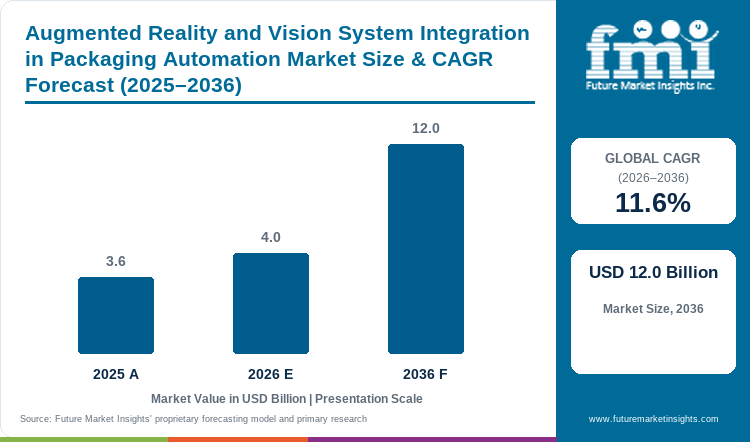
The augmented reality and vision system integration in packaging automation market is valued at USD 4.0 billion in 2026 from USD 3.6 billion in 2025. It is projected to reach USD 12.0 billion by 2036.
Demand for augmented reality and vision system integration in packaging automation is projected to rise at 11.6% CAGR by 2036. Packaging lines are using cameras and edge processors to check products at full line speed. In March 2026, Cognex surveyed more than 500 manufacturers about machine vision and industrial AI. The survey found 57% already use AI for machine vision work. Another 30% plan to deploy AI vision systems across production lines. Packaging teams are linking camera results with robot guidance and code reading. Integrated vision is reducing separate control steps across reject stations and later handling. Plant engineers are favoring packaging automation that keeps vision decisions close to the line.
South Korea is projected to grow at 13.4% CAGR through 2036. Japan is projected to expand at 13.0% CAGR through 2036. In June 2026, the U.S. Commercial Service counted around 30,000 smart factories operating across South Korea. Japan Packaging Institute counted 257,373 packaging machines made during 2025. Korean plants are using local industrial automation skills to connect cameras with sensors and controls. Japanese plants are favoring compact systems for frequent format changes and tight floor space.
Key Takeaways
- Packaging teams are linking visual inspection with traceability and robot guidance to reduce separate integration work.
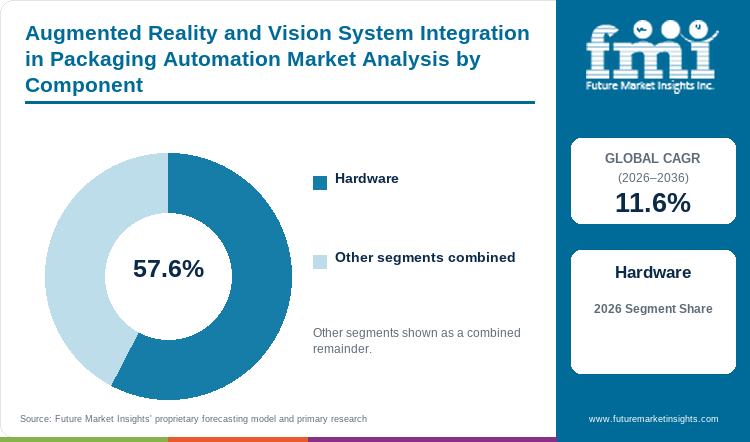
- Hardware is estimated to hold 57.6% of component revenue in 2026. Cameras and edge processors support this position because they form the main imaging stack.
- Technology demand favors 2D vision at 42.0% share in 2026. Common label and code checks are supporting broad use on flat pack surfaces.
- In 2026, quality inspection & defect detection is expected to lead application with 41.6% share. Immediate pass-or-reject needs are driving this position on active packaging lines.
- Brownfield projects are slowing because camera and control changes must align with data and validation needs on existing packaging lines.
- Key participants include Cognex Corporation, KEYENCE Corporation, OMRON Corporation, Basler AG, Teledyne Technologies, SICK AG, Antares Vision Group, and OPTEL Group.
Analyst Perspective
“Packaging teams are likely to gain more value by reusing verified vision models across similar lines. Manufacturers should prepare for slower retrofits because older controls and validation records require separate engineering work.”
- Nandini Roy Choudhury, Principal Consultant, Future Market Insights
How is the augmented reality and vision system integration in packaging automation market segmented?
The augmented reality and vision system integration in packaging automation market is segmented five ways: component, technology, application, end user, and region. Hardware leads component revenue with a 57.6% share in 2026.
The market uses four primary commercial axes together with region. Component includes hardware, software, and services within the market taxonomy. Technology includes 2D vision, 3D vision, smart-camera systems, head-mounted AR, and spatial AR/projection. Application includes quality inspection & defect detection, track & trace / serialization, and robotic guidance / pick & place. The remaining application entries are packaging line setup, operator training / maintenance, and other. End user includes food & beverage, pharmaceuticals, cosmetics & personal care, consumer goods, e-commerce & logistics, and other.
Why does hardware lead the component category?
Hardware is carrying image capture and local processing on packaging lines. Cameras and lights are matching package speed with the required field of view and surface detail. Sensors are sending trigger data while edge processors are running vision models beside the line. High-resolution machine vision cameras need firm mounts and controlled lighting for steady checks. Small camera heads are saving cabinet space on crowded packaging machines. Packaging teams are sizing hardware first because image quality limits later software analysis. Every component must keep pace with the machine without missing the inspection area.
- Hardware is estimated to hold 57.6% of component revenue in 2026. Cameras and lighting work with sensors and edge processors to form the core imaging stack.
- Software and services are gaining importance because multi-line projects need tuning and validation alongside integration and long-term support.
Why does 2D vision hold the technology position?
2D vision is handling many label and presence checks with common area-scan cameras and image tools. Packaging lines are using 2D vision for print quality and code reading on flat pack surfaces. Smart-camera systems are saving cabinet space because processing stays near the camera. Smart-camera systems are serving checks that do not need depth for the inspection decision. 3D vision is adding profile and pose data for uneven packs and robot handling. Plant teams are choosing depth for tasks that need shape or position data.
- By technology, 2D vision is estimated to hold 42.0% in 2026. Established label and code checks are supporting broad use beside presence and surface inspection.
- 3D vision is gaining a larger role as depth and pose data are changing inspection and robotic handling decisions.
How does quality inspection and defect detection shape application demand?
Quality inspection & defect detection is giving packaging lines a direct pass-or-reject decision during production. Plants are checking seals and labels ahead of later packing steps. Teams are checking print quality and product position during normal line runs. In August 2025, OMRON documented a pouch line processing 135 packs per minute with integrated vision and robotics. The documented system uses vision to confirm pouch orientation for robot placement. Machine vision is helping plants find faults without moving packs into a separate quality room. Production teams are keeping vision data close to the control system for faster reject decisions.
- In 2026, quality inspection & defect detection is expected to lead application with 41.6% share. In-line quality requirements are supporting that position through immediate pass-or-reject decisions.
- Track & trace / serialization and robotic guidance / pick & place are gaining value as vision data reaches wider line controls.
Why does food and beverage lead the end-user category?
Food & beverage plants are running fast lines that need frequent pack and label checks. Plant teams are inspecting seals and fill levels during normal production runs. Teams are checking product position and pack appearance during final line checks. Packaging machinery is handling frequent format changes across brands and product sizes on one line. Operators are updating vision recipes during planned changeovers without redesigning each inspection. In May 2025, Antares Vision Group presented food systems for label checks and code reading. The showcased systems included leak checks and traceability for packaged products. Leak checks and traceability are placing cameras beside filling and packing steps instead of separate quality rooms.
- Within end user, food & beverage is projected to hold 29.0% share in 2026. High-throughput inspection and frequent packaging checks are supporting that position.
- Pharmaceutical packaging is placing more weight on serialization and verification with audit trails and validated changes to integrated line software.
What are the drivers, restraints and opportunities in the Augmented Reality and Vision System Integration in Packaging Automation Market?
In the augmented reality and vision system integration in packaging automation market, the key driver is machine-readable packaging data. The key restraint is brownfield integration across older packaging lines and controls. The key opportunity is scalable AI that reuses inspection logic across multiple lines.
- Driver: Packaging lines are using more machine-readable data that vision systems must capture accurately at production speed.
- Restraint: Brownfield projects are slowing as camera and control changes must align with data and validation requirements.
- Opportunity: Cloud-to-edge AI tools are helping plants reuse inspection logic across lines while keeping real-time decisions near production.
Packaging teams are reading more product data from printed codes during normal line runs. In January 2025, GS1 said industry aims for broad use of next-generation 2D barcodes by 2027. Brands are using the 2D barcode transition to test readers with real packs and print quality. Robotic packaging machines are using stable vision data for pick and place tasks. One camera stream is checking code quality during each handling step. Integrators are linking code reading with defect checks to avoid another camera station. Plant teams need proof that each reader works at full line speed. Connected vision gives one camera several jobs without slowing the packaging line. More code data makes camera setup part of daily line control.
Brownfield packaging projects need coordination across cameras and line controls. Plant teams are aligning databases and validation records during project startup. Drug packaging adds pressure because printed codes must match digital tracking records. In August 2026, FDA issued new DSCSA exemptions for qualifying small dispensers. The exemptions change compliance timing for affected small drug channels. Track and trace solutions keep product codes linked with distribution records. Packaging lines link scanners and printers with controls and plant data. Older controllers are limiting upgrades because newer tools use different links and data formats. Integrators are reducing risk by mapping each link ahead of installation and planned shutdown work. Validation teams are testing reject logic and record exchange during line restart.
Plants are scaling AI vision by reusing models for similar inspection checks. In May 2026, Cognex reported more than 100 OneVision users during beta and early access. Cognex reported cost cuts of up to 50% for customers scaling the platform. Converting automation teams are sharing image labels and model controls across several projects. Edge processing is keeping real-time inspection decisions close to the packaging line. Cloud tools are helping plant teams train models and review results ahead of updates. Reusable test plans are reducing setup work as producers move approved checks between lines. Engineering teams are using one vision method across several plants instead of rebuilding each workflow. Shared models are helping teams carry approved checks between similar packaging lines.
Which country CAGRs are profiled in the Augmented Reality and Vision System Integration in Packaging Automation Market?
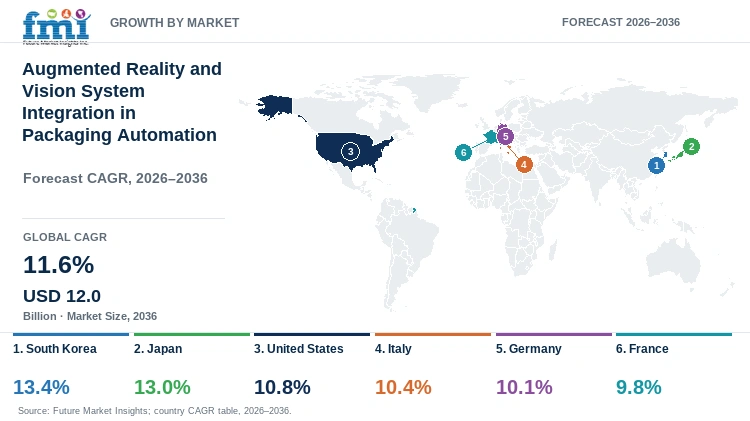
| Country | CAGR |
|---|---|
| South Korea | 13.4% |
| Japan | 13.0% |
| United States | 10.8% |
| Italy | 10.4% |
| Germany | 10.1% |
| France | 9.8% |
How do country-level CAGRs compare in the Augmented Reality and Vision System Integration in Packaging Automation Market?
Packaging plants are using vision differently based on local automation skills and machine-building needs. Traceability rules are shaping camera choices and data links in regulated packaging. Export engineering and brownfield upgrades are changing the service support that plants require.
- South Korean packaging plants are using strong local automation skills to connect cameras with sensors and controls within smart-factory projects.
- Japan favors compact vision cells because packaging plants are managing labor pressure alongside frequent format changes and limited factory space.
- Across the United States, regulated drug packaging keeps code capture and secure data exchange central to line design.
- Italian packaging machine builders are integrating vision and robotics into export equipment that must handle varied formats and customer specifications.
- Germany places emphasis on retrofit compatibility because mature factories already operate large installed bases of automation and control equipment.
- France is favoring modular inspection tools that plant teams can add through focused digital manufacturing and production upgrade projects.
Local machine layouts are changing how teams connect cameras with existing controls. Validation rules are shaping software links and startup work across regulated packaging lines. Service access is influencing how quickly plants can tune and maintain new vision systems.
The full report covers North America and Latin America together with Western Europe and Eastern Europe. The report covers East Asia alongside South Asia and Pacific as well as Middle East and Africa.
Country-wise Analysis
- South Korean demand is projected at 13.4% CAGR through 2036. Packaging plants are building on strong smart-factory skills and connected line controls. In June 2026, the U.S. Commercial Service said state-backed smart factories raised productivity by 25%. Packaging teams are applying the same camera and sensor skills to fast line checks. Local electronics expertise is helping teams run image processing beside production equipment. Smaller plants are relying on local help to tune models and connect controls. Vision vendors are supplying ready-to-use cameras and local setup support for those sites. Training teams are helping operators keep models stable as packs and products change. Local service is making new vision projects easier to run across smaller factories.
- Demand in Japan is expected to grow at 13.0% CAGR through 2036. Packaging plants are using line vision to manage labor pressure and frequent product changes. In July 2026, Japan Packaging Institute said packaging machine output value rose 4.8% during 2025. Compact vision cells fit sites with little open floor space near existing machines. Local service teams are helping operators update recipes as labels and packs change. Machine builders are linking cameras with robots and operator screens during upgrades. Common interfaces are reducing extra design work across later machine builds. Compact hardware and local support are making advanced checks easier on older lines. These design choices are supporting frequent changeovers without long production stops.
- Packaging vision demand in the United States is forecast to rise at 10.8% CAGR through 2036. Plants are adding vision for regulated goods and high-volume consumer packs. In September 2026, PMMI said food made up about 44% of U.S. packaging machinery shipments during 2025. Food lines are using vision for label and seal checks at line speed. Cameras are reading codes and checking packs ahead of downstream handling. Drug plants are adding stricter tracking and verification rules to line design. Large producers are reusing approved inspection methods across several sites. Integrators are testing cameras and software together during each line startup. Strong field service is helping plants reuse approved checks without rebuilding each project.
- Adoption of integrated packaging vision in Italy is estimated to expand at 10.4% CAGR through 2036. Machine builders are adding vision and robots to equipment sold across many industries. In July 2026, UCIMA said its national study covered 629 Italian packaging machinery companies. Italy's large OEM base creates steady work for cameras and machine-level vision software. Export projects are forcing builders to handle many labels and codes. Each machine must accept different pack shapes and customer approval rules. Smaller builders are managing those options without adding heavy design work to every machine. Vision vendors are offering reusable software and OEM-ready hardware for common machine designs. Local support helps builders test new formats during pre-shipment checks.
- Germany's packaging vision market is projected at 10.1% CAGR through 2036. Packaging projects are entering plants that already use dense control and robot networks. In September 2025, Germany Trade and Invest reported 26,982 new industrial robots across the country. Germany's installed robot base gives plant teams deep experience with motion and sensors. Packaging upgrades compete for skilled staff and planned downtime across mature factories. Vision vendors are matching new systems with controllers that plants already trust. Integrators are reducing retrofit work through tested links and clear startup plans. Support for existing controls makes quality upgrades easier for plant teams to approve. Controller fit is reducing the risk of adding cameras to mature packaging lines.
- In France, packaging vision demand is predicted to rise at 9.8% CAGR through 2036. Plants are adding digital tools through upgrades and new factory projects. In January 2026, Business France reported 472 manufacturing investment projects in France during 2025. Factory investment is creating modern sites that can use connected vision. Smaller plants are pacing upgrades because staff and capital remain limited. Modular cameras and flexible software are reducing design work for each project. Service plans are helping firms reuse vision checks across several plants. Local service teams are helping small plants add vision without large in-house design groups. Local support keeps projects manageable for plants with small technical teams.
Who are the notable companies in the Augmented Reality and Vision System Integration in Packaging Automation Market?
The augmented reality and vision system integration in packaging automation market includes eight notable companies. They are Cognex Corporation, KEYENCE Corporation, OMRON Corporation, Basler AG, Teledyne Technologies, SICK AG, Antares Vision Group, and OPTEL Group.
Cognex, KEYENCE, OMRON, and Basler are supplying cameras and vision software for packaging lines. Teledyne and SICK are adding imaging and sensor tools that connect with production equipment. Antares Vision Group and OPTEL are connecting inspection with serialization and packaging-line data. OMRON and SICK are extending vision into motion and plant-control networks. Antares Vision Group and OPTEL are focusing on regulated packaging and traceability workflows. Augmented reality is supporting narrower setup and training tasks alongside machine vision within several company offerings. Packaging buyers are comparing line integration with software upkeep and validation support during supplier selection. Vision hardware is handling image capture while serialization software is linking inspection results with product records.
- Vision and inspection platforms: Cognex Corporation, KEYENCE Corporation, Basler AG, and Teledyne Technologies are supporting image capture and inspection software.
- Connected automation and sensing: OMRON Corporation and SICK AG are linking vision with controls and motion across production equipment.
- Serialization and traceability integration: Antares Vision Group and OPTEL Group are connecting packaging inspection with regulated product and enterprise records.
Competitive Benchmarking: Augmented Reality and Vision System Integration in Packaging Automation Market
| Company | Vision Hardware & Imaging | AI / Vision Software | Packaging / Traceability Integration | Geographic Reach |
|---|---|---|---|---|
| Cognex Corporation | High | High | High | Global; 30+ countries |
| KEYENCE Corporation | High | High | Medium | Global direct-sales network |
| OMRON Corporation | High | High | High | Global automation network |
| Basler AG | High | Medium | Medium | Europe, North America and Asia |
| Teledyne Technologies | High | Medium | Medium | Global imaging operations |
| SICK AG | High | Medium | High | Global sensor and automation network |
| Antares Vision Group | Medium | High | High | Europe, Americas and international |
| OPTEL Group | Medium | High | High | 50+ countries |
High indicates broad documented capability in the named area for this market. Medium marks a narrower verified role within the same capability category. Low marks limited documented capability within the named market area. Geographic reach describes documented coverage and does not affect the capability rating.
Key Developments in the Augmented Reality and Vision System Integration in Packaging Automation Market
- In May 2026, Cognex Corporation launched the In-Sight 3900 embedded AI vision system for high-speed packaging inspection.
- In July 2025, Antares Vision Group signed a global serialization and traceability agreement with a United States consumer-goods company.
- In June 2025, OPTEL launched Carton Station as an integrated serialization platform with print-inspect and checkweighing functions alongside tamper-evident controls.
Key Players in the Augmented Reality and Vision System Integration in Packaging Automation Market
Machine Vision Platforms
- Cognex Corporation
- KEYENCE Corporation
- Basler AG
- Teledyne Technologies
Integrated Automation and Sensing
- OMRON Corporation
- SICK AG
Packaging Traceability and Inspection
- Antares Vision Group
- OPTEL Group
Augmented Reality and Vision System Integration in Packaging Automation Market - Report Scope
| Coverage field | Report scope |
|---|---|
| Market breakdown | By component, technology, application, end user and region. |
| Quantitative Units | USD billion. |
| Market Definition | Integrated hardware, software, services, machine vision, augmented-reality guidance, traceability vision, robotic guidance, inspection, line setup, training, and related integration used within packaging automation. Standalone consumer AR and unrelated general-purpose imaging are excluded. |
| Regions Covered | North America, Latin America, Europe, East Asia, South Asia and Pacific, and Middle East and Africa. |
| Countries Covered | South Korea, Japan, United States, Italy, Germany, France, and 20+ countries included in the full report. |
| Key Companies Profiled | Cognex Corporation, KEYENCE Corporation, OMRON Corporation, Basler AG, Teledyne Technologies, SICK AG, Antares Vision Group, OPTEL Group. |
| Forecast Period | 2026 to 2036. |
| Approach | Primary and secondary research with market triangulation. |
Augmented Reality and Vision System Integration in Packaging Automation Market - Research Methodology
| Method | Approach |
|---|---|
| Primary Research | FMI analysts gathered input from manufacturers, service providers, technology developers, distributors, end users, procurement teams, and subject-matter experts. Interviews examined purchasing decisions, product or service evaluation, adoption barriers, approval requirements, pricing considerations, and expectations for technical or commercial support. Respondents were also asked what evidence is required before a trial, pilot, or initial order develops into regular purchasing. |
| Desk Research | Desk research covered government statistics, regulatory publications, trade data, industry associations, technical literature, standards, company filings, product information, and official corporate announcements. Sources were reviewed for relevance, publication date, geographic coverage, and consistency with the defined market scope. Claims relating to performance, applications, approvals, capacity, investment, and commercial activity were retained only when supported by credible public evidence. |
| Market Sizing and Forecasting | The market model combined the baseline value with historical performance, segment structure, pricing and volume indicators, adoption levels, company participation, and country-level demand conditions. Forecast assumptions considered economic activity, investment trends, regulatory developments, technology adoption, purchasing cycles, supply availability, and barriers to wider market use. Segment and regional estimates were reconciled before the final market total was calculated. |
| Data Validation | Estimates were checked against multiple independent indicators, including public data, company activity, trade patterns, industry developments, and findings from primary interviews. Validation also tested whether products, services, applications, and company revenues fell within the defined market boundaries. Adjacent categories, unsupported claims, overlapping revenues, and activities without direct market relevance were excluded to reduce double counting and maintain consistency across segments and countries. |
Augmented Reality and Vision System Integration in Packaging Automation Market by Segments
Augmented Reality and Vision System Integration in Packaging Automation Market segmented by Component:
- Hardware
- Software
- Services
Augmented Reality and Vision System Integration in Packaging Automation Market segmented by Technology:
- 2D Vision
- 3D Vision
- Smart-Camera Systems
- Head-Mounted AR
- Spatial AR/Projection
Augmented Reality and Vision System Integration in Packaging Automation Market segmented by Application:
- Quality Inspection & Defect Detection
- Track & Trace / Serialization
- Robotic Guidance / Pick & Place
- Packaging Line Setup
- Operator Training / Maintenance
- Other
Augmented Reality and Vision System Integration in Packaging Automation Market segmented by End User:
- Food & Beverage
- Pharmaceuticals
- Cosmetics & Personal Care
- Consumer Goods
- E-commerce & Logistics
- Other
Augmented Reality and Vision System Integration in Packaging Automation Market by Region:
- North America
- United States
- Canada
- Latin America
- Brazil
- Mexico
- Chile
- Rest of Latin America
- Western Europe
- Germany
- United Kingdom
- Italy
- Spain
- France
- Nordics
- Benelux
- Rest of Western Europe
- Eastern Europe
- Russia
- Poland
- Hungary
- Balkan and Baltic States
- Rest of Eastern Europe
- East Asia
- China
- Japan
- South Korea
- South Asia and Pacific
- India
- ASEAN
- Australia and New Zealand
- Rest of South Asia and Pacific
- Middle East and Africa
- Kingdom of Saudi Arabia
- Other GCC Countries
- Türkiye
- South Africa
- Other African Union Countries
- Rest of Middle East and Africa
Research Sources and Bibliography
- Cognex Corporation. (2026, March 23). New Cognex research reveals manufacturers increasingly expect AI vision systems to deliver both high performance and simplicity.
- U.S. International Trade Administration. (2026, June 29). South Korea - Manufacturing technology - Smart factory.
- Japan Packaging Institute. (2026, July 1). Statistics on the scale of the Japanese packaging industry in 2025.
- KEYENCE Corporation of America. (2026, June 2). AI-powered high-performance vision system VS-G series.
- Cognex Corporation. (2026, May 5). Cognex launches highest performance embedded AI vision system powered by Qualcomm.
- Antares Vision Group. (2025, May 13). Quality control and digitalization of the supply chain: Antares Vision Group leads technological innovation for the food industry.
- GS1. (2025, January 8). Why is the goal to transition to 2D barcodes by 2027?
- U.S. Food and Drug Administration. (2026, August 6). Exemptions under the Drug Supply Chain Security Act.
- Cognex Corporation. (2026, May 13). Cognex OneVision adoption ramps as manufacturers scale AI vision globally.
- UCIMA. (2026, July 3). 14th UCIMA national statistical survey and new online platform.
- Germany Trade & Invest. (2025, September 29). Germany is Europe’s leading robotics nation.
- Business France. (2026, January 29). Annual report foreign investment in France 2025.
- OMRON Corporation. (2025, August 4). Mackle Petfoods packs 135 pouches per minute with automated precision.
- Antares Vision Group. (2025, July 29). Agreement with a US FMCG multinational for global serialization and traceability platform.
- Basler AG. (2026, June 10). Discover Basler’s latest vision solutions for food and beverage inspection at ProPak Asia 2026.
- Teledyne Vision Solutions. (2025, March 20). Teledyne’s new 2.5 GigE Vision line scan camera delivers industry-leading performance in a cost-effective package.
- SICK AG. (2025, October 16). SICK at SPS 2025: A partner for intelligent automation.
- OPTEL Group. (2025, September). OPTEL at Pharma Pro&Pack 2025.
- OMRON Corporation. (2025, March 18). OMRON Automation Software Sysmac Studio and NVIDIA Omniverse collaborate to innovate digital twin manufacturing solutions.
- Cognex Corporation. (2026, April 28). Cognex launches In-Sight Vision Controller powered by NVIDIA.
- KEYENCE Corporation of America. (2026, September 14). Vision sensor with built-in AI IV4 series.
- PMMI. (2026, September 14). PMMI’s 2026 State of the Industry Report reveals a packaging machinery market driven by flexibility, automation, and new North American opportunities.
- OPTEL Group. (2025, June 17). Carton Station: Smarter pharma serialization.
- Antares Vision Group. (2026, April 13). Advanced solutions for the evolution of supply chain transparency in life sciences and cosmetics.
- Basler AG. (2026, July 27). 3D stereo camera system for robotics and logistics.
- Teledyne Vision Solutions. (2026, August 27). Teledyne Vision Solutions brings high-performance line scan inspection technologies to PRINTING United Expo.
- SICK AG. (2026, April 21). Vision technologies from SICK: Solutions for modern intralogistics.
- Antares Vision Group. (2026, April 29). Safer cans thanks to AI integration.
The bibliography gives readers a focused reference list and does not cover every source. The full report contains the complete source list and detailed citations.
This Report Answers
- How large is the augmented reality and vision system integration in packaging automation market in 2026 and 2036?
- Why does hardware hold 57.6% of component revenue in 2026?
- Why does 2D vision account for 42.0% of technology demand?
- How does quality inspection and defect detection reach 41.6% of application demand?
- Why does food and beverage represent 29.0% of end-user demand?
- Which integration and validation issues slow brownfield packaging projects?
- How do country growth conditions differ across South Korea, Japan, the United States, Italy, Germany, and France?
- Which companies provide vision, automation, and traceability capabilities for packaging lines?
Frequently Asked Questions
How big is the augmented reality and vision system integration in packaging automation market in 2026?
The augmented reality and vision system integration in packaging automation market is valued at USD 4.0 billion in 2026. Packaging lines are using connected vision for inspection and tracking across more production steps.
What is the CAGR of the augmented reality and vision system integration in packaging automation market from 2026 to 2036?
The augmented reality and vision system integration in packaging automation market is projected to grow at 11.6% CAGR through 2036. More line checks and wider factory use of vision support the 2026–2036 forecast.
Which component leads the market in 2026?
Hardware is estimated to hold 57.6% of component revenue in 2026. Cameras and lighting work with sensors and edge processors to form the main imaging stack.
Which application leads the market in 2026?
Quality inspection & defect detection is estimated to hold 41.6% of application demand in 2026. In-line vision finds defects and checks pack appearance during normal line runs.
Which country records the highest profiled CAGR through 2036?
South Korea is projected to grow at 13.4% CAGR through 2036. Factory-automation skills are supporting new packaging vision projects across South Korean plants.
Which companies are active in the market?
The augmented reality and vision system integration in packaging automation market includes eight notable companies. They are Cognex Corporation, KEYENCE Corporation, OMRON Corporation, Basler AG, Teledyne Technologies, SICK AG, Antares Vision Group, and OPTEL Group.
Preview the report firsthand - request a free sample
Get SampleGet the brochure for pricing and purchase details.
Get PDFTable of Content
- Key Takeaways
- Market Size and CAGR
- Top Growth Driver
- Fastest Growing Segment
- Leading Region
- Key Companies
- Emerging Opportunities
- Executive Summary
- Global Market Outlook
- Demand-side Trends
- Supply-side Trends
- Technology Roadmap Analysis
- Analysis and Recommendations
- Analyst Perspective (What is happening? Why now? What should investors know?)
- Key Questions Answered
- How large is the market?
- What is the CAGR?
- What are key trends?
- Which region dominates?
- Who are the leaders?
- Market Overview
- Market Coverage / Taxonomy
- Market Definition / Scope / Limitations
- Research Methodology
- Chapter Orientation
- Analytical Lens and Working Hypotheses
- Market Structure, Signals, and Trend Drivers
- Benchmarking and Cross-market Comparability
- Market Sizing, Forecasting, and Opportunity Mapping
- Research Design and Evidence Framework
- Desk Research Programme (Secondary Evidence)
- Expert Input and Fieldwork (Primary Evidence)
- Tooling, Models, and Reference Databases
- Data Engineering and Model Build
- Quality Assurance and Audit Trail
- Market Background
- Market Dynamics (Drivers, Restraints, Opportunity, Trends)
- Scenario Forecast (Optimistic, Likely, Conservative)
- Impact Analysis
- AI Impact
- Sustainability Impact
- Regulatory Impact
- Technology Impact
- Consumer / Buyer Analysis
- Purchase Drivers
- Adoption Barriers
- Buyer Journey
- Opportunity Map Analysis
- Product Life Cycle Analysis
- Supply Chain Analysis
- Investment Feasibility Matrix
- Value Chain Analysis
- PESTLE and Porter's Analysis
- Regulatory Landscape
- Regional Parent Market Outlook
- Production and Consumption Statistics
- Import and Export Statistics
- Global Market Analysis and Forecast, 2021 to 2036
- Historical Market Size Value (USD Billion) Analysis, 2021 to 2025
- Current and Future Market Size Value (USD Billion) Projections, 2026 to 2036
- Y-o-Y Growth Trend Analysis
- Absolute $ Opportunity Analysis
- Global Market Pricing Analysis, 2021 to 2036
- Global Market Analysis and Forecast, By Component, 2021 to 2036
- Introduction / Key Findings
- Historical Market Size Value (USD Billion) Analysis By Component, 2021 to 2025
- Current and Future Market Size Value (USD Billion) Analysis and Forecast By Component, 2026 to 2036
- Hardware
- Software
- Services
- Y-o-Y Growth Trend Analysis By Component, 2021 to 2025
- Absolute $ Opportunity Analysis By Component, 2026 to 2036
- Global Market Analysis and Forecast, By Technology, 2021 to 2036
- Introduction / Key Findings
- Historical Market Size Value (USD Billion) Analysis By Technology, 2021 to 2025
- Current and Future Market Size Value (USD Billion) Analysis and Forecast By Technology, 2026 to 2036
- 2D Vision
- 3D Vision
- Smart-Camera Systems
- Head-Mounted AR
- Spatial AR/Projection
- Y-o-Y Growth Trend Analysis By Technology, 2021 to 2025
- Absolute $ Opportunity Analysis By Technology, 2026 to 2036
- Global Market Analysis and Forecast, By Application, 2021 to 2036
- Introduction / Key Findings
- Historical Market Size Value (USD Billion) Analysis By Application, 2021 to 2025
- Current and Future Market Size Value (USD Billion) Analysis and Forecast By Application, 2026 to 2036
- Quality Inspection & Defect Detection
- Track & Trace / Serialization
- Robotic Guidance / Pick & Place
- Packaging Line Setup
- Operator Training / Maintenance
- Other
- Y-o-Y Growth Trend Analysis By Application, 2021 to 2025
- Absolute $ Opportunity Analysis By Application, 2026 to 2036
- Global Market Analysis and Forecast, By End User, 2021 to 2036
- Introduction / Key Findings
- Historical Market Size Value (USD Billion) Analysis By End User, 2021 to 2025
- Current and Future Market Size Value (USD Billion) Analysis and Forecast By End User, 2026 to 2036
- Food & Beverage
- Pharmaceuticals
- Cosmetics & Personal Care
- Consumer Goods
- E-commerce & Logistics
- Other
- Y-o-Y Growth Trend Analysis By End User, 2021 to 2025
- Absolute $ Opportunity Analysis By End User, 2026 to 2036
- Global Market Analysis and Forecast, By Region, 2021 to 2036
- Introduction
- Historical Market Size Value (USD Billion) Analysis By Region, 2021 to 2025
- Current Market Size Value (USD Billion) Analysis and Forecast By Region, 2026 to 2036
- North America
- Latin America
- Western Europe
- Eastern Europe
- East Asia
- South Asia and Pacific
- Middle East and Africa
- Market Attractiveness Analysis By Region
- North America Market Analysis and Forecast, By Country, 2021 to 2036
- Historical Market Size Value (USD Billion) Trend Analysis By Market Taxonomy, 2021 to 2025
- Market Size Value (USD Billion) Forecast By Market Taxonomy, 2026 to 2036
- By Country
- United States
- Canada
- By Component
- By Technology
- By Application
- By End User
- By Country
- Market Attractiveness Analysis
- By Country
- By Component
- By Technology
- By Application
- By End User
- Key Takeaways
- Latin America Market Analysis and Forecast, By Country
- Historical Market Size Value (USD Billion) Trend Analysis By Market Taxonomy, 2021 to 2025
- Market Size Value (USD Billion) Forecast By Market Taxonomy, 2026 to 2036
- By Country
- Brazil
- Mexico
- Chile
- Rest of Latin America
- By Component
- By Technology
- By Application
- By End User
- By Country
- Market Attractiveness Analysis
- By Country
- By Component
- By Technology
- By Application
- By End User
- Key Takeaways
- Western Europe Market Analysis and Forecast, By Country
- Historical Market Size Value (USD Billion) Trend Analysis By Market Taxonomy, 2021 to 2025
- Market Size Value (USD Billion) Forecast By Market Taxonomy, 2026 to 2036
- By Country
- Germany
- United Kingdom
- Italy
- Spain
- France
- Nordics
- Benelux
- Rest of Western Europe
- By Component
- By Technology
- By Application
- By End User
- By Country
- Market Attractiveness Analysis
- By Country
- By Component
- By Technology
- By Application
- By End User
- Key Takeaways
- Eastern Europe Market Analysis and Forecast, By Country
- Historical Market Size Value (USD Billion) Trend Analysis By Market Taxonomy, 2021 to 2025
- Market Size Value (USD Billion) Forecast By Market Taxonomy, 2026 to 2036
- By Country
- Russia
- Poland
- Hungary
- Balkan and Baltic States
- Rest of Eastern Europe
- By Component
- By Technology
- By Application
- By End User
- By Country
- Market Attractiveness Analysis
- By Country
- By Component
- By Technology
- By Application
- By End User
- Key Takeaways
- East Asia Market Analysis and Forecast, By Country
- Historical Market Size Value (USD Billion) Trend Analysis By Market Taxonomy, 2021 to 2025
- Market Size Value (USD Billion) Forecast By Market Taxonomy, 2026 to 2036
- By Country
- China
- Japan
- South Korea
- By Component
- By Technology
- By Application
- By End User
- By Country
- Market Attractiveness Analysis
- By Country
- By Component
- By Technology
- By Application
- By End User
- Key Takeaways
- South Asia and Pacific Market Analysis and Forecast, By Country
- Historical Market Size Value (USD Billion) Trend Analysis By Market Taxonomy, 2021 to 2025
- Market Size Value (USD Billion) Forecast By Market Taxonomy, 2026 to 2036
- By Country
- India
- ASEAN
- Australia and New Zealand
- Rest of South Asia and Pacific
- By Component
- By Technology
- By Application
- By End User
- By Country
- Market Attractiveness Analysis
- By Country
- By Component
- By Technology
- By Application
- By End User
- Key Takeaways
- Middle East and Africa Market Analysis and Forecast, By Country
- Historical Market Size Value (USD Billion) Trend Analysis By Market Taxonomy, 2021 to 2025
- Market Size Value (USD Billion) Forecast By Market Taxonomy, 2026 to 2036
- By Country
- Kingdom of Saudi Arabia
- Other GCC Countries
- Türkiye
- South Africa
- Other African Union Countries
- Rest of Middle East and Africa
- By Component
- By Technology
- By Application
- By End User
- By Country
- Market Attractiveness Analysis
- By Country
- By Component
- By Technology
- By Application
- By End User
- Key Takeaways
- Key Countries Market Analysis
- United States
- Pricing Analysis
- Market Share Analysis, 2025
- By Component
- By Technology
- By Application
- By End User
- Canada
- Pricing Analysis
- Market Share Analysis, 2025
- By Component
- By Technology
- By Application
- By End User
- Mexico
- Pricing Analysis
- Market Share Analysis, 2025
- By Component
- By Technology
- By Application
- By End User
- Brazil
- Pricing Analysis
- Market Share Analysis, 2025
- By Component
- By Technology
- By Application
- By End User
- Chile
- Pricing Analysis
- Market Share Analysis, 2025
- By Component
- By Technology
- By Application
- By End User
- Germany
- Pricing Analysis
- Market Share Analysis, 2025
- By Component
- By Technology
- By Application
- By End User
- United Kingdom
- Pricing Analysis
- Market Share Analysis, 2025
- By Component
- By Technology
- By Application
- By End User
- Italy
- Pricing Analysis
- Market Share Analysis, 2025
- By Component
- By Technology
- By Application
- By End User
- Spain
- Pricing Analysis
- Market Share Analysis, 2025
- By Component
- By Technology
- By Application
- By End User
- France
- Pricing Analysis
- Market Share Analysis, 2025
- By Component
- By Technology
- By Application
- By End User
- India
- Pricing Analysis
- Market Share Analysis, 2025
- By Component
- By Technology
- By Application
- By End User
- ASEAN
- Pricing Analysis
- Market Share Analysis, 2025
- By Component
- By Technology
- By Application
- By End User
- Australia and New Zealand
- Pricing Analysis
- Market Share Analysis, 2025
- By Component
- By Technology
- By Application
- By End User
- China
- Pricing Analysis
- Market Share Analysis, 2025
- By Component
- By Technology
- By Application
- By End User
- Japan
- Pricing Analysis
- Market Share Analysis, 2025
- By Component
- By Technology
- By Application
- By End User
- South Korea
- Pricing Analysis
- Market Share Analysis, 2025
- By Component
- By Technology
- By Application
- By End User
- Russia
- Pricing Analysis
- Market Share Analysis, 2025
- By Component
- By Technology
- By Application
- By End User
- Poland
- Pricing Analysis
- Market Share Analysis, 2025
- By Component
- By Technology
- By Application
- By End User
- Hungary
- Pricing Analysis
- Market Share Analysis, 2025
- By Component
- By Technology
- By Application
- By End User
- Kingdom of Saudi Arabia
- Pricing Analysis
- Market Share Analysis, 2025
- By Component
- By Technology
- By Application
- By End User
- Türkiye
- Pricing Analysis
- Market Share Analysis, 2025
- By Component
- By Technology
- By Application
- By End User
- South Africa
- Pricing Analysis
- Market Share Analysis, 2025
- By Component
- By Technology
- By Application
- By End User
- United States
- Market Structure Analysis
- Competition Dashboard
- Competition Benchmarking
- Market Share Analysis of Top Players
- By Regional
- By Component
- By Technology
- By Application
- By End User
- Emerging Startups
- Innovation Benchmarking
- Competition Analysis
- Competition Deep Dive
- Cognex Corporation
- Overview
- Product Portfolio
- Profitability by Market Segments
- Sales Footprint
- Strategy Overview
- Marketing Strategy
- Product Strategy
- Channel Strategy
- KEYENCE Corporation
- OMRON Corporation
- Basler AG
- Teledyne Technologies
- SICK AG
- Antares Vision Group
- OPTEL Group
- Cognex Corporation
- Case Studies
- Success Stories
- Recent Developments
- Competition Deep Dive
- Assumptions & Acronyms Used


