

- Market Size (2026)
- USD 184.1 Mn
- Forecast (2036)
- USD 375.9 Mn
- CAGR (2026 to 2036)
- 7.4%
How big is Basbousa & Semolina Cakes Market in 2026?
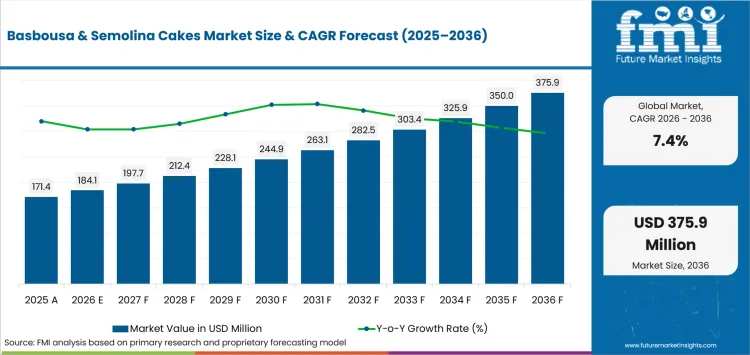
USD 184.1 million in 2026 and USD 375.9 million by 2036 at a 7.4% CAGR.
Basbousa & semolina cakes demand is projected to expand from USD 184.1 million in 2026 to USD 375.9 million by 2036 at 7.4% CAGR. Commercial growth depends on more service points carrying a familiar dessert without changing its expected syrup balance. GASTAT stated in July 2025 that Saudi Arabia had 4,988 licensed hospitality facilities by the end of the first quarter. That outlet base gives bakery chains more menu opportunities if bakery ingredients and portion formats stay consistent enough for branch-level production.
Country conversion routes differ because tourism scale does not translate into the same purchasing model everywhere. TurkStat recorded about 63.9 million visitors during 2025 in its January 2026 tourism release. High-volume destinations support immediate-service desserts whereas smaller Gulf markets depend more heavily on retail density and gifting. Producers serving both routes need frozen bakery options for distance without weakening the soft crumb and syrup penetration expected from fresh basbousa.
Key Takeaways
- Demand expands as heritage sweet shops and multi-branch pastry chains place basbousa into hospitality, retail and digital ordering occasions.
- Based on product type, classic - original is projected to account for 38.0% in 2026 due to familiar taste reducing trial risk for repeat buyers.
- By claim - nature, conventional is estimated to hold 52.0% in 2026 owing to syrup-rich indulgence staying central to core purchase occasions.
- In 2026, fresh is expected to lead the format category with 30.0% share because near-point preparation protects moisture and serving texture.
- Longer distribution raises syrup migration and surface compression risks that weaken freshness cues and reduce repeat purchase after initial trial.
- Some of the key players in this market include El Abd Patisserie, Tseppas, Saadeddin Pastry, Al Baba Sweets, Sea Sweet, Habibah Sweets, Ittihad Sweets & Catering, and Mandarine Koueider.
Analyst Perspective
"Basbousa earns wider distribution after operators prove that syrup balance and surface texture survive the actual service route. Commercial value comes from matching portion size and temperature control with pack protection for each channel instead of treating cake formats as interchangeable."
- Nandini Roy Choudhury, Principal Consultant, Future Market Insights
How is the Basbousa & Semolina Cakes Market segmented?
The market is segmented by product type, claim - nature, format, packaging format, and sales channel.
Product type covers classic - original, layered & frosted, flavored & filled, mini & snacking formats, and premium / artisan products. Claim - nature includes conventional, clean label, organic, gluten-free, and high-protein / fortified. Format separates fresh, frozen, ambient packaged, chilled, and par-baked / thaw-and-serve. Packaging format covers single-serve, multipack, family / loaf pack, and bulk foodservice. Sales channels include supermarkets & hypermarkets, artisan & specialty bakeries, convenience & forecourt, online & DTC, and foodservice distributors.
What makes Classic - original central to the Product type category?
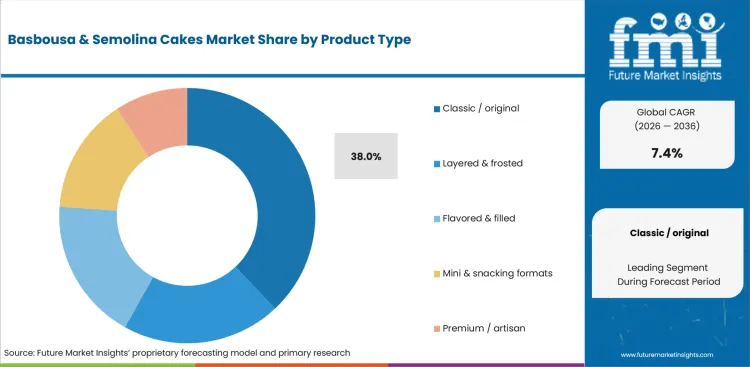
Classic basbousa gives bakeries a stable sensory reference before they extend the assortment into cream or nut variants. Egypt welcomed nearly 19 million tourists in 2025 according to the State Information Service in January 2026. Visitor volume increases trial occasions for familiar local desserts and supports a straightforward core offer beside specialized bakery mixes and pastry extensions.
- By product type, classic - original is estimated to hold 38.0% in 2026 owing to recognizable syrup balance and crumb texture lowering repeat-purchase risk.
- Operators use the original recipe as the comparison point for filled or frosted variants, which keeps formulation changes visible to returning customers.
Why does Conventional lead the Claim - nature category?
Conventional recipes retain the indulgence occasion because consumers judge basbousa on sweetness and moisture instead of a restrictive claim. UAE hotels served more than 32 million guests in 2025 according to the Government of Dubai Media Office in May 2026. Hotel kitchens need familiar profiles that staff can portion predictably as vegan pastry ranges broaden dietary choice.
- In 2026, conventional is expected to lead claim - nature with 52.0% share because the reference eating experience still depends on syrup and rich recipe components.
- Specialty claims can widen reach, but each reformulation must preserve browning and moisture closely enough to avoid feeling like a different dessert.
How does Fresh hold the leading position in the Format category?
Fresh service gives bakeries direct control over the time between syrup application and consumption. Qatar sold 10.8 million hotel room nights in 2025 according to Qatar News Agency in January 2026. Hospitality traffic therefore gives fresh trays and plated portions a large immediate-service channel before producers need the shelf-life compromises associated with distant distribution.
- By format, fresh is forecast to represent 30.0% in 2026 driven by immediate serving that protects the soft crumb and expected syrup distribution.
- Frozen extensions widen geography only after thawing preserves the expected texture, making technical lessons from frozen pastries relevant to operators evaluating longer routes.
What supports Single-serve in the Packaging format category?
Single-serve packaging changes the purchase from a shared tray decision into a lower-commitment snack or takeaway occasion. Jordan recorded about 575,000 same-day visitors in the first half of 2025 according to the Ministry of Tourism and Antiquities. That traffic supports formats that travel quickly through cafés, visitor sites and roadside retail without requiring a family-size purchase.
- Single-serve is projected to hold 29.0% share in 2026 owing to individual portions improving portability and reducing merchandising waste.
- Pack design must contain syrup without flattening the surface, so experience from cupcakes and other portioned bakery products is commercially useful but not directly transferable.
What are the drivers, restraints and opportunities in the basbousa & semolina cakes market?
Hospitality and retail reach expand purchase occasions, sugar guidance limits routine consumption, and portable formats extend distribution beyond specialist bakery counters.
- Driver: Tourism and formal hospitality networks give familiar semolina cakes more menu, catering, gifting and takeaway occasions beyond specialist sweet shops.
- Restraint: Free-sugar guidance and freshness-sensitive texture can reduce purchase frequency or raise reformulation and distribution costs for syrup-rich products.
- Opportunity: Portion engineering and frozen or chilled routes can take heritage cakes farther from the production counter without abandoning their recognizable texture.
Hospitality expansion gives an already familiar dessert more hotel and café service points. GASTAT reported hotel room occupancy of about 63% during the first quarter of 2025. That rate does not measure basbousa sales but it signals frequent buffet and catering occasions. Producers using industrial bakery mixes need branch-level syrup and portion controls because quality differences become more visible as the same cake reaches several outlets.
Free-sugar guidance limits how frequently consumers can fit syrup-heavy cakes into routine eating. The World Health Organization stated in January 2026 that free sugars should remain below 10% of total daily energy intake. Smaller portions can reduce exposure per occasion because aggressive syrup cuts also change moisture and texture and risk weakening the expected eating experience.
Portable and make-ahead formats extend sales beyond immediate bakery catchments because events compress service preparation time. Qatar staged more than 600 events in 2025 according to Qatar News Agency, giving caterers repeated short-duration occasions for fast portion handling. Sealed singles and chilled trays can work beside frozen baked goods formats only if syrup stays contained and the surface reaches the serving point intact.
Which country CAGRs are profiled in the basbousa & semolina cakes market?
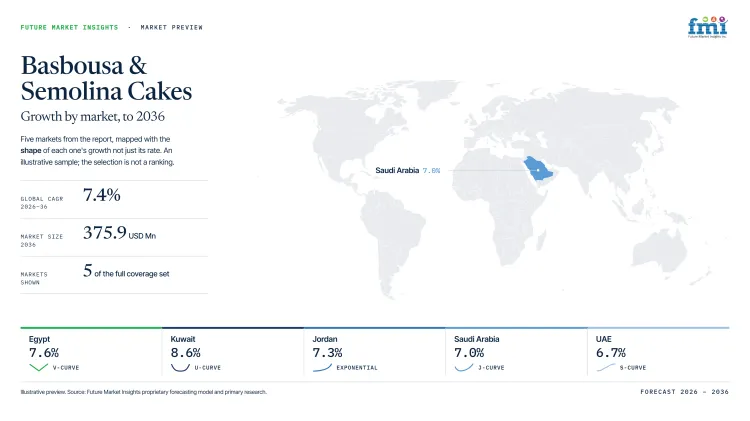
| Country | CAGR |
|---|---|
| Kuwait | 8.6% |
| Egypt | 7.6% |
| Jordan | 7.3% |
| Saudi Arabia | 7.0% |
| UAE | 6.7% |
How do country-level CAGRs compare in the basbousa & semolina cakes market?
The profiled rates span 1.3 percentage points from Kuwait at 8.6% to Jordan at 7.3%, with Kuwait and Turkey forming the upper edge beside Qatar. Egypt and Jordan follow just below that group and keep the distribution compact, which points to route-to-market differences instead of a simple ranking of demand.
- Kuwait’s compact urban geography lets central kitchens replenish fresh dessert counters frequently without building a wide national logistics network.
- Egypt’s dense patisserie base gives fresh basbousa routine neighborhood exposure before tourist demand enters the purchase equation.
- Jordan’s long-running oriental-sweets chains give portioned or delivery-ready formats a trusted counter before standalone retail investment becomes necessary.
- Saudi Arabia’s established patisserie network gives fresh basbousa routine neighborhood exposure before seasonal demand enters the purchase equation.
- The UAE’s premium bakery and dessert chains give portioned or delivery-ready formats a trusted counter before standalone retail investment becomes necessary.
Similar CAGRs still produce different entry conditions because local familiarity and channel economics vary. The full report provides country-level CAGR analysis across North America, Latin America, Europe, East Asia, South Asia, Oceania and the Middle East and Africa.
Country-wise Analysis
- Kuwait concentrates dessert retail within a compact urban network where central kitchens replenish stores quickly. Delivery routes remain short during peak shopping periods and evening trade. Kuwait is estimated to post 8.6% CAGR over the forecast period, because concentrated demand makes frequent fresh-product replenishment commercially practical for branded operators. Kuwait Government Online listed the population at about 4.88 million at the beginning of 2025 and gives operators a measurable resident base for premium sweets. Seasonal gifting raises presentation expectations and intensifies price comparison, so new entrants need differentiated portions plus reliable cold handling before premium pricing becomes defensible.
- Egypt carries deep everyday familiarity because basbousa already appears in neighborhood patisseries and family occasions beside tourist-facing sweet counters in Cairo and beyond. Charter flight traffic to Egyptian destinations increased 32% during 2025 according to the State Information Service in January 2026 and widened visitor exposure beyond major gateways. The Egypt basbousa & semolina cakes sector is projected to record 7.6% CAGR during the assessment period, aided by a broad consumption base and dense specialist retail. Regional recipe preferences and incumbent branch networks make generic national positioning weak, so packaged entrants need local taste fit before scale becomes an advantage.
- Jordanian oriental-sweets chains trade on strong local brand recognition and already serve family purchases beside visitor and gifting occasions. Major urban centers such as Amman give these operators concentrated store traffic. Jordan's basbousa & semolina cakes outlook is anticipated to advance at 7.3% CAGR over the assessment period, given dense sweet-shop networks and regional dessert familiarity. In August 2025 the Ministry of Tourism and Antiquities reported first-half international visitor growth of 18% to 3.292 million. Airline interruptions remain a material tourism friction for visitor-led dessert sales during regional disruptions. New formats should use trusted counters or delivery networks and first prove local portion economics before standalone retail expansion.
- Saudi Arabia’s established patisserie and traditional sweets market gives basbousa strong everyday familiarity through neighborhood bakeries, family occasions, gifting, and premium dessert counters. The Saudi basbousa & semolina cakes sector is projected to record 7.0% CAGR during the assessment period, supported by established dessert consumption and organized specialty retail. Regional taste preferences and strong incumbent brands make generic positioning less effective, so packaged entrants need local flavor fit and trusted retail partnerships before pursuing broader scale.
- The UAE’s premium bakery and dessert landscape gives basbousa broad visibility across modern retail, specialty patisseries, cafés, hospitality, gifting, and delivery channels. The UAE basbousa & semolina cakes sector is projected to advance at 6.7% CAGR during the assessment period, supported by diverse consumer demand and sophisticated dessert distribution. Tourism and expatriate consumption broaden category exposure, but fragmented preferences and premium competition raise the importance of differentiated presentation. New formats should prioritize convenience, portion control, and delivery-ready packaging before expanding across mainstream retail.
Who are the notable companies in the basbousa & semolina cakes market?
El Abd Patisserie, Tseppas, Saadeddin Pastry, Al Baba Sweets, Sea Sweet, Habibah Sweets, Ittihad Sweets & Catering, and Mandarine Koueider are the notable companies serving this market.
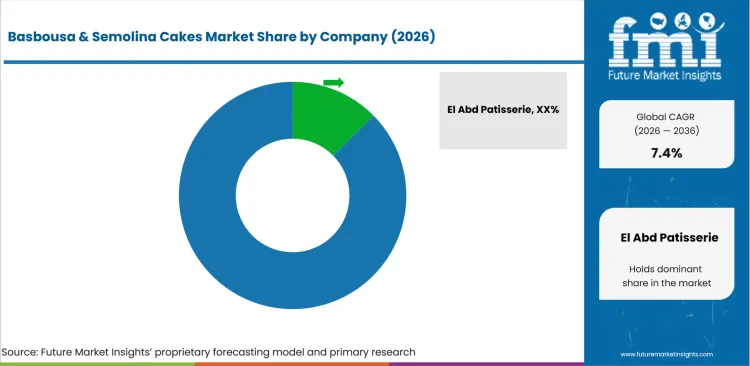
Competition is fragmented between Egyptian heritage patisseries, Gulf multi-branch chains and Levant oriental-sweets operators. Entry barriers come from recipe recognition and branch execution plus the ability to protect a syrup-heavy product during delivery. Companies with existing bakery products networks enter through existing stores without building distribution from zero. They can test personalized bakery products or portion variants locally, though exact taste fit carries more weight than corporate scale.
- El Abd Patisserie, Tseppas and Mandarine Koueider compete from Egyptian heritage positions with recognized oriental-sweets positions and broad patisserie assortments.
- Saadeddin Pastry, Al Baba Sweets, Sea Sweet and Habibah Sweets use multi-branch or cross-border retail networks that extend traditional sweets into gifting and delivery occasions.
- Ittihad Sweets & Catering has direct Namoura heritage in Aley and competes through local production plus catering for institutional and private occasions.
Competitive Benchmarking: Basbousa & Semolina Cakes Market
| Company | Heritage Dessert Breadth | Fresh and Packaged Route Control | Multi-Channel Commercial Reach | Geographic Reach |
|---|---|---|---|---|
| El Abd Patisserie | High | High | High | Egypt |
| Tseppas | High | Medium | High | Egypt |
| Saadeddin Pastry | High | High | High | Saudi Arabia, Bahrain and Kuwait |
| Al Baba Sweets | High | Medium | High | Lebanon, UAE and international shipping |
| Sea Sweet | High | Medium | High | Lebanon and international online sales |
| Habibah Sweets | High | High | High | Jordan, Saudi Arabia and international ordering |
| Ittihad Sweets & Catering | Medium | High | Medium | Lebanon |
| Mandarine Koueider | High | Medium | High | Egypt |
Scoring basis: High heritage breadth requires evidence spanning at least three oriental-dessert families in official company material. Medium requires two verified families and Low identifies evidence limited to one narrow dessert family. High route control requires fresh-service or production control plus documented packaged or delivery execution. Medium confirms one controlled route and Low indicates limited evidence for route ownership beyond that channel. High multi-channel reach requires three verified commercial routes spanning physical retail and catering or digital ordering. Medium requires two verified routes and Low indicates commercial evidence concentrated in one route.
Key Developments in the Basbousa & Semolina Cakes Market
- In July 2026, Habibah Sweets opened its fifth Jordan branch at Abdoun Village and extended its physical retail network into another premium Amman location.
- In June 2025, Saadeddin Pastry opened a new Saadeddin Café branch in Buraidah as part of its continuing Saudi branch expansion.
- In April 2025, TCV completed an investment in El Abd Patisserie through a capital increase representing approximately 20.9% of share capital.
Key Players in the Basbousa & Semolina Cakes Market
Egyptian Heritage Patisseries
- El Abd Patisserie
- Tseppas
- Mandarine Koueider
Gulf and Levant Multi-Channel Sweets Operators
- Saadeddin Pastry
- Al Baba Sweets
- Sea Sweet
- Habibah Sweets
Namoura and Catering Specialist
- Ittihad Sweets & Catering
Basbousa & Semolina Cakes Market - Report Scope
| Coverage field | Report scope |
|---|---|
| Market breakdown | By product type, claim - nature, format, packaging format, sales channel and region. |
| Quantitative Units | USD Million. |
| Market Definition | Commercially sold basbousa, namoura and closely comparable syrup-soaked semolina cakes supplied through bakery, retail, foodservice and direct channels. |
| Regions Covered | North America, Latin America, Europe, East Asia, South Asia and Pacific and Middle East and Africa. |
| Countries Covered | Kuwait, Turkey, Qatar, Egypt, Jordan, and 20+ countries included in the full report. |
| Key Companies Profiled | El Abd Patisserie, Tseppas, Saadeddin Pastry, Al Baba Sweets, Sea Sweet, Habibah Sweets, Ittihad Sweets & Catering, and Mandarine Koueider. |
| Forecast Period | 2026 to 2036. |
| Approach | Primary and secondary research with market triangulation. |
Basbousa & Semolina Cakes Market - Research Methodology
| Method | Approach |
|---|---|
| Primary Research | FMI analysts gathered input from manufacturers, service providers, technology developers, distributors, end users, procurement teams, and subject-matter experts. Interviews examined purchasing decisions, product or service evaluation, adoption barriers, approval requirements, pricing considerations, and expectations for technical or commercial support. Respondents were also asked what evidence is required before a trial, pilot, or initial order develops into regular purchasing. |
| Desk Research | Desk research covered government statistics, regulatory publications, trade data, industry associations, technical literature, standards, company filings, product information, and official corporate announcements. Sources were reviewed for relevance, publication date, geographic coverage, and consistency with the defined market scope. Claims relating to performance, applications, approvals, capacity, investment, and commercial activity were retained only when supported by credible public evidence. |
| Market Sizing and Forecasting | The market model combined the baseline value with historical performance, segment structure, pricing and volume indicators, adoption levels, company participation, and country-level demand conditions. Forecast assumptions considered economic activity, investment trends, regulatory developments, technology adoption, purchasing cycles, supply availability, and barriers to wider market use. Segment and regional estimates were reconciled before the final market total was calculated. |
| Data Validation | Estimates were checked against multiple independent indicators, including public data, company activity, trade patterns, industry developments, and findings from primary interviews. Validation also tested whether products, services, applications, and company revenues fell within the defined market boundaries. Adjacent categories, unsupported claims, overlapping revenues, and activities without direct market relevance were excluded to reduce double counting and maintain consistency across segments and countries. |
Basbousa & Semolina Cakes Market by Segments
By Product Type
- Classic - original
- Layered & frosted
- Flavored & filled
- Mini & snacking formats
- Premium / artisan
By Claim - nature
- Conventional
- Clean label
- Organic
- Gluten-free
- High-protein / fortified
By Format
- Fresh
- Frozen
- Ambient packaged
- Chilled
- Par-baked / thaw-and-serve
By Packaging Format
- Single-serve
- Multipack
- Family / loaf pack
- Bulk foodservice
By Sales Channel
- Supermarkets & hypermarkets
- Artisan & specialty bakeries
- Convenience & forecourt
- Online & DTC
- Foodservice distributors
Basbousa & Semolina Cakes Market by Region:
- North America
- US
- Canada
- Latin America
- Brazil
- Mexico
- Argentina
- Chile
- Western Europe
- Germany
- France
- UK
- Italy
- Spain
- Benelux
- Nordics
- Eastern Europe
- Poland
- Czech Republic
- Romania
- Hungary
- East Asia
- China
- Japan
- South Korea
- South Asia and Pacific
- India
- ASEAN
- Australia and New Zealand
- Middle East and Africa
- GCC Countries
- South Africa
- Türkiye
- Israel
Research Sources and Bibliography
- General Authority for Statistics. (2025, July 3). Tourism Establishments Statistics - Q1 of 2025.
- Turkish Statistical Institute. (2026, January 30). Tourism Statistics, Quarter IV: October-December and Annual, 2025.
- Republic of Türkiye Ministry of Culture and Tourism. (2026, April 30). Bakan Ersoy açıkladı: Turizmde ilk çeyrekte güçlü performans.
- State Information Service. (2026, January 3). Egypt tourism records historic growth in 2025 receiving 19 million tourists.
- Government of Dubai Media Office. (2026, May 25). Mohammed bin Rashid reviews UAE tourism sector achievements for 2025.
- Qatar News Agency. (2026, January 21). Qatar Tourism Marks 2025 as a Year of Global Milestones and Resilient Growth.
- World Health Organization. (2026, January 26). Healthy diet.
- Kuwait Government Online. (2026, July 18). Population Of Kuwait.
- Jordan Ministry of Tourism and Antiquities. (2025, August 14). نمو السياحة في الأردن بنسبة 8% خلال حزيران و18% في النصف الأول من عام 2025.
- Habibah Sweets. (2025, August 13). Al-Bandar Complex (Habibah Sweets) Launches the First Mobile Branch in the Middle East.
- Habibah Sweets. (2026, July). Habibah Sweets company updates: Abdoun Village branch expansion.
- Saadeddinpastry. (2025, June 5). Opening a new Saadeddin Café branch in Buraidah.
- Saadeddinpastry. (2025, February 16). Opening a new Saadeddin Pastry branch in Yanbu Al Bahr.
- Matouk Bassiouny & Hennawy. (2025, April 17). MBH advises El Abd Family on TCV’s successful investment in El Abd Patisserie.
- El Abd Patisserie. (2026). El Abd Patisserie.
- Saadeddin Pastry. (2026). About Saadeddin Pastry.
- Tseppas. (2026). Tseppas.
- Al Baba Sweets. (2026). About Al Baba Sweets.
- Sea Sweet. (2026). Sea Sweet story and branch network.
- Ittihad Sweets & Catering. (2026). About Ittihad Sweets.
- Ittihad Sweets & Catering. (2025). Ittihad Sweets company history: second Aley showroom opening.
- Mandarine Koueider. (2026). Mandarine Koueider.
This bibliography is provided for reader reference and is not exhaustive. The full report contains the complete reference list and detailed citations
This Report Answers
- How large is the basbousa & semolina cakes market in 2026 and how does its valuation change through 2036?
- Which operating conditions broaden purchase occasions for basbousa & semolina cakes in hospitality and retail channels?
- Why does classic - original retain the largest product type share in 2026?
- Why does conventional hold the largest claim - nature share in 2026?
- How do fresh and single-serve formats alter distribution economics and product quality requirements?
- Which constraints limit repeat consumption or longer-distance distribution for syrup-soaked semolina cakes?
- How do Kuwait, Turkey, Qatar, Egypt and Jordan differ in their forecast growth paths?
- Which companies are active in the basbousa & semolina cakes market and how do their operating models differ?
- What recent company actions are changing branch reach and commercial capacity in the category?
Frequently Asked Questions
How big is the basbousa & semolina cakes market in 2026?
The basbousa & semolina cakes market is valued at USD 184.1 million in 2026 and is projected to reach USD 375.9 million by 2036. Growth comes from broader hospitality, retail and digital access to a familiar dessert.
What is the CAGR of the basbousa & semolina cakes market from 2026 to 2036?
The basbousa & semolina cakes market is projected to grow at a CAGR of 7.4% between 2026 and 2036. Expansion is tied to more purchase occasions and formats that preserve syrup balance through wider distribution.
Which product type leads the basbousa & semolina cakes market?
The classic - original segment is expected to hold 38.0% of the basbousa & semolina cakes market in 2026, attributable to familiar taste and lower trial risk. Its reference sensory profile also anchors filled and premium variants that consumers compare directly with the original recipe.
Which claim - nature segment leads the basbousa & semolina cakes market?
The conventional segment is expected to hold 52.0% of the basbousa & semolina cakes market in 2026, supported by indulgence-led purchasing. Reformulated products still need to preserve the moisture and richness consumers associate with the category.
Which countries are projected to record the highest growth in the basbousa & semolina cakes market?
Kuwait is projected to grow at 8.6% CAGR, followed by Turkey at 8.3% and Qatar at 8.0% through 2036. Their higher profiled rates correspond with compact Gulf channels and tourism-heavy occasions plus Turkey’s large domestic dessert base.
Which companies are active in the basbousa & semolina cakes market?
Key companies operating in the market include El Abd Patisserie, Tseppas, Saadeddin Pastry, Al Baba Sweets, Sea Sweet, Habibah Sweets, Ittihad Sweets & Catering, and Mandarine Koueider. Their competitive differences center on heritage recognition and branch reach plus direct ordering and format execution.
Preview the report firsthand - request a free sample
Get SampleGet the brochure for pricing and purchase details.
Get PDFTable of Content
- Key Takeaways
- Market Size and CAGR
- Top Growth Driver
- Fastest Growing Segment
- Leading Region
- Key Companies
- Emerging Opportunities
- Executive Summary
- Global Market Outlook
- Demand-side Trends
- Supply-side Trends
- Technology Roadmap Analysis
- Analysis and Recommendations
- Analyst Perspective (What is happening? Why now? What should investors know?)
- Key Questions Answered
- How large is the market?
- What is the CAGR?
- What are key trends?
- Which region dominates?
- Who are the leaders?
- Market Overview
- Market Coverage / Taxonomy
- Market Definition / Scope / Limitations
- Research Methodology
- Chapter Orientation
- Analytical Lens and Working Hypotheses
- Market Structure, Signals, and Trend Drivers
- Benchmarking and Cross-market Comparability
- Market Sizing, Forecasting, and Opportunity Mapping
- Research Design and Evidence Framework
- Desk Research Programme (Secondary Evidence)
- Expert Input and Fieldwork (Primary Evidence)
- Tooling, Models, and Reference Databases
- Data Engineering and Model Build
- Quality Assurance and Audit Trail
- Market Background
- Market Dynamics (Drivers, Restraints, Opportunity, Trends)
- Scenario Forecast (Optimistic, Likely, Conservative)
- Impact Analysis
- AI Impact
- Sustainability Impact
- Regulatory Impact
- Technology Impact
- Consumer / Buyer Analysis
- Purchase Drivers
- Adoption Barriers
- Buyer Journey
- Opportunity Map Analysis
- Product Life Cycle Analysis
- Supply Chain Analysis
- Investment Feasibility Matrix
- Value Chain Analysis
- PESTLE and Porter's Analysis
- Regulatory Landscape
- Regional Parent Market Outlook
- Production and Consumption Statistics
- Import and Export Statistics
- Global Market Analysis and Forecast, 2021 to 2036
- Historical Market Size Value (USD Million) Analysis, 2021 to 2025
- Current and Future Market Size Value (USD Million) Projections, 2026 to 2036
- Y-o-Y Growth Trend Analysis
- Absolute $ Opportunity Analysis
- Global Market Pricing Analysis, 2021 to 2036
- Global Market Analysis and Forecast, By Product Type, 2021 to 2036
- Introduction / Key Findings
- Historical Market Size Value (USD Million) Analysis By Product Type, 2021 to 2025
- Current and Future Market Size Value (USD Million) Analysis and Forecast By Product Type, 2026 to 2036
- Classic / original
- Layered & frosted
- Flavored & filled
- Mini & snacking formats
- Premium / artisan
- Classic / original
- Y-o-Y Growth Trend Analysis By Product Type, 2021 to 2025
- Absolute $ Opportunity Analysis By Product Type, 2026 to 2036
- Global Market Analysis and Forecast, By Claim / Nature, 2021 to 2036
- Introduction / Key Findings
- Historical Market Size Value (USD Million) Analysis By Claim / Nature, 2021 to 2025
- Current and Future Market Size Value (USD Million) Analysis and Forecast By Claim / Nature, 2026 to 2036
- Conventional
- Clean label
- Organic
- Gluten-free
- High-protein / fortified
- Conventional
- Y-o-Y Growth Trend Analysis By Claim / Nature, 2021 to 2025
- Absolute $ Opportunity Analysis By Claim / Nature, 2026 to 2036
- Global Market Analysis and Forecast, By Format, 2021 to 2036
- Introduction / Key Findings
- Historical Market Size Value (USD Million) Analysis By Format, 2021 to 2025
- Current and Future Market Size Value (USD Million) Analysis and Forecast By Format, 2026 to 2036
- Fresh
- Frozen
- Ambient packaged
- Chilled
- Par-baked / thaw-and-serve
- Fresh
- Y-o-Y Growth Trend Analysis By Format, 2021 to 2025
- Absolute $ Opportunity Analysis By Format, 2026 to 2036
- Global Market Analysis and Forecast, By Packaging Format, 2021 to 2036
- Introduction / Key Findings
- Historical Market Size Value (USD Million) Analysis By Packaging Format, 2021 to 2025
- Current and Future Market Size Value (USD Million) Analysis and Forecast By Packaging Format, 2026 to 2036
- Single-serve
- Multipack
- Family / loaf pack
- Bulk foodservice
- Single-serve
- Y-o-Y Growth Trend Analysis By Packaging Format, 2021 to 2025
- Absolute $ Opportunity Analysis By Packaging Format, 2026 to 2036
- Global Market Analysis and Forecast, By Sales Channel, 2021 to 2036
- Introduction / Key Findings
- Historical Market Size Value (USD Million) Analysis By Sales Channel, 2021 to 2025
- Current and Future Market Size Value (USD Million) Analysis and Forecast By Sales Channel, 2026 to 2036
- Supermarkets & hypermarkets
- Artisan & specialty bakeries
- Convenience & forecourt
- Online & DTC
- Foodservice distributors
- Supermarkets & hypermarkets
- Y-o-Y Growth Trend Analysis By Sales Channel, 2021 to 2025
- Absolute $ Opportunity Analysis By Sales Channel, 2026 to 2036
- Global Market Analysis and Forecast, By Region, 2021 to 2036
- Introduction
- Historical Market Size Value (USD Million) Analysis By Region, 2021 to 2025
- Current Market Size Value (USD Million) Analysis and Forecast By Region, 2026 to 2036
- North America
- Latin America
- Western Europe
- Eastern Europe
- East Asia
- South Asia and Pacific
- Middle East & Africa
- Market Attractiveness Analysis By Region
- North America Market Analysis and Forecast, By Country, 2021 to 2036
- Historical Market Size Value (USD Million) Trend Analysis By Market Taxonomy, 2021 to 2025
- Market Size Value (USD Million) Forecast By Market Taxonomy, 2026 to 2036
- By Country
- USA
- Canada
- By Product Type
- By Claim / Nature
- By Format
- By Packaging Format
- By Sales Channel
- By Country
- Market Attractiveness Analysis
- By Country
- By Product Type
- By Claim / Nature
- By Format
- By Packaging Format
- By Sales Channel
- Key Takeaways
- Latin America Market Analysis and Forecast, By Country
- Historical Market Size Value (USD Million) Trend Analysis By Market Taxonomy, 2021 to 2025
- Market Size Value (USD Million) Forecast By Market Taxonomy, 2026 to 2036
- By Country
- Brazil
- Mexico
- Chile
- Rest of Latin America
- By Product Type
- By Claim / Nature
- By Format
- By Packaging Format
- By Sales Channel
- By Country
- Market Attractiveness Analysis
- By Country
- By Product Type
- By Claim / Nature
- By Format
- By Packaging Format
- By Sales Channel
- Key Takeaways
- Western Europe Market Analysis and Forecast, By Country
- Historical Market Size Value (USD Million) Trend Analysis By Market Taxonomy, 2021 to 2025
- Market Size Value (USD Million) Forecast By Market Taxonomy, 2026 to 2036
- By Country
- Germany
- UK
- Italy
- Spain
- France
- Nordic
- BENELUX
- Rest of Western Europe
- By Product Type
- By Claim / Nature
- By Format
- By Packaging Format
- By Sales Channel
- By Country
- Market Attractiveness Analysis
- By Country
- By Product Type
- By Claim / Nature
- By Format
- By Packaging Format
- By Sales Channel
- Key Takeaways
- Eastern Europe Market Analysis and Forecast, By Country
- Historical Market Size Value (USD Million) Trend Analysis By Market Taxonomy, 2021 to 2025
- Market Size Value (USD Million) Forecast By Market Taxonomy, 2026 to 2036
- By Country
- Russia
- Poland
- Hungary
- Balkan & Baltic
- Rest of Eastern Europe
- By Product Type
- By Claim / Nature
- By Format
- By Packaging Format
- By Sales Channel
- By Country
- Market Attractiveness Analysis
- By Country
- By Product Type
- By Claim / Nature
- By Format
- By Packaging Format
- By Sales Channel
- Key Takeaways
- East Asia Market Analysis and Forecast, By Country
- Historical Market Size Value (USD Million) Trend Analysis By Market Taxonomy, 2021 to 2025
- Market Size Value (USD Million) Forecast By Market Taxonomy, 2026 to 2036
- By Country
- China
- Japan
- South Korea
- By Product Type
- By Claim / Nature
- By Format
- By Packaging Format
- By Sales Channel
- By Country
- Market Attractiveness Analysis
- By Country
- By Product Type
- By Claim / Nature
- By Format
- By Packaging Format
- By Sales Channel
- Key Takeaways
- South Asia and Pacific Market Analysis and Forecast, By Country
- Historical Market Size Value (USD Million) Trend Analysis By Market Taxonomy, 2021 to 2025
- Market Size Value (USD Million) Forecast By Market Taxonomy, 2026 to 2036
- By Country
- India
- ASEAN
- Australia & New Zealand
- Rest of South Asia and Pacific
- By Product Type
- By Claim / Nature
- By Format
- By Packaging Format
- By Sales Channel
- By Country
- Market Attractiveness Analysis
- By Country
- By Product Type
- By Claim / Nature
- By Format
- By Packaging Format
- By Sales Channel
- Key Takeaways
- Middle East & Africa Market Analysis and Forecast, By Country
- Historical Market Size Value (USD Million) Trend Analysis By Market Taxonomy, 2021 to 2025
- Market Size Value (USD Million) Forecast By Market Taxonomy, 2026 to 2036
- By Country
- Kingdom of Saudi Arabia
- Other GCC Countries
- Türkiye
- South Africa
- Other African Union
- Rest of Middle East & Africa
- By Product Type
- By Claim / Nature
- By Format
- By Packaging Format
- By Sales Channel
- By Country
- Market Attractiveness Analysis
- By Country
- By Product Type
- By Claim / Nature
- By Format
- By Packaging Format
- By Sales Channel
- Key Takeaways
- Key Countries Market Analysis
- USA
- Pricing Analysis
- Market Share Analysis, 2025
- By Product Type
- By Claim / Nature
- By Format
- By Packaging Format
- By Sales Channel
- Canada
- Pricing Analysis
- Market Share Analysis, 2025
- By Product Type
- By Claim / Nature
- By Format
- By Packaging Format
- By Sales Channel
- Mexico
- Pricing Analysis
- Market Share Analysis, 2025
- By Product Type
- By Claim / Nature
- By Format
- By Packaging Format
- By Sales Channel
- Brazil
- Pricing Analysis
- Market Share Analysis, 2025
- By Product Type
- By Claim / Nature
- By Format
- By Packaging Format
- By Sales Channel
- Chile
- Pricing Analysis
- Market Share Analysis, 2025
- By Product Type
- By Claim / Nature
- By Format
- By Packaging Format
- By Sales Channel
- Germany
- Pricing Analysis
- Market Share Analysis, 2025
- By Product Type
- By Claim / Nature
- By Format
- By Packaging Format
- By Sales Channel
- UK
- Pricing Analysis
- Market Share Analysis, 2025
- By Product Type
- By Claim / Nature
- By Format
- By Packaging Format
- By Sales Channel
- Italy
- Pricing Analysis
- Market Share Analysis, 2025
- By Product Type
- By Claim / Nature
- By Format
- By Packaging Format
- By Sales Channel
- Spain
- Pricing Analysis
- Market Share Analysis, 2025
- By Product Type
- By Claim / Nature
- By Format
- By Packaging Format
- By Sales Channel
- France
- Pricing Analysis
- Market Share Analysis, 2025
- By Product Type
- By Claim / Nature
- By Format
- By Packaging Format
- By Sales Channel
- India
- Pricing Analysis
- Market Share Analysis, 2025
- By Product Type
- By Claim / Nature
- By Format
- By Packaging Format
- By Sales Channel
- ASEAN
- Pricing Analysis
- Market Share Analysis, 2025
- By Product Type
- By Claim / Nature
- By Format
- By Packaging Format
- By Sales Channel
- Australia & New Zealand
- Pricing Analysis
- Market Share Analysis, 2025
- By Product Type
- By Claim / Nature
- By Format
- By Packaging Format
- By Sales Channel
- China
- Pricing Analysis
- Market Share Analysis, 2025
- By Product Type
- By Claim / Nature
- By Format
- By Packaging Format
- By Sales Channel
- Japan
- Pricing Analysis
- Market Share Analysis, 2025
- By Product Type
- By Claim / Nature
- By Format
- By Packaging Format
- By Sales Channel
- South Korea
- Pricing Analysis
- Market Share Analysis, 2025
- By Product Type
- By Claim / Nature
- By Format
- By Packaging Format
- By Sales Channel
- Russia
- Pricing Analysis
- Market Share Analysis, 2025
- By Product Type
- By Claim / Nature
- By Format
- By Packaging Format
- By Sales Channel
- Poland
- Pricing Analysis
- Market Share Analysis, 2025
- By Product Type
- By Claim / Nature
- By Format
- By Packaging Format
- By Sales Channel
- Hungary
- Pricing Analysis
- Market Share Analysis, 2025
- By Product Type
- By Claim / Nature
- By Format
- By Packaging Format
- By Sales Channel
- Kingdom of Saudi Arabia
- Pricing Analysis
- Market Share Analysis, 2025
- By Product Type
- By Claim / Nature
- By Format
- By Packaging Format
- By Sales Channel
- Türkiye
- Pricing Analysis
- Market Share Analysis, 2025
- By Product Type
- By Claim / Nature
- By Format
- By Packaging Format
- By Sales Channel
- South Africa
- Pricing Analysis
- Market Share Analysis, 2025
- By Product Type
- By Claim / Nature
- By Format
- By Packaging Format
- By Sales Channel
- USA
- Market Structure Analysis
- Competition Dashboard
- Competition Benchmarking
- Market Share Analysis of Top Players
- By Regional
- By Product Type
- By Claim / Nature
- By Format
- By Packaging Format
- By Sales Channel
- Emerging Startups
- Innovation Benchmarking
- Competition Analysis
- Competition Deep Dive
- El Abd Patisserie
- Overview
- Product Portfolio
- Profitability by Market Segments
- Sales Footprint
- Strategy Overview
- Marketing Strategy
- Product Strategy
- Channel Strategy
- Tseppas
- Saadeddin Pastry
- Al Baba Sweets
- Sea Sweet
- Habibah Sweets
- Bateel
- El Abd Patisserie
- Case Studies
- Success Stories
- Recent Developments
- Competition Deep Dive
- Assumptions & Acronyms Used


