

- Market Size (2026)
- USD 1064.0 million
- Forecast (2036)
- USD 2054.2 million
- CAGR (2026 to 2036)
- 6.8%
How big is Behavioral Health Care Coordination Market in 2026?
USD 1,064.0 million in 2026 and USD 2,054.2 million by 2036 at a 6.8% CAGR.
Demand for behavioral health care coordination is forecast to expand at 6.8% CAGR between 2026 and 2036, increasing valuation from USD 1,064.0 million in 2026 to USD 2,054.2 million by 2036. Care coordination services create value through assigned responsibility for screening and referral across disconnected care settings. Defined teams also manage follow-up and medication support while reviewing outcomes through shared records throughout treatment. The Substance Abuse and Mental Health Services Administration reported in July 2025 that 61.5 million American adults experienced any mental illness during 2024. Behavioral health services create clinical workload, yet coordination spending depends on handoffs and measurable action between organizations. AI-powered care coordination tools can strengthen prioritization and monitoring, although technology requires accountable clinical teams and reliable escalation routes. Health systems therefore assess staffing capacity and reimbursement fit before expanding coordination programs across multiple locations. They also require reliable data continuity and measurable service outcomes across participating teams during routine operations.
National purchasing routes differ through distinct payment systems and provider networks across behavioral health services. Public programs and information-sharing rules also determine which organizations can operate coordinated pathways within each jurisdiction. United States health plans and provider groups can combine reimbursable care management with employer programs and state-led demonstrations. United Kingdom commissioners focus more directly on public-service capacity and referral backlogs within nationally governed pathways. Germany relies on regulated provider networks, while Japanese municipalities connect medical care with welfare services through local administrative structures. South Korean community centers provide a public coordination base, although access can vary between metropolitan and less densely served locations. Across these routes, healthcare interoperability solutions support shared records but cannot replace local service capacity or agreed clinical ownership. Commercial entry therefore depends on adapting clinical workflows and staff training to each national operating structure. Contracting and support arrangements must also reflect local payment responsibilities rather than one standard model.
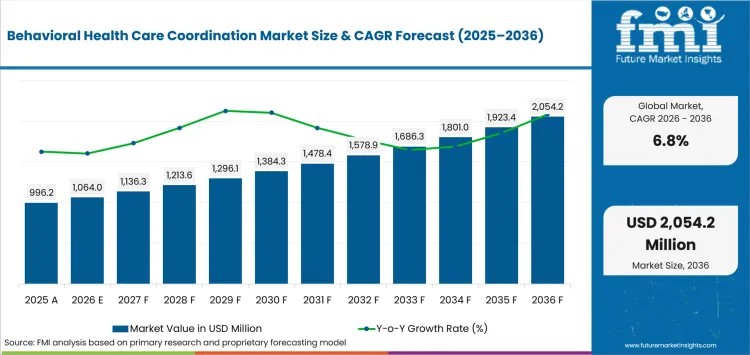
Key Takeaways of Behavioral Health Care Coordination Market
- Demand for behavioral health care coordination is driven by fragmented referrals and follow-up failures that create measurable clinical and administrative consequences, alongside growing mental health caseloads requiring screening and monitoring.
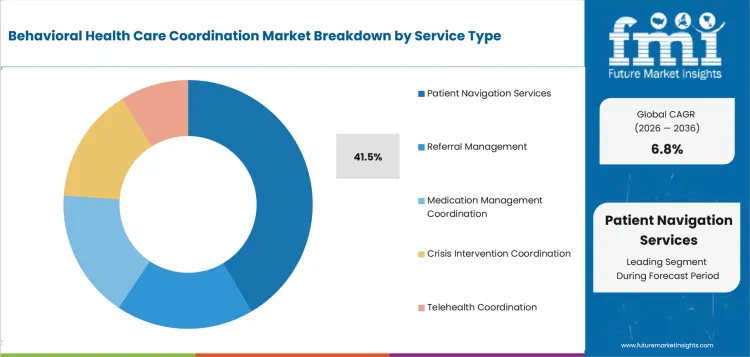
- By service type, patient navigation services are expected to lead with 41.5% share in 2026, helping patients locate providers and complete referrals.
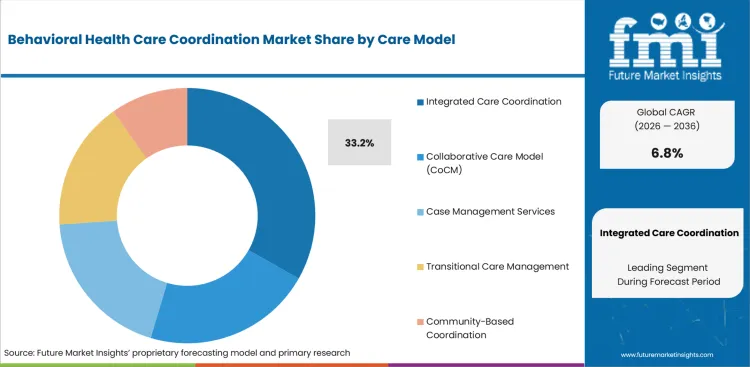
- Integrated care coordination is estimated to hold 33.2% share in 2026, through its ability to connect physical and behavioral treatment responsibilities.
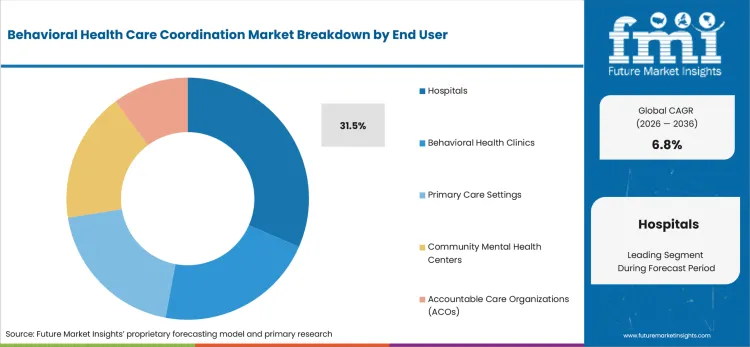
- Hospitals are the dominant end-user segment, projected to account for 31.5% share in 2026, as acute and outpatient settings manage complex transitions and escalations.
- Major depressive disorder represents 29.9% share in 2026, though condition-specific pathways require different monitoring and recovery measures.
- The United States, South Korea, and Japan are expected to lead growth at 8.1%, 7.7%, and 6.6% CAGR respectively through 2036, while Germany and the UK follow distinct regulated pathways shaped by network formation and public-service capacity.
- Competition centers on Carelon Behavioral Health, Magellan Healthcare, Aetna, Optum, Spring Health, Lucet, Netsmart, and NeuroFlow, with vendors differentiating through care management and network operations, benefit administration and navigation, and data exchange/referral management platforms.
Analyst Perspective
"Sustainable care coordination depends less on expanding digital access and more on creating accountable workflows across providers, payers, and community services. Healthcare organizations are increasingly measuring referral completion, patient engagement, and continuity of care as distinct performance indicators. Long-term adoption will favor platforms that establish clear governance, support reliable clinical collaboration, and maintain consistent service delivery across routine care and complex patient pathways."
— Anurag Sharma, Principal Analyst, Healthcare
Source: FMI's proprietary forecasting model and primary research
How is the Behavioral Health Care Coordination Market segmented?
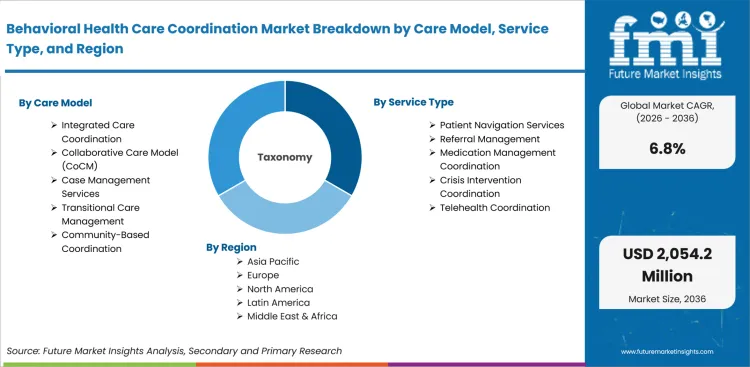
The behavioral health care coordination industry is segmented by care model, service type, end user, condition, and region.
Care model analysis separates integrated clinical structures from case management and transitional support arrangements within provider organizations. Community-based coordination forms another distinct model within the approved service boundary for local service networks and public agencies. Service type analysis distinguishes patient navigation from referral management and medication coordination activities within covered pathways. Crisis intervention and telehealth coordination address different service responsibilities across the care pathway during urgent and remote encounters. End-user categories identify hospitals and behavioral health clinics alongside primary care settings that purchase coordination support.
Community mental health centers and accountable care organizations represent additional purchasing environments for defined patient populations. Condition analysis compares pathways for depressive and anxiety disorders alongside bipolar disorder and schizophrenia requiring continuing review. Substance use disorders and post-traumatic stress disorder require additional coordination routes across different service settings and recovery stages. Regional analysis examines how reimbursement and service capacity influence operating requirements across national markets during implementation. Provider networks and data infrastructure operate within the applicable national regulatory framework that governs commercial entry.
How does integrated care coordination shape the care model workflow?
Integrated care coordination addresses gaps between behavioral health treatment and physical or social needs managed by separate professionals. The Agency for Healthcare Research and Quality revised its integration playbook in May 2025 with modules for operational systems and patient tracking. Additional guidance addresses technology and data use across integrated practices and continuing performance measurement requirements. Provider organizations need shared work queues and escalation rules that connect clinical responsibility with reliable follow-up. Patient engagement platforms can support communication, although each participating team must retain a defined response obligation for unresolved needs.
- Within the care model category, integrated care coordination accounts for 33.2% share in 2026, linked to its whole-person operating structure. The model brings behavioral and physical treatment decisions into one accountable pathway instead of leaving referrals as isolated administrative events.
- Health systems and accountable care organizations select integrated coordination to manage comorbid conditions across primary care and specialty behavioral services. Adoption depends on aligned payment and shared documentation because additional meetings create limited value without timely actions or measurable outcomes.
What supports demand for patient navigation services within the service type category?
Patient navigation services reduce the search burden that follows a behavioral health referral across fragmented networks and benefit structures. Navigators clarify coverage and provider options while helping patients complete appointments or reach a suitable alternative. Telehealth and telemedicine can extend available choices, yet remote access requires scheduling support and clinically appropriate escalation pathways. Health plans therefore evaluate navigation through completed connections and continuing engagement rather than outbound contact volume alone.
- Patient navigation services hold 41.5% share within the service type category in 2026, reflecting their direct access role. CMS listed principal illness navigation alongside behavioral health integration and other care management services on its updated May 2026 guidance page.
- Health-plan members and primary care patients use navigation to identify available clinicians and understand the next step after screening. Programs gain stronger operational support when navigators can schedule appointments and document unsuccessful referrals for ongoing network planning or clinical review.
What makes hospitals central to the end-user category?
Hospitals manage behavioral health needs across emergency departments and inpatient units with different clinical responsibilities. Outpatient clinics and discharge pathways also involve several organizations outside the facility during continuing patient care. Coordination services help clinical teams identify responsibility for follow-up and transfer relevant information to community providers. Post-acute transition coordination provides a useful adjacent framework because discharge success also depends on timely records and accountable outreach. Hospital purchasing decisions therefore consider integration with existing clinical systems and service availability beyond the facility boundary.
- Hospitals represent 31.5% share within the end-user category in 2026, owing to complex transitions and urgent escalation needs. Their position reflects the coordination burden created by multiple entry points rather than a single treatment setting or specialty department.
- Hospital systems expand behavioral health coordination to connect acute care with primary care and community services across patient transitions. The American Hospital Association stated in May 2026 that hospitals are integrating physical and behavioral health services across inpatient and emergency settings as well as primary care.
How do major depressive disorder pathways influence coordination needs?
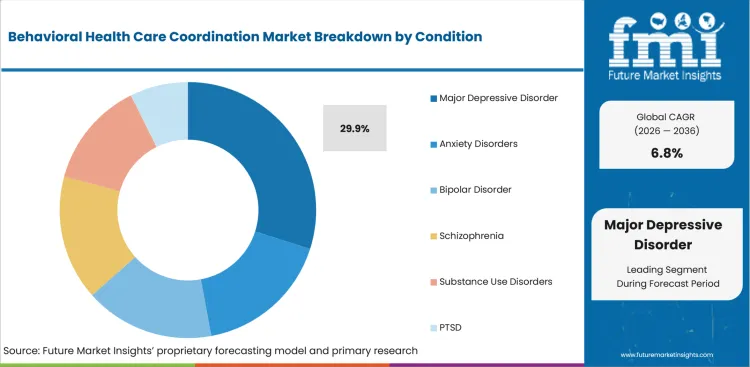
Major depressive disorder pathways require symptom review across medication management and therapy services during ongoing treatment. Coordinated treatment adjustments can involve primary care and hospital teams during symptom changes and service transitions. Germany's Federal Statistical Office reported in March 2025 that hospitals treated about 261,200 patients for depressive episodes or recurrent depressive disorders during 2023. Extended or recurring episodes increase the importance of documented follow-up after discharge and between different treatment providers. Care coordination programs must distinguish routine symptom monitoring from urgent safety escalation and structured relapse prevention responsibilities.
- Major depressive disorder represents 29.9% of the condition category in 2026 through its broad treatment pathway and recurring monitoring needs. Coordination services support continuity across medication management and psychotherapy without assuming that every patient requires the same intensity or setting.
- Behavioral health clinics and health systems use coordinated pathways to track symptom change and unresolved referrals among people receiving depression treatment. Programs addressing mental health-sleep overlap need explicit responsibility because sleep disruption can complicate monitoring without independently determining the primary treatment plan.
What are the drivers, restraints, and opportunities in the Behavioral Health Care Coordination Market?
Rising behavioral health workload supports coordinated care across medical and community services with fragmented referral responsibilities. Workforce shortages constrain dependable delivery while targeted infrastructure funding creates practical implementation routes for participating organizations.
- Driver: Clinical teams need repeatable coordination pathways as behavioral health caseloads increase across medical and community service settings.
- Restraint: Workforce shortages restrict outreach and follow-up capacity even when technology identifies patients requiring additional support.
- Opportunity: Funding tied to interoperability and practice transformation can support governed coordination programs with defined responsibilities.
Behavioral health workload creates demand for coordination whenever patients require physical care and social support beside mental health treatment. CMS reported in November 2025 that 40% of adults enrolled in Medicaid experience mental illness or substance use disorder. The agency linked its Innovation in Behavioral Health model with interprofessional teams and integrated service access. State agencies and participating practices therefore need coordination services that direct patients across clinical and community resources without losing accountability.
Workforce capacity limits coordination because outreach and follow-up require trained professionals who can interpret risk and arrange suitable services. HRSA projects a shortage of 99,780 mental health counselors by 2038 under current service-use patterns. Digital population health platforms can prioritize work and identify unresolved cases, yet software cannot create clinical time or local provider availability. Provider organizations must align caseload standards and escalation responsibilities before digital monitoring can support dependable routine care.
Targeted infrastructure funding creates an opening for practices that need interoperable systems and redesigned workflows before assuming broader coordination duties. AI-enabled behavioral therapy may complement monitored care pathways, although automated support needs clinical boundaries and referral options. CMS stated in its March 2026 Innovation in Behavioral Health guidance that approved practices can receive up to USD 200,000 for infrastructure including interoperability and telehealth capabilities. Technology providers can capture this opening by pairing implementation support with measurable care management responsibilities and documented service recovery.
Which country CAGRs are profiled in the behavioral health care coordination market?
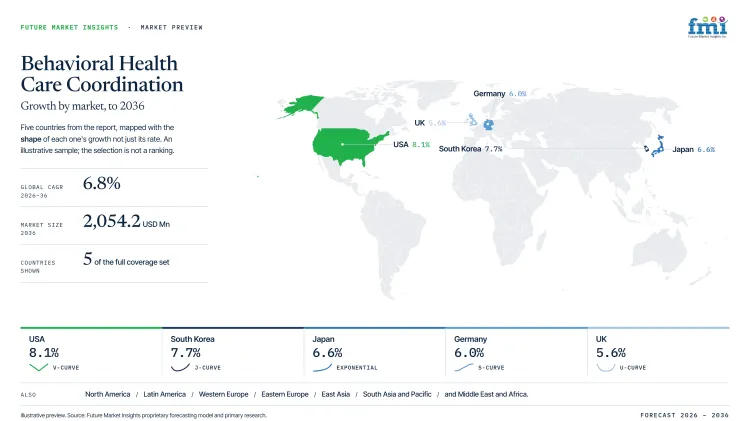
| Country | CAGR |
|---|---|
| USA | 8.1% |
| UK | 5.6% |
| Germany | 6.0% |
| Japan | 6.6% |
| South Korea | 7.7% |
How do country-level CAGRs compare in the Behavioral Health Care Coordination Market?
The five-country comparison spans 2.5 percentage points between the USA and the UK during the 2026-to-2036 assessment period. The USA and South Korea form the upper growth group with a measured separation of 0.4 percentage point. Japan and Germany occupy the middle range through distinct public and regulated coordination structures that support different implementation routes. The UK stands outside that cluster with a lower forecast rate despite substantial public mental health service activity. The spacing reflects different implementation speeds and does not establish current market size or service quality across countries.
- The USA and South Korea share stronger forecast momentum, although American purchasing relies more heavily on health plans and provider organizations than Korean community infrastructure.
- Japan is positioned near the center because municipal integration routes support coordination while local staffing and administrative variation can slow standardized deployment.
- Germany follows closely through regulated network formation and coordinated pathways for severe mental illness across multiple professional groups.
- The UK records a more moderate forecast as public commissioning and service capacity require solutions that demonstrate practical effects on referral completion and clinical workload.
Similar CAGRs can produce different entry conditions across countries with distinct reimbursement and procurement systems. Workforce capacity and information governance determine which organizations can purchase or operate coordination services at meaningful scale. Commercial plans therefore require country-specific contracting and support models even across markets with relatively close forecast rates. The full report provides country-level CAGR analysis across North America, Latin America, Europe, East Asia, South Asia, Oceania and the Middle East and Africa.
Country-wise Analysis
- American behavioral health coordination operates through health plans and provider groups with different payment responsibilities. Adoption of behavioral health care coordination in USA is estimated to expand at 8.1% CAGR through 2036, enabled by state demonstrations and established managed-care channels. CMS confirmed in June 2026 that three states remain active participants in the Innovation in Behavioral Health model: Michigan and New York alongside South Carolina. Adjacent medical home services offer an operating comparison because primary care integration also requires shared plans and referral accountability. The broad payer base enables varied purchasing routes, although state requirements and network availability create material implementation differences. Service providers need state-specific reimbursement knowledge and reliable local referral capacity before scaling a national coordination contract.
- England relies on nationally governed mental health pathways where public providers manage referral queues and continuing care across regional service organizations. Demand for behavioral health care coordination in UK is forecast to rise at 5.6% CAGR over the 2026-2036 forecast period, shaped by public procurement and pressure on specialist service capacity. The national data infrastructure supports performance monitoring across commissioned services, although constrained clinical capacity can limit navigation outcomes. NHS England Digital reported in June 2026 that 2.26 million people had an open mental health service referral at the end of April. Commercial providers need procurement evidence that demonstrates shorter referral delays or reduced administrative workload within established NHS pathways.
- German coordination pathways depend on regulated provider participation and formal cooperation across medical and psychosocial professional groups. The behavioral health care coordination market in Germany is projected to grow at 6.0% CAGR through 2036, supported by regulated network formation for people with complex mental health needs. The Federal Joint Committee decided in August 2025 to simplify structural and administrative requirements for multidisciplinary networks serving adults with severe mental illness. The policy change supports coordinated operating models, although provider shortages and regional network formation remain practical frictions. Market entry requires documented compliance with local care rules and credible integration across participating professional practices.
- Japanese behavioral health coordination often develops through municipal networks that connect public health offices with medical and welfare organizations. Adoption of behavioral health care coordination in Japan is estimated to expand at 6.6% CAGR through 2036, enabled by municipal integration of health and community support services. Municipal teams can coordinate health and welfare responsibilities through local operating structures that reflect available service capacity. Japan's Ministry of Health portal lists a fiscal 2025 casebook describing Hachioji coordination across public health and medical services. Local staffing and administrative approaches can limit uniform national deployment despite the direct enabler created by municipal pathways. Providers need configurable workflows and local implementation partners rather than one standardized national service package.
- South Korea uses municipal and regional mental health welfare centers as public infrastructure for case management and crisis response. Demand for behavioral health care coordination in South Korea is forecast to rise at 7.7% CAGR over the 2026-2036 assessment period, shaped by community centers and dense digital communication channels. The Ministry of Health and Welfare stated on its August 2025 updated page that centers provide registration and case management. The same centers also manage referrals and rehabilitation alongside crisis intervention for registered local service users. The nationwide center structure supports coordinated access, although service intensity and specialist availability can differ between local jurisdictions. Technology companies need interfaces that fit public workflows and training plans that accommodate varied local operating capacity.
Who are the notable companies in the Behavioral Health Care Coordination Market?
Carelon Behavioral Health, Aetna Behavioral Health, Optum Behavioral Health, Magellan Healthcare, Spring Health, Netsmart, NeuroFlow, and Lucet are notable companies shaping this market.
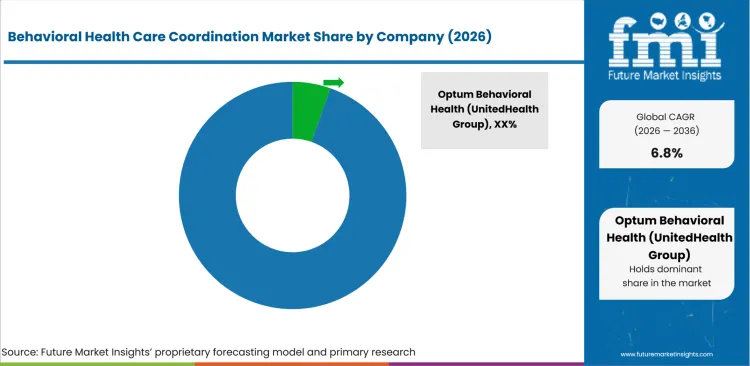
The competitive structure combines managed behavioral health organizations with benefit administrators across payer programs and different service contracts. Carelon and Magellan operate care management programs that connect network access with complex behavioral health support. Aetna and Optum embed coordination within broader health-plan services that provide member guidance and access support across covered populations. Spring Health and Lucet use technology-enabled navigation to match people with clinicians and continuing support. Netsmart supplies provider data exchange and shared care planning, while NeuroFlow adds behavioral health identification and referral management within clinical workflows. Selection depends on the organization responsible for clinical escalation and network adequacy across the defined pathway. Data integration and measurable follow-up establish whether coordination continues beyond initial contact across participating organizations.
- Carelon Behavioral Health and Magellan Healthcare support managed programs through care coordination and case management. Their provider networks also support complex-care pathways across public and commercial populations with different access requirements. Aetna Behavioral Health and Optum Behavioral Health add member guidance within health-plan operating models serving covered populations.
- Spring Health and Lucet focus on navigation technology that assesses member needs and connects people with suitable behavioral health services. Their commercial fit depends on scheduling performance and network capacity across the covered member populations. Clinical escalation and continuing support must remain available beyond the initial appointment across each service pathway.
- Netsmart and NeuroFlow provide technology for secure data exchange and patient monitoring across provider organizations. Their platforms also support referral management and workflow integration across separate clinical teams during continuing treatment. Commercial value depends on implementation depth and preserved responsibility across service settings during routine operation.
Competitive Benchmarking: Behavioral Health Care Coordination Market
| Company | Integrated Care Delivery | Navigation and Referral | Care Management Technology | Geographic Reach |
|---|---|---|---|---|
| Carelon Behavioral Health | High | High | Medium | United States |
| Aetna Behavioral Health | Medium | High | Medium | United States |
| Optum Behavioral Health | Medium | High | Medium | United States |
| Magellan Healthcare | High | High | Medium | United States |
| Spring Health | Medium | High | High | Global |
| Netsmart | High | Medium | High | United States |
| NeuroFlow | High | High | High | United States |
| Lucet | Medium | High | High | United States |
Key Developments in the Behavioral Health Care Coordination Market
- In January 2025, NeuroFlow announced its acquisition of Quartet Health to expand referral and care navigation capabilities for payers and health systems. Quartet confirmed the completed acquisition on its official site and stated that its Care Connections platform adds referral options to NeuroFlow's analytics and care coordination workflows. The transaction strengthens one integrated platform and confirms that Quartet no longer operates as an independent competitor within the reviewed market boundary.
- In March 2026, Netsmart and Pyramid Healthcare expanded their enterprise collaboration across a multistate behavioral health and addiction treatment system. The organizations stated that Pyramid would broaden its use of the CareFabric platform with workflow automation and care coordination capabilities. The deployment connects enterprise records with clinical documentation and administrative workload management across multiple service locations.
- In March 2026, Spring Health and Stonebrook Risk Solutions announced a strategic partnership for health plans and third-party administrators. The arrangement also serves stop-loss carriers and self-insured employers through the Stonebrook medical management channel. Stonebrook agreed to incorporate Spring Health's connected mental health platform into its medical management ecosystem. The partnership extends navigation and integrated behavioral support through a channel serving organizations that manage claims and complex health risks.
- In May 2026, Aetna announced Mental Health On Demand for members enrolled in the service beginning in 2027. The planned offering provides real-time access to a licensed clinician through chat or telephone and video channels. Each member also receives a personalized plan for continuing support after the first licensed clinician interaction. The service adds an immediate entry route while preserving ongoing coordination as a separate responsibility after the first interaction.
Key Players in the Behavioral Health Care Coordination Market
Managed Behavioral Health and Health Plan Providers
- Carelon Behavioral Health
- Aetna Behavioral Health
- Optum Behavioral Health
- Magellan Healthcare
Navigation and Coordinated Care Platforms
- Spring Health
- Lucet
Provider Technology and Workflow Platforms
- Netsmart
- NeuroFlow
Behavioral Health Care Coordination Market - Report Scope
| Coverage field | Report scope |
|---|---|
| Market breakdown | Care model, service type, end user, condition, and region. |
| Quantitative Units | Revenue in USD Million, CAGR in %. |
| Market Definition | Services and technology used to connect behavioral health screening, referral, navigation, care management, follow-up, and outcome monitoring across participating care organizations. |
| Regions Covered | North America, Latin America, Western Europe, Eastern Europe, East Asia, South Asia and Pacific, and Middle East and Africa. |
| Countries Covered | USA, UK, Germany, Japan, and South Korea, with analysis across more than thirty countries in the full report. |
| Key Companies Profiled | Carelon Behavioral Health, Aetna Behavioral Health, Optum Behavioral Health, Magellan Healthcare, Spring Health, Netsmart, NeuroFlow, and Lucet. |
| Forecast Period | 2026 to 2036. |
| Approach | Hybrid bottom-up and top-down market sizing supported by primary interviews and official desk research. |
Behavioral Health Care Coordination Market - Research Methodology
| Method | Approach |
|---|---|
| Primary Research | FMI analysts gathered input from manufacturers, service providers, technology developers, distributors, end users, sourcing teams, and subject-matter experts. Interviews examined purchasing decisions, product or service evaluation, adoption barriers, approval requirements, pricing considerations, and expectations for technical or commercial support. Respondents were also asked what evidence is required before a trial, pilot, or initial order develops into regular purchasing. |
| Desk Research | Desk research covered government statistics, regulatory publications, trade data, industry associations, technical literature, standards, company filings, product information, and official corporate announcements. Sources were reviewed for relevance, publication date, geographic coverage, and consistency with the defined market scope. Claims relating to performance, applications, approvals, capacity, investment, and commercial activity were retained only when supported by credible public evidence. |
| Market Sizing and Forecasting | The market model combined the baseline value with historical performance, segment structure, pricing and volume indicators, adoption levels, company participation, and country-level demand conditions. Forecast assumptions considered economic activity, investment trends, regulatory developments, technology adoption, purchasing cycles, supply availability, and barriers to wider market use. Segment and regional estimates were reconciled before the final market total was calculated. |
| Data Validation | Estimates were checked against multiple independent indicators, including public data, company activity, trade patterns, industry developments, and findings from primary interviews. Validation also tested whether products, services, applications, and company revenues fell within the defined market boundaries. Adjacent categories, unsupported claims, overlapping revenues, and activities without direct market relevance were excluded to reduce double counting and maintain consistency across segments and countries. |
Behavioral Health Care Coordination Market by Segments
Behavioral Health Care Coordination Market segmented by Care Model:
- Integrated Care Coordination
- Collaborative Care Model (CoCM)
- Case Management Services
- Transitional Care Management
- Community-Based Coordination
Behavioral Health Care Coordination Market segmented by Service Type:
- Patient Navigation Services
- Referral Management
- Medication Management Coordination
- Crisis Intervention Coordination
- Telehealth Coordination
Behavioral Health Care Coordination Market segmented by End User:
- Hospitals
- Behavioral Health Clinics
- Primary Care Settings
- Community Mental Health Centers
- Accountable Care Organizations (ACOs)
Behavioral Health Care Coordination Market segmented by Condition:
- Major Depressive Disorder
- Anxiety Disorders
- Bipolar Disorder
- Schizophrenia
- Substance Use Disorders
- PTSD
Behavioral Health Care Coordination Market by Region:
- North America
- United States
- Canada
- Latin America
- Brazil
- Mexico
- Argentina
- Chile
- Western Europe
- Germany
- France
- United Kingdom
- Italy
- Spain
- Benelux
- Nordics
- Eastern Europe
- Poland
- Czech Republic
- Romania
- Hungary
- East Asia
- China
- Japan
- South Korea
- South Asia and Pacific
- India
- ASEAN
- Australia and New Zealand
- Middle East and Africa
- GCC Countries
- South Africa
- Türkiye
- Israel
Research Sources and Bibliography
- Substance Abuse and Mental Health Services Administration. (2025, July 28). SAMHSA releases annual National Survey on Drug Use and Health.
- Agency for Healthcare Research and Quality. (2025, May 5). Integrating Behavioral Health and Primary Care Playbook.
- Centers for Medicare & Medicaid Services. (2026, May 4). Care management.
- Boom, M. (2026, May 11). Chair File: Hospitals Integrate Behavioral Health Care, Provide Hope and Healing. American Hospital Association.
- Statistisches Bundesamt. (2025, March 5). Zahl der Krankenhausbehandlungen wegen Depression 2023 gegenüber Vorjahr um 3,6 % gestiegen.
- Centers for Medicare & Medicaid Services. (2025, November 12). Innovation Insight: The Innovation in Behavioral Health (IBH) Model Integrates Physical and Mental Health to Power Prevention for States.
- Health Resources and Services Administration. (n.d.). Health workforce projections.
- Centers for Medicare & Medicaid Services. (2026, March 24). Innovation in Behavioral Health (IBH) Model Frequently Asked Questions.
- Centers for Medicare & Medicaid Services. (2026, June 10). IBH (Innovation in Behavioral Health) Model.
- NHS England Digital. (2026, June 11). Mental Health Services Monthly Statistics, Performance April 2026.
- Gemeinsamer Bundesausschuss. (2025, August 21). Netzverbünde für die Versorgung von schwer psychisch erkrankten Menschen: G-BA baut Hürden für Gründungen ab.
- Ministry of Health, Labour and Welfare. (n.d.). [Practice examples].
- Ministry of Health and Welfare. (2025, August 19). [Operation of mental health welfare centers and counseling telephone services].
- Carelon. (n.d.). Behavioral Healthcare.
- Aetna. (n.d.). Care advocate support for you and your family.
- Optum. (n.d.). Behavioral Health Care Solutions for Health Plans.
- Magellan Healthcare. (n.d.). Behavioral Health.
- Spring Health. (n.d.). One Connected Mental Health Platform.
- Netsmart. (n.d.). Care Coordination Software for Secure Data Exchange.
- NeuroFlow. (n.d.). Integrated Behavioral Health.
- Lucet. (n.d.). Health Plans: Behavioral Health Solutions & Care Management.
- NeuroFlow. (2025, January 29). NeuroFlow Acquires Quartet Health Expanding Its Customer Base.
- Quartet Health. (2025, January 29). The Future of Quartet.
- Netsmart. (2026, March 3). Pyramid Healthcare Expands Collaboration with Netsmart to Advance Integrated Behavioral Healthcare.
- Spring Health. (2026, March 18). Spring Health and Stonebrook Risk Solutions announce strategic partnership to accelerate clinical outcomes and reduce cost of care.
- Aetna. (2026, May 28). Aetna launches Aetna Mental Health On Demand to provide real time access to care and ongoing support.
The bibliography presents every public source used for retained evidence and supporting commercial analysis within this article. The full report contains a broader reference list and detailed citations supporting the complete analysis.
This Report Answers
- How large is the behavioral health care coordination market in 2026 and 2036?
- Which operating pressures support spending on behavioral health care coordination services?
- Why does integrated care coordination represent 33.2% of the care model category in 2026?
- How do patient navigation services affect access and referral completion?
- Why are hospitals important end users for behavioral health care coordination?
- How do country growth rates compare across the USA, UK, Germany, Japan, and South Korea?
- Which companies provide managed programs, navigation services, or coordination technology?
- What limits dependable implementation across behavioral health provider networks?
- How should organizations evaluate coordination technology and service contracts?
Frequently Asked Questions
How big is the Behavioral Health Care Coordination Market in 2026?
The behavioral health care coordination market is valued at USD 1064.0 million in 2026 and is forecast to reach USD 2054.2 million by 2036. Growth reflects care organizations assigning defined responsibility for screening and referral, managing follow-up and medication support through shared records across disconnected treatment settings.
What is the CAGR of the Behavioral Health Care Coordination Market from 2026 to 2036?
The behavioral health care coordination market grows at a CAGR of 6.8% between 2026 and 2036, supported by rising behavioral health caseloads that create demand for repeatable coordination pathways across medical and community services with fragmented referral responsibilities.
Which service type leads the Behavioral Health Care Coordination Market?
Patient navigation services account for 41.5% of the behavioral health care coordination market by service type in 2026, reflecting their direct role helping patients identify available clinicians and complete referrals across fragmented networks and benefit structures.
How much will the Behavioral Health Care Coordination Market add between 2026 and 2036?
The behavioral health care coordination market is set to add USD 990.2 million between 2026 and 2036, growing from USD 1064.0 million to USD 2054.2 million as accountable coordination workflows extend across a widening base of hospital and community provider networks.
Who are the leading companies in the Behavioral Health Care Coordination Market?
Five companies lead the behavioral health care coordination market, including Carelon Behavioral Health, Magellan Healthcare, Aetna Behavioral Health, Optum Behavioral Health, and Spring Health, competing through care management and network operations, benefit administration and navigation, and referral management platforms.
Preview the report firsthand - request a free sample
Get SampleGet the brochure for pricing and purchase details.
Get PDFTable of Content
- Key Takeaways
- Market Size and CAGR
- Top Growth Driver
- Fastest Growing Segment
- Leading Region
- Key Companies
- Emerging Opportunities
- Executive Summary
- Global Market Outlook
- Demand-side Trends
- Supply-side Trends
- Technology Roadmap Analysis
- Analysis and Recommendations
- Analyst Perspective (What is happening? Why now? What should investors know?)
- Key Questions Answered
- How large is the market?
- What is the CAGR?
- What are key trends?
- Which region dominates?
- Who are the leaders?
- Market Overview
- Market Coverage / Taxonomy
- Market Definition / Scope / Limitations
- Research Methodology
- Chapter Orientation
- Analytical Lens and Working Hypotheses
- Market Structure, Signals, and Trend Drivers
- Benchmarking and Cross-market Comparability
- Market Sizing, Forecasting, and Opportunity Mapping
- Research Design and Evidence Framework
- Desk Research Programme (Secondary Evidence)
- Expert Input and Fieldwork (Primary Evidence)
- Tooling, Models, and Reference Databases
- Data Engineering and Model Build
- Quality Assurance and Audit Trail
- Market Background
- Market Dynamics (Drivers, Restraints, Opportunity, Trends)
- Scenario Forecast (Optimistic, Likely, Conservative)
- Impact Analysis
- AI Impact
- Sustainability Impact
- Regulatory Impact
- Technology Impact
- Consumer / Buyer Analysis
- Purchase Drivers
- Adoption Barriers
- Buyer Journey
- Opportunity Map Analysis
- Product Life Cycle Analysis
- Supply Chain Analysis
- Investment Feasibility Matrix
- Value Chain Analysis
- PESTLE and Porter's Analysis
- Regulatory Landscape
- Regional Parent Market Outlook
- Production and Consumption Statistics
- Import and Export Statistics
- Global Market Analysis and Forecast, 2021 to 2036
- Historical Market Size Value (USD Million) Analysis, 2021 to 2025
- Current and Future Market Size Value (USD Million) Projections, 2026 to 2036
- Y-o-Y Growth Trend Analysis
- Absolute $ Opportunity Analysis
- Global Market Pricing Analysis, 2021 to 2036
- Global Market Analysis and Forecast, By Care Model, 2021 to 2036
- Introduction / Key Findings
- Historical Market Size Value (USD Million) Analysis By Care Model, 2021 to 2025
- Current and Future Market Size Value (USD Million) Analysis and Forecast By Care Model, 2026 to 2036
- Integrated Care Coordination
- Collaborative Care Model (CoCM)
- Case Management Services
- Transitional Care Management
- Community-Based Coordination
- Integrated Care Coordination
- Y-o-Y Growth Trend Analysis By Care Model, 2021 to 2025
- Absolute $ Opportunity Analysis By Care Model, 2026 to 2036
- Global Market Analysis and Forecast, By Service Type, 2021 to 2036
- Introduction / Key Findings
- Historical Market Size Value (USD Million) Analysis By Service Type, 2021 to 2025
- Current and Future Market Size Value (USD Million) Analysis and Forecast By Service Type, 2026 to 2036
- Patient Navigation Services
- Referral Management
- Medication Management Coordination
- Crisis Intervention Coordination
- Telehealth Coordination
- Patient Navigation Services
- Y-o-Y Growth Trend Analysis By Service Type, 2021 to 2025
- Absolute $ Opportunity Analysis By Service Type, 2026 to 2036
- Global Market Analysis and Forecast, By End User, 2021 to 2036
- Introduction / Key Findings
- Historical Market Size Value (USD Million) Analysis By End User, 2021 to 2025
- Current and Future Market Size Value (USD Million) Analysis and Forecast By End User, 2026 to 2036
- Hospitals
- Behavioral Health Clinics
- Primary Care Settings
- Community Mental Health Centers
- Accountable Care Organizations (ACOs)
- Hospitals
- Y-o-Y Growth Trend Analysis By End User, 2021 to 2025
- Absolute $ Opportunity Analysis By End User, 2026 to 2036
- Global Market Analysis and Forecast, By Condition, 2021 to 2036
- Introduction / Key Findings
- Historical Market Size Value (USD Million) Analysis By Condition, 2021 to 2025
- Current and Future Market Size Value (USD Million) Analysis and Forecast By Condition, 2026 to 2036
- Major Depressive Disorder
- Anxiety Disorders
- Bipolar Disorder
- Schizophrenia
- Substance Use Disorders
- PTSD
- Major Depressive Disorder
- Y-o-Y Growth Trend Analysis By Condition, 2021 to 2025
- Absolute $ Opportunity Analysis By Condition, 2026 to 2036
- Global Market Analysis and Forecast, By Region, 2021 to 2036
- Introduction
- Historical Market Size Value (USD Million) Analysis By Region, 2021 to 2025
- Current Market Size Value (USD Million) Analysis and Forecast By Region, 2026 to 2036
- North America
- Latin America
- Western Europe
- Eastern Europe
- East Asia
- South Asia and Pacific
- Middle East & Africa
- Market Attractiveness Analysis By Region
- North America Market Analysis and Forecast, By Country, 2021 to 2036
- Historical Market Size Value (USD Million) Trend Analysis By Market Taxonomy, 2021 to 2025
- Market Size Value (USD Million) Forecast By Market Taxonomy, 2026 to 2036
- By Country
- USA
- Canada
- By Care Model
- By Service Type
- By End User
- By Condition
- By Country
- Market Attractiveness Analysis
- By Country
- By Care Model
- By Service Type
- By End User
- By Condition
- Key Takeaways
- Latin America Market Analysis and Forecast, By Country
- Historical Market Size Value (USD Million) Trend Analysis By Market Taxonomy, 2021 to 2025
- Market Size Value (USD Million) Forecast By Market Taxonomy, 2026 to 2036
- By Country
- Brazil
- Mexico
- Chile
- Rest of Latin America
- By Care Model
- By Service Type
- By End User
- By Condition
- By Country
- Market Attractiveness Analysis
- By Country
- By Care Model
- By Service Type
- By End User
- By Condition
- Key Takeaways
- Western Europe Market Analysis and Forecast, By Country
- Historical Market Size Value (USD Million) Trend Analysis By Market Taxonomy, 2021 to 2025
- Market Size Value (USD Million) Forecast By Market Taxonomy, 2026 to 2036
- By Country
- Germany
- UK
- Italy
- Spain
- France
- Nordic
- BENELUX
- Rest of Western Europe
- By Care Model
- By Service Type
- By End User
- By Condition
- By Country
- Market Attractiveness Analysis
- By Country
- By Care Model
- By Service Type
- By End User
- By Condition
- Key Takeaways
- Eastern Europe Market Analysis and Forecast, By Country
- Historical Market Size Value (USD Million) Trend Analysis By Market Taxonomy, 2021 to 2025
- Market Size Value (USD Million) Forecast By Market Taxonomy, 2026 to 2036
- By Country
- Russia
- Poland
- Hungary
- Balkan & Baltic
- Rest of Eastern Europe
- By Care Model
- By Service Type
- By End User
- By Condition
- By Country
- Market Attractiveness Analysis
- By Country
- By Care Model
- By Service Type
- By End User
- By Condition
- Key Takeaways
- East Asia Market Analysis and Forecast, By Country
- Historical Market Size Value (USD Million) Trend Analysis By Market Taxonomy, 2021 to 2025
- Market Size Value (USD Million) Forecast By Market Taxonomy, 2026 to 2036
- By Country
- China
- Japan
- South Korea
- By Care Model
- By Service Type
- By End User
- By Condition
- By Country
- Market Attractiveness Analysis
- By Country
- By Care Model
- By Service Type
- By End User
- By Condition
- Key Takeaways
- South Asia and Pacific Market Analysis and Forecast, By Country
- Historical Market Size Value (USD Million) Trend Analysis By Market Taxonomy, 2021 to 2025
- Market Size Value (USD Million) Forecast By Market Taxonomy, 2026 to 2036
- By Country
- India
- ASEAN
- Australia & New Zealand
- Rest of South Asia and Pacific
- By Care Model
- By Service Type
- By End User
- By Condition
- By Country
- Market Attractiveness Analysis
- By Country
- By Care Model
- By Service Type
- By End User
- By Condition
- Key Takeaways
- Middle East & Africa Market Analysis and Forecast, By Country
- Historical Market Size Value (USD Million) Trend Analysis By Market Taxonomy, 2021 to 2025
- Market Size Value (USD Million) Forecast By Market Taxonomy, 2026 to 2036
- By Country
- Kingdom of Saudi Arabia
- Other GCC Countries
- Türkiye
- South Africa
- Other African Union
- Rest of Middle East & Africa
- By Care Model
- By Service Type
- By End User
- By Condition
- By Country
- Market Attractiveness Analysis
- By Country
- By Care Model
- By Service Type
- By End User
- By Condition
- Key Takeaways
- Key Countries Market Analysis
- USA
- Pricing Analysis
- Market Share Analysis, 2025
- By Care Model
- By Service Type
- By End User
- By Condition
- Canada
- Pricing Analysis
- Market Share Analysis, 2025
- By Care Model
- By Service Type
- By End User
- By Condition
- Mexico
- Pricing Analysis
- Market Share Analysis, 2025
- By Care Model
- By Service Type
- By End User
- By Condition
- Brazil
- Pricing Analysis
- Market Share Analysis, 2025
- By Care Model
- By Service Type
- By End User
- By Condition
- Chile
- Pricing Analysis
- Market Share Analysis, 2025
- By Care Model
- By Service Type
- By End User
- By Condition
- Germany
- Pricing Analysis
- Market Share Analysis, 2025
- By Care Model
- By Service Type
- By End User
- By Condition
- UK
- Pricing Analysis
- Market Share Analysis, 2025
- By Care Model
- By Service Type
- By End User
- By Condition
- Italy
- Pricing Analysis
- Market Share Analysis, 2025
- By Care Model
- By Service Type
- By End User
- By Condition
- Spain
- Pricing Analysis
- Market Share Analysis, 2025
- By Care Model
- By Service Type
- By End User
- By Condition
- France
- Pricing Analysis
- Market Share Analysis, 2025
- By Care Model
- By Service Type
- By End User
- By Condition
- India
- Pricing Analysis
- Market Share Analysis, 2025
- By Care Model
- By Service Type
- By End User
- By Condition
- ASEAN
- Pricing Analysis
- Market Share Analysis, 2025
- By Care Model
- By Service Type
- By End User
- By Condition
- Australia & New Zealand
- Pricing Analysis
- Market Share Analysis, 2025
- By Care Model
- By Service Type
- By End User
- By Condition
- China
- Pricing Analysis
- Market Share Analysis, 2025
- By Care Model
- By Service Type
- By End User
- By Condition
- Japan
- Pricing Analysis
- Market Share Analysis, 2025
- By Care Model
- By Service Type
- By End User
- By Condition
- South Korea
- Pricing Analysis
- Market Share Analysis, 2025
- By Care Model
- By Service Type
- By End User
- By Condition
- Russia
- Pricing Analysis
- Market Share Analysis, 2025
- By Care Model
- By Service Type
- By End User
- By Condition
- Poland
- Pricing Analysis
- Market Share Analysis, 2025
- By Care Model
- By Service Type
- By End User
- By Condition
- Hungary
- Pricing Analysis
- Market Share Analysis, 2025
- By Care Model
- By Service Type
- By End User
- By Condition
- Kingdom of Saudi Arabia
- Pricing Analysis
- Market Share Analysis, 2025
- By Care Model
- By Service Type
- By End User
- By Condition
- Türkiye
- Pricing Analysis
- Market Share Analysis, 2025
- By Care Model
- By Service Type
- By End User
- By Condition
- South Africa
- Pricing Analysis
- Market Share Analysis, 2025
- By Care Model
- By Service Type
- By End User
- By Condition
- USA
- Market Structure Analysis
- Competition Dashboard
- Competition Benchmarking
- Market Share Analysis of Top Players
- By Regional
- By Care Model
- By Service Type
- By End User
- By Condition
- Emerging Startups
- Innovation Benchmarking
- Competition Analysis
- Competition Deep Dive
- Optum Behavioral Health (UnitedHealth Group)
- Overview
- Product Portfolio
- Profitability by Market Segments
- Sales Footprint
- Strategy Overview
- Marketing Strategy
- Product Strategy
- Channel Strategy
- Elevance Health (Carelon Behavioral Health)
- CVS Health (Aetna Behavioral Health)
- Magellan Health
- Netsmart Technologies
- Quartet Health
- Valera Health
- Lyra Health
- Headspace Health
- Brightside Health
- Optum Behavioral Health (UnitedHealth Group)
- Case Studies
- Success Stories
- Recent Developments
- Competition Deep Dive
- Assumptions & Acronyms Used


