

- Market Size (2026)
- USD 1386.7 Mn
- Forecast (2036)
- USD 4665.7 Mn
- CAGR (2026 to 2036)
- 12.9%
How big is Behavioral Health EMR Market in 2026?
USD 1,386.7 million in 2026 and USD 4,665.7 million by 2036 at a 12.9% CAGR.
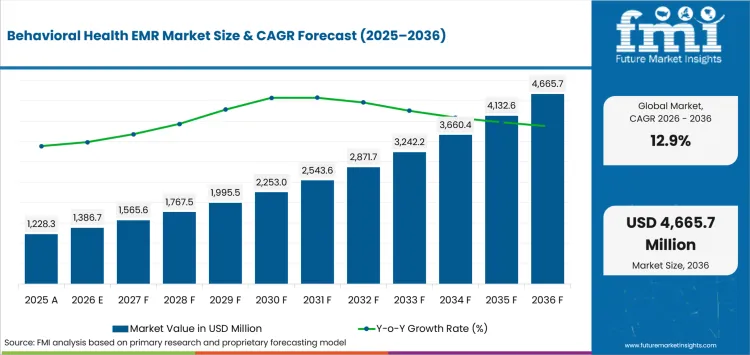
The behavioral health EMR market is projected to expand at a 12.9% CAGR from USD 1,386.7 million in 2026 to USD 4,665.7 million by 2036. Behavioral health providers use electronic medical records to connect therapy notes with treatment plans and medication histories across one governed record. Integrated billing and referral functions reduce manual handoffs that delay claims and obscure responsibility for incomplete follow-up. SAMHSA reported in July 2025 that 61.5 million American adults experienced mental illness during 2024 and 32.0 million received treatment. The treated population illustrates the volume of medication and therapy histories that behavioral providers must manage across service settings. Provider organizations across behavioral health services also need privacy controls that protect substance use information without separating it from the authorized clinical history. Technology spending therefore favors systems that shorten documentation work and preserve continuity across repeated care episodes and payment requirements.
National purchasing routes differ across payment systems and health-information rules that govern behavioral records in each country. United States organizations evaluate electronic health record systems against reimbursement workflows and state program requirements across mixed payer networks. Germany and the United Kingdom emphasize national data exchange and public reporting that raise integration expectations during platform selection. Japan and South Korea connect platform eligibility with certified system standards and structured record-sharing programs across established provider networks. Large deployments therefore treat healthcare interoperability solutions as a core purchasing requirement rather than an optional technical feature. Local service partners must configure privacy controls and migrate older records without interrupting active patient care. Implementation plans also need training and maintenance routes that protect daily operations during data conversion and system launch.
| Metric | Value |
|---|---|
| 2025 Market Size | USD 1,228.3 million |
| 2026 Market Size | USD 1,386.7 million |
| 2036 Market Size | USD 4,665.7 million |
| Forecast CAGR (2026-2036) | 12.9% |
| Product Type Focus | Cloud-Based EMR (54.8% share in 2026) |
| Functionality Focus | Clinical Documentation (39.6% share in 2026) |
| End User Focus | Hospitals (38.4% share in 2026) |
Summary of the Behavioral Health EMR Market
| Market Signal | Commercial Impact |
|---|---|
| Demand and Growth Drivers | Behavioral health records create value as clinical documentation and payment workflows remain connected across every care episode.
|
| Product and Segment View | The segment structure separates deployment choices from clinical functions and the provider settings that purchase each platform.
|
| Geography and Growth Outlook | Country adoption reflects national exchange rules and provider financing together with local implementation capacity across distinct healthcare systems.
|
| Competitive Landscape | Competition separates enterprise health-system platforms from purpose-built behavioral products and ambulatory practice suites across distinct provider groups.
|
| Analyst Perspective | The commercial test is whether each platform reduces administrative effort without weakening privacy controls or behavioral documentation quality.
|
Source: FMI's proprietary forecasting model and primary research
How is the behavioral health EMR market segmented?
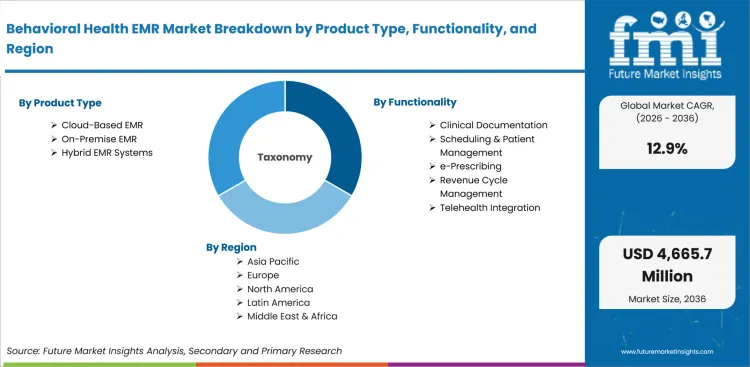
The behavioral health EMR market is segmented by product type, functionality, end user, application, and region.
The segmentation framework separates software deployment from the clinical work supported throughout behavioral care delivery. Product type distinguishes cloud-based systems from on-premise and hybrid architectures with different infrastructure responsibilities for provider organizations. Functionality covers documentation and scheduling together with prescribing and revenue operations across each patient encounter. End user categories distinguish hospitals from specialty providers through care scale and different reporting or service obligations. Application analysis follows mental health and substance use services alongside counseling and crisis intervention workflows. Regional analysis compares national exchange standards and payment routes together with local service capacity across distinct healthcare systems.
What supports demand for Cloud-Based EMR within the Product Type category?
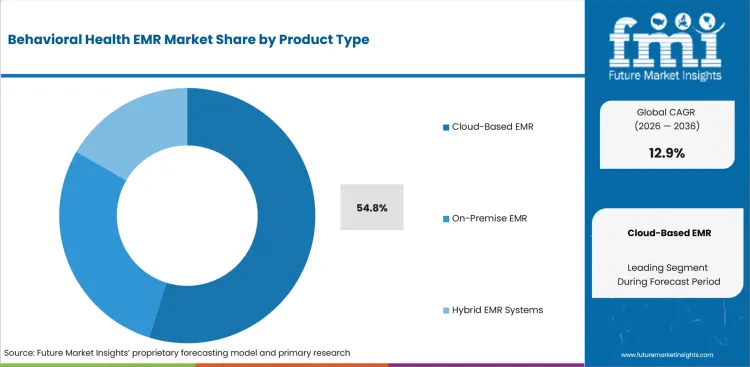
Behavioral health organizations need dependable remote access across clinics and community programs without maintaining separate local infrastructure. AdvancedMD announced in October 2025 that AdvancedMD Now combines cloud practice management and EHR functions with patient engagement for mental health practices with up to three providers. The operating model reflects broader healthcare cloud infrastructure choices that centralize updates and security responsibilities across several care locations. Implementation decisions also depend on migration support and internet resilience during time-sensitive clinical encounters and crisis response.
- By product type, cloud-based EMR is projected to account for 54.8% share in 2026, attributable to centralized updates and lower local infrastructure responsibility. The model also supports standardized configuration across expanding provider networks without separate software releases at every site during routine maintenance.
- Community mental health centers select cloud-based EMR to support mobile teams and shared scheduling across distributed outpatient locations. Adoption depends on reliable identity controls and offline contingency procedures that preserve access throughout connectivity disruptions. Support teams must also define recovery responsibilities for every affected clinical site during urgent care disruptions.
How does Clinical Documentation shape demand within the Functionality category?
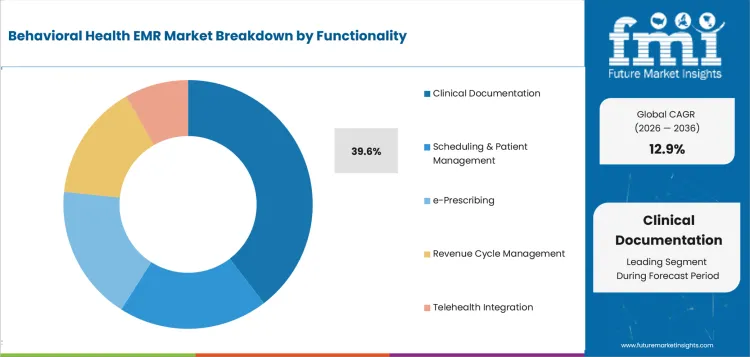
Behavioral clinicians need structured notes that capture treatment goals and risk assessments without losing important details from therapeutic conversations. Purpose-built templates reduce repeated entry across individual sessions and group encounters and preserve the clinical detail required for review. Investment in clinical documentation automation matters commercially if generated content remains reviewable and connected with clear coding responsibilities. Clinical governance must identify every field that requires professional confirmation within the permanent patient record.
- Clinical documentation is estimated to hold 39.6% share within functionality in 2026, owing to its direct effect on clinician capacity and billing readiness. Structured notes also give clinical supervisors a consistent record for treatment reviews without removing the narrative detail required for behavioral care.
- Outpatient behavioral teams prioritize documentation functions that reduce delayed chart closure without weakening specialty detail. athenahealth reported in February 2026 that 93% of PrimeCare behavioral health providers used a focused workflow by June 2025. The practice also reported a 10% to 15% average increase in same-day encounter closure across its behavioral team. Managers can track both measures during rollout and address uneven adoption prior to expanding the workflow.
What makes Hospitals central to the End User category?
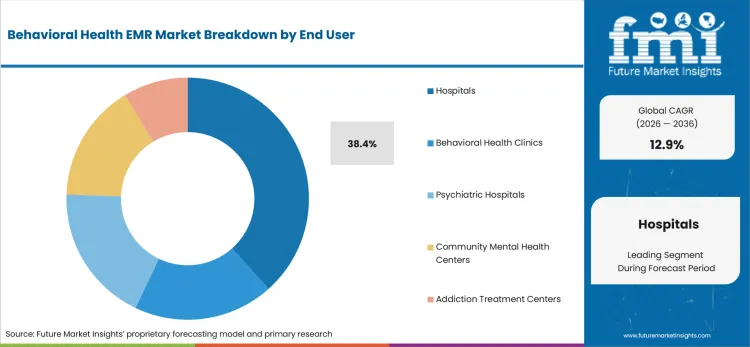
Hospitals coordinate behavioral treatment with emergency and medical services that share medication and patient-safety responsibilities. Integrated hospitals need one clinical record that carries specialty notes into discharge planning and enterprise reporting without fragmenting patient history. Oracle announced in November 2025 that CAMH selected its Clinical AI Agent for a mental health pilot within the hospital’s existing EHR. The pilot reflects broader digital healthcare transformation programs that require physician review and dependable integration governance. Complex interfaces and extensive training can extend deployment schedules beyond those required for smaller outpatient implementations.
- Hospitals are forecast to represent 38.4% share within end user in 2026, driven by the need for connected behavioral and medical information. Integrated records support medication review and discharge planning across departments that share responsibility for complex patients. Hospital selection therefore depends on proven interoperability and dependable support across every department connected to the behavioral record.
- Health-system clinical teams adopt behavioral EMR functions to coordinate crisis care and discharge planning across specialized departments. Selection depends on proven interface stability and role-based privacy controls that protect sensitive information throughout integrated treatment. Hospital technology teams also need dependable support during continuous operations and time-sensitive patient safety events.
Why do Mental Health Disorders lead the Application category?
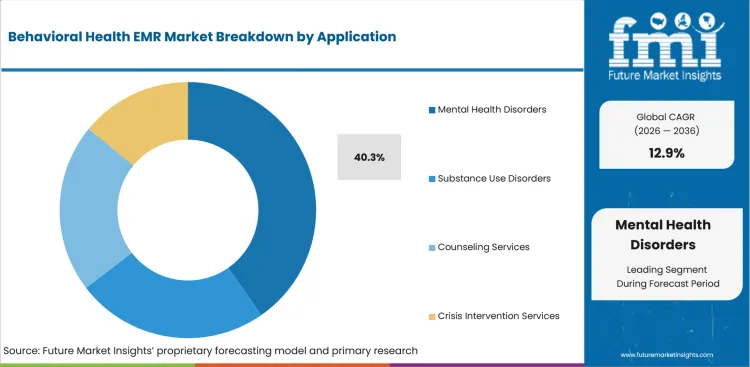
Mental health treatment produces longitudinal records that connect symptoms and care plans across recurring visits and changing service settings. Effective software must support repeated assessments and medication reviews without hiding the clinical history that guides later treatment decisions. Provider organizations also need consistent outcome fields that clinicians can use across different service locations. Implementation value depends on accessible histories and clear measurement responsibilities across every authorized care team.
- Mental health disorders are expected to capture 40.3% share within application in 2026, supported by recurring medication and therapy records. The National Center for Health Statistics reported in June 2026 that 19.3% of US adults took mental health medication during 2024. Another 14.0% received professional counseling or therapy, creating distinct histories that systems must connect across treatment.
- Mental health programs use population health platforms to identify missed follow-up and track outcomes across defined patient groups. Adoption requires consistent screening fields and referral status data that clinicians can interpret without additional manual reconciliation. Program leaders also need clear ownership for correcting incomplete outcome records across distributed behavioral care locations.
What are the drivers, restraints, and opportunities in the behavioral health EMR market?
Connected clinical and payment records reduce repeated administrative work across recurring behavioral treatment episodes in daily operations. Privacy controls and migration complexity can delay implementation across provider workflows that handle sensitive patient information. Interoperable measurement and telehealth functions create a practical service route across distributed behavioral care networks.
- Driver: Integrated clinical and payment records reduce duplicated administrative work across recurring behavioral treatment encounters and payment cycles.
- Restraint: Privacy controls and migration complexity can disrupt established care workflows without specialized implementation and recovery support.
- Opportunity: Interoperable measurement and telehealth functions can extend coordinated behavioral services across distributed provider networks.
Integrated payment pathways support demand by connecting behavioral documentation with compliant claims across recurring treatment encounters. CMS finalized three optional Advanced Primary Care Management add-on codes in October 2025 for behavioral health integration and psychiatric collaborative care services. Compatible EMR workflows can place care coordination beside encounter documentation and payment rules across qualified organizations. Provider groups can then evaluate software through claim readiness and team communication rather than isolated note creation.
Privacy complexity restricts adoption across behavioral records that require controlled access through connected clinical and administrative workflows. Specialty organizations must map consent rules and role permissions across every affected process prior to migrating historical records. HHS states that the Security Rule requires administrative safeguards with physical and technical protections for electronic protected health information. Implementation approvals often slow if project teams cannot demonstrate reliable access controls and recovery procedures during routine operations.
Behavioral platforms can expand their role by combining outcome measurement with remote care across connected service settings. Provider organizations need screening and medication records that remain available during telehealth visits and follow-up referrals. Shared information also requires consent rules that remain effective across partner organizations and remote service settings. HHS stated in January 2026 that Part 2 compliance became mandatory on February 16, 2026. The rule also allows one consent to cover future disclosures for treatment and payment together with healthcare operations. Configurable permissions and telehealth service functions can support cross-organization services without creating separate patient histories.
Which country CAGRs are profiled in the behavioral health EMR market?
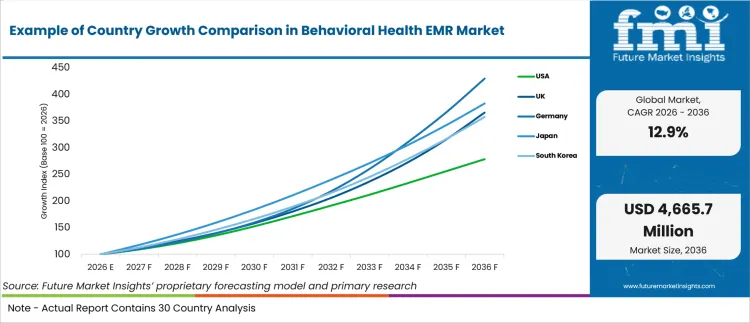
| Country | CAGR |
|---|---|
| USA | 10.8% |
| UK | 13.9% |
| Germany | 15.7% |
| Japan | 14.4% |
| South Korea | 13.6% |
How do country-level CAGRs compare in the behavioral health EMR market?
The country comparison spans 4.9 percentage points from 10.8% to 15.7% CAGR and forms three commercially distinct adoption bands. Germany and Japan occupy the upper band as national health-record programs create structured integration requirements. The United Kingdom and South Korea form a middle cluster with mature public data standards but different purchasing routes. The USA sits outside this cluster within a mature provider environment that already supports widespread software use.
- Germany remains 1.3 percentage points above Japan and 1.8 points above the United Kingdom within the selected comparison. The separation increases the importance of national exchange readiness and implementation partnerships for companies entering German provider networks.
- Japan remains close to Germany but follows a more standardized information-sharing route across established medical institutions. Successful entry depends on system compatibility and local technical documentation rather than forecast pace alone.
- The United Kingdom and South Korea differ by 0.3 percentage points within the middle cluster. British provider selections respond to public reporting requirements across the country’s publicly funded service networks. Korean product readiness depends more directly on formal certification changes and implementation planning for local deployments.
- The USA stands 2.8 percentage points below South Korea within this selected comparison and forms a separate adoption band. Its lower rate accompanies mature software use and fragmented payer requirements across numerous provider types.
Similar CAGRs can conceal substantial differences in purchasing authority and implementation support across healthcare systems. Companies must evaluate reimbursement and service capacity together with data standards during planning for each national entry route. The full report provides country-level CAGR analysis across North America, Latin America, Europe, East Asia, South Asia, Oceania and the Middle East and Africa.
Country-wise Analysis
- United States behavioral health providers operate across public and commercial payment routes that require adaptable billing and consent controls. The USA behavioral health EMR market is projected to grow at 10.8% CAGR over the assessment period, reflecting a mature provider software environment. An official CMS FAQ updated in March 2026 states that approved IBH practices serving Medicare and dually eligible beneficiaries can receive up to USD 200,000 for infrastructure. Permitted uses include EHR development and interoperable systems that support referrals or documentation across participating practices. The model currently operates across Michigan and New York alongside participating organizations in South Carolina. State requirements and payer rules remain a material friction that raises configuration costs for national deployments.
- The United Kingdom contains separate public health systems that use national standards and local purchasing routes for behavioral records. Demand for behavioral health EMR in the UK is forecast to rise at 13.9% CAGR over the forecast period, supported by expanding reporting and coordination requirements. NHS England reported in May 2025 that Mental Health Services Dataset submitters increased from 284 in March 2023 to 401 in March 2025. The broader reporting base increases the number of English provider organizations that need dependable submission workflows. Public budgets and lengthy purchasing cycles remain material frictions for providers that need migration and training support.
- Germany is expanding national patient-record infrastructure through structured testing across medical practices alongside pharmacies and hospitals. The German behavioral health EMR sector is projected to record 15.7% CAGR across the ten-year forecast window, driven by national exchange requirements that create formal implementation routes. The Federal Ministry of Health stated in January 2025 that about 300 sites joined regional electronic patient record testing. The participating sites included medical and dental practices together with pharmacies and hospitals across pilot regions. The program gives compatible systems a defined integration route across hospitals and outpatient services that exchange patient information. Certification work and local interface requirements remain material frictions that require German technical partners and documented service coverage.
- Japanese medical institutions operate within a national information-sharing program that defines technical exchange routes for participating systems. Adoption of behavioral health EMR in Japan is estimated to expand at 14.4% CAGR from 2026 through 2036, enabled by compatibility requirements that guide implementation. The Ministry of Health published technical guide version 2.1.0 on June 30, 2026. The same official page records publication of a list of compatible system providers on February 26, 2025. The official materials give software developers a defined integration route across participating medical institutions nationwide. Language localization and national specifications remain material frictions for foreign platforms without local technical support.
- South Korea uses a national EMR certification framework that directly shapes system eligibility and provider evaluation. South Korea’s behavioral health EMR outlook is anticipated to advance at 13.6% CAGR by 2036, underpinned by formal certification that guides technology selection. Korea Health Information Service published revised second-cycle certification standards for national EMR systems on July 9, 2026. The standards took effect on June 30 and removed the distinction between product and use certification. The unified framework gives healthcare institutions one certification route for evaluating EMR systems across participating care settings. Frequent revisions and Korean-language documentation remain material frictions for software companies without continuous local regulatory support.
Who are the notable companies in the behavioral health EMR market?
Oracle Health (Cerner Corporation), Epic Systems Corporation, Netsmart, Qualifacts, Valant, athenahealth, NextGen Healthcare, and AdvancedMD are notable companies shaping this market.
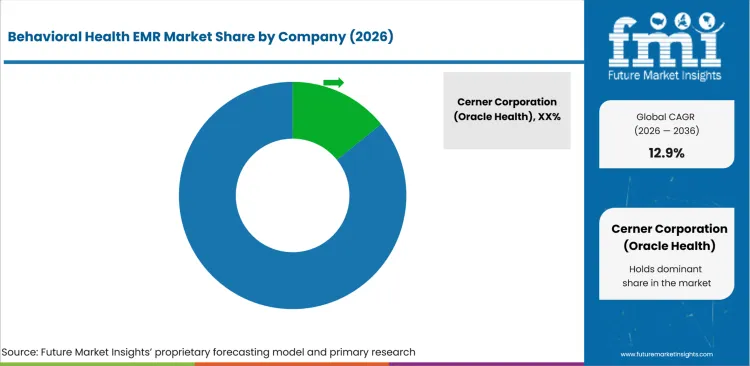
The competitive field combines enterprise health-system platforms with specialized behavioral products and outpatient practice platforms. Netsmart announced in July 2026 that the California Department of State Hospitals selected CareFabric and myAvatar across five inpatient state hospitals. The deployment places Netsmart inside a complex behavioral setting with detailed clinical and operating requirements. Qualifacts and Valant serve behavioral organizations that need configurable documentation with integrated practice administration across several program types. athenahealth and AdvancedMD connect specialty records with billing and patient engagement platforms across outpatient practices. Health systems compare implementation ownership and interoperability across the care settings included in each deployment.
- Oracle Health and Epic support integrated health systems that require behavioral documentation across inpatient and outpatient networks. Their records connect specialty treatment with medication history and discharge planning across departments that share patient responsibility.
- Netsmart and Qualifacts provide specialized platforms for behavioral organizations that manage complex programs and regulatory reporting. Community providers assess configurable care models together with implementation support across mental health and substance use services.
- Valant and athenahealth address outpatient practices through specialty notes and administrative functions within unified software environments. NextGen Healthcare and AdvancedMD add broader ambulatory capabilities for community organizations that combine behavioral and medical services.
Competitive Benchmarking: Behavioral Health EMR Market
| Company | Behavioral Workflow Depth | Care Coordination | Practice Operations | Geographic Reach |
|---|---|---|---|---|
| Oracle Health (Cerner Corporation) | High | High | Medium | Global |
| Epic Systems Corporation | High | High | High | Global |
| Netsmart | High | High | High | United States |
| Qualifacts | High | High | High | United States |
| Valant | High | Medium | High | United States |
| athenahealth | Medium | High | High | United States |
| NextGen Healthcare | High | High | High | United States |
| AdvancedMD | Medium | Medium | High | United States |
Scoring basis: Behavioral Workflow Depth is High for purpose-built documentation that supports several behavioral settings and program types. Medium represents direct specialty support across fewer behavioral settings or program types than the High threshold. Low represents a documented limitation that confines the offering to a small behavioral workflow subset. Care Coordination is High for shared records that support exchange across clinical organizations and referral partners. Medium represents direct coordination through narrower integration routes that support fewer external clinical organizations or partners. Low applies to documented internal coordination without supported exchange beyond the provider organization or local network. Practice Operations is High for integrated scheduling and billing with reporting across complex behavioral programs. Medium covers direct scheduling or billing support with narrower reporting or behavioral program coverage across provider organizations. Low applies to a verified limitation that confines the product to one administrative function alone. Companies without complete official evidence are excluded from the table rather than assigned a Low rating.
Key Developments in the Behavioral Health EMR Market
- In May 2025, Qualifacts announced a strategic partnership with Greenspace Health to embed measurement-based care inside Credible and CareLogic. The integration gives behavioral providers structured patient-reported outcomes alongside existing clinical workflows and creates a clearer route for monitoring progress between scheduled encounters. Program leaders can evaluate symptom changes without maintaining a separate measurement platform or disconnected patient record.
- In February 2025, Netsmart: Alaska Behavioral Health selected the CareFabric platform and myAvatar EHR across eleven facilities statewide. The organization also planned to adopt Bells Virtual Scribe for clinical documentation within the record. The deployment connects clinical and administrative operations across a distributed behavioral provider and gives local teams one platform for integrated care coordination.
- In April 2026, AdvancedMD introduced an electronic medication administration record inside its unified EHR platform for behavioral health and substance use providers. The integrated medication workflow reduces separate system handoffs and gives care teams a documented administration history within the clinical record. Behavioral organizations can compare medication accuracy and staff effort without reconciling records across separate applications.
- In May 2026, NextGen Healthcare: Chestnut Health Systems selected NextGen Enterprise EHR and practice management for integrated primary and behavioral care across Illinois and Missouri. NextGen stated that the unified implementation is expected during 2027 across Chestnut locations and service programs. The planned deployment is intended to give Chestnut one integrated record for care continuity and reporting across locations serving multidisciplinary treatment teams.
Key Players in the Behavioral Health EMR Market
Enterprise Health System Platforms
- Oracle Health (Cerner Corporation)
- Epic Systems Corporation
Specialized Behavioral Health Platforms
- Netsmart
- Qualifacts
- NextGen Healthcare
Ambulatory Behavioral Health Platforms
- Valant
- athenahealth
- AdvancedMD
Behavioral Health EMR Market - Report Scope
| Coverage field | Report scope |
|---|---|
| Market breakdown | Product type, functionality, end user, application, and region. |
| Quantitative Units | USD Million |
| Market Definition | Electronic medical record software and related implementation or support services used directly for behavioral health documentation, coordination, scheduling, prescribing, patient engagement, and revenue workflows. |
| Regions Covered | North America, Latin America, Western Europe, Eastern Europe, East Asia, South Asia and Pacific, and Middle East and Africa. |
| Countries Covered | USA, UK, Germany, Japan, and South Korea,30+ countries |
| Key Companies Profiled | Oracle Health (Cerner Corporation), Epic Systems Corporation, Netsmart, Qualifacts, Valant, athenahealth, NextGen Healthcare, and AdvancedMD |
| Forecast Period | 2026 to 2036. |
| Approach | Hybrid bottom-up and top-down market sizing supported by primary interviews and structured official desk research. |
Behavioral Health EMR Market - Research Methodology
| Method | Approach |
|---|---|
| Primary Research | FMI analysts gathered input from manufacturers, service providers, technology developers, distributors, end users, procurement teams, and subject-matter experts. Interviews examined purchasing decisions, product or service evaluation, adoption barriers, approval requirements, pricing considerations, and expectations for technical or commercial support. Respondents were also asked what evidence is required before a trial, pilot, or initial order develops into regular purchasing. |
| Desk Research | Desk research covered government statistics, regulatory publications, trade data, industry associations, technical literature, standards, company filings, product information, and official corporate announcements. Sources were reviewed for relevance, publication date, geographic coverage, and consistency with the defined market scope. Claims relating to performance, applications, approvals, capacity, investment, and commercial activity were retained only when supported by credible public evidence. |
| Market Sizing and Forecasting | The market model combined the baseline value with historical performance, segment structure, pricing and volume indicators, adoption levels, company participation, and country-level demand conditions. Forecast assumptions considered economic activity, investment trends, regulatory developments, technology adoption, purchasing cycles, supply availability, and barriers to wider market use. Segment and regional estimates were reconciled before the final market total was calculated. |
| Data Validation | Estimates were checked against multiple independent indicators, including public data, company activity, trade patterns, industry developments, and findings from primary interviews. Validation also tested whether products, services, applications, and company revenues fell within the defined market boundaries. Adjacent categories, unsupported claims, overlapping revenues, and activities without direct market relevance were excluded to reduce double counting and maintain consistency across segments and countries. |
Behavioral Health EMR Market by Segments
Behavioral Health EMR Market segmented by Product Type:
- Cloud-Based EMR
- On-Premise EMR
- Hybrid EMR Systems
Behavioral Health EMR Market segmented by Functionality:
- Clinical Documentation
- Scheduling & Patient Management
- e-Prescribing
- Revenue Cycle Management
- Telehealth Integration
Behavioral Health EMR Market segmented by End User:
- Hospitals
- Behavioral Health Clinics
- Psychiatric Hospitals
- Community Mental Health Centers
- Addiction Treatment Centers
Behavioral Health EMR Market segmented by Application:
- Mental Health Disorders
- Substance Use Disorders
- Counseling Services
- Crisis Intervention Services
Behavioral Health EMR Market by Region:
- North America
- United States
- Canada
- Latin America
- Brazil
- Mexico
- Argentina
- Chile
- Western Europe
- Germany
- France
- United Kingdom
- Italy
- Spain
- Benelux
- Nordics
- Eastern Europe
- Poland
- Czech Republic
- Romania
- Hungary
- East Asia
- China
- Japan
- South Korea
- South Asia and Pacific
- India
- ASEAN
- Australia and New Zealand
- Middle East and Africa
- GCC Countries
- South Africa
- Türkiye
- Israel
Research Sources and Bibliography
- Substance Abuse and Mental Health Services Administration. (2025, July 28). SAMHSA Releases Annual National Survey on Drug Use and Health.
- Briones, E. M., & Villarroel, M. A. (2026, June 25). Mental Health Treatment Among Adults: United States, 2024. National Center for Health Statistics.
- AdvancedMD. (2025, October 22). AdvancedMD Now Gives Small Mental Health Practices an Affordable, Cloud-based Practice Management, EHR, and Patient Engagement Platform.
- Centers for Medicare & Medicaid Services. (2025, October 31). Calendar Year (CY) 2026 Medicare Physician Fee Schedule Final Rule (CMS-1832-F).
- USA Department of Health and Human Services. (n.d.). The Security Rule. Retrieved July 20, 2026.
- USA Department of Health and Human Services. (2026, January 30). Fact Sheet 42 CFR Part 2 Final Rule.
- Centers for Medicare & Medicaid Services. (2026, March 24). Innovation in Behavioral Health (IBH) Model Frequently Asked Questions.
- athenahealth. (2026, February 26). How PrimeCare Community Health increased same-day documentation by 10%.
- NHS England. (2025, May 15). Monthly operational statistics - May 2025.
- Bundesministerium für Gesundheit. (2025, January 15). ePA für alle in Modellregionen gestartet.
- Ministry of Health, Labour and Welfare. (2026, June 30).[Electronic medical record information sharing service].
- Korea Health Information Service. (2026, July 9).[Notice of revised second-cycle EMR system certification standards].
- Qualifacts. (2025, May 19). Qualifacts and Greenspace Health Announce Strategic Partnership to Advance Measurement-Based Care in Behavioral Health.
- Netsmart. (2025, February 27). Alaska Behavioral Health Selects Netsmart to Enhance Integrated Behavioral Healthcare.
- Netsmart. (2026, July 9). The California Department of State Hospitals Selects Netsmart as Its Modernized, Data-Driven Technology Platform.
- Oracle. (2025, November 12). Centre for Addiction and Mental Health is First Hospital in Canada to Select Oracle Health Clinical AI Agent to Streamline Documentation.
- AdvancedMD. (2026, April 8). AdvancedMD Rolls Out eMAR Solution Designed to Simplify Medication Workflows.
- NextGen Healthcare. (2026, May 27). NextGen Healthcare Chosen by Chestnut Health Systems to Supercharge Whole-Person Care Delivery Across Illinois and Missouri.
This bibliography is provided for reader reference and is not exhaustive. The full report contains the complete reference list and detailed citations.
This Report Answers
- How large is the behavioral health EMR market in 2026 and 2036?
- Which clinical and payment pressures support behavioral health EMR adoption?
- Why does cloud-based EMR hold the largest product type share in 2026?
- How does clinical documentation influence provider capacity and billing readiness?
- Why do hospitals represent the largest end user category during 2026?
- How do country growth rates differ across USA, UK, Germany, Japan, and South Korea?
- Which companies provide enterprise or specialized behavioral health EMR platforms?
- What privacy and implementation constraints limit behavioral health EMR adoption?
- How should executives evaluate interoperability and service support during platform selection?
Frequently Asked Questions
What is driving growth in the behavioral health EMR market?
Integrated clinical and payment workflows reduce repeated administrative work across recurring behavioral treatment encounters and coordinated care activities. Providers also need coordinated records that support referrals and measurable outcomes across different care settings.
Who are the key players in the behavioral health EMR market?
Oracle Health and Epic provide enterprise platforms for health systems that operate behavioral programs across several care settings. Netsmart and Qualifacts serve community organizations; Valant and athenahealth fit outpatient practices, and NextGen Healthcare with AdvancedMD support broader ambulatory needs.
What is a notable restraint in the behavioral health EMR market?
Privacy controls and migration complexity can delay implementations that involve sensitive behavioral or substance use information. Provider organizations need specialized configuration and recovery procedures prior to replacing established workflows that contain sensitive patient information.
Why should executives track the behavioral health EMR market?
Behavioral documentation affects clinician capacity and claim readiness across recurring care episodes within financially constrained provider organizations. Executive teams can compare technology spending with same-day encounter closure and coordinated treatment performance across defined service programs.
What business problem does the behavioral health EMR market address?
The market addresses fragmented documentation and payment processes across behavioral organizations that manage recurring patient encounters. Integrated records connect treatment plans with scheduling and prescribing, and they support reimbursement responsibilities across the same care episode.
What should healthcare teams evaluate in the behavioral health EMR market?
Healthcare teams should test specialty documentation and consent controls across representative behavioral workflows during initial evaluation. The review should also measure interface stability and implementation support during migration from older systems across active provider locations.
What limits return on investment in the behavioral health EMR market?
Low clinician adoption and prolonged configuration work can delay measurable operational benefits across outpatient and community care programs. Weak interoperability also creates manual reconciliation that reduces savings expected from unified clinical and administrative records.
What supports long-term confidence in the behavioral health EMR market?
Documented workflow improvement and reliable privacy controls support confidence during expansion across behavioral service programs. Clear service ownership gives providers a practical basis for maintaining performance as care models and reporting requirements change.
Preview the report firsthand - request a free sample
Get SampleGet the brochure for pricing and purchase details.
Get PDFTable of Content
- Key Takeaways
- Market Size and CAGR
- Top Growth Driver
- Fastest Growing Segment
- Leading Region
- Key Companies
- Emerging Opportunities
- Executive Summary
- Global Market Outlook
- Demand-side Trends
- Supply-side Trends
- Technology Roadmap Analysis
- Analysis and Recommendations
- Analyst Perspective (What is happening? Why now? What should investors know?)
- Key Questions Answered
- How large is the market?
- What is the CAGR?
- What are key trends?
- Which region dominates?
- Who are the leaders?
- Market Overview
- Market Coverage / Taxonomy
- Market Definition / Scope / Limitations
- Research Methodology
- Chapter Orientation
- Analytical Lens and Working Hypotheses
- Market Structure, Signals, and Trend Drivers
- Benchmarking and Cross-market Comparability
- Market Sizing, Forecasting, and Opportunity Mapping
- Research Design and Evidence Framework
- Desk Research Programme (Secondary Evidence)
- Expert Input and Fieldwork (Primary Evidence)
- Tooling, Models, and Reference Databases
- Data Engineering and Model Build
- Quality Assurance and Audit Trail
- Market Background
- Market Dynamics (Drivers, Restraints, Opportunity, Trends)
- Scenario Forecast (Optimistic, Likely, Conservative)
- Impact Analysis
- AI Impact
- Sustainability Impact
- Regulatory Impact
- Technology Impact
- Consumer / Buyer Analysis
- Purchase Drivers
- Adoption Barriers
- Buyer Journey
- Opportunity Map Analysis
- Product Life Cycle Analysis
- Supply Chain Analysis
- Investment Feasibility Matrix
- Value Chain Analysis
- PESTLE and Porter's Analysis
- Regulatory Landscape
- Regional Parent Market Outlook
- Production and Consumption Statistics
- Import and Export Statistics
- Global Market Analysis and Forecast, 2021 to 2036
- Historical Market Size Value (USD Million) Analysis, 2021 to 2025
- Current and Future Market Size Value (USD Million) Projections, 2026 to 2036
- Y-o-Y Growth Trend Analysis
- Absolute $ Opportunity Analysis
- Global Market Pricing Analysis, 2021 to 2036
- Global Market Analysis and Forecast, By Product Type, 2021 to 2036
- Introduction / Key Findings
- Historical Market Size Value (USD Million) Analysis By Product Type, 2021 to 2025
- Current and Future Market Size Value (USD Million) Analysis and Forecast By Product Type, 2026 to 2036
- Cloud-Based EMR
- On-Premise EMR
- Hybrid EMR Systems
- Cloud-Based EMR
- Y-o-Y Growth Trend Analysis By Product Type, 2021 to 2025
- Absolute $ Opportunity Analysis By Product Type, 2026 to 2036
- Global Market Analysis and Forecast, By Functionality, 2021 to 2036
- Introduction / Key Findings
- Historical Market Size Value (USD Million) Analysis By Functionality, 2021 to 2025
- Current and Future Market Size Value (USD Million) Analysis and Forecast By Functionality, 2026 to 2036
- Clinical Documentation
- Scheduling & Patient Management
- e-Prescribing
- Revenue Cycle Management
- Telehealth Integration
- Clinical Documentation
- Y-o-Y Growth Trend Analysis By Functionality, 2021 to 2025
- Absolute $ Opportunity Analysis By Functionality, 2026 to 2036
- Global Market Analysis and Forecast, By End User, 2021 to 2036
- Introduction / Key Findings
- Historical Market Size Value (USD Million) Analysis By End User, 2021 to 2025
- Current and Future Market Size Value (USD Million) Analysis and Forecast By End User, 2026 to 2036
- Hospitals
- Behavioral Health Clinics
- Psychiatric Hospitals
- Community Mental Health Centers
- Addiction Treatment Centers
- Hospitals
- Y-o-Y Growth Trend Analysis By End User, 2021 to 2025
- Absolute $ Opportunity Analysis By End User, 2026 to 2036
- Global Market Analysis and Forecast, By Application, 2021 to 2036
- Introduction / Key Findings
- Historical Market Size Value (USD Million) Analysis By Application, 2021 to 2025
- Current and Future Market Size Value (USD Million) Analysis and Forecast By Application, 2026 to 2036
- Mental Health Disorders
- Substance Use Disorders
- Counseling Services
- Crisis Intervention Services
- Mental Health Disorders
- Y-o-Y Growth Trend Analysis By Application, 2021 to 2025
- Absolute $ Opportunity Analysis By Application, 2026 to 2036
- Global Market Analysis and Forecast, By Region, 2021 to 2036
- Introduction
- Historical Market Size Value (USD Million) Analysis By Region, 2021 to 2025
- Current Market Size Value (USD Million) Analysis and Forecast By Region, 2026 to 2036
- North America
- Latin America
- Western Europe
- Eastern Europe
- East Asia
- South Asia and Pacific
- Middle East & Africa
- Market Attractiveness Analysis By Region
- North America Market Analysis and Forecast, By Country, 2021 to 2036
- Historical Market Size Value (USD Million) Trend Analysis By Market Taxonomy, 2021 to 2025
- Market Size Value (USD Million) Forecast By Market Taxonomy, 2026 to 2036
- By Country
- USA
- Canada
- By Product Type
- By Functionality
- By End User
- By Application
- By Country
- Market Attractiveness Analysis
- By Country
- By Product Type
- By Functionality
- By End User
- By Application
- Key Takeaways
- Latin America Market Analysis and Forecast, By Country
- Historical Market Size Value (USD Million) Trend Analysis By Market Taxonomy, 2021 to 2025
- Market Size Value (USD Million) Forecast By Market Taxonomy, 2026 to 2036
- By Country
- Brazil
- Mexico
- Chile
- Rest of Latin America
- By Product Type
- By Functionality
- By End User
- By Application
- By Country
- Market Attractiveness Analysis
- By Country
- By Product Type
- By Functionality
- By End User
- By Application
- Key Takeaways
- Western Europe Market Analysis and Forecast, By Country
- Historical Market Size Value (USD Million) Trend Analysis By Market Taxonomy, 2021 to 2025
- Market Size Value (USD Million) Forecast By Market Taxonomy, 2026 to 2036
- By Country
- Germany
- UK
- Italy
- Spain
- France
- Nordic
- BENELUX
- Rest of Western Europe
- By Product Type
- By Functionality
- By End User
- By Application
- By Country
- Market Attractiveness Analysis
- By Country
- By Product Type
- By Functionality
- By End User
- By Application
- Key Takeaways
- Eastern Europe Market Analysis and Forecast, By Country
- Historical Market Size Value (USD Million) Trend Analysis By Market Taxonomy, 2021 to 2025
- Market Size Value (USD Million) Forecast By Market Taxonomy, 2026 to 2036
- By Country
- Russia
- Poland
- Hungary
- Balkan & Baltic
- Rest of Eastern Europe
- By Product Type
- By Functionality
- By End User
- By Application
- By Country
- Market Attractiveness Analysis
- By Country
- By Product Type
- By Functionality
- By End User
- By Application
- Key Takeaways
- East Asia Market Analysis and Forecast, By Country
- Historical Market Size Value (USD Million) Trend Analysis By Market Taxonomy, 2021 to 2025
- Market Size Value (USD Million) Forecast By Market Taxonomy, 2026 to 2036
- By Country
- China
- Japan
- South Korea
- By Product Type
- By Functionality
- By End User
- By Application
- By Country
- Market Attractiveness Analysis
- By Country
- By Product Type
- By Functionality
- By End User
- By Application
- Key Takeaways
- South Asia and Pacific Market Analysis and Forecast, By Country
- Historical Market Size Value (USD Million) Trend Analysis By Market Taxonomy, 2021 to 2025
- Market Size Value (USD Million) Forecast By Market Taxonomy, 2026 to 2036
- By Country
- India
- ASEAN
- Australia & New Zealand
- Rest of South Asia and Pacific
- By Product Type
- By Functionality
- By End User
- By Application
- By Country
- Market Attractiveness Analysis
- By Country
- By Product Type
- By Functionality
- By End User
- By Application
- Key Takeaways
- Middle East & Africa Market Analysis and Forecast, By Country
- Historical Market Size Value (USD Million) Trend Analysis By Market Taxonomy, 2021 to 2025
- Market Size Value (USD Million) Forecast By Market Taxonomy, 2026 to 2036
- By Country
- Kingdom of Saudi Arabia
- Other GCC Countries
- Türkiye
- South Africa
- Other African Union
- Rest of Middle East & Africa
- By Product Type
- By Functionality
- By End User
- By Application
- By Country
- Market Attractiveness Analysis
- By Country
- By Product Type
- By Functionality
- By End User
- By Application
- Key Takeaways
- Key Countries Market Analysis
- USA
- Pricing Analysis
- Market Share Analysis, 2025
- By Product Type
- By Functionality
- By End User
- By Application
- Canada
- Pricing Analysis
- Market Share Analysis, 2025
- By Product Type
- By Functionality
- By End User
- By Application
- Mexico
- Pricing Analysis
- Market Share Analysis, 2025
- By Product Type
- By Functionality
- By End User
- By Application
- Brazil
- Pricing Analysis
- Market Share Analysis, 2025
- By Product Type
- By Functionality
- By End User
- By Application
- Chile
- Pricing Analysis
- Market Share Analysis, 2025
- By Product Type
- By Functionality
- By End User
- By Application
- Germany
- Pricing Analysis
- Market Share Analysis, 2025
- By Product Type
- By Functionality
- By End User
- By Application
- UK
- Pricing Analysis
- Market Share Analysis, 2025
- By Product Type
- By Functionality
- By End User
- By Application
- Italy
- Pricing Analysis
- Market Share Analysis, 2025
- By Product Type
- By Functionality
- By End User
- By Application
- Spain
- Pricing Analysis
- Market Share Analysis, 2025
- By Product Type
- By Functionality
- By End User
- By Application
- France
- Pricing Analysis
- Market Share Analysis, 2025
- By Product Type
- By Functionality
- By End User
- By Application
- India
- Pricing Analysis
- Market Share Analysis, 2025
- By Product Type
- By Functionality
- By End User
- By Application
- ASEAN
- Pricing Analysis
- Market Share Analysis, 2025
- By Product Type
- By Functionality
- By End User
- By Application
- Australia & New Zealand
- Pricing Analysis
- Market Share Analysis, 2025
- By Product Type
- By Functionality
- By End User
- By Application
- China
- Pricing Analysis
- Market Share Analysis, 2025
- By Product Type
- By Functionality
- By End User
- By Application
- Japan
- Pricing Analysis
- Market Share Analysis, 2025
- By Product Type
- By Functionality
- By End User
- By Application
- South Korea
- Pricing Analysis
- Market Share Analysis, 2025
- By Product Type
- By Functionality
- By End User
- By Application
- Russia
- Pricing Analysis
- Market Share Analysis, 2025
- By Product Type
- By Functionality
- By End User
- By Application
- Poland
- Pricing Analysis
- Market Share Analysis, 2025
- By Product Type
- By Functionality
- By End User
- By Application
- Hungary
- Pricing Analysis
- Market Share Analysis, 2025
- By Product Type
- By Functionality
- By End User
- By Application
- Kingdom of Saudi Arabia
- Pricing Analysis
- Market Share Analysis, 2025
- By Product Type
- By Functionality
- By End User
- By Application
- Türkiye
- Pricing Analysis
- Market Share Analysis, 2025
- By Product Type
- By Functionality
- By End User
- By Application
- South Africa
- Pricing Analysis
- Market Share Analysis, 2025
- By Product Type
- By Functionality
- By End User
- By Application
- USA
- Market Structure Analysis
- Competition Dashboard
- Competition Benchmarking
- Market Share Analysis of Top Players
- By Regional
- By Product Type
- By Functionality
- By End User
- By Application
- Emerging Startups
- Innovation Benchmarking
- Competition Analysis
- Competition Deep Dive
- Cerner Corporation (Oracle Health)
- Overview
- Product Portfolio
- Profitability by Market Segments
- Sales Footprint
- Strategy Overview
- Marketing Strategy
- Product Strategy
- Channel Strategy
- Epic Systems Corporation
- MEDITECH
- Athenahealth, Inc.
- Netsmart Technologies
- Valant Medical Solutions
- AdvancedMD, Inc.
- NextGen Healthcare
- eClinicalWorks
- Kareo, Inc.
- Cerner Corporation (Oracle Health)
- Case Studies
- Success Stories
- Recent Developments
- Competition Deep Dive
- Assumptions & Acronyms Used


