

- Market Size (2026)
- USD 1137.5 Mn
- Forecast (2036)
- USD 2668.2 Mn
- CAGR (2026 to 2036)
- 8.9%
How big is Behavioral Health Continuum Solutions Market in 2026?
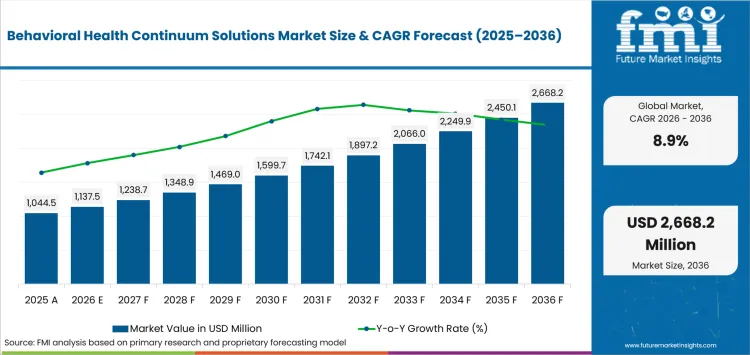
USD 1,137.5 million in 2026 and USD 2,668.2 million by 2036 at an 8.9% CAGR.
Demand for behavioral health continuum solutions is forecast to expand at 8.9% CAGR between 2026 and 2036. Valuation is forecast to increase from USD 1,137.5 million in 2026 to USD 2,668.2 million by 2036. Care organizations purchase these systems to connect screening with treatment planning and maintain accountability across changing care settings. Connected workflows also link referrals with documentation and outcome review across one accountable operating structure. The broader behavioral health services environment creates demand for tools that reduce lost referrals and repeated assessments across separate care settings. SAMHSA reported in July 2025 that 61.5 million United States adults experienced any mental illness during 2024, while 52.1% of that population received treatment. Integrated electronic health records create value by giving clinicians a usable history instead of another disconnected application. Commercial approval depends on measurable staff savings and reliable reimbursement workflows across participating provider organizations. Secure data exchange also requires clear responsibility for unresolved cases throughout the continuing treatment pathway.
National purchasing routes differ sharply because public funding and insurance design shape each deployment decision. Clinical staffing and digital governance create additional implementation requirements across national provider networks and contracted services. United States health systems often combine payer contracts with telehealth therapy services across distributed provider networks. English services rely more heavily on national commissioning standards and shared performance reporting across public providers. NHS England updated its mental health dashboard in February 2026 to monitor treatment delivery and investment through quarterly measures. Germany requires stronger product classification and reimbursement evidence for regulated digital applications, while Japan emphasizes controlled online practice within provider workflows. Effective patient health management therefore depends on local payment rules and dependable implementation support rather than one universal software configuration. Country entry plans become credible once vendors identify the contracting authority and verified integration route. Each plan must also name the training owner and continuing service capacity for every care network.
Key Takeaways of Behavioral Health Continuum Solutions Market
- Demand for behavioral health continuum solutions is driven by organizations needing connected workflows that preserve clinical responsibility across referrals and changes in care setting.
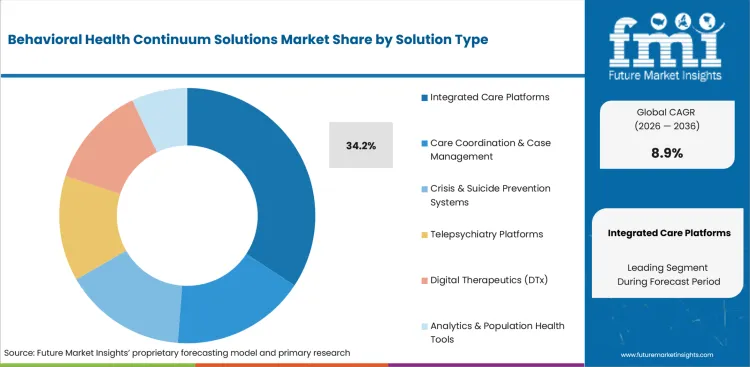
- By solution type, integrated care platforms are expected to lead with 34.2% share in 2026, owing to their role across multiple care transitions.
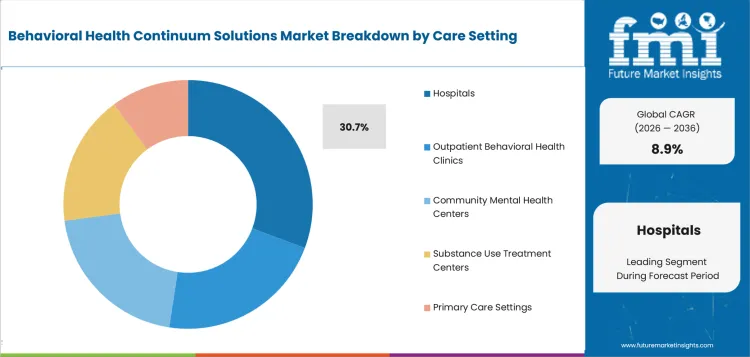
- Hospitals are the dominant care setting segment, projected to hold 30.7% share in 2026, as acute and outpatient teams require shared clinical context.
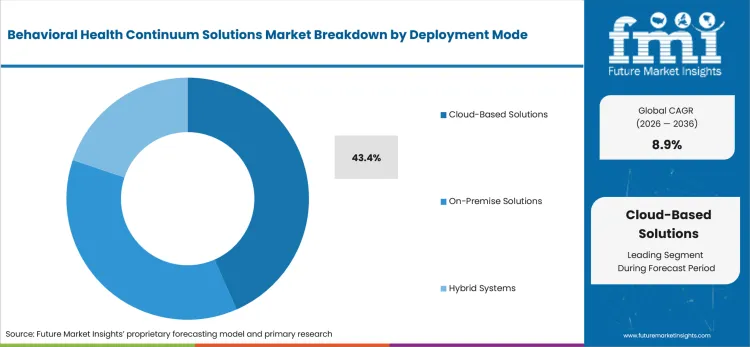
- Cloud-based solutions are estimated to lead the deployment category with 43.4% share in 2026, supported by scalable access and centrally managed software updates.
- Public health systems are anticipated to capture 34.3% share in 2026, as funded programs require broad access and consistent reporting.
- South Korea, Germany, and Japan are expected to lead growth at 10.8%, 8.7%, and 8.0% CAGR respectively through 2036, while the United States and United Kingdom growth depends on network integration despite different payment and procurement structures.
- Competition centers on Oracle Health, Epic Systems, Netsmart, Quartet Health, Headway, Valera Health, Brightside Health, and Lyra Health, with vendors differentiating through enterprise clinical records, specialized behavioral workflows, navigation networks, and employer-sponsored virtual care.
Analyst Perspective
"The behavioral health care software & services market is shifting toward platforms that improve care continuity while reducing administrative burden. Adoption will favor solutions that streamline documentation, support secure interoperability, and deliver measurable workflow improvements. Sustained value will depend on clinical integration, regulatory compliance, and reliable implementation across healthcare networks."
- Anurag Sharma,, Principal Analyst at Future Market Insights
Source: FMI's proprietary forecasting model and primary research
How is the Behavioral Health Continuum Solutions Market segmented?
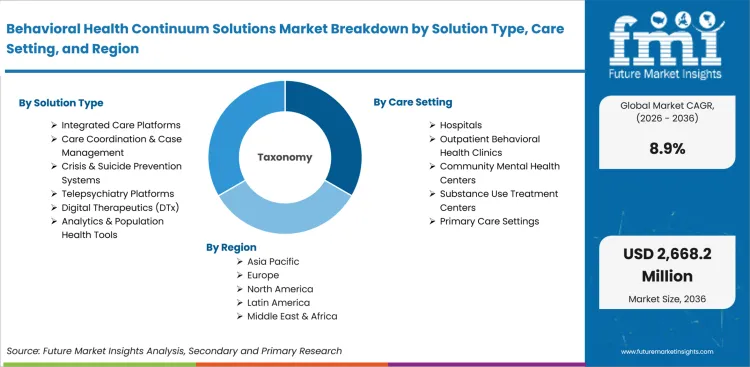
The behavioral health continuum solutions industry is segmented by solution type, care setting, deployment mode, end user, and region.
The segmentation framework separates the solution function from the setting and organization that uses each system. Solution type covers integrated care platforms and care coordination tools alongside crisis systems and telepsychiatry. The framework also includes digital therapeutics and population analytics for structured intervention and continuing performance review. Care setting distinguishes hospitals from outpatient clinics and community centers across continuing behavioral health services. The framework also separates substance use facilities from primary care environments with materially different clinical responsibilities. Deployment mode separates cloud-based and on-premise operating structures with materially different integration and maintenance requirements. Hybrid systems combine both approaches through a shared governance and continuing technical support service model. End-user analysis compares public systems with private providers across behavioral health service delivery and funding. The framework also evaluates payers and government agencies that control funding or continuing program oversight. Regional analysis reflects local reimbursement rules and workforce capacity across established national behavioral care pathways. Digital infrastructure and clinical governance create additional implementation conditions across each country and provider network.
What supports demand for Integrated Care Platforms within the Solution Type category?
Behavioral care often crosses primary care and specialist treatment without one consistent clinical record for clinicians. Crisis support and community services create additional patient handoffs that require accountable coordination across organizations. Integrated platforms create a shared workflow for referrals and treatment plans across those complex service transitions. The same record can preserve consent status and outcome review throughout continuing behavioral health care. CMS began the Innovation in Behavioral Health Model during 2025 across Michigan and New York alongside South Carolina. The model established explicit care coordination and health information technology requirements for participating state programs. Comparable healthcare analytics capabilities help program leaders identify missed handoffs and uneven service results before contract renewal decisions.
- Integrated care platforms hold 34.2% share in 2026, reflecting their position across clinical and administrative handoffs. The platform category receives spending from several departments because one coordinated record can support treatment planning and referral accountability.
- Health systems adopt integrated platforms to reduce repeated assessment and clarify responsibility during transfers between physical and behavioral care. Deployment succeeds when clinicians can access useful information without navigating a separate application during each patient interaction.
How do Hospitals shape demand within the Care Setting category?
Hospitals manage acute behavioral episodes beside medical conditions that require medication review and rapid discharge planning. NHS England published Mental Health Services Monthly Statistics for May 2026 to support timely operational decisions across secondary mental health services. Hospital platforms must connect emergency assessment with inpatient documentation without losing essential clinical context during treatment. The same workflow should support outpatient follow-up and community referrals throughout coordinated hospital discharge planning. Effective next-generation telehealth also extends specialist review across facilities that cannot maintain every discipline on site.
- Hospitals represent 30.7% share in 2026, owing to their responsibility for complex and high-consequence care transitions. A hospital deployment can support multiple departments when behavioral information remains available during emergency and medical treatment decisions.
- Hospital teams favor systems that reduce duplicate documentation and provide clear discharge tasks across inpatient and ambulatory services. Adoption slows when interface work or staff training requires prolonged disruption across already constrained clinical units.
How are Cloud-Based Solutions positioned within the Deployment Mode category?
Distributed behavioral health networks need consistent software access across clinics and remote service locations without maintaining separate local releases. Cloud-based telehealth platforms can centralize updates and performance monitoring across organizations with uneven technical staffing. Commercial value depends on interface reliability and data controls rather than hosting location alone for health systems. Health systems therefore compare implementation support and downtime responsibility alongside subscription pricing during platform selection.
- Cloud-based solutions account for 43.4% share in 2026, linked to scalable access and centrally managed releases. The model lowers local infrastructure demands while preserving the need for secure identity management and dependable integration services.
- Community clinics use cloud deployment to extend shared workflows without building a large internal technology department. SAMHSA guidance for 2025 CCBHC quality measures reinforces the need for consistent calendar-year reporting across participating behavioral health clinics.
What makes Public Health Systems central to the End User category?
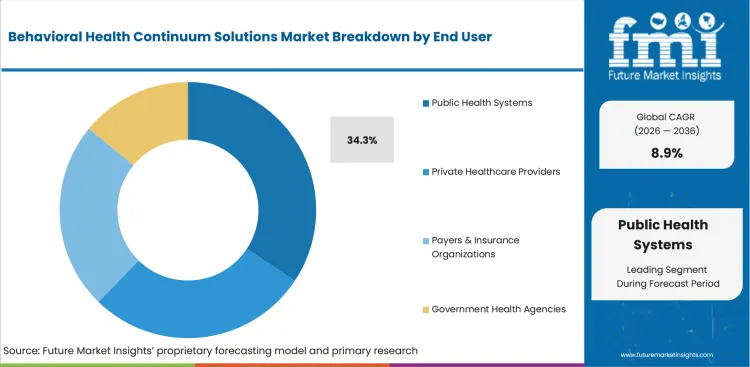
Public health systems must coordinate access across populations that use crisis services and community clinics. Hospitals and social support programs create additional patient handoffs across publicly funded behavioral care pathways. Their technology decisions often require common quality measures and broad provider participation across contracted service networks. Connected digital health tracking can support follow-up tasks when each program retains a defined clinical owner. Public purchasers require procurement terms that protect service continuity and permit reporting across funded care pathways.
- Public health systems capture 34.3% share in 2026, driven by their responsibility for broad access and program accountability. Shared platforms support funded networks when reporting standards and referral rules remain consistent across participating organizations.
- Government agencies adopt continuum solutions to connect crisis response with outpatient and community treatment across funded programs. SAMHSA offered USD 117.2 million during June 2026 to sustain and improve existing Certified Community Behavioral Health Clinics.
What are the drivers, restraints, and opportunities in the Behavioral Health Continuum Solutions Market?
Workforce pressure supports coordinated behavioral workflows, while privacy rules and implementation burden determine whether adoption produces measurable service improvement.
- Driver: Provider shortages increase the value of systems that reduce duplicate work and preserve clinical responsibility across referrals.
- Restraint: Complex confidentiality requirements can delay data integration across substance use treatment and broader care networks.
- Opportunity: Covered integrated-care pathways can connect primary care referrals with behavioral treatment and outcome review.
Workforce constraints support market growth because clinicians cannot absorb unlimited documentation and coordination tasks across fragmented systems. HRSA maintained current mental health professional shortage area designations through July 2026 for geographic areas and population groups. Qualifying facilities also appear within the national designation system used by numerous federal support programs. Continuum platforms can protect scarce clinical time by automating routine routing and presenting relevant history during each handoff. Investment remains defensible when organizations measure completed referrals and staff time rather than counting software logins as care improvement.
Confidentiality obligations limit adoption when organizations cannot distinguish permitted data exchange from restricted disclosure across complex treatment relationships. HHS required compliance with the updated 42 CFR Part 2 rule by February 16, 2026 for covered substance use disorder records. Technology teams must configure consent and redisclosure controls without creating a separate workflow that clinicians cannot operate reliably. Projects lose momentum when legal review and interface design remain disconnected from normal care delivery.
Integrated referral pathways create opportunity for digital therapeutics and clinical services that remain visible inside covered care plans. Primary care organizations need a dependable route from screening to an available behavioral provider and documented follow-up. Headway announced a nationwide insured integrated-care solution in May 2025 that connects primary care referrals with mental health treatment. Commercial value increases when reimbursement verification and referral status are managed together instead of leaving patients to navigate separate systems.
Which country CAGRs are profiled in the Behavioral Health Continuum Solutions Market?
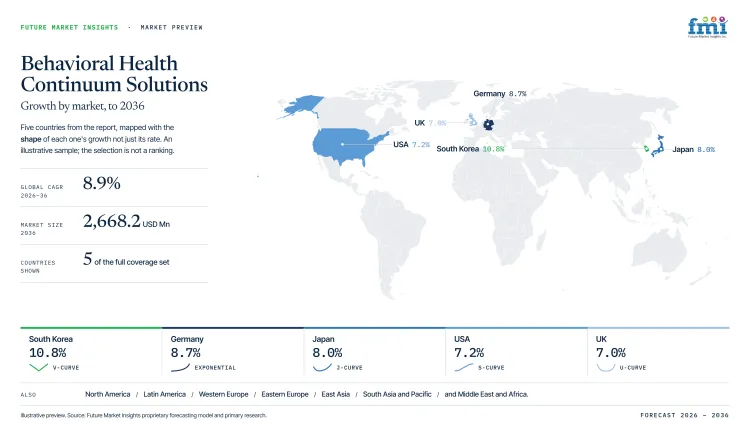
| Country | CAGR |
|---|---|
| USA | 7.2% |
| UK | 7.0% |
| Germany | 8.7% |
| Japan | 8.0% |
| South Korea | 10.8% |
How do country-level CAGRs compare in the behavioral health continuum solutions market?
The country comparison shows materially different adoption speeds rather than one uniform digital-care pathway across national systems. South Korea sits above the middle cluster, while Germany and Japan occupy the next measured band. The USA and UK remain closely grouped despite different payment and procurement systems across their provider networks. The 3.8 percentage-point spread reflects different levels of implementation readiness and public policy support. Provider capacity and local service integration create additional measurable separation across the five national growth forecasts.
- South Korea forms the upper growth position through hospital-linked digital infrastructure and expanding follow-up care pathways.
- Germany and Japan create a middle growth group through regulated digital access and provider-led implementation requirements.
- The USA combines insurance innovation with fragmented purchasing routes that require strong integration and contracting support.
- The UK depends on public procurement and shared reporting across services with substantial local operating differences.
- Similar forecast rates can conceal major differences in maintenance responsibility and provider training across national systems.
Countries with comparable CAGRs can present different entry conditions due to reimbursement design and provider organization. The full report covers North America and Latin America alongside Western Europe and Eastern Europe. It also covers East Asia and South Asia and Pacific alongside the Middle East and Africa.
Country-wise Analysis
- United States care networks combine commercial insurance with public programs across fragmented behavioral health contracting routes. Hospital systems and independent behavioral providers create additional technical integration requirements across covered patient populations. Demand in the USA is forecast to advance at 7.2% CAGR from 2026 to 2036 through investment in insured access and integrated clinical workflows. CMS confirmed in March 2026 that participating Innovation in Behavioral Health states can receive implementation funding and support health information technology modernization. Available enterprise records and virtual-care platforms give purchasers several deployment routes across large provider networks. Local implementation remains difficult when payer rules and provider interfaces differ across states or contracted populations. Vendors need regional integration partners and responsive training support so financed programs can maintain referral continuity after initial deployment.
- United Kingdom adoption operates through public commissioning and national reporting across services delivered by many local provider organizations. The UK market is projected to expand at 7.0% CAGR over the 2026-2036 assessment period as public systems modernize referral and performance workflows. The Office for Health Improvement and Disparities published a July 2026 profile with local referral and contact indicators. The same profile includes inpatient stay measures for local behavioral health services across English provider organizations. National standards provide a direct enabler for comparable reporting across commissioned services and integrated care systems. Local interoperability and procurement timelines create material friction for platforms that require rapid configuration changes. Commercial proposals need clear implementation staffing and long-term support routes that align with public purchasing cycles.
- German providers operate within statutory insurance structures that require strong evidence and disciplined regulatory classification for reimbursed digital tools. Behavioral health continuum solutions in Germany are forecast to record 8.7% CAGR from 2026 to 2036. BfArM released version 3.6 of its DiGA guide in December 2025 with detailed fast-track requirements for digital health applications. The regulated pathway can enable reimbursed deployment for suitable applications with verified clinical and technical evidence. Documentation demands and integration with established practice systems create a material entry friction for smaller providers. Companies need German-language implementation resources and dependable payer evidence before expanding beyond controlled regional deployments successfully.
- Japanese behavioral health services rely on provider-led workflows that place substantial weight on clinical governance and controlled remote practice. During March 2026 the Ministry of Health, Labour and Welfare confirmed that online medical care provisions took effect on April 1 2026. Demand in Japan is estimated to increase at 8.0% CAGR during the 2026-2036 forecast period as regulated virtual access complements hospital and outpatient services. Legal clarity provides a direct enabler for systems that support documented online encounters and coordinated follow-up. Legacy hospital interfaces and limited specialist time can slow training and workflow redesign during implementation. Market entry should prioritize local integration expertise and compact service models that fit established provider operations.
- South Korea combines dense digital infrastructure with tertiary hospitals and public programs that connect crisis response with follow-up care. The national market is projected to advance at 10.8% CAGR from 2026 to 2036 through rapid evaluation of coordinated clinical technologies. The Ministry of Health and Welfare expanded emergency-room follow-up care for suicide attempt survivors from 95 to 100 hospitals in July 2026. The ministry reported that participating services supported more than 14,000 people during the preceding year. Hospital networks provide a direct enabler for coordinated case management across crisis and outpatient settings. Service distance and continuing training remain material frictions for community providers outside major urban centers.
Who are the notable companies in the Behavioral Health Continuum Solutions Market?
Oracle Health, Epic Systems Corporation, Netsmart Technologies, Quartet Health, Valera Health, Headway, Brightside Health, and Lyra Health are notable companies shaping this market.
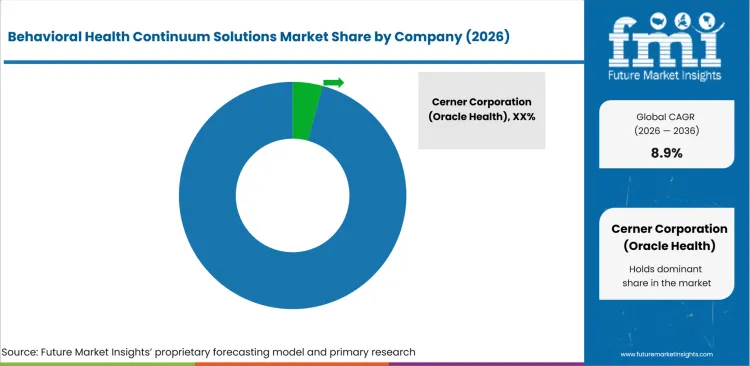
The competitive field combines enterprise clinical platforms with navigation networks and virtual behavioral care organizations. Enterprise vendors compete through shared records and multi-setting workflows, while care platforms compete through access and covered service delivery. Quartet Health currently operates as a NeuroFlow-owned behavioral care solution according to its official website. Talkspace announced a definitive acquisition agreement with Universal Health Services during March 2026, but the announcement described the transaction as pending rather than completed. The wider mental health apps category remains adjacent unless a product includes accountable clinical coordination across the defined continuum. Competitive assessment therefore depends on verified workflow capability and current service geography instead of corporate scale.
- Oracle Health and Epic Systems Corporation support institutional care through records that connect behavioral documentation with broader clinical workflows. Netsmart provides a separate behavioral platform for comparable coordination across specialized provider organizations and service settings. Their strongest differentiation concerns care-setting coverage and configurable coordination across complex provider organizations with multiple service lines.
- Quartet Health and Headway concentrate on navigation and covered access between referring clinicians and behavioral providers. Valera Health adds virtual care teams with coordinated treatment support for patients entering continuing outpatient services.
- Brightside Health provides virtual therapy and psychiatry with partner programs for health plans and health systems. Lyra Health combines workforce access with specialty services and a global provider network across employer-sponsored care pathways.
Competitive Benchmarking: Behavioral Health Continuum Solutions Market
| Company | Care Continuity | Coordination Workflow | Service Breadth | Geographic Reach |
|---|---|---|---|---|
| Oracle Health | High | High | High | Global |
| Epic Systems Corporation | High | High | High | Multiple global regions |
| Netsmart Technologies | High | High | High | United States |
| Quartet Health | Medium | High | Medium | United States |
| Valera Health | Medium | Medium | Medium | Selected United States markets |
| Headway | Low | Medium | Medium | United States |
| Brightside Health | Medium | Medium | Medium | United States |
| Lyra Health | High | High | High | Global |
Key Developments in the Behavioral Health Continuum Solutions Market
- In May 2025, Oracle made Oracle Health Clinical AI Agent available to Canadian health organizations across more than forty specialties including behavioral health. Oracle stated that United States users averaged a thirty percent reduction in daily documentation time. The expansion gives Canadian behavioral health teams a first-party workflow option for reducing note burden inside an established clinical platform.
- In February 2025, Netsmart Technologies: Alaska Behavioral Health selected the CareFabric platform across eleven facilities to support integrated behavioral healthcare. The deployment includes electronic health record functions and the Bells Virtual Scribe service for clinical documentation. The project demonstrates a multi-site implementation route that connects operational workflows with clinician-facing automation across community behavioral services.
- In April 2025, Teladoc Health completed its acquisition of UpLift and added an insured virtual mental health network with approximately 1,500 professionals. Teladoc stated that the combined offering reached more than 100 million covered lives across insured populations. The completed transaction expanded covered therapy and psychiatry access within a broader virtual-care organization rather than remaining a proposed ownership change.
- In July 2025, Lyra Health acquired Bend Health to expand mental health care for children and families through a completed transaction. Lyra linked the acquisition with its global member base and broader specialty-care strategy for families. The addition strengthens family-focused clinical pathways for employer clients that need coordinated support across life stages. Children and adolescents can enter coordinated services through pathways that also support adults and family caregivers.
Key Players in the Behavioral Health Continuum Solutions Market
Enterprise Clinical Platform Providers
- Oracle Health
- Epic Systems Corporation
- Netsmart Technologies
Behavioral Care Navigation and Delivery Platforms
- Quartet Health
- Valera Health
- Headway
Virtual and Workforce Mental Health Providers
- Brightside Health
- Lyra Health
Behavioral Health Continuum Solutions Market - Report Scope
| Coverage field | Report scope |
|---|---|
| Market breakdown | Solution type, care setting, deployment mode, end user, and region. |
| Market Definition | Software platforms and coordinated digital services that support behavioral health access, clinical documentation, referrals, treatment continuity, outcome measurement, and population-level management across care settings. |
| Regions Covered | North America, Latin America, Western Europe, Eastern Europe, East Asia, South Asia and Pacific, and Middle East and Africa. |
| Countries Covered | USA, UK, Germany, Japan, and South Korea, 30+ countries |
| Key Companies Profiled | Oracle Health, Epic Systems Corporation, Netsmart Technologies, Quartet Health, Valera Health, Headway, Brightside Health, and Lyra Health. |
| Forecast Period | 2026 to 2036. |
| Approach | Hybrid bottom-up and top-down market sizing supported by primary interviews and official desk research. |
Behavioral Health Continuum Solutions Market - Research Methodology
| Method | Approach |
|---|---|
| Primary Research | FMI analysts gathered input from manufacturers, service providers, technology developers, distributors, end users, sourcing teams, and subject-matter experts. Interviews examined purchasing decisions, product or service evaluation, adoption barriers, approval requirements, pricing considerations, and expectations for technical or commercial support. Respondents were also asked what evidence is required before a trial, pilot, or initial order develops into regular purchasing. |
| Desk Research | Desk research covered government statistics, regulatory publications, trade data, industry associations, technical literature, standards, company filings, product information, and official corporate announcements. Sources were reviewed for relevance, publication date, geographic coverage, and consistency with the defined market scope. Claims relating to performance, applications, approvals, capacity, investment, and commercial activity were retained only when supported by credible public evidence. |
| Market Sizing and Forecasting | The market model combined the baseline value with historical performance, segment structure, pricing and volume indicators, adoption levels, company participation, and country-level demand conditions. Forecast assumptions considered economic activity, investment trends, regulatory developments, technology adoption, purchasing cycles, supply availability, and barriers to wider market use. Segment and regional estimates were reconciled before the final market total was calculated. |
| Data Validation | Estimates were checked against multiple independent indicators, including public data, company activity, trade patterns, industry developments, and findings from primary interviews. Validation also tested whether products, services, applications, and company revenues fell within the defined market boundaries. Adjacent categories, unsupported claims, overlapping revenues, and activities without direct market relevance were excluded to reduce double counting and maintain consistency across segments and countries. |
Behavioral Health Continuum Solutions Market by Segments
Behavioral Health Continuum Solutions Market segmented by Solution Type:
- Integrated Care Platforms
- Care Coordination & Case Management
- Crisis & Suicide Prevention Systems
- Telepsychiatry Platforms
- Digital Therapeutics (DTx)
- Analytics & Population Health Tools
Behavioral Health Continuum Solutions Market segmented by Care Setting:
- Hospitals
- Outpatient Behavioral Health Clinics
- Community Mental Health Centers
- Substance Use Treatment Centers
- Primary Care Settings
Behavioral Health Continuum Solutions Market segmented by Deployment Mode:
- Cloud-Based Solutions
- On-Premise Solutions
- Hybrid Systems
Behavioral Health Continuum Solutions Market segmented by End User:
- Public Health Systems
- Private Healthcare Providers
- Payers & Insurance Organizations
- Government Health Agencies
Behavioral Health Continuum Solutions Market by Region:
- North America
- United States
- Canada
- Latin America
- Brazil
- Mexico
- Argentina
- Chile
- Western Europe
- Germany
- France
- United Kingdom
- Italy
- Spain
- Benelux
- Nordics
- Eastern Europe
- Poland
- Czech Republic
- Romania
- Hungary
- East Asia
- China
- Japan
- South Korea
- South Asia and Pacific
- India
- ASEAN
- Australia and New Zealand
- Middle East and Africa
- GCC Countries
- South Africa
- Türkiye
- Israel
Research Sources and Bibliography
- Substance Abuse and Mental Health Services Administration. (2025, July 28).
- NHS England. (2026, February 12).
- Centers for Medicare & Medicaid Services. (2025, January 1).
- NHS England. (2026, July 9).
- Substance Abuse and Mental Health Services Administration. (2026).
- Substance Abuse and Mental Health Services Administration. (2026, June 17).
- Health Resources and Services Administration. (2026, July 18).
- USA Department of Health and Human Services. (2026, January 30)
- Headway. (2025, May 13).
- Centers for Medicare & Medicaid Services. (2026, March 24).
- Office for Health Improvement and Disparities. (2026, July 7).
- Federal Institute for Drugs and Medical Devices. (2025, December 11).
- Ministry of Health, Labour and Welfare. (2026, March 27).
- Ministry of Health and Welfare. (2026, July 15).
- Talkspace, Inc.. (2026, March 9).
- Oracle. (2025, May 14).
- Netsmart Technologies, Inc.. (2025, February 27).
- Teladoc Health, Inc.. (2025, April 30).
- Lyra Health, Inc.. (2025, July 16).
- Oracle. (n.d.).
- Epic Systems Corporation. (n.d.).
- Netsmart Technologies, Inc.. (n.d.).
- Quartet Health. (n.d.).
- Valera Health. (n.d.).
- Headway. (n.d.).
- Brightside Health. (n.d.).
- Lyra Health, Inc.. (n.d.).
This bibliography is provided for reader reference and is not exhaustive. The full report contains the complete reference list and detailed citations
This Report Answers
- How large is the behavioral health continuum solutions market in 2026 and 2036?
- Which operational pressures support investment in integrated behavioral care workflows?
- Why do integrated care platforms hold the largest solution type share during 2026?
- How do hospitals evaluate continuum platforms across acute and outpatient behavioral services?
- Why are cloud-based solutions important for distributed behavioral health provider networks?
- How do country growth conditions differ across the USA, UK, Germany, Japan, and South Korea?
- Which companies provide enterprise records, navigation platforms, virtual care, or workforce mental health services?
- What privacy and implementation barriers can delay behavioral health data integration?
- How can public health systems measure referral completion and continuing care performance?
Frequently Asked Questions
What is driving growth in the behavioral health continuum solutions market?
Provider shortages and fragmented care pathways increase demand for systems that reduce duplicate work across behavioral services. Integrated workflows also help organizations document referrals and maintain clinical responsibility during changes in care setting.
Who are the key players in the behavioral health continuum solutions market?
Enterprise platform providers support records and coordination across institutional settings with complex clinical and administrative requirements. Navigation and virtual-care organizations extend covered access through outpatient networks and employer-sponsored behavioral health programs nationwide.
What is a notable restraint in the behavioral health continuum solutions market?
Confidentiality obligations can delay integration across substance use treatment and broader patient records during coordinated service delivery. Implementation also slows when organizations lack clear ownership for consent configuration and continuing interface support.
Why should executives track the behavioral health continuum solutions market?
Behavioral care gaps affect clinical outcomes and operating costs across hospitals and community provider networks substantially. Executives can compare platform spending with completed referrals and staff-time improvement instead of relying on enrollment measures.
What business problem does the behavioral health continuum solutions market address?
The market addresses disconnected screening and treatment workflows across providers that maintain separate clinical records. Continuum solutions create a shared route for referrals and follow-up without removing clinical judgment from complex decisions.
What should health systems evaluate in the behavioral health continuum solutions market?
Health systems should test referral completion and documentation efficiency across representative behavioral health clinical workflows. They should also confirm privacy controls and service responsibilities before expanding one platform across additional care settings.
What limits return on investment in the behavioral health continuum solutions market?
Weak integration can create another application without reducing existing documentation or coordination work for clinicians. Unclear support terms also increase operating risk when interfaces or clinical routing rules require continuing operational changes.
What supports long-term confidence in the behavioral health continuum solutions market?
Documented workflow improvement supports confidence when organizations expand beyond an initial deployment across provider networks. Clear governance and responsive technical support provide a practical basis for maintaining coordinated care across changing provider networks.
Preview the report firsthand - request a free sample
Get SampleGet the brochure for pricing and purchase details.
Get PDFTable of Content
- Key Takeaways
- Market Size and CAGR
- Top Growth Driver
- Fastest Growing Segment
- Leading Region
- Key Companies
- Emerging Opportunities
- Executive Summary
- Global Market Outlook
- Demand-side Trends
- Supply-side Trends
- Technology Roadmap Analysis
- Analysis and Recommendations
- Analyst Perspective (What is happening? Why now? What should investors know?)
- Key Questions Answered
- How large is the market?
- What is the CAGR?
- What are key trends?
- Which region dominates?
- Who are the leaders?
- Market Overview
- Market Coverage / Taxonomy
- Market Definition / Scope / Limitations
- Research Methodology
- Chapter Orientation
- Analytical Lens and Working Hypotheses
- Market Structure, Signals, and Trend Drivers
- Benchmarking and Cross-market Comparability
- Market Sizing, Forecasting, and Opportunity Mapping
- Research Design and Evidence Framework
- Desk Research Programme (Secondary Evidence)
- Expert Input and Fieldwork (Primary Evidence)
- Tooling, Models, and Reference Databases
- Data Engineering and Model Build
- Quality Assurance and Audit Trail
- Market Background
- Market Dynamics (Drivers, Restraints, Opportunity, Trends)
- Scenario Forecast (Optimistic, Likely, Conservative)
- Impact Analysis
- AI Impact
- Sustainability Impact
- Regulatory Impact
- Technology Impact
- Consumer / Buyer Analysis
- Purchase Drivers
- Adoption Barriers
- Buyer Journey
- Opportunity Map Analysis
- Product Life Cycle Analysis
- Supply Chain Analysis
- Investment Feasibility Matrix
- Value Chain Analysis
- PESTLE and Porter's Analysis
- Regulatory Landscape
- Regional Parent Market Outlook
- Production and Consumption Statistics
- Import and Export Statistics
- Global Market Analysis and Forecast, 2021 to 2036
- Historical Market Size Value (USD Million) Analysis, 2021 to 2025
- Current and Future Market Size Value (USD Million) Projections, 2026 to 2036
- Y-o-Y Growth Trend Analysis
- Absolute $ Opportunity Analysis
- Global Market Pricing Analysis, 2021 to 2036
- Global Market Analysis and Forecast, By Solution Type, 2021 to 2036
- Introduction / Key Findings
- Historical Market Size Value (USD Million) Analysis By Solution Type, 2021 to 2025
- Current and Future Market Size Value (USD Million) Analysis and Forecast By Solution Type, 2026 to 2036
- Integrated Care Platforms
- Care Coordination & Case Management
- Crisis & Suicide Prevention Systems
- Telepsychiatry Platforms
- Digital Therapeutics (DTx)
- Analytics & Population Health Tools
- Integrated Care Platforms
- Y-o-Y Growth Trend Analysis By Solution Type, 2021 to 2025
- Absolute $ Opportunity Analysis By Solution Type, 2026 to 2036
- Global Market Analysis and Forecast, By Care Setting, 2021 to 2036
- Introduction / Key Findings
- Historical Market Size Value (USD Million) Analysis By Care Setting, 2021 to 2025
- Current and Future Market Size Value (USD Million) Analysis and Forecast By Care Setting, 2026 to 2036
- Hospitals
- Outpatient Behavioral Health Clinics
- Community Mental Health Centers
- Substance Use Treatment Centers
- Primary Care Settings
- Hospitals
- Y-o-Y Growth Trend Analysis By Care Setting, 2021 to 2025
- Absolute $ Opportunity Analysis By Care Setting, 2026 to 2036
- Global Market Analysis and Forecast, By Deployment Mode, 2021 to 2036
- Introduction / Key Findings
- Historical Market Size Value (USD Million) Analysis By Deployment Mode, 2021 to 2025
- Current and Future Market Size Value (USD Million) Analysis and Forecast By Deployment Mode, 2026 to 2036
- Cloud-Based Solutions
- On-Premise Solutions
- Hybrid Systems
- Cloud-Based Solutions
- Y-o-Y Growth Trend Analysis By Deployment Mode, 2021 to 2025
- Absolute $ Opportunity Analysis By Deployment Mode, 2026 to 2036
- Global Market Analysis and Forecast, By End User, 2021 to 2036
- Introduction / Key Findings
- Historical Market Size Value (USD Million) Analysis By End User, 2021 to 2025
- Current and Future Market Size Value (USD Million) Analysis and Forecast By End User, 2026 to 2036
- Public Health Systems
- Private Healthcare Providers
- Payers & Insurance Organizations
- Government Health Agencies
- Public Health Systems
- Y-o-Y Growth Trend Analysis By End User, 2021 to 2025
- Absolute $ Opportunity Analysis By End User, 2026 to 2036
- Global Market Analysis and Forecast, By Region, 2021 to 2036
- Introduction
- Historical Market Size Value (USD Million) Analysis By Region, 2021 to 2025
- Current Market Size Value (USD Million) Analysis and Forecast By Region, 2026 to 2036
- North America
- Latin America
- Western Europe
- Eastern Europe
- East Asia
- South Asia and Pacific
- Middle East & Africa
- Market Attractiveness Analysis By Region
- North America Market Analysis and Forecast, By Country, 2021 to 2036
- Historical Market Size Value (USD Million) Trend Analysis By Market Taxonomy, 2021 to 2025
- Market Size Value (USD Million) Forecast By Market Taxonomy, 2026 to 2036
- By Country
- USA
- Canada
- By Solution Type
- By Care Setting
- By Deployment Mode
- By End User
- By Country
- Market Attractiveness Analysis
- By Country
- By Solution Type
- By Care Setting
- By Deployment Mode
- By End User
- Key Takeaways
- Latin America Market Analysis and Forecast, By Country
- Historical Market Size Value (USD Million) Trend Analysis By Market Taxonomy, 2021 to 2025
- Market Size Value (USD Million) Forecast By Market Taxonomy, 2026 to 2036
- By Country
- Brazil
- Mexico
- Chile
- Rest of Latin America
- By Solution Type
- By Care Setting
- By Deployment Mode
- By End User
- By Country
- Market Attractiveness Analysis
- By Country
- By Solution Type
- By Care Setting
- By Deployment Mode
- By End User
- Key Takeaways
- Western Europe Market Analysis and Forecast, By Country
- Historical Market Size Value (USD Million) Trend Analysis By Market Taxonomy, 2021 to 2025
- Market Size Value (USD Million) Forecast By Market Taxonomy, 2026 to 2036
- By Country
- Germany
- UK
- Italy
- Spain
- France
- Nordic
- BENELUX
- Rest of Western Europe
- By Solution Type
- By Care Setting
- By Deployment Mode
- By End User
- By Country
- Market Attractiveness Analysis
- By Country
- By Solution Type
- By Care Setting
- By Deployment Mode
- By End User
- Key Takeaways
- Eastern Europe Market Analysis and Forecast, By Country
- Historical Market Size Value (USD Million) Trend Analysis By Market Taxonomy, 2021 to 2025
- Market Size Value (USD Million) Forecast By Market Taxonomy, 2026 to 2036
- By Country
- Russia
- Poland
- Hungary
- Balkan & Baltic
- Rest of Eastern Europe
- By Solution Type
- By Care Setting
- By Deployment Mode
- By End User
- By Country
- Market Attractiveness Analysis
- By Country
- By Solution Type
- By Care Setting
- By Deployment Mode
- By End User
- Key Takeaways
- East Asia Market Analysis and Forecast, By Country
- Historical Market Size Value (USD Million) Trend Analysis By Market Taxonomy, 2021 to 2025
- Market Size Value (USD Million) Forecast By Market Taxonomy, 2026 to 2036
- By Country
- China
- Japan
- South Korea
- By Solution Type
- By Care Setting
- By Deployment Mode
- By End User
- By Country
- Market Attractiveness Analysis
- By Country
- By Solution Type
- By Care Setting
- By Deployment Mode
- By End User
- Key Takeaways
- South Asia and Pacific Market Analysis and Forecast, By Country
- Historical Market Size Value (USD Million) Trend Analysis By Market Taxonomy, 2021 to 2025
- Market Size Value (USD Million) Forecast By Market Taxonomy, 2026 to 2036
- By Country
- India
- ASEAN
- Australia & New Zealand
- Rest of South Asia and Pacific
- By Solution Type
- By Care Setting
- By Deployment Mode
- By End User
- By Country
- Market Attractiveness Analysis
- By Country
- By Solution Type
- By Care Setting
- By Deployment Mode
- By End User
- Key Takeaways
- Middle East & Africa Market Analysis and Forecast, By Country
- Historical Market Size Value (USD Million) Trend Analysis By Market Taxonomy, 2021 to 2025
- Market Size Value (USD Million) Forecast By Market Taxonomy, 2026 to 2036
- By Country
- Kingdom of Saudi Arabia
- Other GCC Countries
- Türkiye
- South Africa
- Other African Union
- Rest of Middle East & Africa
- By Solution Type
- By Care Setting
- By Deployment Mode
- By End User
- By Country
- Market Attractiveness Analysis
- By Country
- By Solution Type
- By Care Setting
- By Deployment Mode
- By End User
- Key Takeaways
- Key Countries Market Analysis
- USA
- Pricing Analysis
- Market Share Analysis, 2025
- By Solution Type
- By Care Setting
- By Deployment Mode
- By End User
- Canada
- Pricing Analysis
- Market Share Analysis, 2025
- By Solution Type
- By Care Setting
- By Deployment Mode
- By End User
- Mexico
- Pricing Analysis
- Market Share Analysis, 2025
- By Solution Type
- By Care Setting
- By Deployment Mode
- By End User
- Brazil
- Pricing Analysis
- Market Share Analysis, 2025
- By Solution Type
- By Care Setting
- By Deployment Mode
- By End User
- Chile
- Pricing Analysis
- Market Share Analysis, 2025
- By Solution Type
- By Care Setting
- By Deployment Mode
- By End User
- Germany
- Pricing Analysis
- Market Share Analysis, 2025
- By Solution Type
- By Care Setting
- By Deployment Mode
- By End User
- UK
- Pricing Analysis
- Market Share Analysis, 2025
- By Solution Type
- By Care Setting
- By Deployment Mode
- By End User
- Italy
- Pricing Analysis
- Market Share Analysis, 2025
- By Solution Type
- By Care Setting
- By Deployment Mode
- By End User
- Spain
- Pricing Analysis
- Market Share Analysis, 2025
- By Solution Type
- By Care Setting
- By Deployment Mode
- By End User
- France
- Pricing Analysis
- Market Share Analysis, 2025
- By Solution Type
- By Care Setting
- By Deployment Mode
- By End User
- India
- Pricing Analysis
- Market Share Analysis, 2025
- By Solution Type
- By Care Setting
- By Deployment Mode
- By End User
- ASEAN
- Pricing Analysis
- Market Share Analysis, 2025
- By Solution Type
- By Care Setting
- By Deployment Mode
- By End User
- Australia & New Zealand
- Pricing Analysis
- Market Share Analysis, 2025
- By Solution Type
- By Care Setting
- By Deployment Mode
- By End User
- China
- Pricing Analysis
- Market Share Analysis, 2025
- By Solution Type
- By Care Setting
- By Deployment Mode
- By End User
- Japan
- Pricing Analysis
- Market Share Analysis, 2025
- By Solution Type
- By Care Setting
- By Deployment Mode
- By End User
- South Korea
- Pricing Analysis
- Market Share Analysis, 2025
- By Solution Type
- By Care Setting
- By Deployment Mode
- By End User
- Russia
- Pricing Analysis
- Market Share Analysis, 2025
- By Solution Type
- By Care Setting
- By Deployment Mode
- By End User
- Poland
- Pricing Analysis
- Market Share Analysis, 2025
- By Solution Type
- By Care Setting
- By Deployment Mode
- By End User
- Hungary
- Pricing Analysis
- Market Share Analysis, 2025
- By Solution Type
- By Care Setting
- By Deployment Mode
- By End User
- Kingdom of Saudi Arabia
- Pricing Analysis
- Market Share Analysis, 2025
- By Solution Type
- By Care Setting
- By Deployment Mode
- By End User
- Türkiye
- Pricing Analysis
- Market Share Analysis, 2025
- By Solution Type
- By Care Setting
- By Deployment Mode
- By End User
- South Africa
- Pricing Analysis
- Market Share Analysis, 2025
- By Solution Type
- By Care Setting
- By Deployment Mode
- By End User
- USA
- Market Structure Analysis
- Competition Dashboard
- Competition Benchmarking
- Market Share Analysis of Top Players
- By Regional
- By Solution Type
- By Care Setting
- By Deployment Mode
- By End User
- Emerging Startups
- Innovation Benchmarking
- Competition Analysis
- Competition Deep Dive
- Cerner Corporation (Oracle Health)
- Overview
- Product Portfolio
- Profitability by Market Segments
- Sales Footprint
- Strategy Overview
- Marketing Strategy
- Product Strategy
- Channel Strategy
- Epic Systems Corporation
- Netsmart Technologies
- Quartet Health
- Valera Health
- Headway
- Brightside Health
- Lyra Health
- Talkspace, Inc.
- Teladoc Health, Inc.
- Cerner Corporation (Oracle Health)
- Case Studies
- Success Stories
- Recent Developments
- Competition Deep Dive
- Assumptions & Acronyms Used


