

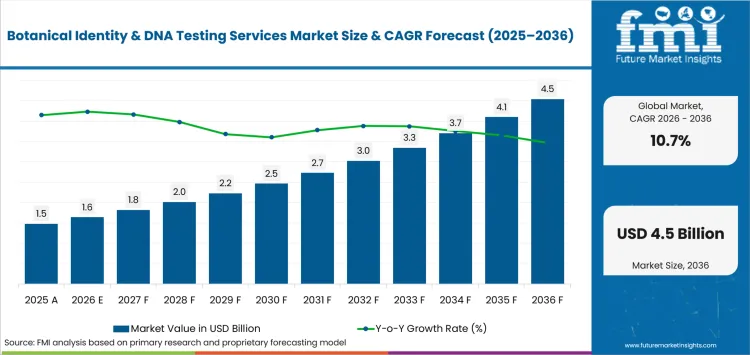
- Market Size (2026)
- USD 1.6 Bn
- Forecast (2036)
- USD 4.5 Bn
- CAGR (2026 to 2036)
- 10.7%
How big is Botanical Identity & DNA Testing Services Market in 2026?
USD 1.6 billion in 2026 and USD 4.5 billion by 2036 at a 10.7% CAGR.
Botanical identity and DNA testing services demand are projected to expand at 10.7% CAGR from 2026 to 2036, supported by recurring authentication across botanical ingredients and supplements. Industry value is estimated to rise from USD 1.6 billion in 2026 to USD 4.5 billion by 2036. The market is also benefiting from the growing scale and complexity of the dietary supplement industry, which increases the need for routine ingredient authentication and traceability verification. In August 2025 FDA described more than 100,000 supplement products within a sector exceeding USD 60 billion. Recurring programs also draw on food safety testing services capabilities that combine authenticated references with validated analytical methods.
Commercial requirements differ across countries as authorities apply separate supplement rules and laboratory recognition systems. United States programs emphasize cGMP identity records whereas German and British programs place greater weight on recognized methods and official surveillance. Chinese health-food registration creates a large regulated product base whereas Indian manufacturers depend on FSSAI-recognized testing routes across dispersed production clusters. In March 2025 AOAC reported progress on botanical identity verification guidance and a functional mushrooms initiative. The guidance work encourages laboratories to define method limits instead of treating every DNA result as complete identity evidence. Related food diagnostics services programs show why extraction controls and orthogonal confirmation protect release decisions. Food authenticity testing provides another comparison for services connecting species claims with traceable laboratory evidence.
Key Takeaways of Botanical Identity & DNA Testing Services Market
- Demand expands through recurring identity programs that support ingredient qualification and release decisions across botanical foods and dietary supplements.
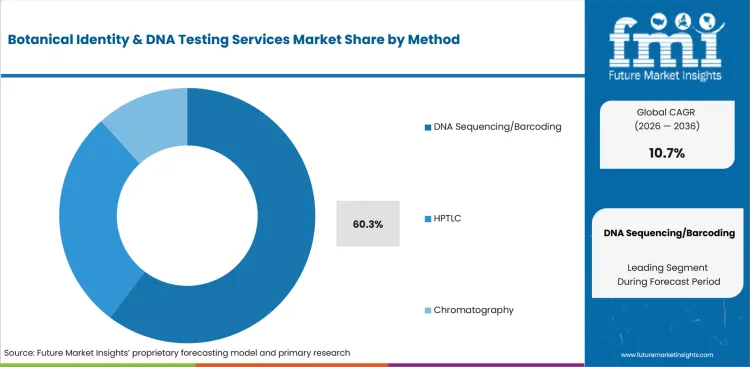
- DNA sequencing/barcoding is expected to lead the method category with 60.3% share in 2026, supported by species-level discrimination across botanicals that retain usable genetic material.
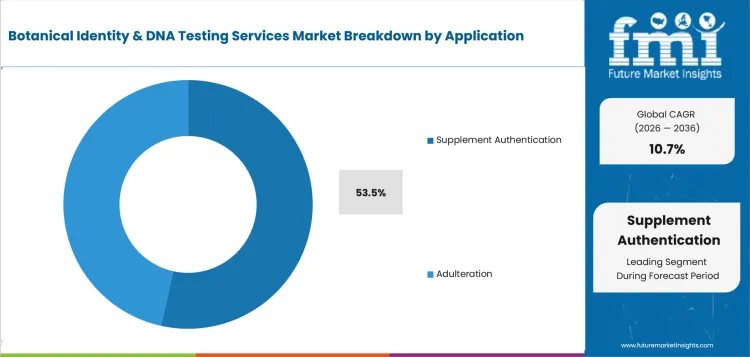
- Supplement authentication is projected to lead the application category with 53.5% share in 2026, reflecting repeated verification against label species and approved ingredient specifications.
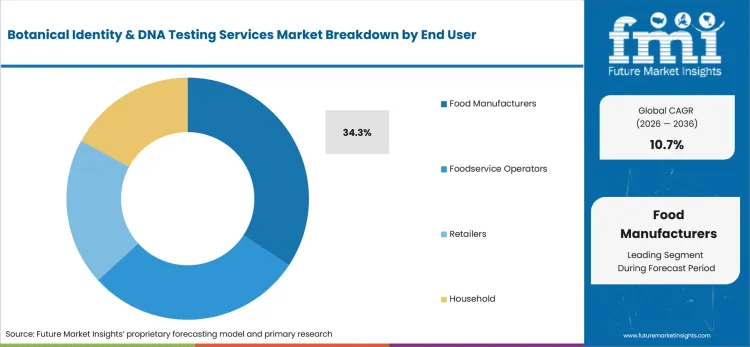
- Food manufacturers are anticipated to lead the end-user category with 34.3% share in 2026, owing to recurring lot volumes and formal ingredient-release responsibility across production sites.
- Processed extracts and extraction damage can reduce DNA recovery, increasing the need for HPTLC or chromatography to confirm plant part and chemical profile when molecular testing becomes inconclusive.
- Turnaround time and laboratory response to ambiguous findings shape adoption more than assay price alone, as manufacturers require reports connecting species evidence with tested plant part and product matrix.
- Competition includes global laboratory networks and specialist botanical laboratories that differ in molecular depth, orthogonal analysis capability, and country coverage.
Analyst Perspective
“Botanical identity programs create value by separating species confirmation from plant-part verification and chemical composition. DNA assays work best with raw botanicals and many blended powders, although microscopy and chemical fingerprints become decisive for processed extracts or plant-part disputes. Laboratories gain recurring work by defining an escalation route for inconclusive samples and translating combined evidence into a defensible production decision.”
- Nikhil Kaitwade, Principal Analyst, Future Market Insights.
How is the Botanical Identity & DNA Testing Services Market segmented?
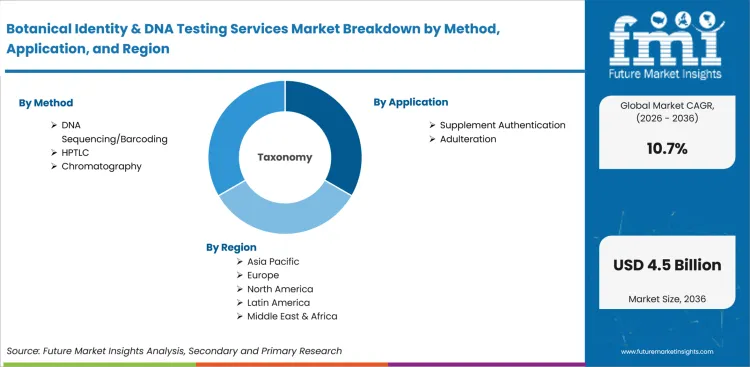
The botanical identity & DNA testing services industry is segmented by Method, Application, End User, and Region.
The market is segmented by Method, Application, End User, and Region across the complete global assessment. Method includes DNA Sequencing/Barcoding, HPTLC, and Chromatography, which address genetic, chemical, and visual evidence across different sample conditions. Application covers Supplement Authentication and Adulteration, which separate routine release testing from investigations into substitution or undeclared botanical material. End User includes Food Manufacturers, Foodservice Operators, Retailers, and Household users, with service demand shaped by sample volume and regulatory responsibility. Botanical ingredients create varied raw-material profiles across powders and extracts used in commercial formulations. Botanical supplements add label and finished-product documentation requirements across regulated product portfolios and recurring quality reviews. Regional analysis reflects method recognition and laboratory accreditation plus reference collections and sample logistics across each operating country.
What makes DNA sequencing/barcoding central to the method category?
Species-specific markers can separate botanicals that share appearance or overlapping chemistry across raw materials and many powders. In September 2025,LeafWorks expanded its DNA testing portfolio to 75 herbs and mushrooms using authenticated reference materials and curated assays. The expansion gives manufacturers defined options for common commercial botanicals although extraction damage can still reduce DNA recovery across processed ingredients. Related GMO testing services programs show how molecular laboratories manage amplification controls and reference comparisons across regulated food matrices.
- DNA sequencing/barcoding is set to lead the method category with 60.3% share in 2026 due to species-level discrimination across botanicals that retain usable genetic material. Species evidence is strongest across raw botanicals and powders that retain amplifiable genetic material during routine laboratory testing. Validated references and extraction controls reveal inconclusive samples and prevent laboratories from overstating identification confidence.
- Ingredient laboratories use DNA methods to screen incoming material and investigate unexpected species during qualification or deviation review. Curated reference databases and transparent matrix limits support repeat use across recurring botanical testing portfolios. Processed extracts can require HPTLC or chromatography to confirm plant part and chemical profile once molecular testing becomes inconclusive.
Why does supplement authentication lead the application category?
Supplement Authentication links species evidence with approved ingredient specifications and documented release decisions across recurring finished-product programs. In October 2025, NSF completed its acquisition of Cambium Analytica and added in-process quality assurance plus batch-release testing for natural products. The completed transaction expands integrated services that connect identity findings with broader supplement quality decisions. Authentication work therefore repeats as formulations or ingredient sources and label claims change across product portfolios.
- Supplement authentication is likely to capture 53.5% share in 2026 attributable to recurring verification against label species and approved ingredient specifications. Repeated verification supports ingredient qualification and deviation investigations across quality systems handling frequent botanical receipts. The service gains value through combined species testing and potency or contaminant analysis under one reporting route.
- Brands adopt recurring authentication programs that preserve sample traceability and compare findings with an approved ingredient specification. Reports must separate genuine substitution from extraction failure or degraded DNA across processed product matrices. A defined escalation route adds microscopy or chemical profiling without restarting the complete investigation through another external laboratory.
How do food manufacturers shape the end user category?
Food manufacturers manage repeated ingredient receipts and convert laboratory findings into hold or release decisions across production schedules. Their quality systems link source qualification with manufacturing controls and documented ingredient-release responsibility across every site. Adjacent residue analysis services capabilities influence laboratory selection among manufacturers that combine identity and contaminant evidence within one quality program. In June 2025, NOW reported expanded ISO/IEC 17025 scopes across its chemical and biological laboratories. The expansion shows why manufacturers compare external identity laboratories with documented competence and validated quality systems before assigning recurring botanical work.
- By end user, food manufacturers are estimated to hold 34.3% in 2026 owing to repeated lot testing and formal responsibility for ingredient release. Recurring lot volumes allow large manufacturers to standardize sample plans across several facilities and compare consistent multi-method reports. Their testing programs influence laboratory capacity for DNA sequencing and HPTLC plus targeted chromatographic confirmation across recurring ingredient programs.
- Adoption depends on turnaround time and the laboratory response to ambiguous findings rather than assay price alone. Production teams need reports that connect species evidence with the tested plant part and product matrix. Laboratories secure recurring work by supporting focused investigations without delaying every unaffected ingredient or finished production lot.
What are the drivers, restraints, and opportunities in the Botanical Identity & DNA Testing Services Market?
Regulated identity decisions support recurring testing demand, while processed matrices and incomplete reference data create a continuing need for orthogonal botanical analysis.
- Driver: Dietary supplement rules require documented identity evidence across new ingredients and recurring production programs.
- Restraint: Processing can damage DNA and weaken species interpretation across extracts and complex finished formulations.
- Opportunity: Integrated laboratories can combine DNA and microscopy plus HPTLC and chromatography within one documented investigation.
Dietary supplement rules create recurring identity work across new ingredients and revised formulations within regulated quality systems. In June 2025 FDA released materials stating that new dietary ingredient review evaluates safety and identity prior to consumer sale. Manufacturers therefore need organized evidence linking the declared botanical and plant part to the reviewed safety record. Laboratories gain repeat assignments through documented sample custody and fit-for-purpose methods that support submissions and later production release. Testing and certification records connect analytical findings with broader quality-system evidence across regulated manufacturing programs.
Processed extracts create the principal restraint by reducing recoverable DNA and changing the evidence available for species interpretation. A January 2025 review in Phytochemical Analysis found that herbal authentication gains reliability through combined DNA and morphological plus chemical methods. Inconclusive molecular results can require another extraction route or analytical technique, which increases cost and delays release decisions. Transparent reports reduce risk by defining matrix limits and separating uncertain findings from confirmed substitution. Incomplete reference databases can also extend investigation time across laboratories testing the same botanical material.
Integrated service packages create an opening for laboratories that resolve species and plant part plus chemical profile through one investigation. In March 2026 LeafWorks announced an upcoming expansion into microscopy and morphological identification alongside its genomic platform for botanical programs. The expansion covers plant-part confirmation and adulterant detection that DNA does not resolve alone across processed botanical materials. A coordinated report shortens escalation work and gives manufacturing teams one basis for release or rejection and further testing. Agricultural testing services connect authenticated plant references with commercial ingredient qualification in adjacent sourcing programs.
Which country CAGRs are profiled in the Botanical Identity & DNA Testing Services Market?
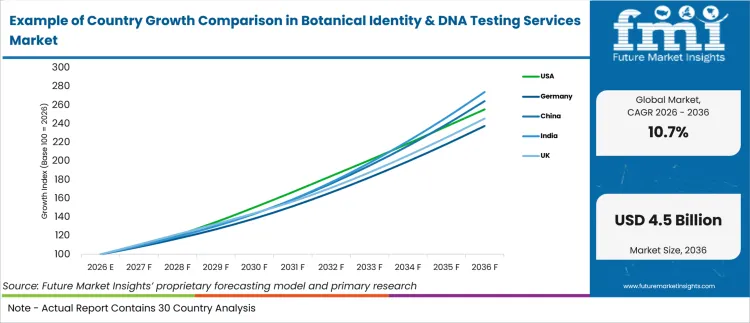
| Country | CAGR |
|---|---|
| USA | 9.8% |
| Germany | 9.0% |
| China | 10.2% |
| India | 10.6% |
| UK | 9.4% |
How do country-level CAGRs compare in the Botanical Identity & DNA Testing Services Market?
The country forecasts show a relatively balanced distribution across the botanical identity & DNA testing services market, with no country separated by a pronounced margin from the rest of the group. India and China form an upper cluster, reflecting growing emphasis on ingredient verification, supply chain transparency and quality assurance across botanical products. The USA follows closely behind and remains connected to the upper group through a limited difference in forecast growth. The UK and Germany create a lower pair with only a modest gap between them, indicating similar market dynamics. The overall pattern suggests that demand for botanical authentication services is expanding across major nutraceutical, herbal and natural ingredient markets as regulatory scrutiny and product traceability requirements become more important.
- India shows a notable position within the comparison as expanding herbal product production and increasing focus on authenticity verification support demand for botanical testing services.
- China remains closely aligned with India as manufacturers strengthen quality control practices and invest in ingredient authentication to support domestic and export markets.
- The USA benefits from growing demand for scientifically validated botanical ingredients, encouraging wider use of DNA-based identification and verification services.
- The UK reflects steady market development as suppliers and brands place greater emphasis on ingredient traceability, compliance and consumer confidence.
- Germany maintains a meaningful position within the comparison as quality standards within the nutraceutical and botanical ingredients sector continue to support adoption of advanced testing methods.
Comparable CAGRs do not create identical market conditions across countries. Differences in regulatory requirements, supply chain complexity, testing standards and botanical sourcing practices can influence service adoption and commercialization opportunities. Similar growth forecasts may therefore reflect different approaches to authentication, compliance and quality assurance across the botanical ingredients value chain. The full report provides country-level CAGR analysis across North America, Latin America, Europe, East Asia, South Asia, Oceania and the Middle East and Africa.
Country-wise Analysis
- United States cGMP rules require an appropriate identity test for every dietary ingredient entering supplement production. In the USA, botanical identity testing demand is predicted to advance at 9.8% CAGR through 2036, influenced by a large supplement portfolio and established specialist laboratories. In July 2026 the NIH Office of Dietary Supplements listed more than 200,000 current and discontinued product labels. The label base supports recurring identity work across formulations using different species and plant parts. Specialist laboratories provide a direct enabler through molecular and orthogonal testing routes across complex product portfolios. Uneven DNA performance across extracts creates a material friction, so programs need HPTLC or chromatography without interrupting unrelated production lots.
- German laboratories work within state food-control systems that emphasize recognized methods and documented analytical competence. Botanical identity testing demand in Germany is forecast to rise at 9.0% CAGR over the forecast period, underpinned by established testing infrastructure and official authenticity programs. In May 2025 BVL convened a conference examining digital tools and artificial intelligence for food authenticity and origin testing. Public reference laboratories and standardization work provide a direct enabler for advanced authenticity services across official and commercial settings. Commercial friction arises from fragmented purchasing across regional authorities and manufacturers with different validation expectations. Laboratories also need German-language reports and recognized accreditation scopes that support routine botanical quality decisions.
- Chinese health-food manufacturers must align ingredient records with national registration and filing requirements for regulated products. Adoption of botanical identity and DNA testing services in China is estimated to expand at 10.2% CAGR through 2036, reinforced by a large regulated health-food portfolio and domestic testing demand. In June 2025 SAMR reported 13,000 valid health-food registration certificates and 22,000 active filing certificates at March 2025. The documented product portfolio creates recurring identity and quality work across regulated botanical health-food formulations. Local entry remains difficult without Chinese reporting support and accepted sample routes that preserve evidence integrity. Reference databases must also cover domestically used botanicals and traditional ingredients across commercial health-food formulations and investigations.
- Indian botanical manufacturers rely on FSSAI-recognized laboratories and pharmacopoeial testing routes across nutraceutical and AYUSH products. Botanical identity testing demand in India is forecast to rise at 10.6% CAGR over the forecast period, shaped by manufacturing scale and access to specialist herbal laboratories. FSSAI listed 20 referral food laboratories in December 2025 and updated its primary laboratory list during July 2026. The recognized network provides a direct adoption enabler through domestic sample access and accepted analytical routes. Regional gaps in DNA and orthogonal chemistry capacity create shipment delays, requiring dependable collection routes and reports aligned with HPTLC or pharmacopoeial methods.
- British testing programs combine food-supplement controls with public authenticity research and accredited laboratory requirements across commercial product categories. The botanical identity testing outlook in the UK is anticipated to advance at 9.4% CAGR over the assessment period, facilitated by active regulatory research and method-development programs. In July 2026 Defra reported that its 2025 authenticity work included a honey project using DNA barcoding and qPCR. The public program provides a direct enabler for method evaluation and broader authenticity capability across official laboratories. Processed botanical extracts create a material validation burden for DNA services across finished supplement matrices. Routine programs also need accredited laboratories and practical turnaround times that fit recurring ingredient-release schedules.
Who are the notable companies in the Botanical Identity & DNA Testing Services Market?
Eurofins Scientific, SGS, NSF, LeafWorks, Alkemist Labs, Mérieux NutriSciences, Tentamus Group, and Auriga Research are notable companies within this market.
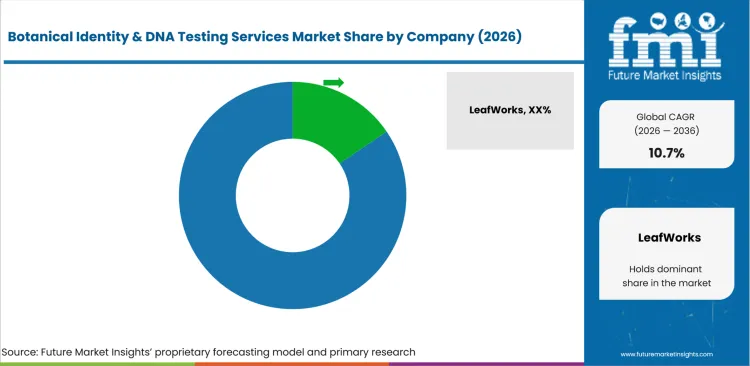
Competition separates global laboratory networks from specialist botanical laboratories with deeper reference collections and narrower service footprints. Eurofins Scientific and SGS combine molecular methods with broad chemistry portfolios across several regulated customer sectors. NSF and Mérieux NutriSciences connect supplement testing with compliance and product-development services across established laboratory networks. LeafWorks concentrates on species-specific botanical genomics supported by authenticated reference materials and curated assays for commercial testing programs. Alkemist Labs and Auriga Research emphasize HPTLC or microscopy beside chemical analysis for difficult botanical matrices. Tentamus Group adds NGS and food-fraud capabilities through a distributed international laboratory network serving food and supplement clients. Commercial differentiation rests on reference quality and matrix interpretation plus practical escalation across complementary methods.
- Global Laboratory Networks: Eurofins Scientific and SGS provide multi-country access with molecular and chemical testing across regulated customer sectors. NSF and Mérieux NutriSciences join Tentamus Group through documented supplement compliance and authenticity support within regulated product sectors. Coordinated sample logistics and integrated reports create their primary advantage across several analytical disciplines and operating countries.
- Specialist Botanical Laboratories: LeafWorks focuses on species-specific genomics supported by curated botanical references and matrix-specific assay development. Alkemist Labs centers botanical identity work on HPTLC and microscopy within a documented accreditation scope. Clients gain focused method expertise but must confirm access to complementary testing and practical sample routes across every operating country.
- Regional Herbal Testing Platforms: Auriga Research combines DNA fingerprinting with HPTLC and pharmacopoeial methods for Indian botanical and AYUSH materials. Regional expertise improves reference selection across Ayurvedic materials and multi-herb formulations used by domestic manufacturers. International clients must confirm destination-market acceptance and export documentation before establishing each recurring testing program.
Competitive Benchmarking: Botanical Identity & DNA Testing Services Market
| Company | DNA Species Identification | Orthogonal Botanical Analysis | Supplement Compliance Support | Geographic Reach |
|---|---|---|---|---|
| LeafWorks | High | Medium | Medium | North America and partner channels |
| Eurofins Scientific | High | High | High | Global |
| SGS | High | High | High | Global |
| NSF | Low | High | High | Global |
| Alkemist Labs | Low | High | High | North America and international clients |
| Mérieux NutriSciences | Low | High | High | Global |
| Tentamus Group | High | High | Medium | Global |
| Auriga Research | High | High | High | India and export markets |
Key Developments in the Botanical Identity & DNA Testing Services Market
- In June 2025, LeafWorks launched species-specific DNA identification tests for mushroom raw materials and foods plus dietary supplements. The official announcement described authenticated reference materials and complementary chemistry-based methods across difficult fungal identity questions. The launch expanded commercial options for materials that remain difficult to distinguish through appearance and overlapping chemical profiles or incomplete processing histories.
- In August 2025, Alkemist Labs published a list of 20 botanicals and fungi requiring extra identity scrutiny based on commercial samples. The laboratory used HPTLC across raw botanicals and extracts plus finished blends submitted through commercial quality programs. The disclosure gives manufacturers a current risk signal for focused source qualification and targeted authentication work across difficult matrices with challenging identity profiles.
- In January 2025, Eurofins Healthcare Assurance launched a GMP certification program for dietary and food supplements covering 21 CFR 111 and 117. The program combines audit evidence with certification across manufacturing systems and regulated food-safety controls for supplement operations. It strengthens the link between botanical laboratory findings and documented release controls across regulated supplement and food ingredient operations.
- In June 2026, NOW and LeafWorks announced a botanical identity testing partnership using next-generation sequencing and a new testing model plus digital data framework. The program connects manufacturer quality systems with specialized genomic interpretation across complex botanical formulations and extensive ingredient portfolios. The development signals demand for recurring identity infrastructure rather than isolated third-party reports across extensive botanical ingredient portfolios.
Key Players in the Botanical Identity & DNA Testing Services Market
Global Testing and Compliance Networks
- Eurofins Scientific
- SGS
- NSF
- Mérieux NutriSciences
- Tentamus Group
Specialist Botanical Identity Laboratories
- LeafWorks
- Alkemist Labs
Regional Herbal Testing Platforms
- Auriga Research
Botanical Identity & DNA Testing Services Market - Report Scope
| Coverage field | Report scope |
|---|---|
| Market breakdown | Method, Application, End User, Region |
| Quantitative Units | Revenue in USD Million, CAGR in %. |
| Market Definition | Outsourced laboratory services that authenticate botanical species or detect substitution and adulteration through DNA sequencing or barcoding plus HPTLC and microscopy and chromatography. |
| Regions Covered | North America, Latin America, Western Europe, Eastern Europe, East Asia, South Asia and Pacific, Middle East and Africa |
| Countries Covered | USA, Germany, China, India, UK, and more than twenty-five additional countries in the full report |
| Key Companies Profiled | Eurofins Scientific, SGS, NSF, LeafWorks, Alkemist Labs, Mérieux NutriSciences, Tentamus Group, Auriga Research |
| Forecast Period | 2026 to 2036 |
| Approach | The model combined bottom-up service volumes and pricing with laboratory participation plus segment structure and country conditions within the defined outsourcing boundary. |
Botanical Identity & DNA Testing Services Market - Research Methodology
| Method | Approach |
|---|---|
| Primary Research | FMI analysts gathered input from manufacturers, service providers, technology developers, distributors, end users, sourcing teams, and subject-matter experts. Interviews examined purchasing decisions, product or service evaluation, adoption barriers, approval requirements, pricing considerations, and expectations for technical or commercial support. Respondents were also asked what evidence is required before a trial, pilot, or initial order develops into regular purchasing. |
| Desk Research | Desk research covered government statistics, regulatory publications, trade data, industry associations, technical literature, standards, company filings, product information, and official corporate announcements. Sources were reviewed for relevance, publication date, geographic coverage, and consistency with the defined market scope. Claims relating to performance, applications, approvals, capacity, investment, and commercial activity were retained only when supported by credible public evidence. |
| Market Sizing and Forecasting | The market model combined the baseline value with historical performance, segment structure, pricing and volume indicators, adoption levels, company participation, and country-level demand conditions. Forecast assumptions considered economic activity, investment trends, regulatory developments, technology adoption, purchasing cycles, supply availability, and barriers to wider market use. Segment and regional estimates were reconciled before the final market total was calculated. |
| Data Validation | Estimates were checked against multiple independent indicators, including public data, company activity, trade patterns, industry developments, and findings from primary interviews. Validation also tested whether products, services, applications, and company revenues fell within the defined market boundaries. Adjacent categories, unsupported claims, overlapping revenues, and activities without direct market relevance were excluded to reduce double counting and maintain consistency across segments and countries. |
Botanical Identity & DNA Testing Services Market by Segments
Botanical Identity & DNA Testing Services Market segmented by Method:
- DNA Sequencing/Barcoding
- HPTLC
- Chromatography
Botanical Identity & DNA Testing Services Market segmented by Application:
- Supplement Authentication
- Adulteration
Botanical Identity & DNA Testing Services Market segmented by End User:
- Food Manufacturers
- Foodservice Operators
- Retailers
- Household
Botanical Identity & DNA Testing Services Market by Region:
- North America
- United States
- Canada
- Latin America
- Brazil
- Mexico
- Argentina
- Chile
- Western Europe
- Germany
- France
- United Kingdom
- Italy
- Spain
- Benelux
- Nordics
- Eastern Europe
- Poland
- Czech Republic
- Romania
- Hungary
- East Asia
- China
- Japan
- South Korea
- South Asia and Pacific
- India
- ASEAN
- Australia and New Zealand
- Middle East and Africa
- GCC Countries
- South Africa
- Türkiye
- Israel
Research Sources and Bibliography
- Alkemist Labs. (2025, August 14). Alkemist Labs releases “Herbs & Fungi We’re Watching” 2025 listing 20 ingredients requiring extra scrutiny.
- AOAC INTERNATIONAL. (2025, March 5). BIDSI program update.
- Auriga Research. (n.d.). Herbal standardisation, identification & fingerprinting.
- Bundesamt für Verbraucherschutz und Lebensmittelsicherheit. (2025, May 28). Mit Hilfe von KI die Echtheit von Lebensmitteln ermitteln.
- Eurofins Healthcare Assurance. (2025, January 15). Eurofins Healthcare Assurance launches new GMP certification program for dietary and food supplements to enhance compliance, safety and quality.
- Eurofins Scientific. (2026, July 14). Botanical and plant authenticity testing.
- Food Safety and Standards Authority of India. (2026, July 17). Food laboratories.
- LeafWorks. (2025, March 26). Redefining DNA testing with LeafWorks: A new era of DNA ID solutions.
- LeafWorks. (2025, September 22). LeafWorks expands DNA testing solutions to 75 herbs and mushrooms.
- LeafWorks. (2026, March 3). LeafWorks expands botanical testing platform with advanced microscopy & morphological identification services.
- Mérieux NutriSciences. (n.d.). Food supplements, dietary supplements: All-inclusive testing and regulatory services.
- National Institutes of Health, Office of Dietary Supplements. (n.d.). Dietary Supplement Label Database.
- Nazar, N., Saxena, A., Sebastian, A., Slater, A., Sundaresan, V., & Sgamma, T. (2025). Integrating DNA barcoding within an orthogonal approach for herbal product authentication: A narrative review. Phytochemical Analysis, 36(1), 7-29.
- NOW Foods. (2026, June 23). NOW & LeafWorks advance botanical identity testing with DNA testing partnership and new testing model.
- NOW Foods. (2025, June 23). NOW ISO 17025 accreditation expanded in both chemical and biological scopes.
- NSF. (2025, October 7). NSF acquires Cambium Analytica.
- NSF. (n.d.). Supplements, nutritional foods, and personal care product testing.
- SGS. (n.d.). Herbs and spices testing services.
- State Administration for Market Regulation. (2025, June 24). [Reply to Recommendation No. 6218 of the Third Session of the 14th National People’s Congress].
- Tentamus Group. (n.d.). Strong against food fraud.
- UK Department for Environment, Food & Rural Affairs. (2026, July 16). Authenticity Methodology Working Group annual summary 2025.
- USA Food and Drug Administration. (2010, December). Small entity compliance guide: Current good manufacturing practice in manufacturing, packaging, labeling, or holding operations for dietary supplements.
- USA Food and Drug Administration. (2025, June 11). FDA releases educational materials on the new dietary ingredient notification process for dietary supplements.
- USA Food and Drug Administration. (2025, August 1). MOU 225-19-032.
This bibliography is provided for reader reference and is not exhaustive. The full report contains the complete reference list and detailed citations
This Report Answers
- How large is the botanical identity & DNA testing services market in 2026 and 2036?
- Which regulatory and quality conditions create recurring demand for botanical identity testing services?
- Why does DNA Sequencing/Barcoding account for the largest Method share in 2026?
- How does Supplement Authentication influence recurring testing volume within the Application category?
- Why do Food Manufacturers account for the largest End User share in 2026?
- How do country growth rates differ across the USA, Germany, China, India and the UK?
- Which companies provide botanical DNA testing, orthogonal analysis or supplement compliance support?
- What technical limitations constrain DNA testing across processed botanical extracts and finished products?
- How should manufacturers compare laboratories before establishing a recurring botanical identity program?
Frequently Asked Questions
What is driving growth in the botanical identity & DNA testing services market?
Manufacturers need documented species identity across expanding botanical portfolios and complex source networks used across several markets. Regulatory records and label claims create recurring demand for validated laboratory services that support consistent ingredient-release decisions.
Who are the key players in the botanical identity & DNA testing services market?
Eurofins Scientific and SGS provide broad laboratory networks alongside NSF and Mérieux NutriSciences across regulated product sectors. LeafWorks and Alkemist Labs join Tentamus Group and Auriga Research within the specialist botanical capability set.
What is a notable restraint in the botanical identity & DNA testing services market?
Processing can degrade DNA and reduce confidence in molecular findings across extracts or complex finished-product blends. Laboratories therefore need HPTLC and microscopy or chromatography to resolve inconclusive samples without overstating species certainty.
Why should executives track the botanical identity & DNA testing services market?
Identity failures can delay production and expose botanical brands to regulatory action or costly customer investigations. Reliable testing programs protect source qualification and support defensible release decisions across recurring global ingredient purchases.
What business problem does the botanical identity & DNA testing services market address?
The market addresses uncertainty about whether botanical materials match their declared species and intended plant parts. Laboratories convert complex samples into traceable evidence that supports practical quality and commercial release decisions across recurring programs.
What should quality and laboratory teams evaluate before selecting a provider?
Quality teams should compare reference-material quality and method suitability across the actual matrices submitted for routine testing. Laboratory managers should also examine turnaround times and escalation routes for ambiguous findings requiring another analytical method.
What limits return on investment in botanical identity testing services?
Frequent inconclusive findings and slow follow-up testing can increase release delays and investigation costs across production schedules. Weak sample logistics also reduce specialized laboratory value and extend commercial decision timelines for manufacturing organizations.
What supports long-term confidence in botanical identity testing services?
Confidence improves through validated methods and transparent reports that explain analytical limits across each tested botanical matrix. Recurring programs also need stable reference collections and consistent sample handling across laboratories serving several countries.
Preview the report firsthand - request a free sample
Get SampleGet the brochure for pricing and purchase details.
Get PDFTable of Content
- Key Takeaways
- Market Size and CAGR
- Top Growth Driver
- Fastest Growing Segment
- Leading Region
- Key Companies
- Emerging Opportunities
- Executive Summary
- Global Market Outlook
- Demand-side Trends
- Supply-side Trends
- Technology Roadmap Analysis
- Analysis and Recommendations
- Analyst Perspective (What is happening? Why now? What should investors know?)
- Key Questions Answered
- How large is the market?
- What is the CAGR?
- What are key trends?
- Which region dominates?
- Who are the leaders?
- Market Overview
- Market Coverage / Taxonomy
- Market Definition / Scope / Limitations
- Research Methodology
- Chapter Orientation
- Analytical Lens and Working Hypotheses
- Market Structure, Signals, and Trend Drivers
- Benchmarking and Cross-market Comparability
- Market Sizing, Forecasting, and Opportunity Mapping
- Research Design and Evidence Framework
- Desk Research Programme (Secondary Evidence)
- Expert Input and Fieldwork (Primary Evidence)
- Tooling, Models, and Reference Databases
- Data Engineering and Model Build
- Quality Assurance and Audit Trail
- Market Background
- Market Dynamics (Drivers, Restraints, Opportunity, Trends)
- Scenario Forecast (Optimistic, Likely, Conservative)
- Impact Analysis
- AI Impact
- Sustainability Impact
- Regulatory Impact
- Technology Impact
- Consumer / Buyer Analysis
- Purchase Drivers
- Adoption Barriers
- Buyer Journey
- Opportunity Map Analysis
- Product Life Cycle Analysis
- Supply Chain Analysis
- Investment Feasibility Matrix
- Value Chain Analysis
- PESTLE and Porter's Analysis
- Regulatory Landscape
- Regional Parent Market Outlook
- Production and Consumption Statistics
- Import and Export Statistics
- Global Market Analysis and Forecast, 2021 to 2036
- Historical Market Size Value (USD Million) Analysis, 2021 to 2025
- Current and Future Market Size Value (USD Million) Projections, 2026 to 2036
- Y-o-Y Growth Trend Analysis
- Absolute $ Opportunity Analysis
- Global Market Pricing Analysis, 2021 to 2036
- Global Market Analysis and Forecast, By Method, 2021 to 2036
- Introduction / Key Findings
- Historical Market Size Value (USD Million) Analysis By Method, 2021 to 2025
- Current and Future Market Size Value (USD Million) Analysis and Forecast By Method, 2026 to 2036
- DNA Sequencing/Barcoding
- HPTLC
- Chromatography
- DNA Sequencing/Barcoding
- Y-o-Y Growth Trend Analysis By Method, 2021 to 2025
- Absolute $ Opportunity Analysis By Method, 2026 to 2036
- Global Market Analysis and Forecast, By Application, 2021 to 2036
- Introduction / Key Findings
- Historical Market Size Value (USD Million) Analysis By Application, 2021 to 2025
- Current and Future Market Size Value (USD Million) Analysis and Forecast By Application, 2026 to 2036
- Supplement Authentication
- Adulteration
- Supplement Authentication
- Y-o-Y Growth Trend Analysis By Application, 2021 to 2025
- Absolute $ Opportunity Analysis By Application, 2026 to 2036
- Global Market Analysis and Forecast, By End User, 2021 to 2036
- Introduction / Key Findings
- Historical Market Size Value (USD Million) Analysis By End User, 2021 to 2025
- Current and Future Market Size Value (USD Million) Analysis and Forecast By End User, 2026 to 2036
- Food Manufacturers
- Foodservice Operators
- Retailers
- Household
- Food Manufacturers
- Y-o-Y Growth Trend Analysis By End User, 2021 to 2025
- Absolute $ Opportunity Analysis By End User, 2026 to 2036
- Global Market Analysis and Forecast, By Region, 2021 to 2036
- Introduction
- Historical Market Size Value (USD Million) Analysis By Region, 2021 to 2025
- Current Market Size Value (USD Million) Analysis and Forecast By Region, 2026 to 2036
- North America
- Latin America
- Western Europe
- Eastern Europe
- East Asia
- South Asia and Pacific
- Middle East & Africa
- Market Attractiveness Analysis By Region
- North America Market Analysis and Forecast, By Country, 2021 to 2036
- Historical Market Size Value (USD Million) Trend Analysis By Market Taxonomy, 2021 to 2025
- Market Size Value (USD Million) Forecast By Market Taxonomy, 2026 to 2036
- By Country
- USA
- Canada
- By Method
- By Application
- By End User
- By Country
- Market Attractiveness Analysis
- By Country
- By Method
- By Application
- By End User
- Key Takeaways
- Latin America Market Analysis and Forecast, By Country
- Historical Market Size Value (USD Million) Trend Analysis By Market Taxonomy, 2021 to 2025
- Market Size Value (USD Million) Forecast By Market Taxonomy, 2026 to 2036
- By Country
- Brazil
- Mexico
- Chile
- Rest of Latin America
- By Method
- By Application
- By End User
- By Country
- Market Attractiveness Analysis
- By Country
- By Method
- By Application
- By End User
- Key Takeaways
- Western Europe Market Analysis and Forecast, By Country
- Historical Market Size Value (USD Million) Trend Analysis By Market Taxonomy, 2021 to 2025
- Market Size Value (USD Million) Forecast By Market Taxonomy, 2026 to 2036
- By Country
- Germany
- UK
- Italy
- Spain
- France
- Nordic
- BENELUX
- Rest of Western Europe
- By Method
- By Application
- By End User
- By Country
- Market Attractiveness Analysis
- By Country
- By Method
- By Application
- By End User
- Key Takeaways
- Eastern Europe Market Analysis and Forecast, By Country
- Historical Market Size Value (USD Million) Trend Analysis By Market Taxonomy, 2021 to 2025
- Market Size Value (USD Million) Forecast By Market Taxonomy, 2026 to 2036
- By Country
- Russia
- Poland
- Hungary
- Balkan & Baltic
- Rest of Eastern Europe
- By Method
- By Application
- By End User
- By Country
- Market Attractiveness Analysis
- By Country
- By Method
- By Application
- By End User
- Key Takeaways
- East Asia Market Analysis and Forecast, By Country
- Historical Market Size Value (USD Million) Trend Analysis By Market Taxonomy, 2021 to 2025
- Market Size Value (USD Million) Forecast By Market Taxonomy, 2026 to 2036
- By Country
- China
- Japan
- South Korea
- By Method
- By Application
- By End User
- By Country
- Market Attractiveness Analysis
- By Country
- By Method
- By Application
- By End User
- Key Takeaways
- South Asia and Pacific Market Analysis and Forecast, By Country
- Historical Market Size Value (USD Million) Trend Analysis By Market Taxonomy, 2021 to 2025
- Market Size Value (USD Million) Forecast By Market Taxonomy, 2026 to 2036
- By Country
- India
- ASEAN
- Australia & New Zealand
- Rest of South Asia and Pacific
- By Method
- By Application
- By End User
- By Country
- Market Attractiveness Analysis
- By Country
- By Method
- By Application
- By End User
- Key Takeaways
- Middle East & Africa Market Analysis and Forecast, By Country
- Historical Market Size Value (USD Million) Trend Analysis By Market Taxonomy, 2021 to 2025
- Market Size Value (USD Million) Forecast By Market Taxonomy, 2026 to 2036
- By Country
- Kingdom of Saudi Arabia
- Other GCC Countries
- Türkiye
- South Africa
- Other African Union
- Rest of Middle East & Africa
- By Method
- By Application
- By End User
- By Country
- Market Attractiveness Analysis
- By Country
- By Method
- By Application
- By End User
- Key Takeaways
- Key Countries Market Analysis
- USA
- Pricing Analysis
- Market Share Analysis, 2025
- By Method
- By Application
- By End User
- Canada
- Pricing Analysis
- Market Share Analysis, 2025
- By Method
- By Application
- By End User
- Mexico
- Pricing Analysis
- Market Share Analysis, 2025
- By Method
- By Application
- By End User
- Brazil
- Pricing Analysis
- Market Share Analysis, 2025
- By Method
- By Application
- By End User
- Chile
- Pricing Analysis
- Market Share Analysis, 2025
- By Method
- By Application
- By End User
- Germany
- Pricing Analysis
- Market Share Analysis, 2025
- By Method
- By Application
- By End User
- UK
- Pricing Analysis
- Market Share Analysis, 2025
- By Method
- By Application
- By End User
- Italy
- Pricing Analysis
- Market Share Analysis, 2025
- By Method
- By Application
- By End User
- Spain
- Pricing Analysis
- Market Share Analysis, 2025
- By Method
- By Application
- By End User
- France
- Pricing Analysis
- Market Share Analysis, 2025
- By Method
- By Application
- By End User
- India
- Pricing Analysis
- Market Share Analysis, 2025
- By Method
- By Application
- By End User
- ASEAN
- Pricing Analysis
- Market Share Analysis, 2025
- By Method
- By Application
- By End User
- Australia & New Zealand
- Pricing Analysis
- Market Share Analysis, 2025
- By Method
- By Application
- By End User
- China
- Pricing Analysis
- Market Share Analysis, 2025
- By Method
- By Application
- By End User
- Japan
- Pricing Analysis
- Market Share Analysis, 2025
- By Method
- By Application
- By End User
- South Korea
- Pricing Analysis
- Market Share Analysis, 2025
- By Method
- By Application
- By End User
- Russia
- Pricing Analysis
- Market Share Analysis, 2025
- By Method
- By Application
- By End User
- Poland
- Pricing Analysis
- Market Share Analysis, 2025
- By Method
- By Application
- By End User
- Hungary
- Pricing Analysis
- Market Share Analysis, 2025
- By Method
- By Application
- By End User
- Kingdom of Saudi Arabia
- Pricing Analysis
- Market Share Analysis, 2025
- By Method
- By Application
- By End User
- Türkiye
- Pricing Analysis
- Market Share Analysis, 2025
- By Method
- By Application
- By End User
- South Africa
- Pricing Analysis
- Market Share Analysis, 2025
- By Method
- By Application
- By End User
- USA
- Market Structure Analysis
- Competition Dashboard
- Competition Benchmarking
- Market Share Analysis of Top Players
- By Regional
- By Method
- By Application
- By End User
- Emerging Startups
- Innovation Benchmarking
- Competition Analysis
- Competition Deep Dive
- LeafWorks
- Overview
- Product Portfolio
- Profitability by Market Segments
- Sales Footprint
- Strategy Overview
- Marketing Strategy
- Product Strategy
- Channel Strategy
- Eurofins
- SGS
- ChromaDex
- NSF
- Alkemist Labs
- AuthenTechnologies
- LeafWorks
- Case Studies
- Success Stories
- Recent Developments
- Competition Deep Dive
- Assumptions & Acronyms Used


