

- Market Size (2026)
- USD 768.6 Mn
- Forecast (2036)
- USD 1208.5 Mn
- CAGR (2026 to 2036)
- 4.6%
How big is Brick Moulds Market in 2026?
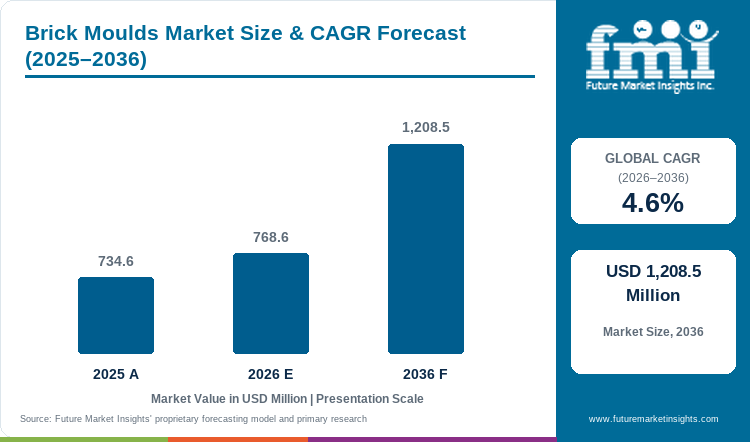
USD 768.6 Million in 2026 and USD 1208.5 Million by 2036, expanding at 4.6% CAGR.
Sales of brick moulds are estimated to rise at 4.6% CAGR through 2036. The value rises from USD 734.6 Million in 2025 to USD 768.6 Million in 2026. It reaches USD 1,208.5 Million by 2036 under the same forecast. Long-lived brick making machines keep wear-related mould orders active between major equipment purchases. In January 2026, TOPWERK formed a group-wide service unit for installed equipment. Plant engineers use planned service stops to check wear life and machine fit before approving another mould.
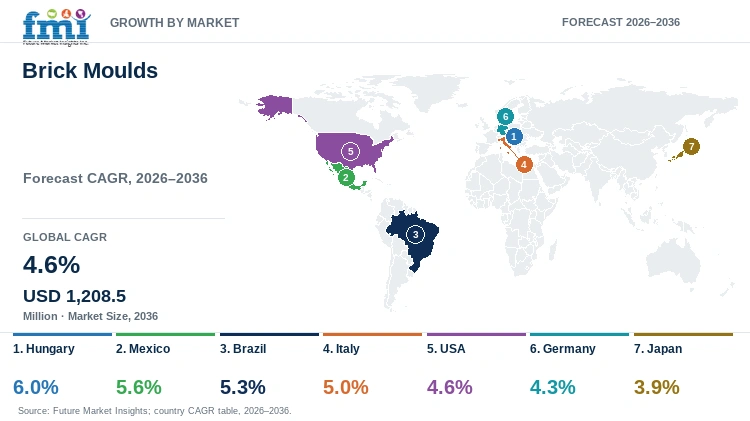
Hungary is projected to grow at 6.0% CAGR through 2036, shaped by changing project activity and replacement needs. Japan is forecast to grow at 3.9% over the same period, linked to a mature installed equipment base. In August 2026, KSH reported that June building output fell 22.1% from one year earlier. Civil engineering output rose 28.3% during the same national reporting period. These opposing trends change mould planning for building materials producers between project cycles. Japan relies more heavily on replacement work as major equipment additions remain selective. Suppliers in both countries must match mould geometry to installed lines before plants approve new tooling.
Key Takeaways
- Routine wear and product changes keep mould orders active across long-lived forming equipment.
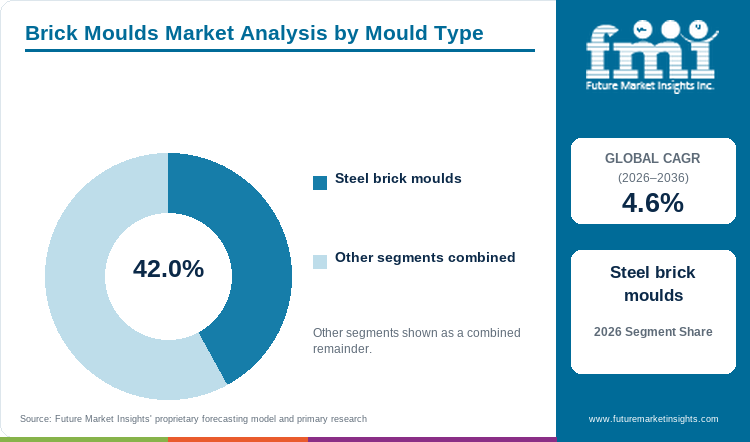
- Steel brick moulds are expected to hold 42.0% of mould type demand in 2026, owing to rigid repairable frames that preserve cavity shape.
- Solid bricks are estimated to hold 31.0% of brick type demand in 2026, linked to simpler cavity layouts and standard production needs.
- Hardened steel is forecast to represent 39.0% of material demand in 2026, influenced by repeated abrasive wear during forming.
- Machine-specific interfaces can slow supplier changes, as poor fit can interrupt production on active forming lines.
- Key companies include Columbia Machine, Besser Company, Masa Group, Hess Group, Tiger International, QGM Zenith, Poyatos, Prensoland, Rometa, and Reit Technology.
Analyst Perspective
"The commercial opportunity lies in repairable mould programs that extend installed lines as plants introduce new brick profiles. Adoption depends on proving machine fit and wear life before tooling changes enter planned service windows."
- Nikhil Kaitwade, Principal Consultant, Future Market Insights
How is the brick moulds market segmented?
The brick moulds market is segmented by Mould Type, Brick Type, Material, End Use, Sales Channel, and Region.
Mould type covers steel, plastic, rubber-lined, interlocking, and custom profile moulds. Brick type covers solid, hollow, facing, interlocking, and refractory bricks. Material covers hardened steel, mild steel, polymer, aluminum, and wear-resistant alloy. End use covers clay brick plants, concrete brick plants, paver plants, refractory units, and small block makers. Sales channel covers aftermarket replacement, brick machinery OEMs, direct mould makers, and distributor networks.
How do steel brick moulds shape demand within the mould type category?
Steel moulds face pressure and vibration inside concrete block machines during each forming cycle. Rigid frames help cavities retain their shape as liners wear under regular production loads. Plants can rebuild worn liners and inserts instead of replacing the complete mould assembly. Planned service stops give maintenance teams enough time to inspect wear and complete repairs. This repair route keeps routine maintenance compatible with new product tooling on the installed line.
- Steel brick moulds are projected to hold 42.0% of mould type demand in 2026, enabled by repairable frames and stable cavity geometry.
- In November 2025, Besser Company added a three-day All About Molds course on mould design and maintenance practices.
Why do solid bricks hold the largest brick type share?
Solid-brick tooling uses simple cavities and requires fewer cores than hollow-brick tooling during routine production. Moulded solid bricks follow a separate shaping route from AAC blocks in construction materials production. Producers can run standard units with fewer internal parts requiring inspection during mould changes. Clear drawings also make spare parts easier to manage across older production lines.
- Solid bricks are expected to hold 31.0% of brick type demand in 2026, attributable to simpler cavities and fewer internal cores.
- In October 2025, Hess Group commissioned an RH 2000-4 VA line designed for multiple concrete products and frequent format changes.
What supports hardened steel within the material category?
Hardened steel resists wear from construction aggregates during repeated vibration and stripping cycles. Plant teams need each cavity to retain its shape as liners and wear parts age. Mild steel remains suitable for lighter production with lower abrasion and impact loads. Polymer and aluminum can reduce mould weight in selected applications with lower forming loads. Wear-resistant alloys serve production cycles that combine severe abrasion with repeated machine vibration.
- Hardened steel is forecast to represent 39.0% of material demand in 2026, supported by wear resistance during repeated forming cycles.
- In July 2026, Masa Group described amplitude monitoring that detects vibration problems before they affect mould filling or compaction quality.
Why do clay brick plants remain important within end use?
Soft-mud clay plants use each mould as an active part of the forming line. The line fills and presses each cavity before releasing the formed brick for handling. Operators wash and sand the mould before starting the next production cycle. Refractory units use separate tooling for kiln refractory bricks with different forming requirements. Soft-mud plants check cavity shape before each run to protect finished brick dimensions. Extruded brick lines follow a different shaping route from soft-mud production systems.
- Clay brick plants are likely to capture 37.0% of end use demand in 2026, tied to regular mould work in soft-mud production.
- In April 2025, Lancaster Products published its AutoBrik technical flyer for PLC-controlled soft-mud production using traditional brick moulds.
What makes aftermarket replacement central to the sales channel category?
Aftermarket orders remain active as host machines stay in service for many years. Plant teams use industrial automation to shorten changeovers while physical wear continues to damage mould components. Worn liners or cores can trigger mould work without requiring a complete production line. Each new product profile creates another tooling order and requires a matched mould set. Local repair reduces lost output and keeps existing machines available during planned maintenance.
- Aftermarket replacement is set to lead sales channel demand with 36.0% share in 2026, driven by wear and changing product profiles.
- In June 2025, Besser Company opened its winter rebuild ordering window for maintenance parts used during planned plant service.
What are the drivers, restraints and opportunities in the Brick Moulds Market?
Physical wear sustains replacement demand, machine-specific fit limits supplier changes, and cross-platform service creates recurring work across mixed equipment fleets.
- Driver: Wear and new brick profiles create recurring tooling orders without requiring complete production-line replacement.
- Restraint: Machine interfaces and cavity tolerances raise qualification costs when drawings or mould configurations remain unproven.
- Opportunity: Cross-platform rebuild services can support mixed machine fleets and reduce downtime during planned tooling changes.
Wear creates repeat mould work
Brick and block plants replace moulds as wear changes cavity size and stripping performance. Long-lived forming machines keep tooling demand active between major equipment purchases and scheduled line upgrades. In November 2025, Besser Company introduced a course covering mould design and maintenance for plant teams. The course treats mould care as a separate maintenance task within routine production planning. New brick profiles require matched cavity sets and create additional tooling work for service teams. Plant teams use predictive maintenance to inspect wear before planned production stops and avoid unplanned tooling failures. Accurate drawings let service teams schedule rebuilds before tolerances fail, aligning tooling spending with measured wear and planned maintenance.
Machine fit slows supplier changes
A brick mould must match the installed machine and the intended product geometry. Small interface errors can change stripping behavior or finished block size during each production cycle. In April 2026, QGM shipped a ZN1000-2 line with customer-specific moulds for several brick types. The project linked each product profile to tooling designed for the installed press and its operating limits. Plants delay supplier changes until engineering teams verify drawings and cavity tolerances against machine requirements. Heavy steel moulds also require safe lifting and transport plans during scheduled changeovers. Smaller plants face greater exposure when one poor fit stops output, so careful qualification narrows the practical supplier pool.
Mixed fleets expand service demand
Plants with several machine brands need service that works across more than one platform. Mould specialists can keep interface drawings ready and prepare replacement parts before planned service stops begin. In January 2026, TOPWERK created a group-wide service unit for installed production lines. The unit coordinates technical staff and service work across machines within the installed base. Remote condition data helps maintenance teams plan mould inspections before scheduled shutdowns and prepare replacement parts. Plants making permeable concrete pavers also need new mould sets as product shapes change. Cross-platform service gives specialists access to repair and new tooling work, while faster response keeps changes inside maintenance windows.
Which country CAGRs are profiled in the Brick Moulds Market?
| Country | CAGR |
|---|---|
| Hungary | 6.0% |
| Mexico | 5.6% |
| Brazil | 5.3% |
| Italy | 5.0% |
| USA | 4.6% |
| Germany | 4.3% |
| Japan | 3.9% |
How do country-level CAGRs compare in the Brick Moulds Market?
The countries span 2.1 percentage points between Japan and Hungary. Project cycles and installed equipment create different mould purchasing conditions across these national markets. Mature production lines generate replacement work between major equipment purchases. New construction adds tooling demand when project activity keeps forming equipment busy. Local service capacity affects how quickly planned mould work becomes a purchase.
- Hungary’s shifting mix of building and civil engineering work favors fast format changes and flexible replacement schedules for installed moulds.
- Mexico’s uneven construction investment favors smaller tooling projects that extend existing machines without requiring complete production-line replacement.
- Brazil’s higher construction costs raise downtime exposure, encouraging plants to compare mould durability with local repair speed and service response.
- Italy’s steady construction activity keeps forming lines in regular use and supports planned mould replacement during scheduled maintenance periods.
- US plants use replaceable moulds to maintain active forming lines while mixed housing signals keep complete production-line investments selective.
- Germany’s stronger home-building approval base supports existing precast lines, while exact machine fit keeps tooling changes carefully planned.
- Japan’s mature building base favors longer mould life and local repair services that reduce switching risk across installed production equipment.
Similar CAGRs can lead to different entry conditions as installed lines and local service change order timing. The full report provides country-level CAGR analysis across North America, Latin America, Western Europe, Eastern Europe, East Asia, South Asia and Pacific, and the Middle East and Africa.
Country-wise Analysis
- US plants can replace worn moulds without purchasing an entirely new forming line. The USA is projected to grow at 4.6% CAGR through 2036, supported by active replacement work across installed equipment. In September 2026, the US Census Bureau reported August permits at a 1.394 million annual rate and starts at 1.275 million. Permits stood 3.5% above August 2025 while starts remained 1.2% lower. Mixed housing signals keep major production-line projects selective across building materials operations. Mould makers reduce service time by keeping machine drawings ready before planned shutdowns. Prepared drawings keep tooling changes inside service windows and limit lost production during replacement work.
- German plants require exact machine fit because poor mould changes can interrupt automated production. Germany is forecast to grow at 4.3% CAGR through 2036, reinforced by a stronger home-building approval base. Destatis reported in September 2026 that 121,200 new-home permits were issued from January through July. That national total stood 13.5% above the same period in 2025. More approved work can increase use of existing precast concrete lines before plants order new presses. Mould makers need clear tolerances and short changeovers for every installed production line. Local service helps plants add new formats without extending shutdowns or creating avoidable production losses.
- Mature building demand limits major line additions, so Japanese plants focus on longer mould life. Brick mould demand in Japan is predicted to advance at 3.9% CAGR through 2036, linked to service for installed equipment. In August 2026, Japan’s MLIT reported that July housing starts rose 8.2% from one year earlier. The seasonally adjusted annual rate fell 1.6% from June during the same release. Mixed readings keep major capital approvals cautious and preserve maintenance demand on installed lines. Plants need wear data and clear fit records before changing a tooling source. Local repair reduces switching risk and keeps mould work inside normal service periods for existing equipment.
- Brazilian brick and block plants weigh mould life against a cost base that raises downtime expense. Brazil is estimated to post 5.3% CAGR through 2036, shaped by the need to control service costs. In January 2026, IBGE reported that the national civil-construction cost index ended 2025 up 5.63%. Workforce costs rose 7.63% while material costs increased 4.20% during the measured period. Higher costs favor durable tooling but make larger upfront spending harder to approve. Plant teams compare wear life with service response before authorizing replacement work during maintenance. Local repair options help suppliers manage downtime costs without forcing premature equipment replacement.
- Hungarian plants face project demand that shifts between building work and civil engineering. Hungary is projected to grow at 6.0% CAGR through 2036, influenced by flexible replacement needs across changing project cycles. In August 2026, KSH reported that June building output fell 22.1% from one year earlier. Civil engineering output rose 28.3% during the same month in Hungary. The split makes large stocks of finished moulds harder to justify between projects. Plants can use replaceable wear parts while suppliers prepare drawings for changing brick and block formats. Short lead times support those format changes without forcing plants to carry excess mould inventory.
- Italian plants can plan mould changes with greater confidence as construction activity keeps forming lines in regular use. Brick mould sales in Italy are forecast to expand at 5.0% CAGR through 2036, supported by steady construction output. In February 2026, Istat reported that average 2025 construction production rose 4.8% after calendar adjustment. The unadjusted increase reached 3.9% for the full 2025 calendar year. Regular line use supports planned wear work but does not remove price pressure. Local repair and faster changeovers help plants protect output during scheduled maintenance. Measured wear then guides tooling decisions and reduces the need for premature production-line replacement.
- Mexican block plants balance industrial projects with regional sites that closely control capital and service spending. Mexico is anticipated to record 5.6% CAGR through 2036, tied to selective investment and ongoing mould needs. In February 2026, INEGI reported that builders’ output value rose 1.7% from November to December 2025. The same national measure remained 5.6% below December 2024 levels. Uneven activity makes new production-line timing differ between plants and regions. Mixed product programs require drawings for new profiles that run on existing machines. Smaller tooling projects can move sooner, while local service and replaceable wear parts support work before larger investments.
Who are the notable companies in the Brick Moulds Market?
Columbia Machine, Besser Company, Masa Group, Hess Group, Tiger International, QGM Zenith, Poyatos, Prensoland, Rometa, and Reit Technology are active within the defined brick moulds supply boundary.
Mould specialists compete with machine groups and regional plant makers for tooling and service work. Accurate machine fit controls supplier access since a poor mould can stop active production. Service reach also shapes orders during planned shutdowns and product changeovers.
- Columbia Machine, Besser Company, Tiger International, and Rometa make custom moulds while supporting cross-machine replacement on installed equipment.
- Masa Group, Hess Group, and QGM Zenith connect mould changes with automated block-production lines and lifecycle service.
- Poyatos, Prensoland, and Reit Technology serve flexible block systems that use changeable mould sets and practical service support.
Competitive Benchmarking: Brick Moulds Market
| Company | Mould Engineering Breadth | Cross-Machine Compatibility | Changeover & Lifecycle Support | Geographic Reach |
|---|---|---|---|---|
| Columbia Machine | High | High | High | North America and international |
| Besser Company | High | High | High | North America and international |
| Masa Group | Medium | Medium | High | Europe and global |
| Hess Group | Medium | Medium | High | Europe and global |
| Tiger International | High | High | Medium | Americas and Asia |
| QGM Zenith | High | High | High | China, Germany, and exports |
| Poyatos | Medium | Low | High | Spain and global |
| Prensoland | Medium | Low | Medium | Spain and international |
| Rometa | High | High | High | Spain and international |
| Reit Technology | Medium | Low | High | China, Asia, and Middle East |
High mould engineering breadth requires proof of custom or multi-profile tooling across documented applications. Medium breadth reflects a smaller verified range of mould types and related services. Low breadth indicates that public evidence covers a limited capability range. High cross-machine compatibility requires proof that moulds work across several equipment brands. High lifecycle support requires rebuild or changeover services for installed production equipment. Medium and Low ratings identify narrower verified support under each benchmark criterion.
Key Developments in the Brick Moulds Market
- In July 2026, Masa Group published amplitude-monitoring guidance linking stable vibration with consistent mould filling in block and paver machines.
- In April 2026, QGM shipped a ZN1000-2 line to the Middle East with moulds configured for several brick products.
- In October 2025, Hess Group commissioned an RH 2000-4 VA line for Mehramat Concretes that handles several product formats.
Key Players in the Brick Moulds Market
Cross-Platform Mould Engineering and Rebuild
- Columbia Machine
- Besser Company
- Tiger International
- Rometa
Integrated High-Automation Plant Platforms
- Masa Group
- Hess Group
- QGM Zenith
Flexible Regional Block-System Suppliers
- Poyatos
- Prensoland
- Reit Technology
Brick Moulds Market - Report Scope
| Coverage field | Report scope |
|---|---|
| Market breakdown | By mould type, brick type, material, end use, sales channel, and region. |
| Quantitative Units | USD Million. |
| Market Definition | Commercial brick mould assemblies and mould-specific wear components used in mould-based clay, concrete, paver, refractory, and related brick production are included. Brick machinery and finished bricks are excluded. |
| Regions Covered | North America, Latin America, Western Europe, Eastern Europe, East Asia, South Asia and Pacific, and Middle East and Africa. |
| Countries Covered | USA, Germany, Japan, Brazil, Hungary, Italy, Mexico, and 20+ countries included in the full report. |
| Key Companies Profiled | Columbia Machine, Besser Company, Masa Group, Hess Group, Tiger International, QGM Zenith, Poyatos, Prensoland, Rometa, and Reit Technology. |
| Forecast Period | 2026 to 2036. |
| Approach | Primary and secondary research with market triangulation. |
Brick Moulds Market - Research Methodology
| Method | Approach |
|---|---|
| Primary Research | FMI analysts gathered input from manufacturers, service providers, technology developers, distributors, end users, procurement teams, and subject-matter experts. Interviews examined purchasing decisions, product or service evaluation, adoption barriers, approval requirements, pricing considerations, and expectations for technical or commercial support. Respondents were also asked what evidence is required before a trial, pilot, or initial order develops into regular purchasing. |
| Desk Research | Desk research covered government statistics, regulatory publications, trade data, industry associations, technical literature, standards, company filings, product information, and official corporate announcements. Sources were reviewed for relevance, publication date, geographic coverage, and consistency with the defined market scope. Claims relating to performance, applications, approvals, capacity, investment, and commercial activity were retained only when supported by credible public evidence. |
| Market Sizing and Forecasting | The market model combined the baseline value with historical performance, segment structure, pricing and volume indicators, adoption levels, company participation, and country-level demand conditions. Forecast assumptions considered economic activity, investment trends, regulatory developments, technology adoption, purchasing cycles, supply availability, and barriers to wider market use. Segment and regional estimates were reconciled before the final market total was calculated. |
| Data Validation | Estimates were checked against multiple independent indicators, including public data, company activity, trade patterns, industry developments, and findings from primary interviews. Validation also tested whether products, services, applications, and company revenues fell within the defined market boundaries. Adjacent categories, unsupported claims, overlapping revenues, and activities without direct market relevance were excluded to reduce double counting and maintain consistency across segments and countries. |
Brick Moulds Market by Segments
Brick Moulds Market segmented by Mould Type:
- Steel brick moulds
- Plastic brick moulds
- Rubber-lined moulds
- Interlocking brick moulds
- Custom profile moulds
Brick Moulds Market segmented by Brick Type:
- Solid bricks
- Hollow bricks
- Facing bricks
- Interlocking bricks
- Refractory bricks
Brick Moulds Market segmented by Material:
- Hardened steel
- Mild steel
- Polymer
- Aluminum
- Wear-resistant alloy
Brick Moulds Market segmented by End Use:
- Clay brick plants
- Concrete brick plants
- Paver plants
- Refractory units
- Small block makers
Brick Moulds Market segmented by Sales Channel:
- Aftermarket replacement
- Brick machinery OEMs
- Direct mould makers
- Distributor network
Brick Moulds Market by Region:
- North America
- United States
- Canada
- Latin America
- Brazil
- Mexico
- Chile
- Rest of Latin America
- Western Europe
- Germany
- United Kingdom
- Italy
- Spain
- France
- Nordics
- Benelux
- Rest of Western Europe
- Eastern Europe
- Russia
- Poland
- Hungary
- Balkan and Baltic States
- Rest of Eastern Europe
- East Asia
- China
- Japan
- South Korea
- South Asia and Pacific
- India
- ASEAN
- Australia and New Zealand
- Rest of South Asia and Pacific
- Middle East and Africa
- Kingdom of Saudi Arabia
- Other GCC Countries
- Türkiye
- South Africa
- Other African Union Countries
- Rest of Middle East and Africa
Research Sources and Bibliography
- TOPWERK Group. (2026, January 6). TOPWERK Establishes New Business Unit for After Sales Service: Service Excellence and Customer Proximity for the Building Materials Industry.
- Hungarian Central Statistical Office. (2026, August 13). Construction, June 2026.
- Besser Company. (2025, November 11). Industry Professionals Invited to Expand Expertise at 2026 Blockmakers Workshops.
- Hess Group. (2025, October 21). Mehramat Concretes Starts Concrete Block Production - A Plant with Vision.
- Masa Group. (2026, July 13). Masa Amplitude Monitoring Featured in BFT.
- Lancaster Products. (2025, April). Lancaster AutoBrik Machine.
- Besser Company. (2025, June 30). Winter Rebuild Season Is Around the Corner.
- QGM Quangong Machinery Co., Ltd. (2026, April 9). Project Shipment: ZN1000-2 Brick Making Machine Shipped to the Middle East, Supporting Green Building.
- U.S. Census Bureau. (2026, September 17). Monthly New Residential Construction, August 2026.
- Federal Statistical Office of Germany (Destatis). (2026, September 18). Building Permits for Dwellings, July 2026.
- Ministry of Land, Infrastructure, Transport and Tourism, Japan. (2026, August 31). Building Starts Statistics Survey, July 2026.
- Brazilian Institute of Geography and Statistics (IBGE). (2026, January 9). National Index of Civil Construction Changes 0.51% in December.
- Italian National Institute of Statistics (Istat). (2026, February 20). Production in the Construction Sector - December 2025.
- Instituto Nacional de Estadística y Geografía (INEGI). (2026, February 24). National Survey of Construction Companies 2025, December Data.
- Columbia Machine. (2026, July 24). Columbia Welcomes Travis Jones as General Manager, Concrete Molds Division.
- Poyatos. (2026, June 16). Custom Concrete Block Machine Projects: The Poyatos Approach 2026.
- Prensoland. (2025, April 4). Strengthening Our Presence in Spain, Turkey, and Asia.
- REIT Machine. (2026, January 28). Successful Dispatch of the India RT9B Brick Making Machine Project.
- ImportInfo. (2026, July 2). Basalite Concrete Products, LLC - U.S. Import Activity: Concrete Block Machine Plant Mold Shipment.
This bibliography provides reader reference and does not represent the complete source record. The full report contains the complete reference list and detailed citations.
This Report Answers
- How large is the brick moulds market in 2026 and 2036?
- Why does mould wear create recurring aftermarket demand for installed forming equipment?
- Which mould type accounts for 42.0% share within its 2026 category?
- Which brick type accounts for 31.0% share within its 2026 category?
- Which material accounts for 39.0% share within its 2026 category?
- How do country CAGRs differ across the seven profiled national markets?
- Which companies supply moulds or block-production systems within the defined market boundary?
- Which machine-fit and service conditions can delay a replacement mould order?
- How do rebuild options change lifecycle economics for installed brick-forming equipment?
Frequently Asked Questions
How large is the global brick moulds market in 2026?
The brick moulds market is valued at USD 768.6 Million in 2026 and reaches an estimated USD 1,208.5 Million by 2036. Wear and new product profiles keep mould orders active across installed production lines.
What is the CAGR of the brick moulds market from 2026 to 2036?
The brick moulds market is projected to grow at 4.6% CAGR between 2026 and 2036. Long machine life keeps replacement demand active as plants delay complete production-line investments.
Which mould type leads its category in the brick moulds market during 2026?
Steel brick moulds are projected to hold 42.0% of mould type revenue in the brick moulds market during 2026. Rigid frames protect cavity shape during repeated forming cycles and planned rebuilds.
Which material segment leads its category in the brick moulds market during 2026?
Hardened steel is forecast to represent 39.0% of material demand in the brick moulds market during 2026. Wear resistance helps each cavity retain its shape under repeated vibration and abrasion.
Which companies are active across the defined brick moulds market supply boundary?
Key companies include Columbia Machine, Besser Company, Masa Group, Hess Group, Tiger International, QGM Zenith, Poyatos, Prensoland, Rometa, and Reit Technology. Their roles span mould engineering and automated block-production systems while also covering lifecycle service for installed equipment.
Preview the report firsthand - request a free sample
Get SampleGet the brochure for pricing and purchase details.
Get PDFTable of Content
- Key Takeaways
- Market Size and CAGR
- Top Growth Driver
- Fastest Growing Segment
- Leading Region
- Key Companies
- Emerging Opportunities
- Executive Summary
- Global Market Outlook
- Demand-side Trends
- Supply-side Trends
- Technology Roadmap Analysis
- Analysis and Recommendations
- Analyst Perspective (What is happening? Why now? What should investors know?)
- Key Questions Answered
- How large is the market?
- What is the CAGR?
- What are key trends?
- Which region dominates?
- Who are the leaders?
- Market Overview
- Market Coverage / Taxonomy
- Market Definition / Scope / Limitations
- Research Methodology
- Chapter Orientation
- Analytical Lens and Working Hypotheses
- Market Structure, Signals, and Trend Drivers
- Benchmarking and Cross-market Comparability
- Market Sizing, Forecasting, and Opportunity Mapping
- Research Design and Evidence Framework
- Desk Research Programme (Secondary Evidence)
- Expert Input and Fieldwork (Primary Evidence)
- Tooling, Models, and Reference Databases
- Data Engineering and Model Build
- Quality Assurance and Audit Trail
- Market Background
- Market Dynamics (Drivers, Restraints, Opportunity, Trends)
- Scenario Forecast (Optimistic, Likely, Conservative)
- Impact Analysis
- AI Impact
- Sustainability Impact
- Regulatory Impact
- Technology Impact
- Consumer / Buyer Analysis
- Purchase Drivers
- Adoption Barriers
- Buyer Journey
- Opportunity Map Analysis
- Product Life Cycle Analysis
- Supply Chain Analysis
- Investment Feasibility Matrix
- Value Chain Analysis
- PESTLE and Porter's Analysis
- Regulatory Landscape
- Regional Parent Market Outlook
- Production and Consumption Statistics
- Import and Export Statistics
- Global Market Analysis and Forecast, 2021 to 2036
- Historical Market Size Value (USD Million) Analysis, 2021 to 2025
- Current and Future Market Size Value (USD Million) Projections, 2026 to 2036
- Y-o-Y Growth Trend Analysis
- Absolute $ Opportunity Analysis
- Global Market Pricing Analysis, 2021 to 2036
- Global Market Analysis and Forecast, By Mould Type, 2021 to 2036
- Introduction / Key Findings
- Historical Market Size Value (USD Million) Analysis By Mould Type, 2021 to 2025
- Current and Future Market Size Value (USD Million) Analysis and Forecast By Mould Type, 2026 to 2036
- Steel brick moulds
- Plastic brick moulds
- Rubber-lined moulds
- Interlocking brick moulds
- Custom profile moulds
- Y-o-Y Growth Trend Analysis By Mould Type, 2021 to 2025
- Absolute $ Opportunity Analysis By Mould Type, 2026 to 2036
- Global Market Analysis and Forecast, By Brick Type, 2021 to 2036
- Introduction / Key Findings
- Historical Market Size Value (USD Million) Analysis By Brick Type, 2021 to 2025
- Current and Future Market Size Value (USD Million) Analysis and Forecast By Brick Type, 2026 to 2036
- Solid bricks
- Hollow bricks
- Facing bricks
- Interlocking bricks
- Refractory bricks
- Y-o-Y Growth Trend Analysis By Brick Type, 2021 to 2025
- Absolute $ Opportunity Analysis By Brick Type, 2026 to 2036
- Global Market Analysis and Forecast, By Material, 2021 to 2036
- Introduction / Key Findings
- Historical Market Size Value (USD Million) Analysis By Material, 2021 to 2025
- Current and Future Market Size Value (USD Million) Analysis and Forecast By Material, 2026 to 2036
- Hardened steel
- Mild steel
- Polymer
- Aluminum
- Wear-resistant alloy
- Y-o-Y Growth Trend Analysis By Material, 2021 to 2025
- Absolute $ Opportunity Analysis By Material, 2026 to 2036
- Global Market Analysis and Forecast, By End Use, 2021 to 2036
- Introduction / Key Findings
- Historical Market Size Value (USD Million) Analysis By End Use, 2021 to 2025
- Current and Future Market Size Value (USD Million) Analysis and Forecast By End Use, 2026 to 2036
- Clay brick plants
- Concrete brick plants
- Paver plants
- Refractory units
- Small block makers
- Y-o-Y Growth Trend Analysis By End Use, 2021 to 2025
- Absolute $ Opportunity Analysis By End Use, 2026 to 2036
- Global Market Analysis and Forecast, By Sales Channel, 2021 to 2036
- Introduction / Key Findings
- Historical Market Size Value (USD Million) Analysis By Sales Channel, 2021 to 2025
- Current and Future Market Size Value (USD Million) Analysis and Forecast By Sales Channel, 2026 to 2036
- Aftermarket replacement
- Brick machinery OEMs
- Direct mould makers
- Distributor network
- Y-o-Y Growth Trend Analysis By Sales Channel, 2021 to 2025
- Absolute $ Opportunity Analysis By Sales Channel, 2026 to 2036
- Global Market Analysis and Forecast, By Region, 2021 to 2036
- Introduction
- Historical Market Size Value (USD Million) Analysis By Region, 2021 to 2025
- Current Market Size Value (USD Million) Analysis and Forecast By Region, 2026 to 2036
- North America
- Latin America
- Western Europe
- Eastern Europe
- East Asia
- South Asia and Pacific
- Middle East and Africa
- Market Attractiveness Analysis By Region
- North America Market Analysis and Forecast, By Country, 2021 to 2036
- Historical Market Size Value (USD Million) Trend Analysis By Market Taxonomy, 2021 to 2025
- Market Size Value (USD Million) Forecast By Market Taxonomy, 2026 to 2036
- By Country
- United States
- Canada
- By Mould Type
- By Brick Type
- By Material
- By End Use
- By Sales Channel
- By Country
- Market Attractiveness Analysis
- By Country
- By Mould Type
- By Brick Type
- By Material
- By End Use
- By Sales Channel
- Key Takeaways
- Latin America Market Analysis and Forecast, By Country
- Historical Market Size Value (USD Million) Trend Analysis By Market Taxonomy, 2021 to 2025
- Market Size Value (USD Million) Forecast By Market Taxonomy, 2026 to 2036
- By Country
- Brazil
- Mexico
- Chile
- Rest of Latin America
- By Mould Type
- By Brick Type
- By Material
- By End Use
- By Sales Channel
- By Country
- Market Attractiveness Analysis
- By Country
- By Mould Type
- By Brick Type
- By Material
- By End Use
- By Sales Channel
- Key Takeaways
- Western Europe Market Analysis and Forecast, By Country
- Historical Market Size Value (USD Million) Trend Analysis By Market Taxonomy, 2021 to 2025
- Market Size Value (USD Million) Forecast By Market Taxonomy, 2026 to 2036
- By Country
- Germany
- United Kingdom
- Italy
- Spain
- France
- Nordics
- Benelux
- Rest of Western Europe
- By Mould Type
- By Brick Type
- By Material
- By End Use
- By Sales Channel
- By Country
- Market Attractiveness Analysis
- By Country
- By Mould Type
- By Brick Type
- By Material
- By End Use
- By Sales Channel
- Key Takeaways
- Eastern Europe Market Analysis and Forecast, By Country
- Historical Market Size Value (USD Million) Trend Analysis By Market Taxonomy, 2021 to 2025
- Market Size Value (USD Million) Forecast By Market Taxonomy, 2026 to 2036
- By Country
- Russia
- Poland
- Hungary
- Balkan and Baltic States
- Rest of Eastern Europe
- By Mould Type
- By Brick Type
- By Material
- By End Use
- By Sales Channel
- By Country
- Market Attractiveness Analysis
- By Country
- By Mould Type
- By Brick Type
- By Material
- By End Use
- By Sales Channel
- Key Takeaways
- East Asia Market Analysis and Forecast, By Country
- Historical Market Size Value (USD Million) Trend Analysis By Market Taxonomy, 2021 to 2025
- Market Size Value (USD Million) Forecast By Market Taxonomy, 2026 to 2036
- By Country
- China
- Japan
- South Korea
- By Mould Type
- By Brick Type
- By Material
- By End Use
- By Sales Channel
- By Country
- Market Attractiveness Analysis
- By Country
- By Mould Type
- By Brick Type
- By Material
- By End Use
- By Sales Channel
- Key Takeaways
- South Asia and Pacific Market Analysis and Forecast, By Country
- Historical Market Size Value (USD Million) Trend Analysis By Market Taxonomy, 2021 to 2025
- Market Size Value (USD Million) Forecast By Market Taxonomy, 2026 to 2036
- By Country
- India
- ASEAN
- Australia and New Zealand
- Rest of South Asia and Pacific
- By Mould Type
- By Brick Type
- By Material
- By End Use
- By Sales Channel
- By Country
- Market Attractiveness Analysis
- By Country
- By Mould Type
- By Brick Type
- By Material
- By End Use
- By Sales Channel
- Key Takeaways
- Middle East and Africa Market Analysis and Forecast, By Country
- Historical Market Size Value (USD Million) Trend Analysis By Market Taxonomy, 2021 to 2025
- Market Size Value (USD Million) Forecast By Market Taxonomy, 2026 to 2036
- By Country
- Kingdom of Saudi Arabia
- Other GCC Countries
- Türkiye
- South Africa
- Other African Union Countries
- Rest of Middle East and Africa
- By Mould Type
- By Brick Type
- By Material
- By End Use
- By Sales Channel
- By Country
- Market Attractiveness Analysis
- By Country
- By Mould Type
- By Brick Type
- By Material
- By End Use
- By Sales Channel
- Key Takeaways
- Key Countries Market Analysis
- United States
- Pricing Analysis
- Market Share Analysis, 2025
- By Mould Type
- By Brick Type
- By Material
- By End Use
- By Sales Channel
- Canada
- Pricing Analysis
- Market Share Analysis, 2025
- By Mould Type
- By Brick Type
- By Material
- By End Use
- By Sales Channel
- Mexico
- Pricing Analysis
- Market Share Analysis, 2025
- By Mould Type
- By Brick Type
- By Material
- By End Use
- By Sales Channel
- Brazil
- Pricing Analysis
- Market Share Analysis, 2025
- By Mould Type
- By Brick Type
- By Material
- By End Use
- By Sales Channel
- Chile
- Pricing Analysis
- Market Share Analysis, 2025
- By Mould Type
- By Brick Type
- By Material
- By End Use
- By Sales Channel
- Germany
- Pricing Analysis
- Market Share Analysis, 2025
- By Mould Type
- By Brick Type
- By Material
- By End Use
- By Sales Channel
- United Kingdom
- Pricing Analysis
- Market Share Analysis, 2025
- By Mould Type
- By Brick Type
- By Material
- By End Use
- By Sales Channel
- Italy
- Pricing Analysis
- Market Share Analysis, 2025
- By Mould Type
- By Brick Type
- By Material
- By End Use
- By Sales Channel
- Spain
- Pricing Analysis
- Market Share Analysis, 2025
- By Mould Type
- By Brick Type
- By Material
- By End Use
- By Sales Channel
- France
- Pricing Analysis
- Market Share Analysis, 2025
- By Mould Type
- By Brick Type
- By Material
- By End Use
- By Sales Channel
- India
- Pricing Analysis
- Market Share Analysis, 2025
- By Mould Type
- By Brick Type
- By Material
- By End Use
- By Sales Channel
- ASEAN
- Pricing Analysis
- Market Share Analysis, 2025
- By Mould Type
- By Brick Type
- By Material
- By End Use
- By Sales Channel
- Australia and New Zealand
- Pricing Analysis
- Market Share Analysis, 2025
- By Mould Type
- By Brick Type
- By Material
- By End Use
- By Sales Channel
- China
- Pricing Analysis
- Market Share Analysis, 2025
- By Mould Type
- By Brick Type
- By Material
- By End Use
- By Sales Channel
- Japan
- Pricing Analysis
- Market Share Analysis, 2025
- By Mould Type
- By Brick Type
- By Material
- By End Use
- By Sales Channel
- South Korea
- Pricing Analysis
- Market Share Analysis, 2025
- By Mould Type
- By Brick Type
- By Material
- By End Use
- By Sales Channel
- Russia
- Pricing Analysis
- Market Share Analysis, 2025
- By Mould Type
- By Brick Type
- By Material
- By End Use
- By Sales Channel
- Poland
- Pricing Analysis
- Market Share Analysis, 2025
- By Mould Type
- By Brick Type
- By Material
- By End Use
- By Sales Channel
- Hungary
- Pricing Analysis
- Market Share Analysis, 2025
- By Mould Type
- By Brick Type
- By Material
- By End Use
- By Sales Channel
- Kingdom of Saudi Arabia
- Pricing Analysis
- Market Share Analysis, 2025
- By Mould Type
- By Brick Type
- By Material
- By End Use
- By Sales Channel
- Türkiye
- Pricing Analysis
- Market Share Analysis, 2025
- By Mould Type
- By Brick Type
- By Material
- By End Use
- By Sales Channel
- South Africa
- Pricing Analysis
- Market Share Analysis, 2025
- By Mould Type
- By Brick Type
- By Material
- By End Use
- By Sales Channel
- United States
- Market Structure Analysis
- Competition Dashboard
- Competition Benchmarking
- Market Share Analysis of Top Players
- By Regional
- By Mould Type
- By Brick Type
- By Material
- By End Use
- By Sales Channel
- Emerging Startups
- Innovation Benchmarking
- Competition Analysis
- Competition Deep Dive
- Columbia Machine
- Overview
- Product Portfolio
- Profitability by Market Segments
- Sales Footprint
- Strategy Overview
- Marketing Strategy
- Product Strategy
- Channel Strategy
- Besser Company
- Masa Group
- Hess Group
- Tiger International
- QGM Zenith
- Poyatos
- Prensoland
- Rometa
- Reit Technology
- Columbia Machine
- Case Studies
- Success Stories
- Recent Developments
- Competition Deep Dive
- Assumptions & Acronyms Used


