

- Market Size (2026)
- USD 989.3 Mn
- Forecast (2036)
- USD 1584.2 Mn
- CAGR (2026 to 2036)
- 4.8%
How big is the Paver Block Moulds Market in 2026?
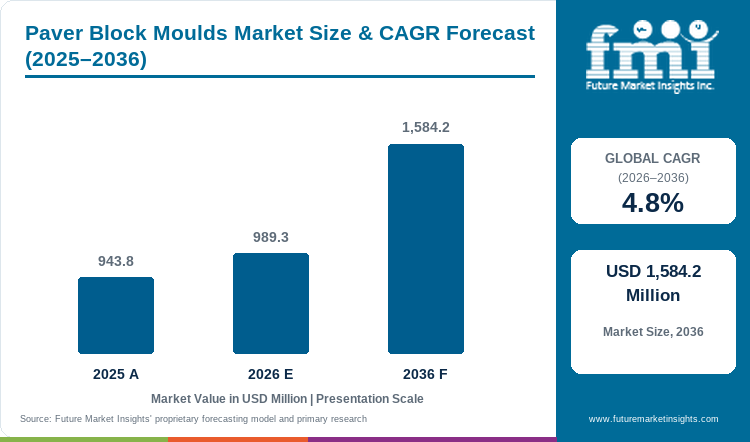
USD 989.3 Million in 2026 and USD 1,584.2 Million by 2036 at a 4.8% CAGR.
The Paver Block Moulds Market is projected to rise from USD 989.3 Million in 2026 to USD 1,584.2 Million by 2036. The forecast represents a 4.8% CAGR across the ten-year assessment period. The valuation stood at USD 943.8 million in 2025. Plants replace moulds as cavity wear changes product shape or new paver designs require different tooling. In May 2025, Kobra Formen started production at its Morocco unit for mould-frame manufacturing. Local frame production places replacement tooling closer to concrete block machines that require exact fit and dimensions.
Country demand follows different replacement and project cycles across mature and expanding production bases. Mexico is forecast at 5.7% CAGR through 2036, while Japan is projected at 4.0%. In January 2025, Mexico announced 263 kilometers of national road and interchange work. The plan expands road activity but does not measure mould sales. Paver blocks can serve selected project applications that require concrete-product output. Japan has a mature production base shaped by service planning and controlled tool changes. Project schedules and plant age change mould order timing across the two countries.
Key Takeaways
- Recurring mould replacement is attributable to cavity wear and new paver designs that change required tooling geometry.
- Interlocking paver moulds are projected to represent 34.0% of Mould Type revenue in 2026, supported by regular programs requiring consistent geometry.
- Hardened steel is expected to hold 43.0% of Material revenue in 2026, reinforced by longer wear life during high-cycle production.
- Within Paver Shape, zig-zag/interlocking is forecast at 31.0% in 2026, influenced by demand for stable edges and dependable interlocking performance.
- Machine-fit checks constrain supplier changes because every replacement mould must match the installed press before production begins.
- Key suppliers include Kobra Formen, Columbia Machine, Masa Group, Hess Group, Besser Company, QGM Zenith, Poyatos, Prensoland, Rometa, and Tiger International.
Analyst Perspective
"The commercial opportunity improves when mould makers prove machine fit and wear control before scheduled production begins. Wider adoption depends on service access because shorter runs create more tool changes and raise the need for fast repairs."
- Nikhil Kaitwade, Principal Consultant, Future Market Insights
How is the paver block moulds market segmented?
The paver block moulds market is segmented by Mould Type, Material, Paver Shape, End Use, Sales Channel, and Region.
The market uses five primary segmentation axes plus Region for global analysis. Mould Type covers interlocking paver, kerbstone, slab, permeable paver, and custom decorative moulds. Material includes hardened steel, polyurethane/rubber, plastic polymer, mild steel, and aluminum. Paver Shape includes zig-zag/interlocking, rectangular, hexagonal, kerb/edge blocks, and designer pavers. End Use covers concrete paver plants, municipal paving contractors, landscape product makers, precast plants, and small block units. Sales Channel includes block machine OEMs, aftermarket replacement suppliers, direct mould suppliers, and dealers/distributors.
What supports interlocking paver moulds within the Mould Type category?
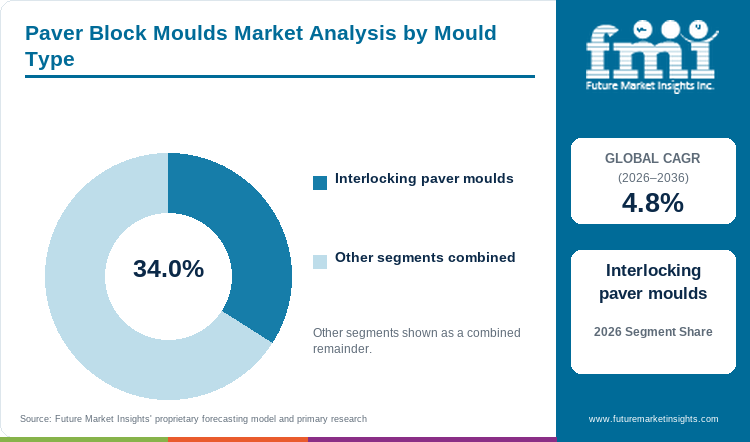
Interlocking moulds keep edge geometry stable during long production runs and support repeatable placement across finished pavers. Machine-laid paving depends on matched mould sets because each unit must connect with the next unit in a consistent pattern. Permeable concrete pavers add drainage openings that require precise cavity dimensions and stable edges through repeated press cycles. Small cavity changes can affect product fit and trigger additional checks before a production batch continues. In March 2025, Masa Group displayed a Kobra paver mould on its XL-R 9.1 production line. The display linked interlocking tooling with established plant equipment and controlled geometry during scheduled production runs.
- Interlocking paver moulds are set to lead Mould Type with 34.0% share in 2026, linked to regular programs that require stable geometry.
- Local frame production can shorten repair routes and keep proven mould inserts available for planned production runs.
Why does hardened steel lead the Material category in paver mould production?
Dry-cast concrete repeatedly abrades mould inserts and tamper parts during each production cycle. Hardened steel retains cavity shape through more cycles and delays repair compared with softer tooling materials. Precast concrete plants compare purchase cost with usable wear life because both affect the cost of each production run. Stable inserts reduce shape drift and help protect an approved paver specification during high-cycle production. In March 2025, Masa Group started research on plant-control systems that connect machine behavior with production data. The research tied machine motion to tool life and service timing, supporting more planned mould maintenance across active production lines.
- Hardened steel is estimated to hold 43.0% of Material revenue in 2026, owing to wear resistance during high-cycle dry-cast production.
- Usable mould cycles and repair time both shape tooling cost across scheduled production runs.
How does zig-zag/interlocking geometry influence Paver Shape selection in production?
Zig-zag pavers require stable edges so each finished unit locks correctly with surrounding units during installation. Concrete admixtures can change mix behavior, while the mould defines the final product shape and edge geometry. Small dimensional shifts can weaken the intended interlock and create extra checks during production or installation. In April 2025, HESS documented inline quality checks for concrete block and paver production lines. The system identifies finished-product shape changes that guide plant crews toward a repair decision. Stable shape control gives crews a clearer basis for deciding when mould repairs are necessary. Consistent mould geometry reduces avoidable finishing work and keeps the required paver profile stable throughout each production run.
- Zig-zag/interlocking is projected to hold 31.0% of Paver Shape demand in 2026, shaped by the need for stable geometry and reliable interlock performance.
- Installers use masonry saw blades for edge cuts, and accurate mould geometry limits unnecessary finishing across completed paving areas.
What supports concrete paver plants within the End Use category?
Dedicated paver plants treat moulds as core production tools because every product format needs a defined cavity and machine interface. The same dry-cast line can produce hollow concrete blocks once crews install tooling for the next product specification. Frequent product changes increase the value of planned mould handling and reliable setup records across each production schedule. In June 2025, Masa Group reported a Consent plant in Abu Dhabi that manages several concrete-product formats. The project used planned tooling changes to move between formats without changing the complete plant layout. The operating model ties daily output to dependable mould availability and controlled product changes across the same production system.
- Concrete paver plants are projected to account for 40.0% of End Use demand in 2026, tied to regular tooling use across scheduled production.
- Spare inserts and repair support protect daily output during planned mould changes and unexpected stops caused by tooling wear.
Why do block machine OEMs lead the Sales Channel category?
Every mould must match pallet dimensions and mounting points on the installed press before production begins. The tooling must suit vibration settings and the required finished product height. Block machine OEMs handle these interface checks during commissioning through a single route for machine and tooling specifications. Brick making machines use similar dry-cast production logic, so plants already manage tooling around fixed press dimensions. In January 2026, TOPWERK formed an after-sales unit as HESS continued service work across installed production systems. Integrated service simplifies troubleshooting when a replacement mould performs poorly during start-up. Direct mould specialists remain relevant for cross-machine support and repairs outside the original equipment group.
- Block machine OEMs are set to lead Sales Channel with 36.0% share in 2026, enabled by interface checks during commissioning.
- Direct mould specialists support plants that need cross-machine fit checks or repair services beyond the original equipment group.
What are the drivers, restraints and opportunities in the Paver Block Moulds Market?
Plant utilization supports replacement demand, machine-specific qualification slows switching, and faster verification can reduce changeover cost.
- Driver: Replacement demand is driven by longer production schedules that increase mould cycles and wear-part repair needs.
- Restraint: Supplier switching is constrained by machine-specific interfaces that require fit and size checks before plants approve another tooling source.
- Opportunity: Faster mould approval is enabled by inline quality records that document product condition during frequent switches and shorter runs.
Long production schedules increase abrasion on cavity edges and inserts, which raises the need for planned mould checks. In February 2025, CMHA reported 1.1 billion concrete blocks produced during the previous 12 months. The figure measures masonry output rather than mould sales, but it shows the scale of dry-cast production activity. Construction aggregates shape the concrete mix, and press cycles wear the tooling that controls finished dimensions. Each new paver format requires a mould matched to the installed press and approved product geometry. Plants schedule repairs before wear interrupts booked output and keep spare inserts available for planned changes. Higher line use increases replacement and maintenance work across active paver plants.
Machine-specific interfaces make paver moulds harder to switch than standard steel parts used outside production equipment. Each mould must match mounting points and pallet dimensions on the installed press. The design must suit vibration response and the required product height. In January 2025, HESS reported a block and paver line for Alomaier with semi-automatic mould changing. The project kept mould handling within a defined machine design and required controlled movement during production changes. Plants changing suppliers must test fit and product release before approving a full production run. Complex shapes add setup points and increase the cost of a failed change. These qualification checks can outweigh lower purchase prices and constrain supplier switching.
Short production runs increase the value of fast quality checks during frequent mould and product changes. In February 2026, Masa Group detailed optical quality control for fresh concrete products leaving the mould. The system checks product height and surface defects while the production run remains active. Plant teams use those records to identify shape drift and plan repairs before defects spread across more units. Faster evidence can reduce approval time for a new tool once machine-fit checks are complete. Paver production equipment benefits from inspection records that connect product condition with maintenance decisions. Live inspection gives mould specialists a practical route into plants that manage frequent product changes.
Which country CAGRs are profiled in the Paver Block Moulds Market?
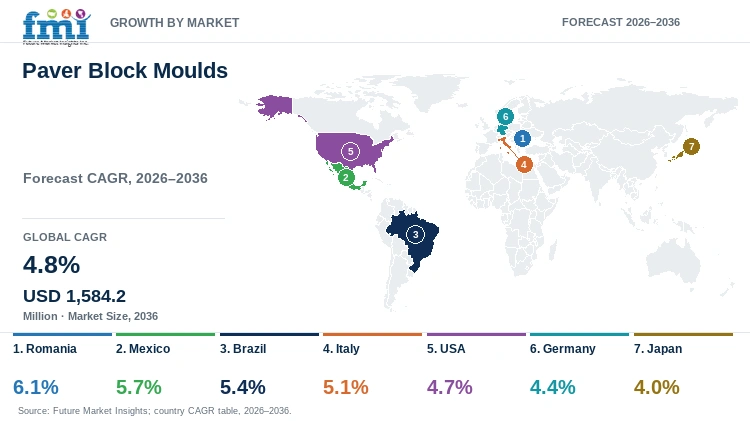
| Country | CAGR |
|---|---|
| Romania | 6.1% |
| Mexico | 5.7% |
| Brazil | 5.4% |
| Italy | 5.1% |
| USA | 4.7% |
| Germany | 4.4% |
| Japan | 4.0% |
How do country-level CAGRs compare in the Paver Block Moulds Market?
The seven profiled countries span 2.1 percentage points between Romania and Japan across the current forecast model. Project timing and plant age change how quickly mould orders appear in each country. Machine fleets and local service networks also shape which suppliers can support those orders.
- Romania's spread-out precast base increases the value of nearby mould repair and wear-part support during active motorway production programs.
- Regional concrete-product plants in Mexico favor adaptable moulds that can handle varied project sizes and different installed machine configurations.
- Staggered municipal project schedules in Brazil reward mould support that can respond quickly across separate local production windows.
- Italy's design-led paving work favors mould cavities that can switch between standard blocks and specialized surface shapes.
- Local repair shops and stocked wear parts in the USA help plants restore moulds without waiting for complete replacement tooling.
- German plants place strong weight on tool life and documented steel treatment before approving replacement moulds for established production lines.
- Tight labor schedules in Japan increase the value of clear interface data and planned service during mould changes.
The full report provides country-level CAGR analysis across all seven covered regions. Coverage includes North America, Latin America, Western Europe, Eastern Europe, East Asia, South Asia and Pacific, and the Middle East and Africa.
Country-wise Analysis
- Romanian precast plants are taking on more work as national road projects move into construction. Romania is estimated to expand at 6.1% CAGR through 2036, supported by motorway activity and local service needs. In October 2025, a European Parliament analysis listed 429 kilometers of planned TEN-T road infrastructure under Romania's recovery program. The target covers more than paver output and does not measure mould sales. The national pipeline can reach concrete-product plants through broader construction activity. Participating plants need moulds that match installed machines and product dimensions before production begins. Nearby wear parts and repair support protect schedules as project activity becomes recurring tooling work.
- Mexico is projected to grow at 5.7% CAGR through 2036, influenced by national road work and varied regional project schedules. Concrete-product producers serve road and local projects that require different paver formats and production windows. In January 2025, the Presidency announced 263 kilometers of road and interchange work planned for that year. The program does not measure mould orders but expands the pool of projects that may reach concrete-product plants. Plant owners need tooling that matches local machines and project budgets before each run begins. Modular inserts reduce setup costs for shorter orders with changing surface designs. Regional service and stocked wear parts limit delays as projects move from planning into production.
- Brazilian paver plants serve projects that begin at different times across states and municipalities. Brazil is predicted to advance at 5.4% CAGR through 2036, shaped by uneven municipal project timing and short production windows. In February 2025, the federal government said a new Novo PAC selection contained more than 20,000 defined deliveries nationwide. The program covers many project types and does not measure mould sales. The municipal pipeline can create production work for concrete-product producers without proving direct mould demand. Plants need tooling that matches each press and the surface shape required for each order. Regional repair access and adaptable inserts help protect short runs when project schedules change with limited notice.
- Paver block mould sales in Italy are forecast to expand at 5.1% CAGR through 2036, supported by established precast output and paving designs. Italian plants produce standard blocks and specialized surface shapes for streets and public spaces. In November 2025, ASSOBETON said a renewed national agreement for brick and cement-product manufacturing covered more than 11,000 workers. The figure confirms an established production workforce rather than direct mould demand. Many plants manage shorter runs that require frequent tooling changes and careful setup. Producers compare mould life with repair access before approving a new tool. Support for standard and custom forms reduces lost production time during design changes. The production mix rewards suppliers able to manage more than one cavity design.
- The USA is estimated to post 4.7% CAGR through 2036, reinforced by replacement work across a large concrete-product production base. Paver plants operate an extensive stock of block and paver machines that require compatible tooling throughout their service lives. In May 2026, the Bureau of Labor Statistics listed 103,800 jobs across concrete pipe and other concrete product manufacturing categories. The employment count includes brick and block production but does not measure mould sales. Replacement tools must match each press and planned paver shape before scheduled production resumes. Plants compare cavity accuracy with delivery time as tooling wear appears. Strong repair access shortens urgent replacement work and protects active production schedules.
- German paver plants value long tool life and exact shape control across established concrete-product production lines. Germany is anticipated to advance at 4.4% CAGR through 2036, linked to mature production and careful tooling qualification. In February 2025, solid UNIT said the national SLG association had joined its mineral construction network. SLG represents concrete products used in roads and gardens and other public spaces. The association provides technical guidance but does not measure mould sales. New tooling must pass machine-fit checks before plants approve full production. Clear steel-treatment records and repair plans can shorten that review. Fast local service reduces losses from unexpected tool stops and protects scheduled output.
- Japanese paver plants plan mould changes around tight labor schedules and strict service requirements. Paver block mould demand in Japan is forecast to rise at 4.0% CAGR through 2036, constrained by a mature base and limited specialist time. In February 2026, the Ministry of Land, Infrastructure, Transport and Tourism published its fiscal 2026 road budget overview. The national budget shapes project conditions but does not measure mould sales. Local plants test each tool for machine fit and product-shape control before regular use. Clear interface data shortens the review process for maintenance teams working with fewer specialist staff. Planned repair support keeps production on schedule and makes each tool change easier to verify.
Who are the notable companies in the Paver Block Moulds Market?
Kobra Formen, Columbia Machine, Masa Group, Hess Group, Besser Company, QGM Zenith, Poyatos, Prensoland, Rometa, and Tiger International.
Kobra Formen, Columbia Machine, Rometa, and Tiger International compete mainly through mould engineering and repair support. Masa Group, Hess Group, Besser Company, and QGM Zenith connect tooling with block machines and production services. Poyatos and Prensoland support mould changes inside plant equipment, giving buyers another route based on machine fit and service access.
- Specialist mould engineering: Kobra Formen, Columbia Machine, Rometa, Tiger International.
- Machine and tooling support: Masa Group, Hess Group, Besser Company, QGM Zenith.
- Mould-change plant systems: Poyatos, Prensoland.
Competitive Benchmarking: Paver Block Moulds Market
| Company | Mould Engineering | Machine Integration | After-Sales Support | Geographic Reach |
|---|---|---|---|---|
| Kobra Formen | High | Medium | Medium | Europe; international |
| Columbia Machine | High | High | High | North America; international |
| Masa Group | Medium | High | High | Europe; global |
| Hess Group | Medium | High | High | Europe; Americas; Asia; Middle East |
| Besser Company | High | High | High | North America; international |
| QGM Zenith | High | High | High | Europe; Asia; exports |
| Poyatos | Medium | High | High | Europe; Africa; Asia; Latin America |
| Prensoland | Medium | High | Medium | Europe; international |
| Rometa | High | High | High | Europe; exports |
| Tiger International | High | High | High | Americas; Europe; Asia |
The benchmark compares mould engineering and machine integration using public company records. It separately reviews after-sales support and documented geographic reach for each company. A High rating requires broad evidence across the named capability, while Medium indicates narrower documented coverage. A Low rating marks limited public evidence for the specific capability being assessed. Geographic reach describes documented coverage and does not raise or lower any capability rating.
Key Developments in the Paver Block Moulds Market
- In November 2025, Besser Company introduced an All About Molds course for its 2026 Blockmakers Workshops and plant teams.
- In October 2025, Hess Group reported that Mehramat Concretes had started a new automated concrete block production line.
- In September 2025, Masa Group reported a Cleannox paver-line upgrade that used a Masa Cuboter to remove a packaging bottleneck.
Key Players in the Paver Block Moulds Market
Specialist mould engineering
- Kobra Formen
- Columbia Machine
- Rometa
- Tiger International
Integrated machine-mould production platforms
- Masa Group
- Hess Group
- Besser Company
- QGM Zenith
Mould-change plant solutions
- Poyatos
- Prensoland
Paver Block Moulds Market - Report Scope
| Coverage field | Report scope |
|---|---|
| Market breakdown | By Mould Type, Material, Paver Shape, End Use, Sales Channel, and Region. |
| Quantitative Units | USD Million. |
| Market Definition | Commercial paver moulds, inserts, and wear parts for new or replacement tooling are included. Finished pavers, block machines, concrete, and unrelated forming equipment are excluded. |
| Regions Covered | North America, Latin America, Western Europe, Eastern Europe, East Asia, South Asia and Pacific, and Middle East and Africa. |
| Countries Covered | Romania, Mexico, Brazil, Italy, USA, Germany, Japan, and 20+ countries included in the full report. |
| Key Companies Profiled | Kobra Formen, Columbia Machine, Masa Group, Hess Group, Besser Company, QGM Zenith, Poyatos, Prensoland, Rometa, and Tiger International. |
| Forecast Period | 2026 to 2036. |
| Approach | Primary and secondary research with market triangulation. |
Paver Block Moulds Market - Research Methodology
| Method | Approach |
|---|---|
| Primary Research | FMI analysts gathered input from manufacturers, service providers, technology developers, distributors, end users, procurement teams, and subject-matter experts. Interviews examined purchasing decisions, product or service evaluation, adoption barriers, approval requirements, pricing considerations, and expectations for technical or commercial support. Respondents were also asked what evidence is required before a trial, pilot, or initial order develops into regular purchasing. |
| Desk Research | Desk research covered government statistics, regulatory publications, trade data, industry associations, technical literature, standards, company filings, product information, and official corporate announcements. Sources were reviewed for relevance, publication date, geographic coverage, and consistency with the defined market scope. Claims relating to performance, applications, approvals, capacity, investment, and commercial activity were retained only when supported by credible public evidence. |
| Market Sizing and Forecasting | The market model combined the baseline value with historical performance, segment structure, pricing and volume indicators, adoption levels, company participation, and country-level demand conditions. Forecast assumptions considered economic activity, investment trends, regulatory developments, technology adoption, purchasing cycles, supply availability, and barriers to wider market use. Segment and regional estimates were reconciled before the final market total was calculated. |
| Data Validation | Estimates were checked against multiple independent indicators, including public data, company activity, trade patterns, industry developments, and findings from primary interviews. Validation also tested whether products, services, applications, and company revenues fell within the defined market boundaries. Adjacent categories, unsupported claims, overlapping revenues, and activities without direct market relevance were excluded to reduce double counting and maintain consistency across segments and countries. |
Paver Block Moulds Market by Segments
Paver Block Moulds Market segmented by Mould Type:
- Interlocking paver moulds
- Kerbstone moulds
- Slab moulds
- Permeable paver moulds
- Custom decorative moulds
Paver Block Moulds Market segmented by Material:
- Hardened steel
- Polyurethane/rubber
- Plastic polymer
- Mild steel
- Aluminum
Paver Block Moulds Market segmented by Paver Shape:
- Zig-zag/interlocking
- Rectangular
- Hexagonal
- Kerb/edge blocks
- Designer pavers
Paver Block Moulds Market segmented by End Use:
- Concrete paver plants
- Municipal paving contractors
- Landscape product makers
- Precast plants
- Small block units
Paver Block Moulds Market segmented by Sales Channel:
- Block machine OEMs
- Aftermarket replacement suppliers
- Direct mould suppliers
- Dealer/distributor
Paver Block Moulds Market by Region:
- North America
- United States
- Canada
- Latin America
- Brazil
- Mexico
- Chile
- Rest of Latin America
- Western Europe
- Germany
- United Kingdom
- Italy
- Spain
- France
- Nordics
- Benelux
- Rest of Western Europe
- Eastern Europe
- Russia
- Poland
- Hungary
- Balkan and Baltic States
- Rest of Eastern Europe
- East Asia
- China
- Japan
- South Korea
- South Asia and Pacific
- India
- ASEAN
- Australia and New Zealand
- Rest of South Asia and Pacific
- Middle East and Africa
- Kingdom of Saudi Arabia
- Other GCC Countries
- Türkiye
- South Africa
- Other African Union Countries
- Rest of Middle East and Africa
Research Sources and Bibliography
- Masa Group. (2025, March 29). Kobra paver mould prepared for the Masa XL-R 9.1 bauma 2025 showcase.
- Masa Group. (2025, March 12). Masa at bauma - R&D project on intelligent plant control.
- HESS Group. (2025, April 4). Automatic non-contact quality control in concrete block and paver production.
- Masa Group. (2025, June 10). Major project in a league of its own - Consent sets new benchmarks with Masa plant.
- TOPWERK Group. (2026, January 6). TOPWERK establishes new business unit for after sales service.
- Concrete Masonry & Hardscapes Association. (2025, February 7). Message from the President: Celebrating success at the 2025 CMHA Annual Meeting.
- HESS Group. (2025, January 31). New concrete block and paver plant and value adding line for Alomaier Trading and Contracting Company.
- Masa Group. (2026, February 25). Masa Optical Quality Control - See more. Decide smarter. Produce better.
- U.S. Bureau of Labor Statistics. (2026, June). Employees on nonfarm payrolls by industry sector and selected industry detail, May 2026.
- solid UNIT. (2025, February 4). Concrete Association Road, Landscape, Garden becomes a new member.
- Ministry of Land, Infrastructure, Transport and Tourism, Japan. (2026, February 18). Fiscal 2026 road budget overview.
- Government of Brazil. (2025, February 12). New Novo PAC selections define more than 20,000 deliveries for municipalities and states.
- ASSOBETON. (2025, November 3). Renewal of the national collective agreement for brick and cement-product manufacturing.
- Presidency of Mexico. (2025, January 16). National road infrastructure program presented for 2025.
- European Parliament. (2025, October 14). Romania Recovery and Resilience Plan: In-depth analysis.
- Besser Company. (2025, November 11). Industry professionals invited to expand expertise at 2026 Blockmakers Workshops.
- HESS Group. (2025, October 21). Mehramat Concretes starts concrete block production - a plant with vision.
- Masa Group. (2025, September 4). Cleannox boosts production efficiency - Masa Cuboter ensures smooth packaging processes.
- TOPWERK Langfang. (2025, October 30). TW Langfang delivers first RH 500 C concrete block machine to Mexico.
- HESS Group. (2025, December 20). From family roots to future visions: Micheletto Pavimentazioni.
- Masa Group. (2026, August 19). Technical article on the Masa API published in CPi - Issue 04/2026.
- TOPWERK Group. (2026, March 24). Successful commissioning of an RH 500-C plant in Mexico.
- Columbia Machine. (2026, February). Big Board Mold Inspection Device introduced for concrete block mould inspection.
- HESS Group. (2025, June 5). Bonaire, divers’ paradise and CBKF.
- Besser Company. (2025, May 27). Unlock your plant’s full potential.
- Prensoland. (2025, April 4). Strengthening our presence in Spain, Turkey, and Asia.
- Masa Group. (2026, July 13). Masa Amplitude Monitoring featured in BFT.
- Kobra Formen GmbH. (2025, May 5). Production start in Morocco.
- Quangong Machinery. (2026, August 24). 35+ years of partnership: A new production chapter with Zenith 870.
- ROMETA Block Making Machine S.A. (2026, March 18). ROMETA 2030-80 - fully automated block production line in the UK.
- ImportInfo. (2026, September 17). Tiger International Inc. U.S. import activity: mould shipment to Pathfinder Integrated.
The bibliography lists the sources used for this article but does not represent the complete research record. The full report contains a broader reference list and additional documentation supporting the market analysis.
This Report Answers
- How large is the paver block moulds market through the 2036 forecast period?
- What production conditions trigger mould replacement during scheduled paver manufacturing runs?
- Which Mould Type holds the leading projected share during 2026?
- Why does hardened steel lead the Material category during high-cycle production?
- How does zig-zag geometry affect mould performance during repeated production cycles?
- How do country growth patterns differ across the seven profiled countries?
- Which companies supply paver moulds and related plant-production systems globally?
- How does machine fit affect supplier switching for replacement moulds?
Frequently Asked Questions
How big is the paver block moulds market in 2026?
The paver block moulds market is valued at USD 989.3 Million in 2026. It is projected to reach USD 1,584.2 Million by 2036, supported by replacement orders from mould wear and new paver formats.
What is the CAGR of the paver block moulds market from 2026 to 2036?
The paver block moulds market is projected to grow at 4.8% CAGR from 2026 through 2036. Current plant use and recurring mould wear support the replacement demand behind that forecast.
Which Mould Type leads the paver block moulds market in 2026?
Interlocking paver moulds are projected to account for 34.0% of Mould Type revenue in 2026. Regular production programs reinforce this position by requiring stable geometry across repeated scheduled runs.
Which Material category leads the paver block moulds market in 2026?
Hardened steel is estimated to hold 43.0% of Material revenue in 2026. Its wear resistance helps moulds retain cavity shape through high-cycle dry-cast production before repair becomes necessary.
Which companies are active in the paver block moulds market?
Key companies include Kobra Formen, Columbia Machine, Masa Group, Hess Group, and Besser Company. QGM Zenith, Poyatos, Prensoland, Rometa, and Tiger International serve paver mould or related plant-tooling needs. Some firms focus on specialist mould engineering and repair services for active plants. Others combine tooling with machines and service under integrated plant systems.
Preview the report firsthand - request a free sample
Get SampleGet the brochure for pricing and purchase details.
Get PDFTable of Content
- Key Takeaways
- Market Size and CAGR
- Top Growth Driver
- Fastest Growing Segment
- Leading Region
- Key Companies
- Emerging Opportunities
- Executive Summary
- Global Market Outlook
- Demand-side Trends
- Supply-side Trends
- Technology Roadmap Analysis
- Analysis and Recommendations
- Analyst Perspective (What is happening? Why now? What should investors know?)
- Key Questions Answered
- How large is the market?
- What is the CAGR?
- What are key trends?
- Which region dominates?
- Who are the leaders?
- Market Overview
- Market Coverage / Taxonomy
- Market Definition / Scope / Limitations
- Research Methodology
- Chapter Orientation
- Analytical Lens and Working Hypotheses
- Market Structure, Signals, and Trend Drivers
- Benchmarking and Cross-market Comparability
- Market Sizing, Forecasting, and Opportunity Mapping
- Research Design and Evidence Framework
- Desk Research Programme (Secondary Evidence)
- Expert Input and Fieldwork (Primary Evidence)
- Tooling, Models, and Reference Databases
- Data Engineering and Model Build
- Quality Assurance and Audit Trail
- Market Background
- Market Dynamics (Drivers, Restraints, Opportunity, Trends)
- Scenario Forecast (Optimistic, Likely, Conservative)
- Impact Analysis
- AI Impact
- Sustainability Impact
- Regulatory Impact
- Technology Impact
- Consumer / Buyer Analysis
- Purchase Drivers
- Adoption Barriers
- Buyer Journey
- Opportunity Map Analysis
- Product Life Cycle Analysis
- Supply Chain Analysis
- Investment Feasibility Matrix
- Value Chain Analysis
- PESTLE and Porter's Analysis
- Regulatory Landscape
- Regional Parent Market Outlook
- Production and Consumption Statistics
- Import and Export Statistics
- Global Market Analysis and Forecast, 2021 to 2036
- Historical Market Size Value (USD Million) Analysis, 2021 to 2025
- Current and Future Market Size Value (USD Million) Projections, 2026 to 2036
- Y-o-Y Growth Trend Analysis
- Absolute $ Opportunity Analysis
- Global Market Pricing Analysis, 2021 to 2036
- Global Market Analysis and Forecast, By Mould Type, 2021 to 2036
- Introduction / Key Findings
- Historical Market Size Value (USD Million) Analysis By Mould Type, 2021 to 2025
- Current and Future Market Size Value (USD Million) Analysis and Forecast By Mould Type, 2026 to 2036
- Interlocking paver moulds
- Kerbstone moulds
- Slab moulds
- Permeable paver moulds
- Custom decorative moulds
- Y-o-Y Growth Trend Analysis By Mould Type, 2021 to 2025
- Absolute $ Opportunity Analysis By Mould Type, 2026 to 2036
- Global Market Analysis and Forecast, By Material, 2021 to 2036
- Introduction / Key Findings
- Historical Market Size Value (USD Million) Analysis By Material, 2021 to 2025
- Current and Future Market Size Value (USD Million) Analysis and Forecast By Material, 2026 to 2036
- Hardened steel
- Polyurethane/rubber
- Plastic polymer
- Mild steel
- Aluminum
- Y-o-Y Growth Trend Analysis By Material, 2021 to 2025
- Absolute $ Opportunity Analysis By Material, 2026 to 2036
- Global Market Analysis and Forecast, By Paver Shape, 2021 to 2036
- Introduction / Key Findings
- Historical Market Size Value (USD Million) Analysis By Paver Shape, 2021 to 2025
- Current and Future Market Size Value (USD Million) Analysis and Forecast By Paver Shape, 2026 to 2036
- Zig-zag/interlocking
- Rectangular
- Hexagonal
- Kerb/edge blocks
- Designer pavers
- Y-o-Y Growth Trend Analysis By Paver Shape, 2021 to 2025
- Absolute $ Opportunity Analysis By Paver Shape, 2026 to 2036
- Global Market Analysis and Forecast, By End Use, 2021 to 2036
- Introduction / Key Findings
- Historical Market Size Value (USD Million) Analysis By End Use, 2021 to 2025
- Current and Future Market Size Value (USD Million) Analysis and Forecast By End Use, 2026 to 2036
- Concrete paver plants
- Municipal paving contractors
- Landscape product makers
- Precast plants
- Small block units
- Y-o-Y Growth Trend Analysis By End Use, 2021 to 2025
- Absolute $ Opportunity Analysis By End Use, 2026 to 2036
- Global Market Analysis and Forecast, By Sales Channel, 2021 to 2036
- Introduction / Key Findings
- Historical Market Size Value (USD Million) Analysis By Sales Channel, 2021 to 2025
- Current and Future Market Size Value (USD Million) Analysis and Forecast By Sales Channel, 2026 to 2036
- Block machine OEMs
- Aftermarket replacement suppliers
- Direct mould suppliers
- Dealer/distributor
- Y-o-Y Growth Trend Analysis By Sales Channel, 2021 to 2025
- Absolute $ Opportunity Analysis By Sales Channel, 2026 to 2036
- Global Market Analysis and Forecast, By Region, 2021 to 2036
- Introduction
- Historical Market Size Value (USD Million) Analysis By Region, 2021 to 2025
- Current Market Size Value (USD Million) Analysis and Forecast By Region, 2026 to 2036
- North America
- Latin America
- Western Europe
- Eastern Europe
- East Asia
- South Asia and Pacific
- Middle East and Africa
- Market Attractiveness Analysis By Region
- North America Market Analysis and Forecast, By Country, 2021 to 2036
- Historical Market Size Value (USD Million) Trend Analysis By Market Taxonomy, 2021 to 2025
- Market Size Value (USD Million) Forecast By Market Taxonomy, 2026 to 2036
- By Country
- United States
- Canada
- By Mould Type
- By Material
- By Paver Shape
- By End Use
- By Sales Channel
- By Country
- Market Attractiveness Analysis
- By Country
- By Mould Type
- By Material
- By Paver Shape
- By End Use
- By Sales Channel
- Key Takeaways
- Latin America Market Analysis and Forecast, By Country
- Historical Market Size Value (USD Million) Trend Analysis By Market Taxonomy, 2021 to 2025
- Market Size Value (USD Million) Forecast By Market Taxonomy, 2026 to 2036
- By Country
- Brazil
- Mexico
- Chile
- Rest of Latin America
- By Mould Type
- By Material
- By Paver Shape
- By End Use
- By Sales Channel
- By Country
- Market Attractiveness Analysis
- By Country
- By Mould Type
- By Material
- By Paver Shape
- By End Use
- By Sales Channel
- Key Takeaways
- Western Europe Market Analysis and Forecast, By Country
- Historical Market Size Value (USD Million) Trend Analysis By Market Taxonomy, 2021 to 2025
- Market Size Value (USD Million) Forecast By Market Taxonomy, 2026 to 2036
- By Country
- Germany
- United Kingdom
- Italy
- Spain
- France
- Nordics
- Benelux
- Rest of Western Europe
- By Mould Type
- By Material
- By Paver Shape
- By End Use
- By Sales Channel
- By Country
- Market Attractiveness Analysis
- By Country
- By Mould Type
- By Material
- By Paver Shape
- By End Use
- By Sales Channel
- Key Takeaways
- Eastern Europe Market Analysis and Forecast, By Country
- Historical Market Size Value (USD Million) Trend Analysis By Market Taxonomy, 2021 to 2025
- Market Size Value (USD Million) Forecast By Market Taxonomy, 2026 to 2036
- By Country
- Russia
- Poland
- Hungary
- Balkan and Baltic States
- Rest of Eastern Europe
- By Mould Type
- By Material
- By Paver Shape
- By End Use
- By Sales Channel
- By Country
- Market Attractiveness Analysis
- By Country
- By Mould Type
- By Material
- By Paver Shape
- By End Use
- By Sales Channel
- Key Takeaways
- East Asia Market Analysis and Forecast, By Country
- Historical Market Size Value (USD Million) Trend Analysis By Market Taxonomy, 2021 to 2025
- Market Size Value (USD Million) Forecast By Market Taxonomy, 2026 to 2036
- By Country
- China
- Japan
- South Korea
- By Mould Type
- By Material
- By Paver Shape
- By End Use
- By Sales Channel
- By Country
- Market Attractiveness Analysis
- By Country
- By Mould Type
- By Material
- By Paver Shape
- By End Use
- By Sales Channel
- Key Takeaways
- South Asia and Pacific Market Analysis and Forecast, By Country
- Historical Market Size Value (USD Million) Trend Analysis By Market Taxonomy, 2021 to 2025
- Market Size Value (USD Million) Forecast By Market Taxonomy, 2026 to 2036
- By Country
- India
- ASEAN
- Australia and New Zealand
- Rest of South Asia and Pacific
- By Mould Type
- By Material
- By Paver Shape
- By End Use
- By Sales Channel
- By Country
- Market Attractiveness Analysis
- By Country
- By Mould Type
- By Material
- By Paver Shape
- By End Use
- By Sales Channel
- Key Takeaways
- Middle East and Africa Market Analysis and Forecast, By Country
- Historical Market Size Value (USD Million) Trend Analysis By Market Taxonomy, 2021 to 2025
- Market Size Value (USD Million) Forecast By Market Taxonomy, 2026 to 2036
- By Country
- Kingdom of Saudi Arabia
- Other GCC Countries
- Türkiye
- South Africa
- Other African Union Countries
- Rest of Middle East and Africa
- By Mould Type
- By Material
- By Paver Shape
- By End Use
- By Sales Channel
- By Country
- Market Attractiveness Analysis
- By Country
- By Mould Type
- By Material
- By Paver Shape
- By End Use
- By Sales Channel
- Key Takeaways
- Key Countries Market Analysis
- United States
- Pricing Analysis
- Market Share Analysis, 2025
- By Mould Type
- By Material
- By Paver Shape
- By End Use
- By Sales Channel
- Canada
- Pricing Analysis
- Market Share Analysis, 2025
- By Mould Type
- By Material
- By Paver Shape
- By End Use
- By Sales Channel
- Mexico
- Pricing Analysis
- Market Share Analysis, 2025
- By Mould Type
- By Material
- By Paver Shape
- By End Use
- By Sales Channel
- Brazil
- Pricing Analysis
- Market Share Analysis, 2025
- By Mould Type
- By Material
- By Paver Shape
- By End Use
- By Sales Channel
- Chile
- Pricing Analysis
- Market Share Analysis, 2025
- By Mould Type
- By Material
- By Paver Shape
- By End Use
- By Sales Channel
- Germany
- Pricing Analysis
- Market Share Analysis, 2025
- By Mould Type
- By Material
- By Paver Shape
- By End Use
- By Sales Channel
- United Kingdom
- Pricing Analysis
- Market Share Analysis, 2025
- By Mould Type
- By Material
- By Paver Shape
- By End Use
- By Sales Channel
- Italy
- Pricing Analysis
- Market Share Analysis, 2025
- By Mould Type
- By Material
- By Paver Shape
- By End Use
- By Sales Channel
- Spain
- Pricing Analysis
- Market Share Analysis, 2025
- By Mould Type
- By Material
- By Paver Shape
- By End Use
- By Sales Channel
- France
- Pricing Analysis
- Market Share Analysis, 2025
- By Mould Type
- By Material
- By Paver Shape
- By End Use
- By Sales Channel
- India
- Pricing Analysis
- Market Share Analysis, 2025
- By Mould Type
- By Material
- By Paver Shape
- By End Use
- By Sales Channel
- ASEAN
- Pricing Analysis
- Market Share Analysis, 2025
- By Mould Type
- By Material
- By Paver Shape
- By End Use
- By Sales Channel
- Australia and New Zealand
- Pricing Analysis
- Market Share Analysis, 2025
- By Mould Type
- By Material
- By Paver Shape
- By End Use
- By Sales Channel
- China
- Pricing Analysis
- Market Share Analysis, 2025
- By Mould Type
- By Material
- By Paver Shape
- By End Use
- By Sales Channel
- Japan
- Pricing Analysis
- Market Share Analysis, 2025
- By Mould Type
- By Material
- By Paver Shape
- By End Use
- By Sales Channel
- South Korea
- Pricing Analysis
- Market Share Analysis, 2025
- By Mould Type
- By Material
- By Paver Shape
- By End Use
- By Sales Channel
- Russia
- Pricing Analysis
- Market Share Analysis, 2025
- By Mould Type
- By Material
- By Paver Shape
- By End Use
- By Sales Channel
- Poland
- Pricing Analysis
- Market Share Analysis, 2025
- By Mould Type
- By Material
- By Paver Shape
- By End Use
- By Sales Channel
- Hungary
- Pricing Analysis
- Market Share Analysis, 2025
- By Mould Type
- By Material
- By Paver Shape
- By End Use
- By Sales Channel
- Kingdom of Saudi Arabia
- Pricing Analysis
- Market Share Analysis, 2025
- By Mould Type
- By Material
- By Paver Shape
- By End Use
- By Sales Channel
- Türkiye
- Pricing Analysis
- Market Share Analysis, 2025
- By Mould Type
- By Material
- By Paver Shape
- By End Use
- By Sales Channel
- South Africa
- Pricing Analysis
- Market Share Analysis, 2025
- By Mould Type
- By Material
- By Paver Shape
- By End Use
- By Sales Channel
- Romania
- Pricing Analysis
- Market Share Analysis, 2025
- By Mould Type
- By Material
- By Paver Shape
- By End Use
- By Sales Channel
- United States
- Market Structure Analysis
- Competition Dashboard
- Competition Benchmarking
- Market Share Analysis of Top Players
- By Regional
- By Mould Type
- By Material
- By Paver Shape
- By End Use
- By Sales Channel
- Emerging Startups
- Innovation Benchmarking
- Competition Analysis
- Competition Deep Dive
- Kobra Formen
- Overview
- Product Portfolio
- Profitability by Market Segments
- Sales Footprint
- Strategy Overview
- Marketing Strategy
- Product Strategy
- Channel Strategy
- Columbia Machine
- Masa Group
- Hess Group
- Besser Company
- QGM Zenith
- Poyatos
- Prensoland
- Rometa
- Tiger International
- Kobra Formen
- Case Studies
- Success Stories
- Recent Developments
- Competition Deep Dive
- Assumptions & Acronyms Used


