

- Market Size (2026)
- USD 1.7 Bn
- Forecast (2036)
- USD 2.8 Bn
- CAGR (2026 to 2036)
- 5.4%
How big is Masonry Saw Blades Market in 2026?
USD 1.7 billion in 2026 and USD 2.8 billion by 2036 at a 5.4% CAGR.
Sales of masonry saw blades are estimated to rise at 5.4% CAGR through 2036 and increase from USD 1.7 billion in 2026 to USD 2.8 billion. Contractors assess blades with compatible power tools because water delivery controls airborne dust and removes heat during concrete or block cutting. OSHA states that blade-applied water substantially reduces silica-bearing dust and supports documented operating controls across recurring abrasive products purchases.
Country demand follows different approval routes even though crews complete similar cutting tasks across renovation and new construction sites. United Kingdom contractors face direct enforcement while German firms depend more heavily on documented low-dust systems and specialist technical support. In July 2025, HSE cited brick cutting that generated silica dust without adequate planning or risk control. This pressure favors industrial diamond products sold through equipment rental networks that provide matched diameters and practical setup guidance.
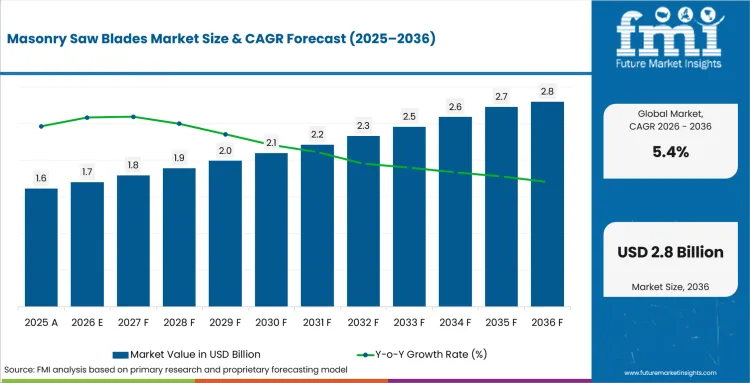
Key Takeaways of Masonry Saw Blades Market
- Recurring masonry cutting supports replacement demand for blades that preserve usable depth under documented dust-control methods across professional projects.
- Segmented diamond blades are forecast to hold 34.0% share in 2026 because open gullets clear abrasive debris efficiently during repeated cuts.
- The 7-14 inch range is projected to hold 39.0% share in 2026 through broad compatibility across portable construction saws.
- Concrete block is anticipated to capture 31.0% share in 2026 because walls require frequent resizing and utility penetrations during construction.
- Incorrect fitment and weak water delivery reduce blade life while increasing stoppages, exposure risks and corrective costs across active worksites.
- Husqvarna and Saint-Gobain Norton compete beside Bosch and Hilti through blade breadth, machine fitment and dependable service access.
Analyst Perspective
“Blade economics depend on usable cutting depth across active projects rather than the purchase price recorded at the counter. Contractors gain better value from matched systems that connect material rating with diameter, cooling and local replacement support.”
- Nikhil Kaitwade, Principal Consultant, Future Market Insights
How is the Masonry Saw Blades Market segmented?
The masonry saw blades industry is segmented by blade type, diameter, material cut, tool fitment, sales channel, and region.
Blade type separates segmented, turbo and continuous-rim designs from abrasive or demolition blades according to cutting and finish requirements. Diameter spans below seven inches through above twenty inches because machine capacity determines practical cutting depth. Material cut covers concrete block, brick and pavers alongside natural stone or refractory products with different wear behavior. Tool fitment includes angle grinders, cut-off saws and masonry saws alongside walk-behind systems used across different depths. Sales channels cover hardware retail and construction-tool distributors alongside e-commerce, rental networks and contractor supply routes. Cutting tools and tile saws provide adjacent purchasing references across several professional cutting applications and recurring replacement programs.
What makes segmented diamond blades central to the blade type category?
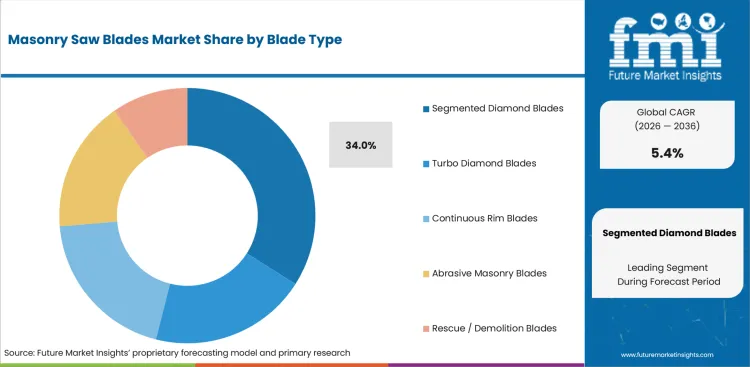
Segmented diamond blades use open gullets to release debris and limit heat during interrupted concrete or brick cuts. Their commercial value increases when contractors combine fast material removal with documented dust controls across recurring professional projects. In January 2025, HSE prohibited brick and block cutting operations that lacked adequate water suppression controls onsite. The notice reinforces demand for compatible blades that maintain output within controlled wet-cutting setups across active construction projects.
- Segmented diamond blades are estimated to capture 34.0% share in 2026 because open gullets clear abrasive debris and reduce heat during repeated cuts.
- Contractors favor segmented designs for block and concrete work that values cutting speed and service life over polished edges. Distributors support adoption through material matching and stocked replacement sizes near active construction projects and regional contractor fleets.
Why does the 7-14 inch range shape the diameter category?
Portable cut-off saws concentrate professional demand within 7-14 inch formats because machine capacity sets practical depth without fixed equipment. Makita displayed a fourteen-inch cordless power cutter during January 2025 and linked this format with five-inch cutting depth.
- The 7-14 inch range is projected to account for 39.0% in 2026 because portable construction saws support broad compatibility across professional fleets.
- Distributors favor these sizes because contractors replace portable-saw blades during active projects with limited scheduling flexibility. Familiar diameters and stocked arbor options simplify planned or emergency purchasing across mixed professional fleets.
How does concrete block support the material cut category?
Concrete masonry units combine abrasive aggregate with repetitive straight cuts across wall construction and renovation. In July 2025, OSHA cited concrete-masonry cutting with a handheld saw that lacked continuous blade water. The record links block-cutting purchases with compatible equipment and defensible operating controls across professional construction projects.
- Concrete block is projected to hold 31.0% share in 2026 owing to frequent resizing across walls and utility penetrations during construction.
- Contractors choose purpose-rated block blades to reduce wandering cuts and unexpected tool changes during recurring wall installation work. Hardware stores support adoption through common diameters, water-control accessories and clear fitment guidance for active contractors.
What supports angle grinders within the tool fitment category?
Angle grinders provide compact access for trimming installed masonry beyond the reach of larger saws. Makita released two five-inch flathead grinders in May 2026 with active feedback control and compact heads for confined work. The development reinforces speed and guard checks across interior repairs conducted within occupied or confined building spaces.
- Angle grinders are forecast to represent 31.0% in 2026 because compact tools provide controlled access around joints and installed details.
- Contractors use grinder-mounted blades for short cuts that do not justify dedicated masonry saws during scheduled repair programs. Adoption depends on guard compatibility and disciplined speed checks across occupied or confined work areas.
What drives hardware retail within the sales channel category?
Hardware retailers serve replacement demand from contractors who cannot suspend active work during specialist delivery. Makita released a hose connector in October 2025 that joins water sprayers with power cutters for dust suppression. The development supports complete retail packages instead of isolated blade sales during urgent replacement work onsite.
- Hardware retail is estimated to hold 38.0% in 2026 owing to immediate access to common diameters and recognizable fitment information.
- Independent stores and large chains convert demand through practical guidance on material ratings and wet or dry operation. Sales weaken when staff cannot confirm arbor compatibility during urgent replacement purchases across active regional construction projects.
What are the drivers, restraints, and opportunities in the Masonry Saw Blades Market?
Stricter dust-control expectations support demand; fitment errors and operator risk limit dependable results; integrated systems strengthen repeat blade and accessory sales.
- Driver: Construction crews need blades that preserve cutting depth and maintain water delivery throughout masonry tasks.
- Restraint: Unsuitable guards and speeds shorten blade life and increase worker exposure during professional masonry cutting.
- Opportunity: Manufacturers can pair blades with saws and water kits through systems supported by replacement service.
Silica controls support demand because crews must cut concrete block without sacrificing output or worker protection. OSHA cited handheld cinder-block cutting in April 2025 because the saw lacked continuous blade water. This violation favors matched blade and dust extractor packages that support productive work through a documented operating method.
Incorrect setup shortens blade life and weakens respiratory protection across professional masonry work involving changing crews onsite. HSE cited brick cutting in October 2025 as available masks did not protect workers with facial hair. The record favors fit-tested protection and on-tool extraction packages across projects with changing crews and variable cutting conditions.
Matched cutting packages combine blades with water delivery and dependable replacement support across contractor fleets. HSE prohibited silica-bearing material cutting without adequate water suppression in February 2026 across active construction projects. This action strengthens demand for cordless equipment packages backed by regional service and stocked accessories.
Which country CAGRs are profiled in the Masonry Saw Blades Market?
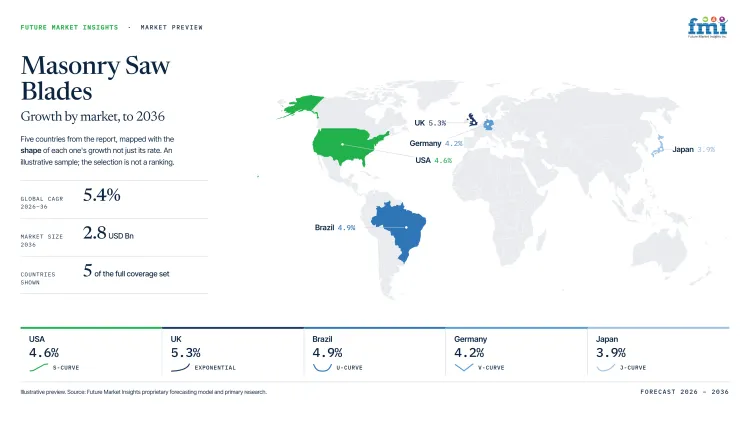
| Country | CAGR |
|---|---|
| United States | 4.6% |
| Germany | 4.2% |
| Japan | 3.9% |
| UK | 5.3% |
| Brazil | 4.9% |
How do country-level CAGRs compare in the Masonry Saw Blades Market?
The five forecasts span 1.4 percentage points and reflect different routes to compliant masonry cutting through 2036.
- United Kingdom enforcement gives compliant water-control packages a purchasing route across renovation and brickwork projects.
- Brazilian dealers convert dust controls into replacement sales despite wider service distances across construction sites.
- United States rules connect approval with continuous blade water and operating practices across contractor fleets.
- German technical channels emphasize tested low-dust systems and service quality across professional masonry cutting programs.
- Japanese renovation work favors compact equipment and material checks across occupied buildings with limited space.
The full report provides country-level CAGR analysis across North America, Latin America, Europe, East Asia, South Asia, Oceania and the Middle East and Africa.
Country-wise Analysis
- United States contractors follow OSHA Table 1 controls that prescribe continuous water delivery for qualifying masonry-saw tasks. Masonry saw blade sales are forecast to expand at 4.6% CAGR by 2036 across professional construction channels. In January 2026, OSHA cited brick cutting with a portable saw that lacked integrated water delivery. The record connects equipment approval with water-system compatibility across contractor fleets, rental channels and tool-hire networks.
- German construction firms evaluate mineral-dust exposure through formal risk assessments and tested low-dust systems across professional construction sites. Germany’s masonry saw blades outlook is anticipated to advance at 4.2% CAGR over the assessment period. In April 2025, the Federal Ministry of Labour added chronic obstructive bronchitis from long-term quartz-dust exposure to the occupational disease list. Specialist distributors can translate this attention into machine matching and service support during project approval and replacement planning. High labor costs remain a friction because slow cutting can erase savings from lower blade prices.
- Japanese renovation projects require material checks before crews cut older surfaces inside occupied or space-constrained buildings. Masonry saw blade demand is projected to advance at 3.9% CAGR through 2036 due to national renovation programs. In September 2025, the Ministry of Health announced a nationwide asbestos-control patrol for demolition and renovation sites. The program reinforces pre-cut verification that affects blade selection and containment planning before crews begin cutting work.
- United Kingdom contractors face enforcement when brick or block cutting releases silica without suitable controls. Masonry saw blade adoption is estimated to expand at 5.3% CAGR by 2036 owing to national construction channels. In July 2025, HSE cited missing water suppression and face-fit testing during brick and block cutting. The action links blade purchasing with documented respiratory methods and compliant tool-hire packages across established rental networks. Immediate stoppage remains a friction until contractors correct equipment and workforce controls before scheduled masonry work resumes.
- Brazilian contractors operate under national controls for occupational exposure to mineral dust across formal construction workplaces. The market is estimated to post 4.9% CAGR over the forecast period through 2036. Portaria MTE Number 105 amended NR-9 during January 2026 and approved a dedicated mineral-dust exposure annex. Major-city dealers can translate updated exposure controls into water-controlled equipment selection and practical fitment support.
Who are the notable companies in the Masonry Saw Blades Market?
Husqvarna, Saint-Gobain Norton, Bosch, Hilti, Makita, Milwaukee Tool, Tyrolit, and DEWALT are the notable companies profiled in this market.
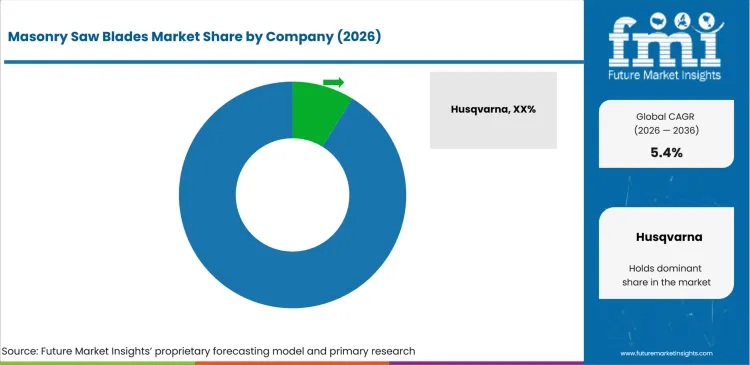
The competitive field combines diamond-tool specialists with power-tool groups that compete through blade coverage, machine compatibility and dependable service access.
- Husqvarna, Saint-Gobain Norton and Tyrolit cover concrete or block cutting alongside natural-stone applications through specialist diamond-tool portfolios.
- Bosch, Makita and DEWALT connect blades with grinders or cut-off saws through established dealer networks and familiar fitment routes.
- Hilti combines cutting equipment with application guidance and fleet support across professional construction accounts and active regional projects.
Competitive Benchmarking: Masonry Saw Blades Market
| Company | Jobsite Productivity | Safety Documentation | Channel Support | Geographic Reach |
|---|---|---|---|---|
| Husqvarna | High | High | High | Global or multi-region |
| Saint-Gobain Norton | High | Medium | High | Global or multi-region |
| Bosch | High | High | High | Global or multi-region |
| Hilti | High | High | High | Global or multi-region |
| Makita | High | Medium | High | Global or multi-region |
| Milwaukee Tool | Medium | High | High | North America and selected export markets |
| Tyrolit | High | Medium | Medium | Global or multi-region |
| DEWALT | Medium | Medium | High | Global or multi-region |
Key Developments in the Masonry Saw Blades Market
- In February 2026, Husqvarna Construction launched the Elite-Cut F1600C flat-saw blade series for cured and reinforced concrete with aligned-diamond and controlled-distribution variants.
- In April 2026, Bosch expanded its Expert range with 230-millimeter and 180-millimeter cordless angle grinders alongside compact models that included X-Lock options.
- In October 2025, Hilti expanded the Nuron platform with more than sixty tools and accessories covering heavy-duty applications including concrete cutting.
- In December 2025, Milwaukee Tool introduced a dual-trigger braking grinder with RAPIDSTOP braking and AUTOSTOP kickback control alongside variable-speed operation.
Masonry Saw Blades Market - Report Scope
| Coverage field | Report scope |
|---|---|
| Market breakdown | Blade type, diameter, material cut, tool fitment, sales channel, and region. |
| Market Definition | Masonry saw blades are replaceable cutting discs designed for concrete, brick, block, pavers, natural stone, and refractory materials. The scope includes diamond and abrasive blades sold for compatible grinders, cut-off saws, masonry saws, and walk-behind systems. |
| Regions Covered | North America, Latin America, Europe, East Asia, South Asia, Oceania, and Middle East and Africa. |
| Countries Covered | United States, Germany, Japan, UK, and Brazil. |
| Key Companies Profiled | Husqvarna, Saint-Gobain Norton, Bosch, Hilti, Makita, Milwaukee Tool, Tyrolit, and DEWALT. |
| Forecast Period | 2026 to 2036. |
| Approach | Hybrid bottom-up and top-down market sizing supported by primary interviews and official desk research. |
Masonry Saw Blades Market - Research Methodology
| Method | Approach |
|---|---|
| Primary Research | Analysts examined manufacturer and distributor views alongside contractor feedback on purchasing criteria, fitment requirements and service expectations plus adoption barriers. |
| Desk Research | The team reviewed official enforcement records and company releases alongside technical literature, product documentation and relevant market disclosures. |
| Market Sizing and Forecasting | Models combined baseline values with segment structure and replacement cycles alongside pricing signals, construction activity and country-level operating conditions. |
| Data Validation | Findings were checked through source triangulation and expert review while excluding adjacent cutting products and unsupported market claims. |
Masonry Saw Blades Market by Segments
Masonry Saw Blades Market segmented by Blade Type:
- Segmented Diamond Blades
- Turbo Diamond Blades
- Continuous Rim Blades
- Abrasive Masonry Blades
- Rescue / Demolition Blades
Masonry Saw Blades Market segmented by Diameter:
- 7-14 inch
- <7 inch
- 14-20 inch
- >20 inch
Masonry Saw Blades Market segmented by Material Cut:
- Concrete Block
- Brick
- Pavers
- Natural Stone
- Roof Tile / Refractory
Masonry Saw Blades Market segmented by Tool Fitment:
- Angle Grinders
- Cut-off Saws
- Masonry Saws
- Walk-behind Saws
Masonry Saw Blades Market segmented by Sales Channel:
- Hardware Retail
- Construction Tool Distributors
- E-commerce
- Rental / Contractor Supply
Masonry Saw Blades Market by Region:
- North America
- United States
- Canada
- Latin America
- Brazil
- Mexico
- Argentina
- Chile
- Western Europe
- Germany
- France
- United Kingdom
- Italy
- Spain
- Benelux
- Nordics
- Eastern Europe
- Poland
- Czech Republic
- Romania
- Hungary
- East Asia
- Japan
- South Korea
- South Asia and Pacific
- ASEAN
- Australia and New Zealand
- Middle East and Africa
- GCC Countries
- South Africa
- Türkiye
- Israel
Research Sources and Bibliography
- Occupational Safety and Health Administration. (2026). Silica, Crystalline - Construction.
- Health and Safety Executive. (2025, July 30). Notice 315329979 served against The Market Design and Build Limited.
- Health and Safety Executive. (2025, January 17). Notice 314797017 served against Yarwoods SPV Ltd.
- Makita U.S.A. (2025, January 28). MAKITA LIGHTS UP WORLD OF CONCRETE 2025 WITH NEW PRODUCTS, DYNAMIC HANDS-ON DEMOS, AND MORE.
- Occupational Safety and Health Administration. (2026, January 30). M&M Masonry, Inc.
- Makita U.S.A. (2026, May 5). MAKITA RELEASES TWO NEW 5” FLATHEAD GRINDERS FOR THE XGT® SYSTEM.
- Makita U.S.A. (2025, October 7). MAKITA RELEASES NEW ACCESSORY FOR CONCRETE PROS.
- Occupational Safety and Health Administration. (2025, April 8). Lomas Tuckpointing & Masonry Llc.
- Health and Safety Executive. (2025, October 30). Notice 315418833 served against Construction Cutting Services Limited.
- Health and Safety Executive. (2026, February 27). Notice 315707678 served against All Builds Construction Limited.
- Occupational Safety and Health Administration. (2025, July 23). Morris & Associates Masonry Inc.
- Federal Ministry of Labour and Social Affairs. (2025, April 1). Ergänzung der Berufskrankheitenliste.
- Ministry of Health, Labour and Welfare. (2025, September 30).
- Health and Safety Executive. (2025, July 7). Notice 315183593 served against Bestwick Estates Limited.
- Ministério do Trabalho e Emprego. (2026, January 29). Portaria MTE No. 105 on mineral-dust exposure.
- Husqvarna Construction. (2026, February 26). Husqvarna Construction launches new, versatile range of flat saw diamond blades.
- Robert Bosch Power Tools GmbH. (2026, April 22). Neu in der Top-Leistungsklasse Expert von Bosch: Drei Akku-Winkelschleifer für anspruchsvolle Profis.
- Hilti Group. (2025, October 21). Hilti Launches Heavy-Duty Cordless Tools to Drive Productivity.
- Milwaukee Tool. (2025, December 9). Milwaukee Tool’s Dual-Trigger Braking Grinder Delivers Maximum Control.
This bibliography is provided for reader reference and is not exhaustive. The full report contains the complete reference list and detailed citations
This Report Answers
- How large is the global Masonry Saw Blades market, and what is its growth outlook through 2036?
- What dust-control and safety requirements shape blade purchasing decisions?
- Why do segmented diamond blades lead the blade type category?
- How does diameter selection affect compatibility across professional saws?
- Why does concrete block lead the material cut category?
- How do market growth rates and enforcement routes compare across major countries?
- Which leading companies compete in the masonry saw blades market?
- What factors limit blade life and cutting performance on active worksites?`
Frequently Asked Questions
How big is the Masonry Saw Blades Market in 2026?
The masonry saw blades market is valued at USD 1.7 billion in 2026 and is forecast to reach USD 2.8 billion by 2036. Growth is supported by contractors adopting blades with compatible water-delivery systems that control airborne silica dust during concrete and block cutting operations.
What is the CAGR of the Masonry Saw Blades Market from 2026 to 2036?
The masonry saw blades market grows at a CAGR of 5.4% between 2026 and 2036, driven by construction crews needing blades that preserve cutting depth and maintain water delivery, while incorrect guard and speed setup shortens blade life and increases worker exposure.
Which blade type leads the Masonry Saw Blades Market?
Segmented diamond blades lead the masonry saw blades market by blade type, holding 34.0% share in 2026 because open gullets clear abrasive debris and reduce heat during repeated concrete and brick cuts across recurring professional projects.
How much will the Masonry Saw Blades Market add between 2026 and 2036?
The masonry saw blades market is set to add USD 1.1 billion between 2026 and 2036, growing from USD 1.7 billion to USD 2.8 billion as documented dust-control requirements expand replacement demand for compatible diamond blade systems across contractor fleets.
Who are the leading companies in the Masonry Saw Blades Market?
Eight companies lead the masonry saw blades market, including Husqvarna, Saint-Gobain Norton, Bosch, Hilti, Makita, Milwaukee Tool, Tyrolit, and DEWALT, competing through blade breadth, machine fitment, safety documentation and dealer channel support.
Preview the report firsthand - request a free sample
Get SampleGet the brochure for pricing and purchase details.
Get PDFTable of Content
- Key Takeaways
- Market Size and CAGR
- Top Growth Driver
- Fastest Growing Segment
- Leading Region
- Key Companies
- Emerging Opportunities
- Executive Summary
- Global Market Outlook
- Demand-side Trends
- Supply-side Trends
- Technology Roadmap Analysis
- Analysis and Recommendations
- Analyst Perspective (What is happening? Why now? What should investors know?)
- Key Questions Answered
- How large is the market?
- What is the CAGR?
- What are key trends?
- Which region dominates?
- Who are the leaders?
- Market Overview
- Market Coverage / Taxonomy
- Market Definition / Scope / Limitations
- Research Methodology
- Chapter Orientation
- Analytical Lens and Working Hypotheses
- Market Structure, Signals, and Trend Drivers
- Benchmarking and Cross-market Comparability
- Market Sizing, Forecasting, and Opportunity Mapping
- Research Design and Evidence Framework
- Desk Research Programme (Secondary Evidence)
- Expert Input and Fieldwork (Primary Evidence)
- Tooling, Models, and Reference Databases
- Data Engineering and Model Build
- Quality Assurance and Audit Trail
- Market Background
- Market Dynamics (Drivers, Restraints, Opportunity, Trends)
- Scenario Forecast (Optimistic, Likely, Conservative)
- Impact Analysis
- AI Impact
- Sustainability Impact
- Regulatory Impact
- Technology Impact
- Consumer / Buyer Analysis
- Purchase Drivers
- Adoption Barriers
- Buyer Journey
- Opportunity Map Analysis
- Product Life Cycle Analysis
- Supply Chain Analysis
- Investment Feasibility Matrix
- Value Chain Analysis
- PESTLE and Porter's Analysis
- Regulatory Landscape
- Regional Parent Market Outlook
- Production and Consumption Statistics
- Import and Export Statistics
- Global Market Analysis and Forecast, 2021 to 2036
- Historical Market Size Value (USD Billion) Analysis, 2021 to 2025
- Current and Future Market Size Value (USD Billion) Projections, 2026 to 2036
- Y-o-Y Growth Trend Analysis
- Absolute $ Opportunity Analysis
- Global Market Pricing Analysis, 2021 to 2036
- Global Market Analysis and Forecast, By Blade Type, 2021 to 2036
- Introduction / Key Findings
- Historical Market Size Value (USD Billion) Analysis By Blade Type, 2021 to 2025
- Current and Future Market Size Value (USD Billion) Analysis and Forecast By Blade Type, 2026 to 2036
- Segmented Diamond Blades
- Turbo Diamond Blades
- Continuous Rim Blades
- Abrasive Masonry Blades
- Rescue / Demolition Blades
- Segmented Diamond Blades
- Y-o-Y Growth Trend Analysis By Blade Type, 2021 to 2025
- Absolute $ Opportunity Analysis By Blade Type, 2026 to 2036
- Global Market Analysis and Forecast, By Diameter, 2021 to 2036
- Introduction / Key Findings
- Historical Market Size Value (USD Billion) Analysis By Diameter, 2021 to 2025
- Current and Future Market Size Value (USD Billion) Analysis and Forecast By Diameter, 2026 to 2036
- 7-14 inch
- <7 inch
- 14-20 inch
- >20 inch
- 7-14 inch
- Y-o-Y Growth Trend Analysis By Diameter, 2021 to 2025
- Absolute $ Opportunity Analysis By Diameter, 2026 to 2036
- Global Market Analysis and Forecast, By Material Cut, 2021 to 2036
- Introduction / Key Findings
- Historical Market Size Value (USD Billion) Analysis By Material Cut, 2021 to 2025
- Current and Future Market Size Value (USD Billion) Analysis and Forecast By Material Cut, 2026 to 2036
- Concrete Block
- Brick
- Pavers
- Natural Stone
- Roof Tile / Refractory
- Concrete Block
- Y-o-Y Growth Trend Analysis By Material Cut, 2021 to 2025
- Absolute $ Opportunity Analysis By Material Cut, 2026 to 2036
- Global Market Analysis and Forecast, By Tool Fitment, 2021 to 2036
- Introduction / Key Findings
- Historical Market Size Value (USD Billion) Analysis By Tool Fitment, 2021 to 2025
- Current and Future Market Size Value (USD Billion) Analysis and Forecast By Tool Fitment, 2026 to 2036
- Angle Grinders
- Cut-off Saws
- Masonry Saws
- Walk-behind Saws
- Angle Grinders
- Y-o-Y Growth Trend Analysis By Tool Fitment, 2021 to 2025
- Absolute $ Opportunity Analysis By Tool Fitment, 2026 to 2036
- Global Market Analysis and Forecast, By Sales Channel, 2021 to 2036
- Introduction / Key Findings
- Historical Market Size Value (USD Billion) Analysis By Sales Channel, 2021 to 2025
- Current and Future Market Size Value (USD Billion) Analysis and Forecast By Sales Channel, 2026 to 2036
- Hardware Retail
- Construction Tool Distributors
- E-commerce
- Rental / Contractor Supply
- Hardware Retail
- Y-o-Y Growth Trend Analysis By Sales Channel, 2021 to 2025
- Absolute $ Opportunity Analysis By Sales Channel, 2026 to 2036
- Global Market Analysis and Forecast, By Region, 2021 to 2036
- Introduction
- Historical Market Size Value (USD Billion) Analysis By Region, 2021 to 2025
- Current Market Size Value (USD Billion) Analysis and Forecast By Region, 2026 to 2036
- North America
- Latin America
- Western Europe
- Eastern Europe
- East Asia
- South Asia and Pacific
- Middle East & Africa
- Market Attractiveness Analysis By Region
- North America Market Analysis and Forecast, By Country, 2021 to 2036
- Historical Market Size Value (USD Billion) Trend Analysis By Market Taxonomy, 2021 to 2025
- Market Size Value (USD Billion) Forecast By Market Taxonomy, 2026 to 2036
- By Country
- USA
- Canada
- By Blade Type
- By Diameter
- By Material Cut
- By Tool Fitment
- By Sales Channel
- By Country
- Market Attractiveness Analysis
- By Country
- By Blade Type
- By Diameter
- By Material Cut
- By Tool Fitment
- By Sales Channel
- Key Takeaways
- Latin America Market Analysis and Forecast, By Country
- Historical Market Size Value (USD Billion) Trend Analysis By Market Taxonomy, 2021 to 2025
- Market Size Value (USD Billion) Forecast By Market Taxonomy, 2026 to 2036
- By Country
- Brazil
- Mexico
- Chile
- Rest of Latin America
- By Blade Type
- By Diameter
- By Material Cut
- By Tool Fitment
- By Sales Channel
- By Country
- Market Attractiveness Analysis
- By Country
- By Blade Type
- By Diameter
- By Material Cut
- By Tool Fitment
- By Sales Channel
- Key Takeaways
- Western Europe Market Analysis and Forecast, By Country
- Historical Market Size Value (USD Billion) Trend Analysis By Market Taxonomy, 2021 to 2025
- Market Size Value (USD Billion) Forecast By Market Taxonomy, 2026 to 2036
- By Country
- Germany
- UK
- Italy
- Spain
- France
- Nordic
- BENELUX
- Rest of Western Europe
- By Blade Type
- By Diameter
- By Material Cut
- By Tool Fitment
- By Sales Channel
- By Country
- Market Attractiveness Analysis
- By Country
- By Blade Type
- By Diameter
- By Material Cut
- By Tool Fitment
- By Sales Channel
- Key Takeaways
- Eastern Europe Market Analysis and Forecast, By Country
- Historical Market Size Value (USD Billion) Trend Analysis By Market Taxonomy, 2021 to 2025
- Market Size Value (USD Billion) Forecast By Market Taxonomy, 2026 to 2036
- By Country
- Russia
- Poland
- Hungary
- Balkan & Baltic
- Rest of Eastern Europe
- By Blade Type
- By Diameter
- By Material Cut
- By Tool Fitment
- By Sales Channel
- By Country
- Market Attractiveness Analysis
- By Country
- By Blade Type
- By Diameter
- By Material Cut
- By Tool Fitment
- By Sales Channel
- Key Takeaways
- East Asia Market Analysis and Forecast, By Country
- Historical Market Size Value (USD Billion) Trend Analysis By Market Taxonomy, 2021 to 2025
- Market Size Value (USD Billion) Forecast By Market Taxonomy, 2026 to 2036
- By Country
- China
- Japan
- South Korea
- By Blade Type
- By Diameter
- By Material Cut
- By Tool Fitment
- By Sales Channel
- By Country
- Market Attractiveness Analysis
- By Country
- By Blade Type
- By Diameter
- By Material Cut
- By Tool Fitment
- By Sales Channel
- Key Takeaways
- South Asia and Pacific Market Analysis and Forecast, By Country
- Historical Market Size Value (USD Billion) Trend Analysis By Market Taxonomy, 2021 to 2025
- Market Size Value (USD Billion) Forecast By Market Taxonomy, 2026 to 2036
- By Country
- India
- ASEAN
- Australia & New Zealand
- Rest of South Asia and Pacific
- By Blade Type
- By Diameter
- By Material Cut
- By Tool Fitment
- By Sales Channel
- By Country
- Market Attractiveness Analysis
- By Country
- By Blade Type
- By Diameter
- By Material Cut
- By Tool Fitment
- By Sales Channel
- Key Takeaways
- Middle East & Africa Market Analysis and Forecast, By Country
- Historical Market Size Value (USD Billion) Trend Analysis By Market Taxonomy, 2021 to 2025
- Market Size Value (USD Billion) Forecast By Market Taxonomy, 2026 to 2036
- By Country
- Kingdom of Saudi Arabia
- Other GCC Countries
- Türkiye
- South Africa
- Other African Union
- Rest of Middle East & Africa
- By Blade Type
- By Diameter
- By Material Cut
- By Tool Fitment
- By Sales Channel
- By Country
- Market Attractiveness Analysis
- By Country
- By Blade Type
- By Diameter
- By Material Cut
- By Tool Fitment
- By Sales Channel
- Key Takeaways
- Key Countries Market Analysis
- USA
- Pricing Analysis
- Market Share Analysis, 2025
- By Blade Type
- By Diameter
- By Material Cut
- By Tool Fitment
- By Sales Channel
- Canada
- Pricing Analysis
- Market Share Analysis, 2025
- By Blade Type
- By Diameter
- By Material Cut
- By Tool Fitment
- By Sales Channel
- Mexico
- Pricing Analysis
- Market Share Analysis, 2025
- By Blade Type
- By Diameter
- By Material Cut
- By Tool Fitment
- By Sales Channel
- Brazil
- Pricing Analysis
- Market Share Analysis, 2025
- By Blade Type
- By Diameter
- By Material Cut
- By Tool Fitment
- By Sales Channel
- Chile
- Pricing Analysis
- Market Share Analysis, 2025
- By Blade Type
- By Diameter
- By Material Cut
- By Tool Fitment
- By Sales Channel
- Germany
- Pricing Analysis
- Market Share Analysis, 2025
- By Blade Type
- By Diameter
- By Material Cut
- By Tool Fitment
- By Sales Channel
- UK
- Pricing Analysis
- Market Share Analysis, 2025
- By Blade Type
- By Diameter
- By Material Cut
- By Tool Fitment
- By Sales Channel
- Italy
- Pricing Analysis
- Market Share Analysis, 2025
- By Blade Type
- By Diameter
- By Material Cut
- By Tool Fitment
- By Sales Channel
- Spain
- Pricing Analysis
- Market Share Analysis, 2025
- By Blade Type
- By Diameter
- By Material Cut
- By Tool Fitment
- By Sales Channel
- France
- Pricing Analysis
- Market Share Analysis, 2025
- By Blade Type
- By Diameter
- By Material Cut
- By Tool Fitment
- By Sales Channel
- India
- Pricing Analysis
- Market Share Analysis, 2025
- By Blade Type
- By Diameter
- By Material Cut
- By Tool Fitment
- By Sales Channel
- ASEAN
- Pricing Analysis
- Market Share Analysis, 2025
- By Blade Type
- By Diameter
- By Material Cut
- By Tool Fitment
- By Sales Channel
- Australia & New Zealand
- Pricing Analysis
- Market Share Analysis, 2025
- By Blade Type
- By Diameter
- By Material Cut
- By Tool Fitment
- By Sales Channel
- China
- Pricing Analysis
- Market Share Analysis, 2025
- By Blade Type
- By Diameter
- By Material Cut
- By Tool Fitment
- By Sales Channel
- Japan
- Pricing Analysis
- Market Share Analysis, 2025
- By Blade Type
- By Diameter
- By Material Cut
- By Tool Fitment
- By Sales Channel
- South Korea
- Pricing Analysis
- Market Share Analysis, 2025
- By Blade Type
- By Diameter
- By Material Cut
- By Tool Fitment
- By Sales Channel
- Russia
- Pricing Analysis
- Market Share Analysis, 2025
- By Blade Type
- By Diameter
- By Material Cut
- By Tool Fitment
- By Sales Channel
- Poland
- Pricing Analysis
- Market Share Analysis, 2025
- By Blade Type
- By Diameter
- By Material Cut
- By Tool Fitment
- By Sales Channel
- Hungary
- Pricing Analysis
- Market Share Analysis, 2025
- By Blade Type
- By Diameter
- By Material Cut
- By Tool Fitment
- By Sales Channel
- Kingdom of Saudi Arabia
- Pricing Analysis
- Market Share Analysis, 2025
- By Blade Type
- By Diameter
- By Material Cut
- By Tool Fitment
- By Sales Channel
- Türkiye
- Pricing Analysis
- Market Share Analysis, 2025
- By Blade Type
- By Diameter
- By Material Cut
- By Tool Fitment
- By Sales Channel
- South Africa
- Pricing Analysis
- Market Share Analysis, 2025
- By Blade Type
- By Diameter
- By Material Cut
- By Tool Fitment
- By Sales Channel
- USA
- Market Structure Analysis
- Competition Dashboard
- Competition Benchmarking
- Market Share Analysis of Top Players
- By Regional
- By Blade Type
- By Diameter
- By Material Cut
- By Tool Fitment
- By Sales Channel
- Emerging Startups
- Innovation Benchmarking
- Competition Analysis
- Competition Deep Dive
- Husqvarna
- Overview
- Product Portfolio
- Profitability by Market Segments
- Sales Footprint
- Strategy Overview
- Marketing Strategy
- Product Strategy
- Channel Strategy
- Saint-Gobain Norton
- Bosch
- Hilti
- Makita
- Milwaukee Tool
- Tyrolit
- Lackmond Products
- MK Diamond
- DEWALT
- Husqvarna
- Case Studies
- Success Stories
- Recent Developments
- Competition Deep Dive
- Assumptions & Acronyms Used


