

- Market Size (2026)
- USD 1.51 Bn
- Forecast (2036)
- USD 2.89 Bn
- CAGR (2026 to 2036)
- 6.7%
How big is the on-tool dust extraction systems market in 2026?
USD 1.51 billion in 2026 and USD 2.89 billion by 2036 at a 6.7% CAGR.
The on-tool dust extraction systems market is predicted to grow from USD 1.42 billion in 2025 to USD 2.89 billion by 2036 at 6.7% CAGR. Demand is tied to silica-control rules, concrete drilling work and equipment replacement in formal contractor channels. Shrouds are forecast to represent 34.0% share in 2026 because grinders and saws need close dust capture at the cutting point. Rotary hammers are expected to hold 38.0% share by tool pairing as anchor drilling remains a frequent concrete task.
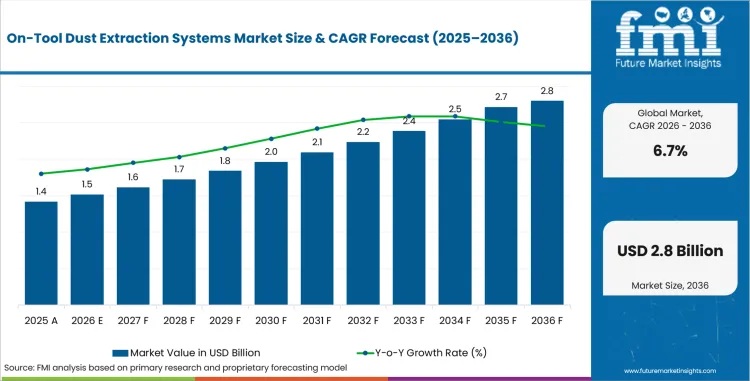
On-Tool Dust Extraction Systems Market Overview: Size and Forecast
- 2026 Market Size: USD 1.51 billion
- 2036 Market Size: USD 2.89 billion
- Forecast CAGR: 6.7% from 2026 to 2036
- Leading Product Type: Shrouds
- Shrouds Share in 2026: 34.0%
- Leading Tool Pairing: Rotary Hammers
- Rotary Hammers Share in 2026: 38.0%
- Fastest-growing Country: India
- India CAGR: 8.1% by 2036
Summary of the On-Tool Dust Extraction Systems Market
- Demand and Growth Drivers
- Rising adoption of on-tool dust extraction systems across construction, woodworking, and industrial manufacturing is being driven by stricter workplace dust-control regulations and growing emphasis on worker safety.
- Strong sales growth is supported by increasing demand for portable power tools equipped with integrated dust collection solutions, particularly in renovation, infrastructure, and commercial construction projects.
- End users are investing in advanced dust extraction equipment to improve operational efficiency, reduce cleanup time, and minimize equipment wear caused by airborne particulate matter.
- Market demand is further expanding as contractors and industrial facilities upgrade to high-performance extraction systems that help meet occupational health standards and enhance productivity.
- Product and Segment View
- Shrouds are projected to lead the Product Type segment with 34.0% share in 2026 as they fit common grinders and saws.
- Rotary hammers are expected to lead the Tool Pairing segment with 38.0% share in 2026 since anchor drilling uses hollow bits.
- HEPA systems are anticipated to lead the Dust Class segment with 46.0% share in 2026 with OSHA filtration language supporting buyer choice.
- Construction is projected to lead the End Use segment with 58.0% share in 2026 because concrete cutting and drilling create frequent dust tasks.
- Tool dealers are expected to lead the Sales Channel segment with 42.0% share in 2026 as buyers check hose fit and filter stock.
- Geography and Competitive Outlook
- India and the United States are forecast to outpace the global CAGR with 8.1% and 7.2% country growth rates.
- Germany and France are expected to grow below the global pace at 6.1% and 5.9% due to slower construction cycles.
- Hilti, Bosch, DeWalt, Festool, Makita, Husqvarna and Dustcontrol AB form the verified benchmark set.
- Specialist suppliers compete in high-dust work by offering better filter cleaning and stronger vacuum pairings.
- Rental fleets are expected to gain share as contractors avoid owning separate vacuum systems for every concrete task.
- Analyst Opinion
- Nikhil Kaitwade, Principal Consultant at FMI, observes, “On-tool dust extraction is shifting from accessory buying to task approval buying. Contractors ask whether a shroud fits the grinder, whether the hose stays connected and whether the filter can survive concrete dust during a full shift. Suppliers gain an edge when they prove tool compatibility and filter-cleaning performance in jobsite terms.”
Regulation is moving dust extraction from a safety add-on into a buying condition for concrete work. OSHA Table 1 requires task-specific controls for silica exposure and defines HEPA filters as at least 99.97% efficient for 0.3 micrometer particles. HSE guidance on on-tool extraction gives contractors a method for choosing shrouds, hoses and vacuum classes. The market is therefore shaped by matched tool systems rather than generic vacuum sales.
On-Tool Dust Extraction Systems Market Value Analysis
The market value is rising as dust extraction moves from housekeeping into task-level safety control for drilling and grinding.
- OSHA Table 1 keeps demand tied to named tools and tasks, which favors suppliers with documented system pairings.
- HSE guidance on on-tool extraction supports sales of matched shrouds, hoses and vacuums in the United Kingdom.
- HEPA and M-Class filters raise replacement revenue since concrete dust loads filters faster than wood dust.
- Rental fleets expand the addressable pool as small contractors rent compliant kits for short concrete jobs.
Which factors support expansion in the on-tool dust extraction systems market?
Task-level silica controls and matched power-tool accessories support market value across regulated contractor channels.
- Market value is supported by shrouds, hollow bits and extractor kits tied directly to drilling and grinding tasks.
- Supplier pricing reflects vacuum class, filter cleaning, hose compatibility and replacement consumables before brand premium is added.
- Revenue improves as contractors replace improvised vacuum setups with documented tool-and-extractor pairings.
- Rental fleet demand expands when small contractors need compliant kits for short concrete jobs without owning every vacuum class.
Why is the on-tool dust extraction systems market growing?
Silica rules convert dust capture into a compliance step for drilling and cutting concrete.
- Silica rules convert dust capture into a compliance step for drilling and cutting concrete.
- Hollow bits reduce manual hole cleaning when they are paired with approved extractors.
- Renovation work in occupied buildings pushes contractors toward lower-dust cutting methods.
- Rental fleets make high-cost extractors easier for small contractors to access.
- Filter replacement demand grows as concrete dust loads HEPA and M-Class filters during heavy use.
Compliance is the clearest demand trigger for the market. OSHA requires specified exposure control methods for many construction tasks involving respirable crystalline silica. Its construction standard defines a HEPA filter as at least 99.97% efficient at removing 0.3 micrometer particles. That number matters because contractors can compare filter claims against a clear regulatory threshold.
The practical result is a stronger preference for branded tool-and-extractor systems over improvised vacuum attachments. Demand also connects with the broader industrial vacuum cleaners market because contractors need certified extraction rather than ordinary cleanup machines. Source capture also links this report with the dust control system market where site-level particulate control is a wider compliance and productivity theme.
How is the on-tool dust extraction systems market segmented?
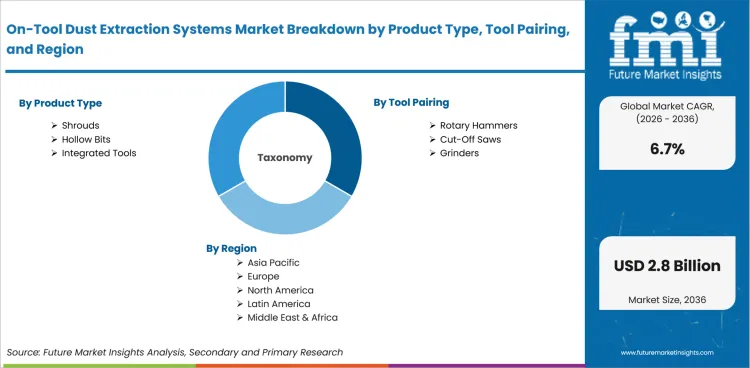
The on-tool dust extraction systems industry is segmented by product type, tool pairing, dust class, end use and sales channel.
- Shrouds are projected to secure 34.0% share in 2026, led by fast retrofit demand across grinders and cut-off saws.
- Rotary hammers are anticipated to hold 38.0% share in 2026 since anchor drilling needs clean holes and source capture.
- HEPA systems are expected to capture 46.0% share in 2026 due to OSHA filtration language and contractor safety files.
- Construction is forecast to represent 58.0% share in 2026, guided by concrete drilling and cutting frequency.
- Tool dealers are projected to account for 42.0% share in 2026, reflected by buyer need for fit checks before purchase.
Why do shrouds lead the on-tool dust extraction systems market?
Shrouds lead because grinder and saw users can retrofit dust capture without replacing the core tool.
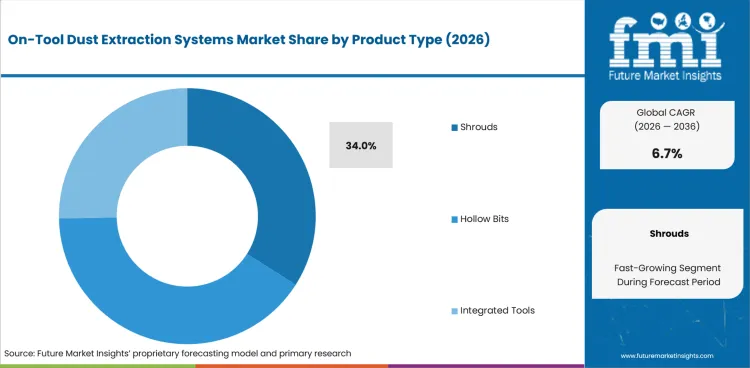
- Shrouds are projected to account for 34.0% share in 2026, influenced by fast installation and common grinder use.
- Replacement skirts and hose adapters create recurring accessory revenue after the first shroud purchase.
Which tool pairing leads the on-tool dust extraction systems market?
Rotary hammers lead as anchor drilling is one of the most frequent concrete dust tasks.
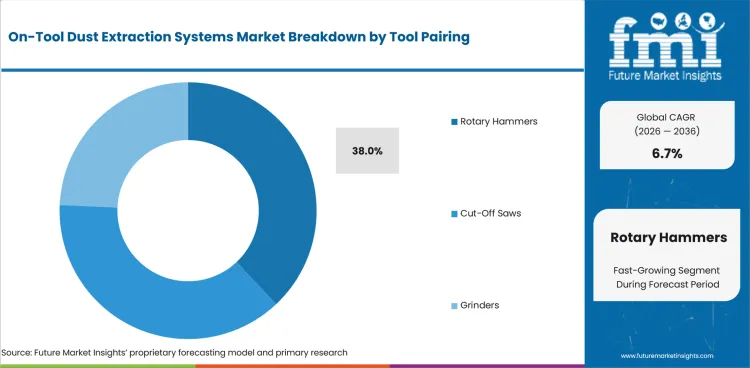
- Rotary hammers are expected to represent 38.0% share in 2026 through repeated anchor drilling applications.
- Hollow drill bits remove dust during drilling and reduce brushing or blow-out steps for approved anchors.
Which dust class leads the on-tool dust extraction systems market?
HEPA systems lead because contractor safety files use filtration claims to separate compliant kits from basic workshop vacuums.
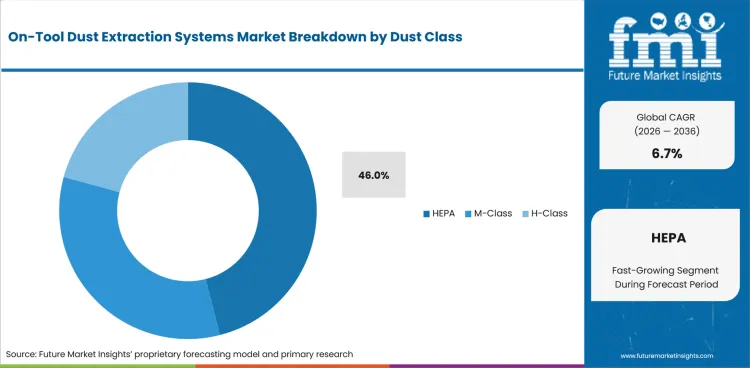
- HEPA systems are anticipated to hold 46.0% share in 2026 as OSHA defines HEPA around 99.97% efficiency at 0.3 micrometers.
- M-Class and H-Class systems gain value in Europe where buyers specify dust class for professional work.
Which end use leads the on-tool dust extraction systems market?
Construction leads because concrete drilling, grinding and cutting produce repeated source-capture needs.
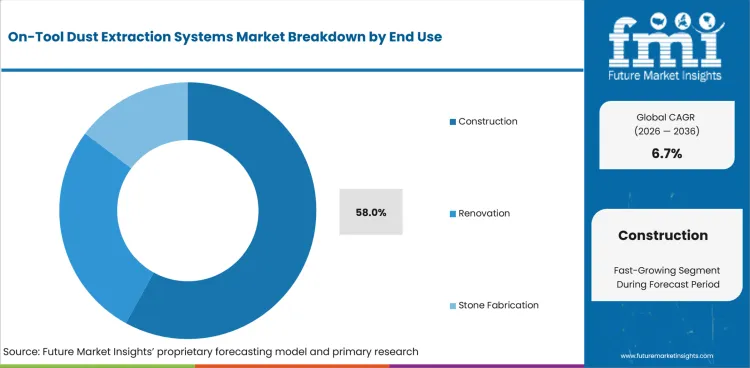
- Construction is projected to account for 58.0% share in 2026 due to frequent silica dust tasks.
- Renovation differs from new-build work because occupied buildings place more value on visible dust control and cleanup time.
Which sales channel leads the on-tool dust extraction systems market?
Tool dealers lead because buyers need to confirm fit across tool bodies, hoses and extractors.
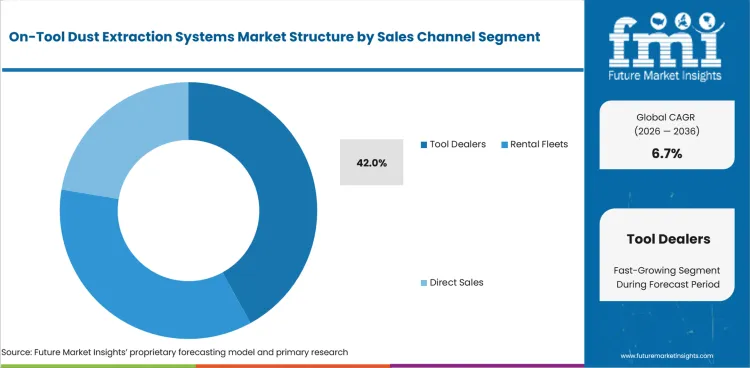
- Tool dealers are estimated to account for 42.0% share in 2026 as contractors need accessory fit checks.
- Rental fleets carry higher-value extractors where small contractors need compliant kits for short jobs.
What are the drivers, restraints, and opportunities in the on-tool dust extraction systems market?
Silica task tables and hollow-bit productivity support growth while filter loading and hose fit limit field acceptance.
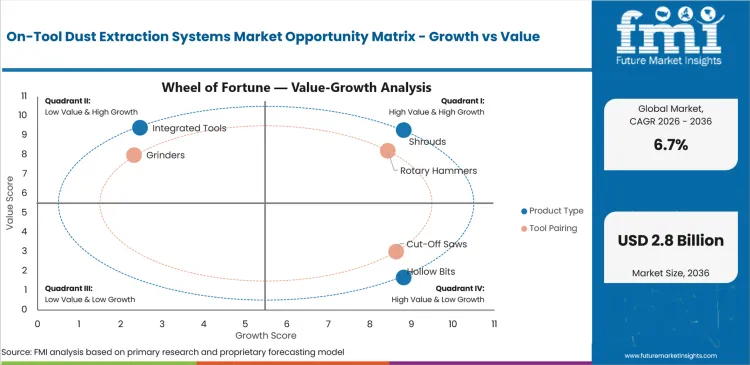
- Driver: Silica task tables drive demand by tying dust controls to named cutting and drilling jobs.
- Restraint: Filter loading reduces suction when crews skip cleaning cycles or use the wrong bag.
- Opportunity: Rental channels create a route for M-Class and H-Class extractors among small contractors.
On-Tool Dust Extraction Systems Market Demand Outlook
Demand outlook is moving toward matched tool systems that can prove source capture before the task starts. OSHA Table 1 gives contractors a clearer way to match drilling, cutting and grinding methods with extractor requirements. HSE guidance reinforces the same pattern in the United Kingdom by explaining how to choose and maintain on-tool extraction. Suppliers that publish pairing tables and maintain local consumable stock are better placed for repeat sales.
Customer Segmentation and Purchase Behavior Analysis
Construction contractors, rental operators and safety managers form the main buying pool. Contractors buy shrouds and hollow bits when they need fast task approval. Rental operators buy higher-value extractors when short jobs do not justify full contractor ownership. Safety managers influence demand when bids require documented silica controls and jobsite dust plans.
Voice of Customer and Decision-driver Analysis
Purchase decisions are shaped by fit, airflow, filter cleaning and consumable availability. Buyers check whether a hose connects to the grinder, whether the extractor class matches the task and whether bags are available locally. The adjacent HEPA vacuum cleaners market supports the same preference for certified filtration and replacement consumables.
Who are the leading companies in the on-tool dust extraction systems market?
Hilti, Bosch, DeWalt, Festool, Makita, Husqvarna and Dustcontrol AB form the core verified supplier group.
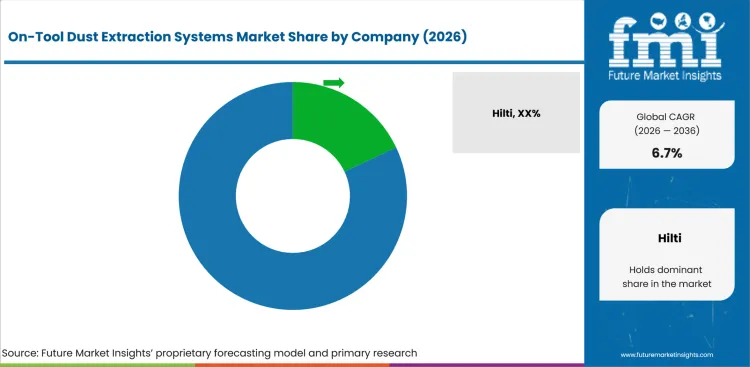
- Integrated tool-system suppliers hold an advantage when they connect tool bodies, shrouds, hollow bits and extractor kits.
- Surface-preparation specialists gain traction in grinding and scarifying jobs where filter loading is heavy.
- Rental-ready suppliers gain better channel access when extractors are durable and consumables are easy to stock.
- Dealer training supports trial because contractors need confirmation that the attachment fits the tool they already own.
Company competition centers on fit and proof. Buyers want dust extraction that works with the tool they already own and satisfies the safety rule tied to the task. Stanley Black & Decker states that the DeWalt Perform & Protect line includes over 220 OSHA Table 1 compliant dust solutions. Festool’s February 2025 CT 26, CT 36 and CT 48 EI launch added built-in Bluetooth and app-linked warning support.
Specialist firms compete where heavy dust loads challenge standard power-tool vacuums. Dustcontrol AB and Husqvarna focus on stronger suction paths, filter cleaning and site-specific extraction. Husqvarna introduced the DE 130 H with Auto-Pulse technology in September 2024 for demanding dust-intense applications. These applications connect the market to adjacent industrial air filtration market and professional source-capture systems.
Automation is starting to reshape high-volume drilling. DeWalt’s January 2026 downward drilling robot reduced construction timelines by 80 weeks across 10 data center projects and reached 99.97% accuracy across more than 90,000 holes. The development shows how dust control can become part of broader automated construction workflows rather than a separate accessory purchase.
How do top on-tool dust extraction systems companies compare?
| Company | Relevance to Market Title | Tool-Pairing Depth | Dust-Class Coverage | Filter-Cleaning Strength | Geographic Footprint |
|---|---|---|---|---|---|
| Hilti | Very High | Very Strong | Strong | Strong | Global |
| Bosch | Very High | Very Strong | Moderate | Strong | Global |
| DeWalt | Very High | Very Strong | Strong | Moderate | Global |
| Festool | High | Moderate | Strong | Very Strong | Europe and North America |
| Makita | High | Very Strong | Moderate | Moderate | Global |
| Husqvarna | High | Moderate | Very Strong | Very Strong | Global |
| Dustcontrol AB | High | Moderate | Very Strong | Very Strong | Europe and export markets |
| Milwaukee Tool | Moderate to High | Strong | Strong | Moderate | North America and global |
| Metabo | Moderate | Moderate | Moderate | Moderate | Europe and global |
| RIDGID | Moderate | Moderate | Moderate | Moderate | North America and selected markets |
Source: Future Market Insights competitive analysis, 2026.
Who are the key players in the on-tool dust extraction systems market?
Hilti, Bosch and DeWalt are listed with Festool, Makita, Husqvarna and Dustcontrol AB among other suppliers.
Key global companies leading the on-tool dust extraction systems market include:
- Hilti
- Bosch
- DeWalt
- Festool
- Makita
- Husqvarna
- Dustcontrol AB
- Milwaukee Tool
- Metabo
- RIDGID
Key Developments in On-Tool Dust Extraction Systems Market
- In February 2025, Festool introduced the CT 26, CT 36 and CT 48 EI mobile dust extractors. Bluetooth and app connectivity support cordless tool activation and service alerts.
- In September 2024, Husqvarna Construction introduced the DE 130 H dust extractor with Auto-Pulse technology. The launch targets surface preparation and handheld tool applications.
- In March 2024, Makita released the 40V max XGT 6 Quart HEPA Filter Dry Backpack Vacuum. The product extends cordless HEPA cleanup around professional jobsites.
- In January 2026, DeWalt unveiled a fleet-capable downward drilling robot for data center construction. The system connects drilling productivity with dust and vibration control.
- In October 2024, Makita released the XGT 70 lb breaker hammer and noted AWS dust extraction attachment availability. The launch points to heavier demolition tool pairing.
Key Players in the On-Tool Dust Extraction Systems Market
Integrated Tool-System Leaders
- Hilti
- Bosch
- DeWalt
- Makita
- Festool
Surface Preparation and Heavy-Dust Specialists
- Husqvarna
- Dustcontrol AB
Channel and Rental-Ready Competitors
- Milwaukee Tool
- Metabo
- RIDGID
Which countries are growing fastest in the on-tool dust extraction systems market?
India 8.1% CAGR, United States 7.2% CAGR, China 6.8% CAGR, United Kingdom 6.5% CAGR, South Korea 6.3% CAGR, Germany 6.1% CAGR, France 5.9% CAGR and Japan 5.4% CAGR through 2036.
.webp "Top Country Growth Comparison On Tool Dust Extraction Systems Market Cagr (2026 2036)")
| Country | CAGR |
|---|---|
| India | 8.1% |
| United States | 7.2% |
| China | 6.8% |
| United Kingdom | 6.5% |
| South Korea | 6.3% |
| Germany | 6.1% |
| France | 5.9% |
| Japan | 5.4% |
Source: Future Market Insights, 2026.
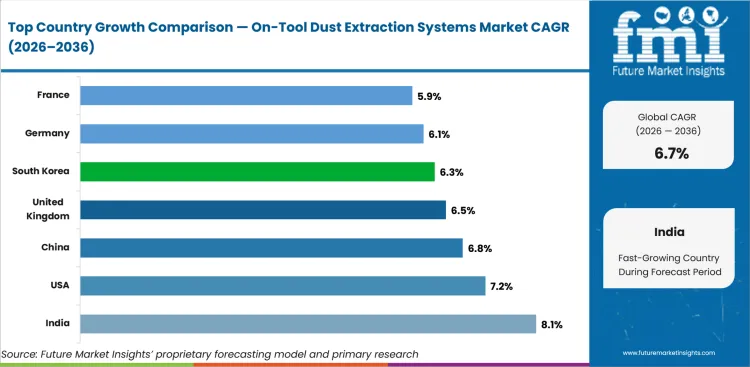
How do country-level CAGRs compare in the on-tool dust extraction systems market?
India leads country growth while Japan records the most cautious expansion outlook among profiled markets.
- India is forecast to record 8.1% CAGR by 2036, supported by construction growth and low current penetration.
- United States is forecast to record 7.2% CAGR by 2036, supported by OSHA-linked compliance and rental scale.
- China is forecast to record 6.8% CAGR by 2036, supported by infrastructure and industrial maintenance demand.
- United Kingdom is forecast to record 6.5% CAGR by 2036, supported by HSE guidance and hire channels.
- South Korea is forecast to record 6.3% CAGR by 2036, supported by high-spec industrial project demand.
- Germany is forecast to record 6.1% CAGR by 2036, supported by premium replacement demand.
- France is forecast to record 5.9% CAGR by 2036, supported by renovation and rental channels.
- Japan is forecast to record 5.4% CAGR by 2036, supported by labor-efficiency needs and premium replacement.
Why is India the fastest-growing on-tool dust extraction systems market?
An 8.1% CAGR through 2036 reflects construction growth and low current penetration of source-capture systems.
Country Market Snapshot Table
| Parameter | Value |
|---|---|
| Market Size in 2025 (Value) | USD 82.3 million |
| Market Size in 2026 (Value) | USD 89.0 million |
| Market Forecast in 2036 (Value) | USD 193.9 million |
| CAGR (2026 to 2036) | 8.1% |
| Years Considered | 2021 to 2036 |
| Base Year | 2025 |
| Forecast Period | 2026 to 2036 |
| Units Considered | Value (USD million) |
| Leading Sub-Region | NCR, Mumbai, Bengaluru and infrastructure corridors |
India On-Tool Dust Extraction Systems Market Outlook
India is the fastest-growth country because construction expansion combines with low current penetration. Adoption starts with large contractors before moving through dealers and rental shops.
Metro rail, commercial buildings and factory fit-outs create repeated concrete drilling and cutting tasks. Price sensitivity keeps shrouds and basic extractors ahead of high-end systems in many cities.
Key Growth Drivers
- MOSPI reported in May 2025 that India’s construction sector recorded 9.4% growth in FY 2024-25. This increases concrete drilling and cutting tasks.
- India’s Ministry of Finance stated in February 2026 that public capital expenditure was proposed to rise to ₹12.2 lakh crore in FY 2026-27. This supports infrastructure equipment demand.
- Large contractors use dust control to meet client safety expectations on metro rail, airport and factory projects.
- Rental shops improve access to extractors for short-duration work where contractors cannot justify full ownership.
Key Restraints
- PIB reported in January 2026 that Gross Fixed Capital Formation was estimated to grow 7.8% at constant prices in FY 2025-26. This keeps project timing sensitive to capital spending cycles.
- Informal contractors often avoid premium filters and replacement bags when project payment cycles are tight.
- Low-cost local vacuums create confusion between general cleanup and source extraction at the tool point.
What makes India unique
India is unique because formal project need is rising faster than current penetration of on-tool dust extraction.
Key Companies
- Bosch Power Tools India
- Hilti India
- Makita Power Tools India
- Stanley Black & Decker India
- Husqvarna India
- Koki Holdings India
Sales & Marketing Channels
- Dealer networks
- Rental shops
- Direct large-contractor sales
- Project procurement teams
- Online tool marketplaces
- Safety training partnerships
Country Segment Breakdown Table
| Segment | Sub-Segments |
|---|---|
| By Product Type | Shrouds, Hollow Bits, Integrated Tools, Dust Extractors, Hoses |
| By Tool Pairing | Rotary Hammers, Cut-Off Saws, Grinders, Sanders, Core Drills |
| By Dust Class | HEPA, M-Class, H-Class, Standard |
| By End Use | Construction, Renovation, Industrial Maintenance, Stone Fabrication, Woodworking |
| By Sales Channel | Tool Dealers, Rental Fleets, Direct Sales, Online Sales, OEM Kits |
| Key Sub-Regions Covered, Infrastructure and Contractor Formalization Corridors | Delhi NCR, Mumbai, Bengaluru, Hyderabad, Chennai, Pune |
Frequently Asked Questions
How fast is India on-tool dust extraction systems market growing?
India is forecast to grow at 8.1% CAGR from 2026 to 2036 as formal projects expand.
Who leads India on-tool dust extraction systems market?
Bosch, Hilti, Makita, DeWalt and Husqvarna compete through India dealer and contractor channels.
What is driving adoption in India on-tool dust extraction systems market?
Construction growth, infrastructure projects and rental access are moving Indian contractors toward source-capture systems.
What is the on-tool dust extraction systems market outlook in the United States?
A 7.2% CAGR through 2036 is supported by OSHA silica controls and large-scale construction spending.
Country Market Snapshot Table
| Parameter | Value |
|---|---|
| Market Size in 2025 (Value) | USD 452.4 million |
| Market Size in 2026 (Value) | USD 485.0 million |
| Market Forecast in 2036 (Value) | USD 972.1 million |
| CAGR (2026 to 2036) | 7.2% |
| Years Considered | 2021 to 2036 |
| Base Year | 2025 |
| Forecast Period | 2026 to 2036 |
| Units Considered | Value (USD million) |
| Leading Sub-Region | South and West data-center construction corridors |
United States On-Tool Dust Extraction Systems Market Outlook
United States demand is shaped by contractor risk control and jobsite documentation. OSHA Table 1 keeps concrete drilling and grinding tied to named dust-control methods before work begins.
Rental fleets and dealers help smaller contractors access HEPA extractors without owning several vacuum sizes. Data centers and warehouse fit-outs add repeated anchor drilling demand.
Key Growth Drivers
- OSHA Table 1 requires dust collectors for handheld drills to provide manufacturer-recommended airflow or greater with 99% or higher filter efficiency. This keeps matched tool kits visible in safety plans.
- U.S. Census Bureau reported construction spending at a seasonally adjusted annual rate of USD 2,172.4 billion in April 2026. This scale sustains repeated concrete cutting and drilling work.
- National rental chains make HEPA and M-Class extractors available for short concrete projects without forcing every subcontractor into full ownership.
- Data centers and warehouse fit-outs create repeated overhead and floor anchor drilling where hollow bits can reduce cleanup work.
Key Restraints
- BLS reported in June 2026 that the Producer Price Index for final demand rose 1.1% in May. That cost pressure can delay filter and bag replacement among smaller subcontractors.
- Tool-brand fragmentation creates hose and adapter mismatch on mixed jobsites where crews use several grinder and rotary hammer platforms.
- First-time buyers can confuse cleanup vacuums with source-capture extractors if distributors do not explain tool pairing and airflow requirements.
What makes United States unique
The United States is unique because OSHA Table 1 converts dust-control choices into task-level work-method decisions.
Key Companies
- Hilti North America
- Stanley Black & Decker / DeWalt
- Robert Bosch Tool Corporation
- Makita U.S.A.
- Milwaukee Tool
- Husqvarna Construction North America
Sales & Marketing Channels
- Direct enterprise sales
- Tool dealer networks
- Rental fleets
- Safety distributor channels
- Online replacement parts
- OEM tool kits
Country Segment Breakdown Table
| Segment | Sub-Segments |
|---|---|
| By Product Type | Shrouds, Hollow Bits, Integrated Tools, Dust Extractors, Hoses |
| By Tool Pairing | Rotary Hammers, Cut-Off Saws, Grinders, Sanders, Core Drills |
| By Dust Class | HEPA, M-Class, H-Class, Standard |
| By End Use | Construction, Renovation, Industrial Maintenance, Stone Fabrication, Woodworking |
| By Sales Channel | Tool Dealers, Rental Fleets, Direct Sales, Online Sales, OEM Kits |
| Key Sub-Regions Covered, Data Center and National Rental Corridors | Texas, Virginia, California, Southeast, Midwest, Pacific Northwest |
Frequently Asked Questions
How fast is United States on-tool dust extraction systems market growing?
The United States market is projected to grow at 7.2% CAGR from 2026 to 2036 due to OSHA-linked concrete dust controls.
Who leads United States on-tool dust extraction systems market?
Hilti, DeWalt, Bosch, Makita, Milwaukee and Husqvarna compete through tool systems and rental channels.
What is driving adoption in United States on-tool dust extraction systems market?
OSHA Table 1, data-center construction and rental fleet access are moving buyers toward matched on-tool dust systems.
How is the on-tool dust extraction systems market performing in China?
A 6.8% CAGR through 2036 reflects large construction scale and industrial maintenance demand.
Country Market Snapshot Table
| Parameter | Value |
|---|---|
| Market Size in 2025 (Value) | USD 221.0 million |
| Market Size in 2026 (Value) | USD 236.0 million |
| Market Forecast in 2036 (Value) | USD 455.6 million |
| CAGR (2026 to 2036) | 6.8% |
| Years Considered | 2021 to 2036 |
| Base Year | 2025 |
| Forecast Period | 2026 to 2036 |
| Units Considered | Value (USD million) |
| Leading Sub-Region | Yangtze River Delta and major infrastructure corridors |
China On-Tool Dust Extraction Systems Market Outlook
China carries large volume potential but uneven margin quality. Buyers split between premium imported systems and lower-cost local alternatives.
Infrastructure and industrial work support dust-control upgrades even as property development weakens. E-commerce channels widen access to hoses, shrouds and replacement filters.
Key Growth Drivers
- National Bureau of Statistics reported in February 2026 that construction enterprise value added reached CNY 8,642.5 billion in 2025. This creates a large tool-use base.
- China’s State Council reported in January 2026 that GDP reached CNY 140,187.9 billion in 2025 with 5.0% annual growth. This supports industrial and infrastructure activity.
- Large online channels speed replacement accessory purchases for hoses, bags and shroud parts.
- Premium projects favor certified dust control and brand documentation in industrial and infrastructure settings.
Key Restraints
- SCIO reported in March 2026 that real estate development investment declined by 11.1% from January to February 2026. This heightens price pressure on premium dust systems.
- Real estate weakness reduces some residential construction tool demand and shifts attention toward infrastructure work.
- Low-cost local vacuums create pricing pressure for imported premium brands and confuse cleanup with source extraction.
What makes China unique
China is unique because suppliers must separate premium compliance buyers from price-driven tool users.
Key Companies
- Bosch China
- Hilti China
- Makita China
- Husqvarna Construction China
- Dongcheng Power Tools
- Devon Tools
Sales & Marketing Channels
- E-commerce platforms
- Authorized dealers
- Contractor distributors
- OEM bundles
- Rental channels
- Industrial supply networks
Country Segment Breakdown Table
| Segment | Sub-Segments |
|---|---|
| By Product Type | Shrouds, Hollow Bits, Integrated Tools, Dust Extractors, Hoses |
| By Tool Pairing | Rotary Hammers, Cut-Off Saws, Grinders, Sanders, Core Drills |
| By Dust Class | HEPA, M-Class, H-Class, Standard |
| By End Use | Construction, Renovation, Industrial Maintenance, Stone Fabrication, Woodworking |
| By Sales Channel | Tool Dealers, Rental Fleets, Direct Sales, Online Sales, OEM Kits |
| Key Sub-Regions Covered, Infrastructure and E-commerce Access Corridors | Shanghai, Jiangsu, Zhejiang, Guangdong, Beijing, Sichuan |
Frequently Asked Questions
How fast is China on-tool dust extraction systems market growing?
China is forecast to grow at 6.8% CAGR from 2026 to 2036 through infrastructure and industrial maintenance demand.
Who leads China on-tool dust extraction systems market?
Bosch, Hilti, Makita, Husqvarna and selected local suppliers compete through online and dealer routes.
What is driving adoption in China on-tool dust extraction systems market?
Construction scale, online accessory access and premium project documentation are supporting dust-control adoption in China.
How is the on-tool dust extraction systems market performing in the United Kingdom?
A 6.5% CAGR through 2036 reflects HSE guidance, hire-channel access, and repair-heavy construction demand.
Country Market Snapshot Table
| Parameter | Value |
|---|---|
| Market Size in 2025 (Value) | USD 120.2 million |
| Market Size in 2026 (Value) | USD 128.0 million |
| Market Forecast in 2036 (Value) | USD 240.3 million |
| CAGR (2026 to 2036) | 6.5% |
| Years Considered | 2021 to 2036 |
| Base Year | 2025 |
| Forecast Period | 2026 to 2036 |
| Units Considered | Value (USD million) |
| Leading Sub-Region | London, Midlands and refurbishment-heavy urban corridors |
United Kingdom On-Tool Dust Extraction Systems Market Outlook
United Kingdom demand is shaped by guidance-driven procurement and refurbishment work. HSE guidance gives buyers a practical framework for choosing shrouds and extractors.
Repair and maintenance tasks keep dust control relevant in schools, hospitals and retail spaces. Hire shops lower the entry cost for contractors that need M-Class extractors for short projects.
Key Growth Drivers
- HSE stated in February 2024 that CIS69 explains how to choose, use and maintain on-tool extraction for construction dust. This supports complete system buying.
- ONS reported in February 2026 that annual construction output increased by 1.8% in 2025 compared with 2024. This sustains repair and maintenance demand.
- Tool hire shops reduce upfront cost by giving refurbishment contractors access to M-Class extractors only when dusty tasks occur.
- Safety managers in occupied buildings value lower visible dust because cleanup time can affect school and hospital access.
Key Restraints
- The Department for Business and Trade reported in May 2026 that Great Britain cement production decreased by 5.3% to 7.3 million tonnes in 2024. Softer heavy-material throughput can delay short-term fleet upgrades.
- Small refurbishment firms can treat extraction as optional when enforcement is not visible during short indoor jobs.
- Mixed fleets create fit issues between shrouds, hoses and tool ports when contractors rent from different hire chains.
What makes United Kingdom unique
The United Kingdom is unique because HSE guidance is converted into buying behavior through hire shops and safety-manager influence.
Key Companies
- Hilti Great Britain
- Bosch Professional UK
- DeWalt UK
- Festool UK
- Makita UK
- Dustcontrol UK
Sales & Marketing Channels
- Tool hire shops
- National merchant chains
- Safety consultants
- Dealer demonstrations
- Direct contractor sales
- Online consumable sales
Country Segment Breakdown Table
| Segment | Sub-Segments |
|---|---|
| By Product Type | Shrouds, Hollow Bits, Integrated Tools, Dust Extractors, Hoses |
| By Tool Pairing | Rotary Hammers, Cut-Off Saws, Grinders, Sanders, Core Drills |
| By Dust Class | HEPA, M-Class, H-Class, Standard |
| By End Use | Construction, Renovation, Industrial Maintenance, Stone Fabrication, Woodworking |
| By Sales Channel | Tool Dealers, Rental Fleets, Direct Sales, Online Sales, OEM Kits |
| Key Sub-Regions Covered, Refurbishment and Hire Retail Corridors | London, Manchester, Birmingham, Leeds, Glasgow, Bristol |
Frequently Asked Questions
How fast is United Kingdom on-tool dust extraction systems market growing?
The United Kingdom market is forecast to grow at 6.5% CAGR from 2026 to 2036 through HSE-guided procurement.
Who leads United Kingdom on-tool dust extraction systems market?
Hilti, Bosch, DeWalt, Festool and Makita compete through UK dealers and hire channels.
What is driving adoption in United Kingdom on-tool dust extraction systems market?
HSE guidance and refurbishment work are moving contractors toward shrouds, hoses and M-Class extractors.
What is the on-tool dust extraction systems market forecast for South Korea?
A 6.3% CAGR through 2036 reflects high-spec project demand despite weaker construction cycles.
Country Market Snapshot Table
| Parameter | Value |
|---|---|
| Market Size in 2025 (Value) | USD 71.5 million |
| Market Size in 2026 (Value) | USD 76.0 million |
| Market Forecast in 2036 (Value) | USD 140.0 million |
| CAGR (2026 to 2036) | 6.3% |
| Years Considered | 2021 to 2036 |
| Base Year | 2025 |
| Forecast Period | 2026 to 2036 |
| Units Considered | Value (USD million) |
| Leading Sub-Region | Seoul Capital Area and semiconductor construction corridors |
South Korea On-Tool Dust Extraction Systems Market Outlook
South Korea has high-spec contractor segments but faces construction cycle pressure. Semiconductor and logistics projects still require clean anchor drilling and controlled cutting.
Buyers ask for reliable service and compact systems that suit dense jobsites. Rental channels help contractors handle short bursts of concrete work.
Key Growth Drivers
- KOSTAT reported in April 2025 that domestic machinery orders received rose 8.6% year over year. This supports equipment investment interest in formal firms.
- MOTIE reported in March 2024 that Korea raised the 2024 R&D budget for semiconductors, displays, secondary batteries and bio by 10.0%. High-tech industrial project demand supports premium dust-control systems.
- Dense urban jobsites favor compact extractors and clean cutting methods that reduce visible dust during fit-outs.
- Formal contractors value documented tool compatibility for safety audits on semiconductor and industrial projects.
Key Restraints
- Bank of Korea reported in May 2025 that construction investment accounted for around 14.0% of GDP and its sharper-than-expected decline lowered the growth projection by 0.4 percentage points. This affects broad replacement cycles.
- Smaller contractors compare dust extraction against cheaper cleanup labor when project margins are thin.
- Weak construction orders can delay tool fleet upgrades outside high-value industrial projects.
What makes South Korea unique
South Korea is unique because high-spec industrial jobs can support premium systems despite weaker general construction.
Key Companies
- Bosch Korea
- Hilti Korea
- Makita Korea
- DeWalt Korea
- Husqvarna Korea
- Koki Holdings Korea
Sales & Marketing Channels
- Industrial distributors
- Rental channels
- Direct key-account sales
- Dealer networks
- Online parts platforms
- Safety procurement routes
Country Segment Breakdown Table
| Segment | Sub-Segments |
|---|---|
| By Product Type | Shrouds, Hollow Bits, Integrated Tools, Dust Extractors, Hoses |
| By Tool Pairing | Rotary Hammers, Cut-Off Saws, Grinders, Sanders, Core Drills |
| By Dust Class | HEPA, M-Class, H-Class, Standard |
| By End Use | Construction, Renovation, Industrial Maintenance, Stone Fabrication, Woodworking |
| By Sales Channel | Tool Dealers, Rental Fleets, Direct Sales, Online Sales, OEM Kits |
| Key Sub-Regions Covered, Semiconductor and Industrial Project Corridors | Seoul, Incheon, Gyeonggi, Busan, Ulsan, Daejeon |
Frequently Asked Questions
How fast is South Korea on-tool dust extraction systems market growing?
South Korea is projected to grow at 6.3% CAGR from 2026 to 2036 through high-spec industrial demand.
Who leads South Korea on-tool dust extraction systems market?
Bosch, Hilti, Makita, DeWalt and Husqvarna compete through Korean distributors and contractor channels.
What is driving adoption in South Korea on-tool dust extraction systems market?
Semiconductor construction and documented tool compatibility are supporting premium on-tool dust extraction demand.
How fast is the on-tool dust extraction systems market growing in Germany?
A 6.1% CAGR through 2036 reflects safety-conscious contractor channels and premium dust-class purchasing.
Country Market Snapshot Table
| Parameter | Value |
|---|---|
| Market Size in 2025 (Value) | USD 144.2 million |
| Market Size in 2026 (Value) | USD 153.0 million |
| Market Forecast in 2036 (Value) | USD 276.6 million |
| CAGR (2026 to 2036) | 6.1% |
| Years Considered | 2021 to 2036 |
| Base Year | 2025 |
| Forecast Period | 2026 to 2036 |
| Units Considered | Value (USD million) |
| Leading Sub-Region | North Rhine-Westphalia and southern industrial corridors |
Germany On-Tool Dust Extraction Systems Market Outlook
Germany demand is quality-led and documentation-heavy. Buyers compare dust class, antistatic hoses, filter cleaning and service support before selecting a system.
The market favors premium replacement rather than basic first-time adoption. Professional dealers and direct contractor teams carry more influence than low-cost online channels.
Key Growth Drivers
- Destatis reported in May 2025 that construction industry economic performance was up 0.9% in the first quarter. This supports cautious replacement demand.
- BAuA reported in April 2025 that three new conditions were added to Germany’s official occupational-disease list, including chronic obstructive bronchitis caused by silica dust. This supports safety-led dust control.
- German trade dealers support premium dust-class education at the counter for contractors comparing HEPA and M-Class systems.
- Industrial maintenance and renovation work support drilling, chasing and surface grinding applications beyond new residential construction.
Key Restraints
- DGUV reported in a 2025 IFA presentation that the MEGA workplace exposure database contains more than 4 million hazardous-substance and biological-agent measurements. This keeps German dust-control training requirements high.
- Premium systems face price checks from small craft businesses that separate basic vacuums from certified source-capture systems.
- Slower housing construction reduces short-term new-build tool purchases for residential contractors.
What makes Germany unique
Germany is unique because dust class, tool fit and service documentation carry more weight than headline suction claims.
Key Companies
- Robert Bosch Power Tools GmbH
- Festool GmbH
- Hilti Deutschland AG
- Makita Werkzeug GmbH
- Husqvarna Deutschland
- Dustcontrol GmbH
Sales & Marketing Channels
- Professional tool wholesalers
- Brand service centers
- Direct contractor teams
- Trade fair demonstrations
- Rental fleets
- Online spare parts portals
Country Segment Breakdown Table
| Segment | Sub-Segments |
|---|---|
| By Product Type | Shrouds, Hollow Bits, Integrated Tools, Dust Extractors, Hoses |
| By Tool Pairing | Rotary Hammers, Cut-Off Saws, Grinders, Sanders, Core Drills |
| By Dust Class | HEPA, M-Class, H-Class, Standard |
| By End Use | Construction, Renovation, Industrial Maintenance, Stone Fabrication, Woodworking |
| By Sales Channel | Tool Dealers, Rental Fleets, Direct Sales, Online Sales, OEM Kits |
| Key Sub-Regions Covered, Industrial Trade and Professional Dealer Corridors | North Rhine-Westphalia, Bavaria, Baden-Württemberg, Berlin, Hamburg, Hesse |
Frequently Asked Questions
How fast is Germany on-tool dust extraction systems market growing?
Germany is forecast to expand at 6.1% CAGR from 2026 to 2036 through premium replacement demand.
Who leads Germany on-tool dust extraction systems market?
Bosch, Festool, Hilti, Makita and Dustcontrol compete through German dealers and contractor service.
What is driving adoption in Germany on-tool dust extraction systems market?
Dust-class documentation and professional dealer support are moving German buyers toward matched extraction systems.
What is the on-tool dust extraction systems market forecast for France?
A 5.9% CAGR through 2036 reflects renovation demand and rental-led access under cost pressure.
Country Market Snapshot Table
| Parameter | Value |
|---|---|
| Market Size in 2025 (Value) | USD 99.2 million |
| Market Size in 2026 (Value) | USD 105.0 million |
| Market Forecast in 2036 (Value) | USD 186.3 million |
| CAGR (2026 to 2036) | 5.9% |
| Years Considered | 2021 to 2036 |
| Base Year | 2025 |
| Forecast Period | 2026 to 2036 |
| Units Considered | Value (USD million) |
| Leading Sub-Region | Paris region and major renovation corridors |
France On-Tool Dust Extraction Systems Market Outlook
France is a renovation-sensitive market where cost control and compliance pull in different directions. Contractors often buy shrouds and hoses first before upgrading to higher-class vacuums.
Rental and trade distribution are important because smaller firms prefer staged upgrades. Finish-trade buyers value clean cutting in occupied sites and commercial interiors.
Key Growth Drivers
- INSEE reported in December 2025 that production costs in construction rose 0.5% in the third quarter. This pushes contractors to rent before purchasing full kits.
- SDES reported in February 2026 that about 3.9 million French main residences had F or G energy-performance labels on January 1, 2025. This supports renovation-led indoor dust-control demand.
- Renovation work in Paris and major cities increases indoor dust-control needs for cutting and surface preparation.
- Rental networks reduce the capital barrier for certified extractors where contractors need dust systems for project-specific tasks.
Key Restraints
- Banque de France reported in January 2026 that 9.0% of building contractors lowered prices in December while only 1.0% raised them. Weak pricing power can delay premium upgrades.
- Small subcontractors often use mixed tool fleets with adapter gaps across grinders, saws and rotary hammers.
- Construction cost pressure delays purchases of higher-class extractors when shroud retrofits appear sufficient.
What makes France unique
France is unique because renovation demand supports dust control, but cost pressure makes staged purchasing and rental important.
Key Companies
- Hilti France
- Bosch Professional France
- Festool France
- Makita France
- Husqvarna Construction France
- Dustcontrol France
Sales & Marketing Channels
- Trade distributors
- Rental companies
- Direct contractor sales
- Safety equipment suppliers
- Dealer training days
- Online accessory stores
Country Segment Breakdown Table
| Segment | Sub-Segments |
|---|---|
| By Product Type | Shrouds, Hollow Bits, Integrated Tools, Dust Extractors, Hoses |
| By Tool Pairing | Rotary Hammers, Cut-Off Saws, Grinders, Sanders, Core Drills |
| By Dust Class | HEPA, M-Class, H-Class, Standard |
| By End Use | Construction, Renovation, Industrial Maintenance, Stone Fabrication, Woodworking |
| By Sales Channel | Tool Dealers, Rental Fleets, Direct Sales, Online Sales, OEM Kits |
| Key Sub-Regions Covered, Renovation and Trade Distribution Corridors | Île-de-France, Auvergne-Rhône-Alpes, Provence-Alpes-Côte d’Azur, Hauts-de-France, Grand Est, Occitanie |
Frequently Asked Questions
How fast is France on-tool dust extraction systems market growing?
France is forecast to grow at 5.9% CAGR from 2026 to 2036 through renovation and rental channels.
Who leads France on-tool dust extraction systems market?
Hilti, Bosch, Festool, Makita and Husqvarna compete through French trade and rental networks.
What is driving adoption in France on-tool dust extraction systems market?
Renovation work and cost-controlled rental access are moving French contractors toward shrouds and certified extractors.
What is the on-tool dust extraction systems market outlook in Japan?
A 5.4% CAGR through 2036 reflects labor-efficiency needs and premium replacement buying.
Country Market Snapshot Table
| Parameter | Value |
|---|---|
| Market Size in 2025 (Value) | USD 93.0 million |
| Market Size in 2026 (Value) | USD 98.0 million |
| Market Forecast in 2036 (Value) | USD 165.8 million |
| CAGR (2026 to 2036) | 5.4% |
| Years Considered | 2021 to 2036 |
| Base Year | 2025 |
| Forecast Period | 2026 to 2036 |
| Units Considered | Value (USD million) |
| Leading Sub-Region | Tokyo, Osaka and seismic retrofit corridors |
Japan On-Tool Dust Extraction Systems Market Outlook
Japan demand is shaped by labor efficiency and worker protection. Dealers play a major role because buyers prefer proven fit and service continuity.
Dust extraction gains value when it reduces cleanup and makes drilling easier to manage. The market is more about premium replacement than first-time adoption.
Key Growth Drivers
- Japan’s 2025 Statistical Handbook states that construction workers are aging and future labor shortages are an urgent issue. This supports cleaner and easier work methods.
- MLIT reported in its 2025 English summary that workers aged 50 and above would account for roughly half of construction workers in 2025. This raises interest in labor-saving tools.
- Seismic retrofit and infrastructure repair create repeat drilling applications in dense urban buildings.
- Makita’s domestic tool ecosystem supports dust extraction attachments and cordless vacuums through dealer-led sales.
Key Restraints
- MLIT stated in its 2025 English summary that the number of construction engineers and skilled workers is expected to decline beyond 2025. This can limit training capacity for new systems.
- Mature tool ownership limits faster first-time kit growth among contractors that already own serviceable vacuums.
- Buyers can delay upgrades when current systems meet basic site rules and distributor support favors existing platforms.
What makes Japan unique
Japan is unique because ergonomic benefit and service trust matter as much as formal compliance language.
Key Companies
- Makita Corporation
- Hilti Japan
- Bosch Japan
- Festool Japan
- Husqvarna Japan
- Koki Holdings
Sales & Marketing Channels
- Contractor supply stores
- Brand service networks
- Distributor training
- Rental channels
- Online accessory sales
- OEM kit bundles
Country Segment Breakdown Table
| Segment | Sub-Segments |
|---|---|
| By Product Type | Shrouds, Hollow Bits, Integrated Tools, Dust Extractors, Hoses |
| By Tool Pairing | Rotary Hammers, Cut-Off Saws, Grinders, Sanders, Core Drills |
| By Dust Class | HEPA, M-Class, H-Class, Standard |
| By End Use | Construction, Renovation, Industrial Maintenance, Stone Fabrication, Woodworking |
| By Sales Channel | Tool Dealers, Rental Fleets, Direct Sales, Online Sales, OEM Kits |
| Key Sub-Regions Covered, Seismic Retrofit and Contractor Dealer Corridors | Tokyo, Osaka, Yokohama, Nagoya, Fukuoka, Sapporo |
Frequently Asked Questions
How fast is Japan on-tool dust extraction systems market growing?
Japan is projected to grow at 5.4% CAGR from 2026 to 2036 as labor efficiency supports premium replacement.
Who leads Japan on-tool dust extraction systems market?
Makita, Hilti, Bosch, Festool and Husqvarna compete through dealer and service channels.
What is driving adoption in Japan on-tool dust extraction systems market?
Aging construction crews and retrofit work are moving Japanese contractors toward cleaner drilling and grinding systems.
On-Tool Dust Extraction Systems Market - Scope & Definition
| Attribute | Detail |
|---|---|
| Market Definition | Tool-mounted dust capture systems attached directly to drilling, cutting, grinding, sanding and core drilling tools to collect dust at source |
| Functions Covered | Source dust capture, silica exposure control support, tool pairing, airflow management, filter cleaning and consumable replacement |
| Applications Covered | Shrouds, hollow bits, integrated extractors, hoses, adapters and portable dust extractors used with power tools |
| End-Use Industries | Construction, renovation, industrial maintenance, stone fabrication and woodworking |
| Grades Covered | HEPA, M-Class, H-Class and standard dust extraction systems |
| Inclusions | Commercially available on-tool dust extraction systems across product types, tool pairings, dust classes, end uses and sales channels |
| Exclusions | Central factory dust collectors, wet suppression systems, room air cleaners, general cleaning vacuums, disposable masks and respirators |
On-Tool Dust Extraction Systems Market - Research Methodology
| Method | Description |
|---|---|
| Primary Research | FMI analyst interviews with safety managers, tool rental operators, concrete contractors, stone fabricators and industrial maintenance teams across key markets |
| Desk Research | Review of OSHA silica rules, HSE guidance, NIOSH field studies, official construction output data and verified company product launches |
| Market Sizing & Forecasting | Bottom-up modeling using tool pairing volumes, attachment attach rates, replacement filter demand, country construction activity and contractor-grade pricing |
| Data Validation | Cross-verification using construction spending, silica compliance triggers, verified supplier portfolios and adjacent industrial vacuum cleaner and HEPA vacuum cleaner categories |
On-Tool Dust Extraction Systems Market - Report Scope
| Item | Value |
|---|---|
| Market size by 2036 | USD 2.89 billion |
| Growth rate | 6.7% CAGR from 2026 to 2036 |
| Forecast period | 2026 to 2036 |
| Base year value (2025) | USD 1.42 billion |
| By product type | Shrouds, hollow bits, integrated tools, dust extractors, hoses |
| By tool pairing | Rotary hammers, cut-off saws, grinders, sanders, core drills |
| By dust class | HEPA, M-Class, H-Class, standard |
| By end use | Construction, renovation, industrial maintenance, stone fabrication, woodworking |
| By sales channel | Tool dealers, rental fleets, direct sales, online sales, OEM kits |
| Regions covered | North America, Latin America, Europe, East Asia, South Asia and Pacific, Middle East and Africa |
| Countries covered | United States, United Kingdom, Germany, France, Japan, China, South Korea, India |
| Key companies profiled | Hilti, Bosch, DeWalt, Festool, Makita, Husqvarna, Dustcontrol AB, Milwaukee Tool, Metabo, RIDGID |
| Approach | Bottom-up product-boundary approach using tool pairing volumes, country construction activity, dust attachment attach rates and verified supplier portfolios |
Source: Future Market Insights, 2026.
On-Tool Dust Extraction Systems Market Breakdown by Product Type, Tool Pairing, Dust Class, End Use, Sales Channel, and Region
On-Tool Dust Extraction Systems Market Segmented by Product Type
- Shrouds
- Hollow Bits
- Integrated Tools
- Dust Extractors
- Hoses
On-Tool Dust Extraction Systems Market Segmented by Tool Pairing
- Rotary Hammers
- Cut-Off Saws
- Grinders
- Sanders
- Core Drills
On-Tool Dust Extraction Systems Market Segmented by Dust Class
- HEPA
- M-Class
- H-Class
- Standard
On-Tool Dust Extraction Systems Market Segmented by End Use
- Construction
- Renovation
- Industrial Maintenance
- Stone Fabrication
- Woodworking
On-Tool Dust Extraction Systems Market Segmented by Sales Channel
- Tool Dealers
- Rental Fleets
- Direct Sales
- Online Sales
- OEM Kits
On-Tool Dust Extraction Systems Market by Region
- North America
- Latin America
- Europe
- East Asia
- South Asia and Pacific
- Middle East and Africa
Research Sources and Bibliography
- Electronic Code of Federal Regulations. (2026, June 18). 29 CFR § 1926.1153 - Respirable crystalline silica. U.S. Government Publishing Office.
- Occupational Safety and Health Administration. (2026, June 18). 29 CFR 1926.1153 - Respirable crystalline silica. U.S. Department of Labor.
- Health and Safety Executive. (2024, February 9). CIS69 - Controlling construction dust with on-tool extraction.
- Health and Safety Executive. (2024, September 30). Construction dust.
- National Institute for Occupational Safety and Health. (2024, September). Evaluation of respirable dust and respirable crystalline silica exposures during asphalt mix production and road paving operations. Centers for Disease Control and Prevention.
- U.S. Census Bureau. (2026, June 1). Monthly construction spending, April 2026.
- U.S. Bureau of Labor Statistics. (2026, June 11). Producer price indexes - May 2026.
- Office for National Statistics. (2026, February 12). Construction output in Great Britain: December 2025.
- Department for Business and Trade. (2026, May 6). Construction building materials: Commentary April 2026. GOV.UK.
- Federal Statistical Office of Germany. (2025, May 23). Gross domestic product: Detailed economic performance results. Destatis.
- Federal Institute for Occupational Safety and Health. (2025, April 1). Occupational diseases. BAuA.
- German Social Accident Insurance. (2025). Exposure during blasting at German workplaces. Institute for Occupational Safety and Health of the DGUV.
- Institut national de la statistique et des études économiques. (2025, December 16). In Q3 2025, production costs in construction rose by 0.5% over a quarter. INSEE.
- Service des données et études statistiques. (2026, February 10). Tableau de suivi de la rénovation énergétique dans le secteur résidentiel. Ministry for Ecological Transition.
- Banque de France. (2026, January 13). Monthly business survey - Start of January 2026.
- Statistics Bureau of Japan. (2025). Statistical handbook of Japan 2025. Ministry of Internal Affairs and Communications.
- Ministry of Land, Infrastructure, Transport and Tourism. (2025). Summary of the White Paper on Land, Infrastructure, Transport and Tourism in Japan.
- National Bureau of Statistics of China. (2026, February 28). Statistical communique of the People’s Republic of China on the 2025 national economic and social development.
- State Council of the People’s Republic of China. (2026, January 19). National economy pushed forward with innovation-led and steady growth in 2025.
- National Bureau of Statistics of China. (2026, March 17). Investment in real estate development from January to February 2026.
- State Council Information Office of the People's Republic of China. (2026, March 27). SCIO press conference on China's economic performance in the first two months of 2026.
- Ministry of Data and Statistics of Korea. (2025, April). Monthly industrial statistics, April 2025.
- Ministry of Trade, Industry and Energy. (2024, March 27). Korea to push tailored measures in establishing high-tech strategic industry specialization complexes.
- Ministry of Statistics and Programme Implementation. (2025, May 30). Press note on provisional estimates of annual gross domestic product for FY 2024-25. Government of India.
- Ministry of Finance, Government of India. (2026, February 1). Budget speech 2026-2027.
- Press Information Bureau. (2026, January 7). First advance estimates of gross domestic product, 2025-26. Government of India.
- Festool. (2025, February 3). The new generation CT 26/36/48 EI from Festool.
- Husqvarna Construction. (2024, September 2). Introducing DE 130 H.
- Makita U.S.A. (2024, March 13). Makita releases new 40V max XGT 6 Quart HEPA Filter Backpack Vacuum.
- DeWalt. (2026, January 20). DeWalt unveils the world’s first downward drilling, fleet-capable robot to accelerate data center construction.
- Makita U.S.A. (2024, October 2). Makita releases new XGT 70 lb. breaker hammer.
This bibliography is provided for reader reference and is not exhaustive. The full report contains the complete reference list and detailed citations.
This Report Answers
- Market size estimates for 2026 and forecasts through 2036 for the on-tool dust extraction systems market.
- Insights across more than 30 regional and country-level markets.
- Analysis of demand drivers, contractor adoption patterns, dust class selection and purchasing behavior.
- Evaluation of product types and tool pairings, including shrouds, hollow bits and extractors.
- Assessment of silica-control frameworks and construction dust guidance on market development.
- Identification of growth opportunities across product types, dust classes, end uses and sales channels.
- Evaluation of supply chain dynamics, filter replacement demand and distribution channel structures.
- Country-level growth analysis covering the United States, the United Kingdom, Germany, France, Japan, China, South Korea and India.
- Assessment of the competitive landscape, including leading tool-system manufacturers and extraction specialists.
- Delivery of market data, forecasts and supporting analysis in PDF and Excel formats.
Frequently Asked Questions
What is the on-tool dust extraction systems market size in 2026?
The on-tool dust extraction systems market size is anticipated to reach USD 1.51 billion in 2026.
What is the on-tool dust extraction systems market forecast for 2036?
The on-tool dust extraction systems industry revenue is predicted to reach USD 2.89 billion by 2036 as matched extraction kits gain use.
What is the on-tool dust extraction systems market CAGR?
The on-tool dust extraction systems sector is projected to expand at 6.7% CAGR from 2026 to 2036.
What product type leads the on-tool dust extraction systems market?
Shrouds are likely to capture 34.0% share in 2026 due to grinder and saw retrofit demand.
What country grows fastest in the on-tool dust extraction systems market?
India is set to record 8.1% CAGR by 2036, driven by construction growth and low current penetration.
Preview the report firsthand - request a free sample
Get SampleGet the brochure for pricing and purchase details.
Get PDFTable of Content
- Executive Summary
- Global Market Outlook
- Demand to side Trends
- Supply to side Trends
- Technology Roadmap Analysis
- Analysis and Recommendations
- Market Overview
- Market Coverage / Taxonomy
- Market Definition / Scope / Limitations
- Research Methodology
- Chapter Orientation
- Analytical Lens and Working Hypotheses
- Market Structure, Signals, and Trend Drivers
- Benchmarking and Cross-market Comparability
- Market Sizing, Forecasting, and Opportunity Mapping
- Research Design and Evidence Framework
- Desk Research Programme (Secondary Evidence)
- Company Annual and Sustainability Reports
- Peer-reviewed Journals and Academic Literature
- Corporate Websites, Product Literature, and Technical Notes
- Earnings Decks and Investor Briefings
- Statutory Filings and Regulatory Disclosures
- Technical White Papers and Standards Notes
- Trade Journals, Industry Magazines, and Analyst Briefs
- Conference Proceedings, Webinars, and Seminar Materials
- Government Statistics Portals and Public Data Releases
- Press Releases and Reputable Media Coverage
- Specialist Newsletters and Curated Briefings
- Sector Databases and Reference Repositories
- FMI Internal Proprietary Databases and Historical Market Datasets
- Subscription Datasets and Paid Sources
- Social Channels, Communities, and Digital Listening Inputs
- Additional Desk Sources
- Expert Input and Fieldwork (Primary Evidence)
- Primary Modes
- Qualitative Interviews and Expert Elicitation
- Quantitative Surveys and Structured Data Capture
- Blended Approach
- Why Primary Evidence is Used
- Field Techniques
- Interviews
- Surveys
- Focus Groups
- Observational and In-context Research
- Social and Community Interactions
- Stakeholder Universe Engaged
- C-suite Leaders
- Board Members
- Presidents and Vice Presidents
- R&D and Innovation Heads
- Technical Specialists
- Domain Subject-matter Experts
- Scientists
- Physicians and Other Healthcare Professionals
- Governance, Ethics, and Data Stewardship
- Research Ethics
- Data Integrity and Handling
- Primary Modes
- Tooling, Models, and Reference Databases
- Desk Research Programme (Secondary Evidence)
- Data Engineering and Model Build
- Data Acquisition and Ingestion
- Cleaning, Normalisation, and Verification
- Synthesis, Triangulation, and Analysis
- Quality Assurance and Audit Trail
- Market Background
- Market Dynamics
- Drivers
- Restraints
- Opportunity
- Trends
- Scenario Forecast
- Demand in Optimistic Scenario
- Demand in Likely Scenario
- Demand in Conservative Scenario
- Opportunity Map Analysis
- Product Life Cycle Analysis
- Supply Chain Analysis
- Investment Feasibility Matrix
- Value Chain Analysis
- PESTLE and Porter’s Analysis
- Regulatory Landscape
- Regional Parent Market Outlook
- Production and Consumption Statistics
- Import and Export Statistics
- Market Dynamics
- Global Market Analysis 2021 to 2025 and Forecast, 2026 to 2036
- Historical Market Size Value (USD Million) Analysis, 2021 to 2025
- Current and Future Market Size Value (USD Million) Projections, 2026 to 2036
- Y to o to Y Growth Trend Analysis
- Absolute $ Opportunity Analysis
- Global Market Pricing Analysis 2021 to 2025 and Forecast 2026 to 2036
- Global Market Analysis 2021 to 2025 and Forecast 2026 to 2036, By Product Type
- Introduction / Key Findings
- Historical Market Size Value (USD Million) Analysis By Product Type , 2021 to 2025
- Current and Future Market Size Value (USD Million) Analysis and Forecast By Product Type , 2026 to 2036
- Shrouds
- Hollow Bits
- Integrated Tools
- Shrouds
- Y to o to Y Growth Trend Analysis By Product Type , 2021 to 2025
- Absolute $ Opportunity Analysis By Product Type , 2026 to 2036
- Global Market Analysis 2021 to 2025 and Forecast 2026 to 2036, By Tool Pairing
- Introduction / Key Findings
- Historical Market Size Value (USD Million) Analysis By Tool Pairing, 2021 to 2025
- Current and Future Market Size Value (USD Million) Analysis and Forecast By Tool Pairing, 2026 to 2036
- Rotary Hammers
- Cut-Off Saws
- Grinders
- Rotary Hammers
- Y to o to Y Growth Trend Analysis By Tool Pairing, 2021 to 2025
- Absolute $ Opportunity Analysis By Tool Pairing, 2026 to 2036
- Global Market Analysis 2021 to 2025 and Forecast 2026 to 2036, By Dust Class
- Introduction / Key Findings
- Historical Market Size Value (USD Million) Analysis By Dust Class, 2021 to 2025
- Current and Future Market Size Value (USD Million) Analysis and Forecast By Dust Class, 2026 to 2036
- HEPA
- M-Class
- H-Class
- HEPA
- Y to o to Y Growth Trend Analysis By Dust Class, 2021 to 2025
- Absolute $ Opportunity Analysis By Dust Class, 2026 to 2036
- Global Market Analysis 2021 to 2025 and Forecast 2026 to 2036, By End Use
- Introduction / Key Findings
- Historical Market Size Value (USD Million) Analysis By End Use, 2021 to 2025
- Current and Future Market Size Value (USD Million) Analysis and Forecast By End Use, 2026 to 2036
- Construction
- Renovation
- Stone Fabrication
- Construction
- Y to o to Y Growth Trend Analysis By End Use, 2021 to 2025
- Absolute $ Opportunity Analysis By End Use, 2026 to 2036
- Global Market Analysis 2021 to 2025 and Forecast 2026 to 2036, By Sales Channel
- Introduction / Key Findings
- Historical Market Size Value (USD Million) Analysis By Sales Channel, 2021 to 2025
- Current and Future Market Size Value (USD Million) Analysis and Forecast By Sales Channel, 2026 to 2036
- Tool Dealers
- Rental Fleets
- Direct Sales
- Tool Dealers
- Y to o to Y Growth Trend Analysis By Sales Channel, 2021 to 2025
- Absolute $ Opportunity Analysis By Sales Channel, 2026 to 2036
- Global Market Analysis 2021 to 2025 and Forecast 2026 to 2036, By Region
- Introduction
- Historical Market Size Value (USD Million) Analysis By Region, 2021 to 2025
- Current Market Size Value (USD Million) Analysis and Forecast By Region, 2026 to 2036
- North America
- Latin America
- Western Europe
- Eastern Europe
- East Asia
- South Asia and Pacific
- Middle East & Africa
- Market Attractiveness Analysis By Region
- North America Market Analysis 2021 to 2025 and Forecast 2026 to 2036, By Country
- Historical Market Size Value (USD Million) Trend Analysis By Market Taxonomy, 2021 to 2025
- Market Size Value (USD Million) Forecast By Market Taxonomy, 2026 to 2036
- By Country
- USA
- Canada
- Mexico
- By Product Type
- By Tool Pairing
- By Dust Class
- By End Use
- By Sales Channel
- By Country
- Market Attractiveness Analysis
- By Country
- By Product Type
- By Tool Pairing
- By Dust Class
- By End Use
- By Sales Channel
- Key Takeaways
- Latin America Market Analysis 2021 to 2025 and Forecast 2026 to 2036, By Country
- Historical Market Size Value (USD Million) Trend Analysis By Market Taxonomy, 2021 to 2025
- Market Size Value (USD Million) Forecast By Market Taxonomy, 2026 to 2036
- By Country
- Brazil
- Chile
- Rest of Latin America
- By Product Type
- By Tool Pairing
- By Dust Class
- By End Use
- By Sales Channel
- By Country
- Market Attractiveness Analysis
- By Country
- By Product Type
- By Tool Pairing
- By Dust Class
- By End Use
- By Sales Channel
- Key Takeaways
- Western Europe Market Analysis 2021 to 2025 and Forecast 2026 to 2036, By Country
- Historical Market Size Value (USD Million) Trend Analysis By Market Taxonomy, 2021 to 2025
- Market Size Value (USD Million) Forecast By Market Taxonomy, 2026 to 2036
- By Country
- Germany
- UK
- Italy
- Spain
- France
- Nordic
- BENELUX
- Rest of Western Europe
- By Product Type
- By Tool Pairing
- By Dust Class
- By End Use
- By Sales Channel
- By Country
- Market Attractiveness Analysis
- By Country
- By Product Type
- By Tool Pairing
- By Dust Class
- By End Use
- By Sales Channel
- Key Takeaways
- Eastern Europe Market Analysis 2021 to 2025 and Forecast 2026 to 2036, By Country
- Historical Market Size Value (USD Million) Trend Analysis By Market Taxonomy, 2021 to 2025
- Market Size Value (USD Million) Forecast By Market Taxonomy, 2026 to 2036
- By Country
- Russia
- Poland
- Hungary
- Balkan & Baltic
- Rest of Eastern Europe
- By Product Type
- By Tool Pairing
- By Dust Class
- By End Use
- By Sales Channel
- By Country
- Market Attractiveness Analysis
- By Country
- By Product Type
- By Tool Pairing
- By Dust Class
- By End Use
- By Sales Channel
- Key Takeaways
- East Asia Market Analysis 2021 to 2025 and Forecast 2026 to 2036, By Country
- Historical Market Size Value (USD Million) Trend Analysis By Market Taxonomy, 2021 to 2025
- Market Size Value (USD Million) Forecast By Market Taxonomy, 2026 to 2036
- By Country
- China
- Japan
- South Korea
- By Product Type
- By Tool Pairing
- By Dust Class
- By End Use
- By Sales Channel
- By Country
- Market Attractiveness Analysis
- By Country
- By Product Type
- By Tool Pairing
- By Dust Class
- By End Use
- By Sales Channel
- Key Takeaways
- South Asia and Pacific Market Analysis 2021 to 2025 and Forecast 2026 to 2036, By Country
- Historical Market Size Value (USD Million) Trend Analysis By Market Taxonomy, 2021 to 2025
- Market Size Value (USD Million) Forecast By Market Taxonomy, 2026 to 2036
- By Country
- India
- ASEAN
- Australia & New Zealand
- Rest of South Asia and Pacific
- By Product Type
- By Tool Pairing
- By Dust Class
- By End Use
- By Sales Channel
- By Country
- Market Attractiveness Analysis
- By Country
- By Product Type
- By Tool Pairing
- By Dust Class
- By End Use
- By Sales Channel
- Key Takeaways
- Middle East & Africa Market Analysis 2021 to 2025 and Forecast 2026 to 2036, By Country
- Historical Market Size Value (USD Million) Trend Analysis By Market Taxonomy, 2021 to 2025
- Market Size Value (USD Million) Forecast By Market Taxonomy, 2026 to 2036
- By Country
- Kingdom of Saudi Arabia
- Other GCC Countries
- Turkiye
- South Africa
- Other African Union
- Rest of Middle East & Africa
- By Product Type
- By Tool Pairing
- By Dust Class
- By End Use
- By Sales Channel
- By Country
- Market Attractiveness Analysis
- By Country
- By Product Type
- By Tool Pairing
- By Dust Class
- By End Use
- By Sales Channel
- Key Takeaways
- Key Countries Market Analysis
- USA
- Pricing Analysis
- Market Share Analysis, 2025
- By Product Type
- By Tool Pairing
- By Dust Class
- By End Use
- By Sales Channel
- Canada
- Pricing Analysis
- Market Share Analysis, 2025
- By Product Type
- By Tool Pairing
- By Dust Class
- By End Use
- By Sales Channel
- Mexico
- Pricing Analysis
- Market Share Analysis, 2025
- By Product Type
- By Tool Pairing
- By Dust Class
- By End Use
- By Sales Channel
- Brazil
- Pricing Analysis
- Market Share Analysis, 2025
- By Product Type
- By Tool Pairing
- By Dust Class
- By End Use
- By Sales Channel
- Chile
- Pricing Analysis
- Market Share Analysis, 2025
- By Product Type
- By Tool Pairing
- By Dust Class
- By End Use
- By Sales Channel
- Germany
- Pricing Analysis
- Market Share Analysis, 2025
- By Product Type
- By Tool Pairing
- By Dust Class
- By End Use
- By Sales Channel
- UK
- Pricing Analysis
- Market Share Analysis, 2025
- By Product Type
- By Tool Pairing
- By Dust Class
- By End Use
- By Sales Channel
- Italy
- Pricing Analysis
- Market Share Analysis, 2025
- By Product Type
- By Tool Pairing
- By Dust Class
- By End Use
- By Sales Channel
- Spain
- Pricing Analysis
- Market Share Analysis, 2025
- By Product Type
- By Tool Pairing
- By Dust Class
- By End Use
- By Sales Channel
- France
- Pricing Analysis
- Market Share Analysis, 2025
- By Product Type
- By Tool Pairing
- By Dust Class
- By End Use
- By Sales Channel
- India
- Pricing Analysis
- Market Share Analysis, 2025
- By Product Type
- By Tool Pairing
- By Dust Class
- By End Use
- By Sales Channel
- ASEAN
- Pricing Analysis
- Market Share Analysis, 2025
- By Product Type
- By Tool Pairing
- By Dust Class
- By End Use
- By Sales Channel
- Australia & New Zealand
- Pricing Analysis
- Market Share Analysis, 2025
- By Product Type
- By Tool Pairing
- By Dust Class
- By End Use
- By Sales Channel
- China
- Pricing Analysis
- Market Share Analysis, 2025
- By Product Type
- By Tool Pairing
- By Dust Class
- By End Use
- By Sales Channel
- Japan
- Pricing Analysis
- Market Share Analysis, 2025
- By Product Type
- By Tool Pairing
- By Dust Class
- By End Use
- By Sales Channel
- South Korea
- Pricing Analysis
- Market Share Analysis, 2025
- By Product Type
- By Tool Pairing
- By Dust Class
- By End Use
- By Sales Channel
- Russia
- Pricing Analysis
- Market Share Analysis, 2025
- By Product Type
- By Tool Pairing
- By Dust Class
- By End Use
- By Sales Channel
- Poland
- Pricing Analysis
- Market Share Analysis, 2025
- By Product Type
- By Tool Pairing
- By Dust Class
- By End Use
- By Sales Channel
- Hungary
- Pricing Analysis
- Market Share Analysis, 2025
- By Product Type
- By Tool Pairing
- By Dust Class
- By End Use
- By Sales Channel
- Kingdom of Saudi Arabia
- Pricing Analysis
- Market Share Analysis, 2025
- By Product Type
- By Tool Pairing
- By Dust Class
- By End Use
- By Sales Channel
- Turkiye
- Pricing Analysis
- Market Share Analysis, 2025
- By Product Type
- By Tool Pairing
- By Dust Class
- By End Use
- By Sales Channel
- South Africa
- Pricing Analysis
- Market Share Analysis, 2025
- By Product Type
- By Tool Pairing
- By Dust Class
- By End Use
- By Sales Channel
- USA
- Market Structure Analysis
- Competition Dashboard
- Competition Benchmarking
- Market Share Analysis of Top Players
- By Regional
- By Product Type
- By Tool Pairing
- By Dust Class
- By End Use
- By Sales Channel
- Competition Analysis
- Competition Deep Dive
- Hilti
- Overview
- Product Portfolio
- Profitability by Market Segments (Product/Age /Sales Channel/Region)
- Sales Footprint
- Strategy Overview
- Marketing Strategy
- Product Strategy
- Channel Strategy
- Bosch
- DeWalt
- Makita
- Festool
- Hilti
- Competition Deep Dive
- Assumptions & Acronyms Used


