

- Market Size (2026)
- USD 2.1 Bn
- Forecast (2036)
- USD 3.8 Bn
- CAGR (2026 to 2036)
- 6.0%
How big is Burner Management System Market in 2026?
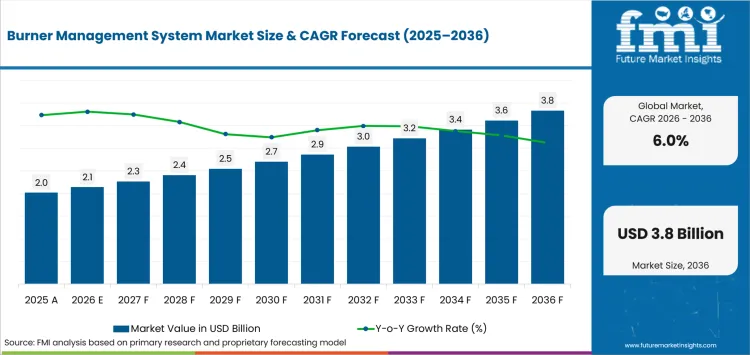
USD 2.1 billion in 2026 and USD 3.8 billion by 2036 at a 6.0% CAGR.
The burner management system market is projected to rise from USD 2.1 billion in 2026 to USD 3.8 billion by 2036 at a 6.0% CAGR. Aging burner controls are moving trips and sequencing into programmable safety instrumented systems as operators seek clearer diagnostics and simpler maintenance. CECO Environmental closed its Profire Energy acquisition in January 2025 and gained a specialist in industrial burner management. CECO’s added burner-management engineering depth increases retrofit support for projects that must replace obsolete controls during planned outages.
Project timing differs between new gas infrastructure and brownfield plants that must wait for shutdown access. The Canada Energy Regulator documented in May 2026 that 2025 natural gas production averaged about 19.0 Bcf/d. A production base of that scale sustains combustion controls work on new facilities and mature plants replacing burner controls on industrial boilers. BMS companies therefore need early greenfield specification access plus commissioning teams that can work inside planned outage windows.
Key Takeaways of Burner Management System Market
- Demand is projected to grow as operators replace difficult-to-support burner controls and specify programmable safety logic for new fired equipment.
- Based on system type, PLC-based BMS is projected to account for 31.0% in 2026 due to reusable safety sequences that suit multi-burner retrofit engineering.
- Gas burners are set to lead the burner type category with 34.0% share in 2026 owing to repeated purge and valve-proving requirements in industrial gas trains.
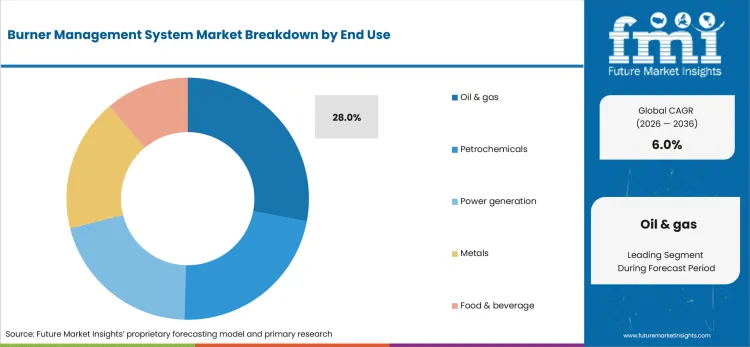
- By end use, oil & gas is forecast to represent 28.0% in 2026 driven by high-consequence heaters and boilers that require controlled startup and trip protection.
- Brownfield conversion is constrained by shutdown access and field validation because permissives and final elements require proof before a safe restart.
- Key players in the burner management system market include Rockwell Automation, Inc., Fireye, LLC, CECO Environmental Corp. (Profire Energy), ANDRITZ AG, Zeeco, Inc., Fives, ABB Ltd., and Honeywell International Inc.
Analyst Perspective
"BMS selection should start with the plant’s installed safety architecture and the outage work needed to prove every burner permissive after migration. A lower controller price loses value quickly if commissioning requires rewiring or leaves maintenance teams without clear trip diagnostics."
- Nikhil Kaitwade, Principal Consultant, Future Market Insights
How is the Burner Management System Market segmented?
The burner management system market is segmented by system type, burner type, end use, safety level, sales channel and region.
System type covers PLC-based BMS, DCS-integrated BMS, standalone burner controllers, SIL-rated safety systems and retrofit burner-management packages. Burner type includes gas, oil, dual-fuel, low-NOx and multi-burner furnace systems. End use covers oil & gas, petrochemicals, power generation, metals and food & beverage. Safety levels include SIL 2, standard control, SIL 3 and custom architectures. Sales channels include process automation OEMs, EPC contractors, burner OEMs and retrofit service providers.
How does Oil & Gas anchor the End Use category?
Refineries and production facilities use fired heaters in processes where an unsafe ignition sequence can disrupt a larger unit. BMS specifications therefore follow shutdown logic and operating procedures for high-temperature burners that must restart under tightly controlled process conditions.
- Oil & gas is set to lead the end use category with 28.0% share in 2026 due to high-consequence fired assets requiring controlled startup and documented trips.
- Oil India listed a March 2025 purchase order for burner management systems covering seven ETs and four IWBHs. Direct project buying gives BMS companies a route into operating-asset replacement programs where field integration and commissioning support decide acceptance.
What makes PLC-based BMS central to the System Type category?
PLC-based BMS fits plants that want burner sequencing inside a familiar control environment without surrendering independent combustion-safety logic. Rockwell Automation documented an October 2025 Lawrence Equipment deployment using Compact GuardLogix and certified burner-management instructions to replace separate third-party controllers. The same engineering environment retained safety I/O and diagnostics during later maintenance.
- By system type, PLC-based BMS is estimated to hold 31.0% in 2026 owing to reusable certified sequences that reduce custom migration work.
- Engineering teams can reuse certified objects on programmable logic controllers while retaining application-specific fuel trains and field-device counts. Reusable objects limit custom code and preserve diagnostics for individual safety inputs during commissioning.
Why do Gas Burners lead the Burner Type category?
Gas-fired systems place purge airflow and valve status directly in the startup sequence before operators admit fuel. Reliable flame detection and pressure permissives also return an interrupted ignition sequence to a defined safe shutdown state.
- In 2026, gas burners are expected to lead burner type with 34.0% share because purge logic and valve proving are repeated industrial gas-train requirements.
- USA Energy Information Administration data published in March 2026 put 2025 marketed natural gas production at 118.5 Bcf/d. The large operating base keeps industrial burners exposed to replacement projects requiring proven flame supervision and gas-train sequencing.
What drives process automation OEMs in the Sales channel category?
Process automation OEMs can place burner safety beside plant controls without forcing owners to maintain unrelated engineering environments. The channel fits sites where distributed control systems and safety controllers already define lifecycle support and change-management practices for the wider process unit.
- By sales channel, process automation OEMs are forecast to represent 36.0% in 2026 driven by installed control platforms that reduce safety-integration interfaces.
- Honeywell filed its first-quarter 2026 Form 10-Q in April and listed burner management systems within Industrial Automation offerings. BMS scope can travel with broader control projects while the same service organization handles testing and later modifications.
What are the drivers, restraints and opportunities in the Burner Management System Market?
Combustion-safety modernization raises demand while brownfield validation slows conversion and certified packaged controls shorten retrofit engineering.
- Driver: New gas-processing projects and aging controls increase demand for programmable burner sequences with stronger diagnostics and documented safety logic.
- Restraint: Brownfield work requires outage access and field validation before altered permissives or final elements can return safely to service.
- Opportunity: Certified libraries and modular combustion packages reduce custom engineering and give maintenance teams clearer diagnostics plus fuel-control flexibility.
Gas processing expands the installed base for protected fired equipment
New gas-processing projects increase the number of heaters and boilers that require sequenced ignition and safe fuel trips. Aramco confirmed in February 2026 that Tanajib Gas Plant had begun operating and was expected to process 2.6 bscfd of raw gas during 2026. The added processing equipment gives BMS companies more scope inside industrial automation packages because combustion safety is specified with the wider control system.
Validation work keeps brownfield conversion tied to outage windows
Brownfield BMS conversion depends on field devices and safety interlocks working correctly after logic changes, so controller replacement alone does not settle restart readiness. NFPA 86 second-revision material published in 2025 requires defined flame-propagation conditions to be proven and interlocked into the burner management system. Plants with short shutdowns therefore prefer migration designs that limit rewiring and leave technicians a clear cause-and-effect record during industrial workplace safety commissioning.
Packaged combustion controls widen the retrofit revenue route
Burner specialists can widen retrofit scope by pairing safety sequencing with air-fuel control and diagnostics used after startup. Fireye acquired Energy Technology & Control in March 2026, expanding its portfolio into multi-boiler management and air-fuel ratio control. A wider package gives one service team more responsibility for obsolete controls and fault isolation without changing the validated burner-safety boundary.
Which country CAGRs are profiled in the Burner Management System Market?
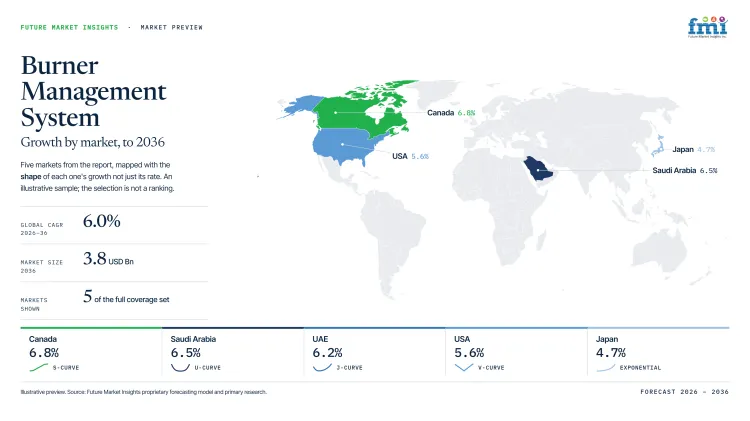
| Country | CAGR |
|---|---|
| Canada | 6.8% |
| Saudi Arabia | 6.5% |
| United Arab Emirates | 6.2% |
| United States | 5.6% |
| Japan | 4.7% |
How do country-level CAGRs compare in the Burner Management System Market?
Canada and Saudi Arabia form the upper-growth group, with BMS demand growing at 6.8% and 6.5% CAGR, respectively, as new gas projects generate more greenfield specifications. The UAE follows at 6.2% CAGR, supported by brownfield integration alongside capacity expansion. The United States records 5.6% CAGR, while Japan grows at 4.7% CAGR, with replacement and modernization work carrying greater demand weight.
- Canadian projects place greater emphasis on factory-tested logic and compact commissioning plans.
- Saudi EPC packages move BMS selection earlier into approved controls engineering work.
- UAE capacity additions combine new burner-control scope with ongoing operating-site modernization.
- United States fleet practices favor standard spares and repeatable test procedures during upgrades.
- Japan’s replacement-focused projects prioritize standardized BMS configurations and controlled retrofit execution.
The narrow CAGR spread hides materially different project timing and service requirements. The full report provides country-level CAGR analysis across North America, Latin America, Europe, East Asia, South Asia, Oceania and the Middle East and Africa.
Country-wise Analysis
- Canadian BMS projects often serve remote gas and LNG facilities, where travel increases commissioning costs and owner PLC standards limit migration options during shutdowns. Burner management system demand in Canada is estimated to grow at 6.8% CAGR through 2036, supported by new gas facilities and continued brownfield upgrades. The Major Projects Office stated in July 2026 that proposed LNG Canada Phase 2 could double facility production, strengthening greenfield BMS opportunities at Kitimat while local commissioning capabilities remain valuable.
- Large Saudi EPC contracts typically integrate burner logic into owner-approved automation packages, making platform qualification and documentation important for project access. Saudi Arabia’s burner management system market is estimated to grow at 6.5% CAGR through 2036, supported by expanding gas-processing capacity and higher heater and boiler requirements. Aramco stated in November 2025 that its 2030 sales-gas capacity target had increased to about 80% above 2021 levels, supporting continued demand for qualified BMS contractors.
- UAE operating gas facilities require retrofit teams to stage BMS cutovers around live process units, while installed safety interfaces and short outage windows increase execution requirements. BMS demand in the UAE is forecast to expand at 6.2% CAGR through 2036, driven by gas-processing upgrades and brownfield modernization. ADNOC Gas reported that IGD-E2 entered service in 2025 and added 370 MMSCFD of supply from Das Island, supporting opportunities for firms with established EPC and commissioning capabilities.
- U.S. refineries have a large installed base of fired equipment, creating sustained replacement demand across multiple sites. Burner management system sales in the United States are forecast to grow at 5.6% CAGR through 2036, with modernization rather than rapid capacity expansion driving demand. EIA data published in June 2025 placed operable atmospheric distillation capacity at 18.4 million barrels per calendar day, while legacy wiring and site-specific documentation continue to require tailored migration and outage strategies.
- Japan’s BMS demand is expected to grow at 4.7% CAGR through 2036, reflecting a mature installed base where replacement, modernization, and safety-system upgrades outweigh large-scale greenfield expansion. Refinery and industrial operators emphasize standardized controls, reliable spare-parts availability, and controlled shutdown execution, creating opportunities for BMS suppliers with proven retrofit and integration capabilities.
Who are the notable companies in the Burner Management System Market?
Rockwell Automation, Inc., Fireye, LLC, CECO Environmental Corp. (Profire Energy), ANDRITZ AG, Zeeco, Inc., Fives, ABB Ltd. and Honeywell International Inc. are notable companies serving this market.
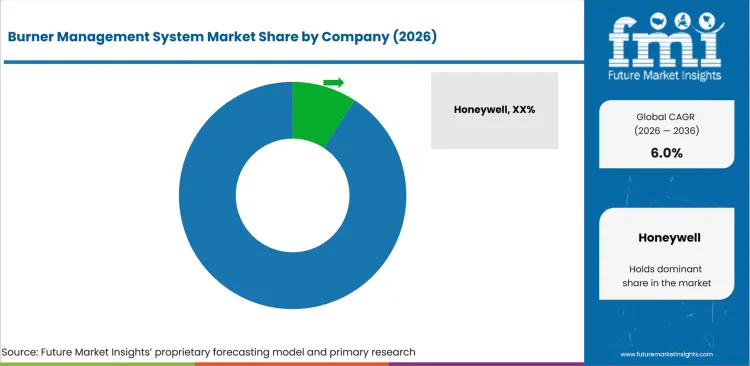
Automation-platform companies and combustion specialists control different parts of a BMS project. Certified safety logic raises entry barriers at plants that standardize safety controllers and engineering tools. Burner engineering and field commissioning decide acceptance during outages that leave little time to modify existing fuel trains.
- Rockwell Automation, Inc., ABB Ltd. and Honeywell International Inc. center BMS offers on programmable safety platforms that integrate with wider plant-control environments.
- Fireye, LLC and CECO Environmental Corp. (Profire Energy) concentrate on flame safeguard and purpose-built burner controls for industrial combustion applications.
- ANDRITZ AG, Zeeco, Inc. and Fives pair burner engineering with field integration when combustion hardware defines much of the control scope.
Competitive Benchmarking: Burner Management System Market
| Company | BMS Scope Breadth | Safety Integration Depth | Combustion Service Coverage | Geographic Reach |
|---|---|---|---|---|
| Rockwell Automation, Inc. | High | High | Medium | Global |
| Fireye, LLC | High | Medium | High | Global |
| CECO Environmental Corp. (Profire Energy) | High | Medium | High | North America and international |
| ANDRITZ AG | Medium | Medium | High | Global |
| Zeeco, Inc. | High | Medium | High | Global |
| Fives | Medium | Medium | High | Europe, Americas and Asia |
| ABB Ltd. | Medium | High | Medium | Global |
| Honeywell International Inc. | High | High | High | Global |
Scoring basis: Scope breadth is High for a BMS with two adjacent combustion functions, Medium for one adjacent function and Low for a narrow offer. Safety integration is High for certified SIL architecture, Medium for verified interlocks or flame-safeguard integration and Low for limited functional-safety coverage. Service coverage is High for engineering plus commissioning and lifecycle support, Medium for two lifecycle stages and Low for product-focused supply.
Key Developments in the Burner Management System Market
- In January 2026, Zeeco, Inc. finalized its acquisition of Applicot Corporation to expand local combustion engineering and EPC support in Japan.
- In September 2025, Fives launched ITAS Invistableflame for industrial process heating with automatic transition into flameless combustion and integrated UV flame detection.
- In March 2025, ANDRITZ AG received a Cartaseta order for new hood burners and gas valve trains plus a new burner management system.
Key Players in the Burner Management System Market
Programmable Safety and Automation Platforms
- Rockwell Automation, Inc.
Combustion Controls and Burner Specialists
- Fireye, LLC
- CECO Environmental Corp. (Profire Energy)
Engineered Combustion System Providers
- ANDRITZ AG
- Zeeco, Inc.
- Fives
Integrated Safety Automation Platforms
- ABB Ltd.
- Honeywell International Inc.
Burner Management System Market - Report Scope
| Coverage field | Report scope |
|---|---|
| Market breakdown | By system type, burner type, end use, safety level, sales channel and region. |
| Quantitative Units | USD Billion. |
| Market Definition | Commercial burner management hardware and safety logic used to sequence ignition, supervise flame and execute defined fuel-trip functions on fired industrial equipment. |
| Regions Covered | North America, Latin America, Europe, East Asia, South Asia and Pacific and Middle East and Africa. |
| Countries Covered | Canada, Saudi Arabia, United Arab Emirates, Brazil, United States, and 20+ countries included in the full report. |
| Key Companies Profiled | Rockwell Automation, Inc., Fireye, LLC, CECO Environmental Corp. (Profire Energy), ANDRITZ AG, Zeeco, Inc., Fives, ABB Ltd., Honeywell International Inc. |
| Forecast Period | 2026 to 2036. |
| Approach | Primary and secondary research with market triangulation. |
Burner Management System Market - Research Methodology
| Method | Approach |
|---|---|
| Primary Research | FMI analysts gathered input from manufacturers, service providers, technology developers, distributors, end users, procurement teams, and subject-matter experts. Interviews examined purchasing decisions, product or service evaluation, adoption barriers, approval requirements, pricing considerations, and expectations for technical or commercial support. Respondents were also asked what evidence is required before a trial, pilot, or initial order develops into regular purchasing. |
| Desk Research | Desk research covered government statistics, regulatory publications, trade data, industry associations, technical literature, standards, company filings, product information, and official corporate announcements. Sources were reviewed for relevance, publication date, geographic coverage, and consistency with the defined market scope. Claims relating to performance, applications, approvals, capacity, investment, and commercial activity were retained only when supported by credible public evidence. |
| Market Sizing and Forecasting | The market model combined the baseline value with historical performance, segment structure, pricing and volume indicators, adoption levels, company participation, and country-level demand conditions. Forecast assumptions considered economic activity, investment trends, regulatory developments, technology adoption, purchasing cycles, supply availability, and barriers to wider market use. Segment and regional estimates were reconciled before the final market total was calculated. |
| Data Validation | Estimates were checked against multiple independent indicators, including public data, company activity, trade patterns, industry developments, and findings from primary interviews. Validation also tested whether products, services, applications, and company revenues fell within the defined market boundaries. Adjacent categories, unsupported claims, overlapping revenues, and activities without direct market relevance were excluded to reduce double counting and maintain consistency across segments and countries. |
Burner Management System Market by Segments
Burner Management System Market segmented by System Type:
- PLC-based BMS
- DCS-integrated BMS
- Standalone burner controllers
- SIL-rated safety systems
- Retrofit burner management packages
Burner Management System Market segmented by Burner Type:
- Gas burners
- Oil burners
- Dual-fuel burners
- Low-NOx burners
- Multi-burner furnace systems
Burner Management System Market segmented by End Use:
- Oil & gas
- Petrochemicals
- Power generation
- Metals
- Food & beverage
Burner Management System Market segmented by Safety Level:
- SIL 2
- Standard control
- SIL 3
- Custom safety architecture
Burner Management System Market segmented by Sales Channel:
- Process automation OEMs
- EPC contractors
- Burner OEMs
- Retrofit service providers
Burner Management System Market by Region:
- North America
- United States
- Canada
- Latin America
- Brazil
- Mexico
- Chile
- Rest of Latin America
- Western Europe
- Germany
- United Kingdom
- Italy
- Spain
- France
- Nordics
- Benelux
- Rest of Western Europe
- Eastern Europe
- Russia
- Poland
- Hungary
- Balkan and Baltic States
- Rest of Eastern Europe
- East Asia
- China
- Japan
- South Korea
- South Asia and Pacific
- India
- ASEAN
- Australia and New Zealand
- Rest of South Asia and Pacific
- Middle East and Africa
- Kingdom of Saudi Arabia
- Other GCC Countries
- Türkiye
- South Africa
- Other African Union Countries
- Rest of Middle East and Africa
Research Sources and Bibliography
- CECO Environmental Corp. (2025, January 9). CECO Environmental Announces Closing of Acquisition of Profire Energy.
- Canada Energy Regulator. (2026, May 20). Market Snapshot: Canada’s natural gas production kept climbing in 2025.
- Rockwell Automation. (2025, October 3). Lawrence Equipment Innovates Burner Management Safety.
- Oil India Limited. (2025, March). Details of purchase orders placed during the month of March 2025 from IP Section, Materials Dept. Duliajan.
- Honeywell International Inc. (2026, April 23). Quarterly report on Form 10-Q for the period ended March 31, 2026.
- Saudi Aramco. (2026, February 26). Aramco’s gas strategy builds momentum with major progress towards growth target.
- National Fire Protection Association. (2025). Second Revision No. 13-NFPA 86-2025.
- Fireye, LLC. (2026, March 2). Fireye Acquires ETC Energy Technology & Control.
- Government of Canada, Major Projects Office. (2026, July 2). LNG Canada Phase 2.
- Saudi Aramco. (2025, November 4). Aramco announces third quarter 2025 results.
- ADNOC Gas plc. (2026). ADNOC Gas Integrated Report 2025.
- Agência Nacional do Petróleo, Gás Natural e Biocombustíveis. (2026, June 30). ANP divulga dados consolidados do setor regulado em 2025.
- USA Energy Information Administration. (2025, June 30). USA refining capacity largely unchanged as of January 2025.
- Zeeco, Inc. (2026, February 16). Zeeco, Inc. Expands Global Presence with Acquisition of Japan-Based Applicot Corporation.
- Fives. (2025, September 10). ITAS Invistableflame: Fives’ new game-changer flameless burner for low emission combustion.
- ANDRITZ AG. (2025, March 26). ANDRITZ to supply combustion system upgrade to Cartaseta, Switzerland.
- Fireye, LLC. (2025, June 19). Fireye Expands Distribution Network in India with Two New Partners.
- Zeeco, Inc. (2026, February 17). Zeeco Expands Presence in India with New Pune Office.
- Emerson. (2025, August 20). New Emerson safety controller streamlines integration and offers superior safety and functionality.
- Fives. (2025, November 25). Toyota decarbonizes its industrial processes thanks to Fives’ hydrogen technology.
- ABB Ltd. (2026, February 4). ABB launches System 800xA 7.0 DCS, bridging today and tomorrow’s automation.
- Honeywell International Inc. (2026, July 23). Quarterly report on Form 10-Q for the period ended June 30, 2026.
- CECO Environmental Corp. (2025, October 28). Form 10-Q for Ceco Environmental Corp filed 10/28/2025.
- Cleaver-Brooks. (2025, February 10). New EOS 500 Burner Control System Combines Advanced Functionality with Robust Safety Features.
This bibliography is provided for reader reference and is not exhaustive. The full report contains the complete reference list and detailed citations
This Report Answers
- How large is the burner management system market in 2026 and what value is projected for 2036?
- Which operating conditions are increasing burner management system replacement and greenfield specification activity?
- Why does PLC-based BMS hold the leading system-type share in the 2026 market?
- How do process automation OEMs convert installed control platforms into burner-management sales opportunities?
- Which five profiled countries record the highest approved CAGRs from 2026 through 2036?
- What capabilities separate burner-management companies in competitive benchmarking and lifecycle service coverage?
- Which verified company developments are changing burner controls and combustion engineering after January 2025?
- Which companies are profiled as notable participants in the burner management system market?
Frequently Asked Questions
How big is the burner management system market in 2026?
The burner management system market is valued at USD 2.1 billion in 2026 and is projected to reach USD 3.8 billion by 2036. Growth is driven by combustion-safety modernization and new fired-equipment projects that require sequenced ignition plus reliable fuel-trip protection.
What is the CAGR of the burner management system market from 2026 to 2036?
The burner management system market is projected to grow at a CAGR of 6.0% between 2026 and 2036. Expansion is supported by programmable safety upgrades and gas-processing investment that increases the number of protected fired assets.
Which system type leads the burner management system market?
The PLC-based BMS segment is expected to hold 31.0% of the burner management system market in 2026, driven by reusable safety logic for multi-burner sequencing. Brownfield sites also value familiar engineering tools that shorten migration work and preserve diagnostic visibility during scheduled outages.
Which sales channel leads the burner management system market?
Process automation OEMs are projected to hold 36.0% of the burner management system market by sales channel in 2026, owing to installed control platforms that reduce engineering interfaces. Existing service organizations also handle proof testing and later control changes without introducing another engineering environment.
Which companies are active in the burner management system market?
Key companies operating in the market include Rockwell Automation, Inc., Fireye, LLC, CECO Environmental Corp. (Profire Energy), ANDRITZ AG, Zeeco, Inc., Fives, ABB Ltd., and Honeywell International Inc. The eight companies compete on safety integration and combustion engineering plus field support for installations and brownfield migrations.
Preview the report firsthand - request a free sample
Get SampleGet the brochure for pricing and purchase details.
Get PDFTable of Content
- Key Takeaways
- Market Size and CAGR
- Top Growth Driver
- Fastest Growing Segment
- Leading Region
- Key Companies
- Emerging Opportunities
- Executive Summary
- Global Market Outlook
- Demand-side Trends
- Supply-side Trends
- Technology Roadmap Analysis
- Analysis and Recommendations
- Analyst Perspective (What is happening? Why now? What should investors know?)
- Key Questions Answered
- How large is the market?
- What is the CAGR?
- What are key trends?
- Which region dominates?
- Who are the leaders?
- Market Overview
- Market Coverage / Taxonomy
- Market Definition / Scope / Limitations
- Research Methodology
- Chapter Orientation
- Analytical Lens and Working Hypotheses
- Market Structure, Signals, and Trend Drivers
- Benchmarking and Cross-market Comparability
- Market Sizing, Forecasting, and Opportunity Mapping
- Research Design and Evidence Framework
- Desk Research Programme (Secondary Evidence)
- Expert Input and Fieldwork (Primary Evidence)
- Tooling, Models, and Reference Databases
- Data Engineering and Model Build
- Quality Assurance and Audit Trail
- Market Background
- Market Dynamics (Drivers, Restraints, Opportunity, Trends)
- Scenario Forecast (Optimistic, Likely, Conservative)
- Impact Analysis
- AI Impact
- Sustainability Impact
- Regulatory Impact
- Technology Impact
- Consumer / Buyer Analysis
- Purchase Drivers
- Adoption Barriers
- Buyer Journey
- Opportunity Map Analysis
- Product Life Cycle Analysis
- Supply Chain Analysis
- Investment Feasibility Matrix
- Value Chain Analysis
- PESTLE and Porter's Analysis
- Regulatory Landscape
- Regional Parent Market Outlook
- Production and Consumption Statistics
- Import and Export Statistics
- Global Market Analysis and Forecast, 2021 to 2036
- Historical Market Size Value (USD Billion) Analysis, 2021 to 2025
- Current and Future Market Size Value (USD Billion) Projections, 2026 to 2036
- Y-o-Y Growth Trend Analysis
- Absolute $ Opportunity Analysis
- Global Market Pricing Analysis, 2021 to 2036
- Global Market Analysis and Forecast, By System Type, 2021 to 2036
- Introduction / Key Findings
- Historical Market Size Value (USD Billion) Analysis By System Type, 2021 to 2025
- Current and Future Market Size Value (USD Billion) Analysis and Forecast By System Type, 2026 to 2036
- PLC-based BMS
- DCS-integrated BMS
- Standalone burner controllers
- SIL-rated safety systems
- Retrofit burner management packages
- PLC-based BMS
- Y-o-Y Growth Trend Analysis By System Type, 2021 to 2025
- Absolute $ Opportunity Analysis By System Type, 2026 to 2036
- Global Market Analysis and Forecast, By Burner Type, 2021 to 2036
- Introduction / Key Findings
- Historical Market Size Value (USD Billion) Analysis By Burner Type, 2021 to 2025
- Current and Future Market Size Value (USD Billion) Analysis and Forecast By Burner Type, 2026 to 2036
- Gas burners
- Oil burners
- Dual-fuel burners
- Low-NOx burners
- Multi-burner furnace systems
- Gas burners
- Y-o-Y Growth Trend Analysis By Burner Type, 2021 to 2025
- Absolute $ Opportunity Analysis By Burner Type, 2026 to 2036
- Global Market Analysis and Forecast, By End Use, 2021 to 2036
- Introduction / Key Findings
- Historical Market Size Value (USD Billion) Analysis By End Use, 2021 to 2025
- Current and Future Market Size Value (USD Billion) Analysis and Forecast By End Use, 2026 to 2036
- Oil & gas
- Petrochemicals
- Power generation
- Metals
- Food & beverage
- Oil & gas
- Y-o-Y Growth Trend Analysis By End Use, 2021 to 2025
- Absolute $ Opportunity Analysis By End Use, 2026 to 2036
- Global Market Analysis and Forecast, By Safety Level, 2021 to 2036
- Introduction / Key Findings
- Historical Market Size Value (USD Billion) Analysis By Safety Level, 2021 to 2025
- Current and Future Market Size Value (USD Billion) Analysis and Forecast By Safety Level, 2026 to 2036
- SIL 2
- Standard control
- SIL 3
- Custom safety architecture
- SIL 2
- Y-o-Y Growth Trend Analysis By Safety Level, 2021 to 2025
- Absolute $ Opportunity Analysis By Safety Level, 2026 to 2036
- Global Market Analysis and Forecast, By Sales Channel, 2021 to 2036
- Introduction / Key Findings
- Historical Market Size Value (USD Billion) Analysis By Sales Channel, 2021 to 2025
- Current and Future Market Size Value (USD Billion) Analysis and Forecast By Sales Channel, 2026 to 2036
- Process automation OEMs
- EPC contractors
- Burner OEMs
- Retrofit service providers
- Process automation OEMs
- Y-o-Y Growth Trend Analysis By Sales Channel, 2021 to 2025
- Absolute $ Opportunity Analysis By Sales Channel, 2026 to 2036
- Global Market Analysis and Forecast, By Region, 2021 to 2036
- Introduction
- Historical Market Size Value (USD Billion) Analysis By Region, 2021 to 2025
- Current Market Size Value (USD Billion) Analysis and Forecast By Region, 2026 to 2036
- North America
- Latin America
- Western Europe
- Eastern Europe
- East Asia
- South Asia and Pacific
- Middle East & Africa
- Market Attractiveness Analysis By Region
- North America Market Analysis and Forecast, By Country, 2021 to 2036
- Historical Market Size Value (USD Billion) Trend Analysis By Market Taxonomy, 2021 to 2025
- Market Size Value (USD Billion) Forecast By Market Taxonomy, 2026 to 2036
- By Country
- USA
- Canada
- By System Type
- By Burner Type
- By End Use
- By Safety Level
- By Sales Channel
- By Country
- Market Attractiveness Analysis
- By Country
- By System Type
- By Burner Type
- By End Use
- By Safety Level
- By Sales Channel
- Key Takeaways
- Latin America Market Analysis and Forecast, By Country
- Historical Market Size Value (USD Billion) Trend Analysis By Market Taxonomy, 2021 to 2025
- Market Size Value (USD Billion) Forecast By Market Taxonomy, 2026 to 2036
- By Country
- Brazil
- Mexico
- Chile
- Rest of Latin America
- By System Type
- By Burner Type
- By End Use
- By Safety Level
- By Sales Channel
- By Country
- Market Attractiveness Analysis
- By Country
- By System Type
- By Burner Type
- By End Use
- By Safety Level
- By Sales Channel
- Key Takeaways
- Western Europe Market Analysis and Forecast, By Country
- Historical Market Size Value (USD Billion) Trend Analysis By Market Taxonomy, 2021 to 2025
- Market Size Value (USD Billion) Forecast By Market Taxonomy, 2026 to 2036
- By Country
- Germany
- UK
- Italy
- Spain
- France
- Nordic
- BENELUX
- Rest of Western Europe
- By System Type
- By Burner Type
- By End Use
- By Safety Level
- By Sales Channel
- By Country
- Market Attractiveness Analysis
- By Country
- By System Type
- By Burner Type
- By End Use
- By Safety Level
- By Sales Channel
- Key Takeaways
- Eastern Europe Market Analysis and Forecast, By Country
- Historical Market Size Value (USD Billion) Trend Analysis By Market Taxonomy, 2021 to 2025
- Market Size Value (USD Billion) Forecast By Market Taxonomy, 2026 to 2036
- By Country
- Russia
- Poland
- Hungary
- Balkan & Baltic
- Rest of Eastern Europe
- By System Type
- By Burner Type
- By End Use
- By Safety Level
- By Sales Channel
- By Country
- Market Attractiveness Analysis
- By Country
- By System Type
- By Burner Type
- By End Use
- By Safety Level
- By Sales Channel
- Key Takeaways
- East Asia Market Analysis and Forecast, By Country
- Historical Market Size Value (USD Billion) Trend Analysis By Market Taxonomy, 2021 to 2025
- Market Size Value (USD Billion) Forecast By Market Taxonomy, 2026 to 2036
- By Country
- China
- Japan
- South Korea
- By System Type
- By Burner Type
- By End Use
- By Safety Level
- By Sales Channel
- By Country
- Market Attractiveness Analysis
- By Country
- By System Type
- By Burner Type
- By End Use
- By Safety Level
- By Sales Channel
- Key Takeaways
- South Asia and Pacific Market Analysis and Forecast, By Country
- Historical Market Size Value (USD Billion) Trend Analysis By Market Taxonomy, 2021 to 2025
- Market Size Value (USD Billion) Forecast By Market Taxonomy, 2026 to 2036
- By Country
- India
- ASEAN
- Australia & New Zealand
- Rest of South Asia and Pacific
- By System Type
- By Burner Type
- By End Use
- By Safety Level
- By Sales Channel
- By Country
- Market Attractiveness Analysis
- By Country
- By System Type
- By Burner Type
- By End Use
- By Safety Level
- By Sales Channel
- Key Takeaways
- Middle East & Africa Market Analysis and Forecast, By Country
- Historical Market Size Value (USD Billion) Trend Analysis By Market Taxonomy, 2021 to 2025
- Market Size Value (USD Billion) Forecast By Market Taxonomy, 2026 to 2036
- By Country
- Kingdom of Saudi Arabia
- Other GCC Countries
- Türkiye
- South Africa
- Other African Union
- Rest of Middle East & Africa
- By System Type
- By Burner Type
- By End Use
- By Safety Level
- By Sales Channel
- By Country
- Market Attractiveness Analysis
- By Country
- By System Type
- By Burner Type
- By End Use
- By Safety Level
- By Sales Channel
- Key Takeaways
- Key Countries Market Analysis
- USA
- Pricing Analysis
- Market Share Analysis, 2025
- By System Type
- By Burner Type
- By End Use
- By Safety Level
- By Sales Channel
- Canada
- Pricing Analysis
- Market Share Analysis, 2025
- By System Type
- By Burner Type
- By End Use
- By Safety Level
- By Sales Channel
- Mexico
- Pricing Analysis
- Market Share Analysis, 2025
- By System Type
- By Burner Type
- By End Use
- By Safety Level
- By Sales Channel
- Brazil
- Pricing Analysis
- Market Share Analysis, 2025
- By System Type
- By Burner Type
- By End Use
- By Safety Level
- By Sales Channel
- Chile
- Pricing Analysis
- Market Share Analysis, 2025
- By System Type
- By Burner Type
- By End Use
- By Safety Level
- By Sales Channel
- Germany
- Pricing Analysis
- Market Share Analysis, 2025
- By System Type
- By Burner Type
- By End Use
- By Safety Level
- By Sales Channel
- UK
- Pricing Analysis
- Market Share Analysis, 2025
- By System Type
- By Burner Type
- By End Use
- By Safety Level
- By Sales Channel
- Italy
- Pricing Analysis
- Market Share Analysis, 2025
- By System Type
- By Burner Type
- By End Use
- By Safety Level
- By Sales Channel
- Spain
- Pricing Analysis
- Market Share Analysis, 2025
- By System Type
- By Burner Type
- By End Use
- By Safety Level
- By Sales Channel
- France
- Pricing Analysis
- Market Share Analysis, 2025
- By System Type
- By Burner Type
- By End Use
- By Safety Level
- By Sales Channel
- India
- Pricing Analysis
- Market Share Analysis, 2025
- By System Type
- By Burner Type
- By End Use
- By Safety Level
- By Sales Channel
- ASEAN
- Pricing Analysis
- Market Share Analysis, 2025
- By System Type
- By Burner Type
- By End Use
- By Safety Level
- By Sales Channel
- Australia & New Zealand
- Pricing Analysis
- Market Share Analysis, 2025
- By System Type
- By Burner Type
- By End Use
- By Safety Level
- By Sales Channel
- China
- Pricing Analysis
- Market Share Analysis, 2025
- By System Type
- By Burner Type
- By End Use
- By Safety Level
- By Sales Channel
- Japan
- Pricing Analysis
- Market Share Analysis, 2025
- By System Type
- By Burner Type
- By End Use
- By Safety Level
- By Sales Channel
- South Korea
- Pricing Analysis
- Market Share Analysis, 2025
- By System Type
- By Burner Type
- By End Use
- By Safety Level
- By Sales Channel
- Russia
- Pricing Analysis
- Market Share Analysis, 2025
- By System Type
- By Burner Type
- By End Use
- By Safety Level
- By Sales Channel
- Poland
- Pricing Analysis
- Market Share Analysis, 2025
- By System Type
- By Burner Type
- By End Use
- By Safety Level
- By Sales Channel
- Hungary
- Pricing Analysis
- Market Share Analysis, 2025
- By System Type
- By Burner Type
- By End Use
- By Safety Level
- By Sales Channel
- Kingdom of Saudi Arabia
- Pricing Analysis
- Market Share Analysis, 2025
- By System Type
- By Burner Type
- By End Use
- By Safety Level
- By Sales Channel
- Türkiye
- Pricing Analysis
- Market Share Analysis, 2025
- By System Type
- By Burner Type
- By End Use
- By Safety Level
- By Sales Channel
- South Africa
- Pricing Analysis
- Market Share Analysis, 2025
- By System Type
- By Burner Type
- By End Use
- By Safety Level
- By Sales Channel
- USA
- Market Structure Analysis
- Competition Dashboard
- Competition Benchmarking
- Market Share Analysis of Top Players
- By Regional
- By System Type
- By Burner Type
- By End Use
- By Safety Level
- By Sales Channel
- Emerging Startups
- Innovation Benchmarking
- Competition Analysis
- Competition Deep Dive
- Honeywell
- Overview
- Product Portfolio
- Profitability by Market Segments
- Sales Footprint
- Strategy Overview
- Marketing Strategy
- Product Strategy
- Channel Strategy
- Emerson
- Siemens
- Rockwell Automation
- ABB
- Yokogawa
- Schneider Electric
- Fireye
- Kromschröder / Honeywell
- Zeeco
- Honeywell
- Case Studies
- Success Stories
- Recent Developments
- Competition Deep Dive
- Assumptions & Acronyms Used


