

- Market Size (2026)
- USD 299.4 Mn
- Forecast (2036)
- USD 798.0 Mn
- CAGR (2026 to 2036)
- 10.3%
How big is Cake Margarine Market in 2026?
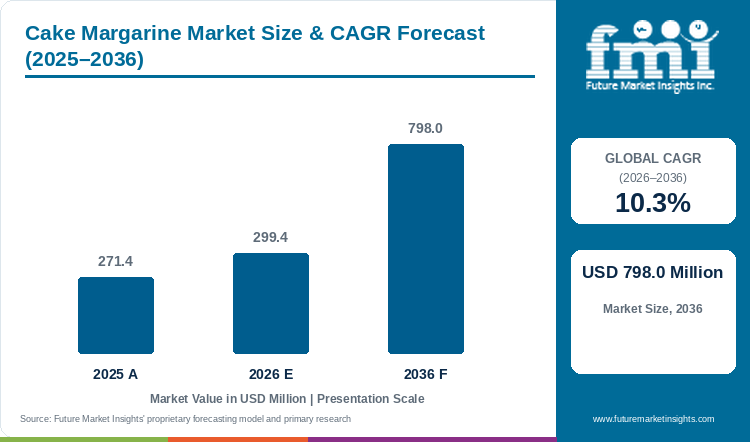
Starting from USD 271.4 million in 2025, the cake margarine market valuation advanced to USD 299.4 million in 2026, with projections pointing toward USD 798.0 million by 2036 at a CAGR of 10.3%.
The global cake margarine market was valued at USD 271.4 million in 2025 and is estimated to reach USD 299.4 million in 2026. The market is projected to reach USD 798.0 million by 2036, expanding at a compound annual growth rate (CAGR) of 10.3% between 2026 and 2036. Cake margarine is projected to capture 36.0% of 2026 type demand because beta-prime fat crystals stabilize the fine air cells whipped during continuous aeration, and that foam decides crumb volume at industrial line speeds. Demand is supported by trans-fat-free reformulation waves that pushed bakeries off partial hydrogenation while keeping the plasticity window solid fat profiles provide, and requalification of any substitute fat costs a production week per line [1]. The category compounds far ahead of the margarine market at 4.5% CAGR, since table margarine fights on spreads while cake margarine fights on oven performance. Structure is shifting with the demand, as Bunge closed its Viterra merger in July 2025 after agreeing to divest European margarines across four EU markets to Vandemoortele [17] [23], and Cargill launched NatureFresh Professional Elite Choice aerated bakery fat with up to 10% higher flour absorption at AAHAR in March 2025 [2]. Industrial bakeries award volume to fat suppliers whose crystal specification survives their aerator settings, and requalification friction keeps those contracts sticky through 2036.
Key Market Trends & Insights
- By type: Cake Margarine is projected to capture 36.0% of the type segment in 2026 because beta-prime fat crystals stabilize fine air bubbles during continuous mixing.
- By form: Powder / Dry formulations are estimated to command 46.0% of the form segment in 2026 as automated dry-ingredient hoppers eliminate heated liquid tank maintenance.
- By application: Bread & Rolls are expected to concentrate 38.0% of the application segment in 2026 because high-throughput bun and loaf ovens require dependable crumb softening.
- By claim: Conventional grades are forecast to generate 58.0% of the claim segment in 2026 owing to flexible edible-oil fractionation and lower raw-material invoice costs.
- By sales channel: Direct to Industrial Bakeries is anticipated to account for 55.0% of the sales channel segment in 2026 through co-developed solid-fat content specifications.
Regional Highlights
- Top national expansion: The UAE is projected to lead national growth at an 11.5% CAGR through 2036 under heat-tolerant bakery fat imports for hotel commissaries.
- Broader country progression: Saudi Arabia is expected to expand at an 11.2% CAGR ahead of South Korea at 10.8% and the USA at 10.5%, while Japan is forecast to advance at a 9.2% CAGR.
Market Size & Forecast
Table 1: Market Size and Forecast for the Cake Margarine Market (USD million and CAGR percentage), 2025 to 2036
| Metric | Value |
|---|---|
| 2025 Market Size | USD 271.4 million |
| Estimated Market Size in 2026 | USD 299.4 million |
| Projected Market Size by 2036 | USD 798.0 million |
| CAGR, 2026 to 2036 | 10.3% |
| Added Revenue, 2026 to 2036 | USD 498.6 million |
Demand for specialized cake margarine is closely tied to how commercial bakeries manage reject rates on automated tunnel ovens. When ambient bakery floor temperatures shift by even a few degrees, uncalibrated vegetable shortenings lose plasticity during high-shear whipping and cause batter curdling that forces costly line stoppages. To solve that processing bottleneck without adding synthetic chemical emulsifiers, a March 2026 D-optimal formulation study published in Foods showed that pre-emulsification paired with 50 to 100 ppm lipase restored cake volume and reduced crumb hardness across 50% fat-reduced muffin batters [3]. Findings like this explain why plant procurement directors are moving away from spot-market shortenings and locking in multi-quarter industrial margarine supply contracts that guarantee uniform slip melting points across seasonal oilseed harvests.
Industrial Bakery Throughput and Fat-Inclusion Sizing
Table 2: Industrial Bakery Throughput and Fat-Inclusion Sizing for the Cake Margarine Market (USD million and operational ranges), 2025 to 2036
| Metric | 2025 | 2026 | 2036 |
|---|---|---|---|
| Market size (USD million) | 271.4 | 299.4 | 798.0 |
| Commercial cake & sweet-goods output (million MT) | 14.2 to 15.8 | 14.9 to 16.6 | 24.5 to 27.2 |
| Formulated cake-margarine consumption (thousand MT) | 128.0 to 142.0 | 140.0 to 155.0 | 345.0 to 385.0 |
| Average B2B contract price per kg (USD) | 1.90 to 2.15 | 1.95 to 2.20 | 2.10 to 2.40 |
Operational note: B2B volume ranges reflect 8% to 22% fat-to-flour dosing ratios across industrial cake batters and 2% to 5% crumb-softening inclusion in continuous pan-bread lines.
Adoption of automated ingredient-handling equipment is another factor reshaping purchasing specifications across multi-line bakeries. Because continuous rotor mixers must entrain air within 90-second whipping cycles, centralized bakery commissaries work directly with lipid refiners to match pastry margarine and cake-fat crystallization curves to bulk-tote pumping stations and pneumatic dry hoppers.
Per Capita & Bakery Plant Spending Indicators
Table 3: Per Capita and Facility Spending Indicators for the Cake Margarine Market (USD), 2025 to 2036
| Metric | 2025 | 2026 | 2036 |
|---|---|---|---|
| World population (billion) | 8.2 | 8.3 | 9.0 |
| Spend per 1,000 people (USD) | 33.1 | 36.1 | 88.7 |
| Annual fat spend per industrial bakery (USD) | 14,200 to 16,800 | 15,500 to 18,200 | 36,000 to 42,500 |
| Direct industrial contract share (%) | 53.0% to 56.0% | 54.0% to 57.0% | 60.0% to 64.0% |
Table 4: Plant & Industrial Bakery Spending Indicators for the Cake Margarine Market (USD and percentages), 2026
| Metric | Value | Institutional Reference Basis |
|---|---|---|
| Market size, 2026 | USD 299.4 million | 2026 global valuation baseline |
| Commercial bakery plants globally | 18,500 plants | Industrial & large artisan bakery plant registry |
| Market spend per bakery plant | USD 16,183.8 | Annualized cake-margarine procurement per plant |
| Direct industrial bakery allocation, 2026 | USD 164.7 million | 55.0% sales-channel segment allocation |
Gross margin protection on fixed-price supermarket supply contracts requires tight control over batter specific gravity and bake loss. When dairy butter prices spike, bakery purchasing directors substitute structured butter and margarine blends engineered from palm-stearin fractions and liquid seed oils so finished sponge loaves retain moistness without exceeding per-unit recipe budgets.
Analyst Perspective
"Bakery procurement teams no longer buy cake fats on per-ton commodity oil pricing alone. Suppliers that deliver pre-crystallized beta-prime margarines and free-flowing dry fat powders verified to hold batter overrun across 14-day shelf-life windows will secure multi-year industrial supply contracts."
- Nandini Roy Choudhury, Principal Analyst at Future Market Insights
How is the cake margarine market segmented?
The cake margarine market is segmented by type, form, application, claim, and sales channel. In 2026, Cake Margarine is projected at 36.0%, Powder / Dry at 46.0%, Bread & Rolls at 38.0%, Conventional at 58.0%, and Direct to Industrial Bakeries at 55.0%.
By type: Cake Margarine, Cream Margarine, Aerating Specialty, and Reduced-Fat.
By form: Powder / Dry, Liquid, Paste / Semi-Solid, and Granules / Pieces.
By application: Bread & Rolls, Cakes & Muffins, Biscuits & Cookies, Viennoiserie & Pastry, and Other Bakery & Snacks.
By claim: Conventional, Clean Label, Organic, and Non-GMO / Identity Preserved.
By sales channel: Direct to Industrial Bakeries, Ingredient Distributors, Foodservice & Artisan Supply, and Online B2B.
Why does Cake Margarine lead the type segment?
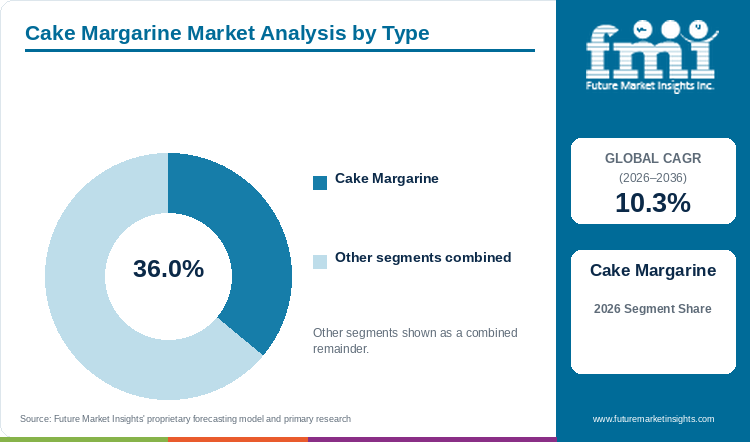
Cake Margarine is projected to capture 36.0% of the type segment in 2026, supported by beta-prime crystal aeration.
Table 5: Type Share for the Cake Margarine Market (percentage share), 2026
| Type | Share (2026) |
|---|---|
| Cake Margarine | 36.0% |
| Other Segments Combined | 64.0%* |
| Total | 100.0% |
*Note: Remaining type subsegments sum to 100.0% of 2026 cake margarine demand.
Table 6: Type Leadership and Market Growth for the Cake Margarine Market (segment and CAGR percentage), 2026 to 2036
| Metric | Value |
|---|---|
| Global CAGR (2026 to 2036) | 10.3% |
| Leading Segment | Cake Margarine |
Demand for classic structured Cake Margarine remains ahead of specialty fillings and reduced-fat variants because one 80% fat emulsion handles both batch creaming and continuous mixing without reformulating the base flour ratio. Whereas liquid vegetable oils allow air cells to coalesce in warm mixing bowls and cause tunnel voids in baked loaves, beta-prime crystallized emulsions lock microscopic bubbles inside the batter and support vegan margarine conversion across dairy-free cake lines.
- Cake Margarine is projected to account for 36.0% of the type segment in 2026 because balanced plasticity supports both batch creaming and continuous aeration.
- An August 2025 evaluation study in the Journal of the Science of Food and Agriculture demonstrated that emulsion-templated diacylglycerol oleogels cross-linked with 0.15 wt% tannic acid replaced 50% of butter in chiffon cakes while matching control texture scores at 6.44 versus 6.72 [4].
Why does Powder / Dry define the largest form segment?
Powder / Dry formulations are estimated to secure 46.0% of the form segment in 2026, driven by automated dry-hopper dosing.
Labor shortages on bakery mixing floors are pushing commercial premix and cake manufacturers toward dry-dosed ingredients. Manual unwrapping of 20-kilogram plasticized fat blocks by hand slows batch changeovers and leaves residual fat clinging to polyethylene liners, whereas spray-cooled Powder / Dry cake margarines meter directly from gravimetric hoppers paired with aerating cake emulsifiers without heated storage tanks.
- Powder / Dry options are estimated to command 46.0% of the form segment in 2026 as dry-blending compatibility reduces mixer cleanout time.
- A July 2025 study published in ACS Omega confirmed that bicontinuous psyllium-husk hydrogel and beeswax oleogel systems at a 75:25 ratio matched palm-oil cake crumb porosity and hardness without liquid oil percolation [5].
What keeps Bread & Rolls ahead in the application segment?
Bread & Rolls are expected to command 38.0% of the application segment in 2026, reflecting continuous high-speed bun and loaf production.
Although sponge and layer cakes use a higher fat percentage per batch, industrial Bread & Rolls lines run 24-hour daily schedules that generate the largest cumulative tonnage orders for structured bakery margarines. Inclusion of 2% to 4% structured margarine into bread doughs lubricates gluten films during high-speed dividing and delays starch staling across multi-day grocery distribution paired with shortenings in sweet goods.
- Bread & Rolls are expected to hold 38.0% of the application segment in 2026 because uninterrupted daily loaf throughput generates recurring bulk fat reorders.
- A September 2025 study in Frontiers in Nutrition analyzing eight wheat-roll dough formulations confirmed that maintaining rheological stability during salt-reduction trials requires precise control over dough cohesion and loaf volume [6].
Why does Conventional lead the claim segment?
Conventional products are forecast to generate 58.0% of the claim segment in 2026, owing to cost-effective oil fractionation and pre-approved specs.
Price pressure from supermarket private-label tenders keeps Conventional cake margarines in the lead over certified organic and identity-preserved alternatives. Because conventional zero-trans specifications allow lipid refiners to blend palm fractions with domestic soybean or sunflower oil as harvest prices shift, bakeries avoid paying certification premiums while still meeting statutory trans-fat caps.
- Conventional is forecast to account for 58.0% of the claim segment in 2026 because established oilseed blending flexibility minimizes per-batch formulation cost.
- In March 2025, Cargill introduced Gemini Plus trans-fat-free vanaspati and NatureFresh Professional Elite Choice aerated bakery fat at AAHAR 2025, delivering up to 10% higher flour absorption for cost-sensitive commercial bakers [2].
What gives Direct to Industrial Bakeries the leading position in the sales channel segment?
Direct to Industrial Bakeries is anticipated to account for 55.0% of the sales channel segment in 2026, reinforced by pilot-line co-development.
Large bakery groups rarely buy structured cake fats from general wholesale catalogs because even a two-degree shift in slip melting point can alter cake dome height across tunnel ovens. Instead, industrial bakeries contract directly with specialty fat refiners so application scientists can calibrate solid-fat content curves on pilot lines before multi-ton deliveries begin.
- Direct to Industrial Bakeries is anticipated to capture 55.0% of the sales channel segment in 2026 because recipe qualification depends on plant-scale co-development.
- In April 2025, AAK launched its 2024 Annual and Sustainability Reports confirming 91% verified deforestation-free palm supply and 97% traceability to plantation across its co-development bakery fat network [7].
What are the drivers, restraints, and opportunities in the cake margarine market?
In the cake margarine market, trans-fat-free reformulation and automated line speed requirements propel structured fat procurement whereas solid-fat requalification hurdles restrain rapid vendor switching and enzyme-interesterified dry powders create margin expansion opportunities.
- Driver: Mandatory partially hydrogenated oil bans and high-speed continuous mixing lines convert beta-prime cake margarines into critical bakery infrastructure.
- Restraint: Beta-crystal coarsening during warm warehouse storage and multi-week plant qualification trials slow supplier substitution across established recipes.
- Opportunity: Enzymatically structured low-saturate emulgels and free-flowing powdered cake fats unlock clean-label reformulation contracts.
Growth Analysis and Future Potential: Qualitative Demand Catalysts
Wholesale price inflation across dairy butter and bakery inputs is compelling commercial cake manufacturers to standardize structured vegetable margarines across high-speed lines. Beta-prime crystallized cake margarines stabilize microscopic air cells against thermal coalescence before starch gelatinization sets the crumb, allowing bakeries to maintain loaf volume without expensive dairy cream. FMI plant audits show that bakery groups pair cake margarines with normal and specialty fats to protect crumb softness across 14-day supermarket distribution cycles. In June 2026, a rheological study in the Journal of the Science of Food and Agriculture demonstrated that 55% structured sacha inchi oil emulgels achieved 509.00 mPa s batter viscosity and replaced saturated cake fat without losing loaf volume [8]. Validated structured lipid performance encourages bakery R&D directors to qualify specialty cake margarines that improve flour absorption and lower per-unit batch cost.
Risk Assessment of the Cake Margarine Market: Operational and Formulation Friction
Post-crystallization hardening and beta-crystal bloom during warm transit remain the primary technical barriers restricting commercial fat substitution. When cake margarines experience temperature cycling above 28 degrees Celsius in distribution warehouses, small beta-prime needles recrystallize into coarse beta platelets that lose creaming power and produce dense cakes. A March 2025 study from Leibniz University Hannover published in Current Research in Food Science demonstrated that mechanical plasticizing altered wax-based bigel crystal networks and produced flatter laminated pastries when replacing control margarine at 100% [9]. Industrial QA teams therefore mandate multi-week pilot and tunnel-oven validation runs before approving any alternative interesterified fats supplier, which lengthens B2B sales cycles and protects incumbent vendors.
Commercial Opportunity Analysis: Formulation Differentiation and Value-Add Formats
Ingredient suppliers capture higher gross margins by engineering spray-cooled powdered cake margarines and low-saturate protein-polysaccharide emulgels that run on existing dry-dosing lines. Automated bakery premix facilities now replace 20-kilogram carton blocks that require manual unwrapping and heated melting kettles. Formulators supplying free-flowing powdered fat concentrates and clean-label edible oils and fats eliminate block-scraping labor while cutting saturated fatty acid declarations by 30% to 50%. In June 2025, food engineering trials published in Gels confirmed that thermally treated pea and soy protein isolate emulgels containing 40% to 60% sunflower oil matched reference margarine biscuit color and sensory acceptance scores [10]. Combined dry-handling convenience and verified clean-label mold inhibition position specialty fat processors to win multi-plant national bakery tenders.
Cake Margarine Market by Country (2026 to 2036)
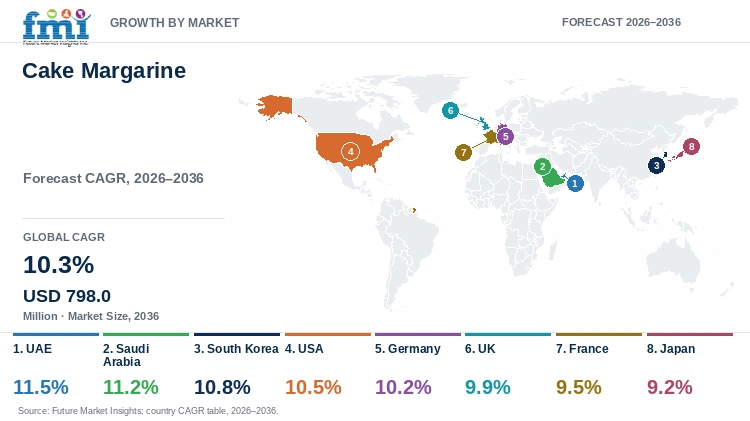
As per FMI, the UAE is projected to lead cake margarine expansion across evaluated national markets at an 11.5% CAGR through 2036, whereas Japan is forecast to advance at a 9.2% CAGR. Commercial uptake across Middle Eastern hospitality commissaries and East Asian or Western European industrial bakeries depends on trans-fat compliance documentation and thermal stability during ambient distribution.
Table 7: Country CAGR and Primary Growth Levers for the Cake Margarine Market (CAGR percentage and operational drivers), 2026 to 2036
| Country | CAGR (2026 to 2036) | Primary Growth Lever |
|---|---|---|
| UAE | 11.5% | Resort & airline commissary expansion and high-melt-point tropical fat specifications |
| Saudi Arabia | 11.2% | Mandatory SFDA trans-fat elimination rules and domestic industrial bakery scaling |
| South Korea | 10.8% | High imported ingredient reliance across KRW 111.9 trillion food processing sector |
| USA | 10.5% | Federal PHO prohibition compliance and high-speed continuous cake-line automation |
| Germany | 10.2% | 14.7% wholesale bakery input inflation and European margarine asset restructuring |
| UK | 9.9% | Bakery labor vacancy pressures driving pre-crystallized and dry-dosed fat adoption |
| France | 9.5% | SME agri-food reformulation across 17,000+ enterprises and butter price hedging |
| Japan | 9.2% | Domestic butter stock shifts and precision beta-prime fat structuring |
Source: Future Market Insights analysis
UAE Cake Margarine Market Outlook (2026 to 2036)
Cake margarine sales in the UAE are projected to expand at a leading 11.5% CAGR from 2026 to 2036 across hotel commissaries and industrial bakeries. Unlike temperate European markets, ambient summer warehouse temperatures exceeding 42 degrees Celsius in Dubai and Abu Dhabi force bakers to specify tropicalized cake margarines that resist oil separation during transit. According to an August 2026 USDA Foreign Agricultural Service report, more than 570 food and beverage processors in the UAE rely on imported ingredients under the National Food Security Strategy 2051 [11]. High chilled-container freight rates still pressure distributor margins, prompting central kitchens to favor multi-purpose palm-fraction cake margarines with verified thermal tolerance.
Key takeaway: In the UAE, hotel commissary expansion and high-temperature logistics standards are projected to anchor demand for thermal-stable cake margarines.
Saudi Arabia Cake Margarine Market Outlook (2026 to 2036)
Strict regulatory enforcement against partially hydrogenated oils and pre-Hajj factory audits make verified fatty-acid composition the primary qualification gate in Saudi Arabia. Commercial cake margarine revenue in Saudi Arabia is forecast to climb at an 11.2% CAGR between 2026 and 2036 across Riyadh and Jeddah baking plants. In December 2025, the General Authority for Statistics reported rising domestic food self-sufficiency paired with expanding local industrial food and bakery manufacturing capacity across the Kingdom [12]. Earlier in May 2025, the Saudi Food and Drug Authority conducted over 300 food-factory inspection visits across Makkah and Madinah [13], compelling industrial bakers to lock in audited zero-trans margarine suppliers despite intense price competition.
Key takeaway: In Saudi Arabia, mandatory trans-fat compliance inspections and domestic bakery capacity expansion are forecast to accelerate industrial cake-margarine contracting.
South Korea Cake Margarine Market Outlook (2026 to 2036)
Structural dependence on overseas oilseed and dairy inputs sets South Korea apart from self-sufficient agricultural economies and creates steady demand for imported functional baking fats. In April 2026, the USDA Foreign Agricultural Service reported that Vietnam’s food processing industry reached USD 88 billion in 2025, growing 11% as processors expanded capacity for industrial bakery and specialty fat applications [26]. Demand for cake margarine in South Korea is estimated to advance at a 10.8% CAGR from 2026 through 2036 across packaged cake and convenience-store bakery lines. Stringent customs inspection protocols and cold-chain warehousing fees nonetheless require foreign fat refiners to supply shelf-stable powdered and block formats.
Key takeaway: In South Korea, heavy processor reliance on imported functional lipids is estimated to sustain 10.8% CAGR expansion for specialty cake margarines.
USA Cake Margarine Market Outlook (2026 to 2036)
After federal revocation of partially hydrogenated oil tolerances, large commercial bakeries in the USA evaluate cake margarines on continuous-mixer overrun and clean-label emulsifier compatibility. Data published by the USDA Economic Research Service in January 2025 showed that retail cereals and bakery product price inflation slowed to 0.5% in 2024 while fats and oils rose 2.4% [15]. That narrow retail pricing window prevents bakery chains from passing raw-material spikes onto grocery buyers and steers R&D teams toward high-absorption aerated fats and egg-reducing systems. Shipments of cake margarine in the USA are anticipated to progress at a 10.5% CAGR between 2026 and 2036 across industrial cake and roll plants.
Key takeaway: In the USA, capped retail bakery price pass-through and zero-PHO formulation mandates are anticipated to drive adoption of high-yield cake margarines.
Germany Cake Margarine Market Outlook (2026 to 2036)
Germany is projected to record a 10.2% CAGR in the cake margarine market from 2026 to 2036 across industrial commissaries and regional bakery chains. Steep wholesale input inflation and corporate divestitures in European spreads manufacturing are reshaping B2B fat procurement contracts across the country. In January 2026, Destatis reported that 2025 annual average wholesale prices in Germany rose 14.7% for sugar and bakery products and 5.7% for edible fats and oils [1], while the Central Bakers Confederation in Germany documented EUR 17.92 billion in trade turnover across 8,912 enterprises [16]. Bunge also agreed in March 2025 to sell its European margarines business to Vandemoortele [17], prompting bakers in Germany to qualify backup suppliers.
Key takeaway: In Germany, 14.7% wholesale bakery price inflation and European margarine ownership shifts are projected to prioritize dual-qualified industrial fat supply.
UK Cake Margarine Market Outlook (2026 to 2036)
Persistent shop-floor labor shortages and strict front-of-pack nutrition rules in the UK compel plant bakers to adopt pre-tempered and dry-dosed cake margarines that eliminate manual rework. Sales of cake margarine in the UK are expected to rise at a 9.9% CAGR over the 2026 to 2036 forecast period. In May 2025, the Food and Drink Federation reported that UK food and drink manufacturing labor vacancies reached 3.9% in Q1 2025 while 41% of manufacturers scaled back capital investment [18]. Office for National Statistics ProdCom data released in July 2025 confirmed that food manufacturing represented 21% of total UK product sales [19], yet packaging EPR fees continue to squeeze processor margins.
Key takeaway: In the UK, 3.9% factory labor vacancy rates and HFSS reformulation pressures are expected to favor automated dry and pumpable cake margarines.
France Cake Margarine Market Outlook (2026 to 2036)
High domestic butter prices and fragmented small-enterprise production in France encourage industrial viennoiserie and cake manufacturers to blend structured vegetable margarines into commercial batters. An April 2026 USDA Foreign Agricultural Service report documented that the agri-food sector in France includes 17,000 to 18,000 companies (98% SMEs) generating USD 215 billion to USD 225 billion in annual revenue [20]. Commercial turnover in the France cake margarine market is slated to grow at a 9.5% CAGR from 2026 to 2036 across regional industrial patisserie and supermarket bake-off channels. Culinary resistance to non-dairy flavors in traditional domestic cakes still forces lipid suppliers to engineer butter-flavored fractions with clean melting profiles.
Key takeaway: In France, SME bakery cost pressures and dairy-butter price volatility are slated to support adoption of butter-flavored structured cake margarines.
Japan Cake Margarine Market Outlook (2026 to 2036)
Strict sponge-cake pore uniformity and gift-confectionery shelf-life standards in Japan require specialty fat suppliers to co-develop narrow-melting beta-prime emulsions with domestic bakers. An October 2026 USDA Foreign Agricultural Service report noted that dairy processors in Japan continue directing surplus raw milk into butter and non-fat dry milk while tariff-rate quotas keep butter imports flat [21]. In January 2026, Fuji Oil Holdings advanced its United for Growth 2027 plan and expanded its GOODNOON plant-based brand after integrating Provence Huile in France into its sunflower oil chain [22]. Revenue in the Japan cake margarine market is forecast to expand at a 9.2% CAGR from 2026 to 2036 despite demographic headwinds.
Key takeaway: In Japan, strict sponge-crumb texture tolerances and tariff-quota-constrained butter supply are forecast to sustain specialized beta-prime cake margarine procurement.
Full report country CAGRs cover: North America; Latin America; Western Europe; Eastern Europe; East Asia; South Asia and Pacific; Middle East and Africa.
Who are the notable companies in the cake margarine market?
AAK, Bunge, Cargill, Fuji Oil Holdings, Wilmar International, Lactalis Ingredients, FrieslandCampina Ingredients, Arla Foods Ingredients, Michael Foods, and Corbion are the notable companies evaluated in this market.
FMI analysis indicates that commercial competition divides between vertically integrated specialty oilseed refiners supplying structured cake margarines and functional dairy or emulsifier specialists whose ingredients co-stabilize cake batters. Primary lipid processors engineer beta-prime crystal networks and spray-cooled fat powders, whereas dairy and fermentation suppliers provide whey proteins and dough emulsifiers that govern whole-recipe cost-in-use.
- Structured Margarine & Specialty-Fat Producers: AAK and Bunge paired with Cargill, Fuji Oil Holdings, and Wilmar International formulate zero-trans cake margarines and powdered bakery fat systems.
- Dairy & Protein Formulation Specialists: Lactalis Ingredients and FrieslandCampina Ingredients with Arla Foods Ingredients supply whey protein concentrates and dairy fat powders used with baking fats.
- Egg-System & Bakery Emulsifier Specialists: Michael Foods and Corbion provide industrial liquid egg baselines, Vantage egg-replacement blends, and Verdad cultured-wheat preservation systems.
Competitive Benchmarking: Cake Margarine Market
Table 8: Competitive Benchmarking for the Cake Margarine Market (qualitative capability ratings), 2026
| Company | Structured Cake-Fat Evidence | Dry-Format Formulation | Bakery Application Support | Geographic Reach |
|---|---|---|---|---|
| AAK | High | Medium | High | Europe, North America, Asia-Pacific |
| Bunge | High | High | High | North America, Europe, Asia |
| Cargill | High | Unscored | High | North America, Europe, Asia-Pacific |
| Fuji Oil Holdings | High | Unscored | Medium | Japan and Southeast Asia |
| Wilmar International | High | Unscored | Medium | Asia, Middle East, and Africa |
| Lactalis Ingredients | Unscored | Medium | Medium | Europe and international dairy channels |
| FrieslandCampina Ingredients | Unscored | Medium | Medium | Europe, Asia, and North America |
| Arla Foods Ingredients | Unscored | Medium | High | Europe, North America, and Latin America |
| Michael Foods | Unscored | Medium | Medium | United States foodservice and bakery |
| Corbion | Unscored | High | High | North America and Europe |
Scoring basis: Capability tiers evaluate documented structured cake-margarine SKU breadth and spray-dried or powdered bakery fat offerings across dedicated pilot-lab co-development centers. Unscored entries indicate adjacent ingredient participation without a separately verified standalone cake-margarine SKU.
Key Developments in the Cake Margarine Market
- Bunge Global SA completed its merger with Viterra Limited in July 2025 after agreeing in March 2025 to divest its European margarines and spreads business in four EU markets to Vandemoortele [17] [23].
- Cargill launched NatureFresh Professional Elite Choice aerated bakery fat (delivering up to 10% higher flour absorption) and NatureFresh Professional Lite butter-flavored vegetable fat at AAHAR in March 2025 [2].
- Corbion unveiled Verdad Essence WH100 cultured-wheat natural mold inhibition and an upgraded 11-mold predictive preservation model in April 2025 to protect clean-label baked goods shelf life [24].
Key Players in the Cake Margarine Market
Structured Cake-Margarine and Bakery-Fat Suppliers
- AAK
- Bunge
- Cargill
- Fuji Oil Holdings
- Wilmar International
Dairy-Derived Bakery Formulation Specialists
- Lactalis Ingredients
- FrieslandCampina Ingredients
- Arla Foods Ingredients
Egg-System and Emulsifier Ingredient Specialists
- Michael Foods
- Corbion
Cake Margarine Market - Report Scope
Table 9: Report Scope for the Cake Margarine Market (coverage fields and definitions), 2026 to 2036
| Coverage field | Report scope |
|---|---|
| Market breakdown | Type; Form; Application; Claim; Sales Channel |
| Quantitative Units | USD Million |
| Market Definition | Includes commercial B2B revenue from structured cake margarines, cream margarines, aerating specialty fats, and powdered/liquid cake-margarine preparations sold for bakery manufacturing. Category Scope Note: Excludes finished baked goods retail value, standalone dairy butter, unblended bulk cooking oils, and non-lipid egg or dairy ingredients. |
| Regions Covered | North America; Latin America; Western Europe; Eastern Europe; East Asia; South Asia and Pacific; Middle East and Africa |
| Countries Covered | UAE, Saudi Arabia, South Korea, USA, Germany, UK, France, Japan, and additional countries in the full report |
| Key Companies Covered | AAK, Bunge, Cargill, Fuji Oil Holdings, Wilmar International, Lactalis Ingredients, FrieslandCampina Ingredients, Arla Foods Ingredients, Michael Foods, Corbion |
| Forecast Period | 2026 to 2036 |
| Approach | Primary and secondary research with top-down and bottom-up market triangulation. |
Cake Margarine Market - Research Methodology
Table 10: Research Methodology for the Cake Margarine Market (research methods and approach), 2026 edition
| Method | Approach |
|---|---|
| Primary Research | Structured interviews with specialty oilseed crystallization engineers, industrial cake-line QA directors, bakery premix formulators, and B2B ingredient distributors to validate beta-prime solid-fat curves and per-kilogram contract pricing. |
| Secondary Research | Audit of USDA Foreign Agricultural Service GAIN country filings, USDA Economic Research Service food-price series, UK ONS ProdCom manufacturing logs, peer-reviewed rheology journals indexed in PubMed, and corporate annual reports. |
| Market Sizing and Forecasting | Bottom-up mass-balance modeling of commercial cake and pan-bread output using 8% to 22% cake-batter fat dosing and 80% lipid-emulsion conversion yields reconciled against top-down specialty fats turnover from 2025 to 2036. |
| Country Forecasting Model | Econometric national projections weight commercial bakery plant counts, imported food-ingredient dependency ratios, statutory trans-fat limits, and cold-chain warehousing costs across eight evaluated countries. |
| Operational Benchmark Traceability | Throughput and plant spending indicators in Tables 2, 3, and 4 trace to USDA FAS food-processing registries, UK ONS division sales, FDF labor vacancy surveys, and peer-reviewed cake-batter rheology trials. |
| Data Triangulation and Validation | Supplier revenue estimates are cross-checked against oilseed fractionation capacities while isolating structured cake-margarine sales from parent bulk palm oil, commodity shortenings, and adjacent dairy or egg replacers. |
Cake Margarine Market by Segments
Cake Margarine Market segmented by Type:
- Cake Margarine
- Cream Margarine
- Aerating Specialty
- Reduced-Fat
Cake Margarine Market segmented by Form:
- Powder / Dry
- Liquid
- Paste / Semi-Solid
- Granules / Pieces
Cake Margarine Market segmented by Application:
- Bread & Rolls
- Cakes & Muffins
- Biscuits & Cookies
- Viennoiserie & Pastry
- Other Bakery & Snacks
Cake Margarine Market segmented by Claim:
- Conventional
- Clean Label
- Organic
- Non-GMO / Identity Preserved
Cake Margarine Market segmented by Sales Channel:
- Direct to Industrial Bakeries
- Ingredient Distributors
- Foodservice & Artisan Supply
- Online B2B
Cake Margarine Market by Region
- North America
- United States
- Canada
- Latin America
- Brazil
- Mexico
- Argentina
- Chile
- Western Europe
- Germany
- France
- United Kingdom
- Italy
- Spain
- Benelux
- Nordics
- Eastern Europe
- Poland
- Czech Republic
- Romania
- Hungary
- East Asia
- China
- Japan
- South Korea
- South Asia and Pacific
- India
- ASEAN
- Australia and New Zealand
- Middle East and Africa
- GCC Countries
- South Africa
- Türkiye
- Israel
Research Sources and Bibliography
- [1] German Federal Statistical Office (Destatis). (2026, January 15). Wholesale prices in December 2025: +1.2% on December 2024. Statistisches Bundesamt Press Release No. 016.
- [2] Cargill, Incorporated. (2025, March 4). Cargill Showcases Full Range of Innovative Food Solutions at AAHAR 2025. Cargill Newsroom.
- [3] Ozbek, S., & Kirtil, E. (2026, March 10). Interfacial Route to Low-Fat Muffin Cake Quality: Pre-Emulsification-Enabled Lipase Action Improves Structure and Acceptance. Foods, 15(6), 978 (PubMed PMID 41897701).
- [4] Liu, N., Xue, X., Zhang, K., Li, D., Lin, P., Ju, Q., Chen, Y., Nishinari, K., Zhao, M., & Yao, X. (2025, August 15). Enhanced chiffon cake quality using tannic acid cross-linked diacylglycerol oleogels as a replacement of butter. Journal of the Science of Food and Agriculture, 105(10), 5173-5182 (PubMed PMID 40152238).
- [5] Akcicek, A., Gultekin, F., & Karasu, S. (2025, July 23). Preparation and Characterization of Bigels from Psyllium Husk Seed Hydrogel-Beeswax Oleogel: As a Fat Replacer in Cakes. ACS Omega, 10(30), 33328-33340 (PubMed PMID 40787393).
- [6] Musiienko, D., Jurkaninová, L., Chrpová, D., & Kourimská, L. (2025, September 22). Impact of NaCl reduction and substitution with KCl and CaCl2 on quality attributes of wheat-based bakery products. Frontiers in Nutrition, 12, 1657034 (PubMed PMID 41058986).
- [7] AAK AB. (2025, April 10). The AAK Annual Report and the Sustainability Report for 2024 are now launched. AAK News & Media.
- [8] Luna-Arévalo, A., Vidaurre-Ruiz, J., Pasquel-Reategui, J. L., & Vélez-Erazo, E. M. (2026, June 11). Structuring sacha inchi oil into emulsion and emulgel systems for total fat replacement in cakes: From batter rheology to cake quality. Journal of the Science of Food and Agriculture (PubMed PMID 42277606).
- [9] Steinkellner, C., Kroll, L., & Franke, K. (2025, March 25). Bigels containing different wax-based oleogels as laminating fat replacers in croissants. Current Research in Food Science, 10, 101042 (PubMed PMID 40231316).
- [10] Pușcaș, A., Tanislav, A. E., Mureșan, A. E., & Mureșan, V. (2025, June 20). Emulgels as Fat-Replacing Systems in Biscuits Developed with Ternary Mixtures of Pea and Soy Protein Isolates and Gums. Gels, 11(7), 478 (PubMed PMID 40710640).
- [11] U.S. Department of Agriculture, Foreign Agricultural Service. (2026, August 4). United Arab Emirates: Food Processing Ingredients Annual. USDA FAS GAIN Report TC2026-0009.
- [12] Saudi Press Agency. (2025, December 11). Saudi Arabia's Food Self-Sufficiency Rates Rise Significantly in 2024. General Authority for Statistics (GASTAT) Food Security Statistics via SPA.
- [13] Saudi Press Agency. (2025, May 10). SFDA Expands Inspection Campaigns on Food Factories Ahead of Hajj Season. Saudi Press Agency Official Portal.
- [14] U.S. Department of Agriculture, Foreign Agricultural Service. (2026, May 27). South Korea: Food Processing Ingredients Annual. USDA FAS GAIN Report KS2026-0013.
- [15] Davidenko, V., & Sweitzer, M. (2025, January 30). Retail food price inflation subsided across most categories in 2024. U.S. Department of Agriculture, Economic Research Service.
- [16] Zentralverband des Deutschen Bäckerhandwerks e.V. (2025, April 14). Bäckerhandwerk beweist Resilienz: Betriebsrückgang, aber stabile Zahl an Neugründungen und mehr Azubis. German Bakers Confederation Official Statistics.
- [17] Bunge Global SA. (2025, March 25). Bunge Agrees to Sell its European Margarines and Spreads Business to Vandemoortele. Bunge Investor Relations.
- [18] Food and Drink Federation. (2025, May 14). State of Industry Report Q1 2025. Food and Drink Federation Publications.
- [19] Office for National Statistics. (2025, July 22). UK manufacturers' sales by product: 2024. UK Office for National Statistics Statistical Bulletin.
- [20] U.S. Department of Agriculture, Foreign Agricultural Service. (2026, April 3). France: Food Processing Ingredients Annual. USDA FAS GAIN Report FR2026-0003.
- [21] U.S. Department of Agriculture, Foreign Agricultural Service. (2026, October 22). Japan: Dairy and Products Annual. USDA FAS GAIN Report Tokyo.
- [22] Fuji Oil Co., Ltd. (2026, January 5). New Year's Message for 2026. Fuji Oil Co., Ltd. News Release.
- [23] Bunge Global SA. (2025, July 2). Bunge and Viterra Complete Merger to Create Premier Global Agribusiness Solutions Company. Bunge Global Press Releases.
- [24] Corbion N.V. (2025, April 21). Corbion Unveils Verdad Essence WH100: Redefining Natural Mold Inhibition for Bakers. Corbion Media Releases.
- [25] Wilmar International Limited. (2026, August 12). Wilmar 1H2026 Core Net Profit Increases 10% to US$641.5 Million. Wilmar International Media Releases.
- [26] U.S. Department of Agriculture, Foreign Agricultural Service. (2026, April). Vietnam: Food Processing Ingredients Annual. Global Agriculture Information Networkhttps://www.fas.usda.gov/data/gain/2026/04/vietnam-food-processing-ingredients-annual
This bibliography is provided for reader reference and is not exhaustive. The full report contains the complete reference list and detailed citations.
This Report Answers
- How large is the cake margarine market in 2026 and what is forecast for 2036?
- Which industrial bakery and regulatory pressures support demand for cake margarine?
- Why does Cake Margarine lead the type segment?
- Why does Powder / Dry lead the form segment globally?
- How do growth rates differ across the UAE, Saudi Arabia, South Korea, and the USA?
- Which leading companies supply structured cake fats or adjacent bakery-formulation ingredients today?
- What limits adoption or supplier switching in the cake margarine market?
- What should buyers evaluate before contracting a cake margarine supplier?
Frequently Asked Questions
How big is the cake margarine market in 2026, and what is forecast for 2036?
According to FMI, the global cake margarine market size is estimated to reach USD 299.4 million in 2026 from USD 271.4 million in 2025. Industry valuation is forecast to hit USD 798.0 million by 2036 as commercial bakeries standardize zero-trans structured baking fats.
What is the CAGR for the cake margarine market from 2026 to 2036?
Future Market Insights projects a 10.3% compound annual growth rate between 2026 and 2036, generating an anticipated USD 498.6 million in added market value across industrial and foodservice bakery channels.
Which type segment leads the cake margarine market?
Cake Margarine is projected to capture 36.0% of the type segment in 2026 because beta-prime crystal networks trap fine air bubbles during batter creaming and protect crumb softness.
Which form segment leads the cake margarine market?
Powder / Dry formulations are estimated to secure 46.0% of the form segment in 2026 as automated dry-ingredient hoppers eliminate manual block scraping and heated tank maintenance.
Which country has a notable growth outlook during the assessment period?
The UAE is projected to lead evaluated national growth at an 11.5% CAGR through 2036, supported by hotel commissary expansion and high-melt-point tropicalized fat specifications.
Who are the key players in the market?
AAK, Bunge, Cargill, Fuji Oil Holdings, Wilmar International, Lactalis Ingredients, FrieslandCampina Ingredients, Arla Foods Ingredients, Michael Foods, and Corbion participate across structured baking fats and functional bakery ingredients.
Preview the report firsthand - request a free sample
Get SampleGet the brochure for pricing and purchase details.
Get PDFTable of Content
- Key Takeaways
- Market Size and CAGR
- Top Growth Driver
- Fastest Growing Segment
- Leading Region
- Key Companies
- Emerging Opportunities
- Executive Summary
- Global Market Outlook
- Demand-side Trends
- Supply-side Trends
- Technology Roadmap Analysis
- Analysis and Recommendations
- Analyst Perspective (What is happening? Why now? What should investors know?)
- Key Questions Answered
- How large is the market?
- What is the CAGR?
- What are key trends?
- Which region dominates?
- Who are the leaders?
- Market Overview
- Market Coverage / Taxonomy
- Market Definition / Scope / Limitations
- Research Methodology
- Chapter Orientation
- Analytical Lens and Working Hypotheses
- Market Structure, Signals, and Trend Drivers
- Benchmarking and Cross-market Comparability
- Market Sizing, Forecasting, and Opportunity Mapping
- Research Design and Evidence Framework
- Desk Research Programme (Secondary Evidence)
- Expert Input and Fieldwork (Primary Evidence)
- Tooling, Models, and Reference Databases
- Data Engineering and Model Build
- Quality Assurance and Audit Trail
- Market Background
- Market Dynamics (Drivers, Restraints, Opportunity, Trends)
- Scenario Forecast (Optimistic, Likely, Conservative)
- Impact Analysis
- AI Impact
- Sustainability Impact
- Regulatory Impact
- Technology Impact
- Consumer / Buyer Analysis
- Purchase Drivers
- Adoption Barriers
- Buyer Journey
- Opportunity Map Analysis
- Product Life Cycle Analysis
- Supply Chain Analysis
- Investment Feasibility Matrix
- Value Chain Analysis
- PESTLE and Porter's Analysis
- Regulatory Landscape
- Regional Parent Market Outlook
- Production and Consumption Statistics
- Import and Export Statistics
- Global Market Analysis and Forecast, 2021 to 2036
- Historical Market Size Value (USD Million) Analysis, 2021 to 2025
- Current and Future Market Size Value (USD Million) Projections, 2026 to 2036
- Y-o-Y Growth Trend Analysis
- Absolute $ Opportunity Analysis
- Global Market Pricing Analysis, 2021 to 2036
- Global Market Analysis and Forecast, By Type, 2021 to 2036
- Introduction / Key Findings
- Historical Market Size Value (USD Million) Analysis By Type, 2021 to 2025
- Current and Future Market Size Value (USD Million) Analysis and Forecast By Type, 2026 to 2036
- Cake Margarine
- Cream Margarine
- Aerating Specialty
- Reduced-Fat
- Y-o-Y Growth Trend Analysis By Type, 2021 to 2025
- Absolute $ Opportunity Analysis By Type, 2026 to 2036
- Global Market Analysis and Forecast, By Form, 2021 to 2036
- Introduction / Key Findings
- Historical Market Size Value (USD Million) Analysis By Form, 2021 to 2025
- Current and Future Market Size Value (USD Million) Analysis and Forecast By Form, 2026 to 2036
- Powder / Dry
- Liquid
- Paste / Semi-Solid
- Granules / Pieces
- Y-o-Y Growth Trend Analysis By Form, 2021 to 2025
- Absolute $ Opportunity Analysis By Form, 2026 to 2036
- Global Market Analysis and Forecast, By Application, 2021 to 2036
- Introduction / Key Findings
- Historical Market Size Value (USD Million) Analysis By Application, 2021 to 2025
- Current and Future Market Size Value (USD Million) Analysis and Forecast By Application, 2026 to 2036
- Bread & Rolls
- Cakes & Muffins
- Biscuits & Cookies
- Viennoiserie & Pastry
- Other Bakery & Snacks
- Y-o-Y Growth Trend Analysis By Application, 2021 to 2025
- Absolute $ Opportunity Analysis By Application, 2026 to 2036
- Global Market Analysis and Forecast, By Claim, 2021 to 2036
- Introduction / Key Findings
- Historical Market Size Value (USD Million) Analysis By Claim, 2021 to 2025
- Current and Future Market Size Value (USD Million) Analysis and Forecast By Claim, 2026 to 2036
- Conventional
- Clean Label
- Organic
- Non-GMO / Identity Preserved
- Y-o-Y Growth Trend Analysis By Claim, 2021 to 2025
- Absolute $ Opportunity Analysis By Claim, 2026 to 2036
- Global Market Analysis and Forecast, By Sales Channel, 2021 to 2036
- Introduction / Key Findings
- Historical Market Size Value (USD Million) Analysis By Sales Channel, 2021 to 2025
- Current and Future Market Size Value (USD Million) Analysis and Forecast By Sales Channel, 2026 to 2036
- Direct to Industrial Bakeries
- Ingredient Distributors
- Foodservice & Artisan Supply
- Online B2B
- Y-o-Y Growth Trend Analysis By Sales Channel, 2021 to 2025
- Absolute $ Opportunity Analysis By Sales Channel, 2026 to 2036
- Global Market Analysis and Forecast, By Region, 2021 to 2036
- Introduction
- Historical Market Size Value (USD Million) Analysis By Region, 2021 to 2025
- Current Market Size Value (USD Million) Analysis and Forecast By Region, 2026 to 2036
- North America
- Latin America
- Western Europe
- Eastern Europe
- East Asia
- South Asia and Pacific
- Middle East and Africa
- Market Attractiveness Analysis By Region
- North America Market Analysis and Forecast, By Country, 2021 to 2036
- Historical Market Size Value (USD Million) Trend Analysis By Market Taxonomy, 2021 to 2025
- Market Size Value (USD Million) Forecast By Market Taxonomy, 2026 to 2036
- By Country
- United States
- Canada
- By Type
- By Form
- By Application
- By Claim
- By Sales Channel
- By Country
- Market Attractiveness Analysis
- By Country
- By Type
- By Form
- By Application
- By Claim
- By Sales Channel
- Key Takeaways
- Latin America Market Analysis and Forecast, By Country
- Historical Market Size Value (USD Million) Trend Analysis By Market Taxonomy, 2021 to 2025
- Market Size Value (USD Million) Forecast By Market Taxonomy, 2026 to 2036
- By Country
- Brazil
- Mexico
- Argentina
- Chile
- By Type
- By Form
- By Application
- By Claim
- By Sales Channel
- By Country
- Market Attractiveness Analysis
- By Country
- By Type
- By Form
- By Application
- By Claim
- By Sales Channel
- Key Takeaways
- Western Europe Market Analysis and Forecast, By Country
- Historical Market Size Value (USD Million) Trend Analysis By Market Taxonomy, 2021 to 2025
- Market Size Value (USD Million) Forecast By Market Taxonomy, 2026 to 2036
- By Country
- Germany
- France
- United Kingdom
- Italy
- Spain
- Benelux
- Nordics
- By Type
- By Form
- By Application
- By Claim
- By Sales Channel
- By Country
- Market Attractiveness Analysis
- By Country
- By Type
- By Form
- By Application
- By Claim
- By Sales Channel
- Key Takeaways
- Eastern Europe Market Analysis and Forecast, By Country
- Historical Market Size Value (USD Million) Trend Analysis By Market Taxonomy, 2021 to 2025
- Market Size Value (USD Million) Forecast By Market Taxonomy, 2026 to 2036
- By Country
- Poland
- Czech Republic
- Romania
- Hungary
- By Type
- By Form
- By Application
- By Claim
- By Sales Channel
- By Country
- Market Attractiveness Analysis
- By Country
- By Type
- By Form
- By Application
- By Claim
- By Sales Channel
- Key Takeaways
- East Asia Market Analysis and Forecast, By Country
- Historical Market Size Value (USD Million) Trend Analysis By Market Taxonomy, 2021 to 2025
- Market Size Value (USD Million) Forecast By Market Taxonomy, 2026 to 2036
- By Country
- China
- Japan
- South Korea
- By Type
- By Form
- By Application
- By Claim
- By Sales Channel
- By Country
- Market Attractiveness Analysis
- By Country
- By Type
- By Form
- By Application
- By Claim
- By Sales Channel
- Key Takeaways
- South Asia and Pacific Market Analysis and Forecast, By Country
- Historical Market Size Value (USD Million) Trend Analysis By Market Taxonomy, 2021 to 2025
- Market Size Value (USD Million) Forecast By Market Taxonomy, 2026 to 2036
- By Country
- India
- ASEAN
- Australia and New Zealand
- By Type
- By Form
- By Application
- By Claim
- By Sales Channel
- By Country
- Market Attractiveness Analysis
- By Country
- By Type
- By Form
- By Application
- By Claim
- By Sales Channel
- Key Takeaways
- Middle East and Africa Market Analysis and Forecast, By Country
- Historical Market Size Value (USD Million) Trend Analysis By Market Taxonomy, 2021 to 2025
- Market Size Value (USD Million) Forecast By Market Taxonomy, 2026 to 2036
- By Country
- GCC Countries
- South Africa
- Türkiye
- Israel
- By Type
- By Form
- By Application
- By Claim
- By Sales Channel
- By Country
- Market Attractiveness Analysis
- By Country
- By Type
- By Form
- By Application
- By Claim
- By Sales Channel
- Key Takeaways
- Key Countries Market Analysis
- United States
- Pricing Analysis
- Market Share Analysis, 2025
- By Type
- By Form
- By Application
- By Claim
- By Sales Channel
- Canada
- Pricing Analysis
- Market Share Analysis, 2025
- By Type
- By Form
- By Application
- By Claim
- By Sales Channel
- Mexico
- Pricing Analysis
- Market Share Analysis, 2025
- By Type
- By Form
- By Application
- By Claim
- By Sales Channel
- Brazil
- Pricing Analysis
- Market Share Analysis, 2025
- By Type
- By Form
- By Application
- By Claim
- By Sales Channel
- Chile
- Pricing Analysis
- Market Share Analysis, 2025
- By Type
- By Form
- By Application
- By Claim
- By Sales Channel
- Germany
- Pricing Analysis
- Market Share Analysis, 2025
- By Type
- By Form
- By Application
- By Claim
- By Sales Channel
- United Kingdom
- Pricing Analysis
- Market Share Analysis, 2025
- By Type
- By Form
- By Application
- By Claim
- By Sales Channel
- Italy
- Pricing Analysis
- Market Share Analysis, 2025
- By Type
- By Form
- By Application
- By Claim
- By Sales Channel
- Spain
- Pricing Analysis
- Market Share Analysis, 2025
- By Type
- By Form
- By Application
- By Claim
- By Sales Channel
- France
- Pricing Analysis
- Market Share Analysis, 2025
- By Type
- By Form
- By Application
- By Claim
- By Sales Channel
- India
- Pricing Analysis
- Market Share Analysis, 2025
- By Type
- By Form
- By Application
- By Claim
- By Sales Channel
- ASEAN
- Pricing Analysis
- Market Share Analysis, 2025
- By Type
- By Form
- By Application
- By Claim
- By Sales Channel
- Australia and New Zealand
- Pricing Analysis
- Market Share Analysis, 2025
- By Type
- By Form
- By Application
- By Claim
- By Sales Channel
- China
- Pricing Analysis
- Market Share Analysis, 2025
- By Type
- By Form
- By Application
- By Claim
- By Sales Channel
- Japan
- Pricing Analysis
- Market Share Analysis, 2025
- By Type
- By Form
- By Application
- By Claim
- By Sales Channel
- South Korea
- Pricing Analysis
- Market Share Analysis, 2025
- By Type
- By Form
- By Application
- By Claim
- By Sales Channel
- Poland
- Pricing Analysis
- Market Share Analysis, 2025
- By Type
- By Form
- By Application
- By Claim
- By Sales Channel
- Hungary
- Pricing Analysis
- Market Share Analysis, 2025
- By Type
- By Form
- By Application
- By Claim
- By Sales Channel
- Türkiye
- Pricing Analysis
- Market Share Analysis, 2025
- By Type
- By Form
- By Application
- By Claim
- By Sales Channel
- South Africa
- Pricing Analysis
- Market Share Analysis, 2025
- By Type
- By Form
- By Application
- By Claim
- By Sales Channel
- UAE
- Pricing Analysis
- Market Share Analysis, 2025
- By Type
- By Form
- By Application
- By Claim
- By Sales Channel
- Saudi Arabia
- Pricing Analysis
- Market Share Analysis, 2025
- By Type
- By Form
- By Application
- By Claim
- By Sales Channel
- United States
- Market Structure Analysis
- Competition Dashboard
- Competition Benchmarking
- Market Share Analysis of Top Players
- By Regional
- By Type
- By Form
- By Application
- By Claim
- By Sales Channel
- Emerging Startups
- Innovation Benchmarking
- Competition Analysis
- Competition Deep Dive
- AAK
- Overview
- Product Portfolio
- Profitability by Market Segments
- Sales Footprint
- Strategy Overview
- Marketing Strategy
- Product Strategy
- Channel Strategy
- Bunge
- Cargill
- Fuji Oil Holdings
- Wilmar International
- Lactalis Ingredients
- FrieslandCampina Ingredients
- Arla Foods Ingredients
- Michael Foods
- Corbion
- AAK
- Case Studies
- Success Stories
- Recent Developments
- Competition Deep Dive
- Assumptions & Acronyms Used


