

- Market Size (2026)
- USD 355.9 Mn
- Forecast (2036)
- USD 625.4 Mn
- CAGR (2026 to 2036)
- 5.8%
How big is Cake Flour Market in 2026?
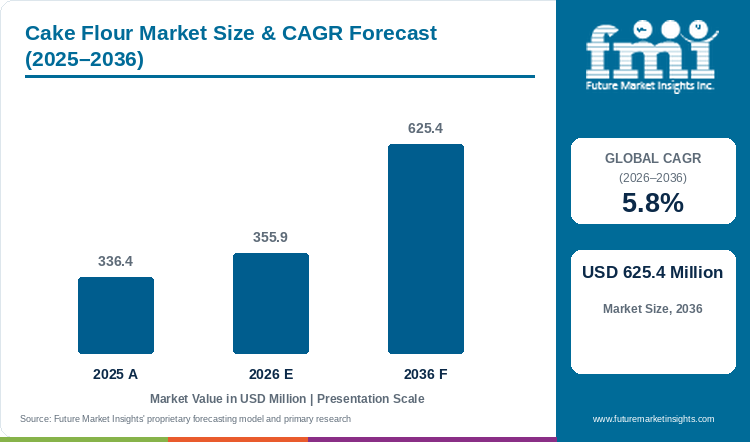
The global cake flour market evolved from a 2025 valuation of USD 336.4 million to USD 355.9 million in 2026, and is set to achieve USD 625.4 million by 2036, reflecting a 5.8% CAGR.
Automated tunnel-oven bakeries scaling packaged snack cakes and celebration layer cakes are pushing global cake flour market size from USD 336.4 million in 2025 to USD 355.9 million in 2026 and reaching USD 625.4 million by 2036 under an anticipated 5.8% CAGR, adding USD 269.5 million in annual value. High-speed cake depositors cannot tolerate wide swings in wheat gluten strength because excess protein toughens the crumb and causes high-sugar batters to collapse mid-bake. For example, October 2025 sponge-cake rheology testing archived on PubMed Central confirmed that soft-wheat cake flour milled to 7.3% crude protein and 0.3% ash reaches starch gelatinization at 57.9 degrees Celsius and delivers a 4.2-milliliter-per-gram specific cake volume [1]. Because of these strict oven-spring requirements, the Standard High-Ratio Cake Grade subsegment is projected to secure a 44.8% grade segment share in 2026 among plants formulating commercial bakery mixes, even though weather-driven shifts in soft-wheat harvest protein still restrain rapid supplier switching.
Key Market Trends & Insights
- By grade: Standard High-Ratio Cake Grade is projected to secure a 44.8% grade segment share in 2026, driven by consistent 7.0% to 8.5% protein specifications across continuous bakery lines.
- By form: Free-Flowing Fine-Milled Dry Powder is estimated to command a 56.4% form segment share in 2026, supported by pneumatic silo conveying and automated mixer dosing.
- By application: Cakes, Cupcakes & Sponge Goods are expected to capture a 48.6% application segment share in 2026 owing to high-ratio batter formulas that demand fine starch granulation.
- By claim: Within the claim segment, the Conventional subsegment is forecast to represent a 53.7% share in 2026 due to lower raw-wheat cost and established pH-conditioning workflows.
- By sales channel: Across the sales channel segment, Direct to Industrial Bakeries is anticipated to hold a 51.4% share in 2026 through multi-quarter bulk tanker contracts and pre-shipment bake testing.
Regional Highlights
- Gulf bakery expansion: The UAE is projected to pace national growth at a 7.4% CAGR through 2036 while Saudi Arabia follows at 6.9%, supported by hospitality commissaries and domestic flour mill investments.
- Wider national outlook: Demand in the USA is expected to advance at a 6.1% CAGR past South Korea at 5.7% or the UK at 5.3%, whereas Germany at 4.8% and Japan at 4.4% outpace France at 4.1%.
Market Size & Forecast
Table 1: Market Size and Forecast for the Cake Flour Market (USD million and CAGR percentage), 2025 to 2036
| Metric | Value |
|---|---|
| 2025 Market Size | USD 336.4 million |
| Estimated Market Size in 2026 | USD 355.9 million |
| Projected Market Size by 2036 | USD 625.4 million |
| CAGR, 2026 to 2036 | 5.8% |
| Added Revenue, 2026 to 2036 | USD 269.5 million |
Multi-plant bakery groups are consolidating their bulk cake-flour contracts with commercial millers that can eliminate lot-to-lot batter viscosity drift before tanker trucks reach the bakery. Unchecked variations in wheat starch damage or falling number force automated cake lines to halt production and adjust water dosing mid-shift. For instance, in October 2025, ADM commissioned its Decatur Central Lab-Milling hub to run experimental grist and bake tests across 31 flour mills in North America [2]. Through this centralized testing network, millers verify absorption and loaf volume prior to shipment, which reduces batch rejection for plants that also blend whole-wheat flour grades and locks in multi-quarter supply agreements.
Soft-Wheat Milling Throughput and Bakery Shipment Sizing
Table 2: Soft-Wheat Milling Throughput and Bakery Shipment Sizing for the Cake Flour Market (USD million and operational ranges), 2025 to 2036
| Metric | 2025 | 2026 | 2036 |
|---|---|---|---|
| Market size (USD million) | 336.4 | 355.9 | 625.4 |
| Commercial cake-grade flour shipped (thousand tonnes) | 510.0 to 535.0 | 530.0 to 555.0 | 820.0 to 860.0 |
| Soft-wheat grain milled for cake grades (thousand tonnes) | 680.0 to 715.0 | 705.0 to 740.0 | 1,090.0 to 1,145.0 |
| Realized mill-gate price per metric ton (USD) | 630.0 to 665.0 | 645.0 to 680.0 | 735.0 to 775.0 |
Operational note: Shipment and grain-grind ranges reconcile soft red and soft white winter wheat extraction yields (72% to 75% patent extraction) against industrial bulk and 25-to-50-pound bag fulfillment.
Realized mill-gate prices per metric ton are projected to rise faster than raw soft-wheat grind volume between 2026 and 2036 because cake-grade patent milling isolates only the low-ash central endosperm. Diverting outer bran and higher-protein clear streams lowers flour yield per ton of grain milled, yet it allows millers to guarantee sub-90-micron granulation and charge premium prices to pastry manufacturers producing formulated flour mixes. Because unbleached thermal-treated cake flours require additional steam and dry-heat conditioning energy, commercial mills increasingly lock in multi-quarter tolling premiums above standard soft-wheat commodity prices.
Per Capita & Industrial Bakery Line Sizing
Table 3: Per Capita and Bakery Line Valuation Indicators for the Cake Flour Market (USD), 2025 to 2036
| Metric | 2025 | 2026 | 2036 |
|---|---|---|---|
| World population (billion) | 8.2 | 8.3 | 9.0 |
| Market value per 1,000 people (USD) | 41.0 | 42.9 | 69.5 |
| Annual cake-flour valuation per industrial bakery (USD thousand) | 18.5 to 22.0 | 19.5 to 23.2 | 31.0 to 36.5 |
| Bulk pneumatic silo & tote delivery share (%) | 61.0% to 65.0% | 62.5% to 66.5% | 69.0% to 73.0% |
Table 4: Milling & Bakery Qualification Valuation Indicators for the Cake Flour Market (USD and percentages), 2026
| Metric | Value | Institutional Reference Basis |
|---|---|---|
| Market size, 2026 | USD 355.9 million | 2026 global cake-grade milling baseline |
| Commercial cake & sweet-goods bakeries globally | 16,800 plants | Global industrial & commissary bakery registry |
| Standard high-ratio cake grade, 2026 | USD 159.4 million | 44.8% grade segment allocation |
| Direct industrial bakery channel, 2026 | USD 182.9 million | 51.4% sales channel segment allocation |
Annual cake-flour expenditure per industrial bakery is expanding as commercial plants replace manual 50-pound bag dumping with closed pneumatic silo and tote systems. Closed silo delivery keeps flour moisture locked between 13.0% and 14.0% during humid summer shifts and lowers bakery floor labor, which encourages packaged sweet-goods producers to pair bulk soft-wheat flour contracts with functional bakery improvers for 30-day retail shelf softness. Once an industrial bakery calibrates its automated silo scale hoppers and continuous mixer hydration to a specific miller's soft-wheat stream, high requalification costs keep annual account retention unusually strong.
Analyst Perspective
"Industrial cake bakeries qualify flour suppliers on reproducible starch gelatinization and low ash extraction across crop years. Millers that pair soft-wheat grist blending with thermal clean-label treatment and pre-shipment bake validation will secure multi-year commissary contracts."
- Nandini Roy Choudhury, Principal Consultant, Future Market Insights.
How is the cake flour market segmented?
The cake flour market is segmented by grade, form, application, claim, sales channel, and region. In 2026, Standard High-Ratio Cake Grade is projected at 44.8%, Free-Flowing Fine-Milled Dry Powder at 56.4%, Cakes, Cupcakes & Sponge Goods at 48.6%, Conventional at 53.7%, and Direct to Industrial Bakeries at 51.4%.
By grade: Standard High-Ratio Cake Grade and Ultra-Fine Patisserie & Chiffon Grade as well as Unbleached Thermal-Treated Soft-Wheat Grade and Specialty Stone-Milled Cake Grade.
By form: Free-Flowing Fine-Milled Dry Powder and Chlorinated pH-Adjusted High-Ratio Powder in addition to Heat-Treated Clean-Label Dry Flour and Agglomerated Instant-Dispersing Dry Granules.
By application: Cakes, Cupcakes & Sponge Goods and Muffins, Quick Breads & Sweet Batter Goods plus Biscuits, Cookies & Shortcake and Viennoiserie, Soft Rolls & Tart Shells.
By claim: Conventional soft-wheat cake flour and Clean-Label / Unbleached cake grades plus Certified Organic and Non-GMO & Identity-Preserved soft-wheat options.
By sales channel: Direct to Industrial Bakeries and Specialty Bakery & Ingredient Distributors plus Foodservice & Artisan Patisserie Supply and Retail & Online B2B Channels.
Why does Standard High-Ratio Cake Grade anchor the grade segment?
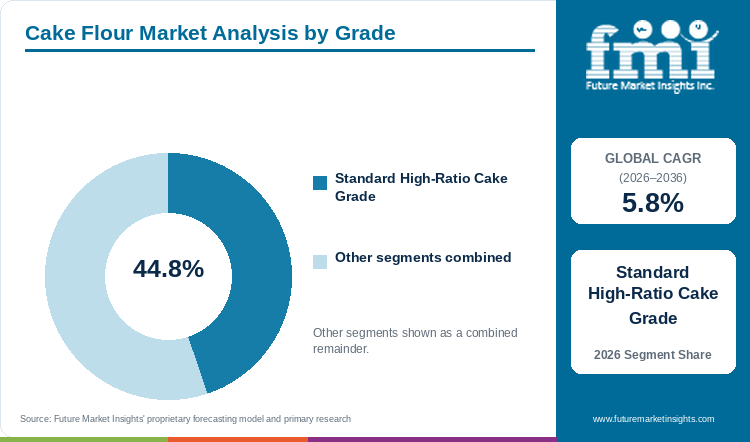
Standard High-Ratio Cake Grade is projected to secure a 44.8% grade segment share in 2026, driven by calibrated soft-wheat protein tolerances.
Table 5: Grade Share for the Cake Flour Market (percentage share), 2026
| Grade | Share (2026) |
|---|---|
| Standard High-Ratio Cake Grade | 44.8% |
| Other Segments Combined* | 55.2% |
| Total | 100.0% |
*Calculated as the balance remaining after deducting the leading segment's reported share from 100.0%.
Table 6: Grade Leadership and Market Growth for the Cake Flour Market (segment and CAGR percentage), 2026 to 2036
| Metric | Value |
|---|---|
| Global CAGR (2026 to 2036) | 5.8% |
| Leading Segment | Standard High-Ratio Cake Grade |
Commercial cake manufacturers formulate high-ratio batters where sugar and liquid weights exceed flour weight, which creates a direct need for flour that can carry heavy sugar loads without collapsing in the oven. Standard High-Ratio Cake Grade solves this production risk by holding soft-wheat protein within a narrow 7.0% to 8.5% window so starch granules swell and set the cake structure before steam escapes. While Ultra-Fine Patisserie & Chiffon Grade serves boutique sponge bakeries in France and East Asia and Unbleached Thermal-Treated grades support clean-label lines using modified flour ingredients, standard high-ratio grades run on existing continuous mixers without costly recipe changes. As a result, high-volume snack-cake commissaries keep their core bulk procurement anchored in this subsegment.
- In 2026, the Standard High-Ratio Cake Grade subsegment is projected to secure a 44.8% grade segment share on the strength of repeatable certificate-of-analysis protein and ash limits.
- July 2025 Western Himalayan wheat-genotype evaluations on PubMed Central reported 72% extraction white flour protein starting at 8.06% and dry gluten down to 8.78%, confirming the low-gluten baseline needed to prevent tough cake crumb [3].
How does Free-Flowing Fine-Milled Dry Powder sustain form segment leadership?
Free-Flowing Fine-Milled Dry Powder is estimated to command a 56.4% form segment share in 2026, supported by pneumatic silo compatibility.
Automated bakeries face severe dosing bottlenecks when cohesive flour bridges inside storage hoppers or clogs rotary airlocks during high-speed batching. Free-Flowing Fine-Milled Dry Powder overcomes this handling friction by maintaining uniform sub-90-micron granulation that meters smoothly through pneumatic silo lines and loss-in-weight screw feeders. Although Agglomerated Instant-Dispersing Dry Granules speed up slurry hydration and Heat-Treated Clean-Label Dry Flour serves chlorine-free plants that also process high-protein flour streams, both specialty forms carry extra thermal or agglomeration processing surcharges. Consequently, cost-conscious industrial bakeries rely on free-flowing dry powder for daily bulk production.
- Within the form segment, the Free-Flowing Fine-Milled Dry Powder subsegment is estimated to command a 56.4% share in 2026 owing to automated silo weighing and sifting compatibility.
- March 2025 cake-batter rheology trials in the journal Foods (PMC11942047) showed dry-milled wheat control flour yielding an 18.84 Pa·s^n consistency index and an 11.5% bake loss with a 7.03 N Day-1 crumb hardness, validating dry-milled powder performance [4].
Why do Cakes, Cupcakes & Sponge Goods lead the application segment?
Cakes, Cupcakes & Sponge Goods are expected to capture a 48.6% application segment share in 2026 attributable to high-sugar crumb structure.
Retail grocery in-store bakeries and packaged snack-cake brands depend on aerated sponge and layer-cake formats where visual cake height and soft mouthfeel directly drive repeat consumer purchases. Using general all-purpose flour in these products causes coarse air tunnels and rapid crumb staling, which forces manufacturers of Cakes, Cupcakes & Sponge Goods to specify dedicated soft-wheat cake flour. Bakeries making Muffins and Quick Breads or Biscuits and Shortcake also blend cake flour with pound and loaf cake lines to control cookie spread, yet celebration and snack cakes consume the largest continuous tonnage.
- Across the application segment, Cakes, Cupcakes & Sponge Goods are expected to capture a 48.6% share in 2026 driven by year-round retail and foodservice orders for celebration and snack cakes.
- For instance, in April 2026, King Arthur Baking expanded its celebration baking portfolio with new confetti and yellow cake lines as well as chocolate cupcake formats to capture rising household and bakery celebration demand [5].
Why does Conventional lead the claim segment?
Within the claim segment, the Conventional subsegment is forecast to represent a 53.7% share in 2026 across industrial soft-wheat procurement.
Margin pressure from supermarket private-label contracts compels high-volume commissary bakeries to minimize delivered ingredient cost per hundredweight while keeping batter pH and cake height uniform. Conventional cake flour meets this cost requirement by allowing commercial millers to blend multi-state soft-wheat harvests and apply standard pH conditioning without paying organic farm premiums. Although Clean-Label / Unbleached and Certified Organic subsegments are gaining retail shelf space, mandatory mill purge runs and third-party certification audits keep their delivered prices substantially higher than conventional bulk flour.
- Conventional cake flour is forecast to represent a 53.7% claim segment share in 2026, resulting from broad industrial reliance on standard soft-wheat grist blending.
- Specifically, United States Department of Agriculture Agricultural Marketing Service organic labeling rules updated in February 2025 mandate accredited certifier verification and segregated mill runs before packaged flours can display certified organic seals [6].
What gives Direct to Industrial Bakeries the leading position in the sales channel segment?
Across the sales channel segment, Direct to Industrial Bakeries is anticipated to hold a 51.4% share in 2026 supported by contracted bulk mill shipments.
Large snack-cake and frozen-dessert factories consume multiple pneumatic tanker loads of cake flour every week, making distributor markups and palletized bag handling economically unviable. Contracting Direct to Industrial Bakeries allows commercial milling groups to schedule dedicated soft-wheat grist runs and provide joint bake-lab troubleshooting whenever new-crop wheat enters the mill. Specialty Bakery & Ingredient Distributors and Foodservice & Artisan Patisserie Supply channels remain essential for hotel kitchens and independent pastry shops ordering 25-pound and 50-pound bags, but bulk plant-to-plant tanker contracts account for the majority of market volume.
- The Direct to Industrial Bakeries subsegment is anticipated to hold a 51.4% sales channel segment share in 2026, influenced by multi-plant forward grain contracting and bulk silo economics.
- According to the May 2025 USDA NASS Flour Milling Products Annual Summary, commercial mills in the USA produced 425 million hundredweight of wheat flour in 2024 to fulfill direct industrial bakery and wholesale contracts [7].
What are the drivers, restraints, and opportunities in the cake flour market?
In the cake flour market, automated packaged snack-cake production is projected to sustain bulk soft-wheat demand whereas raw-flour pathogen controls restrain rapid supplier switching and heat-treated clean-label grades create margin opportunities.
- Driver: Expanding industrial production of single-serve snack cakes and Chiffon sponge lines sustains recurring orders for low-protein soft-wheat cake flour.
- Restraint: Seasonal soft-wheat protein fluctuations and raw-flour microbiological safety protocols elevate qualification costs when bakeries evaluate alternative mills.
- Opportunity: Hydrothermal and dry-heat clean-label flour treatments allow millers to capture unbleached cake-flour contracts across European and clean-label retail bakeries.
Growth Analysis and Future Potential: Qualitative Demand Catalysts
Consumer demand for portion-controlled cupcakes and pillow-pack sponge cakes as well as Southern-style tender biscuits is compelling commercial bakeries and retail flour brands to expand soft-wheat milling orders. High-speed rotary depositors require cake flour with narrow particle-size distributions so batter viscosity stays uniform across multi-shift runs, including on lines that also bake commercial cake rusks. For instance, in March 2025, King Arthur Baking launched its Buttermilk Biscuit Flour Blend milled from low-protein soft wheat to give bakers tender crumb structure without sourcing regional specialty grain [8]. Through such targeted soft-wheat product launches and industrial commissary expansions, millers are capturing steady volume growth across both retail and B2B bakery channels.
Risk Assessment of the Cake Flour Market: Operational and Formulation Friction
Stringent microbiological food-safety audits and harvest-to-harvest swings in soft-wheat falling numbers act as major restraints on supplier switching and margin expansion in the cake flour market. Standard roller milling grinds raw wheat kernels without a thermal pasteurization step, which means untreated flour cannot be used in ready-to-eat batters or dry mixes without pathogen controls. As a matter of fact, January 2025 food-safety guidance from the U.S. Food and Drug Administration warns commercial and household buyers that raw flour remains an unpasteurized agricultural input capable of carrying field bacteria prior to baking [9]. Because of this contamination risk, industrial bakeries formulating commercial biscuit mixes or packaged cake batters must run costly mycotoxin screenings and full-scale tunnel-oven validation trials before qualifying a new mill.
Commercial Opportunity Analysis: Formulation Differentiation and Value-Add Formats
European Union prohibitions on chlorine gas bleaching and clean-label ingredient mandates across North America are creating lucrative margin opportunities for millers that invest in hydrothermal flour conditioning and organic grain segregation. Controlled steam and dry-heat treatments partially modify soft-wheat starch surfaces and relax gluten elasticity without chemical bleaching, allowing clean-label cake batters to hold high sugar ratios. To capitalize on this shift toward traceable specialty flours, in July 2025, Ardent Mills entered an agreement to acquire Stone Mill in North Dakota to expand its organic and identity-preserved specialty grain cleaning and milling capacity [10]. This acquisition enables commercial millers to bundle certified organic and unbleached cake flours with soft-baked cookies and premium patisserie programs at higher per-ton margins.
Cake Flour Market by Country (2026 to 2036)
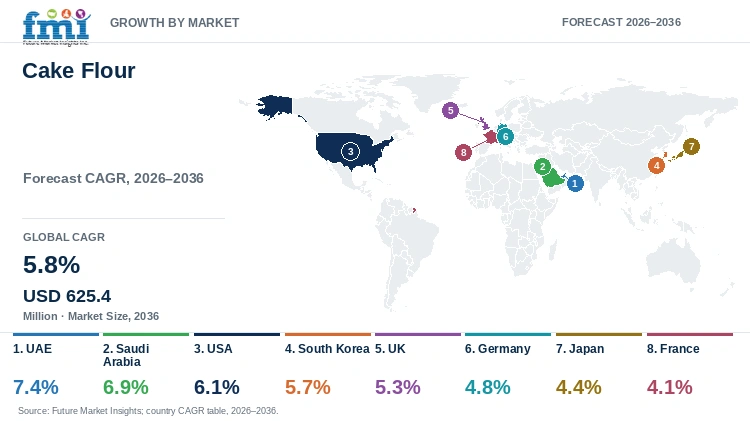
Country-level consumption patterns place the UAE at the front of soft-wheat cake flour expansion at 7.4% annually through 2036 ahead of Saudi Arabia at 6.9% and the USA at 6.1%, whereas France progresses at a 4.1% yearly pace. Growth variations between Gulf import hubs and established milling markets across North America and Europe or East Asia depend on local soft-wheat harvest quality and central bakery automation in addition to clean-label bleaching rules.
Table 7: Country CAGR and Primary Growth Levers for the Cake Flour Market (CAGR percentage and operational drivers), 2026 to 2036
| Country | CAGR (2026 to 2036) | Primary Growth Lever |
|---|---|---|
| UAE | 7.4% | High-throughput port food-import clearance and hotel central-bakery commissary expansion |
| Saudi Arabia | 6.9% | Rising milling-wheat imports and packaged snack-cake manufacturing localization |
| USA | 6.1% | Calibrated soft red and soft white wheat harvests and centralized mill-to-bakery bake labs |
| South Korea | 5.7% | Premium bakery-café sponge-cake demand and imported soft-wheat specification blending |
| UK | 5.3% | Soft-wheat grist balancing and heat-treated unbleached cake-flour adoption across bakeries |
| Germany | 4.8% | High-volume EU soft-wheat milling supply and clean-label heat-treated pastry flours |
| Japan | 4.4% | Ultra-fine sponge-cake granulation tolerances and imported food-wheat quality calibration |
| France | 4.1% | Regional soft-wheat harvests across Centre-Val de Loire and Picardie supporting Type 45 mills |
Source: Future Market Insights analysis
UAE Cake Flour Market Outlook (2026 to 2036)
Unlike wheat-producing nations that grind domestic harvests, the UAE functions as an import-dependent hospitality and airline-catering bakery hub where luxury hotel patisseries and central commissaries drive specialty flour demand. Fast digital customs release in Dubai directly supports this import flow; in July 2025, Dubai Municipality reported conducting 34,700 food-establishment inspections in the first half of 2025 while clearing 173,775 imported food shipments exceeding 4.6 million tonnes [11]. Resort kitchens and industrial commissaries scaling fine sponge and pastry output put cake-flour volume in the UAE on a projected 7.4% compound annual growth rate through 2036. However, extreme summer coastal humidity in the UAE risks caking stored flour and forces buyers to demand moisture-barrier 25-kilogram packaging.
Key takeaway: In the UAE, streamlined Dubai port clearance and expanding hospitality central bakeries are projected to drive leading growth for imported low-protein cake flour.
Saudi Arabia Cake Flour Market Outlook (2026 to 2036)
Cake flour demand in Saudi Arabia is estimated to expand at a 6.9% yearly rate through 2036, supported by domestic industrial bakeries localizing packaged layer-cake and muffin production under Vision 2030 food-processing programs. Rather than importing finished sweet baked goods, food manufacturers in Saudi Arabia are expanding local tunnel-oven lines that require steady soft-wheat flour supply. According to the April 2026 USDA FAS Grain and Feed Annual for Saudi Arabia, national wheat imports are forecast to rise 2% to reach 3.5 million metric tons in MY 2026/27 to feed expanding domestic flour mills [12]. Even so, heavy focus on standard bread-wheat tenders in Saudi Arabia means bakeries still face tight supply for ultra-low-protein cake grades.
Key takeaway: In Saudi Arabia, milling-wheat imports climbing toward 3.5 million metric tons and localized snack-cake production are estimated to sustain strong industrial cake-flour tenders.
USA Cake Flour Market Outlook (2026 to 2036)
Abundant domestic harvests of Soft Red Winter and Soft White wheat give commercial millers in the USA a cost and formulation advantage in supplying both chlorinated high-ratio industrial cake flours and unbleached retail bags. To help bakery buyers manage crop-year transitions, U.S. Wheat Associates released its October 2026 Crop Quality Report benchmarking Soft Red Winter and Soft White kernel protein and test weight for cake-flour buyers in the USA [13]. Multi-state commissary automation of boxed cake-mix and fresh in-store bakery programs keeps cake-flour shipments in the USA advancing at an expected 6.1% annual pace between 2026 and 2036. Still, retailer pressure to remove bleached ingredients in the USA is forcing millers to invest in heat-treatment retrofits.
Key takeaway: In the USA, calibrated soft red and soft white wheat harvests and bulk pneumatic commissary contracts are expected to anchor steady industrial and retail cake-flour expansion.
South Korea Cake Flour Market Outlook (2026 to 2036)
In South Korea, minimal domestic wheat production forces commercial flour mills to rely on imported low-protein soft white wheat that they custom-blend into ultra-fine streams for urban franchise bakery-cafés. The April 2026 USDA FAS Grain and Feed Annual for South Korea noted that export-oriented processed food and sweet-bakery production continues to sustain national milling-wheat imports across commercial ports [14]. Retail café chains scaling chilled cream-cake and castella sponge production lift cake-flour usage in South Korea at a forecast 5.7% compound annual rate to 2036. However, currency fluctuations and ocean freight surcharges on imported grain in South Korea compress miller margins and make bakery buyers intolerant of water-absorption drift across lots.
Key takeaway: In South Korea, franchise bakery-café castella and cream-cake production with imported soft-wheat blending are forecast to sustain specialty cake-flour procurement.
UK Cake Flour Market Outlook (2026 to 2036)
Statutory bans on chlorine gas flour bleaching make the UK cake flour market structurally dependent on physical heat-treatment milling and careful grist balancing of domestic Group 3 biscuit wheats. Rainfall-driven harvest volatility frequently complicates this domestic sourcing; in July 2025, UK Defra crop statistics documented that national wheat production dropped 20% to 11.1 million tonnes and forced higher milling wheat imports into the UK [15]. Supermarket private-label celebration cake contracts and organic retail milling at suppliers such as Doves Farm push cake flour demand in the UK forward at an anticipated 5.3% yearly rate through 2036. Higher energy costs for hydrothermal starch conditioning in the UK nevertheless restrain margin growth on standard bakery tenders.
Key takeaway: In the UK, heat-treated unbleached high-ratio milling and private-label supermarket cake contracts are anticipated to support resilient cake-flour demand despite domestic harvest swings.
Germany Cake Flour Market Outlook (2026 to 2036)
Industrial fine-bakery plants standardizing Type 405 low-ash soft-wheat flours and hydrothermal functional grades push commercial cake-flour orders in Germany up at a predicted 4.8% annual rate between 2026 and 2036. Ongoing structural mill consolidation across Germany has concentrated specialty pastry and cake-flour production inside large laboratory-equipped industrial milling groups serving Central European food processors. Backing this regional raw-material supply, the April 2026 USDA FAS European Union Grain and Feed Annual projected 2026/27 EU grain harvests at 277 million metric tons supporting soft-wheat patisserie milling in Germany [16]. Even so, intense discount-supermarket price negotiations in Germany restrain packaged cake manufacturers from paying premiums unless functional flours measurably reduce batter scrap.
Key takeaway: In Germany, consolidated industrial milling capacity and Type 405 low-ash functional flour engineering are predicted to support steady fine-bakery procurement.
Japan Cake Flour Market Outlook (2026 to 2036)
Confectionery and sponge-cake manufacturers in Japan enforce ultra-fine particle granulation and low starch-damage thresholds so *hakurikiko* cake flour produces feather-light roll cakes and castella sponges. Because state-managed wheat import tenders govern mill raw-material supply, the March 2026 USDA FAS Japan grain assessment documented how food-wheat import allocations adjusted to offset earlier harvest swings before stabilizing with recovering domestic wheat output across milling regions in Japan [17]. Convenience-store chilled dessert roll cakes and gift-boxed patisserie items keep commercial cake-flour demand in Japan advancing at a 4.4% compound annual rate through 2036. However, demographic population decline and administered imported grain prices in Japan limit volume expansion and force millers to compete on micron-level classification.
Key takeaway: In Japan, ultra-fine *hakurikiko* sponge-cake particle tolerances and convenience-store dessert programs are projected to sustain specialized low-protein flour milling.
France Cake Flour Market Outlook (2026 to 2036)
Deep domestic soft-wheat breeding programs and regional roller mills make France one of Europe's primary producers of low-ash *Type 45* patisserie and cake-making flours. Confirming this domestic grain foundation, Eurostat's July 2026 Regions in Europe edition showed Centre-Val de Loire producing 3.3 million tonnes of soft wheat and spelt grain while Picardie harvested 3.2 million tonnes to supply patisserie mills in France [18]. Industrial madeleine and genoise producers adopting clean-label heat-treated soft-wheat flours from suppliers such as Limagrain Ingredients keep cake-flour sales in France progressing at a likely 4.1% yearly rate from 2026 to 2036. Still, mature per-capita bakery consumption and strict Label Rouge flour standards in France create high entry barriers for outside millers.
Key takeaway: In France, abundant regional soft-wheat harvests across Centre-Val de Loire and Picardie and clean-label patisserie milling are likely to support steady madeleine and genoise flour demand.
Full report country CAGRs cover: North America; Latin America; Western Europe; Eastern Europe; East Asia; South Asia and Pacific; Middle East and Africa.
Who are the notable companies in the cake flour market?
Ardent Mills, ADM, Bay State Milling, King Arthur Baking, Bob's Red Mill, GoodMills Group, Limagrain Ingredients, Doves Farm, Manildra Group, and Scoular are the notable companies in the cake flour market.
Supplier positioning across the cake flour sector separates multi-facility industrial soft-wheat millers from branded specialty baking-flour suppliers and functional wheat-ingredient processors. Industrial millers in North America and Europe led by Ardent Mills and ADM as well as Bay State Milling and GoodMills Group or Manildra Group operate high-capacity roller mills that supply bulk pneumatic tankers to commercial cake plants. Branded specialty suppliers including King Arthur Baking and Doves Farm along with Bob's Red Mill serve pastry kitchens and retail consumers with unbleached and organic cake flours, while Limagrain Ingredients and Scoular provide functional clean-label wheat flours and identity-preserved soft-wheat grain sourcing.
- Industrial Soft-Wheat & High-Ratio Millers: Ardent Mills and ADM as well as Bay State Milling and GoodMills Group or Manildra Group operate commercial patent-flour mills and analytical bake-testing laboratories for industrial cake lines.
- Branded Specialty & Organic Cake-Flour Suppliers: Consumer and pastry-shop bags from King Arthur Baking and Doves Farm or Bob's Red Mill provide unbleached and certified organic soft-wheat cake flours.
- Functional Bakery-Flour & Identity-Preserved Grain Specialists: Limagrain Ingredients and Scoular deliver heat-treated functional wheat ingredients and traceable non-GMO or organic soft-wheat supply chains.
Competitive Benchmarking: Cake Flour Market
Table 8: Competitive Benchmarking for the Cake Flour Market (qualitative capability ratings), 2026
| Company | Cake & Soft-Wheat Grade Breadth | Specialty & Organic Traceability | Bakery Technical & Lab Support | Geographic Reach |
|---|---|---|---|---|
| Ardent Mills | High | High | High | High |
| ADM | High | Medium | High | High |
| Bay State Milling | High | Medium | Medium | Medium |
| King Arthur Baking | High | Medium | Medium | Medium |
| Bob's Red Mill | High | Medium | Medium | Medium |
| GoodMills Group | Medium | High | High | High |
| Limagrain Ingredients | Medium | High | High | High |
| Doves Farm | Medium | High | Medium | Medium |
| Manildra Group | Medium | Medium | High | High |
| Scoular | Medium | High | Medium | High |
Scoring basis: Capability tiers evaluate documented soft-wheat cake and patisserie flour specifications (6.0% to 9.25% protein ranges) and certified organic or identity-preserved grain segregation as well as central bake-testing laboratory infrastructure. Geographic reach reflects verified commercial milling plants and bulk tanker fulfillment in addition to multi-region foodservice or retail distribution.
Key Developments in the Cake Flour Market
- GoodMills Innovation introduced GOOD NatureRelax in April 2026, a clean-label functional bakery ingredient based on stabilized wheat germ designed to improve dough and batter extensibility on automated industrial lines [19].
- GoodMills Innovation launched SNOW SPELT in April 2026 as an ultra-fine micro-granulated wholegrain spelt flour engineered for light sponge cakes and delicate fine bakery goods [20].
- Limagrain reported in March 2026 that its field-seed and wheat-milling operations along with bakery ingredients generated EUR 2,542 million in 2024 to 2025 fiscal sales [21].
Key Players in the Cake Flour Market
Industrial Soft-Wheat & High-Ratio Millers
- Ardent Mills
- ADM
- Bay State Milling
- GoodMills Group
- Manildra Group
Branded Specialty & Organic Cake-Flour Suppliers
- King Arthur Baking
- Bob's Red Mill
- Doves Farm
Functional Bakery-Flour & Identity-Preserved Grain Specialists
- Limagrain Ingredients
- Scoular
Cake Flour Market - Report Scope
Table 9: Report Scope for the Cake Flour Market (coverage fields and definitions), 2026 to 2036
| Coverage field | Report scope |
|---|---|
| Market breakdown | Grade; Form; Application; Claim; Sales Channel; Region |
| Quantitative Units | USD Million |
| Market Definition | Includes commercial supplier revenue from finely milled soft-wheat cake flour (typically 6.0% to 9.5% protein and <=0.42% ash) sold in free-flowing dry powder, chlorinated high-ratio, heat-treated clean-label, and agglomerated instant-dispersing dry forms. Category Scope Note: Excludes high-protein hard-wheat bread flour, downstream baked cakes, and pre-hydrated liquid batters. |
| Regions Covered | North America; Latin America; Western Europe; Eastern Europe; East Asia; South Asia and Pacific; Middle East and Africa |
| Countries Covered | UAE, Saudi Arabia, USA, South Korea, UK, Germany, Japan, France, and additional countries in the full report |
| Key Companies Covered | Ardent Mills, ADM, Bay State Milling, King Arthur Baking, Bob's Red Mill, GoodMills Group, Limagrain Ingredients, Doves Farm, Manildra Group, Scoular |
| Forecast Period | 2026 to 2036 |
| Approach | Primary and secondary research with top-down and bottom-up market triangulation. |
Cake Flour Market - Research Methodology
Table 10: Research Methodology for the Cake Flour Market (research methods and approach), 2026 edition
| Method | Approach |
|---|---|
| Primary Research | Structured interviews with soft-wheat head millers, industrial cake-line rheology managers, bakery quality-assurance directors, and specialty flour distributors across North America, Europe, the Gulf, and East Asia to validate protein windows and bulk contract pricing. |
| Secondary Research | Analysis of USDA FAS grain and feed annuals, USDA NASS flour-milling summaries, U.S. Wheat Associates crop quality reports, UK Defra crop statistics, Eurostat regional crop bulletins, Dubai Municipality food-import records, and peer-reviewed PubMed Central baking studies. |
| Market Sizing and Forecasting | Top-down commercial soft-wheat patent milling revenues reconciled against bottom-up industrial cake, cupcake, and sponge-bakery flour consumption volumes from 2025 to 2036. |
| Country Forecasting Model | Econometric country projections weight domestic soft-wheat harvest stability, industrial bakery line automation, clean-label unbleached reformulation rates, and imported food-wheat tariff structures across eight national markets. |
| Operational Benchmark Traceability | Soft-wheat milling throughput and bakery plant valuation indicators in Tables 2, 3, and 4 trace to Defra, Eurostat, U.S. Wheat Associates, and USDA grain-milling production benchmarks. |
| Data Triangulation and Validation | Segment and country estimates are cross-checked against commercial mill grist allocations and industrial bakery bulk silo procurement without double counting standard bread flour or finished bakery mixes. |
Cake Flour Market by Segments
Cake Flour Market segmented by Grade:
- Standard High-Ratio Cake Grade
- Ultra-Fine Patisserie & Chiffon Grade
- Unbleached Thermal-Treated Soft-Wheat Grade
- Specialty Stone-Milled Cake Grade
Cake Flour Market segmented by Form:
- Free-Flowing Fine-Milled Dry Powder
- Chlorinated pH-Adjusted High-Ratio Powder
- Heat-Treated Clean-Label Dry Flour
- Agglomerated Instant-Dispersing Dry Granules
Cake Flour Market segmented by Application:
- Cakes, Cupcakes & Sponge Goods
- Muffins, Quick Breads & Sweet Batter Goods
- Biscuits, Cookies & Shortcake
- Viennoiserie, Soft Rolls & Tart Shells
- Other Delicate Bakery Goods
Cake Flour Market segmented by Claim:
- Conventional
- Clean-Label / Unbleached
- Certified Organic
- Non-GMO & Identity-Preserved
Cake Flour Market segmented by Sales Channel:
- Direct to Industrial Bakeries
- Specialty Bakery & Ingredient Distributors
- Foodservice & Artisan Patisserie Supply
- Retail & Online B2B Channels
Cake Flour Market by Region
- North America
- United States
- Canada
- Latin America
- Brazil
- Mexico
- Argentina
- Chile
- Western Europe
- Germany
- France
- United Kingdom
- Italy
- Spain
- Benelux
- Nordics
- Eastern Europe
- Poland
- Czech Republic
- Romania
- Hungary
- East Asia
- China
- Japan
- South Korea
- South Asia and Pacific
- India
- ASEAN
- Australia and New Zealand
- Middle East and Africa
- GCC Countries
- South Africa
- Türkiye
- Israel
Research Sources and Bibliography
- [1] National Library of Medicine (PubMed Central). (2025, October 1). Physicochemical and Rheological Properties of Floury Rice Powder with Different Particle Sizes: Effects on Gluten-Free Sponge Cake Qualities - PMC. Foods (PubMed Central PMC12562764).
- [2] Archer Daniels Midland Company (ADM). (2025, October 14). ADM Advances Quality Capabilities with opening of New Central Lab-Milling | ADM. ADM Corporate Newsroom.
- [3] National Library of Medicine (PubMed Central). (2025, July 15). Variability in grain, flour, functional properties and protein profiling in newly developed wheat genotypes grown in temperate climate of Western Himalayas - PMC. PubMed Central (PMC12304001).
- [4] National Library of Medicine (PubMed Central). (2025, March 19). Development of Gluten-Free Cakes Using Protein Concentrate Obtained from Cold-Pressed Terebinth (Pistacia terebinthus L.) Oil By-Products - PMC. Foods (PubMed Central PMC11942047).
- [5] King Arthur Baking Company. (2026, April 21). King Arthur Baking Taps Celebrations, Gluten-Free Demand, and. King Arthur Baking Newsroom.
- [6] U.S. Department of Agriculture, Agricultural Marketing Service (USDA AMS). (2025, February 10). Labeling Organic Products | Agricultural Marketing Service. USDA Agricultural Marketing Service.
- [7] U.S. Department of Agriculture, National Agricultural Statistics Service (USDA NASS). (2025, May 1). Flour Milling Products Annual Summary | Economics, Statistics, and Market Information System. USDA National Agricultural Statistics Service.
- [8] King Arthur Baking Company. (2025, March 5). King Arthur Baking Company Expands Flour Line with the Launch of Buttermilk Biscuit Flour Blend | King Arthur Baking. King Arthur Baking Newsroom.
- [9] U.S. Food and Drug Administration (FDA). (2025, January 20). Handling Flour Safely: What You Need to Know | FDA. U.S. Department of Health and Human Services.
- [10] Ardent Mills. (2025, July 31). Ardent Mills Enters Agreement to Acquire Stone Mill in North Dakota, Expanding Emerging Nutrition Portfolio | Ardent Mills. Ardent Mills Corporate Announcements.
- [11] Dubai Municipality. (2025, July 30). Over 34,000 food inspections conducted in first half of 2025. Government of Dubai Media Center.
- [12] USDA Foreign Agricultural Service (FAS). (2026, April 6). Saudi Arabia: Grain and Feed Annual | USDA Foreign Agricultural. U.S. Department of Agriculture.
- [13] U.S. Wheat Associates. (2026, October 21). USW Crop Quality Report, Seminars Provide Buyers a Roadmap to. U.S. Wheat Associates Wheat Letter.
- [14] USDA Foreign Agricultural Service (FAS). (2026, April 4). South Korea: Grain and Feed Annual | USDA Foreign Agricultural Service. U.S. Department of Agriculture.
- [15] UK Department for Environment, Food and Rural Affairs (Defra). (2025, July 10). Chapter 7: Crops - GOV.UK. GOV.UK Official Statistics.
- [16] USDA Foreign Agricultural Service (FAS). (2026, April 20). European Union: Grain and Feed Annual | USDA Foreign. U.S. Department of Agriculture.
- [17] USDA Foreign Agricultural Service (FAS). (2026, March 19). Japan: Grain and Feed Annual | USDA Foreign Agricultural Service. U.S. Department of Agriculture.
- [18] Eurostat. (2026, July 15). Regions in Europe – 2026 edition - Interactive publications - Eurostat. European Commission Eurostat.
- [19] GoodMills Innovation GmbH. (2026, April 27). Stable processes, relaxed doughs: GOOD NatureRelax - GoodMills Innovation. GoodMills Innovation News.
- [20] GoodMills Innovation GmbH. (2026, April 9). Lighter, finer, milder: wholemeal reimagined - GoodMills Innovation. GoodMills Innovation News.
- [21] Limagrain Cooperatives. (2026, March 23). Key Figures 2024-2025 - Limagrain. Limagrain Corporate Newsroom.
- [22] Ardent Mills. (2025, December 19). Strategies for Success in 2026 | Ardent Mills. Ardent Mills Corporate Newsroom.
- [23] Bay State Milling Company. (2026, May 19). Bay State Milling Named a 2026 US Best Managed Gold Honoree. Bay State Milling Newsroom.
- [24] The Scoular Company. (2025, October 2). Scoular progresses on regenerative agriculture, other sustainability. Scoular Corporate Newsroom.
This bibliography is provided for reader reference and is not exhaustive. The full report contains the complete reference list and detailed citations.
This Report Answers
- How large is the cake flour market in 2026 and what value is forecast by 2036?
- Which soft-wheat protein tolerances and bakery pressures sustain demand for cake flour?
- Why does Standard High-Ratio Cake Grade lead the grade segment?
- What sustains the Free-Flowing Fine-Milled Dry Powder position in the form segment?
- How do the evaluated country CAGRs compare between 2026 and 2036?
- Which notable companies provide cake-grade flour or functional milling capabilities?
- Why do harvest variability, raw-flour food safety, and bake validation delay switching?
- Which technical specifications and origin certifications should buyers check before contracting?
Frequently Asked Questions
How big is the cake flour market in 2026, and what is forecast for 2036?
Global cake flour market size is estimated to reach USD 355.9 million in 2026 from USD 336.4 million in 2025, and is projected to climb to USD 625.4 million by 2036 as automated layer-cake and sponge bakeries expand bulk soft-wheat contracting.
What is the CAGR for the cake flour market from 2026 to 2036?
Ten-year projections place the cake flour sector on a 5.8% compound annual growth rate between 2026 and 2036, yielding USD 269.5 million in added annual revenue across commercial and specialty bakeries.
Which grade segment leads the cake flour market?
Standard High-Ratio Cake Grade is projected to secure a 44.8% grade segment share in 2026, driven by calibrated 7.0% to 8.5% soft-wheat protein windows that support high-sugar cake formulas.
Which application segment accounts for the largest share in 2026?
Cakes, Cupcakes & Sponge Goods are expected to capture a 48.6% application segment share in 2026, owing to continuous industrial orders for fine-crumb celebration cakes and portioned cupcakes.
Which country has the fastest growth outlook through 2036?
The UAE is projected to pace national growth at a 7.4% CAGR through 2036, supported by high-volume food-import infrastructure in Dubai and expanding hotel central-bakery commissaries.
Who are the key players in the cake flour market?
High-ratio industrial soft-wheat milling is anchored by Ardent Mills and ADM as well as Bay State Milling and GoodMills Group, whereas Manildra Group, Limagrain Ingredients, Doves Farm, King Arthur Baking, Bob's Red Mill, and Scoular cover specialty patisserie and organic soft-wheat supply.
Preview the report firsthand - request a free sample
Get SampleGet the brochure for pricing and purchase details.
Get PDFTable of Content
- Key Takeaways
- Market Size and CAGR
- Top Growth Driver
- Fastest Growing Segment
- Leading Region
- Key Companies
- Emerging Opportunities
- Executive Summary
- Global Market Outlook
- Demand-side Trends
- Supply-side Trends
- Technology Roadmap Analysis
- Analysis and Recommendations
- Analyst Perspective (What is happening? Why now? What should investors know?)
- Key Questions Answered
- How large is the market?
- What is the CAGR?
- What are key trends?
- Which region dominates?
- Who are the leaders?
- Market Overview
- Market Coverage / Taxonomy
- Market Definition / Scope / Limitations
- Research Methodology
- Chapter Orientation
- Analytical Lens and Working Hypotheses
- Market Structure, Signals, and Trend Drivers
- Benchmarking and Cross-market Comparability
- Market Sizing, Forecasting, and Opportunity Mapping
- Research Design and Evidence Framework
- Desk Research Programme (Secondary Evidence)
- Expert Input and Fieldwork (Primary Evidence)
- Tooling, Models, and Reference Databases
- Data Engineering and Model Build
- Quality Assurance and Audit Trail
- Market Background
- Market Dynamics (Drivers, Restraints, Opportunity, Trends)
- Scenario Forecast (Optimistic, Likely, Conservative)
- Impact Analysis
- AI Impact
- Sustainability Impact
- Regulatory Impact
- Technology Impact
- Consumer / Buyer Analysis
- Purchase Drivers
- Adoption Barriers
- Buyer Journey
- Opportunity Map Analysis
- Product Life Cycle Analysis
- Supply Chain Analysis
- Investment Feasibility Matrix
- Value Chain Analysis
- PESTLE and Porter's Analysis
- Regulatory Landscape
- Regional Parent Market Outlook
- Production and Consumption Statistics
- Import and Export Statistics
- Global Market Analysis and Forecast, 2021 to 2036
- Historical Market Size Value (USD Million) Analysis, 2021 to 2025
- Current and Future Market Size Value (USD Million) Projections, 2026 to 2036
- Y-o-Y Growth Trend Analysis
- Absolute $ Opportunity Analysis
- Global Market Pricing Analysis, 2021 to 2036
- Global Market Analysis and Forecast, By Grade, 2021 to 2036
- Introduction / Key Findings
- Historical Market Size Value (USD Million) Analysis By Grade, 2021 to 2025
- Current and Future Market Size Value (USD Million) Analysis and Forecast By Grade, 2026 to 2036
- Standard High-Ratio Cake Grade
- Ultra-Fine Patisserie & Chiffon Grade
- Unbleached Thermal-Treated Soft-Wheat Grade
- Specialty Stone-Milled Cake Grade
- Y-o-Y Growth Trend Analysis By Grade, 2021 to 2025
- Absolute $ Opportunity Analysis By Grade, 2026 to 2036
- Global Market Analysis and Forecast, By Form, 2021 to 2036
- Introduction / Key Findings
- Historical Market Size Value (USD Million) Analysis By Form, 2021 to 2025
- Current and Future Market Size Value (USD Million) Analysis and Forecast By Form, 2026 to 2036
- Free-Flowing Fine-Milled Dry Powder
- Chlorinated pH-Adjusted High-Ratio Powder
- Heat-Treated Clean-Label Dry Flour
- Agglomerated Instant-Dispersing Dry Granules
- Y-o-Y Growth Trend Analysis By Form, 2021 to 2025
- Absolute $ Opportunity Analysis By Form, 2026 to 2036
- Global Market Analysis and Forecast, By Application, 2021 to 2036
- Introduction / Key Findings
- Historical Market Size Value (USD Million) Analysis By Application, 2021 to 2025
- Current and Future Market Size Value (USD Million) Analysis and Forecast By Application, 2026 to 2036
- Cakes, Cupcakes & Sponge Goods
- Muffins, Quick Breads & Sweet Batter Goods
- Biscuits, Cookies & Shortcake
- Viennoiserie, Soft Rolls & Tart Shells
- Other Delicate Bakery Goods
- Y-o-Y Growth Trend Analysis By Application, 2021 to 2025
- Absolute $ Opportunity Analysis By Application, 2026 to 2036
- Global Market Analysis and Forecast, By Claim, 2021 to 2036
- Introduction / Key Findings
- Historical Market Size Value (USD Million) Analysis By Claim, 2021 to 2025
- Current and Future Market Size Value (USD Million) Analysis and Forecast By Claim, 2026 to 2036
- Conventional
- Clean-Label / Unbleached
- Certified Organic
- Non-GMO & Identity-Preserved
- Y-o-Y Growth Trend Analysis By Claim, 2021 to 2025
- Absolute $ Opportunity Analysis By Claim, 2026 to 2036
- Global Market Analysis and Forecast, By Sales Channel, 2021 to 2036
- Introduction / Key Findings
- Historical Market Size Value (USD Million) Analysis By Sales Channel, 2021 to 2025
- Current and Future Market Size Value (USD Million) Analysis and Forecast By Sales Channel, 2026 to 2036
- Direct to Industrial Bakeries
- Specialty Bakery & Ingredient Distributors
- Foodservice & Artisan Patisserie Supply
- Retail & Online B2B Channels
- Y-o-Y Growth Trend Analysis By Sales Channel, 2021 to 2025
- Absolute $ Opportunity Analysis By Sales Channel, 2026 to 2036
- Global Market Analysis and Forecast, By Region, 2021 to 2036
- Introduction
- Historical Market Size Value (USD Million) Analysis By Region, 2021 to 2025
- Current Market Size Value (USD Million) Analysis and Forecast By Region, 2026 to 2036
- North America
- Latin America
- Western Europe
- Eastern Europe
- East Asia
- South Asia and Pacific
- Middle East and Africa
- Market Attractiveness Analysis By Region
- North America Market Analysis and Forecast, By Country, 2021 to 2036
- Historical Market Size Value (USD Million) Trend Analysis By Market Taxonomy, 2021 to 2025
- Market Size Value (USD Million) Forecast By Market Taxonomy, 2026 to 2036
- By Country
- United States
- Canada
- By Grade
- By Form
- By Application
- By Claim
- By Sales Channel
- By Country
- Market Attractiveness Analysis
- By Country
- By Grade
- By Form
- By Application
- By Claim
- By Sales Channel
- Key Takeaways
- Latin America Market Analysis and Forecast, By Country
- Historical Market Size Value (USD Million) Trend Analysis By Market Taxonomy, 2021 to 2025
- Market Size Value (USD Million) Forecast By Market Taxonomy, 2026 to 2036
- By Country
- Brazil
- Mexico
- Argentina
- Chile
- By Grade
- By Form
- By Application
- By Claim
- By Sales Channel
- By Country
- Market Attractiveness Analysis
- By Country
- By Grade
- By Form
- By Application
- By Claim
- By Sales Channel
- Key Takeaways
- Western Europe Market Analysis and Forecast, By Country
- Historical Market Size Value (USD Million) Trend Analysis By Market Taxonomy, 2021 to 2025
- Market Size Value (USD Million) Forecast By Market Taxonomy, 2026 to 2036
- By Country
- Germany
- France
- United Kingdom
- Italy
- Spain
- Benelux
- Nordics
- By Grade
- By Form
- By Application
- By Claim
- By Sales Channel
- By Country
- Market Attractiveness Analysis
- By Country
- By Grade
- By Form
- By Application
- By Claim
- By Sales Channel
- Key Takeaways
- Eastern Europe Market Analysis and Forecast, By Country
- Historical Market Size Value (USD Million) Trend Analysis By Market Taxonomy, 2021 to 2025
- Market Size Value (USD Million) Forecast By Market Taxonomy, 2026 to 2036
- By Country
- Poland
- Czech Republic
- Romania
- Hungary
- By Grade
- By Form
- By Application
- By Claim
- By Sales Channel
- By Country
- Market Attractiveness Analysis
- By Country
- By Grade
- By Form
- By Application
- By Claim
- By Sales Channel
- Key Takeaways
- East Asia Market Analysis and Forecast, By Country
- Historical Market Size Value (USD Million) Trend Analysis By Market Taxonomy, 2021 to 2025
- Market Size Value (USD Million) Forecast By Market Taxonomy, 2026 to 2036
- By Country
- China
- Japan
- South Korea
- By Grade
- By Form
- By Application
- By Claim
- By Sales Channel
- By Country
- Market Attractiveness Analysis
- By Country
- By Grade
- By Form
- By Application
- By Claim
- By Sales Channel
- Key Takeaways
- South Asia and Pacific Market Analysis and Forecast, By Country
- Historical Market Size Value (USD Million) Trend Analysis By Market Taxonomy, 2021 to 2025
- Market Size Value (USD Million) Forecast By Market Taxonomy, 2026 to 2036
- By Country
- India
- ASEAN
- Australia and New Zealand
- By Grade
- By Form
- By Application
- By Claim
- By Sales Channel
- By Country
- Market Attractiveness Analysis
- By Country
- By Grade
- By Form
- By Application
- By Claim
- By Sales Channel
- Key Takeaways
- Middle East and Africa Market Analysis and Forecast, By Country
- Historical Market Size Value (USD Million) Trend Analysis By Market Taxonomy, 2021 to 2025
- Market Size Value (USD Million) Forecast By Market Taxonomy, 2026 to 2036
- By Country
- GCC Countries
- South Africa
- Türkiye
- Israel
- By Grade
- By Form
- By Application
- By Claim
- By Sales Channel
- By Country
- Market Attractiveness Analysis
- By Country
- By Grade
- By Form
- By Application
- By Claim
- By Sales Channel
- Key Takeaways
- Key Countries Market Analysis
- United States
- Pricing Analysis
- Market Share Analysis, 2025
- By Grade
- By Form
- By Application
- By Claim
- By Sales Channel
- Canada
- Pricing Analysis
- Market Share Analysis, 2025
- By Grade
- By Form
- By Application
- By Claim
- By Sales Channel
- Mexico
- Pricing Analysis
- Market Share Analysis, 2025
- By Grade
- By Form
- By Application
- By Claim
- By Sales Channel
- Brazil
- Pricing Analysis
- Market Share Analysis, 2025
- By Grade
- By Form
- By Application
- By Claim
- By Sales Channel
- Chile
- Pricing Analysis
- Market Share Analysis, 2025
- By Grade
- By Form
- By Application
- By Claim
- By Sales Channel
- Germany
- Pricing Analysis
- Market Share Analysis, 2025
- By Grade
- By Form
- By Application
- By Claim
- By Sales Channel
- United Kingdom
- Pricing Analysis
- Market Share Analysis, 2025
- By Grade
- By Form
- By Application
- By Claim
- By Sales Channel
- Italy
- Pricing Analysis
- Market Share Analysis, 2025
- By Grade
- By Form
- By Application
- By Claim
- By Sales Channel
- Spain
- Pricing Analysis
- Market Share Analysis, 2025
- By Grade
- By Form
- By Application
- By Claim
- By Sales Channel
- France
- Pricing Analysis
- Market Share Analysis, 2025
- By Grade
- By Form
- By Application
- By Claim
- By Sales Channel
- India
- Pricing Analysis
- Market Share Analysis, 2025
- By Grade
- By Form
- By Application
- By Claim
- By Sales Channel
- ASEAN
- Pricing Analysis
- Market Share Analysis, 2025
- By Grade
- By Form
- By Application
- By Claim
- By Sales Channel
- Australia and New Zealand
- Pricing Analysis
- Market Share Analysis, 2025
- By Grade
- By Form
- By Application
- By Claim
- By Sales Channel
- China
- Pricing Analysis
- Market Share Analysis, 2025
- By Grade
- By Form
- By Application
- By Claim
- By Sales Channel
- Japan
- Pricing Analysis
- Market Share Analysis, 2025
- By Grade
- By Form
- By Application
- By Claim
- By Sales Channel
- South Korea
- Pricing Analysis
- Market Share Analysis, 2025
- By Grade
- By Form
- By Application
- By Claim
- By Sales Channel
- Poland
- Pricing Analysis
- Market Share Analysis, 2025
- By Grade
- By Form
- By Application
- By Claim
- By Sales Channel
- Hungary
- Pricing Analysis
- Market Share Analysis, 2025
- By Grade
- By Form
- By Application
- By Claim
- By Sales Channel
- Türkiye
- Pricing Analysis
- Market Share Analysis, 2025
- By Grade
- By Form
- By Application
- By Claim
- By Sales Channel
- South Africa
- Pricing Analysis
- Market Share Analysis, 2025
- By Grade
- By Form
- By Application
- By Claim
- By Sales Channel
- UAE
- Pricing Analysis
- Market Share Analysis, 2025
- By Grade
- By Form
- By Application
- By Claim
- By Sales Channel
- Saudi Arabia
- Pricing Analysis
- Market Share Analysis, 2025
- By Grade
- By Form
- By Application
- By Claim
- By Sales Channel
- United States
- Market Structure Analysis
- Competition Dashboard
- Competition Benchmarking
- Market Share Analysis of Top Players
- By Regional
- By Grade
- By Form
- By Application
- By Claim
- By Sales Channel
- Emerging Startups
- Innovation Benchmarking
- Competition Analysis
- Competition Deep Dive
- Ardent Mills
- Overview
- Product Portfolio
- Profitability by Market Segments
- Sales Footprint
- Strategy Overview
- Marketing Strategy
- Product Strategy
- Channel Strategy
- ADM
- Bay State Milling
- King Arthur Baking
- Bob's Red Mill
- GoodMills Group
- Limagrain Ingredients
- Doves Farm
- Manildra Group
- Scoular
- Ardent Mills
- Case Studies
- Success Stories
- Recent Developments
- Competition Deep Dive
- Assumptions & Acronyms Used


