

- Market Size (2026)
- USD 747.4 Mn
- Forecast (2036)
- USD 1921.0 Mn
- CAGR (2026 to 2036)
- 9.9%
How big is Cake Pops Market in 2026?
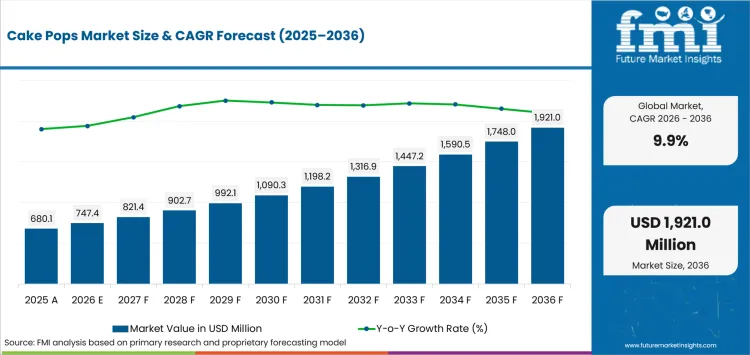
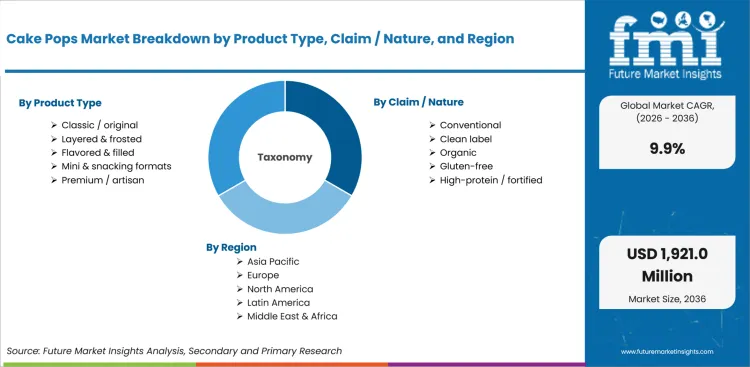
USD 747.4 million in 2026 and USD 1,921.0 million by 2036 at a 9.9% CAGR.
The cake pops market is projected to expand at a 9.9% CAGR between 2026 and 2036. Its value rises from USD 747.4 million in 2026 to USD 1,921.0 million by 2036. Cake pops turn familiar cake into a fixed portion that accepts seasonal decoration without changing the core recipe. American Bakers Association research conducted in 2025 found that 45% of Americans consume snack cakes and pies at least weekly. Weekly snack frequency gives portioned cake more repeat occasions beyond birthdays or formal celebration purchases.
Channel economics also favor a product that can be sold by the piece without cutting or plating. USDA Economic Research Service data published in June 2026 show food-away-from-home accounted for 56.3% of total USA food expenditures during 2025. Restaurants and in-store bakeries therefore gain a large pool of occasions for individually merchandised sweets. Coating damage and finishing time still determine whether wider channel access produces acceptable per-piece margins for decorated products.
Key Takeaways of Cake Pops Market
- Portioned snack occasions and seasonal decoration support repeat demand because one cake base can serve everyday treats and event-led assortments.
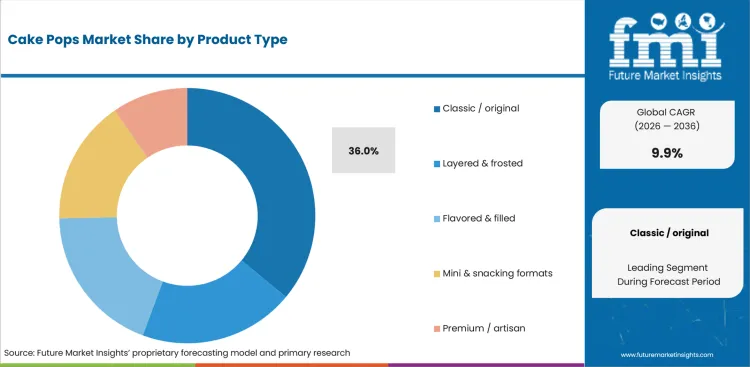
- Based on product type, classic - original is projected to account for 36.0% in 2026 due to familiar flavors that accept seasonal decoration without extra filling steps.
- In 2026, conventional is expected to lead claim - nature with 51.0% share because standard formulas give producers wider control over texture and coating adhesion.
- Fresh is projected to hold 31.0% share in 2026 owing to customization and visual quality close to the point of sale.
- Decoration labor and fragile coatings limit scale because breakage or rework can erase the margin gained from higher per-piece pricing.
- Some of the key players in this market include Rich Products Corporation, Dessert Holdings, Starbucks Corporation, Finsbury Food Group, Premier Foods plc, McKee Foods Corporation, Flowers Foods, Inc., and The J.M. Smucker Co.
Analyst Perspective
"Cake-pop economics should be judged by saleable pieces per labor hour and the share that survives transport without cosmetic damage. The strongest offers earn value from repeatable finishing and channel-ready packaging before premium decoration is applied."
- Nandini Roy Choudhury, Principal Consultant, Future Market Insights
How is the cake pops market segmented?
The market is segmented by product type, claim - nature, format, packaging format and sales channel.
Product type includes classic - original, layered & frosted, flavored & filled, mini & snacking formats and premium / artisan. Claim - nature includes conventional, clean label, organic, gluten-free and high-protein / fortified formulations within the defined taxonomy. Formats include fresh, frozen, ambient packaged, chilled and par-baked / thaw-and-serve products within the defined taxonomy. Packaging formats comprise multipack, single-serve, family / loaf pack and bulk foodservice options within the defined taxonomy. Sales channels include supermarkets & hypermarkets, artisan & specialty bakeries, convenience & forecourt, online & DTC and foodservice distributors.
What makes Classic - original central to the Product type category?
Classic - original starts with flavors consumers already recognize and adapts easily to personalized bakery products sold for short celebration windows. Familiar centers accept different finishes without new filling equipment or layered assembly during seasonal retail programs. Starbucks introduced a limited-time Valentine Cake Pop in January 2025 using vanilla cake under a decorated coating.
- By product type, classic - original is estimated to hold 36.0% in 2026 owing to familiar flavors that accept seasonal decoration without extra filling steps.
- Retailers can rotate themes on one stable cake base, which keeps ingredient planning simpler than filled or multi-layered constructions during short promotions.
Why does Conventional lead the Claim - nature category?
Conventional formulas let producers adjust crumb moisture and coating adhesion without the ingredient restrictions tied to claim-specific production. Finsbury Food Group acquired Flower & White in April 2026 to expand better-for-you snacking, demonstrating the specialist assets often required for differentiated claims. Dedicated claim lines also reduce scheduling flexibility because sensitive recipes require separate changeovers from standard runs.
- By claim - nature, conventional is forecast to represent 51.0% in 2026 driven by easier sourcing and fewer reformulation constraints during scaled production.
- Claim-led formats require ingredient records and production controls that conventional programs avoid, so premium pricing must recover the added qualification and handling work.
Why does Fresh lead the Format category?
Fresh cake pops sell visual finish as part of the product, so specialty bakeries can adjust colors or garnishes close to local collection. The May 2025 Starbucks summer menu added a Strawberries & Cream Cake Pop for a limited seasonal selling window. Frozen desserts and thaw-and-serve alternatives give operators longer replenishment windows during periods with limited decorating labor.
- The fresh segment is likely to capture 31.0% share in 2026 attributable to customization and appearance close to the point of sale.
- Short production runs let local bakery teams respond to event colors or names, and frozen bakery inventory protects replenishment during labor peaks.
What supports Supermarkets & Hypermarkets in the Sales channel category?
Large grocery stores can place cake pops in the in-store bakery or seasonal event display without building a separate trip mission. Premier Foods reported in November 2025 that more than four million packs of its birthday cake tarts had sold after launch. Private-label frozen desserts give category managers another route for testing pack size and replenishment economics.
- The sales channel is forecast to be led by supermarkets & hypermarkets at 36.0% share in 2026 due to grocery traffic supporting planned celebrations and impulse purchases.
- Retailers can compare fresh and packaged bakery products under one roof, letting category teams test labor intensity against shelf life before widening distribution.
What are the drivers, restraints and opportunities in the Cake Pops Market?
Portioned snacking and event demand support growth, whereas decoration loss and allergen controls pressure margins despite new reformulated delivery-ready formats.
- Driver: Frequent snack occasions and seasonal programs give decorated single-bite cakes more chances to sell from one repeatable base formula.
- Restraint: Manual finishing and fragile coatings raise rework risk before allergen controls or labeling costs are considered.
- Opportunity: Free-from formulas and delivery-stable packaging can reach buyers who avoid standard cake or require preordered event assortments.
Snack Frequency Extends Selling Occasions
Repeat snack demand gives cake pops more selling occasions than one-off party orders because the same center can carry different seasonal finishes. Starbucks said February 14 was its highest single day of cake-pop sales in company history during 2026, showing how themed shapes can refresh a familiar center. Low-calorie snack foods also keep portion size visible during category review, but decorative themes need rotation before repeat customers stop noticing them.
Finishing Loss and Allergen Controls Raise Cost
Coating cracks or stick movement turn saleable cake into rework before display, so physical losses appear before labeling costs are counted. FDA's January 2025 allergen guidance requires manufacturers to reassess food-safety plans after new allergen hazard information affects their products. Allergen-free food programs therefore need tighter ingredient separation and cross-contact controls, which increases changeover work beside fragile coating control during routine production.
Claim and Delivery Formats Extend Higher-Value Routes
Claim-led formats expand the addressable buyer set if production controls protect texture and finishing throughput. Finsbury Food Group acquired a majority stake in Lola’s Cupcakes in August 2025 and entered direct-to-consumer retail, placing customization closer to the ordering channel. Gluten-free food demand supports isolated formulas, whereas frozen or chilled bases let operators finish pieces nearer sale and reduce last-mile decoration damage.
Which country CAGRs are profiled in the Cake Pops Market?
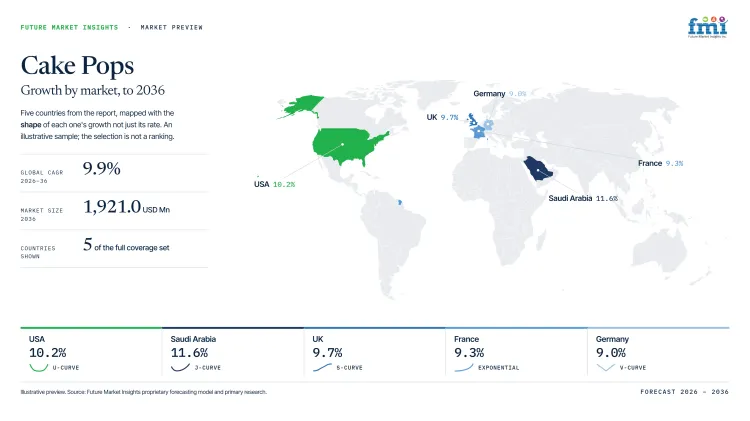
| Country | CAGR |
|---|---|
| Saudi Arabia | 11.6% |
| USA | 10.2% |
| UK | 9.7% |
| France | 9.3% |
| Germany | 9.0% |
How do country-level CAGRs compare in the Cake Pops Market?
The forecasts span 2.6 percentage points from Saudi Arabia at 11.6% to Germany at 9.0%, with Saudi Arabia forming the upper growth band through expanding hospitality and foodservice activity. USA follows through broad retail access, whereas UK, France, and Germany depend more heavily on mature grocery channels, competitive pricing, and disciplined packaging costs during assortment decisions.
- Saudi café chains favor bulk packs that allow finishing near service counters.
- USA in-store bakery counters support cross-selling beside party cakes and cookies.
- UK private-label grocery programs put more pressure on pack cost and shelf life.
- France supermarket bakery counters support cross-selling beside celebration cakes and pastries.
- Germany discount grocery programs put more pressure on pack cost and product consistency.
Channel fit and product durability separate entry choices more clearly than the narrow CAGR ranking alone. The full report provides country-level CAGR analysis across North America, Latin America, Europe, East Asia, South Asia, Oceania and the Middle East and Africa.
Country-wise Analysis
- Saudi hotel and café networks are expanding beyond the largest visitor centers, giving regional distributors more commercial kitchens that can carry celebration desserts. Long service distances remain a practical constraint because decorated pieces need reliable chilled handling between central production and secondary-city outlets. GASTAT reported 5,622 licensed tourism hospitality facilities in Q3 2025 during January 2026, up 40.6% from the previous year. The Saudi Arabia cake pops sector is projected to record 11.6% CAGR during the assessment period, tied to a larger licensed hospitality base. Frozen or chilled bulk packs fit this geography better than highly finished central production because local teams can complete decoration nearer service.
- USA cake-pop programs can enter through in-store bakeries before expanding into club packs or coffeehouse menus, giving producers several routes to trial. USDA data updated in August 2026 show food sales at warehouse clubs and supercenters rose 317.1% between 1997 and 2025. USA is estimated to post 10.2% CAGR over the forecast period, aided by national retail access and multiple portioned-snack occasions. Long distribution distances make fragile coatings harder to protect, especially as centralized fresh production serves stores outside dense metropolitan routes. Large retailers therefore favor packaging systems that preserve decoration without raising per-piece cost beyond the price shoppers accept for impulse bakery items.
- UK cake-pop programs compete inside a mature grocery cake aisle, where private-label pricing leaves limited room for labor-heavy decoration on everyday packs. Paid digital promotion also became harder for qualifying cakes, which shifts more weight toward pack design and in-store merchandising. Department of Health and Social Care guidance updated in June 2025 places cakes and cupcakes within advertising restrictions effective January 2026. Cake pop demand in the UK is forecast to rise at 9.7% CAGR over the forecast period, reflecting deep grocery reach despite tighter promotion choices. Brands with controlled portions and strong shelf appearance can compete without depending on repeated paid-media exposure for each seasonal launch.
- France cake-pop programs can gain traction through supermarkets, hypermarkets, and bakery-led retail formats, where individually portioned treats can be positioned for impulse purchases, children’s occasions, and seasonal promotions. France’s strong grocery distribution network gives producers multiple routes to test decorated snack formats before expanding into larger multipacks or foodservice channels. Cake pop demand in France is forecast to rise at 9.3% CAGR over the forecast period, supported by broad retail access and continued interest in convenient, visually distinctive bakery snacks. Producers must nevertheless balance intricate decoration and fragile coatings against packaging and transport costs, particularly when products move through centralized distribution networks. Retailers are therefore likely to favor compact packaging that protects decoration while maintaining an accessible per-piece price.
- Germany cake-pop programs can enter through supermarkets, discounters, and established bakery channels, creating opportunities to position cake pops as portion-controlled snacks and seasonal confectionery-style bakery products. The country’s highly developed retail infrastructure provides broad shelf access, while discounter competition places greater emphasis on cost-efficient production, packaging, and consistent appearance. Cake pop demand in Germany is forecast to increase at 9.0% CAGR over the forecast period, reflecting strong grocery penetration and demand for convenient portioned bakery formats. Producers need to manage the cost of labor-intensive decoration and protective packaging carefully, as longer distribution routes and centralized production can increase the risk of coating damage. Retailers therefore favor formats that combine attractive presentation, product protection, and low per-unit handling costs.
Who are the notable companies in the Cake Pops Market?
Rich Products Corporation, Dessert Holdings, Starbucks Corporation, Finsbury Food Group, Premier Foods plc, McKee Foods Corporation, Flowers Foods, Inc. and The J.M. Smucker Co. are the notable companies serving this market.
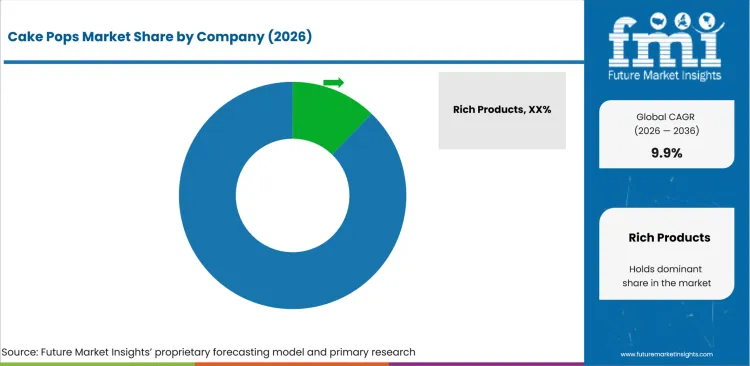
Competition is fragmented because cake-pop formats rely on several production and selling models with different labor and distribution economics. Rich Products Corporation and Dessert Holdings serve industrial bakery programs that depend on large-volume bakery ingredients and foodservice distribution. Starbucks Corporation sells cake pops through coffeehouses where direct menu control supports frequent seasonal changes without a separate retail pack. Finsbury Food Group supplies licensed celebration cakes through grocery channels that require repeatable decoration at larger production volumes. Premier Foods plc, McKee Foods Corporation, Flowers Foods, Inc. and The J.M. Smucker Co. reach national retail through packaged sweet-baked products. Entry becomes harder once producers need stable coatings and channel-specific pack protection at commercial volumes.
- Rich Products Corporation, Dessert Holdings and Finsbury Food Group compete through scaled dessert manufacturing for retail or foodservice programs.
- Starbucks Corporation sells cake pops directly through coffeehouses where menu teams can rotate seasonal designs without retail pack changes. Premier Foods plc, McKee Foods Corporation, Flowers Foods, Inc. and The J.M. Smucker Co. operate packaged lines that compare baking ingredients against shelf-life and throughput requirements for national distribution.
Competitive Benchmarking: Cake Pops Market
| Company | Cake Portfolio Breadth | Channel Coverage | Seasonal / Custom Activity | Geographic Reach |
|---|---|---|---|---|
| Rich Products Corporation | High | High | Medium | Global |
| Dessert Holdings | High | Medium | Low | North America |
| Starbucks Corporation | Low | Low | High | Global coffeehouse markets |
| Finsbury Food Group | High | High | High | UK and Europe |
| Premier Foods plc | High | Medium | High | UK, Europe and North America |
| McKee Foods Corporation | High | High | High | United States |
| Flowers Foods, Inc. | High | Medium | Low | United States |
| The J.M. Smucker Co. | High | Medium | High | North America |
Scoring basis: High cake-portfolio breadth requires three cake or portioned sweet-baked families, Medium requires two and Low one documented family. High channel coverage requires three commercial routes, Medium two and Low one verified route. High seasonal or custom activity requires three documented launches or licensed programs after January 2025, Medium two and Low one documented action.
Key Developments in the Cake Pops Market
- In July 2026, Rich Products Corporation introduced ready-to-serve mini cakes for foodservice and in-store bakery programs that need individual portions with less finishing labor.
- In June 2026, Finsbury Food Group launched its first Hello Kitty celebration cake exclusively at Tesco under a licensed character program.
- In May 2026, Premier Foods plc introduced five Mr Kipling launches that included Birthday Cake Slices and smaller four-pack formats for sweet treats.
Key Players in the Cake Pops Market
Scaled Dessert and Cake-Pop Platforms
- Rich Products Corporation
- Dessert Holdings
- Starbucks Corporation
- Finsbury Food Group
Packaged Sweet-Baked Specialists
- Premier Foods plc
- McKee Foods Corporation
- Flowers Foods, Inc.
- The J.M. Smucker Co.
Cake Pops Market - Report Scope
| Coverage field | Report scope |
|---|---|
| Market breakdown | By product type, claim - nature, format, packaging format, sales channel and region. |
| Quantitative Units | USD Million. |
| Market Definition | Commercially sold cake pops made from portioned cake centers with coatings or decorations for retail, bakery, foodservice and online sale. Finished standard cakes, cupcakes, baking ingredients and decorating supplies sold separately are excluded. |
| Regions Covered | North America, Latin America, Europe, East Asia, South Asia and Pacific and Middle East and Africa. |
| Countries Covered | UAE, Saudi Arabia, South Korea, USA, UK and 20+ countries included in the full report. |
| Key Companies Profiled | Rich Products Corporation, Dessert Holdings, Starbucks Corporation, Finsbury Food Group, Premier Foods plc, McKee Foods Corporation, Flowers Foods, Inc. and The J.M. Smucker Co. |
| Forecast Period | 2026 to 2036. |
| Approach | Primary and secondary research with market triangulation. |
Cake Pops Market - Research Methodology
| Method | Approach |
|---|---|
| Primary Research | FMI analysts gathered input from manufacturers, service providers, technology developers, distributors, end users, procurement teams, and subject-matter experts. Interviews examined purchasing decisions, product or service evaluation, adoption barriers, approval requirements, pricing considerations, and expectations for technical or commercial support. Respondents were also asked what evidence is required before a trial, pilot, or initial order develops into regular purchasing. |
| Desk Research | Desk research covered government statistics, regulatory publications, trade data, industry associations, technical literature, standards, company filings, product information, and official corporate announcements. Sources were reviewed for relevance, publication date, geographic coverage, and consistency with the defined market scope. Claims relating to performance, applications, approvals, capacity, investment, and commercial activity were retained only when supported by credible public evidence. |
| Market Sizing and Forecasting | The market model combined the baseline value with historical performance, segment structure, pricing and volume indicators, adoption levels, company participation, and country-level demand conditions. Forecast assumptions considered economic activity, investment trends, regulatory developments, technology adoption, purchasing cycles, supply availability, and barriers to wider market use. Segment and regional estimates were reconciled before the final market total was calculated. |
| Data Validation | Estimates were checked against multiple independent indicators, including public data, company activity, trade patterns, industry developments, and findings from primary interviews. Validation also tested whether products, services, applications, and company revenues fell within the defined market boundaries. Adjacent categories, unsupported claims, overlapping revenues, and activities without direct market relevance were excluded to reduce double counting and maintain consistency across segments and countries. |
Cake Pops Market by Segments
Cake Pops Market segmented by Product Type:
- Classic - original
- Layered & frosted
- Flavored & filled
- Mini & snacking formats
- Premium / artisan
Cake Pops Market segmented by Claim - nature:
- Conventional
- Clean label
- Organic
- Gluten-free
- High-protein / fortified
Cake Pops Market segmented by Format:
- Fresh
- Frozen
- Ambient packaged
- Chilled
- Par-baked / thaw-and-serve
Cake Pops Market segmented by Packaging Format:
- Multipack
- Single-serve
- Family / loaf pack
- Bulk foodservice
Cake Pops Market segmented by Sales Channel:
- Supermarkets & hypermarkets
- Artisan & specialty bakeries
- Convenience & forecourt
- Online & DTC
- Foodservice distributors
Cake Pops Market by Region:
- North America
- United States
- Canada
- Latin America
- Brazil
- Mexico
- Chile
- Rest of Latin America
- Western Europe
- Germany
- United Kingdom
- Italy
- Spain
- France
- Nordics
- Benelux
- Rest of Western Europe
- Eastern Europe
- Russia
- Poland
- Hungary
- Balkan and Baltic States
- Rest of Eastern Europe
- East Asia
- China
- Japan
- South Korea
- South Asia and Pacific
- India
- ASEAN
- Australia and New Zealand
- Rest of South Asia and Pacific
- Middle East and Africa
- Kingdom of Saudi Arabia
- Other GCC Countries
- Türkiye
- South Africa
- Other African Union Countries
- Rest of Middle East and Africa
Research Sources and Bibliography
- American Bakers Association. (2025). Consumer Trends.
- Zeballos, E., & Sinclair, W. (2026, June 11). Total USA food spending reached $2.51 trillion in 2025.
- Starbucks Corporation. (2025, January 2). Starbucks adds Cortado to its espresso beverage lineup.
- Finsbury Food Group. (2026, April 30). Finsbury Food Group Acquires Flower & White To Boost DTC And Healthy Snacking Growth.
- Starbucks Corporation. (2025, May 19). Summer-Berry Refreshers are back alongside new Iced Horchata Oatmilk Shaken Espresso.
- Premier Foods plc. (2025, November 13). Half Year Results for Premier Foods for the 26 weeks ended 27 September 2025.
- Starbucks Corporation. (2026, February 18). Valentine's Day buzz drives Starbucks to its biggest cake pop sales day ever.
- USA Food and Drug Administration. (2025, January). Guidance for Industry: Questions and Answers Regarding Food Allergen Labeling (Edition 5).
- Finsbury Food Group. (2025, August 15). Finsbury Food Group Acquires Majority Stake in Lola's.
- Dubai Department of Economy and Tourism. (2026, February 9). Dubai welcomes 19.59 million visitors in third record year.
- General Authority for Statistics. (2026, January 8). GASTAT: Publishes Tourism Establishments Statistics for Q3 of 2025.
- Ministry of Data and Statistics, Republic of Korea. (2025, October 1). Online Shopping in August 2025.
- USA Department of Agriculture, Economic Research Service. (2026, August 17). Retailing & Wholesaling - Retail Trends.
- Department of Health and Social Care. (2025, June 4). Restricting advertising of less healthy food or drink on TV and online: products in scope.
- Rich Products Corporation. (2026, July 6). Rich Products Introduces Mini Cakes.
- Finsbury Food Group. (2026, June 26). First-ever Hello Kitty Celebration Cake hits Tesco shelves.
- Premier Foods plc. (2026, May 29). Mr Kipling unveils exceedingly good innovation.
- Finsbury Food Group. (2026, May 7). Finsbury Food Group renews Disney licensing collaboration.
- McKee Foods Corporation. (2025, December 9). Little Debbie Single Serve Strawberry Shortcake Roll.
- Rich Products Corporation. (2025, April 10). Rich Products, Funfetti extend partnership.
- Dessert Holdings. (2025, July 14). Dessert Holdings Acquires Willamette Valley Pie Co.
- Dessert Holdings. (2025, May 30). Dessert Holdings Returns to IDDBA Ahead of 10-Year Anniversary.
- Flowers Foods, Inc. (2025, April 16). Flowers Foods Launches New Products and Line Expansions to Meet Consumer Needs.
- Flowers Foods, Inc. (2025, February 21). Flowers Foods, Inc. completes acquisition of Simple Mills.
- The J.M. Smucker Co. (2025, March 3). The J.M. Smucker Co. Completes the Divestiture of Certain Value Brands to JTM Foods, LLC.
- The J.M. Smucker Co. (2025, February 27). Fiscal Year 2025 Third Quarter Earnings Prepared Remarks.
- Premier Foods plc. (2025, March 13). Spring into Easter with new simnel slices from Mr Kipling.
- Starbucks Corporation. (2026, March 2). Spring Menu Fact Sheet.
- Premier Foods plc. (2025, June). Sustainable Accounting Standards Board disclosure 2024/25.
- Starbucks Corporation. (2026, April 3). Starbucks 'Cake Pop Guru' shares his secrets behind the beloved treat.
- Rich Products Corporation. (2026, April 20). Rich Products Launches First Responsible Business Report, Reflecting a Long-standing, Values-Driven Approach to Responsible Growth.
This Report Answers
- What is the cake pops market size in 2026 and what value is projected for 2036?
- Which snack and celebration occasions are supporting repeat demand for cake pops?
- Why does classic - original hold the leading position within product type?
- Why does conventional hold the largest share within claim - nature?
- How do fresh cake pops compare with frozen or longer-life formats?
- Which five countries carry the highest authorized growth rates in the current profile?
- Which operating frictions limit profitable scale-up for decorated cake-pop programs?
- Which companies have current bakery or cake-pop activity relevant to the market?
- What should retailers and foodservice operators compare before expanding a cake-pop assortment?
Frequently Asked Questions
How big is the cake pops market in 2026?
The cake pops market is valued at USD 747.4 million in 2026 and is projected to reach USD 1,921.0 million by 2036. Growth is driven by portioned snacking and seasonal decoration that extend cake into more everyday and event-led occasions.
What is the CAGR of the cake pops market from 2026 to 2036?
The cake pops market is projected to grow at a CAGR of 9.9% between 2026 and 2036. Expansion is supported by repeated snack occasions and broader retail or foodservice access for small decorated formats.
Which product type leads the cake pops market?
The classic - original segment is expected to hold 36.0% of the cake pops market in 2026, driven by familiar flavors that accept seasonal decoration without extra filling steps. Retailers can rotate short seasonal programs without changing the core center recipe or adding another filling process.
Which claim - nature segment leads the cake pops market?
The conventional segment is expected to hold 51.0% of the cake pops market in 2026, attributable to easier sourcing and fewer reformulation constraints during scaled production. Claim-specific alternatives require tighter ingredient records and separate production controls that conventional programs can avoid.
Which countries are projected to record the highest growth in the cake pops market?
UAE is projected to grow at 12.0% CAGR, followed by Saudi Arabia at 11.6% and South Korea at 10.7% through 2036. Faster growth is tied to hospitality expansion in Gulf markets and frequent mobile food ordering in South Korea.
Which companies are active in the cake pops market?
Key companies operating in the market include Rich Products Corporation, Dessert Holdings, Starbucks Corporation, Finsbury Food Group, Premier Foods plc, McKee Foods Corporation, Flowers Foods, Inc., and The J.M. Smucker Co. Their positions span cake-pop programs, industrial desserts, licensed celebration cakes and packaged sweet-baked distribution.
Preview the report firsthand - request a free sample
Get SampleGet the brochure for pricing and purchase details.
Get PDFTable of Content
- Key Takeaways
- Market Size and CAGR
- Top Growth Driver
- Fastest Growing Segment
- Leading Region
- Key Companies
- Emerging Opportunities
- Executive Summary
- Global Market Outlook
- Demand-side Trends
- Supply-side Trends
- Technology Roadmap Analysis
- Analysis and Recommendations
- Analyst Perspective (What is happening? Why now? What should investors know?)
- Key Questions Answered
- How large is the market?
- What is the CAGR?
- What are key trends?
- Which region dominates?
- Who are the leaders?
- Market Overview
- Market Coverage / Taxonomy
- Market Definition / Scope / Limitations
- Research Methodology
- Chapter Orientation
- Analytical Lens and Working Hypotheses
- Market Structure, Signals, and Trend Drivers
- Benchmarking and Cross-market Comparability
- Market Sizing, Forecasting, and Opportunity Mapping
- Research Design and Evidence Framework
- Desk Research Programme (Secondary Evidence)
- Expert Input and Fieldwork (Primary Evidence)
- Tooling, Models, and Reference Databases
- Data Engineering and Model Build
- Quality Assurance and Audit Trail
- Market Background
- Market Dynamics (Drivers, Restraints, Opportunity, Trends)
- Scenario Forecast (Optimistic, Likely, Conservative)
- Impact Analysis
- AI Impact
- Sustainability Impact
- Regulatory Impact
- Technology Impact
- Consumer / Buyer Analysis
- Purchase Drivers
- Adoption Barriers
- Buyer Journey
- Opportunity Map Analysis
- Product Life Cycle Analysis
- Supply Chain Analysis
- Investment Feasibility Matrix
- Value Chain Analysis
- PESTLE and Porter's Analysis
- Regulatory Landscape
- Regional Parent Market Outlook
- Production and Consumption Statistics
- Import and Export Statistics
- Global Market Analysis and Forecast, 2021 to 2036
- Historical Market Size Value (USD Million) Analysis, 2021 to 2025
- Current and Future Market Size Value (USD Million) Projections, 2026 to 2036
- Y-o-Y Growth Trend Analysis
- Absolute $ Opportunity Analysis
- Global Market Pricing Analysis, 2021 to 2036
- Global Market Analysis and Forecast, By Product Type, 2021 to 2036
- Introduction / Key Findings
- Historical Market Size Value (USD Million) Analysis By Product Type, 2021 to 2025
- Current and Future Market Size Value (USD Million) Analysis and Forecast By Product Type, 2026 to 2036
- Classic / original
- Layered & frosted
- Flavored & filled
- Mini & snacking formats
- Premium / artisan
- Classic / original
- Y-o-Y Growth Trend Analysis By Product Type, 2021 to 2025
- Absolute $ Opportunity Analysis By Product Type, 2026 to 2036
- Global Market Analysis and Forecast, By Claim / Nature, 2021 to 2036
- Introduction / Key Findings
- Historical Market Size Value (USD Million) Analysis By Claim / Nature, 2021 to 2025
- Current and Future Market Size Value (USD Million) Analysis and Forecast By Claim / Nature, 2026 to 2036
- Conventional
- Clean label
- Organic
- Gluten-free
- High-protein / fortified
- Conventional
- Y-o-Y Growth Trend Analysis By Claim / Nature, 2021 to 2025
- Absolute $ Opportunity Analysis By Claim / Nature, 2026 to 2036
- Global Market Analysis and Forecast, By Format, 2021 to 2036
- Introduction / Key Findings
- Historical Market Size Value (USD Million) Analysis By Format, 2021 to 2025
- Current and Future Market Size Value (USD Million) Analysis and Forecast By Format, 2026 to 2036
- Fresh
- Frozen
- Ambient packaged
- Chilled
- Par-baked / thaw-and-serve
- Fresh
- Y-o-Y Growth Trend Analysis By Format, 2021 to 2025
- Absolute $ Opportunity Analysis By Format, 2026 to 2036
- Global Market Analysis and Forecast, By Packaging Format, 2021 to 2036
- Introduction / Key Findings
- Historical Market Size Value (USD Million) Analysis By Packaging Format, 2021 to 2025
- Current and Future Market Size Value (USD Million) Analysis and Forecast By Packaging Format, 2026 to 2036
- Multipack
- Single-serve
- Family / loaf pack
- Bulk foodservice
- Multipack
- Y-o-Y Growth Trend Analysis By Packaging Format, 2021 to 2025
- Absolute $ Opportunity Analysis By Packaging Format, 2026 to 2036
- Global Market Analysis and Forecast, By Sales Channel, 2021 to 2036
- Introduction / Key Findings
- Historical Market Size Value (USD Million) Analysis By Sales Channel, 2021 to 2025
- Current and Future Market Size Value (USD Million) Analysis and Forecast By Sales Channel, 2026 to 2036
- Supermarkets & hypermarkets
- Artisan & specialty bakeries
- Convenience & forecourt
- Online & DTC
- Foodservice distributors
- Supermarkets & hypermarkets
- Y-o-Y Growth Trend Analysis By Sales Channel, 2021 to 2025
- Absolute $ Opportunity Analysis By Sales Channel, 2026 to 2036
- Global Market Analysis and Forecast, By Region, 2021 to 2036
- Introduction
- Historical Market Size Value (USD Million) Analysis By Region, 2021 to 2025
- Current Market Size Value (USD Million) Analysis and Forecast By Region, 2026 to 2036
- North America
- Latin America
- Western Europe
- Eastern Europe
- East Asia
- South Asia and Pacific
- Middle East & Africa
- Market Attractiveness Analysis By Region
- North America Market Analysis and Forecast, By Country, 2021 to 2036
- Historical Market Size Value (USD Million) Trend Analysis By Market Taxonomy, 2021 to 2025
- Market Size Value (USD Million) Forecast By Market Taxonomy, 2026 to 2036
- By Country
- USA
- Canada
- By Product Type
- By Claim / Nature
- By Format
- By Packaging Format
- By Sales Channel
- By Country
- Market Attractiveness Analysis
- By Country
- By Product Type
- By Claim / Nature
- By Format
- By Packaging Format
- By Sales Channel
- Key Takeaways
- Latin America Market Analysis and Forecast, By Country
- Historical Market Size Value (USD Million) Trend Analysis By Market Taxonomy, 2021 to 2025
- Market Size Value (USD Million) Forecast By Market Taxonomy, 2026 to 2036
- By Country
- Brazil
- Mexico
- Chile
- Rest of Latin America
- By Product Type
- By Claim / Nature
- By Format
- By Packaging Format
- By Sales Channel
- By Country
- Market Attractiveness Analysis
- By Country
- By Product Type
- By Claim / Nature
- By Format
- By Packaging Format
- By Sales Channel
- Key Takeaways
- Western Europe Market Analysis and Forecast, By Country
- Historical Market Size Value (USD Million) Trend Analysis By Market Taxonomy, 2021 to 2025
- Market Size Value (USD Million) Forecast By Market Taxonomy, 2026 to 2036
- By Country
- Germany
- UK
- Italy
- Spain
- France
- Nordic
- BENELUX
- Rest of Western Europe
- By Product Type
- By Claim / Nature
- By Format
- By Packaging Format
- By Sales Channel
- By Country
- Market Attractiveness Analysis
- By Country
- By Product Type
- By Claim / Nature
- By Format
- By Packaging Format
- By Sales Channel
- Key Takeaways
- Eastern Europe Market Analysis and Forecast, By Country
- Historical Market Size Value (USD Million) Trend Analysis By Market Taxonomy, 2021 to 2025
- Market Size Value (USD Million) Forecast By Market Taxonomy, 2026 to 2036
- By Country
- Russia
- Poland
- Hungary
- Balkan & Baltic
- Rest of Eastern Europe
- By Product Type
- By Claim / Nature
- By Format
- By Packaging Format
- By Sales Channel
- By Country
- Market Attractiveness Analysis
- By Country
- By Product Type
- By Claim / Nature
- By Format
- By Packaging Format
- By Sales Channel
- Key Takeaways
- East Asia Market Analysis and Forecast, By Country
- Historical Market Size Value (USD Million) Trend Analysis By Market Taxonomy, 2021 to 2025
- Market Size Value (USD Million) Forecast By Market Taxonomy, 2026 to 2036
- By Country
- China
- Japan
- South Korea
- By Product Type
- By Claim / Nature
- By Format
- By Packaging Format
- By Sales Channel
- By Country
- Market Attractiveness Analysis
- By Country
- By Product Type
- By Claim / Nature
- By Format
- By Packaging Format
- By Sales Channel
- Key Takeaways
- South Asia and Pacific Market Analysis and Forecast, By Country
- Historical Market Size Value (USD Million) Trend Analysis By Market Taxonomy, 2021 to 2025
- Market Size Value (USD Million) Forecast By Market Taxonomy, 2026 to 2036
- By Country
- India
- ASEAN
- Australia & New Zealand
- Rest of South Asia and Pacific
- By Product Type
- By Claim / Nature
- By Format
- By Packaging Format
- By Sales Channel
- By Country
- Market Attractiveness Analysis
- By Country
- By Product Type
- By Claim / Nature
- By Format
- By Packaging Format
- By Sales Channel
- Key Takeaways
- Middle East & Africa Market Analysis and Forecast, By Country
- Historical Market Size Value (USD Million) Trend Analysis By Market Taxonomy, 2021 to 2025
- Market Size Value (USD Million) Forecast By Market Taxonomy, 2026 to 2036
- By Country
- Kingdom of Saudi Arabia
- Other GCC Countries
- Türkiye
- South Africa
- Other African Union
- Rest of Middle East & Africa
- By Product Type
- By Claim / Nature
- By Format
- By Packaging Format
- By Sales Channel
- By Country
- Market Attractiveness Analysis
- By Country
- By Product Type
- By Claim / Nature
- By Format
- By Packaging Format
- By Sales Channel
- Key Takeaways
- Key Countries Market Analysis
- USA
- Pricing Analysis
- Market Share Analysis, 2025
- By Product Type
- By Claim / Nature
- By Format
- By Packaging Format
- By Sales Channel
- Canada
- Pricing Analysis
- Market Share Analysis, 2025
- By Product Type
- By Claim / Nature
- By Format
- By Packaging Format
- By Sales Channel
- Mexico
- Pricing Analysis
- Market Share Analysis, 2025
- By Product Type
- By Claim / Nature
- By Format
- By Packaging Format
- By Sales Channel
- Brazil
- Pricing Analysis
- Market Share Analysis, 2025
- By Product Type
- By Claim / Nature
- By Format
- By Packaging Format
- By Sales Channel
- Chile
- Pricing Analysis
- Market Share Analysis, 2025
- By Product Type
- By Claim / Nature
- By Format
- By Packaging Format
- By Sales Channel
- Germany
- Pricing Analysis
- Market Share Analysis, 2025
- By Product Type
- By Claim / Nature
- By Format
- By Packaging Format
- By Sales Channel
- UK
- Pricing Analysis
- Market Share Analysis, 2025
- By Product Type
- By Claim / Nature
- By Format
- By Packaging Format
- By Sales Channel
- Italy
- Pricing Analysis
- Market Share Analysis, 2025
- By Product Type
- By Claim / Nature
- By Format
- By Packaging Format
- By Sales Channel
- Spain
- Pricing Analysis
- Market Share Analysis, 2025
- By Product Type
- By Claim / Nature
- By Format
- By Packaging Format
- By Sales Channel
- France
- Pricing Analysis
- Market Share Analysis, 2025
- By Product Type
- By Claim / Nature
- By Format
- By Packaging Format
- By Sales Channel
- India
- Pricing Analysis
- Market Share Analysis, 2025
- By Product Type
- By Claim / Nature
- By Format
- By Packaging Format
- By Sales Channel
- ASEAN
- Pricing Analysis
- Market Share Analysis, 2025
- By Product Type
- By Claim / Nature
- By Format
- By Packaging Format
- By Sales Channel
- Australia & New Zealand
- Pricing Analysis
- Market Share Analysis, 2025
- By Product Type
- By Claim / Nature
- By Format
- By Packaging Format
- By Sales Channel
- China
- Pricing Analysis
- Market Share Analysis, 2025
- By Product Type
- By Claim / Nature
- By Format
- By Packaging Format
- By Sales Channel
- Japan
- Pricing Analysis
- Market Share Analysis, 2025
- By Product Type
- By Claim / Nature
- By Format
- By Packaging Format
- By Sales Channel
- South Korea
- Pricing Analysis
- Market Share Analysis, 2025
- By Product Type
- By Claim / Nature
- By Format
- By Packaging Format
- By Sales Channel
- Russia
- Pricing Analysis
- Market Share Analysis, 2025
- By Product Type
- By Claim / Nature
- By Format
- By Packaging Format
- By Sales Channel
- Poland
- Pricing Analysis
- Market Share Analysis, 2025
- By Product Type
- By Claim / Nature
- By Format
- By Packaging Format
- By Sales Channel
- Hungary
- Pricing Analysis
- Market Share Analysis, 2025
- By Product Type
- By Claim / Nature
- By Format
- By Packaging Format
- By Sales Channel
- Kingdom of Saudi Arabia
- Pricing Analysis
- Market Share Analysis, 2025
- By Product Type
- By Claim / Nature
- By Format
- By Packaging Format
- By Sales Channel
- Türkiye
- Pricing Analysis
- Market Share Analysis, 2025
- By Product Type
- By Claim / Nature
- By Format
- By Packaging Format
- By Sales Channel
- South Africa
- Pricing Analysis
- Market Share Analysis, 2025
- By Product Type
- By Claim / Nature
- By Format
- By Packaging Format
- By Sales Channel
- USA
- Market Structure Analysis
- Competition Dashboard
- Competition Benchmarking
- Market Share Analysis of Top Players
- By Regional
- By Product Type
- By Claim / Nature
- By Format
- By Packaging Format
- By Sales Channel
- Emerging Startups
- Innovation Benchmarking
- Competition Analysis
- Competition Deep Dive
- Rich Products
- Overview
- Product Portfolio
- Profitability by Market Segments
- Sales Footprint
- Strategy Overview
- Marketing Strategy
- Product Strategy
- Channel Strategy
- Sara Lee Frozen Bakery
- Dessert Holdings
- Mademoiselle Desserts
- Finsbury Food Group
- Premier Foods
- McKee Foods
- Hostess Brands
- Bauli
- Dr. Oetker
- Rich Products
- Case Studies
- Success Stories
- Recent Developments
- Competition Deep Dive
- Assumptions & Acronyms Used


