

- Market Size (2026)
- USD 1.4 Bn
- Forecast (2036)
- USD 2.5 Bn
- CAGR (2026 to 2036)
- 6.3%
Low Calorie Popsicles Market Size, Market Forecast and Outlook By FMI
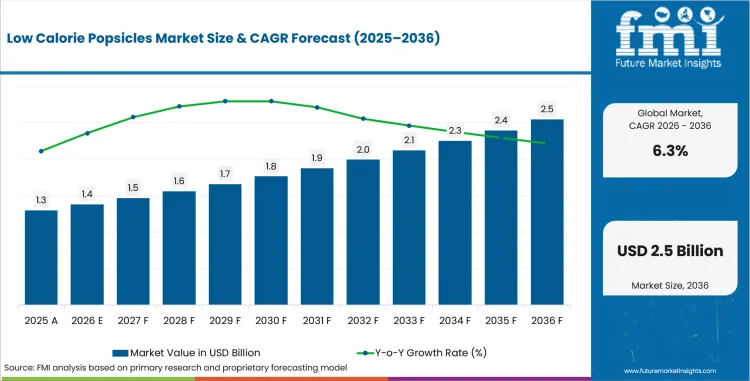
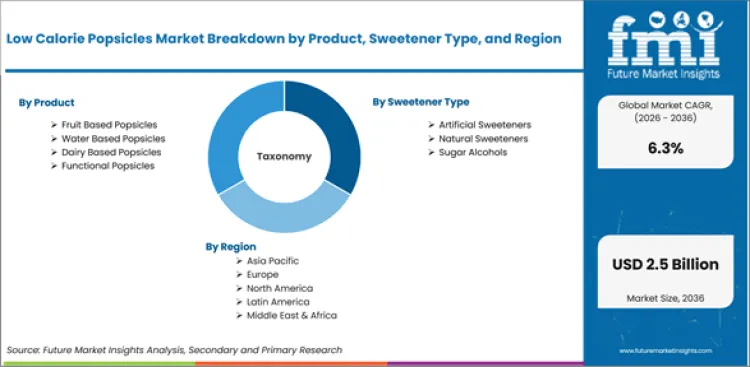
The low calorie popsicles market was valued at USD 1.3 billion in 2025. The market is set to reach USD 1.4 billion by 2026-end and grow at a CAGR of 6.3% between 2026-2036 to reach USD 2.5 billion by 2036. Fruit Based Popsicles will dominate with a 40.0% share, while Artificial Sweeteners will lead with a 45.0% share.
Key Takeaways, Market Size, and Forecast
- 2026 Market Size: USD 1.4 billion
- 2036 Market Size: USD 2.5 billion
- Compound Annual Growth Rate (CAGR): 6.3% from 2026 to 2036
- Absolute $ Opportunity: USD 1.1 billion between 2026 and 2036
- Leading Product Segment: Fruit Based Popsicles
- Fruit Based Popsicles Share in 2026: 40.0%
- Fastest-growing Country: China
- China CAGR: 8.5% through 2036
| Parameter | Details |
|---|---|
| Market Size in 2026 (Value) | USD 1.4 billion |
| Market Forecast in 2036 (Value) | USD 2.5 billion |
| CAGR (2026 to 2036) | 6.3% from 2026 to 2036 |
| Years Considered | 2021 to 2036 |
| Base Year | 2025 |
| Forecast Period | 2026 to 2036 |
| Units Considered | Value (USD Billion) |
| Leading Sub-Region | China |
Summary of the Low Calorie Popsicles Market
- Demand and Growth Drivers
- Health-conscious consumer demand for frozen snack alternatives with reduced calorie content is expected to sustain growth in low calorie popsicle categories across fruit-based and novelty formats.
- Expansion of natural fruit-based popsicle products using real fruit purees and natural sweeteners is likely to support premiumization beyond traditional sugar-free frozen novelty positioning.
- Seasonal consumption patterns and growing availability through convenience retail and food service channels are expected to broaden consumer access and repeat purchase frequency.
- Product and Segment View
- Fruit based popsicles are estimated to account for 40.0% of product demand in 2026, driven by consumer preference for natural fruit flavors and clean label frozen snack positioning.
- Stick popsicles are likely to lead form demand at 60.0%, reflecting the traditional and most widely distributed frozen novelty format.
- Retail consumption is expected to account for 75.0% of application demand, with grocery retail and convenience store freezer sections as primary distribution points.
- Geography and Competitive Outlook
- China is likely to lead country level growth at 8.5% through 2036, driven by expanding frozen novelty consumption and growing health consciousness among urban consumers.
- North America and Western Europe are expected to sustain demand through established frozen novelty retail channels and expanding low calorie product availability.
- Companies with fruit-based formulation capability, natural sweetener expertise, and cold chain retail distribution are likely to strengthen market positioning.
- Analyst Opinion
- Nandini Roy Choudhury, Principal Consultant at FMI says, 'Manufacturers that can deliver indulgent frozen fruit experiences at reduced calorie levels with clean label ingredient lists are positioned to capture growing demand from health-conscious consumers seeking guilt-free summer snacking through 2036.'
- The low calorie popsicles market is transitioning from a diet novelty segment into a mainstream frozen snack category as product quality and variety improve.
- Adoption is increasing due to real fruit formulations that deliver natural flavor intensity without added sugar, repositioning popsicles as a health-positive snack choice.
- The market is also benefiting from portion-controlled single-serve formats that enable calorie management for consumers seeking frozen indulgence occasions.
- Demand is further supported by seasonal consumption patterns in temperate climates, with summer months generating peak procurement and retail activity.
Low Calorie Popsicles Market Definition
The low calorie popsicles market includes frozen novelty products on sticks or in tube formats formulated to deliver reduced calorie content compared to standard frozen desserts. Products span fruit-based popsicles, dairy-based frozen bars, water-based ice pops, and novelty shapes using artificial sweeteners, natural sweeteners, or reduced sugar formulations.
Low Calorie Popsicles Market Inclusions
Market scope encompasses all commercially traded low calorie popsicle products categorized by product (fruit based popsicles, dairy based popsicles, water based ice pops, novelty popsicles), sweetener type (artificial sweeteners, natural sweeteners, reduced sugar), form (stick popsicles, tube popsicles, novelty shapes), application (retail consumption, food service, vending), and end use (individual consumers, hospitality, institutional). Revenue scope covers 2026 to 2036.
Low Calorie Popsicles Market Exclusions
The scope does not include full-calorie popsicles and frozen novelties, ice cream bars with calorie levels comparable to standard ice cream, or frozen fruit bars without explicit low calorie positioning.
Low Calorie Popsicles Market Research Methodology
- Primary Research: FMI analysts conducted interviews with frozen novelty manufacturers, fruit ingredient suppliers, and retail frozen food category managers across key consumption markets.
- Desk Research: Combined data from frozen novelty retail sales tracking, fruit ingredient trade statistics, and manufacturer production disclosures.
- Market Sizing and Forecasting: Bottom-up aggregation across retail, food service, and vending applications with seasonal demand curve modeling based on climate and consumption patterns.
- Data Validation: Cross-checked quarterly against retail scanner data, cold chain distribution reports, and manufacturer shipment data.
Why is the Low Calorie Popsicles Market Growing?
- Consumer demand for healthier frozen snack alternatives is generating sustained procurement of low calorie popsicles, with natural fruit-based variants leading premium segment growth.
- Retail freezer shelf space allocation for low calorie frozen novelties is expanding in mainstream grocery channels, improving product visibility beyond specialty health food sections.
- China leads country level growth at 8.5% CAGR, driven by expanding frozen novelty consumption among urban consumers and growing availability of reduced-calorie frozen snack products.
The low calorie popsicles market is expanding as frozen snack consumption shifts toward healthier alternatives. Fruit-based popsicles made with real fruit purees and natural sweeteners are repositioning the category from diet novelty to health-positive snacking, attracting consumers beyond traditional calorie-counting demographics.
Natural ingredient positioning is a key growth driver. Popsicles formulated with recognizable fruit ingredients, no artificial colors, and natural sweeteners including stevia and monk fruit align with clean label consumer expectations. This positioning commands modest price premiums over standard frozen novelties while attracting health-conscious purchasers.
Seasonal demand patterns concentrate consumption in warmer months across temperate climate markets. Manufacturers manage production cycles and inventory positioning to align with summer peak demand, while year-round consumption is supported by indoor heating environments and tropical market demand patterns.
Market Segmentation Analysis
- Fruit based popsicles lead at 40.0%, with real fruit puree formulations delivering natural flavor and color while supporting clean label positioning.
- Artificial sweeteners account for 45.0% of sweetener demand, though natural sweetener adoption is accelerating in premium and clean label product segments.
- Individual consumers dominate end use at 70.0%, with household purchase for family consumption and personal snacking as primary demand occasions.
The low calorie popsicles market is segmented by product, sweetener type, form, application, and end use. Fruit based popsicles lead product demand while stick formats dominate form preferences.
Insights into the Fruit Based Popsicles Product Segment
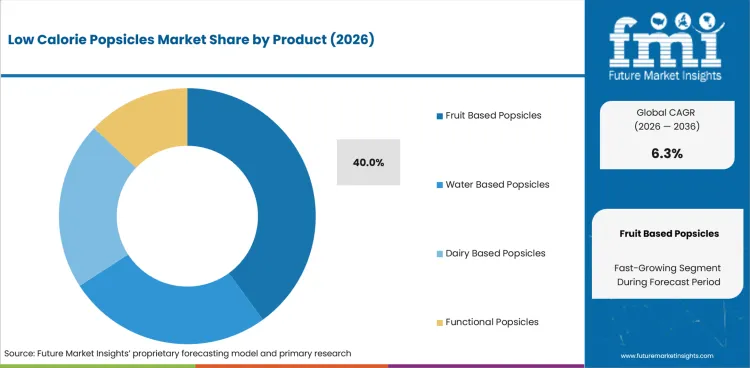
In 2026, fruit based popsicles are estimated to account for 40.0% of total product demand. Real fruit puree and juice-based formulations deliver natural flavor intensity and vibrant color without artificial additives. Mango, strawberry, mixed berry, and citrus are the most popular flavor profiles across major consumption markets.
Single-fruit and blended fruit variants serve different consumer preferences, with single-fruit products delivering pure flavor recognition and blended variants creating complex taste profiles. Organic fruit-based popsicles command the highest price premiums in the category.
Insights into the Stick Popsicles Form Segment
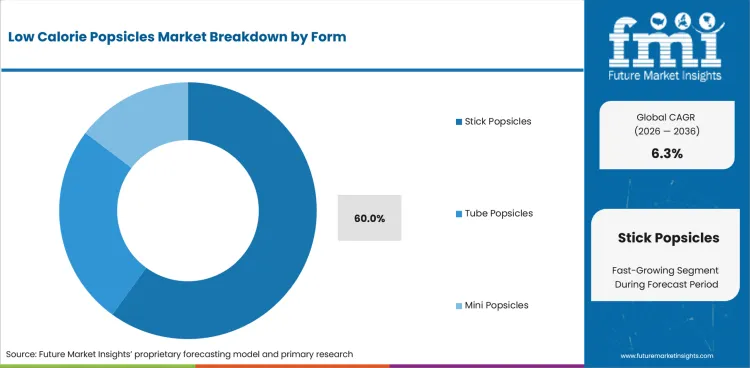
Stick popsicles are expected to account for 60.0% of form demand in 2026, with the traditional stick format providing the most widely recognized and distributed frozen novelty configuration. Stick formats enable single-hand consumption and are the standard specification for multi-pack retail packaging.
Tube popsicles and squeezable frozen formats serve a younger consumer demographic and offer manufacturing cost advantages through simplified packaging. Novelty shapes and character-branded formats target children and family consumption occasions where visual appeal drives purchase decisions.
Low Calorie Popsicles Market Drivers, Restraints, and Opportunities
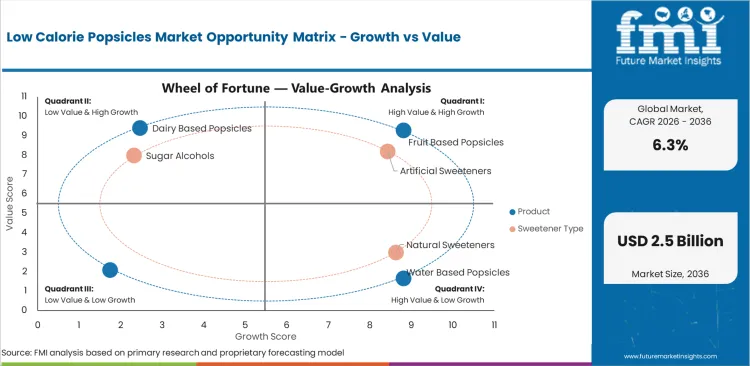
- Health-conscious frozen snack demand and natural fruit formulation capability sustain growth in the low calorie popsicle category across retail and food service channels.
- Seasonal demand concentration creates production planning and inventory management challenges, with summer months accounting for the majority of annual consumption.
- Cold chain distribution requirements and freezer shelf space competition constrain market access for smaller manufacturers without established frozen distribution infrastructure.
- Natural sweetener adoption and real fruit ingredient positioning support premium pricing and clean label consumer appeal beyond traditional diet frozen novelty categories.
The low calorie popsicles market continues to grow based on health-conscious snacking trends, natural ingredient positioning, and expanding retail distribution. Seasonal patterns and cold chain requirements shape operational considerations.
Health-Conscious Frozen Snacking
Demand is shaped by consumer preference for frozen snack options that deliver indulgence with reduced caloric impact. Popsicles positioned as naturally low calorie due to fruit and water base compositions attract consumers seeking inherently lighter alternatives to ice cream and frozen desserts.
Seasonal Demand Concentration
Growth is influenced by seasonal consumption patterns, with summer months generating 60% to 70% of annual retail sales in temperate climate markets. Manufacturers manage production seasonality through advance manufacturing and cold storage inventory positioning.
Cold Chain and Shelf Space Competition
Adoption is constrained by cold chain distribution infrastructure requirements and competitive pressure for retail freezer shelf space. Low calorie popsicles compete with ice cream, frozen meals, and other frozen categories for limited freezer display real estate.
Natural Fruit and Clean Label Premiumization
Products formulated with real fruit and natural sweeteners command price premiums supported by consumer willingness to pay for clean label frozen snacks. This premiumization attracts manufacturers with fruit ingredient sourcing and processing capabilities.
Analysis of Low Calorie Popsicles Market By Key Countries
.webp "Top Country Growth Comparison Low Calorie Popsicles Market Cagr (2026 2036)")
| Country | CAGR |
|---|---|
| China | 8.5% |
| India | 7.9% |
| Germany | 7.3% |
| Brazil | 6.6% |
| USA | 6.0% |
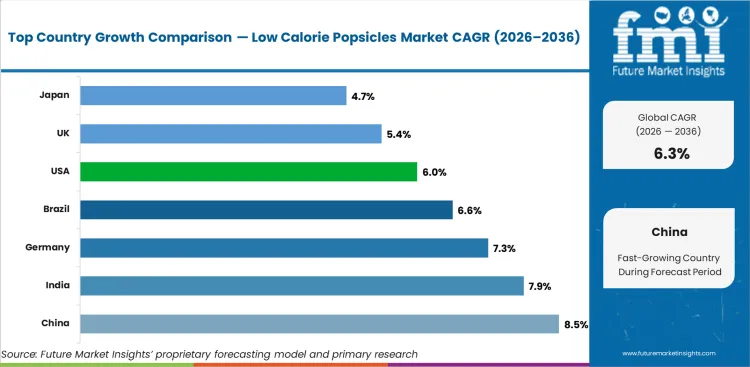
- China at 8.5% leads growth, driven by expanding frozen novelty consumption and growing urban consumer demand for reduced-calorie snack alternatives.
- India at 7.9% reflects rising frozen food retail infrastructure and growing health awareness among urban consumers supporting low calorie product adoption.
- Germany at 7.3% sustains demand through EU health labeling influence and consumer preference for natural fruit-based frozen snack products.
- Brazil at 6.6% shows growth from expanding cold chain retail distribution and growing consumer interest in healthier frozen snack options.
The global low calorie popsicles market is projected to expand at 6.3% CAGR from 2026 to 2036. The study covers more than 30 countries, and the main markets are listed below.
Demand Outlook for Low Calorie Popsicles Market in China
China is projected to record a 8.5% CAGR through 2036. Expanding frozen novelty consumption among urban consumers and growing availability of reduced-calorie frozen snack products sustain demand. E-commerce cold chain delivery and convenience retail distribution provide primary consumer access.
- E-commerce cold chain platforms enable direct-to-consumer distribution of premium low calorie popsicle brands across major urban markets.
- Convenience store freezer expansion in tier-1 and tier-2 cities improves impulse purchase accessibility for frozen novelty products.
- Domestic manufacturers are developing fruit-based reduced-calorie popsicle lines to compete with imported premium frozen novelty brands.
Future Outlook for Low Calorie Popsicles Market in India
India is expected to grow at 7.9% through 2036. Growing cold chain retail infrastructure and rising urban consumer health awareness support adoption of reduced-calorie frozen snack products. Domestic manufacturing scaling under food processing support programs improves supply availability.
- Expanding cold chain retail infrastructure in urban areas improves distribution viability for frozen novelty products requiring unbroken temperature control.
- Domestic fruit processing capacity enables local manufacturing of fruit-based low calorie popsicles using regional tropical fruit varieties.
- E-commerce grocery platforms with frozen delivery capability are creating new distribution channels for premium frozen snack brands.
Opportunity Analysis of Low Calorie Popsicles Market in Germany
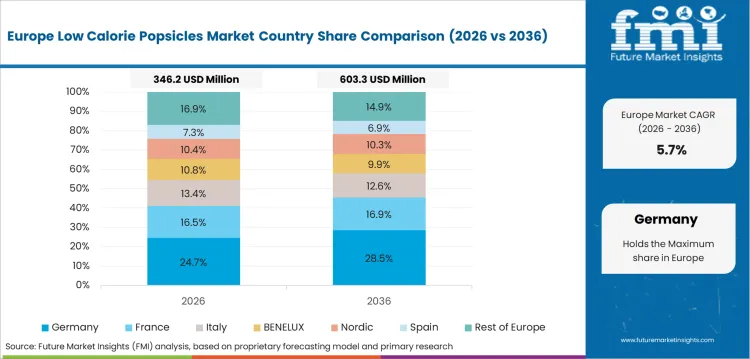
Germany is projected to record a 7.3% CAGR through 2036. EU nutrition labeling and health claim regulations influence consumer selection toward lower calorie frozen snack options. Strong organic food retail infrastructure supports demand for certified organic fruit-based popsicles.
- EU Nutri-Score labeling adoption supports consumer identification and selection of lower calorie frozen snack products in retail freezer sections.
- Organic food retail channels sustain premium demand for certified organic fruit-based low calorie popsicles.
- Extended producer responsibility regulations influence packaging design for frozen novelty products toward recyclable stick and wrapper formats.
Sales Analysis of Low Calorie Popsicles Market in Brazil
Brazil is estimated to grow at 6.6% through 2036. Tropical climate sustains year-round frozen novelty consumption, with growing health awareness supporting demand for reduced-calorie alternatives. Large consumer base and modern retail expansion provide distribution scale.
- Year-round warm climate sustains consistent frozen novelty consumption without the seasonal demand concentration seen in temperate markets.
- Large consumer base and modern retail expansion through supermarket chains provide distribution scale for low calorie frozen snack products.
- Price sensitivity among mass-market consumers creates demand for competitively priced reduced-calorie popsicle options alongside premium natural fruit products.
In-depth Analysis of Low Calorie Popsicles Market in USA
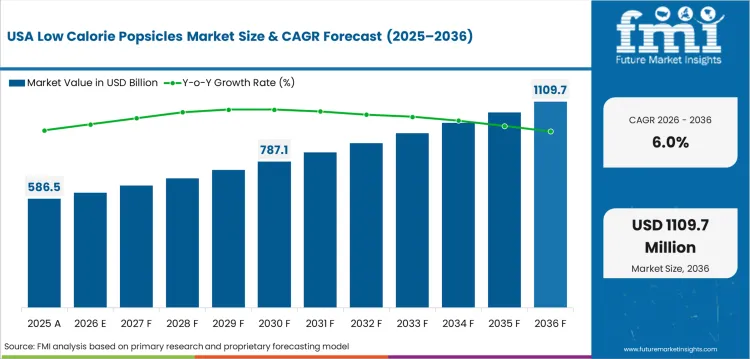
The USA is expected to grow at 6.0% through 2036. Established frozen novelty retail channels and expanding low calorie product variety sustain demand. FDA nutrition labeling requirements govern calorie content claims and front-of-pack messaging for frozen snack products.
- Established grocery retail freezer sections provide broad distribution for an expanding variety of low calorie popsicle brands and products.
- FDA nutrition labeling and calorie disclosure requirements support informed consumer selection of reduced-calorie frozen snack options.
- Natural fruit and organic popsicle brands are capturing premium consumer segments seeking clean label frozen snack alternatives.
Competitive Landscape and Strategic Positioning
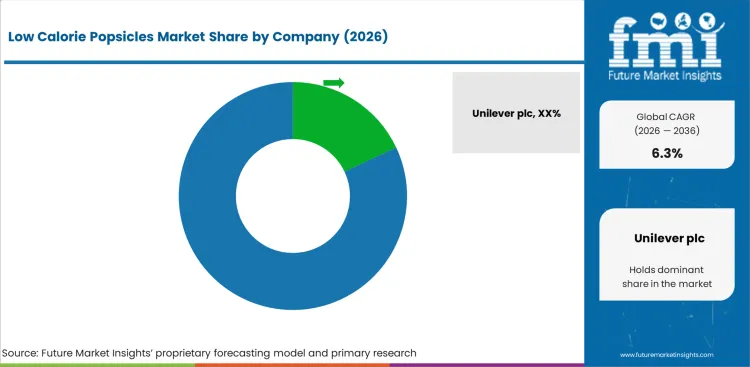
- Unilever and Nestle lead with established frozen novelty manufacturing, cold chain distribution, and multi-brand portfolios spanning standard and reduced-calorie popsicle products.
- Natural Fruit Corporation and J&J Snack Foods compete on fruit-based and natural ingredient positioning in the premium low calorie popsicle segment.
- Emerging brands including Modern Pop and Ice Pop Factory target health-conscious consumers with clean label and organic frozen novelty products.
Unilever plc holds a leading position through its established frozen novelty brand portfolio and global cold chain distribution infrastructure. Nestle S.A. competes on broad frozen food manufacturing capability with reduced-calorie popsicle products as part of its overall frozen novelty range.
Natural Fruit Corporation and J&J Snack Foods Corporation serve the fruit-based and natural ingredient segment with products targeting health-conscious consumers. Andrades Desserts provides specialty frozen dessert products for food service channels.
Barriers to entry include cold chain manufacturing and distribution infrastructure, retail freezer shelf space access, and fruit ingredient sourcing relationships. Strategic priorities include natural sweetener reformulation, organic certification, and food service distribution expansion.
Key Companies in the Low Calorie Popsicles Market
Key global companies leading the low calorie popsicles market include:
- Unilever plc (UK/Netherlands), Nestle S.A. (Switzerland), and J&J Snack Foods Corporation (USA) maintain established frozen novelty manufacturing and cold chain distribution with multi-brand portfolios spanning reduced-calorie product lines.
- Natural Fruit Corporation (USA) and Andrades Desserts (USA) serve regional markets with fruit-based and specialty low calorie frozen novelty products for retail and food service channels.
- Modern Pop (USA), Ice Pop Factory (USA), and Eclectic Food Services Inc. (USA) compete in the premium clean label segment with organic and natural fruit-based low calorie popsicle products.
Competitive Benchmarking: Low Calorie Popsicles Market
| Company | Frozen Range | Natural/Organic | Cold Chain | Geo. Reach |
|---|---|---|---|---|
| Unilever plc | Very High | Growing | Global | Global |
| Nestle S.A. | High | Medium | Global | Global |
| J&J Snack Foods | Medium | Medium | Strong | N. America |
| Natural Fruit Corp. | Medium | High | Medium | N. America |
| Andrades Desserts | Low | Medium | Regional | N. America |
| Modern Pop | Low | High | Growing | N. America |
| Ice Pop Factory | Low | High | Regional | N. America |
| Eclectic Food Svcs. | Low | Medium | Regional | N. America |
Source: Future Market Insights competitive analysis, 2026.
Key Developments in Low Calorie Popsicles Market
- In 2025, Nestle expanded its reduced-calorie frozen novelty range with a new line of fruit-based popsicles using natural sweeteners for North American and European retail markets.
- In 2025, Unilever launched organic fruit popsicle variants under its established frozen novelty brands targeting the clean label consumer segment in European retail channels.
Key Players in the Low Calorie Popsicles Market
Major Global Players
- Unilever plc
- Natural Fruit Corporation
- Nestle S.A.
- J&J Snack Foods Corporation
- Andrades Desserts
Emerging Players/Startups
- Modern Pop
- Ice Pop Factory
- Eclectic Food Services Inc.
Report Scope and Coverage
| Parameter | Details |
|---|---|
| Market size by 2036 | USD 2.5 billion |
| Growth rate | 6.3% CAGR (2026 to 2036) |
| Forecast period | 2026 to 2036 |
| Base year value (2025) | USD 1.3 billion |
| Key Segment Covered | Product, Sweetener Type, Form, Application, End Use |
| Regions covered | North America, Latin America, Western Europe, Eastern Europe, East Asia, South Asia and Pacific, Middle East and Africa |
| Countries covered | USA, South Korea, UK, Japan, China, India, Germany, 30 plus countries |
| Key companies profiled | Unilever plc, Natural Fruit Corporation, Nestle S.A., J&J Snack Foods Corporation, Andrades Desserts, Modern Pop, Ice Pop Factory, Eclectic Food Services Inc. |
| Approach | Hybrid bottom-up and top-down methodology starting with verified transaction data, projecting adoption velocity across segments and regions. |
Market Segmentation Analysis
Low Calorie Popsicles Market Segmented by Product:
- Fruit Based Popsicles
- Citrus Popsicles
- Lemon
- Orange
- Berry Popsicles
- Strawberry
- Blueberry
- Tropical Popsicles
- Mango
- Pineapple
- Citrus Popsicles
- Water Based Popsicles
- Flavored Ice Pops
- Artificial Flavors
- Natural Flavors
- Electrolyte Popsicles
- Hydration Focused
- Functional Formulations
- Flavored Ice Pops
- Dairy Based Popsicles
- Yogurt Popsicles
- Low Fat Yogurt
- Probiotic Yogurt
- Cream Popsicles
- Reduced Fat Cream
- Light Ice Cream Base
- Yogurt Popsicles
- Functional Popsicles
- Protein Popsicles
- High Protein Content
- Fitness Focused
- Vitamin Enriched Popsicles
- Added Vitamins
- Immunity Support
- Protein Popsicles
Low Calorie Popsicles Market Segmented by Sweetener Type:
- Artificial Sweeteners
- Aspartame
- Sucralose
- Acesulfame Potassium
- Natural Sweeteners
- Stevia
- Monk Fruit
- Sugar Alcohols
- Erythritol
- Xylitol
Low Calorie Popsicles Market Segmented by Form:
- Stick Popsicles
- Single Stick
- Multi Pack Sticks
- Tube Popsicles
- Squeeze Tubes
- Frozen Tubes
- Mini Popsicles
- Small Size Portions
- Kids Packs
Low Calorie Popsicles Market Segmented by Application:
- Retail Consumption
- Supermarket Sales
- Packaged Popsicles
- Impulse Purchase
- Supermarket Sales
- Food Service
- Restaurants
- Dessert Offerings
- Cafes and Kiosks
- On the Go Sales
- Restaurants
Low Calorie Popsicles Market Segmented by End Use:
- Individual Consumers
- Health Conscious Consumers
- Weight Management
- Low Calorie Diet
- Children and Families
- Kids Consumption
- Family Packs
- Health Conscious Consumers
- Fitness Consumers
- Athletes
- Recovery Snacks
- Hydration Products
- Athletes
Low Calorie Popsicles Market by Region:
- North America
- USA
- Canada
- Mexico
- Latin America
- Brazil
- Chile
- Rest of Latin America
- Western Europe
- Germany
- UK
- Italy
- Spain
- France
- Nordic
- BENELUX
- Rest of Western Europe
- Eastern Europe
- Russia
- Poland
- Hungary
- Balkan & Baltic
- Rest of Eastern Europe
- East Asia
- China
- Japan
- South Korea
- South Asia and Pacific
- India
- ASEAN
- Australia & New Zealand
- Rest of South Asia and Pacific
- Middle East & Africa
- Kingdom of Saudi Arabia
- Other GCC Countries
- Türkiye
- South Africa
- Other African Union
- Rest of Middle East & Africa
Research Sources and Bibliography
- 1. International Dairy Foods Association. (2025). IDFA Frozen Novelty Production and Sales Statistics. IDFA.
- 2. European Commission. (2025). EU Regulation on Frozen Dessert Composition and Labeling Standards. EC.
- 3. USA Food and Drug Administration. (2025). FDA Standards for Frozen Desserts and Novelties. FDA.
- 4. Codex Alimentarius Commission. (2025). Codex Standard for Edible Ices and Ice Mixes. FAO/WHO.
- 5. World Health Organization. (2025). WHO Guidelines on Sugar Reduction in Packaged Foods. WHO.
This bibliography is provided for reader reference.
This Report Answers
- Estimating the size of the low calorie popsicles market and projected revenue from 2026 to 2036.
- Segmentation by product, sweetener type, form, application, and end use.
- Insights about more than 30 markets in the region.
- Analysis of product types including fruit based, dairy based, water based, and novelty popsicles.
- Assessment of the competitive landscape.
- Identifying investment opportunities in retail, food service, and premium natural frozen snack segments.
- Tracking the supply chain from fruit ingredient sourcing to cold chain retail distribution.
- Delivery of data in PDF and Excel formats.
Frequently Asked Questions
How big is the low calorie popsicles market in 2026?
The global low calorie popsicles market is estimated to be valued at USD 1.4 billion in 2026.
What will be the size of the low calorie popsicles market in 2036?
The market size for the low calorie popsicles market is projected to reach USD 2.5 billion by 2036.
How much will the low calorie popsicles market growth be between 2026 and 2036?
The low calorie popsicles market is expected to grow at a 6.3% CAGR between 2026 and 2036.
What are the key products in the low calorie popsicles market?
The key products in the low calorie popsicles market are Fruit Based Popsicles, Water Based Popsicles, Dairy Based Popsicles and Functional Popsicles.
Which sweetener type segment is expected to contribute a significant share in the low calorie popsicles market in 2026?
In terms of sweetener type, the artificial sweeteners segment is expected to command 45.0% share in the low calorie popsicles market in 2026.
Preview the report firsthand - request a free sample
Get SampleGet the brochure for pricing and purchase details.
Get PDFTable of Content
- Key Takeaways
- Market Size and CAGR
- Top Growth Driver
- Fastest Growing Segment
- Leading Region
- Key Companies
- Emerging Opportunities
- Executive Summary
- Global Market Outlook
- Demand-side Trends
- Supply-side Trends
- Technology Roadmap Analysis
- Analysis and Recommendations
- Analyst Perspective (What is happening? Why now? What should investors know?)
- Key Questions Answered
- How large is the market?
- What is the CAGR?
- What are key trends?
- Which region dominates?
- Who are the leaders?
- Market Overview
- Market Coverage / Taxonomy
- Market Definition / Scope / Limitations
- Research Methodology
- Chapter Orientation
- Analytical Lens and Working Hypotheses
- Market Structure, Signals, and Trend Drivers
- Benchmarking and Cross-market Comparability
- Market Sizing, Forecasting, and Opportunity Mapping
- Research Design and Evidence Framework
- Desk Research Programme (Secondary Evidence)
- Expert Input and Fieldwork (Primary Evidence)
- Tooling, Models, and Reference Databases
- Data Engineering and Model Build
- Quality Assurance and Audit Trail
- Market Background
- Market Dynamics (Drivers, Restraints, Opportunity, Trends)
- Scenario Forecast (Optimistic, Likely, Conservative)
- Impact Analysis
- AI Impact
- Sustainability Impact
- Regulatory Impact
- Technology Impact
- Consumer / Buyer Analysis
- Purchase Drivers
- Adoption Barriers
- Buyer Journey
- Opportunity Map Analysis
- Product Life Cycle Analysis
- Supply Chain Analysis
- Investment Feasibility Matrix
- Value Chain Analysis
- PESTLE and Porter's Analysis
- Regulatory Landscape
- Regional Parent Market Outlook
- Production and Consumption Statistics
- Import and Export Statistics
- Global Market Analysis and Forecast, 2021 to 2036
- Historical Market Size Value (USD Million) Analysis, 2021 to 2025
- Current and Future Market Size Value (USD Million) Projections, 2026 to 2036
- Y-o-Y Growth Trend Analysis
- Absolute $ Opportunity Analysis
- Global Market Pricing Analysis, 2021 to 2036
- Global Market Analysis and Forecast, By Product, 2021 to 2036
- Introduction / Key Findings
- Historical Market Size Value (USD Million) Analysis By Product, 2021 to 2025
- Current and Future Market Size Value (USD Million) Analysis and Forecast By Product, 2026 to 2036
- Fruit Based Popsicles
- Citrus Popsicles
- Berry Popsicles
- Tropical Popsicles
- Water Based Popsicles
- Flavored Ice Pops
- Electrolyte Popsicles
- Dairy Based Popsicles
- Yogurt Popsicles
- Cream Popsicles
- Functional Popsicles
- Protein Popsicles
- Vitamin Enriched Popsicles
- Fruit Based Popsicles
- Y-o-Y Growth Trend Analysis By Product, 2021 to 2025
- Absolute $ Opportunity Analysis By Product, 2026 to 2036
- Global Market Analysis and Forecast, By Sweetener Type, 2021 to 2036
- Introduction / Key Findings
- Historical Market Size Value (USD Million) Analysis By Sweetener Type, 2021 to 2025
- Current and Future Market Size Value (USD Million) Analysis and Forecast By Sweetener Type, 2026 to 2036
- Artificial Sweeteners
- Aspartame
- Sucralose
- Acesulfame Potassium
- Natural Sweeteners
- Stevia
- Monk Fruit
- Sugar Alcohols
- Erythritol
- Xylitol
- Artificial Sweeteners
- Y-o-Y Growth Trend Analysis By Sweetener Type, 2021 to 2025
- Absolute $ Opportunity Analysis By Sweetener Type, 2026 to 2036
- Global Market Analysis and Forecast, By Form, 2021 to 2036
- Introduction / Key Findings
- Historical Market Size Value (USD Million) Analysis By Form, 2021 to 2025
- Current and Future Market Size Value (USD Million) Analysis and Forecast By Form, 2026 to 2036
- Stick Popsicles
- Single Stick
- Multi Pack Sticks
- Tube Popsicles
- Squeeze Tubes
- Frozen Tubes
- Mini Popsicles
- Small Size Portions
- Kids Packs
- Stick Popsicles
- Y-o-Y Growth Trend Analysis By Form, 2021 to 2025
- Absolute $ Opportunity Analysis By Form, 2026 to 2036
- Global Market Analysis and Forecast, By Application, 2021 to 2036
- Introduction / Key Findings
- Historical Market Size Value (USD Million) Analysis By Application, 2021 to 2025
- Current and Future Market Size Value (USD Million) Analysis and Forecast By Application, 2026 to 2036
- Retail Consumption
- Supermarket Sales
- Food Service
- Restaurants
- Cafes and Kiosks
- Retail Consumption
- Y-o-Y Growth Trend Analysis By Application, 2021 to 2025
- Absolute $ Opportunity Analysis By Application, 2026 to 2036
- Global Market Analysis and Forecast, By End Use, 2021 to 2036
- Introduction / Key Findings
- Historical Market Size Value (USD Million) Analysis By End Use, 2021 to 2025
- Current and Future Market Size Value (USD Million) Analysis and Forecast By End Use, 2026 to 2036
- Individual Consumers
- Health Conscious Consumers
- Children and Families
- Fitness Consumers
- Athletes
- Individual Consumers
- Y-o-Y Growth Trend Analysis By End Use, 2021 to 2025
- Absolute $ Opportunity Analysis By End Use, 2026 to 2036
- Global Market Analysis and Forecast, By Region, 2021 to 2036
- Introduction
- Historical Market Size Value (USD Million) Analysis By Region, 2021 to 2025
- Current Market Size Value (USD Million) Analysis and Forecast By Region, 2026 to 2036
- North America
- Latin America
- Western Europe
- Eastern Europe
- East Asia
- South Asia and Pacific
- Middle East & Africa
- Market Attractiveness Analysis By Region
- North America Market Analysis and Forecast, By Country, 2021 to 2036
- Historical Market Size Value (USD Million) Trend Analysis By Market Taxonomy, 2021 to 2025
- Market Size Value (USD Million) Forecast By Market Taxonomy, 2026 to 2036
- By Country
- USA
- Canada
- Mexico
- By Product
- By Sweetener Type
- By Form
- By Application
- By End Use
- By Country
- Market Attractiveness Analysis
- By Country
- By Product
- By Sweetener Type
- By Form
- By Application
- By End Use
- Key Takeaways
- Latin America Market Analysis and Forecast, By Country
- Historical Market Size Value (USD Million) Trend Analysis By Market Taxonomy, 2021 to 2025
- Market Size Value (USD Million) Forecast By Market Taxonomy, 2026 to 2036
- By Country
- Brazil
- Chile
- Rest of Latin America
- By Product
- By Sweetener Type
- By Form
- By Application
- By End Use
- By Country
- Market Attractiveness Analysis
- By Country
- By Product
- By Sweetener Type
- By Form
- By Application
- By End Use
- Key Takeaways
- Western Europe Market Analysis and Forecast, By Country
- Historical Market Size Value (USD Million) Trend Analysis By Market Taxonomy, 2021 to 2025
- Market Size Value (USD Million) Forecast By Market Taxonomy, 2026 to 2036
- By Country
- Germany
- UK
- Italy
- Spain
- France
- Nordic
- BENELUX
- Rest of Western Europe
- By Product
- By Sweetener Type
- By Form
- By Application
- By End Use
- By Country
- Market Attractiveness Analysis
- By Country
- By Product
- By Sweetener Type
- By Form
- By Application
- By End Use
- Key Takeaways
- Eastern Europe Market Analysis and Forecast, By Country
- Historical Market Size Value (USD Million) Trend Analysis By Market Taxonomy, 2021 to 2025
- Market Size Value (USD Million) Forecast By Market Taxonomy, 2026 to 2036
- By Country
- Russia
- Poland
- Hungary
- Balkan & Baltic
- Rest of Eastern Europe
- By Product
- By Sweetener Type
- By Form
- By Application
- By End Use
- By Country
- Market Attractiveness Analysis
- By Country
- By Product
- By Sweetener Type
- By Form
- By Application
- By End Use
- Key Takeaways
- East Asia Market Analysis and Forecast, By Country
- Historical Market Size Value (USD Million) Trend Analysis By Market Taxonomy, 2021 to 2025
- Market Size Value (USD Million) Forecast By Market Taxonomy, 2026 to 2036
- By Country
- China
- Japan
- South Korea
- By Product
- By Sweetener Type
- By Form
- By Application
- By End Use
- By Country
- Market Attractiveness Analysis
- By Country
- By Product
- By Sweetener Type
- By Form
- By Application
- By End Use
- Key Takeaways
- South Asia and Pacific Market Analysis and Forecast, By Country
- Historical Market Size Value (USD Million) Trend Analysis By Market Taxonomy, 2021 to 2025
- Market Size Value (USD Million) Forecast By Market Taxonomy, 2026 to 2036
- By Country
- India
- ASEAN
- Australia & New Zealand
- Rest of South Asia and Pacific
- By Product
- By Sweetener Type
- By Form
- By Application
- By End Use
- By Country
- Market Attractiveness Analysis
- By Country
- By Product
- By Sweetener Type
- By Form
- By Application
- By End Use
- Key Takeaways
- Middle East & Africa Market Analysis and Forecast, By Country
- Historical Market Size Value (USD Million) Trend Analysis By Market Taxonomy, 2021 to 2025
- Market Size Value (USD Million) Forecast By Market Taxonomy, 2026 to 2036
- By Country
- Kingdom of Saudi Arabia
- Other GCC Countries
- Türkiye
- South Africa
- Other African Union
- Rest of Middle East & Africa
- By Product
- By Sweetener Type
- By Form
- By Application
- By End Use
- By Country
- Market Attractiveness Analysis
- By Country
- By Product
- By Sweetener Type
- By Form
- By Application
- By End Use
- Key Takeaways
- Key Countries Market Analysis
- USA
- Pricing Analysis
- Market Share Analysis, 2025
- By Product
- By Sweetener Type
- By Form
- By Application
- By End Use
- Canada
- Pricing Analysis
- Market Share Analysis, 2025
- By Product
- By Sweetener Type
- By Form
- By Application
- By End Use
- Mexico
- Pricing Analysis
- Market Share Analysis, 2025
- By Product
- By Sweetener Type
- By Form
- By Application
- By End Use
- Brazil
- Pricing Analysis
- Market Share Analysis, 2025
- By Product
- By Sweetener Type
- By Form
- By Application
- By End Use
- Chile
- Pricing Analysis
- Market Share Analysis, 2025
- By Product
- By Sweetener Type
- By Form
- By Application
- By End Use
- Germany
- Pricing Analysis
- Market Share Analysis, 2025
- By Product
- By Sweetener Type
- By Form
- By Application
- By End Use
- UK
- Pricing Analysis
- Market Share Analysis, 2025
- By Product
- By Sweetener Type
- By Form
- By Application
- By End Use
- Italy
- Pricing Analysis
- Market Share Analysis, 2025
- By Product
- By Sweetener Type
- By Form
- By Application
- By End Use
- Spain
- Pricing Analysis
- Market Share Analysis, 2025
- By Product
- By Sweetener Type
- By Form
- By Application
- By End Use
- France
- Pricing Analysis
- Market Share Analysis, 2025
- By Product
- By Sweetener Type
- By Form
- By Application
- By End Use
- India
- Pricing Analysis
- Market Share Analysis, 2025
- By Product
- By Sweetener Type
- By Form
- By Application
- By End Use
- ASEAN
- Pricing Analysis
- Market Share Analysis, 2025
- By Product
- By Sweetener Type
- By Form
- By Application
- By End Use
- Australia & New Zealand
- Pricing Analysis
- Market Share Analysis, 2025
- By Product
- By Sweetener Type
- By Form
- By Application
- By End Use
- China
- Pricing Analysis
- Market Share Analysis, 2025
- By Product
- By Sweetener Type
- By Form
- By Application
- By End Use
- Japan
- Pricing Analysis
- Market Share Analysis, 2025
- By Product
- By Sweetener Type
- By Form
- By Application
- By End Use
- South Korea
- Pricing Analysis
- Market Share Analysis, 2025
- By Product
- By Sweetener Type
- By Form
- By Application
- By End Use
- Russia
- Pricing Analysis
- Market Share Analysis, 2025
- By Product
- By Sweetener Type
- By Form
- By Application
- By End Use
- Poland
- Pricing Analysis
- Market Share Analysis, 2025
- By Product
- By Sweetener Type
- By Form
- By Application
- By End Use
- Hungary
- Pricing Analysis
- Market Share Analysis, 2025
- By Product
- By Sweetener Type
- By Form
- By Application
- By End Use
- Kingdom of Saudi Arabia
- Pricing Analysis
- Market Share Analysis, 2025
- By Product
- By Sweetener Type
- By Form
- By Application
- By End Use
- Türkiye
- Pricing Analysis
- Market Share Analysis, 2025
- By Product
- By Sweetener Type
- By Form
- By Application
- By End Use
- South Africa
- Pricing Analysis
- Market Share Analysis, 2025
- By Product
- By Sweetener Type
- By Form
- By Application
- By End Use
- USA
- Market Structure Analysis
- Competition Dashboard
- Competition Benchmarking
- Market Share Analysis of Top Players
- By Regional
- By Product
- By Sweetener Type
- By Form
- By Application
- By End Use
- Emerging Startups
- Innovation Benchmarking
- Competition Analysis
- Competition Deep Dive
- Unilever plc
- Overview
- Product Portfolio
- Profitability by Market Segments (Product/Region/Sales Channel)
- Sales Footprint
- Strategy Overview
- Marketing Strategy
- Product Strategy
- Channel Strategy
- Natural fruit corporation
- Nestle S.A
- J&J snack foods corporation
- Andrades desserts
- Modern pop
- Ice pop factory
- Eclectic food services Inc.
- ZOcal Inc.
- Unilever plc
- Case Studies
- Success Stories
- Recent Developments
- Competition Deep Dive
- Assumptions & Acronyms Used


