

- Industry Size (2025)
- USD 4885.9 Mn
- Forecast (2035)
- USD 7232.3 Mn
- CAGR (2025 to 2035)
- 4%
Low Calorie Cream Cheese Market Outlook 2025 to 2035
A sharp increase in health-consciousness, led by consumers, is one of the key factors propelling global low calorie cream cheese market in the coming years. Lovingly crafted with low-calorie cream cheese provides a lower fat alternative for those consumers of traditional flavors looking to maintain a balanced diet.
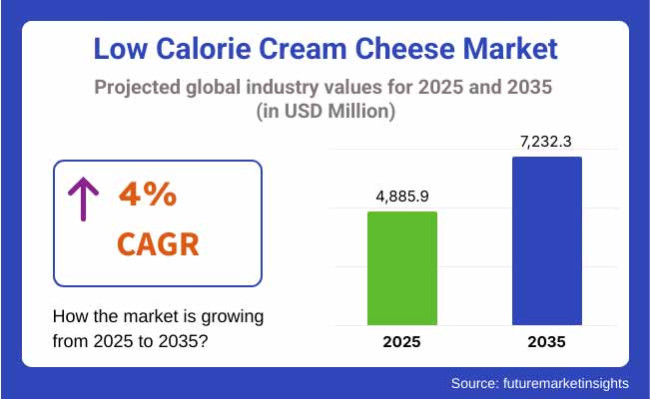
The market is expected to grow at a CAGR of roughly 4% during the forecast period and will reach an estimated value of USD 7,232.3 Million by 2035. growing from USD 4,885.9 Million in 2023.
Regional Market Trends
North America
North America is one of the major contributors to the low calorie cream cheese market owing to high demand for low-calorie food and high dairy consumption culture. In the United States, in particular, demand for low-fat and low-calorie dairy was climbing. Increasing product introductions and the existence of prominent market players augments market growth in this region.
Europe
In this region a stable development of the low calorie cream cheese market can be observed due to an increasing focus on health and wellness. Germany, France, the UK among leading countries where consumers are leaning more towards dairy alternatives that are healthier. Additionally, the demand for low calorie cream cheese is also driven by increased focus on natural and organic products in the region.
Asia-Pacific
Income growth, urbanization, and the adoption of Western dietary culture will be key motivations of the fast growth of Asia-Pacific. This growth in demand is being propelled by countries like China, Japan and India, where consumers are increasingly looking for healthier dairy & non-dairy product alternatives.
Moreover, this region has also witnessed the growth of retail chains and e-commerce platforms, which has provided access to a wide range of consumers compelling them to opt for low calorie cream cheese.
Challenges and Opportunities
Challenges: Taste-Texture Tradeoffs, Clean-Label Demands, and Limited Shelf Stability
The low calorie cream cheese market is challenged primarily around reducing fat and calories without compromising taste and texture. Consumers demand rich, creamy textures even from health-oriented products, making it a formulation challenge for manufacturers.
Moreover, the trend towards clean-label and natural ingredients also restricts the use of synthetic fat replacers and stabilizers. Shelf life and microbiological stability are other challenges, especially when preservatives are reduced to fulfill consumer demand for minimal processing.
Opportunities: Health-Conscious Consumers, Protein-Enriched Variants, and Plant-Based Expansion
The market is growing, though, as health-conscious consumers look for alternatives that provide indulgence without the same caloric load. There is also increased appetite for high-protein, low-fat spreads for summer fitness shoppers and weight-management diets.
This trend is creating new opportunities in plant-based low calorie cream cheese targeting vegan and lactate intolerants. Probiotic-enriched fiber and omega-3 fortified formulations to give customers more value are producing results for manufacturers.
The increase in snacking, baking and healthy meal prep at home is driving demand for spreadable, cooking and versatile low-calorie cream cheese. Moreover, on global retail shelves, the trend for portion-controlled packaging and clean-label claims is on the rise.
Shifts in the Market from 2020 to 2024 and Future Trends 2025 to 2035
During the period from 2020 to 2024, the demand in the market remained steady, owing to growing health awareness and pandemic-driven home cooking trends. Holistic wellness became a significant anchor for consumers, who turned to reduced-fat dairy alternatives as part of their routines. But price sensitivity and inconsistency of flavor experiences limited repeat purchases on some segments.
The market will transition to functional low calorie cream cheese products in 2025 to 2035, brands will focus on trend areas of gut health, immunity and satiety gains in the cream cheese. The days of standard formulations with artificially high sodium levels and extensive ingredient declarations will be over as regulatory and consumer pressure mounts towards clean label, reduced sodium, and naturally thickened formulations.
Market Shifts: A Comparative Analysis 2020 to 2024 vs. 2025 to 2035
| Market Shift | 2020 to 2024 Trends |
|---|---|
| Regulatory Landscape | Focus on nutrition labeling, calorie limits, and dairy fat declarations |
| Consumer Trends | Preference for low-fat dairy and home-snacking solutions |
| Industry Adoption | Used in bagels, sandwiches, and dips |
| Supply Chain and Sourcing | Reliant on traditional dairy processors and cream cheese facilities |
| Market Competition | Dominated by legacy dairy brands with light variants |
| Market Growth Drivers | Health awareness, demand for calorie reduction, and at-home snacking |
| Sustainability and Environmental Impact | Limited focus on eco-packaging or low-emission dairy sourcing |
| Integration of Smart Technologies | Minimal tech in formulation or packaging |
| Advancements in Cream Cheese Tech | Fat-reduced dairy with modified starch and gums |
| Market Shift | 2025 to 2035 Projections |
|---|---|
| Regulatory Landscape | Introduction of functional health claims, natural thickener regulations, and sodium content restrictions |
| Consumer Trends | Shift toward high-protein, functional spreads with added wellness benefits |
| Industry Adoption | Expansion into meal kits, healthy desserts, and plant-based cooking applications |
| Supply Chain and Sourcing | Shift to specialty ingredient suppliers, non-dairy processors, and protein-enriched formulas |
| Market Competition | Entry of functional food startups, plant-based dairy disruptors, and health-focused private labels |
| Market Growth Drivers | Driven by clean-label claims, protein fortification, and digestive health features |
| Sustainability and Environmental Impact | Greater emphasis on plant-based production, biodegradable packaging, and carbon-neutral supply chains |
| Integration of Smart Technologies | Growth of AI-enhanced flavor modeling, digital nutrition tracking, and smart label engagement |
| Advancements in Cream Cheese Tech | Development of fermented plant-based options, probiotic-rich spreads, and clean emulsifier alternatives |
Country-Wise Outlook
United States
The USA market is also growing owing to rising consumer demand for healthier spreads, protein-centric diets, and low-calorie breakfast alternatives. Keto-friendly, whipped, and lactose-free low calorie cream cheese based innovations are making their way onto shelf at local and online grocery store channels.
| Country | CAGR (2025 to 2035) |
|---|---|
| USA | 4.1% |
United Kingdom
In the UK, demand is fueled by the increase in flexitarian eating, calorie counting diets, and clean-label trends. Local brands are creating plant-based and dairy-light options focused on taste retention and sustainability that appeal to urban consumers with a wellness mindset.
| Country | CAGR (2025 to 2035) |
|---|---|
| UK | 3.9% |
European Union
In Europe, growth of functional dairy segments and portion-controlled snacks are mostly taking place at Germany, France, and Netherlands. The focus on nutrition labeling and lower saturated fat consumption is leading to reformulations and premium low-calorie products.
| Region | CAGR (2025 to 2035) |
|---|---|
| EU | 4.0% |
Japan
Japan’s market is growing steadily as the population places emphasis on portion control, calorie-aware products, and digestive health. Low calorie cream cheese is also used in fusion cuisine, bentos, and health-forward dessert recipes;
| Country | CAGR (2025 to 2035) |
|---|---|
| Japan | 4.0% |
South Korea
South Korea is experiencing fast adoption driven by young professionals and wellness enthusiasts looking for functional dairy, smart snacking, and high-protein alternatives. Clean labels, influencer-led trends, e-commerce driving health brands are fueling low calorie dairy category growth.
| Country | CAGR (2025 to 2035) |
|---|---|
| South Korea | 4.1% |
Segmentation Outlook
Conventional and Organic Segments Drive Market Growth as Health-Conscious Consumers Seek Balanced Dairy Options
As consumers become more health-conscious, focusing on nutrition, ingredient transparency, and balance in their diet, the market for low calorie cream cheese will continue to be primarily driven by conventional and organic segments. These stratum fall into a broad range of dietetic preferences, providing options that connect with both classical flavors and clean-label movements.
Conventional Low Calorie Cream Cheese Leads Market Demand as Mainstream Health-Conscious Consumers Opt for Familiar Options
The conventional low calorie cream cheese segment still dominates the market by a wide margin as it is comparatively cheaper, widely available in the market, and can closely replicate the taste and texture of real cream cheese. Conventional options may utilize traditional dairy production methods, while still providing lower calorie levels, unlike organic alternatives.
This segment has seen growth as the demand for healthier spreads that are flavorful continues to rise. Studies show that more than 65% of the consumers selecting low calorie cream cheese purchase regular varieties due to price driven value proposition and brand familiarity.
The marketplace has witnessed an increase in the adoption of fat-reduction and flavor-increasing formulations, supporting market growth as dairy manufacturers are able to provide extra creamy textures with low-calorie content.
The introduction of probiotic strains, protein enrichment, and fortified nutrients in conventional variants has also stimulated adoption rates to meet functional food trends. Low-calorie cream cheeses are now available in formats ranging from spreadable tubs to portion-controlled packs, further maximizing convenience and on-the-go snacking potential.
In fact, the conventional segment faces challenges, including consumer concerns over synthetic additives and preservatives, despite its advantages in affordability and taste retention. Yet more innovations in natural flavoring, cleaner formulations and sustainable sourcing practices are enhancing appeal and ensuring continued market relevance.
Organic Low Calorie Cream Cheese Expands as Clean-Label and Ethical Consumption Trends Grow
All-natural cream cheese without artificial ingredients for those who value natural diets has had significant market acceptance. Differing from traditional cream cheese, organic alternatives must fulfill tighter production requirements and do not use synthetic components, pesticides, or hormones.
Adoption has been fueled by growing demand for organic dairy products, particularly among millennials and families that prioritize health. According to research, organic low calorie cream cheese is outpacing conventional version growth in both premium and health food retail channels.
As organic certification has expanded across markets globally, its availability has continued to strengthen, and brands have been able to scale while maintaining consumer confidence. The use of grass-fed milk sources, sustainable packaging and carbon-neutral production methods has also increased uptake while complementing behaviors with positive environmental and ethical implications.
Flavored variants of these, like [herb, chive, fruit, etc.] These are organic and always the best option that can be created to cater to the target consumers in an effort to keep it healthy.
While organic cream cheese has advantages like transparency and ecological effects, it does have a bigger price point and shorter shelf life. Innovative practices across the circuit organic preservation methods, scalable production techniques and traceability tools are helping improve their competitiveness and drive growth in this segment.
Animal and Plant-Based Sources Drive Market Growth as Dietary Needs and Sustainability Concerns Diversify Demand
Animal Based Source and Plant-Based Source segments influence the low calorie cream cheese market catering to different dietary lifestyles and ethical values. These classifications cover traditional dairy consumers, as well as plant-based consumers searching for reduced-calorie options.
Animal-Based Cream Cheese Leads Market Demand as Dairy Traditions Remain Strong in Everyday Diets
The dynamic of animal-based low calorie cream cheese still led the overall share of market, capitalizing on familiar flavour profiles and dairy protein advantages. Unlike plant based alternatives, dairy products provide a creamier mouthfeel and established culinary versatility.
The emergence of animal-based low calorie spreads has been primarily fueled by the demand for calorie conscious dairy products, especially from breakfast and snack food categories. But studies show that sales of low calorie cream cheese sourced from traditional dairy sources still account for over 70% of all sales.
Additionally, the growth of lactose-free and reduced-fat dairy developments has reinforced industry growth by catering to consumers with digestive sensitivities. Moreover, the incorporation of whey protein enrichment, lower sodium content, and probiotics have led to an increase in adoption of animal-based formulations, adding to their functional and nutritional aesthetics.
The emergence of a variety of regional variants by using premium milk sources and artisanal dairy processes has further used product differentiation in specialty and gourmet retail channels. While genetically engineered foods would outperform traditional animal husbandry on taste and consistency, the animal-based segment is facing pressure from increased plant-based competition and the trends towards more ethical dietary approaches.
However, with innovations in sustainable dairy farming methods, hormone-free production and transparent labeling, consumer confidence is on the rise, leading to continuous growth.
Plant-Based Cream Cheese Expands as Vegan, Lactose-Free, and Allergen-Conscious Options Gain Popularity
With its plant-based properties, low calorie cream cheese's share in the plant-based cream cheese market has quickly been adopted by vegan consumers, and individuals with dairy allergies, as well as sustainability-focused shoppers.
Plant-based formulations are free from cholesterol, unlike their animal-based counterparts, and often provide superior shelf stability. Low calorie cream cheese, particularly those made with soy and almond, has been spurred by the growing need for allergen free, cruelty free and flexitarian friendly products.
Soy-Based Cream Cheese: Among plant-based cream cheeses, soy-based cream cheese takes the lead for its smooth texture, high protein content and neutral flavor. Manufacturers rely on soy as a base for flexible, spreadable products that approximate the experience of traditional dairy. Soy has also grown in popularity because it is known to be affordable and there is an established supply chain for it.
Almond-Based Cream Cheese: Almond-bases options are surging forward as people nibble on nutty, mildly sweet alternatives with shorter ingredient lists. Almonds provide healthful fats and a subtle flavor, which makes them popular with health-conscious and artisanal food consumers. Almond-based products might be more premium-priced, but they do fit in well with organic and non-GMO market segments.
The advent of probiotics, natural thickeners, taste infusions, to enhance taste and texture has narrowed the gap between plant and dairy formulations. However, plant-based products are challenged to replicate texture and protein levels that compare with dairy, even with the advantages of allergen and dietary flexibility.
Innovations in fermentation, emulsification, and ingredient blending are quickly improving quality, leading to continued momentum in plant-based low calorie cream cheese.
Competitive Outlook
The growth of the low calorie cream cheese market is catalyzed by increasing health awareness, rising sales of weight management dairy substitutes, and consumers' inclination towards protein-rich, clean-label spreads.
Companies are prioritizing reduced-fat, low-sugar formulations, plant-based versions, and probiotic-enriched cream cheese varieties. The key players are dairy behemoths, specialty cheese makers and health-focused food startups. Innovations focus on high-protein cream cheese, dairy-free and nut-based alternatives, and Ai-assisted flavor optimization for replicating traditional taste with fewer calories and cleaner ingredients.
Market Share Analysis by Key Players & Low Calorie Cream Cheese Manufacturers
| Company Name | Estimated Market Share (%) |
|---|---|
| Kraft Heinz Company | 16-20% |
| Arla Foods amba | 12-16% |
| Lactalis Group | 10-14% |
| Miyoko’s Creamery | 7-10% |
| Kite Hill (Blue Diamond Growers) | 6-9% |
| Other Low Calorie Cream Cheese Brands | 30-40% |
Key Company & Low Calorie Cream Cheese Solutions
| Company Name | Key Offerings/Activities |
|---|---|
| Kraft Heinz Company | Produces low-fat Philadelphia cream cheese lines with no artificial preservatives and high protein content. |
| Arla Foods amba | Offers cream cheese spreads made from skimmed milk, with clean-label, low-calorie profiles. |
| Lactalis Group | Develops reduced-fat and organic low-calorie cream cheese under multiple brands. |
| Miyoko’s Creamery | Provides cashew-based vegan cream cheeses with low calorie counts and probiotic cultures. |
| Kite Hill | Offers almond milk-based low-calorie cream cheese alternatives, optimized for taste and texture. |
Key Market Insights
Kraft Heinz Company (16-20%)
Kraft Heinz dominates the segment with its Philadelphia Light product line, blending traditional dairy flavor with reduced fat, high protein, and clean-label positioning. Its brand legacy and wide distribution fuel market leadership.
Arla Foods amba (12-16%)
Arla focuses on natural, additive-free low calorie cream cheese made with simple ingredients and fresh milk. Its strong European market base and organic positioning appeal to health-conscious consumers.
Lactalis Group (10-14%)
Lactalis leverages its global brand portfolio, offering reduced-fat and organic variants of cream cheese with a focus on texture retention and clean formulations for calorie-conscious consumers.
Miyoko’s Creamery (7-10%)
Miyoko’s leads in the vegan segment, using cultured cashew bases and coconut cream to deliver low calorie, plant-based cream cheeses that mimic dairy texture while maintaining gut health benefits.
Kite Hill (6-9%)
Kite Hill offers almond milk-based cream cheeses with high fiber content and low calories, developed through proprietary fermentation and AI-assisted flavor tuning for mainstream and specialty diets.
Other Key Players (30-40% Combined)
Numerous natural and wellness-oriented brands are shaping the market through innovation in low calorie and dairy-free cream cheese. These include:
- Tofutti Brands Inc. - Offers soy-based cream cheese with lower fat and calorie content
- GreenVie Foods - Provides coconut oil-based cream cheese alternatives suitable for vegan and keto consumers
- Violife (Upfield) - Delivers dairy-free cream cheese with clean-label ingredients and enhanced texture replication
- Treeline Cheese - Specializes in cashew-based low calorie cheese spreads with no additives or preservatives
- Daiya Foods Inc. - Produces allergen-free, low-calorie cream cheese with pea protein and tapioca-based textures
Low Calorie Cream Cheese Market Segmentation
By Nature:
- Conventional
- Organic
By Source:
- Animal-based
- Plant-based
- Soy
- Almond
- Coconut
By Flavour:
- Unflavored
- Flavored
- Strawberry
- Mixed Berries
- Honey Pecan
- Vegetable
- Brown Sugar & Cinnamon
- Pumpkin Spice
- Jalapeno
- Chive & Onion
- Pineapple
By Application:
- Spread
- Dip
- Pizza & Pasta Sauce
- Cheesecake
- Cake Frosting
By Distribution Channel:
- B2B
- B2C
- Hypermarkets/Supermarkets
- Convenience Stores
- Specialty Food Stores
- Online Retail
By Region:
- North America
- Latin America
- Western Europe
- Eastern Europe
- East Asia
- South Asia Pacific
- Middle East and Africa
Frequently Asked Questions
What was the overall size of the low calorie cream cheese market in 2025?
The overall market size for the low calorie cream cheese market was USD 4,885.9 Million in 2025.
How big is the low calorie cream cheese market expected to be in 2035?
The low calorie cream cheese market is expected to reach USD 7,232.3 Million in 2035.
What will drive the demand for the low calorie cream cheese market during the forecast period?
The demand for low calorie cream cheese is rising due to increasing consumer focus on healthier diets, rising lactose intolerance awareness, and growing popularity of plant-based dairy alternatives. Expanding product availability in retail and foodservice channels is also supporting market growth.
List the top 5 countries contributing to the low calorie cream cheese market?
The top 5 countries driving the development of the low calorie cream cheese market are the USA, Germany, UK, Canada, and Australia.
Which segment in the source type is expected to lead in the low calorie cream cheese market?
Soy and Almond are expected to command a significant share over the assessment period.
Preview the report firsthand - request a free sample
Get SampleGet the brochure for pricing and purchase details.
Get PDFTable of Content
- Executive Summary
- Industry Introduction, including Taxonomy and Market Definition
- Market Trends and Success Factors, including Macro-economic Factors, Market Dynamics, and Recent Industry Developments
- Global Market Demand Analysis 2020 to 2024 and Forecast 2025 to 2035, including Historical Analysis and Future Projections
- Pricing Analysis
- Global Market Analysis 2020 to 2024 and Forecast 2025 to 2035
- Nature
- Source
- Flavour
- Application
- Distribution Channel
- Global Market Analysis 2020 to 2024 and Forecast 2025 to 2035, By Nature
- Conventional
- Organic
- Global Market Analysis 2020 to 2024 and Forecast 2025 to 2035, By Source
- Animal-based
- Plant-based
- Soy
- Almond
- Coconut
- Global Market Analysis 2020 to 2024 and Forecast 2025 to 2035, By Flavour
- Unflavored
- Flavored
- Strawberry
- Mixed Berries
- Honey Pecan
- Vegetable
- Brown Sugar & Cinnamon
- Pumpkin Spice
- Jalapeno
- Chive & Onion
- Pineapple
- Global Market Analysis 2020 to 2024 and Forecast 2025 to 2035, By Application
- Spread
- Dip
- Pizza & Pasta Sauce
- Cheesecake
- Cake Frosting
- Global Market Analysis 2020 to 2024 and Forecast 2025 to 2035, By Distribution Channel
- B2B
- B2C
- Hypermarkets/Supermarkets
- Convenience Stores
- Specialty Food Stores
- Online Retail
- Global Market Analysis 2020 to 2024 and Forecast 2025 to 2035, By Region
- North America
- Latin America
- Western Europe
- Eastern Europe
- East Asia
- South Asia Pacific
- Middle East and Africa
- North America Sales Analysis 2020 to 2024 and Forecast 2025 to 2035, by Key Segments and Countries
- Latin America Sales Analysis 2020 to 2024 and Forecast 2025 to 2035, by Key Segments and Countries
- Western Europe Sales Analysis 2020 to 2024 and Forecast 2025 to 2035, by Key Segments and Countries
- Eastern Europe Sales Analysis 2020 to 2024 and Forecast 2025 to 2035, by Key Segments and Countries
- East Asia Sales Analysis 2020 to 2024 and Forecast 2025 to 2035, by Key Segments and Countries
- South Asia Pacific Sales Analysis 2020 to 2024 and Forecast 2025 to 2035, by Key Segments and Countries
- Middle East and Africa Sales Analysis 2020 to 2024 and Forecast 2025 to 2035, by Key Segments and Countries
- Sales Forecast 2025 to 2035 by Nature, Source, Flavour, Application, and Distribution Channel for 30 Countries
- Competition Outlook, including Market Structure Analysis, Company Share Analysis by Key Players, and Competition Dashboard
- Company Profile
- Daiya Foods Inc.
- Savencia SA
- Associated Milk Producers Inc
- Kite Hill
- Alouette Cheese USA LLC
- Tofutti Brands, Inc.
- Koninklijke FrieslandCampina N.V.
- WayFare Health Foods
- Miyoko’s Creamery
- Arla Foods amba


