

- Market Size (2026)
- USD 640.7 Mn
- Forecast (2036)
- USD 1136.6 Mn
- CAGR (2026 to 2036)
- 5.9%
How big is the Camber Control Links Market in 2026?
USD 640.7 million in 2026 and USD 1,136.6 million by 2036 at a 5.9% CAGR.
Camber control links are moving from routine replacement parts into geometry-control components for heavier vehicle platforms. Electric car sales grew 20% in 2025 to exceed 20 million units and reached 25% of new car sales, which strengthens the case for validated suspension links that protect tire contact and steering consistency.
Vehicle makers are adding battery packs, larger wheels, and richer rear suspension layouts. Repair shops also face alignment issues after curb impact and more wheel upgrades. Automotive suspension systems now carry more validation pressure, and electric cars represented 5% of global car stock in 2025.
Buyers compare link suppliers through geometry retention and adjustment security. Fixed links help OEM plants maintain assembly repeatability, and adjustable links support workshops after alignment complaints. Steel remains preferred for volume programs. Forged alloy parts gain attention after Germany produced 1.67 million electric passenger cars in 2025, up 23% from the prior year.
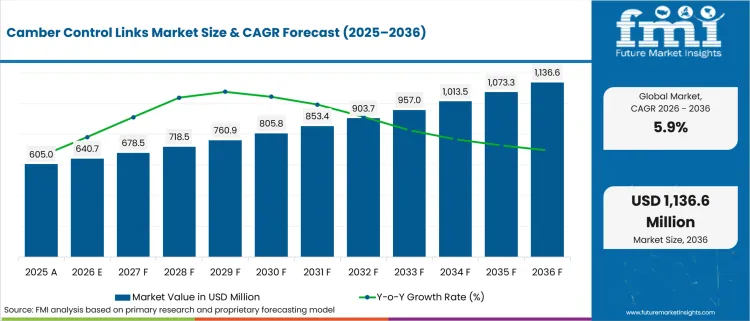
| Metric | Value |
|---|---|
| 2025 Market Size | USD 605.0 million |
| 2026 Market Size | USD 640.7 million |
| 2036 Market Size | USD 1,136.6 million |
| Forecast CAGR (2026-2036) | 5.9% |
| Product Type Focus | Fixed Camber Links |
| Fixed Camber Links Share (2026) | 46.5% |
| Material Focus | Steel |
| Steel Share (2026) | 58.0% |
| Sales Channel Focus | OEM |
| OEM Share (2026) | 64.0% |
| Fastest-growing Country | China |
| China CAGR by 2036 | 6.7% |
Summary of the Camber Control Links Market
| Market Signal | Commercial Impact |
|---|---|
| Demand and Growth Drivers | Demand for camber control links is expected to expand steadily through 2036 as electric vehicles, SUVs, and collision repair activities increase the need for durable suspension components.
|
| Product and Segment View | Fixed camber links, steel construction, and OEM sales channels continue to dominate their respective market segments.
|
| Geography and Growth Outlook | Asia continues to lead market expansion through vehicle production growth, electrification, and increasing suspension component demand.
|
| Competitive Landscape | Competition increasingly focuses on engineering validation, manufacturing quality, and support for both OEM and aftermarket applications.
|
| Analyst Perspective | Camber control links are becoming increasingly important for maintaining suspension performance as vehicle weight, electrification, and chassis complexity continue to increase.
- Nikhil Kaitwade, Principal Consultant for Automotive at Future Market Insights |
How is the camber control links market segmented?
The camber control links industry is segmented by product type, vehicle type, material, suspension type, sales channel, and region.
The Camber Control Links Market is segmented by product type, vehicle type, material, suspension type, sales channel, and region. Product type covers fixed camber links and adjustable camber links along with active links and performance camber arms. Vehicle type includes passenger cars and SUVs or crossovers, and sports cars plus commercial vehicles create additional demand. Material scope includes steel and aluminum, with forged alloy and composite materials serving selected applications. Suspension coverage includes multi-link, double wishbone, and MacPherson or other systems. Sales channels are divided into OEM and aftermarket routes, with regional coverage across North America, Latin America, Western Europe, Eastern Europe, East Asia, South Asia and Pacific, and Middle East and Africa. This structure supports camber control links analysis across 5 parent segments and more than 30 country-level demand signals.
Why do Fixed Camber Links lead within Product Type?
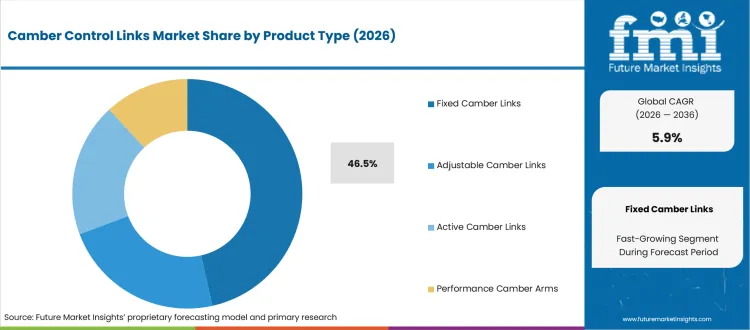
Fixed camber links lead through repeatable geometry and lower adjustment exposure during platform assembly. Electric car stock displaced 1.2 million barrels of oil per day in 2025, which shows how electrified platform scale is moving from sales growth into operating-fleet impact. OEMs therefore need suspension parts that hold alignment on heavier platforms without additional workshop calibration.
- Fixed Camber Links are expected to account for 46.5% share in 2026, supported by OEM programs that need pre-set geometry and fewer adjustment points during assembly. Stable geometry helps plants keep wheel alignment targets consistent across repeated platform builds.
- Volume vehicle platforms favor fixed links for lower warranty exposure. Field adjustment can create locking risk after service work, so pre-set link geometry remains preferred for passenger cars and SUVs designed around repeatable suspension settings across 2026 model programs.
What supports demand from Passenger Cars within Vehicle Type?
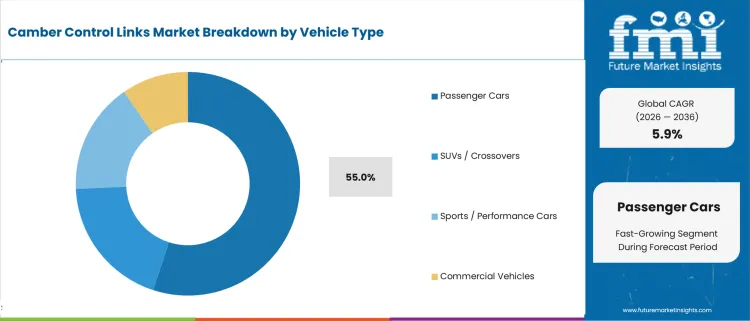
Passenger car demand remains central as compact and mid-size platforms create a large application base. Japan sold 4,421,494 new vehicles in 2024. This vehicle pool supports camber link demand across OEM replacement and repair channels.
- Passenger Cars are anticipated to hold 55.0% share in 2026, driven by wide application coverage across compact and mid-size platforms. A single passenger car platform can support multiple trims and regional variants, which keeps link volumes steady for OEM suppliers.
- Repair demand remains active in passenger cars through pothole impact and curb contact. Tire replacement and suspension wear can expose alignment issues, making camber correction parts useful before full suspension failure appears in high-mileage vehicles after 2025 service cycles.
How does Steel lead within Material?
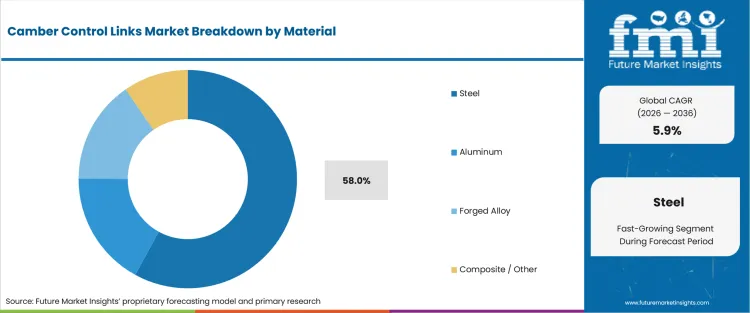
Steel keeps its lead as mainstream chassis programs need predictable fatigue strength at controlled cost. Shanghai Baolong Automotive’s company profile lists 12 manufacturing campuses across China, Southeast Asia, North America, and Europe. Suspension supply chains require scalable metal-processing capacity before OEMs approve large platform programs.
- Steel is forecast to represent 58.0% material share in 2026, helped by fatigue strength and weldability in high-volume chassis programs. Mainstream vehicle platforms need durable parts that can meet price targets without sacrificing load performance.
- Aluminum and forged alloy gain space in selected EV and performance platforms. Lower unsprung mass can support ride targets. Price pressure keeps steel preferred across passenger car and SUV volumes during the 2026 to 2036 assessment period.
What supports Multi-link within Suspension Type?
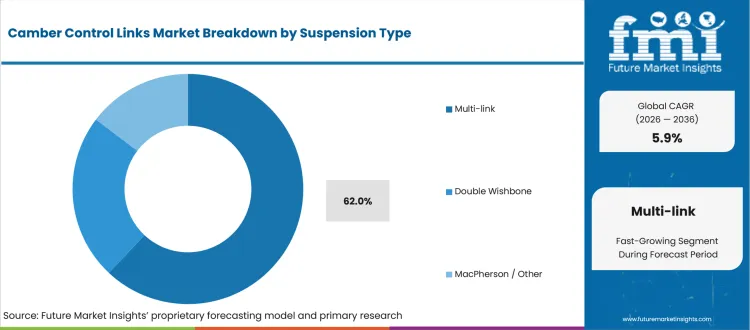
Multi-link suspension benefits from vehicle platforms that need separate control of camber and toe. Air suspension systems also point to rising chassis-control complexity across ride and load-management programs. Suppliers serving these platforms need hardware that keeps geometry stable during braking and uneven road operation.
- Multi-link suspension is projected to hold 62.0% share in 2026, backed by independent rear layouts that need link-based wheel control. Separate arms help engineers manage camber and toe behavior under everyday load changes.
- Multi-link layouts allow engineers to tune ride comfort and tire contact more precisely. Each added wheel-location part raises demand for links that can maintain geometry during braking and uneven road operation across 5 major vehicle groups.
How is OEM positioned within Sales Channel?
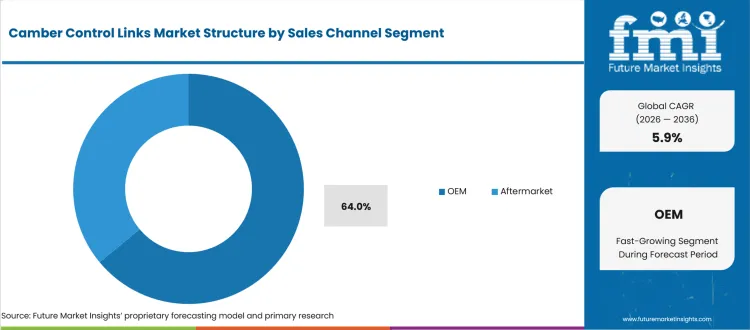
OEM sales lead as camber links are chosen before a platform reaches series production. ZF introduced 810 new passenger-car parts in North America during 2024 across its ZF, LEMFORDER, SACHS, TRW, and WABCO brands. Such portfolio expansion helps chassis suppliers protect platform coverage before repair demand reaches workshops.
- OEM is estimated to account for 64.0% share in 2026, reflecting camber link selection during platform development and suspension module sourcing. Suppliers with validation data and assembly-ready designs secure the larger revenue base.
- Aftermarket demand gains value through repair access and adjustment range. Independent workshops prefer parts that correct alignment after impact or modification without forcing replacement of a full axle or suspension assembly, especially across 2026 and later vehicle parc growth.
What are the drivers, restraints, and opportunities in the Camber Control Links Market?
Near-term purchases are being shaped by the operating requirement, sourcing constraint, and aftermarket route outlined below.
- Driver: EV platform weight drives camber link demand if automakers need suspension hardware that protects alignment under higher battery loads. In China, more than 13 million electric cars were sold in 2025, providing link suppliers a large platform base for chassis validation.
- Restraint: Cost pressure restrains adoption if buyers compare steel and forged alloy parts against strict vehicle program budgets. United States manufacturing output was unchanged in May 2026 after rising 0.7% in April, which shows how uneven production conditions can affect component purchasing discipline.
- Opportunity: Automotive aftermarket correction opens an opportunity among workshops that need alignment repair after impact or modification. Repair channels need parts that reduce bay time and restore camber without full assembly replacement across 2026 and later vehicle service programs.
Camber link demand grows after EV platforms turn wheel geometry into a tire-wear and warranty issue. Battery packaging changes static and dynamic loads, so OEMs need links that can hold camber through braking and cornering. Germany recorded 850,000 electric car sales in 2025 after a 50% rise, creating a clear demand signal for validated suspension hardware.
Input and validation cost remain practical constraints for material upgrades. Aluminum and forged alloy parts can reduce unsprung mass, and price discipline keeps steel in volume programs. In May 2026, Korean automobile export value fell 5.9% year on year to USD 5.83 billion, showing how production disruptions can quickly affect component sourcing confidence.
Technology and catalog support create a route beyond standard replacement parts. Repair channels need parts that reduce bay time and restore alignment without full assembly replacement. Mevotech announced 193 new parts in April 2025, including 58 first-to-market products, which supports aftermarket opportunity for engineered chassis repairs.
Which country CAGRs are profiled in the Camber Control Links Market?
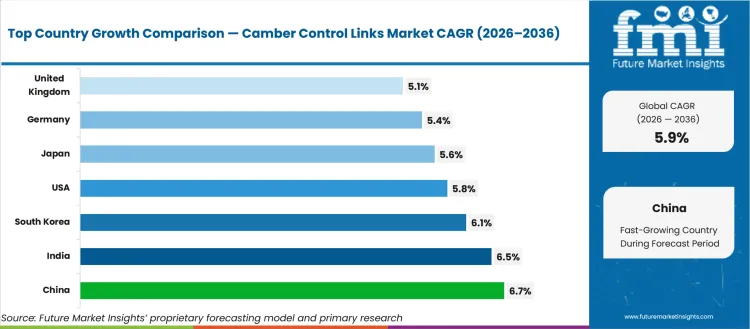
| Country | CAGR |
|---|---|
| China | 6.7% |
| India | 6.5% |
| South Korea | 6.1% |
| United States | 5.8% |
| Japan | 5.6% |
| Germany | 5.4% |
| United Kingdom | 5.1% |
| France | 4.9% |
Source: Future Market Insights analysis, 2026.
How do country-level CAGRs compare in the Camber Control Links Market?
Country growth in camber control links should be read through platform pressure behind vehicle geometry and repair accuracy. China, India, and South Korea connect demand with production depth and export programs. Japan, Germany, the United States, the United Kingdom, and France connect adoption with quality-led repair and large vehicle parc maintenance. Senior buyers should compare CAGR order with each country’s ability to combine validated chassis hardware and workshop access across the 2026 to 2036 forecast period.
- China is estimated at 6.7% CAGR through 2036, supported by NEV platform turnover and export-led vehicle programs. State Council Information Office reported that China’s auto output and sales reached new highs in 2025, while NEV exports doubled to 2.615 million units. Export scale raises demand for suspension components that can meet validation needs across road conditions and warranty markets.
- India is projected at 6.5% CAGR by 2036, helped by passenger vehicle production and SUV platform activity. Society of Indian Automobile Manufacturers reported total production across vehicle categories at 2,927,711 units in May 2026. Higher platform activity improves OEM camber link demand and later replacement demand through repair networks.
- South Korea is estimated to record 6.1% CAGR through 2036, reinforced by export-oriented vehicle programs that keep chassis quality checks tight. Korea’s January 2026 automobile release stated that export volumes rose 23.4% while production increased 24.1% year over year. Chassis suppliers benefit as compact SUV and electrified models require durable wheel-location hardware for overseas buyers.
- United States is forecast to post 5.8% CAGR by 2036, reflecting repair demand and continued output from motor vehicle parts. Federal Reserve reported that motor vehicles and parts output rose by more than 1.0% in May 2026, even as adjacent manufacturing output stayed flat. Component suppliers can therefore find demand in repair channels and selected production programs.
- Japan is set to expand at 5.6% CAGR through 2036, supported by quality-led sourcing and repair precision. International Trade Administration reported that automobile manufacturing represented 13.9% of Japan’s manufacturing GDP in 2024. Camber links gain value in a market that prioritizes alignment accuracy and long part life across compact and hybrid platforms.
- Germany is projected to grow at 5.4% CAGR by 2036, linked to battery-electric output and higher-value chassis part demand. Verband der Automobilindustrie reported that electric cars accounted for 40% of passenger car production in 2025. Suppliers with aluminum and validated steel options can serve EV programs and suspension assemblies.
- United Kingdom is expected to advance at 5.1% CAGR through 2036, guided by a large vehicle parc and steady repair activity. Department for Transport reported 42.3 million licensed vehicles at end-2025, including 2,012,000 licensed zero-emission vehicles. A large operating base keeps alignment repair, tire wear correction, and suspension replacement important for distributors and workshops.
- France is estimated to register 4.9% CAGR by 2036, supported by compact vehicle repair needs and selected OEM programs. France’s Automotive Platform reported vehicle production at 1.464 million units in 2025, up 8% from 2024. Demand remains tied to model allocations and validated parts for mainstream European passenger vehicles.
Who are the notable companies in the Camber Control Links Market?
ZF, thyssenkrupp, Magna, Benteler, Schaeffler, Mevotech, Dorman, SPC Performance, Megan Racing, Hardrace, Whiteline, and Cusco are the notable companies shaping the Camber Control Links Market. Competition is influenced by OEM validation depth and adjustable-link credibility across at least 3 buying routes.
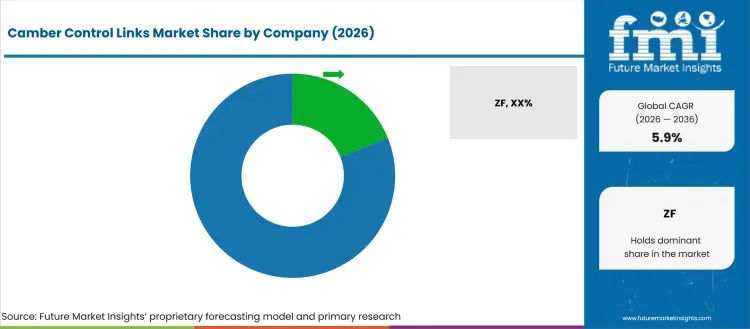
Competition in the Camber Control Links Market is grouped by buyer control needs. ZF, thyssenkrupp, Magna, Benteler, and Schaeffler are stronger in OEM sourcing and module validation. Mevotech and Dorman are important in repair coverage and technician access. SPC Performance, Megan Racing, Hardrace, Whiteline, and Cusco add pressure through performance camber arms and modified-vehicle applications, and control arm and suspension joint bearings support adjacent repair-channel evaluation.
- ZF has an advantage through chassis systems, steering, suspension components, sensors, and aftermarket parts. The company added more than 130 TRW chassis products in early 2025, expanding coverage to about 29 million additional vehicles in operation across the United States and Canada.
- thyssenkrupp is positioned through chassis technology and suspension product capabilities. Its 2025 cooperation with Baolong targets China and Europe, while Baolong supplies more than 2,500 customers across over 50 countries and regions.
- Magna, Benteler, and Schaeffler participate through structural chassis systems, axle modules, and adjacent suspension components. OEM buyers compare such suppliers across platform reach and validation experience as global electric car stock reached about 5% of the total car stock in 2025.
- Mevotech and Dorman compete through aftermarket control arm and repair-solution coverage. Mevotech’s 2025 launch expanded coverage for over 98 million vehicles, showing how repair brands use chassis coverage to reduce workshop bay time and support professional technicians.
- SPC Performance, Megan Racing, Hardrace, Whiteline, and Cusco serve performance and modified vehicle applications. Adjustable camber range remains important for lowered vehicles and wheel upgrades, especially across 5 specialist brand groups that compete on application guidance and tuning credibility.
Competitive Benchmarking: Camber Control Links Market
| Company | Geometry Validation Depth | Aftermarket Application Coverage | Adjustable Link Capability | Geographic Footprint Rating |
|---|---|---|---|---|
| ZF | High | High | Medium | High |
| thyssenkrupp | High | Medium | Medium | Medium |
| Magna | High | Medium | Low | High |
| Benteler | High | Medium | Low | High |
| Schaeffler | High | Medium | Low | High |
| Mevotech | Medium | High | High | Medium |
| Dorman | Medium | High | Medium | Medium |
| SPC Performance | Medium | Medium | High | Medium |
| Megan Racing | Medium | Medium | High | High |
| Hardrace | Medium | Medium | High | High |
| Whiteline | Medium | Medium | High | High |
| Cusco | Medium | Medium | High | High |
Source: Future Market Insights competitive analysis, 2026.
Key Developments in the Camber Control Links Market
- In February 2025, ZF Aftermarket added more than 130 TRW chassis products during the first 2 months of 2025. The launch expanded chassis coverage to about 29 million additional vehicles in operation across the United States and Canada, strengthening access to OE-quality repair parts for workshops.
- In April 2025, Mevotech expanded coverage with 193 new parts, including 58 first-to-market products. The launch provided coverage for over 106.8 million vehicles in operation across the United States and 10.0 million in Canada, supporting technician access to control arms, chassis parts, and wheel hubs.
- In July 2025, ZF unveiled its next-generation Smart Chassis Sensor. The upgraded design added an integrated accelerometer able to capture acceleration in 3 dimensions, supporting force detection and noise-cancelation functions.
Key Players in the Camber Control Links Market
OEM Chassis Suppliers
- ZF
- thyssenkrupp
- Magna
- Benteler
- Schaeffler
Aftermarket Repair Specialists
- Mevotech
- Dorman
- SPC Performance
Performance Suspension Brands
- Megan Racing
- Hardrace
- Whiteline
- Cusco
Camber Control Links Market - Report Scope
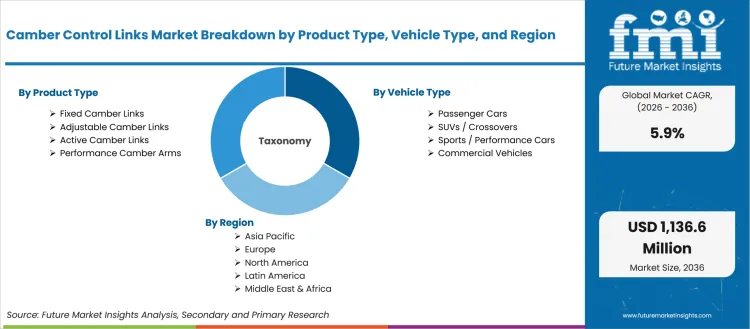
| Coverage field | Report scope |
|---|---|
| Market breakdown | Camber Control Links Market Breakdown By Product Type, Vehicle Type, Material, Suspension Type, Sales Channel, and Region |
| Market Definition | Suspension links and arms that help set or control wheel camber angle across OEM and aftermarket channels |
| Regions Covered | North America, Latin America, Western Europe, Eastern Europe, East Asia, South Asia and Pacific, Middle East and Africa |
| Countries Covered | United States, United Kingdom, Germany, France, Japan, China, South Korea, India and 30+ countries |
| Key Companies Profiled | ZF, thyssenkrupp, Magna, Benteler, Schaeffler, Mevotech, Dorman, SPC Performance, Megan Racing, Hardrace, Whiteline, Cusco |
| Forecast Period | 2026 to 2036 |
| Approach | Hybrid bottom-up and top-down methodology using platform application, part pricing, vehicle mix, material mix, channel demand checks, and country-level adoption signals |
Source: Future Market Insights analysis, 2026.
Camber Control Links Market - Research Methodology
| Method | Approach |
|---|---|
| Primary Research | FMI analysts reviewed input from chassis suppliers, aftermarket distributors, repair workshops, motorsport part sellers, and platform engineers. Supplier interviews focused on part validation, adjustability, material preference, warranty risk, and channel pricing across more than 30 country-level checks. |
| Desk Research | Desk research covered vehicle production data, suspension architecture references, official automotive statistics, company product information, and public chassis supplier announcements. Product checks focused on camber links, control arms, adjustable arms, chassis modules, and suspension repair coverage from 2024 onward. |
| Market Sizing and Forecasting | The model combined link volume by vehicle platform, average selling price, suspension type mix, material mix, and channel split. Forecast values were checked against adjacent automotive suspension systems, control arm, and chassis repair part demand across the 2026 to 2036 period. |
| Data Validation | Forecasts were validated against vehicle output, EV sales signals, aftermarket part coverage, supplier product releases, and platform application trends. Segment shares are FMI estimates based on component role, application frequency, and buyer behavior in 2026. |
Camber Control Links Market by Segments
Camber Control Links Market segmented by Product Type:
- Fixed Camber Links
- Adjustable Camber Links
- Active Camber Links
- Performance Camber Arms
Camber Control Links Market segmented by Vehicle Type:
- Passenger Cars
- SUVs / Crossovers
- Sports / Performance Cars
- Commercial Vehicles
Camber Control Links Market segmented by Material:
- Steel
- Aluminum
- Forged Alloy
- Composite / Other
Camber Control Links Market segmented by Suspension Type:
- Multi-link
- Double Wishbone
- MacPherson / Other
Camber Control Links Market segmented by Sales Channel:
- OEM
- Aftermarket
Camber Control Links Market by Region:
- North America
- United States
- Canada
- Mexico
- Latin America
- Brazil
- Chile
- Rest of Latin America
- Western Europe
- Germany
- UK
- Italy
- Spain
- France
- Nordic
- BENELUX
- Rest of Western Europe
- Eastern Europe
- Russia
- Poland
- Hungary
- Balkan & Baltic
- Rest of Eastern Europe
- East Asia
- China
- Japan
- South Korea
- South Asia and Pacific
- India
- ASEAN
- Australia & New Zealand
- Rest of South Asia and Pacific
- Middle East & Africa
- Kingdom of Saudi Arabia
- Other GCC Countries
- Türkiye
- South Africa
- Other African Union
- Rest of Middle East & Africa
Research Sources and Bibliography
- Board of Governors of the Federal Reserve System. (2026, June). Industrial production and capacity utilization.
- Department for Transport. (2026, April). Vehicle licensing statistics, United Kingdom: 2025.
- International Energy Agency. (2026, May). Global EV Outlook 2026: Executive summary.
- International Energy Agency. (2026, May). Global EV Outlook 2026: Trends in electric cars.
- International Trade Administration. (2025, November 20). Japan - Automotive.
- Korean Culture and Information Service. (2026, February). January 2026 automobile exports reach USD 6.1 billion.
- Mevotech. (2025, April 16). Mevotech expands coverage with 193 new parts, including 58 first-to-markets.
- Mevotech. (2025, July 8). Mevotech launches 84 first-to-market parts, expanding coverage for over 98 million vehicles.
- Plateforme de la Filière Automobile. (2026, March). France’s Automotive Platform market analysis letter.
- Shanghai Baolong Automotive Corporation. (2026). Company profile.
- Society of Indian Automobile Manufacturers. (2026, June 5). Auto industry performance of May 2026.
- State Council Information Office of the People’s Republic of China. (2026, January 15). China’s auto output, sales reach new highs in 2025.
- Verband der Automobilindustrie. (2026, February 3). 40% electric share of passenger car production in 2025.
- ZF Group. (2025, February 26). ZF Aftermarket adds over 130 new parts to TRW chassis product portfolio.
- ZF Group. (2025, July 10). Next-Gen Smart Chassis Sensor: More data, more intelligence for the chassis system.
This bibliography is provided for reader reference and is not exhaustive. The full report contains the complete reference list and detailed citations.
This Report Answers
- What is the expected global value of the Camber Control Links Market in 2026 and 2036?
- What CAGR is forecast for camber control links during the 2026 to 2036 period?
- Which product type segment is used to assess fixed camber link demand in 2026?
- Why do OEMs and repair channels buy controlled camber link systems for suspension geometry?
- How do fixed links and adjustable links shape alignment-control choices across vehicle platforms?
- Which countries are compared in the camber control links forecast?
- Which companies compete across OEM chassis supply and performance suspension routes?
- What hardware capabilities are included within the camber control links definition?
- How does FMI size and forecast camber control link demand across segments and countries?
- What implementation and supplier-selection factors should executives assess?
Frequently Asked Questions
What is driving growth in the Camber Control Links Market?
Demand is driven by EV platform loads, multi-link suspension use, and alignment-correction needs across OEM and aftermarket repair channels.
Why should executives track the Camber Control Links Market?
Executives should track this market because camber control affects tire wear, warranty exposure, and workshop repair outcomes across passenger cars, SUVs, and modified vehicles.
What business problem does the Camber Control Links Market address?
It helps OEMs and workshops maintain wheel camber after load shift, curb impact, suspension wear, or vehicle modification, which protects alignment quality across passenger car and SUV applications.
What should sourcing leaders evaluate before selecting suppliers?
Sourcing leaders should compare geometry validation and aftersales support across at least 3 main supplier groups.
What can limit return on investment for buyers?
Return on investment can be delayed if material upgrades raise part cost without clear warranty reduction. Buyers can reduce this risk by phasing validation across 2026 platform and repair programs.
How can suppliers build executive confidence?
Suppliers build confidence through proven geometry retention, catalog breadth, documented validation, and accountable support during scale-up.
Preview the report firsthand - request a free sample
Get SampleGet the brochure for pricing and purchase details.
Get PDFTable of Content
- Key Takeaways
- Market Size and CAGR
- Top Growth Driver
- Fastest Growing Segment
- Leading Region
- Key Companies
- Emerging Opportunities
- Executive Summary
- Global Market Outlook
- Demand-side Trends
- Supply-side Trends
- Technology Roadmap Analysis
- Analysis and Recommendations
- Analyst Perspective (What is happening? Why now? What should investors know?)
- Key Questions Answered
- How large is the market?
- What is the CAGR?
- What are key trends?
- Which region dominates?
- Who are the leaders?
- Market Overview
- Market Coverage / Taxonomy
- Market Definition / Scope / Limitations
- Research Methodology
- Chapter Orientation
- Analytical Lens and Working Hypotheses
- Market Structure, Signals, and Trend Drivers
- Benchmarking and Cross-market Comparability
- Market Sizing, Forecasting, and Opportunity Mapping
- Research Design and Evidence Framework
- Desk Research Programme (Secondary Evidence)
- Expert Input and Fieldwork (Primary Evidence)
- Tooling, Models, and Reference Databases
- Data Engineering and Model Build
- Quality Assurance and Audit Trail
- Market Background
- Market Dynamics (Drivers, Restraints, Opportunity, Trends)
- Scenario Forecast (Optimistic, Likely, Conservative)
- Impact Analysis
- AI Impact
- Sustainability Impact
- Regulatory Impact
- Technology Impact
- Consumer / Buyer Analysis
- Purchase Drivers
- Adoption Barriers
- Buyer Journey
- Opportunity Map Analysis
- Product Life Cycle Analysis
- Supply Chain Analysis
- Investment Feasibility Matrix
- Value Chain Analysis
- PESTLE and Porter's Analysis
- Regulatory Landscape
- Regional Parent Market Outlook
- Production and Consumption Statistics
- Import and Export Statistics
- Global Market Analysis and Forecast, 2021 to 2036
- Historical Market Size Value (USD Million) & Volume (Unit) Analysis, 2021 to 2025
- Current and Future Market Size Value (USD Million) & Volume (Unit) Projections, 2026 to 2036
- Y-o-Y Growth Trend Analysis
- Absolute $ Opportunity Analysis
- Global Market Pricing Analysis, 2021 to 2036
- Global Market Analysis and Forecast, By Product Type, 2021 to 2036
- Introduction / Key Findings
- Historical Market Size Value (USD Million) & Volume (Unit) Analysis By Product Type, 2021 to 2025
- Current and Future Market Size Value (USD Million) & Volume (Unit) Analysis and Forecast By Product Type, 2026 to 2036
- Fixed Camber Links
- Adjustable Camber Links
- Active Camber Links
- Performance Camber Arms
- Fixed Camber Links
- Y-o-Y Growth Trend Analysis By Product Type, 2021 to 2025
- Absolute $ Opportunity Analysis By Product Type, 2026 to 2036
- Global Market Analysis and Forecast, By Vehicle Type, 2021 to 2036
- Introduction / Key Findings
- Historical Market Size Value (USD Million) & Volume (Unit) Analysis By Vehicle Type, 2021 to 2025
- Current and Future Market Size Value (USD Million) & Volume (Unit) Analysis and Forecast By Vehicle Type, 2026 to 2036
- Passenger Cars
- SUVs / Crossovers
- Sports / Performance Cars
- Commercial Vehicles
- Passenger Cars
- Y-o-Y Growth Trend Analysis By Vehicle Type, 2021 to 2025
- Absolute $ Opportunity Analysis By Vehicle Type, 2026 to 2036
- Global Market Analysis and Forecast, By Material, 2021 to 2036
- Introduction / Key Findings
- Historical Market Size Value (USD Million) & Volume (Unit) Analysis By Material, 2021 to 2025
- Current and Future Market Size Value (USD Million) & Volume (Unit) Analysis and Forecast By Material, 2026 to 2036
- Steel
- Aluminum
- Forged Alloy
- Composite / Other
- Steel
- Y-o-Y Growth Trend Analysis By Material, 2021 to 2025
- Absolute $ Opportunity Analysis By Material, 2026 to 2036
- Global Market Analysis and Forecast, By Suspension Type, 2021 to 2036
- Introduction / Key Findings
- Historical Market Size Value (USD Million) & Volume (Unit) Analysis By Suspension Type, 2021 to 2025
- Current and Future Market Size Value (USD Million) & Volume (Unit) Analysis and Forecast By Suspension Type, 2026 to 2036
- Multi-link
- Double Wishbone
- MacPherson / Other
- Multi-link
- Y-o-Y Growth Trend Analysis By Suspension Type, 2021 to 2025
- Absolute $ Opportunity Analysis By Suspension Type, 2026 to 2036
- Global Market Analysis and Forecast, By Sales Channel, 2021 to 2036
- Introduction / Key Findings
- Historical Market Size Value (USD Million) & Volume (Unit) Analysis By Sales Channel, 2021 to 2025
- Current and Future Market Size Value (USD Million) & Volume (Unit) Analysis and Forecast By Sales Channel, 2026 to 2036
- OEM
- Aftermarket
- OEM
- Y-o-Y Growth Trend Analysis By Sales Channel, 2021 to 2025
- Absolute $ Opportunity Analysis By Sales Channel, 2026 to 2036
- Global Market Analysis and Forecast, By Region, 2021 to 2036
- Introduction
- Historical Market Size Value (USD Million) & Volume (Unit) Analysis By Region, 2021 to 2025
- Current Market Size Value (USD Million) & Volume (Unit) Analysis and Forecast By Region, 2026 to 2036
- North America
- Latin America
- Western Europe
- Eastern Europe
- East Asia
- South Asia and Pacific
- Middle East & Africa
- Market Attractiveness Analysis By Region
- North America Market Analysis and Forecast, By Country, 2021 to 2036
- Historical Market Size Value (USD Million) & Volume (Unit) Trend Analysis By Market Taxonomy, 2021 to 2025
- Market Size Value (USD Million) & Volume (Unit) Forecast By Market Taxonomy, 2026 to 2036
- By Country
- USA
- Canada
- Mexico
- By Product Type
- By Vehicle Type
- By Material
- By Suspension Type
- By Sales Channel
- By Country
- Market Attractiveness Analysis
- By Country
- By Product Type
- By Vehicle Type
- By Material
- By Suspension Type
- By Sales Channel
- Key Takeaways
- Latin America Market Analysis and Forecast, By Country
- Historical Market Size Value (USD Million) & Volume (Unit) Trend Analysis By Market Taxonomy, 2021 to 2025
- Market Size Value (USD Million) & Volume (Unit) Forecast By Market Taxonomy, 2026 to 2036
- By Country
- Brazil
- Chile
- Rest of Latin America
- By Product Type
- By Vehicle Type
- By Material
- By Suspension Type
- By Sales Channel
- By Country
- Market Attractiveness Analysis
- By Country
- By Product Type
- By Vehicle Type
- By Material
- By Suspension Type
- By Sales Channel
- Key Takeaways
- Western Europe Market Analysis and Forecast, By Country
- Historical Market Size Value (USD Million) & Volume (Unit) Trend Analysis By Market Taxonomy, 2021 to 2025
- Market Size Value (USD Million) & Volume (Unit) Forecast By Market Taxonomy, 2026 to 2036
- By Country
- Germany
- UK
- Italy
- Spain
- France
- Nordic
- BENELUX
- Rest of Western Europe
- By Product Type
- By Vehicle Type
- By Material
- By Suspension Type
- By Sales Channel
- By Country
- Market Attractiveness Analysis
- By Country
- By Product Type
- By Vehicle Type
- By Material
- By Suspension Type
- By Sales Channel
- Key Takeaways
- Eastern Europe Market Analysis and Forecast, By Country
- Historical Market Size Value (USD Million) & Volume (Unit) Trend Analysis By Market Taxonomy, 2021 to 2025
- Market Size Value (USD Million) & Volume (Unit) Forecast By Market Taxonomy, 2026 to 2036
- By Country
- Russia
- Poland
- Hungary
- Balkan & Baltic
- Rest of Eastern Europe
- By Product Type
- By Vehicle Type
- By Material
- By Suspension Type
- By Sales Channel
- By Country
- Market Attractiveness Analysis
- By Country
- By Product Type
- By Vehicle Type
- By Material
- By Suspension Type
- By Sales Channel
- Key Takeaways
- East Asia Market Analysis and Forecast, By Country
- Historical Market Size Value (USD Million) & Volume (Unit) Trend Analysis By Market Taxonomy, 2021 to 2025
- Market Size Value (USD Million) & Volume (Unit) Forecast By Market Taxonomy, 2026 to 2036
- By Country
- China
- Japan
- South Korea
- By Product Type
- By Vehicle Type
- By Material
- By Suspension Type
- By Sales Channel
- By Country
- Market Attractiveness Analysis
- By Country
- By Product Type
- By Vehicle Type
- By Material
- By Suspension Type
- By Sales Channel
- Key Takeaways
- South Asia and Pacific Market Analysis and Forecast, By Country
- Historical Market Size Value (USD Million) & Volume (Unit) Trend Analysis By Market Taxonomy, 2021 to 2025
- Market Size Value (USD Million) & Volume (Unit) Forecast By Market Taxonomy, 2026 to 2036
- By Country
- India
- ASEAN
- Australia & New Zealand
- Rest of South Asia and Pacific
- By Product Type
- By Vehicle Type
- By Material
- By Suspension Type
- By Sales Channel
- By Country
- Market Attractiveness Analysis
- By Country
- By Product Type
- By Vehicle Type
- By Material
- By Suspension Type
- By Sales Channel
- Key Takeaways
- Middle East & Africa Market Analysis and Forecast, By Country
- Historical Market Size Value (USD Million) & Volume (Unit) Trend Analysis By Market Taxonomy, 2021 to 2025
- Market Size Value (USD Million) & Volume (Unit) Forecast By Market Taxonomy, 2026 to 2036
- By Country
- Kingdom of Saudi Arabia
- Other GCC Countries
- Türkiye
- South Africa
- Other African Union
- Rest of Middle East & Africa
- By Product Type
- By Vehicle Type
- By Material
- By Suspension Type
- By Sales Channel
- By Country
- Market Attractiveness Analysis
- By Country
- By Product Type
- By Vehicle Type
- By Material
- By Suspension Type
- By Sales Channel
- Key Takeaways
- Key Countries Market Analysis
- USA
- Pricing Analysis
- Market Share Analysis, 2025
- By Product Type
- By Vehicle Type
- By Material
- By Suspension Type
- By Sales Channel
- Canada
- Pricing Analysis
- Market Share Analysis, 2025
- By Product Type
- By Vehicle Type
- By Material
- By Suspension Type
- By Sales Channel
- Mexico
- Pricing Analysis
- Market Share Analysis, 2025
- By Product Type
- By Vehicle Type
- By Material
- By Suspension Type
- By Sales Channel
- Brazil
- Pricing Analysis
- Market Share Analysis, 2025
- By Product Type
- By Vehicle Type
- By Material
- By Suspension Type
- By Sales Channel
- Chile
- Pricing Analysis
- Market Share Analysis, 2025
- By Product Type
- By Vehicle Type
- By Material
- By Suspension Type
- By Sales Channel
- Germany
- Pricing Analysis
- Market Share Analysis, 2025
- By Product Type
- By Vehicle Type
- By Material
- By Suspension Type
- By Sales Channel
- UK
- Pricing Analysis
- Market Share Analysis, 2025
- By Product Type
- By Vehicle Type
- By Material
- By Suspension Type
- By Sales Channel
- Italy
- Pricing Analysis
- Market Share Analysis, 2025
- By Product Type
- By Vehicle Type
- By Material
- By Suspension Type
- By Sales Channel
- Spain
- Pricing Analysis
- Market Share Analysis, 2025
- By Product Type
- By Vehicle Type
- By Material
- By Suspension Type
- By Sales Channel
- France
- Pricing Analysis
- Market Share Analysis, 2025
- By Product Type
- By Vehicle Type
- By Material
- By Suspension Type
- By Sales Channel
- India
- Pricing Analysis
- Market Share Analysis, 2025
- By Product Type
- By Vehicle Type
- By Material
- By Suspension Type
- By Sales Channel
- ASEAN
- Pricing Analysis
- Market Share Analysis, 2025
- By Product Type
- By Vehicle Type
- By Material
- By Suspension Type
- By Sales Channel
- Australia & New Zealand
- Pricing Analysis
- Market Share Analysis, 2025
- By Product Type
- By Vehicle Type
- By Material
- By Suspension Type
- By Sales Channel
- China
- Pricing Analysis
- Market Share Analysis, 2025
- By Product Type
- By Vehicle Type
- By Material
- By Suspension Type
- By Sales Channel
- Japan
- Pricing Analysis
- Market Share Analysis, 2025
- By Product Type
- By Vehicle Type
- By Material
- By Suspension Type
- By Sales Channel
- South Korea
- Pricing Analysis
- Market Share Analysis, 2025
- By Product Type
- By Vehicle Type
- By Material
- By Suspension Type
- By Sales Channel
- Russia
- Pricing Analysis
- Market Share Analysis, 2025
- By Product Type
- By Vehicle Type
- By Material
- By Suspension Type
- By Sales Channel
- Poland
- Pricing Analysis
- Market Share Analysis, 2025
- By Product Type
- By Vehicle Type
- By Material
- By Suspension Type
- By Sales Channel
- Hungary
- Pricing Analysis
- Market Share Analysis, 2025
- By Product Type
- By Vehicle Type
- By Material
- By Suspension Type
- By Sales Channel
- Kingdom of Saudi Arabia
- Pricing Analysis
- Market Share Analysis, 2025
- By Product Type
- By Vehicle Type
- By Material
- By Suspension Type
- By Sales Channel
- Türkiye
- Pricing Analysis
- Market Share Analysis, 2025
- By Product Type
- By Vehicle Type
- By Material
- By Suspension Type
- By Sales Channel
- South Africa
- Pricing Analysis
- Market Share Analysis, 2025
- By Product Type
- By Vehicle Type
- By Material
- By Suspension Type
- By Sales Channel
- USA
- Market Structure Analysis
- Competition Dashboard
- Competition Benchmarking
- Market Share Analysis of Top Players
- By Regional
- By Product Type
- By Vehicle Type
- By Material
- By Suspension Type
- By Sales Channel
- Emerging Startups
- Innovation Benchmarking
- Competition Analysis
- Competition Deep Dive
- ZF
- Overview
- Product Portfolio
- Profitability by Market Segments (Product/Region/Sales Channel)
- Sales Footprint
- Strategy Overview
- Marketing Strategy
- Product Strategy
- Channel Strategy
- thyssenkrupp
- Magna
- Benteler
- Schaeffler
- ZF
- Case Studies
- Success Stories
- Recent Developments
- Competition Deep Dive
- Assumptions & Acronyms Used


