

- Industry Size (2026)
- USD 2.3 Bn
- Forecast (2036)
- USD 4.6 Bn
- CAGR (2026 to 2036)
- 7.2%
Cattle Gastrointestinal Infection Treatment Market Forecast and Outlook 2026 to 2036
The cattle gastrointestinal infection treatment market is expected to be valued at USD 2.3 billion in 2026, reach USD 4.6 billion by 2036, and expand at a CAGR of 7.2%. Spending in this market is closely tied to productivity protection rather than discretionary animal health intervention. Gastrointestinal infections directly affect feed conversion efficiency, growth rates, milk yield, and calf survival, making treatment a functional necessity within herd health programs. Demand is structurally embedded in dairy and beef operations where disease-related losses translate quickly into economic impact, and purchasing decisions prioritize reliability of clinical response over brand novelty.
Treatment utilization reflects differences in herd scale, production intensity, and veterinary access across regions. Large dairy farms and organized beef systems adopt protocol-driven intervention to contain outbreaks and stabilize performance, while smaller operations rely on targeted treatment during high-risk periods such as weaning or seasonal stress. Regulatory pressure on antimicrobial use shapes product mix, encouraging selective therapy supported by diagnostics and complementary use of antiparasitics and gut-support agents. Supply continuity, withdrawal compliance, and ease of administration influence repeat purchasing behavior. Expansion remains steady, supported by herd intensification, biosecurity emphasis, and ongoing need to limit productivity losses linked to enteric disease exposure.
Quick Stats for Cattle Gastrointestinal Infection Treatment Market
- Cattle Gastrointestinal Infection Treatment Market Value (2026): USD 2.3 billion
- Cattle Gastrointestinal Infection Treatment Market Forecast Value (2036): USD 4.6 billion
- Cattle Gastrointestinal Infection Treatment Market Forecast CAGR 2026 to 2036: 7.2%
- Leading Product Type by Utilization: Antibiotics
- Fastest-Growing Countries: India, China, Brazil, USA, UK
- Top Players in Global Demand: Zoetis, MSD Animal Health, Elanco, Boehringer Ingelheim, Ceva

Cattle Gastrointestinal Infection Treatment Market Key Takeaways
| Metric | Value |
|---|---|
| Market Value (2026) | USD 2.3 billion |
| Market Forecast Value (2036) | USD 4.6 billion |
| Forecast CAGR 2026 to 2036 | 7.2% |
Why is the Demand for Cattle Gastrointestinal Infection Treatment Growing?
Demand for cattle gastrointestinal infection treatment is rising as producers and veterinarians confront persistent and emerging enteric diseases that compromise animal health, feed efficiency, and productivity in both beef and dairy herds. Gastrointestinal pathogens, including bacterial, parasitic, and viral agents, disrupt nutrient absorption and can precipitate dehydration, weight loss, and reduced milk yield, prompting on-farm intervention to restore gut function and limit production losses.
Veterinary practitioners specify therapeutic agents, supportive fluids, and anti-infective protocols based on pathogen identification, clinical severity, and herd dynamics to achieve reliable resolution. Procurement teams within veterinary supply distributors and clinic networks prioritize products with documented efficacy, tolerability in bovine patients, and flexible dosing regimens that support treatment in diverse production settings. Demand also reflects emphasis on minimizing prolonged disease courses that elevate labor costs, affect carcass quality, and increase culling risk.
Growth in intensified production systems and animal movement through auctions, feedlots, and grazing rotations reinforces uptake of targeted gastrointestinal treatments integrated with herd health programs. Preventive strategies such as strategic deworming and vaccination against specific enteric agents complement therapeutic interventions, encouraging producers to invest in protocols that reduce infection incidence and recurrence. Field veterinarians assess farm-specific risk factors including hygiene, stocking density, and environmental contamination to tailor treatment selection and support recovery. Retailers and distributors maintain inventories of approved products to ensure rapid availability when outbreaks occur, which supports continuity of animal care. These cattle-specific clinical, operational, and production drivers are contributing to sustained demand growth in the cattle gastrointestinal infection treatment market.
How Is the Cattle Gastrointestinal Infection Treatment Market Segmented by Product Type, Application, and End User?
Demand for cattle gastrointestinal infection treatment is influenced by herd health management priorities, productivity protection, and mortality risk reduction. Management practices emphasize rapid pathogen control, restoration of digestive function, and prevention of secondary complications. Adoption aligns with biosecurity protocols, routine herd monitoring, and veterinary intervention thresholds. Treatment selection considers infection etiology, withdrawal periods, and ease of administration under farm conditions. Segmentation explains how therapy category, infection profile, and delivery channel shape utilization patterns, purchasing concentration, and treatment execution across cattle operations.
Which Product Type Shows the Highest Utilization in Cattle GI Infection Treatment?
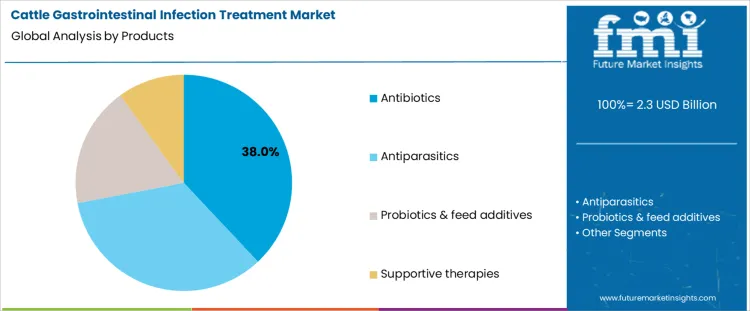
Use remains highest for antibiotics at 38.0%, reflecting their role in managing confirmed bacterial gastrointestinal infections. These agents provide rapid pathogen suppression where systemic involvement threatens feed intake and weight gain. Veterinary oversight guides dosing and compliance with residue regulations. Antiparasitics at 34.0% address helminth and protozoal burdens that impair nutrient absorption and growth. Probiotics and feed additives at 18.0% support gut flora stabilization during recovery phases. Supportive therapies at 10.0% focus on hydration and electrolyte balance. Product segmentation reflects prioritization of etiological treatment supported by recovery-focused adjuncts.
Key Points:
- Antibiotics target acute bacterial gastrointestinal conditions.
- Antiparasitics address productivity losses from parasitic load.
- Adjunct therapies support digestive recovery and resilience.
How Do Infection Profiles Influence Application-Level Treatment Demand?
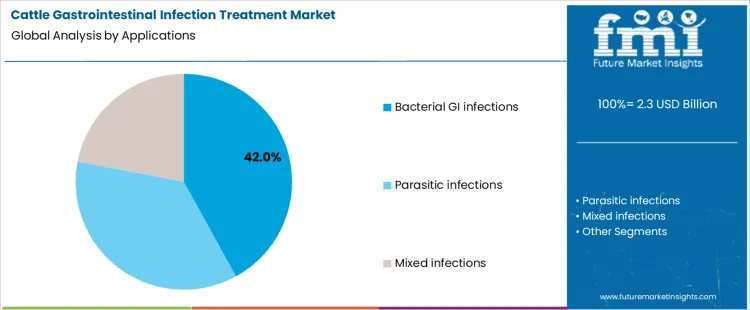
Treatment demand is weighted toward bacterial gastrointestinal infections at 42.0%, driven by acute onset and rapid clinical deterioration. These cases require prompt intervention to limit spread and performance loss. Parasitic infections at 36.0% involve chronic exposure and cumulative productivity impact, prompting routine treatment cycles. Mixed infections at 22.0% require combined therapeutic approaches and extended monitoring. Application segmentation highlights higher utilization where infection severity, transmission risk, and immediate production consequences necessitate decisive treatment action.
Key Points:
- Bacterial infections demand rapid therapeutic response.
- Parasitic cases involve ongoing management cycles.
- Mixed infections require coordinated multi-therapy protocols.
Which End User Channel Drives Treatment Deployment in Cattle GI Care?
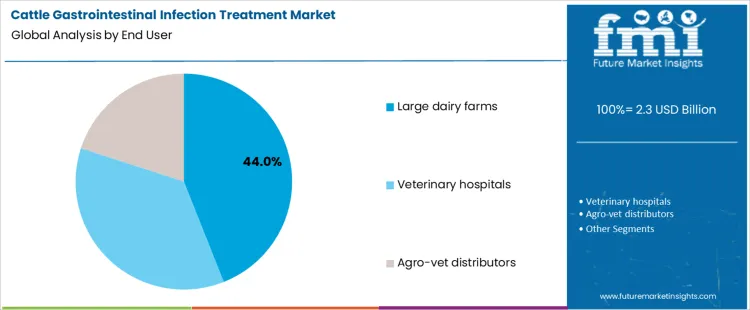
Large dairy farms account for 44.0% of treatment deployment due to on-site disease management capability and herd-scale exposure risk. Trained personnel administer therapies under established protocols to minimize downtime. Veterinary hospitals at 36.0% manage diagnostics, severe cases, and treatment validation. Agro-vet distributors at 20.0% ensure medication availability and supply continuity, particularly for routine farm use. End-user segmentation reflects concentration where herd size, operational readiness, and access to veterinary guidance determine treatment utilization patterns.
Key Points:
- Large farms implement treatments directly at herd scale.
- Veterinary hospitals support diagnosis and complex cases.
- Distributors enable consistent product availability.
What are the Key Dynamics in the Cattle Gastrointestinal Infection Treatment Market?
Demand for cattle gastrointestinal infection treatments reflects herd health management needs tied to morbidity reduction, feed efficiency, and mortality control. Adoption concentrates in dairy and beef operations facing bacterial, protozoal, and parasitic enteric disease burden. Global scope aligns with intensive and semi-intensive livestock systems. Usage centers on antimicrobials, antiparasitics, supportive therapies, and preventive interventions administered through veterinary-directed treatment protocols.
How do disease pressure and productivity protection requirements shape adoption?
Enteric infections impair nutrient absorption, weight gain, and milk yield, directly affecting farm economics. Demand increases where young calves face high exposure to pathogens during early life stages. Treatment selection depends on causative organism, disease severity, and herd history. Oral and injectable antimicrobials address bacterial infections, while anticoccidials and anthelmintics target protozoal and parasitic causes. Supportive therapy using electrolytes and anti-inflammatory agents stabilizes dehydrated or stressed animals. Producers prioritize rapid clinical response to limit spread within group housing systems. Veterinary diagnostics guide targeted therapy to avoid ineffective use. Adoption reflects operational need to preserve growth performance and reduce production losses associated with enteric disease outbreaks.
How do antimicrobial stewardship, resistance risk, and access variability influence market scalability?
Gastrointestinal infection management faces increasing regulatory focus on antimicrobial use in food-producing animals. Demand sensitivity rises where stewardship programs restrict prophylactic or blanket treatment approaches. Resistance development complicates empirical therapy and extends recovery timelines. Diagnostic access variability affects pathogen identification accuracy in field settings. Treatment cost influences adoption in low-margin operations, particularly in extensive systems. Withdrawal periods and residue compliance add management complexity. Improper dosing and incomplete treatment reduce effectiveness and confidence. Supply chain reliance on veterinary prescription channels limits rapid access in remote regions. Scalability remains constrained by resistance management requirements, regulatory oversight, and uneven veterinary infrastructure availability.
How Is Demand for Cattle Gastrointestinal Infection Treatments Evolving Globally?
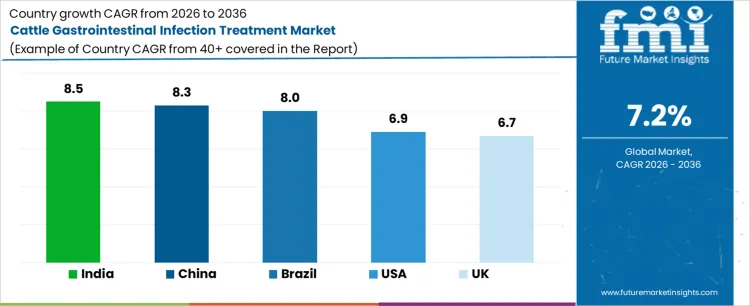
Demand for cattle gastrointestinal infection treatments is increasing globally as herd health programs prioritize productivity protection and mortality reduction. Enteric infections affecting calves and adult cattle drive consistent use of antimicrobials, antiparasitics, probiotics, and supportive therapies. Improved diagnostics and preventive management extend treatment duration and coverage. Veterinary oversight and integrated herd protocols influence utilization patterns. Growth rates in India at 8.5%, China at 8.3%, Brazil at 8.0%, USA at 6.9%, and the UK at 6.7% indicate steady expansion driven by intensification of livestock systems, biosecurity focus, and economic loss prevention rather than episodic outbreak response.
| Country | CAGR (%) |
|---|---|
| India | 8.5% |
| China | 8.3% |
| Brazil | 8.0% |
| USA | 6.9% |
| UK | 6.7% |
What Is Driving Growth of Cattle GI Infection Treatment Demand in India?
Demand for cattle gastrointestinal infection treatments in India is growing at a CAGR of 8.5%, reflecting dairy intensification and calf survival priorities. Cooperative dairies emphasize early intervention against diarrhea and parasitic loads to protect milk yield. Veterinary extension services expand access to oral rehydration, antimicrobials, and dewormers. High-density housing in peri-urban areas elevates transmission risk. Seasonal stress increases incidence during monsoon periods. Growth aligns with productivity protection and herd stabilization rather than expansion of high-cost therapeutics.
- Cooperative-led calf health programs
- Veterinary extension improving treatment access
- High-density housing elevating infection risk
- Seasonal stress increasing enteric incidence
Why Is China Sustaining Expansion in Cattle GI Infection Treatments?
Cattle gastrointestinal infection treatment demand in China is expanding at a CAGR of 8.3%, supported by herd consolidation and standardized health protocols. Large dairy operations implement routine monitoring for enteric pathogens. Integrated veterinary services enable rapid treatment initiation. Domestic pharmaceutical supply improves availability of antimicrobials and antiparasitics. Biosecurity measures focus on preventing productivity losses. Growth reflects protocol-driven herd management and scale efficiencies rather than increased disease prevalence.
- Consolidated herds enabling standardized protocols
- Routine monitoring for enteric pathogens
- Integrated veterinary service delivery
- Reliable domestic pharmaceutical supply
How Is Brazil Supporting Growth in Cattle GI Infection Treatment Utilization?
Demand for cattle gastrointestinal infection treatments in Brazil is growing at a CAGR of 8.0%, influenced by extensive grazing systems and climate variability. Warm and humid conditions elevate parasite and bacterial exposure. Ranchers adopt regular deworming and supportive therapies to protect weight gain. Veterinary outreach improves protocol adherence across large herds. Calf morbidity reduction remains a priority for beef productivity. Growth reflects environmental exposure management and operational scale rather than reliance on advanced diagnostics.
- Climate-driven parasite and pathogen exposure
- Regular deworming in extensive systems
- Veterinary outreach supporting protocol adherence
- Focus on calf morbidity reduction
What Factors Are Driving Cattle GI Infection Treatment Growth in United States?
Cattle gastrointestinal infection treatment demand in the United States is expanding at a CAGR of 6.9%, driven by preventive herd health management and cost control. Feedlot and dairy operations employ routine prophylaxis and early treatment to reduce performance losses. Diagnostic testing supports targeted therapy selection. Strong veterinary infrastructure ensures compliance with treatment protocols. Antimicrobial stewardship influences product choice. Growth reflects precision management and productivity protection rather than expansion of treatment intensity.
- Preventive protocols in feedlot and dairy systems
- Diagnostic-guided targeted therapy
- Robust veterinary infrastructure
- Stewardship shaping product selection
Why Is the UK Showing Steady Growth in Cattle GI Infection Treatments?
Demand for cattle gastrointestinal infection treatments in United Kingdom is growing at a CAGR of 6.7%, shaped by welfare standards and evidence-based veterinary care. Grazing-based systems require timely management of parasitic burdens. Veterinary guidance emphasizes targeted treatment and monitoring. Regulatory oversight encourages prudent antimicrobial use. Economic pressure favors prevention and early intervention. Growth remains steady, reflecting disciplined herd management and compliance rather than rapid intensification.
- Grazing systems requiring parasite control
- Evidence-based veterinary treatment guidance
- Regulatory emphasis on prudent antimicrobial use
- Prevention-focused herd health strategies
What is the competitive landscape of demand for the cattle gastrointestinal infection treatment market globally?
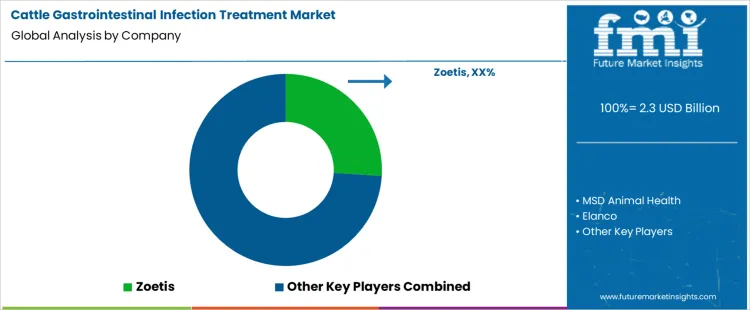
Demand for cattle gastrointestinal infection treatments is shaped by herd health management priorities, productivity protection, and mortality risk control. Livestock veterinarians evaluate antimicrobial spectrum, efficacy against enteric pathogens, withdrawal compliance, and suitability across age groups. Buyer assessment includes ease of administration, dosing accuracy in field conditions, resistance stewardship alignment, and compatibility with herd vaccination programs.
Procurement behavior reflects farm-scale purchasing, seasonal disease incidence, and reliance on trusted veterinary suppliers. Purchasing decisions emphasize treatment reliability, rapid clinical response, and predictable recovery outcomes. Trend in the cattle gastrointestinal infection treatment market reflects continued use in calf health programs and preventive intervention strategies.
Zoetis leads competitive positioning through broad gastrointestinal therapeutics supported by strong veterinary trust and global livestock distribution. MSD Animal Health competes with established anti-infective portfolios integrated within comprehensive cattle health programs.
Elanco supports demand through gastrointestinal infection treatments aligned with feedlot and dairy herd management needs. Boehringer Ingelheim maintains relevance by offering enteric disease solutions positioned within preventive and therapeutic livestock care frameworks. Ceva participates by supplying practical treatment options focused on accessibility and routine farm use. Competitive differentiation centers on clinical efficacy, resistance management confidence, supply reliability, and depth of engagement with livestock veterinarians.
Key Players in the Cattle Gastrointestinal Infection Treatment Market
- Zoetis
- MSD Animal Health
- Elanco
- Boehringer Ingelheim
- Ceva
- Others
Scope of the Report
| Items | Values |
|---|---|
| Quantitative Units | USD billion |
| Products | Antibiotics; Antiparasitics; Probiotics & feed additives; Supportive therapies |
| Applications | Bacterial GI infections; Parasitic infections; Mixed infections |
| End User | Large dairy farms; Veterinary hospitals; Agro-vet distributors |
| Regions Covered | Asia Pacific, Europe, North America, Latin America, Middle East & Africa |
| Countries Covered | India, China, Brazil, USA, UK, and 40+ countries |
| Key Companies Profiled | Zoetis; MSD Animal Health; Elanco; Boehringer Ingelheim; Ceva; Others |
| Additional Attributes | Dollar sales by product category, application, end user, and sales channel; treatment effectiveness across bacterial, parasitic, and mixed gastrointestinal infections in cattle; formulation selection influencing withdrawal periods and herd productivity; role of probiotics and supportive therapies in gut health recovery; prescribing patterns shaped by veterinary oversight and antimicrobial stewardship programs; procurement dynamics linked to farm-scale operations and distributor networks. |
Cattle Gastrointestinal Infection Treatment Market by Segment
Products:
- Antibiotics
- Antiparasitics
- Probiotics & feed additives
- Supportive therapies
Applications:
- Bacterial GI infections
- Parasitic infections
- Mixed infections
End User:
- Large dairy farms
- Veterinary hospitals
- Agro-vet distributors
Region:
- Asia Pacific
- China
- Japan
- South Korea
- India
- Australia & New Zealand
- ASEAN
- Rest of Asia Pacific
- Europe
- Germany
- United Kingdom
- France
- Italy
- Spain
- Nordic
- BENELUX
- Rest of Europe
- North America
- United States
- Canada
- Mexico
- Latin America
- Brazil
- Chile
- Rest of Latin America
- Middle East & Africa
- Kingdom of Saudi Arabia
- Other GCC Countries
- Turkey
- South Africa
- Other African Union
- Rest of Middle East & Africa
Bibliography
- Food and Agriculture Organization of the United Nations. (2024). Antimicrobial use and stewardship in food-producing animals: Enteric disease management. FAO Animal Health Service.
- World Organisation for Animal Health. (2024). Guidelines for diagnosis and management of parasitic and bacterial gastrointestinal diseases in cattle. WOAH.
- European Medicines Agency. (2024). Veterinary antimicrobials and antiparasitics for gastrointestinal infections in cattle: Regulatory and residue considerations. EMA Committee for Medicinal Products for Veterinary Use.
Frequently Asked Questions
How big is the cattle gastrointestinal infection treatment market in 2026?
The global cattle gastrointestinal infection treatment market is estimated to be valued at USD 2.3 billion in 2026.
What will be the size of cattle gastrointestinal infection treatment market in 2036?
The market size for the cattle gastrointestinal infection treatment market is projected to reach USD 4.6 billion by 2036.
How much will be the cattle gastrointestinal infection treatment market growth between 2026 and 2036?
The cattle gastrointestinal infection treatment market is expected to grow at a 7.2% CAGR between 2026 and 2036.
What are the key product types in the cattle gastrointestinal infection treatment market?
The key product types in cattle gastrointestinal infection treatment market are antibiotics, antiparasitics, probiotics & feed additives and supportive therapies.
Which applications segment to contribute significant share in the cattle gastrointestinal infection treatment market in 2026?
In terms of applications, bacterial gi infections segment to command 42.0% share in the cattle gastrointestinal infection treatment market in 2026.
Preview the report firsthand - request a free sample
Get SampleGet the brochure for pricing and purchase details.
Get PDFTable of Content
- Executive Summary
- Global Market Outlook
- Demand-side Trends
- Supply-side Trends
- Technology Roadmap Analysis
- Analysis and Recommendations
- Market Overview
- Market Coverage / Taxonomy
- Market Definition / Scope / Limitations
- Market Background
- Market Dynamics
- Drivers
- Restraints
- Opportunity
- Trends
- Scenario Forecast
- Demand in Optimistic Scenario
- Demand in Likely Scenario
- Demand in Conservative Scenario
- Opportunity Map Analysis
- Product Life Cycle Analysis
- Supply Chain Analysis
- Investment Feasibility Matrix
- Value Chain Analysis
- PESTLE and Porter’s Analysis
- Regulatory Landscape
- Regional Parent Market Outlook
- Production and Consumption Statistics
- Import and Export Statistics
- Market Dynamics
- Global Market Analysis 2021 to 2025 and Forecast, 2026 to 2036
- Historical Market Size Value (USD Million) Analysis, 2021 to 2025
- Current and Future Market Size Value (USD Million) Projections, 2026 to 2036
- Y-o-Y Growth Trend Analysis
- Absolute $ Opportunity Analysis
- Global Market Pricing Analysis 2021 to 2025 and Forecast 2026 to 2036
- Global Market Analysis 2021 to 2025 and Forecast 2026 to 2036, By Products
- Introduction / Key Findings
- Historical Market Size Value (USD Million) Analysis By Products , 2021 to 2025
- Current and Future Market Size Value (USD Million) Analysis and Forecast By Products , 2026 to 2036
- Antibiotics
- Antiparasitics
- Probiotics & feed additives
- Supportive therapies
- Antibiotics
- Y-o-Y Growth Trend Analysis By Products , 2021 to 2025
- Absolute $ Opportunity Analysis By Products , 2026 to 2036
- Global Market Analysis 2021 to 2025 and Forecast 2026 to 2036, By Applications
- Introduction / Key Findings
- Historical Market Size Value (USD Million) Analysis By Applications, 2021 to 2025
- Current and Future Market Size Value (USD Million) Analysis and Forecast By Applications, 2026 to 2036
- Bacterial GI infections
- Parasitic infections
- Mixed infections
- Bacterial GI infections
- Y-o-Y Growth Trend Analysis By Applications, 2021 to 2025
- Absolute $ Opportunity Analysis By Applications, 2026 to 2036
- Global Market Analysis 2021 to 2025 and Forecast 2026 to 2036, By End User
- Introduction / Key Findings
- Historical Market Size Value (USD Million) Analysis By End User, 2021 to 2025
- Current and Future Market Size Value (USD Million) Analysis and Forecast By End User, 2026 to 2036
- Large dairy farms
- Veterinary hospitals
- Agro-vet distributors
- Large dairy farms
- Y-o-Y Growth Trend Analysis By End User, 2021 to 2025
- Absolute $ Opportunity Analysis By End User, 2026 to 2036
- Global Market Analysis 2021 to 2025 and Forecast 2026 to 2036, By Region
- Introduction
- Historical Market Size Value (USD Million) Analysis By Region, 2021 to 2025
- Current Market Size Value (USD Million) Analysis and Forecast By Region, 2026 to 2036
- North America
- Latin America
- Western Europe
- Eastern Europe
- East Asia
- South Asia and Pacific
- Middle East & Africa
- Market Attractiveness Analysis By Region
- North America Market Analysis 2021 to 2025 and Forecast 2026 to 2036, By Country
- Historical Market Size Value (USD Million) Trend Analysis By Market Taxonomy, 2021 to 2025
- Market Size Value (USD Million) Forecast By Market Taxonomy, 2026 to 2036
- By Country
- USA
- Canada
- Mexico
- By Products
- By Applications
- By End User
- By Country
- Market Attractiveness Analysis
- By Country
- By Products
- By Applications
- By End User
- Key Takeaways
- Latin America Market Analysis 2021 to 2025 and Forecast 2026 to 2036, By Country
- Historical Market Size Value (USD Million) Trend Analysis By Market Taxonomy, 2021 to 2025
- Market Size Value (USD Million) Forecast By Market Taxonomy, 2026 to 2036
- By Country
- Brazil
- Chile
- Rest of Latin America
- By Products
- By Applications
- By End User
- By Country
- Market Attractiveness Analysis
- By Country
- By Products
- By Applications
- By End User
- Key Takeaways
- Western Europe Market Analysis 2021 to 2025 and Forecast 2026 to 2036, By Country
- Historical Market Size Value (USD Million) Trend Analysis By Market Taxonomy, 2021 to 2025
- Market Size Value (USD Million) Forecast By Market Taxonomy, 2026 to 2036
- By Country
- Germany
- UK
- Italy
- Spain
- France
- Nordic
- BENELUX
- Rest of Western Europe
- By Products
- By Applications
- By End User
- By Country
- Market Attractiveness Analysis
- By Country
- By Products
- By Applications
- By End User
- Key Takeaways
- Eastern Europe Market Analysis 2021 to 2025 and Forecast 2026 to 2036, By Country
- Historical Market Size Value (USD Million) Trend Analysis By Market Taxonomy, 2021 to 2025
- Market Size Value (USD Million) Forecast By Market Taxonomy, 2026 to 2036
- By Country
- Russia
- Poland
- Hungary
- Balkan & Baltic
- Rest of Eastern Europe
- By Products
- By Applications
- By End User
- By Country
- Market Attractiveness Analysis
- By Country
- By Products
- By Applications
- By End User
- Key Takeaways
- East Asia Market Analysis 2021 to 2025 and Forecast 2026 to 2036, By Country
- Historical Market Size Value (USD Million) Trend Analysis By Market Taxonomy, 2021 to 2025
- Market Size Value (USD Million) Forecast By Market Taxonomy, 2026 to 2036
- By Country
- China
- Japan
- South Korea
- By Products
- By Applications
- By End User
- By Country
- Market Attractiveness Analysis
- By Country
- By Products
- By Applications
- By End User
- Key Takeaways
- South Asia and Pacific Market Analysis 2021 to 2025 and Forecast 2026 to 2036, By Country
- Historical Market Size Value (USD Million) Trend Analysis By Market Taxonomy, 2021 to 2025
- Market Size Value (USD Million) Forecast By Market Taxonomy, 2026 to 2036
- By Country
- India
- ASEAN
- Australia & New Zealand
- Rest of South Asia and Pacific
- By Products
- By Applications
- By End User
- By Country
- Market Attractiveness Analysis
- By Country
- By Products
- By Applications
- By End User
- Key Takeaways
- Middle East & Africa Market Analysis 2021 to 2025 and Forecast 2026 to 2036, By Country
- Historical Market Size Value (USD Million) Trend Analysis By Market Taxonomy, 2021 to 2025
- Market Size Value (USD Million) Forecast By Market Taxonomy, 2026 to 2036
- By Country
- Kingdom of Saudi Arabia
- Other GCC Countries
- Turkiye
- South Africa
- Other African Union
- Rest of Middle East & Africa
- By Products
- By Applications
- By End User
- By Country
- Market Attractiveness Analysis
- By Country
- By Products
- By Applications
- By End User
- Key Takeaways
- Key Countries Market Analysis
- USA
- Pricing Analysis
- Market Share Analysis, 2025
- By Products
- By Applications
- By End User
- Canada
- Pricing Analysis
- Market Share Analysis, 2025
- By Products
- By Applications
- By End User
- Mexico
- Pricing Analysis
- Market Share Analysis, 2025
- By Products
- By Applications
- By End User
- Brazil
- Pricing Analysis
- Market Share Analysis, 2025
- By Products
- By Applications
- By End User
- Chile
- Pricing Analysis
- Market Share Analysis, 2025
- By Products
- By Applications
- By End User
- Germany
- Pricing Analysis
- Market Share Analysis, 2025
- By Products
- By Applications
- By End User
- UK
- Pricing Analysis
- Market Share Analysis, 2025
- By Products
- By Applications
- By End User
- Italy
- Pricing Analysis
- Market Share Analysis, 2025
- By Products
- By Applications
- By End User
- Spain
- Pricing Analysis
- Market Share Analysis, 2025
- By Products
- By Applications
- By End User
- France
- Pricing Analysis
- Market Share Analysis, 2025
- By Products
- By Applications
- By End User
- India
- Pricing Analysis
- Market Share Analysis, 2025
- By Products
- By Applications
- By End User
- ASEAN
- Pricing Analysis
- Market Share Analysis, 2025
- By Products
- By Applications
- By End User
- Australia & New Zealand
- Pricing Analysis
- Market Share Analysis, 2025
- By Products
- By Applications
- By End User
- China
- Pricing Analysis
- Market Share Analysis, 2025
- By Products
- By Applications
- By End User
- Japan
- Pricing Analysis
- Market Share Analysis, 2025
- By Products
- By Applications
- By End User
- South Korea
- Pricing Analysis
- Market Share Analysis, 2025
- By Products
- By Applications
- By End User
- Russia
- Pricing Analysis
- Market Share Analysis, 2025
- By Products
- By Applications
- By End User
- Poland
- Pricing Analysis
- Market Share Analysis, 2025
- By Products
- By Applications
- By End User
- Hungary
- Pricing Analysis
- Market Share Analysis, 2025
- By Products
- By Applications
- By End User
- Kingdom of Saudi Arabia
- Pricing Analysis
- Market Share Analysis, 2025
- By Products
- By Applications
- By End User
- Turkiye
- Pricing Analysis
- Market Share Analysis, 2025
- By Products
- By Applications
- By End User
- South Africa
- Pricing Analysis
- Market Share Analysis, 2025
- By Products
- By Applications
- By End User
- USA
- Market Structure Analysis
- Competition Dashboard
- Competition Benchmarking
- Market Share Analysis of Top Players
- By Regional
- By Products
- By Applications
- By End User
- Competition Analysis
- Competition Deep Dive
- Zoetis
- Overview
- Product Portfolio
- Profitability by Market Segments (Product/Age /Sales Channel/Region)
- Sales Footprint
- Strategy Overview
- Marketing Strategy
- Product Strategy
- Channel Strategy
- MSD Animal Health
- Elanco
- Boehringer Ingelheim
- Ceva
- Others
- Zoetis
- Competition Deep Dive
- Assumptions & Acronyms Used
- Research Methodology


