

- Market Size (2026)
- USD 1.6 Bn
- Forecast (2036)
- USD 4.5 Bn
- CAGR (2026 to 2036)
- 10.8%
How big is the Charcot-Marie-Tooth Market in 2026?
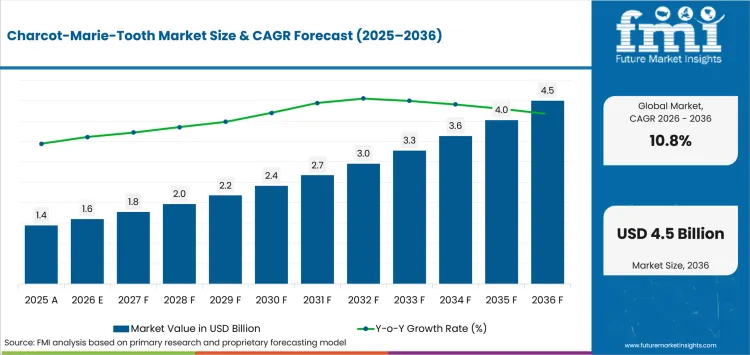
USD 1.6 billion in 2026 and USD 4.5 billion by 2036 at a 10.8% CAGR.
Demand in the charcot-marie-tooth market is anticipated to push valuation from USD 1.6 billion in 2026 to USD 4.5 billion by 2036, expanding at a 10.8% CAGR over the forecast period. Growth is supported by ongoing care requirements among patients experiencing progressive muscle weakness and mobility limitations associated with inherited peripheral neuropathies
Genetic confirmation through molecular diagnostics determines whether neuromuscular centers can place patients into subtype-specific monitoring and therapeutic trials. In February 2026, the NHS Genomics Education Programme reported that CMT1A accounts for up to 50% of all CMT cases. The CMT1A concentration gives centers a larger PMP22-defined population for eligibility screening and repeated functional assessment.
Key Takeaways
- Genetic confirmation and coordinated care increase demand by directing inherited subtypes into rehabilitation planning and clinical trial referral.
- Supportive therapy is projected to represent 39.0% of treatment type demand in 2026 through recurring rehabilitation services.
- CMT1 is estimated to account for 43.0% of application demand in 2026 through its defined diagnostic base.
- Hospitals are forecast to represent 38.0% of end user demand in 2026 through coordinated specialist care.
- Slow progression and genetic heterogeneity restrict development through difficult nerve delivery and slowly changing functional endpoints.
- Novartis AG, NMD Pharma A/S, ENCell Co., Ltd., Augustine Therapeutics NV, Vanda Pharmaceuticals Inc., Armatus Bio, Actio Biosciences and Oryzon Genomics, S.A. span clinical and preclinical CMT development across oral, RNA and cell-based modalities.
Analyst Perspective
“Commercially viable CMT development must pair a genetically defined subtype with an endpoint that changes fast enough to distinguish treatment effects. Programs also need credible peripheral-nerve delivery evidence and trial centers that maintain standardized functional assessment across extended follow-up.”
- Anurag Sharma, Principal Consultant, Future Market Insights
How is the Charcot-Marie-Tooth Market segmented?
The Charcot-Marie-Tooth industry is segmented by treatment type, application, end user, distribution channel, therapy modality and region.
The Charcot-Marie-Tooth market is segmented by treatment type, application, end user, distribution channel, therapy modality and region. Treatment type covers supportive therapy, pharmacological therapy, gene therapy and orthopedic management, while application separates CMT1, CMT2, CMTX and intermediate CMT. End users include hospitals, specialty neurology clinics, rehabilitation centers and academic research institutes that support clinical studies. Distribution channels include hospital, retail, specialty and online pharmacies, while therapy modality covers conventional, genetic, supportive and regenerative approaches.
What supports supportive therapy within the treatment type category?
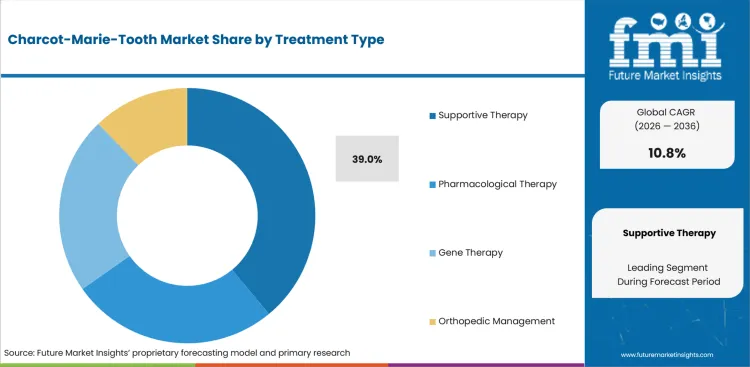
No approved treatment reverses inherited peripheral-nerve damage, so supportive therapy remains the care foundation across progressive CMT forms. Neuromuscular teams use rehabilitation and orthotic support to preserve mobility, hand function and safe daily activity throughout long care pathways.
- The supportive therapy segment is likely to capture 39.0% share in 2026 attributable to recurring rehabilitation and individualized symptom management.
- Rehabilitation teams combine physiotherapy equipment with custom orthoses as weakness changes across prolonged care pathways. In August 2025, the Charcot-Marie-Tooth Association published detailed orthotic guidance covering clinical evaluation and deformity prevention. The guidance helps rehabilitation teams align mobility aids with changing gait needs across long-term care.
How does CMT1 shape demand within the application category?
CMT1 groups demyelinating inherited neuropathies including CMT1A and CMT1B across affected families and clinical registries. The PMP22 duplication behind CMT1A gives laboratories and nucleic acid therapy programs a defined molecular target. In September 2025, Novartis started a 28-participant Phase 1 EDK060 study for genetically confirmed CMT1A.
- In 2026, CMT1 is expected to lead the application category with 43.0% share because molecular confirmation supports a comparatively large diagnostic base.
- Canadian neuromuscular centers use serial safety reviews and skin biopsies to track target exposure during dose escalation. The protocol connects molecular eligibility with repeat functional assessment during early clinical development across participating sites.
What role do hospitals play within the end user category?
Hospitals combine neurology and neurophysiology with genetic counseling across inherited-neuropathy referrals requiring coordinated diagnosis and follow-up. Their multidisciplinary services support diagnosis, rehabilitation planning and repeated functional assessment within one institutional pathway.
- The end user category is forecast to be led by hospitals at 38.0% share in 2026 due to concentrated multidisciplinary services. In October 2025, the Charcot-Marie-Tooth Association added UT Southwestern to its Center of Excellence network.
- The center combines neurology with genetic counseling alongside physiatry and rehabilitation services for adults with CMT. Coordinated clinical diagnostics and electromyography devices support subtype assignment during specialist review and repeated follow-up across complex referrals.
What drives hospital pharmacy use within the distribution channel category?
Hospital pharmacies remain close to specialist prescribing and institutional treatment planning for complex inherited neuropathy care across multidisciplinary centers. They directly manage symptom medicines and investigational supplies under protocol controls inside participating clinical centers.
- By distribution channel, hospital pharmacies are estimated to hold 41.0% in 2026 owing to specialist prescribing and controlled institutional dispensing.
- Pharmacy teams coordinate pain therapeutic solutions with interaction review and study accountability across hospital pathways. Specialty pharmacies could widen future rare-disease access, although payer authorization and specialized handling requirements remain separate barriers for restricted therapies requiring controlled distribution and cold storage.
What are the drivers, restraints and opportunities in the Charcot-Marie-Tooth Market?
Genotype-specific programs improve selection despite slow progression as delivery research and biomarkers strengthen therapeutic development.
- Driver: Molecular classification connects each candidate with a defined mechanism and a genetically confirmed patient population.
- Restraint: Slow progression and peripheral-nerve delivery extend studies across subtypes whose functional measures change unevenly during practical trial periods.
- Opportunity: Natural-history networks and quantitative biomarkers improve enrollment readiness and endpoint selection at specialist centers.
Molecular classification gives developers a defined disease mechanism and a genetically confirmed enrollment pool across rare neurological treatments. Diagnostic laboratories confirm subtype eligibility early, which reduces screen failures during repeated functional testing at specialist centers.
Slow progression and genetic heterogeneity lengthen trials as functional measures change gradually across distinct inherited forms. Peripheral-nerve delivery adds separate risk for viral vector development programs that require durable target exposure without unacceptable systemic effects.
Natural-history networks define expected functional change so sponsors can select endpoints and enrollment criteria with less uncertainty. In February 2026, the Charcot-Marie-Tooth Association committed USD 523 thousand across four nerve-delivery projects that compare distinct routes into peripheral neurons and Schwann cells. The projects give gene therapy manufacturing teams clearer evidence for selecting delivery systems during clinical scale-up.
Which country CAGRs are profiled in the Charcot-Marie-Tooth Market?
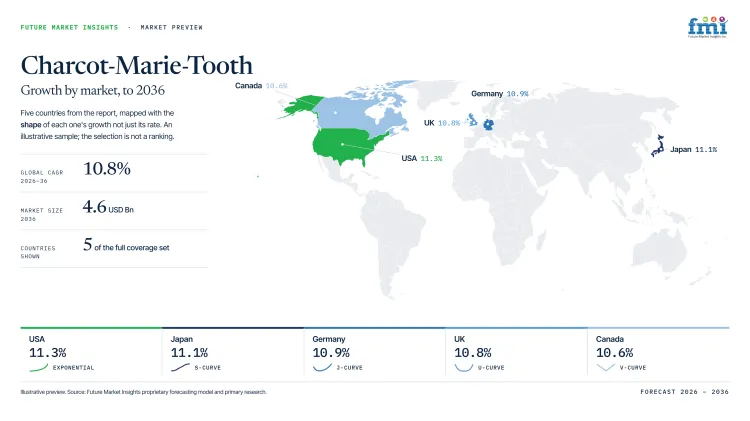
| Country | CAGR |
|---|---|
| USA | 11.3% |
| Japan | 11.1% |
| Germany | 10.9% |
| UK | 10.8% |
| Canada | 10.6% |
How do country-level CAGRs compare in the Charcot-Marie-Tooth Market?
The displayed rates span 0.7 percentage points across five health systems with established inherited-neuropathy services. The narrow band describes forecast pace rather than market size or specialist capacity across these systems.
- The United States benefits from academic trial infrastructure, although reimbursement decisions produce uneven access across states.
- Japan combines designated-disease assistance with metropolitan referral pathways, yet inherited-neuropathy expertise remains concentrated in major cities.
- Germany relies on neuromuscular clinics and molecular testing, although repeated assessment is less accessible beyond major centers.
- The United Kingdom connects commissioned genomic testing with NHS networks, yet workforce constraints can delay specialist follow-up.
- Canada supports natural-history research through academic centers, although provincial differences and travel distances complicate participation.
- Comparable CAGRs can produce materially different entry conditions across national diagnostic systems and specialist-care networks.
- The full report covers country-level growth across North America, Latin America, Europe, East Asia, South Asia and Pacific, and the Middle East and Africa.
Country-wise Analysis
- United States CMT care operates through university neuromuscular centers that connect genetic confirmation with rehabilitation planning and clinical trial referral across regional networks serving patients who regularly travel substantial distances for specialist follow-up. The United States Charcot-Marie-Tooth sector is projected to record 11.3% CAGR during the assessment period, supported by mature research infrastructure despite uneven insurance coverage and travel costs beyond established academic centers across states. In April 2026, the Charcot-Marie-Tooth Association described ACT-CMT across four university centers within a USD 1.2 million natural-history program designed to strengthen biomarker collection and future trial readiness for treatment studies nationwide.
- Japan routes CMT patients through designated intractable-disease services and metropolitan neurology centers that coordinate genetic diagnosis with financial assistance applications through prefectural systems requiring specialist documentation and recurring eligibility review across long-term treatment pathways. Japan's health ministry listed Charcot-Marie-Tooth disease as designation number ten in April 2026 within a schedule covering 348 recognized intractable diseases and application forms used for new and renewal requests across prefectural systems. In Japan, Charcot-Marie-Tooth demand is predicted to advance at 11.1% CAGR through 2036, driven by structured assistance pathways despite concentrated inherited-neuropathy expertise and limited capacity beyond metropolitan referral centers and genetic counseling.
- Germany uses university neuromuscular clinics and genetic laboratories to investigate PMP22-related neuropathies through referral routes connecting electrophysiology with molecular testing across federal health systems and dispersed rehabilitation services within regional care networks nationally. Adoption of Charcot-Marie-Tooth therapies in Germany is estimated to expand at 10.9% CAGR through 2036, reinforced by diagnostic expertise despite uneven access to repeated functional assessment and long-distance rehabilitation travel beyond university centers. The German Clinical Trials Register added a recruiting retrospective PMP22 study in Hamburg during October 2025 to compare persistent toe-walking with CMT1A, HNPP and CMT1E phenotypes using standardized assessment for affected families nationwide.
- United Kingdom CMT pathways use NHS genomic services and neuromuscular clinics to connect eligible patients with molecular testing, rehabilitation planning and subtype-specific research enrollment across regional networks with uneven specialist capacity and rural access. The NHS Genomics Education Programme confirmed nationally commissioned rare-disease testing across England in March 2026 through a detailed current directory defining funded tests and authorized ordering specialties within regional genomic laboratory services. The United Kingdom is estimated to post 10.8% CAGR over the forecast period, supported by commissioned testing despite workforce constraints and variable local rehabilitation availability across regional services and long travel distances nationwide.
- Canada concentrates CMT research within specialist neuromuscular centers that coordinate genetic confirmation with longitudinal assessment across provincial systems serving patients who face extensive travel and uneven rehabilitation access beyond major cities and remote communities. By 2036, Canada is projected to grow at 10.6% CAGR, influenced by active natural-history research despite persistent provincial access differences and limited specialist capacity outside major academic centers and lengthy cross-province travel. ClinicalTrials.gov listed the Hospital for Sick Children in Toronto during October 2025 as a recruiting Canadian site within a five-year natural-history study covering defined CMT subtypes and outcome development through specialist research networks.
Who are the notable companies in the Charcot-Marie-Tooth Market?
Novartis AG, NMD Pharma A/S, ENCell Co., Ltd., Augustine Therapeutics NV, Vanda Pharmaceuticals Inc., Armatus Bio, Actio Biosciences and Oryzon Genomics, S.A. are the notable companies serving this market.
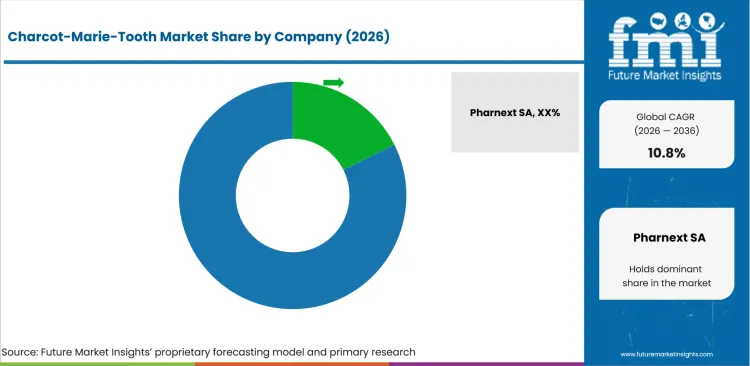
The CMT field remains fragmented as specialist developers pursue distinct subtypes and modalities without an approved disease-modifying benchmark. Competition depends on genotype-specific recruitment, nerve delivery and measurable functional change rather than established prescribing volume.
- Novartis AG, NMD Pharma A/S and ENCell Co., Ltd. maintain clinical CMT programs across three therapeutic modalities.
- Augustine Therapeutics NV, Vanda Pharmaceuticals Inc. and Actio Biosciences advance clinical candidates for defined disease mechanisms.
- Armatus Bio and Oryzon Genomics, S.A. pursue preclinical genetic or epigenetic programs that currently include CMT.
Competitive Benchmarking: Charcot-Marie-Tooth Market
| Company | Clinical Maturity | Molecular Specificity | Current CMT Activity | Geographic Reach |
|---|---|---|---|---|
| Novartis AG | Medium | High | High | Canada |
| NMD Pharma A/S | High | Medium | High | United States and Europe |
| ENCell Co., Ltd. | High | High | High | South Korea |
| Augustine Therapeutics NV | Medium | Medium | High | Europe |
| Vanda Pharmaceuticals Inc. | Low | High | Medium | United States |
| Armatus Bio | Low | High | Medium | United States |
| Actio Biosciences | Medium | High | High | United States |
| Oryzon Genomics, S.A. | Low | Low | Medium | Spain and United States |
Clinical maturity is High for Phase 2 or later exact-CMT evidence, Medium for active Phase 1 programs and Low for verified IND-enabling or advanced preclinical work. Molecular specificity is High for a genotype-defined subtype, Medium for a defined CMT population and Low for a broader neurological mechanism that includes CMT. Current CMT activity is High for active dosing or newly reported clinical results, Medium for verified preclinical or regulatory advancement and Low for discontinued current development. Geographic reach records verified study or operating coverage, and every Low rating requires direct evidence rather than missing information.
Key Developments in the Charcot-Marie-Tooth Market
- In July 2026, Vanda Pharmaceuticals Inc. announced that FDA granted Rare Pediatric Disease Designation to VCA-894A for a single-variant CMT2S program. The designation supports regulatory planning, although broader use requires clinical evidence across genetically defined patients.
- In May 2026, ENCell Co., Ltd. dosed the first patient in its placebo-controlled Phase 2a EN001 study for CMT1A in South Korea. The study tests repeated cell therapy through functional outcomes and coordinated follow-up across participating university hospitals.
- In February 2026, NMD Pharma A/S reported Phase 2a ignaseclant results from 81 adults with genetically confirmed CMT1 or CMT2. Secondary functional signals supported further study, although the primary six-minute walk endpoint showed no treatment difference.
Key Players in the Charcot-Marie-Tooth Market
Clinical-Stage CMT Developers
- Novartis AG
- NMD Pharma A/S
- ENCell Co., Ltd.
- Augustine Therapeutics NV
Genotype-Specific Clinical Programs
- Vanda Pharmaceuticals Inc.
- Actio Biosciences
Preclinical Genetic and Epigenetic Programs
- Armatus Bio
- Oryzon Genomics, S.A.
Charcot-Marie-Tooth Market - Report Scope
| Coverage field | Report scope |
|---|---|
| Market breakdown | By treatment type, application, end user, distribution channel, therapy modality and region. |
| Quantitative Units | USD billion. |
| Market Definition | Supportive, pharmacological, orthopedic, genetic and regenerative pathways used for Charcot-Marie-Tooth disease management and clinical development across regulated health systems. |
| Regions Covered | North America, Latin America, Europe, East Asia, South Asia and Pacific, and Middle East and Africa. |
| Countries Covered | USA, Japan, Germany, UK, Canada, and 20+ countries included in the full report. |
| Key Companies Profiled | Novartis AG, NMD Pharma A/S, ENCell Co., Ltd., Augustine Therapeutics NV, Vanda Pharmaceuticals Inc., Armatus Bio, Actio Biosciences and Oryzon Genomics, S.A. |
| Forecast Period | 2026 to 2036. |
| Approach | Primary and secondary research with market triangulation. |
Charcot-Marie-Tooth Market - Research Methodology
| Method | Approach |
|---|---|
| Primary Research | FMI analysts gathered input from manufacturers, service providers, technology developers, distributors, end users, procurement teams, and subject-matter experts. Interviews examined purchasing decisions, product or service evaluation, adoption barriers, approval requirements, pricing considerations, and expectations for technical or commercial support. Respondents were also asked what evidence is required before a trial, pilot, or initial order develops into regular purchasing. |
| Desk Research | Desk research covered government statistics, regulatory publications, trade data, industry associations, technical literature, standards, company filings, product information, and official corporate announcements. Sources were reviewed for relevance, publication date, geographic coverage, and consistency with the defined market scope. Claims relating to performance, applications, approvals, capacity, investment, and commercial activity were retained only when supported by credible public evidence. |
| Market Sizing and Forecasting | The market model combined the baseline value with historical performance, segment structure, pricing and volume indicators, adoption levels, company participation, and country-level demand conditions. Forecast assumptions considered economic activity, investment trends, regulatory developments, technology adoption, purchasing cycles, supply availability, and barriers to wider market use. Segment and regional estimates were reconciled before the final market total was calculated. |
| Data Validation | Estimates were checked against multiple independent indicators, including public data, company activity, trade patterns, industry developments, and findings from primary interviews. Validation also tested whether products, services, applications, and company revenues fell within the defined market boundaries. Adjacent categories, unsupported claims, overlapping revenues, and activities without direct market relevance were excluded to reduce double counting and maintain consistency across segments and countries. |
Charcot-Marie-Tooth Market by Segments
Charcot-Marie-Tooth Market segmented by Treatment Type:
- Supportive Therapy
- Physical Therapy
- Occupational Therapy
- Pharmacological Therapy
- Pain Management Drugs
- Neuropathic Symptom Management
- Gene Therapy
- Gene Replacement Therapy
- Gene Editing Therapy
- Orthopedic Management
- Orthotic Devices
- Corrective Surgery
Charcot-Marie-Tooth Market segmented by Application:
- Charcot-Marie-Tooth Type 1
- CMT1A
- CMT1B
- Charcot-Marie-Tooth Type 2
- Axonal CMT2
- Hereditary Motor Neuropathy
- Charcot-Marie-Tooth Type X
- CMTX1
- CMTX2
- Intermediate Charcot-Marie-Tooth
- Dominant Intermediate CMT
- Recessive Intermediate CMT
Charcot-Marie-Tooth Market segmented by End User:
- Hospitals
- Tertiary Care Hospitals
- Neurology Specialty Hospitals
- Specialty Neurology Clinics
- Neuromuscular Clinics
- Rare Disease Centers
- Rehabilitation Centers
- Physical Rehabilitation Centers
- Occupational Therapy Centers
- Academic and Research Institutes
- University Hospitals
- Neuromuscular Research Centers
Charcot-Marie-Tooth Market segmented by Distribution Channel:
- Hospital Pharmacies
- Inpatient Pharmacies
- Outpatient Hospital Pharmacies
- Retail Pharmacies
- Chain Pharmacies
- Independent Pharmacies
- Specialty Pharmacies
- Rare Disease Pharmacies
- Neurology Specialty Pharmacies
- Online Pharmacies
- E-Pharmacy Platforms
- Home Delivery Services
Charcot-Marie-Tooth Market segmented by Therapy Modality:
- Conventional Therapy
- Drug Therapy
- Rehabilitation Therapy
- Genetic Therapy
- Gene Replacement Therapy
- Gene Editing Therapy
- Supportive Care
- Assistive Devices
- Mobility Support
- Regenerative Medicine
- Stem Cell Therapy
- Nerve Regeneration Therapy
Charcot-Marie-Tooth Market by Region:
- North America
- United States
- Canada
- Mexico
- Latin America
- Brazil
- Chile
- Rest of Latin America
- Western Europe
- Germany
- United Kingdom
- Italy
- Spain
- France
- Nordics
- Benelux
- Rest of Western Europe
- Eastern Europe
- Russia
- Poland
- Hungary
- Balkan and Baltic States
- Rest of Eastern Europe
- East Asia
- China
- Japan
- South Korea
- South Asia and Pacific
- India
- ASEAN
- Australia and New Zealand
- Rest of South Asia and Pacific
- Middle East and Africa
- Kingdom of Saudi Arabia
- Other GCC Countries
- Türkiye
- South Africa
- Other African Union Countries
- Rest of Middle East and Africa
Research Sources and Bibliography
- NHS Genomics Education Programme. (2026, February 26). Charcot-Marie-Tooth disease type 1A and hereditary neuropathy with liability to pressure palsies.
- Charcot-Marie-Tooth Association. (2025, August 20). Orthotic Management of CMT
- Novartis. (2026, July 29). A First in Human Study to Assess the Safety, Tolerability, and Pharmacokinetics of EDK060 in Adults With CMT1A.
- Charcot-Marie-Tooth Association. (2025, October 30). Dallas Gains a CMTA Center of Excellence With Jaya Trivedi, MD, at UT Southwestern
- Charcot-Marie-Tooth Association. (2026, February 18). CMTA Addresses the Critical Delivery Challenge Underlying CMT Treatment Development through Four Key Investments.
- Charcot-Marie-Tooth Association. (2026, April 3). ACT-CMT: CMT1A Natural History Study, Long-Term Progression, and Biomarkers.
- Ministry of Health, Labour and Welfare. (2026, April). 指定難病の概要、診断基準等、臨床調査個人票(告示番号1~348) ※令和8年4月時点
- German Clinical Trials Register. (2025, October 15). A Comparative Phenotypic Analysis of a PMP22 Heterozygotes Cohort Presenting with Persistent Toe-Walking Versus Classic PMP22-Related Neuropathies.
- NHS Genomics Education Programme. (2026, March 10). National Genomic Test Directory.
- ClinicalTrials.gov. (2025, October 7). Natural History Evaluation of Charcot Marie Tooth Disease (CMT) Types CMT1B, CMT2A, CMT4A, CMT4C, and Others (NCT01193075).
- NMD Pharma. (2026, February 3). NMD Pharma announces topline results from its Phase 2a study of ignaseclant in Charcot-Marie-Tooth disease Types 1 and 2.
- ENCell Co., Ltd. (2026, May 19). 이엔셀, 세계 첫 CMT 세포치료제 도전… ‘EN001’ 임상 2a상 첫 환자 투여
- Augustine Therapeutics. (2025, May 27). Augustine Therapeutics announces first patient dosed in Phase I clinical trial evaluating lead candidate AGT-100216 for the treatment of Charcot-Marie-Tooth disease.
- Vanda Pharmaceuticals Inc. (2026, July 7). Vanda Pharmaceuticals Announces FDA Rare Pediatric Disease Designation for Investigational Therapy for Charcot-Marie-Tooth Disease Type 2S.
- Armatus Bio. (2026, May 4). Armatus Introduces Scalable Potency Assay Platform for Next-Generation Gene Silencing Therapies.
- Actio Biosciences. (2025, March 3). Actio Biosciences Announces First Participant Dosed in Phase 1 Clinical Trial of ABS-0871, a Novel TRPV4 Inhibitor, for the Treatment of Charcot Marie Tooth Disease 2C.
- Oryzon Genomics, S.A. (2026, May 14). ORYZON reports financial results and corporate update for quarter ended March 31st, 2026.
- Augustine Therapeutics. (2025, March 24). Augustine Therapeutics raises oversubscribed EUR 78 million / USD 85 million Series A financing round
- NMD Pharma. (2025, January 6). NMD Pharma Announces FDA Orphan Drug Designation Granted to NMD670 for the Treatment of Patients with Charcot-Marie-Tooth Disease
- ENCell Co., Ltd. (2026, May 22). 이엔셀, CMT 치료제 ‘EN001’ 유럽 EMA 희귀의약품 지정… ‘글로벌 상업화 가시화’
This bibliography is provided for reader reference and is not exhaustive. The full report contains the complete reference list and detailed citations.
This Report Answers
- How large is the Charcot-Marie-Tooth market by 2036?
- Which conditions support inherited CMT demand?
- Why does supportive therapy retain its 2026 share?
- How does genetic confirmation shape CMT1 enrollment?
- Why are hospitals and hospital pharmacies central?
- How do country rates affect entry conditions?
- Which constraints slow therapeutic development?
- Which companies maintain CMT programs?
Frequently Asked Questions
How big is the Charcot-Marie-Tooth market in 2026?
In 2026, the Charcot-Marie-Tooth market is valued at USD 1.6 billion across supportive care and therapeutic development pathways. Genetic confirmation and specialist rehabilitation support the projected increase to USD 4.5 billion by 2036 despite slow progression and difficult delivery into peripheral nerve tissue.
What is the CAGR of the Charcot-Marie-Tooth market from 2026 to 2036?
The Charcot-Marie-Tooth market is projected to expand at 10.8% CAGR from 2026 to 2036 across regulated health systems. Forecast growth depends on supportive care and clinical programs that connect genetically confirmed populations with functional endpoints capable of detecting meaningful change during slowly progressive disease.
Which treatment type is projected to account for 39.0% of the Charcot-Marie-Tooth market?
Supportive therapy is projected to account for 39.0% of the Charcot-Marie-Tooth market by treatment type in 2026. Rehabilitation and orthotic support remain recurring care requirements as current management preserves mobility and daily function without reversing progressive inherited peripheral-nerve damage worldwide.
How much will the Charcot-Marie-Tooth market add between 2026 and 2036?
USD 2.9 billion is expected to be added to the Charcot-Marie-Tooth market between 2026 and 2036. The forecast depends on continuing supportive care and therapeutic candidates that improve measurable function across genetically defined subtypes within practical clinical trial timelines globally.
Which companies are active in the Charcot-Marie-Tooth market?
Some companies active in the Charcot-Marie-Tooth market across current clinical and preclinical therapeutic development programs include Novartis AG, NMD Pharma A/S, ENCell Co., Ltd., Augustine Therapeutics NV, Vanda Pharmaceuticals Inc., Armatus Bio, Actio Biosciences and Oryzon Genomics, S.A.
Preview the report firsthand - request a free sample
Get SampleGet the brochure for pricing and purchase details.
Get PDFTable of Content
- Key Takeaways
- Market Size and CAGR
- Top Growth Driver
- Fastest Growing Segment
- Leading Region
- Key Companies
- Emerging Opportunities
- Executive Summary
- Global Market Outlook
- Demand-side Trends
- Supply-side Trends
- Technology Roadmap Analysis
- Analysis and Recommendations
- Analyst Perspective (What is happening? Why now? What should investors know?)
- Key Questions Answered
- How large is the market?
- What is the CAGR?
- What are key trends?
- Which region dominates?
- Who are the leaders?
- Market Overview
- Market Coverage / Taxonomy
- Market Definition / Scope / Limitations
- Research Methodology
- Chapter Orientation
- Analytical Lens and Working Hypotheses
- Market Structure, Signals, and Trend Drivers
- Benchmarking and Cross-market Comparability
- Market Sizing, Forecasting, and Opportunity Mapping
- Research Design and Evidence Framework
- Desk Research Programme (Secondary Evidence)
- Expert Input and Fieldwork (Primary Evidence)
- Tooling, Models, and Reference Databases
- Data Engineering and Model Build
- Quality Assurance and Audit Trail
- Market Background
- Market Dynamics (Drivers, Restraints, Opportunity, Trends)
- Scenario Forecast (Optimistic, Likely, Conservative)
- Impact Analysis
- AI Impact
- Sustainability Impact
- Regulatory Impact
- Technology Impact
- Consumer / Buyer Analysis
- Purchase Drivers
- Adoption Barriers
- Buyer Journey
- Opportunity Map Analysis
- Product Life Cycle Analysis
- Supply Chain Analysis
- Investment Feasibility Matrix
- Value Chain Analysis
- PESTLE and Porter's Analysis
- Regulatory Landscape
- Regional Parent Market Outlook
- Production and Consumption Statistics
- Import and Export Statistics
- Global Market Analysis and Forecast, 2021 to 2036
- Historical Market Size Value (USD Billion) Analysis, 2021 to 2025
- Current and Future Market Size Value (USD Billion) Projections, 2026 to 2036
- Y-o-Y Growth Trend Analysis
- Absolute $ Opportunity Analysis
- Global Market Pricing Analysis, 2021 to 2036
- Global Market Analysis and Forecast, By Treatment Type, 2021 to 2036
- Introduction / Key Findings
- Historical Market Size Value (USD Billion) Analysis By Treatment Type, 2021 to 2025
- Current and Future Market Size Value (USD Billion) Analysis and Forecast By Treatment Type, 2026 to 2036
- Supportive Therapy
- Physical Therapy
- Occupational Therapy
- Pharmacological Therapy
- Pain Management Drugs
- Neuropathic Symptom Management
- Gene Therapy
- Gene Replacement Therapy
- Gene Editing Therapy
- Orthopedic Management
- Orthotic Devices
- Corrective Surgery
- Supportive Therapy
- Y-o-Y Growth Trend Analysis By Treatment Type, 2021 to 2025
- Absolute $ Opportunity Analysis By Treatment Type, 2026 to 2036
- Global Market Analysis and Forecast, By Application, 2021 to 2036
- Introduction / Key Findings
- Historical Market Size Value (USD Billion) Analysis By Application, 2021 to 2025
- Current and Future Market Size Value (USD Billion) Analysis and Forecast By Application, 2026 to 2036
- Charcot-Marie-Tooth Type 1 (CMT1)
- CMT1A
- CMT1B
- Charcot-Marie-Tooth Type 2 (CMT2)
- Axonal CMT2
- Hereditary Motor Neuropathy
- Charcot-Marie-Tooth Type X (CMTX)
- CMTX1
- CMTX2
- Intermediate CMT
- Dominant Intermediate CMT
- Recessive Intermediate CMT
- Charcot-Marie-Tooth Type 1 (CMT1)
- Y-o-Y Growth Trend Analysis By Application, 2021 to 2025
- Absolute $ Opportunity Analysis By Application, 2026 to 2036
- Global Market Analysis and Forecast, By End User, 2021 to 2036
- Introduction / Key Findings
- Historical Market Size Value (USD Billion) Analysis By End User, 2021 to 2025
- Current and Future Market Size Value (USD Billion) Analysis and Forecast By End User, 2026 to 2036
- Hospitals
- Tertiary Care Hospitals
- Neurology Specialty Hospitals
- Specialty Neurology Clinics
- Neuromuscular Clinics
- Rare Disease Centers
- Rehabilitation Centers
- Physical Rehabilitation Centers
- Occupational Therapy Centers
- Academic & Research Institutes
- University Hospitals
- Neuromuscular Research Centers
- Hospitals
- Y-o-Y Growth Trend Analysis By End User, 2021 to 2025
- Absolute $ Opportunity Analysis By End User, 2026 to 2036
- Global Market Analysis and Forecast, By Distribution Channel, 2021 to 2036
- Introduction / Key Findings
- Historical Market Size Value (USD Billion) Analysis By Distribution Channel, 2021 to 2025
- Current and Future Market Size Value (USD Billion) Analysis and Forecast By Distribution Channel, 2026 to 2036
- Hospital Pharmacies
- Inpatient Pharmacies
- Outpatient Hospital Pharmacies
- Retail Pharmacies
- Chain Pharmacies
- Independent Pharmacies
- Specialty Pharmacies
- Rare Disease Pharmacies
- Neurology Specialty Pharmacies
- Online Pharmacies
- E-Pharmacy Platforms
- Home Delivery Services
- Hospital Pharmacies
- Y-o-Y Growth Trend Analysis By Distribution Channel, 2021 to 2025
- Absolute $ Opportunity Analysis By Distribution Channel, 2026 to 2036
- Global Market Analysis and Forecast, By Therapy Modality, 2021 to 2036
- Introduction / Key Findings
- Historical Market Size Value (USD Billion) Analysis By Therapy Modality, 2021 to 2025
- Current and Future Market Size Value (USD Billion) Analysis and Forecast By Therapy Modality, 2026 to 2036
- Conventional Therapy
- Drug Therapy
- Rehabilitation Therapy
- Genetic Therapy
- Gene Replacement Therapy
- Gene Editing Therapy
- Supportive Care
- Assistive Devices
- Mobility Support
- Regenerative Medicine
- Stem Cell Therapy
- Nerve Regeneration Therapy
- Conventional Therapy
- Y-o-Y Growth Trend Analysis By Therapy Modality, 2021 to 2025
- Absolute $ Opportunity Analysis By Therapy Modality, 2026 to 2036
- Global Market Analysis and Forecast, By Region, 2021 to 2036
- Introduction
- Historical Market Size Value (USD Billion) Analysis By Region, 2021 to 2025
- Current Market Size Value (USD Billion) Analysis and Forecast By Region, 2026 to 2036
- North America
- Latin America
- Western Europe
- Eastern Europe
- East Asia
- South Asia and Pacific
- Middle East & Africa
- Market Attractiveness Analysis By Region
- North America Market Analysis and Forecast, By Country, 2021 to 2036
- Historical Market Size Value (USD Billion) Trend Analysis By Market Taxonomy, 2021 to 2025
- Market Size Value (USD Billion) Forecast By Market Taxonomy, 2026 to 2036
- By Country
- USA
- Canada
- By Treatment Type
- By Application
- By End User
- By Distribution Channel
- By Therapy Modality
- By Country
- Market Attractiveness Analysis
- By Country
- By Treatment Type
- By Application
- By End User
- By Distribution Channel
- By Therapy Modality
- Key Takeaways
- Latin America Market Analysis and Forecast, By Country
- Historical Market Size Value (USD Billion) Trend Analysis By Market Taxonomy, 2021 to 2025
- Market Size Value (USD Billion) Forecast By Market Taxonomy, 2026 to 2036
- By Country
- Brazil
- Mexico
- Chile
- Rest of Latin America
- By Treatment Type
- By Application
- By End User
- By Distribution Channel
- By Therapy Modality
- By Country
- Market Attractiveness Analysis
- By Country
- By Treatment Type
- By Application
- By End User
- By Distribution Channel
- By Therapy Modality
- Key Takeaways
- Western Europe Market Analysis and Forecast, By Country
- Historical Market Size Value (USD Billion) Trend Analysis By Market Taxonomy, 2021 to 2025
- Market Size Value (USD Billion) Forecast By Market Taxonomy, 2026 to 2036
- By Country
- Germany
- UK
- Italy
- Spain
- France
- Nordic
- BENELUX
- Rest of Western Europe
- By Treatment Type
- By Application
- By End User
- By Distribution Channel
- By Therapy Modality
- By Country
- Market Attractiveness Analysis
- By Country
- By Treatment Type
- By Application
- By End User
- By Distribution Channel
- By Therapy Modality
- Key Takeaways
- Eastern Europe Market Analysis and Forecast, By Country
- Historical Market Size Value (USD Billion) Trend Analysis By Market Taxonomy, 2021 to 2025
- Market Size Value (USD Billion) Forecast By Market Taxonomy, 2026 to 2036
- By Country
- Russia
- Poland
- Hungary
- Balkan & Baltic
- Rest of Eastern Europe
- By Treatment Type
- By Application
- By End User
- By Distribution Channel
- By Therapy Modality
- By Country
- Market Attractiveness Analysis
- By Country
- By Treatment Type
- By Application
- By End User
- By Distribution Channel
- By Therapy Modality
- Key Takeaways
- East Asia Market Analysis and Forecast, By Country
- Historical Market Size Value (USD Billion) Trend Analysis By Market Taxonomy, 2021 to 2025
- Market Size Value (USD Billion) Forecast By Market Taxonomy, 2026 to 2036
- By Country
- China
- Japan
- South Korea
- By Treatment Type
- By Application
- By End User
- By Distribution Channel
- By Therapy Modality
- By Country
- Market Attractiveness Analysis
- By Country
- By Treatment Type
- By Application
- By End User
- By Distribution Channel
- By Therapy Modality
- Key Takeaways
- South Asia and Pacific Market Analysis and Forecast, By Country
- Historical Market Size Value (USD Billion) Trend Analysis By Market Taxonomy, 2021 to 2025
- Market Size Value (USD Billion) Forecast By Market Taxonomy, 2026 to 2036
- By Country
- India
- ASEAN
- Australia & New Zealand
- Rest of South Asia and Pacific
- By Treatment Type
- By Application
- By End User
- By Distribution Channel
- By Therapy Modality
- By Country
- Market Attractiveness Analysis
- By Country
- By Treatment Type
- By Application
- By End User
- By Distribution Channel
- By Therapy Modality
- Key Takeaways
- Middle East & Africa Market Analysis and Forecast, By Country
- Historical Market Size Value (USD Billion) Trend Analysis By Market Taxonomy, 2021 to 2025
- Market Size Value (USD Billion) Forecast By Market Taxonomy, 2026 to 2036
- By Country
- Kingdom of Saudi Arabia
- Other GCC Countries
- Türkiye
- South Africa
- Other African Union
- Rest of Middle East & Africa
- By Treatment Type
- By Application
- By End User
- By Distribution Channel
- By Therapy Modality
- By Country
- Market Attractiveness Analysis
- By Country
- By Treatment Type
- By Application
- By End User
- By Distribution Channel
- By Therapy Modality
- Key Takeaways
- Key Countries Market Analysis
- USA
- Pricing Analysis
- Market Share Analysis, 2025
- By Treatment Type
- By Application
- By End User
- By Distribution Channel
- By Therapy Modality
- Canada
- Pricing Analysis
- Market Share Analysis, 2025
- By Treatment Type
- By Application
- By End User
- By Distribution Channel
- By Therapy Modality
- Mexico
- Pricing Analysis
- Market Share Analysis, 2025
- By Treatment Type
- By Application
- By End User
- By Distribution Channel
- By Therapy Modality
- Brazil
- Pricing Analysis
- Market Share Analysis, 2025
- By Treatment Type
- By Application
- By End User
- By Distribution Channel
- By Therapy Modality
- Chile
- Pricing Analysis
- Market Share Analysis, 2025
- By Treatment Type
- By Application
- By End User
- By Distribution Channel
- By Therapy Modality
- Germany
- Pricing Analysis
- Market Share Analysis, 2025
- By Treatment Type
- By Application
- By End User
- By Distribution Channel
- By Therapy Modality
- UK
- Pricing Analysis
- Market Share Analysis, 2025
- By Treatment Type
- By Application
- By End User
- By Distribution Channel
- By Therapy Modality
- Italy
- Pricing Analysis
- Market Share Analysis, 2025
- By Treatment Type
- By Application
- By End User
- By Distribution Channel
- By Therapy Modality
- Spain
- Pricing Analysis
- Market Share Analysis, 2025
- By Treatment Type
- By Application
- By End User
- By Distribution Channel
- By Therapy Modality
- France
- Pricing Analysis
- Market Share Analysis, 2025
- By Treatment Type
- By Application
- By End User
- By Distribution Channel
- By Therapy Modality
- India
- Pricing Analysis
- Market Share Analysis, 2025
- By Treatment Type
- By Application
- By End User
- By Distribution Channel
- By Therapy Modality
- ASEAN
- Pricing Analysis
- Market Share Analysis, 2025
- By Treatment Type
- By Application
- By End User
- By Distribution Channel
- By Therapy Modality
- Australia & New Zealand
- Pricing Analysis
- Market Share Analysis, 2025
- By Treatment Type
- By Application
- By End User
- By Distribution Channel
- By Therapy Modality
- China
- Pricing Analysis
- Market Share Analysis, 2025
- By Treatment Type
- By Application
- By End User
- By Distribution Channel
- By Therapy Modality
- Japan
- Pricing Analysis
- Market Share Analysis, 2025
- By Treatment Type
- By Application
- By End User
- By Distribution Channel
- By Therapy Modality
- South Korea
- Pricing Analysis
- Market Share Analysis, 2025
- By Treatment Type
- By Application
- By End User
- By Distribution Channel
- By Therapy Modality
- Russia
- Pricing Analysis
- Market Share Analysis, 2025
- By Treatment Type
- By Application
- By End User
- By Distribution Channel
- By Therapy Modality
- Poland
- Pricing Analysis
- Market Share Analysis, 2025
- By Treatment Type
- By Application
- By End User
- By Distribution Channel
- By Therapy Modality
- Hungary
- Pricing Analysis
- Market Share Analysis, 2025
- By Treatment Type
- By Application
- By End User
- By Distribution Channel
- By Therapy Modality
- Kingdom of Saudi Arabia
- Pricing Analysis
- Market Share Analysis, 2025
- By Treatment Type
- By Application
- By End User
- By Distribution Channel
- By Therapy Modality
- Türkiye
- Pricing Analysis
- Market Share Analysis, 2025
- By Treatment Type
- By Application
- By End User
- By Distribution Channel
- By Therapy Modality
- South Africa
- Pricing Analysis
- Market Share Analysis, 2025
- By Treatment Type
- By Application
- By End User
- By Distribution Channel
- By Therapy Modality
- USA
- Market Structure Analysis
- Competition Dashboard
- Competition Benchmarking
- Market Share Analysis of Top Players
- By Regional
- By Treatment Type
- By Application
- By End User
- By Distribution Channel
- By Therapy Modality
- Emerging Startups
- Innovation Benchmarking
- Competition Analysis
- Competition Deep Dive
- Pharnext SA
- Overview
- Product Portfolio
- Profitability by Market Segments
- Sales Footprint
- Strategy Overview
- Marketing Strategy
- Product Strategy
- Channel Strategy
- Novartis AG
- Pfizer Inc.
- Roche Holding AG
- Astellas Pharma Inc.
- Sarepta Therapeutics, Inc.
- Regenxbio Inc.
- Applied Therapeutics, Inc.
- AstraZeneca plc
- Vertex Pharmaceuticals Incorporated
- Pharnext SA
- Case Studies
- Success Stories
- Recent Developments
- Competition Deep Dive
- Assumptions & Acronyms Used


