

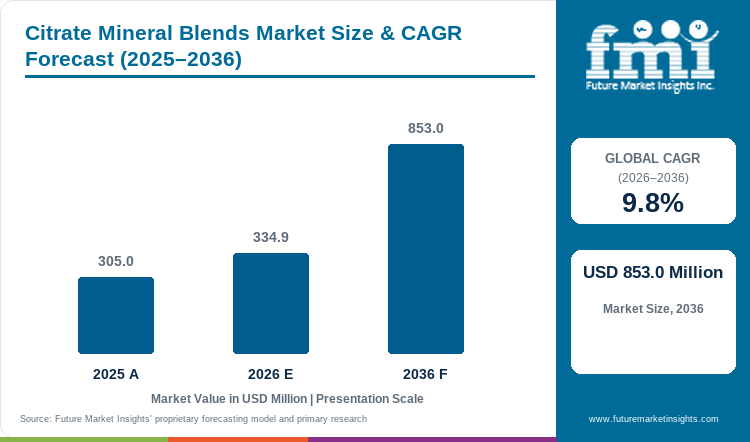
- Market Size (2026)
- USD 334.9 Mn
- Forecast (2036)
- USD 853.0 Mn
- CAGR (2026 to 2036)
- 9.8%
How big is the Citrate Mineral Blends Market in 2026?
USD 334.9 million in 2026 and USD 853.0 million by 2036, expanding at 9.8% CAGR.
Demand for citrate mineral blends is projected to expand at 9.8% CAGR from 2026 to 2036. Valuation rises from USD 305.0 million in 2025 to USD 334.9 million in 2026 and reaches USD 853.0 million by 2036. Growers use crop micronutrients to address limited mineral access under high-pH or difficult-water conditions. USDA NASS reported in May 2026 that 58% of planted cotton acres received nitrogen during 2025. The cotton application rate shows how planned nutrient programs already shape crop input decisions. Field tests identify specific mineral gaps and help growers select chelated blends for measured conditions. Added formulation cost must deliver a practical field benefit before repeat orders become routine.
Farm systems create different routes for soluble mineral use across major agricultural countries. South Korea is projected at 9.4% CAGR through 2036, supported by smart-farm programs that improve control over nutrient timing. Japan is forecast to expand at 7.8% through 2036, shaped by larger farms operating with fewer workers. In June 2025 South Korea’s agriculture ministry named KOAT the national controlled-horticulture support center. KOAT trains operators and supports farm data that can guide timed fertigation decisions. Japanese farms favor straightforward dosing because larger holdings need input routines that require less labor. These conditions reward blends that dissolve reliably and work with existing irrigation or spray practices.
Key Takeaways
- Growers use citrate mineral blends to improve nutrient access under difficult pH or water conditions.
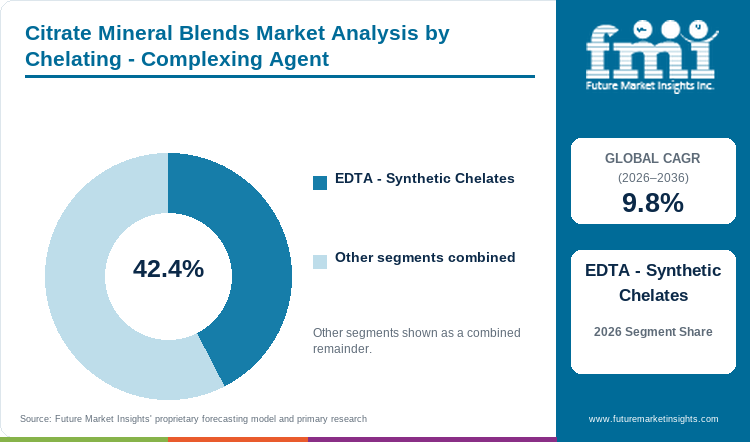
- Based on chelating - complexing agent, EDTA - synthetic chelates are projected to account for 42.4% in 2026, supported by well-documented stability ranges.
- By nutrient, iron is estimated to hold 48.4% in 2026, driven by recurring correction needs under high-pH conditions.
- In 2026, cereals & grains are expected to lead crop type with 44.7% share, reinforced by broad acreage and recurring seasonal nutrition needs.
- Higher chelate costs can delay repeat orders when field trials fail to show a clear crop response.
- Key companies include Valagro (Syngenta Biologicals), Compo Expert, Van Iperen International, ADOB, Aries Agro, Brandt, Rovensa Next (Tradecorp), and BASF.
Analyst Perspective
"Commercial opportunity improves when formulators match citrate mineral blends to measured pH conditions and existing fertigation or foliar routines. Wider adoption depends on stable mixing and repeatable crop response before growers replace lower-cost mineral sources within seasonal programs."
- Nandini Roy Choudhury, Principal Consultant, Future Market Insights
How is the citrate mineral blends market segmented across commercial categories?
The citrate mineral blends market is segmented by Chelating - Complexing Agent, Nutrient, Crop Type, Application Method, Sales Channel, and Region.
The citrate mineral blends market uses five commercial axes plus Region for geographic analysis. Chelating - complexing agent includes EDTA - synthetic chelates, amino acid complexes, organic acid complexes, and lignosulfonates & others. Nutrient includes iron, zinc, manganese & copper, boron - moly & multi-nutrient, and others. Crop type includes cereals & grains, fruits & vegetables, oilseeds & pulses, turf & ornamentals, and others. Application method includes fertigation, foliar, soil, and others within the verified taxonomy. Sales channel includes agri-input distributors, cooperatives, agri-retail chains, online - direct-to-farm, and others.
How do EDTA - synthetic chelates shape demand within the chelating - complexing agent category?
EDTA - synthetic chelates help formulators keep metal nutrients soluble in finished crop nutrition products. EU fertilizer rules separate chelating agents from complexing agents and require stability information for micronutrient chelates. EU requirements give formulators defined specifications for developing commercial chelated micronutrient blends used in agriculture. Organic-acid and amino-acid systems use different ligands with stability ranges suited to other formulation conditions. Formulators compare crop needs with pH and mixing conditions before selecting a ligand for spray or irrigation use. Product choice depends on finished-blend solubility and reliable mineral delivery throughout the planned application.
- Within chelating - complexing agent, EDTA - synthetic chelates are projected to hold 42.4% share in 2026, linked to established stability data.
- The July 2026 EU consolidated rule connects chelate claims with named ligands and declared stability ranges for fertilizer products.
What operating conditions explain iron’s large share within the nutrient category?
High-pH soil can reduce iron availability even when total soil iron appears sufficient for crops. Chelated iron lets agronomists match ligand chemistry with the pH range needed for availability. The same selection logic applies to agricultural chelates used for visible crop iron deficiency. Visible chlorosis gives farms a reason to test whether chelated iron improves local nutrient access. Zinc and manganese products address different deficiencies within the same seasonal nutrition program. Iron remains common under alkaline conditions because pH directly affects how long the nutrient stays available. Growers compare crop response and application cost before adding chelated iron to routine nutrition plans.
- The nutrient category is forecast to be led by iron at 48.4% share in 2026, driven by high-pH correction needs.
- The July 2026 EU rule sets conditions for named iron chelates and their declared stability ranges in fertilizer products.
How do cereals & grains shape demand within the crop type category?
Cereal farms manage micronutrients across large planted areas and repeat nutrient decisions each growing season. Destatis reported in 2026 that Germany harvested 45 million tons of grain during the 2025 season. Winter wheat covered 2.9 million hectares and created substantial scope for field-level nutrient management. Soil testing helps farms identify mineral gaps before they add specialty fertilizers to established programs. Higher crop value can justify more intensive nutrition programs across fruits and vegetables. Oilseeds and pulses require boron and molybdenum alongside zinc at specific development stages. Broad acreage spreads small per-hectare nutrient decisions across many cereal fields and creates substantial demand.
- By crop type, cereals & grains are estimated to hold 44.7% in 2026, supported by broad planted areas and repeated seasonal nutrition decisions.
- Destatis reported in 2026 that German grain output reached 45 million tons during the 2025 harvest season.
What operating conditions support fertigation within the application method category?
Fertigation carries dissolved nutrients through irrigation water and places them close to plant roots. Citrate mineral blends must dissolve and remain stable through irrigation to deliver the planned dose. South Korea’s agriculture ministry issued a smart-farming plan in February 2025 for greenhouse production through 2029. The plan targets smart systems across 35% of 55,000 greenhouse hectares by 2029. Timed irrigation gives water-soluble fertilizers a direct delivery route within controlled crop programs. Foliar and soil applications remain useful for crop stages or field conditions that require another delivery method. Fertigation gains preference on farms with controlled irrigation timing and integrated mineral dosing.
- Fertigation is set to lead the application method category with 45.3% share in 2026, enabled by irrigation systems that carry dissolved blends efficiently.
- South Korea’s February 2025 plan targets smart systems across 35% of national greenhouse area by 2029.
How do agri-input distributors influence selection within the sales channel category?
Crop diagnosis starts product selection because farms must match a mineral formula with measured deficiency. Local dealers connect crop stage and soil pH with products suited to the application method. Defra reported in June 2026 that 69% of surveyed English farmers had a nutrient management plan. Many respondents used published guidance or professional advice to prepare and maintain those plans. Published guidance and professional advice support fertilizer additives and specialty minerals sold through agri-input distributors. Distributor guidance lowers selection risk by helping growers compare ligand chemistry with nutrient combinations and application methods. Direct channels remain practical for farms that understand the chemistry and dose required for their fields.
- Within sales channel, agri-input distributors are projected to hold 36.2% in 2026, reinforced by local advice that lowers product-selection risk.
- Defra reported in June 2026 that 69% of surveyed English farmers used a nutrient management plan.
What are the drivers, restraints and opportunities in the Citrate Mineral Blends Market?
Targeted micronutrient correction supports demand, chelate cost and compatibility limit repeat use, and lower-impact ligand chemistry gives formulators a new qualification route.
- Driver: Difficult pH and water conditions raise demand for soluble mineral products that keep nutrients available to crops.
- Restraint: High chelate costs and poor compatibility can weaken repeat demand when field trials show limited crop benefit.
- Opportunity: Alternative ligands can gain adoption if formulators prove stable mineral delivery and consistent crop performance.
Field testing helps growers identify mineral needs before adding specialized nutrition to established fertilizer programs. USDA NASS reported in May 2026 that potato farms applied nitrogen on 99% of planted acres during 2025. Phosphate reached 88% of planted acres and potash reached 83% during the same crop year. The application rates do not measure citrate blend sales but confirm intensive nutrient programs across potato production. Targeted delivery programs can include controlled-release fertilizers and specialty micronutrients for specific field needs. Growers choose a chelated blend if pH or water conditions reduce mineral access from simpler sources. Field advisers compare crop response with lower-cost salts before recommending repeat purchases. The premium option must deliver enough crop benefit to justify its added formulation cost.
Lower-cost nutrient sources can meet crop needs and reduce the case for routine chelate use. BASF announced a North American price increase in June 2026 for selected EDTA and DTPA chelating agents. BASF said raw-material and energy costs plus logistics expenses prompted the adjustment. Higher formulation costs constrain routine use on crops that show no visible deficiency. Growers may accept a premium under difficult pH conditions that reduce nutrient access from simpler sources. Seasonal reorders rely on field evidence showing that added chemistry improves crop response under measured conditions. Clear mixing guidance reduces failed applications and protects the expected benefit from a premium product.
Formulators are testing alternative ligands instead of relying on synthetic chelates for every crop nutrition requirement. Nouryon gained ISCC PLUS certification at its Herkenbosch green-chelates site in January 2025. The certification covers biobased or bio-circular feedstocks used to produce biodegradable chelating agents at that site. Developers test these ligands under the same pH and water conditions used to qualify existing systems. Crop products need stable mixing and field evidence before growers replace familiar chemistry. Developers can also compare alternative ligands with biostimulants used within the same crop nutrition program. Lower-impact chemistry gains an adoption route if it delivers the intended mineral without complicating application routines. Clear dose guidance helps growers compare results before adding the product to recurring seasonal plans.
Which country CAGRs are profiled in the Citrate Mineral Blends Market?
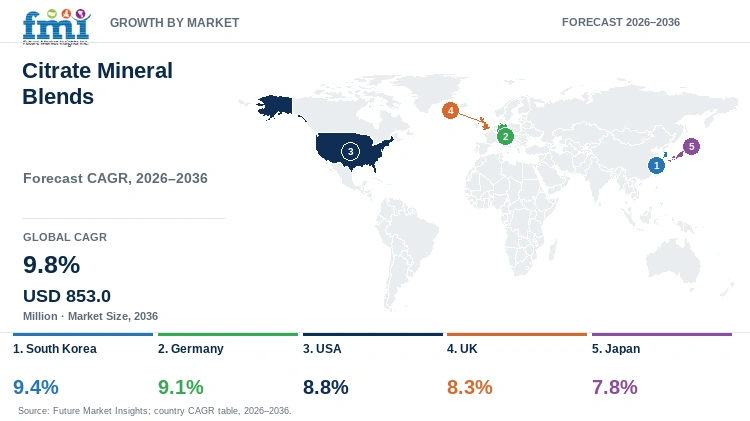
| Country | CAGR |
|---|---|
| South Korea | 9.4% |
| Germany | 9.1% |
| USA | 8.8% |
| UK | 8.3% |
| Japan | 7.8% |
How do country-level CAGRs compare in the Citrate Mineral Blends Market?
The five profiled countries span 1.6 percentage points across the forecast table. South Korea and Germany post higher modeled rates than the USA within that range.
- South Korean greenhouse programs use timed irrigation as a practical delivery route for soluble mineral blends within managed crop schedules.
- Germany’s large cereal base creates repeated seasonal micronutrient decisions across extensive acreage and rewards products with practical application guidance.
- U.S. farms manage specialty nutrition across diverse crop and soil conditions, so ligand selection depends on matching chemistry with local field needs.
- UK nutrient planning often uses published guidance or professional advice, giving distributors a defined role in explaining specialty mineral choices.
- Japan’s varied crop and water conditions favor simple dose instructions that fit existing spray or irrigation routines without adding unnecessary labor.
Similar country CAGRs can produce different buying behavior because farm systems and advice routes create distinct local qualification needs.
The full report provides country-level CAGR analysis across North America, Latin America, Western Europe, and Eastern Europe. Country coverage also includes East Asia, South Asia and Pacific, and the Middle East and Africa.
Country-wise Analysis
- South Korea is projected to grow at 9.4% CAGR through 2036, supported by controlled horticulture programs that use data-led nutrient scheduling. In June 2025 MAFRA named KOAT the national smart-farming support center for controlled horticulture. KOAT trains growers to use farm equipment and data for planned nutrient applications. KOAT support gives smart fertilizer programs a practical role in timed fertigation across managed greenhouse systems. Citrate blends must dissolve consistently so automated schedules deliver the intended mineral dose. Growers can compare application records with crop response before expanding repeat use across seasons. Manual corrections weaken the value of automated dosing and can delay repeat orders.
- Germany’s fertilizer rules shape product qualification before specialty mineral blends enter routine field programs. Germany’s citrate mineral blends market is projected to grow at 9.1% CAGR through 2036, shaped by cereal scale and fertilizer declarations. Destatis reported in 2026 that Germany harvested 45 million tons of grain during 2025. Large crop volumes make small nutrient decisions important across substantial planted areas. EU rules require clear declarations for chelating and complexing systems used in fertilizer products. Advisers compare ligand claims through labels that explain stability ranges and intended use. Formulators need field evidence showing that premium blends deliver enough crop benefit to justify added cost. Strong qualification data supports reorders while weak proof sends spending toward simpler mineral sources.
- Broad-acre farming gives U.S. advisers many sites for testing specialty nutrition under field conditions. The citrate mineral blends market in the USA is estimated to post 8.8% CAGR through 2036, influenced by diverse crop and soil conditions. USDA NASS reported in June 2026 that farmers planted 95.3 million corn acres for the 2026 crop. National scale supports precision agriculture trials that compare micronutrient response across production areas. Premium citrate blends must improve mineral access beyond simple salts under local soil and water conditions. Farm advisers use trial results to guide product selection before seasonal orders become routine. Dealer guidance can strengthen reorders across fields that deliver clear results from repeated applications. Weak crop response shifts spending toward lower-cost mineral sources that already meet basic needs.
- Nutrient planning gives UK farms a structured way to test specialty mineral inputs before regular use. Citrate blend demand in the UK is predicted to advance at 8.3% CAGR through 2036, linked to structured nutrient planning and field testing. Defra reported in June 2026 that 78% of surveyed English farmers tested soil nutrient indices. The national survey found that 79% also tested soil pH before making nutrient decisions. These measurements help farms identify conditions in which chelated or complexed minerals can improve plant access. Farm records also let growers compare crop response between seasons before paying for added chemistry. Clear dose guidance supports repeat use for measured deficiencies or documented pH problems. Weak results can move spending back toward standard fertilizer programs with lower input costs.
- Japan’s larger farm businesses are simplifying input routines as fewer workers manage more land. Blend sales in Japan are forecast to expand at 7.8% CAGR by 2036, shaped by larger operations and labor-saving input routines. MAFF’s March 2026 final census placed average managed farmland at 3.6 hectares per farm business in 2025. Holdings of 20 hectares or more controlled about half of managed farmland nationwide. Larger operations favor clear dosing that works with existing spray or irrigation routines without adding extra labor. Local crop and water conditions require field testing before a blend becomes routine. Simple application guidance reduces work during seasonal treatments and helps staff avoid dosing errors. Products that fit established routines and deliver consistent crop response can earn repeat orders.
Who are the notable companies in the citrate mineral blends market?
Valagro (Syngenta Biologicals), Compo Expert, Van Iperen International, ADOB, Aries Agro, Brandt, Rovensa Next (Tradecorp), and BASF.
Competition spans finished products and farm support alongside distribution access and upstream chelating chemistry. Compo Expert, Van Iperen International, and ADOB sell soluble micronutrient products designed for agricultural use. Valagro, Aries Agro, Brandt, and Rovensa Next combine crop nutrition portfolios with field-facing support channels. BASF supplies chelating chemistry to formulators that produce finished agricultural mineral products for crop programs. Buyers compare these routes with simpler mineral sources by reviewing stability data and crop fit alongside mixing guidance and field results.
- Specialty chelated fertilizer producers: Compo Expert, Van Iperen International, and ADOB supply soluble mineral products with defined nutrient chemistry for crop programs.
- Field-facing crop nutrition platforms: Valagro (Syngenta Biologicals), Aries Agro, Brandt, and Rovensa Next (Tradecorp) combine products with agronomic support channels.
- Upstream chelate chemistry: BASF supplies ligand chemistry that formulators use in finished agricultural mineral products.
Competitive Benchmarking: Citrate Mineral Blends Market
| Company | Finished Chelated Blend Coverage | Foliar / Fertigation Delivery | Chelating / Complexing Chemistry Breadth | Geographic Reach |
|---|---|---|---|---|
| Valagro (Syngenta Biologicals) | Medium | Medium | Medium | Global through Syngenta Biologicals |
| Compo Expert | High | High | Medium | Europe and international specialty-fertilizer markets |
| Van Iperen International | High | High | Medium | Commercial reach in more than 120 countries |
| ADOB | High | High | High | Europe with international export markets |
| Aries Agro | High | Medium | Medium | India with selected export markets |
| Brandt | Medium | High | Medium | Americas with international specialty-nutrition routes |
| Rovensa Next (Tradecorp) | High | High | Medium | Europe, Americas, MENA and APAC |
| BASF | Low | Low | High | Global chelating-chemistry footprint including agriculture |
A High rating means broad current evidence supports the full benchmarking criterion used for that company. A Medium rating means direct evidence supports only part of the stated criterion. A Low rating confirms a company role but shows limited evidence of finished-product coverage. Geographic reach describes the regions each company serves and does not affect its assigned benchmark score.
Key Developments in the Citrate Mineral Blends Market
- In June 2026, BASF announced a North American price adjustment for selected Trilon chelating agents covering agriculture and other uses. The adjustment adds cost pressure for formulators that depend on chelating chemistry in finished nutrient products.
- In February 2026, Aries Agro opened its Sayakha manufacturing unit for specialty fertilizer production. The planned annual capacity is 6,000 MT for boron and NPK water-soluble fertilizers.
- In January 2025, Syngenta and TraitSeq announced a collaboration using AI biomarkers to develop new agricultural biostimulants. The collaboration expands biological options that can complement established mineral nutrition programs.
Key Players in the Citrate Mineral Blends Market
Specialized chelated fertilizer producers
- Compo Expert
- Van Iperen International
- ADOB
Field-facing crop nutrition platforms
- Valagro (Syngenta Biologicals)
- Aries Agro
- Brandt
- Rovensa Next (Tradecorp)
Upstream chelating chemistry
- BASF
Citrate Mineral Blends Market - Report Scope
| Coverage field | Report scope |
|---|---|
| Market breakdown | By chelating - complexing agent, nutrient, crop type, application method, sales channel and region. |
| Quantitative Units | USD million. |
| Market Definition | Commercial revenue from agricultural mineral blends using citrate, chelating or complexing systems within the stated taxonomy. Bulk fertilizers without the defined mineral-complexing function are excluded. |
| Regions Covered | North America, Latin America, Western Europe, Eastern Europe, East Asia, South Asia and Pacific, and Middle East and Africa. |
| Countries Covered | South Korea, Germany, USA, UK, Japan, and 20+ countries included in the full report. |
| Key Companies Profiled | Valagro (Syngenta Biologicals), Compo Expert, Van Iperen International, ADOB, Aries Agro, Brandt, Rovensa Next (Tradecorp), BASF. |
| Forecast Period | 2026 to 2036. |
| Approach | Primary and secondary research with market triangulation. |
Citrate Mineral Blends Market - Research Methodology
| Method | Approach |
|---|---|
| Primary Research | FMI analysts gathered input from manufacturers, service providers, technology developers, distributors, end users, procurement teams, and subject-matter experts. Interviews examined purchasing decisions, product or service evaluation, adoption barriers, approval requirements, pricing considerations, and expectations for technical or commercial support. Respondents were also asked what evidence is required before a trial, pilot, or initial order develops into regular purchasing. |
| Desk Research | Desk research covered government statistics, regulatory publications, trade data, industry associations, technical literature, standards, company filings, product information, and official corporate announcements. Sources were reviewed for relevance, publication date, geographic coverage, and consistency with the defined market scope. Claims relating to performance, applications, approvals, capacity, investment, and commercial activity were retained only when supported by credible public evidence. |
| Market Sizing and Forecasting | The market model combined the baseline value with historical performance, segment structure, pricing and volume indicators, adoption levels, company participation, and country-level demand conditions. Forecast assumptions considered economic activity, investment trends, regulatory developments, technology adoption, purchasing cycles, supply availability, and barriers to wider market use. Segment and regional estimates were reconciled before the final market total was calculated. |
| Data Validation | Estimates were checked against multiple independent indicators, including public data, company activity, trade patterns, industry developments, and findings from primary interviews. Validation also tested whether products, services, applications, and company revenues fell within the defined market boundaries. Adjacent categories, unsupported claims, overlapping revenues, and activities without direct market relevance were excluded to reduce double counting and maintain consistency across segments and countries. |
Citrate Mineral Blends Market by Segments
Citrate Mineral Blends Market segmented by Chelating - Complexing Agent:
- EDTA - Synthetic Chelates
- Amino Acid Complexes
- Organic Acid Complexes
- Lignosulfonates & Others
Citrate Mineral Blends Market segmented by Nutrient:
- Iron
- Zinc
- Manganese & Copper
- Boron - Moly & Multi-Nutrient
- Others
Citrate Mineral Blends Market segmented by Crop Type:
- Cereals & Grains
- Fruits & Vegetables
- Oilseeds & Pulses
- Turf & Ornamentals
- Others
Citrate Mineral Blends Market segmented by Application Method:
- Fertigation
- Foliar
- Soil
- Others
Citrate Mineral Blends Market segmented by Sales Channel:
- Agri-Input Distributors
- Cooperatives
- Agri-Retail Chains
- Online - Direct-to-Farm
- Others
Citrate Mineral Blends Market by Region:
- North America
- United States
- Canada
- Latin America
- Brazil
- Mexico
- Argentina
- Chile
- Western Europe
- Germany
- France
- United Kingdom
- Italy
- Spain
- Benelux
- Nordics
- Eastern Europe
- Poland
- Czech Republic
- Romania
- Hungary
- East Asia
- China
- Japan
- South Korea
- South Asia and Pacific
- India
- ASEAN
- Australia and New Zealand
- Middle East and Africa
- GCC Countries
- South Africa
- Türkiye
- Israel
Research Sources and Bibliography
- United States Department of Agriculture, National Agricultural Statistics Service. (2026, May). 2025 Agricultural Chemical Use Survey: Cotton.
- United States Department of Agriculture, National Agricultural Statistics Service. (2026, May). 2025 Agricultural Chemical Use Survey: Potatoes.
- United States Department of Agriculture, National Agricultural Statistics Service. (2026, June 30). Corn planted acreage down 3% from 2025, soybean acreage up 5% from last year.
- Department for Environment, Food & Rural Affairs. (2026, June 11). Farm practices survey February 2026: Nutrient management.
- Federal Statistical Office of Germany (Destatis). (2026). 2025 grain and potato harvest: 45 million tons of grain and 14 million tons of potatoes.
- Ministry of Agriculture, Forestry and Fisheries of Japan. (2026, March 31). Overview of the 2025 Census of Agriculture and Forestry results: Final values.
- Ministry of Agriculture, Food and Rural Affairs, Republic of Korea. (2025, February). First master plan for promotion of the growth of the smart-farming industry, 2025-2029.
- Ministry of Agriculture, Food and Rural Affairs, Republic of Korea. (2025, June 17). South Korea accelerates turning agricultural production into smart farming through smart farming support centres.
- BASF. (2026, June 5). BASF to adjust prices for select Trilon chelating agents in North America.
- BASF. (2025, April 16). BASF expands sustainable chelating agent solutions with Trilon G.
- COMPO EXPERT. (2025, April 2). Introducing the Basfoliar Premium SL line: Powered by Leaf Care Technology.
- COMPO EXPERT. (2026, July 18). Floranid Twin Permanent 16-5-15: Proven universal slow-release fertilizer, sustainably optimized.
- Van Iperen International. (2025, October 10). IPE Technology is now CE Biostimulant certified.
- Van Iperen International. (2025, December 3). Agritema’s expertise delivers Van Iperen biostimulants to Ukrainian growers.
- Nouryon. (2025, January 28). Nouryon achieves ISCC PLUS certification at green chelates manufacturing site in Herkenbosch, Netherlands.
- Aries Agro Limited. (2026, February 12). Inauguration of manufacturing unit at GIDC Sayakha Industrial Estate.
- Aries Agro Limited. (2026, March 5). Inauguration of relocated manufacturing unit at Unnao.
- BRANDT. (2025, September 3). Talc USA fully integrates under new business name, BRANDT Planting Solutions.
- Syngenta. (2025, January 9). Artificial intelligence is speeding up the development of the next generation of biostimulants.
- Syngenta. (2025, February 26). Syngenta strengthens global leadership in agricultural biologicals.
- Syngenta. (2025, June 30). Syngenta to become global leader in biologicals; expanding nature-inspired solutions for farmers.
- Rovensa Next. (2025, May 12). Rovensa Next launches Biostimulation 360°.
- Rovensa Next. (2026, September 10). Rovensa Next secures financing to accelerate biosolutions R&D and agricultural innovation in Brazil.
- Novonesis. (2026, June 11). Rovensa Next to distribute Novonesis biosolutions for plant health in the United States.
- European Parliament and Council of the European Union. (2026, July 1). Regulation (EU) 2019/1009 laying down rules on the making available on the market of EU fertilising products: Consolidated text.
This bibliography gives readers a concise source list while the full report retains all detailed references and supporting citations.
This Report Answers
- How large is the citrate mineral blends market during 2026 and 2036?
- Which operating conditions make chelated mineral delivery worth the added formulation cost for growers?
- Which chelating - complexing agent holds the largest stated category share during 2026?
- Which nutrient category holds the largest stated category share during 2026?
- How do crop type and application method change formulation requirements across farm programs?
- Which country conditions explain the different CAGR paths across the five profiled markets?
- Which current cost pressures can slow repeat orders for synthetic chelate systems?
- Which companies supply finished blends and field support alongside distribution access or upstream chelating chemistry?
- How are smart-farming programs changing nutrient timing and fertigation decisions for growers?
Frequently Asked Questions
How big is the citrate mineral blends market in 2026?
The citrate mineral blends market is valued at USD 334.9 million in 2026 and projected to reach USD 853.0 million by 2036. Growers use soluble mineral products to improve nutrient access under difficult pH or water conditions. That operating need supports the forecast value path through 2036 across targeted crop nutrition programs.
What is the CAGR of the citrate mineral blends market from 2026 to 2036?
Growth in the citrate mineral blends market is projected at 9.8% CAGR from 2026 through 2036. Growers use chelated minerals under high-pH or difficult-water conditions that make simple mineral salts less available.
Which chelating - complexing agent holds the largest 2026 category share?
Based on chelating - complexing agent, EDTA - synthetic chelates are projected to account for 42.4% in 2026. Formulators use documented stability ranges to match ligand choice with crop needs and expected mixing conditions.
Which nutrient segment holds the largest category share during 2026?
By nutrient, iron is estimated to hold 48.4% in 2026. Chelated iron helps maintain nutrient availability in alkaline soils and high-pH water that reduce access from plain iron sources.
How do the profiled country CAGRs compare in the citrate mineral blends market?
South Korea is projected at 9.4% CAGR and Germany at 9.1% through 2036. The USA follows with the UK and Japan at lower rates because farm systems and input planning create different buying conditions.
Which companies are currently active in the citrate mineral blends market?
Key companies include Valagro (Syngenta Biologicals), Compo Expert, Van Iperen International, ADOB, Aries Agro, Brandt, Rovensa Next (Tradecorp), and BASF. Their roles cover finished blends, farm advice, distribution channels, and chelating agents used within crop nutrition programs.
Preview the report firsthand - request a free sample
Get SampleGet the brochure for pricing and purchase details.
Get PDFTable of Content
- Key Takeaways
- Market Size and CAGR
- Top Growth Driver
- Fastest Growing Segment
- Leading Region
- Key Companies
- Emerging Opportunities
- Executive Summary
- Global Market Outlook
- Demand-side Trends
- Supply-side Trends
- Technology Roadmap Analysis
- Analysis and Recommendations
- Analyst Perspective (What is happening? Why now? What should investors know?)
- Key Questions Answered
- How large is the market?
- What is the CAGR?
- What are key trends?
- Which region dominates?
- Who are the leaders?
- Market Overview
- Market Coverage / Taxonomy
- Market Definition / Scope / Limitations
- Research Methodology
- Chapter Orientation
- Analytical Lens and Working Hypotheses
- Market Structure, Signals, and Trend Drivers
- Benchmarking and Cross-market Comparability
- Market Sizing, Forecasting, and Opportunity Mapping
- Research Design and Evidence Framework
- Desk Research Programme (Secondary Evidence)
- Expert Input and Fieldwork (Primary Evidence)
- Tooling, Models, and Reference Databases
- Data Engineering and Model Build
- Quality Assurance and Audit Trail
- Market Background
- Market Dynamics (Drivers, Restraints, Opportunity, Trends)
- Scenario Forecast (Optimistic, Likely, Conservative)
- Impact Analysis
- AI Impact
- Sustainability Impact
- Regulatory Impact
- Technology Impact
- Consumer / Buyer Analysis
- Purchase Drivers
- Adoption Barriers
- Buyer Journey
- Opportunity Map Analysis
- Product Life Cycle Analysis
- Supply Chain Analysis
- Investment Feasibility Matrix
- Value Chain Analysis
- PESTLE and Porter's Analysis
- Regulatory Landscape
- Regional Parent Market Outlook
- Production and Consumption Statistics
- Import and Export Statistics
- Global Market Analysis and Forecast, 2021 to 2036
- Historical Market Size Value (USD Million) Analysis, 2021 to 2025
- Current and Future Market Size Value (USD Million) Projections, 2026 to 2036
- Y-o-Y Growth Trend Analysis
- Absolute $ Opportunity Analysis
- Global Market Pricing Analysis, 2021 to 2036
- Global Market Analysis and Forecast, By Chelating - Complexing Agent, 2021 to 2036
- Introduction / Key Findings
- Historical Market Size Value (USD Million) Analysis By Chelating - Complexing Agent, 2021 to 2025
- Current and Future Market Size Value (USD Million) Analysis and Forecast By Chelating - Complexing Agent, 2026 to 2036
- EDTA - Synthetic Chelates
- Amino Acid Complexes
- Organic Acid Complexes
- Lignosulfonates & Others
- Y-o-Y Growth Trend Analysis By Chelating - Complexing Agent, 2021 to 2025
- Absolute $ Opportunity Analysis By Chelating - Complexing Agent, 2026 to 2036
- Global Market Analysis and Forecast, By Nutrient, 2021 to 2036
- Introduction / Key Findings
- Historical Market Size Value (USD Million) Analysis By Nutrient, 2021 to 2025
- Current and Future Market Size Value (USD Million) Analysis and Forecast By Nutrient, 2026 to 2036
- Iron
- Zinc
- Manganese & Copper
- Boron - Moly & Multi-Nutrient
- Others
- Y-o-Y Growth Trend Analysis By Nutrient, 2021 to 2025
- Absolute $ Opportunity Analysis By Nutrient, 2026 to 2036
- Global Market Analysis and Forecast, By Crop Type, 2021 to 2036
- Introduction / Key Findings
- Historical Market Size Value (USD Million) Analysis By Crop Type, 2021 to 2025
- Current and Future Market Size Value (USD Million) Analysis and Forecast By Crop Type, 2026 to 2036
- Cereals & Grains
- Fruits & Vegetables
- Oilseeds & Pulses
- Turf & Ornamentals
- Others
- Y-o-Y Growth Trend Analysis By Crop Type, 2021 to 2025
- Absolute $ Opportunity Analysis By Crop Type, 2026 to 2036
- Global Market Analysis and Forecast, By Application Method, 2021 to 2036
- Introduction / Key Findings
- Historical Market Size Value (USD Million) Analysis By Application Method, 2021 to 2025
- Current and Future Market Size Value (USD Million) Analysis and Forecast By Application Method, 2026 to 2036
- Fertigation
- Foliar
- Soil
- Others
- Y-o-Y Growth Trend Analysis By Application Method, 2021 to 2025
- Absolute $ Opportunity Analysis By Application Method, 2026 to 2036
- Global Market Analysis and Forecast, By Sales Channel, 2021 to 2036
- Introduction / Key Findings
- Historical Market Size Value (USD Million) Analysis By Sales Channel, 2021 to 2025
- Current and Future Market Size Value (USD Million) Analysis and Forecast By Sales Channel, 2026 to 2036
- Agri-Input Distributors
- Cooperatives
- Agri-Retail Chains
- Online - Direct-to-Farm
- Others
- Y-o-Y Growth Trend Analysis By Sales Channel, 2021 to 2025
- Absolute $ Opportunity Analysis By Sales Channel, 2026 to 2036
- Global Market Analysis and Forecast, By Region, 2021 to 2036
- Introduction
- Historical Market Size Value (USD Million) Analysis By Region, 2021 to 2025
- Current Market Size Value (USD Million) Analysis and Forecast By Region, 2026 to 2036
- North America
- Latin America
- Western Europe
- Eastern Europe
- East Asia
- South Asia and Pacific
- Middle East and Africa
- Market Attractiveness Analysis By Region
- North America Market Analysis and Forecast, By Country, 2021 to 2036
- Historical Market Size Value (USD Million) Trend Analysis By Market Taxonomy, 2021 to 2025
- Market Size Value (USD Million) Forecast By Market Taxonomy, 2026 to 2036
- By Country
- United States
- Canada
- By Chelating - Complexing Agent
- By Nutrient
- By Crop Type
- By Application Method
- By Sales Channel
- By Country
- Market Attractiveness Analysis
- By Country
- By Chelating - Complexing Agent
- By Nutrient
- By Crop Type
- By Application Method
- By Sales Channel
- Key Takeaways
- Latin America Market Analysis and Forecast, By Country
- Historical Market Size Value (USD Million) Trend Analysis By Market Taxonomy, 2021 to 2025
- Market Size Value (USD Million) Forecast By Market Taxonomy, 2026 to 2036
- By Country
- Brazil
- Mexico
- Argentina
- Chile
- By Chelating - Complexing Agent
- By Nutrient
- By Crop Type
- By Application Method
- By Sales Channel
- By Country
- Market Attractiveness Analysis
- By Country
- By Chelating - Complexing Agent
- By Nutrient
- By Crop Type
- By Application Method
- By Sales Channel
- Key Takeaways
- Western Europe Market Analysis and Forecast, By Country
- Historical Market Size Value (USD Million) Trend Analysis By Market Taxonomy, 2021 to 2025
- Market Size Value (USD Million) Forecast By Market Taxonomy, 2026 to 2036
- By Country
- Germany
- France
- United Kingdom
- Italy
- Spain
- Benelux
- Nordics
- By Chelating - Complexing Agent
- By Nutrient
- By Crop Type
- By Application Method
- By Sales Channel
- By Country
- Market Attractiveness Analysis
- By Country
- By Chelating - Complexing Agent
- By Nutrient
- By Crop Type
- By Application Method
- By Sales Channel
- Key Takeaways
- Eastern Europe Market Analysis and Forecast, By Country
- Historical Market Size Value (USD Million) Trend Analysis By Market Taxonomy, 2021 to 2025
- Market Size Value (USD Million) Forecast By Market Taxonomy, 2026 to 2036
- By Country
- Poland
- Czech Republic
- Romania
- Hungary
- By Chelating - Complexing Agent
- By Nutrient
- By Crop Type
- By Application Method
- By Sales Channel
- By Country
- Market Attractiveness Analysis
- By Country
- By Chelating - Complexing Agent
- By Nutrient
- By Crop Type
- By Application Method
- By Sales Channel
- Key Takeaways
- East Asia Market Analysis and Forecast, By Country
- Historical Market Size Value (USD Million) Trend Analysis By Market Taxonomy, 2021 to 2025
- Market Size Value (USD Million) Forecast By Market Taxonomy, 2026 to 2036
- By Country
- China
- Japan
- South Korea
- By Chelating - Complexing Agent
- By Nutrient
- By Crop Type
- By Application Method
- By Sales Channel
- By Country
- Market Attractiveness Analysis
- By Country
- By Chelating - Complexing Agent
- By Nutrient
- By Crop Type
- By Application Method
- By Sales Channel
- Key Takeaways
- South Asia and Pacific Market Analysis and Forecast, By Country
- Historical Market Size Value (USD Million) Trend Analysis By Market Taxonomy, 2021 to 2025
- Market Size Value (USD Million) Forecast By Market Taxonomy, 2026 to 2036
- By Country
- India
- ASEAN
- Australia and New Zealand
- By Chelating - Complexing Agent
- By Nutrient
- By Crop Type
- By Application Method
- By Sales Channel
- By Country
- Market Attractiveness Analysis
- By Country
- By Chelating - Complexing Agent
- By Nutrient
- By Crop Type
- By Application Method
- By Sales Channel
- Key Takeaways
- Middle East and Africa Market Analysis and Forecast, By Country
- Historical Market Size Value (USD Million) Trend Analysis By Market Taxonomy, 2021 to 2025
- Market Size Value (USD Million) Forecast By Market Taxonomy, 2026 to 2036
- By Country
- GCC Countries
- South Africa
- Türkiye
- Israel
- By Chelating - Complexing Agent
- By Nutrient
- By Crop Type
- By Application Method
- By Sales Channel
- By Country
- Market Attractiveness Analysis
- By Country
- By Chelating - Complexing Agent
- By Nutrient
- By Crop Type
- By Application Method
- By Sales Channel
- Key Takeaways
- Key Countries Market Analysis
- United States
- Pricing Analysis
- Market Share Analysis, 2025
- By Chelating - Complexing Agent
- By Nutrient
- By Crop Type
- By Application Method
- By Sales Channel
- Canada
- Pricing Analysis
- Market Share Analysis, 2025
- By Chelating - Complexing Agent
- By Nutrient
- By Crop Type
- By Application Method
- By Sales Channel
- Mexico
- Pricing Analysis
- Market Share Analysis, 2025
- By Chelating - Complexing Agent
- By Nutrient
- By Crop Type
- By Application Method
- By Sales Channel
- Brazil
- Pricing Analysis
- Market Share Analysis, 2025
- By Chelating - Complexing Agent
- By Nutrient
- By Crop Type
- By Application Method
- By Sales Channel
- Chile
- Pricing Analysis
- Market Share Analysis, 2025
- By Chelating - Complexing Agent
- By Nutrient
- By Crop Type
- By Application Method
- By Sales Channel
- Germany
- Pricing Analysis
- Market Share Analysis, 2025
- By Chelating - Complexing Agent
- By Nutrient
- By Crop Type
- By Application Method
- By Sales Channel
- United Kingdom
- Pricing Analysis
- Market Share Analysis, 2025
- By Chelating - Complexing Agent
- By Nutrient
- By Crop Type
- By Application Method
- By Sales Channel
- Italy
- Pricing Analysis
- Market Share Analysis, 2025
- By Chelating - Complexing Agent
- By Nutrient
- By Crop Type
- By Application Method
- By Sales Channel
- Spain
- Pricing Analysis
- Market Share Analysis, 2025
- By Chelating - Complexing Agent
- By Nutrient
- By Crop Type
- By Application Method
- By Sales Channel
- France
- Pricing Analysis
- Market Share Analysis, 2025
- By Chelating - Complexing Agent
- By Nutrient
- By Crop Type
- By Application Method
- By Sales Channel
- India
- Pricing Analysis
- Market Share Analysis, 2025
- By Chelating - Complexing Agent
- By Nutrient
- By Crop Type
- By Application Method
- By Sales Channel
- ASEAN
- Pricing Analysis
- Market Share Analysis, 2025
- By Chelating - Complexing Agent
- By Nutrient
- By Crop Type
- By Application Method
- By Sales Channel
- Australia and New Zealand
- Pricing Analysis
- Market Share Analysis, 2025
- By Chelating - Complexing Agent
- By Nutrient
- By Crop Type
- By Application Method
- By Sales Channel
- China
- Pricing Analysis
- Market Share Analysis, 2025
- By Chelating - Complexing Agent
- By Nutrient
- By Crop Type
- By Application Method
- By Sales Channel
- Japan
- Pricing Analysis
- Market Share Analysis, 2025
- By Chelating - Complexing Agent
- By Nutrient
- By Crop Type
- By Application Method
- By Sales Channel
- South Korea
- Pricing Analysis
- Market Share Analysis, 2025
- By Chelating - Complexing Agent
- By Nutrient
- By Crop Type
- By Application Method
- By Sales Channel
- Poland
- Pricing Analysis
- Market Share Analysis, 2025
- By Chelating - Complexing Agent
- By Nutrient
- By Crop Type
- By Application Method
- By Sales Channel
- Hungary
- Pricing Analysis
- Market Share Analysis, 2025
- By Chelating - Complexing Agent
- By Nutrient
- By Crop Type
- By Application Method
- By Sales Channel
- Türkiye
- Pricing Analysis
- Market Share Analysis, 2025
- By Chelating - Complexing Agent
- By Nutrient
- By Crop Type
- By Application Method
- By Sales Channel
- South Africa
- Pricing Analysis
- Market Share Analysis, 2025
- By Chelating - Complexing Agent
- By Nutrient
- By Crop Type
- By Application Method
- By Sales Channel
- United States
- Market Structure Analysis
- Competition Dashboard
- Competition Benchmarking
- Market Share Analysis of Top Players
- By Regional
- By Chelating - Complexing Agent
- By Nutrient
- By Crop Type
- By Application Method
- By Sales Channel
- Emerging Startups
- Innovation Benchmarking
- Competition Analysis
- Competition Deep Dive
- Valagro (Syngenta Biologicals)
- Overview
- Product Portfolio
- Profitability by Market Segments
- Sales Footprint
- Strategy Overview
- Marketing Strategy
- Product Strategy
- Channel Strategy
- Compo Expert
- Van Iperen International
- ADOB
- Aries Agro
- Brandt
- Rovensa Next (Tradecorp)
- BASF
- Valagro (Syngenta Biologicals)
- Case Studies
- Success Stories
- Recent Developments
- Competition Deep Dive
- Assumptions & Acronyms Used


