

- Market Size (2026)
- USD 2.7 Bn
- Forecast (2036)
- USD 4.0 Bn
- CAGR (2026 to 2036)
- 4.2%
Citrus Yogurt Market Size, Market Forecast and Outlook By FMI
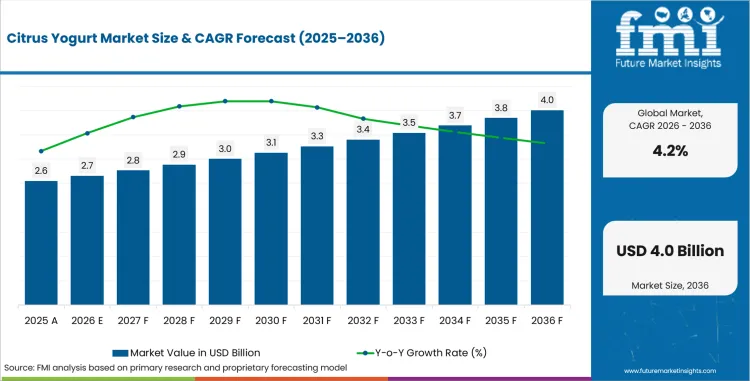
The citrus yogurt market was valued at USD 2.6 billion in 2025. The market is set to reach USD 2.7 billion by 2026-end and grow at a CAGR of 4.2% between 2026-2036 to reach USD 4.0 billion by 2036. Lemon Yogurt will dominate with a 35.0% share, while Stirred Yogurt will lead with a 45.0% share.
Key Takeaways, Market Size, and Forecast
- 2026 Market Size: USD 2.7 billion
- 2036 Market Size: USD 4.0 billion
- Compound Annual Growth Rate (CAGR): 4.2% from 2026 to 2036
- Absolute $ Opportunity: USD 1.4 billion between 2026 and 2036
- Leading Product Segment: Lemon Yogurt
- Lemon Yogurt Share in 2026: 35.0%
- Fastest-growing Country: European Union (EU)
- European Union (EU) CAGR: 4.3% through 2036
Summary of the Citrus Yogurt Market
| Parameter | Details |
|---|---|
| Market Size in 2026 (Value) | USD 2.7 billion |
| Market Forecast in 2036 (Value) | USD 4.0 billion |
| Compound Annual Growth Rate (CAGR) | 4.2% from 2026 to 2036 |
| Years Considered | 2021 to 2036 |
| Base Year | 2025 |
| Forecast Period | 2026 to 2036 |
| Units Considered | Value (USD Billion) |
| Leading Sub-Region | European Union (EU) |
- Demand and Growth Drivers
- Consumer preference for flavored yogurt with natural fruit profiles is expected to sustain demand for citrus yogurt as a mainstream dairy category through 2036, supported by daily consumption and snacking occasions.
- Functional yogurt trends, including probiotic-enriched and low-fat citrus variants, are likely to support premiumization and higher per-unit pricing across retail and food service channels.
- Drinkable yogurt formats and on-the-go packaging are anticipated to expand consumption beyond traditional meal occasions, increasing purchase frequency among urban consumers.
- Product and Segment View
- Lemon yogurt is likely to account for 35.0% of the product segment in 2026, supported by broad consumer flavor acceptance and versatile positioning across breakfast, snacking, and dessert occasions.
- Stirred yogurt form is expected to represent 45.0% of form demand, with smooth-texture and flavored stirred variants as the dominant retail format across supermarkets and convenience channels.
- Cups packaging accounts for 50.0% of the packaging segment in 2026, with single-serve and multi-pack cup formats serving as the primary retail configuration for household and individual consumption.
- Geography and Competitive Outlook
- The EU is projected to lead with a 4.3% CAGR through 2036, supported by mature yogurt consumption culture, retailer private-label strength, and consumer demand for natural fruit-flavored dairy products.
- The USA at 4.1% reflects sustained demand for flavored yogurt in the breakfast and snacking categories, with functional and low-sugar variants gaining shelf space in modern retail channels.
- Companies with established dairy brand portfolios, retail distribution reach, and ability to launch functional citrus yogurt variants are likely to strengthen market position over the forecast period.
- Analyst Opinion
- Nandini Roy Choudhury, Principal Consultant at FMI says, 'Dairy companies that can combine authentic citrus flavor profiles with functional health positioning such as gut health and protein enrichment are likely to achieve stronger retail shelf placement and consumer loyalty through 2036.'
- The citrus yogurt market is evolving from a basic flavored dairy category into a differentiated platform with functional, organic, and premium positioning across multiple consumption occasions.
- Adoption is increasing due to consumer demand for natural fruit flavors, sugar reduction in dairy formulations, and the expanding role of yogurt in snacking and on-the-go consumption.
- Drinkable yogurt formats are the fastest-growing form, expanding citrus yogurt consumption beyond spoon-based occasions into commuter and fitness-related hydration.
- Private-label citrus yogurt is gaining share in European and UK retail, creating competitive pressure on branded manufacturers to differentiate through functional ingredients and premium packaging.
Citrus Yogurt Market Definition
The citrus yogurt market encompasses commercially produced yogurt products flavored with citrus fruit extracts and ingredients, including lemon yogurt, orange yogurt, lime yogurt, and mixed citrus yogurt. These products are sold in stirred, set, and drinkable forms for daily consumption, functional health, and dessert applications.
Citrus Yogurt Market Inclusions
Market scope covers all commercially traded citrus yogurt products categorized by product (lemon yogurt, orange yogurt, lime yogurt, mixed citrus yogurt), form (stirred yogurt, set yogurt, drinkable yogurt), application (daily consumption, functional consumption, desserts), end use (retail consumers, food service industry), nature (natural, organic, conventional), distribution channel (distributor network, direct sales, retail channel, online channel), and packaging (cups, bottles, tubs). Revenue coverage spans 2026 to 2036.
Citrus Yogurt Market Exclusions
The scope does not include unflavored plain yogurt, citrus-flavored frozen yogurt sold as ice cream substitutes, or yogurt-based beverages where yogurt is not the primary component.
Citrus Yogurt Market Research Methodology
- Primary Research: FMI analysts conducted interviews with dairy manufacturers, yogurt brand managers, retail category managers, and food service procurement specialists in key consumer markets.
- Desk Research: Combined data from dairy industry trade databases, retail scanner data, and consumer survey reports on flavored yogurt purchase behavior and consumption patterns.
- Market Sizing and Forecasting: Bottom-up aggregation from retail, food service, and e-commerce channel volumes across regional consumer adoption curves and product pricing tiers.
- Data Validation: Cross-checked quarterly against dairy production statistics, retail distribution metrics, and manufacturer shipment data from industry associations.
Why is the Citrus Yogurt Market Growing?
- Consumer demand for natural fruit-flavored yogurt in breakfast, snacking, and on-the-go occasions is sustaining growth, with the market projected to reach USD 4.0 billion by 2036.
- The EU leads at 4.3% CAGR, reflecting mature yogurt consumption, strong retailer private-label presence, and consumer preference for natural citrus flavor profiles in dairy products.
- Functional citrus yogurt variants with probiotic, high-protein, and low-sugar positioning are commanding premium shelf pricing and expanding the addressable consumer base.
The citrus yogurt market is estimated at USD 2.7 billion in 2026 and is projected to reach USD 4.0 billion by 2036, expanding at a CAGR of 4.2%. Demand is shaped by the structural role of yogurt in daily consumption patterns across developed markets and the growing adoption of flavored yogurt in emerging consumer segments. Citrus flavors, particularly lemon and orange, offer broad acceptance and natural positioning that aligns with clean-label and sugar-reduction priorities in dairy product development.
Lemon yogurt accounts for 35.0% of the product segment, while stirred yogurt represents 45.0% of form demand. Daily consumption occasions account for 50.0% of application demand, with breakfast and snacking as the primary usage contexts. Retail consumers represent 70.0% of end-use demand, with supermarkets and convenience stores as the dominant purchase channels.
Growth reflects the convergence of yogurt category expansion, functional health positioning, and packaging format diversification. The natural product segment holds 45.0% share, and cups packaging accounts for 50.0% of the packaging segment. Distributor networks handle 35.0% of sales as dairy distributors connect manufacturers with retail and food service outlets.
Market Segmentation Analysis
- Lemon yogurt holds 35.0% of the product segment in 2026, supported by broad flavor acceptance and positioning across breakfast, snacking, and dessert consumption occasions.
- Stirred yogurt accounts for 45.0% of form demand, with smooth-texture variants dominating retail shelf space in supermarkets and convenience stores.
- Retail consumers represent 70.0% of end-use demand, with individual consumption and household purchase as the primary drivers of citrus yogurt procurement.
The citrus yogurt market is segmented by product (lemon yogurt, orange yogurt, lime yogurt, mixed citrus yogurt), form (stirred yogurt, set yogurt, drinkable yogurt), application (daily consumption, functional consumption, desserts), end use (retail consumers, food service industry), nature (natural, organic, conventional), distribution channel (distributor network, direct sales, retail channel, online channel), and packaging (cups, bottles, tubs).
Insights into the Lemon Yogurt Product Segment
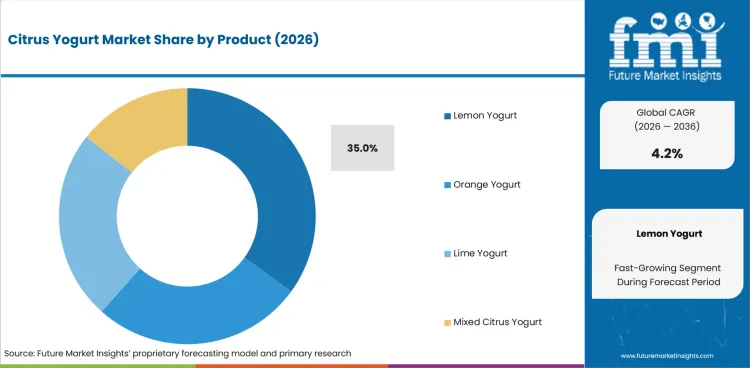
In 2026, lemon yogurt accounts for 35.0% of the product segment. Regular lemon yogurt in classic and sweetened variants serves daily consumption and breakfast occasions. Functional lemon yogurt with probiotic enrichment and low-fat formulations targets health-conscious consumers seeking digestive and weight management benefits from their dairy intake.
Orange yogurt is the second-largest product sub-segment, with classic orange flavor and fruit-pulp-added variants. Lime and mixed citrus yogurt serve smaller but growing niches, particularly in markets where tropical and multi-flavor blends appeal to younger consumer demographics.
Insights into the Stirred Yogurt Form Segment
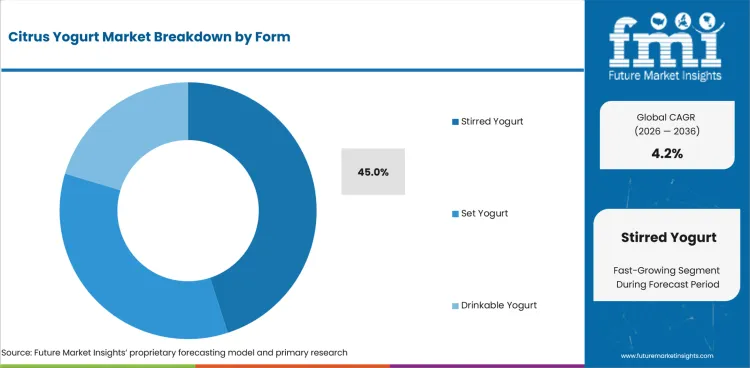
Stirred yogurt accounts for 45.0% of form demand in 2026. Smooth-texture and flavored stirred yogurt in single-serve and multi-pack cups represent the dominant retail format. Set yogurt, including traditional and cup-set variants, serves consumers who prefer firmer texture.
Drinkable yogurt is the fastest-growing form, expanding citrus yogurt consumption into commuter, fitness, and on-the-go occasions. Yogurt drink bottles and on-the-go pack formats are gaining shelf space in convenience stores and vending channels.
Citrus Yogurt Market Drivers, Restraints, and Opportunities
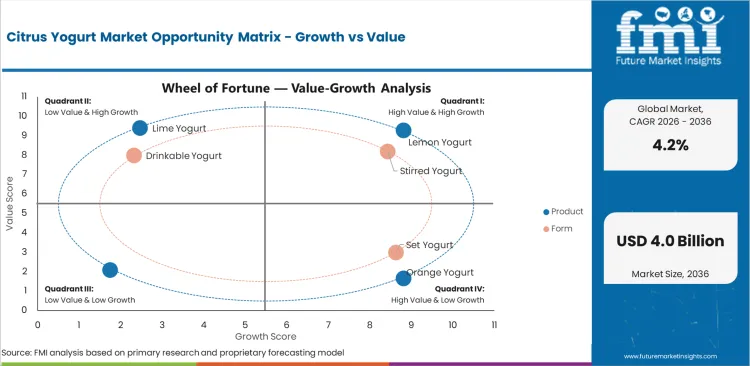
- Consumer demand for flavored yogurt in daily consumption and snacking occasions is creating consistent volume growth across retail and food service channels.
- Sugar reduction pressure and private-label competition constrain branded yogurt pricing, requiring manufacturers to differentiate through functional ingredients and premium packaging.
- Functional health positioning, including gut health, immunity, and high-protein claims, is opening premium pricing tiers and strengthening consumer purchase rationale.
The citrus yogurt market expands on the basis of yogurt category growth, consumer preference for natural fruit flavors, and functional health positioning. Constraints include sugar reduction regulatory pressure, private-label competition, and the need for continuous product innovation to maintain consumer interest.
Yogurt Category Expansion in Daily Consumption
Demand is shaped by the growing role of yogurt in daily breakfast, snacking, and on-the-go consumption occasions. Citrus yogurt benefits from broad flavor acceptance and natural positioning that resonates with consumers seeking healthier alternatives to sweetened desserts and confectionery snacks.
Sugar Reduction and Private-Label Pressure
Adoption dynamics are influenced by regulatory and consumer pressure to reduce sugar content in dairy products. Retailer private-label citrus yogurt products compete on price, requiring branded manufacturers to justify premium pricing through functional health claims, organic certification, or differentiated packaging formats.
Functional Health and Premiumization
Growth is supported by the addition of functional health attributes to citrus yogurt formulations, including probiotics for digestive health, high-protein content for fitness-oriented consumers, and vitamin fortification for immunity support. These functional variants command higher retail prices and achieve stronger shelf placement.
Analysis of Citrus Yogurt Market By Key Countries
.webp "Top Country Growth Comparison Citrus Yogurt Market Cagr (2026 2036)")
| Country | CAGR |
|---|---|
| European Union (EU) | 4.3% |
| USA | 4.1% |
| South Korea | 4.0% |
| Japan | 3.9% |
| UK | 3.8% |
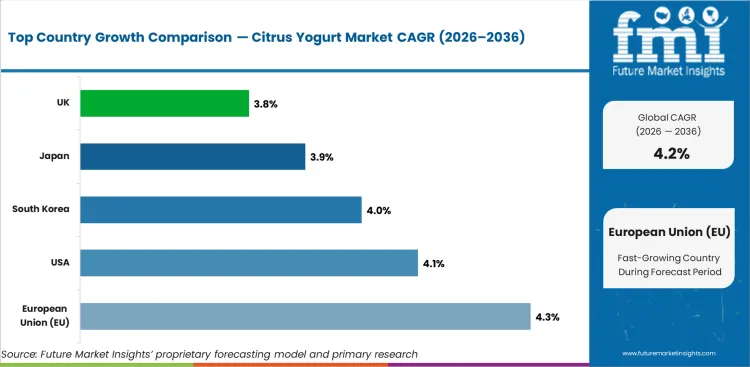
- The EU at 4.3% leads growth, supported by mature yogurt consumption culture, strong private-label presence, and consumer preference for natural fruit-flavored dairy products.
- The USA at 4.1% reflects sustained demand in breakfast and snacking categories, with Greek-style and functional citrus yogurt variants gaining share.
- South Korea (4.0%) and Japan (3.9%) sustain growth through premium dairy product positioning and convenience store distribution that supports single-serve yogurt purchase.
- The UK at 3.8% maintains growth through retailer health-focused product placement and expanding drinkable yogurt formats.
The global citrus yogurt market is projected to expand at a CAGR of 4.2% from 2026 to 2036. The study covers more than 30 countries, and the primary markets are analyzed below.
Demand Outlook for Citrus Yogurt Market in the European Union
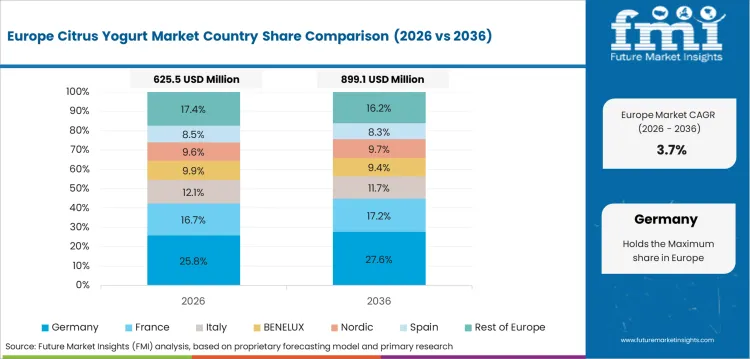
The EU is projected to lead with a 4.3% CAGR through 2036. Mature yogurt consumption culture across France, Germany, and the Netherlands provides a stable demand base, with natural citrus flavors gaining share from synthetic fruit-flavored variants.
- EU food labeling regulations and consumer clean-label preferences support procurement of natural citrus flavor ingredients over artificial alternatives in yogurt formulations.
- Retailer private-label yogurt programs in major European grocery chains drive volume procurement of citrus-flavored yogurt across stirred, set, and drinkable formats.
- Organic citrus yogurt is expanding in Northern and Western European markets where willingness to pay for certified organic dairy products remains structurally strong.
Future Outlook for Citrus Yogurt Market in the United States
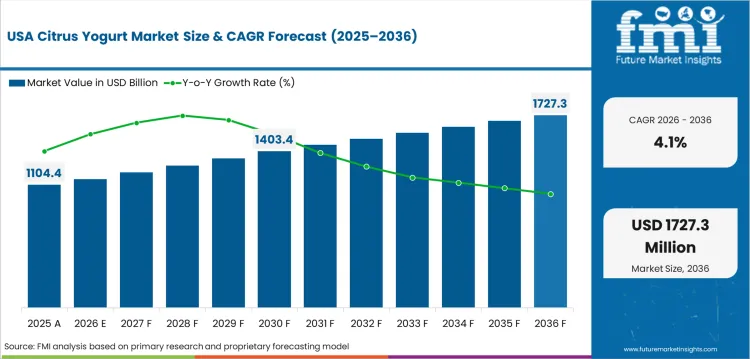
The USA is expected to grow at 4.1% through 2036. Greek-style yogurt continues to expand as a platform for citrus flavor innovation, while functional and high-protein variants are capturing health-conscious consumer segments.
- Chobani and Danone invest in citrus yogurt line extensions targeting breakfast and snacking occasions in supermarket and convenience store channels.
- High-protein and low-sugar citrus yogurt formats are gaining shelf space in health food and fitness-oriented retail channels across urban markets.
- Single-serve drinkable citrus yogurt is expanding in convenience stores and vending as an on-the-go functional breakfast and snack alternative.
Opportunity Analysis of Citrus Yogurt Market in South Korea
South Korea is projected to expand at 4.0% through 2036. High convenience store penetration and consumer preference for premium, functional dairy products support citrus yogurt adoption in single-serve formats.
- Convenience store chains in South Korea provide high-frequency distribution for single-serve citrus yogurt products targeting commuter and office snacking occasions.
- Consumer demand for beauty-from-within and gut health products supports functional citrus yogurt variants with added collagen, probiotics, and vitamins.
- Korean dairy manufacturers develop seasonal and limited-edition citrus yogurt flavors that align with consumer purchase behavior and drive brand trial.
In-depth Analysis of Citrus Yogurt Market in Japan
Japan is projected to grow at 3.9% through 2036. Quality-driven dairy consumption, established functional food retail infrastructure, and FOSHU designation opportunities support premium citrus yogurt positioning.
- FOSHU functional food designation creates a pathway for citrus yogurt brands to claim specific health benefits and command premium retail pricing.
- Japanese consumer preference for mild citrus flavors including yuzu and sudachi supports differentiated product development beyond standard lemon and orange.
- Vending machine and convenience store channels provide year-round access to drinkable citrus yogurt formats in high-traffic urban locations.
Sales Analysis of Citrus Yogurt Market in the United Kingdom
The UK is projected to grow at 3.8% through 2036. Retailer health-focused shelf placement and expanding drinkable yogurt formats support citrus yogurt volume growth in a competitive dairy market.
- UK retailer meal-deal inclusion and health-aisle placement support consistent purchase frequency for single-serve citrus yogurt products.
- Drinkable citrus yogurt is expanding in the UK as an on-the-go breakfast and post-workout recovery alternative to protein shakes.
- Private-label citrus yogurt in major UK grocery chains competes on price, driving branded manufacturers toward functional differentiation and premium packaging.
Competitive Landscape and Strategic Positioning
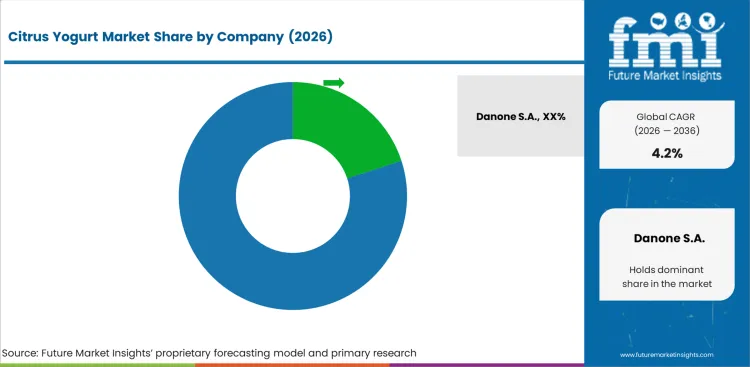
- Danone S.A. leads with a 20.0% share, supported by its global yogurt brand portfolio, established retail distribution, and functional product innovation capabilities.
- Chobani LLC and General Mills Inc. maintain strong positions in North American citrus yogurt through brand recognition and product line expansion across Greek-style and drinkable formats.
- FAGE International S.A. and regional dairy manufacturers serve European and Asian markets with locally adapted citrus yogurt products.
Danone S.A. holds the leading position with a 20.0% share, leveraging its established yogurt brand portfolio that includes Activia, Oikos, and Danone-branded citrus yogurt products across stirred, drinkable, and functional formats. The company invests in probiotic and gut health positioning.
Chobani LLC competes through Greek-style citrus yogurt innovation and strong USA retail distribution. General Mills Inc. maintains its position through the Yoplait brand family with citrus flavor extensions. Nestle S.A. participates through regional dairy operations.
Barriers include the marketing investment needed for brand awareness, cold chain logistics requirements, and retailer shelf space competition. Strategic priorities center on functional health differentiation, sustainable packaging, and sugar reduction without compromising flavor appeal.
Key Companies in the Citrus Yogurt Market
Key global companies leading the citrus yogurt market include:
- Danone S.A. (France), Chobani LLC (USA), and General Mills Inc. (USA) maintain global dairy brand portfolios with established retail distribution, functional product innovation, and citrus yogurt line extensions across stirred, set, and drinkable formats.
- Nestle S.A. (Switzerland) and FAGE International S.A. (Luxembourg) hold positions through regional dairy operations and established relationships with European and North American retail chains for premium and Greek-style yogurt products.
- Other companies including regional dairy manufacturers serve local markets with citrus yogurt products adapted to regional flavor preferences, packaging formats, and distribution channel requirements.
Competitive Benchmarking: Citrus Yogurt Market
| Company | Brand Portfolio | Distribution Reach | Functional Innovation | Geographic Footprint |
|---|---|---|---|---|
| Danone S.A. | High | Strong | High | Global |
| Chobani LLC | Medium | Strong | High | N. America |
| General Mills Inc. | High | Strong | Medium | N. America, Global |
| Nestle S.A. | High | Strong | Medium | Global |
| FAGE International S.A. | Medium | Moderate | Medium | Europe, N. America |
Source: Future Market Insights competitive analysis, 2026.
Key Developments in Citrus Yogurt Market
- In 2025, Danone S.A. launched a new probiotic-enriched lemon yogurt line targeting digestive health consumers in European and North American retail channels.
- In 2025, Chobani LLC expanded its citrus yogurt drinkable format range with lime and mixed citrus variants for convenience store and e-commerce distribution.
Key Players in the Citrus Yogurt Market
Major Global Players
- Danone S.A.
- Chobani LLC
- General Mills Inc.
- Nestle S.A.
- FAGE International S.A.
Emerging Players/Startups
- Yoghino
- Painterland Sisters
Report Scope and Coverage
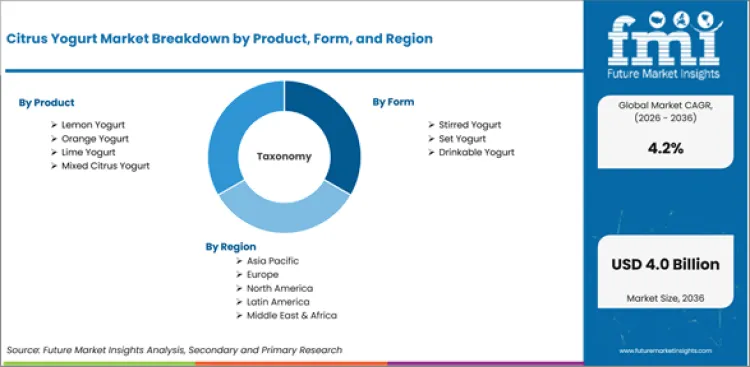
| Parameter | Details |
|---|---|
| Market size by 2036 | USD 4.0 billion |
| Growth rate | 4.2% CAGR (2026 to 2036) |
| Forecast period | 2026 to 2036 |
| Base year value (2025) | USD 2.6 billion |
| Key Segment Covered | Product, Form, Application, End Use, Nature, Distribution Channel, Packaging. |
| Regions covered | North America, Latin America, Europe, East Asia, South Asia and Pacific, Middle East and Africa |
| Countries covered | European Union (EU), USA, South Korea, Japan, UK, 30 plus countries |
| Key companies profiled | Danone S.A., Chobani LLC, General Mills Inc., Nestle S.A., FAGE International S.A. |
| Approach | Hybrid bottom-up and top-down methodology starting with verified retail and dairy production data, projecting adoption velocity across yogurt formats, channels, and regions. |
Market Segmentation Analysis
Citrus Yogurt Market Segmented by Product:
- Lemon Yogurt
- Regular Lemon Yogurt
- Classic Flavor
- Sweetened Variants
- Functional Lemon Yogurt
- Probiotic Enriched
- Low Fat Variants
- Regular Lemon Yogurt
- Orange Yogurt
- Regular Orange Yogurt
- Classic Orange Flavor
- Fruit Pulp Added
- Functional Orange Yogurt
- Vitamin Fortified
- Low Sugar Variants
- Regular Orange Yogurt
- Lime Yogurt
- Regular Lime Yogurt
- Traditional Flavor
- Flavored Variants
- Functional Lime Yogurt
- Probiotic Enriched
- Diet Variants
- Regular Lime Yogurt
- Mixed Citrus Yogurt
- Blended Citrus Yogurt
- Lemon Orange Blend
- Multi Citrus Blend
- Functional Blends
- Immunity Boost Yogurt
- High Protein Yogurt
- Blended Citrus Yogurt
Citrus Yogurt Market Segmented by Form:
- Stirred Yogurt
- Smooth Texture
- Flavored Stirred
- Set Yogurt
- Traditional Set
- Cup Set Yogurt
- Drinkable Yogurt
- Yogurt Drinks
- On the Go Bottles
Citrus Yogurt Market Segmented by Application:
- Daily Consumption
- Regular Diet
- Breakfast
- Snacking
- Regular Diet
- Functional Consumption
- Health and Wellness
- Digestive Health
- Immunity Support
- Health and Wellness
- Desserts
- Sweet Dishes
- Yogurt Based Desserts
- Frozen Yogurt
- Sweet Dishes
Citrus Yogurt Market Segmented by End Use:
- Retail Consumers
- Individual Consumption
- Single Serve Packs
- Multi Pack Formats
- Individual Consumption
- Food Service Industry
- Restaurants and Cafes
- Dessert Menus
- Breakfast Offerings
- Quick Service Restaurants
- On the Go Meals
- Restaurants and Cafes
Citrus Yogurt Market Segmented by Nature:
- Natural
- Clean Label Yogurt
- No Artificial Additives
- Real Fruit Content
- Clean Label Yogurt
- Organic
- Certified Organic Yogurt
- Organic Milk Base
- Organic Fruit Ingredients
- Certified Organic Yogurt
- Conventional
- Standard Yogurt
- Artificial Flavor Added
- Cost Optimized Products
- Standard Yogurt
Citrus Yogurt Market Segmented by Distribution Channel:
- Distributor Network
- Dairy Distributors
- Regional Distribution
- Cold Chain Supply
- Dairy Distributors
- Direct Sales
- Dairy Brand Outlets
- Company Stores
- Dairy Brand Outlets
- Retail Channel
- Supermarkets and Hypermarkets
- Modern Trade
- Convenience Stores
- Local Retail
- Supermarkets and Hypermarkets
- Online Channel
- E-commerce Platforms
- Direct to Consumer
- E-commerce Platforms
Citrus Yogurt Market Segmented by Packaging:
- Cups
- Single Serve Cups
- Multi Pack Cups
- Bottles
- Drinkable Yogurt Bottles
- On the Go Packs
- Tubs
- Family Packs
- Bulk Packaging
Citrus Yogurt Market by Region:
- North America
- USA
- Canada
- Mexico
- Latin America
- Brazil
- Chile
- Rest of Latin America
- Western Europe
- Germany
- UK
- Italy
- Spain
- France
- Nordic
- BENELUX
- Rest of Western Europe
- Eastern Europe
- Russia
- Poland
- Hungary
- Balkan & Baltic
- Rest of Eastern Europe
- East Asia
- China
- Japan
- South Korea
- South Asia and Pacific
- India
- ASEAN
- Australia & New Zealand
- Rest of South Asia and Pacific
- Middle East & Africa
- Kingdom of Saudi Arabia
- Other GCC Countries
- Türkiye
- South Africa
- Other African Union
- Rest of Middle East & Africa
Research Sources and Bibliography
- 1. European Commission. (2025). EU Regulation on Nutrition and Health Claims Made on Foods: Dairy Product Labeling Requirements. EC.
- 2. USA Food and Drug Administration. (2025). FDA Yogurt Standard of Identity: Updated Labeling and Composition Requirements. FDA.
- 3. International Dairy Federation. (2025). IDF Annual Report: Global Yogurt Production and Consumption Statistics. IDF.
- 4. World Health Organization. (2025). WHO Guideline on Sugars Intake: Implications for Dairy Product Reformulation. WHO.
- 5. European Dairy Association. (2025). EDA Market Report: Flavored Yogurt Trends and Consumer Preferences in Europe. EDA.
This bibliography is provided for reader reference.
This Report Answers
- Estimating the size of the citrus yogurt market and projected revenue from 2026 to 2036.
- Segmenting by product, form, application, end use, nature, distribution channel, and packaging.
- Regional and country-level insights across more than 30 markets.
- Analysis of stirred, set, and drinkable yogurt formats and consumer preferences.
- Assessment of the competitive landscape and company benchmarking.
- Identifying investment opportunities in functional yogurt, premium formats, and drinkable yogurt.
- Tracking supply chain dynamics from dairy production to retail distribution.
- Delivery of data in PDF and Excel formats.
Frequently Asked Questions
How big is the citrus yogurt market in 2026?
The global citrus yogurt market is estimated to be valued at USD 2.7 billion in 2026.
What will be the size of citrus yogurt market in 2036?
The market size for the citrus yogurt market is projected to reach USD 4.0 billion by 2036.
How much will be the citrus yogurt market growth between 2026 and 2036?
The citrus yogurt market is expected to grow at a 4.2% CAGR between 2026 and 2036.
What are the key products in the citrus yogurt market?
The key products in the citrus yogurt market are Lemon Yogurt, Orange Yogurt, Lime Yogurt and Mixed Citrus Yogurt.
Which form segment is expected to contribute significant share in the citrus yogurt market in 2026?
In terms of form, stirred yogurt segment is expected to command 45.0% share in the citrus yogurt market in 2026.
Preview the report firsthand - request a free sample
Get SampleGet the brochure for pricing and purchase details.
Get PDFTable of Content
- Key Takeaways
- Market Size and CAGR
- Top Growth Driver
- Fastest Growing Segment
- Leading Region
- Key Companies
- Emerging Opportunities
- Executive Summary
- Global Market Outlook
- Demand-side Trends
- Supply-side Trends
- Technology Roadmap Analysis
- Analysis and Recommendations
- Analyst Perspective (What is happening? Why now? What should investors know?)
- Key Questions Answered
- How large is the market?
- What is the CAGR?
- What are key trends?
- Which region dominates?
- Who are the leaders?
- Market Overview
- Market Coverage / Taxonomy
- Market Definition / Scope / Limitations
- Research Methodology
- Chapter Orientation
- Analytical Lens and Working Hypotheses
- Market Structure, Signals, and Trend Drivers
- Benchmarking and Cross-market Comparability
- Market Sizing, Forecasting, and Opportunity Mapping
- Research Design and Evidence Framework
- Desk Research Programme (Secondary Evidence)
- Expert Input and Fieldwork (Primary Evidence)
- Tooling, Models, and Reference Databases
- Data Engineering and Model Build
- Quality Assurance and Audit Trail
- Market Background
- Market Dynamics (Drivers, Restraints, Opportunity, Trends)
- Scenario Forecast (Optimistic, Likely, Conservative)
- Impact Analysis
- AI Impact
- Sustainability Impact
- Regulatory Impact
- Technology Impact
- Consumer / Buyer Analysis
- Purchase Drivers
- Adoption Barriers
- Buyer Journey
- Opportunity Map Analysis
- Product Life Cycle Analysis
- Supply Chain Analysis
- Investment Feasibility Matrix
- Value Chain Analysis
- PESTLE and Porter's Analysis
- Regulatory Landscape
- Regional Parent Market Outlook
- Production and Consumption Statistics
- Import and Export Statistics
- Global Market Analysis and Forecast, 2021 to 2036
- Historical Market Size Value (USD Million) Analysis, 2021 to 2025
- Current and Future Market Size Value (USD Million) Projections, 2026 to 2036
- Y-o-Y Growth Trend Analysis
- Absolute $ Opportunity Analysis
- Global Market Pricing Analysis, 2021 to 2036
- Global Market Analysis and Forecast, By Product, 2021 to 2036
- Introduction / Key Findings
- Historical Market Size Value (USD Million) Analysis By Product, 2021 to 2025
- Current and Future Market Size Value (USD Million) Analysis and Forecast By Product, 2026 to 2036
- Lemon Yogurt
- Regular Lemon Yogurt
- Functional Lemon Yogurt
- Orange Yogurt
- Regular Orange Yogurt
- Functional Orange Yogurt
- Lime Yogurt
- Regular Lime Yogurt
- Functional Lime Yogurt
- Mixed Citrus Yogurt
- Blended Citrus Yogurt
- Functional Blends
- Lemon Yogurt
- Y-o-Y Growth Trend Analysis By Product, 2021 to 2025
- Absolute $ Opportunity Analysis By Product, 2026 to 2036
- Global Market Analysis and Forecast, By Form, 2021 to 2036
- Introduction / Key Findings
- Historical Market Size Value (USD Million) Analysis By Form, 2021 to 2025
- Current and Future Market Size Value (USD Million) Analysis and Forecast By Form, 2026 to 2036
- Stirred Yogurt
- Smooth Texture
- Flavored Stirred
- Set Yogurt
- Traditional Set
- Cup Set Yogurt
- Drinkable Yogurt
- Yogurt Drinks
- On the Go Bottles
- Stirred Yogurt
- Y-o-Y Growth Trend Analysis By Form, 2021 to 2025
- Absolute $ Opportunity Analysis By Form, 2026 to 2036
- Global Market Analysis and Forecast, By Application, 2021 to 2036
- Introduction / Key Findings
- Historical Market Size Value (USD Million) Analysis By Application, 2021 to 2025
- Current and Future Market Size Value (USD Million) Analysis and Forecast By Application, 2026 to 2036
- Daily Consumption
- Regular Diet
- Functional Consumption
- Health and Wellness
- Desserts
- Sweet Dishes
- Daily Consumption
- Y-o-Y Growth Trend Analysis By Application, 2021 to 2025
- Absolute $ Opportunity Analysis By Application, 2026 to 2036
- Global Market Analysis and Forecast, By End Use, 2021 to 2036
- Introduction / Key Findings
- Historical Market Size Value (USD Million) Analysis By End Use, 2021 to 2025
- Current and Future Market Size Value (USD Million) Analysis and Forecast By End Use, 2026 to 2036
- Retail Consumers
- Individual Consumption
- Food Service Industry
- Restaurants and Cafes
- Quick Service Restaurants
- Retail Consumers
- Y-o-Y Growth Trend Analysis By End Use, 2021 to 2025
- Absolute $ Opportunity Analysis By End Use, 2026 to 2036
- Global Market Analysis and Forecast, By Nature, 2021 to 2036
- Introduction / Key Findings
- Historical Market Size Value (USD Million) Analysis By Nature, 2021 to 2025
- Current and Future Market Size Value (USD Million) Analysis and Forecast By Nature, 2026 to 2036
- Natural
- Clean Label Yogurt
- Organic
- Certified Organic Yogurt
- Conventional
- Standard Yogurt
- Natural
- Y-o-Y Growth Trend Analysis By Nature, 2021 to 2025
- Absolute $ Opportunity Analysis By Nature, 2026 to 2036
- Global Market Analysis and Forecast, By Distribution Channel
- Introduction / Key Findings
- Historical Market Size Value (USD Million) Analysis By Distribution Channel, 2021 to 2025
- Current and Future Market Size Value (USD Million) Analysis and Forecast By Distribution Channel, 2026 to 2036
- Distributor Network
- Dairy Distributors
- Direct Sales
- Dairy Brand Outlets
- Retail Channel
- Supermarkets and Hypermarkets
- Convenience Stores
- Online Channel
- E-commerce Platforms
- Distributor Network
- Y-o-Y Growth Trend Analysis By Distribution Channel, 2021 to 2025
- Absolute $ Opportunity Analysis By Distribution Channel, 2026 to 2036
- Global Market Analysis and Forecast, By Packaging
- Introduction / Key Findings
- Historical Market Size Value (USD Million) Analysis By Packaging, 2021 to 2025
- Current and Future Market Size Value (USD Million) Analysis and Forecast By Packaging, 2026 to 2036
- Cups
- Single Serve Cups
- Multi Pack Cups
- Bottles
- Drinkable Yogurt Bottles
- On the Go Packs
- Tubs
- Family Packs
- Bulk Packaging
- Cups
- Y-o-Y Growth Trend Analysis By Packaging, 2021 to 2025
- Absolute $ Opportunity Analysis By Packaging, 2026 to 2036
- Global Market Analysis and Forecast, By Region, 2021 to 2036
- Introduction
- Historical Market Size Value (USD Million) Analysis By Region, 2021 to 2025
- Current Market Size Value (USD Million) Analysis and Forecast By Region, 2026 to 2036
- North America
- Latin America
- Western Europe
- Eastern Europe
- East Asia
- South Asia and Pacific
- Middle East & Africa
- Market Attractiveness Analysis By Region
- North America Market Analysis and Forecast, By Country, 2021 to 2036
- Historical Market Size Value (USD Million) Trend Analysis By Market Taxonomy, 2021 to 2025
- Market Size Value (USD Million) Forecast By Market Taxonomy, 2026 to 2036
- By Country
- USA
- Canada
- Mexico
- By Product
- By Form
- By Application
- By End Use
- By Nature
- By Distribution Channel
- By Packaging
- By Country
- Market Attractiveness Analysis
- By Country
- By Product
- By Form
- By Application
- By End Use
- By Nature
- By Distribution Channel
- By Packaging
- Key Takeaways
- Latin America Market Analysis and Forecast, By Country
- Historical Market Size Value (USD Million) Trend Analysis By Market Taxonomy, 2021 to 2025
- Market Size Value (USD Million) Forecast By Market Taxonomy, 2026 to 2036
- By Country
- Brazil
- Chile
- Rest of Latin America
- By Product
- By Form
- By Application
- By End Use
- By Nature
- By Distribution Channel
- By Packaging
- By Country
- Market Attractiveness Analysis
- By Country
- By Product
- By Form
- By Application
- By End Use
- By Nature
- By Distribution Channel
- By Packaging
- Key Takeaways
- Western Europe Market Analysis and Forecast, By Country
- Historical Market Size Value (USD Million) Trend Analysis By Market Taxonomy, 2021 to 2025
- Market Size Value (USD Million) Forecast By Market Taxonomy, 2026 to 2036
- By Country
- Germany
- UK
- Italy
- Spain
- France
- Nordic
- BENELUX
- Rest of Western Europe
- By Product
- By Form
- By Application
- By End Use
- By Nature
- By Distribution Channel
- By Packaging
- By Country
- Market Attractiveness Analysis
- By Country
- By Product
- By Form
- By Application
- By End Use
- By Nature
- By Distribution Channel
- By Packaging
- Key Takeaways
- Eastern Europe Market Analysis and Forecast, By Country
- Historical Market Size Value (USD Million) Trend Analysis By Market Taxonomy, 2021 to 2025
- Market Size Value (USD Million) Forecast By Market Taxonomy, 2026 to 2036
- By Country
- Russia
- Poland
- Hungary
- Balkan & Baltic
- Rest of Eastern Europe
- By Product
- By Form
- By Application
- By End Use
- By Nature
- By Distribution Channel
- By Packaging
- By Country
- Market Attractiveness Analysis
- By Country
- By Product
- By Form
- By Application
- By End Use
- By Nature
- By Distribution Channel
- By Packaging
- Key Takeaways
- East Asia Market Analysis and Forecast, By Country
- Historical Market Size Value (USD Million) Trend Analysis By Market Taxonomy, 2021 to 2025
- Market Size Value (USD Million) Forecast By Market Taxonomy, 2026 to 2036
- By Country
- China
- Japan
- South Korea
- By Product
- By Form
- By Application
- By End Use
- By Nature
- By Distribution Channel
- By Packaging
- By Country
- Market Attractiveness Analysis
- By Country
- By Product
- By Form
- By Application
- By End Use
- By Nature
- By Distribution Channel
- By Packaging
- Key Takeaways
- South Asia and Pacific Market Analysis and Forecast, By Country
- Historical Market Size Value (USD Million) Trend Analysis By Market Taxonomy, 2021 to 2025
- Market Size Value (USD Million) Forecast By Market Taxonomy, 2026 to 2036
- By Country
- India
- ASEAN
- Australia & New Zealand
- Rest of South Asia and Pacific
- By Product
- By Form
- By Application
- By End Use
- By Nature
- By Distribution Channel
- By Packaging
- By Country
- Market Attractiveness Analysis
- By Country
- By Product
- By Form
- By Application
- By End Use
- By Nature
- By Distribution Channel
- By Packaging
- Key Takeaways
- Middle East & Africa Market Analysis and Forecast, By Country
- Historical Market Size Value (USD Million) Trend Analysis By Market Taxonomy, 2021 to 2025
- Market Size Value (USD Million) Forecast By Market Taxonomy, 2026 to 2036
- By Country
- Kingdom of Saudi Arabia
- Other GCC Countries
- Türkiye
- South Africa
- Other African Union
- Rest of Middle East & Africa
- By Product
- By Form
- By Application
- By End Use
- By Nature
- By Distribution Channel
- By Packaging
- By Country
- Market Attractiveness Analysis
- By Country
- By Product
- By Form
- By Application
- By End Use
- By Nature
- By Distribution Channel
- By Packaging
- Key Takeaways
- Key Countries Market Analysis
- USA
- Pricing Analysis
- Market Share Analysis, 2025
- By Product
- By Form
- By Application
- By End Use
- By Nature
- By Distribution Channel
- By Packaging
- Canada
- Pricing Analysis
- Market Share Analysis, 2025
- By Product
- By Form
- By Application
- By End Use
- By Nature
- By Distribution Channel
- By Packaging
- Mexico
- Pricing Analysis
- Market Share Analysis, 2025
- By Product
- By Form
- By Application
- By End Use
- By Nature
- By Distribution Channel
- By Packaging
- Brazil
- Pricing Analysis
- Market Share Analysis, 2025
- By Product
- By Form
- By Application
- By End Use
- By Nature
- By Distribution Channel
- By Packaging
- Chile
- Pricing Analysis
- Market Share Analysis, 2025
- By Product
- By Form
- By Application
- By End Use
- By Nature
- By Distribution Channel
- By Packaging
- Germany
- Pricing Analysis
- Market Share Analysis, 2025
- By Product
- By Form
- By Application
- By End Use
- By Nature
- By Distribution Channel
- By Packaging
- UK
- Pricing Analysis
- Market Share Analysis, 2025
- By Product
- By Form
- By Application
- By End Use
- By Nature
- By Distribution Channel
- By Packaging
- Italy
- Pricing Analysis
- Market Share Analysis, 2025
- By Product
- By Form
- By Application
- By End Use
- By Nature
- By Distribution Channel
- By Packaging
- Spain
- Pricing Analysis
- Market Share Analysis, 2025
- By Product
- By Form
- By Application
- By End Use
- By Nature
- By Distribution Channel
- By Packaging
- France
- Pricing Analysis
- Market Share Analysis, 2025
- By Product
- By Form
- By Application
- By End Use
- By Nature
- By Distribution Channel
- By Packaging
- India
- Pricing Analysis
- Market Share Analysis, 2025
- By Product
- By Form
- By Application
- By End Use
- By Nature
- By Distribution Channel
- By Packaging
- ASEAN
- Pricing Analysis
- Market Share Analysis, 2025
- By Product
- By Form
- By Application
- By End Use
- By Nature
- By Distribution Channel
- By Packaging
- Australia & New Zealand
- Pricing Analysis
- Market Share Analysis, 2025
- By Product
- By Form
- By Application
- By End Use
- By Nature
- By Distribution Channel
- By Packaging
- China
- Pricing Analysis
- Market Share Analysis, 2025
- By Product
- By Form
- By Application
- By End Use
- By Nature
- By Distribution Channel
- By Packaging
- Japan
- Pricing Analysis
- Market Share Analysis, 2025
- By Product
- By Form
- By Application
- By End Use
- By Nature
- By Distribution Channel
- By Packaging
- South Korea
- Pricing Analysis
- Market Share Analysis, 2025
- By Product
- By Form
- By Application
- By End Use
- By Nature
- By Distribution Channel
- By Packaging
- Russia
- Pricing Analysis
- Market Share Analysis, 2025
- By Product
- By Form
- By Application
- By End Use
- By Nature
- By Distribution Channel
- By Packaging
- Poland
- Pricing Analysis
- Market Share Analysis, 2025
- By Product
- By Form
- By Application
- By End Use
- By Nature
- By Distribution Channel
- By Packaging
- Hungary
- Pricing Analysis
- Market Share Analysis, 2025
- By Product
- By Form
- By Application
- By End Use
- By Nature
- By Distribution Channel
- By Packaging
- Kingdom of Saudi Arabia
- Pricing Analysis
- Market Share Analysis, 2025
- By Product
- By Form
- By Application
- By End Use
- By Nature
- By Distribution Channel
- By Packaging
- Türkiye
- Pricing Analysis
- Market Share Analysis, 2025
- By Product
- By Form
- By Application
- By End Use
- By Nature
- By Distribution Channel
- By Packaging
- South Africa
- Pricing Analysis
- Market Share Analysis, 2025
- By Product
- By Form
- By Application
- By End Use
- By Nature
- By Distribution Channel
- By Packaging
- USA
- Market Structure Analysis
- Competition Dashboard
- Competition Benchmarking
- Market Share Analysis of Top Players
- By Regional
- By Product
- By Form
- By Application
- By End Use
- By Nature
- By Distribution Channel
- By Packaging
- Emerging Startups
- Innovation Benchmarking
- Competition Analysis
- Competition Deep Dive
- Danone S.A.
- Overview
- Product Portfolio
- Profitability by Market Segments (Product/Region/Sales Channel)
- Sales Footprint
- Strategy Overview
- Marketing Strategy
- Product Strategy
- Channel Strategy
- Chobani LLC
- General Mills Inc.
- Nestlé S.A.
- FAGE International S.A.
- Other Companies (combined)
- Danone S.A.
- Case Studies
- Success Stories
- Recent Developments
- Competition Deep Dive
- Assumptions & Acronyms Used


