

- Industry Size (2026)
- USD 1.4 Bn
- Forecast (2036)
- USD 2.7 Bn
- CAGR (2026 to 2036)
- 6.7%
Cobalt Salt Adhesion Promoter for Tires Market Forecast and Outlook 2026 to 2036
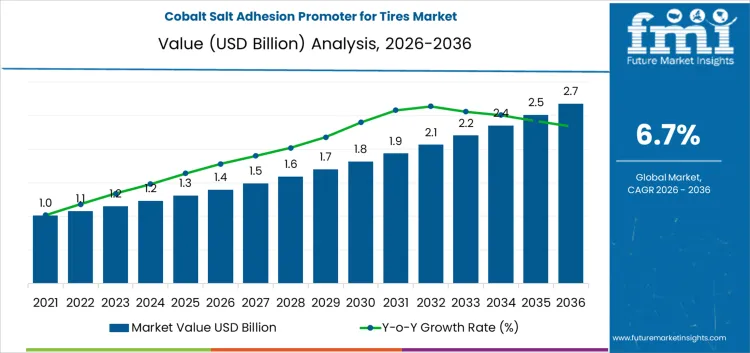
The cobalt salt adhesion promoter for tires market is projected at USD 1.4 billion in 2026 and USD 2.7 billion by 2036, reflecting a 6.7% CAGR. Inside tire plants, this material functions as a process control variable rather than a commodity input. Bond reliability between brass coated steel cord and rubber determines scrap rates and warranty exposure. Compound owners freeze formulations early and protect them through governance procedures. Any drift in adhesion performance shows up during fatigue and peel testing. Mixing order, moisture exposure, and storage time receive daily attention. Plant managers treat this additive as part of the bonding system, not as a standalone purchase item.
Decision power sits with compound approval committees and quality groups rather than procurement. Once a recipe enters serial production, material changes require full revalidation across durability, aging, and corrosion tests. That barrier shapes supplier competition more than price lists. Supply continuity matters because line stoppages cascade through calendaring and building operations. Audit trails, change notifications, and batch consistency dominate supplier scorecards. Technical teams monitor cord pull results and cure behavior to detect early drift. Inventory policies favor short holding periods to limit moisture risk. Commercial outcomes follow stability, not switching activity. Volume aligns with tire output mix and construction choices.
Quick Stats for Cobalt Salt Adhesion Promoter for Tires Market
- Cobalt Salt Adhesion Promoter for Tires Market Value (2026): USD 1.4 billion
- Cobalt Salt Adhesion Promoter for Tires Market Forecast Value (2036): USD 2.7 billion
- Cobalt Salt Adhesion Promoter for Tires Market Forecast CAGR 2026 to 2036: 6.7%
- Leading Product Type in Cobalt Salt Adhesion Promoter for Tires Market: Cobalt salt adhesion promoters
- Leading Application in Cobalt Salt Adhesion Promoter for Tires Market: Passenger car tires
- Key Growth Regions in Cobalt Salt Adhesion Promoter for Tires Market: Asia Pacific, Europe, North America
- Top Players in Cobalt Salt Adhesion Promoter for Tires Market: Shepherd Chemical Company, DIC Corporation, Umicore SA, Comar Chemicals, Ege Kimya, Taekwang Fine Chemical
What Is the Growth Forecast for the Cobalt Salt Adhesion Promoter for Tires Market through 2036?
Formulation standards and tire performance requirements shape demand for the cobalt salt adhesion promoter for tires market more than overall vehicle output. In 2026, at about USD 1.4 billion, consumption is tied to steel cord reinforced tire production where rubber to metal bonding quality affects durability and warranty exposure. Once a compound recipe is validated, plants keep the same adhesion system across long production runs, which links material demand to tire mix and factory utilization rather than to short term purchasing decisions. Volume increases as higher performance and heavier vehicle tires take a larger share of output. The steady climb reflects gradual shifts in tire construction and specification levels rather than sudden changes in compound strategy.
Material qualification and supply reliability guide the later phase of the cobalt salt adhesion promoter for tires market. As value approaches roughly USD 2.7 billion by 2036, buyers place weight on consistency, dispersion behavior, and predictable bonding performance. Production planning favors suppliers that can deliver stable chemistry across regions and batches. Regulatory review and material handling requirements add to the importance of documentation and traceability. The move from the low one billions into the high two billion reflects accumulated changes in tire mix and performance standards across global plants rather than a single technology shift. Producers that maintain tight quality control and dependable logistics tend to hold long term positions in approved compound systems.
Cobalt Salt Adhesion Promoter for Tires Market Key Takeaways
| Metric | Value |
|---|---|
| Market Value (2026) | USD 1.4 billion |
| Forecast Value (2036) | USD 2.7 billion |
| Forecast CAGR 2026 to 2036 | 6.7% |
How Is the Cobalt Salt Adhesion Promoter for Tires Market Supporting Cord Rubber Bond Reliability?
Cobalt salt adhesion promoters are added to rubber compounds to strengthen the bond between steel cord and surrounding rubber in tire construction. The chemistry works at the interface, forming a stable layer that resists heat, moisture, and cyclic stress during service. Before these systems were standardized, tire makers faced variable peel strength and early belt separation, which raised warranty risk and inspection cost. Today, compound engineers specify cobalt systems by dosage window, interaction with sulfur cure packages, and impact on aging behavior. Use concentrates in passenger, truck, and off road tires where steel reinforcement carries load. Purchasing decisions depend on consistency of cobalt content, dispersion behavior, and compatibility with existing mixing cycles. Performance is judged through fatigue testing, corrosion resistance, and retention of adhesion after heat exposure in controlled trials.
Commercial selection is controlled by tire compound development teams because any change affects qualification data and plant process settings. Earlier sourcing allowed multiple local grades, which created variation between factories and increased revalidation work. Current programs aim to lock global formulations with narrow property bands and defined impurity limits. Suppliers compete on batch uniformity, supply continuity, and technical support during compound tuning rather than on price alone. Manufacturers track total impact through scrap rates, belt edge durability, and field performance, not through additive cost per kilogram. Environmental and safety rules also influence packaging and handling choices at plants. Over time, demand follows growth in radial tires, heavier vehicle loads, and longer service intervals, where stable cord rubber adhesion remains a core requirement for product reliability and brand risk control.
What Factors Are Shaping the Demand for Cobalt Salt Adhesion Promoter for Tires Market in 2026 by Product Type and Application?
Demand formation in Cobalt Salt Adhesion Promoter for Tires Market is determined by tire construction standards, cord adhesion specifications, and compound qualification procedures. Once a rubber formulation and reinforcement system are approved, the adhesion promoter becomes a controlled formulation input rather than a variable additive. Any change requires repeat testing for peel strength, aging behavior, and corrosion interaction. This links purchasing volumes to tire program approvals and production schedules rather than to short term tire output fluctuations. Segment structure reflects differences in solubility, reactivity, and dispersion behavior within rubber compounds. Buyers emphasize consistency of chemical behavior, batch traceability, and predictable interaction with steel cord coatings over nominal additive cost.
How Does Product Type Selection Influence Compound Stability and Production Risk in the Cobalt Salt Adhesion Promoter for Tires Market?
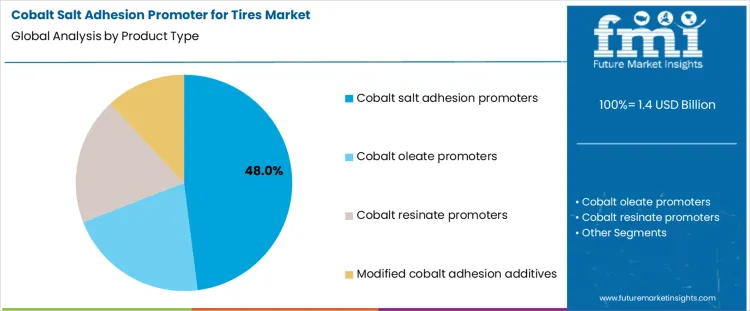
Cobalt salt adhesion promoters represent about 48% of demand in the Cobalt Salt Adhesion Promoter for Tires Market because they provide stable and well understood bonding behavior between rubber compounds and steel reinforcement. Their widespread use reflects long validation history and predictable processing characteristics in mixing and curing. Cobalt oleate promoters are applied where improved dispersion or specific compound compatibility is required, though they introduce tighter control requirements for moisture and storage stability. Cobalt resinate promoters serve formulations that demand controlled release behavior or specific interaction profiles, often in specialty tire compounds. Modified cobalt adhesion additives address tailored performance targets, which increases formulation complexity and qualification effort.
From a production standpoint, product type selection establishes both processing discipline and quality risk exposure. Standard cobalt salts integrate easily into existing mixing sequences and support consistent batch to batch performance. Oleate and resinate forms impose stricter control over handling, temperature, and shelf life, increasing inspection and inventory management requirements. Modified additives expand the range of performance tuning but require closer coordination between additive supplier and compound developer. Once a promoter type is validated within a tire program, substitution is avoided because it triggers renewed adhesion testing, durability evaluation, and corrosion studies. Demand by product type therefore follows long compound approval cycles rather than short term cost optimization initiatives.
Why Does Application Mix Define Volume Concentration and Specification Strictness in the Cobalt Salt Adhesion Promoter for Tires Market?
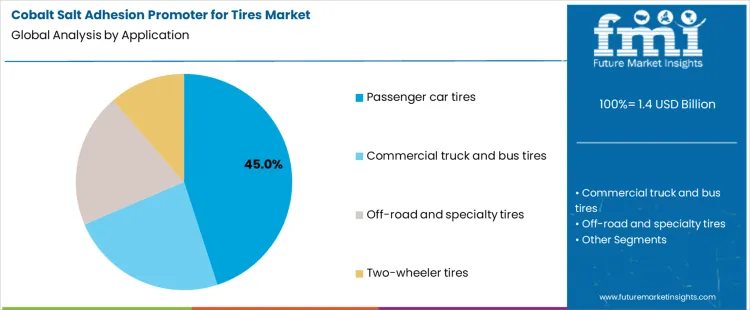
Passenger car tires account for about 45% of demand in the Cobalt Salt Adhesion Promoter for Tires Market because this segment produces the highest unit volumes and uses standardized steel cord reinforced constructions. These programs emphasize consistent adhesion performance across large production runs and multiple plants. Commercial truck and bus tires operate under higher load and durability requirements, which increases testing depth and conservatism in additive selection. Off road and specialty tires involve varied constructions and severe service conditions, which often require tailored compound systems and narrower approved additive lists. Two wheeler tires use smaller quantities per unit, though volumes are influenced by regional production patterns and platform turnover.
Application mix also shapes procurement structure and supplier qualification. Passenger tire producers favor long term supply agreements and multi plant approvals to ensure formulation consistency. Commercial and specialty tire programs involve closer technical oversight and slower approval cycles due to higher liability exposure. Two wheeler producers often balance cost sensitivity with performance requirements, creating segmented sourcing strategies. The resulting demand structure concentrates volume in passenger tire production while technical scrutiny increases in heavy duty and specialty segments. Segment shares therefore move with tire platform renewals, regulatory performance standards, and reinforcement design changes rather than with short term fluctuations in tire shipment volumes.
How Is the Cobalt Salt Adhesion Promoter for Tires Market Being Defined by Bond Reliability and Process Consistency?
The Cobalt Salt Adhesion Promoter for Tires Market is shaped by how tire makers control the bond between steel cord and rubber compounds under demanding service conditions. Adhesion performance affects durability, safety margins, and warranty exposure, which makes cobalt salt systems part of core compound design rather than optional additives. Buyers focus on predictable bonding behavior, stable dispersion, and compatibility with existing mixing and curing processes. Selection decisions involve compound development, quality control, and production engineering teams. This positions cobalt salt adhesion promoters as process-critical materials where consistency, documentation, and supply reliability matter more than short-term price movement.
How Is Compound Platform Management Changing Expectations in The Cobalt Salt Adhesion Promoter for Tires Market?
Tire manufacturers increasingly manage families of compounds across multiple plants and product lines to simplify qualification and quality control. This approach is changing expectations in the Cobalt Salt Adhesion Promoter for Tires Market toward promoters that behave consistently across different formulations and production sites. Development teams prefer materials with stable performance windows and well-defined interaction with brass-coated steel cords. This reduces revalidation work when compounds are transferred between lines or factories. As a result, suppliers are evaluated on batch-to-batch uniformity, technical support, and long-term specification stability rather than on one-off performance claims.
Where Is Incremental Volume Being Built in The Cobalt Salt Adhesion Promoter for Tires Market?
Incremental volume is being built through growth in higher performance and longer life tire segments where adhesion margins are tightly controlled. As product portfolios shift toward more demanding service profiles, compound designs rely more heavily on stable bonding systems. The Cobalt Salt Adhesion Promoter for Tires Market also benefits when manufacturers standardize adhesion systems across multiple tire platforms to reduce internal complexity. There is opportunity for suppliers that can support compound optimization, troubleshooting, and global plant rollouts. Becoming embedded in approved compound recipes creates repeat demand tied to tire output rather than to sporadic reformulation projects.
Why Do Regulatory Pressure and Cost Sensitivity Limit Material Switching in The Cobalt Salt Adhesion Promoter for Tires Market?
Once a compound system is approved for production, changing any critical additive triggers validation work, endurance testing, and internal approvals. This makes material switching slow and cautious. The Cobalt Salt Adhesion Promoter for Tires Market also operates under cost pressure because cobalt-based systems carry visible material cost impact. Tire producers balance performance needs against margin targets, which limits rapid or frequent changes. In addition, regulatory scrutiny around certain materials increases documentation and compliance workload. These factors combine to create a conservative purchasing environment where continuity and risk control often outweigh incremental formulation improvements.
What is the Demand for Cobalt Salt Adhesion Promoter for Tires by Country?
| Country | CAGR |
|---|---|
| USA | 6.2% |
| UK | 6.0% |
| China | 7.0% |
| India | 7.5% |
| Brazil | 6.5% |
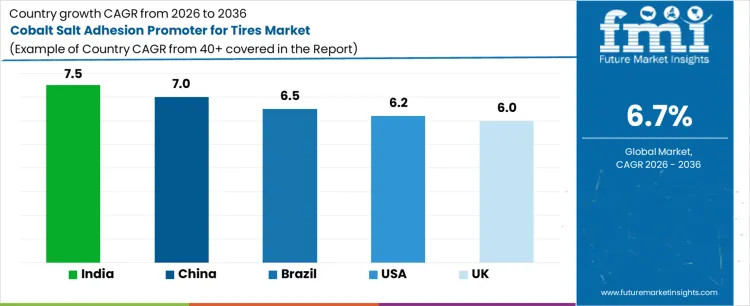
Demand for cobalt salt adhesion promoters for tires is rising as tire manufacturers focus on improving steel cord to rubber bonding strength and long term durability under higher load and temperature conditions. India leads with a 7.5% CAGR, supported by expansion of domestic tire production, growth in passenger and commercial vehicle fleets, and rising use of radial and high performance tire constructions. China follows at 7.0%, driven by its large scale tire manufacturing base and continued demand from export oriented producers. Brazil records 6.5%, reflecting capacity additions and replacement tire demand. The USA grows at 6.2%, shaped by steady production of replacement and specialty tires. The UK, at 6.0%, reflects stable demand from a mature tire manufacturing environment.
How Do Tire Performance Specifications and OEM Qualification Shape Demand in the United States?
Product qualification cycles keep the cobalt salt adhesion promoter for tires market in the United States on a 6.2% CAGR path. Demand comes from tire plants serving passenger vehicles, trucks, and off highway equipment. Compound engineers specify promoters based on bonding consistency between steel cord and rubber compounds. Procurement teams prefer long term supply agreements with controlled batch properties. Audit requirements focus on moisture control, cobalt content stability, and handling safety. Production scheduling links promoter orders to mixing line plans. Replacement of approved grades occurs rarely due to requalification effort. Inventory policies reflect continuous plant operation. Technical service support influences supplier retention. Domestic production supports lead time stability. Import volumes supplement specific grades. Commercial position depends on maintaining approved compound status and audit performance rather than competition for spot chemical purchases across individual tire plants nationwide.
Why Do Certification Systems and Plant Standardization Guide Adoption in the United Kingdom?
Quality assurance systems place the cobalt salt adhesion promoter for tires market in the United Kingdom on a 6.0% CAGR trajectory. Tire manufacturers serving regional and export customers represent the primary users. Material approval follows controlled laboratory testing and plant trials. Central technical teams manage accepted chemical lists across sites. Procurement aligns with annual compound planning cycles. Storage conditions and shelf life monitoring receive close attention. Production teams track bonding performance through routine peel and fatigue tests. Change management processes slow grade substitution. Distributor networks support local delivery and technical service. Import reliance influences logistics planning. Documentation remains part of customer audit files. Commercial access depends on inclusion in approved material schedules and consistent technical support rather than competition for small volume spot chemical orders from individual production lines.
What Role Do Large Scale Tire Production and Process Control Play in China?
High volume tire manufacturing places the cobalt salt adhesion promoter for tires market in China on a 7.0% growth path. Passenger car, truck, and industrial tire plants account for most consumption. Corporate engineering groups define compound recipes and additive standards. Local chemical production supports steady supply and pricing control. Procurement flows through group purchasing organizations. Plant trials confirm compatibility with cord coatings and rubber formulations. Quality teams monitor adhesion results through routine test programs. Inventory planning follows continuous mixing schedules. Replacement of qualified grades occurs infrequently due to process risk. Export oriented production adds compliance requirements. Payment schedules follow supply contracts. Commercial success depends on placement within large tire group approvals and long term supply programs rather than fragmented sales to small independent factories operating at limited scale.
How Do Capacity Expansion and Export Oriented Manufacturing Shape Demand in India?
Growing tire output fixes the cobalt salt adhesion promoter for tires market in India at a 7.5% CAGR. Passenger, commercial, and agricultural tire plants represent core consumers. Procurement decisions focus on consistency, technical support, and local availability. Many plants operate under group technical standards shared across sites. Plant trials remain mandatory before material approval. Storage and handling procedures receive attention due to safety requirements. Production teams track bonding performance during routine quality checks. Import and domestic supply compete under qualification rules. Inventory planning aligns with compound mixing schedules. Replacement demand follows major compound redesign projects. Distributor technical teams support trials and audits. Commercial results depend on inclusion in approved compound lists and maintaining service coverage rather than competition for one time chemical orders to individual plants.
How Do Regional Tire Production and Supply Chain Structure Shape Spending in Brazil?
Plant modernization keeps the cobalt salt adhesion promoter for tires market in Brazil near a 6.5% CAGR. Tire factories serving domestic and regional export markets form the main customer base. Material choice reflects bonding reliability, handling safety, and technical documentation. Procurement often occurs through long term contracts aligned with compound plans. Import procedures influence lead times and stock policies. Quality teams conduct regular adhesion testing during production. Change approval processes limit frequent supplier switching. Inventory management follows continuous mixing operations. Technical service support influences plant confidence. Replacement cycles link to compound reformulation programs. Distributor networks manage local delivery and audits. Commercial position depends on approved supplier status and consistent performance rather than competition for short term chemical sales to individual production sites.
How Do Chemical Suppliers Compete for Compound Approval in the Cobalt Salt Adhesion Promoter for Tires Market?
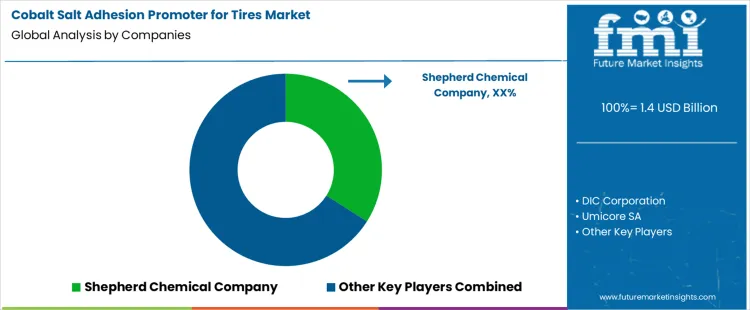
Cobalt salt adhesion promoter purchasing sits inside tire compound approval cycles rather than routine ingredient buying. Formulation teams define steel cord bonding targets, aging behavior, scorch safety, and dispersion limits before naming sources. Shepherd Chemical, DIC Corporation, Umicore, Comar Chemicals, Ege Kimya, Taekwang Fine Chemical compete during that qualification window. Once a cobalt system enters a compound book, change requires new durability testing and plant trials. Shepherd Chemical holds positions through focused cobalt chemistry and batch consistency. Umicore relies on metal processing control and traceability. DIC Corporation links promoters with broader rubber chemical portfolios. Taekwang Fine Chemical Supplies Asian tire plants with stable regional production. Ege Kimya and Comar Chemicals serve price sensitive programs that require consistent specifications and dependable logistics.
Competitive position follows audit results, lot to lot control, and long term supply assurance rather than spot pricing. Tire producers review moisture control, impurity profiles, particle form, and storage stability during supplier approval. Capacity planning matters where multi plant platforms need synchronized deliveries. Metal sourcing discipline affects acceptance in large global programs. Shepherd Chemical benefits from narrow specialization and technical support in compound optimization. Umicore uses upstream metal handling and documentation depth. DIC Corporation secures positions through package supply of multiple rubber additives. Taekwang Fine Chemical competes through regional proximity and delivery reliability. Ege Kimya and Comar Chemicals address programs that value cost control under defined performance limits. Market positions vary by tire category, plant geography, and internal qualification practices.
Key Players in the Cobalt Salt Adhesion Promoter for Tires Market
- Shepherd Chemical Company
- DIC Corporation
- Umicore SA
- Comar Chemicals (Pty) Ltd.
- Ege Kimya
- Taekwang Fine Chemical
Scope of the Report
| Items | Values |
|---|---|
| Quantitative Units (2026) | USD billion |
| Product Type | Cobalt salt adhesion promoters, Cobalt oleate promoters, Cobalt resinate promoters, Modified cobalt adhesion additives |
| Application | Passenger car tires, Commercial truck and bus tires, Off-road and specialty tires, Two-wheeler tires |
| Region | Asia Pacific, Europe, North America, Latin America, Middle East & Africa |
| Countries Covered | China, Japan, South Korea, India, Australia & New Zealand, ASEAN, Germany, United Kingdom, France, Italy, Spain, Nordic, BENELUX, United States, Canada, Mexico, Brazil, Chile, Saudi Arabia, Turkey, South Africa, and other regional markets |
| Key Companies Profiled | Shepherd Chemical Company, DIC Corporation, Umicore SA, Comar Chemicals (Pty) Ltd., Ege Kimya, Taekwang Fine Chemical |
| Additional Attributes | Dollar by sales by product type and application; demand tied to steel cord reinforced tire output; selection driven by compound approval cycles, batch consistency, moisture control, audit requirements, and supply continuity; purchasing governed by long qualification, durability testing, and restricted material change procedures rather than spot price. |
Cobalt Salt Adhesion Promoter for Tires Market Segmentation
Product Type:
- Cobalt salt adhesion promoters
- Cobalt oleate promoters
- Cobalt resinate promoters
- Modified cobalt adhesion additives
Application:
- Passenger car tires
- Commercial truck and bus tires
- Off-road and specialty tires
- Two-wheeler tires
Region:
- Asia Pacific
- China
- Japan
- South Korea
- India
- Australia & New Zealand
- ASEAN
- Rest of Asia Pacific
- Europe
- Germany
- United Kingdom
- France
- Italy
- Spain
- Nordic
- BENELUX
- Rest of Europe
- North America
- United States
- Canada
- Mexico
- Latin America
- Brazil
- Chile
- Rest of Latin America
- Middle East & Africa
- Kingdom of Saudi Arabia
- Other GCC Countries
- Turkey
- South Africa
- Other African Union
- Rest of Middle East & Africa
Bibliography
- ASTM International. (2023). Standard test method for adhesion between steel tire cords and rubber (ASTM D2229). ASTM International.
- International Agency for Research on Cancer. (2023). Cobalt, cobalt compounds and cobalt metal (IARC Monographs, Vol. 131). World Health Organization.
- Organisation for Economic Co-operation and Development. (2023). Safety and environmental management of cobalt and cobalt compounds. OECD Publishing.
- ASTM International. (2023). Standard test methods for rubber property—Adhesion to rigid substrates (ASTM D429). ASTM International.
Frequently Asked Questions
How big is the cobalt salt adhesion promoter for tires market in 2026?
The global cobalt salt adhesion promoter for tires market is estimated to be valued at USD 1.4 billion in 2026.
What will be the size of cobalt salt adhesion promoter for tires market in 2036?
The market size for the cobalt salt adhesion promoter for tires market is projected to reach USD 2.7 billion by 2036.
How much will be the cobalt salt adhesion promoter for tires market growth between 2026 and 2036?
The cobalt salt adhesion promoter for tires market is expected to grow at a 6.7% CAGR between 2026 and 2036.
What are the key product types in the cobalt salt adhesion promoter for tires market?
The key product types in cobalt salt adhesion promoter for tires market are cobalt salt adhesion promoters , cobalt oleate promoters, cobalt resinate promoters and modified cobalt adhesion additives.
Which application segment to contribute significant share in the cobalt salt adhesion promoter for tires market in 2026?
In terms of application, passenger car tires segment to command 45.0% share in the cobalt salt adhesion promoter for tires market in 2026.
Preview the report firsthand - request a free sample
Get SampleGet the brochure for pricing and purchase details.
Get PDFTable of Content
- Executive Summary
- Global Market Outlook
- Demand-side Trends
- Supply-side Trends
- Technology Roadmap Analysis
- Analysis and Recommendations
- Market Overview
- Market Coverage / Taxonomy
- Market Definition / Scope / Limitations
- Market Background
- Market Dynamics
- Drivers
- Restraints
- Opportunity
- Trends
- Scenario Forecast
- Demand in Optimistic Scenario
- Demand in Likely Scenario
- Demand in Conservative Scenario
- Opportunity Map Analysis
- Product Life Cycle Analysis
- Supply Chain Analysis
- Investment Feasibility Matrix
- Value Chain Analysis
- PESTLE and Porter’s Analysis
- Regulatory Landscape
- Regional Parent Market Outlook
- Production and Consumption Statistics
- Import and Export Statistics
- Market Dynamics
- Global Market Analysis 2021 to 2025 and Forecast, 2026 to 2036
- Historical Market Size Value (USD Million) Analysis, 2021 to 2025
- Current and Future Market Size Value (USD Million) Projections, 2026 to 2036
- Y-o-Y Growth Trend Analysis
- Absolute $ Opportunity Analysis
- Global Market Pricing Analysis 2021 to 2025 and Forecast 2026 to 2036
- Global Market Analysis 2021 to 2025 and Forecast 2026 to 2036, By Product Type
- Introduction / Key Findings
- Historical Market Size Value (USD Million) Analysis By Product Type , 2021 to 2025
- Current and Future Market Size Value (USD Million) Analysis and Forecast By Product Type , 2026 to 2036
- Cobalt salt adhesion promoters
- Cobalt oleate promoters
- Cobalt resinate promoters
- Modified cobalt adhesion additives
- Cobalt salt adhesion promoters
- Y-o-Y Growth Trend Analysis By Product Type , 2021 to 2025
- Absolute $ Opportunity Analysis By Product Type , 2026 to 2036
- Global Market Analysis 2021 to 2025 and Forecast 2026 to 2036, By Application
- Introduction / Key Findings
- Historical Market Size Value (USD Million) Analysis By Application, 2021 to 2025
- Current and Future Market Size Value (USD Million) Analysis and Forecast By Application, 2026 to 2036
- Passenger car tires
- Commercial truck and bus tires
- Off‑road and specialty tires
- Two‑wheeler tires
- Passenger car tires
- Y-o-Y Growth Trend Analysis By Application, 2021 to 2025
- Absolute $ Opportunity Analysis By Application, 2026 to 2036
- Global Market Analysis 2021 to 2025 and Forecast 2026 to 2036, By Region
- Introduction
- Historical Market Size Value (USD Million) Analysis By Region, 2021 to 2025
- Current Market Size Value (USD Million) Analysis and Forecast By Region, 2026 to 2036
- North America
- Latin America
- Western Europe
- Eastern Europe
- East Asia
- South Asia and Pacific
- Middle East & Africa
- Market Attractiveness Analysis By Region
- North America Market Analysis 2021 to 2025 and Forecast 2026 to 2036, By Country
- Historical Market Size Value (USD Million) Trend Analysis By Market Taxonomy, 2021 to 2025
- Market Size Value (USD Million) Forecast By Market Taxonomy, 2026 to 2036
- By Country
- USA
- Canada
- Mexico
- By Product Type
- By Application
- By Country
- Market Attractiveness Analysis
- By Country
- By Product Type
- By Application
- Key Takeaways
- Latin America Market Analysis 2021 to 2025 and Forecast 2026 to 2036, By Country
- Historical Market Size Value (USD Million) Trend Analysis By Market Taxonomy, 2021 to 2025
- Market Size Value (USD Million) Forecast By Market Taxonomy, 2026 to 2036
- By Country
- Brazil
- Chile
- Rest of Latin America
- By Product Type
- By Application
- By Country
- Market Attractiveness Analysis
- By Country
- By Product Type
- By Application
- Key Takeaways
- Western Europe Market Analysis 2021 to 2025 and Forecast 2026 to 2036, By Country
- Historical Market Size Value (USD Million) Trend Analysis By Market Taxonomy, 2021 to 2025
- Market Size Value (USD Million) Forecast By Market Taxonomy, 2026 to 2036
- By Country
- Germany
- UK
- Italy
- Spain
- France
- Nordic
- BENELUX
- Rest of Western Europe
- By Product Type
- By Application
- By Country
- Market Attractiveness Analysis
- By Country
- By Product Type
- By Application
- Key Takeaways
- Eastern Europe Market Analysis 2021 to 2025 and Forecast 2026 to 2036, By Country
- Historical Market Size Value (USD Million) Trend Analysis By Market Taxonomy, 2021 to 2025
- Market Size Value (USD Million) Forecast By Market Taxonomy, 2026 to 2036
- By Country
- Russia
- Poland
- Hungary
- Balkan & Baltic
- Rest of Eastern Europe
- By Product Type
- By Application
- By Country
- Market Attractiveness Analysis
- By Country
- By Product Type
- By Application
- Key Takeaways
- East Asia Market Analysis 2021 to 2025 and Forecast 2026 to 2036, By Country
- Historical Market Size Value (USD Million) Trend Analysis By Market Taxonomy, 2021 to 2025
- Market Size Value (USD Million) Forecast By Market Taxonomy, 2026 to 2036
- By Country
- China
- Japan
- South Korea
- By Product Type
- By Application
- By Country
- Market Attractiveness Analysis
- By Country
- By Product Type
- By Application
- Key Takeaways
- South Asia and Pacific Market Analysis 2021 to 2025 and Forecast 2026 to 2036, By Country
- Historical Market Size Value (USD Million) Trend Analysis By Market Taxonomy, 2021 to 2025
- Market Size Value (USD Million) Forecast By Market Taxonomy, 2026 to 2036
- By Country
- India
- ASEAN
- Australia & New Zealand
- Rest of South Asia and Pacific
- By Product Type
- By Application
- By Country
- Market Attractiveness Analysis
- By Country
- By Product Type
- By Application
- Key Takeaways
- Middle East & Africa Market Analysis 2021 to 2025 and Forecast 2026 to 2036, By Country
- Historical Market Size Value (USD Million) Trend Analysis By Market Taxonomy, 2021 to 2025
- Market Size Value (USD Million) Forecast By Market Taxonomy, 2026 to 2036
- By Country
- Kingdom of Saudi Arabia
- Other GCC Countries
- Turkiye
- South Africa
- Other African Union
- Rest of Middle East & Africa
- By Product Type
- By Application
- By Country
- Market Attractiveness Analysis
- By Country
- By Product Type
- By Application
- Key Takeaways
- Key Countries Market Analysis
- USA
- Pricing Analysis
- Market Share Analysis, 2025
- By Product Type
- By Application
- Canada
- Pricing Analysis
- Market Share Analysis, 2025
- By Product Type
- By Application
- Mexico
- Pricing Analysis
- Market Share Analysis, 2025
- By Product Type
- By Application
- Brazil
- Pricing Analysis
- Market Share Analysis, 2025
- By Product Type
- By Application
- Chile
- Pricing Analysis
- Market Share Analysis, 2025
- By Product Type
- By Application
- Germany
- Pricing Analysis
- Market Share Analysis, 2025
- By Product Type
- By Application
- UK
- Pricing Analysis
- Market Share Analysis, 2025
- By Product Type
- By Application
- Italy
- Pricing Analysis
- Market Share Analysis, 2025
- By Product Type
- By Application
- Spain
- Pricing Analysis
- Market Share Analysis, 2025
- By Product Type
- By Application
- France
- Pricing Analysis
- Market Share Analysis, 2025
- By Product Type
- By Application
- India
- Pricing Analysis
- Market Share Analysis, 2025
- By Product Type
- By Application
- ASEAN
- Pricing Analysis
- Market Share Analysis, 2025
- By Product Type
- By Application
- Australia & New Zealand
- Pricing Analysis
- Market Share Analysis, 2025
- By Product Type
- By Application
- China
- Pricing Analysis
- Market Share Analysis, 2025
- By Product Type
- By Application
- Japan
- Pricing Analysis
- Market Share Analysis, 2025
- By Product Type
- By Application
- South Korea
- Pricing Analysis
- Market Share Analysis, 2025
- By Product Type
- By Application
- Russia
- Pricing Analysis
- Market Share Analysis, 2025
- By Product Type
- By Application
- Poland
- Pricing Analysis
- Market Share Analysis, 2025
- By Product Type
- By Application
- Hungary
- Pricing Analysis
- Market Share Analysis, 2025
- By Product Type
- By Application
- Kingdom of Saudi Arabia
- Pricing Analysis
- Market Share Analysis, 2025
- By Product Type
- By Application
- Turkiye
- Pricing Analysis
- Market Share Analysis, 2025
- By Product Type
- By Application
- South Africa
- Pricing Analysis
- Market Share Analysis, 2025
- By Product Type
- By Application
- USA
- Market Structure Analysis
- Competition Dashboard
- Competition Benchmarking
- Market Share Analysis of Top Players
- By Regional
- By Product Type
- By Application
- Competition Analysis
- Competition Deep Dive
- Shepherd Chemical Company
- Overview
- Product Portfolio
- Profitability by Market Segments (Product/Age /Sales Channel/Region)
- Sales Footprint
- Strategy Overview
- Marketing Strategy
- Product Strategy
- Channel Strategy
- DIC Corporation
- Umicore SA
- Comar Chemicals (Pty) Ltd.
- Ege Kimya
- Taekwang Fine Chemical
- Shepherd Chemical Company
- Competition Deep Dive
- Assumptions & Acronyms Used
- Research Methodology


