

Colored Gemstones Market Size and Share Outlook (2025 to 2035)
The global demand for colored gemstones is booming, primarily due to the need for brightness of colors, extraordinary rarity, and responsible sourcing by consumers. Among these, gem market leaders Gemfields, Tiffany & Co., and Stuller command market share premia through better-quality stones plus environmentally responsible source activities, covering the total for 55%.
More narrowly concentrated on geography-based and master craftsmen production lines of differently designed stones with important cultural messages are held to be of value by 30%, followed by new generation, custom-specific or lab-based new entrant offerings valued at around 15%.
Global Market Share Distribution Across Ruby, Sapphire, Emerald, and Niche Gemstone Suppliers
| Global Market Share2025 | Industry Share (%) |
|---|---|
| Top 3 (Gemfields, Tiffany & Co., Stuller) | 55% |
| Rest of Top 5 (Rio Tinto, Chopard) | 10% |
| Next 5 of Top 10 (Swarovski, Leibish & Co., Blue Nile, Boucheron, Graff) | 20% |
| Emerging & Regional Brands (lab-grown and ethical mining startups) | 15% |
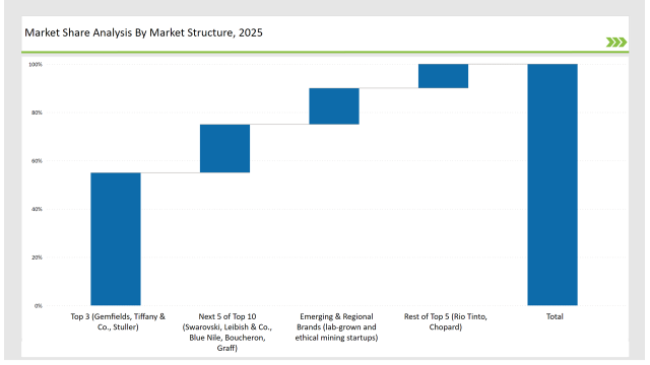
Market Concentration, 2025
The colored gemstones market in 2025 is moderately fragmented, with a mix of global suppliers and regional miners contributing to industry dynamics. While key players like Gemfields and Tiffany & Co. hold a notable share, a significant number of independent gemstone traders and artisanal miners add to the market’s diversity. This fragmentation fosters product variety, price competition, and increasing demand for ethically sourced stones.
Segment Analysis
Sales Channels
50% is made up of luxury jewelry brands and specialty gemstone retailers, targeting exclusivity and high-value buys. E-commerce comprises 25% driven by the increased consumer confidence in buying products online and the ability to virtually try them on. Auction houses and private collectors account for 15% which focuses on rare and investment-grade stones. Direct-to-consumer brands and independent jewelers account for the remaining 10%, focused on customization and affordability.
Product Type
The color gemstones have sapphires, rubies, emeralds, among others.Sapphires dominate the industry at 40% due to their flexibility, in addition to them having a myriad of symbolic roles.Rubies hold 25%, which feature because of how rare they appear, in their deep red color; the emerald also features, 20%. Other gemstone varieties like aquamarine, and spinel tourmaline that hold 15%, as sales rise to collectors or designers.
Who Shaped the Year
For colored gemstones, 2024 has been the year of change: sustainability, customization, and the digitalization of the market. The leaders for this upcoming year are as follows:
- Gemfields: The company has furthered the country's effort in ethical sourcing with transparent mine-to-market programs for rubies and emeralds.
- Tiffany & Co.: The company has enhanced its gemstone collection with responsibly sourced sapphires and new engagement ring designs featuring colored gemstones.
- Stuller: It was more about access to high-quality gemstones with innovative cutting techniques and lab-created alternatives.
- Rio Tinto: It pushed the industry into innovation with responsibly mined pink and fancy-colored diamonds, making the colored palette more expansive.
- Swarovski: It dominates the synthetic market with lab-grown sapphires and rubies that attract the green-conscious buyer.
- Emerging Brands: Vrai and Clean Origin have been on a roll by marketing lab-grown emeralds and rubies that offer full traceability.
Key Highlights from the Forecast
- Sustainability: The consumer demands ethically sourced and conflict-free colored gemstones
- Requirement for Personalization: Unique gemstone cuts and bespoke jewelry are currently trendy.
- Digitalization: Online platforms and virtual certification of gemstones have changed the purchasing dynamics.
- Investment Increase: Colored gemstones that are rare and investment-grade have emerged as a solid alternative asset class.
- Cultural Trends: The people of the world are now keenly interested in historically significant and locally sourced gemstones.
Tier-Wise Brand Classification, 2025

| Tier Type | Tier 1 |
|---|---|
| Example of Key Players | Gemfields, Tiffany & Co., Stuller |
| Market Share % | 55% |
| Tier Type | Tier 2 |
|---|---|
| Example of Key Players | Rio Tinto, Chopard |
| Market Share % | 10% |
| Tier Type | Tier 3 |
|---|---|
| Example of Key Players | Regional miners, lab-grown startups |
| Market Share % | 35% |
Key Brand Initiatives
|
Brand |
Key Focus Areas |
|---|---|
|
Gemfields |
Ethical sourcing and transparency programs |
|
Tiffany & Co. |
Sustainable colored gemstone collections |
|
Stuller |
Accessibility and innovation in gemstone cutting |
|
Rio Tinto |
Investment-grade colored gemstones |
|
Swarovski |
Lab-grown synthetic gemstones |
|
Emerging Brands |
Traceable, lab-grown, and custom gemstones |
Recommendations for Brands
- Investment in Ethical Sourcing: Engage in deep sustainability practices with high transparency to attract the conscious consumer.
- Digital Footprint: Combine AI-facilitated virtual try-ons with blockchain certification, thereby, increasing customer satisfaction.
- More Options of Personalization: Offer tailor-cut gemstones, combined with individually engraved, thereby, setting itself apart.
- Investor Buying Segment: Expand the awareness of value along with scarcity relating to colored gems to the customer
- Cultural Sentiment: Leverage the inspiration related to collection that stems from the heritages or historical value.
Future Roadmap
The colored gemstones market will continue to grow steadily, driven by sustainability, digital transformation, and evolving consumer preferences. Brands will continue to expand into ethical mining, lab-grown alternatives, and unique gemstone designs. Partnerships with high-fashion brands, auction houses, and influencers will further elevate consumer interest, while blockchain authentication will enhance traceability and trust in the market.
Frequently Asked Questions
Which companies hold the largest market share in the colored gemstones industry?
Leading players such as Gemfields, Stuller, and Tiffany & Co. collectively hold around 55% of the market.
What is the market share of regional colored gemstone suppliers?
Regional suppliers, including Sri Lankan and Burmese gemstone traders, contribute about 30% of the market.
How much market share do independent and custom jewelers hold?
High-end boutique designers and niche gemstone brands hold approximately 10% of the market.
What percentage of the market is controlled by private labels in the colored gemstones sector?
Private labels, including department store exclusives, hold around 5% of the market.
How is market concentration assessed in the colored gemstones industry for the year 2025?
High for companies controlling 55%+, medium for 40-55%, and low for those under 30%.
Preview the report firsthand - request a free sample
Get SampleGet the brochure for pricing and purchase details.
Get PDFTable of Content
- Executive Summary
- Market Overview
- Competitive Analysis Outlook for 2025
- Segment Analysis
- Who Shaped the Year
- Key Highlights from the Forecast
- Tier-Wise Brand Classification
- Key Brand Initiatives
- Recommendations for Brands
- Future Roadmap
- FAQs


