

- Market Size (2026)
- USD 2.9 Bn
- Forecast (2036)
- USD 4.6 Bn
- CAGR (2026 to 2036)
- 4.8%
How big is Completion Brines Market in 2026?
USD 2.9 billion in 2026 and USD 4.6 billion by 2036 at a 4.8% CAGR.
Demand for completion brines is projected to expand at 4.8% CAGR between 2026 and 2036, raising valuation from USD 2.9 billion to USD 4.6 billion. Operators order solids-free fluid as wells move toward production because hydrostatic pressure must be maintained without depositing solids in the producing interval. In June 2025, the USA Energy Information Administration expected production to begin at 13 federal offshore Gulf fields during 2025 and 2026. Those schedules turn fluid qualification into timed orders for density, filtration and reservoir compatibility.
Offshore concentration also determines how much prepared brine must sit near ports before each completion campaign. Brazil's ANP reported in August 2026 that 198 pre-salt wells produced oil and gas during June. A multi-well deepwater base makes reclaim capacity and reliable bromide replenishment commercially useful because qualified fluid may need to move between wells without delaying vessel schedules.
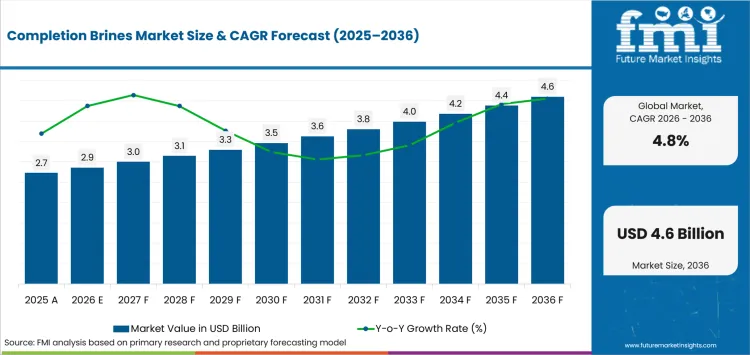
Key Takeaways
- Demand rises as deepwater, HPHT and gas-development programs move wells from drilling into completion or workover stages that require solids-free pressure control.
- By brine type, calcium chloride brine is estimated to hold 25.0% in 2026 owing to lower chemical cost for common low-to-mid density requirements.
- In 2026, below 10 ppg is expected to lead the density range category with 23.0% share because many land wells need moderate hydrostatic pressure.
- Completion fluids are set to lead the application category with 33.0% share in 2026 due to direct fluid demand during final well handover.
- Bromide-heavy systems require more working inventory and tighter compatibility control, which weakens economics on wells that do not need premium density.
- Key players in the completion brines market include TETRA Technologies, Halliburton, SLB, Baker Hughes, ICL Group, LANXESS, and Albemarle.
Analyst Perspective
"Completion-brine economics start with the required density and the time available to stage qualified fluid. Regional inventory earns its place when filtration, compatibility and reclaim support protect the well handover from avoidable fluid delays."
- Nikhil Kaitwade, Principal Consultant, Future Market Insights
How is the completion brines market segmented?
The completion brines market is segmented by brine type, density range, application, well type, sales channel and region.
Brine type covers calcium chloride, calcium bromide, zinc bromide, sodium bromide, potassium chloride and formate brines. Density ranges are below 10 ppg, 10-12 ppg, 12-15 ppg and above 15 ppg. Applications include completion, workover, packer, well-killing and gravel-pack fluids. Well types cover onshore, offshore, deepwater, HPHT and gas wells. Sales channels include completion-fluid suppliers, oilfield service companies, direct E&P contracts and regional brine plants.
Why does calcium chloride brine lead demand within the brine type category?
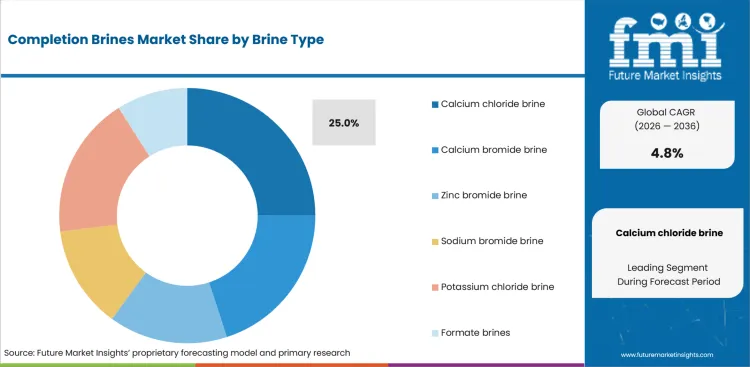
Calcium chloride fits standard completion and workover programs that need clear hydrostatic control without the cost of heavier bromide systems. TETRA Technologies' 2025 Form 10-K reports about 1.0 million equivalent liquid tons of calcium chloride production capacity, giving the company scale in a chemistry used for clear-brine service.
- Based on brine type, calcium chloride brine is projected to account for 25.0% in 2026 due to its fit with common moderate-pressure completion requirements.
- Regional plants can blend or adjust calcium chloride close to active basins, so operators avoid holding higher-cost specialty salts for wells that do not require them.
Why does below 10 ppg lead demand within the density range category?
Lower-density systems fit many land wells whose pressure window does not justify bromide-heavy formulations. Fluid cleanliness and formation compatibility still require qualification before the brine enters the producing interval.
- By density range, below 10 ppg is forecast to represent 23.0% in 2026 driven by lower salt loading for moderate hydrostatic requirements.
- The USA Energy Information Administration found in March 2026 that the Lower 48 outside the Gulf supplied 83% of USA crude output in 2025. That operating base keeps lower-density brines relevant to high-count land programs where onshore fluid cost is repeated over many wells.
Why do completion fluids lead demand within the application category?
Completion fluids are purchased at the handover from well construction to production, which makes fluid readiness part of the completion schedule. Density, cleanliness and reservoir compatibility must be confirmed before the fluid reaches the producing interval.
- The application category is forecast to be led by completion fluids at 33.0% share in 2026 due to direct solids-free pressure-control requirements before production starts.
- In July 2025, TETRA Technologies disclosed CS Neptune use on the final two wells of a three-well deepwater Gulf program. The field record shows why completion-specific fluid selection must align with packers, screens and inflow-control equipment before handover.
Why does onshore lead demand within the well type category?
Onshore programs distribute brine demand over many wells and shorter mobilization routes, allowing regional plants to turn working inventory more frequently. Repeated completion and workover call-offs can offset lower revenue per barrel compared with specialized offshore formulations.
- Onshore is projected to hold 34.0% share in 2026 owing to the large number of conventional and unconventional wells requiring repeated fluid call-offs.
- In June 2025, the USA Energy Information Administration reported that tight oil supplied 81% of Lower 48 onshore crude output during 2024. That scale favors basin-level blending and lower-density inventory that can be reused or replenished between land-well programs.
Why do completion fluid suppliers lead demand within the sales channel category?
Completion-fluid specialists sell blending, filtration, storage and reclaim support with the chemistry, so field execution becomes part of the purchase. ICL reported in February 2026 that clear-brine-fluid sales increased year over year on stronger demand in South America and Europe, showing how specialist channels respond to campaign timing.
- Completion fluid suppliers are set to lead the sales channel category with 38.0% share in 2026 due to bundled fluid preparation and wellsite support.
- Regional technical teams can adjust density and reclaim usable fluid between jobs, reducing fresh-brine mobilization for operators that run repeated completion or workover programs.
What are the drivers, restraints and opportunities in the Completion Brines Market?
Deepwater and HPHT completions increase specification intensity, bromide supply raises inventory exposure, and domestic feedstock plus reclamation can improve high-density economics.
- Driver: Deepwater and high-pressure programs raise demand for solids-free fluids that maintain hydrostatic pressure without placing suspended solids in the producing interval.
- Restraint: Bromide-heavy formulations tie more capital to feedstock and prepared inventory, so an unexpected supply interruption can threaten a fixed completion sequence.
- Opportunity: Domestic bromine production and brine reclamation can shorten replenishment routes for high-density jobs that use specialized chemistry over several wells.
Deepwater Programs Raise Specification-Intensive Fluid Demand
Deepwater teams qualify completion fluids against narrow pressure and temperature windows before a producing interval is exposed. In January 2025, SLB said Shell awarded multi-region deepwater contracts that include drilling and completions fluids. Integrated oilfield service scopes make regional stock more valuable because a late fluid change can interrupt the same offshore sequence covered by the wider contract.
Bromide Supply Interruptions Can Disrupt Fixed Well Schedules
Bromide-heavy brines expose scheduled completions to feedstock interruption because blending begins before final well deployment. Albemarle disclosed in February 2026 that January flooding at Jordan Bromine Company reduced expected 2026 production before the site returned to full rates. The event turns bromine availability into a scheduling concern for high-density jobs that cannot readily substitute a different qualified chemistry.
Domestic Bromine and Reclamation Improve High-Density Supply Control
High-density fluid providers can shorten imported-feedstock routes by producing bromine near major completion basins and reclaiming qualified brine after use. In May 2026, TETRA Technologies approved final investment for an Arkansas bromine facility intended partly for deepwater completion fluids. Domestic feedstock does not remove compatibility testing, though it can reduce the inventory buffer needed for repeated offshore wells.
Which country CAGRs are profiled in the Completion Brines Market?
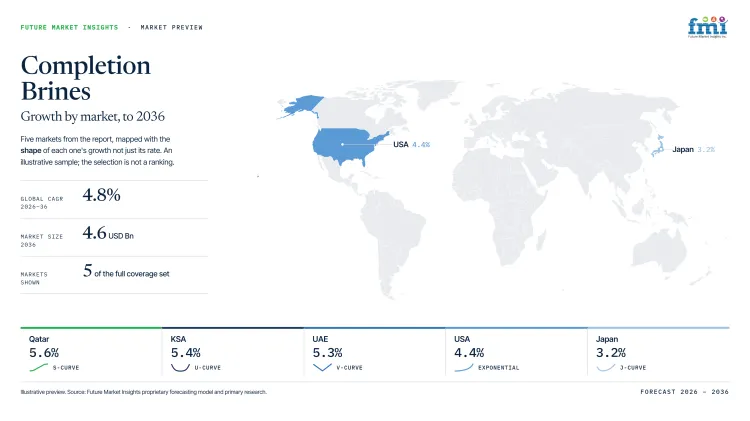
| Country | CAGR |
|---|---|
| Qatar | 5.6% |
| KSA | 5.4% |
| UAE | 5.3% |
| Brazil | 4.9% |
| USA | 4.4% |
| Norway | 4.3% |
| Japan | 3.2% |
How do country-level CAGRs compare in the Completion Brines Market?
The seven profiled rates split into three commercial bands. Qatar, KSA and the UAE lead at 5.3%-5.6% as large gas programs convert into repeated completion schedules. Brazil follows at 4.9% with a deepwater-heavy project base. USA and Norway sit near 4.4%, while Japan's 3.2% reflects a smaller domestic well base. The spread describes project cadence, not current market size.
- Qatar's 5.6% rate reflects a heavier offshore and gas-development mix.
- KSA's 5.4% rate follows high-count unconventional gas development.
- UAE's 5.3% rate reflects multi-rig offshore gas expansion.
- Brazil's 4.9% rate tracks a deepwater-heavy production base.
- USA's 4.4% rate mixes mature shale volume with Gulf deepwater work.
- Norway's 4.3% rate reflects sustained shelf intervention and exploration activity.
- Japan's 3.2% rate reflects a smaller project pipeline despite resource-development policy.
Small CAGR gaps should not dictate inventory placement. Density mix, service distance and turnover often matter more. The full report retains North America, Latin America, Western Europe, Eastern Europe, East Asia, South Asia and Pacific, and Middle East and Africa.
Country-wise Analysis
- Offshore call-off packages in Qatar require completion fluids to be staged before each well sequence, making inventory location part of service execution. QatarEnergy's August 2026 award to Schlumberger Overseas covers a 64-month stimulation contract with personnel, equipment and chemicals supplied on call-off terms. Completion brine demand in Qatar is forecast to rise at 5.6% CAGR over the forecast period, driven by sustained offshore work and prepared fluid near operating bases. Regional blending and reclaim capacity reduce remobilization between wells, but costly bromide stock limits how much specialized inventory can be held between campaigns and raises the value of accurate density forecasting.
- Jafurah's multi-rig development model gives KSA a large onshore base where common brines can be blended close to repeated completion work. Completion brine demand in KSA is estimated to post 5.4% CAGR over the forecast period, attributable to continuing unconventional gas-well activity and field development. Aramco confirmed in February 2026 that Jafurah began first unconventional shale-gas production in December 2025, establishing an operating base for long-running programs. High-density bromides tie up more capital between call-offs, so local reclaim capacity and short replenishment routes become commercially useful as schedules shift and crews move from one completion sequence to the next.
- Offshore Abu Dhabi programs leave little room for late density changes because fluid qualification must stay synchronized with marine logistics and rig schedules. Completion brine demand in the UAE is predicted to advance at 5.3% CAGR through 2036, aided by tightly sequenced offshore gas development. ADNOC announced in July 2026 that Umm Shaif Gas Cap will drill 14 wells over 18 months using three rigs. Prepared inventory near Abu Dhabi shortens response after a specification change, yet approved chemistry records and contamination controls restrict rapid substitution once a well program has qualified its fluid, making documentation and clean handling part of competitive service performance.
- Port handling and vessel timing often influence Brazil's delivered brine cost more than the initial salt price during long deepwater campaigns. ANP's June 2026 sector summary placed pre-salt oil at about 80% of 2025 national output, confirming a deepwater base large enough to sustain fluid infrastructure. Brazil's completion brines outlook is anticipated to advance at 4.9% CAGR over the assessment period, propelled by continuing offshore development and demanding completion specifications. Local storage and reclaim capacity reduce emergency mobilization between wells, while bromide stock still absorbs working capital during project gaps and makes inventory turnover a key test for service companies entering pre-salt campaigns.
- The USA requires two inventory models because high-count shale completions use different fluid economics from deepwater Gulf wells. EIA documented in August 2026 that 81% of Permian horizontal wells completed in 2025 had laterals between 5,000 and 15,000 feet. Completion brine demand in the USA is projected to expand at 4.4% CAGR during the assessment period, owing to steady well handovers in both settings. Basin plants can turn lower-density stock quickly, whereas offshore jobs justify engineered high-density inventory and reclaim support near Gulf service bases. Companies serving both environments need separate stock policies instead of one national blend-and-delivery model.
- Low offshore temperatures make crystallization control a purchase qualification in Norwegian mature-field interventions and subsea tiebacks. Completion brines in Norway are positioned to record 4.3% CAGR during the forecast period, tied to continued shelf activity and disciplined well-intervention demand. The Norwegian Offshore Directorate stated in January 2026 that 2025 was the second-best exploration year in ten years and recorded more than ten kilometres of wellbores. Reuse can improve mature-field economics, yet temperature exposure and service distance require compatibility records before qualified fluid leaves the shore base, which keeps documented cold-condition performance more important than holding excess inventory for uncertain intervention dates.
- Limited domestic drilling makes dedicated completion-brine stock expensive to carry between Japanese projects, favoring consolidated imports and small-batch technical support. METI published in February 2026 that Japan's FY2024 independent oil and gas development ratio reached 42.1%, up 4.9 percentage points from the prior year. Completion brine sales in Japan are forecast to expand at 3.2% CAGR by 2036, given national resource-development work despite the smaller domestic well base. Flexible import arrangements fit this pattern better than permanent local inventory, though each mobilization bears a higher logistics cost per job and gives distributors with reliable customs, storage and technical support a clearer route to repeat business.
Who are the notable companies in the Completion Brines Market?
TETRA Technologies, Halliburton, SLB, Baker Hughes, ICL Group, LANXESS and Albemarle are notable companies serving the completion brines market.
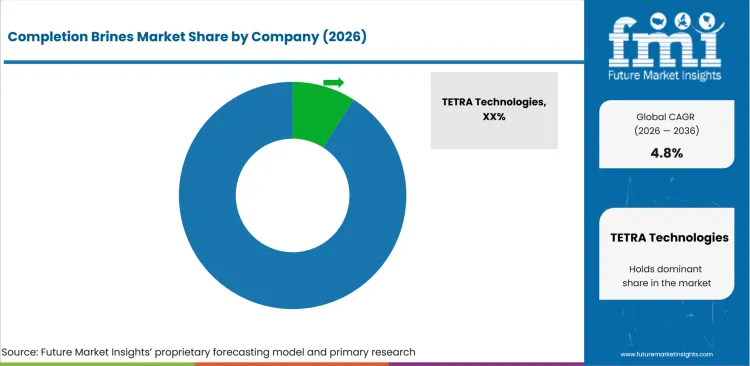
Competition separates into integrated oilfield-service groups and chemical producers with direct bromine or clear-brine exposure. Integrated groups place fluid capability inside broader well-construction programs, whereas chemical companies compete from the feedstock side. Entry becomes harder after operators qualify high-density chemistry because regional inventory and field support must then fit the same well schedule.
- Integrated completion-fluid platforms: TETRA Technologies, Halliburton, SLB and Baker Hughes provide fluid engineering with wider wellsite execution.
- Brine-chemistry suppliers: ICL Group, LANXESS and Albemarle provide bromine or clear-brine chemistry used in specialty and high-density formulations.
Competitive Benchmarking: Completion Brines Market
| Company | Clear Brine Chemistry Breadth | Field Fluid Service Depth | High-Density Supply Position | Geographic Reach |
|---|---|---|---|---|
| TETRA Technologies | High | High | High | Americas, Europe, Middle East and other offshore markets |
| Halliburton | Medium | High | Medium | Global oilfield service network |
| SLB | High | High | High | Global oilfield service network |
| Baker Hughes | Medium | High | Medium | Global energy technology and service network |
| ICL Group | Medium | Low | High | Americas, Europe and industrial markets |
| LANXESS | Medium | Low | High | Global specialty-chemicals distribution |
| Albemarle | Medium | Low | High | Global bromine-specialties supply |
Scoring basis: High chemistry breadth requires at least three documented clear-brine or salt routes, Medium requires two active routes and Low covers one. High field-service depth requires fluid design plus wellsite conditioning or recovery, while Medium covers partial field service and Low identifies chemistry supply without execution. High high-density supply requires direct bromide or engineered-density evidence, Medium represents a narrower route and Low lacks documented high-density supply.
Key Developments in the Completion Brines Market
- In July 2026, Halliburton won long-term drilling and completions contracts for TotalEnergies' GranMorgu project offshore Suriname, including a local workshop for execution support. The award places completion services inside a multi-year offshore program, though individual brine specifications remain controlled by each well design.
- In June 2026, TETRA Technologies introduced Neptune Z-Lite for deepwater and high-pressure completion work and disclosed a three-well 20,000 psi Gulf program. The launch broadens engineered high-density choices for severe wells, but field qualification still depends on the operator's pressure, temperature and compatibility limits.
- In September 2025, SLB received a Petrobras award for completion technologies and services covering up to 35 ultra-deepwater wells in the Atapu and Sépia developments. Multi-well awards favor integrated execution, although fluid selection still follows reservoir and completion requirements for each well.
Key Players in the Completion Brines Market
Integrated Completion-Fluid Platforms
- TETRA Technologies
- Halliburton
- SLB
- Baker Hughes
Bromine and Clear-Brine Chemistry Suppliers
- ICL Group
- LANXESS
- Albemarle
Completion Brines Market - Report Scope
| Coverage field | Report scope |
|---|---|
| Market breakdown | By brine type, density range, application, well type, sales channel and region. |
| Quantitative Units | USD billion. |
| Market Definition | Revenue from clear and solids-free completion brines used in well completion, workover, packer, well-killing and gravel-pack duties within the defined chemistry, density and channel scope. |
| Regions Covered | North America, Latin America, Western Europe, Eastern Europe, East Asia, South Asia and Pacific, and Middle East and Africa. |
| Countries Covered | Qatar, KSA, UAE, Brazil, USA, Norway, Japan, and 20+ countries included in the full report. |
| Key Companies Profiled | TETRA Technologies, Halliburton, SLB, Baker Hughes, ICL Group, LANXESS, Albemarle. |
| Forecast Period | 2026 to 2036. |
| Approach | Primary and secondary research with market triangulation. |
Completion Brines Market - Research Methodology
| Method | Approach |
|---|---|
| Primary Research | FMI analysts gathered input from manufacturers, service providers, technology developers, distributors, end users, procurement teams, and subject-matter experts. Interviews examined purchasing decisions, product or service evaluation, adoption barriers, approval requirements, pricing considerations, and expectations for technical or commercial support. Respondents were also asked what evidence is required before a trial, pilot, or initial order develops into regular purchasing. |
| Desk Research | Desk research covered government statistics, regulatory publications, trade data, industry associations, technical literature, standards, company filings, product information, and official corporate announcements. Sources were reviewed for relevance, publication date, geographic coverage, and consistency with the defined market scope. Claims relating to performance, applications, approvals, capacity, investment, and commercial activity were retained only when supported by credible public evidence. |
| Market Sizing and Forecasting | The market model combined the baseline value with historical performance, segment structure, pricing and volume indicators, adoption levels, company participation, and country-level demand conditions. Forecast assumptions considered economic activity, investment trends, regulatory developments, technology adoption, purchasing cycles, supply availability, and barriers to wider market use. Segment and regional estimates were reconciled before the final market total was calculated. |
| Data Validation | Estimates were checked against multiple independent indicators, including public data, company activity, trade patterns, industry developments, and findings from primary interviews. Validation also tested whether products, services, applications, and company revenues fell within the defined market boundaries. Adjacent categories, unsupported claims, overlapping revenues, and activities without direct market relevance were excluded to reduce double counting and maintain consistency across segments and countries. |
Completion Brines Market by Segments
Completion Brines Market segmented by Brine Type:
- Calcium chloride brine
- Calcium bromide brine
- Zinc bromide brine
- Sodium bromide brine
- Potassium chloride brine
- Formate brines
Completion Brines Market segmented by Density Range:
- Below 10 ppg
- 10-12 ppg
- 12-15 ppg
- Above 15 ppg
Completion Brines Market segmented by Application:
- Completion fluids
- Workover fluids
- Packers fluids
- Well killing
- Gravel pack fluids
Completion Brines Market segmented by Well Type:
- Onshore
- Offshore
- Deepwater
- HPHT
- Gas wells
Completion Brines Market segmented by Sales Channel:
- Completion fluid suppliers
- Oilfield service companies
- Direct E&P contracts
- Regional brine plants
Completion Brines Market by Region:
- North America
- United States
- Canada
- Latin America
- Brazil
- Mexico
- Argentina
- Chile
- Western Europe
- Germany
- France
- United Kingdom
- Italy
- Spain
- Benelux
- Nordics
- Eastern Europe
- Poland
- Czech Republic
- Romania
- Hungary
- East Asia
- China
- Japan
- South Korea
- South Asia and Pacific
- India
- ASEAN
- Australia and New Zealand
- Middle East and Africa
- GCC Countries
- South Africa
- Türkiye
- Israel
Research Sources and Bibliography
- USA Energy Information Administration. (2025, June 6). Gulf of America oil and natural gas production expected to remain stable through 2026.
- Agência Nacional do Petróleo, Gás Natural e Biocombustíveis. (2026, August 3). ANP divulga dados consolidados da produção de petróleo e gás em junho de 2026.
- TETRA Technologies. (2026, February 25). Annual report on Form 10-K for the fiscal year ended December 31, 2025.
- USA Energy Information Administration. (2026, March 31). USA crude oil production rose in 2025, setting new record.
- TETRA Technologies. (2025, July 29). TETRA Technologies, Inc. announces strong second quarter 2025 results and provides full year guidance.
- USA Energy Information Administration. (2025, June 2). Tight oil production in Permian drives growth in onshore USA Lower 48 states production.
- SLB. (2025, January 8). SLB awarded multi-region deepwater contracts by Shell to support capital-efficient energy development.
- Albemarle Corporation. (2026, February 11). Albemarle reports fourth quarter and full year 2025 results.
- TETRA Technologies. (2026, May 28). TETRA Technologies, Inc. board of directors approves final investment decision for Arkansas bromine production facility.
- QatarEnergy. (2026, August 1). Provision of stimulation vessel, rig based package equipment and services for offshore operations.
- Aramco. (2026, February 26). Aramco’s gas strategy builds momentum with major progress towards growth target.
- ADNOC. (2026, July 21). ADNOC accelerates gas growth strategy with final investment decision for Umm Shaif Gas Cap.
- Agência Nacional do Petróleo, Gás Natural e Biocombustíveis. (2026, June 30). ANP divulga dados consolidados do setor regulado em 2025.
- USA Energy Information Administration. (2026, August 19). Longer wells boost Permian crude oil and natural gas production.
- Norwegian Offshore Directorate. (2026, January 8). Best exploration year in several years.
- Ministry of Economy, Trade and Industry of Japan. (2026, February 17). FY2024 independent development ratio of oil and natural gas in Japan released.
- Halliburton. (2026, February 6). Annual report on Form 10-K for the fiscal year ended December 31, 2025.
- SLB. (2026, January 23). Annual report on Form 10-K for the fiscal year ended December 31, 2025.
- Baker Hughes. (2026, February 5). Annual report on Form 10-K for the fiscal year ended December 31, 2025.
- ICL Group. (2026, February 18). ICL reports fourth quarter and full year 2025 results.
- Albemarle Corporation. (2026, June). 2025 sustainability report.
- ICL Group. (2025, November 12). ICL reports third quarter 2025 results and announces new strategic principles.
- LANXESS. (2026, March 19). Annual Report 2025.
- Halliburton. (2026, July 13). Halliburton wins integrated drilling and completions contracts for GranMorgu deepwater development offshore Suriname.
- TETRA Technologies. (2026, June 29). TETRA Technologies introduces TETRA Neptune Z-Lite deepwater completions fluid.
- SLB. (2025, September 25). SLB awarded major completions contract for ultra-deepwater project offshore Brazil.
- Baker Hughes. (2026, May 28). Baker Hughes, Equinor extend significant contracts to support North Sea energy production.
- SLB. (2025, May 6). SLB introduces digitally enabled electric well solutions that maximize production and recovery.
- Baker Hughes. (2025, September 11). Baker Hughes to supply integrated subsea, completion systems for Turkish Petroleum’s Sakarya Gas Field Phase 3.
- SLB. (2026, February 12). SLB awarded multiple offshore drilling contracts by Mubadala Energy for Tangkulo deepwater development in Indonesia.
- Halliburton. (2025, October 16). Aker BP and Halliburton execute first umbilical-less tubing hanger installation.
- LANXESS. (2025, August 14). LANXESS takes action to counter weak market environment.
- Halliburton. (2026, July 15). Aramco awards Halliburton long-term contract for unconventional gas program.
- SLB. (2025, March 31). SLB awarded major drilling contract by Woodside Energy for ultra-deepwater Trion development, offshore Mexico.
- Baker Hughes. (2025, March 20). Baker Hughes to provide fully integrated completions for Petrobras offshore fields.
- TETRA Technologies. (2026, February 25). TETRA Technologies, Inc. announces fourth-quarter and strong full-year 2025 results and provides update on strategic initiatives.
This bibliography is provided for reader reference and is not exhaustive. The full report contains the complete reference list and detailed citations.
This Report Answers
- How large is the completion brines market in 2026 and 2036?
- Which well programs convert into completion-brine orders?
- Why does calcium chloride brine lead by brine type?
- How do density requirements change brine economics?
- Why do completion fluids, onshore wells and specialist channels lead?
- How do growth rates differ among the seven profiled countries?
- Which companies supply completion fluids and bromine inputs?
- What supply and qualification constraints can delay high-density orders?
Frequently Asked Questions
How big is the completion brines market in 2026?
The completion brines market is valued at USD 2.9 billion in 2026 and is projected to reach USD 4.6 billion by 2036. Deepwater and HPHT completion programs require solids-free pressure control before production begins.
What is the CAGR of the completion brines market from 2026 to 2036?
The completion brines market is projected to grow at 4.8% CAGR between 2026 and 2036. Scheduled offshore completions and regional inventory requirements keep fluid demand tied to well handovers.
Which brine type leads the completion brines market?
The calcium chloride brine segment is expected to hold 25.0% of the completion brines market in 2026, driven by lower chemical cost for common low-to-mid density programs. Regional blending also supports routine completion and workover use.
Which application leads the completion brines market?
The completion fluids segment is expected to hold 33.0% of the completion brines market by application in 2026, attributable to direct pressure-control needs during well handover. Operators require clean fluid before the producing interval is placed onstream.
Which companies are active in the completion brines market?
Key companies operating in the completion brines market include TETRA Technologies, Halliburton, SLB, Baker Hughes, ICL Group, LANXESS and Albemarle. Their positions span completion-fluid execution, clear-brine chemistry and bromine supply.
Preview the report firsthand - request a free sample
Get SampleGet the brochure for pricing and purchase details.
Get PDFTable of Content
- Key Takeaways
- Market Size and CAGR
- Top Growth Driver
- Fastest Growing Segment
- Leading Region
- Key Companies
- Emerging Opportunities
- Executive Summary
- Global Market Outlook
- Demand-side Trends
- Supply-side Trends
- Technology Roadmap Analysis
- Analysis and Recommendations
- Analyst Perspective (What is happening? Why now? What should investors know?)
- Key Questions Answered
- How large is the market?
- What is the CAGR?
- What are key trends?
- Which region dominates?
- Who are the leaders?
- Market Overview
- Market Coverage / Taxonomy
- Market Definition / Scope / Limitations
- Research Methodology
- Chapter Orientation
- Analytical Lens and Working Hypotheses
- Market Structure, Signals, and Trend Drivers
- Benchmarking and Cross-market Comparability
- Market Sizing, Forecasting, and Opportunity Mapping
- Research Design and Evidence Framework
- Desk Research Programme (Secondary Evidence)
- Expert Input and Fieldwork (Primary Evidence)
- Tooling, Models, and Reference Databases
- Data Engineering and Model Build
- Quality Assurance and Audit Trail
- Market Background
- Market Dynamics (Drivers, Restraints, Opportunity, Trends)
- Scenario Forecast (Optimistic, Likely, Conservative)
- Impact Analysis
- AI Impact
- Sustainability Impact
- Regulatory Impact
- Technology Impact
- Consumer / Buyer Analysis
- Purchase Drivers
- Adoption Barriers
- Buyer Journey
- Opportunity Map Analysis
- Product Life Cycle Analysis
- Supply Chain Analysis
- Investment Feasibility Matrix
- Value Chain Analysis
- PESTLE and Porter's Analysis
- Regulatory Landscape
- Regional Parent Market Outlook
- Production and Consumption Statistics
- Import and Export Statistics
- Global Market Analysis and Forecast, 2021 to 2036
- Historical Market Size Value (USD Billion) Analysis, 2021 to 2025
- Current and Future Market Size Value (USD Billion) Projections, 2026 to 2036
- Y-o-Y Growth Trend Analysis
- Absolute $ Opportunity Analysis
- Global Market Pricing Analysis, 2021 to 2036
- Global Market Analysis and Forecast, By Brine Type, 2021 to 2036
- Introduction / Key Findings
- Historical Market Size Value (USD Billion) Analysis By Brine Type, 2021 to 2025
- Current and Future Market Size Value (USD Billion) Analysis and Forecast By Brine Type, 2026 to 2036
- Calcium chloride brine
- Calcium bromide brine
- Zinc bromide brine
- Sodium bromide brine
- Potassium chloride brine
- Formate brines
- Calcium chloride brine
- Y-o-Y Growth Trend Analysis By Brine Type, 2021 to 2025
- Absolute $ Opportunity Analysis By Brine Type, 2026 to 2036
- Global Market Analysis and Forecast, By Density Range, 2021 to 2036
- Introduction / Key Findings
- Historical Market Size Value (USD Billion) Analysis By Density Range, 2021 to 2025
- Current and Future Market Size Value (USD Billion) Analysis and Forecast By Density Range, 2026 to 2036
- Below 10 ppg
- 10-12 ppg
- 12-15 ppg
- Above 15 ppg
- Below 10 ppg
- Y-o-Y Growth Trend Analysis By Density Range, 2021 to 2025
- Absolute $ Opportunity Analysis By Density Range, 2026 to 2036
- Global Market Analysis and Forecast, By Application, 2021 to 2036
- Introduction / Key Findings
- Historical Market Size Value (USD Billion) Analysis By Application, 2021 to 2025
- Current and Future Market Size Value (USD Billion) Analysis and Forecast By Application, 2026 to 2036
- Completion fluids
- Workover fluids
- Packers fluids
- Well killing
- Gravel pack fluids
- Completion fluids
- Y-o-Y Growth Trend Analysis By Application, 2021 to 2025
- Absolute $ Opportunity Analysis By Application, 2026 to 2036
- Global Market Analysis and Forecast, By Well Type, 2021 to 2036
- Introduction / Key Findings
- Historical Market Size Value (USD Billion) Analysis By Well Type, 2021 to 2025
- Current and Future Market Size Value (USD Billion) Analysis and Forecast By Well Type, 2026 to 2036
- Onshore
- Offshore
- Deepwater
- HPHT
- Gas wells
- Onshore
- Y-o-Y Growth Trend Analysis By Well Type, 2021 to 2025
- Absolute $ Opportunity Analysis By Well Type, 2026 to 2036
- Global Market Analysis and Forecast, By Sales Channel, 2021 to 2036
- Introduction / Key Findings
- Historical Market Size Value (USD Billion) Analysis By Sales Channel, 2021 to 2025
- Current and Future Market Size Value (USD Billion) Analysis and Forecast By Sales Channel, 2026 to 2036
- Completion fluid suppliers
- Oilfield service companies
- Direct E&P contracts
- Regional brine plants
- Completion fluid suppliers
- Y-o-Y Growth Trend Analysis By Sales Channel, 2021 to 2025
- Absolute $ Opportunity Analysis By Sales Channel, 2026 to 2036
- Global Market Analysis and Forecast, By Region, 2021 to 2036
- Introduction
- Historical Market Size Value (USD Billion) Analysis By Region, 2021 to 2025
- Current Market Size Value (USD Billion) Analysis and Forecast By Region, 2026 to 2036
- North America
- Latin America
- Western Europe
- Eastern Europe
- East Asia
- South Asia and Pacific
- Middle East & Africa
- Market Attractiveness Analysis By Region
- North America Market Analysis and Forecast, By Country, 2021 to 2036
- Historical Market Size Value (USD Billion) Trend Analysis By Market Taxonomy, 2021 to 2025
- Market Size Value (USD Billion) Forecast By Market Taxonomy, 2026 to 2036
- By Country
- USA
- Canada
- By Brine Type
- By Density Range
- By Application
- By Well Type
- By Sales Channel
- By Country
- Market Attractiveness Analysis
- By Country
- By Brine Type
- By Density Range
- By Application
- By Well Type
- By Sales Channel
- Key Takeaways
- Latin America Market Analysis and Forecast, By Country
- Historical Market Size Value (USD Billion) Trend Analysis By Market Taxonomy, 2021 to 2025
- Market Size Value (USD Billion) Forecast By Market Taxonomy, 2026 to 2036
- By Country
- Brazil
- Mexico
- Chile
- Rest of Latin America
- By Brine Type
- By Density Range
- By Application
- By Well Type
- By Sales Channel
- By Country
- Market Attractiveness Analysis
- By Country
- By Brine Type
- By Density Range
- By Application
- By Well Type
- By Sales Channel
- Key Takeaways
- Western Europe Market Analysis and Forecast, By Country
- Historical Market Size Value (USD Billion) Trend Analysis By Market Taxonomy, 2021 to 2025
- Market Size Value (USD Billion) Forecast By Market Taxonomy, 2026 to 2036
- By Country
- Germany
- UK
- Italy
- Spain
- France
- Nordic
- BENELUX
- Rest of Western Europe
- By Brine Type
- By Density Range
- By Application
- By Well Type
- By Sales Channel
- By Country
- Market Attractiveness Analysis
- By Country
- By Brine Type
- By Density Range
- By Application
- By Well Type
- By Sales Channel
- Key Takeaways
- Eastern Europe Market Analysis and Forecast, By Country
- Historical Market Size Value (USD Billion) Trend Analysis By Market Taxonomy, 2021 to 2025
- Market Size Value (USD Billion) Forecast By Market Taxonomy, 2026 to 2036
- By Country
- Russia
- Poland
- Hungary
- Balkan & Baltic
- Rest of Eastern Europe
- By Brine Type
- By Density Range
- By Application
- By Well Type
- By Sales Channel
- By Country
- Market Attractiveness Analysis
- By Country
- By Brine Type
- By Density Range
- By Application
- By Well Type
- By Sales Channel
- Key Takeaways
- East Asia Market Analysis and Forecast, By Country
- Historical Market Size Value (USD Billion) Trend Analysis By Market Taxonomy, 2021 to 2025
- Market Size Value (USD Billion) Forecast By Market Taxonomy, 2026 to 2036
- By Country
- China
- Japan
- South Korea
- By Brine Type
- By Density Range
- By Application
- By Well Type
- By Sales Channel
- By Country
- Market Attractiveness Analysis
- By Country
- By Brine Type
- By Density Range
- By Application
- By Well Type
- By Sales Channel
- Key Takeaways
- South Asia and Pacific Market Analysis and Forecast, By Country
- Historical Market Size Value (USD Billion) Trend Analysis By Market Taxonomy, 2021 to 2025
- Market Size Value (USD Billion) Forecast By Market Taxonomy, 2026 to 2036
- By Country
- India
- ASEAN
- Australia & New Zealand
- Rest of South Asia and Pacific
- By Brine Type
- By Density Range
- By Application
- By Well Type
- By Sales Channel
- By Country
- Market Attractiveness Analysis
- By Country
- By Brine Type
- By Density Range
- By Application
- By Well Type
- By Sales Channel
- Key Takeaways
- Middle East & Africa Market Analysis and Forecast, By Country
- Historical Market Size Value (USD Billion) Trend Analysis By Market Taxonomy, 2021 to 2025
- Market Size Value (USD Billion) Forecast By Market Taxonomy, 2026 to 2036
- By Country
- Kingdom of Saudi Arabia
- Other GCC Countries
- Türkiye
- South Africa
- Other African Union
- Rest of Middle East & Africa
- By Brine Type
- By Density Range
- By Application
- By Well Type
- By Sales Channel
- By Country
- Market Attractiveness Analysis
- By Country
- By Brine Type
- By Density Range
- By Application
- By Well Type
- By Sales Channel
- Key Takeaways
- Key Countries Market Analysis
- USA
- Pricing Analysis
- Market Share Analysis, 2025
- By Brine Type
- By Density Range
- By Application
- By Well Type
- By Sales Channel
- Canada
- Pricing Analysis
- Market Share Analysis, 2025
- By Brine Type
- By Density Range
- By Application
- By Well Type
- By Sales Channel
- Mexico
- Pricing Analysis
- Market Share Analysis, 2025
- By Brine Type
- By Density Range
- By Application
- By Well Type
- By Sales Channel
- Brazil
- Pricing Analysis
- Market Share Analysis, 2025
- By Brine Type
- By Density Range
- By Application
- By Well Type
- By Sales Channel
- Chile
- Pricing Analysis
- Market Share Analysis, 2025
- By Brine Type
- By Density Range
- By Application
- By Well Type
- By Sales Channel
- Germany
- Pricing Analysis
- Market Share Analysis, 2025
- By Brine Type
- By Density Range
- By Application
- By Well Type
- By Sales Channel
- UK
- Pricing Analysis
- Market Share Analysis, 2025
- By Brine Type
- By Density Range
- By Application
- By Well Type
- By Sales Channel
- Italy
- Pricing Analysis
- Market Share Analysis, 2025
- By Brine Type
- By Density Range
- By Application
- By Well Type
- By Sales Channel
- Spain
- Pricing Analysis
- Market Share Analysis, 2025
- By Brine Type
- By Density Range
- By Application
- By Well Type
- By Sales Channel
- France
- Pricing Analysis
- Market Share Analysis, 2025
- By Brine Type
- By Density Range
- By Application
- By Well Type
- By Sales Channel
- India
- Pricing Analysis
- Market Share Analysis, 2025
- By Brine Type
- By Density Range
- By Application
- By Well Type
- By Sales Channel
- ASEAN
- Pricing Analysis
- Market Share Analysis, 2025
- By Brine Type
- By Density Range
- By Application
- By Well Type
- By Sales Channel
- Australia & New Zealand
- Pricing Analysis
- Market Share Analysis, 2025
- By Brine Type
- By Density Range
- By Application
- By Well Type
- By Sales Channel
- China
- Pricing Analysis
- Market Share Analysis, 2025
- By Brine Type
- By Density Range
- By Application
- By Well Type
- By Sales Channel
- Japan
- Pricing Analysis
- Market Share Analysis, 2025
- By Brine Type
- By Density Range
- By Application
- By Well Type
- By Sales Channel
- South Korea
- Pricing Analysis
- Market Share Analysis, 2025
- By Brine Type
- By Density Range
- By Application
- By Well Type
- By Sales Channel
- Russia
- Pricing Analysis
- Market Share Analysis, 2025
- By Brine Type
- By Density Range
- By Application
- By Well Type
- By Sales Channel
- Poland
- Pricing Analysis
- Market Share Analysis, 2025
- By Brine Type
- By Density Range
- By Application
- By Well Type
- By Sales Channel
- Hungary
- Pricing Analysis
- Market Share Analysis, 2025
- By Brine Type
- By Density Range
- By Application
- By Well Type
- By Sales Channel
- Kingdom of Saudi Arabia
- Pricing Analysis
- Market Share Analysis, 2025
- By Brine Type
- By Density Range
- By Application
- By Well Type
- By Sales Channel
- Türkiye
- Pricing Analysis
- Market Share Analysis, 2025
- By Brine Type
- By Density Range
- By Application
- By Well Type
- By Sales Channel
- South Africa
- Pricing Analysis
- Market Share Analysis, 2025
- By Brine Type
- By Density Range
- By Application
- By Well Type
- By Sales Channel
- USA
- Market Structure Analysis
- Competition Dashboard
- Competition Benchmarking
- Market Share Analysis of Top Players
- By Regional
- By Brine Type
- By Density Range
- By Application
- By Well Type
- By Sales Channel
- Emerging Startups
- Innovation Benchmarking
- Competition Analysis
- Competition Deep Dive
- TETRA Technologies
- Overview
- Product Portfolio
- Profitability by Market Segments
- Sales Footprint
- Strategy Overview
- Marketing Strategy
- Product Strategy
- Channel Strategy
- Halliburton
- SLB
- Baker Hughes
- ICL Group
- LANXESS
- Albemarle
- Newpark Resources
- Cabot Corporation
- Solent Chemicals
- TETRA Technologies
- Case Studies
- Success Stories
- Recent Developments
- Competition Deep Dive
- Assumptions & Acronyms Used


