

- Market Size (2026)
- USD 5.9 Bn
- Forecast (2036)
- USD 18.8 Bn
- CAGR (2026 to 2036)
- 12.3%
How big is the Computer-Aided Drug Discovery Market in 2026?
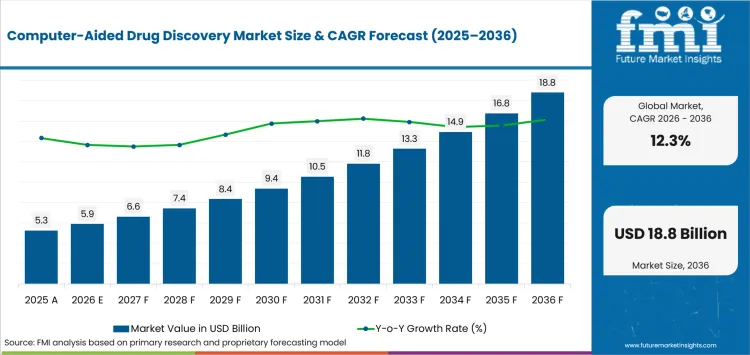
USD 5.9 billion in 2026 and USD 18.8 billion by 2036 at a 12.3% CAGR.
Demand for computer-aided drug discovery is projected to expand at 12.3% CAGR between 2026 and 2036, increasing valuation from USD 5.9 billion in 2026 to USD 18.8 billion by 2036. Pharmaceutical research teams use drug discovery informatics to narrow hypotheses before synthesis or assay work. Commercial value depends on whether model rankings change practical experimental decisions across active research programs.
Regulated development requires evidence that matches each model’s intended decision and clearly defined scientific operating context. In January 2025, FDA reported experience with more than 500 drug and biological product submissions containing AI components since 2016. FDA’s review volume supports recurring demand for AI-enabled drug discovery platforms that preserve provenance and connect computational outputs with laboratory confirmation.
Key Takeaways of Computer-Aided Drug Discovery Market
- Discovery teams use computational screening to focus limited laboratory capacity on molecular hypotheses with stronger evidence.
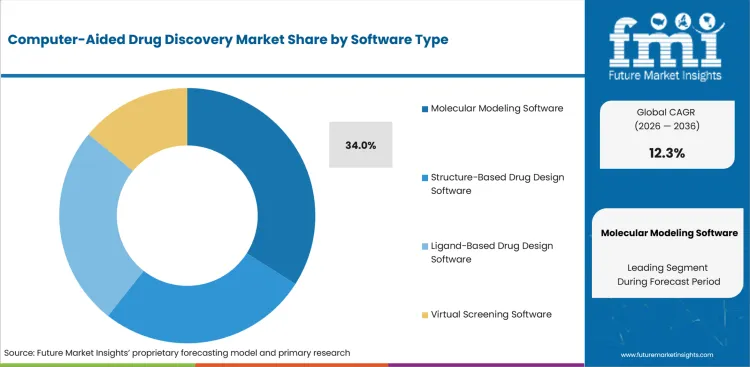
- Molecular modeling software is projected to hold 34.0% of software type demand in 2026 due to workflow coverage.
- Lead identification is estimated at 31.0% of application demand in 2026 owing to repeated candidate filtering.
- Pharmaceutical companies are expected to hold 39.0% of end-user demand in 2026 supported by governed access across pipelines.
- Uneven training data and limited model transferability require validation so computational rankings can guide laboratory decisions.
- Schrödinger, Inc., Certara, Inc., Dassault Systèmes SE, Chemical Computing Group ULC, Cadence Molecular Sciences (OpenEye), a business unit of Cadence Design Systems, Inc., BioSolveIT GmbH, Optibrium Ltd. and Insilico Medicine are some key players.
Analyst Perspective
"Discovery leaders should test whether assay results change candidate rankings and medicinal chemists reproduce decisions. Wider deployment depends on traceable target context and consistent experimental outcomes across partnered programs globally."
- Anurag Sharma, Principal Consultant, Future Market Insights
How is the Computer-Aided Drug Discovery Market segmented?
The computer-aided drug discovery industry is segmented by software type, application, end user, distribution channel, technology and region.
The market is segmented by software type, application, end user, distribution channel, technology and region. Software type covers molecular modeling, structure-based design, ligand-based design and virtual screening across several discovery stages. Applications include lead identification, lead optimization, drug repurposing and preclinical discovery, while end users include pharmaceutical companies, biotechnology companies, CROs and research institutes. Distribution covers direct sales, subscriptions, resellers and online channels, while technology includes AI/ML, molecular simulation, computer-aided molecular design and bioinformatics.
What supports molecular modeling software within the software type category?
Molecular modeling gives medicinal chemists a shared environment for examining structures and interactions during early laboratory planning. In January 2026, Schrödinger linked its physics-plus-AI platform with data-scarce molecular discovery and enterprise informatics across customer programs that require traceable design decisions and experimental follow-up.
- By software type, molecular modeling software is estimated to hold 34.0% in 2026 owing to its use across dynamics and homology modeling workflows.
- Research teams select molecular design tools that connect structural analysis with feasible synthesis decisions during routine cross-site reviews, outsourced chemistry work and compound selection meetings across active global programs.
How do discovery teams evaluate lead identification within the application category?
Lead identification systematically converts target hypotheses into ranked compounds that can enter active screening and refinement. Platforms must connect biological evidence with chemical feasibility so experimental teams assign limited assay capacity across several active therapeutic hypotheses.
- The lead identification segment is likely to capture 31.0% share in 2026 attributable to repeated computational filtering that limits laboratory resources for uncertain candidates.
- Discovery scientists use bioinformatics platforms to connect disease evidence with candidate ranking during early target assessment. In October 2025, Insilico Medicine reported TargetPro coverage across 38 diseases and 71.6% retrieval of known clinical targets as a benchmark for target-ranking breadth.
What makes pharmaceutical companies central to the end-user category?
Pharmaceutical companies run several discovery programs and require consistent access controls across internal laboratories and external research partners. Standardized deployment helps scientific leaders compare computational decisions through enterprise laboratory informatics serving distributed project teams across regional operating groups.
- In 2026, pharmaceutical companies are expected to lead the end-user category with 39.0% share because multiple pipelines require repeatable platform access and specialist support during portfolio reviews.
- Enterprise research groups favor governed platforms that connect model outputs with project data and preserve collaboration between medicinal chemistry and biology teams during candidate selection and global external program reviews.
How does artificial intelligence and machine learning shape technology selection?
AI/ML helps medicinal chemistry teams rank compounds and generate structures across biological and chemical datasets inside governed discovery programs. In February 2026, Dassault Systèmes and NVIDIA connected BIOVIA workflows with BioNeMo models so enterprise researchers could accelerate molecule design within validated modeling environments.
- By technology, artificial intelligence and machine learning are forecast to represent 35.0% in 2026 driven by deep learning and generative design across discovery workflows and candidate selection.
- Scientists pair laboratory information systems with model workflows so experimental results improve candidate ranking and preserve decision traceability across internal teams and research partners during later experimental review and model retraining cycles.
What are the drivers, restraints and opportunities in the Computer-Aided Drug Discovery Market?
Computational screening directs scarce laboratory capacity, model uncertainty slows adoption and closed-loop validation supports more defensible discovery decisions.
- Driver: Computational screening directs laboratory capacity toward molecular hypotheses with stronger evidence and practical experimental routes.
- Restraint: Model uncertainty increases validation work whenever training data or target context differs from the intended scientific decision.
- Opportunity: Closed-loop platforms connect simulation and generative design with assay feedback across one traceable research workflow.
Pharmaceutical teams use drug discovery services to screen chemical spaces so limited assays focus on compounds with stronger predicted fit. In July 2025, Schrödinger and Ajax expanded their collaboration to another JAK target through computational design. Joint programs therefore need laboratory evidence and development responsibilities that govern candidate progression across both organizations.
Model performance weakens across biological targets and chemical series that differ from its training evidence. Research teams need project-specific assays and documented assumptions so rankings support regulated development decisions confidently.
Closed-loop platforms return assay results to simulation and generative design without treating predictions as biological proof. Electronic lab notebooks preserve candidate decisions across research teams, while laboratory automation supplies structured feedback for model refinement.
Which country CAGRs are profiled in the Computer-Aided Drug Discovery Market?
| Country | CAGR |
|---|---|
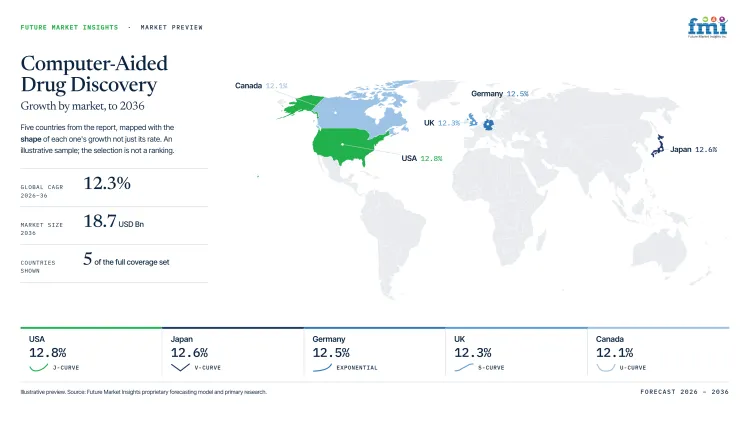
| United States | 12.8% |
| Japan | 12.6% |
| Germany | 12.5% |
| United Kingdom | 12.3% |
| Canada | 12.1% |
How do country-level CAGRs compare in the Computer-Aided Drug Discovery Market?
The five profiled CAGRs span 0.7 percentage point across countries within a narrow double-digit range. Forecast pace does not establish current market size or present installed-base depth across national research systems.
- The United States combines broad regulated pharmaceutical research with demanding model-credibility expectations across enterprise discovery workflows.
- Japan uses coordinated public research programs and domestic pharmaceutical networks that support localized scientific deployment.
- Germany combines computational science capacity with strict European requirements for data governance and reproducible regulated research.
- The United Kingdom links national AI-science missions with academic-industry infrastructure for translational discovery programs nationwide.
- Canada brings public computational-design expertise to a smaller commercialization base spread across distant research centers.
Comparable CAGRs can produce different market entry conditions. The full report provides country-level CAGR analysis across North America, Latin America, Europe, East Asia, South Asia and Pacific, and the Middle East and Africa.
Country-wise Analysis
- United States pharmaceutical laboratories combine internal modeling teams with contract research networks that run assays under shared project controls across major therapeutic areas and geographically distributed discovery sites serving active commercial portfolio groups nationwide. NIH highlighted virtual screening and machine learning from hit identification through lead optimization in January 2026 through active programs requiring defined experimental endpoints and measurable evidence for candidate progression within funded projects. Adoption of computer-aided drug discovery in the United States is estimated to expand at 12.8% CAGR through 2036, supported by experienced centers despite security reviews that extend enterprise licensing across regulated programs nationwide.
- Japan’s metropolitan pharmaceutical laboratories connect corporate research with university drug-discovery programs through established medicinal chemistry teams and AMED-supported networks that require Japanese documentation and local scientific service across external collaborations and cross-border research agreements. Computer-aided drug discovery sales in Japan are forecast to expand at 12.6% CAGR by 2036, reinforced by public research support and structured collaboration routes across active domestic discovery portfolios and enterprise partnerships nationwide. AMED’s May 2025 plan promotes medical digital transformation and AI drug discovery, yet proprietary platforms need translated records and local onboarding so multi-institution teams can use them consistently across shared national programs.
- Germany’s pharmaceutical clusters and university laboratories apply advanced modeling under European data-governance rules that favor regional specialists with secure integration support for internal chemistry systems and cross-border research collaborations across regulated discovery programs. Germany’s federal research ministry issued a funding call for applied AI in drug discovery in March 2025 covering target validation and lead optimization across academic and pharmaceutical partnerships seeking validated and deployable computational tools. Germany’s computer-aided drug discovery outlook is anticipated to advance at 12.5% CAGR over the assessment period, shaped by public research support despite data-location reviews that extend multinational enterprise licensing and renewal decisions.
- United Kingdom discovery teams use university networks and technology companies that share computational resources through medicinal chemistry and translation groups concentrated around major science clusters and established pharmaceutical centers and regional clinical translation hubs. In the United Kingdom, computer-aided drug discovery demand is predicted to advance at 12.3% CAGR through 2036 with support from national computing infrastructure and public-private research partnerships across active translational programs. The November 2025 AI for Science Strategy set a mission to develop trial-ready drugs within 100 days by 2030, yet licensing and dataset permissions can delay onboarding across multi-institution research programs and contract reviews.
- Canada’s biotechnology clusters link university research with smaller companies that need remote computational support across widely separated provinces and fewer local platform specialists outside major life-science centers and distributed discovery teams across regional programs. In May 2025, NRC invited Canadian SMEs to a South Korea co-innovation mission covering AI tools for target identification and molecule generation alongside data platforms for pharmaceutical research partnerships with Korean companies. Canada is estimated to post 12.1% CAGR over the forecast period, supported by cross-border collaboration routes despite subscription costs and limited implementation support for enterprise research groups outside major urban centers across provinces.
Who are the notable companies in the Computer-Aided Drug Discovery Market?
Schrödinger, Inc., Certara, Inc., Dassault Systèmes SE, Chemical Computing Group ULC, BioSolveIT GmbH, Optibrium Ltd. and Insilico Medicine are the notable companies serving this market.
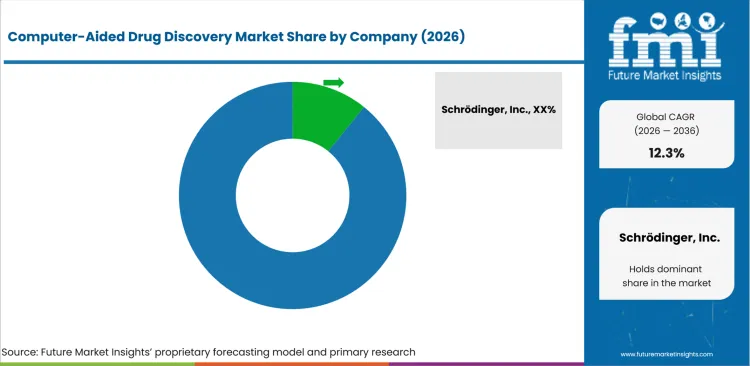
The field remains fragmented across integrated physics-based suites, specialist medicinal chemistry software and AI-native discovery platforms. Competition centers on model credibility and workflow depth, while governed deployment across clinical data systems raises entry barriers for smaller providers. No single business model covers every target-selection and molecule-design requirement across pharmaceutical and biotechnology discovery teams.
- Schrödinger, Inc., Dassault Systèmes SE and Chemical Computing Group ULC compete through broad physics-based modeling and simulation environments.
- Cadence Molecular Sciences (OpenEye), a business unit of Cadence Design Systems, Inc., BioSolveIT GmbH and Optibrium Ltd. emphasize virtual screening and medicinal chemistry decision workflows.
- Certara, Inc. and Insilico Medicine connect AI or model-informed methods with target selection and development decisions.
Competitive Benchmarking: Computer-Aided Drug Discovery Market
| Company | Computational Modeling Breadth | AI/ML Integration | Workflow Coverage | Geographic Reach |
|---|---|---|---|---|
| Schrödinger, Inc. | High | High | High | Global |
| Certara, Inc. | Medium | High | High | Global |
| Dassault Systèmes SE | High | High | High | Global |
| Chemical Computing Group ULC | High | Medium | High | North America, Europe and Asia Pacific |
| Cadence Molecular Sciences (OpenEye), a business unit of Cadence Design Systems, Inc. | High | High | Medium | Global through Cadence Molecular Sciences |
| BioSolveIT GmbH | High | Medium | Medium | Germany |
| Optibrium Ltd. | High | High | High | Global support |
| Insilico Medicine | Medium | High | High | Global partnerships |
Key Developments in the Computer-Aided Drug Discovery Market
- In January 2026, Schrödinger, Inc. partnered with Lilly to make TuneLab workflows available through LiveDesign for participating biotechnology companies.
- In October 2025, Certara, Inc. launched Certara IQ to combine generative AI with quantitative systems pharmacology and biosimulation workflows.
- In September 2025, Cadence Molecular Sciences (OpenEye), a business unit of Cadence Design Systems, Inc. launched ROCS X within Cadence Molecular Sciences for AI-enabled three-dimensional screening across trillion-scale chemical libraries.
Key Players in the Computer-Aided Drug Discovery Market
Integrated Modeling and Screening Platforms
- Schrödinger, Inc.
- Dassault Systèmes SE
- Chemical Computing Group ULC
- Cadence Molecular Sciences (OpenEye),
Model-Informed and Medicinal Chemistry Platforms
- Certara, Inc.
- BioSolveIT GmbH
- Optibrium Ltd.
AI-Native Discovery Platforms
- Insilico Medicine
Computer-Aided Drug Discovery Market - Report Scope
| Coverage field | Report scope |
|---|---|
| Market breakdown | By software type, application, end user, distribution channel, technology and region. |
| Quantitative Units | Revenue in USD billion and CAGR in %. |
| Market Definition | Software and platforms supporting computational target, hit, lead and preclinical drug discovery decisions. |
| Regions Covered | North America, Latin America, Europe, East Asia, South Asia and Pacific, and Middle East and Africa. |
| Countries Covered | United States, Japan, Germany, United Kingdom, Canada, and 20+ countries included in the full report. |
| Key Companies Profiled | Schrödinger, Inc., Certara, Inc., Dassault Systèmes SE, Chemical Computing Group ULC, OpenEye Scientific Software, Inc., BioSolveIT GmbH, Optibrium Ltd. and Insilico Medicine. |
| Forecast Period | 2026 to 2036. |
| Approach | Primary and secondary research with market triangulation. |
Computer-Aided Drug Discovery Market - Research Methodology
| Method | Approach |
|---|---|
| Primary Research | FMI analysts gathered input from manufacturers, service providers, technology developers, distributors, end users, procurement teams, and subject-matter experts. Interviews examined purchasing decisions, product or service evaluation, adoption barriers, approval requirements, pricing considerations, and expectations for technical or commercial support. Respondents were also asked what evidence is required before a trial, pilot, or initial order develops into regular purchasing. |
| Desk Research | Desk research covered government statistics, regulatory publications, trade data, industry associations, technical literature, standards, company filings, product information, and official corporate announcements. Sources were reviewed for relevance, publication date, geographic coverage, and consistency with the defined market scope. Claims relating to performance, applications, approvals, capacity, investment, and commercial activity were retained only when supported by credible public evidence. |
| Market Sizing and Forecasting | The market model combined the baseline value with historical performance, segment structure, pricing and volume indicators, adoption levels, company participation, and country-level demand conditions. Forecast assumptions considered economic activity, investment trends, regulatory developments, technology adoption, purchasing cycles, supply availability, and barriers to wider market use. Segment and regional estimates were reconciled before the final market total was calculated. |
| Data Validation | Estimates were checked against multiple independent indicators, including public data, company activity, trade patterns, industry developments, and findings from primary interviews. Validation also tested whether products, services, applications, and company revenues fell within the defined market boundaries. Adjacent categories, unsupported claims, overlapping revenues, and activities without direct market relevance were excluded to reduce double counting and maintain consistency across segments and countries. |
Computer-Aided Drug Discovery Market by Segments
Computer-Aided Drug Discovery Market segmented by Software Type:
- Molecular Modeling Software
- Molecular Dynamics Software
- Homology Modeling Software
- Structure-Based Drug Design Software
- Docking Software
- Pharmacophore Modeling Software
- Ligand-Based Drug Design Software
- QSAR Software
- Chemoinformatics Software
- Virtual Screening Software
- High-Throughput Virtual Screening
- AI-Based Virtual Screening
Computer-Aided Drug Discovery Market segmented by Application:
- Lead Identification
- Target Identification
- Hit Discovery
- Lead Optimization
- Structure Optimization
- Activity Prediction
- Drug Repurposing
- Computational Drug Repositioning
- AI-Based Candidate Selection
- Preclinical Drug Discovery
- Target Validation
- Candidate Prioritization
Computer-Aided Drug Discovery Market segmented by End User:
- Pharmaceutical Companies
- Large Pharmaceutical Companies
- Specialty Drug Developers
- Biotechnology Companies
- Early-Stage Biotechnology Firms
- Precision Medicine Companies
- Contract Research Organizations (CROs)
- Drug Discovery CROs
- Computational Research CROs
- Academic & Research Institutes
- Universities
- Government Research Institutes
Computer-Aided Drug Discovery Market segmented by Distribution Channel:
- Direct Sales
- Enterprise Licensing
- Corporate Agreements
- Cloud-Based Subscription
- SaaS Platforms
- Cloud Drug Discovery Suites
- Value-Added Resellers
- Life Science Software Partners
- IT Solution Providers
- Online Sales
- Vendor Websites
- Digital Software Marketplaces
Computer-Aided Drug Discovery Market segmented by Technology:
- Artificial Intelligence & Machine Learning
- Deep Learning Models
- Generative AI Platforms
- Molecular Simulation
- Molecular Dynamics Simulation
- Quantum Mechanics Simulation
- Computer-Aided Molecular Design
- De Novo Drug Design
- Fragment-Based Drug Design
- Bioinformatics & Data Mining
- Genomic Data Analysis
- Proteomic Data Analysis
Computer-Aided Drug Discovery Market by Region:
- North America
- United States
- Canada
- Mexico
- Latin America
- Brazil
- Chile
- Rest of Latin America
- Western Europe
- Germany
- United Kingdom
- Italy
- Spain
- France
- Nordics
- Benelux
- Rest of Western Europe
- Eastern Europe
- Russia
- Poland
- Hungary
- Balkan and Baltic States
- Rest of Eastern Europe
- East Asia
- China
- Japan
- South Korea
- South Asia and Pacific
- India
- ASEAN
- Australia and New Zealand
- Rest of South Asia and Pacific
- Middle East and Africa
- Kingdom of Saudi Arabia
- Other GCC Countries
- Türkiye
- South Africa
- Other African Union Countries
- Rest of Middle East and Africa
Research Sources and Bibliography
- USA Food and Drug Administration. (2025, January 6). FDA Proposes Framework to Advance Credibility of AI Models Used for Drug and Biological Product Submissions.
- Schrödinger, Inc. (2026, January 12). Schrödinger Provides Update on Progress Across the Business and Outlines 2026 Strategic Priorities.
- Insilico Medicine. (2025, October 3). Transforming Drug Target Discovery, Insilico Medicine Publishes Landmark Paper Introducing AI-empowered Target Identification Pro (TargetPro) and TargetBench 1.0.
- Dassault Systèmes. (2026, February 3). Dassault Systèmes and NVIDIA Partner to Build Industrial AI Platform Powering Virtual Twins.
- Schrödinger, Inc. (2025, July 17). Ajax Therapeutics and Schrödinger Expand Research Collaboration to Include Additional JAK Target.
- National Institutes of Health. (2026, January 28). Drug Discovery for Nervous System Disorders.
- Japan Agency for Medical Research and Development. (2025, May 21). Message from the President.
- Federal Ministry of Education and Research. (2025, March 3). Richtlinie zur Förderung von Projekten zum Thema Anwendung von Künstlicher Intelligenz (KI) in der Wirkstoffforschung.
- Department for Science, Innovation and Technology. (2025, November 20). AI for Science Strategy.
- National Research Council Canada. (2025, May 22). Canadian AI in Life Sciences co-innovation mission to South Korea - September 23-25, 2025.
- Schrödinger, Inc. (2026, January 9). Schrödinger Partners with Lilly to Make TuneLab Platform Available in LiveDesign.
- Certara, Inc. (2025, October 30). Certara Expands Biosimulation Market with AI-Driven QSP Platform.
- OpenEye Scientific Software, Inc. (2025, September 25). ROCS X: AI-Enabled Molecular Search Unlocks Trillions.
- Schrödinger, Inc. (2026, July 27). Schrödinger Introduces Bunsen, an AI Co-Scientist for Molecular Discovery.
- Insilico Medicine. (2026, July 2). Insilico Medicine Announces Collaboration with Takeda to Advance Strategic AI Drug Discovery.
- Optibrium Ltd. (2026, March 24). Optibrium Introduces Graphical Interface for QuanSA to Enhance Ligand-Based Affinity Predictions.
- Certara, Inc. (2026, February 26). Annual Report on Form 10-K for the year ended December 31, 2025.
- Optibrium Ltd. (2025, May 2). How does Optibrium protect customer data?
- Insilico Medicine. (2026, March 29). Insilico Medicine Announces 2025 Annual Results, Redefining Value Delivery in AI-Powered Drug Discovery.
- Chemical Computing Group ULC. (2025, May 20). CCG | UGM and Conference 2025 | Europe.
- BioSolveIT GmbH. (2025, January 21). SeeSAR 14.1 ‘Atlas’ - Energy Minimization, Chemical Space Docking™, Pharmacophores.
This bibliography is provided for reader reference and is not exhaustive. The full report contains the complete reference list and detailed citations
This Report Answers
- How large is the computer-aided drug discovery market in 2026 and 2036?
- Which operating conditions support computational discovery platform demand?
- Which software type accounts for the significant 2026 share?
- How does lead identification shape experimental resource allocation?
- How does AI/ML influence technology selection across discovery teams?
- How do country growth conditions differ through 2036?
- Which companies provide modeling and AI-enabled discovery platforms?
- What limits model confidence and wider enterprise adoption?
Frequently Asked Questions
How big is the Computer-Aided Drug Discovery Market in 2026?
In 2026, the computer-aided drug discovery market is valued at USD 5.9 billion across platforms supporting target and candidate decisions. Reproducible predictions and workflow integration support the projected increase to USD 18.8 billion by 2036 across pharmaceutical and biotechnology research programs.
What is the CAGR of the Computer-Aided Drug Discovery Market from 2026 to 2036?
The computer-aided drug discovery market is projected to expand at 12.3% CAGR from 2026 to 2036. Discovery organizations must connect model context and data provenance with laboratory confirmation so computational rankings support costly research decisions across several therapeutic areas.
Which software type is projected to account for 34.0% of the Computer-Aided Drug Discovery Market?
Molecular modeling software is projected to account for 34.0% of the computer-aided drug discovery market by software type in 2026. Medicinal chemistry teams use molecular dynamics and homology modeling to examine structures and interactions during synthesis and experimental screening decisions.
Which technology is projected to account for 35.0% of the Computer-Aided Drug Discovery Market?
Artificial intelligence and machine learning are forecast to represent 35.0% of the computer-aided drug discovery market by technology in 2026. Scientists use these methods to rank compounds and generate structures, but experimental evidence remains necessary for development decisions across active programs.
Which companies are active in the Computer-Aided Drug Discovery Market?
Companies active in the computer-aided drug discovery market include Schrödinger, Certara, Dassault Systèmes and Chemical Computing Group. OpenEye Scientific Software, BioSolveIT, Optibrium and Insilico Medicine extend the verified group across virtual screening and AI-enabled target or molecule discovery workflows worldwide.
Preview the report firsthand - request a free sample
Get SampleGet the brochure for pricing and purchase details.
Get PDFTable of Content
- Key Takeaways
- Market Size and CAGR
- Top Growth Driver
- Fastest Growing Segment
- Leading Region
- Key Companies
- Emerging Opportunities
- Executive Summary
- Global Market Outlook
- Demand-side Trends
- Supply-side Trends
- Technology Roadmap Analysis
- Analysis and Recommendations
- Analyst Perspective (What is happening? Why now? What should investors know?)
- Key Questions Answered
- How large is the market?
- What is the CAGR?
- What are key trends?
- Which region dominates?
- Who are the leaders?
- Market Overview
- Market Coverage / Taxonomy
- Market Definition / Scope / Limitations
- Research Methodology
- Chapter Orientation
- Analytical Lens and Working Hypotheses
- Market Structure, Signals, and Trend Drivers
- Benchmarking and Cross-market Comparability
- Market Sizing, Forecasting, and Opportunity Mapping
- Research Design and Evidence Framework
- Desk Research Programme (Secondary Evidence)
- Expert Input and Fieldwork (Primary Evidence)
- Tooling, Models, and Reference Databases
- Data Engineering and Model Build
- Quality Assurance and Audit Trail
- Market Background
- Market Dynamics (Drivers, Restraints, Opportunity, Trends)
- Scenario Forecast (Optimistic, Likely, Conservative)
- Impact Analysis
- AI Impact
- Sustainability Impact
- Regulatory Impact
- Technology Impact
- Consumer / Buyer Analysis
- Purchase Drivers
- Adoption Barriers
- Buyer Journey
- Opportunity Map Analysis
- Product Life Cycle Analysis
- Supply Chain Analysis
- Investment Feasibility Matrix
- Value Chain Analysis
- PESTLE and Porter's Analysis
- Regulatory Landscape
- Regional Parent Market Outlook
- Production and Consumption Statistics
- Import and Export Statistics
- Global Market Analysis and Forecast, 2021 to 2036
- Historical Market Size Value (USD Billion) Analysis, 2021 to 2025
- Current and Future Market Size Value (USD Billion) Projections, 2026 to 2036
- Y-o-Y Growth Trend Analysis
- Absolute $ Opportunity Analysis
- Global Market Pricing Analysis, 2021 to 2036
- Global Market Analysis and Forecast, By Software Type, 2021 to 2036
- Introduction / Key Findings
- Historical Market Size Value (USD Billion) Analysis By Software Type, 2021 to 2025
- Current and Future Market Size Value (USD Billion) Analysis and Forecast By Software Type, 2026 to 2036
- Molecular Modeling Software
- Molecular Dynamics Software
- Homology Modeling Software
- Structure-Based Drug Design Software
- Docking Software
- Pharmacophore Modeling Software
- Ligand-Based Drug Design Software
- QSAR Software
- Chemoinformatics Software
- Virtual Screening Software
- High-Throughput Virtual Screening
- AI-Based Virtual Screening
- Molecular Modeling Software
- Y-o-Y Growth Trend Analysis By Software Type, 2021 to 2025
- Absolute $ Opportunity Analysis By Software Type, 2026 to 2036
- Global Market Analysis and Forecast, By Application, 2021 to 2036
- Introduction / Key Findings
- Historical Market Size Value (USD Billion) Analysis By Application, 2021 to 2025
- Current and Future Market Size Value (USD Billion) Analysis and Forecast By Application, 2026 to 2036
- Lead Identification
- Target Identification
- Hit Discovery
- Lead Optimization
- Structure Optimization
- Activity Prediction
- Drug Repurposing
- Computational Drug Repositioning
- AI-Based Candidate Selection
- Preclinical Drug Discovery
- Target Validation
- Candidate Prioritization
- Lead Identification
- Y-o-Y Growth Trend Analysis By Application, 2021 to 2025
- Absolute $ Opportunity Analysis By Application, 2026 to 2036
- Global Market Analysis and Forecast, By End User, 2021 to 2036
- Introduction / Key Findings
- Historical Market Size Value (USD Billion) Analysis By End User, 2021 to 2025
- Current and Future Market Size Value (USD Billion) Analysis and Forecast By End User, 2026 to 2036
- Pharmaceutical Companies
- Large Pharmaceutical Companies
- Specialty Drug Developers
- Biotechnology Companies
- Early-Stage Biotechnology Firms
- Precision Medicine Companies
- Contract Research Organizations (CROs)
- Drug Discovery CROs
- Computational Research CROs
- Academic & Research Institutes
- Universities
- Government Research Institutes
- Pharmaceutical Companies
- Y-o-Y Growth Trend Analysis By End User, 2021 to 2025
- Absolute $ Opportunity Analysis By End User, 2026 to 2036
- Global Market Analysis and Forecast, By Distribution Channel, 2021 to 2036
- Introduction / Key Findings
- Historical Market Size Value (USD Billion) Analysis By Distribution Channel, 2021 to 2025
- Current and Future Market Size Value (USD Billion) Analysis and Forecast By Distribution Channel, 2026 to 2036
- Direct Sales
- Enterprise Licensing
- Corporate Agreements
- Cloud-Based Subscription
- SaaS Platforms
- Cloud Drug Discovery Suites
- Value-Added Resellers
- Life Science Software Partners
- IT Solution Providers
- Online Sales
- Vendor Websites
- Digital Software Marketplaces
- Direct Sales
- Y-o-Y Growth Trend Analysis By Distribution Channel, 2021 to 2025
- Absolute $ Opportunity Analysis By Distribution Channel, 2026 to 2036
- Global Market Analysis and Forecast, By Technology, 2021 to 2036
- Introduction / Key Findings
- Historical Market Size Value (USD Billion) Analysis By Technology, 2021 to 2025
- Current and Future Market Size Value (USD Billion) Analysis and Forecast By Technology, 2026 to 2036
- Artificial Intelligence & Machine Learning
- Deep Learning Models
- Generative AI Platforms
- Molecular Simulation
- Molecular Dynamics Simulation
- Quantum Mechanics Simulation
- Computer-Aided Molecular Design
- De Novo Drug Design
- Fragment-Based Drug Design
- Bioinformatics & Data Mining
- Genomic Data Analysis
- Proteomic Data Analysis
- Artificial Intelligence & Machine Learning
- Y-o-Y Growth Trend Analysis By Technology, 2021 to 2025
- Absolute $ Opportunity Analysis By Technology, 2026 to 2036
- Global Market Analysis and Forecast, By Region, 2021 to 2036
- Introduction
- Historical Market Size Value (USD Billion) Analysis By Region, 2021 to 2025
- Current Market Size Value (USD Billion) Analysis and Forecast By Region, 2026 to 2036
- North America
- Latin America
- Western Europe
- Eastern Europe
- East Asia
- South Asia and Pacific
- Middle East & Africa
- Market Attractiveness Analysis By Region
- North America Market Analysis and Forecast, By Country, 2021 to 2036
- Historical Market Size Value (USD Billion) Trend Analysis By Market Taxonomy, 2021 to 2025
- Market Size Value (USD Billion) Forecast By Market Taxonomy, 2026 to 2036
- By Country
- USA
- Canada
- By Software Type
- By Application
- By End User
- By Distribution Channel
- By Technology
- By Country
- Market Attractiveness Analysis
- By Country
- By Software Type
- By Application
- By End User
- By Distribution Channel
- By Technology
- Key Takeaways
- Latin America Market Analysis and Forecast, By Country
- Historical Market Size Value (USD Billion) Trend Analysis By Market Taxonomy, 2021 to 2025
- Market Size Value (USD Billion) Forecast By Market Taxonomy, 2026 to 2036
- By Country
- Brazil
- Mexico
- Chile
- Rest of Latin America
- By Software Type
- By Application
- By End User
- By Distribution Channel
- By Technology
- By Country
- Market Attractiveness Analysis
- By Country
- By Software Type
- By Application
- By End User
- By Distribution Channel
- By Technology
- Key Takeaways
- Western Europe Market Analysis and Forecast, By Country
- Historical Market Size Value (USD Billion) Trend Analysis By Market Taxonomy, 2021 to 2025
- Market Size Value (USD Billion) Forecast By Market Taxonomy, 2026 to 2036
- By Country
- Germany
- UK
- Italy
- Spain
- France
- Nordic
- BENELUX
- Rest of Western Europe
- By Software Type
- By Application
- By End User
- By Distribution Channel
- By Technology
- By Country
- Market Attractiveness Analysis
- By Country
- By Software Type
- By Application
- By End User
- By Distribution Channel
- By Technology
- Key Takeaways
- Eastern Europe Market Analysis and Forecast, By Country
- Historical Market Size Value (USD Billion) Trend Analysis By Market Taxonomy, 2021 to 2025
- Market Size Value (USD Billion) Forecast By Market Taxonomy, 2026 to 2036
- By Country
- Russia
- Poland
- Hungary
- Balkan & Baltic
- Rest of Eastern Europe
- By Software Type
- By Application
- By End User
- By Distribution Channel
- By Technology
- By Country
- Market Attractiveness Analysis
- By Country
- By Software Type
- By Application
- By End User
- By Distribution Channel
- By Technology
- Key Takeaways
- East Asia Market Analysis and Forecast, By Country
- Historical Market Size Value (USD Billion) Trend Analysis By Market Taxonomy, 2021 to 2025
- Market Size Value (USD Billion) Forecast By Market Taxonomy, 2026 to 2036
- By Country
- China
- Japan
- South Korea
- By Software Type
- By Application
- By End User
- By Distribution Channel
- By Technology
- By Country
- Market Attractiveness Analysis
- By Country
- By Software Type
- By Application
- By End User
- By Distribution Channel
- By Technology
- Key Takeaways
- South Asia and Pacific Market Analysis and Forecast, By Country
- Historical Market Size Value (USD Billion) Trend Analysis By Market Taxonomy, 2021 to 2025
- Market Size Value (USD Billion) Forecast By Market Taxonomy, 2026 to 2036
- By Country
- India
- ASEAN
- Australia & New Zealand
- Rest of South Asia and Pacific
- By Software Type
- By Application
- By End User
- By Distribution Channel
- By Technology
- By Country
- Market Attractiveness Analysis
- By Country
- By Software Type
- By Application
- By End User
- By Distribution Channel
- By Technology
- Key Takeaways
- Middle East & Africa Market Analysis and Forecast, By Country
- Historical Market Size Value (USD Billion) Trend Analysis By Market Taxonomy, 2021 to 2025
- Market Size Value (USD Billion) Forecast By Market Taxonomy, 2026 to 2036
- By Country
- Kingdom of Saudi Arabia
- Other GCC Countries
- Türkiye
- South Africa
- Other African Union
- Rest of Middle East & Africa
- By Software Type
- By Application
- By End User
- By Distribution Channel
- By Technology
- By Country
- Market Attractiveness Analysis
- By Country
- By Software Type
- By Application
- By End User
- By Distribution Channel
- By Technology
- Key Takeaways
- Key Countries Market Analysis
- USA
- Pricing Analysis
- Market Share Analysis, 2025
- By Software Type
- By Application
- By End User
- By Distribution Channel
- By Technology
- Canada
- Pricing Analysis
- Market Share Analysis, 2025
- By Software Type
- By Application
- By End User
- By Distribution Channel
- By Technology
- Mexico
- Pricing Analysis
- Market Share Analysis, 2025
- By Software Type
- By Application
- By End User
- By Distribution Channel
- By Technology
- Brazil
- Pricing Analysis
- Market Share Analysis, 2025
- By Software Type
- By Application
- By End User
- By Distribution Channel
- By Technology
- Chile
- Pricing Analysis
- Market Share Analysis, 2025
- By Software Type
- By Application
- By End User
- By Distribution Channel
- By Technology
- Germany
- Pricing Analysis
- Market Share Analysis, 2025
- By Software Type
- By Application
- By End User
- By Distribution Channel
- By Technology
- UK
- Pricing Analysis
- Market Share Analysis, 2025
- By Software Type
- By Application
- By End User
- By Distribution Channel
- By Technology
- Italy
- Pricing Analysis
- Market Share Analysis, 2025
- By Software Type
- By Application
- By End User
- By Distribution Channel
- By Technology
- Spain
- Pricing Analysis
- Market Share Analysis, 2025
- By Software Type
- By Application
- By End User
- By Distribution Channel
- By Technology
- France
- Pricing Analysis
- Market Share Analysis, 2025
- By Software Type
- By Application
- By End User
- By Distribution Channel
- By Technology
- India
- Pricing Analysis
- Market Share Analysis, 2025
- By Software Type
- By Application
- By End User
- By Distribution Channel
- By Technology
- ASEAN
- Pricing Analysis
- Market Share Analysis, 2025
- By Software Type
- By Application
- By End User
- By Distribution Channel
- By Technology
- Australia & New Zealand
- Pricing Analysis
- Market Share Analysis, 2025
- By Software Type
- By Application
- By End User
- By Distribution Channel
- By Technology
- China
- Pricing Analysis
- Market Share Analysis, 2025
- By Software Type
- By Application
- By End User
- By Distribution Channel
- By Technology
- Japan
- Pricing Analysis
- Market Share Analysis, 2025
- By Software Type
- By Application
- By End User
- By Distribution Channel
- By Technology
- South Korea
- Pricing Analysis
- Market Share Analysis, 2025
- By Software Type
- By Application
- By End User
- By Distribution Channel
- By Technology
- Russia
- Pricing Analysis
- Market Share Analysis, 2025
- By Software Type
- By Application
- By End User
- By Distribution Channel
- By Technology
- Poland
- Pricing Analysis
- Market Share Analysis, 2025
- By Software Type
- By Application
- By End User
- By Distribution Channel
- By Technology
- Hungary
- Pricing Analysis
- Market Share Analysis, 2025
- By Software Type
- By Application
- By End User
- By Distribution Channel
- By Technology
- Kingdom of Saudi Arabia
- Pricing Analysis
- Market Share Analysis, 2025
- By Software Type
- By Application
- By End User
- By Distribution Channel
- By Technology
- Türkiye
- Pricing Analysis
- Market Share Analysis, 2025
- By Software Type
- By Application
- By End User
- By Distribution Channel
- By Technology
- South Africa
- Pricing Analysis
- Market Share Analysis, 2025
- By Software Type
- By Application
- By End User
- By Distribution Channel
- By Technology
- USA
- Market Structure Analysis
- Competition Dashboard
- Competition Benchmarking
- Market Share Analysis of Top Players
- By Regional
- By Software Type
- By Application
- By End User
- By Distribution Channel
- By Technology
- Emerging Startups
- Innovation Benchmarking
- Competition Analysis
- Competition Deep Dive
- Schrödinger, Inc.
- Overview
- Product Portfolio
- Profitability by Market Segments
- Sales Footprint
- Strategy Overview
- Marketing Strategy
- Product Strategy
- Channel Strategy
- Certara, Inc.
- Dassault Systèmes SE
- Chemical Computing Group ULC
- OpenEye Scientific Software, Inc.
- BioSolveIT GmbH
- Optibrium Ltd.
- Insilico Medicine
- Exscientia plc
- Atomwise, Inc.
- Schrödinger, Inc.
- Case Studies
- Success Stories
- Recent Developments
- Competition Deep Dive
- Assumptions & Acronyms Used


