

- Market Size (2026)
- USD 4.8 Bn
- Forecast (2036)
- USD 9.8 Bn
- CAGR (2026 to 2036)
- 7.4%
How big is the Congenital Heart Defect Devices Market in 2026?
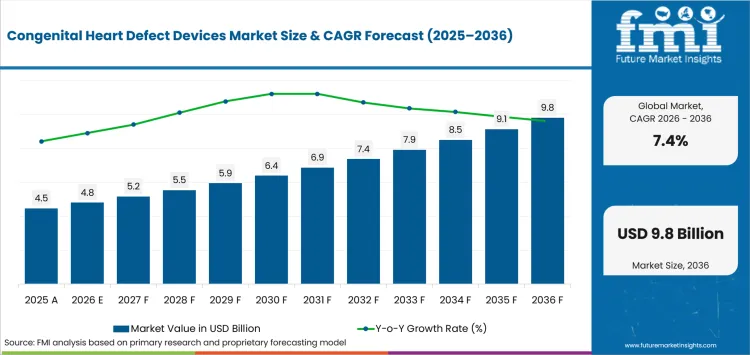
USD 4.8 billion in 2026 and USD 9.8 billion by 2036 at a 7.4% CAGR.
Demand for congenital heart defect devices is projected to expand at 7.4% CAGR between 2026 and 2036, increasing valuation from USD 4.8 billion in 2026 to USD 9.8 billion by 2036. Lifelong congenital care sustains initial closure procedures and later valve or reconstruction interventions through heart closure devices and related platforms.
Each annual birth cohort enters screening and specialist referral through established congenital care pathways that continue into adult follow-up. In December 2025 the CDC reported about 40,000 affected United States births each year. Each cohort adds initial device evaluation and later follow-up through newborn screening equipment and congenital cardiac services.
Key Takeaways of Congenital Heart Defect Devices Market
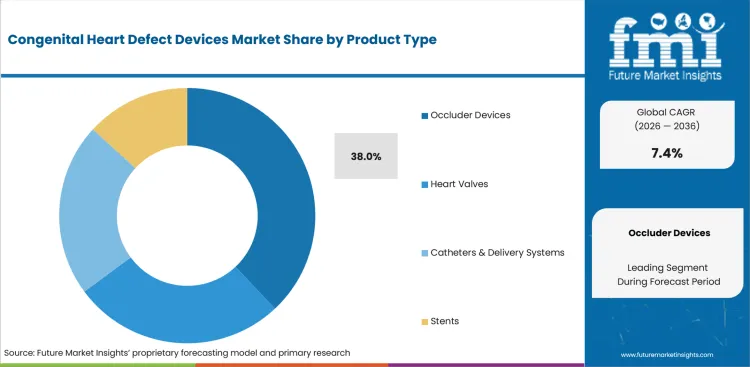
- Occluder devices are projected to represent 38.0% of product-type demand in 2026 due to established catheter closure pathways.
- Atrial septal defect applications are estimated to account for 34.0% share in 2026 as imaging supports structured device selection.
- Hospitals are forecast to capture 43.0% of end-user demand owing to coordinated imaging and immediate surgical backup.
- Anatomy-specific eligibility and delivery-system risk restrict substitution across defect types and previously repaired cardiac structures.
- Abbott Laboratories, Medtronic plc, Edwards Lifesciences Corporation, W. L. Gore & Associates, Inc., Occlutech Holding AG, LifeTech Scientific Corporation, Lepu ScienTech Medical Technology (Shanghai) Co., Ltd. and Venus Medtech (Hangzhou) Inc. are the eight companies profiled in this assessment.
Analyst Perspective
"Congenital heart defect teams select devices through imaging that defines lesion geometry and the safest delivery route ahead of inventory commitment. Manufacturers earn repeat use by proving retrieval control and dependable case support across pediatric repair and adult reintervention."
- Anurag Sharma, Principal Consultant, Future Market Insights
How is the Congenital Heart Defect Devices Market segmented?
The congenital heart defect devices industry is segmented by product type, application, end user, distribution channel, procedure type and region.
Product types cover occluders, heart valves, catheter delivery systems and stents, while applications include atrial septal defect, ventricular septal defect, patent ductus arteriosus and pulmonary valve disorders. End users include hospitals, specialty cardiac centers, ambulatory surgical centers and research institutes serving specialist cardiac programs. Distribution channels cover direct sales, distributors, purchasing organizations and online procurement, while procedures include minimally invasive, open, hybrid and diagnostic care.
How do occluder devices shape demand within the product type category?
Occluder systems convert defect diameter and tissue support into device size through a controlled delivery route. Congenital teams compare retrieval options across atrial and ductal cases during planning within specialist catheterization centers.
- By product type, occluder devices are estimated to hold 38.0% in 2026 owing to established pathways for septal and ductal closure.
- Each class addresses a distinct anatomy and anchoring requirement during selection across congenital treatment pathways. FDA records from October 2025 list Abbott devices for ASD and PDA closure beside a separate muscular VSD class. Separate regulated classes help centers match inventory to the planned lesion without treating closure devices as interchangeable.
What supports atrial septal defect treatment within the application category?
Secundum atrial septal defect closure uses imaging to measure defect diameter and tissue rims so teams can compare transcatheter devices with cardiovascular repair devices for surgical treatment.
- Based on application, atrial septal defect treatment is projected to account for 34.0% in 2026 due to structured imaging and established sizing protocols.
- Primum defects and weak tissue rims usually require surgery due to limited surrounding support for stable deployment. Specialist centers use the imaging distinction to reserve catheter closure for anatomy with measurable anchoring tissue. The anatomical distinction reduces unsuitable device use and preserves surgical options for more complex septal structures.
What role do hospitals play within the end user category?
Hospitals combine congenital imaging and anesthesia with catheterization plus immediate surgical rescue inside one treatment setting. Their infrastructure also supports cardiopulmonary bypass systems for anatomy that requires open repair within coordinated regional specialist programs.
- The hospitals segment is likely to capture 43.0% share in 2026 attributable to multidisciplinary intervention and monitored recovery requirements.
- Complex cases can require temporary pacing leads for rhythm support during intervention or postoperative observation. Hospital contracting favors manufacturers that align case-specific inventory with clinical training and maintain field specialists for procedures requiring surgical rescue if anatomy or hemodynamics change during intervention.
Why are minimally invasive procedures central to the procedure type category?
Catheter-based procedures close defects or support pediatric heart valves without a full sternotomy in patients whose anatomy permits controlled delivery.
- In 2026, minimally invasive procedures are expected to lead procedure type with 48.0% share because transcatheter systems reduce surgical exposure for eligible anatomy.
- Dedicated systems must preserve position and retrieval control across variable right ventricular outflow tract anatomy. Specialist centers evaluate the implant and catheter together during sizing and deployment planning for each case. Trained teams also maintain surgical backup for anatomy that changes during imaging or catheter advancement. Procedure controls support repeatable treatment without presenting transcatheter access as suitable for every congenital lesion.
What are the drivers, restraints and opportunities in the Congenital Heart Defect Devices Market?
Lifelong congenital care sustains intervention demand, but anatomy-specific eligibility limits substitution as integrated procedure platforms improve consistency.
- Driver: Longer survival extends congenital care from initial repair through surveillance and later device-based reintervention across adult services.
- Restraint: Defect geometry and delivery reliability narrow eligibility while increasing training and inventory requirements for specialist centers.
- Opportunity: Coordinated implants and delivery systems can shorten case preparation through repeatable sizing guidance and center support.
Repaired congenital anatomy can develop valve dysfunction or residual shunts that require renewed imaging later in life. Adult congenital programs connect surveillance with repeat intervention through structural heart devices selected for each residual lesion.
Specialist-center concentration makes qualification and case support a practical limit for manufacturers entering congenital programs. Germany's pediatric cardiac rules took effect in January 2026 with defined personnel and infrastructure requirements. Hospital qualification therefore requires training and inventory commitments for routine acceptance of new congenital procedure platforms.
Complete procedure platforms align implants with dedicated catheters and anatomy-specific planning for each congenital case. Manufacturers can combine deployment guidance with cardiac ambulatory monitoring to support intervention and follow-up through one service route.
Which country CAGRs are profiled in the Congenital Heart Defect Devices Market?
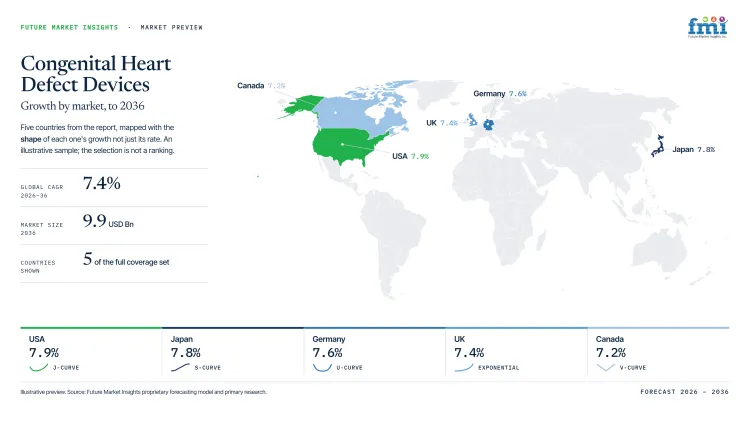
| Country | CAGR |
|---|---|
| United States | 7.9% |
| Japan | 7.8% |
| Germany | 7.6% |
| United Kingdom | 7.4% |
| Canada | 7.2% |
How do country-level CAGRs compare in the Congenital Heart Defect Devices Market?
The displayed country CAGRs span 0.7 percentage point across healthcare systems with different operating conditions. The narrow range describes forecast pace rather than present market size or identical purchasing access.
- United States growth reflects broad specialist access alongside demanding evidence and service requirements across a dispersed hospital network.
- Japan follows a concentrated referral model that supports structured reintervention planning within metropolitan congenital programs.
- Germany combines national pediatric cardiac requirements with institution-specific qualification across specialized treatment centers and formal regional referral pathways.
- United Kingdom growth depends on commissioned referral routes that concentrate device evaluation within specialist cardiac networks.
- Canada converts comparable clinical needs through provincial systems facing longer service distances and separate reimbursement decisions.
Comparable CAGRs can produce different market entry conditions. The full report provides country-level CAGR analysis across North America, Latin America, Europe, East Asia, South Asia and Pacific, and the Middle East and Africa.
Country-wise Analysis
- United States congenital programs combine FDA-reviewed devices with pediatric and adult centers that manage imaging and catheter intervention with surgical backup plus long-term follow-up and case-specific inventory across dispersed hospital networks and referral systems. In December 2025 the CDC reported six national CHD STAR2 sites funded from 2024 through 2029 to track longitudinal outcomes among children and adults with congenital heart defects across several national surveillance regions. Adoption of congenital heart defect devices in the United States is estimated to expand at 7.9% CAGR through 2036, supported by specialist access but constrained by training and inventory controls across referral centers.
- Japan's metropolitan congenital centers connect pediatric treatment with adult follow-up through formal transition pathways that coordinate imaging and reintervention planning across specialist hospitals serving surrounding prefectures and patients referred from smaller cities. Congenital heart defect device sales in Japan are forecast to expand at 7.8% CAGR by 2036, reinforced by structured referral and scheduled follow-up for patients with repaired anatomy across pediatric and adult programs. In December 2025 the Japanese Circulation Society reported more than 500,000 adults with congenital heart disease and reinforced transition-care planning through metropolitan specialist centers serving a growing adult population across national referral networks.
- Germany directs complex congenital procedures to specialized hospitals that follow national personnel and infrastructure requirements for pediatric cardiac surgery with surgical backup and coordinated follow-up across federal states and established regional referral pathways. The National Register for Congenital Heart Defects reported 44,143 patients across diagnosis groups in July 2025 and gave centers a longitudinal base for pediatric and adult follow-up through connected treatment networks and hospitals. Germany's congenital heart defect devices outlook is anticipated to advance at 7.6% CAGR over the assessment period, with institution-specific evidence reviews and service requirements limiting routine purchasing beyond established congenital treatment centers.
- United Kingdom congenital services connect newborn screening with commissioned cardiac networks that centralize device evaluation and catheter intervention alongside lifelong follow-up through integrated national referral routes serving pediatric and adult patients across broad regions. The United Kingdom congenital heart defect devices sector is projected to record 7.4% CAGR during the assessment period, shaped by coordinated referral and specialist treatment pathways within commissioned cardiac networks and defined services. The October 2025 national screening handbook reports at least eight in every thousand births with a heart or circulatory condition, sustaining referral volume as concentrated purchasing requires dependable inventory support across commissioned regions.
- Canada organizes congenital care through provincial referral systems that connect neonatal diagnosis with pediatric and adult cardiac programs across long service routes between smaller communities and major specialist surgical centers requiring coordinated patient transfers. The Public Health Agency of Canada reported 20.8 congenital heart defect cases per 10,000 births in March 2025 and documented stable prevalence across Canadian provinces and territories during recent national surveillance cycles. Congenital heart defect device demand in Canada is forecast to rise at 7.2% CAGR over the forecast period, supported by concentrated expertise but constrained by service distance and provincial purchasing decisions beyond cities.
Who are the notable companies in the Congenital Heart Defect Devices Market?
Abbott Laboratories, Medtronic plc, Edwards Lifesciences Corporation, W. L. Gore & Associates, Inc., Occlutech Holding AG, LifeTech Scientific Corporation, Lepu ScienTech Medical Technology (Shanghai) Co., Ltd. and Venus Medtech (Hangzhou) Inc. are the notable companies serving this market.
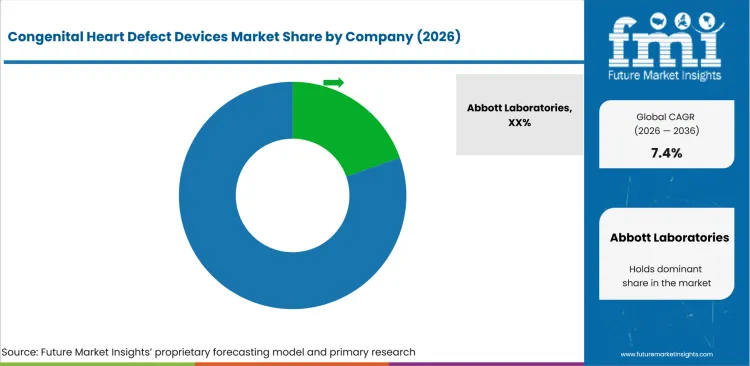
Congenital platforms occupy a specialized part of the broader cardiovascular devices market with competition divided between closure and pulmonary-valve pathways. Indication-specific evidence and trained delivery support limit entry for manufacturers across both treatment routes in specialist centers. Surgical pathways also connect congenital programs with surgical heart valves for defect geometry unsuitable for transcatheter treatment.
- Abbott Laboratories and W. L. Gore & Associates, Inc. compete through regulated closure systems with dedicated catheter delivery routes.
- Occlutech Holding AG and Lepu ScienTech Medical Technology (Shanghai) Co., Ltd. compete through multi-indication occluders alongside LifeTech Scientific Corporation's multigeneration congenital closure platforms.
- Medtronic plc, Edwards Lifesciences Corporation and Venus Medtech (Hangzhou) Inc. focus on transcatheter pulmonary-valve treatment for repaired or native outflow tracts.
Competitive Benchmarking: Congenital Heart Defect Devices Market
| Company | Congenital Closure Breadth | Pulmonary Valve Capability | Delivery-System Integration | Geographic Reach |
|---|---|---|---|---|
| Abbott Laboratories | High | Low | High | Global |
| Medtronic plc | Low | High | High | Global |
| Edwards Lifesciences Corporation | Low | High | High | Global |
| W. L. Gore & Associates, Inc. | Low | Low | Medium | Global |
| Occlutech Holding AG | Medium | Low | High | International and United States |
| LifeTech Scientific Corporation | Medium | Low | Medium | China and international markets |
| Lepu ScienTech Medical Technology (Shanghai) Co., Ltd. | High | Low | Medium | China and selected international markets |
| Venus Medtech (Hangzhou) Inc. | Low | High | High | China and international markets |
Key Developments in the Congenital Heart Defect Devices Market
- In January 2026, Edwards Lifesciences Corporation received FDA approval for the SAPIEN 3 transcatheter pulmonic valve delivery system, designed to support pediatric and adult patients living with congenital heart disease.
- In May 2026, Medtronic plc asked affected customers to quarantine and return specified Harmony delivery catheter lots following distal-tip detachment risk.
- In April 2026, Venus Medtech (Hangzhou) Inc. reported that enrollment in the United States IDE trial for VenusP-Valve remained on track.
Key Players in the Congenital Heart Defect Devices Market
Integrated Congenital Closure Platforms
- Abbott Laboratories
- W. L. Gore & Associates, Inc.
- Occlutech Holding AG
International Occluder Specialists
- LifeTech Scientific Corporation
- Lepu ScienTech Medical Technology (Shanghai) Co., Ltd.
Transcatheter Pulmonary Valve Platforms
- Medtronic plc
- Edwards Lifesciences Corporation
- Venus Medtech (Hangzhou) Inc.
Congenital Heart Defect Devices Market - Report Scope
| Coverage field | Report scope |
|---|---|
| Market breakdown | By product type, application, end user, distribution channel, procedure type and region. |
| Quantitative Units | Revenue in USD billion and CAGR in %. |
| Market Definition | Devices used to close, repair, replace or support congenital cardiac defects across catheter-based and surgical care pathways. |
| Regions Covered | North America, Latin America, Europe, East Asia, South Asia and Pacific, and Middle East and Africa. |
| Countries Covered | United States, Japan, Germany, United Kingdom, Canada, and 20+ countries included in the full report. |
| Key Companies Profiled | Abbott Laboratories, Medtronic plc, Edwards Lifesciences Corporation, W. L. Gore & Associates, Inc., Occlutech Holding AG, LifeTech Scientific Corporation, Lepu ScienTech Medical Technology (Shanghai) Co., Ltd. and Venus Medtech (Hangzhou) Inc. |
| Forecast Period | 2026 to 2036. |
| Approach | Primary and secondary research with market triangulation. |
Congenital Heart Defect Devices Market - Research Methodology
| Method | Approach |
|---|---|
| Primary Research | FMI analysts gathered input from manufacturers, service providers, technology developers, distributors, end users, procurement teams, and subject-matter experts. Interviews examined purchasing decisions, product or service evaluation, adoption barriers, approval requirements, pricing considerations, and expectations for technical or commercial support. Respondents were also asked what evidence is required before a trial, pilot, or initial order develops into regular purchasing. |
| Desk Research | Desk research covered government statistics, regulatory publications, trade data, industry associations, technical literature, standards, company filings, product information, and official corporate announcements. Sources were reviewed for relevance, publication date, geographic coverage, and consistency with the defined market scope. Claims relating to performance, applications, approvals, capacity, investment, and commercial activity were retained only when supported by credible public evidence. |
| Market Sizing and Forecasting | The market model combined the baseline value with historical performance, segment structure, pricing and volume indicators, adoption levels, company participation, and country-level demand conditions. Forecast assumptions considered economic activity, investment trends, regulatory developments, technology adoption, purchasing cycles, supply availability, and barriers to wider market use. Segment and regional estimates were reconciled before the final market total was calculated. |
| Data Validation | Estimates were checked against multiple independent indicators, including public data, company activity, trade patterns, industry developments, and findings from primary interviews. Validation also tested whether products, services, applications, and company revenues fell within the defined market boundaries. Adjacent categories, unsupported claims, overlapping revenues, and activities without direct market relevance were excluded to reduce double counting and maintain consistency across segments and countries. |
Congenital Heart Defect Devices Market by Segments
Congenital Heart Defect Devices Market segmented by Product Type:
- Occluder Devices
- Atrial Septal Defect (ASD) Occluders
- Ventricular Septal Defect (VSD) Occluders
- Heart Valves
- Transcatheter Pulmonary Valves
- Surgical Heart Valves
- Catheters & Delivery Systems
- Delivery Catheters
- Guidewires
- Stents
- Pulmonary Artery Stents
- Aortic Stents
Congenital Heart Defect Devices Market segmented by Application:
- Atrial Septal Defect (ASD)
- Secundum ASD
- Primum ASD
- Ventricular Septal Defect (VSD)
- Perimembranous VSD
- Muscular VSD
- Patent Ductus Arteriosus (PDA)
- Transcatheter PDA Closure
- Surgical PDA Closure
- Pulmonary Valve Disorders
- Pulmonary Valve Replacement
- Pulmonary Valve Repair
Congenital Heart Defect Devices Market segmented by End User:
- Hospitals
- Pediatric Cardiology Centers
- Tertiary Care Hospitals
- Specialty Cardiac Centers
- Congenital Heart Centers
- Interventional Cardiology Centers
- Ambulatory Surgical Centers
- Day Surgery Centers
- Cardiac Procedure Centers
- Academic & Research Institutes
- University Hospitals
- Cardiovascular Research Centers
Congenital Heart Defect Devices Market segmented by Distribution Channel:
- Direct Sales
- Hospital Supply Contracts
- OEM Sales
- Medical Device Distributors
- Regional Distributors
- National Distributors
- Group Purchasing Organizations
- Hospital Purchasing Groups
- Integrated Delivery Networks
- Online Procurement
- B2B Medical Platforms
- Manufacturer Portals
Congenital Heart Defect Devices Market segmented by Procedure Type:
- Minimally Invasive Procedures
- Transcatheter Device Closure
- Transcatheter Valve Implantation
- Open Heart Surgery
- Surgical Defect Repair
- Surgical Valve Replacement
- Hybrid Procedures
- Hybrid Catheter-Surgical Repair
- Image-Guided Hybrid Procedures
- Diagnostic & Monitoring Procedures
- Intraoperative Imaging
- Cardiac Catheterization
Congenital Heart Defect Devices Market by Region:
- North America
- United States
- Canada
- Mexico
- Latin America
- Brazil
- Chile
- Rest of Latin America
- Western Europe
- Germany
- United Kingdom
- Italy
- Spain
- France
- Nordics
- Benelux
- Rest of Western Europe
- Eastern Europe
- Russia
- Poland
- Hungary
- Balkan and Baltic States
- Rest of Eastern Europe
- East Asia
- China
- Japan
- South Korea
- South Asia and Pacific
- India
- ASEAN
- Australia and New Zealand
- Rest of South Asia and Pacific
- Middle East and Africa
- Kingdom of Saudi Arabia
- Other GCC Countries
- Türkiye
- South Africa
- Other African Union Countries
- Rest of Middle East and Africa
Research Sources and Bibliography
- Centers for Disease Control and Prevention. (2025, December 14). Data and Statistics
- USA Food and Drug Administration. (2025, October 23). Premarket Approval (PMA)
- USA Food and Drug Administration. (2025, October 23). Premarket Approval (PMA)
- USA Food and Drug Administration. (2025, October 23). Premarket Approval (PMA)
- Gemeinsamer Bundesausschuss. (2026, January 1). Richtlinie zur Kinderherzchirurgie
- Centers for Disease Control and Prevention. (2025, December 14). Tracking and Research
- Japanese Circulation Society. (2025, December 16). 「先天性心疾患の成人への移行医療に関する提言」について
- Competence Network for Congenital Heart Defects. (2025, July). Donated Data in the Register
- UK Health Security Agency. (2025, October 10). Newborn and infant physical examination (NIPE) screening programme handbook
- Public Health Agency of Canada. (2025, March 7). Congenital Anomalies in Canada
- USA Food and Drug Administration. (2026, June 4). Premarket Approval (PMA)
- USA Food and Drug Administration. (2026, July 13). Pulmonary Valve Catheter Delivery System Recall: Medtronic Removes Harmony Delivery Catheter System (DCS)
- Venus Medtech (Hangzhou) Inc. (2026, April 22). Annual Report 2025
- Abbott. (2025, December 18). Abbott's Amplatzer Piccolo™ Delivery System Receives FDA Clearance and CE Mark to Optimize Procedures for Premature Babies With a Hole in the Heart
- LifeTech Scientific Corporation. (2025, August 22). Admission of Innovative Medical Devices in respect of Congenital Heart Defect Occluder into Special Examination and Approval Procedure
- Medtronic plc. (2025, January 6). Medtronic receives CE Mark for leading transcatheter pulmonary valve replacement system for congenital heart disease
- USA Food and Drug Administration. (2025, December 19). Premarket Approval (PMA)
- USA Food and Drug Administration. (2025, November 24). Premarket Approval (PMA)
- Therapeutic Goods Administration. (2024, January 17). Life Systems Medical Pty Ltd - Occlutech PDA Occluder / Occlutech Occlusions-Pusher - Cardiac occluder (434731)
- LifeTech Scientific Corporation. (2026, April 22). Annual Report 2025
- Lepu ScienTech Medical Technology (Shanghai) Co., Ltd. (2026, April 23). 2025 Annual Report
This bibliography is provided for reader reference and is not exhaustive. The full report contains the complete reference list and detailed citations.
This Report Answers
- How large is the congenital heart defect devices market in 2026 and 2036?
- Which operating conditions sustain demand across lifelong congenital cardiac care?
- Why do occluder devices hold a significant product-type share in 2026?
- How does atrial septal defect anatomy shape transcatheter device selection?
- Why do hospitals concentrate complex congenital device procedures?
- How do country growth rates differ across the profiled forecast set?
- Which companies supply closure systems and transcatheter pulmonary-valve platforms?
- What limits wider adoption across specialist congenital treatment centers?
Frequently Asked Questions
Which product type is projected to account for 38.0% of the congenital heart defect devices market?
Occluder devices are projected to account for 38.0% of the congenital heart defect devices market by product type in 2026. Dedicated transcatheter systems support selected septal and ductal closure through measured sizing with controlled deployment and retrieval options during treatment.
Which application is projected to account for 34.0% of the congenital heart defect devices market?
Atrial septal defect treatment is projected to account for 34.0% of the congenital heart defect devices market by application in 2026. Imaging measures defect diameter and tissue rims so specialist teams can direct eligible secundum anatomy toward transcatheter closure.
Which end user is projected to account for 43.0% of the congenital heart defect devices market?
Hospitals are projected to account for 43.0% of the congenital heart defect devices market by end user in 2026. Their coordinated imaging and catheterization teams provide anesthesia with surgical backup and monitored recovery for complex congenital procedures within specialist programs.
Which procedure type is projected to account for 48.0% of the congenital heart defect devices market?
Minimally invasive procedures are projected to account for 48.0% of the congenital heart defect devices market by procedure type in 2026. Catheter-based closure and pulmonary-valve implantation reduce sternotomy exposure for patients whose anatomy supports controlled transcatheter deployment during coordinated care.
How much will the congenital heart defect devices market add between 2026 and 2036?
USD 5.0 billion is expected to be added to the congenital heart defect devices market between 2026 and 2036. The increase reflects initial interventions and later reinterventions across lifelong care pathways that connect pediatric treatment with adult congenital services.
Which companies are active in the congenital heart defect devices market?
Companies active in the congenital heart defect devices market include Abbott Laboratories and Medtronic plc alongside Edwards Lifesciences Corporation. The remaining companies span regulated closure systems and specialist occluder portfolios with transcatheter pulmonary-valve platforms across international treatment pathways worldwide.
Preview the report firsthand - request a free sample
Get SampleGet the brochure for pricing and purchase details.
Get PDFTable of Content
- Key Takeaways
- Market Size and CAGR
- Top Growth Driver
- Fastest Growing Segment
- Leading Region
- Key Companies
- Emerging Opportunities
- Executive Summary
- Global Market Outlook
- Demand-side Trends
- Supply-side Trends
- Technology Roadmap Analysis
- Analysis and Recommendations
- Analyst Perspective (What is happening? Why now? What should investors know?)
- Key Questions Answered
- How large is the market?
- What is the CAGR?
- What are key trends?
- Which region dominates?
- Who are the leaders?
- Market Overview
- Market Coverage / Taxonomy
- Market Definition / Scope / Limitations
- Research Methodology
- Chapter Orientation
- Analytical Lens and Working Hypotheses
- Market Structure, Signals, and Trend Drivers
- Benchmarking and Cross-market Comparability
- Market Sizing, Forecasting, and Opportunity Mapping
- Research Design and Evidence Framework
- Desk Research Programme (Secondary Evidence)
- Expert Input and Fieldwork (Primary Evidence)
- Tooling, Models, and Reference Databases
- Data Engineering and Model Build
- Quality Assurance and Audit Trail
- Market Background
- Market Dynamics (Drivers, Restraints, Opportunity, Trends)
- Scenario Forecast (Optimistic, Likely, Conservative)
- Impact Analysis
- AI Impact
- Sustainability Impact
- Regulatory Impact
- Technology Impact
- Consumer / Buyer Analysis
- Purchase Drivers
- Adoption Barriers
- Buyer Journey
- Opportunity Map Analysis
- Product Life Cycle Analysis
- Supply Chain Analysis
- Investment Feasibility Matrix
- Value Chain Analysis
- PESTLE and Porter's Analysis
- Regulatory Landscape
- Regional Parent Market Outlook
- Production and Consumption Statistics
- Import and Export Statistics
- Global Market Analysis and Forecast, 2021 to 2036
- Historical Market Size Value (USD Billion) Analysis, 2021 to 2025
- Current and Future Market Size Value (USD Billion) Projections, 2026 to 2036
- Y-o-Y Growth Trend Analysis
- Absolute $ Opportunity Analysis
- Global Market Pricing Analysis, 2021 to 2036
- Global Market Analysis and Forecast, By Product Type, 2021 to 2036
- Introduction / Key Findings
- Historical Market Size Value (USD Billion) Analysis By Product Type, 2021 to 2025
- Current and Future Market Size Value (USD Billion) Analysis and Forecast By Product Type, 2026 to 2036
- Occluder Devices
- Atrial Septal Defect (ASD) Occluders
- Ventricular Septal Defect (VSD) Occluders
- Heart Valves
- Transcatheter Pulmonary Valves
- Surgical Heart Valves
- Catheters & Delivery Systems
- Delivery Catheters
- Guidewires
- Stents
- Pulmonary Artery Stents
- Aortic Stents
- Occluder Devices
- Y-o-Y Growth Trend Analysis By Product Type, 2021 to 2025
- Absolute $ Opportunity Analysis By Product Type, 2026 to 2036
- Global Market Analysis and Forecast, By Application, 2021 to 2036
- Introduction / Key Findings
- Historical Market Size Value (USD Billion) Analysis By Application, 2021 to 2025
- Current and Future Market Size Value (USD Billion) Analysis and Forecast By Application, 2026 to 2036
- Atrial Septal Defect (ASD)
- Secundum ASD
- Primum ASD
- Ventricular Septal Defect (VSD)
- Perimembranous VSD
- Muscular VSD
- Patent Ductus Arteriosus (PDA)
- Transcatheter PDA Closure
- Surgical PDA Closure
- Pulmonary Valve Disorders
- Pulmonary Valve Replacement
- Pulmonary Valve Repair
- Atrial Septal Defect (ASD)
- Y-o-Y Growth Trend Analysis By Application, 2021 to 2025
- Absolute $ Opportunity Analysis By Application, 2026 to 2036
- Global Market Analysis and Forecast, By End User, 2021 to 2036
- Introduction / Key Findings
- Historical Market Size Value (USD Billion) Analysis By End User, 2021 to 2025
- Current and Future Market Size Value (USD Billion) Analysis and Forecast By End User, 2026 to 2036
- Hospitals
- Pediatric Cardiology Centers
- Tertiary Care Hospitals
- Specialty Cardiac Centers
- Congenital Heart Centers
- Interventional Cardiology Centers
- Ambulatory Surgical Centers
- Day Surgery Centers
- Cardiac Procedure Centers
- Academic & Research Institutes
- University Hospitals
- Cardiovascular Research Centers
- Hospitals
- Y-o-Y Growth Trend Analysis By End User, 2021 to 2025
- Absolute $ Opportunity Analysis By End User, 2026 to 2036
- Global Market Analysis and Forecast, By Distribution Channel, 2021 to 2036
- Introduction / Key Findings
- Historical Market Size Value (USD Billion) Analysis By Distribution Channel, 2021 to 2025
- Current and Future Market Size Value (USD Billion) Analysis and Forecast By Distribution Channel, 2026 to 2036
- Direct Sales
- Hospital Supply Contracts
- OEM Sales
- Medical Device Distributors
- Regional Distributors
- National Distributors
- Group Purchasing Organizations
- Hospital Purchasing Groups
- Integrated Delivery Networks
- Online Procurement
- B2B Medical Platforms
- Manufacturer Portals
- Direct Sales
- Y-o-Y Growth Trend Analysis By Distribution Channel, 2021 to 2025
- Absolute $ Opportunity Analysis By Distribution Channel, 2026 to 2036
- Global Market Analysis and Forecast, By Procedure Type, 2021 to 2036
- Introduction / Key Findings
- Historical Market Size Value (USD Billion) Analysis By Procedure Type, 2021 to 2025
- Current and Future Market Size Value (USD Billion) Analysis and Forecast By Procedure Type, 2026 to 2036
- Minimally Invasive Procedures
- Transcatheter Device Closure
- Transcatheter Valve Implantation
- Open Heart Surgery
- Surgical Defect Repair
- Surgical Valve Replacement
- Hybrid Procedures
- Hybrid Catheter-Surgical Repair
- Image-Guided Hybrid Procedures
- Diagnostic & Monitoring Procedures
- Intraoperative Imaging
- Cardiac Catheterization
- Minimally Invasive Procedures
- Y-o-Y Growth Trend Analysis By Procedure Type, 2021 to 2025
- Absolute $ Opportunity Analysis By Procedure Type, 2026 to 2036
- Global Market Analysis and Forecast, By Region, 2021 to 2036
- Introduction
- Historical Market Size Value (USD Billion) Analysis By Region, 2021 to 2025
- Current Market Size Value (USD Billion) Analysis and Forecast By Region, 2026 to 2036
- North America
- Latin America
- Western Europe
- Eastern Europe
- East Asia
- South Asia and Pacific
- Middle East & Africa
- Market Attractiveness Analysis By Region
- North America Market Analysis and Forecast, By Country, 2021 to 2036
- Historical Market Size Value (USD Billion) Trend Analysis By Market Taxonomy, 2021 to 2025
- Market Size Value (USD Billion) Forecast By Market Taxonomy, 2026 to 2036
- By Country
- USA
- Canada
- By Product Type
- By Application
- By End User
- By Distribution Channel
- By Procedure Type
- By Country
- Market Attractiveness Analysis
- By Country
- By Product Type
- By Application
- By End User
- By Distribution Channel
- By Procedure Type
- Key Takeaways
- Latin America Market Analysis and Forecast, By Country
- Historical Market Size Value (USD Billion) Trend Analysis By Market Taxonomy, 2021 to 2025
- Market Size Value (USD Billion) Forecast By Market Taxonomy, 2026 to 2036
- By Country
- Brazil
- Mexico
- Chile
- Rest of Latin America
- By Product Type
- By Application
- By End User
- By Distribution Channel
- By Procedure Type
- By Country
- Market Attractiveness Analysis
- By Country
- By Product Type
- By Application
- By End User
- By Distribution Channel
- By Procedure Type
- Key Takeaways
- Western Europe Market Analysis and Forecast, By Country
- Historical Market Size Value (USD Billion) Trend Analysis By Market Taxonomy, 2021 to 2025
- Market Size Value (USD Billion) Forecast By Market Taxonomy, 2026 to 2036
- By Country
- Germany
- UK
- Italy
- Spain
- France
- Nordic
- BENELUX
- Rest of Western Europe
- By Product Type
- By Application
- By End User
- By Distribution Channel
- By Procedure Type
- By Country
- Market Attractiveness Analysis
- By Country
- By Product Type
- By Application
- By End User
- By Distribution Channel
- By Procedure Type
- Key Takeaways
- Eastern Europe Market Analysis and Forecast, By Country
- Historical Market Size Value (USD Billion) Trend Analysis By Market Taxonomy, 2021 to 2025
- Market Size Value (USD Billion) Forecast By Market Taxonomy, 2026 to 2036
- By Country
- Russia
- Poland
- Hungary
- Balkan & Baltic
- Rest of Eastern Europe
- By Product Type
- By Application
- By End User
- By Distribution Channel
- By Procedure Type
- By Country
- Market Attractiveness Analysis
- By Country
- By Product Type
- By Application
- By End User
- By Distribution Channel
- By Procedure Type
- Key Takeaways
- East Asia Market Analysis and Forecast, By Country
- Historical Market Size Value (USD Billion) Trend Analysis By Market Taxonomy, 2021 to 2025
- Market Size Value (USD Billion) Forecast By Market Taxonomy, 2026 to 2036
- By Country
- China
- Japan
- South Korea
- By Product Type
- By Application
- By End User
- By Distribution Channel
- By Procedure Type
- By Country
- Market Attractiveness Analysis
- By Country
- By Product Type
- By Application
- By End User
- By Distribution Channel
- By Procedure Type
- Key Takeaways
- South Asia and Pacific Market Analysis and Forecast, By Country
- Historical Market Size Value (USD Billion) Trend Analysis By Market Taxonomy, 2021 to 2025
- Market Size Value (USD Billion) Forecast By Market Taxonomy, 2026 to 2036
- By Country
- India
- ASEAN
- Australia & New Zealand
- Rest of South Asia and Pacific
- By Product Type
- By Application
- By End User
- By Distribution Channel
- By Procedure Type
- By Country
- Market Attractiveness Analysis
- By Country
- By Product Type
- By Application
- By End User
- By Distribution Channel
- By Procedure Type
- Key Takeaways
- Middle East & Africa Market Analysis and Forecast, By Country
- Historical Market Size Value (USD Billion) Trend Analysis By Market Taxonomy, 2021 to 2025
- Market Size Value (USD Billion) Forecast By Market Taxonomy, 2026 to 2036
- By Country
- Kingdom of Saudi Arabia
- Other GCC Countries
- Türkiye
- South Africa
- Other African Union
- Rest of Middle East & Africa
- By Product Type
- By Application
- By End User
- By Distribution Channel
- By Procedure Type
- By Country
- Market Attractiveness Analysis
- By Country
- By Product Type
- By Application
- By End User
- By Distribution Channel
- By Procedure Type
- Key Takeaways
- Key Countries Market Analysis
- USA
- Pricing Analysis
- Market Share Analysis, 2025
- By Product Type
- By Application
- By End User
- By Distribution Channel
- By Procedure Type
- Canada
- Pricing Analysis
- Market Share Analysis, 2025
- By Product Type
- By Application
- By End User
- By Distribution Channel
- By Procedure Type
- Mexico
- Pricing Analysis
- Market Share Analysis, 2025
- By Product Type
- By Application
- By End User
- By Distribution Channel
- By Procedure Type
- Brazil
- Pricing Analysis
- Market Share Analysis, 2025
- By Product Type
- By Application
- By End User
- By Distribution Channel
- By Procedure Type
- Chile
- Pricing Analysis
- Market Share Analysis, 2025
- By Product Type
- By Application
- By End User
- By Distribution Channel
- By Procedure Type
- Germany
- Pricing Analysis
- Market Share Analysis, 2025
- By Product Type
- By Application
- By End User
- By Distribution Channel
- By Procedure Type
- UK
- Pricing Analysis
- Market Share Analysis, 2025
- By Product Type
- By Application
- By End User
- By Distribution Channel
- By Procedure Type
- Italy
- Pricing Analysis
- Market Share Analysis, 2025
- By Product Type
- By Application
- By End User
- By Distribution Channel
- By Procedure Type
- Spain
- Pricing Analysis
- Market Share Analysis, 2025
- By Product Type
- By Application
- By End User
- By Distribution Channel
- By Procedure Type
- France
- Pricing Analysis
- Market Share Analysis, 2025
- By Product Type
- By Application
- By End User
- By Distribution Channel
- By Procedure Type
- India
- Pricing Analysis
- Market Share Analysis, 2025
- By Product Type
- By Application
- By End User
- By Distribution Channel
- By Procedure Type
- ASEAN
- Pricing Analysis
- Market Share Analysis, 2025
- By Product Type
- By Application
- By End User
- By Distribution Channel
- By Procedure Type
- Australia & New Zealand
- Pricing Analysis
- Market Share Analysis, 2025
- By Product Type
- By Application
- By End User
- By Distribution Channel
- By Procedure Type
- China
- Pricing Analysis
- Market Share Analysis, 2025
- By Product Type
- By Application
- By End User
- By Distribution Channel
- By Procedure Type
- Japan
- Pricing Analysis
- Market Share Analysis, 2025
- By Product Type
- By Application
- By End User
- By Distribution Channel
- By Procedure Type
- South Korea
- Pricing Analysis
- Market Share Analysis, 2025
- By Product Type
- By Application
- By End User
- By Distribution Channel
- By Procedure Type
- Russia
- Pricing Analysis
- Market Share Analysis, 2025
- By Product Type
- By Application
- By End User
- By Distribution Channel
- By Procedure Type
- Poland
- Pricing Analysis
- Market Share Analysis, 2025
- By Product Type
- By Application
- By End User
- By Distribution Channel
- By Procedure Type
- Hungary
- Pricing Analysis
- Market Share Analysis, 2025
- By Product Type
- By Application
- By End User
- By Distribution Channel
- By Procedure Type
- Kingdom of Saudi Arabia
- Pricing Analysis
- Market Share Analysis, 2025
- By Product Type
- By Application
- By End User
- By Distribution Channel
- By Procedure Type
- Türkiye
- Pricing Analysis
- Market Share Analysis, 2025
- By Product Type
- By Application
- By End User
- By Distribution Channel
- By Procedure Type
- South Africa
- Pricing Analysis
- Market Share Analysis, 2025
- By Product Type
- By Application
- By End User
- By Distribution Channel
- By Procedure Type
- USA
- Market Structure Analysis
- Competition Dashboard
- Competition Benchmarking
- Market Share Analysis of Top Players
- By Regional
- By Product Type
- By Application
- By End User
- By Distribution Channel
- By Procedure Type
- Emerging Startups
- Innovation Benchmarking
- Competition Analysis
- Competition Deep Dive
- Abbott Laboratories
- Overview
- Product Portfolio
- Profitability by Market Segments
- Sales Footprint
- Strategy Overview
- Marketing Strategy
- Product Strategy
- Channel Strategy
- Medtronic plc
- Edwards Lifesciences Corporation
- Boston Scientific Corporation
- W. L. Gore & Associates, Inc.
- Lepu Medical Technology Co., Ltd.
- Occlutech Holding AG
- Meril Life Sciences Pvt. Ltd.
- Braile Biomedica
- Artivion, Inc.
- Abbott Laboratories
- Case Studies
- Success Stories
- Recent Developments
- Competition Deep Dive
- Assumptions & Acronyms Used


