

- Market Size (2026)
- USD 8.7 Bn
- Forecast (2036)
- USD 15.9 Bn
- CAGR (2026 to 2036)
- 6.2%
How big is the Contact Dermatitis Market in 2026?
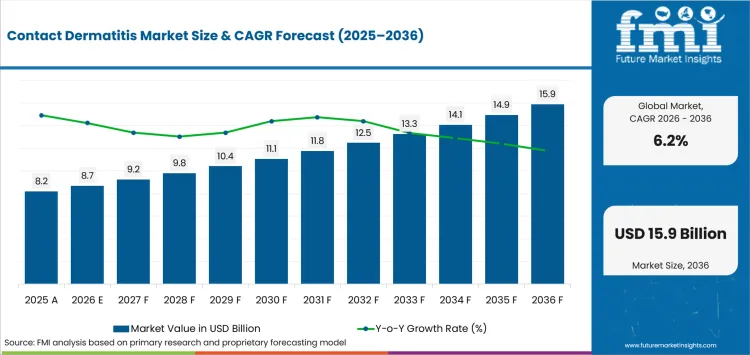
USD 8.7 billion in 2026 and USD 15.9 billion by 2036 at a 6.2% CAGR.
Sales in the contact dermatitis market are projected to grow at 6.2% CAGR through 2036, driving valuation to USD 15.9 billion by 2036 from USD 8.7 billion in 2026. Topical drug delivery supports localized inflammation control through creams and ointments that fit community prescribing. Related atopic dermatitis treatments reinforce prescriber familiarity with topical classes used across recurring inflammatory skin care.
Occupational exposure links recurrent disease with prevention duties and specialist diagnosis across industries involving frequent skin contact. CDC guidance issued in March 2026 prioritizes elimination and substitution over engineering controls or personal protective equipment. Treatment demand persists when those controls leave the responsible workplace exposure unchanged, which ties repeated clinical review to practical prevention.
Key Takeaways of Contact Dermatitis Market
- Repeated workplace and household exposure sustains diagnosis, avoidance guidance and anti-inflammatory treatment across recurrent episodes.
- Topical corticosteroids are projected to represent 39.0% by treatment type in 2026 owing to established prescribing.
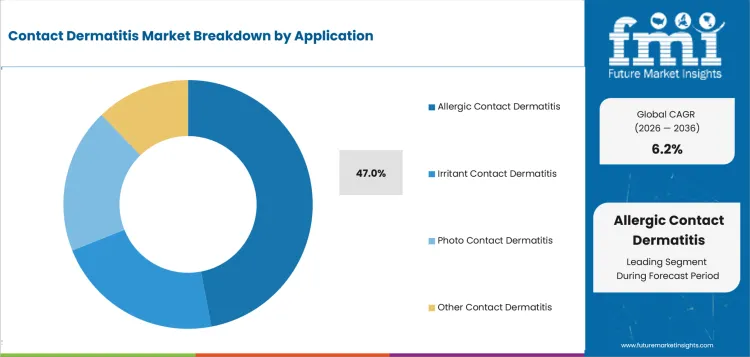
- Allergic contact dermatitis is estimated to account for 47.0% by application in 2026 as allergen confirmation guides care.
- Hospitals are forecast to capture 36.0% by end user in 2026 due to specialist assessment of uncertain cases.
- Overlapping allergic and irritant symptoms delay precise diagnosis and prolong exposure until clinicians establish cause-specific treatment.
- LEO Pharma A/S, Oceanside Pharmaceuticals, Glenmark Pharmaceuticals Inc., USA, Sun Pharmaceutical Industries, Inc., Alembic Pharmaceuticals Limited, Lupin Pharmaceuticals, Inc., E. Fougera & Co. and Encube Ethicals, Inc. are profiled.
Analyst Perspective
"Contact dermatitis portfolios gain value as treatment follows verified exposure rather than recurring symptom relief. Disease-specific medicines need patch-testing referral and reliable pharmacy supply to avoid masking persistent unresolved triggers."
- Anurag Sharma, Principal Consultant, Future Market Insights
How is the Contact Dermatitis Market segmented?
The contact dermatitis industry is segmented by treatment type, application, end user, distribution channel, route of administration and region.
Treatment type includes topical corticosteroids by potency, topical calcineurin inhibitors such as tacrolimus or pimecrolimus, oral or topical antihistamines, and systemic corticosteroids or immunosuppressants. Applications cover allergic, irritant, photo and other contact dermatitis, including protein and systemic forms across hospitals, dermatology clinics, homecare settings and ambulatory surgical centers. Distribution uses retail, hospital, online and wholesale channels, while administration includes topical creams or ointments, oral tablets or capsules, injectable products and transdermal patches or gels.
What makes allergic contact dermatitis central to the application category?
Allergic contact dermatitis requires clinicians to identify the responsible allergen once sensitization develops within exposed skin. Diagnostic pathways use allergy diagnostic platforms to connect exposure history with the June 2026 European Society of Contact Dermatitis guidance for patch-test selection and interpretation.
- Based on application, allergic contact dermatitis is projected to account for 47.0% share in 2026 due to recurring allergen investigation across occupational and household exposure routes.
- Patch testing distinguishes a specific allergy from clinically similar irritant reactions through controlled exposure to selected substances. Limited specialist access can prolong recurrence despite eczema relief creams that reduce inflammation without identifying the responsible allergen.
What supports topical corticosteroids within the treatment type category?
Topical corticosteroids act on localized inflammation and allow dermatologists to match potency with lesion severity or body location. Topical applicator systems also support home use across prescribed creams and ointments without replacing clinical instructions.
- By treatment type, topical corticosteroids are estimated to hold 39.0% share in 2026 owing to broad prescribing familiarity across mild and persistent localized disease.
- Dermatologists adjust formulation strength for skin thickness, treatment duration and sensitive body areas during each prescribed course. Community pharmacy access supports repeat courses, although continued symptoms require renewed exposure assessment or an alternative diagnosis rather than automatic prescription extension.
What role do hospitals play within the end user category?
Hospitals combine dermatology assessment with medical support for widespread inflammation and uncertain diagnoses requiring coordinated review. Their referral networks connect difficult cases with dermatology trial services and supervised treatment escalation across clinical departments.
- In 2026, hospitals are expected to lead the end user category with 36.0% share because specialist teams manage severe or recurrent cases requiring coordinated medical review.
- Hospital teams assess infection risk and monitor treatment response during planned visits for difficult presentations. Routine localized disease returns to outpatient clinics or community pharmacies once clinicians document a suitable medicine and exposure-control plan with clear follow-up responsibility.
How does retail pharmacy access influence the distribution channel category?
Retail pharmacies provide practical access to repeat prescriptions and continuing supplies of creams or ointments. Community ordering expands through digital pharmacy services as stores preserve counseling and dependable collection routes for local patients.
- The distribution channel is forecast to be led by retail pharmacies at 39.0% share in 2026 due to broad community access and dependable repeat dispensing.
- Stock control improves through pharmacy automation systems as treatment continuity depends on clinician review for symptoms persisting beyond an initial course. Pharmacists identify refill delays and direct unresolved inflammation toward medical assessment instead of repeated unsupervised use.
What are the drivers, restraints and opportunities in the Contact Dermatitis Market?
Repeated chemical and allergen exposure sustains treatment demand as diagnostic overlap restricts precision and coordinated exposure management improves treatment selection.
- Driver: Repeated chemical or allergen contact sustains assessment and anti-inflammatory treatment across occupational and household exposure routes.
- Restraint: Similar allergic and irritant symptoms delay diagnosis and prolong exposure until clinicians establish a cause-specific treatment plan.
- Opportunity: Coordinated patch testing and exposure controls align medicine selection with confirmed triggers across recurring patient cases.
Repeated exposure turns a brief episode into recurring care across jobs involving wet work or sensitizing materials. Dermatology visits and pharmacy refills continue until workplaces reduce the responsible contact, making exposure control essential to durable symptom improvement.
Allergic and irritant reactions often produce similar redness and itching during early assessment, complicating cause-specific treatment selection. Limited patch-testing access or incomplete exposure histories extend ineffective treatment cycles without identifying the chemical or allergen driving recurrence.
Specialist assessment aligns patch testing with exposure reduction and suitable formulation selection for recurrent cases. Compounding pharmacy services can prepare alternative bases for patients with verified ingredient sensitivities, but demand depends on documented clinical need and continued allergen avoidance.
Which country CAGRs are profiled in the Contact Dermatitis Market?
| Country | CAGR |
|---|---|
| United States | 6.7% |
| Japan | 6.5% |
| Germany | 6.4% |
| United Kingdom | 6.2% |
| Canada | 6.1% |
How do country-level CAGRs compare in the Contact Dermatitis Market?
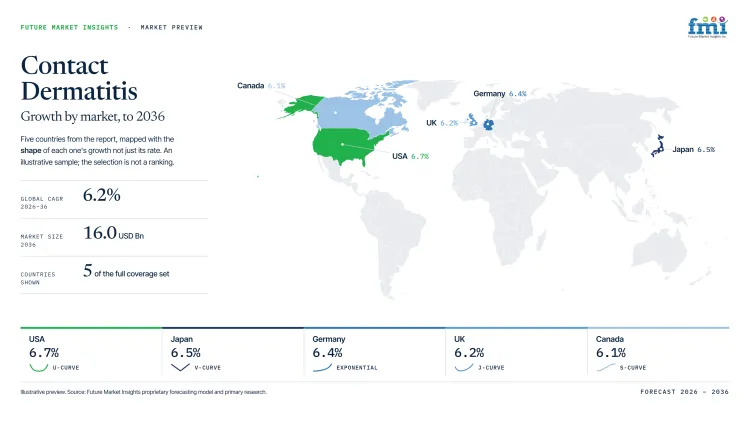
The five profiled CAGRs span 0.6 percentage point and describe forecast pace rather than current market size. Referral access and workplace exposure control explain more than the narrow numerical differences across these countries.
- The United States is 0.2 percentage point above Japan within a closely grouped specialist-access forecast set.
- Japan is 0.1 percentage point above Germany as both systems formalize chemical controls and specialist care.
- Germany is 0.2 percentage point above the United Kingdom despite established occupational health pathways in both systems.
- The United Kingdom is 0.1 percentage point above Canada as community treatment access varies regionally.
- Canada closes the range through broad pharmacy access and uneven specialist availability across rural communities.
Comparable CAGRs can produce different market entry conditions. The full report provides country-level CAGR analysis across North America, Latin America, Europe, East Asia, South Asia and Pacific, and the Middle East and Africa.
Country-wise Analysis
- United States: Occupational health programs connect employer prevention duties with community pharmacies and specialist referral routes, although benefit limits and patch-testing shortages delay diagnostic confirmation for workers outside major cities and nearby industrial communities. The occupational burden remains commercially important across exposed workplaces, and CDC reported in March 2026 that contact dermatitis represents 90% to 95% of reported occupational skin disease cases across the United States. Adoption of contact dermatitis treatment in the United States is estimated to expand at 6.7% CAGR through 2036 due to formal workplace guidance and established dermatology capacity across insured regional clinical care networks.
- Japan’s chemical-management system links employer risk assessment with occupational health clinics and specialist hospitals, although many affected patients outside major cities travel farther for patch testing and follow-up care across dispersed regional employment centers. Contact dermatitis treatment sales in Japan are forecast to expand at 6.5% CAGR by 2036, supported by formal workplace skin-exposure controls and established clinical assessment routes across industrial and regional medical centers. Regulatory coverage expanded in July 2025 as the Ministry of Health, Labour and Welfare identified 28 newly added skin-damaging chemical substances under government GHS classifications and thereby broadened national workplace chemical management rules.
- Germany: Statutory accident insurance connects employer reports with occupational dermatology referrals and rehabilitation services, although detailed evidence requirements and uneven local access can delay confirmation across smaller employers and remote industrial areas nationwide. German Social Accident Insurance recorded 14,060 notifications under occupational skin disease code 5101 during 2024 within a national reporting system that connects employers with specialist prevention and rehabilitation services across industrial regions nationwide. The German contact dermatitis sector is projected to record 6.4% CAGR during the assessment period, reinforced by defined reporting routes and specialist rehabilitation services across established industrial treatment networks and referral centers.
- United Kingdom: Employer risk assessment connects primary care with community pharmacy routes for wet work and repeated chemical exposure, although uneven patch-testing referrals and late worker reporting delay cause-specific treatment across local care networks. The United Kingdom’s contact dermatitis outlook is anticipated to advance at 6.2% CAGR over the assessment period, aided by prevention duties and accessible community treatment across regional employment and healthcare settings nationwide. HSE estimated in January 2026 that 1,000 nurses develop work-related contact dermatitis annually across health and social care services involving frequent hand washing and protective glove use during demanding clinical routines nationwide.
- Canada: Provincial health systems combine community pharmacy access with urban specialist concentration, although rural patients often travel farther for patch testing and specialist review across remote communities and dispersed workplaces with limited dermatology capacity. Physician distribution reinforces that access constraint across provincial care pathways, and the Canadian Institute for Health Information reported that 93% of physicians practiced in urban areas during 2024 across all provinces and territories nationwide. Canada is estimated to post 6.1% CAGR over the forecast period, driven by routine prescribing and occupational health guidance despite uneven specialist availability across provincial referral and pharmacy supply routes nationwide.
Who are the notable companies in the Contact Dermatitis Market?
LEO Pharma A/S, Oceanside Pharmaceuticals, Glenmark Pharmaceuticals Inc., USA, Sun Pharmaceutical Industries, Inc., Alembic Pharmaceuticals Limited, Lupin Pharmaceuticals, Inc., E. Fougera & Co. and Encube Ethicals, Inc. are the notable companies profiled in this market.
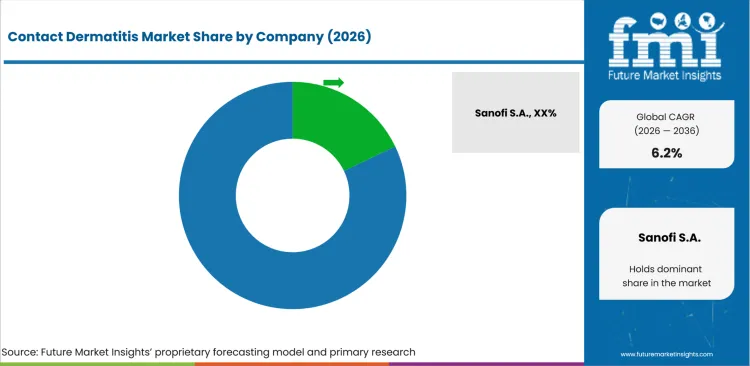
Prescription topical competition remains fragmented as regulator labels and formulation breadth determine entry across recurring hospital and retail prescriptions.
- LEO Pharma A/S competes through disease-specific hand eczema approval and a medical dermatology network across regions.
- Oceanside Pharmaceuticals, Glenmark Pharmaceuticals Inc., USA and E. Fougera & Co. maintain calcineurin inhibitor labels in United States channels.
- Alembic Pharmaceuticals Limited, Lupin Pharmaceuticals, Inc., Encube Ethicals, Inc. and Sun Pharmaceutical Industries, Inc. provide corticosteroids across several dosage forms.
Competitive Benchmarking: Contact Dermatitis Market
| Company | Prescription Dermatology Depth | Treatment-Class Breadth | Formulation Breadth | Geographic Reach |
|---|---|---|---|---|
| LEO Pharma A/S | High | Low | Low | Global |
| Oceanside Pharmaceuticals | High | High | Medium | United States |
| Glenmark Pharmaceuticals Inc., USA | High | High | High | United States |
| Sun Pharmaceutical Industries, Inc. | Low | Low | Low | United States |
| Alembic Pharmaceuticals Limited | Medium | Medium | High | United States |
| Lupin Pharmaceuticals, Inc. | Medium | Medium | High | United States |
| E. Fougera & Co. | High | High | High | United States |
| Encube Ethicals, Inc. | Medium | Medium | High | United States |
Scoring basis: Prescription depth is High for two classes or a disease-specific approval, Medium for several same-class formulations and Low for one label. Treatment breadth is High for two classes, Medium for several same-class products and Low for one product. Formulation breadth is High for two dosage forms, Medium for several single-form products and Low for one product. Geographic reach follows verified labels and official disclosures for each legal entity as FDA, LEO Pharma or DailyMed records support every score without assigning Low to absent evidence.
Key Developments in the Contact Dermatitis Market
- In May 2026, LEO Pharma A/S reported FDA acceptance of an adolescent Anzupgo label-expansion application. The pending review covers patients aged twelve through seventeen without changing the approved adult indication.
- In September 2025, LEO Pharma A/S launched Anzupgo in the United States with a sales force expanded by more than 50%. The rollout increased specialist engagement around disease-specific topical treatment for adults with chronic hand eczema.
- In July 2025, LEO Pharma A/S received FDA approval for Anzupgo cream in adults with moderate-to-severe chronic hand eczema. The approval added a disease-specific topical option following inadequate corticosteroid response or unsuitable corticosteroid treatment.
Key Players in the Contact Dermatitis Market
Disease-Specific Dermatology Platform
- LEO Pharma A/S
Calcineurin Inhibitor Portfolios
- Oceanside Pharmaceuticals
- Glenmark Pharmaceuticals Inc., USA
- E. Fougera & Co.
Topical Corticosteroid Portfolios
- Alembic Pharmaceuticals Limited
- Lupin Pharmaceuticals, Inc.
- Encube Ethicals, Inc.
- Sun Pharmaceutical Industries, Inc.
Contact Dermatitis Market - Report Scope
| Coverage field | Report scope |
|---|---|
| Market breakdown | By treatment type, application, end user, distribution channel, route of administration and region. |
| Quantitative Units | USD billion. |
| Market Definition | Prescription and over-the-counter treatment products used across allergic, irritant, photo and other contact dermatitis applications. |
| Regions Covered | North America, Latin America, Europe, East Asia, South Asia and Pacific, and Middle East and Africa. |
| Countries Covered | United States, Japan, Germany, United Kingdom, Canada and 20+ countries included in the full report. |
| Key Companies Profiled | LEO Pharma A/S, Oceanside Pharmaceuticals, Glenmark Pharmaceuticals Inc., USA, Sun Pharmaceutical Industries, Inc., Alembic Pharmaceuticals Limited, Lupin Pharmaceuticals, Inc., E. Fougera & Co. and Encube Ethicals, Inc. |
| Forecast Period | 2026 to 2036. |
| Approach | Primary and secondary research with market triangulation. |
Contact Dermatitis Market - Research Methodology
| Method | Approach |
|---|---|
| Primary Research | FMI analysts gathered input from manufacturers, service providers, technology developers, distributors, end users, procurement teams, and subject-matter experts. Interviews examined purchasing decisions, product or service evaluation, adoption barriers, approval requirements, pricing considerations, and expectations for technical or commercial support. Respondents were also asked what evidence is required before a trial, pilot, or initial order develops into regular purchasing. |
| Desk Research | Desk research covered government statistics, regulatory publications, trade data, industry associations, technical literature, standards, company filings, product information, and official corporate announcements. Sources were reviewed for relevance, publication date, geographic coverage, and consistency with the defined market scope. Claims relating to performance, applications, approvals, capacity, investment, and commercial activity were retained only when supported by credible public evidence. |
| Market Sizing and Forecasting | The market model combined the baseline value with historical performance, segment structure, pricing and volume indicators, adoption levels, company participation, and country-level demand conditions. Forecast assumptions considered economic activity, investment trends, regulatory developments, technology adoption, purchasing cycles, supply availability, and barriers to wider market use. Segment and regional estimates were reconciled before the final market total was calculated. |
| Data Validation | Estimates were checked against multiple independent indicators, including public data, company activity, trade patterns, industry developments, and findings from primary interviews. Validation also tested whether products, services, applications, and company revenues fell within the defined market boundaries. Adjacent categories, unsupported claims, overlapping revenues, and activities without direct market relevance were excluded to reduce double counting and maintain consistency across segments and countries. |
Contact Dermatitis Market by Segments
Contact Dermatitis Market segmented by Treatment Type:
- Topical Corticosteroids
- Low-Potency Corticosteroids
- High-Potency Corticosteroids
- Topical Calcineurin Inhibitors
- Tacrolimus
- Pimecrolimus
- Antihistamines
- Oral Antihistamines
- Topical Antihistamines
- Systemic Therapies
- Oral Corticosteroids
- Immunosuppressants
Contact Dermatitis Market segmented by Application:
- Allergic Contact Dermatitis
- Metal Allergy
- Cosmetic Allergy
- Irritant Contact Dermatitis
- Occupational Dermatitis
- Household Chemical Dermatitis
- Photo Contact Dermatitis
- Phototoxic Dermatitis
- Photoallergic Dermatitis
- Other Contact Dermatitis
- Protein Contact Dermatitis
- Systemic Contact Dermatitis
Contact Dermatitis Market segmented by End User:
- Hospitals
- Dermatology Departments
- General Hospitals
- Dermatology Clinics
- Private Dermatology Clinics
- Specialty Skin Centers
- Homecare Settings
- Self-Administration
- Home Nursing Care
- Ambulatory Surgical Centers
- Outpatient Treatment Centers
- Day Care Centers
Contact Dermatitis Market segmented by Distribution Channel:
- Retail Pharmacies
- Chain Pharmacies
- Independent Pharmacies
- Hospital Pharmacies
- Inpatient Pharmacies
- Outpatient Pharmacies
- Online Pharmacies
- E-Pharmacy Platforms
- Manufacturer Online Stores
- Drug Wholesalers & Distributors
- National Distributors
- Regional Distributors
Contact Dermatitis Market segmented by Route of Administration:
- Topical
- Creams
- Ointments
- Oral
- Tablets
- Capsules
- Injectable
- Intravenous
- Subcutaneous
- Transdermal
- Medicated Patches
- Gel-Based Systems
Contact Dermatitis Market by Region:
- North America
- United States
- Canada
- Mexico
- Latin America
- Brazil
- Chile
- Rest of Latin America
- Western Europe
- Germany
- United Kingdom
- Italy
- Spain
- France
- Nordics
- Benelux
- Rest of Western Europe
- Eastern Europe
- Russia
- Poland
- Hungary
- Balkan and Baltic States
- Rest of Eastern Europe
- East Asia
- China
- Japan
- South Korea
- South Asia and Pacific
- India
- ASEAN
- Australia and New Zealand
- Rest of South Asia and Pacific
- Middle East and Africa
- Kingdom of Saudi Arabia
- Other GCC Countries
- Türkiye
- South Africa
- Other African Union Countries
- Rest of Middle East and Africa
Research Sources and Bibliography
- National Institute for Occupational Safety and Health. (2026, March 4). Skin Exposures and Effects.
- National Institute for Occupational Safety and Health. (2026, March 4). Preventing Skin Disease Guidelines and Recommendations.
- Uter, W., Aerts, O., Agner, T., Brans, R., Bruze, M., Cannavó, A., Crépy, M.-N., Giménez-Arnau, A. M., Gonçalo, M., Goossens, A., John, S. M., Lidén, C., Ljubojević Hadžavdić, S., Mahler, V., Matura, M., Özkaya, E., Pesonen, M., Raison-Peyron, N., Rustemeyer, T., . . . Johansen, J. D. (2026, June 21). European Society of Contact Dermatitis Guideline for Diagnostic Patch Testing-Recommendations on Best Practice (Update 2026).
- Ministry of Health, Labour and Welfare. (2025, July 16). 令和7年度第2回化学物質管理に係る専門家検討会議事録 [Minutes of the second expert meeting on chemical substance management in fiscal 2025].
- German Social Accident Insurance. (2026, February). DGUV Statistics 2024 Figures and long-term trends.
- Health and Safety Executive. (2026, January 13). Dermatitis in health and social care.
- Canadian Institute for Health Information. (2025, October 30). A profile of physicians in Canada.
- USA Food and Drug Administration. (2025, July 23). Drug Trials Snapshots: ANZUPGO.
- LEO Pharma A/S. (2025, November 6). LEO Pharma delivers 8% revenue growth at CER in 9M 2025 and updates full-year outlook.
- LEO Pharma A/S. (2026, May 5). LEO Pharma delivers 9% revenue growth at CER in Q1 2026 and strengthens innovation pipeline.
- DailyMed. (2026, April 30). Pimecrolimus cream.
- DailyMed. (2026, January 28). Clobetasol propionate cream.
- DailyMed. (2025, July 3). Clobetasol propionate solution.
- DailyMed. (2025, March 26). Clobetasol propionate cream.
- DailyMed. (2025, October 14). Clobetasol propionate cream.
- DailyMed. (2026, January 28). Tacrolimus ointment.
- DailyMed. (2025, September 5). Clobetasol propionate solution.
- DailyMed. (2025, June 5). Hydrocortisone butyrate cream.
- DailyMed. (2026, April 15). Tacrolimus ointment.
- DailyMed. (2025, February 12). Clobetasol propionate ointment.
- DailyMed. (2025, October 14). Clobetasol propionate lotion.
- DailyMed. (2026, January 28). Clobetasol propionate topical solution USP, 0.05%.
- DailyMed. (2026, July 9). Clobetasol propionate-Clobetasol propionate ointment USP, 0.05% ointment.
- LEO Pharma A/S. (2025, May 15). LEO Pharma delivers 9% revenue growth at constant exchange rates and doubles adjusted EBITDA margin to 16%.
- J. Molner AS. (2025, November 14). J. Molner AS launches Clobetasol Propionate Cream USP, 0.05% (Emollient) in the United States.
- DailyMed. (2025, October 2). Clobetasol propionate (emollient) cream.
This bibliography is provided for reader reference and is not exhaustive. The full report contains the complete reference list and detailed citations.
This Report Answers
- How large is the contact dermatitis market?
- What sustains contact dermatitis treatment demand?
- Which treatment type holds the largest share?
- Why does allergic contact dermatitis hold the largest share?
- How do hospitals and retail pharmacies shape treatment access?
- How do profiled country growth rates differ?
- Which companies maintain verified prescription dermatology capabilities?
- How do competitive capabilities differ across profiled companies?
Frequently Asked Questions
How big is the Contact Dermatitis Market in 2026?
In 2026, the contact dermatitis market is valued at USD 8.7 billion across defined treatment pathways and distribution channels. The scope includes allergic and irritant disease treated through topical or systemic administration across clinical settings and community channels.
What is the Contact Dermatitis Market CAGR through 2036?
Between 2026 and 2036, the contact dermatitis market is projected to expand at 6.2% CAGR. Recurring exposure-related care supports growth alongside topical medicine access and specialist assessment for severe or uncertain cases across workplace and household pathways.
Which treatment type holds the dominant 2026 share?
Topical corticosteroids are projected to account for 39.0% of treatment type demand during 2026. Established prescribing supports localized inflammation through potency levels and formulations selected for lesion severity or body location.
Which application records leading 2026 share?
Allergic contact dermatitis is estimated to represent 47.0% of defined application demand during 2026. Confirmed allergens guide treatment selection and practical avoidance across occupational or household exposure routes during specialist follow-up and patch testing.
Which companies are profiled in the Contact Dermatitis Market?
Key companies in the market include LEO Pharma A/S, Oceanside Pharmaceuticals, Glenmark Pharmaceuticals Inc., USA, Sun Pharmaceutical Industries, Inc., Alembic Pharmaceuticals Limited, Lupin Pharmaceuticals, Inc., E. Fougera & Co. and Encube Ethicals, Inc.
How much value is added between 2026 and 2036?
The contact dermatitis market is expected to add USD 7.2 billion between 2026 and 2036. The increase reflects movement from USD 8.7 billion to USD 15.9 billion as recurring exposure and treatment access sustain care across clinical settings and pharmacy channels.
Preview the report firsthand - request a free sample
Get SampleGet the brochure for pricing and purchase details.
Get PDFTable of Content
- Key Takeaways
- Market Size and CAGR
- Top Growth Driver
- Fastest Growing Segment
- Leading Region
- Key Companies
- Emerging Opportunities
- Executive Summary
- Global Market Outlook
- Demand-side Trends
- Supply-side Trends
- Technology Roadmap Analysis
- Analysis and Recommendations
- Analyst Perspective (What is happening? Why now? What should investors know?)
- Key Questions Answered
- How large is the market?
- What is the CAGR?
- What are key trends?
- Which region dominates?
- Who are the leaders?
- Market Overview
- Market Coverage / Taxonomy
- Market Definition / Scope / Limitations
- Research Methodology
- Chapter Orientation
- Analytical Lens and Working Hypotheses
- Market Structure, Signals, and Trend Drivers
- Benchmarking and Cross-market Comparability
- Market Sizing, Forecasting, and Opportunity Mapping
- Research Design and Evidence Framework
- Desk Research Programme (Secondary Evidence)
- Expert Input and Fieldwork (Primary Evidence)
- Tooling, Models, and Reference Databases
- Data Engineering and Model Build
- Quality Assurance and Audit Trail
- Market Background
- Market Dynamics (Drivers, Restraints, Opportunity, Trends)
- Scenario Forecast (Optimistic, Likely, Conservative)
- Impact Analysis
- AI Impact
- Sustainability Impact
- Regulatory Impact
- Technology Impact
- Consumer / Buyer Analysis
- Purchase Drivers
- Adoption Barriers
- Buyer Journey
- Opportunity Map Analysis
- Product Life Cycle Analysis
- Supply Chain Analysis
- Investment Feasibility Matrix
- Value Chain Analysis
- PESTLE and Porter's Analysis
- Regulatory Landscape
- Regional Parent Market Outlook
- Production and Consumption Statistics
- Import and Export Statistics
- Global Market Analysis and Forecast, 2021 to 2036
- Historical Market Size Value (USD Billion) Analysis, 2021 to 2025
- Current and Future Market Size Value (USD Billion) Projections, 2026 to 2036
- Y-o-Y Growth Trend Analysis
- Absolute $ Opportunity Analysis
- Global Market Pricing Analysis, 2021 to 2036
- Global Market Analysis and Forecast, By Treatment Type, 2021 to 2036
- Introduction / Key Findings
- Historical Market Size Value (USD Billion) Analysis By Treatment Type, 2021 to 2025
- Current and Future Market Size Value (USD Billion) Analysis and Forecast By Treatment Type, 2026 to 2036
- Topical Corticosteroids
- Low-Potency Corticosteroids
- High-Potency Corticosteroids
- Topical Calcineurin Inhibitors
- Tacrolimus
- Pimecrolimus
- Antihistamines
- Oral Antihistamines
- Topical Antihistamines
- Systemic Therapies
- Oral Corticosteroids
- Immunosuppressants
- Topical Corticosteroids
- Y-o-Y Growth Trend Analysis By Treatment Type, 2021 to 2025
- Absolute $ Opportunity Analysis By Treatment Type, 2026 to 2036
- Global Market Analysis and Forecast, By Application, 2021 to 2036
- Introduction / Key Findings
- Historical Market Size Value (USD Billion) Analysis By Application, 2021 to 2025
- Current and Future Market Size Value (USD Billion) Analysis and Forecast By Application, 2026 to 2036
- Allergic Contact Dermatitis
- Metal Allergy
- Cosmetic Allergy
- Irritant Contact Dermatitis
- Occupational Dermatitis
- Household Chemical Dermatitis
- Photo Contact Dermatitis
- Phototoxic Dermatitis
- Photoallergic Dermatitis
- Other Contact Dermatitis
- Protein Contact Dermatitis
- Systemic Contact Dermatitis
- Allergic Contact Dermatitis
- Y-o-Y Growth Trend Analysis By Application, 2021 to 2025
- Absolute $ Opportunity Analysis By Application, 2026 to 2036
- Global Market Analysis and Forecast, By End User, 2021 to 2036
- Introduction / Key Findings
- Historical Market Size Value (USD Billion) Analysis By End User, 2021 to 2025
- Current and Future Market Size Value (USD Billion) Analysis and Forecast By End User, 2026 to 2036
- Hospitals
- Dermatology Departments
- General Hospitals
- Dermatology Clinics
- Private Dermatology Clinics
- Specialty Skin Centers
- Homecare Settings
- Self-Administration
- Home Nursing Care
- Ambulatory Surgical Centers
- Outpatient Treatment Centers
- Day Care Centers
- Hospitals
- Y-o-Y Growth Trend Analysis By End User, 2021 to 2025
- Absolute $ Opportunity Analysis By End User, 2026 to 2036
- Global Market Analysis and Forecast, By Distribution Channel, 2021 to 2036
- Introduction / Key Findings
- Historical Market Size Value (USD Billion) Analysis By Distribution Channel, 2021 to 2025
- Current and Future Market Size Value (USD Billion) Analysis and Forecast By Distribution Channel, 2026 to 2036
- Retail Pharmacies
- Chain Pharmacies
- Independent Pharmacies
- Hospital Pharmacies
- Inpatient Pharmacies
- Outpatient Pharmacies
- Online Pharmacies
- E-Pharmacy Platforms
- Manufacturer Online Stores
- Drug Wholesalers & Distributors
- National Distributors
- Regional Distributors
- Retail Pharmacies
- Y-o-Y Growth Trend Analysis By Distribution Channel, 2021 to 2025
- Absolute $ Opportunity Analysis By Distribution Channel, 2026 to 2036
- Global Market Analysis and Forecast, By Route of Administration, 2021 to 2036
- Introduction / Key Findings
- Historical Market Size Value (USD Billion) Analysis By Route of Administration, 2021 to 2025
- Current and Future Market Size Value (USD Billion) Analysis and Forecast By Route of Administration, 2026 to 2036
- Topical
- Creams
- Ointments
- Oral
- Tablets
- Capsules
- Injectable
- Intravenous
- Subcutaneous
- Transdermal
- Medicated Patches
- Gel-Based Systems
- Topical
- Y-o-Y Growth Trend Analysis By Route of Administration, 2021 to 2025
- Absolute $ Opportunity Analysis By Route of Administration, 2026 to 2036
- Global Market Analysis and Forecast, By Region, 2021 to 2036
- Introduction
- Historical Market Size Value (USD Billion) Analysis By Region, 2021 to 2025
- Current Market Size Value (USD Billion) Analysis and Forecast By Region, 2026 to 2036
- North America
- Latin America
- Western Europe
- Eastern Europe
- East Asia
- South Asia and Pacific
- Middle East & Africa
- Market Attractiveness Analysis By Region
- North America Market Analysis and Forecast, By Country, 2021 to 2036
- Historical Market Size Value (USD Billion) Trend Analysis By Market Taxonomy, 2021 to 2025
- Market Size Value (USD Billion) Forecast By Market Taxonomy, 2026 to 2036
- By Country
- USA
- Canada
- By Treatment Type
- By Application
- By End User
- By Distribution Channel
- By Route of Administration
- By Country
- Market Attractiveness Analysis
- By Country
- By Treatment Type
- By Application
- By End User
- By Distribution Channel
- By Route of Administration
- Key Takeaways
- Latin America Market Analysis and Forecast, By Country
- Historical Market Size Value (USD Billion) Trend Analysis By Market Taxonomy, 2021 to 2025
- Market Size Value (USD Billion) Forecast By Market Taxonomy, 2026 to 2036
- By Country
- Brazil
- Mexico
- Chile
- Rest of Latin America
- By Treatment Type
- By Application
- By End User
- By Distribution Channel
- By Route of Administration
- By Country
- Market Attractiveness Analysis
- By Country
- By Treatment Type
- By Application
- By End User
- By Distribution Channel
- By Route of Administration
- Key Takeaways
- Western Europe Market Analysis and Forecast, By Country
- Historical Market Size Value (USD Billion) Trend Analysis By Market Taxonomy, 2021 to 2025
- Market Size Value (USD Billion) Forecast By Market Taxonomy, 2026 to 2036
- By Country
- Germany
- UK
- Italy
- Spain
- France
- Nordic
- BENELUX
- Rest of Western Europe
- By Treatment Type
- By Application
- By End User
- By Distribution Channel
- By Route of Administration
- By Country
- Market Attractiveness Analysis
- By Country
- By Treatment Type
- By Application
- By End User
- By Distribution Channel
- By Route of Administration
- Key Takeaways
- Eastern Europe Market Analysis and Forecast, By Country
- Historical Market Size Value (USD Billion) Trend Analysis By Market Taxonomy, 2021 to 2025
- Market Size Value (USD Billion) Forecast By Market Taxonomy, 2026 to 2036
- By Country
- Russia
- Poland
- Hungary
- Balkan & Baltic
- Rest of Eastern Europe
- By Treatment Type
- By Application
- By End User
- By Distribution Channel
- By Route of Administration
- By Country
- Market Attractiveness Analysis
- By Country
- By Treatment Type
- By Application
- By End User
- By Distribution Channel
- By Route of Administration
- Key Takeaways
- East Asia Market Analysis and Forecast, By Country
- Historical Market Size Value (USD Billion) Trend Analysis By Market Taxonomy, 2021 to 2025
- Market Size Value (USD Billion) Forecast By Market Taxonomy, 2026 to 2036
- By Country
- China
- Japan
- South Korea
- By Treatment Type
- By Application
- By End User
- By Distribution Channel
- By Route of Administration
- By Country
- Market Attractiveness Analysis
- By Country
- By Treatment Type
- By Application
- By End User
- By Distribution Channel
- By Route of Administration
- Key Takeaways
- South Asia and Pacific Market Analysis and Forecast, By Country
- Historical Market Size Value (USD Billion) Trend Analysis By Market Taxonomy, 2021 to 2025
- Market Size Value (USD Billion) Forecast By Market Taxonomy, 2026 to 2036
- By Country
- India
- ASEAN
- Australia & New Zealand
- Rest of South Asia and Pacific
- By Treatment Type
- By Application
- By End User
- By Distribution Channel
- By Route of Administration
- By Country
- Market Attractiveness Analysis
- By Country
- By Treatment Type
- By Application
- By End User
- By Distribution Channel
- By Route of Administration
- Key Takeaways
- Middle East & Africa Market Analysis and Forecast, By Country
- Historical Market Size Value (USD Billion) Trend Analysis By Market Taxonomy, 2021 to 2025
- Market Size Value (USD Billion) Forecast By Market Taxonomy, 2026 to 2036
- By Country
- Kingdom of Saudi Arabia
- Other GCC Countries
- Türkiye
- South Africa
- Other African Union
- Rest of Middle East & Africa
- By Treatment Type
- By Application
- By End User
- By Distribution Channel
- By Route of Administration
- By Country
- Market Attractiveness Analysis
- By Country
- By Treatment Type
- By Application
- By End User
- By Distribution Channel
- By Route of Administration
- Key Takeaways
- Key Countries Market Analysis
- USA
- Pricing Analysis
- Market Share Analysis, 2025
- By Treatment Type
- By Application
- By End User
- By Distribution Channel
- By Route of Administration
- Canada
- Pricing Analysis
- Market Share Analysis, 2025
- By Treatment Type
- By Application
- By End User
- By Distribution Channel
- By Route of Administration
- Mexico
- Pricing Analysis
- Market Share Analysis, 2025
- By Treatment Type
- By Application
- By End User
- By Distribution Channel
- By Route of Administration
- Brazil
- Pricing Analysis
- Market Share Analysis, 2025
- By Treatment Type
- By Application
- By End User
- By Distribution Channel
- By Route of Administration
- Chile
- Pricing Analysis
- Market Share Analysis, 2025
- By Treatment Type
- By Application
- By End User
- By Distribution Channel
- By Route of Administration
- Germany
- Pricing Analysis
- Market Share Analysis, 2025
- By Treatment Type
- By Application
- By End User
- By Distribution Channel
- By Route of Administration
- UK
- Pricing Analysis
- Market Share Analysis, 2025
- By Treatment Type
- By Application
- By End User
- By Distribution Channel
- By Route of Administration
- Italy
- Pricing Analysis
- Market Share Analysis, 2025
- By Treatment Type
- By Application
- By End User
- By Distribution Channel
- By Route of Administration
- Spain
- Pricing Analysis
- Market Share Analysis, 2025
- By Treatment Type
- By Application
- By End User
- By Distribution Channel
- By Route of Administration
- France
- Pricing Analysis
- Market Share Analysis, 2025
- By Treatment Type
- By Application
- By End User
- By Distribution Channel
- By Route of Administration
- India
- Pricing Analysis
- Market Share Analysis, 2025
- By Treatment Type
- By Application
- By End User
- By Distribution Channel
- By Route of Administration
- ASEAN
- Pricing Analysis
- Market Share Analysis, 2025
- By Treatment Type
- By Application
- By End User
- By Distribution Channel
- By Route of Administration
- Australia & New Zealand
- Pricing Analysis
- Market Share Analysis, 2025
- By Treatment Type
- By Application
- By End User
- By Distribution Channel
- By Route of Administration
- China
- Pricing Analysis
- Market Share Analysis, 2025
- By Treatment Type
- By Application
- By End User
- By Distribution Channel
- By Route of Administration
- Japan
- Pricing Analysis
- Market Share Analysis, 2025
- By Treatment Type
- By Application
- By End User
- By Distribution Channel
- By Route of Administration
- South Korea
- Pricing Analysis
- Market Share Analysis, 2025
- By Treatment Type
- By Application
- By End User
- By Distribution Channel
- By Route of Administration
- Russia
- Pricing Analysis
- Market Share Analysis, 2025
- By Treatment Type
- By Application
- By End User
- By Distribution Channel
- By Route of Administration
- Poland
- Pricing Analysis
- Market Share Analysis, 2025
- By Treatment Type
- By Application
- By End User
- By Distribution Channel
- By Route of Administration
- Hungary
- Pricing Analysis
- Market Share Analysis, 2025
- By Treatment Type
- By Application
- By End User
- By Distribution Channel
- By Route of Administration
- Kingdom of Saudi Arabia
- Pricing Analysis
- Market Share Analysis, 2025
- By Treatment Type
- By Application
- By End User
- By Distribution Channel
- By Route of Administration
- Türkiye
- Pricing Analysis
- Market Share Analysis, 2025
- By Treatment Type
- By Application
- By End User
- By Distribution Channel
- By Route of Administration
- South Africa
- Pricing Analysis
- Market Share Analysis, 2025
- By Treatment Type
- By Application
- By End User
- By Distribution Channel
- By Route of Administration
- USA
- Market Structure Analysis
- Competition Dashboard
- Competition Benchmarking
- Market Share Analysis of Top Players
- By Regional
- By Treatment Type
- By Application
- By End User
- By Distribution Channel
- By Route of Administration
- Emerging Startups
- Innovation Benchmarking
- Competition Analysis
- Competition Deep Dive
- Sanofi S.A.
- Overview
- Product Portfolio
- Profitability by Market Segments
- Sales Footprint
- Strategy Overview
- Marketing Strategy
- Product Strategy
- Channel Strategy
- Pfizer Inc.
- LEO Pharma A/S
- AbbVie Inc.
- Galderma S.A.
- Johnson & Johnson
- Bausch Health Companies Inc.
- Bayer AG
- Glenmark Pharmaceuticals Ltd.
- Novartis AG
- Sanofi S.A.
- Case Studies
- Success Stories
- Recent Developments
- Competition Deep Dive
- Assumptions & Acronyms Used


