

- Industry Size (2026)
- USD 6.1 Bn
- Forecast (2036)
- USD 11.2 Bn
- CAGR (2026 to 2036)
- 6.3%
Cross Corner Industrial Bags Market Forecast and Outlook By FMI
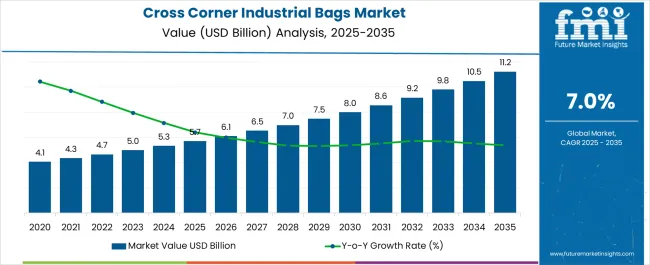
In 2025, the cross corner industrial bags market was valued at USD 5.7 billion. Based on Future Market Insights' analysis, demand for cross corner industrial bags is estimated to grow to USD 6.1 billion in 2026 and USD 11.2 billion by 2036. FMI projects a CAGR of 6.3% during the forecast period.
Absolute dollar growth of USD 5.5 billion over the decade signals steady expansion driven by global bulk commodity trade and industrial production growth rather than transformational shifts. Despite raw material price volatility and increasing competition from other bulk packaging formats, major cross corner industrial bag manufacturers sustain profitability through scale economics, product differentiation with coatings and UV stabilization, and long-term supply contracts with chemical and agricultural exporters.
As Laura Heinen, Sales and Marketing Manager at National Bulk Bag, noted regarding safe bulk bag selection, “Finding a FIBC bulk bag with the right SWL (safe working load) and technical specifications is paramount to proper bulk bag use. At National Bulk Bag, we are dedicated to ensuring our customers get a bag that is safe, reliable, and appropriate for the application.” [1]
Summary of Cross Corner Industrial Bags Market
- Cross Corner Industrial Bags Market Definition: The industry covers large-volume woven polypropylene bags with cross corner lifting loops designed for storing and transporting dry bulk materials across industrial supply chains.
- Demand Drivers in the Market:
- Global chemical and pharmaceutical trade requires safe bulk packaging.
- Agricultural commodity exports drive demand for 500-1000 kg bags.
- Construction material logistics require durable, UV-stabilized containers.
- Key Segments Analyzed in the FMI Report:
- Material: Polypropylene leads with 65.0% share.
- Capacity: 500-1000 kg dominates at 35.0% share.
- Product Type: Coated bags command 55.0% share.
- Analyst Opinion at FMI:
- Ismail Sutaria, Principal Consultant for Packaging at Future Market Insights, opines, "In the updated version of the Cross Corner Industrial Bags Market Report for 2026 to 2036, supply chain managers and packaging procurement directors will find insights into how coating technologies are extending bag life in harsh environments and how cross corner loop design improvements are reducing handling labor costs. Besides this, my findings point at polypropylene resin price volatility directly impacting thin manufacturing margins and the shift toward food-grade certifications enabling access to higher-value pharmaceutical and food ingredient applications."
- Strategic Implications/Executive Takeaways:
- Shift focus from commodity bags to application-specific coated and food-grade solutions.
- Treat UV stabilization and anti-static properties as market access requirements.
- Prioritize 500-1000 kg capacity range for broadest industrial applicability.
- Methodology:
- Validated through global trade statistics and manufacturer shipment records.
- Zero reliance on speculative third-party market research reports.
- Based on verifiable chemical production volumes and agricultural export data.
China (8.8% CAGR) and India (8.2% CAGR) drive new opportunities through expanding manufacturing bases and chemical/pharmaceutical export growth. Brazil (6.8% CAGR) contributes via agricultural commodity exports and mining sector expansion. Mature cross corner industrial bag markets such as Germany (7.5%), the United States (6.2%), the United Kingdom (5.5%), and Japan (4.8%) generate replacement demand through logistics efficiency upgrades, with volume expansion constrained by industrial output growth rates.
Cross Corner Industrial Bags Market Definition
Cross corner industrial bags, also known as cross corner Flexible Intermediate Bulk Containers (FIBCs) or bulk bags, are large-volume packaging solutions designed for storing, handling, and transporting dry bulk materials including powders, granules, and aggregates. These bags feature lifting loops sewn on adjacent corners that stand upright after filling, enabling efficient forklift handling without manual assistance. Constructed primarily from woven polypropylene, they are available with various coatings, inlet types, and outlet configurations to meet specific product protection and handling requirements across multiple industries.
Cross Corner Industrial Bags Market Inclusions
The report includes a comprehensive analysis of market dynamics, featuring Global and Regional Market Sizes (Volume and Value) and a 10-year Forecast (2026-2036). It covers segmental breakdowns by material (Polypropylene, Woven Polyethylene), capacity (Up To 500 Kg, 500-1000 Kg, 1000-2000 Kg, 2000 Kg & Above), product type (Coated, Uncoated), inlet type (Spout Top, Open Top, Duffle Top, Flap With Spout Top), end use (Food & Beverage, Chemicals, Agriculture, Building & Construction, Mining), and geographic regions.
Cross Corner Industrial Bags Market Exclusions
The scope excludes small-sized consumer packaging bags, rigid intermediate bulk containers (IBCs), and bulk packaging formats not utilizing cross corner loop designs. It also omits non-industrial applications such as retail shopping bags, focusing strictly on industrial bulk bags designed for material handling and transportation.
Cross Corner Industrial Bags Market Research Methodology
- Primary Research: Interviews were conducted with industrial bag manufacturers, chemical exporters, agricultural commodity traders, and logistics professionals across major regions. Raw material suppliers clarified polypropylene resin supply dynamics.
- Desk Research: Global trade statistics, industrial production indices, and corporate financial filings supported volume benchmarking.
- Market-Sizing and Forecasting: A hybrid top-down and bottom-up model was developed. Demand was reconstructed from global chemical production volumes, agricultural commodity trade flows, and construction material consumption patterns, then validated against manufacturer shipment data.
- Data Validation and Update Cycle: Outputs undergo anomaly screening, variance checks across production and trade datasets, and structured peer review prior to release.
Segmental Analysis
Cross Corner Industrial Bags Market Analysis by Material
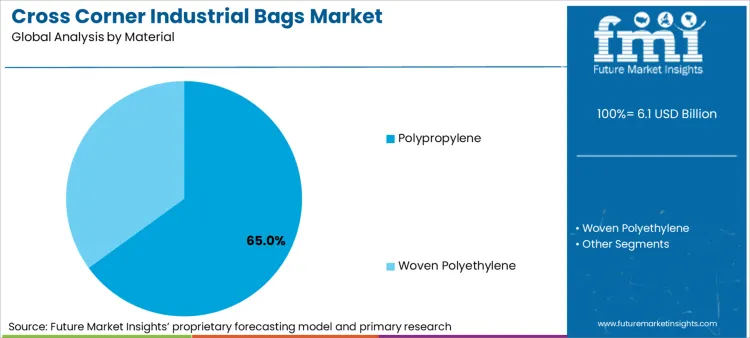
Based on FMI’s cross corner industrial bags market report, consumption of polypropylene bags is estimated to hold 65.0% share in 2026. Growth in demand for polypropylene comes from its optimal combination of strength-to-weight ratio, chemical resistance, UV stability when formulated with additives, and cost-effectiveness through established resin production infrastructure.
- Recycled Content Innovation: “These bags are manufactured using recycled polypropylene, which not only ensures their lightweight nature but also makes them cost-effective.” [2]
- Food-Grade Certification: “A key component of our quality program is our focus on cleanliness and hygiene that ensure all our FIBC, especially food grade FIBC, are sanitized and free from dust, germs and pollutants.” [3]
Cross Corner Industrial Bags Market Analysis by Capacity
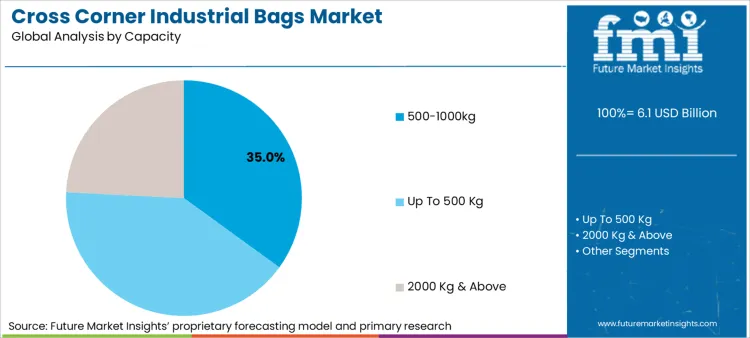
Based on FMI’s cross corner industrial bags market report, consumption of 500-1000 kg capacity bags is estimated to hold 35.0% share in 2026. Growth in demand for this mid-range capacity comes from its optimal balance between payload efficiency and handling convenience, enabling standard forklift operation without requiring heavy-lift equipment while maximizing truck and container utilization.
- Chemical Industry Standardization: “VPIL Jumbo Bags are known to pack powdered, solid and semi solid products (Chemical, Mineral, etc.).” [4]
- Agricultural Application Growth: “Brazil's agribusiness exports reached USD 14.29 billion in August 2025, driven by a 5.1% increase in shipment volumes. Soybeans, beef, and corn accounted for the bulk of the growth.” [5]
Cross Corner Industrial Bags Market Drivers, Restraints, and Opportunities
Future Market Insights analysis suggests that historical patterns point to a mature, logistics-linked bulk packaging market where cross corner industrial bags are selected for safe handling, predictable load performance, and transport efficiency across chemicals, minerals, and agriculture. Estimated valuation in 2026 reflects an immediate “specification push” as buyers tighten SWL and hygiene requirements and expand procurement of standardized bag formats that reduce handling risk and product loss.
While demand for conventional polypropylene bags remains volume-led, value growth increasingly comes from recycled-content designs and cleaner, food-grade manufacturing practices that support broader end-use adoption. The forecast assumes a “new normal” where buyers prioritize reliability, compliance documentation, and consistent quality to sustain throughput and export readiness.
- Recycled Content Value Shift: Growth is supported by recycled polypropylene use that improves cost-effectiveness while meeting sustainability expectations.
- Quality and Hygiene Mandates: Restraints center on meeting food-grade cleanliness requirements and maintaining consistent contamination control.
- Trade and Volume Upside: Opportunity expands where agribusiness export growth and chemical packaging demand reinforce recurring, high-volume bag consumption.
Regional Analysis
Based on the regional analysis, cross corner industrial bags market is segmented into North America, Latin America, Europe, East Asia, South Asia, Oceania and Middle East & Africa across 40+ countries. The full report also offers market attractiveness analysis based on regional trends.
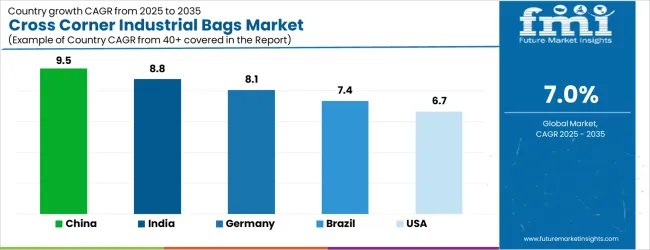
| Country | CAGR (2026 to 2036) |
|---|---|
| China | 8.8% |
| India | 8.2% |
| Germany | 7.5% |
| Brazil | 6.8% |
| United States | 6.2% |
| United Kingdom | 5.5% |
| Japan | 4.8% |
Source: Future Market Insights (FMI) analysis, based on proprietary forecasting model and primary research
North America Cross Corner Industrial Bags Market Analysis
North America is a mature market where growth is driven by the scale of chemical manufacturing and export logistics, sustaining steady demand for bulk packaging that supports safe handling and compliant shipment for industrial products.
- United States: Demand for cross corner industrial bags in the United States is projected to rise at a 6.2% CAGR through 2036. Growth is supported by the breadth of the chemical industry’s manufacturing footprint and export intensity, where the chemical industry is positioned as one of the United States’ largest manufacturing industries and the U.S. exported over USD 494 billion worth of chemicals in 2022 [6].
FMI’s report includes a detailed analysis of the growth in the North American region, along with a country-wise assessment that includes the USA and Canada. Readers can also find regional trends, regulations, and market growth based on different segments and countries in the North America region.
East Asia Cross Corner Industrial Bags Market Analysis
East Asia, led by China, represents the global manufacturing and export anchor for cross corner industrial bags, supported by large industrial output expansion and sustained activity in chemical production that requires specialized bulk packaging.
- China: Demand for cross corner industrial bags is projected to rise at an 8.8% CAGR through 2036. Growth is anchored by the chemical sector, where the value-added output of China’s manufacture of raw chemical materials and chemical products grew 8.2% in the first half of 2025 [7]. Growth is reinforced by broader industrial momentum, where China’s value-added industrial output expanded 5.9% year on year in 2025 [8].
- Japan: The Japanese market grows at a 4.8% CAGR through 2036, driven by high-precision manufacturing and stringent requirements for chemical and pharmaceutical-grade bulk packaging.
The full report analyze the cross corner industrial bags market across East and South Asia from 2021-2036, covering trade, trends, and growth drivers in China, Japan, South Korea, India, Indonesia, Malaysia, and Thailand. The assessment highlights trends that dictate regional demand patterns and buyer specifications.
South Asia Cross Corner Industrial Bags Market Analysis
South Asia is the growth frontier for the market, supported by export expansion and rising requirements for reliable bulk packaging across chemicals and pharmaceuticals.
- India: Demand is projected to rise at an 8.2% CAGR through 2036. Growth is supported by export momentum, where organic and inorganic chemicals exports grew 18.49% year on year in November 2025 [9]. Expansion is reinforced by rising pharmaceutical exports, where drugs and pharmaceuticals exports increased by 20.91% from USD 2.16 billion in November 2024 to USD 2.61 billion in November 2025 [10].
The full report analyze the cross corner industrial bags market across South Asia from 2021-2036, covering export-linked demand, bulk handling requirements, and growth drivers in India and other South Asian countries.
Latin America Cross Corner Industrial Bags Market Analysis
Latin America is emerging as a critical hub for agricultural and commodities logistics, where export volumes reinforce recurring demand for durable bulk packaging solutions for storage, handling, and shipment.
- Brazil: A projected 6.8% CAGR through 2036 is supported by trade performance, where Brazilian agribusiness exports reached USD 169.2 billion in 2025, marking a 3.0% increase over 2024 [11].
The report consists of a detailed analysis for the market in Brazil, Mexico, Chile, Argentina, Peru and Rest of Latin America. Readers can find detailed information about several factors, such as trade-linked demand, regional logistics trends, and growth drivers impacting the Latin America region.
Europe Cross Corner Industrial Bags Market Analysis
Europe acts as a quality and regulatory leader, where demand is tied to certified bulk packaging needs for chemical and pharmaceutical supply chains that serve both domestic and export markets.
- Germany: Demand is rising at a 7.5% CAGR through 2036, supported by sustained chemical and pharmaceutical industry turnover, where total sales in the German chemical and pharmaceutical industry reached 221 billion euros in 2025 [12].
FMI’s analysis of cross corner industrial bags market in Europe consists of country-wise assessment that includes Germany, Italy, France, UK, Spain, Russia, Nordic, Benelux and Rest of Europe. Readers can know various regulations and latest trends in the regional market.
Competitive Aligners for Market Players
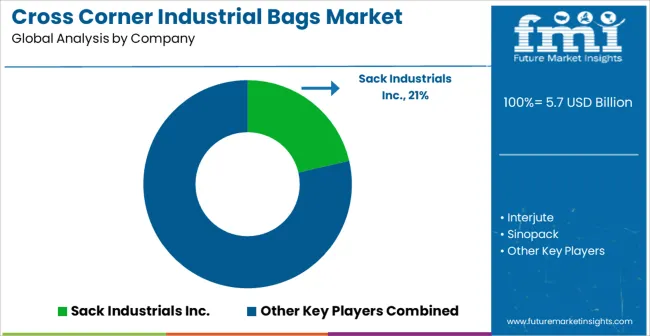
Market structure remains fragmented overall, yet practical competition is concentrated among a limited set of suppliers capable of meeting volume consistency, compliance documentation, and service expectations of large chemical producers, agribusiness exporters, and bulk logistics operators. A meaningful share of demand sits with suppliers that can deliver standardized SWL-rated bags at scale, while smaller converters operate with limited pricing leverage and high utilization dependency tied to seasonal export cycles. The primary competitive variable is cost survivability at mid-cycle resin pricing, not peak margin capture, because buyers routinely benchmark total landed cost and enforce strict defect and breakage tolerances.
Producers with integrated polypropylene sourcing relationships and stable lamination, weaving, and liner capabilities absorb resin volatility more effectively and sustain supply continuity during demand surges. Suppliers without scale depend on spot resin and outsourced conversion, increasing exposure to margin compression, inconsistent fabric properties, and delivery slippage during peak shipping windows. Compliance capability further narrows the competitive field. Ability to consistently meet SWL/SF performance, hygiene requirements for food-grade uses, and traceable quality systems requires testing discipline, batch control, and documented manufacturing practices, creating natural attrition among underinvested plants.
Customer concentration reinforces buyer leverage. Large exporters and chemical shippers multi-source to avoid dependency, limiting price pass-through and elevating lead time reliability, audit readiness, and customization support as key differentiators.
Recent Developments
The report includes full coverage of key trends from competitive benchmarking. Some of the recent developments covered in the reports:
- In February 2026, Emmbi Industries reported Q3FY25 net sales of ₹1,122 million, up 9%, while profit declined due to one-time labour code provisions. Nine-month results showed strong revenue and profit growth overall [13].
- In February 2026, Kanpur Plastipack reported a 205% jump in nine-month profit to ₹2,366 lakh on 20% income growth, driven by exports and global expansion. The stock trades at 14x earnings, below industry average [14].
Key Players in Cross Corner Industrial Bags Market
- Sack Industrials Inc.
- Interjute
- Sinopack
- Aditya Timpack Pvt Ltd.
- Strosack Group
- Bonus Bags
- Accon
- Years Sentetik
- Virgo Polymer India Ltd.
- Vishish Bulkpack Solution
- Jumbo Bag Ltd.
- LC Packaging International BV
- Halsted Corporation
- Greif, Inc.
- Berry Global Inc.
- Emmbi Industries Ltd.
- Kanpur Plastipack Ltd.
- Conitex Sonoco
- Rishi FIBC Solutions Pvt. Ltd.
- Da Nang Plastic Joint Stock Company
Scope of the Report
| Metric | Value |
|---|---|
| Quantitative Units | USD 6.1 billion (2026) to USD 11.2 billion (2036), at a CAGR of 6.3% |
| Market Definition | The cross corner industrial bags market comprises large-volume Flexible Intermediate Bulk Containers (FIBCs) designed to store, handle, and transport dry bulk materials such as powders, granules, and aggregates. These bags use cross corner lifting loops that remain upright after filling to enable efficient forklift handling. Products are primarily manufactured using woven polypropylene or woven polyethylene and are supplied in coated or uncoated constructions with multiple inlet configurations to meet industry-specific protection and handling requirements. |
| Material Segmentation | Polypropylene, Woven Polyethylene |
| Capacity Segmentation | Up To 500 Kg, 500-1000 Kg, 1000-2000 Kg, 2000 Kg & Above |
| Product Type Segmentation | Coated, Uncoated |
| Inlet Type Segmentation | Spout Top, Open Top, Duffle Top, Flap With Spout Top |
| End Use Segmentation | Food & Beverage, Chemicals, Agriculture, Building & Construction, Mining Industry |
| Regions Covered | North America, Latin America, Europe, East Asia, South Asia, Oceania, Middle East & Africa |
| Countries Covered | United States, Canada, Mexico, Brazil, Argentina, Germany, France, United Kingdom, Italy, Spain, China, India, Japan, South Korea, Indonesia, Australia and 40 plus countries |
| Key Companies Profiled | Sack Industrials Inc., Interjute, Sinopack, Aditya Timpack Pvt Ltd., Strosack Group, Bonus Bags, LC Packaging International BV, Greif, Inc., Berry Global Inc., Emmbi Industries Ltd. |
| Forecast Period | 2026 to 2036 |
| Approach | Hybrid top-down and bottom-up market modeling validated through primary interviews with industrial bag manufacturers, chemical exporters, agricultural commodity traders, and logistics stakeholders, supported by global trade statistics benchmarking and shipment-level triangulation. |
Cross Corner Industrial Bags Market Analysis by Segments
Material
- Polypropylene
- Virgin Polypropylene
- Recycled/Recycled Content Polypropylene
- Woven Polyethylene
Capacity
- Up To 500 Kg
- 500-1000 Kg
- 1000-2000 Kg
- 2000 Kg & Above
Product Type
- Coated
- PE Coated
- Laminated
- UV Coated
- Uncoated
Inlet Type
- Spout Top
- Open Top
- Duffle Top
- Flap With Spout Top
End Use
- Food & Beverage
- Grains and Cereals
- Sugar and Salt
- Food Ingredients
- Spices and Nuts
- Chemicals
- Industrial Chemicals
- Polymers and Resins
- Fertilizers
- Pharmaceuticals
- Agriculture
- Animal Feed
- Seeds
- Agricultural Products
- Building & Construction
- Cement
- Sand and Aggregates
- Construction Chemicals
- Mining Industry
- Mineral Concentrates
- Ores
- Mining Chemicals
Region
- North America
- United States
- Canada
- Mexico
- Latin America
- Brazil
- Argentina
- Chile
- Colombia
- Rest of Latin America
- Europe
- Germany
- United Kingdom
- France
- Italy
- Spain
- Russia
- Nordic
- Benelux
- Rest of Europe
- East Asia
- China
- Japan
- South Korea
- South Asia & Pacific
- India
- Bangladesh
- Sri Lanka
- Pakistan
- Rest of South Asia
- Southeast Asia
- Indonesia
- Thailand
- Vietnam
- Malaysia
- Philippines
- Rest of Southeast Asia
- Oceania
- Australia
- New Zealand
- Pacific Islands
- Middle East & Africa
- Saudi Arabia
- UAE
- Turkey
- South Africa
- Rest of Middle East & Africa
Bibliography
- [1] FIBC Big Bags. (2025). Custom bulk bags for your needs: High-quality FIBCs. FIBC Big Bags.
- [2] Virgo Polymers. (2025). FIBC sustainability with Virgo Polymers. FIBC Big Bags.
- [3] Aditya Timpack Pvt. Ltd. (2025). Company policy. Aditya Timpack.
- [4] FIBC Big Bags. (2025). Company website. FIBC Big Bags.
- [5] Datamar News. (2025). Brazil’s agribusiness exports reach USD 14.29 bln in August, up 1.5%. Datamar News.
- [6] SelectUSA. (2025). Chemicals industry overview. U.S. Department of Commerce.
- [7] National Bureau of Statistics of China. (2025). Industrial production operation in June 2025. NBS China.
- [8] National Bureau of Statistics of China. (2025). China’s industrial output up 5.9% in 2025. NBS China.
- [9] Press Information Bureau, Government of India. (2025). Press release. PIB.
- [10] Press Information Bureau, Government of India. (2025, November). Press release – November 2025 (PDF). PIB.
- [11] Ministério da Agricultura e Pecuária (Brazil). (2025). Brazil agribusiness exports hit record US$169.2 billion in 2025. Government of Brazil.
- [12] [Corporate Author Unknown]. (2025). Quarterly report 2/2025.
- [13] Emmbi Industries Limited. (2025). Emmbi Industries reports Q3FY25 results with net sales of ₹1,122.37 million. Emmbi Industries.
- [14] Kanpur Plastipack Limited. (2025). Profit surge outshines valuation amid global expansion. Kanpur Plastipack.
This bibliography is provided for reader reference and is not exhaustive. The full report contains the complete reference list and detailed citations.
This Report Addresses
- Market intelligence to enable structured strategic decision-making across mature and emerging cross corner industrial bag markets
- Market size estimation and 10-year revenue forecasts from 2026 to 2036, supported by validated global trade data and industrial production statistics
- Growth opportunity mapping across materials, capacities, product types, inlet types, and end-use industries with emphasis on coated and food-grade bags
- Segment and regional revenue forecasts covering chemical, agricultural, construction, and mining applications
- Competition strategy assessment including certification depth, product line breadth, and geographic coverage benchmarking
- Technology roadmap tracking including UV stabilization, anti-static properties, RFID integration, and recycled content development
- Regulatory impact analysis covering food contact certifications, hazardous material transport standards (ISO 21898), and sustainability requirements
- Market report delivery in PDF, Excel, PPT, and interactive dashboard formats for executive and operational use
Frequently Asked Questions
How large is the demand for cross corner industrial bags in the global market in 2026?
Demand for cross corner industrial bags in the global market is estimated to be valued at USD 6.1 billion in 2026.
What will be the market size of cross corner industrial bags in the global market by 2036?
Market size for cross corner industrial bags is projected to reach USD 11.2 billion by 2036.
What is the expected demand growth for cross corner industrial bags in the global market between 2026 and 2036?
Demand for cross corner industrial bags in the global market is expected to grow at a CAGR of 6.3% between 2026 and 2036.
Which material segment is poised to lead global sales by 2026?
Polypropylene is expected to be the dominant material, capturing approximately 65.0% of global market share in 2026 due to its optimal strength-to-weight ratio, chemical resistance, and cost-effectiveness.
Which capacity segment is projected to contribute significant share in the cross corner industrial bags market in 2026?
In terms of capacity, the 500-1000 kg segment is projected to command 35.0% share in the cross corner industrial bags market in 2026, driven by optimal balance between payload efficiency and handling convenience.
What is driving cross corner industrial bag demand in China?
China's 8.8% CAGR is driven by continued chemical industry expansion, construction materials production for domestic infrastructure and Belt and Road exports, and agricultural chemical exports requiring bulk packaging.
What compliance standards are referenced for China?
China's GB standards for flexible intermediate bulk containers and chemical packaging regulations are referenced as key compliance benchmarks.
What is the United States growth outlook in this report?
The United States is projected to grow at a CAGR of 6.2% during 2026 to 2036, supported by chemical industry production, agricultural exports, and construction materials logistics.
Why is Germany's growth rate significant in this report?
Germany's 7.5% CAGR reflects chemical industry leadership requiring certified bulk packaging, automotive supply chain demands for plastic resin packaging, and stringent regulatory compliance driving coated bag adoption.
What type of demand dominates in mature markets?
Replacement demand through quality upgrades to coated, food-grade, and anti-static bags dominates mature markets, with volume growth constrained by industrial output rates.
What is Japan's growth outlook in this report?
Japan is projected to grow at a CAGR of 4.8% during 2026 to 2036, characterized by high-quality requirements for chemical and pharmaceutical packaging and emphasis on specialized bags with anti-static and food-grade certifications.
Does the report cover Australia in its regional analysis?
Australia is included within Oceania under the regional coverage framework, recognizing its mining sector demand for durable bulk bags and agricultural exports.
What are the sources referred to for analyzing the market in Australia?
Australian Bureau of Statistics mining production data and Department of Agriculture export statistics are cited as primary reference sources.
What is the main demand theme linked to Southeast Asia coverage?
Southeast Asia demand centers on chemical manufacturing growth, agricultural commodity exports, and expanding industrial base requiring bulk packaging solutions.
Which end-use industry is strategically important for coated bag demand?
The chemical industry represents a critical end-use sector for coated bags, requiring moisture barrier properties and contamination prevention for sensitive materials.
What are cross corner industrial bags and what are they mainly used for?
Cross corner industrial bags are large-volume woven polypropylene bags with lifting loops sewn on adjacent corners, primarily used for storing, handling, and transporting dry bulk materials including chemicals, agricultural products, construction materials, and minerals.
What does the cross corner industrial bags market mean in this report?
The cross corner industrial bags market refers to global production and supply of flexible intermediate bulk containers with cross corner loop designs for industrial material handling applications.
What is included in the scope of this cross corner industrial bags market report?
Scope covers cross corner industrial bags by material, capacity, product type, inlet type, end use, and geographic regions.
What is excluded from the scope of this report?
Small-sized consumer packaging bags, rigid intermediate bulk containers, and bulk packaging formats without cross corner loop designs are excluded.
What does market forecast mean on this page?
Market forecast represents a model-based projection built on defined assumptions for strategic planning purposes.
How does FMI build and validate the cross corner industrial bags market forecast?
Forecast is developed using hybrid top-down and bottom-up modeling validated through global trade statistics, industrial production data, and manufacturer shipment benchmarks.
What does zero reliance on speculative third-party market research mean here?
Primary interviews and verifiable public datasets including chemical production statistics, agricultural export data, and corporate financial filings are used instead of unverified syndicated market estimates.
Preview the report firsthand - request a free sample
Get SampleGet the brochure for pricing and purchase details.
Get PDFTable of Content
- Executive Summary
- Global Market Outlook
- Demand-side Trends
- Supply-side Trends
- Technology Roadmap Analysis
- Analysis and Recommendations
- Market Overview
- Market Coverage / Taxonomy
- Market Definition / Scope / Limitations
- Research Methodology
- Chapter Orientation
- Analytical Lens and Working Hypotheses
- Market Structure, Signals, and Trend Drivers
- Benchmarking and Cross-market Comparability
- Market Sizing, Forecasting, and Opportunity Mapping
- Research Design and Evidence Framework
- Desk Research Programme (Secondary Evidence)
- Company Annual and Sustainability Reports
- Peer-reviewed Journals and Academic Literature
- Corporate Websites, Product Literature, and Technical Notes
- Earnings Decks and Investor Briefings
- Statutory Filings and Regulatory Disclosures
- Technical White Papers and Standards Notes
- Trade Journals, Industry Magazines, and Analyst Briefs
- Conference Proceedings, Webinars, and Seminar Materials
- Government Statistics Portals and Public Data Releases
- Press Releases and Reputable Media Coverage
- Specialist Newsletters and Curated Briefings
- Sector Databases and Reference Repositories
- FMI Internal Proprietary Databases and Historical Market Datasets
- Subscription Datasets and Paid Sources
- Social Channels, Communities, and Digital Listening Inputs
- Additional Desk Sources
- Expert Input and Fieldwork (Primary Evidence)
- Primary Modes
- Qualitative Interviews and Expert Elicitation
- Quantitative Surveys and Structured Data Capture
- Blended Approach
- Why Primary Evidence is Used
- Field Techniques
- Interviews
- Surveys
- Focus Groups
- Observational and In-context Research
- Social and Community Interactions
- Stakeholder Universe Engaged
- C-suite Leaders
- Board Members
- Presidents and Vice Presidents
- R&D and Innovation Heads
- Technical Specialists
- Domain Subject-matter Experts
- Scientists
- Physicians and Other Healthcare Professionals
- Governance, Ethics, and Data Stewardship
- Research Ethics
- Data Integrity and Handling
- Primary Modes
- Tooling, Models, and Reference Databases
- Desk Research Programme (Secondary Evidence)
- Data Engineering and Model Build
- Data Acquisition and Ingestion
- Cleaning, Normalisation, and Verification
- Synthesis, Triangulation, and Analysis
- Quality Assurance and Audit Trail
- Market Background
- Market Dynamics
- Drivers
- Restraints
- Opportunity
- Trends
- Scenario Forecast
- Demand in Optimistic Scenario
- Demand in Likely Scenario
- Demand in Conservative Scenario
- Opportunity Map Analysis
- Product Life Cycle Analysis
- Supply Chain Analysis
- Investment Feasibility Matrix
- Value Chain Analysis
- PESTLE and Porter’s Analysis
- Regulatory Landscape
- Regional Parent Market Outlook
- Production and Consumption Statistics
- Import and Export Statistics
- Market Dynamics
- Global Market Analysis 2021 to 2025 and Forecast, 2026 to 2036
- Historical Market Size Value (USD Million) Analysis, 2021 to 2025
- Current and Future Market Size Value (USD Million) Projections, 2026 to 2036
- Y-o-Y Growth Trend Analysis
- Absolute $ Opportunity Analysis
- Global Market Pricing Analysis 2021 to 2025 and Forecast 2026 to 2036
- Global Market Analysis 2021 to 2025 and Forecast 2026 to 2036, By Material
- Introduction / Key Findings
- Historical Market Size Value (USD Million) Analysis By Material , 2021 to 2025
- Current and Future Market Size Value (USD Million) Analysis and Forecast By Material , 2026 to 2036
- Polypropylene
- Woven Polyethylene
- Polypropylene
- Y-o-Y Growth Trend Analysis By Material , 2021 to 2025
- Absolute $ Opportunity Analysis By Material , 2026 to 2036
- Global Market Analysis 2021 to 2025 and Forecast 2026 to 2036, By Capacity
- Introduction / Key Findings
- Historical Market Size Value (USD Million) Analysis By Capacity, 2021 to 2025
- Current and Future Market Size Value (USD Million) Analysis and Forecast By Capacity, 2026 to 2036
- 500-1000kg
- Up To 500 Kg
- 2000 Kg & Above
- 500-1000kg
- Y-o-Y Growth Trend Analysis By Capacity, 2021 to 2025
- Absolute $ Opportunity Analysis By Capacity, 2026 to 2036
- Global Market Analysis 2021 to 2025 and Forecast 2026 to 2036, By Product Type
- Introduction / Key Findings
- Historical Market Size Value (USD Million) Analysis By Product Type, 2021 to 2025
- Current and Future Market Size Value (USD Million) Analysis and Forecast By Product Type, 2026 to 2036
- Coated
- Uncoated
- Coated
- Y-o-Y Growth Trend Analysis By Product Type, 2021 to 2025
- Absolute $ Opportunity Analysis By Product Type, 2026 to 2036
- Global Market Analysis 2021 to 2025 and Forecast 2026 to 2036, By Region
- Introduction
- Historical Market Size Value (USD Million) Analysis By Region, 2021 to 2025
- Current Market Size Value (USD Million) Analysis and Forecast By Region, 2026 to 2036
- North America
- Latin America
- Western Europe
- Eastern Europe
- East Asia
- South Asia and Pacific
- Middle East & Africa
- Market Attractiveness Analysis By Region
- North America Market Analysis 2021 to 2025 and Forecast 2026 to 2036, By Country
- Historical Market Size Value (USD Million) Trend Analysis By Market Taxonomy, 2021 to 2025
- Market Size Value (USD Million) Forecast By Market Taxonomy, 2026 to 2036
- By Country
- USA
- Canada
- Mexico
- By Material
- By Capacity
- By Product Type
- By Country
- Market Attractiveness Analysis
- By Country
- By Material
- By Capacity
- By Product Type
- Key Takeaways
- Latin America Market Analysis 2021 to 2025 and Forecast 2026 to 2036, By Country
- Historical Market Size Value (USD Million) Trend Analysis By Market Taxonomy, 2021 to 2025
- Market Size Value (USD Million) Forecast By Market Taxonomy, 2026 to 2036
- By Country
- Brazil
- Chile
- Rest of Latin America
- By Material
- By Capacity
- By Product Type
- By Country
- Market Attractiveness Analysis
- By Country
- By Material
- By Capacity
- By Product Type
- Key Takeaways
- Western Europe Market Analysis 2021 to 2025 and Forecast 2026 to 2036, By Country
- Historical Market Size Value (USD Million) Trend Analysis By Market Taxonomy, 2021 to 2025
- Market Size Value (USD Million) Forecast By Market Taxonomy, 2026 to 2036
- By Country
- Germany
- UK
- Italy
- Spain
- France
- Nordic
- BENELUX
- Rest of Western Europe
- By Material
- By Capacity
- By Product Type
- By Country
- Market Attractiveness Analysis
- By Country
- By Material
- By Capacity
- By Product Type
- Key Takeaways
- Eastern Europe Market Analysis 2021 to 2025 and Forecast 2026 to 2036, By Country
- Historical Market Size Value (USD Million) Trend Analysis By Market Taxonomy, 2021 to 2025
- Market Size Value (USD Million) Forecast By Market Taxonomy, 2026 to 2036
- By Country
- Russia
- Poland
- Hungary
- Balkan & Baltic
- Rest of Eastern Europe
- By Material
- By Capacity
- By Product Type
- By Country
- Market Attractiveness Analysis
- By Country
- By Material
- By Capacity
- By Product Type
- Key Takeaways
- East Asia Market Analysis 2021 to 2025 and Forecast 2026 to 2036, By Country
- Historical Market Size Value (USD Million) Trend Analysis By Market Taxonomy, 2021 to 2025
- Market Size Value (USD Million) Forecast By Market Taxonomy, 2026 to 2036
- By Country
- China
- Japan
- South Korea
- By Material
- By Capacity
- By Product Type
- By Country
- Market Attractiveness Analysis
- By Country
- By Material
- By Capacity
- By Product Type
- Key Takeaways
- South Asia and Pacific Market Analysis 2021 to 2025 and Forecast 2026 to 2036, By Country
- Historical Market Size Value (USD Million) Trend Analysis By Market Taxonomy, 2021 to 2025
- Market Size Value (USD Million) Forecast By Market Taxonomy, 2026 to 2036
- By Country
- India
- ASEAN
- Australia & New Zealand
- Rest of South Asia and Pacific
- By Material
- By Capacity
- By Product Type
- By Country
- Market Attractiveness Analysis
- By Country
- By Material
- By Capacity
- By Product Type
- Key Takeaways
- Middle East & Africa Market Analysis 2021 to 2025 and Forecast 2026 to 2036, By Country
- Historical Market Size Value (USD Million) Trend Analysis By Market Taxonomy, 2021 to 2025
- Market Size Value (USD Million) Forecast By Market Taxonomy, 2026 to 2036
- By Country
- Kingdom of Saudi Arabia
- Other GCC Countries
- Turkiye
- South Africa
- Other African Union
- Rest of Middle East & Africa
- By Material
- By Capacity
- By Product Type
- By Country
- Market Attractiveness Analysis
- By Country
- By Material
- By Capacity
- By Product Type
- Key Takeaways
- Key Countries Market Analysis
- USA
- Pricing Analysis
- Market Share Analysis, 2025
- By Material
- By Capacity
- By Product Type
- Canada
- Pricing Analysis
- Market Share Analysis, 2025
- By Material
- By Capacity
- By Product Type
- Mexico
- Pricing Analysis
- Market Share Analysis, 2025
- By Material
- By Capacity
- By Product Type
- Brazil
- Pricing Analysis
- Market Share Analysis, 2025
- By Material
- By Capacity
- By Product Type
- Chile
- Pricing Analysis
- Market Share Analysis, 2025
- By Material
- By Capacity
- By Product Type
- Germany
- Pricing Analysis
- Market Share Analysis, 2025
- By Material
- By Capacity
- By Product Type
- UK
- Pricing Analysis
- Market Share Analysis, 2025
- By Material
- By Capacity
- By Product Type
- Italy
- Pricing Analysis
- Market Share Analysis, 2025
- By Material
- By Capacity
- By Product Type
- Spain
- Pricing Analysis
- Market Share Analysis, 2025
- By Material
- By Capacity
- By Product Type
- France
- Pricing Analysis
- Market Share Analysis, 2025
- By Material
- By Capacity
- By Product Type
- India
- Pricing Analysis
- Market Share Analysis, 2025
- By Material
- By Capacity
- By Product Type
- ASEAN
- Pricing Analysis
- Market Share Analysis, 2025
- By Material
- By Capacity
- By Product Type
- Australia & New Zealand
- Pricing Analysis
- Market Share Analysis, 2025
- By Material
- By Capacity
- By Product Type
- China
- Pricing Analysis
- Market Share Analysis, 2025
- By Material
- By Capacity
- By Product Type
- Japan
- Pricing Analysis
- Market Share Analysis, 2025
- By Material
- By Capacity
- By Product Type
- South Korea
- Pricing Analysis
- Market Share Analysis, 2025
- By Material
- By Capacity
- By Product Type
- Russia
- Pricing Analysis
- Market Share Analysis, 2025
- By Material
- By Capacity
- By Product Type
- Poland
- Pricing Analysis
- Market Share Analysis, 2025
- By Material
- By Capacity
- By Product Type
- Hungary
- Pricing Analysis
- Market Share Analysis, 2025
- By Material
- By Capacity
- By Product Type
- Kingdom of Saudi Arabia
- Pricing Analysis
- Market Share Analysis, 2025
- By Material
- By Capacity
- By Product Type
- Turkiye
- Pricing Analysis
- Market Share Analysis, 2025
- By Material
- By Capacity
- By Product Type
- South Africa
- Pricing Analysis
- Market Share Analysis, 2025
- By Material
- By Capacity
- By Product Type
- USA
- Market Structure Analysis
- Competition Dashboard
- Competition Benchmarking
- Market Share Analysis of Top Players
- By Regional
- By Material
- By Capacity
- By Product Type
- Competition Analysis
- Competition Deep Dive
- Sack Industrials Inc
- Overview
- Product Portfolio
- Profitability by Market Segments (Product/Age /Sales Channel/Region)
- Sales Footprint
- Strategy Overview
- Marketing Strategy
- Product Strategy
- Channel Strategy
- Interjute
- Sinopack
- Aditya Timpack Pvt Ltd.
- Strosack Group
- Bonus Bags
- Accon
- Sack Industrials Inc
- Competition Deep Dive
- Assumptions & Acronyms Used


