

- Market Size (2026)
- USD 1.8 Bn
- Forecast (2036)
- USD 4.6 Bn
- CAGR (2026 to 2036)
- 9.9%
How big is the Cryptococcosis Market in 2026?
USD 1.8 billion in 2026 and USD 4.6 billion by 2036 at a 9.9% CAGR.
Sales of cryptococcosis therapeutics are set to climb from USD 1.8 billion in 2026 to USD 4.6 billion by 2036, expanding at a CAGR of 9.9% across the forecast decade.
Cryptococcosis sits at the intersection of infectious disease and immunology, and that shapes how this market behaves. A confirmed case commits a patient to a staged arc, intensive induction under close monitoring, then months of consolidation and maintenance dosing, giving the market a recurring revenue character built on repeat prescriptions and repeat clinical visits rather than one-off transactions. Growth is pulled by expanding HIV and transplant patient pools plus wider access to rapid antigen testing. Restraints include a thin pipeline of novel antifungal classes, emerging resistance, and reimbursement gaps in lower income geographies. Opportunities are opening around combination regimens, shorter induction protocols, and diagnostic-therapeutic bundling. Product, therapy, and end-user segments each respond differently, and regional performance splits between markets with mature HIV care infrastructure and those still building diagnostic access.
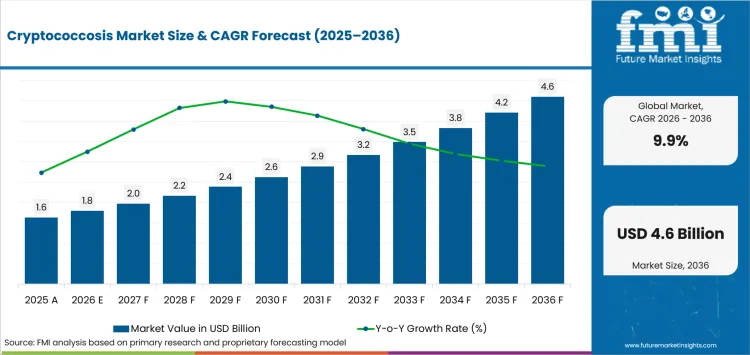
Key Takeaways of Cryptococcosis Market
- Earlier fungal identification and complete treatment increase demand across hospital induction and prolonged outpatient care.
- Antifungal drugs are estimated to hold around 46.0% share in 2026 driven by fungal clearance.
- In 2026, cryptococcal meningitis is estimated at 49.0% of application demand owing to intensive neurologic care.
- Hospitals are forecast at 44.0% of end user demand in 2026, supported by monitored infusion and toxicity surveillance.
- Renal toxicity and prolonged treatment restrict completion in hospitals lacking dependable laboratories or essential induction medicines.
- Pfizer Inc., Gilead Sciences, Inc., Lupin Pharmaceuticals, Inc., Emcure Pharmaceuticals Limited, Macleods Pharmaceuticals Ltd, Mycovia Pharmaceuticals, Inc., Basilea Pharmaceutica Ltd and Solara Active Pharma Sciences Limited are some notable players.
Analyst Perspective
"Hospital teams compare cryptococcosis products against regimens since missing monitoring or flucytosine can undermine induction. Manufacturers gain durable positions through induction supply and uninterrupted consolidation or maintenance through specialist discharge planning."
- Anurag Sharma, Principal Consultant, Future Market Insights
How is the Cryptococcosis Market segmented?
The cryptococcosis market is segmented by treatment type, application, end user, distribution channel, drug class and region.
The cryptococcosis market is segmented by treatment type, application, end user, distribution channel, drug class and region. Treatment type covers antifungal drugs, azole therapy, combination therapy and supportive care across different treatment phases. Applications cover cryptococcal meningitis, pulmonary disease, disseminated infection and prophylactic treatment for immunocompromised patients requiring distinct care pathways. End users include hospitals, specialty clinics, research institutes and diagnostic laboratories that support diagnosis or treatment. Distribution channels cover hospital, retail, specialty and online pharmacies, while drug classes include polyenes, azoles, antimetabolites and echinocandins.
What supports antifungal drugs within the treatment type category?
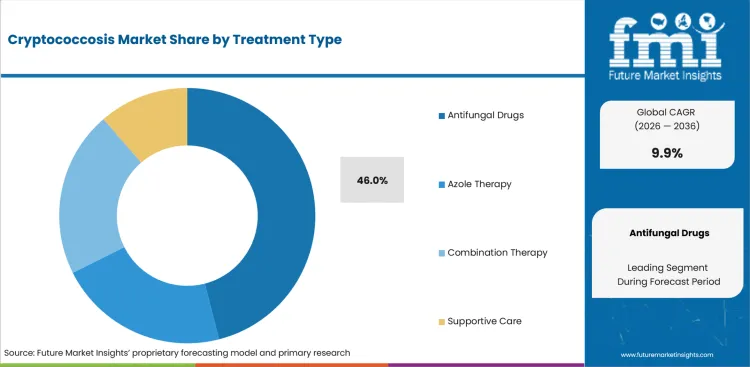
Antifungal drugs provide the active fungal-clearance step across pulmonary disease and central nervous system infection. Their role connects intravenous induction with oral continuation through pharmaceutical drug delivery routes shaped by disease severity and specialist setting.
- The treatment type category is forecast to be led by antifungal drugs at 46.0% share in 2026 due to direct use across severe pulmonary and disseminated infection.
- Severe disease requires a staged regimen that links initial fungal clearance with longer oral therapy. CDC stated in January 2025 that severe lung infection or meningitis requires liposomal amphotericin B with flucytosine followed by fluconazole, sustaining demand for liposomal delivery and continuation.
Why does cryptococcal meningitis shape the application category?
Cryptococcal meningitis concentrates diagnosis around cerebrospinal fluid testing and management of raised intracranial pressure during severe neurologic disease. Cryptococcal antigen testing can trigger lumbar puncture and specialist evaluation, linking laboratory confirmation with urgent treatment decisions across coordinated hospital pathways.
- The cryptococcal meningitis segment is likely to capture 49.0% share in 2026 attributable to intensive neurologic treatment and prolonged hospital monitoring.
- Neurology and infectious disease teams coordinate lumbar puncture with induction medicines and toxicity surveillance across the first treatment phase. HIV diagnostics remain linked to screening as advanced immune suppression raises the risk of late presentation and complicated hospital care.
What role do hospitals play within the end user category?
Hospitals combine clinical diagnostics with lumbar puncture and intravenous antifungal administration under coordinated specialist supervision during severe infection. Inpatient teams also manage electrolyte changes and neurologic deterioration throughout high-risk induction and early stabilization across complex cases.
- By end user, hospitals are estimated to hold 44.0% in 2026 owing to integrated monitoring across infectious disease and neurology teams working with hospital pharmacies.
- Complex induction requires fungal testing kits and laboratory results that support timely dose changes during renal or hematologic toxicity. NIH guidance reviewed in March 2026 calls for frequent monitoring during amphotericin B and flucytosine therapy, tying hospital diagnostics to safe discharge planning.
How do hospital pharmacies influence distribution channel demand?
Hospital pharmacies position induction medicines near teams managing renal toxicity and urgent regimen changes throughout complex inpatient treatment. Current labels document liposomal amphotericin B for cryptococcal meningitis through institutional pharmacy channels that manage controlled reconstitution and monitored infusion under hospital protocols.
- Hospital pharmacies are projected to hold 47.0% share in 2026 owing to institution-based initiation and monitored administration across severe cases.
- Pharmacy teams align antifungal susceptibility testing with medicine availability during difficult cases requiring specialist regimen adjustment. Retail and specialty pharmacies support prolonged fluconazole refills across consolidation and maintenance following hospital discharge and monitored follow-up.
What are the drivers, restraints and opportunities in the Cryptococcosis Market?
Severity-based protocols guide hospital treatment while toxicity and medicine gaps restrict completion and oral candidates reduce infusion dependence.
- Driver: Severity-based regimens give hospitals a defined sequence for screening, induction and prolonged oral treatment across complex infections.
- Restraint: Toxicity surveillance and uneven essential-medicine access can interrupt guideline-based treatment across hospital systems during severe infections.
- Opportunity: Oral candidates could reduce infusion dependence through regimens that preserve fungal clearance and simplify monitored care.
Severity-based protocols convert diagnostic results into a defined sequence of induction and extended oral treatment. WHO introduced a cryptococcal disease course in February 2025 covering diagnosis, medicine administration and toxicity management. Consistent training helps hospitals forecast medicine needs and coordinate referrals across advanced HIV and fungal care.
Treatment completion depends on timely renal and blood monitoring throughout induction and extended oral therapy. Hospitals without dependable laboratory services face delayed dose changes and interrupted regimens during the highest-risk phase of care.
Oral candidates could reduce infusion days for selected patients without weakening fungal clearance across difficult treatment pathways. Specialist teams need clinical trials that demonstrate comparable outcomes and practical monitoring requirements to justify changes to established regimens.
Which country CAGRs are profiled in the Cryptococcosis Market?
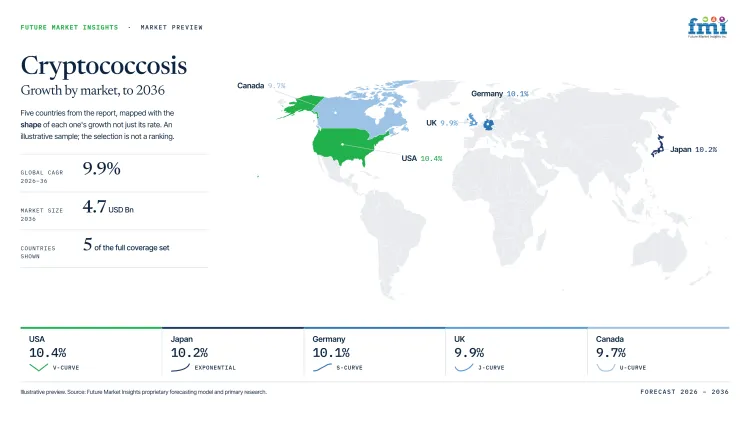
| Country | CAGR |
|---|---|
| United States | 10.4% |
| Japan | 10.2% |
| Germany | 10.1% |
| United Kingdom | 9.9% |
| Canada | 9.7% |
How do country-level CAGRs compare in the Cryptococcosis Market?
The country CAGRs span 0.7 percentage point and measure forecast pace rather than current market size. Narrow spacing reflects shared treatment standards with different screening access or specialist capacity across national healthcare systems.
- The United States combines broad specialist capacity with uneven cryptococcal antigen screening across advanced HIV care settings.
- Japan links centralized infectious disease expertise with detailed reimbursement requirements across a smaller specialist treatment network.
- Germany benefits from university mycology centers although decentralized formulary decisions can alter hospital medicine access.
- The United Kingdom uses coordinated national guidance while specialist bed capacity influences treatment initiation for complex presentations.
- Canada combines public coverage with long referral distances that complicate specialist access outside major metropolitan centers.
Comparable CAGRs can produce different market entry conditions. The full report provides country-level CAGR analysis across North America, Latin America, Europe, East Asia, South Asia and Pacific, and the Middle East and Africa.
Country-wise Analysis
- United States infectious disease centers combine antigen testing with hospital pharmacy access and experienced HIV or transplant teams across major regional referral networks serving patients with advanced immune suppression throughout the country. A CDC survey published in May 2025 found uneven screening practices among 215 specialists, linking delayed testing with later treatment decisions and inconsistent referral patterns across hospitals treating high-risk patients during routine care nationwide. Cryptococcosis demand in the United States is forecast to rise at 10.4% CAGR over the forecast period, supported by labeled induction and continuation medicines although hospitals without routine screening can lose treatment time.
- Japan requires notification of disseminated cryptococcosis and concentrates diagnosis within urban infectious disease hospitals that connect antigen testing with specialist treatment and reimbursed follow-up across coordinated national referral networks serving distant prefectures nationwide. The Japan Institute for Health Security reported 190 disseminated cryptococcosis notifications for 2024 in March 2026, giving hospital teams a current caseload measure for laboratory capacity and specialist referral planning across all prefectures. Japan is estimated to post 10.2% CAGR over the forecast period, supported by national surveillance and coordinated hospital care although rural distance and limited mycology capacity can delay urgent evaluation outside major cities.
- Germany relies on specialized university mycology centers and infectious disease hospitals that align European treatment guidance with regional laboratories and decentralized formularies across federal health systems serving complex immunocompromised cases throughout Germany. A Robert Koch Institute-hosted multicenter study published in February 2024 included 64 patients and recorded 14% mortality within two months, reinforcing the need for rapid diagnosis and close specialist monitoring across severe clinical presentations. Adoption of cryptococcosis treatment in Germany is estimated to expand at 10.1% CAGR through 2036, supported by established referral routes although decentralized formulary decisions can delay preferred induction medicines outside major academic centers.
- United Kingdom hospitals manage cryptococcosis through NHS infectious disease networks that coordinate lumbar puncture with antigen testing, specialist pharmacy supply and extended follow-up across devolved health systems serving complex immunocompromised cases throughout Britain. A UKHSA-hosted diagnostic update published in June 2026 reported that most invasive fungal disease now uses non-culture tests, while access and turnaround times continue to vary across the country and between specialist diagnostic laboratories. The United Kingdom's cryptococcosis outlook is anticipated to advance at 9.9% CAGR over the assessment period, shaped by national guidance although bed pressure and uneven mycology access can delay complex induction treatment.
- Canada's provincial referral systems connect HIV and transplant services with metropolitan infectious disease teams that manage induction and extended follow-up across geographic catchments serving widely dispersed remote communities and smaller provincial hospitals throughout Canada. Health Canada listed Taro-Amphotericin B Liposomal as approved in December 2024 alongside marketed AmBisome, widening the documented liposomal supply base available for hospital induction across provincial formularies and specialist treatment centers nationwide. Cryptococcosis sales in Canada are forecast to expand at 9.7% CAGR by 2036, supported by public coverage and authorized medicines although referral distance and formulary differences can delay treatment outside major metropolitan centers.
Who are the notable companies in the Cryptococcosis Market?
Pfizer Inc., Gilead Sciences, Inc., Lupin Pharmaceuticals, Inc., Emcure Pharmaceuticals Limited, Macleods Pharmaceuticals Ltd, Mycovia Pharmaceuticals, Inc., Basilea Pharmaceutica Ltd and Solara Active Pharma Sciences Limited are the notable companies serving this market.
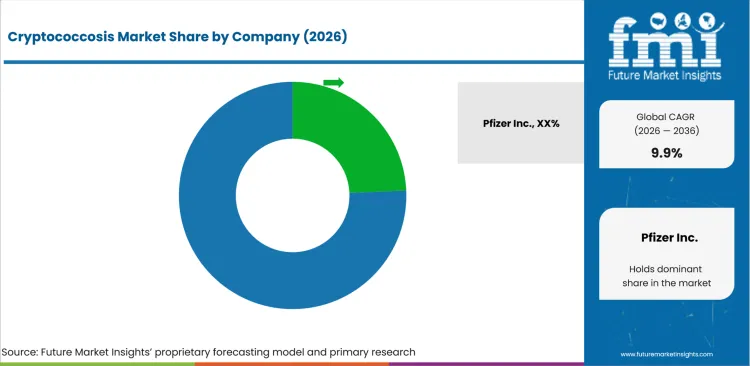
Established antifungal molecules support most current cryptococcosis treatment, leaving a moderately concentrated field with few developers pursuing exact-market alternatives. New entrants need disease-specific evidence and dependable hospital supply to persuade specialist teams to change established regimens.
- Pfizer Inc. and Gilead Sciences, Inc. maintain established exact-market positions through oral fluconazole and liposomal amphotericin B therapies.
- Lupin Pharmaceuticals, Inc., Emcure Pharmaceuticals Limited, Macleods Pharmaceuticals Ltd and Solara Active Pharma Sciences Limited support induction supply through finished medicines or qualified ingredients.
- Mycovia Pharmaceuticals, Inc. and Basilea Pharmaceutica Ltd add exact-market clinical programs focused on alternative oral and intravenous treatment routes.
Competitive Benchmarking: Cryptococcosis Market
| Company | Exact-Market Position | Induction-Regimen Role | Oral Continuation Role | Geographic Reach |
|---|---|---|---|---|
| Pfizer Inc. | High | Medium | High | Global |
| Gilead Sciences, Inc. | High | High | Low | Global |
| Lupin Pharmaceuticals, Inc. | High | High | Low | United States |
| Emcure Pharmaceuticals Limited | High | High | Low | India manufacturing with United States supply |
| Macleods Pharmaceuticals Ltd | High | High | Low | WHO-prequalified global supply |
| Mycovia Pharmaceuticals, Inc. | Medium | Medium | Medium | United States and Uganda study network |
| Basilea Pharmaceutica Ltd | High | Medium | High | United States and Africa clinical development |
| Solara Active Pharma Sciences Limited | Low | Medium | Low | WHO-prequalified global API supply |
Key Developments in the Cryptococcosis Market
- In July 2026, Basilea Pharmaceutica Ltd received USD 30 million in additional BARDA funding under its existing agreement to advance phase 3 development of fosmanogepix, its broad-spectrum antifungal candidate with EU orphan designation covering cryptococcosis.
- In June 2025, Mycovia Pharmaceuticals, Inc. announced enrollment of the first participant in the phase 2 PLATFORM-CM study evaluating oteseconazole for cryptococcal meningitis.
- In May 2025, Solara Active Pharma Sciences Limited received an updated WHO confirmation document for its prequalified flucytosine active pharmaceutical ingredient used in antifungal manufacturing.
Key Players in the Cryptococcosis Market
Established Antifungal Therapy Suppliers
- Pfizer Inc.
- Gilead Sciences, Inc.
- Lupin Pharmaceuticals, Inc.
- Emcure Pharmaceuticals Limited
- Macleods Pharmaceuticals Ltd
Exact-Market Antifungal Developers
- Mycovia Pharmaceuticals, Inc.
- Basilea Pharmaceutica Ltd
Qualified Ingredient Platforms
- Solara Active Pharma Sciences Limited
Cryptococcosis Market - Report Scope
| Coverage field | Report scope |
|---|---|
| Market breakdown | By treatment type, application, end user, distribution channel, drug class and region. |
| Quantitative Units | USD billion. |
| Market Definition | Therapeutic products and treatment pathways used to diagnose or manage pulmonary, meningeal and disseminated cryptococcosis within regulated healthcare systems. |
| Regions Covered | North America, Latin America, Europe, East Asia, South Asia and Pacific, and Middle East and Africa. |
| Countries Covered | United States, Japan, Germany, United Kingdom, Canada, and 20+ countries included in the full report. |
| Key Companies Profiled | Pfizer Inc., Gilead Sciences, Inc., Lupin Pharmaceuticals, Inc., Emcure Pharmaceuticals Limited, Macleods Pharmaceuticals Ltd, Mycovia Pharmaceuticals, Inc., Basilea Pharmaceutica Ltd and Solara Active Pharma Sciences Limited. |
| Forecast Period | 2026 to 2036. |
| Approach | Primary and secondary research with market triangulation. |
Cryptococcosis Market - Research Methodology
| Method | Approach |
|---|---|
| Primary Research | FMI analysts gathered input from manufacturers, service providers, technology developers, distributors, end users, procurement teams, and subject-matter experts. Interviews examined purchasing decisions, product or service evaluation, adoption barriers, approval requirements, pricing considerations, and expectations for technical or commercial support. Respondents were also asked what evidence is required before a trial, pilot, or initial order develops into regular purchasing. |
| Desk Research | Desk research covered government statistics, regulatory publications, trade data, industry associations, technical literature, standards, company filings, product information, and official corporate announcements. Sources were reviewed for relevance, publication date, geographic coverage, and consistency with the defined market scope. Claims relating to performance, applications, approvals, capacity, investment, and commercial activity were retained only when supported by credible public evidence. |
| Market Sizing and Forecasting | The market model combined the baseline value with historical performance, segment structure, pricing and volume indicators, adoption levels, company participation, and country-level demand conditions. Forecast assumptions considered economic activity, investment trends, regulatory developments, technology adoption, purchasing cycles, supply availability, and barriers to wider market use. Segment and regional estimates were reconciled before the final market total was calculated. |
| Data Validation | Estimates were checked against multiple independent indicators, including public data, company activity, trade patterns, industry developments, and findings from primary interviews. Validation also tested whether products, services, applications, and company revenues fell within the defined market boundaries. Adjacent categories, unsupported claims, overlapping revenues, and activities without direct market relevance were excluded to reduce double counting and maintain consistency across segments and countries. |
Cryptococcosis Market by Segments
Cryptococcosis Market segmented by Treatment Type:
- Antifungal Drugs
- Amphotericin B
- Flucytosine
- Azole Therapy
- Fluconazole
- Itraconazole
- Combination Therapy
- Amphotericin B - Flucytosine
- Azole-Based Combination Therapy
- Supportive Care
- Intracranial Pressure Management
- Intensive Care Support
Cryptococcosis Market segmented by Application:
- Cryptococcal Meningitis
- HIV-Associated Meningitis
- Non-HIV Meningitis
- Pulmonary Cryptococcosis
- Localized Pulmonary Infection
- Disseminated Pulmonary Disease
- Disseminated Cryptococcosis
- Multiorgan Infection
- Bloodstream Infection
- Prophylactic Treatment
- High-Risk Immunocompromised Patients
- Post-Transplant Patients
Cryptococcosis Market segmented by End User:
- Hospitals
- Tertiary Care Hospitals
- Infectious Disease Hospitals
- Specialty Clinics
- Infectious Disease Clinics
- Pulmonology Clinics
- Academic & Research Institutes
- University Hospitals
- Medical Research Institutes
- Diagnostic Laboratories
- Clinical Laboratories
- Reference Laboratories
Cryptococcosis Market segmented by Distribution Channel:
- Hospital Pharmacies
- Inpatient Pharmacies
- Outpatient Hospital Pharmacies
- Retail Pharmacies
- Chain Pharmacies
- Independent Pharmacies
- Specialty Pharmacies
- Infectious Disease Pharmacies
- High-Cost Drug Pharmacies
- Online Pharmacies
- E-Pharmacy Platforms
- Home Delivery Services
Cryptococcosis Market segmented by Drug Class:
- Polyenes
- Amphotericin B Deoxycholate
- Liposomal Amphotericin B
- Azoles
- Fluconazole
- Voriconazole
- Antimetabolites
- Flucytosine
- Combination Antimetabolite Therapy
- Echinocandins
- Caspofungin
- Micafungin
Cryptococcosis Market by Region:
- North America
- United States
- Canada
- Mexico
- Latin America
- Brazil
- Chile
- Rest of Latin America
- Western Europe
- Germany
- United Kingdom
- Italy
- Spain
- France
- Nordics
- Benelux
- Rest of Western Europe
- Eastern Europe
- Russia
- Poland
- Hungary
- Balkan and Baltic States
- Rest of Eastern Europe
- East Asia
- China
- Japan
- South Korea
- South Asia and Pacific
- India
- ASEAN
- Australia and New Zealand
- Rest of South Asia and Pacific
- Middle East and Africa
- Kingdom of Saudi Arabia
- Other GCC Countries
- Türkiye
- South Africa
- Other African Union Countries
- Rest of Middle East and Africa
Research Sources and Bibliography
- Centers for Disease Control and Prevention. (2025, May 29). Fungal Disease Burden by the Numbers.
- Centers for Disease Control and Prevention. (2025, January 31). Treatment of Cryptococcosis.
- National Institutes of Health. (2024, October 29). Cryptococcosis: Adult and Adolescent OIs.
- Astellas Pharma US, Inc. (2025, June 11). AMBISOME- amphotericin b injection, powder, lyophilized, for solution.
- World Health Organization. (2025, February 4). WHO launches new WHO Academy course on management of cryptococcal disease.
- Benedict, K., Jordan, A., Gold, J. A. W., Smith, D. J., Chiller, T., Hennessee, I., Polgreen, P. M., & Beekmann, S. E. (2025, May 29). Emerging Infections Network Survey of Screening for Cryptococcal Antigenemia, United States, 2024. Emerging Infectious Diseases, 31(7), 1493-1495.
- Japan Institute for Health Security. (2026, March 2).
- Kessel, J., Rossaert, A.-C., Lingscheid, T., Grothe, J., Harrer, T., Wyen, C., Tominski, D., Bollinger, T., Kehr, A. K., Kalbitz, S., Hoffmann, C., Cornely, O., Koppe, U., Stephan, C., & Rickerts, V. (2024, February 16). Survival after cryptococcosis in Germany: A retrospective multicenter cohort study of patients diagnosed between 2004 and 2021.
- Schelenz, S., Abdolrasouli, A., Armstrong-James, D., Ashbee, H. R., Barton, R., Bicanic, T., Borman, A., Brown, L., Eades, C., Ferreras-Antolin, L., Gorton, R., McMullan, R., Page, I., Perera, N., Rautemaa-Richardson, R., Wagener, J., White, P. L., & Denning, D. W. (2026, June). British Society for Medical Mycology best practice recommendations for the diagnosis of serious fungal diseases: 2025 update. The Lancet Infectious Diseases, 26(6), e217-e231.
- Health Canada. (2024, December 20). Product information.
- Roerig. (2026, April 2). DIFLUCAN- fluconazole tablet; DIFLUCAN- fluconazole powder, for suspension.
- Gilead Sciences, Inc. (2026, February 24). Form 10-K.
- Lupin Pharmaceuticals, Inc. (2025, August 26). FLUCYTOSINE capsule.
- Heritage Pharmaceuticals Inc. d/b/a Avet Pharmaceuticals Inc. (2025, June 3). AMPHOTERICIN B injectable, liposomal.
- World Health Organization. (2024, April 25). HA769.
- Mycovia Pharmaceuticals, Inc. (2025, June 4). Mycovia Pharmaceuticals, Inc. Announces First Participant Enrolled in an Investigator-Initiated Phase 2 Study for Cryptococcal Meningitis.
- ClinicalTrials.gov. (2023, March 31). Encochleated Oral Amphotericin for Cryptococcal Meningitis Trial (EnACT) (NCT04031833).
- Basilea Pharmaceutica Ltd. (2026, July 29). Basilea receives USD 30 million funding under existing BARDA agreement for advancing phase 3 development of novel antifungal fosmanogepix.
- Basilea Pharmaceutica Ltd. (2026, August 18). Basilea reports strong 2026 half-year results and raises full-year guidance; fosmanogepix phase 3 program on track.
- World Health Organization. (2025, May 8). WHOAPI-406: Flucytosine.
- Laurus Labs Limited. (2025, July 28). FLUCYTOSINE capsule.
This bibliography is provided for reader reference and is not exhaustive. The full report contains the complete reference list and detailed citations
This Report Answers
- How large is the cryptococcosis market in 2026 and 2036?
- Which clinical conditions support recurring demand for cryptococcosis diagnosis and treatment?
- Which treatment type accounts for the substantial approved 2026 share?
- How does cryptococcal meningitis shape treatment intensity and monitoring requirements?
- Why do hospitals and hospital pharmacies hold substantial current shares?
- How do country CAGRs differ across the five profiled healthcare systems?
- Which companies supply established therapies or develop exact-market antifungal candidates?
- Which toxicity and medicine-access conditions restrict completion of guideline-based treatment?
Frequently Asked Questions
How big is the Cryptococcosis Market in 2026?
In 2026, the cryptococcosis market is valued at USD 1.8 billion across antifungal medicines and specialized treatment pathways. Hospital induction and prolonged oral therapy support recurring use as clinical teams coordinate diagnosis with toxicity monitoring and structured follow-up across each treatment phase.
What is the CAGR of the Cryptococcosis Market from 2026 to 2036?
The cryptococcosis market is projected to expand at 9.9% CAGR from 2026 to 2036 and reach USD 4.6 billion. Forecast demand depends on earlier diagnosis plus reliable access to induction medicines and extended consolidation or maintenance therapy across specialist care networks.
Which treatment type is projected to account for 46.0% of the Cryptococcosis Market?
Antifungal drugs are projected to account for 46.0% of the cryptococcosis market by treatment type in 2026. Their position reflects direct use against severe pulmonary or central nervous system infection during initial control followed by longer oral consolidation and maintenance across specialist care.
Which application is projected to account for 49.0% of the Cryptococcosis Market?
Cryptococcal meningitis is projected to account for 49.0% of the cryptococcosis market by application in 2026. Its position reflects cerebrospinal fluid assessment plus intensive induction and management of raised intracranial pressure through coordinated specialist hospital teams during severe neurologic disease.
Which end user is projected to account for 44.0% of the Cryptococcosis Market?
Hospitals are projected to account for 44.0% of the cryptococcosis market by end user in 2026. Their position reflects integrated lumbar puncture plus intravenous medicine administration and laboratory monitoring for toxicity across severe inpatient cases requiring coordinated specialist clinical oversight.
Which distribution channel is projected to account for 47.0% of the Cryptococcosis Market?
Hospital pharmacies are projected to account for 47.0% of the cryptococcosis market by distribution channel in 2026. Their position reflects immediate access to induction medicines plus institutional controls that support urgent regimen adjustments during complex hospital care and monitored discharge planning.
Which companies are active in the Cryptococcosis Market?
Pfizer Inc., Gilead Sciences, Inc., Lupin Pharmaceuticals, Inc. and Emcure Pharmaceuticals Limited supply established therapies within the cryptococcosis market. Macleods Pharmaceuticals Ltd, Mycovia Pharmaceuticals, Inc., Matinas BioPharma Holdings, Inc. and Solara Active Pharma Sciences Limited extend the group through qualified medicine supply or exact-market development.
What is a major restraint in the Cryptococcosis Market?
Renal toxicity and hematologic monitoring remain material restraints within the cryptococcosis market during induction and prolonged treatment. Uneven access to flucytosine or liposomal amphotericin B can interrupt complete care across hospitals lacking dependable laboratory or pharmacy capacity for dose adjustment.
Preview the report firsthand - request a free sample
Get SampleGet the brochure for pricing and purchase details.
Get PDFTable of Content
- Key Takeaways
- Market Size and CAGR
- Top Growth Driver
- Fastest Growing Segment
- Leading Region
- Key Companies
- Emerging Opportunities
- Executive Summary
- Global Market Outlook
- Demand-side Trends
- Supply-side Trends
- Technology Roadmap Analysis
- Analysis and Recommendations
- Analyst Perspective (What is happening? Why now? What should investors know?)
- Key Questions Answered
- How large is the market?
- What is the CAGR?
- What are key trends?
- Which region dominates?
- Who are the leaders?
- Market Overview
- Market Coverage / Taxonomy
- Market Definition / Scope / Limitations
- Research Methodology
- Chapter Orientation
- Analytical Lens and Working Hypotheses
- Market Structure, Signals, and Trend Drivers
- Benchmarking and Cross-market Comparability
- Market Sizing, Forecasting, and Opportunity Mapping
- Research Design and Evidence Framework
- Desk Research Programme (Secondary Evidence)
- Expert Input and Fieldwork (Primary Evidence)
- Tooling, Models, and Reference Databases
- Data Engineering and Model Build
- Quality Assurance and Audit Trail
- Market Background
- Market Dynamics (Drivers, Restraints, Opportunity, Trends)
- Scenario Forecast (Optimistic, Likely, Conservative)
- Impact Analysis
- AI Impact
- Sustainability Impact
- Regulatory Impact
- Technology Impact
- Consumer / Buyer Analysis
- Purchase Drivers
- Adoption Barriers
- Buyer Journey
- Opportunity Map Analysis
- Product Life Cycle Analysis
- Supply Chain Analysis
- Investment Feasibility Matrix
- Value Chain Analysis
- PESTLE and Porter's Analysis
- Regulatory Landscape
- Regional Parent Market Outlook
- Production and Consumption Statistics
- Import and Export Statistics
- Global Market Analysis and Forecast, 2021 to 2036
- Historical Market Size Value (USD Billion) Analysis, 2021 to 2025
- Current and Future Market Size Value (USD Billion) Projections, 2026 to 2036
- Y-o-Y Growth Trend Analysis
- Absolute $ Opportunity Analysis
- Global Market Pricing Analysis, 2021 to 2036
- Global Market Analysis and Forecast, By Treatment Type, 2021 to 2036
- Introduction / Key Findings
- Historical Market Size Value (USD Billion) Analysis By Treatment Type, 2021 to 2025
- Current and Future Market Size Value (USD Billion) Analysis and Forecast By Treatment Type, 2026 to 2036
- Antifungal Drugs
- Amphotericin B
- Flucytosine
- Azole Therapy
- Fluconazole
- Itraconazole
- Combination Therapy
- Amphotericin B - Flucytosine
- Azole-Based Combination Therapy
- Supportive Care
- Intracranial Pressure Management
- Intensive Care Support
- Antifungal Drugs
- Y-o-Y Growth Trend Analysis By Treatment Type, 2021 to 2025
- Absolute $ Opportunity Analysis By Treatment Type, 2026 to 2036
- Global Market Analysis and Forecast, By Application, 2021 to 2036
- Introduction / Key Findings
- Historical Market Size Value (USD Billion) Analysis By Application, 2021 to 2025
- Current and Future Market Size Value (USD Billion) Analysis and Forecast By Application, 2026 to 2036
- Cryptococcal Meningitis
- HIV-Associated Meningitis
- Non-HIV Meningitis
- Pulmonary Cryptococcosis
- Localized Pulmonary Infection
- Disseminated Pulmonary Disease
- Disseminated Cryptococcosis
- Multiorgan Infection
- Bloodstream Infection
- Prophylactic Treatment
- High-Risk Immunocompromised Patients
- Post-Transplant Patients
- Cryptococcal Meningitis
- Y-o-Y Growth Trend Analysis By Application, 2021 to 2025
- Absolute $ Opportunity Analysis By Application, 2026 to 2036
- Global Market Analysis and Forecast, By End User, 2021 to 2036
- Introduction / Key Findings
- Historical Market Size Value (USD Billion) Analysis By End User, 2021 to 2025
- Current and Future Market Size Value (USD Billion) Analysis and Forecast By End User, 2026 to 2036
- Hospitals
- Tertiary Care Hospitals
- Infectious Disease Hospitals
- Specialty Clinics
- Infectious Disease Clinics
- Pulmonology Clinics
- Academic & Research Institutes
- University Hospitals
- Medical Research Institutes
- Diagnostic Laboratories
- Clinical Laboratories
- Reference Laboratories
- Hospitals
- Y-o-Y Growth Trend Analysis By End User, 2021 to 2025
- Absolute $ Opportunity Analysis By End User, 2026 to 2036
- Global Market Analysis and Forecast, By Distribution Channel, 2021 to 2036
- Introduction / Key Findings
- Historical Market Size Value (USD Billion) Analysis By Distribution Channel, 2021 to 2025
- Current and Future Market Size Value (USD Billion) Analysis and Forecast By Distribution Channel, 2026 to 2036
- Hospital Pharmacies
- Inpatient Pharmacies
- Outpatient Hospital Pharmacies
- Retail Pharmacies
- Chain Pharmacies
- Independent Pharmacies
- Specialty Pharmacies
- Infectious Disease Pharmacies
- High-Cost Drug Pharmacies
- Online Pharmacies
- E-Pharmacy Platforms
- Home Delivery Services
- Hospital Pharmacies
- Y-o-Y Growth Trend Analysis By Distribution Channel, 2021 to 2025
- Absolute $ Opportunity Analysis By Distribution Channel, 2026 to 2036
- Global Market Analysis and Forecast, By Drug Class, 2021 to 2036
- Introduction / Key Findings
- Historical Market Size Value (USD Billion) Analysis By Drug Class, 2021 to 2025
- Current and Future Market Size Value (USD Billion) Analysis and Forecast By Drug Class, 2026 to 2036
- Polyenes
- Amphotericin B Deoxycholate
- Liposomal Amphotericin B
- Azoles
- Fluconazole
- Voriconazole
- Antimetabolites
- Flucytosine
- Combination Antimetabolite Therapy
- Echinocandins
- Caspofungin
- Micafungin
- Polyenes
- Y-o-Y Growth Trend Analysis By Drug Class, 2021 to 2025
- Absolute $ Opportunity Analysis By Drug Class, 2026 to 2036
- Global Market Analysis and Forecast, By Region, 2021 to 2036
- Introduction
- Historical Market Size Value (USD Billion) Analysis By Region, 2021 to 2025
- Current Market Size Value (USD Billion) Analysis and Forecast By Region, 2026 to 2036
- North America
- Latin America
- Western Europe
- Eastern Europe
- East Asia
- South Asia and Pacific
- Middle East & Africa
- Market Attractiveness Analysis By Region
- North America Market Analysis and Forecast, By Country, 2021 to 2036
- Historical Market Size Value (USD Billion) Trend Analysis By Market Taxonomy, 2021 to 2025
- Market Size Value (USD Billion) Forecast By Market Taxonomy, 2026 to 2036
- By Country
- USA
- Canada
- By Treatment Type
- By Application
- By End User
- By Distribution Channel
- By Drug Class
- By Country
- Market Attractiveness Analysis
- By Country
- By Treatment Type
- By Application
- By End User
- By Distribution Channel
- By Drug Class
- Key Takeaways
- Latin America Market Analysis and Forecast, By Country
- Historical Market Size Value (USD Billion) Trend Analysis By Market Taxonomy, 2021 to 2025
- Market Size Value (USD Billion) Forecast By Market Taxonomy, 2026 to 2036
- By Country
- Brazil
- Mexico
- Chile
- Rest of Latin America
- By Treatment Type
- By Application
- By End User
- By Distribution Channel
- By Drug Class
- By Country
- Market Attractiveness Analysis
- By Country
- By Treatment Type
- By Application
- By End User
- By Distribution Channel
- By Drug Class
- Key Takeaways
- Western Europe Market Analysis and Forecast, By Country
- Historical Market Size Value (USD Billion) Trend Analysis By Market Taxonomy, 2021 to 2025
- Market Size Value (USD Billion) Forecast By Market Taxonomy, 2026 to 2036
- By Country
- Germany
- UK
- Italy
- Spain
- France
- Nordic
- BENELUX
- Rest of Western Europe
- By Treatment Type
- By Application
- By End User
- By Distribution Channel
- By Drug Class
- By Country
- Market Attractiveness Analysis
- By Country
- By Treatment Type
- By Application
- By End User
- By Distribution Channel
- By Drug Class
- Key Takeaways
- Eastern Europe Market Analysis and Forecast, By Country
- Historical Market Size Value (USD Billion) Trend Analysis By Market Taxonomy, 2021 to 2025
- Market Size Value (USD Billion) Forecast By Market Taxonomy, 2026 to 2036
- By Country
- Russia
- Poland
- Hungary
- Balkan & Baltic
- Rest of Eastern Europe
- By Treatment Type
- By Application
- By End User
- By Distribution Channel
- By Drug Class
- By Country
- Market Attractiveness Analysis
- By Country
- By Treatment Type
- By Application
- By End User
- By Distribution Channel
- By Drug Class
- Key Takeaways
- East Asia Market Analysis and Forecast, By Country
- Historical Market Size Value (USD Billion) Trend Analysis By Market Taxonomy, 2021 to 2025
- Market Size Value (USD Billion) Forecast By Market Taxonomy, 2026 to 2036
- By Country
- China
- Japan
- South Korea
- By Treatment Type
- By Application
- By End User
- By Distribution Channel
- By Drug Class
- By Country
- Market Attractiveness Analysis
- By Country
- By Treatment Type
- By Application
- By End User
- By Distribution Channel
- By Drug Class
- Key Takeaways
- South Asia and Pacific Market Analysis and Forecast, By Country
- Historical Market Size Value (USD Billion) Trend Analysis By Market Taxonomy, 2021 to 2025
- Market Size Value (USD Billion) Forecast By Market Taxonomy, 2026 to 2036
- By Country
- India
- ASEAN
- Australia & New Zealand
- Rest of South Asia and Pacific
- By Treatment Type
- By Application
- By End User
- By Distribution Channel
- By Drug Class
- By Country
- Market Attractiveness Analysis
- By Country
- By Treatment Type
- By Application
- By End User
- By Distribution Channel
- By Drug Class
- Key Takeaways
- Middle East & Africa Market Analysis and Forecast, By Country
- Historical Market Size Value (USD Billion) Trend Analysis By Market Taxonomy, 2021 to 2025
- Market Size Value (USD Billion) Forecast By Market Taxonomy, 2026 to 2036
- By Country
- Kingdom of Saudi Arabia
- Other GCC Countries
- Türkiye
- South Africa
- Other African Union
- Rest of Middle East & Africa
- By Treatment Type
- By Application
- By End User
- By Distribution Channel
- By Drug Class
- By Country
- Market Attractiveness Analysis
- By Country
- By Treatment Type
- By Application
- By End User
- By Distribution Channel
- By Drug Class
- Key Takeaways
- Key Countries Market Analysis
- USA
- Pricing Analysis
- Market Share Analysis, 2025
- By Treatment Type
- By Application
- By End User
- By Distribution Channel
- By Drug Class
- Canada
- Pricing Analysis
- Market Share Analysis, 2025
- By Treatment Type
- By Application
- By End User
- By Distribution Channel
- By Drug Class
- Mexico
- Pricing Analysis
- Market Share Analysis, 2025
- By Treatment Type
- By Application
- By End User
- By Distribution Channel
- By Drug Class
- Brazil
- Pricing Analysis
- Market Share Analysis, 2025
- By Treatment Type
- By Application
- By End User
- By Distribution Channel
- By Drug Class
- Chile
- Pricing Analysis
- Market Share Analysis, 2025
- By Treatment Type
- By Application
- By End User
- By Distribution Channel
- By Drug Class
- Germany
- Pricing Analysis
- Market Share Analysis, 2025
- By Treatment Type
- By Application
- By End User
- By Distribution Channel
- By Drug Class
- UK
- Pricing Analysis
- Market Share Analysis, 2025
- By Treatment Type
- By Application
- By End User
- By Distribution Channel
- By Drug Class
- Italy
- Pricing Analysis
- Market Share Analysis, 2025
- By Treatment Type
- By Application
- By End User
- By Distribution Channel
- By Drug Class
- Spain
- Pricing Analysis
- Market Share Analysis, 2025
- By Treatment Type
- By Application
- By End User
- By Distribution Channel
- By Drug Class
- France
- Pricing Analysis
- Market Share Analysis, 2025
- By Treatment Type
- By Application
- By End User
- By Distribution Channel
- By Drug Class
- India
- Pricing Analysis
- Market Share Analysis, 2025
- By Treatment Type
- By Application
- By End User
- By Distribution Channel
- By Drug Class
- ASEAN
- Pricing Analysis
- Market Share Analysis, 2025
- By Treatment Type
- By Application
- By End User
- By Distribution Channel
- By Drug Class
- Australia & New Zealand
- Pricing Analysis
- Market Share Analysis, 2025
- By Treatment Type
- By Application
- By End User
- By Distribution Channel
- By Drug Class
- China
- Pricing Analysis
- Market Share Analysis, 2025
- By Treatment Type
- By Application
- By End User
- By Distribution Channel
- By Drug Class
- Japan
- Pricing Analysis
- Market Share Analysis, 2025
- By Treatment Type
- By Application
- By End User
- By Distribution Channel
- By Drug Class
- South Korea
- Pricing Analysis
- Market Share Analysis, 2025
- By Treatment Type
- By Application
- By End User
- By Distribution Channel
- By Drug Class
- Russia
- Pricing Analysis
- Market Share Analysis, 2025
- By Treatment Type
- By Application
- By End User
- By Distribution Channel
- By Drug Class
- Poland
- Pricing Analysis
- Market Share Analysis, 2025
- By Treatment Type
- By Application
- By End User
- By Distribution Channel
- By Drug Class
- Hungary
- Pricing Analysis
- Market Share Analysis, 2025
- By Treatment Type
- By Application
- By End User
- By Distribution Channel
- By Drug Class
- Kingdom of Saudi Arabia
- Pricing Analysis
- Market Share Analysis, 2025
- By Treatment Type
- By Application
- By End User
- By Distribution Channel
- By Drug Class
- Türkiye
- Pricing Analysis
- Market Share Analysis, 2025
- By Treatment Type
- By Application
- By End User
- By Distribution Channel
- By Drug Class
- South Africa
- Pricing Analysis
- Market Share Analysis, 2025
- By Treatment Type
- By Application
- By End User
- By Distribution Channel
- By Drug Class
- USA
- Market Structure Analysis
- Competition Dashboard
- Competition Benchmarking
- Market Share Analysis of Top Players
- By Regional
- By Treatment Type
- By Application
- By End User
- By Distribution Channel
- By Drug Class
- Emerging Startups
- Innovation Benchmarking
- Competition Analysis
- Competition Deep Dive
- Pfizer Inc.
- Overview
- Product Portfolio
- Profitability by Market Segments
- Sales Footprint
- Strategy Overview
- Marketing Strategy
- Product Strategy
- Channel Strategy
- Gilead Sciences, Inc.
- Bristol Myers Squibb
- Astellas Pharma Inc.
- Merck & Co., Inc.
- F. Hoffmann-La Roche Ltd.
- Scynexis, Inc.
- Amplyx Pharmaceuticals, Inc.
- Basilea Pharmaceutica Ltd
- Cidara Therapeutics, Inc.
- Pfizer Inc.
- Case Studies
- Success Stories
- Recent Developments
- Competition Deep Dive
- Assumptions & Acronyms Used


