

- Market Size (2026)
- USD 385.5 Mn
- Forecast (2036)
- USD 5607.6 Mn
- CAGR (2026 to 2036)
- 30.7%
How big is Cultivated Meat Bioprocess & Scale-Up Technology Market in 2026?
USD 385.5 million in 2026 and USD 5,607.6 million by 2036 at a 30.7% CAGR.
Sales of cultivated meat bioprocess and scale-up technologies are projected to expand at 30.7% CAGR through 2036. The industry valuation is forecast to rise from USD 385.5 million in 2026 to USD 5,607.6 million by 2036. FDA's 2025 consultations covered Mission Barns' cultured pork fat, cleared in March 2025, and Believer Meats' cultured chicken cell material, cleared in July 2025. The update shows that regulatory evidence is moving from early chicken cases toward broader cell materials. Technology providers gain commercial approval when bioreactors, growth media and cell lines hold performance at larger batch sizes and documented operating limits.
Country strategy depends on whether local rules accept the production dossier before a product reaches retail or foodservice customers. In the United States, FDA handles preharvest cell collection and growth while FSIS takes oversight at harvest and post-harvest for covered meat and poultry. In the European Union, cell-cultured meat remains a Novel Food route that requires authorization before sale. Singapore formalized pre-market approval for novel foods in 2025, and the UK is running a cell-cultivated products sandbox from March 2025 to February 2027. These differences make technical validation and regulatory planning inseparable in provider selection.
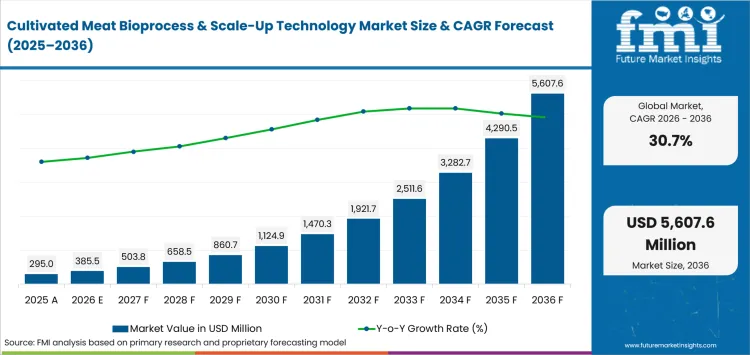
Key Takeaways of Cultivated Meat Bioprocess & Scale-Up Technology Market
- Demand for cultivated meat bioprocess and scale-up technology is shaped by the need to improve reproducibility between pilot and food-grade production, reduce animal-derived material exposure, and meet regulatory documentation requirements across local approval routes.
- By solution, Bioreactors hold 43.2% share in 2026, while Continuous process accounts for 63.4% share in 2026, reflecting controlled cell expansion at the first production bottleneck and steadier feeding and harvest routines during scale-up.
- Israel leads country growth at 29.6% CAGR through 2036, followed by Singapore at 28.7% and the Netherlands at 27.6%, shaped by regulatory clarity, novel-food approval routes, and active alternative-protein programs.
- Competition centers on Believer Meats, UPSIDE Foods, Mosa Meat, Aleph Farms, Meatable, Multus, and Ever After Foods, spanning cell production, media, bioreactor platforms, and authorization route development.
- Cell-line ownership, media specifications, contamination control, batch-to-batch comparability, and regulatory-document responsibility remain key considerations for wider commercial adoption.
- Commercial expansion is expected to follow bioreactor performance data from the intended operating range, with contracts defining process and regulatory responsibilities before larger supply commitments begin.
Analyst Perspective
"The cultivated meat bioprocess & scale-up technology market is increasingly shaped by process consistency beyond laboratory conditions. Developers are evaluating cell growth, bioreactor performance, media efficiency, and process control across intended production ranges. Suppliers that demonstrate reproducible scale-up, clear cell-line and media specifications, and strong regulatory support will be better positioned to advance commercial adoption."
— Nandini Roy Choudhury, Principal Analyst at Future Market Insights
Source: FMI's proprietary forecasting model and primary research
How is the Cultivated Meat Bioprocess & Scale-Up Technology Market segmented?
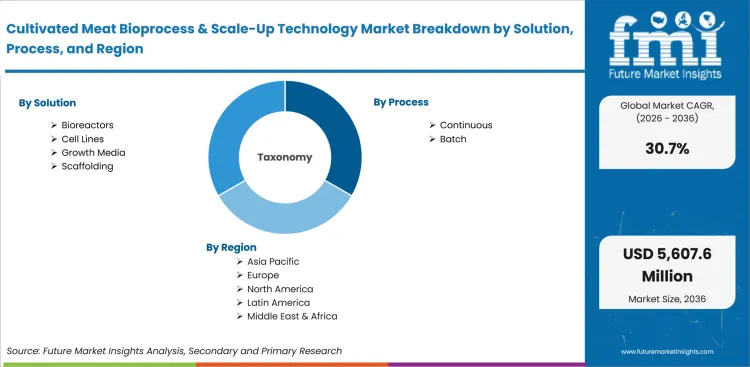
The market is analyzed by Solution, Process, End User, and Region.
The segmentation framework separates the technology used in production from the process model and the customer group that approves purchases. Solution analysis covers Bioreactors, Cell Lines, Growth Media and Scaffolding, with automated cell culture systems shaping comparable validation expectations. Process analysis compares Continuous and Batch production because feed strategy and harvest timing shape scale-up economics. End User analysis covers Food Manufacturers, Foodservice Operators, Retailers and Household users so production systems remain linked to the final route to market.
Why are bioreactors central to the solution category?
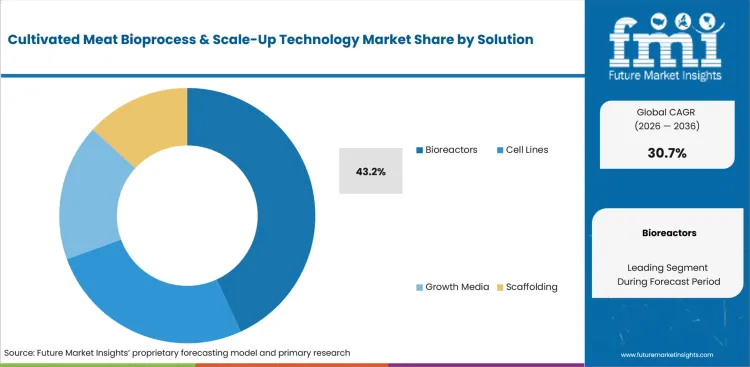
Bioreactors hold the central position since cultivated meat scale-up depends on controlled cell expansion before texture, yield or cost can be improved. Single-use bioreactors and closed system bioprocessing references are important for companies that want lower contamination risk and faster changeover during process development. For cultivated meat equipment still has to prove mixing, oxygen transfers and harvest consistency at food-grade volumes.
- Bioreactors are projected to hold 43.2% share in 2026, attributable to their role in controlling the first production bottleneck.
- Approval of a bioreactor system needs evidence on cell density, contamination control and repeatability at the intended scale.
What supports demand for continuous within the process category?
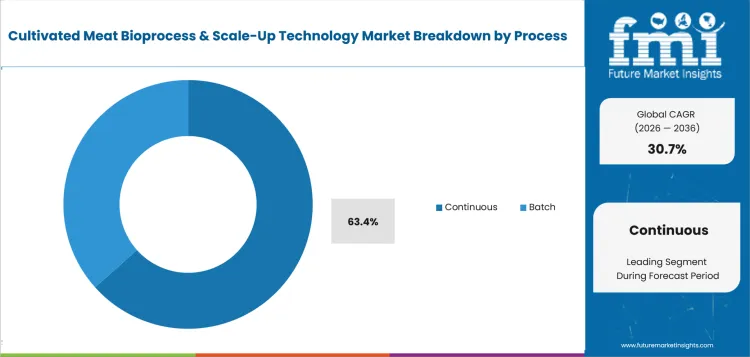
Continuous processing is favored where steady feeding and harvest routines reduce stoppages between cell-growth stages. Continuous flow bioreactors offer a useful comparison for process-control expectations because operators need evidence across long runs instead of short trial batches. The segment remains difficult to approve when media cost, shear stress or contamination controls change after scale-up.
- Continuous is projected to hold 63.4% share in 2026 because it supports steadier cell-growth management during scale-up.
- Continuous-system providers need data covering feed rates, harvest intervals and batch-to-batch comparability under the intended operating conditions.
Why are food manufacturers central to the end user category?
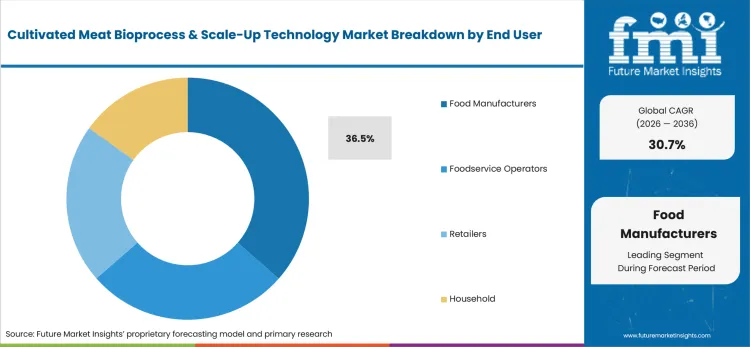
Food Manufacturers lead end-user demand because they have to translate cell-culture output into repeatable food products, not just successful laboratory samples. The segment connects cultivated meat with meat alternatives through hybrid formats, fat systems and ingredient blending. Adoption is expected to remain selective until cost, sensory performance and food-safety documentation are ready for routine purchasing.
- Food Manufacturers are projected to hold 36.5% share in 2026, supported by their role in final product validation and launch planning.
- Qualification for Food Manufacturers needs to reproduce the intended process conditions and confirm the final performance threshold.
What are the drivers, restraints, and opportunities in the Cultivated Meat Bioprocess & Scale-Up Technology Market?
Demand is tied to reproducible scale-up, regulatory evidence and lower reliance on animal-derived inputs.
- Driver: Food-grade scale-up is expected to raise demand for bioreactors, cell lines and media that keep output consistent beyond pilot batches.
- Restraint: Regulatory review remains product-specific, so each market entry requires safety evidence tied to the cell source and process.
- Opportunity: Precision fermentation ingredients are expected to reduce reliance on fetal bovine serum and improve media cost control.
Demand is supported by the shift from proof-of-concept work to repeatable production trials. FDA's 2025 consultation inventory for cultured animal cells shows that companies are now preparing dossiers for more cell materials, including cell-based chicken fat and cultured pork fat. That evidence gives equipment and media providers clearer targets for validation, especially where food manufacturers require documented inputs before launch planning.
The main restraint is the cost of proving that performance remains acceptable under local rules and real operating conditions. FDA and FSIS oversight in the United States creates separate preharvest and harvest-stage expectations for covered meat and poultry. A technically viable system can still stall when the dossier, labeling position or contaminant controls remain incomplete.
The primary opportunity is concentrated in media and process inputs that lower the cost of scale-up without weakening product quality. Serum-free media and recombinant growth factors are expected to draw more company attention as the field reduces dependence on fetal bovine serum. The fermented protein and precision-fermented ingredient supply base gives developers more options for food-grade inputs and performance testing.
Which country CAGRs are profiled in the Cultivated Meat Bioprocess & Scale-Up Technology Market?
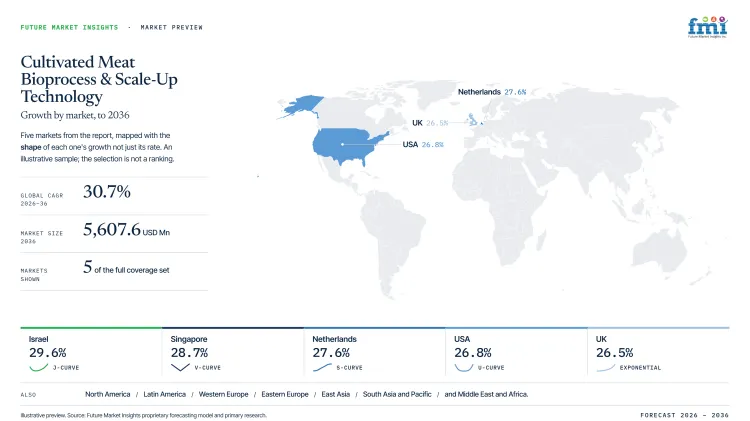
| Country | CAGR |
|---|---|
| USA | 26.8% |
| Israel | 29.6% |
| Netherlands | 27.6% |
| Singapore | 28.7% |
| UK | 26.5% |
How do country-level CAGRs compare in the Cultivated Meat Bioprocess & Scale-Up Technology Market?
The country comparison is defined less by the overall CAGR range and more by the spacing between the profiled markets. The total range from Israel to the UK is 3.1 percentage points. Israel and Singapore form a compact upper cluster with a gap of less than one point. The Netherlands occupies a middle position while the USA and the UK remain closely aligned near the other end of the comparison. This pattern reflects differences in regulatory pathways and scale-up infrastructure rather than current market size.
- Israel shows a notable position through bio-convergence programs and nearby cultivated-meat developers that support cell-line and bioprocess validation.
- Singapore remains close to Israel in CAGR terms but follows a different route through defined novel-food approval and compact modular production systems.
- The Netherlands holds a measured middle position as EU Novel Food requirements shape demand for dossier support and controlled production trials.
- The USA is separated moderately from the upper cluster despite its extensive biotechnology research base and visible FDA consultation route. Its commercial model also requires coordination between FDA and FSIS oversight.
- The UK remains closely aligned with the USA although its adoption route depends more on the regulatory sandbox and applicant support services. The programme may improve dossier readiness without replacing product-specific authorization.
Comparable CAGRs can therefore create different market entry conditions because equipment validation must match local approval procedures. Deployment timing will depend on regulatory evidence and food-grade scale-up readiness rather than the CAGR position alone.
The full report provides country-level CAGR analysis across North America, Latin America, Europe, East Asia, South Asia, Oceania and the Middle East and Africa.
Country-level analysis
- United States demand is expected to develop around companies that require clear records before harvest-stage oversight. The USA is projected to post 26.8% CAGR from 2026 to 2036, supported by a defined FDA and USDA-FSIS oversight route. FDA’s inventory updated in February 2026 listed Believer Meats cultured chicken cell material with an FDA response dated 24 July 2025. The record shows how USA commercialization remains tied to product-specific safety review. Technology providers gain a clearer sales route when bioreactors and media create records that fit consultation requirements. Technology proposals have to state how process data moves into the customer food-safety dossier.
- Israel combines alternative-protein research with a national bio-convergence program that includes cultivated meat work. Demand in Israel is forecast to rise at 29.6% CAGR through 2036, led by local companies that require scale-up tools for cell growth and media performance. The Israel Innovation Authority reported on 13 April 2026 that Israel had 186 active bio-convergence companies as of 2025. The agency identified cultivated meat technologies and cost-effective growth factors within the programme. This gives providers a local route for validation projects. Export planning still requires separate dossiers because Israeli approval does not replace other national review routes.
- The Netherlands is expected to benefit from EU filing work and controlled tasting rules. Adoption is anticipated to expand at 27.6% CAGR through 2036, shaped by food developers that require practical product feedback before authorization. Rijksoverheid published a Code of Practice on 24 November 2025 for safely conducting tastings of innovative fermentation-based food before EU approval. The document supports independent safety review for tasting activity. This matters for scale-up providers because tasting programs expose texture and batch-quality gaps before wider authorization. Equipment choices work best when repeatable batches serve both technical testing and dossier preparation.
- Singapore remains a focus country for compact production formats and clear pre-market review. Cultivated meat bioprocess demand in Singapore is forecast to advance at 28.7% CAGR through 2036, supported by early approval experience and updated novel-food rules. SFA states that novel food may include material from cell culture or tissue culture. From 28 November 2025, firms must have pre-market approval before lawful supply. Safety assessment therefore stays close to equipment purchasing decisions. Technology providers are expected to win support when their systems fit small facilities and create records suitable for SFA review.
- The UK is building a safety-evidence route through guidance and sandbox work for cell-cultivated products. UK demand is estimated to rise at 26.5% CAGR from 2026 to 2036, supported by product testing and clearer food-business requirements. GOV.UK published hygiene guidance for cell-cultivated products on 10 July 2026. The guidance says primary-production records support the application for authorization. This affects scale-up technology because providers have to help applicants explain hygiene controls and process evidence. Companies are expected to choose systems that make evidence collection steady during regulatory review.
Who are the notable companies in the Cultivated Meat Bioprocess & Scale-Up Technology Market?
Believer Meats, Mosa Meat, Meatable, UPSIDE Foods, Aleph Farms, Multus, and Ever After Foods are the notable companies profiled in this market.
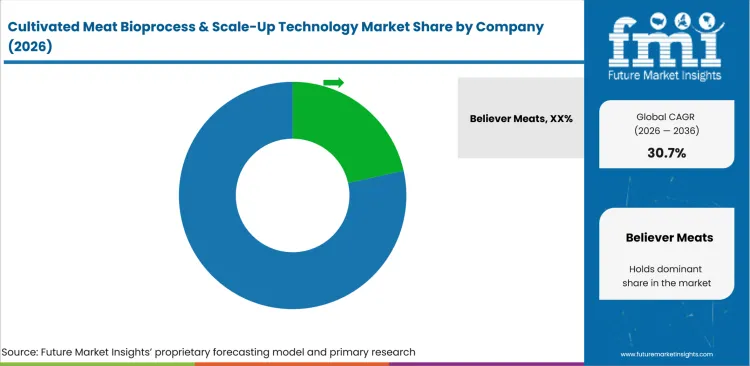
The competitive field combines cultivated-meat developers with companies that provide media, process platforms and scale-up support. Selection depends on cell-line readiness, regulatory evidence and the ability to move from pilot output to repeatable food production.
- Believer Meats and UPSIDE Foods are tied to USA consultation evidence and chicken-cell production planning.
- Meatable, Multus and Ever After Foods contribute application, media and bioreactor platform capabilities used in scale-up work.
Competitive benchmarking: Cultivated Meat Bioprocess & Scale-Up Technology Market
| Company | Solution | Process | Process Integration | Geographic Reach |
|---|---|---|---|---|
| Believer Meats | Medium | High | High | United States and Israel |
| Mosa Meat | High | Medium | Medium | Europe |
| Meatable | Medium | High | Medium | Europe and Asia-Pacific |
| UPSIDE Foods | Medium | Medium | High | United States |
| Aleph Farms | Medium | Medium | Medium | Israel, Middle East and Asia-Pacific |
| Multus | High | Medium | Medium | United Kingdom and Europe |
| Ever After Foods | Medium | High | Medium | Israel and United States |
Key companies in the cultivated meat bioprocess and scale-up technology market
Core technology and ingredient developers
- Believer Meats
- UPSIDE Foods
- Mosa Meat
- Aleph Farms
- Meatable
Scaled manufacturing and supply groups
- Ever After Foods
- Multus
Cultivated Meat Bioprocess & Scale-Up Technology Market - Report Scope
| Coverage field | Report scope |
|---|---|
| Market breakdown | Solution, Process, End User, and Region. |
| Quantitative Units | Revenue in USD Million, CAGR in %. |
| Market Definition | Bioprocess equipment, cell-line systems, growth media, scaffolding, and related scale-up technologies used to move cultivated meat production from laboratory development to repeatable food-grade manufacturing. |
| Regions Covered | North America, Latin America, Western Europe, Eastern Europe, East Asia, South Asia and Pacific, and Middle East and Africa. |
| Countries Covered | United States, Canada, Brazil, Mexico, Argentina, Chile, Germany, France, United Kingdom, Italy, Spain, Benelux, Nordics, Poland, Czech Republic, Romania, Hungary, China, Japan, South Korea, India, ASEAN, Australia and New Zealand, GCC Countries, South Africa, Türkiye, and Israel. |
| Key Companies Profiled | Believer Meats, Mosa Meat, Meatable, UPSIDE Foods, Aleph Farms, Multus, and Ever After Foods. |
| Forecast Period | 2026 to 2036. |
| Approach | Hybrid bottom-up and top-down market sizing supported by primary research, regulatory records, company disclosures, official statistics, expert interviews, and sensitivity testing for approval timing, media costs, process yield, and commercialization pace. |
Cultivated Meat Bioprocess & Scale-Up Technology Market - Research Methodology
| Method | Approach |
|---|---|
| Primary Research | FMI analysts gathered input from manufacturers, service providers, technology developers, distributors, end users, procurement teams, and subject-matter experts. Interviews examined purchasing decisions, product or service evaluation, adoption barriers, approval requirements, pricing considerations, and expectations for technical or commercial support. Respondents were also asked what evidence is required before a trial, pilot, or initial order develops into regular purchasing. |
| Desk Research | Desk research covered government statistics, regulatory publications, trade data, industry associations, technical literature, standards, company filings, product information, and official corporate announcements. Sources were reviewed for relevance, publication date, geographic coverage, and consistency with the defined market scope. Claims relating to performance, applications, approvals, capacity, investment, and commercial activity were retained only when supported by credible public evidence. |
| Market Sizing and Forecasting | The market model combined the baseline value with historical performance, segment structure, pricing and volume indicators, adoption levels, company participation, and country-level demand conditions. Forecast assumptions considered economic activity, investment trends, regulatory developments, technology adoption, purchasing cycles, supply availability, and barriers to wider market use. Segment and regional estimates were reconciled before the final market total was calculated. |
| Data Validation | Estimates were checked against multiple independent indicators, including public data, company activity, trade patterns, industry developments, and findings from primary interviews. Validation also tested whether products, services, applications, and company revenues fell within the defined market boundaries. Adjacent categories, unsupported claims, overlapping revenues, and activities without direct market relevance were excluded to reduce double counting and maintain consistency across segments and countries. |
Cultivated Meat Bioprocess & Scale-Up Technology Market Segmentation
Cultivated Meat Bioprocess & Scale-Up Technology Market Segmentation by Solution
- Bioreactors
- Cell Lines
- Growth Media
- Scaffolding
Cultivated Meat Bioprocess & Scale-Up Technology Market Segmentation by Process
- Continuous
- Batch
Cultivated Meat Bioprocess & Scale-Up Technology Market Segmentation by End User
- Food Manufacturers
- Foodservice Operators
- Retailers
- Household
Cultivated Meat Bioprocess & Scale-Up Technology Market by Region
- North America
- United States
- Canada
- Latin America
- Brazil
- Mexico
- Argentina
- Chile
- Western Europe
- Germany
- France
- United Kingdom
- Italy
- Spain
- Benelux
- Nordics
- Eastern Europe
- Poland
- Czech Republic
- Romania
- Hungary
- East Asia
- China
- Japan
- South Korea
- South Asia and Pacific
- India
- ASEAN
- Australia and New Zealand
- Middle East and Africa
- GCC Countries
- South Africa
- Türkiye
- Israel
Research Sources and Bibliography
- USA Food and Drug Administration. (2025, March 7). FDA completes pre-market consultation for human food made with cultured pork fat cells.
- USA Department of Agriculture, Economic Research Service. (2026, June 1). Total USA food spending reached $2.51 trillion in 2025.
- National Center for Science and Engineering Statistics. (2026, May). The state of USA science and engineering 2026.
- Israel Innovation Authority. (2025). FoodTech 2024 overview.
- Israel Innovation Authority. (2026, April). Investment in national bio-convergence program surges.
- Bank of Israel. (2026, July 6). The Monetary Committee decides on July 6, 2026 to lower the interest rate to 3.5 percent.
- Statistics Netherlands. (2026, July). Industry; production and sales, changes and index, 2021=100.
- Singapore Food Agency. (2025, March 17). Requirements for the safety assessment of novel foods and novel food ingredients.
- Enterprise Singapore & Infocomm Media Development Authority. (2026, February). Refreshed Industry Digital Plan to support food manufacturers.
- Food Standards Agency. (2025, March 10). FSA launches pioneering regulatory programme for cell-cultivated products.
- Office for National Statistics. (2026, July 16). GDP monthly estimate, UK: May 2026.
- Mosa Meat. (2025, January 22). Submitting our first EU market authorisation request.
This bibliography is provided for reader reference and is not exhaustive. The full report contains the complete reference list and detailed citations.
This Report Answers
- How large is the Cultivated Meat Bioprocess & Scale-Up Technology Market in 2026 and 2036?
- Which production, formulation or regulatory pressures support spending in the Cultivated Meat Bioprocess & Scale-Up Technology Market?
- Why do Bioreactors lead the Solution category in 2026?
- Why does Continuous lead the Process category in 2026?
- Why do Food Manufacturers lead the End User category in 2026?
- How do country growth rates differ across USA, Israel, Netherlands, Singapore and UK?
- Which companies provide technology, ingredients, manufacturing scale or application support?
- What limits qualification and commercial scale-up in the Cultivated Meat Bioprocess & Scale-Up Technology Market?
- What does a company test before approving a larger order or wider deployment?
Frequently Asked Questions
How big is the Cultivated Meat Bioprocess & Scale-Up Technology Market in 2026?
The cultivated meat bioprocess and scale-up technology market is valued at USD 385.5 million in 2026 and is forecast to reach USD 5607.6 million by 2036, reflecting growing demand for reproducible food-grade production systems across regulated markets.
What is the CAGR of the Cultivated Meat Bioprocess & Scale-Up Technology Market from 2026 to 2036?
The cultivated meat bioprocess and scale-up technology market is projected to grow at a CAGR of 30.7% between 2026 and 2036, supported by the shift from proof-of-concept work to repeatable production trials and expanding regulatory consultation activity across key markets.
Which solution leads the Cultivated Meat Bioprocess & Scale-Up Technology Market?
Bioreactors account for 43.2% of the cultivated meat bioprocess and scale-up technology market by solution in 2026, driven by their role in controlling the first production bottleneck through consistent cell expansion, contamination management, and harvest repeatability at food-grade volumes.
Why do executives track the Cultivated Meat Bioprocess & Scale-Up Technology Market?
The market connects production technology with launch timing and operating cost. A weak scale-up choice can affect margin before a product reaches routine sale.
Which country is growing fastest in the Cultivated Meat Bioprocess & Scale-Up Technology Market?
The cultivated meat bioprocess and scale-up technology market in Israel is projected to grow at a CAGR of 29.6% through 2036, supported by an active national bio-convergence program and local cultivated-meat developers requiring cell-growth and media-performance validation tools.
Who are the leading companies in the Cultivated Meat Bioprocess & Scale-Up Technology Market?
Leading companies in the cultivated meat bioprocess and scale-up technology market include Believer Meats, UPSIDE Foods, Mosa Meat, Aleph Farms, Meatable, Multus, and Ever After Foods, spanning cell production, growth media, bioreactor platforms, and regulatory authorization route development.
Preview the report firsthand - request a free sample
Get SampleGet the brochure for pricing and purchase details.
Get PDFTable of Content
- Key Takeaways
- Market Size and CAGR
- Top Growth Driver
- Fastest Growing Segment
- Leading Region
- Key Companies
- Emerging Opportunities
- Executive Summary
- Global Market Outlook
- Demand-side Trends
- Supply-side Trends
- Technology Roadmap Analysis
- Analysis and Recommendations
- Analyst Perspective (What is happening? Why now? What should investors know?)
- Key Questions Answered
- How large is the market?
- What is the CAGR?
- What are key trends?
- Which region dominates?
- Who are the leaders?
- Market Overview
- Market Coverage / Taxonomy
- Market Definition / Scope / Limitations
- Research Methodology
- Chapter Orientation
- Analytical Lens and Working Hypotheses
- Market Structure, Signals, and Trend Drivers
- Benchmarking and Cross-market Comparability
- Market Sizing, Forecasting, and Opportunity Mapping
- Research Design and Evidence Framework
- Desk Research Programme (Secondary Evidence)
- Expert Input and Fieldwork (Primary Evidence)
- Tooling, Models, and Reference Databases
- Data Engineering and Model Build
- Quality Assurance and Audit Trail
- Market Background
- Market Dynamics (Drivers, Restraints, Opportunity, Trends)
- Scenario Forecast (Optimistic, Likely, Conservative)
- Impact Analysis
- AI Impact
- Sustainability Impact
- Regulatory Impact
- Technology Impact
- Consumer / Buyer Analysis
- Purchase Drivers
- Adoption Barriers
- Buyer Journey
- Opportunity Map Analysis
- Product Life Cycle Analysis
- Supply Chain Analysis
- Investment Feasibility Matrix
- Value Chain Analysis
- PESTLE and Porter's Analysis
- Regulatory Landscape
- Regional Parent Market Outlook
- Production and Consumption Statistics
- Import and Export Statistics
- Global Market Analysis and Forecast, 2021 to 2036
- Historical Market Size Value (USD Million) Analysis, 2021 to 2025
- Current and Future Market Size Value (USD Million) Projections, 2026 to 2036
- Y-o-Y Growth Trend Analysis
- Absolute $ Opportunity Analysis
- Global Market Pricing Analysis, 2021 to 2036
- Global Market Analysis and Forecast, By Solution, 2021 to 2036
- Introduction / Key Findings
- Historical Market Size Value (USD Million) Analysis By Solution, 2021 to 2025
- Current and Future Market Size Value (USD Million) Analysis and Forecast By Solution, 2026 to 2036
- Bioreactors
- Cell Lines
- Growth Media
- Scaffolding
- Bioreactors
- Y-o-Y Growth Trend Analysis By Solution, 2021 to 2025
- Absolute $ Opportunity Analysis By Solution, 2026 to 2036
- Global Market Analysis and Forecast, By Process, 2021 to 2036
- Introduction / Key Findings
- Historical Market Size Value (USD Million) Analysis By Process, 2021 to 2025
- Current and Future Market Size Value (USD Million) Analysis and Forecast By Process, 2026 to 2036
- Continuous
- Batch
- Continuous
- Y-o-Y Growth Trend Analysis By Process, 2021 to 2025
- Absolute $ Opportunity Analysis By Process, 2026 to 2036
- Global Market Analysis and Forecast, By End User, 2021 to 2036
- Introduction / Key Findings
- Historical Market Size Value (USD Million) Analysis By End User, 2021 to 2025
- Current and Future Market Size Value (USD Million) Analysis and Forecast By End User, 2026 to 2036
- Food Manufacturers
- Foodservice Operators
- Retailers
- Household
- Food Manufacturers
- Y-o-Y Growth Trend Analysis By End User, 2021 to 2025
- Absolute $ Opportunity Analysis By End User, 2026 to 2036
- Global Market Analysis and Forecast, By Region, 2021 to 2036
- Introduction
- Historical Market Size Value (USD Million) Analysis By Region, 2021 to 2025
- Current Market Size Value (USD Million) Analysis and Forecast By Region, 2026 to 2036
- North America
- Latin America
- Western Europe
- Eastern Europe
- East Asia
- South Asia and Pacific
- Middle East & Africa
- Market Attractiveness Analysis By Region
- North America Market Analysis and Forecast, By Country, 2021 to 2036
- Historical Market Size Value (USD Million) Trend Analysis By Market Taxonomy, 2021 to 2025
- Market Size Value (USD Million) Forecast By Market Taxonomy, 2026 to 2036
- By Country
- USA
- Canada
- By Solution
- By Process
- By End User
- By Country
- Market Attractiveness Analysis
- By Country
- By Solution
- By Process
- By End User
- Key Takeaways
- Latin America Market Analysis and Forecast, By Country
- Historical Market Size Value (USD Million) Trend Analysis By Market Taxonomy, 2021 to 2025
- Market Size Value (USD Million) Forecast By Market Taxonomy, 2026 to 2036
- By Country
- Brazil
- Mexico
- Chile
- Rest of Latin America
- By Solution
- By Process
- By End User
- By Country
- Market Attractiveness Analysis
- By Country
- By Solution
- By Process
- By End User
- Key Takeaways
- Western Europe Market Analysis and Forecast, By Country
- Historical Market Size Value (USD Million) Trend Analysis By Market Taxonomy, 2021 to 2025
- Market Size Value (USD Million) Forecast By Market Taxonomy, 2026 to 2036
- By Country
- Germany
- UK
- Italy
- Spain
- France
- Nordic
- BENELUX
- Rest of Western Europe
- By Solution
- By Process
- By End User
- By Country
- Market Attractiveness Analysis
- By Country
- By Solution
- By Process
- By End User
- Key Takeaways
- Eastern Europe Market Analysis and Forecast, By Country
- Historical Market Size Value (USD Million) Trend Analysis By Market Taxonomy, 2021 to 2025
- Market Size Value (USD Million) Forecast By Market Taxonomy, 2026 to 2036
- By Country
- Russia
- Poland
- Hungary
- Balkan & Baltic
- Rest of Eastern Europe
- By Solution
- By Process
- By End User
- By Country
- Market Attractiveness Analysis
- By Country
- By Solution
- By Process
- By End User
- Key Takeaways
- East Asia Market Analysis and Forecast, By Country
- Historical Market Size Value (USD Million) Trend Analysis By Market Taxonomy, 2021 to 2025
- Market Size Value (USD Million) Forecast By Market Taxonomy, 2026 to 2036
- By Country
- China
- Japan
- South Korea
- By Solution
- By Process
- By End User
- By Country
- Market Attractiveness Analysis
- By Country
- By Solution
- By Process
- By End User
- Key Takeaways
- South Asia and Pacific Market Analysis and Forecast, By Country
- Historical Market Size Value (USD Million) Trend Analysis By Market Taxonomy, 2021 to 2025
- Market Size Value (USD Million) Forecast By Market Taxonomy, 2026 to 2036
- By Country
- India
- ASEAN
- Australia & New Zealand
- Rest of South Asia and Pacific
- By Solution
- By Process
- By End User
- By Country
- Market Attractiveness Analysis
- By Country
- By Solution
- By Process
- By End User
- Key Takeaways
- Middle East & Africa Market Analysis and Forecast, By Country
- Historical Market Size Value (USD Million) Trend Analysis By Market Taxonomy, 2021 to 2025
- Market Size Value (USD Million) Forecast By Market Taxonomy, 2026 to 2036
- By Country
- Kingdom of Saudi Arabia
- Other GCC Countries
- Türkiye
- South Africa
- Other African Union
- Rest of Middle East & Africa
- By Solution
- By Process
- By End User
- By Country
- Market Attractiveness Analysis
- By Country
- By Solution
- By Process
- By End User
- Key Takeaways
- Key Countries Market Analysis
- USA
- Pricing Analysis
- Market Share Analysis, 2025
- By Solution
- By Process
- By End User
- Canada
- Pricing Analysis
- Market Share Analysis, 2025
- By Solution
- By Process
- By End User
- Mexico
- Pricing Analysis
- Market Share Analysis, 2025
- By Solution
- By Process
- By End User
- Brazil
- Pricing Analysis
- Market Share Analysis, 2025
- By Solution
- By Process
- By End User
- Chile
- Pricing Analysis
- Market Share Analysis, 2025
- By Solution
- By Process
- By End User
- Germany
- Pricing Analysis
- Market Share Analysis, 2025
- By Solution
- By Process
- By End User
- UK
- Pricing Analysis
- Market Share Analysis, 2025
- By Solution
- By Process
- By End User
- Italy
- Pricing Analysis
- Market Share Analysis, 2025
- By Solution
- By Process
- By End User
- Spain
- Pricing Analysis
- Market Share Analysis, 2025
- By Solution
- By Process
- By End User
- France
- Pricing Analysis
- Market Share Analysis, 2025
- By Solution
- By Process
- By End User
- India
- Pricing Analysis
- Market Share Analysis, 2025
- By Solution
- By Process
- By End User
- ASEAN
- Pricing Analysis
- Market Share Analysis, 2025
- By Solution
- By Process
- By End User
- Australia & New Zealand
- Pricing Analysis
- Market Share Analysis, 2025
- By Solution
- By Process
- By End User
- China
- Pricing Analysis
- Market Share Analysis, 2025
- By Solution
- By Process
- By End User
- Japan
- Pricing Analysis
- Market Share Analysis, 2025
- By Solution
- By Process
- By End User
- South Korea
- Pricing Analysis
- Market Share Analysis, 2025
- By Solution
- By Process
- By End User
- Russia
- Pricing Analysis
- Market Share Analysis, 2025
- By Solution
- By Process
- By End User
- Poland
- Pricing Analysis
- Market Share Analysis, 2025
- By Solution
- By Process
- By End User
- Hungary
- Pricing Analysis
- Market Share Analysis, 2025
- By Solution
- By Process
- By End User
- Kingdom of Saudi Arabia
- Pricing Analysis
- Market Share Analysis, 2025
- By Solution
- By Process
- By End User
- Türkiye
- Pricing Analysis
- Market Share Analysis, 2025
- By Solution
- By Process
- By End User
- South Africa
- Pricing Analysis
- Market Share Analysis, 2025
- By Solution
- By Process
- By End User
- USA
- Market Structure Analysis
- Competition Dashboard
- Competition Benchmarking
- Market Share Analysis of Top Players
- By Regional
- By Solution
- By Process
- By End User
- Emerging Startups
- Innovation Benchmarking
- Competition Analysis
- Competition Deep Dive
- Believer Meats
- Overview
- Product Portfolio
- Profitability by Market Segments
- Sales Footprint
- Strategy Overview
- Marketing Strategy
- Product Strategy
- Channel Strategy
- Mosa Meat
- Meatable
- UPSIDE Foods
- Aleph Farms
- Multus
- Mosa
- Ever After Foods
- Believer Meats
- Case Studies
- Success Stories
- Recent Developments
- Competition Deep Dive
- Assumptions & Acronyms Used


