

- Industry Size (2026)
- USD 90.0 Mn
- Forecast (2036)
- USD 780.0 Mn
- CAGR (2026 to 2036)
- 24.0%
Cell-Based Chicken Fat Market Size, Market Forecast and Outlook By FMI
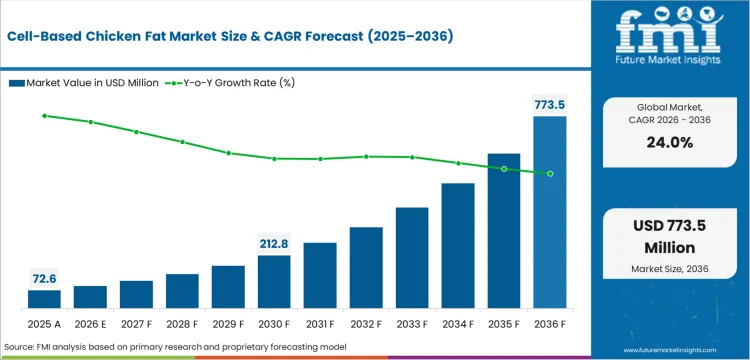
In 2025, the cell-based chicken fat market surpassed a value of USD 73.0 million and is projected to reach USD 90.0 million in 2026 and USD 780.0 million by 2036, reflecting a CAGR of 24.0%. Food technologists prioritize cultured meat lipids to solve sensory deficits in existing vegetable formulations. Regulatory clearances reset ingredient qualification parameters across global jurisdictions. In March 2025, federal agencies completed pre-market consultations covering multiple avian and pork fat products [1]. Procurement teams concentrate supplier networks around entities holding established compliance portfolios.
Absolute dollar growth of USD 690.0 million over forecast period signals strict compliance gate and retrofit capital expenditure cycle. Regulators raise minimum safety thresholds, forcing legacy processors to secure approved cell lines. Cultivation media cost reductions below USD 0.20 per liter in 2025 reshape unit economics [2]. Facility operators transition from pharmaceutical grade inputs to food grade growth factors. Buyers specify verifiable alternative protein inputs to bypass volatile conventional agricultural supply chains.
Summary of Cell-Based Chicken Fat Market
- Cell-Based Chicken Fat Market Definition
- The industry covers commercially cultivated avian-derived lipids produced through controlled bioreactor systems, utilized as a functional food ingredient to enhance flavor, juiciness, and texture in alternative protein and hybrid meat formulations.
- Demand Drivers in Market
- Sensory deficits in existing meat analogues force adoption of authentic animal fats.
- Regulatory clearances in North America establish viable paths to retail distribution.
- Media cost reductions below USD 0.25 per liter improve unit economics.
- Key Segments Analyzed in FMI Report
- Product Form: Liquid/rendered fat (38%) versus emulsified systems, encapsulated powders, and plant-lipid blends.
- Application: Cultivated meat products (46% of total volume) versus hybrid meats, flavor enhancers, functional ingredients, and pet nutrition.
- Geography: High-growth North America and Europe (United States 26.8%, Germany 25.7%, Netherlands 25.0%) versus advancing Asia-Pacific hubs (Singapore 24.5%, China 23.8%, United Kingdom 23.5%).
- Analyst Opinion at FMI
- Nandini Roy Choudhury, Principal Consultant for Food & Beverage at Future Market Insights, opines, “In our updated Cell-Based Chicken Fat Market analysis, my team and I have identified sensory authenticity as the structural growth catalyst. Cultivated fat delivers the aroma release, mouthfeel, and cooking behavior that plant-based lipids struggle to replicate. However, scalable bioreactor economics and cost-per-kilogram parity remain critical hurdles. Companies prioritizing fat-first commercialization strategies will unlock near-term hybrid meat opportunities.”
- Strategic Implications/Executive Takeaways
- Prioritize hybrid formulations to stretch limited cultivation capacities.
- Secure long term off-take agreements with established plant-based brands.
- Invest in media recycling technologies to suppress variable production costs.
- Methodology
- Validated through first-hand corporate production and capacity data.
- Zero reliance on speculative third-party market research reports.
- Based on verifiable industrial benchmarks and verified sources.
Ingredient functionality determines sensory acceptance and final product viability. As noted by Eitan Fischer, Founder and CEO at Mission Barns, 'Food security and the health of our food system is a big challenge we are tackling at Mission Barns. We are expecting 1.7 billion more humans on our planet in the next 25 years and we need to innovate in order to find more efficient ways to produce delicious food products to feed the world. First and foremost, consumers won’t eat food that isn’t absolutely delicious, which is why we chose to pursue a fat-first approach.' [3] Capturing authentic flavor matrices allows producers to command premium margins before achieving full muscle tissue parity. Brands update procurement criteria to include isolated lipids.
United States, Germany, Netherlands, Singapore, China, and United Kingdom represent core adoption zones. Country dispersion skews toward regulatory approval corridors where framework clarity aligns with investor capital. Food conglomerates mandate plant based chicken formulation upgrades to satisfy strict regional sustainability benchmarks.
Cell-Based Chicken Fat Market Key Takeaways
| Metric | Details |
|---|---|
| Industry Size (2026) | USD 90.0 million |
| Industry Value (2036) | USD 780.0 million |
| CAGR (2026-2036) | 24.0% |
Cell-Based Chicken Fat Market Definition
Cell-Based Chicken Fat represents the commercial production and trade of lipid tissue cultivated from avian-derived cell lines within controlled bioreactor systems. The market comprises revenue generated from the manufacturing, formulation, and B2B distribution of cultivated adipocyte-derived fat used as a functional ingredient to enhance flavor release, juiciness, and mouthfeel in alternative protein and hybrid meat applications. Commercial output is based on scalable cell proliferation and lipid accumulation processes, independent of conventional poultry slaughter and rendering supply chains.
Cell-Based Chicken Fat Market Inclusions
The report provides detailed assessment of global and regional market size in both value (USD million) and volume (metric tons), along with a 10-year forecast (2026–2036). It includes segmentation by product format (Liquid/Rendered, Emulsified Systems, Encapsulated Powder), application (Hybrid Meat Products, Plant-Based Protein Formulations, Processed Food Ingredients, Foodservice Applications), and end-use (Food Manufacturers, Alternative Protein Startups, Ingredient Blenders, Quick-Service Restaurant Partnerships). The scope covers commercial-scale cultivated avian lipid production, toll-manufacturing arrangements, licensing agreements for cell lines, and structured supply contracts with downstream food processors.
Cell-Based Chicken Fat Market Exclusions
The scope excludes conventional poultry fat derived from slaughtered birds, commodity animal tallow, and plant-derived oils such as soybean, sunflower, or coconut oil that do not involve avian cell cultivation. Whole-cut cultivated meat products containing structural muscle tissue are not included unless traded separately as isolated lipid fractions. Precision fermentation-derived lipids that do not originate from avian adipocyte cell lines are excluded. The report does not account for small-scale laboratory research, academic pilot studies without commercial output, or non-food cosmetic and pharmaceutical lipid applications with negligible impact on global food ingredient revenue streams.
Cell-Based Chicken Fat Market Research Methodology
- Primary Research: Analysts conducted interviews with bioreactor engineers and regulatory consultants to verify commercialization timelines.
- Desk Research: Evaluators analyzed federal consultation letters and global patent filings to map technology readiness.
- Market-Sizing and Forecasting: Top-down volumetric models integrated capacity announcements with assumed media cost reductions.
- Data Validation and Update Cycle: Reviewers cross-referenced capital funding rounds against verifiable pilot plant throughput claims.
Segmental Analysis
Cell-Based Chicken Fat Market Analysis by Product Form
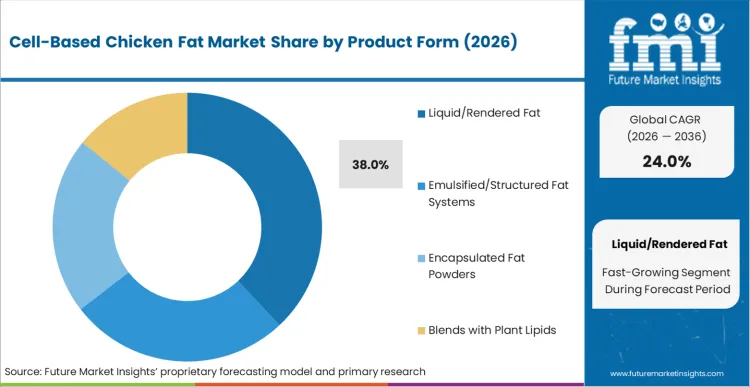
Liquid/Rendered Fat commands 38% of volume in 2026. Manufacturers prioritize liquid formats due to direct integration capabilities into existing extrusion hardware. As per FMI's projection, food biotechnology firms favor liquid integration to minimize thermal degradation during downstream processing steps. Encapsulation techniques gain traction for ambient storage requirements, but liquid forms retain dominance due to immediate flavor release characteristics. Operations scaling up bioreactor volumes target liquid output to bypass expensive secondary drying procedures.
- Procurement priority: Extrusion compatibility dictates format selection. Technologists select liquid inputs to ensure uniform lipid distribution across protein matrices without clumping. Operations achieve cost parity milestones using optimized liquid cultivation methods to bypass structural engineering costs.
- Cost mechanism: Secondary processing avoidance lowers unit prices. Liquid formats bypass energy intensive spray drying phases to reduce factory overheads. Eliminating encapsulation steps shortens production cycles from weeks to days.
- Storage constraint: Cold chain dependence limits geographic distribution. Liquid lipids require continuous refrigeration to prevent oxidation and spoilage. Buyers offset freight premiums by establishing co manufacturing facilities adjacent to cultivation plants.
Cell-Based Chicken Fat Market Analysis by Application
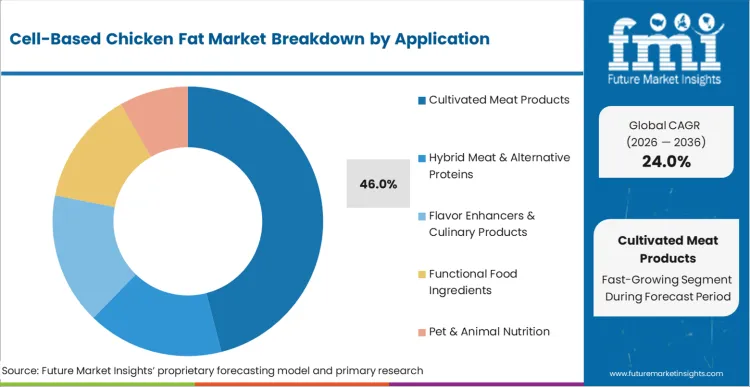
Pure cultivated muscle tissue lacks natural marbling, making external lipid integration essential to replicate conventional texture and juiciness. Manufacturers incorporate cell-based fat into structured protein matrices to enhance mouthfeel and flavor release. Hybrid meat formulations are also gaining traction as brands refine plant-based products with authentic animal notes, positioning cultivated meat products to capture 46% share in 2026.
- Formulation trigger: Sensory parity demands authentic lipid profiles. Food scientists inject cultivated fat into synthetic food scaffolds to replicate Maillard reaction browning during cooking. Product developers announce partnerships blending cultivated chicken fat with mycoprotein bases to elevate sensory performance.
- Margin strategy: Premium positioning justifies elevated ingredient costs. Brands incorporating authentic avian lipids command higher retail price points than standard plant equivalents. Superior tasting products generate repeat purchases, offsetting initial customer acquisition expenses.
- Adoption barrier: Labeling regulations complicate consumer messaging. Regulators require specific nomenclature for cell-based ingredients, causing hesitation among legacy brand portfolios. Marketing teams deploy educational campaigns to demystify cultivation processes for cautious shoppers.
Cell-Based Chicken Fat Market Drivers, Restraints, and Opportunities
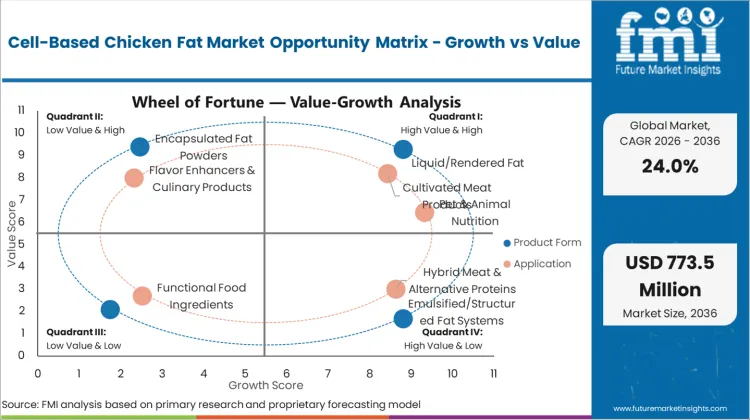
Sensory limitations inherent in legacy plant based food alternatives restrict mainstream consumer retention, forcing product developers to source authentic animal lipids. Plant derived oils like coconut or canola fail to replicate species specific flavor compounds released during cooking, causing distinct taste discrepancies. By replacing vegetable oils with cell derived equivalents, formulators achieve identical aromatic profiles and melting points found in conventional poultry. FMI analysts opine that sensory upgrades convert flexitarian shoppers who previously abandoned plant based categories due to poor taste experiences. Bioreactor scaling reaches 20,000 liters globally, supplying sufficient tonnage to support commercial retail rollouts [4]. Procurement departments authorize higher ingredient budgets for authentic lipids to defend market share against emerging competitors.
High bioreactor capital expenditures and expensive growth media pose formidable scaling barriers, suppressing total available production volumes. Recombinant proteins and growth factors required for cell proliferation dictate high operating expenses, preventing price parity with conventional rendered animal fats. Buyers encounter strict allocation quotas from suppliers unable to fulfill large tonnage commercial orders. To mitigate unit costs, manufacturers blend cultivated lipids with cheaper plant oils, creating hybrid systems that deliver flavor at acceptable price points. As per FMI's projection, investors withhold scale up capital until pilot facilities demonstrate consecutive quarters of positive unit economics. Cultivated chicken nutrient profiles confirm exact fat variations compared to conventional equivalents, requiring precise reformulation adjustments [5].
- Margin Expansion: Premium hybrid products command higher retail pricing structures. Formulators blend small percentages of cultivated fat into cheap soy bases, drastically elevating product perceived value.
- Facility Repurposing: Stranded fermentation assets offer fast track cultivation scaling. Technologists utilize existing pharmaceutical bioreactors to bypass multi year greenfield construction timelines.
- Regulatory Arbitrage: Jurisdictions with streamlined approval frameworks attract concentrated capital investments. Companies relocate production bases to specific states or nations to secure faster commercialization permits.
Regional Analysis
Based on regional analysis, Cell-Based Chicken Fat market is segmented into North America, Latin America, Europe, East Asia, South Asia, Oceania and Middle East & Africa across 40+ countries. Full report also offers market attractiveness analysis based on regional trends.
.webp "Top Country Growth Comparison Cell Based Chicken Fat Market Cagr (2026 2036)")
| Country | CAGR (2026 to 2036) |
|---|---|
| United States | 26.8% |
| Germany | 25.7% |
| Netherlands | 25.0% |
| Singapore | 24.5% |
| China | 23.8% |
| United Kingdom | 23.5% |
Source: Future Market Insights (FMI) analysis, based on proprietary forecasting model and primary research
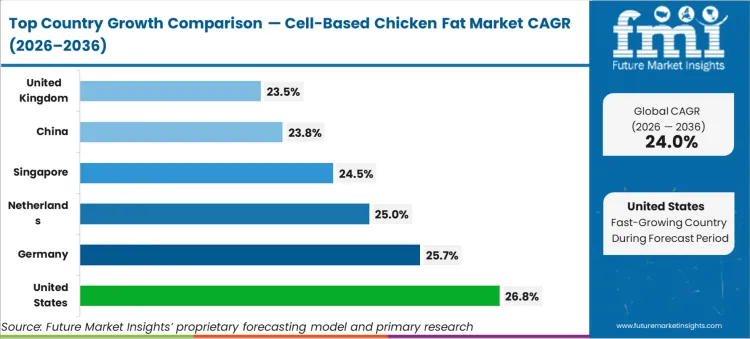
North America Cell-Based Chicken Fat Market Analysis
Federal regulatory clarity and concentrated venture capital deployments position North America as primary commercialization hub. Operations migrate toward states offering favorable biotechnology tax incentives and deep academic talent pools. Food scientists prioritize lipid cultivation to resolve taste parity issues plaguing domestic meat alternatives sectors. Capital allocators fund alternative protein production equipment to transition from bench scale research into commercial tonnage. Strategic alliances between startups and legacy meatpackers expedite retail distribution networks across continental borders.
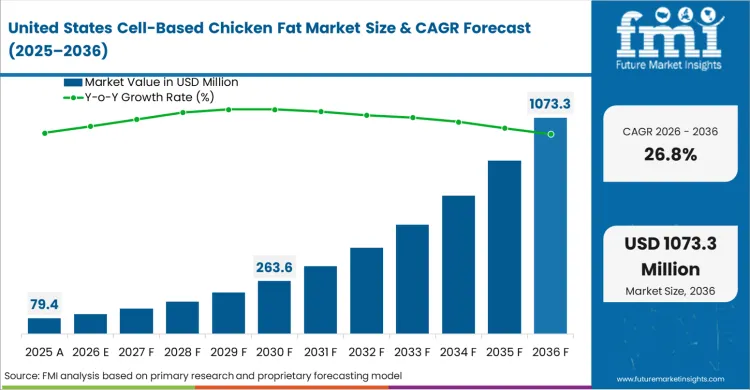
- United States: Demand for cell-based chicken fat in United States is set to grow at 26.8% CAGR through 2036, supported by comprehensive federal consultation completions before procurement and budgeting cycles translate into higher deployment volumes. Believer Meats secured USDA clearance for cultivated chicken at a large scale North Carolina facility in November 2025 [6]. Buyers integrate novel lipids to capture premium grocery shelf space.
FMI’s report includes detailed analysis for North America, highlighting growth across Canada and Mexico. Canada presents distinct commercialization prospects due to proactive novel food regulatory reviews. Supply chain architects establish localized manufacturing to avoid cross border perishable ingredient tariffs. In March 2025, Mission Barns secured clearance for cultivated fat, validating commercial pathways across regional borders [7].
Europe Cell-Based Chicken Fat Market Analysis
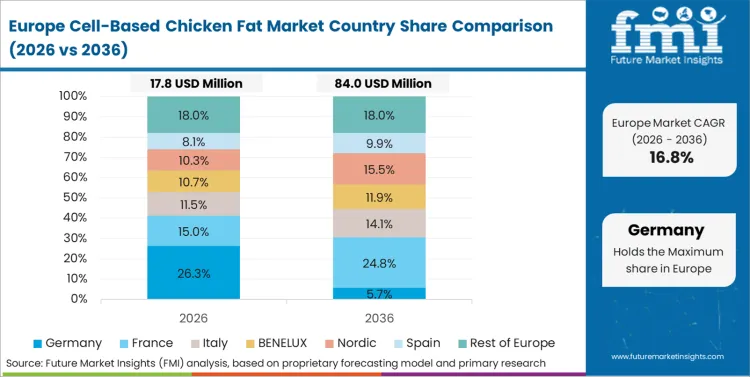
Strict novel food regulations dictate prolonged commercialization timelines across European jurisdictions, forcing companies to refine unit economics during waiting periods. Food conglomerates target hybrid formulations to satisfy stringent continental sustainability mandates while maintaining sensory appeal. According to FMI's estimates, producers emphasize life cycle assessments proving massive greenhouse gas reductions compared to conventional agriculture. Research consortiums pool resources to tackle serum free media optimization and automate bioprocessing sequences.
- Germany: Cell-based chicken fat sales in Germany are projected to rise at 25.7% CAGR from 2026 to 2036 as domestic food conglomerates invest in cellular agriculture, creating a clearer pathway from policy or spending intent to purchase orders. Steakholder Foods expanded Belgian pilot plants in 2025, validating nearby regional hybrid integration capabilities [8]. Formulators use local supply to upgrade existing vegan product portfolios.
- Netherlands: In the Netherlands, the cell-based chicken fat sector is gaining strong momentum as government-backed cellular agriculture consortia continue to fund early-stage research and infrastructure development. Strategic consolidation is also shaping the landscape, highlighted by Meatable’s 2025 acquisition of Uncommon Bio to scale its technology platforms [9]. Procurement teams are increasingly relying on domestic innovation clusters to secure dedicated ingredient supply agreements, supporting expansion at a 25.0% CAGR from 2026 to 2036.
- United Kingdom: United Kingdom is expected to grow 23.5% CAGR in cell-based chicken fat demand over 2026 to 2036 as post-Brexit regulatory frameworks aim for faster novel food approvals, tightening link between operational constraints and adoption-led investment. Suppliers target British retail chains eager for exclusive product launches. Procurement departments prioritize domestic capacities to minimize import friction.
FMI’s report includes detailed analysis for Europe, covering emerging markets in France and Spain. France and Spain represent critical expansion territories as domestic meat consumption habits face climate related scrutiny. Formulators watch European Food Safety Authority dossier progression to time product formulation cycles. Enough announced mycoprotein and cultivated fat hybrid partnerships in 2025, signaling widespread ingredient integration [10].
Asia Pacific Cell-Based Chicken Fat Market Analysis
Food security imperatives and volatile conventional import dependencies propel state sponsored cellular agriculture investments across Asian territories. Governments classify cultivated proteins as critical infrastructure necessary for long term population nutrition. Technologists adapt bioreactor designs to tolerate fluctuating local energy grids while minimizing clean room footprints. Domestic sovereign wealth funds supply multi year capital tranches to commercialize serum free media formulations.
- Singapore: In Singapore, the cell-based chicken fat sector is gaining momentum as national food security strategies translate into structured funding and commercialization support. Regulatory progress has reinforced confidence, highlighted by PARIMA securing approval for cultivated chicken in 2025, validating regional compliance pathways [11]. Companies are leveraging Singapore’s policy environment as a launch platform for novel food innovation, supporting growth at a 24.5% CAGR through 2036.
- China: Demand for cell-based chicken fat in China is anticipated to climb at 23.8% CAGR over forecast period as state five-year plans explicitly mandate future foods development, helping suppliers align positioning with local buying triggers. Mass production capabilities attract Western firms seeking contract manufacturing agreements. Buyers secure off-take agreements to guarantee volume allocations.
FMI’s report includes comprehensive coverage for Asia Pacific, detailing strategies across Japan and Australia. Japan and Australia emerge as sophisticated testing grounds where consumers readily accept advanced food technologies. Regulators draft customized cellular agriculture guidelines to attract foreign direct investment. By November 2025, seven companies cleared regulatory hurdles for sale across United States, Singapore, and Australia, proving multinational viability [12].
Competitive Aligners for Market Players
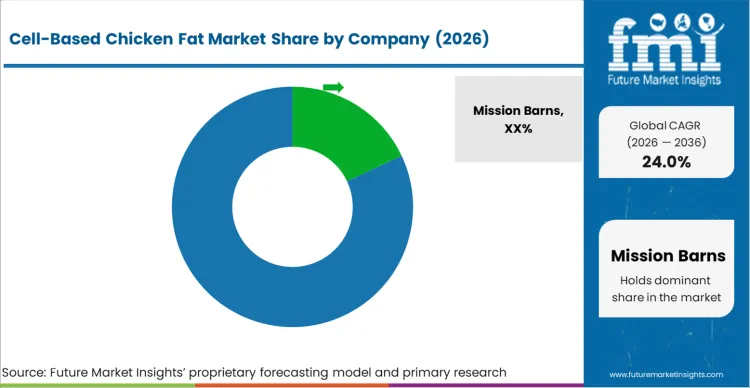
Regulatory clearance velocity acts as primary competitive differentiator, separating commercial operators from perpetual research projects. Companies possessing established dossiers navigate multi jurisdictional approvals faster, offering multinational food brands unified global launch strategies. Early federal clearances force competitors to aggressively fund regulatory compliance teams to close temporal market gaps.
Media cost suppression determines long term survivability during transition from venture funding to commercial revenue. As per FMI's projection, facilities achieving sub dollar per liter growth media costs unlock positive unit economics for ingredient supply contracts. Competitors must transparently publish technoeconomic assessments to attract institutional funding rounds.
Intellectual property surrounding immortalized avian cell lines and specialized bioreactor hardware dictates merger and acquisition valuations. Large legacy meat processors acquire struggling startups purely to absorb patented cell lines and bio process engineering talent. According to FMI's estimates, hardware and cell line consolidation determines market leadership across next decade.
Recent Developments
Report includes full coverage of key trends from competitive benchmarking. Some recent developments covered in reports:
- In February 2025, Stamm and SuperMeat announced partnership to commercialize cultivated chicken by 2026 using automated bioreactors. [13]
- In November 2025, SuperMeat announced cost parity achievements, reaching USD 11.79 per pound for large scale cultivated meat production. [14]
Key Players in Cell-Based Chicken Fat Market
- Mission Barns
- Believer Meats
- SuperMeat
- Steakholder Foods
- GOOD Meat
- UPSIDE Foods
Scope of the Report
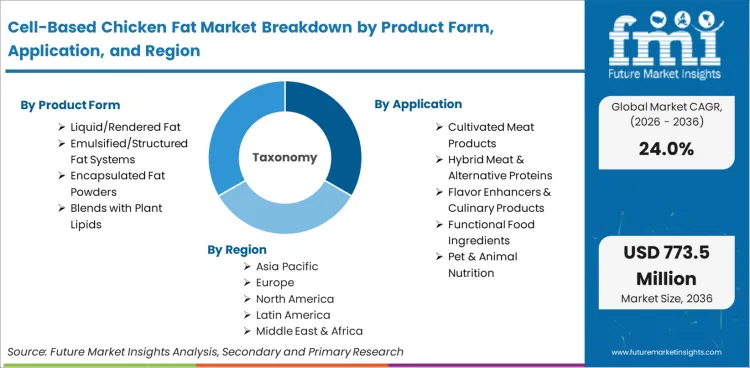
| Metric | Value |
|---|---|
| Quantitative Units | USD 90.0 million (2026) to USD 780.0 million (2036), at a CAGR of 24.0% |
| Market Definition | Cell-Based Chicken Fat refers to lipid tissues cultivated directly from avian cells within controlled bioreactor environments, serving as an industrial ingredient for improving texture and flavor profiles in novel food matrices. |
| Product Form Segmentation | Liquid/Rendered Fat, Emulsified/Structured Fat Systems, Encapsulated Fat Powders, Blends with Plant Lipids |
| Application Segmentation | Cultivated Meat Products, Hybrid Meat & Alternative Proteins, Flavor Enhancers & Culinary Products, Functional Food Ingredients, Pet & Animal Nutrition |
| Regions Covered | North America, Latin America, Europe, East Asia, South Asia, Oceania, Middle East and Africa |
| Countries Covered | United States, Germany, Netherlands, Singapore, China, United Kingdom, Canada, France, Spain, Japan, South Korea, Australia and 40 plus countries |
| Key Companies Profiled | Mission Barns, Believer Meats, SuperMeat, Steakholder Foods, GOOD Meat, UPSIDE Foods |
| Forecast Period | 2026 to 2036 |
| Approach | Hybrid top-down and bottom-up market modeling validated through primary interviews with cultivated fat producers, bioprocess engineers, and food regulatory experts, supported by production capacity assessments, pilot-plant validation, intellectual property mapping, and commercialization pipeline benchmarking across cell-based chicken fat manufacturers |
Cell-Based Chicken Fat Market Analysis by Segments
Product Form
- Liquid/Rendered Fat
- Emulsified/Structured Fat Systems
- Encapsulated Fat Powders
- Blends with Plant Lipids
Application
- Cultivated Meat Products
- Hybrid Meat & Alternative Proteins
- Flavor Enhancers & Culinary Products
- Functional Food Ingredients
- Pet & Animal Nutrition
Region
- Asia Pacific
- India
- China
- Japan
- South Korea
- Indonesia
- Australia & New Zealand
- ASEAN
- Rest of Asia Pacific
- Europe
- Germany
- Italy
- France
- United Kingdom
- Spain
- Benelux
- Nordics
- Central & Eastern Europe
- Rest of Europe
- North America
- United States
- Canada
- Mexico
- Latin America
- Brazil
- Argentina
- Chile
- Rest of Latin America
- Middle East & Africa
- Kingdom of Saudi Arabia
- United Arab Emirates
- South Africa
- Turkey
- Rest of Middle East & Africa
Bibliography
- [1] FDA.gov (2025). Human Food Made with Cultured Animal Cells pre-market consultations.
- [2] GFI.org (2025). The Science of Cultivated Meat: Media cost reductions.
- [3] Mission Barns (Mar 2025). Press Release: Eitan Fischer Quote.
- [4] GFI.org (2025). The Science of Cultivated Meat: Bioreactor scale reaching 20,000 L.
- [5] MOSTpolicyinitiative.org (Mar 2025). Cultivated chicken nutrient profile evaluation.
- [6] Feedstuffs (Nov 2025). USDA clears cultivated chicken from Believer Meats North Carolina facility.
- [7] GFI.org (Nov 2025). Addressing Cultivated Meat Challenges: Mission Barns pork fat clearance.
- [8] Cultivated Meat Co (2025). 10 Cultivated Meat Startups: Steakholder Foods Belgian pilot plant.
- [9] Green Queen (2025). Meatable acquires Uncommon Bio lab grown meat platform.
- [10] DigiComply (2025). The Rise of Hybrid Foods: Enough mycoprotein partnership.
- [11] GFI.org (Nov 2025). Addressing Cultivated Meat Challenges: PARIMA Singapore clearance.
- [12] GFI.org (Nov 2025). 7 companies cleared for sale in US, Singapore, Australia.
- [13] BioProcess Intl (2025). Stamm and SuperMeat seek to bring cultivated chicken to market.
- [14] SuperMeat (2025). Cost-Effective Cultivated Meat Production milestones.
- This bibliography is provided for reader reference and is not exhaustive. Full report contains complete reference list and detailed citations.
This Report Addresses
- Regulatory timelines mapping commercialization pathways across North America and European jurisdictions.
- Media cost reduction projections validating transition from pilot facilities to commercial tonnage.
- Sensory improvement metrics comparing cultivated avian lipids against conventional vegetable oils.
- Capacity constraints influencing hybrid formulation strategies for multinational food brands.
- Capital expenditure models associated with large scale bioreactor fabrication and deployment.
- Intellectual property consolidation trends shaping merger and acquisition valuations globally.
- Supply chain vulnerabilities mitigated by domestic cellular agriculture infrastructure investments.
Frequently Asked Questions
How large is demand for Cell-Based Chicken Fat in global market in 2026?
Demand for Cell-Based Chicken Fat in global market is estimated to be valued at USD 90.0 million in 2026.
What will be market size of Cell-Based Chicken Fat in global market by 2036?
Market size for Cell-Based Chicken Fat is projected to reach USD 780.0 million by 2036.
What is expected demand growth for Cell-Based Chicken Fat in global market between 2026 and 2036?
Demand for Cell-Based Chicken Fat in global market is expected to grow at a CAGR of 24.0% between 2026 and 2036.
Which Product Form is poised to lead global sales by 2026?
Liquid/Rendered Fat is expected to be dominant form, capturing 38% of global market share in 2026 due to seamless integration into extrusion processes.
How significant is role of Cultivated Meat Products in driving Cell-Based Chicken Fat adoption in 2026?
Cultivated Meat Products represent critical segment, projected to hold substantial 46% share of total market in 2026 as sensory parity demands exogenous fat addition.
What is driving demand in United States?
Federal regulatory clearances establish viable retail pathways and attract immense venture capital deployment for production facilities.
What compliance standards or regulations are referenced for United States?
FDA pre-market consultations and USDA label approvals serve as primary compliance benchmarks.
What is United States growth outlook in this report?
United States is projected to grow at a CAGR of 26.8% during 2026 to 2036.
Why is Europe described as priority region in this report?
Strict novel food regulations force companies to prioritize verifiable greenhouse gas reductions and sustainable hybrid formulations to secure approvals.
What type of demand dominates in Europe?
Demand for hybrid ingredients satisfying sustainability mandates while elevating sensory performance dominates regional consumption.
What is Germany growth outlook in this report?
Germany is projected to expand at a CAGR of 25.7% during 2026 to 2036.
Does report cover Singapore in its regional analysis?
Yes, Singapore is included within Asia Pacific under regional scope of analysis.
What are sources referred to for analyzing Singapore?
Regulatory clearances from PARIMA and verifiable domestic agency approvals inform regional analysis.
What is main demand theme linked to Singapore in its region coverage?
Food security mandates utilizing island policies to establish global launchpads for novel foods drive continuous innovation.
Does report cover China in its regional analysis?
Yes, China is included within Asia Pacific under regional coverage framework.
What is main China related demand theme in its region coverage?
State sponsored five-year plans mandate cellular agriculture investments to reduce conventional import dependencies.
Which product formats or configurations are strategically important for North America supply chains?
Liquid formats remain prioritized to bypass expensive secondary drying phases and expedite integration into existing manufacturing lines.
What is Cell-Based Chicken Fat and what is it mainly used for?
Cell-Based Chicken Fat refers to lipid tissues cultivated from avian cells, primarily used to improve texture and flavor in alternative protein matrices.
What does Cell-Based Chicken Fat mean in this report?
Cell-Based Chicken Fat refers to industrial production of avian lipids through cellular agriculture rather than conventional animal slaughter.
What is included in scope of this Cell-Based Chicken Fat report?
Scope includes liquid, emulsified, and encapsulated cultivated avian fats intended for hybrid meats, flavor enhancers, and functional ingredients.
What is excluded from scope of this report?
Conventional rendered poultry fat, non avian precision fermentation lipids, and whole muscle cultivated tissues are excluded.
What does market forecast mean on this page?
Market forecast represents model based projection built on defined assumptions for strategic planning purposes.
How does FMI build and validate Cell-Based Chicken Fat forecast?
Forecast is developed using hybrid top down and bottom up modeling validated through primary interviews and capacity verifications.
What does zero reliance on speculative third party market research mean here?
Primary interviews and verifiable public datasets are used instead of unverified syndicated market estimates.
Preview the report firsthand - request a free sample
Get SampleGet the brochure for pricing and purchase details.
Get PDFTable of Content
- Executive Summary
- Global Market Outlook
- Demand-side Trends
- Supply-side Trends
- Technology Roadmap Analysis
- Analysis and Recommendations
- Market Overview
- Market Coverage / Taxonomy
- Market Definition / Scope / Limitations
- Research Methodology
- Chapter Orientation
- Analytical Lens and Working Hypotheses
- Market Structure, Signals, and Trend Drivers
- Benchmarking and Cross-market Comparability
- Market Sizing, Forecasting, and Opportunity Mapping
- Research Design and Evidence Framework
- Desk Research Programme (Secondary Evidence)
- Company Annual and Sustainability Reports
- Peer-reviewed Journals and Academic Literature
- Corporate Websites, Product Literature, and Technical Notes
- Earnings Decks and Investor Briefings
- Statutory Filings and Regulatory Disclosures
- Technical White Papers and Standards Notes
- Trade Journals, Industry Magazines, and Analyst Briefs
- Conference Proceedings, Webinars, and Seminar Materials
- Government Statistics Portals and Public Data Releases
- Press Releases and Reputable Media Coverage
- Specialist Newsletters and Curated Briefings
- Sector Databases and Reference Repositories
- FMI Internal Proprietary Databases and Historical Market Datasets
- Subscription Datasets and Paid Sources
- Social Channels, Communities, and Digital Listening Inputs
- Additional Desk Sources
- Expert Input and Fieldwork (Primary Evidence)
- Primary Modes
- Qualitative Interviews and Expert Elicitation
- Quantitative Surveys and Structured Data Capture
- Blended Approach
- Why Primary Evidence is Used
- Field Techniques
- Interviews
- Surveys
- Focus Groups
- Observational and In-context Research
- Social and Community Interactions
- Stakeholder Universe Engaged
- C-suite Leaders
- Board Members
- Presidents and Vice Presidents
- R&D and Innovation Heads
- Technical Specialists
- Domain Subject-matter Experts
- Scientists
- Physicians and Other Healthcare Professionals
- Governance, Ethics, and Data Stewardship
- Research Ethics
- Data Integrity and Handling
- Primary Modes
- Tooling, Models, and Reference Databases
- Desk Research Programme (Secondary Evidence)
- Data Engineering and Model Build
- Data Acquisition and Ingestion
- Cleaning, Normalisation, and Verification
- Synthesis, Triangulation, and Analysis
- Quality Assurance and Audit Trail
- Market Background
- Market Dynamics
- Drivers
- Restraints
- Opportunity
- Trends
- Scenario Forecast
- Demand in Optimistic Scenario
- Demand in Likely Scenario
- Demand in Conservative Scenario
- Opportunity Map Analysis
- Product Life Cycle Analysis
- Supply Chain Analysis
- Investment Feasibility Matrix
- Value Chain Analysis
- PESTLE and Porter’s Analysis
- Regulatory Landscape
- Regional Parent Market Outlook
- Production and Consumption Statistics
- Import and Export Statistics
- Market Dynamics
- Global Market Analysis 2021 to 2025 and Forecast, 2026 to 2036
- Historical Market Size Value (USD Million) Analysis, 2021 to 2025
- Current and Future Market Size Value (USD Million) Projections, 2026 to 2036
- Y-o-Y Growth Trend Analysis
- Absolute $ Opportunity Analysis
- Global Market Pricing Analysis 2021 to 2025 and Forecast 2026 to 2036
- Global Market Analysis 2021 to 2025 and Forecast 2026 to 2036, By Product Form
- Introduction / Key Findings
- Historical Market Size Value (USD Million) Analysis By Product Form , 2021 to 2025
- Current and Future Market Size Value (USD Million) Analysis and Forecast By Product Form , 2026 to 2036
- Liquid/Rendered Fat
- Emulsified/Structured Fat Systems
- Encapsulated Fat Powders
- Blends with Plant Lipids
- Liquid/Rendered Fat
- Y-o-Y Growth Trend Analysis By Product Form , 2021 to 2025
- Absolute $ Opportunity Analysis By Product Form , 2026 to 2036
- Global Market Analysis 2021 to 2025 and Forecast 2026 to 2036, By Application
- Introduction / Key Findings
- Historical Market Size Value (USD Million) Analysis By Application, 2021 to 2025
- Current and Future Market Size Value (USD Million) Analysis and Forecast By Application, 2026 to 2036
- Cultivated Meat Products
- Hybrid Meat & Alternative Proteins
- Flavor Enhancers & Culinary Products
- Functional Food Ingredients
- Pet & Animal Nutrition
- Cultivated Meat Products
- Y-o-Y Growth Trend Analysis By Application, 2021 to 2025
- Absolute $ Opportunity Analysis By Application, 2026 to 2036
- Global Market Analysis 2021 to 2025 and Forecast 2026 to 2036, By Region
- Introduction
- Historical Market Size Value (USD Million) Analysis By Region, 2021 to 2025
- Current Market Size Value (USD Million) Analysis and Forecast By Region, 2026 to 2036
- North America
- Latin America
- Western Europe
- Eastern Europe
- East Asia
- South Asia and Pacific
- Middle East & Africa
- Market Attractiveness Analysis By Region
- North America Market Analysis 2021 to 2025 and Forecast 2026 to 2036, By Country
- Historical Market Size Value (USD Million) Trend Analysis By Market Taxonomy, 2021 to 2025
- Market Size Value (USD Million) Forecast By Market Taxonomy, 2026 to 2036
- By Country
- USA
- Canada
- Mexico
- By Product Form
- By Application
- By Country
- Market Attractiveness Analysis
- By Country
- By Product Form
- By Application
- Key Takeaways
- Latin America Market Analysis 2021 to 2025 and Forecast 2026 to 2036, By Country
- Historical Market Size Value (USD Million) Trend Analysis By Market Taxonomy, 2021 to 2025
- Market Size Value (USD Million) Forecast By Market Taxonomy, 2026 to 2036
- By Country
- Brazil
- Chile
- Rest of Latin America
- By Product Form
- By Application
- By Country
- Market Attractiveness Analysis
- By Country
- By Product Form
- By Application
- Key Takeaways
- Western Europe Market Analysis 2021 to 2025 and Forecast 2026 to 2036, By Country
- Historical Market Size Value (USD Million) Trend Analysis By Market Taxonomy, 2021 to 2025
- Market Size Value (USD Million) Forecast By Market Taxonomy, 2026 to 2036
- By Country
- Germany
- UK
- Italy
- Spain
- France
- Nordic
- BENELUX
- Rest of Western Europe
- By Product Form
- By Application
- By Country
- Market Attractiveness Analysis
- By Country
- By Product Form
- By Application
- Key Takeaways
- Eastern Europe Market Analysis 2021 to 2025 and Forecast 2026 to 2036, By Country
- Historical Market Size Value (USD Million) Trend Analysis By Market Taxonomy, 2021 to 2025
- Market Size Value (USD Million) Forecast By Market Taxonomy, 2026 to 2036
- By Country
- Russia
- Poland
- Hungary
- Balkan & Baltic
- Rest of Eastern Europe
- By Product Form
- By Application
- By Country
- Market Attractiveness Analysis
- By Country
- By Product Form
- By Application
- Key Takeaways
- East Asia Market Analysis 2021 to 2025 and Forecast 2026 to 2036, By Country
- Historical Market Size Value (USD Million) Trend Analysis By Market Taxonomy, 2021 to 2025
- Market Size Value (USD Million) Forecast By Market Taxonomy, 2026 to 2036
- By Country
- China
- Japan
- South Korea
- By Product Form
- By Application
- By Country
- Market Attractiveness Analysis
- By Country
- By Product Form
- By Application
- Key Takeaways
- South Asia and Pacific Market Analysis 2021 to 2025 and Forecast 2026 to 2036, By Country
- Historical Market Size Value (USD Million) Trend Analysis By Market Taxonomy, 2021 to 2025
- Market Size Value (USD Million) Forecast By Market Taxonomy, 2026 to 2036
- By Country
- India
- ASEAN
- Australia & New Zealand
- Rest of South Asia and Pacific
- By Product Form
- By Application
- By Country
- Market Attractiveness Analysis
- By Country
- By Product Form
- By Application
- Key Takeaways
- Middle East & Africa Market Analysis 2021 to 2025 and Forecast 2026 to 2036, By Country
- Historical Market Size Value (USD Million) Trend Analysis By Market Taxonomy, 2021 to 2025
- Market Size Value (USD Million) Forecast By Market Taxonomy, 2026 to 2036
- By Country
- Kingdom of Saudi Arabia
- Other GCC Countries
- Turkiye
- South Africa
- Other African Union
- Rest of Middle East & Africa
- By Product Form
- By Application
- By Country
- Market Attractiveness Analysis
- By Country
- By Product Form
- By Application
- Key Takeaways
- Key Countries Market Analysis
- USA
- Pricing Analysis
- Market Share Analysis, 2025
- By Product Form
- By Application
- Canada
- Pricing Analysis
- Market Share Analysis, 2025
- By Product Form
- By Application
- Mexico
- Pricing Analysis
- Market Share Analysis, 2025
- By Product Form
- By Application
- Brazil
- Pricing Analysis
- Market Share Analysis, 2025
- By Product Form
- By Application
- Chile
- Pricing Analysis
- Market Share Analysis, 2025
- By Product Form
- By Application
- Germany
- Pricing Analysis
- Market Share Analysis, 2025
- By Product Form
- By Application
- UK
- Pricing Analysis
- Market Share Analysis, 2025
- By Product Form
- By Application
- Italy
- Pricing Analysis
- Market Share Analysis, 2025
- By Product Form
- By Application
- Spain
- Pricing Analysis
- Market Share Analysis, 2025
- By Product Form
- By Application
- France
- Pricing Analysis
- Market Share Analysis, 2025
- By Product Form
- By Application
- India
- Pricing Analysis
- Market Share Analysis, 2025
- By Product Form
- By Application
- ASEAN
- Pricing Analysis
- Market Share Analysis, 2025
- By Product Form
- By Application
- Australia & New Zealand
- Pricing Analysis
- Market Share Analysis, 2025
- By Product Form
- By Application
- China
- Pricing Analysis
- Market Share Analysis, 2025
- By Product Form
- By Application
- Japan
- Pricing Analysis
- Market Share Analysis, 2025
- By Product Form
- By Application
- South Korea
- Pricing Analysis
- Market Share Analysis, 2025
- By Product Form
- By Application
- Russia
- Pricing Analysis
- Market Share Analysis, 2025
- By Product Form
- By Application
- Poland
- Pricing Analysis
- Market Share Analysis, 2025
- By Product Form
- By Application
- Hungary
- Pricing Analysis
- Market Share Analysis, 2025
- By Product Form
- By Application
- Kingdom of Saudi Arabia
- Pricing Analysis
- Market Share Analysis, 2025
- By Product Form
- By Application
- Turkiye
- Pricing Analysis
- Market Share Analysis, 2025
- By Product Form
- By Application
- South Africa
- Pricing Analysis
- Market Share Analysis, 2025
- By Product Form
- By Application
- USA
- Market Structure Analysis
- Competition Dashboard
- Competition Benchmarking
- Market Share Analysis of Top Players
- By Regional
- By Product Form
- By Application
- Competition Analysis
- Competition Deep Dive
- Mission Barns
- Overview
- Product Portfolio
- Profitability by Market Segments (Product/Age /Sales Channel/Region)
- Sales Footprint
- Strategy Overview
- Marketing Strategy
- Product Strategy
- Channel Strategy
- Believer Meats
- SuperMeat
- Steakholder Foods
- GOOD Meat
- UPSIDE Foods
- Mission Barns
- Competition Deep Dive
- Assumptions & Acronyms Used


