

- Market Size (2026)
- USD 111.0 Mn
- Forecast (2036)
- USD 2604.3 Mn
- CAGR (2026 to 2036)
- 37.1%
How big is the Cultivated Seafood & Poultry (Duck) Market in 2026?
USD 111.0 million in 2026 and USD 2,604.3 million by 2036 at a 37.1% CAGR.
Demand for cultivated seafood & poultry (duck) in the market is projected to drive valuation from USD 111.0 million in 2026 to USD 2,604.3 million by 2036 at a 37.1% CAGR during the forecast period. Commercial planning depends on cultured meat processes that document the cell source, production controls and intended food use. That discipline separates a repeatable launch route from an early technical demonstration with no channel-ready specification. Each program must convert process records into a finished-food specification that inspectors, restaurants and distributors can apply.
Species selection changes the regulatory records and finished-food specifications needed for commercial sale in each target geography. Defined seafood categories help food developers match product design with intended culinary uses across named menu formats. Reliable alternative protein equipment supports hygienic production and traceable batch release through every defined production batch. Country plans also require service capacity, cold-storage conditions and traceability records that fit the intended channel. Local plans need trained technical partners, clear maintenance responsibilities and traceable cold-chain handoffs for each commercial format. Those operating details show whether a product can progress from production into regular service without disrupting quality or safety controls. Teams should settle the channel plan, documentation and support route early to avoid late changes during launch preparation.
-market-value-analysis.webp "Cultivated Seafood & Poultry (duck) Market Value Analysis")
Key Takeaways of Cultivated Seafood & Poultry (Duck) Market
- Demand for cultivated seafood and poultry is driven by repeatable taste, texture, and safety performance across planned food formats, with clear pre-market routes giving restaurants and distributors a lawful product scope to evaluate.
- By species, duck holds the leading share at 43.9% in 2026, driven by premium menus that value familiar flavor and fat attributes suited to specific foodservice preparation.
- Cell culture is the dominant technology segment, accounting for 68.4% share in 2026, due to its role in producing biological material across every defined species route.
- Approved status leads the approval category at 44.9% share in 2026, as completed review routes give commercial planning a defined legal basis for launch.
- Documented inputs and release controls remain critical to adoption, since changed cell inputs can reopen safety review and delay planned commercial scheduling for already-approved products.
- Israel and Singapore lead growth at 44.4% and 43.1% CAGR respectively, while France and the Netherlands require European novel-food authorization and US poultry programs must coordinate FDA and USDA-FSIS responsibilities.
- Competition centers on PARIMA, Wildtype, BlueNalu, GOOD Meat, UPSIDE Foods, Mosa Meat, Aleph Farms, and Vow, with vendors differentiating through species capability, documented regulatory status, and cultivated duck, chicken, seafood, beef, or quail routes.
Analyst Perspective
A regulatory approval in cultivated seafood and poultry marks the start of commercial discipline, not the end of it, since dossiers tied to specific cell inputs and manufacturing processes can reopen for review the moment a production input changes. Duck's traction in premium menus works because chefs can map it onto cooking behavior they already know, letting operators test handling and repeat ordering without redesigning service around an unfamiliar format. The gap between a technical milestone and standing commercial demand is where most programs will actually be tested, since a single authorized product route says little about capacity, distribution readiness, or whether a restaurant can source it reliably at scale.
-Nandini Roy Choudhury, Principal Analyst at Future Market Insights
Source: FMI's proprietary forecasting model and primary research
How is the Cultivated Seafood & Poultry (Duck) Market segmented?
The cultivated seafood & poultry (duck) industry is segmented by species, technology, approval status and region.
The segmentation framework separates the animal source, production method and commercial authorization position used in commercial forecasting. Species distinguishes duck, chicken, beef and seafood so product biology and culinary use stay clear. Technology separates cell culture from scaffolding; each route shapes tissue formation and process design for a defined food format. Approval status distinguishes lawful-sale programs from projects in review, development, or regional restriction across defined geographies.
A clear approval-status view connects commercial planning with food technology workflows across product development, safety review and channel preparation. Regional analysis compares national food rules, financing, distribution routes and technical service capacity available to food developers. The taxonomy prevents comparisons between products at different regulatory and operating stages, preserving commercial clarity.
What supports demand for duck within the species category?
-market-analysis-by-species.webp "Cultivated Seafood & Poultry (duck) Market Analysis By Species")
Cultivated duck fits premium menus that rely on recognizable flavor, fat and cooking behavior in premium restaurant kitchens. In April 2026, PARIMA reported Singapore authorization for cultivated duck following its previous chicken authorization in the country. A strategy built around meat alternative formats gains value through a texture profile suited to a specific foodservice preparation. Growth-media cost and culture duration remain material constraints on larger-volume duck production at commercial scale. The approval covers one defined product route rather than every duck application or commercial market.
- By species, duck is forecast to represent 43.9% in 2026 driven by premium menus that value familiar flavor and fat attributes. Chefs can compare the product with established preparation methods and define limited menus using predictable cooking instructions and handling. They can also compare texture, cooking loss and plating performance across controlled premium-menu trials during full restaurant service.
- Early duck adoption depends on sensory consistency, ingredient disclosure and dependable batch availability across scheduled restaurant service. Those operating conditions help chefs repeat preparation methods and limit waste during tightly controlled menu trials. Clear ingredient disclosure also helps chefs explain the format to guests and repeat a stable service routine.
How is cell culture positioned within the technology category?
-market-analysis-by-technology.webp "Cultivated Seafood & Poultry (duck) Market Analysis By Technology")
Cell culture produces and differentiates cells that determine the composition and finished-food characteristics of a cultivated product. Disciplined input control gives meat substitute formulations a direct connection to finished-food design and release. Singapore Food Agency guidance issued in March 2025 requires cultured-meat dossiers to describe cell source, manufacturing process and intended uses. Scaffolding can shape tissue structure but cannot substitute for repeatable cell growth across larger manufacturing runs. The requirement connects process control to the exact food category presented for each regulatory review.
- Based on technology, cell culture is projected to account for 68.4% in 2026 due to its role in producing biological material across every defined species route. Engineers use operating parameters to protect cell quality as production moves from development vessels into larger manufacturing equipment without compromising traceability or batch consistency.
- Bioprocess teams favor cell-culture systems that generate repeatable material ahead of more complex tissue-forming stages. Adoption depends on validated cleaning, sampling and release procedures that support corrective action during production deviations. These procedures give food manufacturers confidence in each finished lot and reduce avoidable uncertainty during larger scheduled production at commercial scale.
What makes approved central to the approval status category?
-market-analysis-by-approval-status.webp "Cultivated Seafood & Poultry (duck) Market Analysis By Approval Status")
Approved status covers programs with a route to lawful sale rather than research projects or pending applications. Aleph Farms received Israeli approval for cultivated beef in January 2024, subject to good-manufacturing-practice inspection. A completed review gives alternative protein applications a clearer commercial boundary than early research programs. Approval scope and finished-food labeling determine which channel conversations a program can begin with restaurant or retail partners. The milestone illustrates a regulatory decision, yet ongoing process control remains necessary for the approved product.
- The approval status category is forecast to be led by approved at 44.9% share in 2026 due to completed review routes that give commercial planning a defined legal basis. Authorization clarifies specifications and labeling responsibilities but does not replace manufacturing discipline across every food channel. Channel partners can align label content, product specifications and service expectations around the approved food.
- Commercial teams favor approved programs as they have fewer unresolved regulatory questions during launch planning. Adoption depends on dossiers that remain aligned with production inputs, process conditions and the food categories covered by the safety assessment. That alignment helps manufacturers manage new formats or channels without losing the assessment’s original relevance.
What are the drivers, restraints and opportunities in the Cultivated Seafood & Poultry (Duck) Market?
Premium culinary formats, repeatable production and defined approval routes shape commercial progress for cultivated seafood and poultry.
- Driver: Premium seafood and duck formats reward consistent taste, texture and preparation performance across restaurant service.
- Restraint: Safety dossiers must align cell lines, culture inputs, manufacturing controls and final-food specifications for each intended commercial food product.
- Opportunity: Defined authorization requests can support focused foodservice entry for products with limited-volume production capacity.
Premium foodservice creates demand for products that deliver reliable taste, texture and handling during scheduled service. A practical seafood processing plan helps food developers match tissue output with downstream handling requirements. Repeatable results reduce trial waste and make staff training easier for restaurant partners during limited commercial trials. Restaurants can then judge whether product performance supports repeat ordering across normal weekly service conditions. A restaurant can assess repeat ordering once staff prepare the product consistently across ordinary service periods.
Changed cell inputs can create a hurdle for industry by altering the process covered in an earlier safety assessment. The Food Standards Agency reported in June 2026 that two cell-cultivated applications completed validation in June 2025. Developers need change-control records that show how revised media or processing conditions preserve the assessed safety profile. Commercial commitments therefore require stable specifications and early regulatory engagement that extends beyond laboratory feasibility. That connection protects the commercial plan from late changes that require fresh scientific assessment for the complete approved product.
A defined authorization request can create an opportunity for a product with limited-volume foodservice capacity. Mosa Meat submitted its first European Union market-authorisation request for cultivated beef fat in January 2025. The request identifies a product scope that can guide menu development and safety documentation within the European legal route. Commercial returns remain tied to cost discipline, product quality and distribution practices that protect the food during service. The defined scope also helps restaurant partners discuss the product without extending claims beyond the authorization request.
Which country CAGRs are profiled in the Cultivated Seafood & Poultry (Duck) Market?
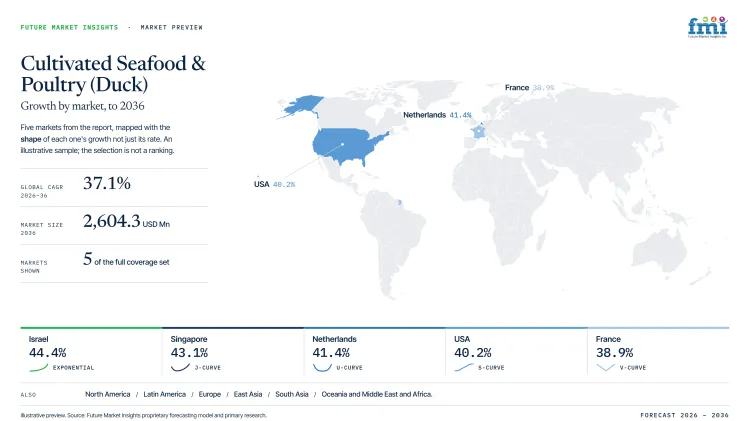
| Country | CAGR |
|---|---|
| France | 38.9% |
| Singapore | 43.1% |
| USA | 40.2% |
| Israel | 44.4% |
| Netherlands | 41.4% |
How do country-level CAGRs compare in the Cultivated Seafood & Poultry (Duck) Market?
The displayed country forecasts span 5.5 percentage points from France at 38.9% CAGR to Israel at 44.4% CAGR through 2036. Singapore joins Israel in the upper range, while France and the United States form a lower range. The Netherlands occupies a central position within the stated forecast range for the five profiled countries. Forecast rates show relative expansion rather than starting revenue bases or total addressable demand across commercial programs.
- Israel and Singapore combine defined novel-food routes with recent commercial activity that can support earlier channel planning. Their forecast position does not remove the need for complete safety dossiers and disciplined production controls.
- The Netherlands and the United States occupy the middle range under different operating conditions for cultivated-food commercialization. Dutch programs can access policy support for food innovation, while United States poultry programs coordinate FDA and USDA-FSIS responsibilities.
- France combines premium culinary development with the European novel-food authorization route for defined cultivated-food products. Its limited gap from the United States means approval progress and partner selection can change launch sequencing.
The country pattern favors selective capacity planning instead of a single global rollout across differentiated national routes. The full report compares national forecasts across North America, Latin America, Europe, East Asia, South Asia, Oceania and the Middle East and Africa.
Country-wise analysis
- France now has a cultivated-poultry platform following PARIMA’s October 2025 combination of Gourmey and Vital Meat’s Nantes cell-line capability. In France, cultivated seafood and poultry demand is predicted to advance at 38.9% CAGR through 2036, supported by local poultry cell-line expertise and premium culinary development. The combined Nantes platform gives food developers access to duck and chicken technical expertise near premium dining partners. European novel-food authorization remains a material friction; regular sale requires approval of the intended product and production process. Restaurants also need reliable product availability and a consistent specification to place cultivated items on repeat menus. This local platform can speed technical coordination among cell-line specialists, food scientists, processors and premium culinary partners.
- Singapore requires pre-market approval for novel foods entering restaurants, distribution, or retail sale across its domestic food system. Cultivated seafood and poultry demand in Singapore is forecast to rise at 43.1% CAGR over the forecast period, supported by a defined novel-food route and tightly concentrated foodservice distribution. The Singapore Food Agency list published in March 2026 includes cultured chicken and cultured Japanese quail within approved novel-food entries. The compact city-state concentrates regulators, cold-chain providers and restaurant partners within one tightly connected operating environment. A changed manufacturing process or intended use can require another regulatory review, creating a material constraint on expansion.
- United States cultivated-poultry programs follow a shared FDA and USDA-FSIS pathway that divides pre-harvest and inspection responsibilities. Cultivated seafood and poultry sales in the United States are forecast to expand at 40.2% CAGR by 2036, supported by a defined federal route for poultry products. FDA guidance updated in March 2025 assigns cell collection and growth to FDA oversight, while USDA-FSIS oversees poultry harvest and processing. The split route gives poultry producers a defined compliance sequence for commercial launch planning from dossier preparation through restaurant launch. Seafood follows a different FDA pathway, leaving species-specific records and inspection readiness as a material local friction. The divided roles also require teams to maintain records that match the relevant product and production stage.
- Israel’s novel-protein guidance requires a review for cultured meat marketed or imported within the country. Israel’s cultivated seafood and poultry outlook is anticipated to advance at 44.4% CAGR over the assessment period, supported by a national route that lets developers discuss product requirements with the food authority. Clear requirements for composition, production, intake and contaminants give local teams a defined dossier plan. The same evidence requirements create a material friction for developers whose production assumptions do not match the proposed food. Local launch planning therefore depends on a product description that matches the evidence prepared for review. Food developers need a production plan that matches the submitted dossier and the intended use.
- Dutch coalition policy supports food-production technology through grants and credit mechanisms that can assist private investment. The Netherlands is estimated to post 41.4% CAGR over the forecast period for cultivated seafood and poultry demand, supported by defined public support for food-production scale-up. The 2026 coalition agreement supplies a funding enabler for scale-up activities that meet program requirements. Investors can align staged funding with equipment commissioning, food-safety milestones and distributor engagement for defined commercialization milestones. European novel-food authorization remains a material friction, since investment assistance cannot satisfy the product safety review. Food developers must align investment plans with the product evidence required for a European novel-food authorization.
Who are the notable companies in the Cultivated Seafood & Poultry (Duck) Market?
PARIMA, Wildtype, GOOD Meat, BlueNalu, UPSIDE Foods, Mosa Meat, Aleph Farms and Vow are the notable companies profiled in this market.
-market-analysis-by-company.webp "Cultivated Seafood & Poultry (duck) Market Analysis By Company")
Regulatory status and a credible route to repeat production separate the profiled companies more clearly than broad technology claims. PARIMA combines cultivated duck and chicken capabilities, while Wildtype and BlueNalu develop cultivated seafood programs. GOOD Meat and UPSIDE Foods retain cultivated poultry relevance through United States and Singapore regulatory milestones. Commercial selection also depends on foodservice fit, manufacturing evidence and quality controls that work with food packaging systems and cold-chain requirements. Each profile needs assessment against documented product scope rather than a broad alternative-protein reputation in each target market.
- PARIMA and GOOD Meat support poultry programs with defined species routes and documented approval history. Their approved process and intended food use must align with the selected commercial format and geography. The review should focus on a precise species, food format and route to local sale in each country.
- Wildtype and BlueNalu address cultivated seafood through different species and market-entry priorities within the current competitive landscape. Restaurant and distribution partners must link product form with a managed frozen seafood chain that protects handling consistency during premium seafood service. Storage duties and handoff procedures also need agreement for repeat commercial orders across each nominated service location.
- UPSIDE Foods, Mosa Meat, Aleph Farms and Vow add poultry, beef, or quail routes to the comparison. Approval status, production geography and finished-food specifications determine which route fits local sale conditions for each candidate entry. The relevant comparison requires a precise species, product format, geography and completed approval status for each local market.
Competitive Benchmarking: Cultivated Seafood & Poultry (Duck) Market
| Company | Species | Technology | Approval Status | Geographic Reach |
|---|---|---|---|---|
| PARIMA | High | High | High | Asia and Europe |
| Wildtype | Medium | High | High | United States |
| GOOD Meat | Medium | High | High | Singapore and United States |
| BlueNalu | Medium | High | Medium | United States, United Kingdom and Europe |
| UPSIDE Foods | Medium | High | High | United States |
| Mosa Meat | Medium | High | Medium | Europe |
| Aleph Farms | Medium | High | High | Israel |
| Vow | Medium | High | High | Australia and New Zealand |
Key Developments in the Cultivated Seafood & Poultry (Duck) Market
- In April 2025, BlueNalu expanded its Nomad Foods partnership to support planned seafood commercialization in the United Kingdom and Europe. The company also entered the United Kingdom Food Standards Agency regulatory sandbox for novel-food review. The development links a seafood program with regional food distribution and formal regulatory engagement for selected food products. It supports entry planning but does not confirm completed food authorization or consumer sales in those defined geographies.
- In June 2025, Vow received a Food Standards Australia New Zealand code amendment permitting cell-cultured quail as food. The authority recorded Vow Group as applicant in its formal novel-food application submitted to the national food authority. The decision creates a lawful-sale route for the defined quail product, not for unrelated species or manufacturing changes. The code change gives restaurants a lawful product category to evaluate within the approved scope.
- In December 2025, BlueNalu raised approximately USD 11 million through an insider-led convertible note and preferred-stock financing for cell-cultivated bluefin tuna toro. The company said proceeds would support manufacturing readiness, regulatory engagement and premium foodservice planning across target regions. The financing adds resources for the next operating stage but does not confirm product approval or completed commercial sales. The funds do not remove the need for regulator clearance or dependable production performance at commercial scale.
- In June 2026, Wildtype announced cultivated salmon service at barmini in Washington, D.C., beginning June 3. The named restaurant created a documented foodservice use case for the company’s cultivated seafood program. The announcement supports commercial relevance at that venue, although it does not establish broader United States distribution. Service at the venue gives chefs a direct reference point for handling and menu preparation.
Key Players in the Cultivated Seafood & Poultry (Duck) Market
Core Technology and Ingredient Developers
- PARIMA
- Mosa Meat
- Aleph Farms
Scaled Manufacturing and Supply Groups
- Wildtype
- BlueNalu
- Vow
Application and Commercialization Specialists
- GOOD Meat
- UPSIDE Foods
Cultivated Seafood & Poultry (Duck) Market - Report Scope
-market-breakdown-by-species,-technology,-and-region.webp "Cultivated Seafood & Poultry (duck) Market Breakdown By Species, Technology, And Region")
| Coverage Field | Report Scope |
|---|---|
| Market breakdown | Species, technology, approval status and region. |
| Quantitative units | Revenue in USD Million, CAGR in %. |
| Market definition | Cultivated seafood and poultry products, including duck, produced through cell culture and related scaffolding processes. |
| Regions covered | North America, Latin America, Europe, East Asia, South Asia, Oceania and Middle East and Africa. |
| Countries covered | France, Singapore, USA, Israel, Netherlands and more than twenty-five additional countries. |
| Key companies profiled | PARIMA, Wildtype, GOOD Meat, BlueNalu, UPSIDE Foods, Mosa Meat, Aleph Farms and Vow |
| Forecast Period | 2026 to 2036. |
| Approach | Hybrid bottom-up and top-down market sizing supported by primary interviews, official desk research and commercial analysis. |
Cultivated Seafood & Poultry (Duck) Market - Research Methodology
| Method | Approach |
|---|---|
| Primary Research | FMI analysts gathered input from manufacturers, service providers, technology developers, distributors, end users, sourcing teams and subject-matter experts. Interviews examined purchasing decisions, product or service evaluation, adoption barriers, approval requirements, pricing considerations and expectations for technical or commercial support. Respondents were also asked what evidence is required before a trial, pilot, or initial order develops into regular purchasing. |
| Desk Research | Desk research covered government statistics, regulatory publications, trade data, industry associations, technical literature, standards, company filings, product information and official corporate announcements. Sources were reviewed for relevance, publication date, geographic coverage and consistency with the defined market scope. Claims relating to performance, applications, approvals, capacity, investment and commercial activity were retained only when supported by credible public evidence. |
| Market Sizing and Forecasting | The market model combined the baseline value with historical performance, segment structure, pricing and volume indicators, adoption levels, company participation and country-level demand conditions. Forecast assumptions considered economic activity, investment trends, regulatory developments, technology adoption, purchasing cycles, supply availability and barriers to wider market use. Segment and regional estimates were reconciled before the final market total was calculated. |
| Data Validation | Estimates were checked against multiple independent indicators, including public data, company activity, trade patterns, industry developments and findings from primary interviews. Validation also tested whether products, services, applications and company revenues fell within the defined market boundaries. Adjacent categories, unsupported claims, overlapping revenues and activities without direct market relevance were excluded to reduce double counting and maintain consistency across segments and countries. |
Cultivated Seafood & Poultry (Duck) Market by Segments
Cultivated Seafood & Poultry (Duck) Market segmented by species:
- Duck
- Chicken
- Beef
- Seafood
Cultivated Seafood & Poultry (Duck) Market segmented by technology:
- Cell culture
- Scaffolding
Cultivated Seafood & Poultry (Duck) Market segmented by approval status:
- Approved
- Pending review
- Under development
- Regionally restricted
Cultivated Seafood & Poultry (Duck) Market by Region:
- North America
- United States
- Canada
- Latin America
- Brazil
- Mexico
- Argentina
- Chile
- Western Europe
- Germany
- France
- United Kingdom
- Italy
- Spain
- Benelux
- Nordics
- Eastern Europe
- Poland
- Czech Republic
- Romania
- Hungary
- East Asia
- China
- Japan
- South Korea
- South Asia and Pacific
- India
- ASEAN
- Australia and New Zealand
- Middle East and Africa
- GCC Countries
- South Africa
- Türkiye
- Israel
Research Sources and Bibliography
- Aleph Farms. (2024, January 17). Aleph Farms Granted World’s First Regulatory Approval for Cultivated Beef.
- BlueNalu. (2025, April 29). BlueNalu Expands Partnership with Nomad Foods as New Research Shows Strong UK Consumer Demand.
- BlueNalu. (2025, December 29). BlueNalu Announces Insider-Led Convertible Note and Preferred Stock Financings to Advance Commercialization of Cell-Cultivated Bluefin Tuna Toro.
- Food Standards Agency. (2026, June 25). CCP Sandbox Progress Report.
- Food Standards Australia New Zealand. (2025, June 18). A1269-Cultured Quail as a Novel Food.
- GOOD Meat. (2023, June 21). GOOD Meat Gets Full Approval in the USA for Cultivated Meat.
- Government of the Netherlands. (2026, January 30). 2026-2030 Coalition Agreement: Let’s Get to Work - Building a Better Netherlands.
- Israel Ministry of Health. (2024, December). Guidance Document on the Submission of an Application for the Approval as “Novel Food” of “Novel Proteins” (Alternative Proteins) Derived from Cell Culture Originating in Animals, Plants, or Microorganisms.
- PARIMA. (2025, October 15). Gourmey Acquires Vital Meat to Form PARIMA, a Global Leader in protein innovation.
- PARIMA. (2026, April 15). PARIMA Becomes the First Company to Obtain Cultivated Food Approval Across Two Species.
- Singapore Food Agency. (2025, March 17). Requirements for the Safety Assessment of Novel Foods and Novel Food Ingredients.
- Singapore Food Agency. (2026, March 17). SFA List of Approved Novel Foods.
- Tim van de Rijdt. (2025, January 22). Submitting Our First EU Market Authorisation Request.
- USA Food and Drug Administration. (2025, March 7). Human Food Made with Cultured Animal Cells.
- UPSIDE Foods. (2023, June 20). The UpShot: How Do the FDA and USDA Regulate Cultivated Meat?
- Wildtype. (2026, June). Holy mackerel, José Andrés Is Serving Wildtype at barmini!
This bibliography is provided for reader reference and is not exhaustive. The full report contains the complete reference list and detailed citations.
This Report Answers
- How large is the cultivated seafood & poultry (duck) market in 2026 and 2036?
- Which production and approval conditions support commercial planning for cultivated seafood and duck?
- Why is duck projected to account for a notable species share in 2026?
- How does cell culture influence tissue development and manufacturing consistency?
- Why does approved hold commercial importance within the approval status category?
- How do country growth rates differ across the five profiled national markets?
- Which companies retain current relevance across cultivated duck poultry and seafood programs?
- What restrains scale-up of cultivated seafood and poultry products?
- What should foodservice and manufacturing teams assess for commercial expansion?
Frequently Asked Questions
How big is the Cultivated Seafood & Poultry (Duck) Market in 2026?
The cultivated seafood and poultry duck market is valued at USD 111.0 million in 2026 and is forecast to reach USD 2604.3 million by 2036. Growth reflects cultured meat processes that document cell source, production controls, and intended food use across repeatable commercial launch routes.
What is the CAGR of the Cultivated Seafood & Poultry (Duck) Market from 2026 to 2036?
The cultivated seafood and poultry duck market grows at a CAGR of 37.1% between 2026 and 2036, supported by premium seafood and duck formats that reward consistent taste, texture, and preparation performance across scheduled restaurant service.
Which species leads the Cultivated Seafood & Poultry (Duck) Market?
Duck accounts for 43.9% of the cultivated seafood and poultry market by species in 2026, driven by premium menus that value familiar flavor and fat attributes suited to specific foodservice preparation and repeatable chef handling.
How much will the Cultivated Seafood & Poultry (Duck) Market add between 2026 and 2036?
The cultivated seafood and poultry duck market is set to add USD 2493.3 million between 2026 and 2036, growing from USD 111.0 million to USD 2604.3 million as approved species routes extend across a widening base of premium foodservice channels.
Who are the leading companies in the Cultivated Seafood & Poultry (Duck) Market?
Five companies lead the cultivated seafood and poultry duck market, including PARIMA, Wildtype, BlueNalu, GOOD Meat, and UPSIDE Foods, competing through species capability, documented regulatory status, and cultivated duck, chicken, seafood, or beef commercialization routes.
Preview the report firsthand - request a free sample
Get SampleGet the brochure for pricing and purchase details.
Get PDFTable of Content
- Key Takeaways
- Market Size and CAGR
- Top Growth Driver
- Fastest Growing Segment
- Leading Region
- Key Companies
- Emerging Opportunities
- Executive Summary
- Global Market Outlook
- Demand-side Trends
- Supply-side Trends
- Technology Roadmap Analysis
- Analysis and Recommendations
- Analyst Perspective (What is happening? Why now? What should investors know?)
- Key Questions Answered
- How large is the market?
- What is the CAGR?
- What are key trends?
- Which region dominates?
- Who are the leaders?
- Market Overview
- Market Coverage / Taxonomy
- Market Definition / Scope / Limitations
- Research Methodology
- Chapter Orientation
- Analytical Lens and Working Hypotheses
- Market Structure, Signals, and Trend Drivers
- Benchmarking and Cross-market Comparability
- Market Sizing, Forecasting, and Opportunity Mapping
- Research Design and Evidence Framework
- Desk Research Programme (Secondary Evidence)
- Expert Input and Fieldwork (Primary Evidence)
- Tooling, Models, and Reference Databases
- Data Engineering and Model Build
- Quality Assurance and Audit Trail
- Market Background
- Market Dynamics (Drivers, Restraints, Opportunity, Trends)
- Scenario Forecast (Optimistic, Likely, Conservative)
- Impact Analysis
- AI Impact
- Sustainability Impact
- Regulatory Impact
- Technology Impact
- Consumer / Buyer Analysis
- Purchase Drivers
- Adoption Barriers
- Buyer Journey
- Opportunity Map Analysis
- Product Life Cycle Analysis
- Supply Chain Analysis
- Investment Feasibility Matrix
- Value Chain Analysis
- PESTLE and Porter's Analysis
- Regulatory Landscape
- Regional Parent Market Outlook
- Production and Consumption Statistics
- Import and Export Statistics
- Global Market Analysis and Forecast, 2021 to 2036
- Historical Market Size Value (USD Million) Analysis, 2021 to 2025
- Current and Future Market Size Value (USD Million) Projections, 2026 to 2036
- Y-o-Y Growth Trend Analysis
- Absolute $ Opportunity Analysis
- Global Market Pricing Analysis, 2021 to 2036
- Global Market Analysis and Forecast, By Species, 2021 to 2036
- Introduction / Key Findings
- Historical Market Size Value (USD Million) Analysis By Species, 2021 to 2025
- Current and Future Market Size Value (USD Million) Analysis and Forecast By Species, 2026 to 2036
- Duck
- Chicken
- Beef
- Seafood
- Duck
- Y-o-Y Growth Trend Analysis By Species, 2021 to 2025
- Absolute $ Opportunity Analysis By Species, 2026 to 2036
- Global Market Analysis and Forecast, By Technology, 2021 to 2036
- Introduction / Key Findings
- Historical Market Size Value (USD Million) Analysis By Technology, 2021 to 2025
- Current and Future Market Size Value (USD Million) Analysis and Forecast By Technology, 2026 to 2036
- Cell Culture
- Scaffolding
- Cell Culture
- Y-o-Y Growth Trend Analysis By Technology, 2021 to 2025
- Absolute $ Opportunity Analysis By Technology, 2026 to 2036
- Global Market Analysis and Forecast, By Approval Status, 2021 to 2036
- Introduction / Key Findings
- Historical Market Size Value (USD Million) Analysis By Approval Status, 2021 to 2025
- Current and Future Market Size Value (USD Million) Analysis and Forecast By Approval Status, 2026 to 2036
- Approved
- Pending Review
- Under Development
- Regionally Restricted
- Approved
- Y-o-Y Growth Trend Analysis By Approval Status, 2021 to 2025
- Absolute $ Opportunity Analysis By Approval Status, 2026 to 2036
- Global Market Analysis and Forecast, By Region, 2021 to 2036
- Introduction
- Historical Market Size Value (USD Million) Analysis By Region, 2021 to 2025
- Current Market Size Value (USD Million) Analysis and Forecast By Region, 2026 to 2036
- North America
- Latin America
- Western Europe
- Eastern Europe
- East Asia
- South Asia and Pacific
- Middle East & Africa
- Market Attractiveness Analysis By Region
- North America Market Analysis and Forecast, By Country, 2021 to 2036
- Historical Market Size Value (USD Million) Trend Analysis By Market Taxonomy, 2021 to 2025
- Market Size Value (USD Million) Forecast By Market Taxonomy, 2026 to 2036
- By Country
- USA
- Canada
- By Species
- By Technology
- By Approval Status
- By Country
- Market Attractiveness Analysis
- By Country
- By Species
- By Technology
- By Approval Status
- Key Takeaways
- Latin America Market Analysis and Forecast, By Country
- Historical Market Size Value (USD Million) Trend Analysis By Market Taxonomy, 2021 to 2025
- Market Size Value (USD Million) Forecast By Market Taxonomy, 2026 to 2036
- By Country
- Brazil
- Mexico
- Chile
- Rest of Latin America
- By Species
- By Technology
- By Approval Status
- By Country
- Market Attractiveness Analysis
- By Country
- By Species
- By Technology
- By Approval Status
- Key Takeaways
- Western Europe Market Analysis and Forecast, By Country
- Historical Market Size Value (USD Million) Trend Analysis By Market Taxonomy, 2021 to 2025
- Market Size Value (USD Million) Forecast By Market Taxonomy, 2026 to 2036
- By Country
- Germany
- UK
- Italy
- Spain
- France
- Nordic
- BENELUX
- Rest of Western Europe
- By Species
- By Technology
- By Approval Status
- By Country
- Market Attractiveness Analysis
- By Country
- By Species
- By Technology
- By Approval Status
- Key Takeaways
- Eastern Europe Market Analysis and Forecast, By Country
- Historical Market Size Value (USD Million) Trend Analysis By Market Taxonomy, 2021 to 2025
- Market Size Value (USD Million) Forecast By Market Taxonomy, 2026 to 2036
- By Country
- Russia
- Poland
- Hungary
- Balkan & Baltic
- Rest of Eastern Europe
- By Species
- By Technology
- By Approval Status
- By Country
- Market Attractiveness Analysis
- By Country
- By Species
- By Technology
- By Approval Status
- Key Takeaways
- East Asia Market Analysis and Forecast, By Country
- Historical Market Size Value (USD Million) Trend Analysis By Market Taxonomy, 2021 to 2025
- Market Size Value (USD Million) Forecast By Market Taxonomy, 2026 to 2036
- By Country
- China
- Japan
- South Korea
- By Species
- By Technology
- By Approval Status
- By Country
- Market Attractiveness Analysis
- By Country
- By Species
- By Technology
- By Approval Status
- Key Takeaways
- South Asia and Pacific Market Analysis and Forecast, By Country
- Historical Market Size Value (USD Million) Trend Analysis By Market Taxonomy, 2021 to 2025
- Market Size Value (USD Million) Forecast By Market Taxonomy, 2026 to 2036
- By Country
- India
- ASEAN
- Australia & New Zealand
- Rest of South Asia and Pacific
- By Species
- By Technology
- By Approval Status
- By Country
- Market Attractiveness Analysis
- By Country
- By Species
- By Technology
- By Approval Status
- Key Takeaways
- Middle East & Africa Market Analysis and Forecast, By Country
- Historical Market Size Value (USD Million) Trend Analysis By Market Taxonomy, 2021 to 2025
- Market Size Value (USD Million) Forecast By Market Taxonomy, 2026 to 2036
- By Country
- Kingdom of Saudi Arabia
- Other GCC Countries
- Türkiye
- South Africa
- Other African Union
- Rest of Middle East & Africa
- By Species
- By Technology
- By Approval Status
- By Country
- Market Attractiveness Analysis
- By Country
- By Species
- By Technology
- By Approval Status
- Key Takeaways
- Key Countries Market Analysis
- USA
- Pricing Analysis
- Market Share Analysis, 2025
- By Species
- By Technology
- By Approval Status
- Canada
- Pricing Analysis
- Market Share Analysis, 2025
- By Species
- By Technology
- By Approval Status
- Mexico
- Pricing Analysis
- Market Share Analysis, 2025
- By Species
- By Technology
- By Approval Status
- Brazil
- Pricing Analysis
- Market Share Analysis, 2025
- By Species
- By Technology
- By Approval Status
- Chile
- Pricing Analysis
- Market Share Analysis, 2025
- By Species
- By Technology
- By Approval Status
- Germany
- Pricing Analysis
- Market Share Analysis, 2025
- By Species
- By Technology
- By Approval Status
- UK
- Pricing Analysis
- Market Share Analysis, 2025
- By Species
- By Technology
- By Approval Status
- Italy
- Pricing Analysis
- Market Share Analysis, 2025
- By Species
- By Technology
- By Approval Status
- Spain
- Pricing Analysis
- Market Share Analysis, 2025
- By Species
- By Technology
- By Approval Status
- France
- Pricing Analysis
- Market Share Analysis, 2025
- By Species
- By Technology
- By Approval Status
- India
- Pricing Analysis
- Market Share Analysis, 2025
- By Species
- By Technology
- By Approval Status
- ASEAN
- Pricing Analysis
- Market Share Analysis, 2025
- By Species
- By Technology
- By Approval Status
- Australia & New Zealand
- Pricing Analysis
- Market Share Analysis, 2025
- By Species
- By Technology
- By Approval Status
- China
- Pricing Analysis
- Market Share Analysis, 2025
- By Species
- By Technology
- By Approval Status
- Japan
- Pricing Analysis
- Market Share Analysis, 2025
- By Species
- By Technology
- By Approval Status
- South Korea
- Pricing Analysis
- Market Share Analysis, 2025
- By Species
- By Technology
- By Approval Status
- Russia
- Pricing Analysis
- Market Share Analysis, 2025
- By Species
- By Technology
- By Approval Status
- Poland
- Pricing Analysis
- Market Share Analysis, 2025
- By Species
- By Technology
- By Approval Status
- Hungary
- Pricing Analysis
- Market Share Analysis, 2025
- By Species
- By Technology
- By Approval Status
- Kingdom of Saudi Arabia
- Pricing Analysis
- Market Share Analysis, 2025
- By Species
- By Technology
- By Approval Status
- Türkiye
- Pricing Analysis
- Market Share Analysis, 2025
- By Species
- By Technology
- By Approval Status
- South Africa
- Pricing Analysis
- Market Share Analysis, 2025
- By Species
- By Technology
- By Approval Status
- USA
- Market Structure Analysis
- Competition Dashboard
- Competition Benchmarking
- Market Share Analysis of Top Players
- By Regional
- By Species
- By Technology
- By Approval Status
- Emerging Startups
- Innovation Benchmarking
- Competition Analysis
- Competition Deep Dive
- Parima
- Overview
- Product Portfolio
- Profitability by Market Segments
- Sales Footprint
- Strategy Overview
- Marketing Strategy
- Product Strategy
- Channel Strategy
- Gourmey
- Vital Meat
- Wildtype
- BlueNalu
- UPSIDE Foods
- GOOD Meat
- Parima
- Case Studies
- Success Stories
- Recent Developments
- Competition Deep Dive
- Assumptions & Acronyms Used


