

- Market Size (2026)
- USD 860.6 Mn
- Forecast (2036)
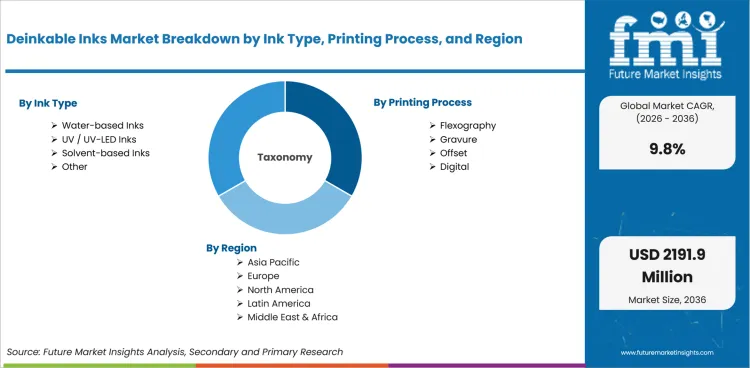
- USD 2191.9 Mn
- CAGR (2026 to 2036)
- 9.8%
How big is the deinkable inks market in 2026?
USD 860.6 million in 2026 and USD 2,191.9 million by 2036 at a 9.8% CAGR.
The deinkable inks industry value is forecast to grow from USD 783.8 million in 2025 to USD 2,191.9 million by 2036 at 9.8% CAGR as packaging converters shift ink selection toward recovery proof and recycler acceptance. Direct to Printers / Converters is expected to secure 64.0% share in 2026 because pressroom trials and wash testing are central to buying decisions. Water-based Inks are projected to represent 46.5% share in 2026 because paper and board recovery systems favor washable chemistry and lower residue formation.
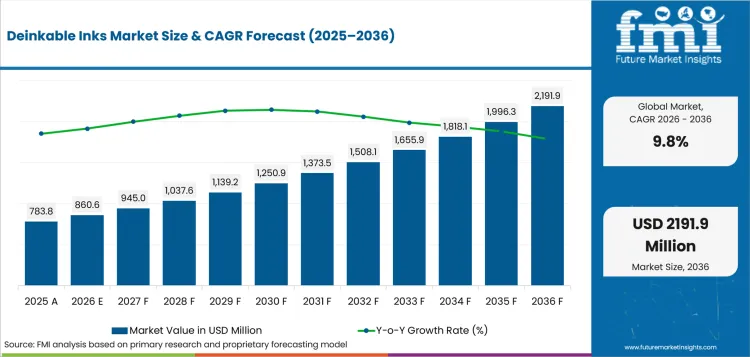
Deinkable Inks Market Overview: Size and Forecast
- 2025 Market Size: USD 783.8 million
- 2026 Market Size: USD 860.6 million
- 2036 Market Size: USD 2,191.9 million
- Forecast CAGR: 9.8% from 2026 to 2036
- Leading Sales Channel: Direct to Printers / Converters
- Direct to Printers / Converters Share in 2026: 64.0%
- Leading Ink Type: Water-based Inks
- Water-based Inks Share in 2026: 46.5%
- Fastest-growing Country: China
- China CAGR: 10.8% by 2036
Summary of the Deinkable Inks Market
- Demand and Growth Drivers
- Packaging brands are moving ink selection closer to recyclability scoring and recovery proof.
- Converters are asking suppliers for wash-off performance before changing labels, cartons, and plastic cups.
- Regulatory teams are reviewing print layers as part of broader sustainable packaging market outlook requirements.
- Product and Segment View
- Direct to Printers / Converters is projected to hold 64.0% share in 2026, influenced by technical trials and wash-test coordination.
- Water-based Inks are forecast to represent 46.5% share in 2026, supported by paperboard recovery and mill-facing deinking routines.
- Paper & Board is expected to account for 44.0% share in 2026, led by carton recycling systems that need cleaner recovered fiber.
- Geography and Competitive Outlook
- China is projected to record 10.8% CAGR by 2036, backed by waste sorting coverage and export packaging requirements.
- India is expected to expand at 10.5% CAGR by 2036 as packaging rules and local ink manufacturing improve together.
- hubergroup and Siegwerk compete through validated deinking systems for labels, films, and paper packaging.
- Sun Chemical, Flint Group, and artience focus on washable inks, NC-free technologies, and deinking coatings for converter trials.
- Analyst Opinion
- Nandini Roy Choudhury, Principal Consultant for Packaging at FMI, observes, "Deinkable inks are moving from a sustainability claim into a packaging approval tool. Buyers now ask whether the printed layer separates cleanly during recycling and whether recovered material keeps value. Suppliers with deinking proof, food packaging compliance, and converter service can defend price better than suppliers selling standard ink alone."
Packaging recovery policy is the central outlook driver for deinkable inks as buyers connect print approval with recycling performance. The United States environmental authority keeps a 50% national recycling rate goal for 2030, which supports cleaner label and cup recovery trials. UK plastic packaging tax rules apply when plastic packaging contains less than 30% recycled plastic and reached £228.82 per tonne from 1 April 2026. U.S. Plastics Pact reporting shows 54% of Activator plastic packaging is now reusable, recyclable, or compostable and average PCR or responsibly sourced biobased content reached 14%. These figures show why converters increasingly test ink removal before brands approve packaging graphics.
Which factors support expansion in the deinkable inks market?
Verified ink-removal performance and direct converter support strengthen market value across recyclable packaging programs.
- Market value is supported by finished ink systems that can prove wash-off performance before brand packaging approval.
- Supplier pricing reflects formulation work and recycler-facing validation before print color strength affects repeat buying.
- Revenue improves as brand owners connect recyclable packaging industry analysis with ink selection and substrate recovery.
- Converter trust rises as technical teams compare press performance, recovery evidence, and food packaging compliance together.
Why is the deinkable inks market growing?
Packaging recyclability rules push converters to prove ink removal during material recovery.
Deinkable inks are gaining adoption because packaging buyers increasingly treat ink as part of recycling quality rather than a minor print input. The European Commission states that all packaging on the EU market must be recyclable by 2030, pushing printed packs toward stronger end-of-life proof. Eurostat reported in October 2025 that each EU resident generated 35.3 kg of plastic packaging waste in 2023 and 14.8 kg was recycled, showing why ink removal is becoming part of material-quality planning. This supports eco-friendly inks market outlook decisions because buyers want printed packs that protect recovered fiber, PET flakes, and film recyclate quality.
How is the deinkable inks market segmented?
The deinkable inks industry is segmented by ink type, printing process, substrate, end use, and sales channel.
- Water-based Inks is projected to secure 46.5% share in 2026, led by paperboard recycling systems that favor washable chemistry and lower residue after pulping.
- Flexography is projected to secure 42.0% share in 2026, since wide-web converters need fast runs across labels, cartons, and flexible packages.
- Paper & Board is projected to secure 44.0% share in 2026, with carton mills seeking cleaner recovered fiber and more stable brightness after recycling.
- Food & Beverage Packaging is projected to secure 38.5% share in 2026, as packaged food brands balance print safety, shelf appeal, and pack recovery requirements.
- Direct to Printers / Converters is projected to secure 64.0% share in 2026, with pressroom testing and supplier technical support guiding product approval.
Which ink type leads the deinkable inks market?
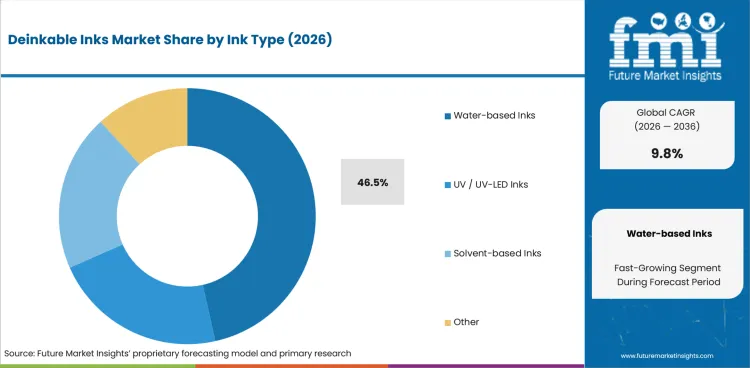
- Water-based Inks is expected to account for 46.5% share in 2026, influenced by fiber recovery needs and easier compatibility with paper and board deinking systems.
- UV / UV-LED systems need more primer work as cured ink films can resist wash steps and raise residue concerns.
Which printing process leads the deinkable inks market?
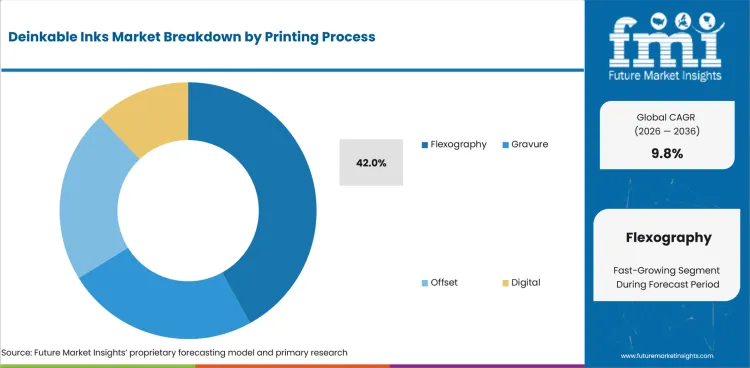
- Flexography is expected to account for 42.0% share in 2026, supported by high-speed packaging lines and wide coverage across labels, films, and cartons.
- Gravure remains important for high-coverage films but needs tighter solvent balance and recycling validation.
Which substrate leads the deinkable inks market?
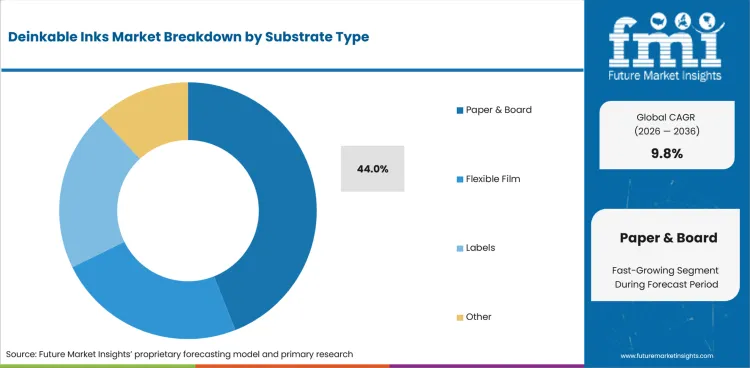
- Paper & Board is expected to account for 44.0% share in 2026, reflected by carton recovery systems that already use cleaning and deinking steps.
- Flexible Film creates stricter deinking needs because ink bleed can discolor washed flakes and reduce output value.
Which end use leads the deinkable inks market?
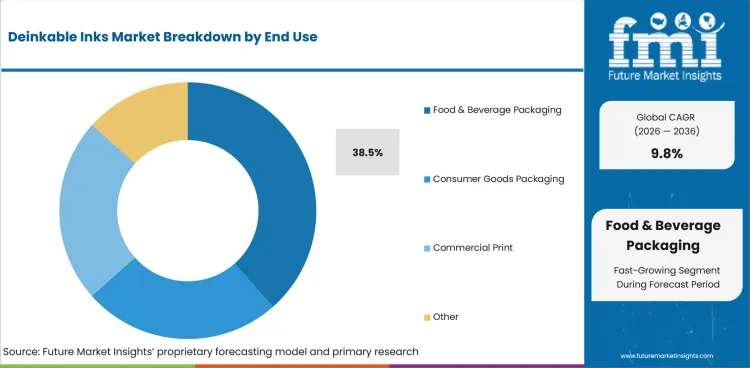
- Food & Beverage Packaging is expected to account for 38.5% share in 2026, led by branded packaged foods that need safe graphics and recyclable pack designs.
- Consumer Goods Packaging gains use when beauty and home-care brands request premium graphics with recovery proof.
Which sales channel leads the deinkable inks market?
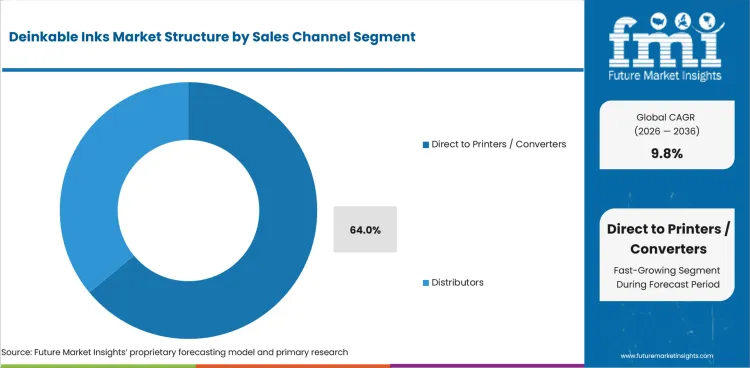
- Direct to Printers / Converters is expected to account for 64.0% share in 2026, shaped by converter trials, technical service, and supplier-controlled performance documentation.
- Distributors remain useful for smaller printers but technical approval often returns to ink manufacturers.
What are the driver, restraints, and opportunities in the deinkable inks market?
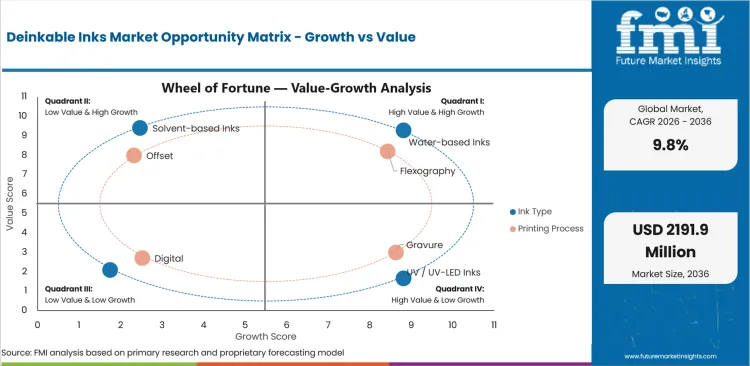
Recyclability scoring and wash-off evidence support growth while validation cost limits faster channel expansion.
- Driver: Brand packaging teams are moving ink removal into recyclable packaging approval and supplier audits.
- Restraint: Some high-performance ink systems require longer testing when food-contact and wash-off needs overlap.
- Opportunity: Validated deinking primers can create new value in labels and sleeves where cured inks resist removal.
Recyclability Rule Pull for Deinkable Inks
Regulation is the clearest driver because printed layers now affect recycling performance before a pack reaches the converter. European Commission guidance states that EU members must collect at least 90% of single-use plastic and metal beverage containers separately by 2029. This target makes ink removal more important when brands compare labels, films, cups, and carton packs under recyclability programs. Suppliers with documented wash-off performance can gain better specification access because recyclers and buyers can link ink removal to recovered material quality.
Validation Cost and Recovery System Restraint
Adoption is restrained by uneven qualification work because each ink, substrate, wash process, and food-contact profile needs testing before approval. U.S. Plastics Pact’s April 2025 PCR barriers report drew on insights from more than 100 member organizations, showing that circular packaging adoption still depends on supply, demand, and financial coordination. That complexity slows smaller converter adoption when buyers need proof across labels, sleeves, cartons, and flexible packaging formats.
Wash-off Primers and Brand Opportunity
Opportunity improves as brand groups use packaging targets to justify early validation for labels and sleeves. EUR-Lex states that 40% of transport packaging must be reusable by 2030, which creates a clearer business case for recoverable print systems in higher-volume logistics formats. This creates a stronger case for deinking primers and washable inks that help printed packs meet recovery expectations without weakening shelf appeal.
Deinkable Inks Market Demand Outlook
Demand outlook is moving toward packaging ink systems that can prove deinking before printed packs enter commercial production. Eurostat reported that EU packaging waste reached 79.7 million tonnes in 2023, and paper and cardboard represented 40.4% of that waste stream. That makes fiber brightness and ink removal more valuable for converters working on cartons, sleeves, labels, and printed cups. Suppliers serving water-borne inks and paints market outlook applications can gain stronger approval when they show documented wash-off performance and pressroom support.
Converter Purchase Behavior Analysis
Current packaging converters and label printers form the main switching pool for deinkable inks because they manage press setup, substrate changes, and customer approvals. RecyClass recognized Flint Group NC-free technologies in 2026 for flexible packaging applications, and approval covered technologies used in established recycling streams. This makes third-party validation a purchase factor for buyers serving branded food, beverage, and personal care accounts. Repeat buying will depend on whether the ink performs reliably across press speed, adhesion, color density, and wash steps.
Voice of Customer and Decision-driver Analysis
Purchase decisions are shaped by recycler acceptance, food-contact compliance, and service support at the press. Sun Chemical stated in July 2025 that its SunCure EcoPlast washable UV offset range supports wash-off performance for printed plastic cups while meeting low-migration requirements. This matters because buyers want deinkability without losing food packaging safety or print quality. For flexible plastic packaging industry analysis needs, converters also compare ink bleed, wash-water discoloration, and flake value before changing qualified systems.
Which countries are growing fastest in the deinkable inks market?
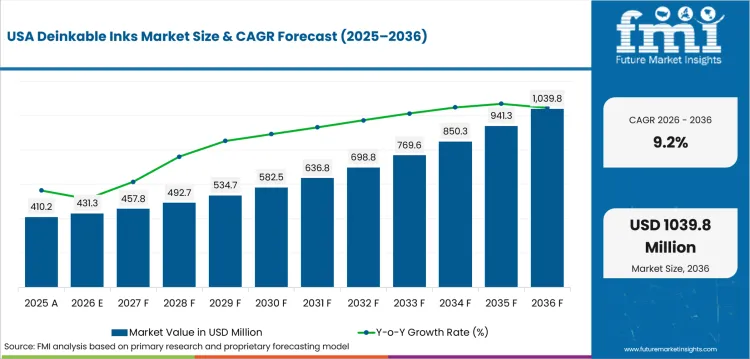
China 10.8% CAGR, India 10.5% CAGR, Germany 10.2% CAGR, South Korea 10.1% CAGR, France 9.7% CAGR, Japan 9.6% CAGR, United States 9.2% CAGR, and United Kingdom 9.0% CAGR through 2036.
.webp "Top Country Growth Comparison Deinkable Inks Market Cagr (2026 2036)")
| Country | CAGR |
|---|---|
| United States | 9.2% |
| United Kingdom | 9.0% |
| Germany | 10.2% |
| France | 9.7% |
| Japan | 9.6% |
| China | 10.8% |
| South Korea | 10.1% |
| India | 10.5% |
Source: Future Market Insights, 2026.
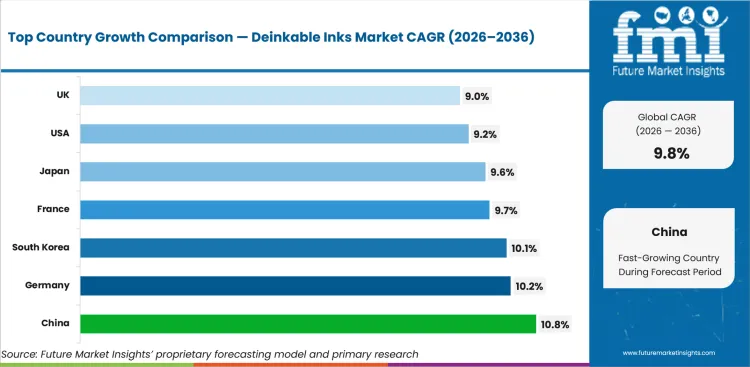
How do country-level CAGRs compare in the deinkable inks market?
China leads country growth while the United Kingdom records the most cautious expansion outlook among profiled markets.
- United States is projected to post 9.2% CAGR by 2036 as recycler-recognized label and cup applications move into brand packaging programs.
- United Kingdom is projected to post 9.0% CAGR by 2036 with plastic tax pressure and retailer packaging tenders shaping selective adoption.
- Germany is projected to post 10.2% CAGR by 2036 as EU regulation and local supplier depth support validated deinking systems.
- France is projected to post 9.7% CAGR by 2036 as plastic packaging recovery risk pushes brand packaging redesign.
- Japan is projected to post 9.6% CAGR by 2036 as structured recycling schemes and local technology suppliers support material-loop trials.
- China is projected to post 10.8% CAGR by 2036 as waste sorting coverage and export packaging specifications increase trial volume.
- South Korea is projected to post 10.1% CAGR by 2036 as EPR rules and premium cosmetics packaging needs converge.
- India is projected to post 10.5% CAGR by 2036 as draft EPR targets and local ink capacity support converter trials.
How fast is the deinkable inks market growing in United States?
A 9.2% CAGR through 2036 reflects country-specific packaging recovery rules and converter validation requirements.
Country Market Snapshot Table
| Parameter | Value |
|---|---|
| Market Size in 2025 (Value) | USD 143.3 million |
| Market Size in 2026 (Value) | USD 156.5 million |
| Market Forecast in 2036 (Value) | USD 377.3 million |
| CAGR (2026 to 2036) | 9.2% |
| Years Considered | 2021 to 2036 |
| Base Year | 2025 |
| Forecast Period | 2026 to 2036 |
| Units Considered | Value (USD million) |
| Leading Sub-Region | South Atlantic and beverage-label converter corridors |
United States Deinkable Inks Market Outlook
United States demand is shaped by beverage labels, printed cups, and brand packaging teams that need practical recycler acceptance. Direct converter relationships are important because each printed pack must be tested against its own substrate and recovery route.
Suppliers with label, sleeve, and cup deinking proof should gain better access to national converters. Smaller printers may need distributor support before switching from standard packaging inks.
Key Growth Drivers
- National recycling strategy pressure supports cleaner printed packaging because environmental authorities set a 50% national recycling rate goal for 2030.
- Beverage and personal care brands need label systems that limit PET flake discoloration during hot-wash recovery.
- Foodservice cup printers gain a practical trial case as Sun Chemical designed SunCure EcoPlast for automated MX12 dispensing and post-consumer wash-off recycling.
- Large converters can work directly with ink suppliers when brand owners request recycler-recognized testing before commercial launch.
Key Restraints
- State-level recycling rules differ widely and can slow one national approval route for printed packs.
- APR-style recyclability definitions can raise proof needs since packaging may need to show a 30% postconsumer recycling rate in applicable regions.
- Higher deinkable ink costs can delay conversion among regional printers with lower brand-backed recyclability pressure.
What makes United States unique
United States is unique because recycler-recognized label and cup performance can influence brand decisions before federal recycling rules become uniform.
Key Companies
- Sun Chemical
- INX International Ink Co.
- Flint Group
- DIC Corporation
- Siegwerk USA
- Nazdar Ink Technologies
- Zeller+Gmelin
Sales & Marketing Channels
- Direct sales to beverage label converters
- Technical trials with cup decorators
- Brand owner packaging specification teams
- Distributor support for regional printers
- Recycler-facing qualification programs
- Foodservice packaging converter networks
Country Segment Breakdown Table
| Segment | Sub-Segments |
|---|---|
| By Ink Type | Water-based Inks · UV / UV-LED Inks · Solvent-based Inks · Other |
| By Printing Process | Flexography · Gravure · Offset · Digital |
| By Substrate | Paper & Board · Flexible Film · Labels · Other |
| By End Use | Food & Beverage Packaging · Consumer Goods Packaging · Commercial Print · Other |
| By Sales Channel | Direct to Printers / Converters · Distributors |
| Key Sub-Regions Covered, Packaging Converter Regions | Southeast · Midwest · Texas · California · New York · Pacific Northwest |
Frequently Asked Questions
How fast is United States deinkable inks market growing?
Sales in United States are ready to scale at 9.2% CAGR from 2026 to 2036, guided by country-specific packaging recovery needs.
Who leads United States deinkable inks market?
Sun Chemical, INX International Ink Co., Flint Group, and DIC Corporation compete based on packaging ink capability and converter service coverage.
What is driving adoption in United States deinkable inks market?
Recyclable packaging requirements and converter validation needs are moving buyers toward inks that can prove cleaner recovery.
How fast is the deinkable inks market growing in United Kingdom?
A 9.0% CAGR through 2036 reflects country-specific packaging recovery rules and converter validation requirements.
Country Market Snapshot Table
| Parameter | Value |
|---|---|
| Market Size in 2025 (Value) | USD 52.3 million |
| Market Size in 2026 (Value) | USD 57.0 million |
| Market Forecast in 2036 (Value) | USD 134.9 million |
| CAGR (2026 to 2036) | 9.0% |
| Years Considered | 2021 to 2036 |
| Base Year | 2025 |
| Forecast Period | 2026 to 2036 |
| Units Considered | Value (USD million) |
| Leading Sub-Region | London and retailer-led packaging specification networks |
United Kingdom Deinkable Inks Market Outlook
United Kingdom demand is shaped by plastic tax exposure and retailer-led packaging scorecards. Converters are expected to test washable inks when recycled-content access and recyclability evidence influence procurement decisions.
Brands with supermarket and foodservice exposure are likely to ask for more evidence before approving higher-cost ink systems. Suppliers with food packaging documentation and press support should gain stronger repeat listings.
Key Growth Drivers
- Plastic Packaging Tax supports recycled-content economics because the rate rose to £228.82 per tonne from 1 April 2026 for qualifying plastic packaging.
- Retailer packaging scorecards encourage converters to prove ink removal when recycled-content access becomes a commercial requirement.
- Tax rules keep attention on recycled plastic because packaging with less than 30% recycled plastic remains within the taxable scope.
- Label converters serving beverages need sleeves and inks that reduce disruption during bottle recovery and sorting.
Key Restraints
- Some buyers prioritize recycled-content sourcing over deinkable ink trials when tax exposure can be addressed through resin procurement.
- Smaller printers may avoid switching unless brand contracts require proof from a named supplier or recycler.
- The 2025 rate of £223.69 per tonne still creates cost pressure for importers and manufacturers with limited packaging redesign capacity.
What makes United Kingdom unique
United Kingdom is unique because tax economics make recycled-content availability a practical packaging procurement issue.
Key Companies
- Sun Chemical UK
- Flint Group UK
- Fujifilm Ink Solutions
- Siegwerk UK
- INX International UK
- Pulse Roll Label Products
- Zeller+Gmelin UK
Sales & Marketing Channels
- Direct converter sales
- Retailer packaging tenders
- Distributor networks for label printers
- Brand owner technical approvals
- Food packaging compliance reviews
- Recycled-content audit programs
Country Segment Breakdown Table
| Segment | Sub-Segments |
|---|---|
| By Ink Type | Water-based Inks · UV / UV-LED Inks · Solvent-based Inks · Other |
| By Printing Process | Flexography · Gravure · Offset · Digital |
| By Substrate | Paper & Board · Flexible Film · Labels · Other |
| By End Use | Food & Beverage Packaging · Consumer Goods Packaging · Commercial Print · Other |
| By Sales Channel | Direct to Printers / Converters · Distributors |
| Key Sub-Regions Covered, Retailer and Converter Corridors | London · Manchester · Birmingham · Leeds · Glasgow · Bristol |
Frequently Asked Questions
How fast is United Kingdom deinkable inks market growing?
Sales in United Kingdom are ready to scale at 9.0% CAGR from 2026 to 2036, guided by country-specific packaging recovery needs.
Who leads United Kingdom deinkable inks market?
Sun Chemical UK, Flint Group UK, Fujifilm Ink Solutions, and Siegwerk UK compete based on packaging ink capability and converter service coverage.
What is driving adoption in United Kingdom deinkable inks market?
Recyclable packaging requirements and converter validation needs are moving buyers toward inks that can prove cleaner recovery.
How fast is the deinkable inks market growing in Germany?
A 10.2% CAGR through 2036 reflects country-specific packaging recovery rules and converter validation requirements.
Country Market Snapshot Table
| Parameter | Value |
|---|---|
| Market Size in 2025 (Value) | USD 64.0 million |
| Market Size in 2026 (Value) | USD 70.5 million |
| Market Forecast in 2036 (Value) | USD 186.2 million |
| CAGR (2026 to 2036) | 10.2% |
| Years Considered | 2021 to 2036 |
| Base Year | 2025 |
| Forecast Period | 2026 to 2036 |
| Units Considered | Value (USD million) |
| Leading Sub-Region | North Rhine-Westphalia and converter clusters |
Germany Deinkable Inks Market Outlook
Germany demand is influenced by advanced waste management systems and strong local ink supplier depth. Buyers often request method-specific proof before changing ink systems across labels, cartons, or flexible films.
Suppliers that combine deinking evidence with low-migration knowledge can gain stronger positions. Adoption should remain technical and proof-led rather than price-led across advanced converter groups.
Key Growth Drivers
- Advanced recycling performance strengthens deinking proof because EEA reported Germany at a 69% municipal waste recycling rate in 2023.
- Local ink suppliers offer validated systems for labels and flexible packaging, giving converters practical access to trials.
- European packaging law requires a 70% recycling rate for all packaging waste by 2030, supporting early redesign by German brand owners.
- Technical buyers often request method-specific deinking evidence before changing substrates and ink systems together.
Key Restraints
- Composite packs can fail recycling rules even when an ink system performs well during removal testing.
- Technical approval cycles can be slow when converters must align ink, coating, adhesive, and substrate decisions.
- RecyClass guidance can limit conventional ink systems because coloured polyethylene and polypropylene packs face a 0.8 wt% dry nitrocellulose threshold.
What makes Germany unique
Germany is unique because local supplier depth and strict recycling practice make deinking proof a routine buying tool.
Key Companies
- hubergroup
- Siegwerk
- Sun Chemical Germany
- Flint Group Germany
- Zeller+Gmelin
- Epple Druckfarben
- DIC Europe
Sales & Marketing Channels
- Direct sales to converters
- Technical service trials
- Packaging design agencies
- Recycler test collaborations
- Brand owner approval teams
- Distributor support for smaller printers
Country Segment Breakdown Table
| Segment | Sub-Segments |
|---|---|
| By Ink Type | Water-based Inks · UV / UV-LED Inks · Solvent-based Inks · Other |
| By Printing Process | Flexography · Gravure · Offset · Digital |
| By Substrate | Paper & Board · Flexible Film · Labels · Other |
| By End Use | Food & Beverage Packaging · Consumer Goods Packaging · Commercial Print · Other |
| By Sales Channel | Direct to Printers / Converters · Distributors |
| Key Sub-Regions Covered, Packaging and Recycling Hubs | North Rhine-Westphalia · Bavaria · Baden-Wurttemberg · Hamburg · Hesse · Saxony |
Frequently Asked Questions
How fast is Germany deinkable inks market growing?
Sales in Germany are ready to scale at 10.2% CAGR from 2026 to 2036, guided by country-specific packaging recovery needs.
Who leads Germany deinkable inks market?
hubergroup, Siegwerk, Sun Chemical Germany, and Flint Group Germany compete based on packaging ink capability and converter service coverage.
What is driving adoption in Germany deinkable inks market?
Recyclable packaging requirements and converter validation needs are moving buyers toward inks that can prove cleaner recovery.
How fast is the deinkable inks market growing in France?
A 9.7% CAGR through 2036 reflects country-specific packaging recovery rules and converter validation requirements.
Country Market Snapshot Table
| Parameter | Value |
|---|---|
| Market Size in 2025 (Value) | USD 45.4 million |
| Market Size in 2026 (Value) | USD 49.8 million |
| Market Forecast in 2036 (Value) | USD 125.7 million |
| CAGR (2026 to 2036) | 9.7% |
| Years Considered | 2021 to 2036 |
| Base Year | 2025 |
| Forecast Period | 2026 to 2036 |
| Units Considered | Value (USD million) |
| Leading Sub-Region | Ile-de-France and premium consumer packaging corridors |
France Deinkable Inks Market Outlook
France demand is linked to premium consumer packaging and practical plastic recovery improvement. Retailers and brand owners are expected to push deinking trials where packaging redesign improves sorting and recovered material quality.
Demand should remain strongest among food, beauty, and personal care brands with structured sustainability programs. Ink suppliers must show whether their systems support real recovery outcomes beyond visual pack changes.
Key Growth Drivers
- Plastic packaging pressure supports redesign because European reporting places France at risk of missing the 2025 plastic packaging recycling target.
- Retailer rules create demand for packaging with tested end-of-life behaviour across food, beauty, and personal care categories.
- EU packaging rules expect all packaging placed on the market to be recyclable by 2030, making ink removal more relevant to French branded packs.
- Premium packaging buyers need strong graphics while maintaining clearer recovery routes for paperboard and plastic substrates.
Key Restraints
- Separate collection gaps reduce the recovery benefit of advanced ink systems when local sorting quality remains inconsistent.
- Price-sensitive converters delay change where retailer pressure is weak or deinking evidence is not mandatory.
- European waste policy also targets municipal waste landfilling at 10% or less by 2035, which keeps pressure broad rather than ink-specific.
What makes France unique
France is unique because premium consumer packaging demand must align with practical plastic recycling improvement.
Key Companies
- Siegwerk France
- Sun Chemical France
- Flint Group France
- DIC France
- hubergroup France
- Toyo Ink Europe
- Brancher
Sales & Marketing Channels
- Retailer packaging specification routes
- Direct converter trials
- Distributor networks for regional printers
- Brand sustainability teams
- Recycler and sorting feedback channels
- Food and beauty packaging procurement
Country Segment Breakdown Table
| Segment | Sub-Segments |
|---|---|
| By Ink Type | Water-based Inks · UV / UV-LED Inks · Solvent-based Inks · Other |
| By Printing Process | Flexography · Gravure · Offset · Digital |
| By Substrate | Paper & Board · Flexible Film · Labels · Other |
| By End Use | Food & Beverage Packaging · Consumer Goods Packaging · Commercial Print · Other |
| By Sales Channel | Direct to Printers / Converters · Distributors |
| Key Sub-Regions Covered, Consumer Packaging Corridors | Ile-de-France · Auvergne-Rhone-Alpes · Hauts-de-France · Nouvelle-Aquitaine · Occitanie · Grand Est |
Frequently Asked Questions
How fast is France deinkable inks market growing?
Sales in France are ready to scale at 9.7% CAGR from 2026 to 2036, guided by country-specific packaging recovery needs.
Who leads France deinkable inks market?
Siegwerk France, Sun Chemical France, Flint Group France, and DIC France compete based on packaging ink capability and converter service coverage.
What is driving adoption in France deinkable inks market?
Recyclable packaging requirements and converter validation needs are moving buyers toward inks that can prove cleaner recovery.
How fast is the deinkable inks market growing in Japan?
A 9.6% CAGR through 2036 reflects country-specific packaging recovery rules and converter validation requirements.
Country Market Snapshot Table
| Parameter | Value |
|---|---|
| Market Size in 2025 (Value) | USD 55.8 million |
| Market Size in 2026 (Value) | USD 61.2 million |
| Market Forecast in 2036 (Value) | USD 153.1 million |
| CAGR (2026 to 2036) | 9.6% |
| Years Considered | 2021 to 2036 |
| Base Year | 2025 |
| Forecast Period | 2026 to 2036 |
| Units Considered | Value (USD million) |
| Leading Sub-Region | Tokyo and Kansai packaging innovation corridors |
Japan Deinkable Inks Market Outlook
Japan demand is expected to build through structured recycling schemes and local material development. Buyers often want a full reuse or recycling pathway before approving new ink and coating combinations.
artience, Toyo Ink, DIC, and Sakata INX provide a supplier base that understands packaging ink and functional coating needs. The market should favor collaborative development over simple catalogue sales.
Key Growth Drivers
- Packaging recycling institutions support structured approval because JCPRA lets specified business entities fulfil obligations through recycling fees.
- Cosmetic and consumer packaging buyers need clear recovered plastics with fewer visible impurities after deinking.
- METI materials state that the Circular Partners initiative had approximately 444 members by the end of May 2024, supporting broader resource-circulation collaboration.
- Local suppliers can connect ink chemistry with coating and adhesive technology for full material-loop development.
Key Restraints
- New systems face long testing cycles before brand and recycler acceptance because Japanese buyers expect proven material reuse routes.
- UV-cured ink films can require primer or coating changes to remove cleanly during recovery.
- JCPRA rules exclude four traded items such as steel cans and aluminum cans from recycling obligations, narrowing the direct obligation pool for some printed packaging.
What makes Japan unique
Japan is unique because deinking is often developed as a full recycling scheme with material partners.
Key Companies
- artience Group
- Toyo Ink
- DIC Corporation
- Sakata INX
- T&K Toka
- Sun Chemical Japan
- Flint Group Japan
Sales & Marketing Channels
- Direct sales to packaging converters
- Joint development with material producers
- Brand owner packaging teams
- Recycling scheme partnerships
- Technical exhibitions and demonstration trials
- Functional material development programs
Country Segment Breakdown Table
| Segment | Sub-Segments |
|---|---|
| By Ink Type | Water-based Inks · UV / UV-LED Inks · Solvent-based Inks · Other |
| By Printing Process | Flexography · Gravure · Offset · Digital |
| By Substrate | Paper & Board · Flexible Film · Labels · Other |
| By End Use | Food & Beverage Packaging · Consumer Goods Packaging · Commercial Print · Other |
| By Sales Channel | Direct to Printers / Converters · Distributors |
| Key Sub-Regions Covered, Advanced Packaging Corridors | Tokyo · Osaka · Nagoya · Yokohama · Saitama · Fukuoka |
Frequently Asked Questions
How fast is Japan deinkable inks market growing?
Sales in Japan are ready to scale at 9.6% CAGR from 2026 to 2036, guided by country-specific packaging recovery needs.
Who leads Japan deinkable inks market?
artience Group, Toyo Ink, DIC Corporation, and Sakata INX compete based on packaging ink capability and converter service coverage.
What is driving adoption in Japan deinkable inks market?
Recyclable packaging requirements and converter validation needs are moving buyers toward inks that can prove cleaner recovery.
How fast is the deinkable inks market growing in China?
A 10.8% CAGR through 2036 reflects country-specific packaging recovery rules and converter validation requirements.
Country Market Snapshot Table
| Parameter | Value |
|---|---|
| Market Size in 2025 (Value) | USD 162.5 million |
| Market Size in 2026 (Value) | USD 180.0 million |
| Market Forecast in 2036 (Value) | USD 502.0 million |
| CAGR (2026 to 2036) | 10.8% |
| Years Considered | 2021 to 2036 |
| Base Year | 2025 |
| Forecast Period | 2026 to 2036 |
| Units Considered | Value (USD million) |
| Leading Sub-Region | East China export and food packaging hubs |
China Deinkable Inks Market Outlook
China demand is supported by large packaging output and broader waste sorting coverage. Export-facing converters can move faster when EU and retailer standards require verified packaging recovery performance.
Domestic adoption will be uneven because price-sensitive buyers may not pay for validated systems without brand requirements. Multinational packaging programs should remain the strongest near-term trigger.
Key Growth Drivers
- Waste sorting coverage improves the case for recoverable printed packaging because 98.5% of urban residential compounds had sorting facilities by the end of 2024.
- Export converters need inks aligned with EU recyclability and recycled-content rules when serving multinational food and beverage brands.
- China reported over 10,000 green building materials certificates by June 2025, indicating wider official support for certified low-carbon materials.
- Large e-commerce and consumer goods packaging lines can scale deinkable inks quickly once brand specifications become standardized.
Key Restraints
- Lower-price packaging segments can resist premium deinkable ink systems when recyclability evidence is not tied to customer contracts.
- Local validation routes vary by customer and recycling partner, creating uneven adoption outside export-facing supply chains.
- Public transport and shared-bike statistics show 200 million daily public transport users and 25 million shared-bike users, which keeps policy attention spread across broader low-carbon behaviours rather than packaging alone.
What makes China unique
China is unique because huge print volume can scale deinkable inks quickly once large brands standardize specifications.
Key Companies
- Sun Chemical China
- Siegwerk China
- DIC China
- Sakata INX China
- Flint Group China
- Toyo Ink China
- hubergroup China
Sales & Marketing Channels
- Direct sales to large converters
- Brand owner specification programs
- Local distributor networks
- Export packaging approval routes
- Technical service through regional ink labs
- Food and e-commerce packaging procurement
Country Segment Breakdown Table
| Segment | Sub-Segments |
|---|---|
| By Ink Type | Water-based Inks · UV / UV-LED Inks · Solvent-based Inks · Other |
| By Printing Process | Flexography · Gravure · Offset · Digital |
| By Substrate | Paper & Board · Flexible Film · Labels · Other |
| By End Use | Food & Beverage Packaging · Consumer Goods Packaging · Commercial Print · Other |
| By Sales Channel | Direct to Printers / Converters · Distributors |
| Key Sub-Regions Covered, Packaging Manufacturing Hubs | Guangdong · Zhejiang · Jiangsu · Shanghai · Shandong · Fujian |
Frequently Asked Questions
How fast is China deinkable inks market growing?
Sales in China are ready to scale at 10.8% CAGR from 2026 to 2036, guided by country-specific packaging recovery needs.
Who leads China deinkable inks market?
Sun Chemical China, Siegwerk China, DIC China, and Sakata INX China compete based on packaging ink capability and converter service coverage.
What is driving adoption in China deinkable inks market?
Recyclable packaging requirements and converter validation needs are moving buyers toward inks that can prove cleaner recovery.
How fast is the deinkable inks market growing in South Korea?
A 10.1% CAGR through 2036 reflects country-specific packaging recovery rules and converter validation requirements.
Country Market Snapshot Table
| Parameter | Value |
|---|---|
| Market Size in 2025 (Value) | USD 44.1 million |
| Market Size in 2026 (Value) | USD 48.6 million |
| Market Forecast in 2036 (Value) | USD 127.2 million |
| CAGR (2026 to 2036) | 10.1% |
| Years Considered | 2021 to 2036 |
| Base Year | 2025 |
| Forecast Period | 2026 to 2036 |
| Units Considered | Value (USD million) |
| Leading Sub-Region | Seoul Capital Area and cosmetics packaging clusters |
South Korea Deinkable Inks Market Outlook
South Korea demand is shaped by EPR obligations and high-value cosmetics packaging. Converters need ink systems that keep graphics strong while lowering recovery risk in plastic and paper packaging.
Adoption should be strongest among export-oriented brands and large converters that already manage packaging compliance. Smaller printers will need simpler trial protocols and clearer cost justification.
Key Growth Drivers
- EPR coverage supports printed packaging review because Korea lists four mandatory packaging materials including synthetic resin packaging.
- Cosmetics and personal care brands need high-quality print with better end-of-life behaviour across export-facing packs.
- Korean EPR thresholds can pull larger producers into compliance when manufacturers exceed KRW 1 billion in prior-year revenues or importers exceed KRW 0.3 billion.
- Export-focused converters face stricter overseas packaging design expectations and may prefer inks that show recovery compatibility.
Key Restraints
- High-performance print requirements can conflict with wash-off targets when surface finish and color strength remain essential.
- Smaller printers may lack resources for repeated deinking trials and recycler-facing documentation.
- Korea’s EPR reporting timetable requires recycling plans by January 31, which can tighten administrative workload for packaging suppliers.
What makes South Korea unique
South Korea is unique because premium packaging design and EPR pressure converge in cosmetics and consumer goods.
Key Companies
- DIC Korea
- Sakata INX Korea
- Sun Chemical Korea
- Flint Group Korea
- Toyo Ink Korea
- Siegwerk Korea
- Dongyang Ink
Sales & Marketing Channels
- Direct converter engagement
- Brand packaging specification teams
- Distributor channels for regional printers
- Export packaging compliance reviews
- Recycler and producer responsibility networks
- Cosmetics packaging procurement channels
Country Segment Breakdown Table
| Segment | Sub-Segments |
|---|---|
| By Ink Type | Water-based Inks · UV / UV-LED Inks · Solvent-based Inks · Other |
| By Printing Process | Flexography · Gravure · Offset · Digital |
| By Substrate | Paper & Board · Flexible Film · Labels · Other |
| By End Use | Food & Beverage Packaging · Consumer Goods Packaging · Commercial Print · Other |
| By Sales Channel | Direct to Printers / Converters · Distributors |
| Key Sub-Regions Covered, Consumer Packaging Clusters | Seoul · Incheon · Gyeonggi · Busan · Daegu · Daejeon |
Frequently Asked Questions
How fast is South Korea deinkable inks market growing?
Sales in South Korea are ready to scale at 10.1% CAGR from 2026 to 2036, guided by country-specific packaging recovery needs.
Who leads South Korea deinkable inks market?
DIC Korea, Sakata INX Korea, Sun Chemical Korea, and Flint Group Korea compete based on packaging ink capability and converter service coverage.
What is driving adoption in South Korea deinkable inks market?
Recyclable packaging requirements and converter validation needs are moving buyers toward inks that can prove cleaner recovery.
How fast is the deinkable inks market growing in India?
A 10.5% CAGR through 2036 reflects country-specific packaging recovery rules and converter validation requirements.
Country Market Snapshot Table
| Parameter | Value |
|---|---|
| Market Size in 2025 (Value) | USD 57.4 million |
| Market Size in 2026 (Value) | USD 63.4 million |
| Market Forecast in 2036 (Value) | USD 172.1 million |
| CAGR (2026 to 2036) | 10.5% |
| Years Considered | 2021 to 2036 |
| Base Year | 2025 |
| Forecast Period | 2026 to 2036 |
| Units Considered | Value (USD million) |
| Leading Sub-Region | Gujarat, Maharashtra, and FMCG converter corridors |
India Deinkable Inks Market Outlook
India demand is expected to rise through wider producer responsibility rules and local water-based ink capacity. Large FMCG converters are likely to lead adoption where brands require proof for printed paperboard and label recovery.
Local production and technical service can improve conversion speed for paper and board inks. Price-sensitive printers will move more slowly unless brands tie contracts to recyclable packaging evidence.
Key Growth Drivers
- New EPR rules can push printed paper and board packaging toward cleaner recycling because draft targets set 70% for paper packaging in 2026-27.
- FMCG converters need ink systems that pass brand and regulatory checks across food, beverage, personal care, and e-commerce packaging.
- Local manufacturing support improved when Flint Group opened a 9,000-square-metre Savli facility for water-based inks and coatings.
- Large packaging converters can approve deinkable inks faster when suppliers support press trials and mill-facing proof.
Key Restraints
- Smaller regional printers often choose lower-cost standard inks over validated systems when brand requirements are limited.
- Recycling quality varies by city and weakens the case for premium ink in informal recovery channels.
- Draft rules also propose 50% minimum recycling targets for paper packaging in 2026-27, creating compliance work before converter economics are clear.
What makes India unique
India is unique because regulation and local manufacturing capacity are rising together across packaging inks.
Key Companies
- Flint Group India
- Sakata INX India
- DIC India
- hubergroup India
- Sun Chemical India
- Siegwerk India
- Toyo Ink India
Sales & Marketing Channels
- Direct sales to FMCG converters
- Distributor networks for regional printers
- Brand owner packaging approvals
- Paperboard converter trials
- Technical service visits at press sites
- Water-based ink manufacturing support
Country Segment Breakdown Table
| Segment | Sub-Segments |
|---|---|
| By Ink Type | Water-based Inks · UV / UV-LED Inks · Solvent-based Inks · Other |
| By Printing Process | Flexography · Gravure · Offset · Digital |
| By Substrate | Paper & Board · Flexible Film · Labels · Other |
| By End Use | Food & Beverage Packaging · Consumer Goods Packaging · Commercial Print · Other |
| By Sales Channel | Direct to Printers / Converters · Distributors |
| Key Sub-Regions Covered, Packaging Manufacturing Corridors | Gujarat · Maharashtra · Delhi NCR · Tamil Nadu · Karnataka · Telangana |
Frequently Asked Questions
How fast is India deinkable inks market growing?
Sales in India are ready to scale at 10.5% CAGR from 2026 to 2036, guided by country-specific packaging recovery needs.
Who leads India deinkable inks market?
Flint Group India, Sakata INX India, DIC India, and hubergroup India compete based on packaging ink capability and converter service coverage.
What is driving adoption in India deinkable inks market?
Recyclable packaging requirements and converter validation needs are moving buyers toward inks that can prove cleaner recovery.
Who are the leading companies in the deinkable inks market?
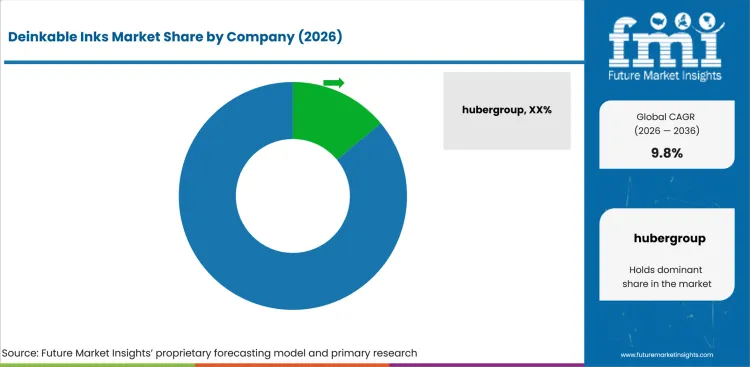
hubergroup, Siegwerk, Sun Chemical, Flint Group and DIC Corporation.
- Established packaging ink companies hold an advantage through formulation depth and converter-facing technical service.
- Specialist wash-off ink providers gain share by proving recovery performance across labels, plastic cups, and printed films.
- Paper and board ink suppliers gain stronger approval when their systems protect fiber brightness during recycling.
- Retail-ready technical documentation supports trials through clear test evidence, food packaging compliance, and substrate guidance.
Large ink groups in the market compete by combining print performance with recyclability proof. hubergroup and Siegwerk hold strong positions because their portfolios include deinking systems for labels, paper packaging, and flexible films. Sun Chemical gains value through washable UV offset inks for printed plastic cups and broader packaging ink support. Flint Group competes through NC-free flexible packaging technologies that support recycler approval. DIC adds global packaging ink scale and regional technical coverage.
Technical validation has become a competitive separator as packaging buyers move beyond simple sustainability claims. Converters need suppliers that can support press trials, wash tests, food-contact review, and brand documentation. Suppliers with application labs can help buyers compare adhesion, cure behaviour, ink removal, and substrate recovery in one approval process. This favors companies with strong regional service and verified deinking evidence. Scale alone is not enough if the printed pack fails recovery quality tests.
Smaller and regional suppliers can win through fast substrate adaptation and closer converter relationships. INX International and artience compete with washable ink and deinking coating technologies. Sakata INX and Zeller+Gmelin can gain where printers need local service and application-specific ink systems. Europe rewards suppliers with deinking proof tied to packaging regulation, while Asia rewards suppliers that can support high-volume converter trials. Companies with recyclable ink evidence and practical press support should gain more durable listing decisions.
How do top deinkable inks companies compare?
hubergroup and Siegwerk score strongly on validation depth while Sun Chemical leads plastic cup wash-off evidence.
| Company | Deinking Validation Depth | Packaging Compliance Range | Converter Trial Support | Geographic Footprint |
|---|---|---|---|---|
| hubergroup | High | Strong | Strong | Global |
| Siegwerk | High | Strong | Strong | Global |
| Sun Chemical | High | High | Strong | Global |
| Flint Group | High | Medium | Strong | Global |
| INX International | High | Medium | Strong | North America and Europe |
| artience / Toyo Ink | High | Medium | Strong | Asia and Global |
| DIC Corporation | Medium | High | Strong | Global |
| Sakata INX | Medium | Medium | Moderate | Asia and Global |
| Zeller+Gmelin | Medium | Medium | Moderate | Europe and North America |
Source: Future Market Insights competitive analysis, 2026. Ratings reflect relative positioning based on Deinking Validation Depth, Packaging Compliance Range, and Converter Trial Support.
Who are the key players in the deinkable inks market?
hubergroup, Siegwerk and Sun Chemical are listed with Flint Group and DIC Corporation among other suppliers.
Key global companies leading the deinkable inks market include:
- hubergroup
- Siegwerk
- Sun Chemical
- Flint Group
- DIC Corporation
- INX International
- artience / Toyo Ink
- Sakata INX
- Zeller+Gmelin
Key Developments in Deinkable Inks Market
- In July 2025, Sun Chemical launched SunCure EcoPlast, a washable UV offset ink series for printed plastic cups. The launch supports plastic cup decoration with post-consumer wash-off recovery.
- In February 2026, Flint Group earned RecyClass Technology Approval for NC-free ink technologies designed for flexible packaging. The approval supports verified compatibility with European polyethylene recycling streams.
- In January 2026, Toyochem Specialty Chemical achieved INGEDE deinkability certification for TK MARK V MOF sheetfed offset inks. The Good rating supports cleaner recycled paper quality from printed sheets.
Key Players in the Deinkable Inks Market
Global Leaders
- hubergroup
- Siegwerk
- Sun Chemical
- Flint Group
- DIC Corporation
Specialist Deinking and Wash-Off Providers
- INX International
- artience / Toyo Ink
Regional and Application-Focused Players
- Sakata INX
- Zeller+Gmelin
Deinkable Inks Market - Report Scope
| Parameter | Details |
|---|---|
| Forecast period | 2026 to 2036 |
| Historical period | 2021 to 2025 |
| Quantitative unit | Revenue in USD million |
| By ink type | Water-based inks, UV / UV-LED inks, solvent-based inks, other |
| By printing process | Flexography, gravure, offset, digital |
| By substrate | Paper and board, flexible film, labels, other |
| By end use | Food and beverage packaging, consumer goods packaging, commercial print, other |
| By sales channel | Direct to printers / converters, distributors |
| Regions covered | North America, Latin America, Europe, East Asia, South Asia and Pacific, Middle East and Africa |
| Countries covered | United States, United Kingdom, Germany, France, Japan, China, South Korea, India |
| Key companies profiled | hubergroup, Siegwerk, Sun Chemical, Flint Group, DIC Corporation, INX International, artience / Toyo Ink, Sakata INX, Zeller+Gmelin |
| Approach | Hybrid bottom-up and top-down methodology using packaging ink demand, substrate mix, converter trials, and recycling rule pressure |
Source: Future Market Insights, 2026.
Deinkable Inks Market - Scope & Definition
| Attribute | Details |
|---|---|
| Market Name | Deinkable Inks Market |
| Market Definition | Printing inks, primers, and coatings designed to be removed from paper, board, film, or labels during recycling. |
| Scope Includes | Water-based inks, UV / UV-LED inks, solvent-based inks, primers, coatings, wash-off systems, and converter-facing validation services. |
| Scope Excludes | Standard inks without deinking proof, pigments sold alone, printing equipment, packaging substrates, adhesives without ink removal function, and recycling machinery. |
| Regions Covered | North America, Latin America, Europe, East Asia, South Asia and Pacific, Middle East and Africa |
| Countries Covered | United States, United Kingdom, Germany, France, Japan, China, South Korea, India |
| Key Companies Profiled | hubergroup, Siegwerk, Sun Chemical, Flint Group, INX International, artience / Toyo Ink, DIC Corporation, Sakata INX, Zeller+Gmelin |
| Forecast Period | 2026 to 2036 |
| Approach | Hybrid bottom-up and top-down methodology using packaging ink demand, substrate mix, converter trials, and recycling rule pressure |
Deinkable Inks Market - Research Methodology
| Methodology Element | Details |
|---|---|
| Primary Research | FMI analysts reviewed input from packaging converters, label printers, ink formulators, recycling specialists, brand packaging teams, and distributor sales teams. |
| Desk Research | The review covered packaging waste rules, deinking guidance, company product pages, official company releases, association materials, and regulator guidance. |
| Market Sizing and Forecasting | The model combined packaging ink demand, deinkable share penetration, substrate mix, process mix, and country-level recycling pressure. |
| Data Validation | Forecasts were checked against packaging waste trends, recycling regulation, supplier portfolios, and converter buying behavior. |
Deinkable Inks Market Breakdown by Ink Type, Printing Process, Substrate, End Use, Sales Channel, and Region
Deinkable Inks Market Segmented by Ink Type:
- Water-based Inks
- UV / UV-LED Inks
- Solvent-based Inks
- Other
Deinkable Inks Market Segmented by Printing Process:
- Flexography
- Gravure
- Offset
- Digital
Deinkable Inks Market Segmented by Substrate:
- Paper & Board
- Flexible Film
- Labels
- Other
Deinkable Inks Market Segmented by End Use:
- Food & Beverage Packaging
- Consumer Goods Packaging
- Commercial Print
- Other
Deinkable Inks Market Segmented by Sales Channel:
- Direct to Printers / Converters
- Distributors
Deinkable Inks Market by Region:
- North America
- Western Europe
- Eastern Europe
- East Asia
- South Asia and Pacific
- Middle East & Africa
- Other GCC Countries
- Rest of Middle East & Africa
Research Sources and Bibliography
- Artience Group. (2026, January 29). Mineral-oil-free inks by Toyochem Specialty Chemical achieve INGEDE deinkability certification.
- European Commission. (2025). Packaging & Packaging Waste Regulation.
- European Environment Agency. (2025, March). Waste management country profile with a focus on municipal and packaging waste: France.
- European Environment Agency. (2025, September 28). Waste recycling.
- Eurostat. (2025, October 22). Plastic packaging waste in the EU: 35.3 kg per person.
- Flint Group. (2026, February 26). Flint Group earns RecyClass Approval for its NC-free inks designed for flexible packaging applications.
- HM Revenue & Customs. (2026, February 12). Plastic Packaging Tax: Steps to take.
- Japan Containers and Packaging Recycling Association. (2024). Point of act.
- Korea Environment Corporation. (2024). Extended Producer Responsibility.
- Ministry of Economy, Trade and Industry. (2024, June 28). Third report of the committee on new direction of economic and industrial policies.
- Ministry of Environment, Forest and Climate Change. (2024, December 9). Draft Environment Protection Rules for Packaging.
- RecyClass. (2026, March 2). Flint Group approval letter for VertixCode Star SC WB1U.
- State Council of the People’s Republic of China. (2025, November 8). Carbon Peaking and Carbon Neutrality: China’s Plans and Solutions.
- Sun Chemical. (2025, July 9). Sun Chemical launches new sustainable UV offset ink series for printed plastic cups.
- U.S. Environmental Protection Agency. (2026, January 22). U.S. National Recycling Goal.
- U.S. Plastics Pact. (2026, January 16). U.S. Plastics Pact releases 2024–2025 impact report highlighting measurable progress and the work ahead.
- European Commission. (2025). Facts about the new EU rules on packaging and packaging waste.
- EUR-Lex. (2025, September 26). Packaging and packaging waste (from 2026).
- U.S. Plastics Pact. (2025, April). Overcoming barriers to increasing the use of postconsumer recycled content in the U.S.
This bibliography is provided for reader reference and is not exhaustive. The full report contains the complete reference list and detailed citations.
This Report Answers
- Market size estimates for 2026 and forecasts through 2036 for the deinkable inks market.
- Insights across selected regional and country-level markets.
- Analysis of demand drivers, converter adoption patterns, validation requirements, and purchasing behavior.
- Evaluation of leading ink types, printing processes, substrates, end uses, and sales channels.
- Assessment of packaging regulation, recycler acceptance, and deinking proof requirements.
- Identification of opportunities across water-based inks, labels, paperboard, flexible films, and printed cups.
- Evaluation of supply chain dynamics, next generation packaging revenue opportunities, product innovation trends, and direct converter service models.
- Country-level growth analysis covering the United States, United Kingdom, Germany, France, Japan, China, South Korea, and India.
- Assessment of the competitive landscape including leading deinkable ink suppliers and wash-off technology providers.
- Analysis of buyer preferences, market penetration patterns, and emerging growth opportunities.
- Regional outlooks across North America, Europe, East Asia, and South Asia and Pacific.
- Delivery of market data, forecasts, and supporting analysis in PDF and Excel formats.
Frequently Asked Questions
What is the growth prospect for deinkable inks?
Demand for deinkable inks is expected to rise at a considerable pace as brands move packaging approval toward recovery proof and recycler acceptance.
Which companies are expected to shape the deinkable inks market?
hubergroup, Siegwerk, Sun Chemical, Flint Group, INX International, artience, DIC Corporation, Sakata INX, and Zeller+Gmelin are expected to shape competitive positioning.
Why are leading ink companies investing in deinkable inks?
Leading ink companies are investing in deinkable inks to serve recyclable packaging programs and protect converter relationships with large brand owners.
Why are direct converter channels important in the deinkable inks market?
Direct converter channels support press trials, wash testing, and technical documentation before a new ink system receives commercial approval.
Which ink formats are gaining attention in deinkable inks?
Water-based inks, washable UV offset systems, deinking primers, and digital fabrication inkjet inks industry analysis links are gaining attention as buyers seek cleaner recovery for paper, film, labels, and cups.
How do regulations influence deinkable ink launches?
Regulations influence launches through packaging recyclability requirements, recycled-content economics, and buyer demand for stronger recovery evidence.
Why is food packaging important for deinkable inks?
Food packaging is important because suppliers must balance migration control, print quality, and ink-removal performance within one approved product system.
What role do deinking primers play in recyclable packaging?
Deinking primers support ink removal from labels and sleeves where cured films or strong adhesion can otherwise restrict clean recovery.
How do flexible films affect deinkable ink demand?
Flexible films affect demand because washed flakes can lose value when ink bleed, residue, or color transfer reduce recovered material quality.
How do paper and board applications support deinkable inks?
Paper and board applications support demand because fiber recovery systems already use cleaning and deinking steps that reward washable chemistry.
Preview the report firsthand - request a free sample
Get SampleGet the brochure for pricing and purchase details.
Get PDFTable of Content
- Executive Summary
- Global Market Outlook
- Demand-side Trends
- Supply-side Trends
- Technology Roadmap Analysis
- Analysis and Recommendations
- Market Overview
- Market Coverage / Taxonomy
- Market Definition / Scope / Limitations
- Research Methodology
- Research Design
- Primary Research
- Desk Research
- Market Sizing and Forecasting
- Data Validation
- Global Market Analysis 2021 to 2025 and Forecast, 2026 to 2036
- Historical Market Size Value (USD Million) Analysis, 2021 to 2025
- Current and Future Market Size Value (USD Million) Projections, 2026 to 2036
- Y-o-Y Growth Trend Analysis
- Absolute $ Opportunity Analysis
- Global Market Pricing Analysis 2021 to 2025 and Forecast 2026 to 2036
- Global Market Analysis 2021 to 2025 and Forecast 2026 to 2036, By Ink Type
- Introduction / Key Findings
- Historical Market Size Value (USD Million) Analysis By Ink Type, 2021 to 2025
- Current and Future Market Size Value (USD Million) Analysis By Ink Type, 2026 to 2036
- Global Market Analysis 2021 to 2025 and Forecast 2026 to 2036, By Printing Process
- Introduction / Key Findings
- Historical Market Size Value (USD Million) Analysis By Printing Process, 2021 to 2025
- Current and Future Market Size Value (USD Million) Analysis By Printing Process, 2026 to 2036
- Global Market Analysis 2021 to 2025 and Forecast 2026 to 2036, By Substrate
- Introduction / Key Findings
- Historical Market Size Value (USD Million) Analysis By Substrate, 2021 to 2025
- Current and Future Market Size Value (USD Million) Analysis By Substrate, 2026 to 2036
- Global Market Analysis 2021 to 2025 and Forecast 2026 to 2036, By End Use
- Introduction / Key Findings
- Historical Market Size Value (USD Million) Analysis By End Use, 2021 to 2025
- Current and Future Market Size Value (USD Million) Analysis By End Use, 2026 to 2036
- Global Market Analysis 2021 to 2025 and Forecast 2026 to 2036, By Sales Channel
- Introduction / Key Findings
- Historical Market Size Value (USD Million) Analysis By Sales Channel, 2021 to 2025
- Current and Future Market Size Value (USD Million) Analysis By Sales Channel, 2026 to 2036
- Global Market Analysis 2021 to 2025 and Forecast 2026 to 2036, By Region
- Introduction / Key Findings
- Historical Market Size Value (USD Million) Analysis By Region, 2021 to 2025
- Current and Future Market Size Value (USD Million) Analysis By Region, 2026 to 2036
- North America Market Analysis 2021 to 2025 and Forecast 2026 to 2036
- Pricing Analysis
- Market Share Analysis, 2025
- By Country
- By Ink Type
- By Printing Process
- By Substrate
- By End Use
- By Sales Channel
- Country-level Analysis
- United States
- Canada
- Latin America Market Analysis 2021 to 2025 and Forecast 2026 to 2036
- Pricing Analysis
- Market Share Analysis, 2025
- By Country
- By Ink Type
- By Printing Process
- By Substrate
- By End Use
- By Sales Channel
- Country-level Analysis
- Brazil
- Mexico
- Rest of Latin America
- Western Europe Market Analysis 2021 to 2025 and Forecast 2026 to 2036
- Pricing Analysis
- Market Share Analysis, 2025
- By Country
- By Ink Type
- By Printing Process
- By Substrate
- By End Use
- By Sales Channel
- Country-level Analysis
- Germany
- France
- United Kingdom
- Italy
- Spain
- BENELUX
- Nordics
- Rest of Western Europe
- Eastern Europe Market Analysis 2021 to 2025 and Forecast 2026 to 2036
- Pricing Analysis
- Market Share Analysis, 2025
- By Country
- By Ink Type
- By Printing Process
- By Substrate
- By End Use
- By Sales Channel
- Country-level Analysis
- Russia
- Poland
- Rest of Eastern Europe
- East Asia Market Analysis 2021 to 2025 and Forecast 2026 to 2036
- Pricing Analysis
- Market Share Analysis, 2025
- By Country
- By Ink Type
- By Printing Process
- By Substrate
- By End Use
- By Sales Channel
- Country-level Analysis
- China
- Japan
- South Korea
- South Asia and Pacific Market Analysis 2021 to 2025 and Forecast 2026 to 2036
- Pricing Analysis
- Market Share Analysis, 2025
- By Country
- By Ink Type
- By Printing Process
- By Substrate
- By End Use
- By Sales Channel
- Country-level Analysis
- India
- ASEAN
- Australia & New Zealand
- Rest of South Asia and Pacific
- Middle East & Africa Market Analysis 2021 to 2025 and Forecast 2026 to 2036
- Pricing Analysis
- Market Share Analysis, 2025
- By Country
- By Ink Type
- By Printing Process
- By Substrate
- By End Use
- By Sales Channel
- Country-level Analysis
- GCC Countries
- South Africa
- Turkey
- Rest of Middle East & Africa
- Market Structure Analysis
- Competition Dashboard
- Competition Benchmarking
- Market Share Analysis of Top Players
- By Region
- By Ink Type
- By Printing Process
- By Substrate
- By End Use
- By Sales Channel
- Emerging Startups
- Innovation Benchmarking
- Competition Analysis
- Competition Deep Dive
- Company Profiles
- Case Studies
- Success Stories
- Recent Developments
- Assumptions & Acronyms Used
- List of Tables: Deinkable Inks Market
- List of Figures: Deinkable Inks Market


