

- Market Size (2026)
- USD 9.7 Bn
- Forecast (2036)
- USD 18.7 Bn
- CAGR (2026 to 2036)
- 6.8%
How big is Diabetes Associated Ophthalmic Treatment Market in 2026?
USD 9.7 billion in 2026 and USD 18.7 billion by 2036 at a 6.8% CAGR.
Demand for diabetes associated ophthalmic treatment is projected to expand at 6.8% CAGR between 2026 and 2036, increasing valuation from USD 9.7 billion in 2026 to USD 18.7 billion by 2036. Revenue develops as retinal imaging confirms diabetic macular edema or proliferative disease that requires medicine, laser therapy or surgery. The International Diabetes Federation reported in 2025 that 589 million adults lived with diabetes during 2024. That population defines the broad screening base rather than the smaller group requiring immediate retinal treatment. Commercial conversion depends on referral completion and sustained specialist follow-up across diabetic retinopathy treatment pathways. Missed appointments reduce recurring medicine use and delay procedures even where diagnosed disease creates a clear clinical need.
National care systems convert diabetic eye findings into treatment demand through different referral routes and specialist capacity levels. The National Eye Institute stated in September 2025 that established treatment options include injections, laser procedures and surgery. Each route requires suitable staffing and follow-up resources before screened patients enter active retinal care. Investment in retinal imaging equipment improves disease classification but does not guarantee therapy initiation among referred patients. Revenue depends on completed referrals and enough retinal capacity to sustain repeated injections or procedures. Countries with similar diabetes burdens can produce different treatment volumes as reimbursement rules and appointment access determine conversion into recurring care. This difference makes service capacity as important as epidemiology during country prioritization and commercial planning.
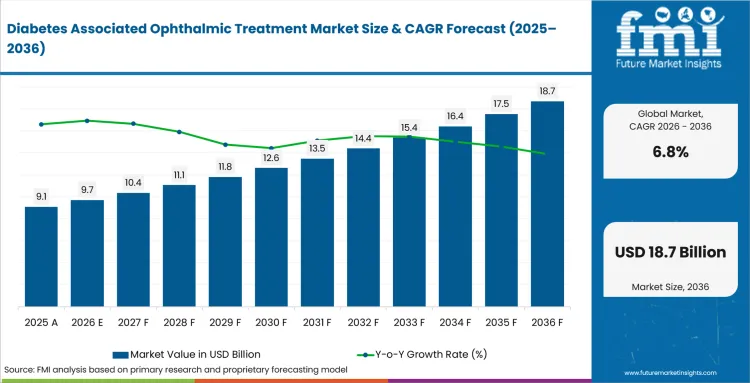
Key Takeaways of Diabetes-Associated Ophthalmic Treatment Market
- Earlier retinal detection increases treatment demand as specialist imaging identifies edema or proliferative disease requiring active retinal therapy.
- Anti-VEGF therapies are projected to account for 47.0% of product in 2026 through established use across diabetic retinal treatment pathways.
- Diabetic macular edema is estimated to represent 44.0% of application in 2026 as OCT findings create a direct route into active treatment.
- Hospitals are anticipated to capture 43.0% of end user in 2026 through specialist staffing and sterile capacity for recurring intravitreal procedures.
- Repeated injection visits remain the central restraint as missed appointments weaken outcomes and reduce recurring pharmaceutical treatment revenue.
- Regeneron; Roche; Bayer; Novartis; AbbVie; ANI Pharmaceuticals; Sandoz; and Kodiak Sciences compete through approved indications and treatment durability.
Analyst Perspective
"Retinal therapy revenue depends less on the number of people with diabetes than on how reliably screening programs move treatable disease into specialist care. Portfolios that extend dosing intervals can protect clinic capacity and reduce missed treatment visits across recurring injection programs. Longer intervals create value when imaging confirms sustained disease control and medicine access remains dependable across each follow-up cycle."
- Anurag Sharma, Principal Analyst, Future Market Insights
How is the Diabetes-Associated Ophthalmic Treatment Market segmented?
The diabetes associated ophthalmic treatment industry is segmented by product, application, end user, distribution channel, treatment modality, and region.
The market is segmented by product, application, end user, distribution channel, treatment modality, and region. Product categories cover anti-VEGF therapies and corticosteroid implants alongside laser systems, vitrectomy systems, and monitoring devices used during retinal care. Application analysis separates diabetic macular edema from diabetic retinopathy and related vision-preservation needs that create different treatment thresholds. End-user categories identify hospitals, ophthalmology clinics, surgery centers, research institutes, and home-care services participating across diagnosis or treatment. Distribution channels describe how medicines reach treatment sites, while treatment modality compares pharmacological care with laser and surgical intervention. Regional analysis reflects differences in screening referral, reimbursement access, specialist capacity, and approved product availability across national care systems.
What supports demand for anti-VEGF therapies within the product category?
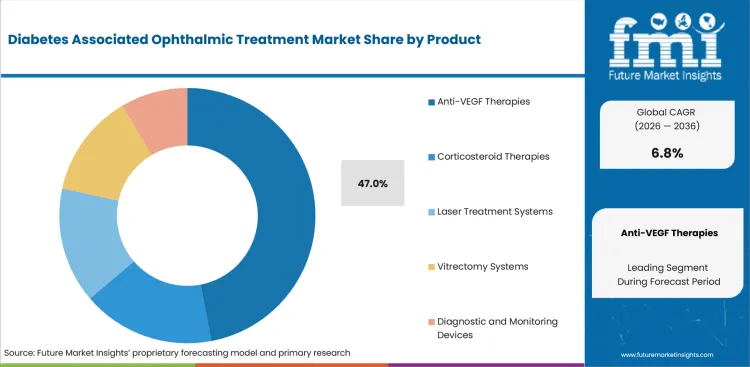
Anti-VEGF therapy addresses vascular leakage and abnormal vessel growth across diabetic retinal disease in specialist practice. In November 2025, Novartis received Japanese approval for Beovu in proliferative diabetic retinopathy within specialist retinal practice. The approval added a medicinal alternative to panretinal laser treatment for eligible patients within Japan. Repeat dosing continues to create recurring demand for ophthalmic biologics across scheduled retinal care and follow-up programs. Commercial performance depends on labeled durability and reliable patient attendance throughout each scheduled treatment cycle.
- Anti-VEGF therapies are set to lead the product category with 47.0% share in 2026 due to established use across diabetic macular edema and proliferative retinal disease. Retina specialists compare medicines through visual acuity improvement and retinal fluid control during repeated examinations. Formulary rules then determine which approved products remain available across long-term injection schedules within hospital and specialty settings.
- Longer dosing intervals can expand anti-VEGF adoption by reducing pressure on specialist injection lists and patient travel schedules. Pharmacy access remains a material constraint across treatment programs that require dependable product supply through hospital and specialty networks. Retina services gain practical capacity when eligible patients maintain disease control with fewer annual injections without weakening monitoring discipline.
Why does diabetic macular edema lead the application category?
Diabetic macular edema creates a direct treatment pathway because retinal fluid threatens central vision during daily activities. In February 2025, Roche received FDA approval for Susvimo as a continuous-delivery treatment for eligible adults with DME. The refillable implant can reduce regular injection frequency but requires surgical placement and device management. Spending on diabetic macular edema therapies therefore follows confirmed swelling, visual risk and suitable delivery infrastructure.
- The application category is forecast to be led by diabetic macular edema at 44.0% share in 2026 due to its direct route from OCT findings into active treatment. Central vision risk creates a stronger treatment need than retinal changes that do not require immediate intervention. Revenue remains concentrated among patients needing medicine and repeated response monitoring throughout long-term retinal care.
- Reliable referrals from screening services into retinal clinics support diabetic macular edema treatment across the complete care pathway. Repeated OCT imaging documents response and guides retreatment decisions during specialist follow-up and recurring treatment cycles. Delayed attendance allows swelling to progress and reduces the measurable value of otherwise effective therapy. Care networks therefore need clear referral ownership and enough imaging capacity to prevent avoidable treatment delays.
How do hospitals shape demand within the end-user category?
Hospitals concentrate retina specialists and sterile procedure capacity for complex diabetic eye disease requiring coordinated care. The Centers for Medicare & Medicaid Services retained a 2026 quality measure requiring retinal or dilated examinations for eligible adults with diabetes. Screening documentation can create referrals but clinical confirmation remains necessary for treatment initiation across hospital retinal services. Hospital access to optical coherence tomography equipment supports diagnosis and retreatment decisions across complex cases. Injection lists compete with surgery and other retinal procedures for limited specialist capacity during each treatment week.
- Based on the end-user category, hospitals are projected to account for 43.0% in 2026 due to specialist staffing and access to imaging with sterile injection facilities. Complex cases remain concentrated within hospital retinal services that coordinate medical assessment and procedural care. Hospital systems connect medicine inventory with imaging records and surgical backup within coordinated eye-care services.
- Hospital demand expands as formularies and procedure schedules support repeated therapy without long appointment delays. Incomplete imaging or medical records can postpone treatment and shift routine injections toward specialist clinics. Hospitals retain an operating advantage for cases that require surgery or additional medical oversight across the same care episode. This coordination matters most for patients with advanced disease and several related systemic health conditions.
What keeps hospital pharmacies ahead within the distribution channel?
Hospital pharmacies coordinate biologic handling with scheduled retinal procedures across institutional treatment sites and specialist injection services. The United States Food and Drug Administration revised the ENZEEVU label in February 2026 for diabetic macular edema and diabetic retinopathy. Qualified physicians must administer the medicine through intravitreal injection under sterile clinical conditions within approved treatment settings. The requirement supports institutional distribution for ophthalmic prefilled injectables across scheduled retinal injection and follow-up services. Stock availability must align with appointments to protect established retreatment intervals throughout recurring treatment cycles.
- By distribution channel, hospital pharmacies are estimated to hold 46.0% in 2026 owing to direct coordination with retina procedure rooms and treatment-day inventory. Institutional pharmacy teams manage cold-chain controls and scheduled medicine release across daily retinal injection programs. Their position strengthens as product availability aligns with specialist appointments and documented retreatment schedules across recurring care.
- Formulary approval and dependable reimbursement determine hospital pharmacy adoption across repeated retinal treatment schedules and institutional care pathways. Biosimilar entry broadens institutional choice but adds contracting and switching decisions across ophthalmic injectable therapies. Specialty pharmacies remain relevant under payer rules that require external dispensing for selected medicines and defined patient groups. Clear responsibility for delivery timing prevents missed treatment caused by avoidable shipping or authorization delays.
Which operating mechanism supports pharmacological treatment within the treatment modality category?
Pharmacological treatment controls active retinal leakage without immediately moving patients into laser or surgical pathways. Brazil’s health regulator registered Ranivisio for diabetic macular edema and proliferative diabetic retinopathy in June 2025. The registration expanded regulated anti-VEGF choice for eligible patients across national retinal treatment and follow-up programs. Wide-field imaging supports peripheral disease documentation and helps clinicians balance treatment response against available injection capacity.
- The pharmacological treatment segment is likely to capture 52.0% share in 2026 attributable to broad anti-VEGF use and sustained-release implant availability. Medicines address active retinal disease without immediately requiring surgery for many eligible patients during specialist care. Pharmacological options also support retreatment adjustments through imaging findings and documented changes in visual function during specialist follow-up.
- Longer dosing intervals and additional biosimilar choices strengthen pharmacological adoption across established retinal care pathways. Steroid implants offer another route for selected patients but require pressure monitoring throughout scheduled specialist follow-up. Laser and surgery remain essential for advanced disease that medicines cannot control adequately through pharmacological care alone. Adoption therefore depends on matching treatment durability with disease severity and available retinal clinic capacity.
What are the drivers, restraints, and opportunities in the Diabetes-Associated Ophthalmic Treatment Market?
Broader treatment availability supports demand while repeated visit burden limits persistence. Longer-acting delivery and wider reimbursement create the clearest commercial opening.
- Driver: Additional approved biologics widen treatment choice across established diabetic retinal care pathways and institutional formularies.
- Restraint: Repeated injection visits create adherence pressure and reduce treatment persistence across long-term retinal care.
- Opportunity: Longer-acting delivery can release retinal clinic capacity when safety monitoring and follow-up remain dependable across treatment cycles.
Broader medicine availability supports demand after eye testing equipment and specialist assessment confirm treatable diabetic retinal disease. Amgen reported in May 2025 that PAVBLU generated USD 99 million during the first quarter after its United States launch in late 2024. The result provides direct commercialization evidence for an aflibercept biosimilar across retinal indications in the United States. Additional choices can strengthen formulary competition and reduce dependence on one product across hospital formularies. Treatment volume remains dependent on specialist assessment and reliable reimbursement for each medicine throughout recurring treatment cycles.
Repeated therapy is one of the key restraints across retinal clinics and patient schedules that depend on reliable long-term attendance. AbbVie and REGENXBIO stated in January 2025 that chronic frequent dosing remains a treatment burden across diabetic retinopathy programs. Missed visits weaken clinical outcomes and reduce recurring pharmaceutical use across ongoing retinal treatment programs. Manufacturers must prove durability alongside safety and anatomical response throughout the intended schedule and longer dosing intervals. Retina clinics also need enough sterile procedure capacity and follow-up imaging to maintain treatment continuity.
Longer-acting delivery and biosimilar entry offer opportunity across retinal care systems with different commercial effects. The European Medicines Agency published the Afqlir assessment in January 2025 for diabetic macular edema and related retinal indications. Additional medicine choice can support contracting and regional access through regulated pathways and hospital pharmacies. Longer treatment intervals can release specialist capacity for other eligible patients across congested retinal clinics. Commercial value depends on accepted evidence and reliable supply rather than price reduction alone across each treatment cycle.
Which country CAGRs are profiled in the Diabetes-Associated Ophthalmic Treatment Market?
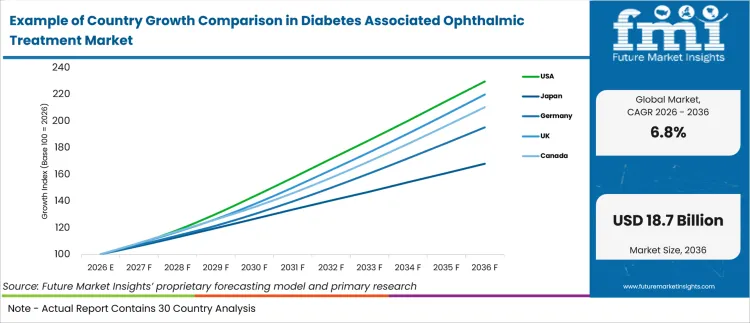
| Country | CAGR |
|---|---|
| USA | 8.7% |
| UK | 8.2% |
| Canada | 7.7% |
| Brazil | 7.3% |
| Germany | 6.9% |
| Australia | 5.8% |
| Japan | 5.3% |
How do country-level CAGRs compare in the Diabetes-Associated Ophthalmic Treatment Market?
The country forecasts show a measured progression across the diabetes associated ophthalmic treatment market, with the gap between adjacent countries remaining relatively consistent throughout the comparison. The USA and the UK form an upper group where growth is supported by established diabetic eye disease screening programs and broad access to advanced treatment options. Canada and Brazil create a middle band that bridges the higher-growth and lower-growth markets, reflecting ongoing expansion of ophthalmic care services for diabetic patients. Germany, Australia and Japan follow with more moderate forecasts, indicating mature treatment environments where growth is increasingly linked to innovation and patient management strategies rather than access expansion. This pattern reflects differences in diabetes burden, retinal disease detection rates and the adoption of therapies for conditions such as diabetic retinopathy and diabetic macular edema. Market development is therefore shaped by both clinical demand and the ability of healthcare systems to identify and treat patients at earlier stages of disease progression.
- The USA benefits from extensive ophthalmology infrastructure, widespread diabetic eye screening initiatives and continued adoption of advanced therapies for retinal complications associated with diabetes.
- The UK remains closely aligned with the USA as national screening programs and structured management pathways help support demand for ophthalmic treatments among diabetic populations.
- Canada's outlook reflects increasing attention to early detection and long-term management of diabetes-related vision disorders across a well-established healthcare system.
- Brazil continues to expand through improving access to ophthalmic services and rising awareness of vision-related complications among patients with diabetes.
- Germany supports steady market development through strong clinical care standards and continued use of established and emerging retinal treatment approaches.
- Australia benefits from growing emphasis on preventive eye care and regular monitoring of diabetic patients to reduce the risk of vision impairment.
- Japan's market growth is influenced by a mature healthcare landscape where diabetic eye disease management is well established and future expansion is increasingly tied to treatment innovation and patient outcomes.
Similar CAGRs do not necessarily translate into identical commercial opportunities. Differences in screening coverage, reimbursement policies, treatment access, referral pathways and adoption of retinal therapies can significantly influence how diabetes-associated ophthalmic treatments are utilized across countries. The full report provides country-level CAGR analysis across North America, Latin America, Europe, East Asia, South Asia, Oceania and the Middle East and Africa.
Country-wise Analysis
- United States retinal treatment operates through specialist practices and hospital departments that document disease activity before intravitreal therapy begins. In the USA, diabetes associated ophthalmic treatment demand is predicted to advance at 8.7% CAGR through 2036, supported by broad medicine availability and documented care coordination. The 2026 CMS142v14 measure requires retinal examination findings to be communicated to the physician managing ongoing diabetes care. Several anti-VEGF choices and delivery formats support treatment selection across hospital and independent retinal practice settings. Insurance authorization and limited specialist capacity can delay repeated appointments across recurring retinal treatment cycles. Commercial plans must connect screening networks with injection sites and dependable follow-up imaging across defined referral regions.
- England uses a national diabetic eye screening pathway with defined grading and hospital referral rules for identified maculopathy. NHS England updated OCT surveillance guidance in April 2025 for diabetic eye screening clinics and hospital eye services. Diabetes associated ophthalmic treatment demand in the UK is forecast to rise at 8.2% CAGR over the forecast period, supported by structured screening escalation into hospital treatment. The pathway directs higher-risk maculopathy into hospital eye services and retains lower-risk cases within digital surveillance. National screening creates a direct enabler for earlier identification of patients who need specialist retinal review. Hospital eye-service capacity remains the principal friction because referrals can exceed available retinal appointments and injection slots.
- Canadian medicine access combines federal approval with provincial reimbursement decisions and local retinal service capacity. Diabetes associated ophthalmic treatment sales in Canada are forecast to expand at 7.7% CAGR by 2036, supported by additional authorized anti-VEGF choices across provincial systems. Health Canada recorded seven aflibercept biosimilar Notices of Compliance between June and November 2025 for national sale. Additional authorized products widen contracting options and reduce reliance on a narrow medicine set within provincial tendering systems. Provincial formulary decisions provide the direct enabler for practical medicine access within each public care system. Long travel distances outside major cities remain a material friction for repeated injections and follow-up imaging. Commercial coverage therefore depends on regional treatment capacity and dependable cold-chain supply across dispersed care networks.
- Brazilian retinal treatment depends on national medicine registration and specialist access across public and private care networks. Anvisa published the PAVBLU aflibercept registration in October 2025 for indications including diabetic macular edema. Brazil’s diabetes associated ophthalmic treatment outlook is anticipated to advance at 7.3% CAGR over the assessment period, influenced by broader legal product availability. Biosimilar registration provides a direct purchasing route through institutional contracts across public and private care systems. Ophthalmology capacity remains uneven outside larger urban centers and established specialist hospitals with retinal injection capacity. Payment conditions and long distribution routes create material frictions for repeated treatment and dependable biologic supply across public retinal services.
- German retinal care operates through ophthalmology specialists within a regulated medicine and reimbursement environment across statutory and private care. Dense specialist coverage and established imaging infrastructure support diagnosis across many urban treatment settings for diabetic retinal disease. In June 2025, KBV noted that statutory outpatient practices had been able to bill OCT for diabetic-retinopathy-related macular edema since 2019. Adoption of diabetes associated ophthalmic treatment in Germany is estimated to expand at 6.9% CAGR through 2036, supported by an established outpatient OCT reimbursement route. Reimbursed OCT provides a direct monitoring enabler but does not remove medicine contracting requirements for newer retinal products. Regional practice capacity and evidence review remain material frictions for newer dosing approaches across outpatient retinal practices.
- Australian retinal care combines metropolitan specialist centers with patients travelling substantial distances from regional and remote communities. The Pharmaceutical Benefits Scheme recorded the Eylea listing for diabetic macular edema from March 2026. The Australian diabetes associated ophthalmic treatment sector is projected to record 5.8% CAGR during the assessment period, supported by a defined public reimbursement route. Public funding creates a direct access enabler for eligible patients in approved specialist settings through public medicine funding. Travel distance and appointment frequency remain material barriers outside major metropolitan areas requiring repeated retinal visits. Commercial plans must align reimbursement status with retinal capacity and dependable national cold-chain distribution across regional networks.
- Japanese diabetic retinal treatment is concentrated within specialist hospitals and clinics that apply detailed monitoring and quality requirements. Established ophthalmic expertise and advanced imaging access provide direct enablers for careful treatment selection across metropolitan treatment centers. By 2036, Japan’s diabetes associated ophthalmic treatment market is projected to grow at 5.3% CAGR, supported by updated treatment choices and concentrated retinal expertise. The Pharmaceuticals and Medical Devices Agency posted an Eylea 8 mg review report dated March 23 2026. Extended approval processes and strict institutional quality expectations create material frictions across hospital pharmacy and retina services. Market entry requires local evidence support and dependable service from authorized distribution partners during commercial rollout.
Who are the notable companies in the Diabetes-Associated Ophthalmic Treatment Market?
Regeneron Pharmaceuticals, Inc., F. Hoffmann-La Roche Ltd, Bayer AG, Novartis AG, AbbVie Inc., ANI Pharmaceuticals, Inc., Sandoz Group AG, and Kodiak Sciences Inc. are the notable companies shaping this market.
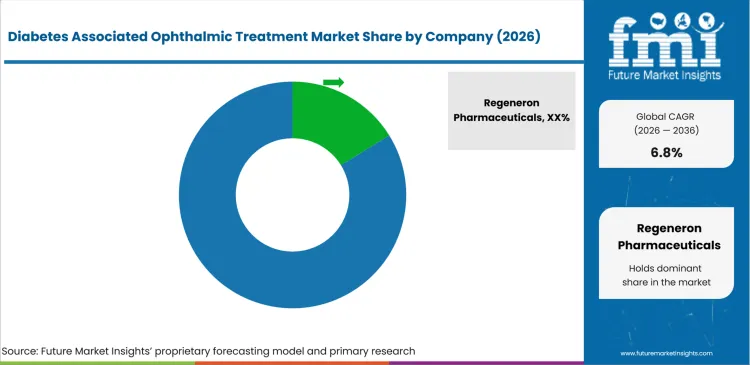
The competitive field combines marketed anti-VEGF franchises with sustained-release implants and late-stage retinal development programs. ANI Pharmaceuticals completed its acquisition of Alimera Sciences in September 2024 and now controls ILUVIEN. Regeneron and Bayer share the aflibercept platform across separate territories while Roche competes through Vabysmo and Susvimo. Novartis and Sandoz add alternative anti-VEGF products across selected markets, while AbbVie contributes a corticosteroid implant and gene-therapy development program. Kodiak remains development-focused through a six-month dosing strategy for diabetic retinopathy across global clinical sites. These differences shape competition across diabetic retinopathy care more directly than company size or broad ophthalmology revenue.
- Regeneron Pharmaceuticals and Bayer commercialize aflibercept through separate territorial rights while Roche adds faricimab and continuous delivery. Their competition centers on approved diabetic macular edema use and dosing intervals that reduce injection frequency. Commercial differentiation depends on labelled durability and the specialist infrastructure required for each delivery approach.
- Novartis and Sandoz provide alternative anti-VEGF products across selected markets while AbbVie and ANI Pharmaceuticals add implant or retinal pipeline options. Their portfolios create additional choices beyond conventional repeated injection schedules across selected retinal treatment pathways. Market access depends on approved indications plus formulary positioning and service requirements within each geography.
- Kodiak Sciences remains a clinical-stage competitor focused on extended retinal dosing through its Zenkuda program. Its future relevance depends on regulatory progression and evidence that six-month schedules preserve diabetic retinopathy control. Commercial entry requires dependable manufacturing and specialist confidence across routine retinal treatment practice and distribution networks.
Competitive Benchmarking: Diabetes Associated Ophthalmic Treatment Market
| Company | Commercial Anti-VEGF | Long-Acting Delivery | Diabetic Retinal Breadth | Geographic Reach |
|---|---|---|---|---|
| Regeneron Pharmaceuticals, Inc. | High | Medium | High | United States |
| F. Hoffmann-La Roche Ltd | High | High | High | Global |
| Bayer AG | High | Medium | High | Global outside United States |
| Novartis AG | Medium | Medium | High | Multi-country |
| AbbVie Inc. | Low | High | Medium | Global |
| ANI Pharmaceuticals, Inc. | Low | High | Medium | United States and Europe |
| Sandoz Group AG | Medium | Low | High | Multi-country |
| Kodiak Sciences Inc. | Low | Medium | Medium | Global clinical network |
Key Developments in the Diabetes Associated Ophthalmic Treatment Market
- In April 2026, Regeneron Pharmaceuticals reported that FDA had approved EYLEA HD dosing intervals up to five months in diabetic macular edema for patients who have demonstrated one year of successful response based on visual and anatomic outcomes. The revised schedule allows eligible patients to receive fewer injections after achieving sustained disease control. Commercial value depends on whether specialists confirm disease control throughout the longer interval and maintain reliable follow-up imaging across repeated treatment cycles and treatment-site schedules.
- In July 2025, ANI Pharmaceuticals reported NEW DAY trial results for ILUVIEN in diabetic macular edema. The primary endpoint showed no significant reduction in supplemental aflibercept injections across the full study population. A secondary endpoint showed a longer average period before the first supplemental injection for ILUVIEN-treated patients. The mixed result supports further clinical positioning but does not establish broad superiority over aflibercept.
- In June 2025, Bayer reported European Union approval for Eylea 8 mg treatment intervals up to six months in neovascular age-related macular degeneration and diabetic macular edema. The longer interval can release retinal clinic capacity for other patients across busy treatment services. Specialists must confirm disease control throughout the extended schedule before reducing appointment frequency across routine treatment programs and established follow-up pathways.
- In March 2026, Kodiak Sciences reported positive topline GLOW2 results for Zenkuda in diabetic retinopathy. The company stated that 62.5% of treated patients achieved at least a two-step disease-severity improvement at one year. The development supports a potential six-month treatment approach across retinal clinics but remains subject to regulatory review and commercial launch requirements before routine specialist use across national treatment pathways.
Key Players in the Diabetes Associated Ophthalmic Treatment Market
Commercial Anti-VEGF Providers
- Regeneron Pharmaceuticals, Inc.
- F. Hoffmann-La Roche Ltd
- Bayer AG
- Novartis AG
- Sandoz Group AG
Implant and Portfolio Participants
- AbbVie Inc.
- ANI Pharmaceuticals, Inc.
Clinical-Stage Retinal Developers
- Kodiak Sciences Inc.
Diabetes Associated Ophthalmic Treatment Market - Report Scope
| Coverage field | Report scope |
|---|---|
| Market breakdown | Product, application, end user, distribution channel, treatment modality, and region. |
| Quantitative Units | Revenue in USD Million, CAGR in %. |
| Market Definition | Pharmacological, laser, surgical, and monitoring interventions for diabetic macular edema, diabetic retinopathy, and related vision-threatening complications. |
| Regions Covered | North America, Latin America, Western Europe, Eastern Europe, East Asia, South Asia and Pacific, and the Middle East and Africa. |
| Countries Covered | USA, UK, Canada, Brazil, Germany, Australia, and Japan with additional countries included in the regional model. |
| Key Companies Profiled | Regeneron Pharmaceuticals, Inc., F. Hoffmann-La Roche Ltd, Bayer AG, Novartis AG, AbbVie Inc., ANI Pharmaceuticals, Inc., Sandoz Group AG, Kodiak Sciences Inc. |
| Forecast Period | 2026 to 2036. |
| Approach | Hybrid bottom-up and top-down market sizing supported by primary interviews and official desk research. |
Diabetes Associated Ophthalmic Treatment Market - Research Methodology
| Method | Approach |
|---|---|
| Primary Research | FMI analysts gathered input from manufacturers, service providers, technology developers, distributors, end users, procurement teams, and subject-matter experts. Interviews examined purchasing decisions, product or service evaluation, adoption barriers, approval requirements, pricing considerations, and expectations for technical or commercial support. Respondents were also asked what evidence is required before a trial, pilot, or initial order develops into regular purchasing. |
| Desk Research | Desk research covered government statistics, regulatory publications, trade data, industry associations, technical literature, standards, company filings, product information, and official corporate announcements. Sources were reviewed for relevance, publication date, geographic coverage, and consistency with the defined market scope. Claims relating to performance, applications, approvals, capacity, investment, and commercial activity were retained only when supported by credible public evidence. |
| Market Sizing and Forecasting | The market model combined the baseline value with historical performance, segment structure, pricing and volume indicators, adoption levels, company participation, and country-level demand conditions. Forecast assumptions considered economic activity, investment trends, regulatory developments, technology adoption, purchasing cycles, supply availability, and barriers to wider market use. Segment and regional estimates were reconciled before the final market total was calculated. |
| Data Validation | Estimates were checked against multiple independent indicators, including public data, company activity, trade patterns, industry developments, and findings from primary interviews. Validation also tested whether products, services, applications, and company revenues fell within the defined market boundaries. Adjacent categories, unsupported claims, overlapping revenues, and activities without direct market relevance were excluded to reduce double counting and maintain consistency across segments and countries. |
Diabetes Associated Ophthalmic Treatment Market by Segments
Diabetes Associated Ophthalmic Treatment Market segmented by Product:
- Anti-VEGF Therapies
- Ranibizumab
- Aflibercept
- Corticosteroid Therapies
- Dexamethasone Implants
- Fluocinolone Acetonide Implants
- Laser Treatment Systems
- Focal Laser Systems
- Panretinal Photocoagulation Systems
- Vitrectomy Systems
- Posterior Vitrectomy Systems
- Microincision Vitrectomy Systems
- Diagnostic and Monitoring Devices
- OCT Imaging Systems
- Fundus Fluorescein Angiography Systems
Diabetes Associated Ophthalmic Treatment Market segmented by Application:
- Diabetic Macular Edema
- Center-Involved Diabetic Macular Edema
- Non-Center-Involved Diabetic Macular Edema
- Diabetic Retinopathy
- Non-Proliferative Diabetic Retinopathy
- Proliferative Diabetic Retinopathy
- Retinal Vein Complications
- Branch Retinal Vein Occlusion
- Central Retinal Vein Occlusion
- Vision Preservation
- Early Disease Management
- Long-Term Vision Maintenance
- Post-Surgical Care
- Post Vitrectomy Management
- Post Laser Therapy Care
Diabetes Associated Ophthalmic Treatment Market segmented by End User:
- Hospitals
- Tertiary Care Hospitals
- Multispecialty Hospitals
- Ophthalmology Clinics
- Retina Specialty Clinics
- Comprehensive Eye Clinics
- Ambulatory Surgical Centers
- Day Surgery Centers
- Independent Surgical Centers
- Academic and Research Institutes
- University Hospitals
- Clinical Research Centers
- Home Healthcare
- Remote Ophthalmic Monitoring
- Home Vision Care Services
Diabetes Associated Ophthalmic Treatment Market segmented by Distribution Channel:
- Hospital Pharmacies
- Inpatient Pharmacies
- Outpatient Hospital Pharmacies
- Retail Pharmacies
- Chain Pharmacies
- Independent Pharmacies
- Specialty Pharmacies
- Biologic Therapy Providers
- Ophthalmic Specialty Pharmacies
- Online Pharmacies
- E-Commerce Pharmacy Platforms
- Digital Prescription Services
- Direct Institutional Supply
- Group Purchasing Organizations
- Direct Manufacturer Contracts
Diabetes Associated Ophthalmic Treatment Market segmented by Treatment Modality:
- Pharmacological Treatment
- Intravitreal Injection Therapy
- Sustained Release Drug Therapy
- Laser-Based Treatment
- Focal Laser Therapy
- Panretinal Photocoagulation
- Surgical Treatment
- Pars Plana Vitrectomy
- Minimally Invasive Retinal Surgery
- Combination Therapy
- Anti-VEGF Plus Laser Therapy
- Steroid Plus Anti-VEGF Therapy
- Supportive Care
- Glycemic Control Programs
- Vision Rehabilitation Services
Diabetes Associated Ophthalmic Treatment Market by Region:
- North America
- United States
- Canada
- Latin America
- Brazil
- Mexico
- Argentina
- Chile
- Western Europe
- Germany
- France
- United Kingdom
- Italy
- Spain
- Benelux
- Nordics
- Eastern Europe
- Poland
- Czech Republic
- Romania
- Hungary
- East Asia
- China
- Japan
- South Korea
- South Asia and Pacific
- India
- ASEAN
- Australia and New Zealand
- Middle East and Africa
- GCC Countries
- South Africa
- Türkiye
- Israel
Research Sources and Bibliography
- International Diabetes Federation. (2025, April 7). IDF Diabetes Atlas 11th Edition 2025.
- National Eye Institute. (2025, September 11). Diabetic retinopathy.
- Centers for Medicare & Medicaid Services. (2026). Diabetes: Eye exam, CMS131v14.
- Centers for Medicare & Medicaid Services. (2026). Diabetic retinopathy: Communication with the physician managing ongoing diabetes care, CMS142v14.
- USA Food and Drug Administration. (2026, February). ENZEEVU (aflibercept-abzv) injection, for intravitreal use.
- Agência Nacional de Vigilância Sanitária. (2025, June 12). Ranivisio (ranibizumabe): Novo registro.
- Amgen Inc. (2025, May 1). AMGEN REPORTS FIRST QUARTER 2025 FINANCIAL RESULTS.
- AbbVie. (2025, January 13). AbbVie and REGENXBIO announce updates on the ABBV-RGX-314 clinical program.
- European Medicines Agency. (2025, January 20). Afqlir: EPAR - Product information.
- NHS England. (2025, April 16). Optical coherence tomography (OCT) in diabetic eye screening (DES) surveillance clinics.
- Health Canada. (2026, June 30). Drug and Health Product Submissions Under Review (SUR): New drug submissions completed.
- Agência Nacional de Vigilância Sanitária. (2025, October 14). PAVBLU (aflibercepte): Novo registro.
- Kassenärztliche Bundesvereinigung. (2025, June 19). ASV-Abrechnung: Optische Kohärenztomographie bei Augentumoren ab Juli im EBM.
- Pharmaceutical Benefits Scheme. (2026, March 31). Medicine Status.
- Pharmaceuticals and Medical Devices Agency. (2026, March 23).
- ANI Pharmaceuticals, Inc. (2026, February 27). Annual report for the fiscal year ended December 31, 2025 (Form 10-K).
- ANI Pharmaceuticals, Inc. (2025, July 23). ANI Pharmaceuticals Announces Results from NEW DAY Clinical Trial of ILUVIEN® for Use in Patients with Diabetic Macular Edema (DME).
- Regeneron Pharmaceuticals, Inc. (2026, April 29). Quarterly report for the period ended March 31, 2026 (Form 10-Q).
- F. Hoffmann-La Roche Ltd. (2025, February 4). FDA approves Roche’s Susvimo as the first and only continuous delivery treatment for the leading cause of diabetes-related blindness.
- Bayer AG. (2025, June 27). Eylea 8 mg with extended 6-month treatment interval approved in the EU.
- Kodiak Sciences Inc. (2026, March 26). Kodiak Sciences announces positive topline results in GLOW2, the second Phase 3 study in diabetic retinopathy, demonstrating superiority of Zenkuda™ (tarcocimab tedromer) over sham.
- Novartis Pharma K.K. (2025, November).
- USA Food and Drug Administration. (2024, August 9). Purple Book Search.
- AbbVie Inc. (2026, February 20). Annual report for the fiscal year ended December 31, 2025 (Form 10-K).
This bibliography is provided for reader reference and is not exhaustive. The full report contains the complete reference list and detailed citations.
This Report Answers
- How large is the diabetes associated ophthalmic treatment market in 2026 and 2036?
- Which clinical conditions convert the diabetes burden into retinal treatment revenue?
- Why are Anti-VEGF Therapies estimated to hold 47.0% of Product in 2026?
- How does Diabetic Macular Edema shape treatment selection and imaging demand?
- Why do Hospitals and Hospital Pharmacies retain substantial shares across care delivery?
- How do country growth rates differ across the USA, UK, Canada, Brazil, Germany, Australia, and Japan?
- Which companies commercialise anti-VEGF products or sustained retinal delivery systems?
- What limits treatment persistence across repeated injection schedules and specialist visits?
- How can longer treatment intervals or biosimilar access change commercial adoption?
Frequently Asked Questions
How big is the Diabetes Associated Ophthalmic Treatment Market in 2026?
The diabetes associated ophthalmic treatment market is valued at USD 9.7 billion in 2026 and is forecast to reach USD 18.7 billion by 2036. Growth is supported by earlier retinal detection through imaging confirming diabetic macular edema or proliferative disease that requires anti-VEGF therapy, laser treatment, or surgery across specialist retinal care pathways.
What is the CAGR of the Diabetes Associated Ophthalmic Treatment Market from 2026 to 2036?
The diabetes associated ophthalmic treatment market grows at a CAGR of 6.8% between 2026 and 2036, supported by retinal specialists adopting additional approved biologics and longer-acting delivery systems once those products demonstrate sustained disease control across repeated injection schedules and reliable specialist follow-up programs.
Which product leads the Diabetes Associated Ophthalmic Treatment Market?
Anti-VEGF therapies account for 47.0% of the diabetes associated ophthalmic treatment market by product in 2026, driven by established use across diabetic macular edema and proliferative retinal disease where retina specialists compare medicines through visual acuity improvement and retinal fluid control during repeated examinations and long-term treatment cycles.
How much will the Diabetes Associated Ophthalmic Treatment Market add between 2026 and 2036?
The diabetes associated ophthalmic treatment market is set to add USD 9.0 billion between 2026 and 2036, growing from USD 9.7 billion to USD 18.7 billion as anti-VEGF therapies, sustained-release implants, and longer-acting delivery systems enter funded retinal care pathways across a widening base of diabetic eye disease treatment programs worldwide.
Who are the leading companies in the Diabetes Associated Ophthalmic Treatment Market?
Five companies lead the diabetes associated ophthalmic treatment market, including Regeneron Pharmaceuticals, F. Hoffmann-La Roche, Bayer, Novartis, and AbbVie, competing through marketed anti-VEGF franchises, continuous-delivery implants, extended dosing intervals, and corticosteroid implant portfolios across diabetic macular edema and diabetic retinopathy treatment pathways worldwide.
Preview the report firsthand - request a free sample
Get SampleGet the brochure for pricing and purchase details.
Get PDFTable of Content
- Key Takeaways
- Market Size and CAGR
- Top Growth Driver
- Fastest Growing Segment
- Leading Region
- Key Companies
- Emerging Opportunities
- Executive Summary
- Global Market Outlook
- Demand-side Trends
- Supply-side Trends
- Technology Roadmap Analysis
- Analysis and Recommendations
- Analyst Perspective (What is happening? Why now? What should investors know?)
- Key Questions Answered
- How large is the market?
- What is the CAGR?
- What are key trends?
- Which region dominates?
- Who are the leaders?
- Market Overview
- Market Coverage / Taxonomy
- Market Definition / Scope / Limitations
- Research Methodology
- Chapter Orientation
- Analytical Lens and Working Hypotheses
- Market Structure, Signals, and Trend Drivers
- Benchmarking and Cross-market Comparability
- Market Sizing, Forecasting, and Opportunity Mapping
- Research Design and Evidence Framework
- Desk Research Programme (Secondary Evidence)
- Expert Input and Fieldwork (Primary Evidence)
- Tooling, Models, and Reference Databases
- Data Engineering and Model Build
- Quality Assurance and Audit Trail
- Market Background
- Market Dynamics (Drivers, Restraints, Opportunity, Trends)
- Scenario Forecast (Optimistic, Likely, Conservative)
- Impact Analysis
- AI Impact
- Sustainability Impact
- Regulatory Impact
- Technology Impact
- Consumer / Buyer Analysis
- Purchase Drivers
- Adoption Barriers
- Buyer Journey
- Opportunity Map Analysis
- Product Life Cycle Analysis
- Supply Chain Analysis
- Investment Feasibility Matrix
- Value Chain Analysis
- PESTLE and Porter's Analysis
- Regulatory Landscape
- Regional Parent Market Outlook
- Production and Consumption Statistics
- Import and Export Statistics
- Global Market Analysis and Forecast, 2021 to 2036
- Historical Market Size Value (USD Billion) Analysis, 2021 to 2025
- Current and Future Market Size Value (USD Billion) Projections, 2026 to 2036
- Y-o-Y Growth Trend Analysis
- Absolute $ Opportunity Analysis
- Global Market Pricing Analysis, 2021 to 2036
- Global Market Analysis and Forecast, By Product, 2021 to 2036
- Introduction / Key Findings
- Historical Market Size Value (USD Billion) Analysis By Product, 2021 to 2025
- Current and Future Market Size Value (USD Billion) Analysis and Forecast By Product, 2026 to 2036
- Anti-VEGF Therapies
- Ranibizumab
- Aflibercept
- Corticosteroid Therapies
- Dexamethasone Implants
- Fluocinolone Acetonide Implants
- Laser Treatment Systems
- Focal Laser Systems
- Panretinal Photocoagulation Systems
- Vitrectomy Systems
- Posterior Vitrectomy Systems
- Microincision Vitrectomy Systems
- Diagnostic and Monitoring Devices
- OCT Imaging Systems
- Fundus Fluorescein Angiography Systems
- Anti-VEGF Therapies
- Y-o-Y Growth Trend Analysis By Product, 2021 to 2025
- Absolute $ Opportunity Analysis By Product, 2026 to 2036
- Global Market Analysis and Forecast, By Application, 2021 to 2036
- Introduction / Key Findings
- Historical Market Size Value (USD Billion) Analysis By Application, 2021 to 2025
- Current and Future Market Size Value (USD Billion) Analysis and Forecast By Application, 2026 to 2036
- Diabetic Macular Edema
- Center-Involved Diabetic Macular Edema
- Non-Center-Involved Diabetic Macular Edema
- Diabetic Retinopathy
- Non-Proliferative Diabetic Retinopathy
- Proliferative Diabetic Retinopathy
- Retinal Vein Complications
- Branch Retinal Vein Occlusion
- Central Retinal Vein Occlusion
- Vision Preservation
- Early Disease Management
- Long-Term Vision Maintenance
- Post-Surgical Care
- Post Vitrectomy Management
- Post Laser Therapy Care
- Diabetic Macular Edema
- Y-o-Y Growth Trend Analysis By Application, 2021 to 2025
- Absolute $ Opportunity Analysis By Application, 2026 to 2036
- Global Market Analysis and Forecast, By Application, 2021 to 2036
- Introduction / Key Findings
- Historical Market Size Value (USD Billion) Analysis By Application, 2021 to 2025
- Current and Future Market Size Value (USD Billion) Analysis and Forecast By Application, 2026 to 2036
- Diabetic Macular Edema
- Center-Involved Diabetic Macular Edema
- Non-Center-Involved Diabetic Macular Edema
- Diabetic Retinopathy
- Non-Proliferative Diabetic Retinopathy
- Proliferative Diabetic Retinopathy
- Retinal Vein Complications
- Branch Retinal Vein Occlusion
- Central Retinal Vein Occlusion
- Vision Preservation
- Early Disease Management
- Long-Term Vision Maintenance
- Post-Surgical Care
- Post Vitrectomy Management
- Post Laser Therapy Care
- Diabetic Macular Edema
- Y-o-Y Growth Trend Analysis By Application, 2021 to 2025
- Absolute $ Opportunity Analysis By Application, 2026 to 2036
- Global Market Analysis and Forecast, By End User, 2021 to 2036
- Introduction / Key Findings
- Historical Market Size Value (USD Billion) Analysis By End User, 2021 to 2025
- Current and Future Market Size Value (USD Billion) Analysis and Forecast By End User, 2026 to 2036
- Hospitals
- Tertiary Care Hospitals
- Multispecialty Hospitals
- Ophthalmology Clinics
- Retina Specialty Clinics
- Comprehensive Eye Clinics
- Ambulatory Surgical Centers
- Day Surgery Centers
- Independent Surgical Centers
- Academic and Research Institutes
- University Hospitals
- Clinical Research Centers
- Home Healthcare
- Remote Ophthalmic Monitoring
- Home Vision Care Services
- Hospitals
- Y-o-Y Growth Trend Analysis By End User, 2021 to 2025
- Absolute $ Opportunity Analysis By End User, 2026 to 2036
- Global Market Analysis and Forecast, By Distribution Channel, 2021 to 2036
- Introduction / Key Findings
- Historical Market Size Value (USD Billion) Analysis By Distribution Channel, 2021 to 2025
- Current and Future Market Size Value (USD Billion) Analysis and Forecast By Distribution Channel, 2026 to 2036
- Hospital Pharmacies
- Inpatient Pharmacies
- Outpatient Hospital Pharmacies
- Retail Pharmacies
- Chain Pharmacies
- Independent Pharmacies
- Specialty Pharmacies
- Biologic Therapy Providers
- Ophthalmic Specialty Pharmacies
- Online Pharmacies
- E-Commerce Pharmacy Platforms
- Digital Prescription Services
- Direct Institutional Supply
- Group Purchasing Organizations
- Direct Manufacturer Contracts
- Hospital Pharmacies
- Y-o-Y Growth Trend Analysis By Distribution Channel, 2021 to 2025
- Absolute $ Opportunity Analysis By Distribution Channel, 2026 to 2036
- Global Market Analysis and Forecast, By Treatment Modality
- Introduction / Key Findings
- Historical Market Size Value (USD Billion) Analysis By Treatment Modality, 2021 to 2025
- Current and Future Market Size Value (USD Billion) Analysis and Forecast By Treatment Modality, 2026 to 2036
- Pharmacological Treatment
- Intravitreal Injection Therapy
- Sustained Release Drug Therapy
- Laser-Based Treatment
- Focal Laser Therapy
- Panretinal Photocoagulation
- Surgical Treatment
- Pars Plana Vitrectomy
- Minimally Invasive Retinal Surgery
- Combination Therapy
- Anti-VEGF Plus Laser Therapy
- Steroid Plus Anti-VEGF Therapy
- Supportive Care
- Glycemic Control Programs
- Vision Rehabilitation Services
- Pharmacological Treatment
- Y-o-Y Growth Trend Analysis By Treatment Modality, 2021 to 2025
- Absolute $ Opportunity Analysis By Treatment Modality, 2026 to 2036
- Global Market Analysis and Forecast, By Region, 2021 to 2036
- Introduction
- Historical Market Size Value (USD Billion) Analysis By Region, 2021 to 2025
- Current Market Size Value (USD Billion) Analysis and Forecast By Region, 2026 to 2036
- North America
- Latin America
- Western Europe
- Eastern Europe
- East Asia
- South Asia and Pacific
- Middle East & Africa
- Market Attractiveness Analysis By Region
- North America Market Analysis and Forecast, By Country, 2021 to 2036
- Historical Market Size Value (USD Billion) Trend Analysis By Market Taxonomy, 2021 to 2025
- Market Size Value (USD Billion) Forecast By Market Taxonomy, 2026 to 2036
- By Country
- USA
- Canada
- By Product
- By Application
- By Application
- By End User
- By Distribution Channel
- By Treatment Modality
- By Country
- Market Attractiveness Analysis
- By Country
- By Product
- By Application
- By Application
- By End User
- By Distribution Channel
- By Treatment Modality
- Key Takeaways
- Latin America Market Analysis and Forecast, By Country
- Historical Market Size Value (USD Billion) Trend Analysis By Market Taxonomy, 2021 to 2025
- Market Size Value (USD Billion) Forecast By Market Taxonomy, 2026 to 2036
- By Country
- Brazil
- Mexico
- Chile
- Rest of Latin America
- By Product
- By Application
- By Application
- By End User
- By Distribution Channel
- By Treatment Modality
- By Country
- Market Attractiveness Analysis
- By Country
- By Product
- By Application
- By Application
- By End User
- By Distribution Channel
- By Treatment Modality
- Key Takeaways
- Western Europe Market Analysis and Forecast, By Country
- Historical Market Size Value (USD Billion) Trend Analysis By Market Taxonomy, 2021 to 2025
- Market Size Value (USD Billion) Forecast By Market Taxonomy, 2026 to 2036
- By Country
- Germany
- UK
- Italy
- Spain
- France
- Nordic
- BENELUX
- Rest of Western Europe
- By Product
- By Application
- By Application
- By End User
- By Distribution Channel
- By Treatment Modality
- By Country
- Market Attractiveness Analysis
- By Country
- By Product
- By Application
- By Application
- By End User
- By Distribution Channel
- By Treatment Modality
- Key Takeaways
- Eastern Europe Market Analysis and Forecast, By Country
- Historical Market Size Value (USD Billion) Trend Analysis By Market Taxonomy, 2021 to 2025
- Market Size Value (USD Billion) Forecast By Market Taxonomy, 2026 to 2036
- By Country
- Russia
- Poland
- Hungary
- Balkan & Baltic
- Rest of Eastern Europe
- By Product
- By Application
- By Application
- By End User
- By Distribution Channel
- By Treatment Modality
- By Country
- Market Attractiveness Analysis
- By Country
- By Product
- By Application
- By Application
- By End User
- By Distribution Channel
- By Treatment Modality
- Key Takeaways
- East Asia Market Analysis and Forecast, By Country
- Historical Market Size Value (USD Billion) Trend Analysis By Market Taxonomy, 2021 to 2025
- Market Size Value (USD Billion) Forecast By Market Taxonomy, 2026 to 2036
- By Country
- China
- Japan
- South Korea
- By Product
- By Application
- By Application
- By End User
- By Distribution Channel
- By Treatment Modality
- By Country
- Market Attractiveness Analysis
- By Country
- By Product
- By Application
- By Application
- By End User
- By Distribution Channel
- By Treatment Modality
- Key Takeaways
- South Asia and Pacific Market Analysis and Forecast, By Country
- Historical Market Size Value (USD Billion) Trend Analysis By Market Taxonomy, 2021 to 2025
- Market Size Value (USD Billion) Forecast By Market Taxonomy, 2026 to 2036
- By Country
- India
- ASEAN
- Australia & New Zealand
- Rest of South Asia and Pacific
- By Product
- By Application
- By Application
- By End User
- By Distribution Channel
- By Treatment Modality
- By Country
- Market Attractiveness Analysis
- By Country
- By Product
- By Application
- By Application
- By End User
- By Distribution Channel
- By Treatment Modality
- Key Takeaways
- Middle East & Africa Market Analysis and Forecast, By Country
- Historical Market Size Value (USD Billion) Trend Analysis By Market Taxonomy, 2021 to 2025
- Market Size Value (USD Billion) Forecast By Market Taxonomy, 2026 to 2036
- By Country
- Kingdom of Saudi Arabia
- Other GCC Countries
- Türkiye
- South Africa
- Other African Union
- Rest of Middle East & Africa
- By Product
- By Application
- By Application
- By End User
- By Distribution Channel
- By Treatment Modality
- By Country
- Market Attractiveness Analysis
- By Country
- By Product
- By Application
- By Application
- By End User
- By Distribution Channel
- By Treatment Modality
- Key Takeaways
- Key Countries Market Analysis
- USA
- Pricing Analysis
- Market Share Analysis, 2025
- By Product
- By Application
- By Application
- By End User
- By Distribution Channel
- By Treatment Modality
- Canada
- Pricing Analysis
- Market Share Analysis, 2025
- By Product
- By Application
- By Application
- By End User
- By Distribution Channel
- By Treatment Modality
- Mexico
- Pricing Analysis
- Market Share Analysis, 2025
- By Product
- By Application
- By Application
- By End User
- By Distribution Channel
- By Treatment Modality
- Brazil
- Pricing Analysis
- Market Share Analysis, 2025
- By Product
- By Application
- By Application
- By End User
- By Distribution Channel
- By Treatment Modality
- Chile
- Pricing Analysis
- Market Share Analysis, 2025
- By Product
- By Application
- By Application
- By End User
- By Distribution Channel
- By Treatment Modality
- Germany
- Pricing Analysis
- Market Share Analysis, 2025
- By Product
- By Application
- By Application
- By End User
- By Distribution Channel
- By Treatment Modality
- UK
- Pricing Analysis
- Market Share Analysis, 2025
- By Product
- By Application
- By Application
- By End User
- By Distribution Channel
- By Treatment Modality
- Italy
- Pricing Analysis
- Market Share Analysis, 2025
- By Product
- By Application
- By Application
- By End User
- By Distribution Channel
- By Treatment Modality
- Spain
- Pricing Analysis
- Market Share Analysis, 2025
- By Product
- By Application
- By Application
- By End User
- By Distribution Channel
- By Treatment Modality
- France
- Pricing Analysis
- Market Share Analysis, 2025
- By Product
- By Application
- By Application
- By End User
- By Distribution Channel
- By Treatment Modality
- India
- Pricing Analysis
- Market Share Analysis, 2025
- By Product
- By Application
- By Application
- By End User
- By Distribution Channel
- By Treatment Modality
- ASEAN
- Pricing Analysis
- Market Share Analysis, 2025
- By Product
- By Application
- By Application
- By End User
- By Distribution Channel
- By Treatment Modality
- Australia & New Zealand
- Pricing Analysis
- Market Share Analysis, 2025
- By Product
- By Application
- By Application
- By End User
- By Distribution Channel
- By Treatment Modality
- China
- Pricing Analysis
- Market Share Analysis, 2025
- By Product
- By Application
- By Application
- By End User
- By Distribution Channel
- By Treatment Modality
- Japan
- Pricing Analysis
- Market Share Analysis, 2025
- By Product
- By Application
- By Application
- By End User
- By Distribution Channel
- By Treatment Modality
- South Korea
- Pricing Analysis
- Market Share Analysis, 2025
- By Product
- By Application
- By Application
- By End User
- By Distribution Channel
- By Treatment Modality
- Russia
- Pricing Analysis
- Market Share Analysis, 2025
- By Product
- By Application
- By Application
- By End User
- By Distribution Channel
- By Treatment Modality
- Poland
- Pricing Analysis
- Market Share Analysis, 2025
- By Product
- By Application
- By Application
- By End User
- By Distribution Channel
- By Treatment Modality
- Hungary
- Pricing Analysis
- Market Share Analysis, 2025
- By Product
- By Application
- By Application
- By End User
- By Distribution Channel
- By Treatment Modality
- Kingdom of Saudi Arabia
- Pricing Analysis
- Market Share Analysis, 2025
- By Product
- By Application
- By Application
- By End User
- By Distribution Channel
- By Treatment Modality
- Türkiye
- Pricing Analysis
- Market Share Analysis, 2025
- By Product
- By Application
- By Application
- By End User
- By Distribution Channel
- By Treatment Modality
- South Africa
- Pricing Analysis
- Market Share Analysis, 2025
- By Product
- By Application
- By Application
- By End User
- By Distribution Channel
- By Treatment Modality
- USA
- Market Structure Analysis
- Competition Dashboard
- Competition Benchmarking
- Market Share Analysis of Top Players
- By Regional
- By Product
- By Application
- By Application
- By End User
- By Distribution Channel
- By Treatment Modality
- Emerging Startups
- Innovation Benchmarking
- Competition Analysis
- Competition Deep Dive
- Regeneron Pharmaceuticals
- Overview
- Product Portfolio
- Profitability by Market Segments
- Sales Footprint
- Strategy Overview
- Marketing Strategy
- Product Strategy
- Channel Strategy
- F. Hoffmann-La Roche
- Bayer AG
- Novartis AG
- AbbVie
- Alimera Sciences
- Oxurion
- Kodiak Sciences
- Bausch + Lomb
- Carl Zeiss Meditec
- Regeneron Pharmaceuticals
- Case Studies
- Success Stories
- Recent Developments
- Competition Deep Dive
- Assumptions & Acronyms Used


