

- Industry Size (2026)
- USD 668.98 Mn
- Forecast (2036)
- USD 1431.0 Mn
- CAGR (2026 to 2036)
- 7.90%
Ophthalmic Gas Delivery Market Forecast and Outlook 2026 to 2036
The ophthalmic gas delivery market is likely to grow from USD 668.98 million in 2026 to reach USD 1,431.0 million by 2036, at a CAGR of 7.90%. This segment holds commercial importance because it supports core vitreoretinal procedures where execution reliability directly affects surgical outcomes. Demand is structurally tied to procedure volumes, not discretionary purchasing, creating predictable consumption across hospitals and ambulatory surgery centers.
Buyer intent centers on minimizing intraoperative risk, maintaining protocol consistency, and avoiding workflow disruption in the operating room. Supplier selection therefore prioritizes delivery accuracy, regulatory compliance, and assured availability over short-term pricing advantages. As retinal surgery capacity expands globally, institutions are increasingly consolidating vendors to simplify training, inventory management, and quality control. Between 2026 and 2036, economic relevance will be shaped by recurring procedural usage, long-term supply agreements, and the growth of specialized eye-care facilities. For decision-makers, ophthalmic gas delivery represents a stable, execution-driven market where trust, reliability, and operational alignment determine commercial success.
Quick Stats for Ophthalmic Gas Delivery Market
- Ophthalmic Gas Delivery Market Value (2026): USD 668.98 Million
- Ophthalmic Gas Delivery Market Forecast Value (2036): USD 1,431.0 Million
- Ophthalmic Gas Delivery Market Forecast CAGR (2026-2036): 7.90%
- Leading Product Type in Ophthalmic Gas Delivery Market: SF6 Gas Systems (42% share)
- Key Growth Regions in Ophthalmic Gas Delivery Market: Asia Pacific, North America, Europe, Latin America, Middle East & Africa
- Top Key Players in Ophthalmic Gas Delivery Market: Alcon, Bausch + Lomb, Dutch Ophthalmic, Geuder, Rumex
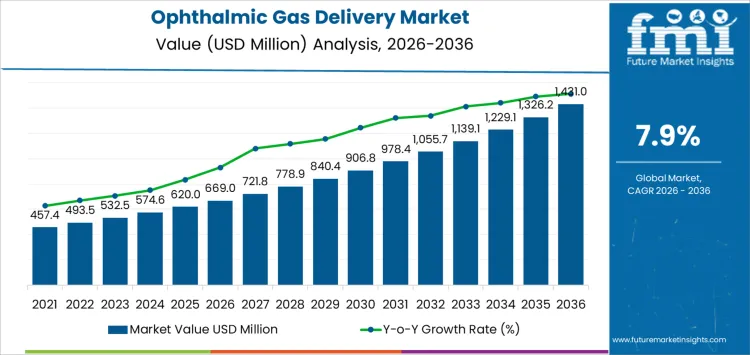
Ophthalmic Gas Delivery Market Key Takeaways
| Metric | Value |
|---|---|
| Ophthalmic Gas Delivery Market Value (2026) | USD 668.98 Million |
| Ophthalmic Gas Delivery Market Forecast Value (2036) | USD 1,431.0 Million |
| Ophthalmic Gas Delivery Market Forecast CAGR (2026-2036) | 7.90% |
How are Surgical Precision Requirements and OR Standardization Driving the Ophthalmic Gas Delivery Market?
The ophthalmic gas delivery market is expanding as vitreoretinal surgery volumes increase and surgical teams demand higher precision and procedural consistency. In procedures such as minimally invasive injectable procedures, retinal detachment repair and macular hole surgery, accurate delivery of medical gases is critical to achieving optimal intraocular pressure control and post-operative outcomes. For device manufacturers and gas suppliers, demand is increasingly driven by ophthalmic gas delivery systems that ensure controlled flow rates, precise gas mixtures, and minimal risk of contamination during surgery.
Hospital purchasing decisions are strongly influenced by safety assurance and workflow compatibility. Ophthalmic surgeons and operating-room teams prefer ocular drug delivery platforms that integrate seamlessly with existing vitrectomy platforms and adhere to strict sterility and labeling standards. Single-use delivery components, pre-mixed gas cartridges, and error-prevention features are gaining traction as hospitals aim to reduce handling complexity and mitigate procedural risk. Suppliers offering validated delivery accuracy and clear clinical documentation are better positioned in competitive tenders.
Operational efficiency and regulatory compliance are further shaping market adoption. Hospitals are standardizing ophthalmic surgical instruments consumables to streamline inventory management and training while ensuring compliance with evolving medical device regulations. Growth in ambulatory surgical centers and ophthalmic eye drop therapies is expanding demand beyond large tertiary hospitals. For manufacturers and suppliers, competitive advantage increasingly depends on delivery accuracy, product reliability, and the ability to support standardized ophthalmic surgical workflows positioning ophthalmic gas delivery systems as a critical enabler of modern retinal biologic therapies.
How is the Ophthalmic Gas Delivery Market Structured by Product and Application?
The ophthalmic gas delivery market is segmented by product and application, reflecting how intraocular tamponade requirements and surgical techniques influence system selection. By product, SF6 gas systems lead the market, supported by their controlled expansion characteristics and predictable absorption profile. Other products include C3F8 gas systems and gas delivery accessories, which address longer tamponade duration and precise intraoperative handling needs. By application, retinal detachment surgery represents the primary demand area, while vitrectomy procedures and other ophthalmic uses contribute to broader clinical adoption across specialized eye surgeries.
Why Do SF6 Gas Systems Lead Product Adoption in the Ophthalmic Gas Delivery Market?
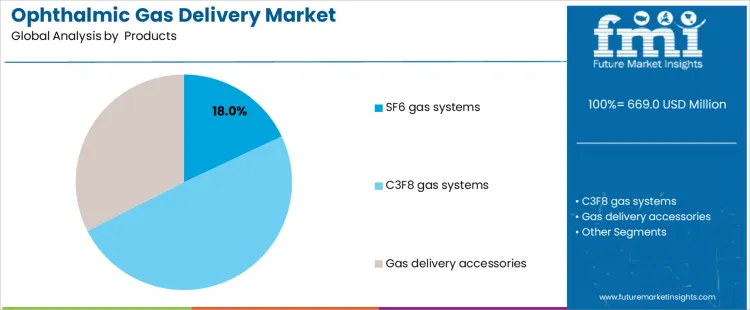
SF6 gas systems account for 42% share of the ophthalmic gas delivery market because they provide short- to medium-term intraocular tamponade with reliable safety and handling characteristics. Surgeons prefer SF6 and postoperative infection management therapies due to its moderate expansion rate and predictable resorption timeline, which reduces postoperative complication risk. The gas is widely used in routine retinal procedures where controlled retinal reattachment is required. Compatibility with standard delivery accessories simplifies surgical workflows. Hospitals and ambulatory surgery centers favor SF6 systems for their ease of storage and consistent clinical outcomes. These procedural reliability and handling advantages explain why SF6 gas systems remain the leading product category.
Why Does Retinal Detachment Surgery Dominate Application Demand In The Ophthalmic Gas Delivery Market?

Retinal detachment surgery holds 58% share of the ophthalmic gas delivery market because gas tamponade plays a central role in reattaching the retina and maintaining postoperative positioning. Ophthalmic gases create internal pressure that supports retinal healing following vitrectomy or scleral buckling procedures. Rising incidence of age-related retinal conditions and trauma-related detachments increases surgical volume. Surgeons rely on gas delivery systems to achieve precise dosing and controlled intraocular pressure. High procedure frequency and standardized surgical protocols drive consistent gas consumption. These clinical necessity and volume-driven factors explain why retinal detachment surgery remains the dominant application segment.
What are the Key Dynamics of the Ophthalmic Gas Delivery Market?
The ophthalmic gas delivery market is driven by clinical demand for intraocular gases used in retinal repair procedures, such as pneumatic retinopexy and vitrectomy. Gases like sulfur hexafluoride (SF₆) and perfluoropropane (C₃F₈) provide temporary internal tamponade to support reattachment of the retina, improve anatomical outcomes, and reduce need for repeat surgery. For medical gas suppliers, device manufacturers, and healthcare providers, product purity, predictable expansion characteristics, and ease of delivery through precision syringe systems are critical performance considerations. Adoption correlates with prevalence of retinal disorders, surgical volume in ophthalmic centers, and physician preference for gas-based versus alternative tamponade agents.
How Are Clinical Practice And Technology Trends Shaping This Market?
Clinical practice patterns and technology trends are shaping the ophthalmic gas delivery market through increased standardization of surgical techniques, improved gas handling protocols, and refinements in delivery instruments. Ophthalmic surgeons prioritize gases with well-characterized expansion and longevity profiles tailored to specific indications. Precision delivery systems syringes, valves, and controlled administration devices enhance procedural accuracy and reduce risk of overexpansion or pressure spikes. Training programs and clinical guidelines from retinal associations support consistent use. For manufacturers and suppliers, aligning gas formulations with best practices and providing comprehensive training and handling support enhances procedural confidence and adoption.
Why Do Regulatory, Supply, And Safety Challenges Restrain Market Growth?
Regulatory, supply, and safety challenges restrain growth in the ophthalmic gas delivery market due to stringent requirements for medical-grade gas production, packaging, and traceability. High purity standards and controlled manufacturing environments increase production cost and oversight. Distribution logistics must protect gas integrity, maintain cold-chain or pressure safety standards, and ensure on-time delivery to surgical centers. Safety concerns related to intraocular pressure changes, gas expansion behavior, and patient positioning protocols require thorough clinician training and careful handling to avoid complications. These factors can extend qualification timelines for new providers and limit rapid expansion into smaller or resource-limited healthcare facilities.
What is the Country-Level Outlook for the Ophthalmic Gas Delivery Market?
The ophthalmic gas delivery market is expanding as vitreoretinal surgeries increase globally, particularly procedures for retinal detachment, macular holes, and diabetic retinopathy. Ophthalmic gases such as sulfur hexafluoride and perfluoropropane are widely used to support retinal tamponade and improve surgical outcomes. Country-level growth varies based on prevalence of retinal disorders, availability of advanced ophthalmic surgical centers, surgeon expertise, and access to specialty medical gases. Mature markets emphasize procedural precision, safety standards, and protocol-driven usage, while higher-growth regions are driven by rising surgical volumes, expanding eye care infrastructure, and improving access to specialist services.

| Country | CAGR (%) |
|---|---|
| India | 9.6 |
| China | 9.4 |
| Brazil | 8.8 |
| United States | 8.6 |
| Germany | 7.2 |
How is the United States Driving Steady Growth in Ophthalmic Gas Delivery?
The ophthalmic gas delivery market in the United States is growing at a CAGR of 8.6% during 2026-2036, supported by high procedure volumes in vitreoretinal surgery. Demand is driven by widespread treatment of retinal detachment, macular holes, and diabetic retinopathy across specialized eye hospitals and ambulatory surgery centers. Surgeons rely on gases such as sulfur hexafluoride and perfluoropropane for predictable tamponade performance and controlled intraocular behavior. Buyers emphasize gas purity, consistency, and compatibility with established surgical protocols. Procurement decisions are influenced by regulatory compliance, supplier reliability, and long-term contracts with medical gas providers. Adoption is stable, with incremental growth tied to aging demographics and rising prevalence of retinal disorders. Market value is driven by repeat surgical usage and standardized procedural practices. The USA represents a mature market where success depends on quality assurance, dependable supply chains, and close alignment with intraocular lens delivery workflows.
Why is Brazil Experiencing Expanding Demand for Ophthalmic Gas Delivery Systems?
Brazil’s ophthalmic gas delivery market is expanding at a CAGR of 8.8% during 2026-2036, driven by increasing access to advanced ophthalmic surgeries in urban healthcare centers. Growth is supported by rising diagnosis of retinal disorders and expansion of private eye clinics. Surgeons adopt ophthalmic gases to improve surgical outcomes and reduce complication rates in vitreoretinal procedures. Buyers prioritize affordability, reliable supply, and ease of handling within operating room environments. Procurement decisions are shaped by distributor presence, pricing structures, and clinician familiarity with specific gas types. Adoption is strongest in private hospitals and specialty clinics, while public sector uptake is gradual. Market value is driven by expanding surgical capacity and increasing procedural awareness. Brazil represents a growth-oriented market where supplier competitiveness depends on cost-effective offerings, strong local distribution networks, and consistent clinical support.
Why is China Rapidly Scaling the Ophthalmic Gas Delivery Market?
China’s ophthalmic gas delivery market is growing at a CAGR of 9.4% during 2026-2036, driven by rapid expansion of ophthalmic surgical infrastructure and increasing prevalence of retinal diseases. Large public hospitals and regional medical centers are investing in advanced vitreoretinal capabilities, leading to higher demand for ophthalmic gases. Surgeons emphasize throughput efficiency, procedural reliability, and standardized gas performance. Buyers prioritize suppliers with local manufacturing, regulatory approvals, and capacity to support high surgical volumes. Procurement cycles are relatively short, reflecting strong institutional demand. Market value is driven by population scale, rising surgical intervention rates, and integration of modern ophthalmic techniques. China represents a volume-driven market where success depends on supply consistency, regulatory alignment, and the ability to serve high-demand surgical environments reliably.
Why Is India Emerging As A High-Growth Market For Ophthalmic Gas Delivery?
India’s ophthalmic gas delivery market is projected to grow at a CAGR of 9.6% during 2026-2036, supported by expanding eye care infrastructure and increasing vitreoretinal surgery volumes. Growth is driven by rising incidence of diabetic retinopathy, retinal detachment, and age-related eye conditions. Adoption is concentrated in private eye hospitals, specialty clinics, and medical tourism centers. Buyers emphasize affordability, availability, and consistent gas quality. Procurement cycles are short, enabling rapid onboarding of new suppliers. Market value is driven by high patient throughput, increasing surgeon expertise, and expanding access to advanced eye care. India represents a fast-growing market where scalability, competitive pricing, and strong distribution networks are critical for supplier success.
How Is Germany Maintaining A Conservative Ophthalmic Gas Delivery Market?
Germany’s ophthalmic gas delivery market is growing at a CAGR of 7.2% during the forecast period, characterized by structured clinical protocols and strong regulatory oversight. Adoption is driven by consistent demand for vitreoretinal surgeries within specialized ophthalmology centers. Surgeons emphasize patient safety, precise gas behavior, and adherence to standardized treatment guidelines. Buyers prioritize product purity, documented performance, and compliance with medical gas regulations. Procurement decisions involve hospital committees and long evaluation processes, resulting in steady but controlled adoption. Market value is supported by stable surgical volumes and long-term management of retinal conditions. Germany represents a mature market where growth is incremental and shaped by clinical rigor rather than rapid expansion.
What Defines Competition in the Ophthalmic Gas Delivery Market?
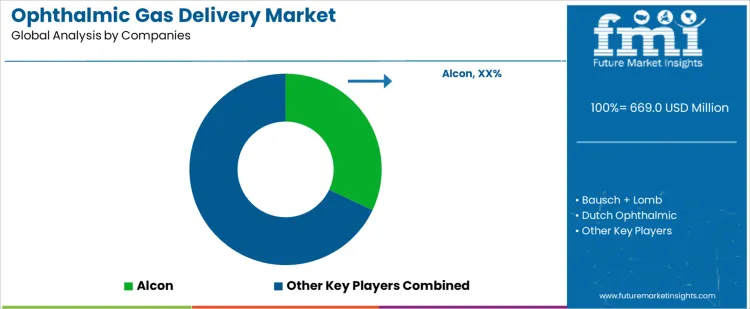
Competition in the ophthalmic gas delivery market is shaped by precision dosing, delivery control, and documented safety performance that matter to retinal surgeons, ophthalmic clinics, and surgical centers. Alcon positions its gas delivery solutions with product literature emphasizing calibrated delivery systems designed for consistent intraocular gas tamponade in procedures such as retinal detachment repair. Official materials highlight controlled expansion properties of gases and packaging engineered for sterile, convenient use in the OR.
Bausch + Lomb competes through ophthalmic gas offerings supported by brochures that focus on predictable dispersion characteristics and clinician-validated dosing guidance. Product documentation underscores compatibility with standard pneumatic delivery tools and adherence to ophthalmic safety standards. Dutch Ophthalmic differentiates via specialized delivery systems optimized for precision and minimized intraocular fluctuation. Official guides emphasize engineered flow control and ergonomic design tailored to surgeon handling.
Instrument and accessory specialists also contribute to competitive breadth. Geuder positions its delivery instruments with materials that highlight reliable connection interfaces and consistent gas flow regulation during delicate procedures. Rumex competes by aligning gas delivery systems with ancillary vitrectomy tools, offering product documentation focused on secure fittings and ease of integration into surgical trays.
Others in the market provide niche gas delivery devices, custom sterile packaging, and localized support options. These products are supported by specification sheets detailing flow control, pressure ratings, and compliance with ophthalmic safety standards. Across all suppliers, competitive differentiation is based on brochure-verified dosing accuracy, delivery reliability, and documented clinician preference rather than pricing alone.
Key Players in Ophthalmic Gas Delivery Market
- Alcon
- Bausch + Lomb
- Dutch Ophthalmic
- Geuder
- Rumex
- Others
Scope of Report
| Attribute | Description |
|---|---|
| Quantitative Unit | USD Million |
| Products | SF6 Gas Systems, C3F8 Gas Systems, Gas Delivery Accessories |
| Applications | Retinal Detachment Surgery, Vitrectomy Procedures, Other Ophthalmic Uses |
| Countries Covered | China, Japan, South Korea, India, Australia & New Zealand, ASEAN, Rest of Asia Pacific, Germany, United Kingdom, France, Italy, Spain, Nordic, BENELUX, Rest of Europe, United States, Canada, Mexico, Brazil, Chile, Rest of Latin America, Kingdom of Saudi Arabia, Other GCC Countries, Turkey, South Africa, Other African Union, Rest of Middle East & Africa |
| Regions Covered | Asia Pacific, Europe, North America, Latin America, Middle East & Africa |
| Key Companies Profiled | Alcon, Bausch + Lomb, Dutch Ophthalmic, Geuder AG, Rumex International Co., Others |
| Additional Attributes | Dollar sales by product type and surgical application are evaluated across ophthalmic surgical care settings. The report includes country-level demand assessment, growth projections for 2026-2036, analysis of vitreoretinal surgery volumes, evaluation of gas purity and delivery accuracy, competitive benchmarking of manufacturers, and assessment of adoption trends across specialty eye hospitals and ambulatory surgical centers. |
Ophthalmic Gas Delivery Market by Key Segments
Products:
- SF6 gas systems
- C3F8 gas systems
- Gas delivery accessories
Applications:
- Retinal detachment surgery
- Vitrectomy procedures
- Other ophthalmic uses
Region:
- Asia Pacific
- China
- Japan
- South Korea
- India
- Australia & New Zealand
- ASEAN
- Rest of Asia Pacific
- Europe
- Germany
- United Kingdom
- France
- Italy
- Spain
- Nordic
- BENELUX
- Rest of Europe
- North America
- United States
- Canada
- Mexico
- Latin America
- Brazil
- Chile
- Rest of Latin America
- Middle East & Africa
- Kingdom of Saudi Arabia
- Other GCC Countries
- Turkey
- South Africa
- Other African Union
- Rest of Middle East & Africa
Bibliography
- American Academy of Ophthalmology. (2025). Preferred practice pattern: Retinal detachment. American Academy of Ophthalmology.
- Charteris, D. G., & Stanga, P. E. (2024). Vitreoretinal surgery: Strategies and tactics. Springer.
- Kuhn, F., & Aylward, B. (2025). Ocular traumatology: Principles and practice of intraocular gas application. Kugler Publications.
- Sparrow, J. R., & Wong, D. T. (2024). Ophthalmic surgery: Principles and techniques of gas and oil tamponade. Elsevier.
- Williams, G. A., & Gallemore, R. P. (2025). Retinal detachment surgery: Pneumatic retinopexy and vitrectomy. JP Medical Ltd.
Frequently Asked Questions
How big is the ophthalmic gas delivery market in 2026?
The global ophthalmic gas delivery market is estimated to be valued at USD 669.0 million in 2026.
What will be the size of ophthalmic gas delivery market in 2036?
The market size for the ophthalmic gas delivery market is projected to reach USD 1,431.0 million by 2036.
How much will be the ophthalmic gas delivery market growth between 2026 and 2036?
The ophthalmic gas delivery market is expected to grow at a 7.9% CAGR between 2026 and 2036.
What are the key product types in the ophthalmic gas delivery market?
The key product types in ophthalmic gas delivery market are sf6 gas systems, c3f8 gas systems and gas delivery accessories.
Which applications segment to contribute significant share in the ophthalmic gas delivery market in 2026?
In terms of applications, retinal detachment surgery segment to command 58.0% share in the ophthalmic gas delivery market in 2026.
Preview the report firsthand - request a free sample
Get SampleGet the brochure for pricing and purchase details.
Get PDFTable of Content
- Executive Summary
- Global Market Outlook
- Demand-side Trends
- Supply-side Trends
- Technology Roadmap Analysis
- Analysis and Recommendations
- Market Overview
- Market Coverage / Taxonomy
- Market Definition / Scope / Limitations
- Market Background
- Market Dynamics
- Drivers
- Restraints
- Opportunity
- Trends
- Scenario Forecast
- Demand in Optimistic Scenario
- Demand in Likely Scenario
- Demand in Conservative Scenario
- Opportunity Map Analysis
- Product Life Cycle Analysis
- Supply Chain Analysis
- Investment Feasibility Matrix
- Value Chain Analysis
- PESTLE and Porter’s Analysis
- Regulatory Landscape
- Regional Parent Market Outlook
- Production and Consumption Statistics
- Import and Export Statistics
- Market Dynamics
- Global Market Analysis 2021 to 2025 and Forecast, 2026 to 2036
- Historical Market Size Value (USD Million) Analysis, 2021 to 2025
- Current and Future Market Size Value (USD Million) Projections, 2026 to 2036
- Y-o-Y Growth Trend Analysis
- Absolute $ Opportunity Analysis
- Global Market Pricing Analysis 2021 to 2025 and Forecast 2026 to 2036
- Global Market Analysis 2021 to 2025 and Forecast 2026 to 2036, By Products
- Introduction / Key Findings
- Historical Market Size Value (USD Million) Analysis By Products , 2021 to 2025
- Current and Future Market Size Value (USD Million) Analysis and Forecast By Products , 2026 to 2036
- SF6 gas systems
- C3F8 gas systems
- Gas delivery accessories
- SF6 gas systems
- Y-o-Y Growth Trend Analysis By Products , 2021 to 2025
- Absolute $ Opportunity Analysis By Products , 2026 to 2036
- Global Market Analysis 2021 to 2025 and Forecast 2026 to 2036, By Applications
- Introduction / Key Findings
- Historical Market Size Value (USD Million) Analysis By Applications, 2021 to 2025
- Current and Future Market Size Value (USD Million) Analysis and Forecast By Applications, 2026 to 2036
- Retinal detachment surgery
- Vitrectomy procedures
- Other ophthalmic uses
- Retinal detachment surgery
- Y-o-Y Growth Trend Analysis By Applications, 2021 to 2025
- Absolute $ Opportunity Analysis By Applications, 2026 to 2036
- Global Market Analysis 2021 to 2025 and Forecast 2026 to 2036, By Region
- Introduction
- Historical Market Size Value (USD Million) Analysis By Region, 2021 to 2025
- Current Market Size Value (USD Million) Analysis and Forecast By Region, 2026 to 2036
- North America
- Latin America
- Western Europe
- Eastern Europe
- East Asia
- South Asia and Pacific
- Middle East & Africa
- Market Attractiveness Analysis By Region
- North America Market Analysis 2021 to 2025 and Forecast 2026 to 2036, By Country
- Historical Market Size Value (USD Million) Trend Analysis By Market Taxonomy, 2021 to 2025
- Market Size Value (USD Million) Forecast By Market Taxonomy, 2026 to 2036
- By Country
- USA
- Canada
- Mexico
- By Products
- By Applications
- By Country
- Market Attractiveness Analysis
- By Country
- By Products
- By Applications
- Key Takeaways
- Latin America Market Analysis 2021 to 2025 and Forecast 2026 to 2036, By Country
- Historical Market Size Value (USD Million) Trend Analysis By Market Taxonomy, 2021 to 2025
- Market Size Value (USD Million) Forecast By Market Taxonomy, 2026 to 2036
- By Country
- Brazil
- Chile
- Rest of Latin America
- By Products
- By Applications
- By Country
- Market Attractiveness Analysis
- By Country
- By Products
- By Applications
- Key Takeaways
- Western Europe Market Analysis 2021 to 2025 and Forecast 2026 to 2036, By Country
- Historical Market Size Value (USD Million) Trend Analysis By Market Taxonomy, 2021 to 2025
- Market Size Value (USD Million) Forecast By Market Taxonomy, 2026 to 2036
- By Country
- Germany
- UK
- Italy
- Spain
- France
- Nordic
- BENELUX
- Rest of Western Europe
- By Products
- By Applications
- By Country
- Market Attractiveness Analysis
- By Country
- By Products
- By Applications
- Key Takeaways
- Eastern Europe Market Analysis 2021 to 2025 and Forecast 2026 to 2036, By Country
- Historical Market Size Value (USD Million) Trend Analysis By Market Taxonomy, 2021 to 2025
- Market Size Value (USD Million) Forecast By Market Taxonomy, 2026 to 2036
- By Country
- Russia
- Poland
- Hungary
- Balkan & Baltic
- Rest of Eastern Europe
- By Products
- By Applications
- By Country
- Market Attractiveness Analysis
- By Country
- By Products
- By Applications
- Key Takeaways
- East Asia Market Analysis 2021 to 2025 and Forecast 2026 to 2036, By Country
- Historical Market Size Value (USD Million) Trend Analysis By Market Taxonomy, 2021 to 2025
- Market Size Value (USD Million) Forecast By Market Taxonomy, 2026 to 2036
- By Country
- China
- Japan
- South Korea
- By Products
- By Applications
- By Country
- Market Attractiveness Analysis
- By Country
- By Products
- By Applications
- Key Takeaways
- South Asia and Pacific Market Analysis 2021 to 2025 and Forecast 2026 to 2036, By Country
- Historical Market Size Value (USD Million) Trend Analysis By Market Taxonomy, 2021 to 2025
- Market Size Value (USD Million) Forecast By Market Taxonomy, 2026 to 2036
- By Country
- India
- ASEAN
- Australia & New Zealand
- Rest of South Asia and Pacific
- By Products
- By Applications
- By Country
- Market Attractiveness Analysis
- By Country
- By Products
- By Applications
- Key Takeaways
- Middle East & Africa Market Analysis 2021 to 2025 and Forecast 2026 to 2036, By Country
- Historical Market Size Value (USD Million) Trend Analysis By Market Taxonomy, 2021 to 2025
- Market Size Value (USD Million) Forecast By Market Taxonomy, 2026 to 2036
- By Country
- Kingdom of Saudi Arabia
- Other GCC Countries
- Turkiye
- South Africa
- Other African Union
- Rest of Middle East & Africa
- By Products
- By Applications
- By Country
- Market Attractiveness Analysis
- By Country
- By Products
- By Applications
- Key Takeaways
- Key Countries Market Analysis
- USA
- Pricing Analysis
- Market Share Analysis, 2025
- By Products
- By Applications
- Canada
- Pricing Analysis
- Market Share Analysis, 2025
- By Products
- By Applications
- Mexico
- Pricing Analysis
- Market Share Analysis, 2025
- By Products
- By Applications
- Brazil
- Pricing Analysis
- Market Share Analysis, 2025
- By Products
- By Applications
- Chile
- Pricing Analysis
- Market Share Analysis, 2025
- By Products
- By Applications
- Germany
- Pricing Analysis
- Market Share Analysis, 2025
- By Products
- By Applications
- UK
- Pricing Analysis
- Market Share Analysis, 2025
- By Products
- By Applications
- Italy
- Pricing Analysis
- Market Share Analysis, 2025
- By Products
- By Applications
- Spain
- Pricing Analysis
- Market Share Analysis, 2025
- By Products
- By Applications
- France
- Pricing Analysis
- Market Share Analysis, 2025
- By Products
- By Applications
- India
- Pricing Analysis
- Market Share Analysis, 2025
- By Products
- By Applications
- ASEAN
- Pricing Analysis
- Market Share Analysis, 2025
- By Products
- By Applications
- Australia & New Zealand
- Pricing Analysis
- Market Share Analysis, 2025
- By Products
- By Applications
- China
- Pricing Analysis
- Market Share Analysis, 2025
- By Products
- By Applications
- Japan
- Pricing Analysis
- Market Share Analysis, 2025
- By Products
- By Applications
- South Korea
- Pricing Analysis
- Market Share Analysis, 2025
- By Products
- By Applications
- Russia
- Pricing Analysis
- Market Share Analysis, 2025
- By Products
- By Applications
- Poland
- Pricing Analysis
- Market Share Analysis, 2025
- By Products
- By Applications
- Hungary
- Pricing Analysis
- Market Share Analysis, 2025
- By Products
- By Applications
- Kingdom of Saudi Arabia
- Pricing Analysis
- Market Share Analysis, 2025
- By Products
- By Applications
- Turkiye
- Pricing Analysis
- Market Share Analysis, 2025
- By Products
- By Applications
- South Africa
- Pricing Analysis
- Market Share Analysis, 2025
- By Products
- By Applications
- USA
- Market Structure Analysis
- Competition Dashboard
- Competition Benchmarking
- Market Share Analysis of Top Players
- By Regional
- By Products
- By Applications
- Competition Analysis
- Competition Deep Dive
- Alcon
- Overview
- Product Portfolio
- Profitability by Market Segments (Product/Age /Sales Channel/Region)
- Sales Footprint
- Strategy Overview
- Marketing Strategy
- Product Strategy
- Channel Strategy
- Bausch + Lomb
- Dutch Ophthalmic
- Geuder
- Rumex
- Others
- Alcon
- Competition Deep Dive
- Assumptions & Acronyms Used
- Research Methodology


