

- Industry Size (2026)
- USD 23.2 Bn
- Forecast (2036)
- USD 51.0 Bn
- CAGR (2026 to 2036)
- 8.2%
Ophthalmic Biologics Market Size, Market Forecast and Outlook By FMI
The ophthalmic biologics market is projected to reach USD 23.2 billion in 2026 and advance to USD 51.0 billion by 2036, at a CAGR of 8.2% over the forecast period. Expansion is supported by the growing clinical dependence on biologic agents for managing chronic, vision-threatening retinal conditions where long-term disease control is required. Treatment demand is anchored in disorders such as age-related macular degeneration and diabetic retinopathy, which necessitate repeated intervention rather than episodic care. As diagnostic imaging improves and patient monitoring becomes more precise, biologics are increasingly positioned as sustained therapy rather than rescue treatment, extending average treatment duration per patient.
Summary of Ophthalmic Biologics Market
- Market Overview
- The ophthalmic biologics market is projected to grow from USD 23.2 billion (2026) to USD 51.0 billion (2036) at a CAGR of 8.2%.
- Growth is driven by increasing reliance on biologics for chronic retinal diseases requiring long-term treatment.
- Key Growth Drivers
- Rising prevalence of age-related macular degeneration (AMD) and diabetic retinopathy
- Shift toward targeted therapies (anti-VEGF, immune modulators) instead of symptomatic treatments
- Improved diagnostic imaging and patient monitoring
- Expansion of outpatient retinal clinics and injection-based care
- Increasing adoption of biosimilars, improving affordability and access
- Market Segmentation Insights
- By Product: Anti-VEGF therapies dominate (~62%) due to strong clinical effectiveness
- By Application: AMD leads (~48%) because of high prevalence in aging populations
- By End User: Ophthalmology clinics (~56%) are the primary treatment centers
- Regional Trends
- Fastest growth seen in: India (9.9%), China (9.7%), Brazil (9.4%)
- Growth supported by: Expanding healthcare infrastructure, Increased disease screening, Better insurance and public healthcare access
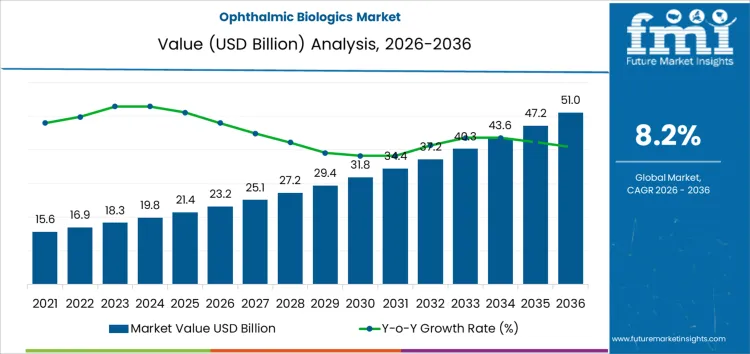
Market momentum is further influenced by how ophthalmic care delivery is organized and financed. High procedure volumes in outpatient retinal clinics create predictable consumption patterns for intravitreal biologics, while reimbursement frameworks increasingly recognize the cost implications of untreated vision loss. Biosimilar availability is reshaping procurement strategies by enabling broader access without materially altering treatment algorithms, particularly in public healthcare systems. From a supplier standpoint, competitive advantage is linked to dosing durability, supply reliability, and compatibility with clinic workflow constraints. Growth across the forecast horizon therefore reflects structural reliance on biologics as routine components of retinal disease management, rather than incremental uptake driven by short-term therapeutic substitution.
Quick Stats for Ophthalmic Biologics Market
- Ophthalmic Biologics Market Value (2026): USD 23.2 billion
- Ophthalmic Biologics Market Forecast Value (2036): USD 51.0 billion
- Ophthalmic Biologics Market Forecast CAGR 2026 to 2036: 8.2%
- Leading Product Type by Demand Share: Anti-VEGF therapies
- Fastest-Growing Countries: India, China, Brazil, USA, UK
- Top Players in Global Demand: Roche, Regeneron, Novartis, Bayer, Santen
Ophthalmic Biologics Market Key Takeaways
| Metric | Value |
|---|---|
| Market Value (2026) | USD 23.2 billion |
| Market Forecast Value (2036) | USD 51.0 billion |
| Forecast CAGR 2026 to 2036 | 8.2% |
Why is the Demand for Ophthalmic Biologics Growing?
Demand for ophthalmic biologics is rising as treatment approaches for retinal and inflammatory eye diseases emphasize targeted molecular intervention that addresses underlying pathophysiology rather than symptomatic relief. Conditions such as age-related macular degeneration, diabetic macular edema, and uveitis involve pathological signaling pathways that drive vision loss. Ophthalmologists and retinal specialists increasingly specify biologic agents that inhibit vascular endothelial growth factor or modulate immune activity to reduce fluid accumulation, prevent neovascularization, and preserve visual acuity. Clinics and specialty practices invest in injection suites, sterile preparation facilities, and training for intravitreal administration because proper delivery and patient monitoring directly affect clinical outcomes. Procurement teams assess long-term efficacy, safety data, dosing intervals, and cold chain handling requirements to support consistent availability and treatment planning across outpatient care settings.
Growing prevalence of retinal diseases due to aging populations and metabolic health trends reinforces uptake of ophthalmic biologics that align with evidence-based care protocols and visual function preservation goals. Managed care organizations and health systems incorporate these therapies into formulary pathways that recognize impact on quality of life and reduction in severe vision loss. Real-world outcome reporting and longitudinal studies encourage adoption of agents that demonstrate durable response in diverse patient populations. Research investment in next-generation biologics and delivery platforms is expanding options that may extend dosing intervals and reduce treatment burden. These clinical and operational imperatives are contributing to sustained demand growth in the ophthalmic biologics market.
How Is the Ophthalmic Biologics Market Segmented by Product Type, Application, and End User?
Demand for ophthalmic biologics is driven by rising prevalence of chronic retinal disorders, aging populations, and preference for targeted intravitreal therapies. Clinical management focuses on preserving vision, slowing disease progression, and reducing treatment burden through sustained efficacy. Adoption reflects standardized diagnostic protocols, expanded access to retinal imaging, and guideline-backed biologic use. Therapy selection balances durability of response, injection frequency, and safety monitoring. Segmentation explains how biologic class, ocular indication, and care delivery setting shape utilization intensity, procurement concentration, and treatment workflows across ophthalmic care.
Which Product Type Holds the Largest Share in Ophthalmic Biologics?
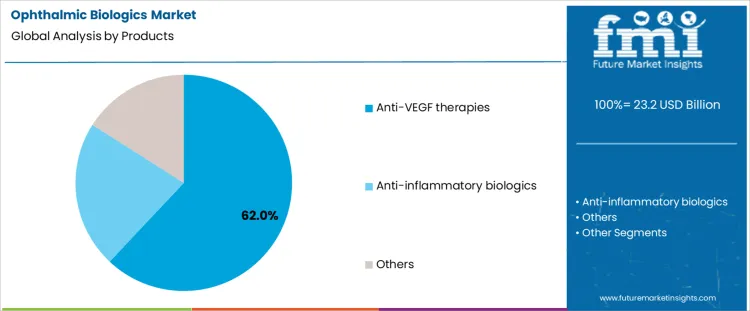
Anti-VEGF therapies hold 62.0%, representing the largest share among ophthalmic biologic product types. These agents directly inhibit pathological angiogenesis responsible for vision loss in major retinal diseases. Strong clinical evidence supports consistent visual acuity improvement and disease stabilization. Established dosing regimens enable predictable treatment planning and follow-up scheduling. Anti-inflammatory biologics serve specific inflammatory eye conditions with narrower patient pools. Other biologics address less common ocular pathways. Product segmentation reflects dominance of therapies targeting vascular endothelial growth where disease prevalence, treatment effectiveness, and standardized protocols drive sustained utilization.
Key Points
- Anti-VEGF agents directly address pathological retinal angiogenesis.
- Established regimens support predictable long-term management.
- Other biologics serve narrower or condition-specific roles.
Why Does AMD Represent the Largest Application Segment?
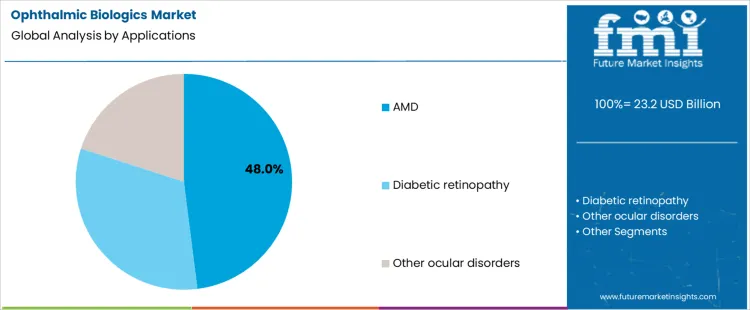
Age-related macular degeneration accounts for 48.0%, representing the largest share among ophthalmic biologic applications. High prevalence in older populations creates sustained demand for long-term treatment. Neovascular disease progression requires repeated biologic intervention to preserve central vision. Screening programs and early diagnosis increase eligible patient volumes. Diabetic retinopathy follows with biologic use driven by rising diabetes prevalence and retinal complications. Other ocular disorders involve smaller, heterogeneous patient groups. Application segmentation reflects concentration where disease burden, chronic progression, and proven biologic responsiveness converge most strongly.
Key Points
- AMD prevalence increases with population aging.
- Disease progression requires sustained biologic therapy.
- Other indications involve smaller or more diverse populations.
Which End User Accounts for the Highest Share of Treatment Delivery?
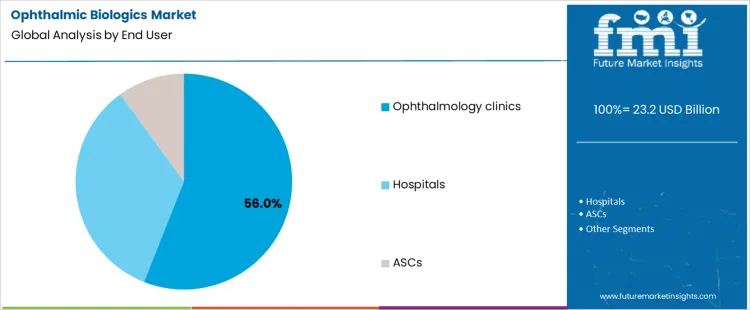
Ophthalmology clinics account for 56.0%, representing the largest share among end-user settings. Most biologic injections are administered in specialized outpatient retinal practices. Clinics provide integrated diagnostics, injection suites, and follow-up monitoring. High patient throughput supports efficient scheduling of repeat treatments. Hospitals manage complex cases and inpatient coordination with lower routine volume. Ambulatory surgical centers perform procedures for selected patients requiring controlled environments. End-user segmentation reflects concentration where specialized expertise, outpatient infrastructure, and procedural efficiency support routine biologic administration.
Key Points
- Clinics deliver the majority of intravitreal injections.
- Integrated diagnostics support efficient treatment cycles.
- Other settings manage complex or procedural cases.
What are the Key Dynamics in the Ophthalmic Biologics Market?
Demand for ophthalmic biologics reflects need to manage progressive retinal and inflammatory eye diseases that threaten vision preservation. Adoption concentrates in ophthalmology clinics, specialty eye hospitals, and outpatient injection centers. Global scope aligns with aging populations and increased diagnosis of chronic ocular disorders. Usage centers on biologic agents administered primarily through intravitreal injection to control pathological angiogenesis, inflammation, or immune-mediated tissue damage.
How do disease burden characteristics and treatment precision requirements shape adoption?
Ocular diseases such as age-related macular degeneration, diabetic macular edema, and uveitis require sustained control to prevent irreversible vision loss. Demand increases where conventional topical or systemic therapies fail to achieve localized efficacy. Biologics deliver targeted action at the retinal or intraocular level, limiting systemic exposure. Treatment regimens are structured around loading doses and maintenance intervals tailored to disease activity and imaging findings. Real-world adoption depends on visual acuity outcomes, injection frequency, and durability of response. Clinic workflows adapt to high injection volumes supported by standardized protocols. Patient monitoring relies on imaging-guided decision-making. Adoption reflects clinical emphasis on preserving functional vision through localized, high-efficacy biologic intervention.
How does administration burden, cost exposure, and long-term adherence influence market scalability?
Intravitreal delivery requires sterile settings, trained specialists, and repeat clinic visits, increasing operational burden. Demand sensitivity rises where injection frequency affects patient adherence and clinic capacity. Safety concerns include endophthalmitis risk and cumulative ocular stress. High therapy cost drives reimbursement scrutiny and dosing optimization strategies. Biosimilar entry affects pricing dynamics yet requires clinician confidence in equivalence. Cold chain handling and shelf-life constraints affect distribution logistics. Long-term treatment persistence varies due to disease progression and patient tolerance. Scalability remains constrained by procedural intensity, payer controls, and reliance on sustained specialist-led care delivery.
How Is Demand for Ophthalmic Biologics Evolving Globally?
Demand for ophthalmic biologics is expanding globally as retinal disease prevalence rises and treatment protocols increasingly favor biologic interventions over conventional therapies. Anti-VEGF biologics and newer agents dominate management of age-related macular degeneration, diabetic retinopathy, and retinal vein occlusion. Longer treatment duration, repeat dosing schedules, and improved diagnostic screening sustain volume growth. Expansion of ophthalmology services and reimbursement inclusion influence access dynamics. Growth rates in India at 9.9%, China at 9.7%, Brazil at 9.4%, USA at 8.8%, and the UK at 7.7% reflect strong expansion driven by patient identification, therapy persistence, and healthcare system capacity building rather than short-term product switching.
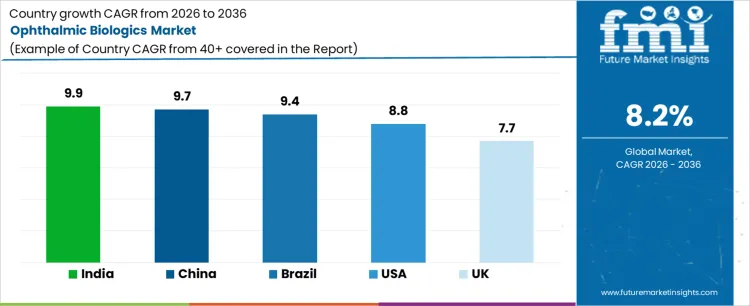
| Country | CAGR (%) |
|---|---|
| India | 9.9% |
| China | 9.7% |
| Brazil | 9.4% |
| USA | 8.8% |
| UK | 7.7% |
What Is Accelerating Ophthalmic Biologic Uptake in India?
Ophthalmic biologic demand in India is growing at a CAGR of 9.9%, shaped by rising retinal disease diagnosis and expanding access to specialized eye care. Large private hospital chains and dedicated eye institutes perform increasing volumes of intravitreal injections. Improved availability of optical coherence tomography supports earlier detection and sustained monitoring. Insurance participation for retinal therapies improves affordability for chronic treatment cycles. Biosimilar entry reduces therapy discontinuation caused by cost pressures. High diabetes prevalence sustains long-term need for retinal biologic management. Growth reflects service expansion, affordability improvements, and treatment continuity rather than rapid adoption of premium next-generation agents.
- Expansion of private retinal care networks
- Improved diagnostic imaging availability
- Insurance coverage supporting chronic therapy
- Biosimilar entry stabilizing long-term treatment
Why Is China Demonstrating Strong Momentum in Ophthalmic Biologics?
Demand for ophthalmic biologics in China is expanding at a CAGR of 9.7%, supported by large hospital networks and standardized retinal treatment pathways. Public hospitals increasingly adopt protocol-based intravitreal injection schedules for retinal disorders. Reimbursement inclusion for selected biologics improves initiation and persistence rates. Domestic biologic manufacturing strengthens supply reliability and pricing control. Expansion of diabetic retinopathy screening programs increases eligible patient identification. Growth reflects coordinated scaling of diagnosis, reimbursement, and service delivery rather than concentration of biologic use in high-end private clinics.
- Hospital-led protocol standardization
- Reimbursement support for key biologics
- Domestic production improving supply security
- Expanded screening for diabetes-related eye disease
How Is Brazil Sustaining Expansion in Ophthalmic Biologic Demand?
Ophthalmic biologic demand in Brazil is growing at a CAGR of 9.4%, driven by public healthcare engagement and increasing retinal disease burden. National treatment protocols prioritize biologics for advanced retinal conditions where vision preservation is critical. Judicial access mechanisms frequently mandate biologic coverage, expanding patient eligibility. Public hospitals adopt biosimilars to manage budget impact while maintaining treatment access. Growth of regional ophthalmology centers improves availability beyond metropolitan areas. Expansion is supported by access enforcement, chronic disease prevalence, and public system scale rather than rapid private-sector driven uptake.
- National protocols supporting retinal biologics
- Judicial pathways expanding patient access
- Biosimilar adoption for cost containment
- Regional ophthalmology service expansion
What Factors Are Driving Ophthalmic Biologic Demand in United States?
Ophthalmic biologic demand in the United States is expanding at a CAGR of 8.8%, reflecting high screening penetration and long-term therapy persistence. Early diagnosis through routine retinal examinations enables prompt biologic initiation. Broad insurance coverage supports sustained repeat dosing across approved indications. High specialist density allows individualized regimen optimization and switching. Aging population demographics increase prevalence of macular degeneration and diabetic eye disease. Growth is driven by treatment duration, patient retention, and service capacity rather than rapid introduction of entirely new biologic classes.
- High retinal screening and early diagnosis rates
- Broad payer coverage for injectable therapies
- Specialist-driven regimen optimization
- Aging population increasing retinal disease prevalence
Why Is the UK Showing Steady Expansion in Ophthalmic Biologics?
Demand for ophthalmic biologics in United Kingdom is growing at a CAGR of 7.7%, supported by structured NHS retinal care pathways and centralized commissioning. National screening programs increase early identification of eligible patients requiring biologic intervention. Managed access agreements regulate utilization within defined cost-effectiveness thresholds. Biosimilar adoption expands treatment capacity without proportional escalation in public spending. Centralized ophthalmology clinics enable consistent dosing, monitoring, and adherence across regions. Growth remains steady, reflecting governance-led access expansion and capacity planning rather than unrestricted biologic utilization or rapid protocol escalation.
- NHS-led centralized commissioning framework
- National retinal screening program coverage
- Managed access agreements for biologics
- Biosimilar-driven treatment capacity expansion
What is the competitive landscape of demand for the ophthalmic biologics market globally?
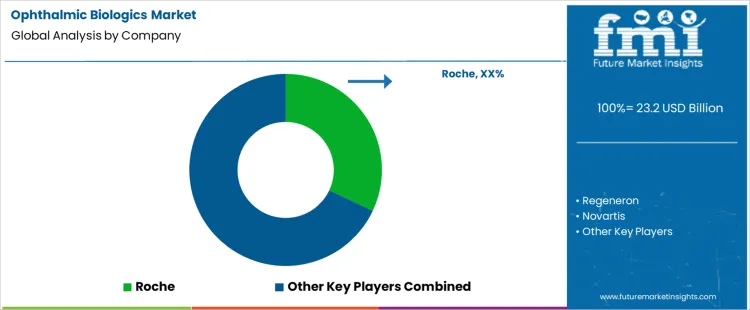
Demand for ophthalmic biologics is anchored in rising prevalence of retinal disorders, aging populations, and chronic management needs for vision-threatening diseases. Retina specialists evaluate visual acuity outcomes, injection frequency, durability between doses, safety signals, and real-world persistence. Hospital and clinic buyers assess cold-chain handling, indication-specific approvals, patient support programs, and reimbursement alignment. Procurement behavior reflects preference for therapies reducing treatment burden while maintaining consistent efficacy.
Purchasing decisions emphasize long-term disease control, predictable supply, and integration into established retinal care workflows. Trend in the ophthalmic biologics market shows continued shift toward longer-acting biologics and expanded use beyond late-stage disease.
Roche leads competitive positioning through biologics with strong clinical adoption and broad utilization across retinal indications. Regeneron competes through high-efficacy agents widely embedded in standard retinal treatment protocols. Novartis supports demand with ophthalmology-focused biologics positioned for differentiated dosing schedules and sustained outcomes. Bayer maintains relevance through biologic therapies supported by global commercialization partnerships and strong presence in retinal care. Santen participates by advancing biologic innovation aligned with ophthalmology specialization and regional market strengths. Competitive differentiation centers on dosing durability, visual outcome consistency, payer access, and depth of engagement with retinal specialists.
Key Players in the Ophthalmic Biologics Market
- Roche
- Regeneron
- Novartis
- Bayer
- Santen
- Others
Scope of the Report
| Items | Values |
|---|---|
| Quantitative Units | USD billion |
| Products | Anti-VEGF therapies; Anti-inflammatory biologics; Others |
| Applications | AMD; Diabetic retinopathy; Other ocular disorders |
| End User | Ophthalmology clinics; Hospitals; ASCs |
| Regions Covered | Asia Pacific, Europe, North America, Latin America, Middle East & Africa |
| Countries Covered | India, China, Brazil, USA, UK, and 40+ countries |
| Key Companies Profiled | Roche; Regeneron; Novartis; Bayer; Santen; Others |
| Additional Attributes | Dollar sales by product type, application, end user, and sales channel; treatment frequency and durability profiles influencing anti-VEGF utilization; administration setting preferences across clinics, hospitals, and ASCs; cold-chain handling and intravitreal injection logistics; reimbursement structures and procedure bundling affecting uptake; competitive dynamics shaped by biosimilar entry, pipeline innovation, and long-acting formulation development. |
Ophthalmic Biologics Market by Segment
Products:
- Anti-VEGF therapies
- Anti-inflammatory biologics
- Others
Applications:
- AMD
- Diabetic retinopathy
- Other ocular disorders
End User:
- Ophthalmology clinics
- Hospitals
- ASCs
Region:
- Asia Pacific
- China
- Japan
- South Korea
- India
- Australia & New Zealand
- ASEAN
- Rest of Asia Pacific
- Europe
- Germany
- United Kingdom
- France
- Italy
- Spain
- Nordic
- BENELUX
- Rest of Europe
- North America
- United States
- Canada
- Mexico
- Latin America
- Brazil
- Chile
- Rest of Latin America
- Middle East & Africa
- Kingdom of Saudi Arabia
- Other GCC Countries
- Turkey
- South Africa
- Other African Union
- Rest of Middle East & Africa
Bibliography
- American Academy of Ophthalmology. (2024). Preferred practice pattern guidelines: Age-related macular degeneration (2024 update). American Academy of Ophthalmology.
- European Medicines Agency. (2025). Guideline on clinical evaluation of medicinal products for retinal and inflammatory eye diseases (Revision 2, 2025). EMA.
- National Eye Institute. (2025). Retinal diseases and biologic therapies: Epidemiology and treatment outcomes review 2025. U.S. National Institutes of Health.
Frequently Asked Questions
How big is the ophthalmic biologics market in 2026?
The global ophthalmic biologics market is estimated to be valued at USD 23.2 billion in 2026.
What will be the size of ophthalmic biologics market in 2036?
The market size for the ophthalmic biologics market is projected to reach USD 51.0 billion by 2036.
How much will be the ophthalmic biologics market growth between 2026 and 2036?
The ophthalmic biologics market is expected to grow at a 8.2% CAGR between 2026 and 2036.
What are the key product types in the ophthalmic biologics market?
The key product types in ophthalmic biologics market are anti-vegf therapies, anti-inflammatory biologics and others.
Which applications segment to contribute significant share in the ophthalmic biologics market in 2026?
In terms of applications, amd segment to command 48.0% share in the ophthalmic biologics market in 2026.
Preview the report firsthand - request a free sample
Get SampleGet the brochure for pricing and purchase details.
Get PDFTable of Content
- Executive Summary
- Global Market Outlook
- Demand-side Trends
- Supply-side Trends
- Technology Roadmap Analysis
- Analysis and Recommendations
- Market Overview
- Market Coverage / Taxonomy
- Market Definition / Scope / Limitations
- Market Background
- Market Dynamics
- Drivers
- Restraints
- Opportunity
- Trends
- Scenario Forecast
- Demand in Optimistic Scenario
- Demand in Likely Scenario
- Demand in Conservative Scenario
- Opportunity Map Analysis
- Product Life Cycle Analysis
- Supply Chain Analysis
- Investment Feasibility Matrix
- Value Chain Analysis
- PESTLE and Porter’s Analysis
- Regulatory Landscape
- Regional Parent Market Outlook
- Production and Consumption Statistics
- Import and Export Statistics
- Market Dynamics
- Global Market Analysis 2021 to 2025 and Forecast, 2026 to 2036
- Historical Market Size Value (USD Million) Analysis, 2021 to 2025
- Current and Future Market Size Value (USD Million) Projections, 2026 to 2036
- Y-o-Y Growth Trend Analysis
- Absolute $ Opportunity Analysis
- Global Market Pricing Analysis 2021 to 2025 and Forecast 2026 to 2036
- Global Market Analysis 2021 to 2025 and Forecast 2026 to 2036, By Products
- Introduction / Key Findings
- Historical Market Size Value (USD Million) Analysis By Products , 2021 to 2025
- Current and Future Market Size Value (USD Million) Analysis and Forecast By Products , 2026 to 2036
- Anti-VEGF therapies
- Anti-inflammatory biologics
- Others
- Anti-VEGF therapies
- Y-o-Y Growth Trend Analysis By Products , 2021 to 2025
- Absolute $ Opportunity Analysis By Products , 2026 to 2036
- Global Market Analysis 2021 to 2025 and Forecast 2026 to 2036, By Applications
- Introduction / Key Findings
- Historical Market Size Value (USD Million) Analysis By Applications, 2021 to 2025
- Current and Future Market Size Value (USD Million) Analysis and Forecast By Applications, 2026 to 2036
- AMD
- Diabetic retinopathy
- Other ocular disorders
- AMD
- Y-o-Y Growth Trend Analysis By Applications, 2021 to 2025
- Absolute $ Opportunity Analysis By Applications, 2026 to 2036
- Global Market Analysis 2021 to 2025 and Forecast 2026 to 2036, By End User
- Introduction / Key Findings
- Historical Market Size Value (USD Million) Analysis By End User, 2021 to 2025
- Current and Future Market Size Value (USD Million) Analysis and Forecast By End User, 2026 to 2036
- Ophthalmology clinics
- Hospitals
- ASCs
- Ophthalmology clinics
- Y-o-Y Growth Trend Analysis By End User, 2021 to 2025
- Absolute $ Opportunity Analysis By End User, 2026 to 2036
- Global Market Analysis 2021 to 2025 and Forecast 2026 to 2036, By Region
- Introduction
- Historical Market Size Value (USD Million) Analysis By Region, 2021 to 2025
- Current Market Size Value (USD Million) Analysis and Forecast By Region, 2026 to 2036
- North America
- Latin America
- Western Europe
- Eastern Europe
- East Asia
- South Asia and Pacific
- Middle East & Africa
- Market Attractiveness Analysis By Region
- North America Market Analysis 2021 to 2025 and Forecast 2026 to 2036, By Country
- Historical Market Size Value (USD Million) Trend Analysis By Market Taxonomy, 2021 to 2025
- Market Size Value (USD Million) Forecast By Market Taxonomy, 2026 to 2036
- By Country
- USA
- Canada
- Mexico
- By Products
- By Applications
- By End User
- By Country
- Market Attractiveness Analysis
- By Country
- By Products
- By Applications
- By End User
- Key Takeaways
- Latin America Market Analysis 2021 to 2025 and Forecast 2026 to 2036, By Country
- Historical Market Size Value (USD Million) Trend Analysis By Market Taxonomy, 2021 to 2025
- Market Size Value (USD Million) Forecast By Market Taxonomy, 2026 to 2036
- By Country
- Brazil
- Chile
- Rest of Latin America
- By Products
- By Applications
- By End User
- By Country
- Market Attractiveness Analysis
- By Country
- By Products
- By Applications
- By End User
- Key Takeaways
- Western Europe Market Analysis 2021 to 2025 and Forecast 2026 to 2036, By Country
- Historical Market Size Value (USD Million) Trend Analysis By Market Taxonomy, 2021 to 2025
- Market Size Value (USD Million) Forecast By Market Taxonomy, 2026 to 2036
- By Country
- Germany
- UK
- Italy
- Spain
- France
- Nordic
- BENELUX
- Rest of Western Europe
- By Products
- By Applications
- By End User
- By Country
- Market Attractiveness Analysis
- By Country
- By Products
- By Applications
- By End User
- Key Takeaways
- Eastern Europe Market Analysis 2021 to 2025 and Forecast 2026 to 2036, By Country
- Historical Market Size Value (USD Million) Trend Analysis By Market Taxonomy, 2021 to 2025
- Market Size Value (USD Million) Forecast By Market Taxonomy, 2026 to 2036
- By Country
- Russia
- Poland
- Hungary
- Balkan & Baltic
- Rest of Eastern Europe
- By Products
- By Applications
- By End User
- By Country
- Market Attractiveness Analysis
- By Country
- By Products
- By Applications
- By End User
- Key Takeaways
- East Asia Market Analysis 2021 to 2025 and Forecast 2026 to 2036, By Country
- Historical Market Size Value (USD Million) Trend Analysis By Market Taxonomy, 2021 to 2025
- Market Size Value (USD Million) Forecast By Market Taxonomy, 2026 to 2036
- By Country
- China
- Japan
- South Korea
- By Products
- By Applications
- By End User
- By Country
- Market Attractiveness Analysis
- By Country
- By Products
- By Applications
- By End User
- Key Takeaways
- South Asia and Pacific Market Analysis 2021 to 2025 and Forecast 2026 to 2036, By Country
- Historical Market Size Value (USD Million) Trend Analysis By Market Taxonomy, 2021 to 2025
- Market Size Value (USD Million) Forecast By Market Taxonomy, 2026 to 2036
- By Country
- India
- ASEAN
- Australia & New Zealand
- Rest of South Asia and Pacific
- By Products
- By Applications
- By End User
- By Country
- Market Attractiveness Analysis
- By Country
- By Products
- By Applications
- By End User
- Key Takeaways
- Middle East & Africa Market Analysis 2021 to 2025 and Forecast 2026 to 2036, By Country
- Historical Market Size Value (USD Million) Trend Analysis By Market Taxonomy, 2021 to 2025
- Market Size Value (USD Million) Forecast By Market Taxonomy, 2026 to 2036
- By Country
- Kingdom of Saudi Arabia
- Other GCC Countries
- Turkiye
- South Africa
- Other African Union
- Rest of Middle East & Africa
- By Products
- By Applications
- By End User
- By Country
- Market Attractiveness Analysis
- By Country
- By Products
- By Applications
- By End User
- Key Takeaways
- Key Countries Market Analysis
- USA
- Pricing Analysis
- Market Share Analysis, 2025
- By Products
- By Applications
- By End User
- Canada
- Pricing Analysis
- Market Share Analysis, 2025
- By Products
- By Applications
- By End User
- Mexico
- Pricing Analysis
- Market Share Analysis, 2025
- By Products
- By Applications
- By End User
- Brazil
- Pricing Analysis
- Market Share Analysis, 2025
- By Products
- By Applications
- By End User
- Chile
- Pricing Analysis
- Market Share Analysis, 2025
- By Products
- By Applications
- By End User
- Germany
- Pricing Analysis
- Market Share Analysis, 2025
- By Products
- By Applications
- By End User
- UK
- Pricing Analysis
- Market Share Analysis, 2025
- By Products
- By Applications
- By End User
- Italy
- Pricing Analysis
- Market Share Analysis, 2025
- By Products
- By Applications
- By End User
- Spain
- Pricing Analysis
- Market Share Analysis, 2025
- By Products
- By Applications
- By End User
- France
- Pricing Analysis
- Market Share Analysis, 2025
- By Products
- By Applications
- By End User
- India
- Pricing Analysis
- Market Share Analysis, 2025
- By Products
- By Applications
- By End User
- ASEAN
- Pricing Analysis
- Market Share Analysis, 2025
- By Products
- By Applications
- By End User
- Australia & New Zealand
- Pricing Analysis
- Market Share Analysis, 2025
- By Products
- By Applications
- By End User
- China
- Pricing Analysis
- Market Share Analysis, 2025
- By Products
- By Applications
- By End User
- Japan
- Pricing Analysis
- Market Share Analysis, 2025
- By Products
- By Applications
- By End User
- South Korea
- Pricing Analysis
- Market Share Analysis, 2025
- By Products
- By Applications
- By End User
- Russia
- Pricing Analysis
- Market Share Analysis, 2025
- By Products
- By Applications
- By End User
- Poland
- Pricing Analysis
- Market Share Analysis, 2025
- By Products
- By Applications
- By End User
- Hungary
- Pricing Analysis
- Market Share Analysis, 2025
- By Products
- By Applications
- By End User
- Kingdom of Saudi Arabia
- Pricing Analysis
- Market Share Analysis, 2025
- By Products
- By Applications
- By End User
- Turkiye
- Pricing Analysis
- Market Share Analysis, 2025
- By Products
- By Applications
- By End User
- South Africa
- Pricing Analysis
- Market Share Analysis, 2025
- By Products
- By Applications
- By End User
- USA
- Market Structure Analysis
- Competition Dashboard
- Competition Benchmarking
- Market Share Analysis of Top Players
- By Regional
- By Products
- By Applications
- By End User
- Competition Analysis
- Competition Deep Dive
- Roche
- Overview
- Product Portfolio
- Profitability by Market Segments (Product/Age /Sales Channel/Region)
- Sales Footprint
- Strategy Overview
- Marketing Strategy
- Product Strategy
- Channel Strategy
- Regeneron
- Novartis
- Bayer
- Santen
- Others
- Roche
- Competition Deep Dive
- Assumptions & Acronyms Used
- Research Methodology


