

- Market Size (2026)
- USD 460.7 Mn
- Forecast (2036)
- USD 1013.2 Mn
- CAGR (2026 to 2036)
- 8.2%
Digestor Gas Storage Roofs Market Size, Market Forecast and Outlook By FMI
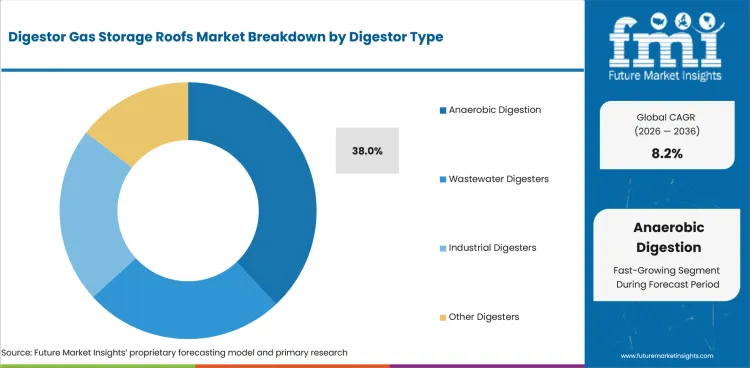
The digestor gas storage roofs industry value is forecast to grow from USD 425.8 million in 2025 to USD 1,013.2 million by 2036 at 8.2% CAGR. Demand is supported by biogas plants, wastewater digesters, and organic-waste treatment systems that need gas-tight covers with pressure control. Double Membrane Roofs are projected to account for 58.0% share in 2026 because buyers need flexible gas storage and weather protection in one roof package. Anaerobic Digestion is expected to represent 38.0% share in 2026, led by farm and mixed-waste projects that need gas space above active tanks.
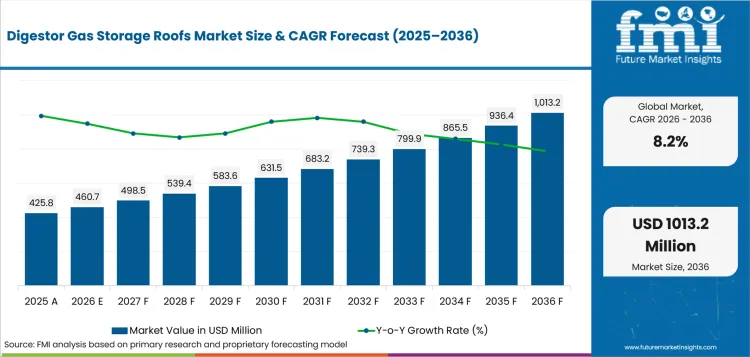
Digestor Gas Storage Roofs Market Overview: Size and Forecast
- 2025 Market Size: USD 425.8 million
- 2026 Market Size: USD 460.7 million
- 2036 Market Size: USD 1,013.2 million
- Forecast CAGR: 8.2% from 2026 to 2036
- Leading Roof Type: Double Membrane Roofs
- Double Membrane Roofs Share in 2026: 58.0%
- Leading Digester Type: Anaerobic Digestion
- Anaerobic Digestion Share in 2026: 38.0%
- Leading Gas Capacity: 1,000-5,000 m³
- 1,000-5,000 m³ Share in 2026: 46.0%
- Leading End Use: Municipal Wastewater
- Municipal Wastewater Share in 2026: 37.0%
- Leading Installation: New Installation
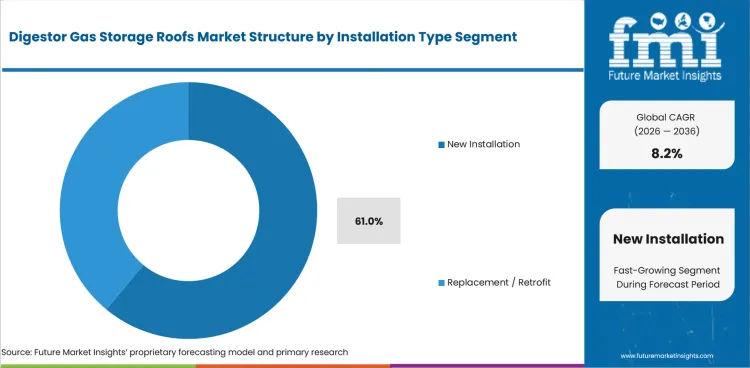
- New Installation Share in 2026: 61.0%
- Leading Country by CAGR: India
- India CAGR: 10.1% by 2036
Summary of the Digestor Gas Storage Roofs Market
- Demand and Growth Drivers
- Growing investments in biogas and anaerobic digestion facilities are increasing demand for gas storage roofs that enable safe and efficient biogas collection and storage.
- Expansion of municipal wastewater treatment plants and agricultural digesters is driving higher adoption of durable membrane and fixed-roof gas storage systems.
- Rising renewable energy generation from organic waste streams is boosting sales of advanced gas storage roofs designed to maximize gas recovery and minimize leakage.
- Stricter environmental and methane-emission regulations are encouraging facility operators to upgrade existing digesters with high-performance gas storage roof solutions, supporting market growth.
- Product and Segment View
- Double Membrane Roofs are projected to lead By Roof Type with 58.0% share in 2026 due to combined gas storage and weather protection.
- Anaerobic Digestion is expected to lead By Digester Type with 38.0% share in 2026 because farm and waste-site use is broad.
- The 1,000-5,000 m³ category is projected to lead By Gas Capacity with 46.0% share in 2026 due to its fit with mid-sized plants.
- Municipal Wastewater is expected to lead By End Use with 37.0% share in 2026 since plants need odor control and gas capture.
- New Installation is projected to lead By Installation with 61.0% share in 2026 while retrofit work supports service revenue.
- Geography and Competitive Outlook
- The selected countries cover mature retrofit markets, grid-injection markets, and faster build-out markets across biogas infrastructure.
- Sattler CENO, HUESKER, and Ecomembrane compete on membrane welding, roof geometry, and gas-tight design.
- Permastore and Balmoral Tanks serve buyers that want tank and roof integration in one engineered package.
- Specialist suppliers gain ground when projects need snow-load design, pressure stability, and local installation partners.
- Country-specific company coverage varies, so buyers often rely on EPC contractors and certified installers for final supplier choice.
- Analyst Opinion
- Anurag Sharma, Principal Consultant at FMI says, "Digestor gas storage roofs should be viewed as reliability equipment rather than tank accessories. Buyers need pressure stability, odor control, and usable gas storage that keeps engines or upgrading units fed at the right flow. Suppliers gain an edge when they can prove membrane life, weld quality, fan control, valve control, and local service response."
Official digestion indicators support this equipment outlook. EPA reported 400 operational manure-based anaerobic digestion systems in the United States as of June 2024. The Federal Network Agency reported 267 German biogas injection plants in 2024. Ofgem reported 274.6 million cubic meters of biomethane produced under the Green Gas Support Scheme in 2024 to 2025.
Which factors support expansion in the digestor gas storage roofs market?
Gas capture, pressure stability, and replacement cycles support market value across municipal, farm, and industrial digestion sites.
- Market value is supported by roof packages that combine coated membrane supply, blowers, pressure relief systems, and installation labor.
- Supplier pricing reflects membrane grade and site engineering before service contracts add recurring revenue.
- Revenue improves as biomethane projects require steadier gas flow before upgrading and injection.
- Retailer-style channels are limited because most sales move through EPC contractors, tank suppliers, and direct technical bids.
Why is the Digester Gas Storage Roofs Market Growing?
Growing anaerobic digestion and biomethane infrastructure increase demand for gas-tight, pressure-controlled roof systems
The digester gas storage roofs market is growing because anaerobic digestion operators are linking vessel covers with methane capture and usable gas control. In October 2025, EPA reported that its 2024 survey covered 313 USA anaerobic digestion facilities that process food waste. EPA also said the identified facility count rose from 154 in 2017 to 313 in 2024. This matters because each added co-digestion site needs a controlled gas space before biogas can move into boilers, CHP units or upgrading systems.
Biomethane injection is also changing how owners judge roof performance. In June 2025, the European Biogas Association reported that Europe’s biomethane plant count increased from 1,548 to 1,678 between the 2024 and 2025 data collections. That expansion raises the value of storage margin because grid-connected plants lose revenue when poor pressure control interrupts upgrading or injection. Buyers are therefore moving beyond simple tank sealing toward roof packages that protect gas availability and plant uptime.
Double membrane roof designs are gaining attention because they combine vessel coverage with low-pressure gas storage. SATTLER PRO-TEX describes double membrane biogas roofs as systems mounted on fermenter tanks where an outer membrane provides weather protection and an inner membrane seals the digester gas-tight. AMOCO’s April 2026 project updates show the same equipment route through completed 3,000 m³ and 2,000 m³ digester-mounted double membrane biogas holders. Suppliers with commissioning support, pressure-safety know-how and membrane service capability are likely to gain repeat orders from municipal, farm and food-waste digestion projects.
How is the digestor gas storage roofs market segmented?
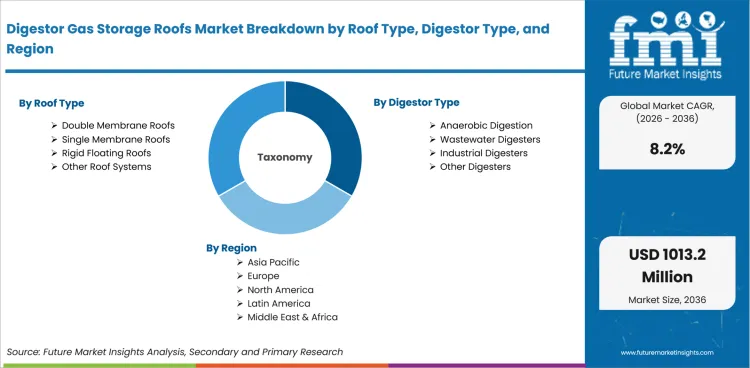
The digestor gas storage roofs industry is segmented by roof type, digester type, gas capacity, end use, and installation.
- Double Membrane Roofs are projected to secure 58.0% share in 2026 due to flexible gas volume and weather shielding.
- Anaerobic Digestion is anticipated to hold 38.0% share in 2026 since farm and organic-waste projects need gas storage above active tanks.
- The 1,000-5,000 m³ category is expected to capture 46.0% share in 2026 because mid-sized plants balance storage need and roof cost.
- Municipal Wastewater is forecast to represent 37.0% share in 2026, guided by odor control and recoverable digester gas.
- New Installation is projected to account for 61.0% share in 2026, reflected by greenfield digestion and wastewater upgrade projects.
Why do double membrane roofs lead the digestor gas storage roofs market?
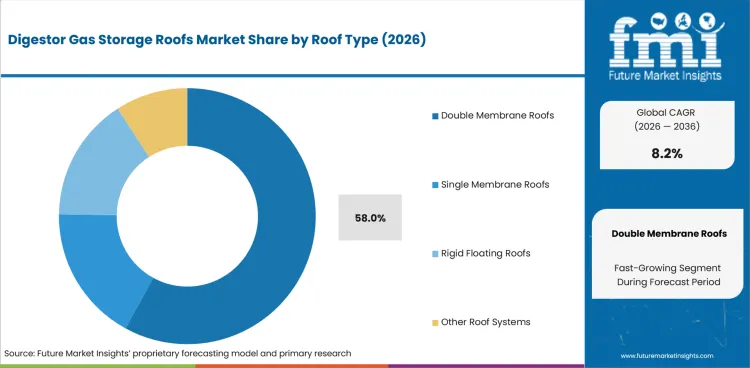
- Double Membrane Roofs are projected to account for 58.0% share in 2026, influenced by combined gas storage and external weather protection.
- Single membrane and rigid floating roofs retain use where storage volume and pressure control carry less weight.
Which digester type leads the digestor gas storage roofs market?
- Anaerobic Digestion is expected to represent 38.0% share in 2026 through broad farm and organic-waste plant use.
- Wastewater digesters gain value when public plants need odor control and recoverable gas from sludge treatment.
Which gas capacity leads the digestor gas storage roofs market?
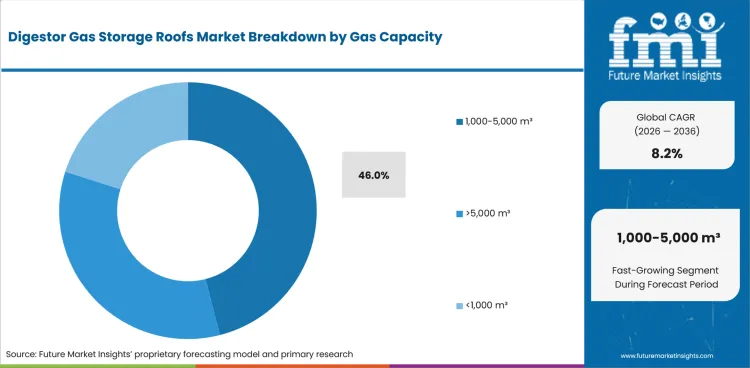
- The 1,000-5,000 m³ category is anticipated to hold 46.0% share in 2026 due to its fit with mid-sized municipal and commercial digestion plants.
- Oversized roofs raise blower and fabric cost while undersized roofs increase flare use during variable feedstock periods.
Which end use leads the digestor gas storage roofs market?
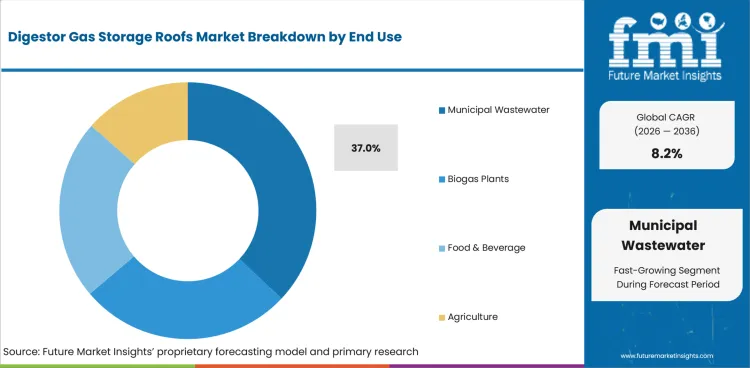
- Municipal Wastewater is projected to account for 37.0% share in 2026 as public plants need odor control and recoverable digester gas.
- Biogas plants add demand when upgraded projects require a steadier gas feed before engines or biomethane skids.
Which installation type leads the digestor gas storage roofs market?
- New Installation is expected to represent 61.0% share in 2026 as new biogas and wastewater projects include roof systems during tank design.
- Replacement and retrofit work becomes urgent when aged covers create odor complaints or interrupt gas use.
Digestor Gas Storage Roofs Market Drivers, Restraints, and Opportunities
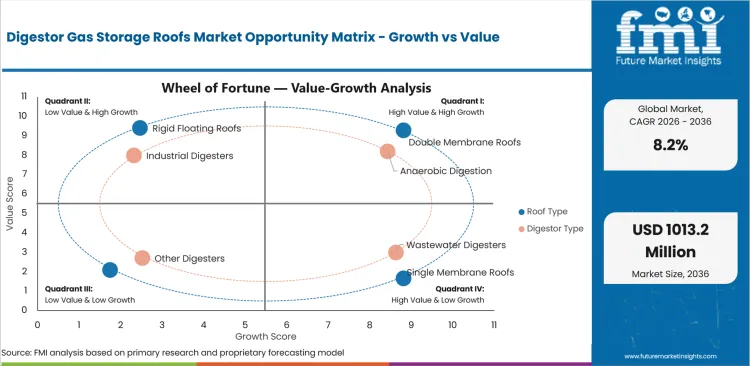
- Driver: Gas-tight storage demand grows as plant owners seek usable methane and fewer odor complaints from active digestion tanks.
- Driver: Roof replacement cycles increase when older membranes face UV aging, weld fatigue, and condensate exposure.
- Restraint: Installation risk remains high because poor welding or incorrect pressure setup can shorten membrane life.
- Restraint: Public tenders can separate civil works from roof supply, which can pressure supplier margins.
- Opportunity: Retrofit audits can pair roof inspection with pressure-control upgrades and service contracts.
Gas Buffering Need
Digesters produce gas at uneven rates, but engines and upgrading units need steadier feed. Germany’s Federal Network Agency reported 10.9 TWh of biogas injected into the German gas system in 2024. This makes pressure stability more valuable for plant operators.
Membrane Integrity Risk
Roof failure creates an operating problem because gas loss affects energy revenue and odor control at the same time. Buyers therefore compare membrane grade, weld quality, site access, and commissioning support before price alone.
Retrofit Service Opportunity
The clearest opportunity is concentrated in service-backed replacement work. Older covers need inspection before visible failure because seam fatigue and condensate exposure can reduce gas tightness. Suppliers that combine inspection, repair, and pressure-control upgrades are expected to win repeat work.
Digestor Gas Storage Roofs Market Demand Outlook
Demand outlook is moving toward roof systems that prove gas tightness and serviceability before channel expansion. EPA’s March 2026 AgSTAR update counted 400 operational manure-based AD systems as of June 2024. That figure shows why farm retrofits remain important for roof suppliers.
Wastewater and biomethane operators need more than fabric supply. They need pressure relief, blower control, penetration sealing, and commissioning support. This shifts purchase criteria toward engineered roof packages instead of low-cost membrane replacement alone.
Which countries are growing fastest in the digestor gas storage roofs market?
India leads country growth, followed by China, South Korea, the United Kingdom, France, the United States, Germany, and Japan through 2036.
.webp "Top Country Growth Comparison Digestor Gas Storage Roofs Market Cagr (2026 2036)")
| Country | CAGR |
| India | 10.1% |
| China | 8.8% |
| South Korea | 8.6% |
| United Kingdom | 8.4% |
| France | 8.1% |
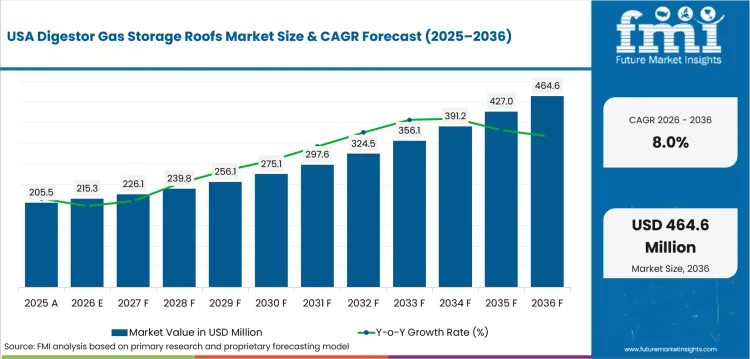
| United States | 8.0% |
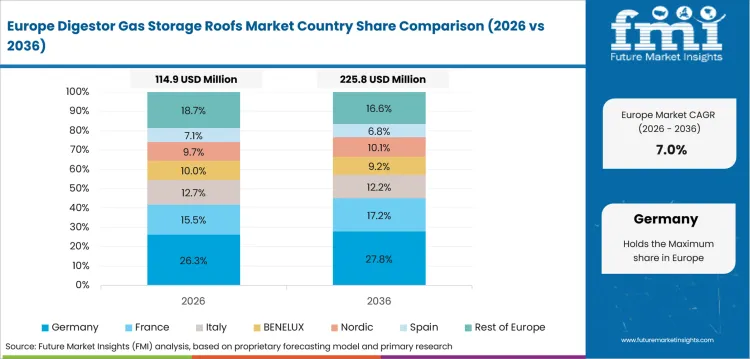
| Germany | 7.6% |
| Japan | 7.2% |
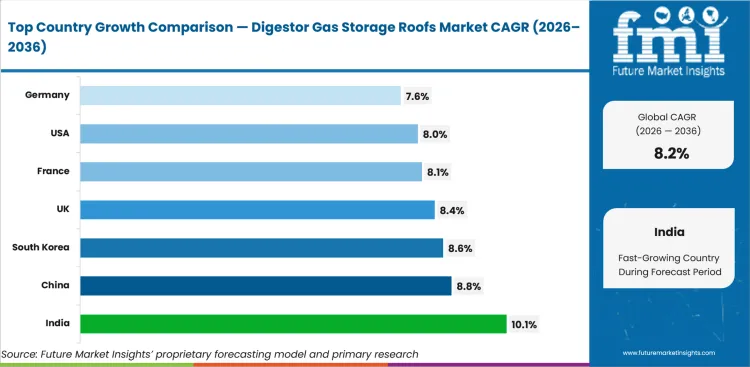
Source: Future Market Insights, 2026.
How do country-level CAGRs compare in the digestor gas storage roofs market?
India records the fastest outlook while Japan shows the most measured expansion among the profiled countries.
- India is forecast to record 10.1% CAGR by 2036 as CBG projects and municipal organic-waste programs raise covered digester demand.
- China is projected to grow at 8.8% CAGR through 2036 as large livestock and municipal waste streams support gas-managed digestion assets.
- South Korea is expected to expand at 8.6% CAGR by 2036 as food-waste digestion policy lifts demand for compact gas-storage covers.
- The United Kingdom is forecast to rise at 8.4% CAGR through 2036 as biomethane injection projects require stable gas buffering.
- France is projected to post 8.1% CAGR by 2036 as farm biomethane projects increase demand for medium-size membrane roof systems.
- The United States is anticipated to advance at 8.0% CAGR through 2036 as manure digesters and RNG projects support retrofit orders.
- Germany is forecast to record 7.6% CAGR by 2036 as mature biogas fleets create service-backed replacement demand.
- Japan is expected to register 7.2% CAGR through 2036 as compact livestock and food-waste digestion projects support selective roof procurement.
How fast is the digestor gas storage roofs market growing in India?
A 10.1% CAGR through 2036 reflects compressed biogas expansion and policy-backed organic-waste digestion.
Country Market Snapshot Table
| Parameter | Value |
|---|---|
| Market Size in 2025 (Value) | USD 26.6 million |
| Market Size in 2026 (Value) | USD 29.3 million |
| Market Forecast in 2036 (Value) | USD 76.8 million |
| CAGR (2026 to 2036) | 10.1% |
| Years Considered | 2021 to 2036 |
| Base Year | 2025 |
| Forecast Period | 2026 to 2036 |
| Units Considered | Value (USD million) |
| Leading Sub-Region | Punjab, Maharashtra, Gujarat, and Uttar Pradesh CBG corridors |
India Digestor Gas Storage Roofs Market Outlook
India demand is expected to rise faster than other profiled markets because compressed biogas and municipal organic-waste projects need covered digestion assets. Roof suppliers can benefit when projects combine tank construction with gas storage and safety equipment.
Local service and cost discipline are essential for conversion from announced CBG projects to installed roofs. Buyers are likely to favor suppliers with installation partners near project clusters.
Key Growth Drivers
- The GOBARdhan portal listed 1,700 registered biogas plants in June 2026, showing a broad project pipeline for covered digestion systems.
- MNRE reported 59 compressed biogas plants with 684.33 TPD capacity installed during 2025 through November.
- Municipal organic-waste projects are expected to increase demand for odor-controlled roofs at decentralized treatment sites.
- Dairy and sugar-sector residues create demand for gas storage roofs that can manage variable feedstock quality.
Key Restraints
- GOBARdhan listed 177 biogas plants under construction in June 2026, indicating execution delays across part of the project pipeline.
- Small and medium plants remain price sensitive when roof, blower, and service costs are quoted separately.
- Local installation quality can vary across states and raise long-term membrane-maintenance risk.
What makes India unique
India has the fastest profile because CBG policy support is creating both new-build and localized service demand.
Key Companies
- Praj Industries
- GPS Renewables
- Sistema.bio India
- Mailhem Engineers
- AtmosPower
- Green Elephant Biogas
- Carbon Masters
Sales & Marketing Channels
- CBG developers
- Municipal solid-waste tenders
- Dairy cooperatives
- Sugar and distillery projects
- EPC contractors
- State renewable-energy agencies
Country Segment Breakdown Table
| Segment | Sub-Segments |
|---|---|
| By Roof Type | Double Membrane Roofs · Single Membrane Roofs · Rigid Floating Roofs · Other |
| By Digester Type | Anaerobic Digestion · Wastewater Digesters · Industrial Digesters · Other |
| By Gas Capacity | <1,000 m³ · 1,000–5,000 m³ · >5,000 m³ |
| By End Use | Municipal Wastewater · Biogas Plants · Food & Beverage · Agriculture |
| By Installation | New Installation · Replacement / Retrofit |
| Key Sub-Regions Covered, Urban and industrial digestion clusters | Punjab · Maharashtra · Gujarat · Uttar Pradesh · Karnataka · Tamil Nadu |
Frequently Asked Questions
How fast is India expected to grow?
A 10.1% CAGR through 2036 reflects compressed biogas expansion and policy-backed organic-waste digestion.
How fast is the digestor gas storage roofs market growing in China?
An 8.8% CAGR through 2036 reflects large organic-waste resources and municipal digestion investment.
Country Market Snapshot Table
| Parameter | Value |
|---|---|
| Market Size in 2025 (Value) | USD 55.7 million |
| Market Size in 2026 (Value) | USD 60.6 million |
| Market Forecast in 2036 (Value) | USD 140.4 million |
| CAGR (2026 to 2036) | 8.8% |
| Years Considered | 2021 to 2036 |
| Base Year | 2025 |
| Forecast Period | 2026 to 2036 |
| Units Considered | Value (USD million) |
| Leading Sub-Region | Eastern municipal clusters and livestock provinces |
China Digestor Gas Storage Roofs Market Outlook
China demand is supported by large municipal and agricultural waste streams that require gas-managed digestion assets. Roof suppliers are expected to compete through local fabrication, project delivery, and integration with waste-to-energy contractors.
The country remains sensitive to procurement cost because public projects often evaluate roof packages inside larger digestion or wastewater tenders.
Key Growth Drivers
- IEA Bioenergy’s 2024 country review reported that China had more than 100,000 biogas plants across operating scales.
- The same IEA Bioenergy review placed China’s biogas output at about 81 TWh per year, supporting gas-storage equipment demand.
- Municipal organic-waste treatment projects need gas-tight roofs that keep odor and methane under control near urban districts.
- Large livestock provinces create demand for roof systems that can handle variable manure gas flow and seasonal operating loads.
Key Restraints
- IEA Bioenergy reported that output data vary widely across China’s distributed biogas base, making project-level sizing more dependent on local verification.
- Price competition can pressure imported membrane suppliers when local fabricators meet basic tender specifications.
- Regional permitting differences can delay roof orders when digestion projects cross waste, water, and energy approval routes.
What makes China unique
China has very large organic-waste resources and a broad project base spanning municipal and agricultural digestion.
Key Companies
- Beijing Drainage Group
- China Everbright Environment
- Beijing Enterprises Water Group
- Sound Group
- China Tianying
- CITIC Environment
- Shanghai SUS Environment
Sales & Marketing Channels
- Municipal waste contractors
- Water utilities
- Industrial park EPC firms
- Provincial tender channels
- Tank fabricators
- Service distributors
Country Segment Breakdown Table
| Segment | Sub-Segments |
|---|---|
| By Roof Type | Double Membrane Roofs · Single Membrane Roofs · Rigid Floating Roofs · Other |
| By Digester Type | Anaerobic Digestion · Wastewater Digesters · Industrial Digesters · Other |
| By Gas Capacity | <1,000 m³ · 1,000–5,000 m³ · >5,000 m³ |
| By End Use | Municipal Wastewater · Biogas Plants · Food & Beverage · Agriculture |
| By Installation | New Installation · Replacement / Retrofit |
| Key Sub-Regions Covered, Urban and industrial digestion clusters | Guangdong · Jiangsu · Shandong · Zhejiang · Sichuan · Henan |
Frequently Asked Questions
How fast is China expected to grow?
An 8.8% CAGR through 2036 reflects large organic-waste resources and municipal digestion investment.
How fast is the digestor gas storage roofs market growing in South Korea?
An 8.6% CAGR through 2036 reflects food-waste digestion policy and wastewater-resource integration.
Country Market Snapshot Table
| Parameter | Value |
|---|---|
| Market Size in 2025 (Value) | USD 22.9 million |
| Market Size in 2026 (Value) | USD 24.9 million |
| Market Forecast in 2036 (Value) | USD 56.8 million |
| CAGR (2026 to 2036) | 8.6% |
| Years Considered | 2021 to 2036 |
| Base Year | 2025 |
| Forecast Period | 2026 to 2036 |
| Units Considered | Value (USD million) |
| Leading Sub-Region | Seoul Capital Area and industrial coastal corridors |
South Korea Digestor Gas Storage Roofs Market Outlook
South Korea demand is tied to organic-waste and wastewater policies that push more biogas use from public facilities. Roof suppliers are expected to benefit when digestion tanks need odor control and pressure-managed gas storage.
Local projects often require compact installation and rapid maintenance response. This favors suppliers that work with domestic environmental-engineering contractors.
Key Growth Drivers
- Public-sector targets support roof demand. The Ministry of Environment stated in January 2025 that obligated producers must reach 50.0% biogas production from organic waste resources in 2025.
- Project funding is moving into clean-hydrogen routes. The Ministry of Environment announced KRW 9.1 billion in government funding for Jeju’s biogas-based hydrogen project in April 2025.
- Food-waste digestion projects require covered systems because urban collection routes need tight odor control.
- Wastewater-resource integration favors gas roofs that can support combined heat and power or upgrading routes.
Key Restraints
- IEA Bioenergy reported in December 2024 that selected pilot facilities would process 1,660 tons of organic waste per day, showing that capacity remains concentrated in a small project group.
- High land-use density can restrict large tank layouts in urban and coastal industrial corridors.
- Public procurement cycles can delay replacement projects when roof failures compete with other wastewater upgrades.
What makes South Korea unique
South Korea links food-waste treatment and wastewater energy recovery under compact public-infrastructure projects.
Key Companies
- Hanwha Engineering & Construction
- Samsung Engineering
- Hyundai Engineering
- Doosan Enerbility
- Kolon Global
- Taeyoung Engineering & Construction
- K-water
Sales & Marketing Channels
- Public waste-resource tenders
- Wastewater utilities
- EPC contractors
- Industrial park developers
- Membrane installers
- Maintenance firms
Country Segment Breakdown Table
| Segment | Sub-Segments |
|---|---|
| By Roof Type | Double Membrane Roofs · Single Membrane Roofs · Rigid Floating Roofs · Other |
| By Digester Type | Anaerobic Digestion · Wastewater Digesters · Industrial Digesters · Other |
| By Gas Capacity | <1,000 m³ · 1,000–5,000 m³ · >5,000 m³ |
| By End Use | Municipal Wastewater · Biogas Plants · Food & Beverage · Agriculture |
| By Installation | New Installation · Replacement / Retrofit |
| Key Sub-Regions Covered, Urban and industrial digestion clusters | Seoul Capital Area · Gyeonggi · Busan · Ulsan · Incheon · Daegu |
Frequently Asked Questions
How fast is South Korea expected to grow?
An 8.6% CAGR through 2036 reflects food-waste digestion policy and wastewater-resource integration.
How fast is the digestor gas storage roofs market growing in United Kingdom?
An 8.4% CAGR through 2036 reflects biomethane injection demand and wastewater digestion upgrades.
Country Market Snapshot Table
| Parameter | Value |
|---|---|
| Market Size in 2025 (Value) | USD 41.9 million |
| Market Size in 2026 (Value) | USD 45.4 million |
| Market Forecast in 2036 (Value) | USD 101.7 million |
| CAGR (2026 to 2036) | 8.4% |
| Years Considered | 2021 to 2036 |
| Base Year | 2025 |
| Forecast Period | 2026 to 2036 |
| Units Considered | Value (USD million) |
| Leading Sub-Region | England and Scotland biomethane corridors |
United Kingdom Digestor Gas Storage Roofs Market Outlook
United Kingdom demand is tied to biomethane projects that need stable gas handling before upgrading and grid entry. Roof packages are evaluated for pressure stability and safe access because injection revenue depends on uninterrupted gas flow.
Public and private digestion projects are expected to favor service-backed suppliers. Tender language is likely to prioritize weld quality and membrane replacement response.
Key Growth Drivers
- Biomethane roof demand is supported by Ofgem recording 274.6 million cubic meters of GGSS biomethane production in 2024 to 2025.
- Policy-backed project screening is visible because Ofgem reported seven GGSS participants during the 2024 to 2025 scheme year.
- Food-waste digestion projects are expected to support odor-controlled roofs as local authorities tighten organic waste treatment routes.
- Grid-injection developers specify double membrane systems to keep gas pressure stable before upgrading equipment receives feed gas.
Key Restraints
- Ofgem recorded 17 GGSS tariff guarantee applicants in the 2024 to 2025 scheme year, showing that project queues remain selective.
- Planning review can slow digester and roof installation in rural or peri-urban locations with odor concerns.
- Grid connection sequencing can delay roof procurement when biomethane injection dates move beyond civil works schedules.
What makes United Kingdom unique
The United Kingdom is shaped by grid-injection discipline and public wastewater upgrade cycles.
Key Companies
- Balmoral Tanks
- Kirk Environmental
- Biogas Products Ltd.
- CST Industries UK
- Jones McGirr & Co.
- Marches Biogas
- WELTEC BIOPOWER UK
Sales & Marketing Channels
- Water utility tenders
- Anaerobic digestion developers
- Biomethane EPC firms
- Tank suppliers
- Specialist membrane installers
- Service contractors
Country Segment Breakdown Table
| Segment | Sub-Segments |
|---|---|
| By Roof Type | Double Membrane Roofs · Single Membrane Roofs · Rigid Floating Roofs · Other |
| By Digester Type | Anaerobic Digestion · Wastewater Digesters · Industrial Digesters · Other |
| By Gas Capacity | <1,000 m³ · 1,000–5,000 m³ · >5,000 m³ |
| By End Use | Municipal Wastewater · Biogas Plants · Food & Beverage · Agriculture |
| By Installation | New Installation · Replacement / Retrofit |
| Key Sub-Regions Covered, Urban and industrial digestion clusters | England · Scotland · Wales · Northern Ireland · Yorkshire · Midlands |
Frequently Asked Questions
How fast is United Kingdom expected to grow?
An 8.4% CAGR through 2036 reflects biomethane injection demand and wastewater digestion upgrades.
How fast is the digestor gas storage roofs market growing in France?
An 8.1% CAGR through 2036 reflects biomethane injection growth and farm-based project demand.
Country Market Snapshot Table
| Parameter | Value |
|---|---|
| Market Size in 2025 (Value) | USD 50.7 million |
| Market Size in 2026 (Value) | USD 54.8 million |
| Market Forecast in 2036 (Value) | USD 119.3 million |
| CAGR (2026 to 2036) | 8.1% |
| Years Considered | 2021 to 2036 |
| Base Year | 2025 |
| Forecast Period | 2026 to 2036 |
| Units Considered | Value (USD million) |
| Leading Sub-Region | Brittany and Grand Est biomethane corridors |
France Digestor Gas Storage Roofs Market Outlook
France demand is shaped by farm biomethane and industrial residue projects that need controlled gas storage before upgrading. Medium-size double membrane roofs are expected to fit many agricultural and regional installations.
Supplier selection is likely to depend on local installation capability and membrane service support. This is important because decentralized plants need quick repair access.
Key Growth Drivers
- NaTran reported 11.6 TWh of biomethane injected in France during 2024 through 731 anaerobic digestion sites.
- IEA Bioenergy reported that France had 1,449 agricultural AD plants as of January 2024.
- Farm biomethane projects need medium-size gas roofs that can handle variable slurry and crop-residue feedstock.
- Industrial organic waste plants favor chemically resistant covers where process streams create harsher gas-space conditions.
Key Restraints
- IEA Bioenergy reported 364 French upgrading plants by January 2024, indicating tighter biomethane interface requirements for roof suppliers.
- Local acceptance review can slow agricultural biomethane projects when truck traffic and odor risks become community issues.
- Feedstock contract uncertainty can affect tank sizing and delay final roof procurement for decentralized projects.
What makes France unique
France combines agricultural biomethane growth with a decentralized project base that needs local service partners.
Key Companies
- MSE France
- Suez France
- Naskeo Environnement
- Biogaz PlanET France
- Prodeval
- Clarke Energy France
- Agripower France
Sales & Marketing Channels
- Agricultural biomethane developers
- Industrial waste processors
- Water utilities
- Regional EPC firms
- Tank builders
- Maintenance providers
Country Segment Breakdown Table
| Segment | Sub-Segments |
|---|---|
| By Roof Type | Double Membrane Roofs · Single Membrane Roofs · Rigid Floating Roofs · Other |
| By Digester Type | Anaerobic Digestion · Wastewater Digesters · Industrial Digesters · Other |
| By Gas Capacity | <1,000 m³ · 1,000–5,000 m³ · >5,000 m³ |
| By End Use | Municipal Wastewater · Biogas Plants · Food & Beverage · Agriculture |
| By Installation | New Installation · Replacement / Retrofit |
| Key Sub-Regions Covered, Urban and industrial digestion clusters | Brittany · Grand Est · Hauts-de-France · Auvergne-Rhone-Alpes · Normandy · Nouvelle-Aquitaine |
Frequently Asked Questions
How fast is France expected to grow?
An 8.1% CAGR through 2036 reflects biomethane injection growth and farm-based project demand.
How fast is the digestor gas storage roofs market growing in United States?
An 8.0% CAGR through 2036 reflects manure digesters, RNG projects, and wastewater retrofit demand.
Country Market Snapshot Table
| Parameter | Value |
|---|---|
| Market Size in 2025 (Value) | USD 85.3 million |
| Market Size in 2026 (Value) | USD 92.1 million |
| Market Forecast in 2036 (Value) | USD 198.9 million |
| CAGR (2026 to 2036) | 8.0% |
| Years Considered | 2021 to 2036 |
| Base Year | 2025 |
| Forecast Period | 2026 to 2036 |
| Units Considered | Value (USD million) |
| Leading Sub-Region | California and Midwest dairy RNG corridors |
United States Digestor Gas Storage Roofs Market Outlook
United States demand is shaped by farm RNG projects and municipal wastewater digesters that need gas-tight storage above active tanks. Roof suppliers are expected to gain orders when projects add pressure control and access systems during new builds.
Retrofit demand is supported by older covers at dairy and public treatment sites. Buyers need membrane repairs and replacement roofs that reduce odor complaints and protect gas use.
Key Growth Drivers
- Farm digester roof demand is supported by EPA reporting 400 operational manure-based anaerobic digestion systems as of June 2024.
- RNG-linked specifications are expanding because EPA listed 191 manure-based AD systems producing RNG as of June 2024.
- Municipal wastewater plants are expected to add roof replacement work when aging covers weaken gas capture and odor control.
- Dairy and food-waste co-digestion sites need flexible roof storage because feedstock loads change during seasonal operations.
Key Restraints
- EPA food-waste AD survey coverage reached 65 operational facilities in 2025, showing limited public data for developers assessing feedstock availability.
- Pipeline interconnection can delay gas monetization after roof and digester installation are technically ready.
- Rural service gaps raise repair risk when membrane failures occur outside major dairy and RNG corridors.
What makes United States unique
The United States combines manure digesters, RNG procurement, and wastewater retrofits in one large addressable base.
Key Companies
- WesTech Engineering
- Smith & Loveless
- Parkson Corporation
- Balmoral Tanks USA
- Evoqua Water Technologies
- DVO Anaerobic Digesters
- Symbiont Science Engineering and Construction
Sales & Marketing Channels
- EPC contractors
- Municipal wastewater tenders
- Farm digester developers
- RNG project integrators
- Tank builders
- After-sales service partners
Country Segment Breakdown Table
| Segment | Sub-Segments |
|---|---|
| By Roof Type | Double Membrane Roofs · Single Membrane Roofs · Rigid Floating Roofs · Other |
| By Digester Type | Anaerobic Digestion · Wastewater Digesters · Industrial Digesters · Other |
| By Gas Capacity | <1,000 m³ · 1,000–5,000 m³ · >5,000 m³ |
| By End Use | Municipal Wastewater · Biogas Plants · Food & Beverage · Agriculture |
| By Installation | New Installation · Replacement / Retrofit |
| Key Sub-Regions Covered, Urban and industrial digestion clusters | California · Wisconsin · New York · Pennsylvania · Iowa · Texas |
Frequently Asked Questions
How fast is United States expected to grow?
An 8.0% CAGR through 2036 reflects manure digesters, RNG projects, and wastewater retrofit demand.
How fast is the digestor gas storage roofs market growing in Germany?
A 7.6% CAGR through 2036 reflects replacement work across a deep biogas installed base.
Country Market Snapshot Table
| Parameter | Value |
|---|---|
| Market Size in 2025 (Value) | USD 66.9 million |
| Market Size in 2026 (Value) | USD 72.0 million |
| Market Forecast in 2036 (Value) | USD 149.8 million |
| CAGR (2026 to 2036) | 7.6% |
| Years Considered | 2021 to 2036 |
| Base Year | 2025 |
| Forecast Period | 2026 to 2036 |
| Units Considered | Value (USD million) |
| Leading Sub-Region | Bavaria and Lower Saxony biogas clusters |
Germany Digestor Gas Storage Roofs Market Outlook
Germany demand is led by retrofit and maintenance needs across mature agricultural and biomethane plants. Roof replacement decisions are tied to gas leakage, weather exposure, and service response.
Engineered membrane suppliers are expected to retain an advantage where tenders request wind-load design, snow-load design, and commissioning support.
Key Growth Drivers
- Grid-connected demand is supported by the Federal Network Agency counting 267 biogas injection plants in Germany in 2024.
- Gas-storage discipline remains important because the Federal Network Agency reported 10.9 TWh of biogas injected into the gas system in 2024.
- Mature farm fleets create recurring membrane and pressure-control replacement demand as older covers face weather exposure.
- Technically specified tenders favor suppliers that can document weld quality and roof geometry under local operating rules.
Key Restraints
- The Federal Network Agency reported 3.421 million kWh per hour of agreed input capacity in 2024, making grid documentation demanding for smaller projects.
- Older electricity-linked plants may defer roof replacement when project revenue depends on legacy support terms.
- Certification needs raise entry costs for smaller foreign roof suppliers that lack German installation partners.
What makes Germany unique
Germany has one of the deepest biogas fleets and a large base of technically specified retrofit opportunities.
Key Companies
- HUESKER Synthetic GmbH
- Sattler CENO TOP-TEX GmbH
- WELTEC BIOPOWER GmbH
- EnviTec Biogas AG
- Biogastechnik Süd GmbH
- Lipp GmbH
- agriKomp GmbH
Sales & Marketing Channels
- Biogas EPC firms
- Agricultural plant operators
- Municipal utilities
- Tank builders
- Certified installers
- Maintenance service providers
Country Segment Breakdown Table
| Segment | Sub-Segments |
|---|---|
| By Roof Type | Double Membrane Roofs · Single Membrane Roofs · Rigid Floating Roofs · Other |
| By Digester Type | Anaerobic Digestion · Wastewater Digesters · Industrial Digesters · Other |
| By Gas Capacity | <1,000 m³ · 1,000–5,000 m³ · >5,000 m³ |
| By End Use | Municipal Wastewater · Biogas Plants · Food & Beverage · Agriculture |
| By Installation | New Installation · Replacement / Retrofit |
| Key Sub-Regions Covered, Urban and industrial digestion clusters | Bavaria · Lower Saxony · Baden-Württemberg · North Rhine-Westphalia · Saxony-Anhalt · Schleswig-Holstein |
Frequently Asked Questions
How fast is Germany expected to grow?
A 7.6% CAGR through 2036 reflects replacement work across a deep biogas installed base.
How fast is the digestor gas storage roofs market growing in Japan?
A 7.2% CAGR through 2036 reflects livestock-waste projects and compact wastewater retrofit demand.
Country Market Snapshot Table
| Parameter | Value |
|---|---|
| Market Size in 2025 (Value) | USD 30.3 million |
| Market Size in 2026 (Value) | USD 32.5 million |
| Market Forecast in 2036 (Value) | USD 65.2 million |
| CAGR (2026 to 2036) | 7.2% |
| Years Considered | 2021 to 2036 |
| Base Year | 2025 |
| Forecast Period | 2026 to 2036 |
| Units Considered | Value (USD million) |
| Leading Sub-Region | Hokkaido livestock and Kanto wastewater corridors |
Japan Digestor Gas Storage Roofs Market Outlook
Japan demand is concentrated in livestock, food-waste, and wastewater digestion sites where footprint and maintenance access matter. Buyers tend to favor engineered roof packages that reduce odor risk and require limited on-site intervention.
Country growth is steadier than India or China because project scale is smaller. Replacement and carefully selected new projects are expected to carry demand.
Key Growth Drivers
- MAFF reference material published in 2025 identifies biogas power generation facilities using livestock waste and food waste as local circular agriculture cases.
- MAFF climate-policy material published in August 2025 links agriculture and biomass to Japan’s 2024 Bioeconomy Strategy, supporting digestion routes that reduce environmental burden.
- Livestock-waste digestion sites need compact roof systems that can operate reliably in rural locations with limited service windows.
- Food processors are expected to specify covered digesters when organic residue treatment must reduce odor and transport cost.
Key Restraints
- MAFF FY2023 reporting points to site-specific biogas power generation cases, indicating that deployment remains project-led rather than broad-based in published national examples.
- High engineering standards can raise procurement cost for imported membrane and blower packages.
- Limited land availability can restrict tank size and reduce the use of large gas-capacity roof systems.
What makes Japan unique
Japan is defined by compact project design and the need to fit biogas roofs into constrained wastewater and livestock sites.
Key Companies
- Kubota Corporation
- Swing Corporation
- JFE Engineering Corporation
- Metawater Co. Ltd.
- Mitsubishi Kakoki Kaisha Ltd.
- Taisei Corporation
- Hitachi Zosen Corporation
Sales & Marketing Channels
- Municipal wastewater tenders
- Livestock cooperatives
- Food processor projects
- Engineering contractors
- Equipment integrators
- Maintenance partners
Country Segment Breakdown Table
| Segment | Sub-Segments |
|---|---|
| By Roof Type | Double Membrane Roofs · Single Membrane Roofs · Rigid Floating Roofs · Other |
| By Digester Type | Anaerobic Digestion · Wastewater Digesters · Industrial Digesters · Other |
| By Gas Capacity | <1,000 m³ · 1,000–5,000 m³ · >5,000 m³ |
| By End Use | Municipal Wastewater · Biogas Plants · Food & Beverage · Agriculture |
| By Installation | New Installation · Replacement / Retrofit |
| Key Sub-Regions Covered, Urban and industrial digestion clusters | Hokkaido · Kanto · Chubu · Kansai · Kyushu · Tohoku |
Frequently Asked Questions
How fast is Japan expected to grow?
A 7.2% CAGR through 2036 reflects livestock-waste projects and compact wastewater retrofit demand.
Competitive Landscape and Strategic Positioning
Who are the leading companies in the digestor gas storage roofs market?
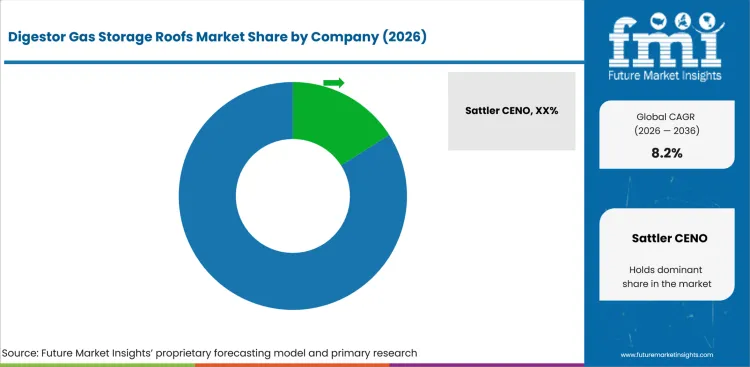
Sattler CENO, HUESKER, Ecomembrane, Permastore, Balmoral Tanks, Lipp GmbH, WesTech Engineering, WELTEC BIOPOWER, EnviTec Biogas, Praj Industries, GPS Renewables, and Kubota Corporation are key companies in the digestor gas storage roofs market.
- Specialist membrane roof suppliers compete through membrane life, weld quality, pressure stability, and gas-tight roof design.
- Tank manufacturers compete through integrated tank-and-roof packages where buyers need interface control and single-supplier accountability.
- Biogas EPC firms compete through project execution, commissioning support, and local service reach.
- Regional installers remain important because roof installation quality can decide long-term gas tightness and operating reliability.
The competitive landscape is led by specialist membrane roof suppliers, tank manufacturers, and biogas EPC firms. Competition is based on membrane life, weld quality, roof geometry, pressure-control integration, and local service reach. Buyers place higher value on suppliers that can support site measurement, membrane fabrication, fan control, pressure relief, and commissioning.
Sattler CENO, HUESKER, Ecomembrane, Permastore, and Balmoral Tanks are well positioned where buyers need engineered gas storage and tank integration. Local EPC partners remain important because roof installation quality can decide long-term performance. Suppliers with after-sales teams, weld documentation, and pressure-control experience are better placed for municipal wastewater, agricultural biogas, and biomethane projects.
How do top digestor gas storage roofs companies compare?
Sattler CENO, HUESKER, and Ecomembrane lead through membrane and gas-holder roof expertise, while Permastore and Balmoral Tanks strengthen their position through tank integration and engineered package supply.
| Company | Relevant Positioning | Membrane / Roof Engineering Strength | Pressure-Control and Integration Fit | Buyer Fit | Positioning |
|---|---|---|---|---|---|
| Sattler CENO | Double membrane and gas-holder roof systems | Strong membrane fabrication and gas-holder roof design | Strong fit for pressure-stable biogas and wastewater roof packages | Biogas and wastewater projects requiring fabric engineering | Membrane roof specialist |
| HUESKER | Technical textile and membrane gasholder expertise | Strong technical textile and reinforced membrane capability | Strong fit where wind-load, snow-load, and structural detailing matter | Projects needing wind-load and snow-load design support | Technical textile specialist |
| Ecomembrane | Biogas gas-holder and roof systems | Strong biogas membrane and gas storage roof capability | Strong fit for integrated gas storage and field installation support | Agricultural and industrial digestion installations | Biogas roof system supplier |
| Permastore | Glass-fused steel tanks and integrated storage packages | Moderate roof specialization with strong tank interface capability | Strong fit for tank-roof coordination and package engineering | Buyers seeking tank and roof interface control | Tank and roof package supplier |
| Balmoral Tanks | Storage tanks and engineered covers | Moderate membrane specialization with engineered cover capability | Strong fit for municipal and industrial tank package supply | Municipal and industrial buyers needing package supply | Engineered storage supplier |
Source: Future Market Insights competitive analysis, 2026.
Key Developments in Digestor Gas Storage Roofs Market
- In July 2025, Ofgem published the Green Gas Support Scheme annual report for April 2024 to March 2025, providing updated biomethane production and participant data for UK projects. The update supports demand visibility for gas-storage roofs used in biomethane-linked digestion assets.
- In April 2026, AMOCO completed a 3,000 m³ digester-mounted double membrane biogas holder installation in East Kalimantan. The project matters because it shows continued replacement and upgrade demand for tank-mounted gas storage roofs in palm-oil and industrial digestion sites.
Who are the key players in the digestor gas storage roofs market?
Key companies participating in the digestor gas storage roofs market include:
Specialist Membrane Roof Suppliers
- Sattler CENO
- HUESKER
- Ecomembrane
- Lipp GmbH
Tank and Engineered Storage Suppliers
- Permastore
- Balmoral Tanks
- WesTech Engineering
Biogas EPC and Project Developers
- WELTEC BIOPOWER
- EnviTec Biogas
- Praj Industries
- GPS Renewables
- Kubota Corporation
Digestor Gas Storage Roofs Market - Report Scope
| Parameter | Details |
|---|---|
| Forecast period | 2026 to 2036 |
| Historical period | 2021 to 2025 |
| Quantitative unit | Revenue in USD million |
| By roof type | Double membrane roofs, single membrane roofs, rigid floating roofs, other roof systems |
| By digester type | Anaerobic digestion, wastewater digesters, industrial digesters, other digesters |
| By gas capacity | <1,000 m³, 1,000-5,000 m³, >5,000 m³ |
| By end use | Municipal wastewater, biogas plants, food and beverage, agriculture |
| By installation | New installation, replacement / retrofit |
| Regions covered | North America, Latin America, Europe, East Asia, South Asia and Pacific, Middle East and Africa |
| Countries covered | India, China, South Korea, United Kingdom, France, United States, Germany, Japan |
| Key companies profiled | Sattler CENO, HUESKER, Ecomembrane, Permastore, Balmoral Tanks, Lipp, WesTech Engineering, WELTEC BIOPOWER |
| Approach | Bottom-up equipment-boundary approach using roof system revenue, replacement cycles, project activity, and country-level digestion infrastructure |
Digestor Gas Storage Roofs Market - Scope & Definition
| Attribute | Detail |
|---|---|
| Market Definition | Flexible and rigid roof systems used to seal digesters and store digester gas above liquid or sludge contents across biogas and wastewater assets |
| Functions Covered | Gas capture, pressure stabilization, odor control, weather protection, access safety, and short-term gas buffering |
| Applications Covered | Double membrane roofs, single membrane roofs, rigid floating roofs, support frames, air blowers, pressure relief equipment, and sealing parts |
| End-Use Industries | Municipal wastewater, biogas plants, food and beverage processing, agriculture, and industrial organic-waste treatment |
| Grades Covered | <1,000 m³, 1,000-5,000 m³, and >5,000 m³ gas-capacity systems |
| Inclusions | All commercially traded digestor gas storage roof products across roof type, digester type, capacity, end use, installation route, and selected country demand |
| Exclusions | Standalone gas balloons, gas upgrading skids, downstream upgrading membranes, flare stacks, pressure vessels, LNG tanks, and natural gas pipeline storage assets |
Digestor Gas Storage Roofs Market - Research Methodology
| Method | Description |
|---|---|
| Primary Research | FMI analyst interviews with membrane roof suppliers, tank builders, biogas EPC firms, wastewater plant owners, agricultural project owners, and after-sales service providers across key markets |
| Desk Research | Review of biogas policy documents, wastewater infrastructure references, official digestion statistics, biomethane injection reports, company product pages, and roof system specifications |
| Market Sizing & Forecasting | Bottom-up equipment-boundary approach using project volume, replacement cycles, average membrane roof pricing, gas capacity mix, and country-level biogas infrastructure intensity |
| Data Validation | Cross-verification using biogas plant counts, biomethane injection data, wastewater treatment activity, supplier product evidence, and country-specific digestion signals |
Digestor Gas Storage Roofs Market Breakdown by Roof Type, Digester Type, Gas Capacity, End Use, Installation, and Region
Digestor Gas Storage Roofs Market Segmented by Roof Type
- Double Membrane Roofs
- Single Membrane Roofs
- Rigid Floating Roofs
- Other Roof Systems
Digestor Gas Storage Roofs Market Segmented by Digester Type
- Anaerobic Digestion
- Wastewater Digesters
- Industrial Digesters
- Other Digesters
Digestor Gas Storage Roofs Market Segmented by Gas Capacity
- <1,000 m³
- 1,000-5,000 m³
- >5,000 m³
Digestor Gas Storage Roofs Market Segmented by End Use
- Municipal Wastewater
- Biogas Plants
- Food & Beverage
- Agriculture
Digestor Gas Storage Roofs Market Segmented by Installation
- New Installation
- Replacement / Retrofit
Digestor Gas Storage Roofs Market by Region
- North America
- Latin America
- Europe
- East Asia
- South Asia and Pacific
- Middle East and Africa
Research Sources and Bibliography
- USA Environmental Protection Agency. (2026, March 10). AgSTAR data and trends. EPA.
- USA Environmental Protection Agency. (2025, October 1). Anaerobic digestion facilities processing food waste in the United States. EPA.
- Office of Gas and Electricity Markets. (2025, July 31). Green Gas Support Scheme: Annual report April 2024 to March 2025. Ofgem.
- Bundesnetzagentur and Bundeskartellamt. (2026, January 26). Monitoring report 2025: Developments in the electricity and gas markets. Bundesnetzagentur.
- NaTran. (2025, May 13). Renewable gases: A sustained dynamic in France. NaTran.
- Gustafsson, M., et al. (2024, September). A perspective on the state of the biogas industry in 12 member countries of IEA Bioenergy Task 37. IEA Bioenergy.
- European Biogas Association. (2025, June 26). European Biomethane Map 2025. European Biogas Association.
- European Biogas Association. (2025, December 10). EBA Statistical Report 2025. European Biogas Association.
- Press Information Bureau. (2025, December 29). 2025 marks highest-ever renewable energy expansion in India. Government of India.
- Ministry of New and Renewable Energy. (2025, November 24). Biogas Programme. Government of India.
- Government of India. (2026, June). GOBARdhan unified registration portal. Government of India.
- Ministry of Environment, Republic of Korea. (2025, January 1). Environmental policies: Changes coming in 2025. Ministry of Environment.
- Ministry of Environment, Republic of Korea. (2025, April 21). Jeju achieving carbon neutrality producing clean hydrogen using biogas. Ministry of Environment.
- International Energy Agency Bioenergy. (2024, December). Implementation of bioenergy in the Republic of Korea. IEA Bioenergy.
- Ministry of Agriculture, Forestry and Fisheries of Japan. (2025, August 29). MIDORI INFINITY: Deploy GHG emission reduction technologies overseas. MAFF.
- Ministry of Agriculture, Forestry and Fisheries of Japan. (2024, December). Annual report on food, agriculture and rural areas in Japan FY2023. MAFF.
This Report Answers
- Market size estimates for 2026 and forecasts through 2036 for the digestor gas storage roofs market.
- Insights across regional and country-level markets covering mature retrofit zones and faster build-out markets.
- Analysis of demand drivers, gas-storage requirements, replacement cycles, and purchasing behavior.
- Evaluation of roof types, digester types, gas-capacity bands, end-use sectors, and installation routes.
- Assessment of biomethane injection activity, farm digestion, wastewater upgrades, and organic-waste treatment demand.
- Identification of growth opportunities across double membrane roofs, pressure-control upgrades, and retrofit service programs.
- Evaluation of supplier positioning across membrane specialists, tank manufacturers, EPC firms, and service partners.
- Country-level growth analysis covering India, China, South Korea, the United Kingdom, France, the United States, Germany, and Japan.
- Assessment of competitive landscape, including leading gas-holder and digestor roof system suppliers.
- Delivery of market data, forecasts, and supporting analysis in PDF and Excel formats.
Frequently Asked Questions
What is the growth prospect for digestor gas storage roofs?
Demand for digestor gas storage roofs is expected to rise steadily as biogas and wastewater operators add gas capture, odor control, and pressure stability.
Which companies are expected to shape the digestor gas storage roofs market?
Sattler CENO, HUESKER, Ecomembrane, Permastore, Balmoral Tanks, Lipp, and WesTech Engineering are expected to shape competition through roof design and service depth.
Why are biogas operators investing in digestor gas storage roofs?
Biogas operators are investing in digestor gas storage roofs to reduce gas leakage, stabilize feed to engines or upgrading units, and manage odor exposure.
Why are replacement and retrofit channels important in this market?
Replacement and retrofit channels support demand because older membranes can lose gas tightness after UV exposure, condensate attack, and seam fatigue.
Which roof formats are gaining attention in digestor gas storage roofs?
Double membrane roofs are gaining attention because they combine weather shielding with flexible gas storage above active digesters.
How do regulations influence digestor gas storage roof procurement?
Regulations influence procurement through methane-control expectations, public wastewater safety rules, odor management requirements, and biomethane grid-entry documentation.
Why is membrane quality important for digestor gas storage roofs?
Membrane quality is important because coated fabric, weld strength, and pressure control directly affect roof life and gas-storage reliability.
What role do EPC contractors play in digestor gas storage roof demand?
EPC contractors translate project specifications into supplier selection by coordinating roof systems with tanks, blowers, valves, and site commissioning.
How do country markets differ in digestor gas storage roof demand?
Country markets differ by installed biogas base, biomethane policy, wastewater retrofit activity, agricultural feedstock concentration, and local service availability.
Preview the report firsthand - request a free sample
Get SampleGet the brochure for pricing and purchase details.
Get PDFTable of Content
- Executive Summary
- Global Market Outlook
- Demand-side Trends
- Supply-side Trends
- Technology Roadmap Analysis
- Analysis and Recommendations
- Market Overview
- Market Coverage / Taxonomy
- Market Definition / Scope / Limitations
- Research Methodology
- Research Design
- Primary Research
- Desk Research
- Market Sizing and Forecasting
- Data Validation
- Global Market Analysis 2021 to 2025 and Forecast, 2026 to 2036
- Historical Market Size Value (USD Million) Analysis, 2021 to 2025
- Current and Future Market Size Value (USD Million) Projections, 2026 to 2036
- Y-o-Y Growth Trend Analysis
- Absolute $ Opportunity Analysis
- Global Market Pricing Analysis 2021 to 2025 and Forecast 2026 to 2036
- Global Market Analysis 2021 to 2025 and Forecast 2026 to 2036, By Roof Type
- Introduction / Key Findings
- Historical Market Size Value (USD Million) Analysis By Roof Type, 2021 to 2025
- Current and Future Market Size Value (USD Million) Analysis By Roof Type, 2026 to 2036
- Global Market Analysis 2021 to 2025 and Forecast 2026 to 2036, By Digester Type
- Introduction / Key Findings
- Historical Market Size Value (USD Million) Analysis By Digester Type, 2021 to 2025
- Current and Future Market Size Value (USD Million) Analysis By Digester Type, 2026 to 2036
- Global Market Analysis 2021 to 2025 and Forecast 2026 to 2036, By Gas Capacity
- Introduction / Key Findings
- Historical Market Size Value (USD Million) Analysis By Gas Capacity, 2021 to 2025
- Current and Future Market Size Value (USD Million) Analysis By Gas Capacity, 2026 to 2036
- Global Market Analysis 2021 to 2025 and Forecast 2026 to 2036, By End Use
- Introduction / Key Findings
- Historical Market Size Value (USD Million) Analysis By End Use, 2021 to 2025
- Current and Future Market Size Value (USD Million) Analysis By End Use, 2026 to 2036
- Global Market Analysis 2021 to 2025 and Forecast 2026 to 2036, By Installation
- Introduction / Key Findings
- Historical Market Size Value (USD Million) Analysis By Installation, 2021 to 2025
- Current and Future Market Size Value (USD Million) Analysis By Installation, 2026 to 2036
- Global Market Analysis 2021 to 2025 and Forecast 2026 to 2036, By Region
- Introduction / Key Findings
- Historical Market Size Value (USD Million) Analysis By Region, 2021 to 2025
- Current and Future Market Size Value (USD Million) Analysis By Region, 2026 to 2036
- North America Market Analysis 2021 to 2025 and Forecast 2026 to 2036
- Pricing Analysis
- Market Share Analysis, 2025
- By Country
- By Roof Type
- By Digester Type
- By Gas Capacity
- By End Use
- By Installation
- Country-level Analysis
- United States
- Canada
- Latin America Market Analysis 2021 to 2025 and Forecast 2026 to 2036
- Pricing Analysis
- Market Share Analysis, 2025
- By Country
- By Roof Type
- By Digester Type
- By Gas Capacity
- By End Use
- By Installation
- Country-level Analysis
- Brazil
- Mexico
- Rest of Latin America
- Western Europe Market Analysis 2021 to 2025 and Forecast 2026 to 2036
- Pricing Analysis
- Market Share Analysis, 2025
- By Country
- By Roof Type
- By Digester Type
- By Gas Capacity
- By End Use
- By Installation
- Country-level Analysis
- Germany
- France
- United Kingdom
- Italy
- Spain
- BENELUX
- Nordics
- Rest of Western Europe
- Eastern Europe Market Analysis 2021 to 2025 and Forecast 2026 to 2036
- Pricing Analysis
- Market Share Analysis, 2025
- By Country
- By Roof Type
- By Digester Type
- By Gas Capacity
- By End Use
- By Installation
- Country-level Analysis
- Russia
- Poland
- Rest of Eastern Europe
- East Asia Market Analysis 2021 to 2025 and Forecast 2026 to 2036
- Pricing Analysis
- Market Share Analysis, 2025
- By Country
- By Roof Type
- By Digester Type
- By Gas Capacity
- By End Use
- By Installation
- Country-level Analysis
- China
- Japan
- South Korea
- South Asia and Pacific Market Analysis 2021 to 2025 and Forecast 2026 to 2036
- Pricing Analysis
- Market Share Analysis, 2025
- By Country
- By Roof Type
- By Digester Type
- By Gas Capacity
- By End Use
- By Installation
- Country-level Analysis
- India
- ASEAN
- Australia & New Zealand
- Rest of South Asia and Pacific
- Middle East & Africa Market Analysis 2021 to 2025 and Forecast 2026 to 2036
- Pricing Analysis
- Market Share Analysis, 2025
- By Country
- By Roof Type
- By Digester Type
- By Gas Capacity
- By End Use
- By Installation
- Country-level Analysis
- GCC Countries
- South Africa
- Turkey
- Rest of Middle East & Africa
- Market Structure Analysis
- Competition Dashboard
- Competition Benchmarking
- Market Share Analysis of Top Players
- By Region
- By Roof Type
- By Digester Type
- By Gas Capacity
- By End Use
- By Installation
- Emerging Startups
- Innovation Benchmarking
- Competition Analysis
- Competition Deep Dive
- Company Profiles
- Case Studies
- Success Stories
- Recent Developments
- Assumptions & Acronyms Used
- List of Tables: Digestor Gas Storage Roofs Market
- List of Figures: Digestor Gas Storage Roofs Market


