

- Market Size (2026)
- USD 5.3 Bn
- Forecast (2036)
- USD 11.8 Bn
- CAGR (2026 to 2036)
- 8.3%
How big is the Digital Tattoos Market in 2026?
USD 5.3 billion in 2026, reaching USD 11.8 billion by 2036 at an 8.3% CAGR
The digital tattoos market is estimated at USD 5.3 billion in 2026 and is forecast to reach USD 11.8 billion by 2036 at an 8.3% CAGR. Demand is shaped by health monitoring, where graphene-based digital tattoos sense skin-surface biosignals. Graphene tattoos account for 41.0% of Product Type demand in 2026, while Medical applications hold 34.0% of use.
The market was valued at USD 4.9 billion in 2025. Growth reflects advancing flexible electronics and rising demand for skin-conformal health monitoring. Demand is shaped by hospitals and consumers adopting graphene and nano-tattoo wearables using flexible electronics and sensor technology for health monitoring and consumer electronics.
Digital tattoos are skin-conformal flexible electronic wearables for health monitoring and sensing. Buyers judge tattoos through signal accuracy and wearability. Sourcing centers on healthcare and consumer-electronics channels.
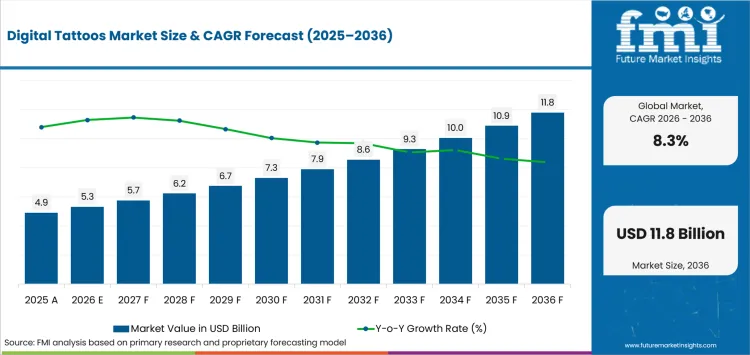
| Metric | Value |
|---|---|
| 2025 Market Size | USD 4.9 billion |
| 2026 Market Size | USD 5.3 billion |
| 2036 Market Size | USD 11.8 billion |
| Forecast CAGR (2026-2036) | 8.3% |
| Product Type Focus | Graphene Tattoo |
| Graphene Tattoo Share (2026) | 41.0% |
| Application Focus | Medical |
| Medical Share (2026) | 34.0% |
| Key Countries | USA, Germany, France, UK |
Summary of the Digital Tattoos Market
| Market Signal | Commercial Impact |
|---|---|
| Demand and Growth Drivers | Demand is driven by continuous health monitoring and consumer electronics, enabled by advancing flexible electronics.
|
| Product and Segment View | Graphene tattoos and medical applications lead the mix, built on flexible electronics.
|
| Geography and Competitive Outlook | South Korea leads growth on flexible-electronics and consumer adoption, while developers compete on signal accuracy and materials.
|
| Analyst Opinion | Accurate graphene biosensing combined with durable flexible electronics will lead as health-monitoring demand grows across medical and consumer uses.
|
Why is the Digital Tattoos Market growing?
Rising Graphene Tattoo and medical-application demand in health monitoring
- Sustained adoption of graphene digital tattoos is shaped by hospitals monitoring skin-surface biosignals.
- South Korea is leading the way with growth of 10.3%, driven by flexible electronics, consumer adoption, and health monitoring.
- The application segment is led by Medical at 34.0% share, supported by health-monitoring sensing.
Demand is rising because continuous health monitoring requires skin-conformal sensors. Adoption is increasing due to graphene and nano-tattoo flexible electronics, which sense biosignals while conforming to skin, with hospitals and consumers adopting digital tattoos for health monitoring and consumer electronics applications.
How is the Digital Tattoos Market segmented?
By Product Type, Application, End Use, Technology and Material
- Graphene Tattoos are projected to lead Product Type with 41.0% share in 2026 due to health-monitoring sensing.
- Medical applications are expected to lead Application with 34.0% share in 2026 as health monitoring drives use.
- Flexible Electronics are forecast to lead Technology as they enable skin-conformal sensing.
Why do graphene tattoos lead the Digital Tattoos Market?
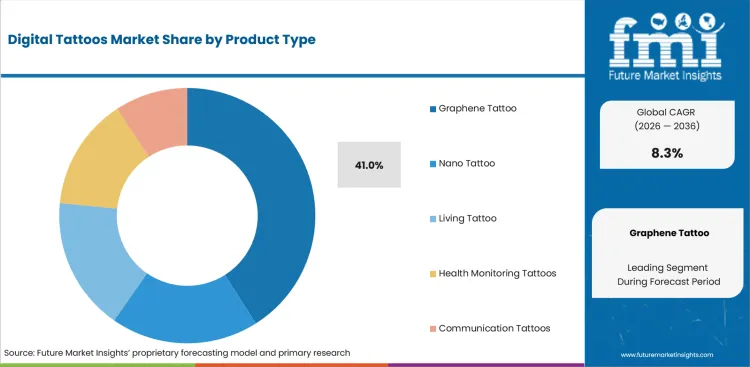
- Graphene Tattoos are expected to hold 41.0% share in 2026 because graphene enables accurate skin-conformal biosensing.
- Their sensing performance anchors demand in health monitoring.
Medical holds 34.0% share, led by health monitoring
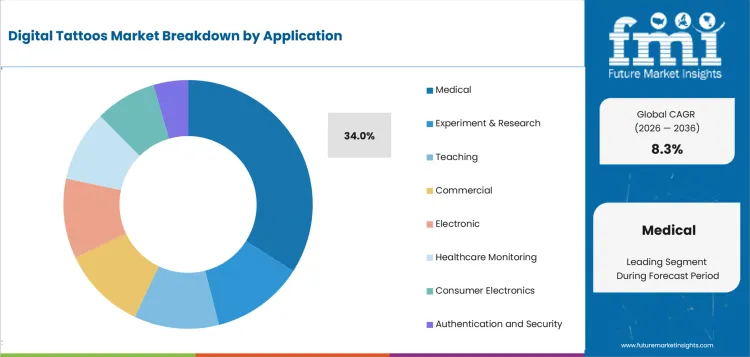
- Medical applications form the leading category at 34.0% share, anchored by continuous health monitoring.
- Research, commercial, and consumer electronics follow as applications diversify.
Which end use leads the market?
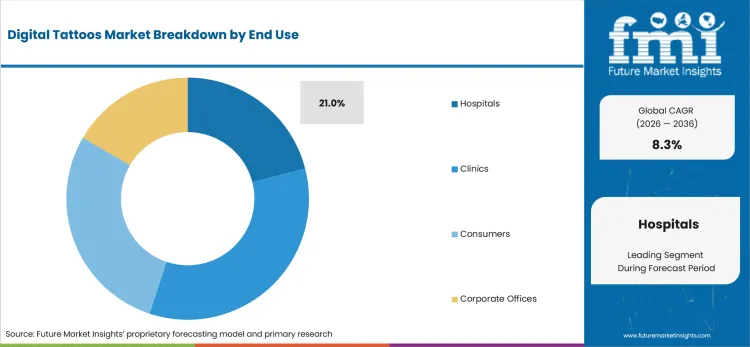
- Hospitals lead End Use as health-monitoring digital tattoos are deployed in clinical settings.
- Consumers and corporate offices follow as wearable and consumer adoption extends.
Which technology leads procurement?
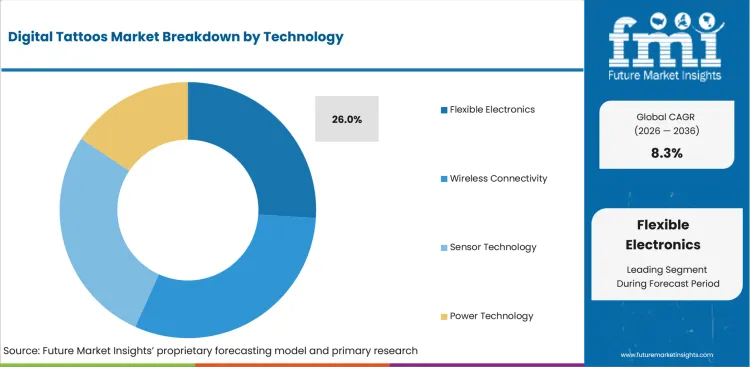
- Flexible Electronics lead as they enable skin-conformal wearable sensing.
- Wireless connectivity and sensor technology follow as data transmission extends.
Which material leads the market?
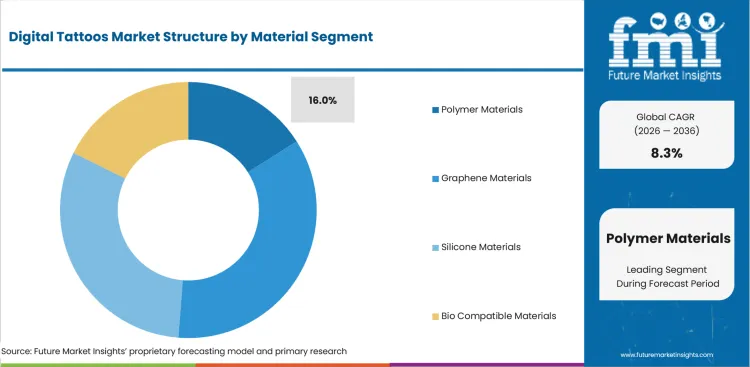
- Polymer Materials lead as they provide flexible, skin-compatible substrates.
- Graphene and biocompatible materials follow as sensing and wearability extend.
What drives and restrains the Digital Tattoos Market?
Driven by health monitoring and flexible electronics; restrained by durability and regulatory validation
Health monitoring and flexible electronics advances support growth while wearable durability and medical regulatory validation constrain adoption.
- Driver: Hospitals adopting graphene digital tattoos for continuous health monitoring generate demand as flexible electronics enable accurate skin-conformal biosensing.
- Restraint: Adoption is constrained by digital tattoo durability and the medical regulatory validation requirements that govern clinical use of skin-conformal sensing wearables.
- Opportunity: Consumer electronics and communication tattoos can widen value by extending digital tattoos beyond medical monitoring into consumer wearable applications.
Health monitoring is lifting digital tattoo adoption as hospitals deploy skin-conformal sensors. Graphene tattoos anchor demand while flexible electronics improve wearability.
The market is led by structural demand from health monitoring. Graphene tattoos remain the leading product, while nano and living tattoos serve emerging uses. Constraints include durability, regulatory validation, and consumer adoption pace.
Which factors support expansion in the Digital Tattoos Market?
Health monitoring and flexible electronics support market value across healthcare and consumer channels
- Market value is supported by medical health-monitoring tattoos before consumer applications add demand.
- Developer pricing reflects signal accuracy and durability before regulatory validation affects adoption.
- Healthcare buyers compare signal accuracy and wearability before deploying a digital tattoo.
Which countries are growing fastest in the Digital Tattoos Market?
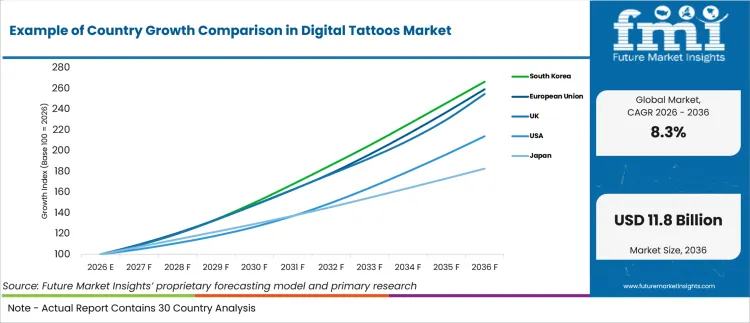
| Country | CAGR |
|---|---|
| South Korea | 10.3% |
| European Union | 10.0% |
| UK | 9.8% |
| USA | 7.9% |
| Japan | 6.2% |
Source: Future Market Insights analysis, 2026.
How do country-level CAGRs compare in the Digital Tattoos Market?
The global digital tattoos market is projected to expand at 8.3% from 2026 to 2036. The study covers more than 30 countries, and the primary markets are listed below.
- South Korea is forecast to record 10.3% CAGR by 2036 as flexible electronics and consumer adoption accelerate.
- The European Union is expected to expand at 10.0% CAGR through 2036 as health monitoring and technology adoption grow.
- The UK is estimated to grow at 9.8% CAGR by 2036 as wearable health monitoring expands.
- The USA is projected to rise at 7.9% CAGR through 2036 as medical and consumer adoption grow.
- Japan is forecast to post 6.2% CAGR by 2036 as a measured adoption pace shapes demand.
Who are the leading companies in the Digital Tattoos Market?
MC10, Google, VivaLNK, Xsensio, and Rogers Corporation
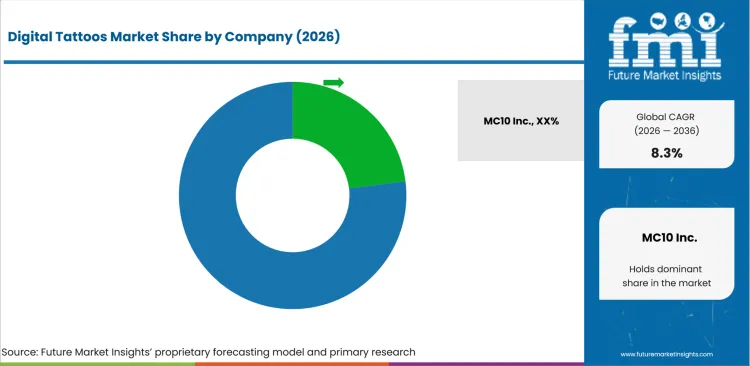
MC10 and Google compete through flexible electronic and biosensing tattoo technology. Signal accuracy remains a further point of differentiation. VivaLNK and Xsensio compete on health-monitoring wearables, while Rogers Corporation holds positions in flexible electronic materials. These overlap with broader wearable sensor and flexible electronics buying paths.
Buyers compare developers on signal accuracy, durability, and wearability. Healthcare buyers standardize on tattoos with validated biosensing accuracy. Consumer and research adopters favor developers offering durable flexible electronics with reliable sensing.
Who are the key players in the Digital Tattoos Market?
Key global companies leading the Digital Tattoos Market include:
- MC10, Google, and VivaLNK maintain leading positions through flexible electronic tattoo technology, biosensing, and development capacity across global markets.
- Wearable technology specialists such as Xsensio, Chaotic Moon, and Wearable X compete through flexible electronic and sensing tattoos.
- Specialist and emerging developers such as Rogers Corporation, Epidermal Electronics Lab, and iSkin Technologies target flexible electronics to establish positions and scale.
How do top Digital Tattoos Market companies compare?
MC10 and Google lead on scale; VivaLNK also has a broad footprint, while Xsensio and Chaotic Moon are more technology-concentrated.
| Company | Product Breadth | Signal Accuracy | Deployment Scale | Geographic Footprint |
|---|---|---|---|---|
| MC10 | High | High | Strong | Americas-led |
| High | High | Strong | Global | |
| VivaLNK | Moderate | High | Strong | Global |
| Xsensio | Moderate | High | Moderate | Europe-led |
| Rogers Corporation | Moderate | Moderate | Strong | Global |
Source: Future Market Insights competitive analysis, 2026.
Key Developments in the Digital Tattoos Market
-
In May 2025, researchers at the University of Texas at Austin developed a wireless ultra-thin forehead electronic tattoo capable of monitoring brain activity (EEG) and eye movements (EOG) to assess mental workload, stress, and cognitive fatigue in real time. The non-invasive device targets applications in high-stress fields such as aviation, defense, and healthcare, advancing the potential of e-tattoos for continuous physiological and human-machine interface monitoring.
-
In 2024–2025, multiple research teams advanced graphene-based electronic tattoos for multimodal biosensing, including electrophysiological signals, temperature, and motion tracking. These ultrathin, skin-conformable devices demonstrate strong potential for wearable healthcare, continuous monitoring, and integration with neuromorphic computing concepts, expanding digital tattoos beyond aesthetics into clinical and industrial applications.
-
Throughout 2025, ongoing commercialization efforts in epidermal electronics have increased investment and prototyping in flexible, tattoo-like wearables. Academic and industry collaborations are focusing on improving durability, wireless data transmission, and biocompatibility to support broader adoption in medical monitoring and consumer wellness applications.
Key Players in the Digital Tattoos Market
Global Flexible Electronics Leaders
- MC10 Inc.
- Google (Alphabet)
- VivaLNK
Wearable Sensing Specialists
- Xsensio
- Chaotic Moon
- Wearable X
Emerging and Materials Players
- Rogers Corporation
- Epidermal Electronics Lab
- Tattoos Alive
- iSkin Technologies
Digital Tattoos Market - Scope & Definition
| Attribute | Detail |
|---|---|
| Market Definition | Digital tattoos including graphene, nano, and health-monitoring skin-conformal flexible electronic wearables used for health monitoring and sensing across applications |
| Functions Covered | Biosignal sensing, health monitoring, communication, and skin-conformal wearable sensing across applications |
| Applications Covered | Medical, research, teaching, commercial, electronic, healthcare monitoring, and consumer electronics |
| End-Use Industries | Hospitals, clinics, consumers, and corporate offices |
| Inclusions | Graphene tattoos, nano tattoos, living tattoos, health-monitoring and communication tattoos across flexible electronic technologies |
| Exclusions | Conventional wearables outside skin-conformal tattoos, and decorative non-electronic tattoos |
Digital Tattoos Market - Research Methodology
| Method | Description |
|---|---|
| Primary Research | FMI analysts gathered input from manufacturers, service providers, technology developers, distributors, end users, procurement teams, and subject-matter experts. Interviews examined purchasing decisions, product or service evaluation, adoption barriers, approval requirements, pricing considerations, and expectations for technical or commercial support. Respondents were also asked what evidence is required before a trial, pilot, or initial order develops into regular purchasing. |
| Desk Research | Desk research covered government statistics, regulatory publications, trade data, industry associations, technical literature, standards, company filings, product information, and official corporate announcements. Sources were reviewed for relevance, publication date, geographic coverage, and consistency with the defined market scope. Claims relating to performance, applications, approvals, capacity, investment, and commercial activity were retained only when supported by credible public evidence. |
| Market Sizing & Forecasting | The market model combined the baseline value with historical performance, segment structure, pricing and volume indicators, adoption levels, company participation, and country-level demand conditions. Forecast assumptions considered economic activity, investment trends, regulatory developments, technology adoption, purchasing cycles, supply availability, and barriers to wider market use. Segment and regional estimates were reconciled before the final market total was calculated. |
| Data Validation | The market model combined the baseline value with historical performance, segment structure, pricing and volume indicators, adoption levels, company participation, and country-level demand conditions. Forecast assumptions considered economic activity, investment trends, regulatory developments, technology adoption, purchasing cycles, supply availability, and barriers to wider market use. Segment and regional estimates were reconciled before the final market total was calculated. |
What does the Digital Tattoos Market report cover?
2021 to 2025 history and 2026 to 2036 forecasts across all segments and 30+ countries
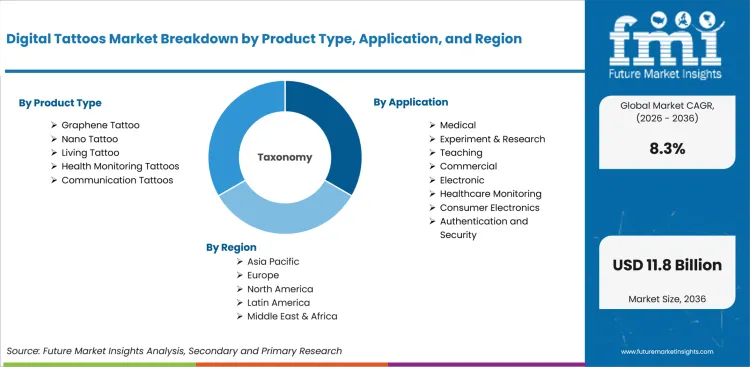
| Parameter | Details |
|---|---|
| Forecast period | 2026 to 2036 |
| Historical period | 2021 to 2025 |
| Quantitative unit | Value in USD billion |
| By Product type | Graphene Tattoo, Nano Tattoo, Living Tattoo, Health Monitoring Tattoos, Communication Tattoos |
| By Application | Medical, Experiment and Research, Teaching, Commercial, Electronic, Healthcare Monitoring, Consumer Electronics |
| By End use | Hospitals, Clinics, Consumers, Corporate Offices |
| By Technology | Flexible Electronics, Wireless Connectivity, Sensor Technology, Power Technology |
| By Material | Polymer Materials, Graphene Materials, Silicone Materials, Bio Compatible Materials |
| Regions covered | North America, Latin America, Western Europe, Eastern Europe, East Asia, South Asia and Pacific, Middle East and Africa |
| Countries covered | USA, South Korea, European Union, UK, Japan, and other major markets |
| Key companies profiled | MC10, Google, VivaLNK, Xsensio, Chaotic Moon, Wearable X, Rogers Corporation, Epidermal Electronics Lab |
| Approach | Bottom-up adoption-based approach using application uptake, product-type mix, end-use, and supplier disclosures |
Market Segmentation Analysis
Digital Tattoos Market Segmented by Product Type:
- Graphene Tattoo
- Nano Tattoo
- Living Tattoo
- Health Monitoring Tattoos
- Biometric Sensor Tattoos
- Heart Rate Monitoring Tattoos
- Respiration Tracking Tattoos
- Biosignal Detection Tattoos
- ECG Monitoring Tattoos
- EMG Muscle Signal Tattoos
- Biochemical Sensor Tattoos
- Sweat Analysis Tattoos
- Hydration Monitoring Tattoos
- Biometric Sensor Tattoos
- Communication Tattoos
- NFC Tattoos
- Contactless Access Tattoos
- Smartphone Pairing Tattoos
- Bluetooth Tattoos
- Short Range Data Transfer Tattoos
- Connected Wearable Use
- RF Signal Tattoos
- Identity Tagging Tattoos
- Industrial Communication Use
- NFC Tattoos
Digital Tattoos Market Segmented by Application:
- Medical
- Experiment & Research
- Teaching
- Commercial
- Electronic
- Healthcare Monitoring
- Chronic Disease Monitoring
- Diabetes Tracking Use
- Cardiac Care Monitoring
- Remote Patient Monitoring
- Post Surgery Observation Use
- Homecare Adoption Demand
- Fitness and Wellness
- Stress Tracking Use
- Daily Health Analytics
- Chronic Disease Monitoring
- Consumer Electronics
- Device Control Applications
- Touchless Smartphone Commands
- Gesture Interface Use
- Gaming Applications
- Immersive Gameplay Controls
- AR VR Integration Demand
- Device Control Applications
- Authentication and Security
- Access Control
- Office Entry Solutions
- Smart Home Access Use
- Digital Payments
- Identity Verification
- Access Control
Digital Tattoos Market Segmented by End Use:
- Hospitals
- Public Hospitals
- Patient Monitoring Programs
- Acute Care Adoption
- Private Hospitals
- Premium Digital Health Use
- Remote Monitoring Demand
- Public Hospitals
- Clinics
- Diabetes Clinics
- Glucose Tracking Demand
- Outpatient Monitoring Use
- Cardiology Clinics
- ECG Tattoo Adoption
- Follow Up Care Programs
- Diabetes Clinics
- Consumers
- Health Conscious Users
- Fitness Tracking Demand
- Lifestyle Wellness Adoption
- Tech Enthusiasts
- Early Gadget Adoption
- Premium Wearable Interest
- Health Conscious Users
- Corporate Offices
- Employee Access Systems
- NFC Entry Adoption
- Workplace Security Use
- Wellness Programs
- Stress Tracking Demand
- Corporate Health Initiatives
- Employee Access Systems
Digital Tattoos Market Segmented by Technology:
- Flexible Electronics
- Stretchable Circuits
- Skin Conforming Designs
- Comfort Driven Use
- Thin Film Electronics
- Ultra Light Tattoos
- Long Wear Demand
- Stretchable Circuits
- Wireless Connectivity
- Bluetooth Technology
- Smartphone Pairing Use
- Consumer Electronics Demand
- NFC Technology
- Tap Interaction Use
- Payment And Access Demand
- RF Connectivity
- Secure Signal Transfer
- Industrial Use Cases
- Bluetooth Technology
- Sensor Technology
- Biosensors
- Glucose Detection Use
- Sweat Monitoring Demand
- Motion Sensors
- Temperature Sensors
- Biosensors
- Power Technology
- Battery Powered Tattoos
- Energy Harvesting Tattoos
Digital Tattoos Market Segmented by Material:
- Polymer Materials
- Flexible Substrates
- Comfortable Skin Contact
- Mass Production Use
- Water Resistant Polymers
- Outdoor Use Demand
- Durability Benefit
- Flexible Substrates
- Graphene Materials
- Conductive Graphene Layers
- High Sensitivity Sensors
- Premium Innovation Use
- Ultra Thin Films
- Advanced Research Demand
- Future Commercial Potential
- Conductive Graphene Layers
- Silicone Materials
- Soft Skin Adhesives
- Medical Grade Comfort Use
- Long Wear Stability
- Hypoallergenic Bases
- Sensitive Skin Demand
- Healthcare Preference
- Soft Skin Adhesives
- Bio Compatible Materials
- Eco Friendly Substrates
- Disposable Green Products
- Sustainability Demand
- Breathable Membranes
- Long Duration Comfort
- Medical Monitoring Use
- Eco Friendly Substrates
Digital Tattoos Market by Region:
- North America
- USA
- Canada
- Latin America
- Brazil
- Mexico
- Chile
- Rest of Latin America
- Western Europe
- Germany
- UK
- Italy
- Spain
- France
- Nordic
- BENELUX
- Rest of Western Europe
- Eastern Europe
- Russia
- Poland
- Hungary
- Balkan & Baltic
- Rest of Eastern Europe
- East Asia
- China
- Japan
- South Korea
- South Asia and Pacific
- India
- ASEAN
- Australia & New Zealand
- Rest of South Asia and Pacific
- Middle East & Africa
- Kingdom of Saudi Arabia
- Other GCC Countries
- Türkiye
- South Africa
- Other African Union
- Rest of Middle East & Africa
Research Sources and Bibliography
- International Organization for Standardization. (2025, October). Standards for wearable medical sensing devices.
- Organisation for Economic Co-operation and Development. (2025, November). Digital health and wearable technology indicators.
- USA Food and Drug Administration. (2026, February 9). Guidance for wearable health-monitoring devices.
- European Commission. (2025, December 6). Medical Device Regulation guidance for wearable sensors.
- National Institute of Standards and Technology. (2025, September). Flexible electronics and sensing materials report.
- Rogers Corporation. (2026, February 13). 2025 annual report and flexible electronics overview.
- VivaLNK. (2026, February 20). 2025 wearable sensor platform update.
This bibliography is provided for reader reference and is not exhaustive.
This Report Answers
- Market size estimates for 2026 and forecasts through 2036 for the Digital Tattoos Market.
- Analysis of product-type demand across graphene and nano tattoos.
- Country-level growth analysis covering South Korea and the European Union with UK, USA and Japan outlooks.
- Evaluation of company positioning across MC10 and Google with VivaLNK, Xsensio and Rogers Corporation.
- Assessment of drivers and restraints with adoption patterns across healthcare and consumer channels.
Frequently Asked Questions
What is the growth prospect for the Digital Tattoos Market?
Demand is projected to grow as flexible electronics drive adoption of skin-conformal health-monitoring tattoos.
Which companies are expected to shape the Digital Tattoos Market?
MC10 and Google are positioned to lead the competitive landscape, alongside VivaLNK, Xsensio, and Rogers Corporation.
Why do Graphene Tattoos matter in this market?
Graphene Tattoos account for the largest share of Product Type demand, as graphene enables accurate skin-conformal biosensing.
How do durability and regulation influence demand?
Wearable durability and medical regulatory validation influence digital tattoo adoption.
Which application is gaining attention?
Medical health monitoring leads demand, while consumer electronics is gaining prominence for wearable tattoos.
Preview the report firsthand - request a free sample
Get SampleGet the brochure for pricing and purchase details.
Get PDFTable of Content
- Key Takeaways
- Market Size and CAGR
- Top Growth Driver
- Fastest Growing Segment
- Leading Region
- Key Companies
- Emerging Opportunities
- Executive Summary
- Global Market Outlook
- Demand-side Trends
- Supply-side Trends
- Technology Roadmap Analysis
- Analysis and Recommendations
- Analyst Perspective (What is happening? Why now? What should investors know?)
- Key Questions Answered
- How large is the market?
- What is the CAGR?
- What are key trends?
- Which region dominates?
- Who are the leaders?
- Market Overview
- Market Coverage / Taxonomy
- Market Definition / Scope / Limitations
- Research Methodology
- Chapter Orientation
- Analytical Lens and Working Hypotheses
- Market Structure, Signals, and Trend Drivers
- Benchmarking and Cross-market Comparability
- Market Sizing, Forecasting, and Opportunity Mapping
- Research Design and Evidence Framework
- Desk Research Programme (Secondary Evidence)
- Expert Input and Fieldwork (Primary Evidence)
- Tooling, Models, and Reference Databases
- Data Engineering and Model Build
- Quality Assurance and Audit Trail
- Market Background
- Market Dynamics (Drivers, Restraints, Opportunity, Trends)
- Scenario Forecast (Optimistic, Likely, Conservative)
- Impact Analysis
- AI Impact
- Sustainability Impact
- Regulatory Impact
- Technology Impact
- Consumer / Buyer Analysis
- Purchase Drivers
- Adoption Barriers
- Buyer Journey
- Opportunity Map Analysis
- Product Life Cycle Analysis
- Supply Chain Analysis
- Investment Feasibility Matrix
- Value Chain Analysis
- PESTLE and Porter's Analysis
- Regulatory Landscape
- Regional Parent Market Outlook
- Production and Consumption Statistics
- Import and Export Statistics
- Global Market Analysis and Forecast, 2021 to 2036
- Historical Market Size Value (USD Billion) Analysis, 2021 to 2025
- Current and Future Market Size Value (USD Billion) Projections, 2026 to 2036
- Y-o-Y Growth Trend Analysis
- Absolute $ Opportunity Analysis
- Global Market Pricing Analysis, 2021 to 2036
- Global Market Analysis and Forecast, By Product Type, 2021 to 2036
- Introduction / Key Findings
- Historical Market Size Value (USD Billion) Analysis By Product Type, 2021 to 2025
- Current and Future Market Size Value (USD Billion) Analysis and Forecast By Product Type, 2026 to 2036
- Graphene Tattoo
- Nano Tattoo
- Living Tattoo
- Health Monitoring Tattoos
- Biometric Sensor Tattoos
- Biosignal Detection Tattoos
- Communication Tattoos
- NFC Tattoos
- Bluetooth Tattoos
- Graphene Tattoo
- Y-o-Y Growth Trend Analysis By Product Type, 2021 to 2025
- Absolute $ Opportunity Analysis By Product Type, 2026 to 2036
- Global Market Analysis and Forecast, By Application, 2021 to 2036
- Introduction / Key Findings
- Historical Market Size Value (USD Billion) Analysis By Application, 2021 to 2025
- Current and Future Market Size Value (USD Billion) Analysis and Forecast By Application, 2026 to 2036
- Medical
- Experiment & Research
- Teaching
- Commercial
- Electronic
- Healthcare Monitoring
- Chronic Disease Monitoring
- Remote Patient Monitoring
- Consumer Electronics
- Device Control Applications
- Gaming Applications
- Authentication and Security
- Access Control
- Digital Payments
- Identity Verification
- Medical
- Y-o-Y Growth Trend Analysis By Application, 2021 to 2025
- Absolute $ Opportunity Analysis By Application, 2026 to 2036
- Global Market Analysis and Forecast, By End Use, 2021 to 2036
- Introduction / Key Findings
- Historical Market Size Value (USD Billion) Analysis By End Use, 2021 to 2025
- Current and Future Market Size Value (USD Billion) Analysis and Forecast By End Use, 2026 to 2036
- Hospitals
- Public Hospitals
- Private Hospitals
- Clinics
- Diabetes Clinics
- Cardiology Clinics
- Consumers
- Health Conscious Users
- Tech Enthusiasts
- Corporate Offices
- Employee Access Systems
- Wellness Programs
- Hospitals
- Y-o-Y Growth Trend Analysis By End Use, 2021 to 2025
- Absolute $ Opportunity Analysis By End Use, 2026 to 2036
- Global Market Analysis and Forecast, By Technology, 2021 to 2036
- Introduction / Key Findings
- Historical Market Size Value (USD Billion) Analysis By Technology, 2021 to 2025
- Current and Future Market Size Value (USD Billion) Analysis and Forecast By Technology, 2026 to 2036
- Flexible Electronics
- Stretchable Circuits
- Thin Film Electronics
- Wireless Connectivity
- Bluetooth Technology
- NFC Technology
- Sensor Technology
- Biosensors
- Motion Sensors
- Temperature Sensors
- Power Technology
- Battery Powered Tattoos
- Energy Harvesting Tattoos
- Flexible Electronics
- Y-o-Y Growth Trend Analysis By Technology, 2021 to 2025
- Absolute $ Opportunity Analysis By Technology, 2026 to 2036
- Global Market Analysis and Forecast, By Material, 2021 to 2036
- Introduction / Key Findings
- Historical Market Size Value (USD Billion) Analysis By Material, 2021 to 2025
- Current and Future Market Size Value (USD Billion) Analysis and Forecast By Material, 2026 to 2036
- Polymer Materials
- Flexible Substrates
- Water Resistant Polymers
- Graphene Materials
- Conductive Graphene Layers
- Ultra Thin Films
- Silicone Materials
- Soft Skin Adhesives
- Hypoallergenic Bases
- Bio Compatible Materials
- Eco Friendly Substrates
- Breathable Membranes
- Polymer Materials
- Y-o-Y Growth Trend Analysis By Material, 2021 to 2025
- Absolute $ Opportunity Analysis By Material, 2026 to 2036
- Global Market Analysis and Forecast, By Region, 2021 to 2036
- Introduction
- Historical Market Size Value (USD Billion) Analysis By Region, 2021 to 2025
- Current Market Size Value (USD Billion) Analysis and Forecast By Region, 2026 to 2036
- North America
- Latin America
- Western Europe
- Eastern Europe
- East Asia
- South Asia and Pacific
- Middle East & Africa
- Market Attractiveness Analysis By Region
- North America Market Analysis and Forecast, By Country, 2021 to 2036
- Historical Market Size Value (USD Billion) Trend Analysis By Market Taxonomy, 2021 to 2025
- Market Size Value (USD Billion) Forecast By Market Taxonomy, 2026 to 2036
- By Country
- USA
- Canada
- By Product Type
- By Application
- By End Use
- By Technology
- By Material
- By Country
- Market Attractiveness Analysis
- By Country
- By Product Type
- By Application
- By End Use
- By Technology
- By Material
- Key Takeaways
- Latin America Market Analysis and Forecast, By Country
- Historical Market Size Value (USD Billion) Trend Analysis By Market Taxonomy, 2021 to 2025
- Market Size Value (USD Billion) Forecast By Market Taxonomy, 2026 to 2036
- By Country
- Brazil
- Mexico
- Chile
- Rest of Latin America
- By Product Type
- By Application
- By End Use
- By Technology
- By Material
- By Country
- Market Attractiveness Analysis
- By Country
- By Product Type
- By Application
- By End Use
- By Technology
- By Material
- Key Takeaways
- Western Europe Market Analysis and Forecast, By Country
- Historical Market Size Value (USD Billion) Trend Analysis By Market Taxonomy, 2021 to 2025
- Market Size Value (USD Billion) Forecast By Market Taxonomy, 2026 to 2036
- By Country
- Germany
- UK
- Italy
- Spain
- France
- Nordic
- BENELUX
- Rest of Western Europe
- By Product Type
- By Application
- By End Use
- By Technology
- By Material
- By Country
- Market Attractiveness Analysis
- By Country
- By Product Type
- By Application
- By End Use
- By Technology
- By Material
- Key Takeaways
- Eastern Europe Market Analysis and Forecast, By Country
- Historical Market Size Value (USD Billion) Trend Analysis By Market Taxonomy, 2021 to 2025
- Market Size Value (USD Billion) Forecast By Market Taxonomy, 2026 to 2036
- By Country
- Russia
- Poland
- Hungary
- Balkan & Baltic
- Rest of Eastern Europe
- By Product Type
- By Application
- By End Use
- By Technology
- By Material
- By Country
- Market Attractiveness Analysis
- By Country
- By Product Type
- By Application
- By End Use
- By Technology
- By Material
- Key Takeaways
- East Asia Market Analysis and Forecast, By Country
- Historical Market Size Value (USD Billion) Trend Analysis By Market Taxonomy, 2021 to 2025
- Market Size Value (USD Billion) Forecast By Market Taxonomy, 2026 to 2036
- By Country
- China
- Japan
- South Korea
- By Product Type
- By Application
- By End Use
- By Technology
- By Material
- By Country
- Market Attractiveness Analysis
- By Country
- By Product Type
- By Application
- By End Use
- By Technology
- By Material
- Key Takeaways
- South Asia and Pacific Market Analysis and Forecast, By Country
- Historical Market Size Value (USD Billion) Trend Analysis By Market Taxonomy, 2021 to 2025
- Market Size Value (USD Billion) Forecast By Market Taxonomy, 2026 to 2036
- By Country
- India
- ASEAN
- Australia & New Zealand
- Rest of South Asia and Pacific
- By Product Type
- By Application
- By End Use
- By Technology
- By Material
- By Country
- Market Attractiveness Analysis
- By Country
- By Product Type
- By Application
- By End Use
- By Technology
- By Material
- Key Takeaways
- Middle East & Africa Market Analysis and Forecast, By Country
- Historical Market Size Value (USD Billion) Trend Analysis By Market Taxonomy, 2021 to 2025
- Market Size Value (USD Billion) Forecast By Market Taxonomy, 2026 to 2036
- By Country
- Kingdom of Saudi Arabia
- Other GCC Countries
- Türkiye
- South Africa
- Other African Union
- Rest of Middle East & Africa
- By Product Type
- By Application
- By End Use
- By Technology
- By Material
- By Country
- Market Attractiveness Analysis
- By Country
- By Product Type
- By Application
- By End Use
- By Technology
- By Material
- Key Takeaways
- Key Countries Market Analysis
- USA
- Pricing Analysis
- Market Share Analysis, 2025
- By Product Type
- By Application
- By End Use
- By Technology
- By Material
- Canada
- Pricing Analysis
- Market Share Analysis, 2025
- By Product Type
- By Application
- By End Use
- By Technology
- By Material
- Mexico
- Pricing Analysis
- Market Share Analysis, 2025
- By Product Type
- By Application
- By End Use
- By Technology
- By Material
- Brazil
- Pricing Analysis
- Market Share Analysis, 2025
- By Product Type
- By Application
- By End Use
- By Technology
- By Material
- Chile
- Pricing Analysis
- Market Share Analysis, 2025
- By Product Type
- By Application
- By End Use
- By Technology
- By Material
- Germany
- Pricing Analysis
- Market Share Analysis, 2025
- By Product Type
- By Application
- By End Use
- By Technology
- By Material
- UK
- Pricing Analysis
- Market Share Analysis, 2025
- By Product Type
- By Application
- By End Use
- By Technology
- By Material
- Italy
- Pricing Analysis
- Market Share Analysis, 2025
- By Product Type
- By Application
- By End Use
- By Technology
- By Material
- Spain
- Pricing Analysis
- Market Share Analysis, 2025
- By Product Type
- By Application
- By End Use
- By Technology
- By Material
- France
- Pricing Analysis
- Market Share Analysis, 2025
- By Product Type
- By Application
- By End Use
- By Technology
- By Material
- India
- Pricing Analysis
- Market Share Analysis, 2025
- By Product Type
- By Application
- By End Use
- By Technology
- By Material
- ASEAN
- Pricing Analysis
- Market Share Analysis, 2025
- By Product Type
- By Application
- By End Use
- By Technology
- By Material
- Australia & New Zealand
- Pricing Analysis
- Market Share Analysis, 2025
- By Product Type
- By Application
- By End Use
- By Technology
- By Material
- China
- Pricing Analysis
- Market Share Analysis, 2025
- By Product Type
- By Application
- By End Use
- By Technology
- By Material
- Japan
- Pricing Analysis
- Market Share Analysis, 2025
- By Product Type
- By Application
- By End Use
- By Technology
- By Material
- South Korea
- Pricing Analysis
- Market Share Analysis, 2025
- By Product Type
- By Application
- By End Use
- By Technology
- By Material
- Russia
- Pricing Analysis
- Market Share Analysis, 2025
- By Product Type
- By Application
- By End Use
- By Technology
- By Material
- Poland
- Pricing Analysis
- Market Share Analysis, 2025
- By Product Type
- By Application
- By End Use
- By Technology
- By Material
- Hungary
- Pricing Analysis
- Market Share Analysis, 2025
- By Product Type
- By Application
- By End Use
- By Technology
- By Material
- Kingdom of Saudi Arabia
- Pricing Analysis
- Market Share Analysis, 2025
- By Product Type
- By Application
- By End Use
- By Technology
- By Material
- Türkiye
- Pricing Analysis
- Market Share Analysis, 2025
- By Product Type
- By Application
- By End Use
- By Technology
- By Material
- South Africa
- Pricing Analysis
- Market Share Analysis, 2025
- By Product Type
- By Application
- By End Use
- By Technology
- By Material
- USA
- Market Structure Analysis
- Competition Dashboard
- Competition Benchmarking
- Market Share Analysis of Top Players
- By Regional
- By Product Type
- By Application
- By End Use
- By Technology
- By Material
- Emerging Startups
- Innovation Benchmarking
- Competition Analysis
- Competition Deep Dive
- MC10 Inc.
- Overview
- Product Portfolio
- Profitability by Market Segments
- Sales Footprint
- Strategy Overview
- Marketing Strategy
- Product Strategy
- Channel Strategy
- Google (Alphabet)
- VivaLNK
- Wearable X
- Chaotic Moon
- Xsensio
- Epidermal Electronics Lab
- Rogers Corporation
- Tattoos Alive
- iSkin Technologies
- MC10 Inc.
- Case Studies
- Success Stories
- Recent Developments
- Competition Deep Dive
- Assumptions & Acronyms Used


