

- Market Size (2026)
- USD 590.0 Mn
- Forecast (2036)
- USD 1899.0 Mn
- CAGR (2026 to 2036)
- 12.4%
Digital Work Instructions for Machine Operators Market Size, Market Forecast and Outlook By FMI
The digital work instructions for machine operators industry value is forecast to grow from USD 524.9 million in 2025 to USD 1,899.0 million by 2036 at a 12.4% CAGR. Engineering Software is projected to account for 46.0% share in 2026 because workflow authoring and revision control carry the main buying value. Discrete Automation is expected to secure 52.0% share in 2026, led by assembly cells and inspection stations that need controlled operator prompts.
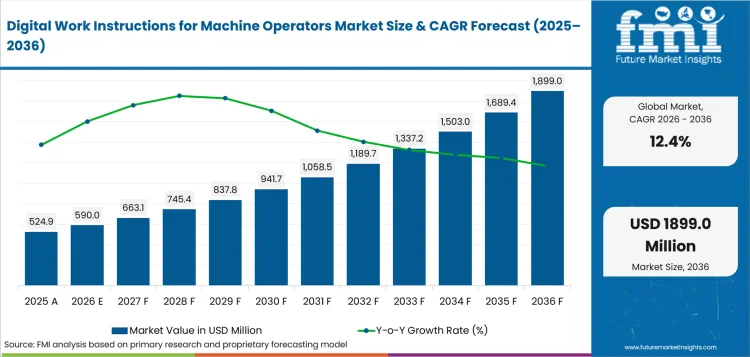
Digital Work Instructions for Machine Operators Market Overview: Size and Forecast
- 2025 Market Size: USD 524.9 million
- 2026 Market Size: USD 590.0 million
- 2036 Market Size: USD 1,899.0 million
- Forecast CAGR: 12.4% from 2026 to 2036
- Leading Offering: Engineering Software
- Engineering Software Share in 2026: 46.0%
- Leading Deployment: Discrete Automation
- Discrete Automation Share in 2026: 52.0%
- Leading Application: Line Integration
- Line Integration Share in 2026: 35.0%
- Leading End-use Industry: Automotive
- Automotive Share in 2026: 29.0%
- Leading Region: North America
- North America Share in 2026: 33.0%
- Fastest-growing Country: India
- India CAGR: 14.1% by 2036
Summary of the Digital Work Instructions for Machine Operators Market
- Demand and Growth Drivers
- Industry demand is accelerating, driven by increasing customer requirements, expanding use cases, and investment across key market segments.
- Adoption rates continue to rise as organizations prioritize solutions that improve operational efficiency, scalability, and business outcomes.
- Sales growth is being supported by strong pipeline development, higher customer acquisition, and increased penetration within existing accounts.
- Market momentum remains positive, with industry participants expanding capacity, partnerships, and product offerings to capture emerging opportunities.
- Product and Segment View
- Engineering Software leads the By Offering segment with 46.0% projected share in 2026 as workflow authoring becomes the core buying item.
- Discrete Automation leads the By Deployment segment with 52.0% projected share in 2026 as assembly cells need guided checks.
- Line Integration leads the By Application segment with 35.0% projected share in 2026 as work instructions shift from documents to line control.
- Automotive leads the By End-use Industry segment with 29.0% projected share in 2026 as plants handle frequent changeovers.
- North America leads the By Region segment with 33.0% projected share in 2026 due to MES maturity and skilled-labor pressure.
- Geography and Competitive Outlook
- India is projected to record 14.1% CAGR by 2036 as electronics and automotive suppliers scale guided work programs.
- China is expected to expand at 13.5% CAGR by 2036 through high automation density and electronics capacity.
- Siemens, Rockwell Automation and ABB compete where operator guidance links with control systems.
- Tulip, Dozuki and Augmentir compete where buyers want fast authoring and frontline ease of use.
- iBASEt and Yokogawa fit complex manufacturing and process environments with traceable execution needs.
- Analyst Opinion
- Nikhil Kaitwade, Principal Consultant at FMI says, “Manufacturers buy digital work instructions when paper procedures start delaying changeovers and training. Suppliers gain pricing power when every instruction stays tied to the current product version and the right workstation.”
Quality control is the main pressure point as factories replace paper procedures with live task guidance. The International Federation of Robotics reported in September 2025 that 542,000 industrial robots were installed in 2024. That figure raises the value of operator screens at mixed human-machine workstations. Smart factory programs make version-controlled instructions more relevant when engineering changes must reach the correct workstation.
Which factors support expansion in the digital work instructions for machine operators market?
Machine-linked task records and controlled instruction release support market value across automation-heavy plants.
- Revenue is rising as factories move operator knowledge from paper binders into controlled steps that can be checked during production.
- Engineering change management supports value growth as one part revision can affect several workstations within the same line.
- Machine-readable task records are gaining weight as buyers connect instructions with factory automation and industrial controls during plant upgrades.
- Supplier pricing improves when platforms support multilingual instructions, e-signatures and automated data capture within one workflow.
- The main watch point is integration cost as many plants still run older PLCs and separate quality systems.
Why is the Digital Work Instructions for Machine Operators Market Growing?
Demand is rising as factories need controlled task execution as product variants make paper instructions too slow for line changes.
Operator guidance improves audit readiness by recording who completed each step and what data was entered. Machine-linked checks reduce rework risk because instructions can block movement until required conditions are met. Labor turnover supports guided work as plants need new operators to perform tasks without waiting for expert support.
Complex production lines are making operator guidance part of execution control. The International Federation of Robotics reported 542,000 industrial robot installations in 2024 and a global operational stock of 4.664 million industrial robots. Digital work instructions fit this environment by turning manual steps into controlled checkpoints beside automated equipment. Buyers see value when the system captures proof of completion and flags missing steps before defects reach inspection.
Smart factory programs are changing how plants think about work instructions. Product releases can change torque values, safety checks and inspection prompts across several stations. Platforms connected with manufacturing execution systems reduce the delay between engineering release and shop-floor execution.
How is the digital work instructions for machine operators market segmented?
The market is segmented by offering and deployment. It is also segmented by application, end-use industry and region.
- Engineering Software is projected to account for 46.0% of By Offering revenue in 2026 as authoring, version control and audit records carry the main value.
- Discrete Automation is expected to lead By Deployment with 52.0% share in 2026 as assembly and inspection cells need operator guidance.
- Line Integration is anticipated to represent 35.0% of By Application revenue in 2026 given its role in tying instructions to line status.
- Automotive end users are projected to hold 29.0% share in 2026 as variant-heavy production raises the cost of missed steps.
- North America is expected to account for 33.0% regional share in 2026 with MES maturity and software-led plant upgrades supporting adoption.
How is the digital work instructions for machine operators market segmented?
The digital work instructions for machine operators market is segmented by offering, deployment, application, end-use industry, and region.
- Engineering Software is projected to account for 46.0% share in 2026 as buyers need workflow authoring, revision approval, and controlled release across plants.
- Discrete Automation is expected to represent 52.0% share in 2026 as assembly lines use guided tasks for fastening, inspection, and changeover control.
- Line Integration is anticipated to hold 35.0% share in 2026 as plants link instruction screens with takt time, machine alarms, and inspection gates.
- Automotive is estimated to account for 29.0% share in 2026 as model variants and supplier parts create frequent instruction changes.
- North America is projected to represent 33.0% share in 2026 as large plants fund operator guidance through MES and quality programs.
The segmentation structure reflects how factories buy digital instructions. Plants first evaluate software capability for authoring, release control, and revision tracking. Deployment needs then differ between discrete production lines and process automation environments. Application demand is strongest where instruction screens connect with machines, alarms, takt time, and inspection gates.
Why does engineering software lead the offering segment?
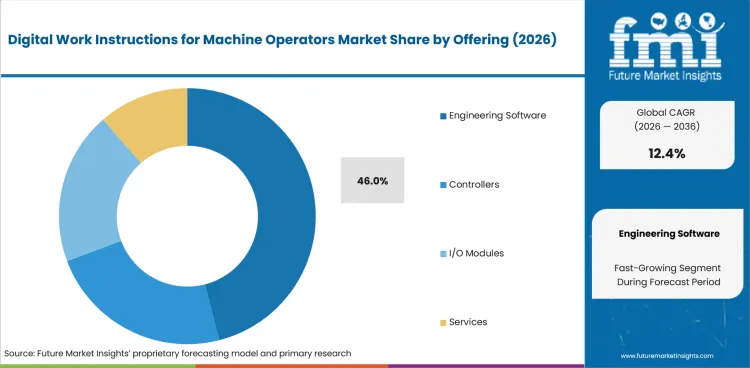
- Engineering Software is projected to account for 46.0% share in 2026 as buyers need workflow authoring, revision approval, and controlled release across plants.
- Services remain important after software selection because plants must map paper SOPs, machine states, and quality checks before operators trust the screen flow.
Why does discrete automation lead the deployment segment?
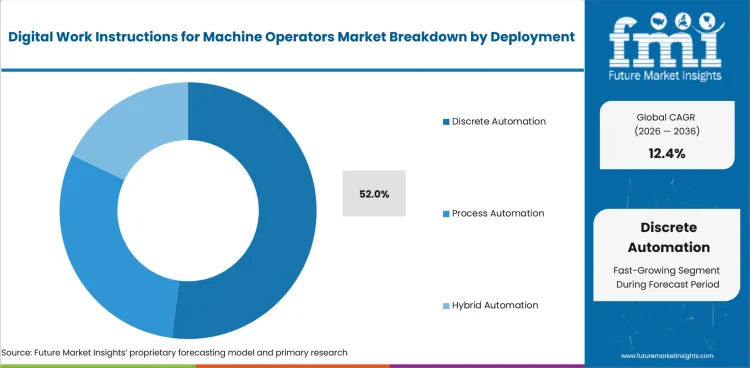
- Discrete Automation is expected to represent 52.0% share in 2026 as assembly lines use guided tasks for fastening, inspection, and changeover control.
- Process Automation buyers use instructions differently because batch plants need e-signatures, deviation notes, and safe handoff between manual and automated steps.
Why does line integration lead the application segment?
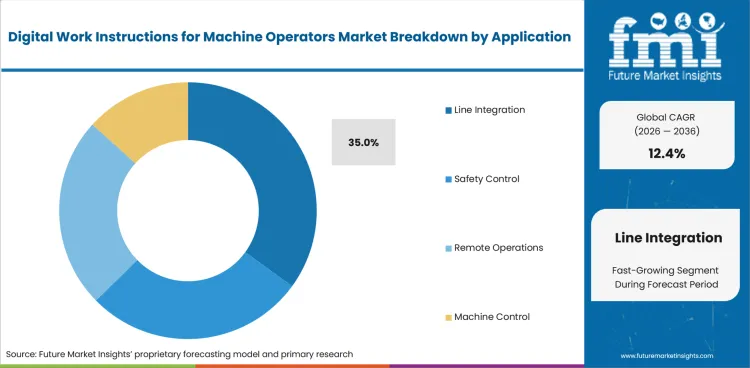
- Line Integration is anticipated to hold 35.0% share in 2026 as plants link instruction screens with takt time, machine alarms, and inspection gates.
- Safety Control adoption rises when instructions include lockout steps and required confirmations, changing the role of industrial access control in production areas.
Why does automotive lead the end-use industry segment?
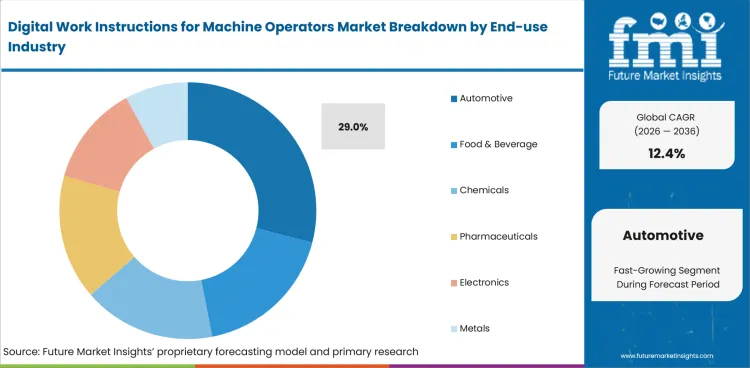
- Automotive is estimated to account for 29.0% share in 2026 as model variants and supplier parts create frequent instruction changes.
- Electronics users follow closely because 2024 robot data placed electronics at 24.0% of global installations, raising the need for station-level guidance.
What are the drivers, restraints, and opportunities in the digital work instructions for machine operators market?
Engineering change control, compliance-heavy production, and SOP digitization support adoption, while integration cost slows rollout in older plants.
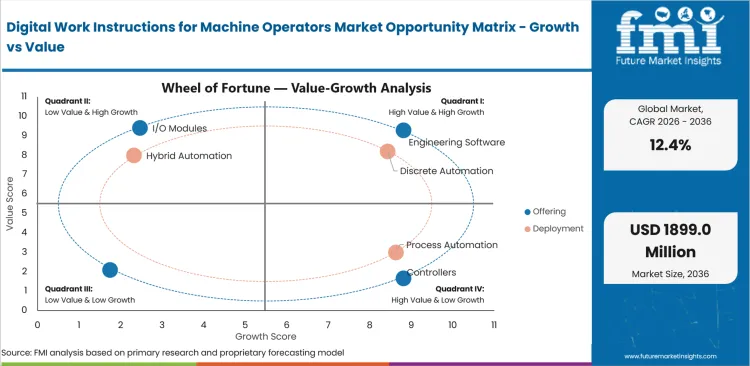
- Driver: Engineering change control pushes adoption as static instructions cannot keep pace with updated product variants.
- Driver: Compliance-heavy production supports use as electronic task records reduce manual batch and inspection paperwork.
- Restraint: Integration cost slows rollout when older PLCs and paper-based quality processes must be mapped first.
- Opportunity: AI-assisted authoring can shorten the time needed to turn legacy SOPs into usable operator workflows.
- Opportunity: Model-based manufacturing technologies can make visual instructions clearer for complex assembly work.
Version-Controlled Operator Guidance
Version control is the main reason buyers move beyond PDF libraries. Siemens introduced Teamcenter Manufacturing Easy Plan 2512 in January 2026 with enhancements for process planning and work instructions. This changes the buying test from document storage to execution proof. When a plant has frequent engineering changes, the supplier must show how released instructions reach the right workstation without old versions staying active.
PLC-Linked Task Enforcement
Task enforcement is becoming a stronger buying factor as operators work beside automated cells. Operator screens often operate near systems that monitor or control physical processes. Buyers must decide whether the instruction platform only displays steps or can verify conditions through safe system links. This creates value for suppliers that understand OT security and plant reliability constraints.
Workforce Skill Drift
Skill drift is a practical restraint and an opportunity for vendors. Rockwell Automation stated in September 2024 that its Plex connected worker solution addresses workforce gaps with digital tools for retention, attraction and reskilling. That signal shows why work instructions are moving closer to daily workforce management. Plants with high turnover want guided screens that keep new operators productive without waiting for expert shadowing.
AI-Assisted Instruction Authoring
AI-assisted authoring is expected to change software selection without replacing production validation. Tulip introduced AI Composer in March 2025 for turning SOPs, work instructions, batch records, and forms into interactive apps. iBASEt launched Solumina AI in January 2026 with ScanAI for converting paper-based work instructions and records into structured digital data. AI-driven predictive maintenance projects create adjacent data flows that can improve guided task prompts. These launches make authoring speed a visible selection factor for suppliers.
Which countries are growing fastest in the digital work instructions for machine operators market?
India leads at 14.1% CAGR through 2036. China follows at 13.5% CAGR. South Korea is set at 12.9% CAGR. The United States is projected at 12.6% CAGR. Germany records 11.4% CAGR. Japan records 11.2% CAGR. The United Kingdom records 10.9% CAGR. France records 10.8% CAGR.
.webp "Top Country Growth Comparison Digital Work Instructions For Machine Operators Market Cagr (2026 2036)")
| Country | CAGR |
| United States | 12.6% |
| United Kingdom | 10.9% |
| Germany | 11.4% |
| France | 10.8% |
| Japan | 11.2% |
| China | 13.5% |
| South Korea | 12.9% |
| India | 14.1% |
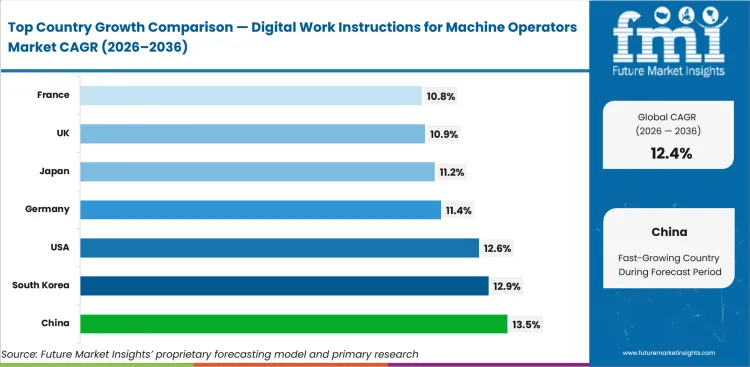
Source: Future Market Insights, 2026.
How do country-level CAGRs compare in the digital work instructions for machine operators market?
India leads country growth while France records the most measured expansion outlook among profiled markets.
- India is forecast to record 14.1% CAGR by 2036 as electronics and automotive suppliers digitize operator tasks.
- China is expected to expand at 13.5% CAGR from 2026 to 2036 due to high automation density and electronics capacity.
- South Korea is projected to grow at 12.9% CAGR through 2036 as semiconductor factories use controlled operator workflows.
- The United States is estimated to rise at 12.6% CAGR by 2036 with enterprise software buyers scaling multi-site programs.
- Germany is expected to advance at 11.4% CAGR over the forecast period as Industrie 4.0 users connect instructions with standards.
- Japan is forecast to grow at 11.2% CAGR through 2036 as electronics and transport equipment plants standardize guided tasks.
- The United Kingdom is projected to post 10.9% CAGR by 2036 as mid-sized manufacturers digitize shop-floor knowledge.
- France is anticipated to reach 10.8% CAGR through 2036 as aerospace and industrial suppliers adopt traceable operator records.
How fast is the digital work instructions for machine operators market growing in United States?
A 12.6% CAGR through 2036 reflects plant-level digitization and guided execution needs across industrial users.
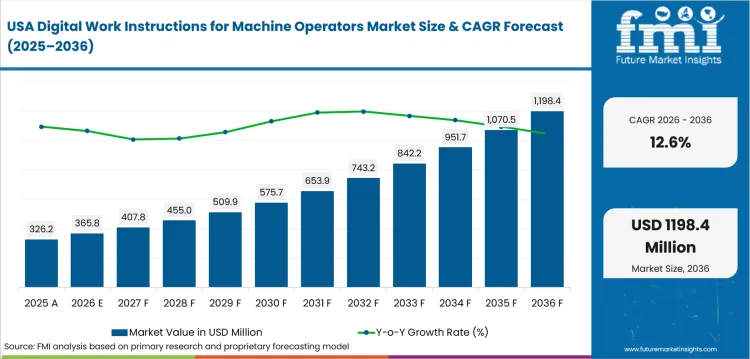
Country Market Snapshot Table
| Parameter | Value |
|---|---|
| Market Size in 2025 (Value) | USD 142.1 million |
| Market Size in 2026 (Value) | USD 160.0 million |
| Market Forecast in 2036 (Value) | USD 524.2 million |
| CAGR (2026 to 2036) | 12.6% |
| Years Considered | 2021 to 2036 |
| Base Year | 2025 |
| Forecast Period | 2026 to 2036 |
| Units Considered | Value (USD million) |
| Leading Sub-Region | Midwest and Southeast manufacturing corridors |
United States Digital Work Instructions for Machine Operators Market Outlook
United States demand is shaped by enterprise software buying and large multi-site plants that need common instruction libraries. Automotive, aerospace and electronics facilities are expected to remain the main early adopters.
Work-instruction platforms are gaining attention where MES programs already track quality and production release. Suppliers with plant integration skills should gain preference over document-only tools.
Key Growth Drivers
- USA manufacturers need guided work where product variants and labor turnover make paper procedures harder to control.
- The USA Census Bureau reported that durable goods new orders rose 7.9% in April 2026. This supports more frequent production changes that need controlled instruction release.
- The USA Bureau of Labor Statistics projected nearly 1 million production-occupation openings each year from 2024 to 2034. This supports guided training for new shop-floor workers.
- Aerospace and automotive suppliers are expected to use guided steps to control rework and part-specific inspection evidence.
Key Restraints
- Legacy PLCs and older quality systems can raise integration cost before rollout reaches multiple sites.
- The Federal Reserve reported that manufacturing output was unchanged in May 2026. Flat output can delay discretionary software projects in smaller plants.
- Cybersecurity reviews can slow machine-linked instruction projects when software writes data into execution systems.
What makes United States unique
The United States is unique because multi-site software procurement allows successful plant pilots to scale across national manufacturing networks.
Key Companies
- Rockwell Automation
- Tulip Interfaces
- Dozuki
- iBASEt
- Augmentir
- PTC
- GE Vernova Digital
Sales & Marketing Channels
- Direct enterprise software sales
- System integrators
- MES partners
- Automation distributors
- Cloud marketplaces
- Plant transformation consultants
Country Segment Breakdown Table
| Segment | Sub-Segments |
|---|---|
| By Offering | Controllers · I/O Modules · Engineering Software · Services |
| By Deployment | Discrete Automation · Process Automation · Hybrid Automation |
| By Application | Machine Control · Line Integration · Safety Control · Remote Operations |
| By End-use Industry | Automotive · Food & Beverage · Chemicals · Pharmaceuticals · Electronics · Metals |
| By Region | North America · Latin America · Europe · East Asia · South Asia & Pacific · Middle East & Africa |
| Key Sub-Regions Covered, Industrial Manufacturing Clusters | Michigan · Ohio · Texas · California · North Carolina · Tennessee |
Frequently Asked Questions
How fast is United States digital work instructions for machine operators market growing?
Sales in United States are expected to scale at 12.6% CAGR from 2026 to 2036. Growth is supported by guided execution needs in automation-heavy plants.
Who leads United States digital work instructions for machine operators market?
Rockwell Automation and Tulip Interfaces lead local supplier coverage. Dozuki and iBASEt compete through plant integration strengths.
What is driving adoption in United States digital work instructions for machine operators market?
Durable goods order growth and labor replacement needs are moving USA plants toward guided operator workflows.
How fast is the digital work instructions for machine operators market growing in United Kingdom?
A 10.9% CAGR through 2036 reflects plant-level digitization and guided execution needs across industrial users.
Country Market Snapshot Table
| Parameter | Value |
|---|---|
| Market Size in 2025 (Value) | USD 32.5 million |
| Market Size in 2026 (Value) | USD 36.0 million |
| Market Forecast in 2036 (Value) | USD 101.3 million |
| CAGR (2026 to 2036) | 10.9% |
| Years Considered | 2021 to 2036 |
| Base Year | 2025 |
| Forecast Period | 2026 to 2036 |
| Units Considered | Value (USD million) |
| Leading Sub-Region | Midlands and northern industrial corridors |
United Kingdom Digital Work Instructions for Machine Operators Market Outlook
United Kingdom demand is supported by mid-sized manufacturers replacing informal shop-floor knowledge with controlled instructions. Aerospace, transport equipment and food processing users are expected to lead adoption.
Buyers are likely to prefer tools that can be deployed without large custom integration teams. This favors vendors with simple authoring and clear compliance records.
Key Growth Drivers
- UK manufacturers need digital guidance where experienced operators hold process knowledge that is difficult to transfer.
- The Office for National Statistics reported manufacturing output rose 1.2% in the three months to February 2026. This supports plant-level attention to execution consistency.
- GOV.UK reported that advanced manufacturing supports over 760,000 jobs in the United Kingdom. This creates a broad base for digital operator guidance.
- Food and aerospace suppliers are expected to use digital instructions to standardize training and evidence capture across sites.
Key Restraints
- Smaller factories can delay purchases when software conversion services exceed the initial license cost.
- The UK Cyber Security Breaches Survey reported that 43.0% of businesses experienced a cyber breach or attack in the last 12 months. This can slow connected shop-floor deployment.
- Data-hosting reviews can slow adoption when shop-floor applications connect with equipment or quality systems.
What makes United Kingdom unique
The United Kingdom is unique because mid-market plants often need fast deployment that does not depend on large in-house automation teams.
Key Companies
- Intoware
- Kallik
- Valuechain Technology
- Cimlogic
- Ubisense
- ATS Global UK
- BCN Group
Sales & Marketing Channels
- Direct SaaS sales
- Manufacturing consultants
- Automation integrators
- ERP partners
- Quality software resellers
- Industry associations
Country Segment Breakdown Table
| Segment | Sub-Segments |
|---|---|
| By Offering | Controllers · I/O Modules · Engineering Software · Services |
| By Deployment | Discrete Automation · Process Automation · Hybrid Automation |
| By Application | Machine Control · Line Integration · Safety Control · Remote Operations |
| By End-use Industry | Automotive · Food & Beverage · Chemicals · Pharmaceuticals · Electronics · Metals |
| By Region | North America · Latin America · Europe · East Asia · South Asia & Pacific · Middle East & Africa |
| Key Sub-Regions Covered, Industrial Manufacturing Clusters | West Midlands · East Midlands · North West England · Yorkshire · Scotland · Wales |
Frequently Asked Questions
How fast is United Kingdom digital work instructions for machine operators market growing?
Sales in United Kingdom are expected to scale at 10.9% CAGR from 2026 to 2036. Growth is supported by guided execution needs in automation-heavy plants.
Who leads United Kingdom digital work instructions for machine operators market?
Intoware and Kallik lead local supplier coverage. Valuechain Technology and Cimlogic compete through plant integration strengths.
What is driving adoption in United Kingdom digital work instructions for machine operators market?
Manufacturing output recovery and advanced manufacturing employment are supporting guided task adoption in UK plants.
How fast is the digital work instructions for machine operators market growing in Germany?
A 11.4% CAGR through 2036 reflects plant-level digitization and guided execution needs across industrial users.
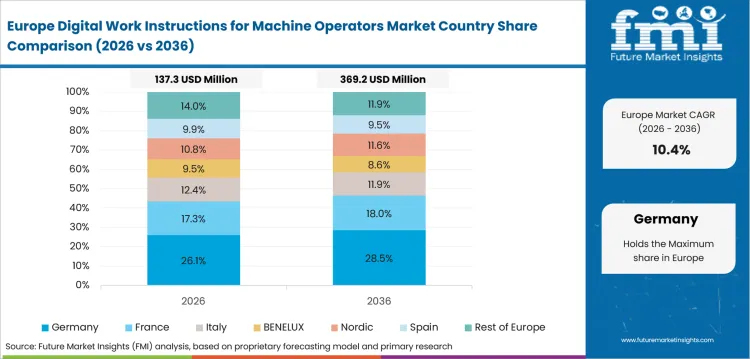
Country Market Snapshot Table
| Parameter | Value |
|---|---|
| Market Size in 2025 (Value) | USD 55.7 million |
| Market Size in 2026 (Value) | USD 62.0 million |
| Market Forecast in 2036 (Value) | USD 182.5 million |
| CAGR (2026 to 2036) | 11.4% |
| Years Considered | 2021 to 2036 |
| Base Year | 2025 |
| Forecast Period | 2026 to 2036 |
| Units Considered | Value (USD million) |
| Leading Sub-Region | Bavaria, Baden-Württemberg and North Rhine-Westphalia |
Germany Digital Work Instructions for Machine Operators Market Outlook
Germany demand is shaped by complex machinery, automotive and electronics plants that already use structured manufacturing data. Guided instructions are expected to connect with Industrie 4.0 programs and machine interoperability standards.
Buyers are likely to evaluate suppliers on integration depth and local implementation support. Document-only systems face a tougher selling route in high-engineering environments.
Key Growth Drivers
- German machinery and automotive plants need controlled instructions where part variants create frequent workstation updates.
- Destatis reported manufacturing order stocks were 8.4% higher year over year in April 2026. This supports execution tools that reduce delays across order backlogs.
- VDMA reported that incoming orders in Bavaria’s mechanical and plant engineering sector rose 6.0% year over year in April 2026. This supports guided execution needs in machinery plants.
- Machine builders are expected to embed instruction screens into service and commissioning workflows for complex equipment.
Key Restraints
- High integration expectations can slow vendor selection when buyers require MES, PLM and machine connectivity in one program.
- OECD reported that part-time employment in Germany rose from 19.0% of employees in 2000 to 29.0% in 2023. This can constrain project staffing for shop-floor rollouts.
- Data-sovereignty and works-council reviews can extend approval cycles for workforce-facing production software.
What makes Germany unique
Germany is unique because buyers often treat work instructions as part of an engineering data chain rather than a standalone document system.
Key Companies
- Siemens AG
- SAP SE
- Operations1 GmbH
- MPDV Mikrolab GmbH
- FORCAM GmbH
- Empolis Information Management
- Bosch Connected Industry
Sales & Marketing Channels
- Direct enterprise software sales
- Automation integrators
- Machine-builder channels
- PLM partners
- Industry 4.0 consultants
- MES specialists
Country Segment Breakdown Table
| Segment | Sub-Segments |
|---|---|
| By Offering | Controllers · I/O Modules · Engineering Software · Services |
| By Deployment | Discrete Automation · Process Automation · Hybrid Automation |
| By Application | Machine Control · Line Integration · Safety Control · Remote Operations |
| By End-use Industry | Automotive · Food & Beverage · Chemicals · Pharmaceuticals · Electronics · Metals |
| By Region | North America · Latin America · Europe · East Asia · South Asia & Pacific · Middle East & Africa |
| Key Sub-Regions Covered, Industrial Manufacturing Clusters | Bavaria · Baden-Württemberg · North Rhine-Westphalia · Saxony · Lower Saxony · Hesse |
Frequently Asked Questions
How fast is Germany digital work instructions for machine operators market growing?
Sales in Germany are expected to scale at 11.4% CAGR from 2026 to 2036. Growth is supported by guided execution needs in automation-heavy plants.
Who leads Germany digital work instructions for machine operators market?
Siemens AG and SAP SE lead local supplier coverage. Operations1 GmbH and MPDV Mikrolab GmbH compete through plant integration strengths.
What is driving adoption in Germany digital work instructions for machine operators market?
Order-backlog pressure and machinery-sector demand are moving German factories toward version-controlled operator guidance.
How fast is the digital work instructions for machine operators market growing in France?
A 10.8% CAGR through 2036 reflects plant-level digitization and guided execution needs across industrial users.
Country Market Snapshot Table
| Parameter | Value |
|---|---|
| Market Size in 2025 (Value) | USD 37.9 million |
| Market Size in 2026 (Value) | USD 42.0 million |
| Market Forecast in 2036 (Value) | USD 117.1 million |
| CAGR (2026 to 2036) | 10.8% |
| Years Considered | 2021 to 2036 |
| Base Year | 2025 |
| Forecast Period | 2026 to 2036 |
| Units Considered | Value (USD million) |
| Leading Sub-Region | Île-de-France, Auvergne-Rhône-Alpes and Occitanie |
France Digital Work Instructions for Machine Operators Market Outlook
France demand is supported by aerospace, transport equipment and regulated manufacturing sites that need traceable operator records. Digital work instructions are expected to help suppliers handle quality evidence across complex assemblies.
Deployment speed depends on how well vendors localize instructions and connect them with existing MES or PLM tools. Suppliers with aerospace credibility should hold an advantage.
Key Growth Drivers
- French aerospace and industrial suppliers need guided steps where quality records must follow parts through assembly.
- INSEE reported that manufacturing output rose 0.4% in April 2026. This supports production-control investment tied to active factory workflows.
- Bpifrance reported in October 2025 that it planned to deploy nearly EUR 35.0 billion to revive French industry. This supports digital execution programs inside advanced factories.
- Regulated and export-oriented manufacturers are expected to use digital instructions to reduce audit gaps during supplier qualification.
Key Restraints
- Plant-specific customization can increase service cost when older procedures exist only as local documents.
- OECD projected in July 2025 that France’s employment-to-population ratio would decrease by 2.08 percentage points. This can limit internal staffing for software conversion work.
- Public procurement and data residency checks can slow cloud deployment for larger industrial programs.
What makes France unique
France is unique because aerospace and regulated industrial suppliers create demand for instruction records that can support customer audits.
Key Companies
- Dassault Systèmes
- Schneider Electric
- Ordinal Software
- Creative IT
- Braincube
- Astrée Software
- Sogeti France
Sales & Marketing Channels
- Direct software sales
- Aerospace supplier programs
- Industrial integrators
- PLM partners
- Quality consultants
- Regional manufacturing clusters
Country Segment Breakdown Table
| Segment | Sub-Segments |
|---|---|
| By Offering | Controllers · I/O Modules · Engineering Software · Services |
| By Deployment | Discrete Automation · Process Automation · Hybrid Automation |
| By Application | Machine Control · Line Integration · Safety Control · Remote Operations |
| By End-use Industry | Automotive · Food & Beverage · Chemicals · Pharmaceuticals · Electronics · Metals |
| By Region | North America · Latin America · Europe · East Asia · South Asia & Pacific · Middle East & Africa |
| Key Sub-Regions Covered, Industrial Manufacturing Clusters | Île-de-France · Auvergne-Rhône-Alpes · Occitanie · Nouvelle-Aquitaine · Grand Est · Hauts-de-France |
Frequently Asked Questions
How fast is France digital work instructions for machine operators market growing?
Sales in France are expected to scale at 10.8% CAGR from 2026 to 2036. Growth is supported by guided execution needs in automation-heavy plants.
Who leads France digital work instructions for machine operators market?
Dassault Systèmes and Schneider Electric lead local supplier coverage. Ordinal Software and Creative IT compete through plant integration strengths.
What is driving adoption in France digital work instructions for machine operators market?
Manufacturing output recovery and industrial investment are supporting traceable operator guidance programs.
How fast is the digital work instructions for machine operators market growing in Japan?
A 11.2% CAGR through 2036 reflects plant-level digitization and guided execution needs across industrial users.
Country Market Snapshot Table
| Parameter | Value |
|---|---|
| Market Size in 2025 (Value) | USD 45.0 million |
| Market Size in 2026 (Value) | USD 50.0 million |
| Market Forecast in 2036 (Value) | USD 144.5 million |
| CAGR (2026 to 2036) | 11.2% |
| Years Considered | 2021 to 2036 |
| Base Year | 2025 |
| Forecast Period | 2026 to 2036 |
| Units Considered | Value (USD million) |
| Leading Sub-Region | Kanto, Chubu and Kansai industrial corridors |
Japan Digital Work Instructions for Machine Operators Market Outlook
Japan demand is influenced by electronics, transport equipment and precision manufacturing plants where standardized operator work is central to quality control. Guided instructions are expected to fit kaizen and line-discipline routines.
Suppliers with Japanese-language support and equipment integration are likely to gain stronger acceptance. Buyers should prioritize platforms that fit existing factory improvement practices.
Key Growth Drivers
- Japanese plants need guided work where skilled operators support precision assembly and inspection routines.
- METI reported that Japan’s production index rose 0.5% month over month in April 2026. This supports factory software demand tied to live production activity.
- Japan’s Cabinet Office reported that machinery orders received by 280 manufacturers increased 3.4% in April 2026. This supports investment-led demand for updated operator procedures.
- Electronics and automotive suppliers are expected to use digital instructions to standardize changeover and inspection evidence.
Key Restraints
- Localized templates and equipment-specific workflows can lengthen implementation before multi-site rollout.
- The Statistics Bureau of Japan reported a 2.5% seasonally adjusted unemployment rate in April 2026. Tight labor availability can limit internal teams for instruction conversion.
- Conservative validation practices can slow adoption when plants require proof that screen-led steps match existing standard work.
What makes Japan unique
Japan is unique because guided instructions must fit disciplined production routines and established continuous-improvement practices.
Key Companies
- Yokogawa Electric
- Mitsubishi Electric
- Omron
- Hitachi
- NEC Corporation
- Fujitsu
- Toshiba Digital Solutions
Sales & Marketing Channels
- Direct automation sales
- Factory IT integrators
- Electronics supplier programs
- MES partners
- Machine-builder channels
- Industrial distributors
Country Segment Breakdown Table
| Segment | Sub-Segments |
|---|---|
| By Offering | Controllers · I/O Modules · Engineering Software · Services |
| By Deployment | Discrete Automation · Process Automation · Hybrid Automation |
| By Application | Machine Control · Line Integration · Safety Control · Remote Operations |
| By End-use Industry | Automotive · Food & Beverage · Chemicals · Pharmaceuticals · Electronics · Metals |
| By Region | North America · Latin America · Europe · East Asia · South Asia & Pacific · Middle East & Africa |
| Key Sub-Regions Covered, Industrial Manufacturing Clusters | Tokyo · Aichi · Osaka · Kanagawa · Shizuoka · Fukuoka |
Frequently Asked Questions
How fast is Japan digital work instructions for machine operators market growing?
Sales in Japan are expected to scale at 11.2% CAGR from 2026 to 2036. Growth is supported by guided execution needs in automation-heavy plants.
Who leads Japan digital work instructions for machine operators market?
Yokogawa Electric and Mitsubishi Electric lead local supplier coverage. Omron and Hitachi compete through plant integration strengths.
What is driving adoption in Japan digital work instructions for machine operators market?
Production recovery and machinery-order growth are supporting guided shop-floor execution in Japanese plants.
How fast is the digital work instructions for machine operators market growing in China?
A 13.5% CAGR through 2036 reflects plant-level digitization and guided execution needs across industrial users.
Country Market Snapshot Table
| Parameter | Value |
|---|---|
| Market Size in 2025 (Value) | USD 83.7 million |
| Market Size in 2026 (Value) | USD 95.0 million |
| Market Forecast in 2036 (Value) | USD 337.0 million |
| CAGR (2026 to 2036) | 13.5% |
| Years Considered | 2021 to 2036 |
| Base Year | 2025 |
| Forecast Period | 2026 to 2036 |
| Units Considered | Value (USD million) |
| Leading Sub-Region | Yangtze River Delta and Pearl River Delta factories |
China Digital Work Instructions for Machine Operators Market Outlook
China demand is shaped by dense electronics, automotive and equipment manufacturing clusters. Digital work instructions are expected to scale where factories need multilingual guidance and frequent line changeovers.
Domestic software ecosystems and local cloud requirements will influence vendor selection. Platforms that integrate with local MES stacks should gain stronger access.
Key Growth Drivers
- Chinese electronics and equipment factories need guided operator workflows where fast changeovers occur across dense production networks.
- The National Bureau of Statistics reported that manufacturing value added grew 6.4% year over year in the first quarter of 2026. This supports production software demand.
- The State Council reported that eight government agencies issued a machinery-sector digital transformation plan in August 2025. This supports smart-factory instruction workflows.
- Domestic automation programs are expected to support instruction tools that connect with MES and quality data.
Key Restraints
- Local integration requirements can slow foreign supplier adoption when plants use domestic MES and cloud infrastructure.
- The State Council reported that China’s fixed-asset investment dropped 4.1% year over year in the first five months of 2026. This can narrow budgets for plant software upgrades.
- Data governance and local hosting requirements can lengthen procurement for cloud-based instruction platforms.
What makes China unique
China is unique because automation density and domestic software ecosystems create demand for scalable instruction workflows in local languages.
Key Companies
- SUPCON Technology
- Hollysys Automation
- Foxconn Industrial Internet
- Huawei Cloud
- Alibaba Cloud
- Tencent Cloud
- Digiwin Software
Sales & Marketing Channels
- Domestic MES partners
- Automation integrators
- Cloud marketplaces
- Electronics cluster sales
- System integrators
- Industrial software distributors
Country Segment Breakdown Table
| Segment | Sub-Segments |
|---|---|
| By Offering | Controllers · I/O Modules · Engineering Software · Services |
| By Deployment | Discrete Automation · Process Automation · Hybrid Automation |
| By Application | Machine Control · Line Integration · Safety Control · Remote Operations |
| By End-use Industry | Automotive · Food & Beverage · Chemicals · Pharmaceuticals · Electronics · Metals |
| By Region | North America · Latin America · Europe · East Asia · South Asia & Pacific · Middle East & Africa |
| Key Sub-Regions Covered, Industrial Manufacturing Clusters | Shanghai · Jiangsu · Zhejiang · Guangdong · Shandong · Chongqing |
Frequently Asked Questions
How fast is China digital work instructions for machine operators market growing?
Sales in China are expected to scale at 13.5% CAGR from 2026 to 2036. Growth is supported by guided execution needs in automation-heavy plants.
Who leads China digital work instructions for machine operators market?
SUPCON Technology and Hollysys Automation lead local supplier coverage. Foxconn Industrial Internet and Huawei Cloud compete through plant integration strengths.
What is driving adoption in China digital work instructions for machine operators market?
Manufacturing value-added growth and machinery-sector digital policy are supporting operator-guidance adoption in Chinese factories.
How fast is the digital work instructions for machine operators market growing in South Korea?
A 12.9% CAGR through 2036 reflects plant-level digitization and guided execution needs across industrial users.
Country Market Snapshot Table
| Parameter | Value |
|---|---|
| Market Size in 2025 (Value) | USD 39.2 million |
| Market Size in 2026 (Value) | USD 44.0 million |
| Market Forecast in 2036 (Value) | USD 139.1 million |
| CAGR (2026 to 2036) | 12.9% |
| Years Considered | 2021 to 2036 |
| Base Year | 2025 |
| Forecast Period | 2026 to 2036 |
| Units Considered | Value (USD million) |
| Leading Sub-Region | Gyeonggi and southeastern electronics clusters |
South Korea Digital Work Instructions for Machine Operators Market Outlook
South Korea demand is tied to semiconductor and electronics plants plus battery and automotive production where process discipline matters. Guided work instructions are expected to support high-throughput lines that need reliable handoffs.
Technology groups will likely prefer platforms connected with local enterprise IT stacks. Suppliers that fit cybersecurity and plant-data requirements should gain preference.
Key Growth Drivers
- South Korean semiconductor and electronics plants need guided steps where high-throughput production depends on clean operator handoffs.
- The Ministry of Trade, Industry and Resources reported that semiconductor exports rose 151.4% in March 2026. This supports execution software demand in electronics supply chains.
- KDI projected that Korea’s equipment investment would expand 3.3% in 2026. This supports demand for software tied to new factory equipment.
- Automotive and battery suppliers are expected to use digital instructions to control rework and variant-specific checks.
Key Restraints
- Integration must fit domestic IT stacks and equipment protocols before wider plant deployment.
- The Ministry of Data and Statistics reported all-industry production fell 0.6% month over month in April 2026. Softer output can slow discretionary upgrades outside technology-led plants.
- Cybersecurity and supplier-access controls can delay projects that require machine data exchange across production lines.
What makes South Korea unique
South Korea is unique because electronics and semiconductor production create high demand for traceable task execution at scale.
Key Companies
- Samsung SDS
- LG CNS
- Hyundai AutoEver
- POSCO DX
- LS Electric
- Hanwha Systems
- Doosan Robotics
Sales & Marketing Channels
- Direct enterprise IT sales
- Factory automation partners
- Semiconductor supplier programs
- Systems integrators
- Cloud platform partners
- Industrial distributors
Country Segment Breakdown Table
| Segment | Sub-Segments |
|---|---|
| By Offering | Controllers · I/O Modules · Engineering Software · Services |
| By Deployment | Discrete Automation · Process Automation · Hybrid Automation |
| By Application | Machine Control · Line Integration · Safety Control · Remote Operations |
| By End-use Industry | Automotive · Food & Beverage · Chemicals · Pharmaceuticals · Electronics · Metals |
| By Region | North America · Latin America · Europe · East Asia · South Asia & Pacific · Middle East & Africa |
| Key Sub-Regions Covered, Industrial Manufacturing Clusters | Gyeonggi · Seoul · Incheon · Ulsan · Busan · Daegu |
Frequently Asked Questions
How fast is South Korea digital work instructions for machine operators market growing?
Sales in South Korea are expected to scale at 12.9% CAGR from 2026 to 2036. Growth is supported by guided execution needs in automation-heavy plants.
Who leads South Korea digital work instructions for machine operators market?
Samsung SDS and LG CNS lead local supplier coverage. Hyundai AutoEver and POSCO DX compete through plant integration strengths.
What is driving adoption in South Korea digital work instructions for machine operators market?
Semiconductor export growth and equipment investment are supporting guided execution tools in South Korean plants.
How fast is the digital work instructions for machine operators market growing in India?
A 14.1% CAGR through 2036 reflects operator training and production ramp-up needs across industrial users.
Country Market Snapshot Table
| Parameter | Value |
|---|---|
| Market Size in 2025 (Value) | USD 45.6 million |
| Market Size in 2026 (Value) | USD 52.0 million |
| Market Forecast in 2036 (Value) | USD 194.5 million |
| CAGR (2026 to 2036) | 14.1% |
| Years Considered | 2021 to 2036 |
| Base Year | 2025 |
| Forecast Period | 2026 to 2036 |
| Units Considered | Value (USD million) |
| Leading Sub-Region | Western and southern manufacturing corridors |
India Digital Work Instructions for Machine Operators Market Outlook
India demand is supported by electronics, automotive and industrial equipment factories that are digitizing operator tasks. Digital work instructions are expected to help plants scale training and quality records across new production lines.
Buyers are likely to prefer modular tools that work across mixed equipment and varied skill levels. Vendors with local implementation capacity should gain an early advantage.
Key Growth Drivers
- Indian factories need guided work where rapid capacity addition requires faster operator training and standardized task release.
- MoSPI reported that manufacturing output grew 6.2% in April 2026 under the new IIP series. This supports shop-floor digitization tied to expanding production activity.
- PIB reported that medium- and high-technology industries contributed 46.3% of India’s manufacturing value added in FY2025-26. This supports demand for structured operator execution.
- Electronics and automotive suppliers are expected to use digital instructions to reduce training time during new-line ramp-up.
Key Restraints
- Many plants still rely on paper SOPs and local spreadsheets, raising conversion effort before software benefits appear.
- MSDE reported that DGT’s Autodesk skills agreement covered 14,682 ITIs in 2025. This scale shows why plant-specific operator training remains a large implementation task.
- Plant connectivity gaps can delay machine-linked instruction projects outside larger automotive and electronics clusters.
What makes India unique
India is unique because fast capacity ramp-up makes operator training and controlled instruction release a direct production constraint.
Key Companies
- Tata Technologies
- L&T Technology Services
- Tata Elxsi
- Tata Consultancy Services
- Wipro PARI
- TVS Digital
- HCLTech
Sales & Marketing Channels
- Direct enterprise sales
- Automation integrators
- IT service partners
- Automotive supplier programs
- Electronics clusters
- Cloud marketplaces
Country Segment Breakdown Table
| Segment | Sub-Segments |
|---|---|
| By Offering | Controllers · I/O Modules · Engineering Software · Services |
| By Deployment | Discrete Automation · Process Automation · Hybrid Automation |
| By Application | Machine Control · Line Integration · Safety Control · Remote Operations |
| By End-use Industry | Automotive · Food & Beverage · Chemicals · Pharmaceuticals · Electronics · Metals |
| By Region | North America · Latin America · Europe · East Asia · South Asia & Pacific · Middle East & Africa |
| Key Sub-Regions Covered, Industrial Manufacturing Clusters | Maharashtra · Gujarat · Tamil Nadu · Karnataka · Telangana · Uttar Pradesh |
Frequently Asked Questions
How fast is India digital work instructions for machine operators market growing?
Sales in India are expected to scale at 14.1% CAGR from 2026 to 2036. Growth is supported by guided execution needs in automation-heavy plants.
Who leads India digital work instructions for machine operators market?
Tata Technologies and L&T Technology Services lead local supplier coverage. Tata Elxsi and Tata Consultancy Services compete through plant integration strengths.
What is driving adoption in India digital work instructions for machine operators market?
Manufacturing output growth and high-technology value-added share are supporting guided work in Indian factories.
Competitive Landscape and Strategic Positioning
Who are the leading companies in the digital work instructions for machine operators market?
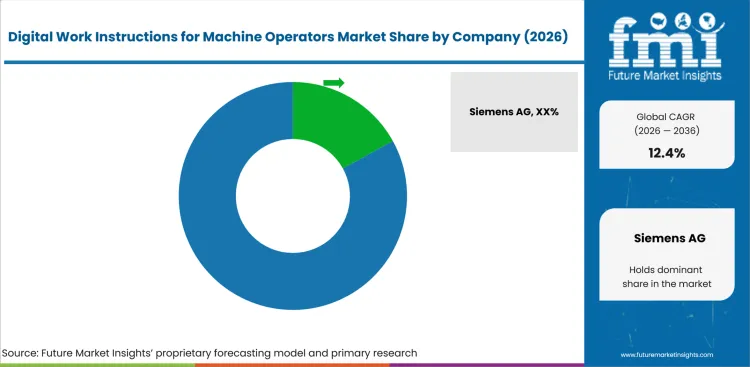
Siemens AG, Rockwell Automation, ABB Ltd., Schneider Electric SE, Emerson Electric Co., Yokogawa Electric Corporation, Tulip Interfaces, Dozuki, Augmentir, Operations1, iBASEt, PTC Inc., Dassault Systèmes SE, and SAP SE are key companies in the digital work instructions for machine operators market.
- Automation and MOM vendors compete through MES integration, machine-data connectivity, and plant-wide execution control.
- Connected worker platforms compete through fast authoring, frontline workflow design, operator feedback, and no-code deployment.
- Regulated manufacturing platforms compete through compliance records, audit trails, electronic task execution, and controlled documentation.
- Regional implementation partners support deployment through system integration, plant configuration, operator training, and MES consulting.
Competition is split between automation vendors and specialist instruction software companies. MES providers support deployments that need task records tied to production systems. Siemens and Rockwell Automation compete through automation and operations software portfolios, while ABB and Schneider Electric compete through industrial software channels.
Tulip and Dozuki compete through frontline workflows and fast authoring. Augmentir and Operations1 compete through workforce guidance and regulated execution depth. Suppliers are best positioned when they combine authoring speed with MES and machine-data integration. Automation-linked vendors have an advantage in plants that require equipment state verification, while specialist connected worker vendors fit buyers that need quick rollout and operator feedback loops.
How do top digital work instructions for machine operators companies compare?
Siemens and Rockwell Automation lead through automation and MES depth, while Tulip, Dozuki, Augmentir, and Operations1 compete through connected worker execution and faster workflow authoring.
| Company | Relevance to Market Title | Compliance Fit | Geographic Footprint | Positioning |
|---|---|---|---|---|
| Siemens AG | Deep planning and EWI coverage | High | Global automation and PLM footprint | Automation and manufacturing planning leader |
| Rockwell Automation, Inc. | Connected worker tied to Plex MES | High | Global automation and MES footprint | MES-linked connected worker supplier |
| ABB Ltd. | Process automation and operator support fit | Medium | Global process automation channel | Automation software supplier |
| Schneider Electric SE | Industrial software and automation channel | Medium | Global industrial software footprint | Industrial operations software supplier |
| Emerson Electric Co. | Batch execution and regulated process fit | High | Global process automation footprint | Process execution specialist |
| Yokogawa Electric Corporation | Process operations and guided task execution | High | Global process industry channel | Process industry automation supplier |
| Tulip Interfaces, Inc. | No-code frontline workflow authoring | Medium | Global connected worker platform | Frontline workflow platform |
| Dozuki | Specialist work-instruction authoring | Medium | North America led | Work-instruction software specialist |
| Augmentir, Inc. | Connected worker and workforce intelligence | Medium | North America led | Workforce guidance platform |
| Operations1 GmbH | European digital instruction workflow specialist | Medium | Europe led | Connected worker workflow supplier |
| iBASEt | Regulated aerospace and defense execution | High | North America led | Regulated manufacturing execution platform |
Source: Future Market Insights competitive analysis, 2026.
Key Developments in the Digital Work Instructions for Machine Operators Market
- In March 2025, Tulip introduced AI Composer for converting SOPs, work instructions, batch records, and forms into interactive production apps. In October 2025, Tulip said AI Composer was generally available to all customers with template support.
- In January 2026, Siemens introduced Teamcenter Manufacturing Easy Plan 2512 with enhancements for process planning and work instructions. The release added AI-assisted planning capabilities for manufacturing engineers.
- In January 2026, iBASEt launched Solumina AI with ScanAI for converting paper-based work instructions and records into structured digital data. The launch focused on regulated aerospace and defense manufacturing.
Who are the key players in the digital work instructions for machine operators market?
Key companies participating in the digital work instructions for machine operators market include:
Automation and MOM Vendors
- Siemens AG
- Rockwell Automation, Inc.
- ABB Ltd.
- Schneider Electric SE
- Emerson Electric Co.
- Yokogawa Electric Corporation
Connected Worker Platforms
- Tulip Interfaces, Inc.
- Dozuki
- Augmentir, Inc.
- Operations1 GmbH
Regulated Manufacturing Platforms
- iBASEt
- PTC Inc.
- Dassault Systèmes SE
- SAP SE
Regional Implementation Partners
- System integrators
- MES consultants
- Automation distributors
- Plant-floor digitalization partners
Digital Work Instructions for Machine Operators Market - Report Scope
| Parameter | Details |
|---|---|
| Base year | 2025 |
| Forecast period | 2026 to 2036 |
| Historical period | 2021 to 2025 |
| Units considered | Value in USD million |
| Segments covered | Offering, Deployment, Application, End-use Industry, and Region |
| Countries profiled | United States, United Kingdom, Germany, France, Japan, China, South Korea, and India |
| Companies covered | Siemens, Rockwell Automation, ABB, Schneider Electric, Emerson, Yokogawa, Tulip, Dozuki, Augmentir, Operations1, iBASEt, PTC, Dassault Systèmes, SAP, and other suppliers |
Digital Work Instructions for Machine Operators Market - Scope & Definition
| Attribute | Detail |
|---|---|
| Included product scope | Controllers, I/O Modules, Engineering Software and Services tied to guided operator execution. |
| Included deployment scope | Discrete Automation, Process Automation and Hybrid Automation settings. |
| Included application scope | Machine Control, Line Integration, Safety Control and Remote Operations. |
| Included end-use scope | Automotive, Food & Beverage, Chemicals, Pharmaceuticals, Electronics and Metals. |
| Excluded scope | Generic training videos, consumer manuals, office SOP repositories and back-office workflow tools. |
| Revenue basis | Software licenses, subscriptions, services and hardware pull-through used for live operator guidance. |
| Geographic scope | North America, Latin America, Europe, East Asia, South Asia & Pacific and Middle East & Africa. |
Digital Work Instructions for Machine Operators Market - Research Methodology
| Method | Description |
|---|---|
| Primary Research | FMI reviewed inputs from plant managers, production engineers, quality leads, automation integrators and industrial software buyers. |
| Desk Research | Desk research covered official manufacturing statistics, robotics data, company releases, automation standards and industrial software portfolios. |
| Market Sizing | The model combined workflow software spend, automation hardware pull-through, services attach rates and country-level manufacturing digitization. |
| Forecasting | Forecasts were built from 2025 base values and tested against automation density, MES activity, end-use intensity and regional adoption barriers. |
| Validation | Forecast outputs were validated through supplier benchmarking, company portfolio review and comparison with official country manufacturing indicators. |
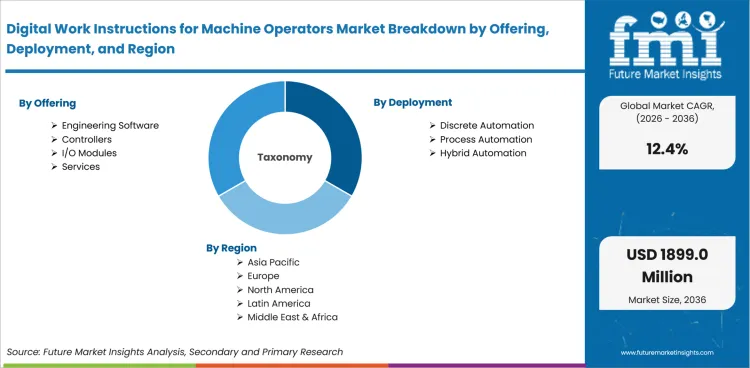
Digital Work Instructions for Machine Operators Market Breakdown by Offering Deployment Application End-use Industry and Region
Digital Work Instructions for Machine Operators Market Segmented by Offering
- Controllers
- I/O Modules
- Engineering Software
- Services
Digital Work Instructions for Machine Operators Market Segmented by Deployment
- Discrete Automation
- Process Automation
- Hybrid Automation
Digital Work Instructions for Machine Operators Market Segmented by Application
- Machine Control
- Line Integration
- Safety Control
- Remote Operations
Digital Work Instructions for Machine Operators Market Segmented by End-use Industry
- Automotive
- Food & Beverage
- Chemicals
- Pharmaceuticals
- Electronics
- Metals
Digital Work Instructions for Machine Operators Market by Region
- North America
- Latin America
- Europe
- East Asia
- South Asia and Pacific
- Middle East and Africa
Research Sources and Bibliography
- Bpifrance. (2025, October 1). Bpifrance unveils its 2030 strategy.
- Cabinet Office, Government of Japan. (2026, June 16). Machinery orders in April 2026.
- Department for Business and Trade. (2026, June 4). Advanced manufacturing.
- Department for Science, Innovation and Technology. (2026, April 30). Cyber Security Breaches Survey 2025/26.
- Federal Reserve Board. (2026, June 15). Industrial production and capacity utilization: G.17.
- Federal Statistical Office of Germany. (2026, June 18). Stock of orders in manufacturing in April 2026.
- iBASEt. (2026, January 15). Solumina AI launches for aerospace and defense manufacturing.
- INSEE. (2026, April 23). In April 2026, manufacturers expect demand to weaken.
- INSEE. (2026, June 5). In April 2026, manufacturing output increased by 0.4%.
- International Federation of Robotics. (2025, September 25). World Robotics 2025 report: Industrial robots released by IFR.
- KDI. (2026, May). KDI economic outlook, 2026 first half.
- Ministry of Data and Statistics, Republic of Korea. (2026, May 29). Monthly industrial statistics: April 2026.
- Ministry of Economy, Trade and Industry. (2026, June 12). Indices of industrial production: Revised report for April 2026.
- Ministry of Skill Development and Entrepreneurship. (2026, January 23). Year End Review 2025.
- Ministry of Statistics and Programme Implementation. (2026, June 1). First press release of All India Index of Industrial Production of new series with base year 2022-23.
- Ministry of Trade, Industry and Resources. (2026, April 1). March 2026 exports reach record level.
- National Bureau of Statistics of China. (2026, April 16). National economy got off to a good start in the first quarter.
- Office for National Statistics. (2026, April 16). Index of Production, UK: February 2026.
- Organisation for Economic Co-operation and Development. (2025, July 9). OECD Employment Outlook 2025: France.
- Organisation for Economic Co-operation and Development. (2025, July 9). OECD Employment Outlook 2025: Germany.
- Rockwell Automation. (2024, September 17). Connected worker solution from Plex by Rockwell Automation addresses labor crisis in manufacturing.
- Siemens Digital Industries Software. (2026, January 28). What’s new in Teamcenter Manufacturing Easy Plan 2512.
- State Council of the People’s Republic of China. (2025, August 5). China unveils plan to promote digital transformation of machinery sector.
- State Council of the People’s Republic of China. (2026, June 16). China’s fixed-asset investment down 4.1 percent in first five months.
- Tulip Interfaces. (2025, April 2). Tulip announces AI Composer to instantly transform SOPs into interactive apps.
- Tulip Interfaces. (2025, October 15). What’s new in Tulip: Fall 2025.
- USA Bureau of Labor Statistics. (2026, May). Job opportunities in manufacturing.
- USA Census Bureau. (2026, May 28). Monthly advance report on durable goods manufacturers’ shipments, inventories and orders: April 2026.
- Verband Deutscher Maschinen- und Anlagenbau. (2026, April). Economic situation.
The bibliography lists sources used to verify report claims and source-backed statistics.
This Report Answers
- Market size estimates for 2026 and forecasts through 2036 for the digital work instructions for machine operators market.
- Insights across more than 30 regional and country-level manufacturing software markets.
- Analysis of demand drivers and operator adoption patterns alongside integration needs and purchasing behavior.
- Evaluation of leading segments including Engineering Software and Discrete Automation with Line Integration and Automotive end use.
- Assessment of country-level drivers and restraints across eight profiled countries.
- Identification of growth opportunities across authoring software, connected worker platforms and machine-linked task verification.
- Evaluation of source-backed manufacturing statistics and post-2024 company developments.
- Assessment of the competitive landscape including automation vendors, MES providers and specialist connected worker platforms.
- Analysis of buyer decision factors including integration depth and audit records alongside training value and conversion services.
- Delivery of market data, forecasts and supporting analysis in PDF and Excel formats.
Frequently Asked Questions
What is the growth prospect for digital work instructions for machine operators?
Demand is expected to rise as factories replace paper procedures with controlled operator workflows connected to quality and production records.
Which companies are expected to shape the market?
Siemens and Rockwell Automation are expected to shape supplier competition. Tulip and Dozuki compete with Augmentir and iBASEt in connected worker platforms.
Why are manufacturers investing in digital work instructions?
Manufacturers are investing to reduce rework risk, standardize training and keep released instructions aligned with current product versions.
Which offering segment leads the market?
Engineering Software leads with 46.0% projected share in 2026 because authoring and revision control carry the core buying value.
Which deployment segment leads the market?
Discrete Automation leads with 52.0% projected share in 2026 because assembly and inspection cells need guided operator checks.
Which country is growing fastest?
India is projected to grow at 14.1% CAGR through 2036 as electronics and automotive suppliers scale operator guidance programs.
How do regulations influence buying decisions?
Regulated factories favor platforms that capture e-signatures, deviation notes and completion records for audit review.
Why does machine integration matter?
Machine integration matters because instruction screens gain value when they verify equipment state and write completion data to execution systems.
What role does AI-assisted authoring play?
AI-assisted authoring can reduce the time needed to convert paper SOPs into usable operator workflows.
Which end-use industry leads demand?
Automotive leads with 29.0% projected share in 2026 because frequent variants increase the cost of missed assembly steps.
Preview the report firsthand - request a free sample
Get SampleGet the brochure for pricing and purchase details.
Get PDFTable of Content
- Executive Summary
- Global Market Outlook
- Demand-side Trends
- Supply-side Trends
- Technology Roadmap Analysis
- Analysis and Recommendations
- Market Overview
- Market Coverage / Taxonomy
- Market Definition / Scope / Limitations
- Research Methodology
- Research Design
- Primary Research
- Desk Research
- Market Sizing and Forecasting
- Data Validation
- Global Market Analysis 2021 to 2025 and Forecast, 2026 to 2036
- Historical Market Size Value (USD Million) Analysis, 2021 to 2025
- Current and Future Market Size Value (USD Million) Projections, 2026 to 2036
- Y-o-Y Growth Trend Analysis
- Absolute $ Opportunity Analysis
- Global Market Pricing Analysis 2021 to 2025 and Forecast 2026 to 2036
- Global Market Analysis 2021 to 2025 and Forecast 2026 to 2036, By Offering
- Introduction / Key Findings
- Historical Market Size Value (USD Million) Analysis By Offering, 2021 to 2025
- Current and Future Market Size Value (USD Million) Analysis By Offering, 2026 to 2036
- Global Market Analysis 2021 to 2025 and Forecast 2026 to 2036, By Deployment
- Introduction / Key Findings
- Historical Market Size Value (USD Million) Analysis By Deployment, 2021 to 2025
- Current and Future Market Size Value (USD Million) Analysis By Deployment, 2026 to 2036
- Global Market Analysis 2021 to 2025 and Forecast 2026 to 2036, By Application
- Introduction / Key Findings
- Historical Market Size Value (USD Million) Analysis By Application, 2021 to 2025
- Current and Future Market Size Value (USD Million) Analysis By Application, 2026 to 2036
- Global Market Analysis 2021 to 2025 and Forecast 2026 to 2036, By End-use Industry
- Introduction / Key Findings
- Historical Market Size Value (USD Million) Analysis By End-use Industry, 2021 to 2025
- Current and Future Market Size Value (USD Million) Analysis By End-use Industry, 2026 to 2036
- Global Market Analysis 2021 to 2025 and Forecast 2026 to 2036, By Region
- Introduction / Key Findings
- Historical Market Size Value (USD Million) Analysis By Region, 2021 to 2025
- Current and Future Market Size Value (USD Million) Analysis By Region, 2026 to 2036
- North America Market Analysis 2021 to 2025 and Forecast 2026 to 2036
- Pricing Analysis
- Market Share Analysis, 2025
- By Country
- By Offering
- By Deployment
- By Application
- By End-use Industry
- Country-level Analysis
- United States
- Canada
- Latin America Market Analysis 2021 to 2025 and Forecast 2026 to 2036
- Pricing Analysis
- Market Share Analysis, 2025
- By Country
- By Offering
- By Deployment
- By Application
- By End-use Industry
- Country-level Analysis
- Brazil
- Mexico
- Rest of Latin America
- Western Europe Market Analysis 2021 to 2025 and Forecast 2026 to 2036
- Pricing Analysis
- Market Share Analysis, 2025
- By Country
- By Offering
- By Deployment
- By Application
- By End-use Industry
- Country-level Analysis
- Germany
- France
- United Kingdom
- Italy
- Spain
- BENELUX
- Nordics
- Rest of Western Europe
- Eastern Europe Market Analysis 2021 to 2025 and Forecast 2026 to 2036
- Pricing Analysis
- Market Share Analysis, 2025
- By Country
- By Offering
- By Deployment
- By Application
- By End-use Industry
- Country-level Analysis
- Russia
- Poland
- Rest of Eastern Europe
- East Asia Market Analysis 2021 to 2025 and Forecast 2026 to 2036
- Pricing Analysis
- Market Share Analysis, 2025
- By Country
- By Offering
- By Deployment
- By Application
- By End-use Industry
- Country-level Analysis
- China
- Japan
- South Korea
- South Asia and Pacific Market Analysis 2021 to 2025 and Forecast 2026 to 2036
- Pricing Analysis
- Market Share Analysis, 2025
- By Country
- By Offering
- By Deployment
- By Application
- By End-use Industry
- Country-level Analysis
- India
- ASEAN
- Australia & New Zealand
- Rest of South Asia and Pacific
- Middle East & Africa Market Analysis 2021 to 2025 and Forecast 2026 to 2036
- Pricing Analysis
- Market Share Analysis, 2025
- By Country
- By Offering
- By Deployment
- By Application
- By End-use Industry
- Country-level Analysis
- GCC Countries
- South Africa
- Turkey
- Rest of Middle East & Africa
- Market Structure Analysis
- Competition Dashboard
- Competition Benchmarking
- Market Share Analysis of Top Players
- By Region
- By Offering
- By Deployment
- By Application
- By End-use Industry
- Emerging Startups
- Innovation Benchmarking
- Competition Analysis
- Competition Deep Dive
- Company Profiles
- Case Studies
- Success Stories
- Recent Developments
- Assumptions & Acronyms Used
- List of Tables: Digital Work Instructions for Machine Operators Market
- List of Figures: Digital Work Instructions for Machine Operators Market


